Trust, Contract Control and Project Performance in Construction
Projects: an Empirical Study in China
*Ling Yang,
Chuanmin Shuai
School of Economics and Management, China University of Geosciences (Wuhan),
Wuhan 430074, China,
[email protected]
Abstract
Focusing on the interplay of trust and contract control, this paper develops a theoretical model to investigate the interaction between owners’ trust, contractors’ trust, contract control and project performance in construction projects. Using structural equation model, we find that owners’ trust and contractors’ trust both have significant positive direct influence on project performance; and through mutual affect they also have significant positive indirect influence on project performance. Additionally, we find out that the direct influence of contract control on project performance is not significant, but contract control indirectly acts on project performance via contractors’ trust. Field survey data from 424 questionnaires collected with executives in 36 construction firms in China are used to test our hypotheses.
Keywords:
Trust; Contract Control; Project Performance; Construction Project; China; Structural Equation Model1.Introduction
In many countries, the construction industry has been criticized for its incapacity for innovation and improvement[1-4]. Schedule delay, cost overruns, decline in construction quality, decrease in customer satisfaction and conflicts are problematic areas for the sector[5,6]. Therefore, in the field of construction project management, it is a core research issue to analyze how to improve project performance.
According to the traditional management view, the main method to improve project performance is the control. The control can be divided into two types by essential features: formal control and informal control. Formal control mainly refers to contract control that can through detailed contracts specify the scope of work, clear responsibilities and obligations and regulate the behavior of project stakeholders. Contract control can improve project performance since it instructs stakeholders to achieve the project objectives in accordance with contract requirement[7].
However, people find that in practice it is difficult to guarantee the success of projects just depending on contract control. On the one hand, the contract is always incomplete, and can not tally with the practical scenarios very well. On the other hand, the signal transmitted by the excessive contract control is distrust, and this kind of distrust once perceived will promote inappropriate actions, such as opportunistic behaviors[8-10].
With the further understanding of and research on the issues in project management, it is widely acknowledged that for inter-organizational projects building trust between project stakeholders can improve project performance. Trust may, for example, facilitate the alignment of partners interests, enhance stakeholders’ satisfaction and support the achievement of project goals.
Based on the existing literature, we argue that contract control is instrumental in the improvement of project performance and trust brings the important role into play[11].
Trust, contract control and project performance like three sides of a triangle are indispensable and mutually constrained. Therefore, any of the three elements is essential to the research on project management. The purpose of this paper is to explore the interactive mechanism of trust, contract control and project performance. Specifically, this paper intends to study the following problems:
(1) What kind of relationship is there between the strength of trust and project performance? (2) What kind of relationship is there between the intensity of contract control and project performance?
(3) How do they interact and together affect construction project performance?
and the relationship between trust, contract control and project performance. We continued with proposing a conceptual model of owners’ trust, contract control, contractors’ trust and project performance. Subsequently, we presented the findings of the empirical analysis and discussed our results with regard to the direct and indirect influence of trust and contract control on project performance. Finally, several managerial implications are given based on the findings.
2. Literature Review
2.1 Trust
Trust in construction projects is viewed as the inter-organizational trust. In construction projects, owners often have more control over contractors. Accordingly, quite a few studies are perceived from owners’ standpoint. Other studies simply sum owners’ trust and contractors’ trust up to calculate the whole trust. An important aspect of trust is the reciprocal nature. This suggests that the quality of the trust relationship depends on both parties. The parties involved in the trust relationship influence each other. That is to say, in construction projects owners need to display a trusting behavior, contractors need to display a trustworthy behavior. Only when the level of trusting as well as the level of trustworthiness were both high, the trust relationship would be most beneficial. Nonetheless, a relatively small number of studies have investigated contractors’ trust. In light of the above, this study would discuss trust from two different angles (i.e. owners and contractors), attempting to point out the mechanism of mutual influence on owners’ trust and contractors’ trust.
2.2 Trust and Contract Control
The relationship between trust and contract control is one of the most controversial issues in literature. Representative studies, to date, can be divided into the following three categories:
(1)The Impact of Trust on Contract Control
A considerable number of studies have found that trust can effectively overcome the antagonistic relationship between owners and contractors in construction projects, and then to form a close cooperation relationship. Consequently, most scholars agree that trust improves project performance.
(2)The Impact of Contract Control on Trust
As for the impact of contract on trust, scholars hold two opposite views. Some consider that contract control restricts the generation of trust. Ben-ner and Putterman (2009) think that contract control is largely unnecessary to mandate trusting and trustworthy behaviors.On the contrary, others contend that contract control guarantees the generation of trust. In this way partners with excellent records are easier to access the trust.
(3)The Interaction of Trust and Contract Control
In the above mentioned literature, most of them focus only on the unidirectional causality. The logic of such research is that assuming there is a causal relationship between trust and contract control, and validating this kind of relationship through an econometric model. Along with the development of trust and control theory, people recognize that trust and contract control are coexistence.
In fact, the interplay of trust and contract control has attracted widespread interest in general management research from the late 1980s. Under the background, considering the reciprocation of trust, this paper would explore the interaction of owners’ trust, contract control and contractors’ trust, in an effort to provide new insights into the debate of the relationship between trust and contract control.
2.3 Trust, Contract Control and Project Performance
At present, the literature that integrates trust, contract control and project performance into a synthetic framework is rarely seen. The previous studies can be divided into two classes. Firstly, some regard that trust and contract control simultaneously and independently affect the performance. Secondly, others consider that the combination of trust and contract control has an effect on the performance after assembling trust and contract control into four modes according to the strength (i.e. high trust & high control, high trust & low control, low trust & high control, low trust & low control).
control are independent variables. Different from the previous research, focusing on the interplay of trust and contract control, this paper would construct a research model of owners’ trust, contract control, contractors’ trust and project performance, in order to reveal how trust and contract control affect project performance as they interact in construction projects.
3. Conceptual Model and Hypotheses
The premise of contract control is that the consciousness and autonomy of the other party is insufficient, and then one party takes elaborate contracts to control the other party’s behavior. However, when owners have more confidence with contractors’ competence, quality and motivation, the premise of contract control will not exist. That is to say, it is unnecessary to implement high strength contract control. Therefore, we argued that owners’ trust reduces the level of contract control.
H1:Owners’ trust is negatively related to contract control.
The application of contract control strategies by one party may force the other party to face the situation that signals distrust, which is unexpected. In such circumstances, the other party being controlled may feel its trust has been abused and readjust its corresponding reactions. And so distrust begets distrust. So we thought that if owners frequently use contract control, contractors will feel distrust from owners, which consequently will cause conflict, opportunistic behaviors.
H2:Contract control is negatively related to contractors’ trust.
If one party undertakes a high risk to trust the other party, the other party will appreciate the trust and then requite the trust. In construction projects, if contractors feel the trust from owners, they will conduct reciprocation as the sense of duty. Contractors’ reciprocation mainly consists of the strict contract performance, timely information sharing and actively communication. All of these excellent works will in turn reinforce owners’ confidence in contractors. Accordingly, we proposed the following hypotheses:
H3:Contractors’ trust is positively related to owners’ trust.
Although scholars in economics, sociology and psychology render quite different opinions about the trust, they subscribe to the importance of trust. For example, trust can reduce transaction risks, lessen transaction costs, decrease inter-organizational conflicts, and enhance inter-organizational communications. At the same time, trust can improve the resilience of construction supply chain, especially in the face of emergencies and crisis. Those projects with good performance are not only bounded by the supervision and restraint of contracts. In fact, their trust levels are very high. Then, we considered that trust between stakeholders can greatly improve construction project performance. Therefore, we proposed the following hypotheses:
H4:Owners’ trust is positively related to project performance. H5:Contractors’ trust is positively related to project performance.
Contract control is crucial in construction project management. According to the principle-agent theory, relatively perfect contract clause is an important means to solve the trickiest problem – information asymmetry. The more detailed the contract clause is, the more clearly commitments, obligations and processes are, which guarantees the temporary inter-organizational cooperation in construction projects. In addition to the design of contract terms, monitoring whether partners fulfill the obligations in accordance with the contract stipulations is another important aspect of contract control. The monitoring can ensure the smooth implementation of construction projects, but also protect the interests of both parties. So we proposed the following hypotheses:
H6:Contract control is positively related to project performance.
Figure 1. Research Model
4. Methodologies
4.1 Samples
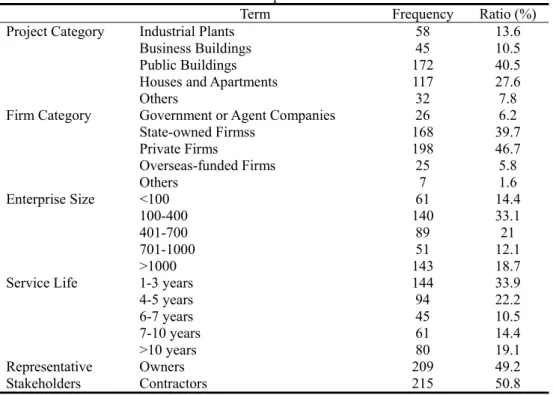
The paper took 36 construction firms in Beijing, Shanghai, Guangdong and Hubei provinces or municipalities in China as samples and sent questionnaires by email to the middle and senior managers of construction projects. A total of 480 questionnaires were handed out, of which 424 were completed for an 88.3% response rate (209 were from owners and 216 were from contractors). The basic characteristics of the samples were specified in Table 1.
Table 1. Sample Characteristics
Term Frequency Ratio (%)
Project Category Industrial Plants 58 13.6 Business Buildings 45 10.5 Public Buildings 172 40.5 Houses and Apartments 117 27.6
Others 32 7.8
Firm Category Government or Agent Companies 26 6.2 State-owned Firmss 168 39.7 Private Firms 198 46.7 Overseas-funded Firms 25 5.8 Others 7 1.6 Enterprise Size <100 61 14.4 100-400 140 33.1 401-700 89 21 701-1000 51 12.1 >1000 143 18.7
Service Life 1-3 years 144 33.9
4-5 years 94 22.2 6-7 years 45 10.5 7-10 years 61 14.4 >10 years 80 19.1 Representative Stakeholders Owners 209 49.2 Contractors 215 50.8
Source: based on the questionnaire data collected by the authors.
4.2 The Measures
In this study, we employed elements of surveys that had been previously developed by Liang (2009) and Pinto et al. (2009). All measures employed the five-point Likert terms. Respondents rated the questions from 1= totally disagree to 5= totally agree.
(1)Trust
The present research literature on the dimensions of trust in construction projects has adopted the existing achievements on inter-organizational trust for reference to some extent. The models applied by the previous studies are mostly established under western culture and enterprises. However, strong
Confucian culture penetrates into every corner of the society in China, a country with a very long history. We argue that western trust models do not fit China’s situation. Among the items, 1-4 measure competence-based trust, 5-7 measure Guanxi-based trust, 8-10 measure intuitive-based trust.
(2) Contract Control
Contract control in construction projects includes not only detailed contract terms but also comprehensive monitoring. Therefore, this paper used the inventory developed by Liang and Yuan (2009) to measure the strength of contract control. Among the items, 1-4 measure contract item control, 5-7 measure contract implementation control.
(3) Project Performance
Borrowing the scale from Pinto et al. (2009), we used 10 items to assess project performance in terms of budget and schedule adherence, technical performance of the project and stakeholder satisfaction.
5. Results and Discussion
The paper conducted SEM analysis using AMOS17.0, which included the assessment of the scale, verification of the structural model and test of research hypotheses.
5.1 Assessment of Scale
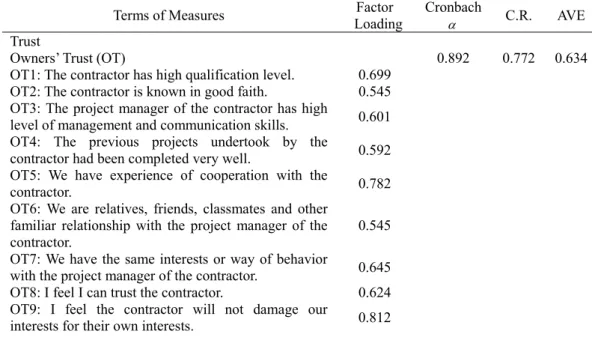
The first step involved reliability test of multiple terms of each construct. In every instance the Cronbach
of each construct was over 0.845 (see Table 2), showing that all the factors are reliable. Then, the composite reliability (C.R) ranged from 0.751 to 0.812 (see Table 2), indicating acceptable levels of reliability for constructs.Next, convergent validity analysis was conducted. By analyzing the factor loading of every variable, we found that the factor loading of variables were above 0.5 (see Table 2), indicating construct validity. Then, we analyzed the average variance extracted (AVE) of the constructs, and the results showed that all AVE exceeded 0.5 (see Table 2), indicating that the constructs reflect the information of the structure of the original data.
Finally, we chose two constructs randomly and compared the change in chi-square to test the discriminant validity (Bagozzi and Phillips, 1982). The results showed a significant difference between the chi-square of the two constructs (p=0.000<0.05), indicating that the construct has good discriminant validity.
Table 2. Result of the assessment of scale Terms of Measures Factor
Loading
Cronbach
C.R. AVE
Trust Owners’ Trust (OT) 0.892 0.772 0.634
OT1: The contractor has high qualification level. 0.699 OT2: The contractor is known in good faith. 0.545 OT3: The project manager of the contractor has high
level of management and communication skills. 0.601 OT4: The previous projects undertook by the
contractor had been completed very well. 0.592 OT5: We have experience of cooperation with the
contractor. 0.782
OT6: We are relatives, friends, classmates and other familiar relationship with the project manager of the contractor.
0.545 OT7: We have the same interests or way of behavior
with the project manager of the contractor. 0.645 OT8: I feel I can trust the contractor. 0.624 OT9: I feel the contractor will not damage our
OT10: During the practical construction, you feel that
the contractors trust you. 0.585
Contractors’ Trust (CT) 0.873 0.812 0.701 CT1: The owner’s project funding is always adequate
and in place. 0.743 CT2: The owner makes a commitment to his
responsibilities and keeps his promise. 0.678 CT3: The project manager of the owner has high level
of management and communication skills. 0.623 CT4: The previous projects operated by the owner had
been very successful. 0.788 CT5: We have experience of cooperation with the
owner. 0.592
CT6: We are relatives, friends, classmates and other familiar relationship with the project manager of the owner.
0.712 CT7: We have the same interests or way of behavior
with the project manager of the owner. 0.690 CT8: I feel the owner trusts me. 0.598 CT9: I feel the owner will not damage our interests
for their own interests. 0.713 CT10: During the practical construction, you feel that
the owners trust you. 0.715
Contract Control (CC) 0.845 0.751 0.503 CC1:The contract contains very detailed special
terms. 0.718
CC2:The contract contains the terms of schedule control that clearly define the beginning, stop and termination.
0.596 CC3:The contract contains the terms of cost and
quality control. 0.743 CC4: The contract contains the clear definitions of the
specific response conducted by the two sides when
unforeseen events occur. 0.500 CC5: Stern legal sanctions and financial penalties
shall be taken against the breaching party according to the contract.
0.504 CC6:There are many claims from the two sides in
construction field 0.825 CC7:Matters unstipulated in the contract can be done
after the two sides sign a contract. 0.549
Project Performance (PP) 0.857 0.762 0.516 PP1: The project has come in on schedule. 0.888
PP2: The project has come in on budget. 0.812 PP3: The project results or deliverables are in line
with owners’ objectives. 0.803 PP4: Given the problem for which it was developed,
the contractors seem to do the best job of solving that problem.
0.571 PP5: This project has a positive impact on those who
make use of it. 0.537 PP6: The owners are satisfied with the project
outcomes. 0.561
5.2 Verification of the Structural Model
Before the verification of structural model, the paper firstly made the examination of offending estimates,and the result was shown in Table 3. We could see from Table 3 that the model was in accordance with the evaluation standards of basic goodness-of-fit, as error variables were all above 0 and all of standard factor loading limited within 0.50~0.95.
Table 3. Summary of the Basic Goodness-of-fit Test Evaluation term Calculation Conclusion Error variables>=0 Error variables>0 Fit
0.50=<Factor
loading<=0.95 0.500~0.888 Fit Standard Errors are not
large 0.149~0.362 Fit Source: based on the Goodness-of-fit test by the authors.
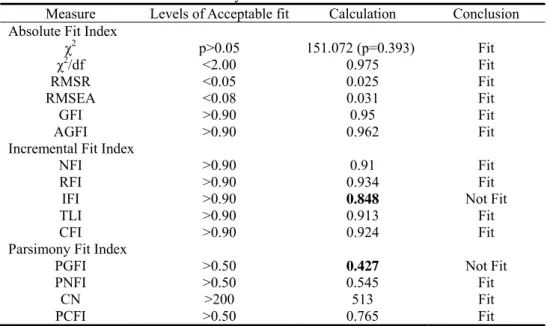
The overall goodness-of-fit test of the model was shown in Table 4. From the results we can see that all the values of absolute, incremental and parsimony fitted the indexes. The Chi-square was 151.072 (p=0.393>0.05) as the degree of freedom being 155, suggesting that the theoretical model proposed in this paper fitted with the data very well. As a whole, the goodness-of-fit of the second-order model was quite good.
Table 4. Summary of the Overall Goodness-of-fit Test
Measure Levels of Acceptable fit Calculation Conclusion Absolute Fit Index
χ2 p>0.05 151.072 (p=0.393) Fit χ2/df <2.00 0.975 Fit RMSR <0.05 0.025 Fit RMSEA <0.08 0.031 Fit GFI >0.90 0.95 Fit AGFI >0.90 0.962 Fit
Incremental Fit Index
NFI >0.90 0.91 Fit RFI >0.90 0.934 Fit IFI >0.90 0.848 Not Fit TLI >0.90 0.913 Fit CFI >0.90 0.924 Fit Parsimony Fit Index
PGFI >0.50 0.427 Not Fit PNFI >0.50 0.545 Fit
CN >200 513 Fit
PCFI >0.50 0.765 Fit Source: based on the Goodness-of-fit test by the authors.
Note: χ2 = Chi-square; χ2/df = Chi-square/degree; RMSR = root mean square residual; RMSEA = root mean square error of approximation; GFI = goodness-of-fit index; AGFI = adjusted goodness-of-fit; NFI = normed fit index; RFI = relative fit index; IFI = incremental fit index; TLI = Tucker Lewis Index; CFI = comparative fit index; PGFI = parsimonious goodness-of-fit index; PNFI = parsimonious normed fit index; CN = critical N; PCFI = parsimonious comparative fit index.
5.3 Test of Research Hypotheses
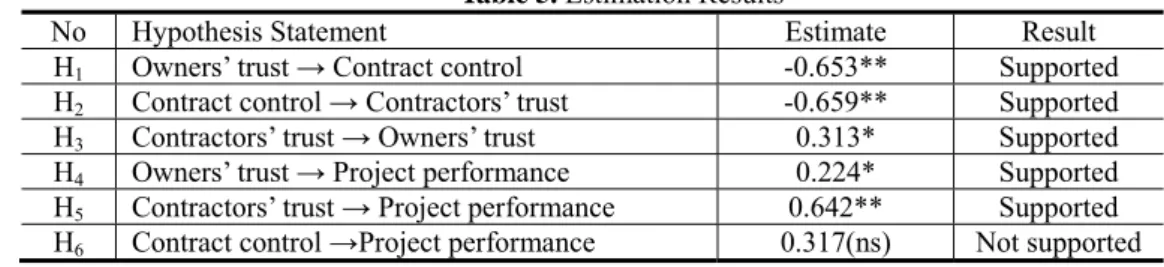
By the method of maximum likelihood (ML), this paper tested the research hypotheses, with the results listed in Table 5 and Figure 2.
Our first hypothesis addressed how owners’ trust influenced the strength of contract control. The result (p=0.006<0.01) indicated that owners’ trust had significant influence on contract control, and thus H1 was supported.
Hypothesis 2 suggested a negative direct relationship between contract control and contractors’ trust. The result indicated that contract control significantly affected the trust perceived by contractors (p=0.003<0.01), so H2 was supported. These findings were in line with Patzelt and Shepherd (2008).
Contractors’ trust had a positive influence on their reciprocation, while their reciprocation in turn impacted owners’ trust. The result (p=0.042<0.05) supported H3.Owners’ trust and contractors’ trust, measured by competence-based trust, Guanxi-based trust, and intuitive-based trust, were all positively
associated with project performance (p=0.039<0.05, p=0.009<0.01). Therefore, H4 and H5 were supported.H6 addressing that contract control was positively related to project performance was not statistically supported although the sign indicated a positive relationship as expected. These findings were identical with Li et al. (2010). More specific operationalization might be needed on contract control in order to confirm this result further.
The relationship between variables was shown in Figure 2. According Figure 2, using the assessment of indirect effect, we can find direct and indirect influence of trust and contract control on project performance. On the one hand, owners’ trust had significant positive direct influence on project performance (r=0.224*). On the other hand, through contract control and contractors’ trust, it had significant positive indirect influence on project performance (r=0.276*). Therefore, the total effect of owners’ trust on project performance was 0.5, of which the contribution rates were 44.8% for direct effect and 55.2% for indirect effect.
The direct influence of contract control on project performance was not significant (p>0.5). But it can be seen from Figure 2 that contract control indirectly acted on project performance via contractors’ trust (r=0.423). That can account for why unilateral strengthening of contract control does not always improve project performance. Only under the action of trust, can contract control succeed. Contractors’ trust, for one thing, had significant positive direct influence on project performance (r=0.642**). For another thing, through owners’ trust, it had significant positive indirect influence on project performance (r=0.2*). Therefore, the total effect of contractors’ trust on project performance was 0.842, of which the contribution rates were 76.2% for direct effect and 23.8% for indirect effect.
Table 5. Estimation Results
No Hypothesis Statement Estimate Result H1 Owners’ trust → Contract control -0.653** Supported H2 Contract control → Contractors’ trust -0.659** Supported H3 Contractors’ trust → Owners’ trust 0.313* Supported H4 Owners’ trust → Project performance 0.224* Supported H5 Contractors’ trust → Project performance 0.642** Supported H6 Contract control →Project performance 0.317(ns) Not supported Source: based on the path analysis by the authors.
Note: * p<0.05,** p<0.01, ns p>0.05
Figure 2. Path Model with Coefficients
6. Conclusions
municipalities in China as samples, using the structural equation model, this paper empirically verified the model of owners’ trust, contractors’ trust, contract control and project performance. The finding indicated:
(1) Owners’ trust had significant positive direct effect on project performance; and it had significant positive indirect effect on project performance through contract control and contractors’ trust. Of the two effects, indirect effect was greater than the direct one.
(2) The direct influence of contract control on project performance was not significant, but contract control indirectly acted on project performance via contractors’ trust.
(3) Contractors’ trust had significant positive direct effect on project performance, by owners’ trust it had significant positive indirect effect on project performance. Of the two effects, direct effect was greater than the indirect one.
7. References
[1] Ben-ner, A., Putterman, L.,"Trust, communication and contracts: An experiment",Journal of Economic Behavior and Organization, Vol.70, No. (1-2), pp.106 ~121,2009.
[2] Xiaolong Xue, Qiping Shen, Zhaomin Ren, Jiqi Ni, "Cognition and Decision Making in Construction Engineering and Management: A Case of Construction Project Contract Negotiation", JCIT, Vol. 6, No. 3, pp. 226 ~ 233, 2011.
[3] Cheung, S.O., Wong, W.K., Yiu, T.W., et al.,"Developing a trust inventory for construction contracting",International Journal of Project Management,Vol.29, No.2,pp.184 ~196, 2010.
[4] Wen-Chih Chang, Freya H. Lin, Lai-Chi Wu, "Application of Social Network Analysis to Project Curriculum", JDCTA, Vol. 5, No. 3, pp. 364 ~ 372, 2011.
[5] Nasrin Dastranj Mamaghani, Reza Samizadeh, Fatemeh Saghafi, "Developing a Combined Framework for Evaluating IT Projects based on IT-BSC and COBIT", JDCTA, Vol. 5, No. 5, pp. 10 ~ 22, 2011.
[6] Jiming Cao, Yong Fu, "A Survey on the Role of Emotional Intelligence in Construction Project", AISS, Vol. 3, No. 9, pp. 107 ~ 113, 2011.
[7] Ding, Z.K., Ng, F.F.,"Reliability and validity of the Chinese version of McAllister’s trust scale. Construction Management and Economics, Vol. 25, No. 11, pp.1107 ~1117,2007.
[8] Karlsen, J.T., Græe, K. and Massaoud, M.J.,"Building trust in project-stakeholder relationships", Baltic Journal of Management,Viol.3,No.1, pp.7 ~22, 2008.
[9] Li, Y., Xie En, Teo, H.H., et al.,"Formal control and social control in domestic and international buyer-supplier relationships",Journal of Operations Management,Vol.28,No.4, pp.333 ~344, 2010. [10]Patzelt, H., Shepherd, D.A.," The decision to persist with underperforming alliances: The role of
trust and control",Journal of Management Studies,Vol.45,No.7,pp.1217 ~1243, 2008.
[11]Pinto, J.K., Slevin, D.P. and English, B.,"Trust in projects: An empirical assessment of owner/contractor relationships",International Journal of Project Management,Vol.27,No.6, pp.638 ~648, 2009.