From blind spots to hotspots: How knowledge services clusters
develop and attract foreign investment
Article (Accepted Version)
Manning, Stephan, Ricart, Joan E, Rosatti Rique, Maria Soledad and Lewin, Arie Y (2010) From blind spots to hotspots: How knowledge services clusters develop and attract foreign investment. Journal of International Management, 16 (4). pp. 369-382. ISSN 1075-4253
This version is available from Sussex Research Online: http://sro.sussex.ac.uk/id/eprint/86269/ This document is made available in accordance with publisher policies and may differ from the published version or from the version of record. If you wish to cite this item you are advised to consult the publisher’s version. Please see the URL above for details on accessing the published version.
Copyright and reuse:
Sussex Research Online is a digital repository of the research output of the University.
Copyright and all moral rights to the version of the paper presented here belong to the individual author(s) and/or other copyright owners. To the extent reasonable and practicable, the material made available in SRO has been checked for eligibility before being made available.
Copies of full text items generally can be reproduced, displayed or performed and given to third parties in any format or medium for personal research or study, educational, or not-for-profit purposes without prior permission or charge, provided that the authors, title and full bibliographic details are credited, a hyperlink and/or URL is given for the original metadata page and the content is not changed in any way.
From Blind Spots to Hotspots: How Knowledge Services Clusters
Develop and Attract Foreign Investment
Stephan Manning
University of Massachusetts Boston College of Management 100 Morrissey Boulevard Boston, MA 02125, USA [email protected] Joan E. Ricart University of Navarra IESE Business School
Avd. Pearson 21 08034 Barcelona, Spain
[email protected] Maria Soledad Rosatti Rique
University of Navarra IESE Business School
Avd. Pearson 21 08034 Barcelona, Spain
[email protected] Arie Y. Lewin Duke University Fuqua School of Business
1 Towerview Drive Durham, NC 27708, USA
FINAL DRAFT VERSION (May 2010)
Published in Journal of International Management
Full reference: Manning, S., Ricart, J.-E., Rosatti Rique, M.S., Lewin, A.Y. 2010. “From Blind Spots to Hotspots: How Knowledge Services Clusters Develop and Attract Foreign Investment”; Journal of International Management, 16 (4), 369-382.
From Blind Spots to Hotspots: How Knowledge Services Clusters
Develop and Attract Foreign Investment
Abstract
This paper explores local and global dynamics underlying the development of knowledge services clusters, which we define as new geographic concentrations of technical talent and service providers offering upstream technical and knowledge-intensive business services to regional and global clients. Taking a co-evolutionary perspective on the development of knowledge services clusters in Latin America, based on data from the Offshoring Research Network (ORN), we find that cluster growth results from intersecting trajectories: the emergence of local talent pools and capabilities initially serving local and regional demand; broadening global search for talent and expertise by multinational corporations; and internationalization strategies of service providers competing to serve global clients. Findings suggest that increasing commoditization of knowledge services opens up windows of opportunity for new clusters, but also involves challenges for sustainable growth. Results may stimulate future research on global sourcing and cluster development.
Key words:
Knowledge Services, Cluster Development, Emerging Economies, Global Sourcing, Location Choices, Service Capabilities, Commoditization
From Blind Spots to Hotspots: How Knowledge Services Clusters
Develop and Attract Foreign Investment
1. Introduction
In recent years, sourcing knowledge-intensive businesses services, such as software development, product design, R&D and analytical services, from emerging economies has become an established business practice (UNCTAD, 2005; Kenney et al., 2009; Manning et al., 2008). Knowledge services involve symbolic-analytical work, are typically more complex, and require higher-skilled personnel to be performed than administrative business services, e.g. payroll processing, and call centers. Multinational corporations (MNCs) source knowledge services from abroad mainly to tap into growing pools of qualified, yet often cheaper personnel and specialized expertise outside their home countries (e.g. Doh, 2005; Lewin et al., 2009). They do so either by setting up wholly owned subsidiaries (captive delivery models) or by contracting with specialized service providers (outsourcing) (Couto et al., 2008).
This trend has co-evolved with the development of knowledge services clusters – new geographic concentrations of technical science and engineering (S&E) talent and service providers offering upstream technical and knowledge-intensive business services, e.g. engineering, R&D, design, software and analytical services, for regional and global clients (see also Manning et al., 2008). A number of recent studies have examined the emergence of service capabilities and clusters particularly in India (e.g. Bresnahan et al., 2001; Dossani and Kenney, 2007; Athreye, 2005; Ethiraj et al., 2005). China has also been recognized as an emerging destination for sourcing product development services (Altenburg et al., 2007). However, recent studies suggest that Western MNCs, facing
growing competition for talent, have increasingly broadened their global search for talent and expertise (e.g. Heijmen et al., 2009). At the same time, as knowledge services have become more commoditized, new second-tier knowledge services clusters, e.g. in North Africa and Latin America, have developed and begun to attract investment by Western client companies and international service providers (Couto et al., 2008).
Despite the increasing number of studies investigating sourcing location choices (e.g. Doh et al., 2005, 2009) and the emergence of service capabilities in emerging economies (e.g. Athreye, 2005), we lack an understanding of the dynamics underlying the more recent development of knowledge services clusters across the globe. In this study, we take a co-evolutionary perspective on the development of knowledge services clusters, based on the empirical example of Latin America. Using both quantitative and qualitative data of client investment decisions and provider capabilities, collected by the Offshoring Research Network (ORN), we explore inductively how Latin America has increasingly attracted foreign investment in a changing global sourcing context. Unlike previous studies which primarily focus on local factors contributing to cluster development, e.g. government policies, specialization of suppliers etc., (e.g. Dossani and Kenney, 2007; Athreye, 2005), we look at the intersection of global and local dynamics promoting cluster growth. Also, unlike previous studies, we show how increasing commoditization of services as well as the internationalization of service providers are currently changing the landscape of knowledge services sourcing.
Based on our empirical findings we construct a dynamic model of cluster growth in the global sourcing context to inform future research. In particular we seek to contribute to the emerging literature on knowledge services clusters and capabilities on
the one hand (e.g. Athreye, 2005; Ethiraj et al., 2005), and sourcing strategies and location choices on the other hand (Doh et al., 2005, 2009). The rest of the paper is organized as follows: Section 2 presents the rationale for a co-evolutionary perspective to study the development of knowledge services clusters. Section 3 presents the data for Latin America. We combine some quantitative and qualitative data as a way to further develop our co-evolutionary perspective. Section 4 presents the discussion and develops from the data a dynamic model of cluster growth that is fully coherent with the co-evolutionary perspective. We end with some policy as well as managerial implications, and with follow-up ideas for future research.
2. The Development of Knowledge Services Clusters: A Co-evolutionary Perspective
Clusters in general have been defined as “geographic concentrations of interconnected companies, specialized suppliers, service providers, firms in related industries, and associated institutions (e.g., universities, standards agencies, trade associations) in a particular field that compete but also cooperate” (Porter, 2000, p. 15). The concept relates back to Marshall’s well-known concept of industrial districts, which are characterized by concentrations of industry players, pools of readily available labor, and a knowledge base shared by a local community of firms and professionals (Marshall, 1920). All these features – geographic concentration of related firms, specialized labor pool, professional community – apply well to more traditional industry clusters in advanced economies, such as the textiles cluster Emilia Romagna in Italy (Piore and Sabel, 1984) or the IT cluster Silicon Valley in the U.S. (Saxenian, 1994). However, they can also be found in a relatively new type of cluster - knowledge services clusters.
Knowledge services clusters provide technical talent and knowledge-intensive, upstream business service capabilities, and are strongly oriented to and dependent on global rather than just local or regional demand for such talent and capabilities. Examples include the IT and software services cluster Bangalore in India (Bresnahan et al., 2001; Dossani and Kenney, 2007), and the emerging science and analytical services clusters Moscow and St. Petersburg in Russia (see also AT Kearney 2004; GlobalServices, 2008). Their emergence is a fairly recent phenomenon, facilitated by advanced ICT supporting long-distance service delivery; the increasing commoditization of knowledge-intensive business services; the development of technical universities producing high-skilled technical talent in emerging economies; and the emergence of more or less specialized knowledge service providers (Metters and Verma, 2008; Apte and Mason, 1995; Athreye, 2005; Manning et al., 2008).
Two features in particular – their focus on technical talent and knowledge services, and their strong global orientation – make them quite distinct from most traditional industry clusters. On the one hand, knowledge services clusters develop around the provision of technical talent and upstream knowledge services rather than manual labor and the manufacturing of goods. Knowledge services can be recognized by their symbolic-analytical and partially intangible nature and the need for higher-skilled technical talent and expertise to perform these services (Drucker, 1959; Reich, 2001). Examples include software programming, engineering, product design, research, and analytical services. Unlike clusters which are organized around the manufacturing of material goods, e.g. textiles, automotive parts or electronics, or the sourcing and processing of natural resources, e.g. wine, knowledge services clusters typically depend
less on certain geographic conditions, e.g. climate or natural resources, nor do they necessarily build on craft traditions in a particular region. Also, unlike manufacturing clusters which often attract geographically proximate clients due to logistical advantages, knowledge services clusters are supported by advanced ICT which allows service delivery across long distances at relatively low costs (Metters and Verma, 2008; Blinder, 2006). However, unlike lower-skilled administrative work, e.g. payroll processing, knowledge services do require qualified personnel who cluster around technical training institutions and universities, and who form local networks and communities which become important infrastructures supporting cluster formation.
On the other hand, knowledge services clusters are strongly oriented to and dependent on global rather than just local or regional sourcing demand. A number of both supply and demand factors contribute to this. As for supply, knowledge services clusters, such as Bangalore, are typically located in emerging economies whose industrial policies have been strongly oriented to serving global clients and attracting foreign investment. In recent years, governments in emerging economies have made increased efforts to develop technical universities based on Western models to produce high-skilled talent for both local and global demand; at the same time, specialized knowledge service providers have established, e.g. in India, offering a variety of technical and analytical business services to global clients (Athreye, 2005; Ethiraj et al., 2005). At the same time, demand for lower-cost, but high skilled technical talent and service expertise from abroad has increased in Western economies, partly driven by global competitive pressures and perceived domestic talent shortages (Lewin et al., 2009; Manning et al., 2008). As a consequence, similar to – and even more than – manufacturing clusters in emerging
economies, which are already embedded in global value chains (Humphrey and Schmitz, 2002; Nadvi and Halder, 2005; Morrison et al., 2008), knowledge services clusters have established as new hubs for global service delivery.
But how do knowledge services clusters develop and grow over time? And how do they compete in a rapidly changing global sourcing context? Typically, cluster scholars have argued that early cluster development is sparked by local entrepreneurship, sometimes in conjunction with government incentives (see e.g. Bresnahan et al., 2001; Feldman et al., 2005; Porter, 2000). Later on, agglomeration and specialization effects may lead to sustainable growth (see e.g. Porter, 2000; Pouder and St. John, 1996). In other words, client firms with similar sourcing needs and suppliers with similar service capabilities cluster in certain locations over time promoting the emergence of ‘hotspots’ which attract continuous investment through economies of agglomeration and specialization. Cluster agglomeration, however, may also lead to diseconomies due to increasing competition for local resources (Pouder and St. John, 1996). In the global sourcing context, in particular the development of Bangalore as an IT and software services cluster has been examined in greater detail. Findings suggest that indeed government policies in the 1980s promoted local entrepreneurship in the software industry (e.g. Dossani and Kenney, 2007). Later on, Bangalore became a magnet for MNCs in demand for IT and software services promoting further growth. Importantly, research also indicates that from early on MNCs have been a key factor in cluster growth: in particular the engagement of pioneer Western MNCs played an important role in the development of local service capabilities and the attraction of further foreign investment (Reddy, 1997; Patibandla and Petersen, 2002).
On a more general level, this suggests that rather than just looking at local drivers of cluster development like most previous studies, cluster growth needs to be examined in conjunction with MNCs’ global sourcing demands and location preferences. In addition and related to this, the conditions under which certain service capabilities, e.g. IT and software programming, can develop and attract foreign investment need to be better understood. In what ways for example does the increasing commoditization of knowledge services affect the development and attractiveness of local service capabilities? Finally, a new trend has emerged that may affect cluster development: the internationalization of knowledge service providers from emerging economies, e.g. India-based Wipro, Infosys and Genpact. Arguably, all these trends – location preferences of MNCs, increasing commoditization of knowledge services, and the internationalization of service providers – have promoted the emergence of a number of new global hubs for the delivery of knowledge services. In this study we seek to explore and understand the development of these new knowledge services clusters in greater detail.
We focus here on the development of knowledge services clusters in Latin America, which has been referred to as an upcoming destination for sourcing knowledge work (GlobalServices, 2008). We examine cluster development from a co-evolutionary perspective which helps us account for both local and global dynamics. Co-evolution means that entities which are part of a larger system influence each other’s evolution. Sourcing locations are such entities whose development needs to be seen as part of an evolving global field constituted by multi-national client firms, talent pools and more or less locally embedded service providers and institutions. A co-evolutionary perspective furthermore points to multidirectional causalities, path dependencies and non-linear
feedbacks between firm decisions and environmental conditions (Lewin and Volberda, 1999). The decisions of a particular firm at a particular point in time to invest in location A rather than B can have a profound impact on the further development of both locations, as prior investments attract followers and/or lead to path dependencies in the way local economies grow (see also Belussi and Sedita, 2008). Co-evolutionary perspectives have been applied to a number of related research contexts, e.g. the analysis of MNCs (Madhok and Liu, 2006) and firms in emerging economies (Suhomlinova, 2006; Dieleman and Sachs 2008). Using a co-evolutionary perspective as an analytical guide, we now investigate inductively the development of Latin America as a sourcing destination as well as particular locations within this region in a changing global landscape of sourcing knowledge work. Based on this analysis we develop a more general dynamic model of cluster growth to inform future research.
3. The Case of Latin America
For many years, Latin America has been the subject of studies on economic development and the success (or failure) of economic reforms and industrial policies (see e.g. Hirschman, 1958). More recently, studies have explicitly addressed the development of industry clusters (e.g. Altenburg and Meyer-Stamer, 1999; Kesidou and Romijn, 2008). At the core of these studies lies an interest in Latin America’s potential to industrialize and develop technological capabilities to promote sustainable economic growth (see e.g. Figueiredo, 2007), and to become more independent from agricultural commodities, such as sugar, coffee and cacao. As part of this debate, several studies have looked into Latin America’s potential to develop a manufacturing base attracting foreign direct investment.
In this context, Altenburg and Meyer-Stamer (1999) for example note that several ‘transnational clusters’ have developed in Latin America, in particular in automotive component production, electronics and telecommunication. Puebla, Aguascalientes and Guadalajara in Mexico, and Costa Rica are given as examples. However, the authors point out that most of these clusters have been lacking the capacity to innovate impeding sustainable cluster growth. More recently, some scholars even ask “Is there a future for manufacturing in Latin America?” (Moreira, 2006). In particular, the growing importance of China as a low-cost manufacturing base in recent years (see also Altenburg et al., 2007) has put into question Latin America’s ability to grow and compete in this field (Moreira, 2006; Jenkins et al., 2007).
In very recent years, however, the business press as well as a number of reports, e.g. by consulting firms, have shown increased interest in Latin America as a destination for service-related sourcing. In the latest Global Services Report (2008), for example, a number of Latin American cities are listed among the Top 20 offshoring/outsourcing destinations for business services. This recent trend has not attracted much attention so far in the academic literature which has primarily focused on India as an outsourcing destination (e.g. Dossani and Kenney, 2007; Athreye et al., 2005) and on particular clusters in India, such as Bangalore (e.g. Bresnahan et al., 2001). Likewise, until very recently, Latin America – like other emerging sourcing destinations, such as the Middle East and Northern Africa – remained largely ‘under the radar’ – a blind spot – in the business community. We seek to reveal why this is and why suddenly more or more Western client companies have decided to source technical and knowledge-intensive services, including IT, software and product development, from Latin American
locations. Our findings help better understand under what conditions locations can develop into hotspots in the context of global sourcing. Also, it opens up opportunities to reconsider Latin America’s economic growth potential in the future.
3.1 Data and Methodology
To analyze the development of knowledge services clusters and capabilities in Latin America and their growing attractiveness for Western client companies, we employ an inductive research design using multiple sources of evidence, including both quantitative and qualitative data.
On the one hand, we utilize comprehensive data collected by the Offshoring Research Network (ORN) to report both global sourcing trends and trends in the region of Latin America. The ORN is an international research network studying recent and historical trends of business process sourcing and service provision worldwide. It conducts annual Corporate Client and Service Provider Surveys. The Corporate Client Survey collects data on global sourcing strategies, drivers, and risks, as well as concrete implementations of sourcing projects, including launch year, sourcing location, location choice factors, service delivery model (e.g. outsourced, captive, joint venture), performance data (e.g. savings), and future plans. The survey includes companies across industries, e.g. financial services, manufacturing, software, and professional services, from the U.S. and Western European countries. Sourcing projects range across business functions, including finance & accounting, IT, HR, legal services, product design, R&D, engineering, software development, marketing & sales, call centers and procurement. The client database (surveys 2005-2008) includes 1,322 firms and 2,529 implementations.
48% of these companies are currently offshoring and 17% considering. 14% of firms are large (>20,000 employees), 35% midsize and 52% small (<500 employees); 32% of firms are U.S.-based, 28% Dutch, 14% Belgian, 11% Spanish and 15% from other countries (Germany, UK, Scandinavia). The Service Provider Survey collects data on service profiles and strategies of service providers, including the services they offer, the locations they provide services from, the size and origin of client companies etc. The provider database (surveys 2007-2009) includes 417 companies, mainly headquartered in the U.S. & Canada (35%), Europe (24%), India (17%), other Asia & Australia (15%) and Latin America (7%). 27% are large, 30% midsize and 43% small.
On the other hand, we use qualitative data collected from business press articles, corporate websites, reports and other studies on Latin America, as well as semi-structured interviews with representatives of particular cluster initiatives in this region (see in more detail below). In particular, one author analyzed recent cluster initiatives taken in Mexico, Argentina and Brazil which have attracted the lion’s share of foreign investment in Latin America, when it comes to knowledge services. Importantly, Latin America also provides a range of other business services, notably call centers. For the purpose of this study, however, we focused on technical and knowledge services, in particular IT and software development. The first author also gained first-hand insight into Latin America’s outsourcing industry through participating in a meeting of the International Association of Outsourcing Professionals (IAOP) in Guatemala in 2009.
Taking a co-evolutionary perspective, we analyze both supply and demand factors as well global and regional dynamics related to knowledge services sourcing. At the global level, we first investigate the changing landscape of knowledge services sourcing,
in terms of the growing trend of sourcing technical and knowledge-intensive work, including IT services, software development, engineering, product design and R&D, from abroad, as well as the changing availability of related talent and expertise in different parts of the world. As a result of this analysis, we are able to position Latin America in terms of its competitiveness over time in a shifting global arena of knowledge services sourcing. At the regional level, we look more deeply into the history and current trends of knowledge services sourcing in Latin America. On the one hand, we analyze location choice patterns by Western multinational firms and their rationale for choosing Latin American locations over time. On the other hand, we investigate the development of selected knowledge services clusters and their changing attractiveness in Latin America. This comprehensive analysis allows us to generate a dynamic conceptual model of knowledge services cluster growth that may inspire future research.
3.2 The Changing Global Landscape of Knowledge Services Sourcing
More and more companies today take advantage of the increasing availability of (often cheaper) technical talent in emerging economies by disaggregating and sourcing technical and knowledge work from abroad, including IT, software and product development (Kenney et al., 2009; Lewin et al., 2009). IT and software development are today by far the most frequently offshored and/or outsourced business functions. More surprisingly perhaps, engineering, product design and R&D have also become subject to increased disaggregation and offshore sourcing (e.g. Lewin and Couto, 2007). This trend is promoted, on the one hand, by the increasing availability of highly qualified S&E talent in emerging economies (see e.g. Lewin et al., 2009), and, on the other hand, by the
emergence of service providers offering and specializing in knowledge services. In fact, according to the ORN, product development services belong to the most frequently provided services, right after IT and software development (Heijmen et al., 2009). In turn, more and more client firms make use of specialized external expertise in knowledge services (Couto et al., 2008). Interestingly, the market for knowledge services has been dominated until recently by small (<500 employees) rather than large providers. Only in recent years, large international service providers have also entered the knowledge services sourcing business.
--- Figures 1, 2 Here ---
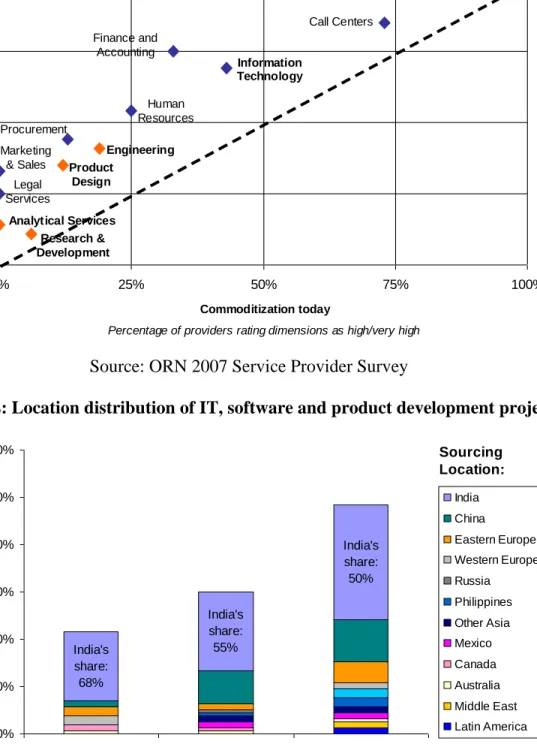
Another important trend is the increasing commoditization of knowledge services. Commoditization refers to a process by which services and processes become more standardized, lowering transaction and switching costs for clients and barriers to entry for new providers, while making it more difficult for any one provider to differentiate and sustain a competitive advantage, resulting in tougher competition on both quality and price (see for a similar definition Davenport, 2005). Figure 1 reports, based on the ORN service provider survey, the degree to which service providers on average regard particular services as commoditized today (horizontal dimension) and in the future (vertical dimension). Traditionally, lower-skilled IT services and administrative processes have been regarded as most commoditized (see Figure 1). However, the commoditization of higher-skilled technical and knowledge-intensive services is marching forward, thereby changing the global sourcing landscape.
Arguably, one major impact of this trend is the emergence of new providers and new locations offering expertise and services in the IT and knowledge services domain. In the past, most scholars would associate IT services, software and other knowledge services mainly with India (see e.g. Ethiraj et al., 2005; Athreye, 2005; Dossani and Kenney, 2007). Indeed, according to ORN data, India still attracts most offshore investments in this area. Figure 2 reports the volume and location choices distribution for knowledge services sourcing over time, based on the ORN client survey. Almost 50% of all sourcing implementations reported in the survey were made fairly recently: between 2005 and 2007. Out of these projects, 50% were located in India. However, as Figure 2 indicates, while in terms of volume the Indian market is still growing, India’s market share is declining. In recent years, more and more companies have started searching for and using talent and expertise in other parts of the world, including China, Eastern Europe, Russia, the Middle East and Latin America. Reasons include increasing competition for talent and resulting wage inflation in India, and growing availability and client awareness of talent pools and expertise in other parts of the world. Interestingly, this trend is driven by small client firms who prefer second-tier and upcoming destinations for offshore investments rather than established hotspots.
Latin America is one of the regions benefitting from this global shift. In particular U.S. and Spanish firms have increasingly considered Latin America as a destination for sourcing technical and knowledge work. In the following we analyze the development of knowledge service capabilities and clusters in Latin America in greater detail.
3.3 The Emerging Attractiveness of Service Capabilities in Latin America
Latin America has been identified as one of the upcoming locations for sourcing higher-skilled technical and knowledge work (see e.g. GlobalServices, 2008). To better understand its emerging attractiveness, we now take a co-evolutionary perspective on the changing demand for and supply of knowledge services in Latin American locations.
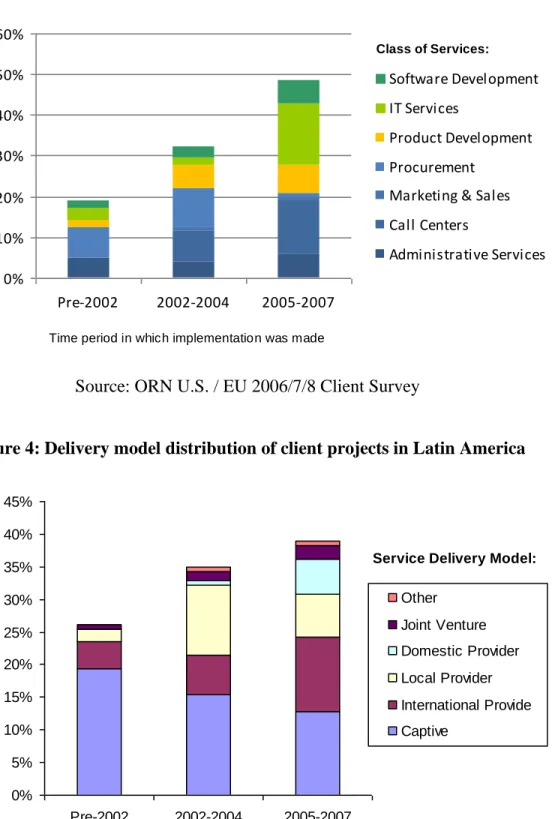
Findings from the ORN client survey indicate two major trends with regard to Latin America as an offshore destination. On the one hand, the number of sourcing projects in Latin America in general and those involving technical and knowledge work in particular has been growing in recent years. Figure 3 shows that almost 50% of all projects reported in the survey took place between 2005 and 2007. More surprisingly, almost half of these projects were related to IT, software and product development indicating an increasing attractiveness of Latin America for projects in this domain. In particular Mexico, Argentina and Brazil have attracted offshore investments in this department, whereas Central America for example primarily attracts call center work. Most clients, according to ORN survey findings, are headquartered in the U.S. and Spain. On the other hand, offshore investments in Latin America increasingly involve third party providers. Figure 4 shows that whereas prior to 2002 most projects were implemented using captive (wholly owned, in-house) units, between 2005 and 2007 more than 50% of all projects involved third party providers – either local providers based in the host country; international providers using certain locations as a hub; or domestic providers operating from the client’s home country, but utilizing resources at offshore destinations. Interestingly, international providers are particularly present in Central America, whereas Argentina, Brazil and Mexico in particular have a large local provider base. However, in
recent years the provider market in these countries as well has been shaped by large international players, including IBM, Accenture, Wipro, Infosys, and GenPact, who have established facilities across the continent.
--- Insert Figures 3, 4 ---
The ORN service provider survey further reveals that small local providers and large international providers seem to serve different market segments. Large international providers who have set up facilities in Latin America primarily serve large U.S. clients. In contrast, many local providers, who are primarily headquartered in Mexico, Argentina or Brazil, serve smaller clients (<500 employees, 62% of total clients), both from the U.S. and Latin America. Service providers headquartered in Latin America further seek to differentiate themselves from world competitors by offering tailor-made solutions. Nearly 50% of Latin American providers taking the ORN survey – more than in any other region (e.g. India: 40%; China: 20%) – see ‘customization of service delivery’ as an important selection factor for clients. The highest ranking factors, however, are skills/training (82%), quality (65%) and cost (59%). Quite interestingly, the survey also suggests that most IT and software service providers in Latin America are much more experienced than their counterparts in India and Eastern Europe. On average, Latin American providers taking the survey report 15 years of experience in IT services, and 13 years in software development (Indian providers: 11 years; 8 years). In fact, other studies have shown that IT and software service providers in Latin America have served in particular regional clients for many years (see e.g. Kesidou and Romijn, 2008).
Only recently, however, clients from the U.S. and Western Europe, in particular Spain, have started utilizing these resources. What could be reasons for this? Survey findings point at multiple dynamics coming into play. First, as explained earlier, for many years in particular U.S. firms have targeted India and, to some extent, China as primary offshore sourcing locations, thereby attracting followers from the U.S. and Europe. Other potential destinations have been largely ‘out of sight’ and not considered as options. Second, many service providers in Latin America have focused on attracting regional rather than global clients, not least because efforts towards marketing outside the region have been limited in effectiveness (see also below). Third, partly due to lack of regional experience, many U.S. firms have been largely unfamiliar with market conditions and the availability of talent in Latin America. By contrast, a number of Spanish firms for example realized the resource potential earlier. According to ORN client survey data, 80% of Spanish offshore projects to Latin America have been motivated by available talent and expertise (rather than just labor costs). For U.S. firms only 50% of projects in Latin America have been motivated this way; to them low cost is the main factor (80%). Prior institutional linkages to local universities, cultural proximity and the ability to identify talent pools have made it easier for Spanish firms to utilize this resource potential. In recent years, however, U.S. firms – and international providers – have increased efforts to set up higher skilled operations in Latin America.
In the following, we look at some of these emerging hotspots in greater detail. This allows us to come to a more fine-grained understanding of how certain service capabilities in IT, software and product development have developed over time, and how the dynamics of supply and demand has affected the development of these locations. We
focus on locations in Argentina, Mexico and Brazil. These countries have attracted the lion’s share (>60%) of sourcing projects in Latin America related to technical and knowledge services according to the ORN client survey. Also, these three countries have large consumer markets and labor pools, including pools of skilled IT and software professionals. Brazil has the largest overall labor force; Mexico and Argentina however have a higher percentage of industry and service professionals (see Table 1). Labor costs in engineering and technical professions are lowest in Mexico and Argentina; Brazil, by contrast, has attracted higher-end foreign investments (see in more detail below). Both lower and high-end investments in sourcing knowledge work have focused on certain locations in Brazil, Argentina and Mexico. Next, we conduct a comparative historical analysis of three selected locations in these countries.
--- Insert Table 1 --- 3.3.1 Guadalajara, Mexico
For many years, Mexico has been an important nearshore location for U.S. companies, in particular for low-cost manufacturing (e.g. Altenburg and Meyer-Stamer, 1999). More recently, Mexico has attracted more investment in IT, software development and design. Transitioning from low-cost manufacturing to knowledge services has been a primary goal of Mexico’s economic policies since 2002. Since then a number of MNCs have set up technical service operations in Mexico, including Accenture, SAP, EDS, Microsoft, TCS, Oracle, Intel, Wipro, Infosys, Siemens and Genpact.1 In Mexico we can find 23 IT
parks accommodating around 700 firms (IJALTI, 2008). However, foreign investments have been located in particular in Baja California, Guadalajara-Jalisco and Nueva Leon. Out of these three clusters, the electronics and IT services cluster of Guadalajara has been regarded the most competitive one.
Since its initial formation in the 1960s, the Guadalajara cluster has become the most important economic location in Mexico for electronics manufacturing and, later, for technical services and design work. It is often referred to as the ‘Mexican Silicon Valley’ (Aburto, 2005; UKWTecnologia, 2005). Guadalajara is a good example of how local and global dynamics interact and promote but also limit the development of new knowledge services clusters. It is made up of more than 500 firms, including 12 OEMs, 14 contract manufacturers, 31 design centers and more than 500 providers (IJALTI, 2008). 40% of sales go to national clients, 40% to the regional market, and 20% to international clients mainly from the U.S. and Canada. Despite the presence of MNCs, the local and regional market remain an important factor of cluster growth. In the following, however, we focus on Guadalajara’s positioning in the global market.
The development of the Guadalajara cluster is rooted in the 1960s when big multinationals mainly from the U.S. set up manufacturing plants in the metropolitan area of Guadalajara. The first one was Siemens coming in 1962 producing low voltage switches and electric engines in the area. Motorola followed in 1968 to produce cables and harnesses. Boroughs industries (later Unisys) joined with assembly of radios and transistors. Following this wave, other important players, such as IBM and Kodak, moved to the region. The main factors attracting multinationals at that point were: geographical proximity, availability of skilled, yet relatively cheap labor force, available infrastructure
(airports, ports, electricity, etc.), as well as universities and technological institutes. Facilitated by an open policy to foreign investment, many companies joined the cluster during the 1980s, e.g. Hewlett Packard, which started assembling mini computers for the U.S. In the 1990s, Guadalajara further attracted a number of contract manufacturers, which set out to manufacture components and provide services for local OEMs. Examples include: NEC (mobile phones), Flextronics (all types of assembling) and BTC (assembling of computers) (Jimenez, 2005).
In the early 2000s, however, the region’s potential for sustainable development as an electronic cluster was called into question. Several factors led to a stagnation of foreign investment activities: the U.S. economy, which cluster participants strongly depended on, experienced a recession; the Mexican Peso appreciated, which affected the comparative cost competitiveness of the location; and the aggressive approach of Asian countries, in particular China, towards attracting foreign investment further challenged the cluster’s future development in the electronics sector (Aburto, 2005). Notably, some companies, including Sanyo, Canon and Philips, left Mexico and moved operations to Asia, mainly for lower costs.2 The situation Guadalajara was in at this time paralleled more general concerns about Latin America losing competitive edge against up and coming China as a manufacturing base (Moreira, 2006; Jenkins et al., 2007).
Facing this situation, Mexico’s government enacted economic policies to help clusters like Guadalajara make the transition from low-cost manufacturing to higher skilled IT, software and design services. One important local initiative was the foundation of IJALTI – Centre del Software in 2002. IJALTI was designed to promote and bundle investment in IT, software and product development services in the region. Today it
supports 70 companies and employs around 3000 professionals providing mainly IT and software services.3 Areas of expertise include embedded software, IT services and multimedia applications. Foreign firms making use of design and software development capacities in this region today include Intel, Siemens-VDO, and IBM. However, despite considerable successes in developing IT and software service capabilities in recent years, Guadalajara is still struggling to make the transition.
Reasons are manifold, but a co-evolutionary perspective can help shed light on the current situation as well as the future potential of Mexico’s ‘Silicon Valley’. When the Mexican government, together with private firms and academia started investing in IT and software capabilities in the early 2000s, India was already on its way of becoming a hotspot for technical and knowledge services (see Figure 2). Whereas in the case of manufacturing, geographical proximity to the U.S. has been a source of competitive advantage, when it comes to knowledge services, ORN data shows that most US firms would source IT and software services from India right away, rather than searching for nearshore talent in Mexico (see also Manning et al., 2009). Only some U.S. firms took advantage of co-locating design and development facilities with existing manufacturing units in Guadalajara. A major disadvantage also lied in the comparatively limited supply of qualified programmers and the late adoption of quality and service standards by local institutions and providers. For example, only a few providers are CMMI certified which would signal their ability to meet quality and software development standards of their Indian counterparts (IJALTI, 2008). Instead Mexico has established its own standard – Moprosoft – which, however, is only recognized by local and national clients. This example shows how a traditionally strong orientation towards the local and national
economy can become a disadvantage for knowledge services clusters competing with other clusters globally.
However, other studies suggest that more and more U.S. firms are reconsidering nearshore locations in Mexico as an alternative to increasingly crowded hotspots in India and other Asian countries. Yet, it is questionable how strong Guadalajara’s growth potential is. As we show further below, one major reason might be the lack of outward orientation and the increasing competitiveness of other clusters in Latin America.
3.3.2 Cordoba, Argentina
In recent years, Argentina has developed into an attractive destination for sourcing knowledge services. The ORN client sample indicates that a large percentage of sourcing projects in Argentina have been in the area IT, software and product development. Both U.S. and Spanish companies have been attracted by Argentina’s emerging technical talent pool and external expertise. According to the chamber of IT companies (Cessi) there are 24 IT clusters, most of which have only started to develop. The IT sector has grown significantly in employment in recent years. Employment figures rose from 45.700 in 2007 to around 51.000 in 2008 (López and Ramos, 2009). According to CESSI4, around 1000 companies participated in the IT sector in 2007.
Argentina has developed a certain reputation for providing tailor-made IT and software services, specializing e.g. in accounting and management applications. While some larger mostly international service providers have set up operations in Argentina to provide rather standardized services to mostly big clients in Western economies, the industry is dominated by local small and midsize companies providing tailor-made
solutions. Most of them have been established by entrepreneurs experienced in IT and/or marketing in larger firms (López and Ramos, 2009). These small entrepreneurial firms have generated revenue mainly by serving the Latin American client market, e.g. Chile, México, Peru and Costa Rica. However, over time, in particular clients from Spain and the U.S. have increasingly utilized this resource. In 2007, 60% of sales of small and midsize firms went to firms in Latin America, 30% to firms based in US and Canada, and around 10% to Spanish firms (López and Ramos, 2009). The devaluation of the Argentinean currency in December 2001 gave an additional boost to outsourcing activities from Western economies, not least benefiting small and mid-size firms in IT and software development. Most of these companies are today located in one of Argentina’s IT clusters: Buenos Aires and Cordoba.
The Córdoba technology cluster today has 100 firms providing jobs to 4200 people. 42% of sales in 2007 went to foreign clients. The main client markets are Latin America, EU and US. The cluster is perceived as a technological solution provider in different sectors, such as: financial services, telecommunication, insurance, government, healthcare (Information Technology Institute, 2008). Forecasts for 20155 estimate a jump in sales from USD 300 Million in 2008 to USD 3000 Million; the number of employees is expected to increase from 4500 to 45000 and the number of companies from 100 to 1000. Between 2001 and 2008, the cluster grew in similar proportions. Today some call Cordoba the ‘Silicon Valley of the South’ (Barraclough, 2005).
Historically, Cordoba began to attract investment in the same time period and sector as Guadalajara in Mexico. In the 1970’s, a group of companies started developing and producing electronic equipment in Cordoba. However, Cordoba soon developed IT
and software capabilities, whereas Guadalajara continued to grow until the late 1990s based on low-cost electronics manufacturing. In fact, Cordoba is recognized as the first province in Argentina to declare software development as an industrial activity.6 During the 1980’s the local government set out to create an IT cluster in Cordoba to foster employment and economic growth based on IT manufacturing and software development. Although this particular project was cancelled, local firms started building up IT and software capabilities at a limited scale throughout the 1990s. These efforts where further supported by a strong Peso and the nation-wide growth of telecommunications companies.
However, it was not until 2000 that Cordoba would start establishing an international reputation as an IT and software development cluster. In the late 1990s, the government and local universities organized several business trips with representatives of Western MNCs, notably Motorola, who set up a software development center in Cordoba in 2000. In the mid 1990s, Motorola’s Software Group launched a strategy part of which was the opening of development centers in different parts of the world. Motorola selected Cordoba as a first mover Western enterprise arguably for the following reasons: highly qualified human resources from prestigious universities, the security offered by the city, similar time zone with US, the existence of a growing local software industry and tax benefits offered by the government.7 Today, the Motorola unit produces software for mobile phones and other products of the company. In doing so, it maintains close relations to educational and academic institutions, thereby tailoring their services; it also
6 Telephone Interview with Lic.. Ma. Fernanda Romero; Coordinadora de Comunicación y
Asuntos Institucionales, Technology Park, Institucional Presentation 2008
outsources part of software development to local vendors. Since Motorola expects level 5 CMM certification, this has led to increased efforts among local firms to certify themselves in accordance with these Western standards (López et al., 2009).
The arrival of Motorola in 2000 has triggered a series of related investments by Western MNCs, notably Intel (2006), EDS (2007), Gameloft (2007) and Datasul (2007). Intel today mainly develops software for microprocessors through its unit in Cordoba. 2007 the firm made an additional investment of more than USD 9 millions in IT infrastructure, planning to grow staff with university degrees from 60 to 400, and to expand operations including high-skilled process design. EDS opened its global service center in 2007 with 600 employees. The center produces maintenance software and develops projects in Java and Dotnet. Investment followed from the French company Gameloft, a video game producer for mobile phones, and Datasul, a Brazilian software solution provider (López et al., 2009). This series of investments from MNCs that serve different markets yet depend on similar resources, e.g. software programmers, is a typical indicator of an agglomeration effect in the context of knowledge services clusters. Quite interestingly, Cordoba has also attracted MNCs from different national contexts, which make it less dependent from particular Western economies.
Importantly, Córdoba has remained a mixture of local entrepreneurial firms and subsidiaries of large foreign enterprises. More than 65% of companies in this cluster provide services to more than 17 countries – both inside and outside Latin America.8 To further foster competitiveness, local firms, government representatives and academia founded the Cordoba Technology Center (CCT) in 2002. The purpose of this institution is
to better link the IT industry with educational institutions, but also to generate synergy effects in providing training and technological solutions for foreign clients, and in coordinating promotional efforts.9 Compared to Guadalajara, Cordoba has been more successful in attracting large scale foreign investment and in maintaining a strong entrepreneurial service capability targeting local and regional clients at the same time. However, some observers have noted that foreign MNCs are only loosely embedded in the local economy. Vertical linkages to local and regional clients and providers are rather rare. This however may not hinder the cluster to grow sustainably if economic and institutional conditions remain favourable for Western MNCs as well as local providers serving the regional market.
3.3.3 Recife, Brazil
In recent years, Brazil has not only developed a strong reputation as provider of knowledge services, but has also been an important market for local and regional service providers. Foreign multinationals include U.S. firms, but also Western European companies. Spanish firms, however, have been more reluctant to invest in Brazil, not least because of language and cultural barriers. Like Mexico and Argentina, Brazil has concentrated knowledge services expertise in particular locations.
In Brazil, according to a report from Anprotec10, we find a total of 25 active IT parks, 16 in process of implementation and 31 which are in a project phase. ‘Porto Digital’ in Recife is acknowledged today as the largest technology park in Brazil with 107 firms and over 3,600 employees. Recife provides the following capabilities:
9 Ibidem
production of games for mobile phones, management software, security software, traffic and transport management systems, systems for credit analysis, usability of software and integrated solutions for the development of gateways. Porto Digital is a public-private business model for promoting IT and knowledge services that was launched in 2000. The initial funding of Porto Digital amounted to R$ 33 million ($18 million) and came from the State Government for creating the infrastructure and business conditions. Part of this infrastructure is C.E.S.A.R., a spin-off from the Computer Science Center at the Federal University of Pernambuco. Its goal is to facilitate access to knowledge resources and promote technology transfer between firms and universities. Starting in 2001 with only 12 companies, after three years of operation, Porto Digital has become a high-tech park with the largest number of companies in Brazil. By 2003, more than 60 companies had already joined the park, attracted by the existing companies, institutional promotion and access to new markets (Bercovich and Marcos, 2009).
Similar to the foundation of IJALTI – Centre del Software in Guadalajara, Mexico, Porto Digital was an attempt to revitalize the local economy and transition to higher-skilled technical and knowledge services. For centuries, Recife had been Brazil’s main port terminus for sugar exports. Later, Recife became Brazil’s most important commercial and financial center of the north-east. As a consequence, Recife hosted early data processing centres for banks and big companies. In the 1980s these centres were replaced by IT service companies and providers of software. By the same time, the state developed a prestigious and thriving IT university. In addition, the city has developed one of the best telecommunication infrastructures of the country. These factors, stemming from the history of the city as a financial center, arguably helped establish and implement
the project ‘Porto Digital’. Since its foundation, a number of companies from other Brazilian states, such as Impacta (São Paulo), Telematic (Bahia), and Conecta (Brasília), have set up branches at Porto Digital, attuned to new business opportunities generated by the emerging ICT environment (Pinto da Costa Junior, 2005).
However, like in the case of Cordoba, Argentina, only the arrival of pioneer global investors would help develop the location into an emerging hotspot for knowledge services. Notably, one of the first large investors was Motorola who in 2006 made an investment of $12 Million in an existing local operation in collaboration with the local technology transfer organizations CESAR and CIN, a highly reputational IT academic center. Motorola’s primary objective in Recife has been to build and maintain a test center employing 350 professionals and technicians. Its major task is to verify and integrate software tests for Motorola mobiles. Motorola is a good example of an MNC that over the last few decades has established tech and development centers in different parts of the world, including India and Latin America. Strategic decisions to set up a software development center in Cordoba in 2000, and a large-scale test center in Recife in 2006 were opportunistically driven by strategic options at hand, e.g. investment incentives by the local government and/or availability of talent at a particular point in time. The latter investment in particular may have also been driven by the increasing competition for software and IT talent in India, as a result of which MNCs started broadening their global search for talent and expertise (see Figure 2). Importantly, both these investments triggered follow-up investments and served as role models for other companies and shifted the competitive development of clusters in the same region. For example, Motorola’s decision to invest in Cordoba, Argentina, and Recife, Brazil, rather
than Guadalajara, Mexico, can be interpreted as a strong competitive signal to other firms with similar sourcing interests.
In the case of Porto Digital, Motorola’s investment was followed for example by Nokia, who opened its third branch in Brazil in Porto Digital in 2006. With more than 70 professionals, the branch focuses on collaborations with academic institutions in conducting research on mobile communication and advanced technologies related to digital convergence and mobility. Microsoft decided in 2008 to expand a small existing operation in Recife in 2008. The center is called XML Research Center, and operates in partnership with HP and Fisepe (Pernambuco State Science Support Foundation) at the Porto Digital head office. It focuses on helping firms, institutions and developers adopt Microsoft technologies in the region.
Importantly, and unlike in the case of Cordoba, all these investments involve collaborations with local universities and academic institutions at multiple levels: training and employment of S&E graduates, as well as technology transfer. Porto Digital has benefited from the interaction with these MNCs, by promoting the development and transfer of technologies and expertise, wider visibility in the market, and technical training of employees. However, international exposure of this cluster is still limited and relatively small compared to its involvement in the regional market. Similar to Cordoba, collaborations between MNC units and local providers and clients have been very limited or non-existent. Yet, local firms have indirectly benefited from the emerging technical expertise of local universities and technology transfer organizations.
4. Discussion: Towards a Dynamic Model of Growth of Knowledge Services
Clusters in the Global Sourcing Context
The main objective of this paper has been to analyze the development of knowledge services clusters from a co-evolutionary perspective. Based on the example of Latin America, we looked at intersecting dynamics of changing global and regional demand for knowledge services in conjunction with the emergence of talent tools and service capabilities. To stimulate future research, we develop in the following a dynamic model explaining growth of knowledge services clusters in the global sourcing context.
--- Insert Figure 5 Here ---
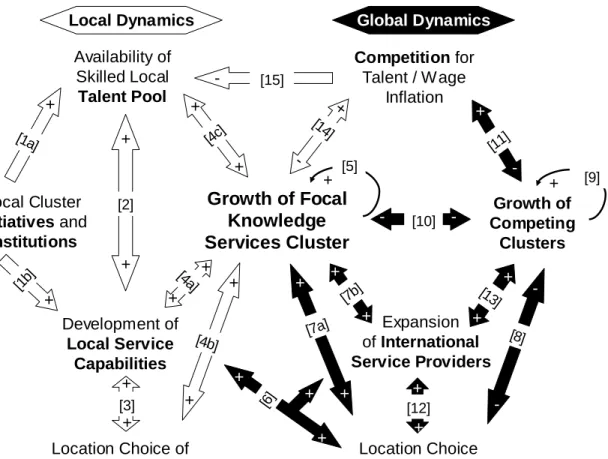
Our empirical analysis reveals that the development and growth of knowledge services clusters is driven by both local and global dynamics of changing supply, demand and competitive sourcing conditions (see Figure 5). The interaction between local and global dynamics has not been well understood, despite the increasing number of recent studies focusing on new knowledge services clusters, such as Bangalore (e.g. Dossani and Kenney, 2007; Bresnahan et al., 2001). Our empirical analysis, by contrast, allows for a more dynamic understanding of cluster growth, combining both local and global factors. Figure 5 displays the main dynamics in conjunction. Arrows with positive or negative signs mark positive or negative effects between different dynamics.
First, in particular our explorative analysis of three knowledge services clusters in Latin America confirms the importance of local dynamics in cluster development (see also in general Porter, 2000; Feldman et al., 2005). All three clusters in our case are
examples of clusters transitioning from lower-skilled capabilities – in electronics manufacturing (Guadalajara, Cordoba) and administrative processes (Recife) – to more advanced IT, software and other knowledge services. This transition has been promoted by government funding and the establishment of important cluster initiatives and institutions (IJALTI, CCT, CESAR). These partly government-led, partly private initiatives and institutions promoted, on the one hand, the development of local pools of highly skilled talent (see relation [1a] on Figure 5); on the other hand, they more or less actively promoted the development of local service capabilities, e.g. through specialized entrepreneurial firms, but also through captive units of MNCs ([1b], similar Athreye, 2005 for India). Both local firms and MNC subsidiaries further attract and, at the same time, train and utilize local talent ([2]). Interestingly, in all three cases, but in particular in Cordoba and Recife, local providers initially served local and regional clients rather than global MNCs. The very interactions and business relations between local providers and regional clients ([3]) can help clusters develop more or less specialized service capabilities. Cordoba, for example, has become known for customized software services which became a source of competitive advantage later on. Jointly, local talent, providers, regional clients, and – later – MNC subsidiaries contribute to cluster growth ([4a,b,c]), which may trigger further agglomeration ([5]).
However, from the very beginning, local cluster development in all three cases has also been shaped by global dynamics. To begin with, the very articulation of a need for transition towards knowledge services was sparked in particular by the growing dominance of China as the new global manufacturing base in the 1980s resulting in fewer foreign investment in Latin America (Moreira, 2006; Jenkins et al., 2007; see also
Altenburg et al., 2007). Later on, the ‘acquisition’ of pioneer MNCs – both clients and international service providers – as early users of local technical talent and expertise in the region would become a crucial part of cluster development ([6], [7a,b]). The success of such ‘acquisitions’, in turn, would depend on location preferences and strategic imperatives of MNCs at particular points in time. To some extent, e.g. in the case of Cordoba, MNCs have been attracted to the location not only by the availability of talent with certain technical and language skills, but also by specialized service capabilities, e.g. customized software services, that had emerged over time ([6]). For some pioneer MNCs, similar time zones (U.S. clients) or cultural proximity (Spanish clients) may have also played a role. Importantly, pioneer MNCs often promote further development of local service capabilities e.g. by promoting CMM certification as in the case of Motorola in Cordoba ([6]), see similar Ethiraj et al., 2005 for the case of Indian software service capabilities). The arrival of foreign firms promotes further cluster growth triggering self-reinforcing agglomeration effects as follower firms arrive, which is evident in all cases ([7a,b], [5], see in general, Porter, 2000; Pouder and St John, 1996).
However, why have some knowledge services clusters, e.g. Cordoba and Recife, developed in more promising ways than others, e.g. Guadalajara? There are certainly a number of reasons. Our study pointed at a major one: the parallel growth of clusters providing similar talent and capabilities in other parts of the world. When Guadalajara started acquiring pioneer MNCs in the early 2000s, Indian locations were already developing into hotspots for IT and software services. Their growth attracted further foreign investment, driven by isomorphic pressures (DiMaggio and Powell, 1983) and the avoidance of search costs involved in finding alternative locations ([8,9]). In particular
inexperienced sourcing firms lack market knowledge and would therefore follow industry leaders ([9]). As a result, growth of less developed clusters with similar profiles, such as Guadalajara, is likely to slow down ([10]). The same competitive effect can occur within a region: For example, the fact that lead investor Motorola set up a software development center in Cordoba in 2000 and not in Guadalajara (or any other location) promoted the growth of the Cordoba cluster at the expense of other clusters.
Yet, as pointed out by Pouder and St John (1996), cluster growth may lead to diseconomies of agglomeration, in particular growing competition for talent and wage inflation ([11, 14]). This has happened in recent years in many locations in India in particular. As established knowledge services clusters become more crowded, MNCs see the need to broaden their global search for technical talent and service expertise. With the recent trend towards commoditization of knowledge services and the establishment of global sourcing practices, several second-tier locations have emerged offering similar capabilities potentially attracting foreign investment. Unlike in the case of manufacturing, choosing alternative destinations for knowledge services sourcing is less constrained by logistics considerations, but primarily driven by the availability of high-skilled, yet lower cost talent and service expertise. In our case, in particular Recife arguably benefited from the shift of attention from India to alternative locations around 2005/6 by attracting a number of prestigious MNCs ([6], [10]). At the same time, international service providers, such as IBM, Accenture, Wipro and Infosys, started expanding by setting up new hubs for service delivery in these locations to serve global clients ([12, 13]). The presence of international providers may result in further cluster growth by attracting even more foreign client projects ([12]), in particular from inexperienced firms who otherwise
lack local contacts and expertise. As a result, as we showed based on ORN service provider data, the local sourcing market may become segmented into local, mostly smaller providers serving primarily smaller, often regional clients on the one hand ([3]), and large international providers serving often larger global clients on the other hand ([12]). However, cluster growth may also increase local competition for talent [(14)], making it more difficult for firms to find personnel to develop local capabilities ([15, 2]), hence giving other competing clusters the opportunity to catch up.
These findings have important implications for our understanding of the growth of knowledge services clusters in a global sourcing context. They suggest that cluster growth is much more contingent on changing global supply and demand for talent and services than previously assumed. While local dynamics of cluster development – including both path-dependent agglomeration effects and diseconomies of agglomeration (e.g. Pouder and St John, 1996) – remain important, we also point at the interaction of these dynamics within a global field of competing clusters. Future studies need to further explore these intersecting dynamics. At the same time, our study suggests that sources of sustainable competitive advantage in cluster development are limited in the context of global sourcing due to the increasing commoditization of knowledge services. Interestingly, the emergence of locally or regionally bound business relations may lead to the development of more specialized capabilities (see also Porter, 2000), e.g. in the case of Cordoba. However, the very arrival of international providers focusing on more standardized service capabilities may counteract local specialization effects. On the other hand, they may promote professionalization of local talent and service delivery, making second-tier clusters more competitive globally.
Our study may inform both cluster policies and managerial practice. As for policy implications, we suggest that the increasing commoditization of technical and knowledge services provides opportunities for new locations to develop technical talent pools and expertise attracting foreign firms. As global clients and providers alike have started establishing service hubs across the globe, this may provide good opportunities for learning and imitation. More specialized capabilities, e.g. customized services, as well as language skills and cultural proximity to MNCs from particular home countries, e.g. Spain in the case of Latin America, may even generate at least temporarily a competitive advantage. However, the increasing trend towards commoditization may also limit opportunities for differentiation. We also suggest that in a competitive global sourcing environment, windows of opportunity for growth may open and close. Timing therefore becomes very important. Today, particular clusters not only compete with others in the same country or region, but with clusters in different parts of the world. Being able to monitor changing MNC location preferences and concerns with rising wage inflation and competition for talent can become a key factor in trying to attract foreign investment decisions. A more dynamic understanding of local cluster growth and global competition is therefore needed to promote reflective and effective policy decisions.
As for managerial implications, our findings first of all confirm that many firms follow others when making location choices rather than trying to explore less crowded second-tier locations. Only a few companies, such as Motorola, seem to have developed capabilities that allow them to exploit location advantages long before locations become recognized as viable sourcing options by peers. Given the competitive dynamics of the global sourcing space, our findings suggest that it might be beneficial for more pioneer