MEMORY MODEL SENSITIVE ANALYSIS OF
CONCURRENT DATA TYPES
Sebastian Burckhardt
A DISSERTATION
in
Computer and Information Science
Presented to the Faculties of the University of Pennsylvania in Partial Fulfillment of the Requirements for the Degree of Doctor of Philosophy
2007
Rajeev Alur, Milo Martin Supervisors of Dissertation
Rajeev Alur
COPYRIGHT
Sebastian Burckhardt
To my wife Andrea and my children Sasha and Ellie
ABSTRACT
MEMORY MODEL SENSITIVE ANALYSIS OF CONCURRENT DATA TYPES Sebastian Burckhardt
Rajeev Alur, Milo Martin
Concurrency libraries can facilitate the development of multi-threaded programs by providing concurrent implementations of familiar data types such as queues and sets. Many optimized algorithms that use lock-free synchronization have been pro-posed for multiprocessors. Unfortunately, such algorithms are notoriously difficult to design and verify and may contain subtle concurrency bugs. Moreover, it is often difficult to place memory ordering fences in the implementation code. Such fences are required for correct function on relaxed memory models, which are common on contemporary multiprocessors.
To address these difficulties, we describe an automated verification procedure based on bounded model checking that can exhaustively check all concurrent execu-tions of a given test program on a relaxed memory model and can either (1) verify that the data type is sequentially consistent, or (2) construct a counterexample.
Given C implementation code, a bounded test program, and an axiomatic mem-ory model specification, ourCheckFence prototype verifies operation-level sequential consistency by encoding the existence of inconsistent executions as solutions to a propositional formula and using a standard SAT solver to decide satisfiability.
We appliedCheckFence to five previously published algorithms and found several bugs (some not previously known). Furthermore, we determined where to place memory ordering fences in the implementations and verified their sufficiency on our test suite.
Contents
1 Introduction 1
1.1 The Problem . . . 1
1.2 Our Solution . . . 2
1.2.1 The CheckFence Tool . . . 3
1.2.2 Checking Operation-Level Sequential Consistency . . . 4
1.2.3 Experiments . . . 6 1.3 Related Work . . . 6 1.4 Contributions . . . 9 1.5 Overview . . . 10 2 Foundations 12 2.1 Multiprocessor Executions . . . 12
2.1.1 Instructions and Values . . . 14
2.1.2 Local Memory Traces . . . 15
2.1.3 Local Trace Semantics . . . 16
2.1.4 Global Memory Traces . . . 16
2.1.5 Memory Model Semantics . . . 17
2.1.6 Concurrent Executions . . . 17 2.2 Formulae . . . 18 2.2.1 Vocabularies . . . 18 2.2.2 Formula Syntax . . . 20 2.2.3 Evaluation of Formulae . . . 21 3 Memory Models 22 3.1 Introduction . . . 22
3.2 Memory Model Examples . . . 24
3.2.1 Formal Specification . . . 27
3.2.2 Sequential Consistency (SeqCons) . . . 27
3.2.3 Relaxed . . . 27
3.2.4 Comparing Memory Models . . . 28
3.3 Specification Format . . . 29
3.3.2 Illustrative Example: Sequential Consistency . . . 33
3.4 Extensions . . . 33
3.4.1 Atomic Blocks . . . 34
3.4.2 Control and Data Dependencies . . . 35
3.4.3 Fences . . . 37
3.5 Axiomatic Memory Model Specifications . . . 39
3.5.1 Short Description of the Format . . . 40
3.5.2 Axiomatic Specification of Sequential Consistency . . . 41
3.5.3 Axiomatic Specification of Relaxed . . . 42
3.6 The RMO Model . . . 43
3.6.1 Axiomatic Specification of RMO . . . 44
3.6.2 Comparison to Relaxed . . . 45
3.6.3 Comparison to the SPARC Specification . . . 46
4 Programs 47 4.1 Motivation for an Intermediate Language . . . 47
4.2 Syntax . . . 48 4.2.1 Types . . . 48 4.2.2 Values . . . 48 4.2.3 Identifiers . . . 50 4.2.4 Execution States . . . 50 4.2.5 Procedure Definitions . . . 51 4.2.6 Program Statements . . . 51 4.2.7 Programs . . . 52 4.2.8 Basic Functions . . . 52
4.3 Memory Trace Semantics . . . 53
4.3.1 Inference Rules . . . 54 4.4 From C to LSL . . . 56 4.5 Unrolling Programs . . . 58 4.5.1 Unrolling Programs . . . 58 4.5.2 Unrolled Programs . . . 59 4.5.3 Sound Unrollings . . . 61 4.5.4 Circular Dependencies . . . 63 4.6 Extensions . . . 63 4.6.1 Nondeterministic Choice . . . 65 4.6.2 Atomic Blocks . . . 65 4.6.3 Tagged Unions . . . 65 5 Encoding 67 5.1 Vocabulary for Formulae . . . 68
5.1.1 Set Symbols . . . 69
5.1.3 Variable Symbols . . . 69
5.2 Valuations and Executions . . . 70
5.3 The Formula Ψ . . . 72
5.4 Encoding the Memory Model . . . 73
5.4.1 Encoding procedure . . . 74
5.4.2 The Formula Θ . . . 75
5.5 Encoding Local Traces . . . 77
5.5.1 Symbolic Traces . . . 78
5.5.2 Evaluating Symbolic Traces . . . 79
5.5.3 Appending Instructions . . . 79
5.5.4 Pseudocode Algorithm . . . 80
5.5.5 Formal Algorithm . . . 83
5.5.6 Correctness of the Algorithm . . . 84
5.5.7 The Formulae Πk . . . 85 5.6 Correctness . . . 86 6 Checking Consistency 87 6.1 Introduction . . . 87 6.1.1 Lock-based Implementations . . . 88 6.1.2 Lock-free Synchronization . . . 89 6.1.3 Correctness Proofs . . . 89 6.2 Correctness Criteria . . . 90 6.2.1 Linearizability . . . 90 6.2.2 Sequential Consistency . . . 90 6.2.3 Our Choice . . . 91 6.3 Bounded Verification . . . 92
6.3.1 Bounded Test Programs . . . 92
6.3.2 Correctness Condition . . . 92
6.3.3 Checking Tests . . . 93
6.4 Consistency Check . . . 94
6.5 Specification Mining . . . 95
6.5.1 Algorithm . . . 96
7 The CheckFence Implementation 97 7.1 General Description . . . 97
7.1.1 Runtime Type Checks . . . 99
7.2 Front End . . . 99
7.2.1 General Philosophy . . . 100
7.2.2 Parsing . . . 100
7.2.3 Locks . . . 101
7.2.4 Dynamic Memory Allocation . . . 101
7.3 Back End . . . 103
7.3.1 Lazy Loop Unrolling . . . 103
7.3.2 Range Analysis . . . 103
7.3.3 Using a SAT Solver . . . 104
7.3.4 Optimized Memory Models . . . 105
8 Experiments 107 8.1 Implementation Examples . . . 108
8.2 Bugs Found . . . 110
8.2.1 Missing Fences . . . 110
8.2.2 Description of Typical Failures . . . 113
8.3 Quantitative Results . . . 114
8.3.1 Consistency Check Statistics . . . 114
8.3.2 Specification Mining Statistics . . . 114
8.3.3 Impact of Range Analysis . . . 118
8.3.4 Memory Model Encoding . . . 118
9 Conclusions 121 9.1 Contributions . . . 122
9.2 Future Work . . . 122
9.2.1 General Research Directions . . . 122
9.2.2 ImprovingCheckFence . . . 123
A Correctness of Encoding 124 A.1 Basic Invariants . . . 124
A.2 Correspondence . . . 127
A.3 Core Lemmas . . . 127
A.4 Core Proofs . . . 129
A.4.1 Proof of Lemma 52 . . . 129
A.4.2 Proof of Lemma 53 . . . 137
B C Implementation Sources 144 B.1 Prototypes . . . 144
B.2 Two-Lock Queue (ms2) . . . 145
B.3 Nonblocking Queue (msn) . . . 147
B.4 Nonblocking List-Based Set (harris) . . . 148
B.5 Lazy List-Based Set (lazylist) . . . 152
B.6 Snark Deque (snark) . . . 154
List of Figures
1.1 Black-box view of the CheckFence tool. . . 3
2.1 An example of a program and a local memory trace. . . 13
2.2 An example of a concurrent program and a global memory trace. . . 13
2.3 Formula Syntax. . . 19
3.1 An example of a relaxed execution trace . . . 23
3.2 A trace showing out-of-order execution . . . 25
3.3 A trace showing the effect of fences . . . 25
3.4 A trace showing the effect of store-load forwarding . . . 26
3.5 A trace showing lack of global store order . . . 26
3.6 A comparison of various memory models. . . 29
3.7 Memory Model Axiom Syntax. . . 31
3.8 Pseudocode for the compare-and-swap (CAS) operation. . . 34
3.9 Pseudocode for the lock and unlock operations. . . 38
4.1 The abstract syntax of LSL . . . 49
4.2 Representing C pointers in LSL. . . 56
4.3 Example of how to translate a two-armed conditional from C to LSL. 57 4.4 Example of how to translate a loop from C to LSL. . . 57
4.5 The abstract syntax of unrolled LSL programs . . . 60
4.6 Unrolling Example. . . 62
4.7 An example of a unsound unrolling on a memory trace with circular dependencies. . . 64
5.1 Example of a symbolic trace. . . 79
6.1 Illustration example: concurrent queue. . . 88
6.2 Example: A bounded test. . . 93
7.1 An example run of the tool . . . 98
7.2 A screenshot of a counterexample trace . . . 98
8.1 The implementations we studied . . . 108
8.3 The issues we found using ourCheckFence tool. . . 110
8.4 Statistics about the consistency checks . . . 115
8.5 Time/Memory required by SAT solver . . . 116
8.6 Observation set construction statistics. . . 117
8.7 (a) Breakdown of Runtime (b) Impact of Range Analysis . . . 118
Chapter 1
Introduction
Shared-memory multiprocessor architectures are now ubiquitous. With today’s ad-vanced chip manufacturing technology, several processors can easily fit onto a single chip. In fact, because of the better performance/power ratio of multiprocessors, hardware architects now prefer to provide multiple cores rather than a highly opti-mized single core.
Unfortunately, even as multiprocessor hardware becomes cheap, writing software that can unleash its performance potential remains challenging [67]. We see this gap as an opportunity for researchers, as it is likely to lead to a high demand for strategies that can aid programmers to write simple, correct, efficient and portable multi-threaded programs.
In this introductory chapter, we first describe the specific problem this work addresses (Section 1.1). Next, we present our solution and report on our practical experiences applying it (Section 1.2). Then, we compare our work to prior results and tools in this general area (Section 1.3). Finally, we conclude this chapter with a description of the logical structure of this document and a brief summary of each of the remaining chapters (Section 1.5).
1.1
The Problem
The specific problem we are solving is the verification of concurrency libraries that use lock-free synchronization and target multiprocessor architectures with relaxed memory models.
Concurrency Libraries
Concurrency libraries can alleviate some of the problems associated with the de-velopment of concurrent software. For example, the java.util.concurrent package JSR-166 [46] or the Intel Threading Building Blocks [40] support the development of safe and efficient multi-threaded programs by providing concurrent data types, that
is, concurrent implementations of familiar data abstractions such as queues, sets, or maps.
By raising the data abstraction level, concurrency libraries can free the program-mer from some of the issues associated with safe sharing of data between threads. Moreover, libraries can also improve performance, as they may use algorithms that are optimized for concurrency.
Lock-free Synchronization
Many sophisticated algorithms for concurrent data types that use lock-free synchro-nization have been proposed [29, 30, 52, 54, 55, 66]. Such implementations are not race-free in the classic sense because they allow concurrent access to shared memory locations without using locks for mutual exclusion.
Algorithms with lock-free synchronization are notoriously hard to verify, as wit-nessed by many formal verification efforts [12, 25, 70, 74] and by bugs found in published algorithms [17, 53]. Many more interleavings need to be considered than for implementations that follow a strict locking discipline. Moreover, the deliber-ate use of races prohibits the use of classic race-avoiding design methodologies and race-detecting tools [1, 20, 31, 43, 57, 61, 63, 73].
Relaxed Memory Models
Most commonly used multiprocessor architectures userelaxed memory ordering mod-els [2]. For example, a processor may reorder loads and stores by the same thread if they target different addresses, or it may buffer stores in a local queue. Whereas fully lock-based programs are insensitive to the memory model (because the lock and unlock operations are designed to guarantee the necessary memory ordering), implementations that use lock-free synchronization require explicitmemory ordering fences to function correctly on relaxed memory models. Nevertheless, fence place-ments are rarely published along with the algorithm.
Memory ordering fences (or, as they are sometimes called, memory barriers) counteract the ordering relaxations by enforcing memory order between preceding and succeeding instructions. A lack of fences can lead to incorrect behavior, whereas an overzealous use of fences impacts performance.
1.2
Our Solution
To help designers and implementors develop correct and efficient programs for re-laxed models, we present a verification method which is based on bounded model checking and can check the correctness of an implementation automatically, for a suite of bounded test programs written by the user. Furthermore, it can produce counterexample traces if the implementation is found to be incorrect.
C code for data type ope− rations Symbolic test thread 1: enqueue(X) dequeue()−>Y thread 2:
Memory Model Specification
INCONCLUSIVE runs out of time or memory Counterexample thread 1: Trace thread 2: FAIL
CheckFence
PASS: all executions of the test are sequentially
consistent (on the level of the data type operations)
Figure 1.1: Black-box view of the CheckFence tool.
We describe our solution in the following three sections. Section 1.2.1 describes our tool CheckFence from a “black-box” perspective. In Section 1.2.2, we describe in more detail how our tool checks the sequential consistency of an implementation. Finally, Section 1.2.3 summarizes our experiences with applying the tool to some implementations from the literature.
1.2.1
The
CheckFence
Tool
We implemented our verification method in our CheckFence tool (Fig. 1.1). Given (1) the implementation code, (2) a bounded test, and (3) an axiomatic memory model specification,CheckFencechecks all executions and returns one of the following answers:
• PASS: all executions of the test are correct.
• FAIL: an incorrect execution was found, and is presented to the user in the form of a counterexample trace.
• INCONCLUSIVE: the tool exhausted its time or space resources.
We use it in the following manner. First, we write a few small and simple bounded tests by hand that call the code being verified. For those, our method can decide quickly whether they are correct, or give us a counterexample if they are not. Then we can manually increase the size of the tests gradually (fixing any bugs we find along the way), until we reach the scalability limits. All counterexamples are sound, and no time is thus wasted on false warnings.
Although we can not completely verify an implementation in this manner (be-cause our test suite may be incomplete and not cover all possible cases), our expe-rience suggests that most bugs can be found on simple, small tests, especially the bugs that are caused by relaxations in the memory model.
1.2.2
Checking Operation-Level Sequential Consistency
Our correctness condition issequential consistency [44] on the operation level, which requires that for all client programs and all executions, the observed outcome is con-sistent with some atomic interleaving of the operations by each thread. Note that the consistency of the data type operations is independent of the consistency model used by the underlying hardware: a concurrent data type may be sequentially consis-tent on the level of the data type operations even if the underlying multiprocessor’s memory model (which is specified as one of the inputs to the tool) is not sequentially consistent.
Bounded Tests
Each bounded test specifies a finite sequence of operation invocations for each thread and may use nondeterministic input arguments. Because the total number of instruc-tions is limited for each test, the number of execuinstruc-tions is finite. Unlike deterministic tests, however, a bounded test has an exponential number of executions, because it considers all possible inputs, all instruction interleavings and reorderings, and non-deterministic dynamic memory allocation. It is thus easy to cover many executions with just a few tests.
Note that without bounding the executions in some way, the verification problem is generally undecidable because (1) C programs that access unbounded amounts of memory are Turing-complete, and (2) sequential consistency is undecidable even for implementations with finite memory [3].
Specification Mining
The definition of sequential consistency assumes that we have a formal specification of the serial semantics of the data type. Because we prefer not to require the user to write a formal specification, we use an automatic specification mining algorithm that can extract a specification directly from an implementation. The idea is that we assume that the serial executions of the implementation are correct and can thus serve as the serial specification of the data type.
Note that we can verify the serial executions separately, using more conventional techniques: for serial executions, only one thread executes at a time, and the threads are interleaved along operation boundaries only. They are thus much easier to verify. Also, we have the option of writing a separate reference implementation (which need
not be concurrent and is thus much simpler) and extract the specification from the latter.
Encoding
At the heart of our method is an encoding that represents the executions of the test program (on a relaxed memory model) as solutions to a propositional formula. More specifically, we construct a formula that has a satisfying valuation if and only if there exists an incorrect execution. Then, we use a standard SAT solver to decide if such a solution exists; if it does, we can use the assignment provided by the SAT solver to construct the counterexample trace.
Handling C Code
The C language does not have a language-level memory model, and does not explic-itly specify what load and store instructions a program may produce. To accurately model synchronization instructions and the effects of the memory model, we require a lower-level representation that makes the loads and stores explicit.
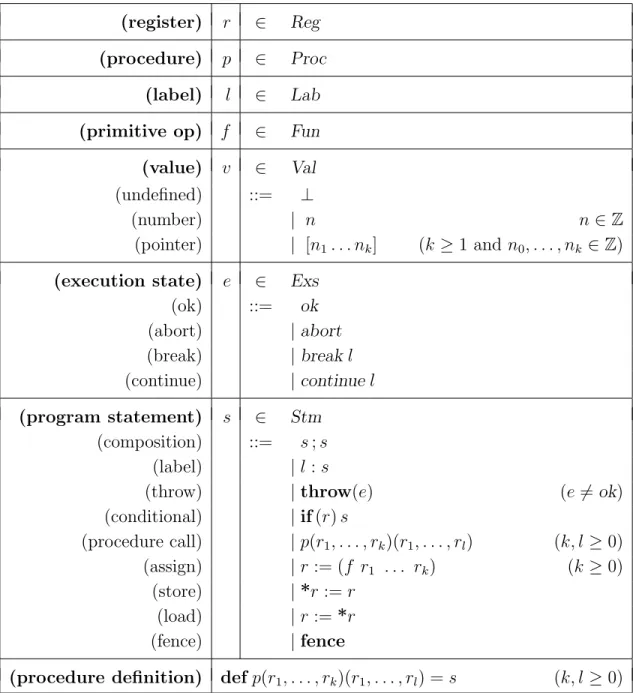
To this end, we define an intermediate language called LSL (load-store language) that has (a) a small syntax, (b) a well-defined semantics even for weak memory models, and (c) support for spin loops, atomic blocks, and assertions.
Our front end accepts a reasonable subset of C and performs an automatic trans-lation into LSL.
Memory Model Specifications
Unfortunately, researchers, engineers and programmers do not always agree on how to interpret the memory model specifications found in the architecture manuals. Because precise specifications are an absolute prerequisite for formal verification, we establish a solid formal foundation for multiprocessor executions and develop a specification format for axiomatic memory models.
Moreover, we capture the most common relaxations (store buffers, out-of-order execution) by defining a memory model Relaxed. This model abstracts unneeded details and provides a common conservative approximation of the Sun SPARC v9 TSO/PSO/RMO [72], Alpha [13], and IBM zArchitecture [41]. We chose not to include a third relaxation (non-global store orders) in Relaxed, which is thus not quite as weak as IBM PowerPC [24], IA-32 [38], or IA-64 [39]. It remains on our list of future work to explore the impact of non-global store orders on the correctness of implementations.
We give a brief introduction to memory models and present examples of these relaxations in Section 3.1.
1.2.3
Experiments
We applied CheckFence to five previously published algorithms, writing C code that closely follows the published pseudocode, and creating test programs. We were thus able to
1. Reproduce two known bugs in a concurrent deque algorithm known as “snark” [14, 17, 45].
2. Uncover a not-previously-known bug in a lazy list-based set implementation. The published pseudocode [30] fails to initialize a field, which was missed by a prior formal verification using the PVS interactive proof system [12].
3. Show numerous failures on architectures with relaxed memory models (the original algorithms assume sequentially consistent architectures), and fix them by inserting appropriate memory ordering fences.
Our experiments confirm that the CheckFence method is very efficient at verify-ing or falsifyverify-ing small testcases. As small testcases appear to be sufficient to find memory-model-related bugs (all of the testcases that we required to expose missing fences contained fewer than 200 memory accesses and took less than 10 minutes to verify),CheckFence achieves its main goal.
Furthermore, CheckFence proved to be useful to find algorithmic bugs that are not related to the memory model. In general, however, we found that the tool does not scale for testcases that require more than a few hundred memory accesses.
1.3
Related Work
Of course, many aspects of our method were inspired by previous work and build upon the results of others. The following list should be representative for the various research areas that we found relevant for our work.
Verification of Concurrent Data Types
Most prior work on verification of concurrent data types is based on interactive proof construction and assumes a sequentially consistent memory model [12, 25, 62, 70]. These methods are far from automated, but require a laborious proof construction. Shape analysis can provide a somewhat higher degree of automation[74], but still requires sophisticated user guidance. To our knowledge, analogous proof strategies for relaxed memory models have not been investigated.
Runtime verification is highly automatic and scalable (yet less complete) and has been applied successfully in this domain [18, 68]. These methods require the user to specify the commit points for each operation manually.
Relaxed Memory Models
Reasoning about execution traces by means of ordering relations and axioms was pioneered by Collier [11]. Using similar techniques, Gharacharloo [26] describes a number of practically relevant models and how they are connected to hardware implementations. A similar perspective is assumed by the tutorial [2], which is an excellent introduction to the subject. Contemporary architecture manuals [13, 24, 37, 38, 39, 41, 72] use an axiomatic style for memory model specifications, although they are often not quite formal, nor quite complete. The Java Memory Model [50] also uses an axiomatic style.
Model Checking Code on Relaxed Models
Most previous work on model checking executions on relaxed memory models has focused on relatively small and hand-translated code snippets (such as spinlocks or litmus tests). It can be divided into two categories: explicit-state model checking combined with operational memory models [16, 60], and constraint solving combined with axiomatic memory models [8, 27, 78].
We prefer the latter approach for two reasons: (1) axiomatic models can more easily capture official specifications because they use an axiomatic style, and (2) constraint-based encodings can leverage the advances in SAT solving technology.
Operational Memory Models
The first connection between memory model specifications and verification tools was made using explicit-state model checking [16, 60]. For this approach to work, the axiomatic specification must first be manually translated into an operational model, which can be challenging. This same method was applied again more recently to the C# memory model [36].
We are not aware of any work that demonstrates an application of operational memory models to the verification of programs that contain more than a few lines of code.
Axiomatic Memory Model Specifications
The use of constraint solvers rather than explicit-state model checkers was first ap-plied to the validation of hardware execution traces [27], which inspired our encoding of executions.
Our axiomatic specification format is very similar also to the one used by the NEMOS project [75, 78] (Non-operational yet executable memory ordering specifi-cations), which also proposes the use of SAT solvers to validate execution traces. The main differences are that (1) our approach uses a custom specification format rather than a subset of PROLOG, and (2) we connect the memory model specifica-tion with actual C programs and concurrent data type implementaspecifica-tions rather than
hardware execution traces. More recently, the NEMOS ideas were extended to apply to software verification as well [76, 77]. However, there is no mention of applying these techniques to concurrent data types. Also, they consider a custom, abstract programming language only, and do not demonstrate that their prototype can find issues in real implementations.
Encoding Program Executions
The idea of encoding program executions as formulae is of course not new, in par-ticular for sequential programs. Jackson and Vaziri [42] demonstrate that constraint solving is useful for finding bugs in small, sequential code, using the Alloy constraint solver. The CBMC tool by Clarke, Kroening and Lerda [10] tackles a problem that is closely related to ours, as it translates sequential ANSI C code into SAT constraints. The brief paper on CBMC [10] gave us some important clues on how to encode programs; however, it does leave many aspects undiscussed and does not present an encoding algorithm.
For concurrent programs, a SAT encoding based on bounding the context switches was proposed by Rabinovitz and Grumberg [62]. This encoding is quite different from ours (and handles sequentially consistent executions only): it models the interleav-ings by associating with each instruction the number of context switches prior to its execution, rather than encoding the memory ordering as a binary relation.
Parts of the design of our intermediate language LSL were inspired by prior work in research areas not related to memory models or concurrent data types. For instance, we liked the elegant use of exceptions as the fundamental control structure in the intermediate language for ESC Java [47]. Also, the work on building verifiable compilers [6, 48] gave helpful clues on the design of a front end, because it describes in careful detail how to transform C into machine language through a series of steps that are then formally verified by the Coq proof assistant.
Fence Insertion
Specialized algorithms to insert memory fences automatically during compilation have been proposed early on [19, 64]. However, these methods are based on a con-servative program analysis, which makes them less attractive for highly optimized implementations: inserting fences indiscriminately has a considerable performance impact [69, 71] and should be used sparingly.
Existing Verification Tools
Today’s state-of-the-art software verification tools offer only indirect help for imple-mentors of concurrent data types that use lock-free synchronization. Race-detectors are useless, as the implementations contain intentional data races. Many model checkers do not support concurrency at all (BLAST, SLAM, CBMC). The ones that
do (Zing, F-Soft, SPIN) assume a sequentially consistent memory model and offer no support for checking high-level correctness conditions such as sequential consistency, which cannot be captured using monitors or assert statements.
Comparison to Our Earlier Publications
We first introduced our verification method in the CAV paper [8]. This paper is written as a case study that describes our encoding of executions of bounded test programs, and reports on our experiences applying it to a small example. In our PLDI paper [9], we add the front end that translates C code, study more exam-ples, and describe the specification mining (replacing the less automatic and slower commit point method we used for the case study). Compared to those papers, this dissertation contains new material in the following areas:
1. We develop a generic specification format for axiomatic memory models. To demonstrate its use, we use it to formalize the Sparc RMO model (Chapter 3). Furthermore, we give a quantitative comparison of the various memory model encodings in Chapter 8.
2. We describe our intermediate language LSL in detail, and present a formal syntax and semantics (Chapter 4).
3. We present a pseudocode algorithm that shows how we encode programs as formulae, and prove its correctness (Chapter 5).
1.4
Contributions
Verifying concurrent data type implementations that make deliberate use of data races and memory ordering fences is challenging because of the many interleavings and counterintuitive instruction reorderings that need to be considered. Conven-tional verification tools for multithreaded programs are not sufficient because they make assumptions on the programming style (race-free programs) or the memory model (sequential consistency).
Our verification method as embodied in theCheckFence implementation provides a valuable aid to algorithm designers and implementors because it (1) accepts im-plementations written as C code, (2) supports relaxed memory models and memory ordering fences, and (3) can verify that the implementation behaves correctly for a given bounded test and produce a counterexample trace if it does not.
Our experiments confirm that the CheckFence method is very efficient at finding memory-model related bugs. All of the testcases we required to expose missing fences contained fewer than 200 memory accesses and took less than 10 minutes to verify. Furthermore, CheckFence proved to be useful to find algorithmic bugs that are not related to the memory model.
1.5
Overview
To facilitate navigation, we provide a brief summary of each of the remaining chap-ters.
• Chapter 2 lays the technical foundations of our formalization. We establish what we mean by an execution of a program on a multiprocessor, including executions on relaxed memory models.
Furthermore, we introduce the logic framework (formulae, vocabularies, valua-tions, etc.) needed for describing memory model specifications (Section 3.3.1) and our encoding of executions (Section 2.2).
• Chapter 3 introduces relaxed memory models and describes our specification format for axiomatic memory models. We conclude this chapter with a listing of the axiomatic specifications for sequential consistency, Relaxed, and the SPARC RMO model.
• Chapter 4 formalizes our notion of programs by introducing an intermediate language called LSL (load-store language) with a formal syntax and semantics. Furthermore, it describes how to unroll programs to obtain finite, bounded versions that can be encoded into formulae.
• Chapter 5 describes how to construct a propositional formula whose solutions correspond to the concurrent execution of an unrolled program on the specified memory model. This encoding lays the technical foundation for our verifica-tion method. It also contains a correctness proof (which is partially broken out into Appendix A). The construction of this proof heavily influenced our formalization of concurrent executions and memory traces.
• Chapter 6 introduces concurrent data types and shows how we define correct-ness and verify it by bounded model checking. This chapter shows how to assemble the techniques introduced in the earlier chapters, and explains our verification method.
• Chapter 7 describes the CheckFence tool, which implements our verification method. We discuss some of the implementation challenges, such as the trans-lation from C to LSL, and how to encode formulae in CNF form suitable for SAT solving.
• Chapter 8 describes the results of our experiments. It lists both qualitative re-sults (bugs we found in the studied implementations), and quantitative rere-sults (performance measurements for the CheckFence tool). For completeness, we list the C source code of the studied implementations (along with the fences we inserted) in Appendix B.
Chapter 2
Foundations
In this chapter, we lay the technical foundations of our formalization. We address two topics:
• In Section 2.1, we establish what we mean by an execution of a program on a multiprocessor. While the execution semantics of uniprocessor machines is generally well understood by programmers and well specified by architecture manuals, the situation is less clear for multiprocessors. As we wish to use precise reasoning, we first establish a solid formal foundation for multiprocessor executions.
• In Section 2.2, we present the logic framework needed for describing our en-coding. Specifically, we define a syntax and semantics for formulae (featuring types, quantifiers, equality, and limited support for second-order variables). Most of the material in that section is fairly standard and can be skimmed by most readers.
2.1
Multiprocessor Executions
To achieve a clean separation between the local program semantics (local program execution for each thread) and the memory model (interaction between different threads via shared memory), we abstractly represent the communication between the program and the memory system using memory traces. More specifically, we adopt the following perspective:
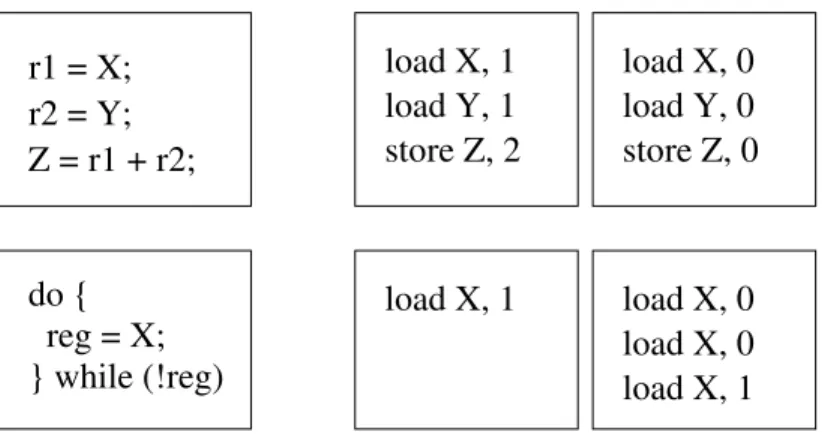
• During an execution, each local program performs a logical sequence of load, store, and fence instructions, which can be described abstractly by a local memory trace. Fig. 2.1 shows informal examples of programs and some local memory traces they may produce (many others are possible). We define the setLtr of all local traces in Section 2.1.2.
r1 = X; Z = r1 + r2; r2 = Y; do { } while (!reg) reg = X; load X, 1 load X, 0 load Y, 0 store Z, 0 load Y, 1 store Z, 2 load X, 1 load X, 0 load X, 0 load X, 1
Figure 2.1: Informal Example: we show two programs on the left, and for each program two possible local memory traces it may produce on the right.
do {
} while (!reg)
reg = X; X = 0;X = 1;
processor 1 processor 2 processor 1 processor 2
load X, 0 load X, 0 load X, 0 load X, 1 store X, 0 store X, 1
Figure 2.2: Informal Example: the concurrent program on the left may produce the global memory trace on the right (among many other possibilities). The arrows indicate for each load where the value was sourced from.
• The memory system combines the local traces into aglobal memory trace. The global trace specifies for each load where its value originated. The origin of the value can be either a store appearing in one of the local traces, or the initial value of the memory location. Fig. 2.2 shows an informal example of a concurrent program and a global trace that it could possibly exhibit (again, other executions are possible). We define the set Gtr of all global traces in Section 2.1.4.
Trace Semantics
For the purpose of this chapter, we assume an abstract view of programs and memory models. We simply foreshadow the definition of suitable sets Prog, Axm and the semantic functionsEL and EG as follows:
• We assume a definition for the setProgof local programs (defined in Chapter 4) and a function
EL :Prog → P(Ltr×Exs)
where Ltr is the set of local traces (to be defined in Section 2.1.2 below) and
Exs is a set of execution states (to be defined in Chapter 4). EL(p) captures
the semantics of the program p in the following sense: (t, e) ∈ EL(p) if and
only if there is an execution of programp(in some arbitrary environment) that produces the local memory trace t and terminates with execution state e.
• We assume a definition for the set Axmof axiomatic memory model specifica-tions (defined in Chapter 3) and a function
EG:Axm→ P(Gtr)
where Gtr is the set of global traces (to be defined in Section 2.1.4 below).
EG(Y) captures the semantics of the memory model specification Y in the
following sense: T ∈EG(Y) if and only if the global traceT is allowed by the
memory model Y.
As we formalize the semantics of the memory system and the individual threads separately, they both become highly nondeterministic (because they assume the most general behavior of the environment). For a specific concurrent program and mem-ory model, the executions are much more constrained because the possible traces must simultaneously match the semantics of each individual thread and the memory model. When we encode concurrent executions later on (Chapter 5) we express these individual constraints as formulae that must be simultaneously satisfied.
In the remainder of this section, we formalize the ideas outlined above and con-clude with a definition of the set of concurrent executions (Section 2.1.6).
2.1.1
Instructions and Values
To formalize memory traces, we need some preliminary definitions that provide the framework for representing the machine instructions, memory addresses and data values used by a program. We also need to consider the fact that programs may terminate abnormally.
1. Memory traces are made up of individual instructions. We let I be a pool of instruction identifiers. We will use these identifiers to distinguish individual instructioninstances. Note that a single statement in a program may produce more than one instruction instance1:
1Computer architects sometimes use a terminology that distinguishes between “static” and
• Some statements produce several memory accesses. For example, if x, y
are variables residing in memory, the assignment x = y+ 1 first loads the location y, then adds 1, then stores the result to location x, thus producing both a load and a store instruction.
• Program statements may be executed more than once if they appear within a loop or a recursive procedure. Each time it gets executed, a statement produces fresh instruction instances.
We keep identifiers unique within an execution, and say ‘instruction’ short for ‘instruction identifier’ or ‘instruction instance’.
2. There are different types of instructions. For our purposes, we care about instructions that are relevant for the memory model only and define the fol-lowing types: Cmd = {load,store,fence}. We let the type of each instruction be defined by the function cmd :I →Cmd.
We assume that cmd−1(c) is infinite for all all c∈Cmd, so there is an infinite supply of instruction identifiers for each type. For notational convenience, we define the following functions on sets of instructions:
loads : P(I)→ P(I) loads(I) = {i∈I |cmd(i) = load} stores : P(I)→ P(I) stores(I) = {i∈I |cmd(i) = store} fences : P(I)→ P(I) fences(I) = {i∈I |cmd(i) = fence} accesses : P(I)→ P(I) accesses(I) = loads(I)∪stores(I)
3. We let Val denote the set of values that appear in the traces. We give a full definition of Val in Section 4.2. For now, we only state its properties as far as they are relevant for understanding this section:
• Val can represent address and data values used by programs
• Val contains a special value ⊥ to represent an undefined value
2.1.2
Local Memory Traces
A local memory trace describes the logical sequence of memory instructions issued by the local program, and it includes the specific values that are loaded and stored, and the addresses of all accessed memory locations. It is defined as follows:
Definition 1 A local memory trace is a tuple t= (I,≺,adr,val) such that • I ⊂ I is a set of instructions
• ≺ is a total order over I (called the program order) • adr is a function of type accesses(I)→Val
• val is a function of type accesses(I)→Val
Let Ltr be the set of all local traces. Let t0 be the local trace for which I =∅.
For an instruction i, adr(i) is the address of the accessed memory location, and
val(i) is the value loaded or stored.
2.1.3
Local Trace Semantics
What memory traces are possible depends on the local program. The same local program may exhibit many different memory traces, because the details of its exe-cution (say, the path taken) usually depends on the behavior of other threads. We account for this nondeterministic behavior by defining the trace semantics of a pro-gram to be the set of all memory traces that the propro-gram may exhibitin an arbitrary environment. This set must cover all local program executions, for arbitrary values returned by each load: when running in an arbitrary environment, other threads may store any value to any location at any time, so a load may return any value.
In Chapter 4, we will formally define the set Prog of local programs, the setExs
of execution states and the semantic function EL :Prog → P(Ltr×Exs) such that (t, e) ∈ EL(p) if and only if there is an execution of program p (in some arbitrary
environment) that produces the local memory tracet and terminates with execution state e.
2.1.4
Global Memory Traces
A global memory trace is somewhat similar to a local trace, but with a few important differences. First of all, the trace contains instructions from different processors. As a result, the program order is no longer a total order, but a partial order. Moreover, a global trace specifies for each load where the loaded value originated. A loaded value may originate from some prior store in the trace (if that store targeted the same address), or it may be the initial value of the loaded memory location (which we represent using the special value ⊥). Note that a global trace does not specify any temporal relationships between the instructions, only the logical relationship between loads and the stores they get their value from.
Definition 2 Aglobal trace is a tupleT = (I,≺,proc,adr,val,seed,stat) such that • I ⊂ I is a set of instructions
• ≺ is a partial order overI
• proc is a function of type I →N (the processor issuing the instruction) • ≺ is a total order on proc−1(k) for each k∈N
• val is a function of type accesses(I)→Val
• seed is a partial function of type loads(I)*stores(I)
• if seed(l) =s, then adr(l) =adr(s) and val(l) =val(s)
• if l ∈(loads(I)\domseed), then val(l) =⊥
• stat is a partial function of type N→Exs such that (rgproc⊂domstat ) Let Gtr be the set of all global traces. Let T0 be the global trace for which I =∅.
We can project a global trace onto its local components as follows:
Definition 3 For a global trace T ∈Gtr and an integer k ∈N define the projection πk(T) of T onto processor k to be the tuple (I0,≺0,adr0
,val0) where • I0 ={i∈I |proc(i) = k} • ≺0=≺| (I0×I0) • adr0 =adr|I0 • val0 =val|I0
It follows directly from the definition that for any global trace T, the projection
πk(T) is a local trace.
2.1.5
Memory Model Semantics
The memory model defines restrictions on what global traces are possible. For ex-ample, the simplest memory model (sequential consistency) requires that the global trace is consistent with someinterleaving of the local traces. However, not all mem-ory models are that strict. We will discuss this topic in more detail in Chapter 3 where we define the set Axm of axiomatic memory model specifications and the se-mantic function EG:Axm→ P(Gtr) such that T ∈EG(Y) if and only if the global
trace T is allowed by the memory model Y.
2.1.6
Concurrent Executions
We can now bring together the notions of programs, memory models, and executions. First we define concurrent programs.
Definition 4 Aconcurrent program is a tupleP = (p1, . . . , pn)such thatn≥0and for each i, pi ∈Prog is a local program.
We now conclude this section with the definition of concurrent executions.
Definition 5 For a concurrent program P = (p1, . . . , pn) and a memory model Y, define the set E(P, Y) of concurrent executions of P on Y to consist of all global traces T = (I,≺,proc,adr,val,seed,stat) that satisfy the following conditions:
• T ∈EG(Y)
• for all k ∈ {1, . . . , n}, we have (πk(T),stat(k))∈EL(pk) • for all other k, πk(T) =t0
Because memory models are nondeterministic, there are typically many execu-tions for a given programP. Reasonable memory models will likely satisfy additional properties (for example, all programsP should have at least one execution).
2.2
Formulae
In this section, we establish the logical framework for formulae. Most of this material is fairly standard; we start with a quick informal overview which is likely to be sufficient for most readers.
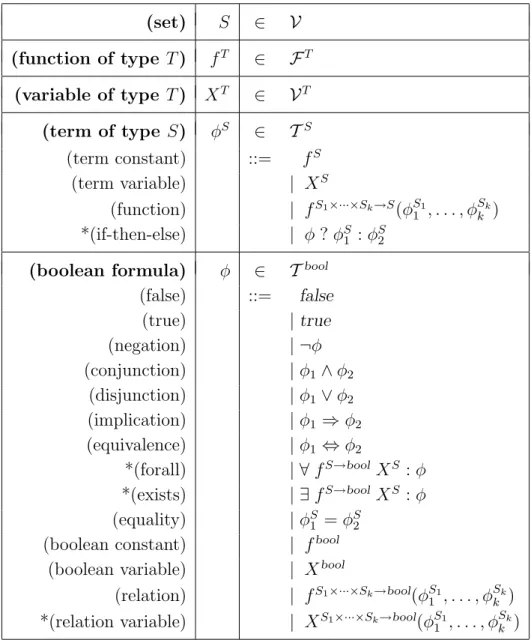
We construct formulae and terms over a vocabulary of set symbols S, typed function symbolsF and typed variable symbolsV, using the syntax shown in Fig. 2.3. For some interpretationJ.KofS ∪ F and a valuation ν of the variables inV, we then define the evaluation function JφKν on a formula or termφ in the usual way.
The following points of interest are marked by an asterisk (*) in Fig. 2.3:
• We provide an (if-then-else) constructφ ?φ1 :φ2 which evaluates to either φ1 orφ2, depending on whether φ evaluates to true or false, respectively.
• We provide a limited quantifier syntax (∀p X :φ) and (∃p X :φ), wherepis a predicate that restricts the range over which the variableX is being quantified. The reason is that we use these quantifiers when expressing memory model axioms (Section 3.3.1). Our encoding does not support arbitrary quantification, but requires that the quantifiers range over subsets of instructions in the trace (which are finite). Using this syntax, we can control the range of quantifiers by limiting the predicates that are available in the vocabulary.
• We provide second-order relation variables.
For completeness, we provide a more formal exposition of these concepts in the remainder of this section. We encourage the reader to skim the details.
2.2.1
Vocabularies
To construct formulae, we need some elementary symbols to represent sets, functions, relations, and variables. Such symbols are provided by the vocabulary, defined as follows:
Definition 6 An uninterpreted vocabulary is a tuple σ = (S,F,V) where • S is a set of set symbols.
(set) S ∈ V (function of type T) fT ∈ FT (variable of type T) XT ∈ VT (term of type S) φS ∈ TS (term constant) ::= fS (term variable) | XS (function) | fS1×···×Sk→S(φS1 1 , . . . , φ Sk k ) *(if-then-else) | φ?φS 1 :φS2 (boolean formula) φ ∈ Tbool
(false) ::= false (true) |true (negation) | ¬φ (conjunction) |φ1∧φ2 (disjunction) |φ1∨φ2 (implication) |φ1 ⇒φ2 (equivalence) |φ1 ⇔φ2 *(forall) | ∀fS→bool XS :φ *(exists) | ∃fS→bool XS :φ (equality) |φS1 =φS2
(boolean constant) | fbool
(boolean variable) | Xbool
(relation) | fS1×···×Sk→bool(φS1
1 , . . . , φ Sk
k )
*(relation variable) | XS1×···×Sk→bool(φS1
1 , . . . , φ Sk
k )
• We define types as follows: a type T is of the form
T ::= bool | S | S1× · · · ×Sk →bool | S1× · · · ×Sk→S where k ≥1 and S, S1, . . . , Sk ∈ S.
• F is a set of typed function symbols. We let FT be the functions of type T. • V is a set of typed variable symbols. We let VT be the variables of type T. • the sets S,F,V are pairwise disjoint
An uninterpreted vocabulary does not assume any particular meaning of the symbols. If we wish to establish such a meaning, we use an interpretation, defined as follows:
Definition 7 Given an uninterpreted vocabularyσ, define an interpretation to be a function J.K on (S ∪ F) that “interprets” the symbols as follows:
• each set symbol S∈ S is mapped to a set JSK • each constant c∈ FS is mapped to an element
JcK ∈JSK • each constant c∈ Fbool is mapped to a truth value
JcK∈ {false,true} • each function f ∈ FS1×···×Sk→S is mapped to a function
JfK:JS1K× · · · ×JSnK →JSK
• each predicate p∈ FS1×···×Sk→bool is mapped to a function
JpK:JS1K× · · · ×JSnK→ {false,true}
The combination of a vocabulary and an interpretation is called an interpreted vo-cabulary.
Definition 8 An interpreted vocabulary is a tuple σ = (S,F,V,J.K) such that
(S,F,V) is an uninterpreted vocabulary and J.K is an interpretation for the latter.
2.2.2
Formula Syntax
We now introduce the formula syntax.
Definition 9 Given a vocabulary (S,F,V), define • the set of boolean formulae Tbool
• for each set symbol S, the set TS of terms of type S recursively as specified in Fig. 2.3.
Definition 10 Given a vocabulary σ, define the set of free variables F V(φ) of a formula or term φ inductively as follows:
• F V(true) =F V(false) =∅ • F V(¬φ) =F V(φ) • F V(φ1∧φ2) =F V(φ1)∪F V(φ2) • F V(φ1∨φ2) =F V(φ1)∪F V(φ2) • F V(φ1 ⇒φ2) =F V(φ1)∪F V(φ2) • F V(φ1 ⇔φ2) =F V(φ1)∪F V(φ2) • F V(∀p X :φ) =F V(φ)\ {X} • F V(∃p X :φ) =F V(φ)\ {X} • F V(φ1 =φ2) = F V(φ1)∪F V(φ2) • F V(φ?φ1 :φ2) = F V(φ)∪F V(φ1)∪F V(φ2) • F V(X) ={X} • F V(f) = ∅ • F V(X(φ1, . . . , φk)) = {X} ∪F V(φ1)∪ · · · ∪F V(φk) • F V(f(φ1, . . . , φk)) =F V(φ1)∪ · · · ∪F V(φk)
A formula φ is called closed if F V(φ) =∅.
2.2.3
Evaluation of Formulae
We can now conclude this chapter with a definition of valuations, and what it means to evaluate a formula for a given valuation.
Definition 11 Given an interpreted vocabulary σ, define a valuation ν to be a par-tial function on V which assigns values to variable symbols as follows:
• each term variable X ∈ VS is mapped to an element ν(X)∈ JSK
• each boolean variable X ∈ Vbool is mapped to truth value ν(X)∈ {false,true} • each function variable X ∈ VS1×···×Sk→S is mapped to a function
ν(X) :JS1K× · · · ×JSnK→JSK
• each predicate variable X ∈ VS1×···×Sk→bool is mapped to a function
ν(X) :JS1K× · · · ×JSnK→ {false,true}
Definition 12 Given an interpreted vocabulary σ and a valuation ν, we define the
evaluation function JφKν of a formula or term φ that satisfies F V(φ) ⊂ domν in-ductively as follows:
• JfalseKν =false • JtrueKν =true
• J¬φKν =¬ JφK ν • Jφ1∧φ2K ν = Jφ1K ν∧ Jφ2K ν • Jφ1∨φ2K ν = Jφ1K ν∨ Jφ2K ν • Jφ1 ⇒φ2K ν =¬ Jφ1K ν∨ Jφ2K ν • Jφ1 ⇔φ2K ν = true if Jφ1K ν = Jφ2K ν false otherwise • J∀p XS :φ K ν = true if (Jp(XS)⇒φ K ν[XS7→x]
=true) for all x∈JSK false otherwise • J∃p XS :φ K ν = true if (Jp(XS)∧φ K
ν[XS7→x] =true) for some x∈ JSK false otherwise • Jφ1 =φ2K ν = true if Jφ1K ν = Jφ2K ν false otherwise • Jφ? φ1 :φ2K ν = Jφ1K ν if ( JφK ν =true) Jφ2K ν otherwise • JXKν =ν(X) • JfKν =JfK • JX(φ1, . . . , φk)K ν =ν(X)( Jφ1K ν, . . . , JφkK ν) • Jf(φ1, . . . , φk)K ν = JfK(Jφ1K ν, . . . , JφkK ν)
Chapter 3
Memory Models
In this chapter, we introduce the reader to memory models and describe our speci-fication format for axiomatic memory models. It is structured as follows:
• Section 3.1 provides a brief introduction to memory models. We give some background information about the underlying motivations for relaxed memory models, and we provide an informal description of the most common relax-ations.
• Section 3.2 describes the two memory models that were most important for our work: sequential consistency (which is the strictest model and does not relax any of the ordering guarantees), and Relaxed (which is a weak model that we use as a simple, conservative approximation for several relaxed models).
• Section 3.3 describes the basic format of axiomatic specifications that we use to define memory models. For illustration purposes, we show how to express sequential consistency in this format.
• Section 3.4 describes how we extend the basic format to include atomic blocks, fences, and control- or data-dependencies.
• Section 3.5 introduces the specification format used by our CheckFence tool, and gives the full axiomatic specifications for sequential consistency and Re-laxed.
• Section 3.6 shows and discusses our formalization of the SPARC RMO model.
3.1
Introduction
Memory models describe how to generalize the semantics of memory accesses in a von Neumann architecture to a setting where several processors access a shared memory concurrently. Memory models specify the behavior of loads and stores to
Initially: A=F lag= 0 thread 1 thread 2 store A, 1 load Flag, 1 store Flag, 1 load A, 0
Figure 3.1: An execution trace that is not sequentially consistent, but allowed on relaxed memory models that allow out-of-order execution (and may swap either the stores in thread 1 or the loads in thread 2).
shared memory locations, and their interplay with special fence and synchronization operations.
The simplest memory model is Sequential Consistency [44], which specifies that a multiprocessor should execute like a single processor that interleaves the loads and stores of the different threads nondeterministically, yet preserves their relative order within each thread.
Although sequential consistency is simple to understand and popular with pro-grammers, most commercially available multiprocessors do not support it. The rea-son is that it comes with a price: the memory system hardware is forced to maintain global ordering properties even though the vast majority of all memory accesses do not require such strict guarantees (usually, the ordering guarantees are important only with respect to accesses that serve a synchronization purpose).
For that reason, hardware architects tend to prefer Relaxed Memory Models [2] that provide more freedom for the hardware to optimize performance by reordering accesses opportunistically. Many different kinds of memory models have been formu-lated for various purposes [65]. We focus our attention on hardware-level memory models for multiprocessor architectures where the following three relaxations are common:
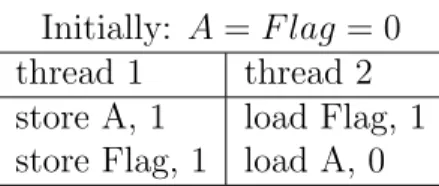
Out-of-order execution. Modern processors may execute instructions out of or-der where it can speed up execution. On uniprocessors, these “tricks” are completely invisible to the programmer, but on multiprocessors, they become visible in some cases, because the order in which loads and stores commit to memory can be observed by a remote processor. Fig. 3.1 shows an example of a relaxed execution that could be caused either by out-of-order stores, or out-of-order loads.
Store Buffers. On most architectures, stores do not commit atomically; when exe-cuted, they update a local buffer first (a store queue or a memory order buffer) before they become visible to other processors. Subsequent loads by the same processor ‘see’ the store (an effect calledstore-load forwarding) even if it hasn’t committed globally yet.
No Global Store Order. Some architectures allow stores to different addresses to happen in an order that is not globally consistent. This means that different processors may observe such stores in a different order.
Of course, if a processor could reorder instructions at will, it would be impossible to write meaningful programs. The relaxations are therefore formulated with the following goals in mind:
1. Single processor semantics must be preserved; if each processor executes an independent program, the results are the same as if each program were executed separately on a uniprocessor.
2. If all accesses to shared memory locations are fully synchronized (i.e., guarded by critical sections or other suitable synchronization constructs), the memory model should be indistinguishable from sequential consistency.
3. Special memory ordering instructions (called memory fences, memory barri-ers, or memory synchronization instructions) are provided, which can be used to selectively avoid out-of-order execution, or to flush store buffers. Such in-structions allow the implementation of mutual exclusion locks that have the desired property as stated above. To avoid confusion with cross-thread syn-chronization barriers or with synsyn-chronization operations such as test-and-set or compare-and-swap, we consistently use the termmemory ordering fences or just fences to refer to such instructions.
Most architecture manuals provide some code examples to illustrate the use of fences, and include code for a simple spinlock that can be used to build critical sec-tions. The precise name and semantics of the fences vary across architectures (for ex-ample, some of the fence instructions are called: MB, WMB on Alpha; sync, lwsync, eieio on PowerPC; load-load/load-store/store-load/store-store fences on SPARC; mf on Itanium, etc.)
3.2
Memory Model Examples
In this section, we present formal presentations of the two main memory models we used. The first one is the classic sequential consistency [44], which requires that the loads and stores issued by the individual threads are interleaved in some global, total order. Sequential consistency is the easiest to understand; however, it is not guaranteed by most multiprocessors.
The second memory model we describe in this section is Relaxed [8]. The pur-pose of this model is to provide an abstract, conservative approximation of several commonly used memory models. Of the relaxations listed above, it models the first two (out-of-order execution and store buffers), but not the third (it does assume that
Initially: X =Y = 0 thread 1 thread 2 X = 1 r1 = Y Y = 1 r2 = X
Eventually: r1 = 1, r2 = 0
Figure 3.2: An execution trace that is not sequentially consistent, but allowed by
Relaxed, because the latter may swap the order of the stores in thread 1, or the order of the loads in thread 2.
Initially: X =Y = 0
thread 1 thread 2
X = 1 r1 = Y
store-store fence load-load fence
Y = 1 r2 = X
Eventually: r1 = 1, r2 = 0
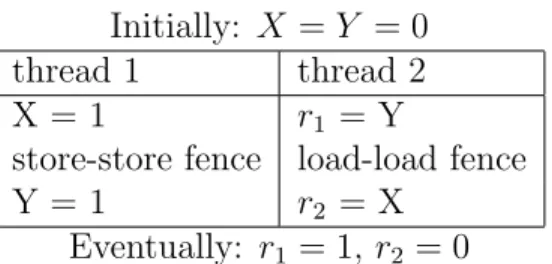
Figure 3.3: An execution trace that is not allowed by Relaxed because neither the stores in thread 1 nor the loads in thread 2 may be reordered due to the respective fences.
stores are globally ordered). Specifically, the relaxations permit (1) reorderings of loads and stores to different addresses, (2) buffering of stores in local queues, (3) for-warding of buffered stores to local loads, (4) reordering of loads to the same address, and (5) reordering of control- or data-dependent instructions.
To illustrate some of the relaxations, we now discuss a few examples. Such examples are often calledlitmus tests and are included as part of the official memory model specification.
• The execution trace in Fig. 3.2 illustrates how out-of-order execution may become visible to the programmer. The values loaded by thread 2 are not consistent with any sequentially consistent execution, but may result from a reordering of the stores by thread 1 or a reordering of the loads by thread 2.
• The trace in Fig. 3.3 illustrates how fences can prevent out-of-order execution. It shows the same sequence of loads and stores as the previous example, but with two fences inserted: a store-store fence that enforces the order of preceding and succeeding stores, and a load-load fence that enforces the order of preceding and succeeding loads. These fences prevent this trace onRelaxed.
Initially: X =Y = 0
thread 1 thread 2
Y = 2
X = 1 r1 = Y
store-store fence load-load fence
Y = 1 r2 = X
Eventually: r1 = 2, r2 = 0, Y = 2
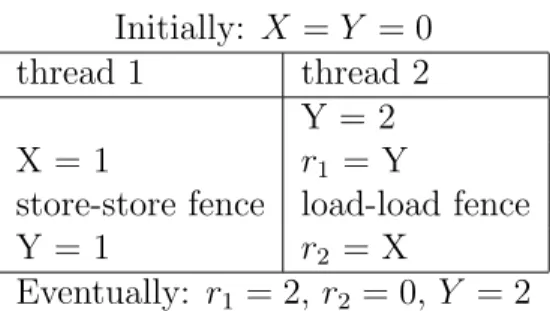
Figure 3.4: An execution trace that is not sequentially consistent, but allowed by
Relaxed, because the latter allows store-load forwarding.
Initially: X = Y = 0
thread 1 thread 2 thread 3 thread 4
X = 1 Y = 1 r1 = X r3 = Y
load-load fence load-load fence
r2 = Y r4 = X
Eventually: r1 =r3 = 1, r2 =r4 = 0
Figure 3.5: An execution trace that is theoretically possible on PPC, 32, and IA-64, but not allowed byRelaxed because the latter requires that all stores be globally ordered.
• The trace in Fig. 3.4 illustrates store-load forwarding. The value 2 stored by (Y = 2) is loaded by (r1 =Y) while the store is still sitting in the store buffer. Thus, it is possible for the store (Y = 2) to take global effect after the load (r1 =Y). Without store-load forwarding, this trace is impossible because
– (Y = 2) must happen before (r1 =Y).
– (r1 =Y) must happen before (r2 =X) because of the load-load fence. – (r2 =X) must happen before (X = 1) because it loads value 0, not 1. – (X = 1) must happen before (Y = 1) because of the store-store fence. This implies that (Y = 2) must happen before (Y = 1) which contradicts the final value 2 of Y.
• The trace in Fig. 3.5 illustrates an execution without a globally consistent ordering of stores. The threads 3 and 4 observe a different ordering of the stores (X = 1) and (Y = 1). We do not include this relaxation in Relaxed, which is thus not quite as weak as IBM PowerPC [24], IA-32 [38], or IA-64
[39]. It remains on our list of future work to explore the impact of non-global store orders on the correctness of implementations.
3.2.1
Formal Specification
Clearly, memory models can not be completely and precisely specified by giving examples only. Because precise specifications are an absolute prerequisite for formal verification, we now proceed to a formal definition of sequential consistency and
Relaxed. We use the formal framework for multiprocessor executions introduced in Sections 2.1.4 and 2.1.5. Briefly summarized, we define executions as tuples (I,≺,proc,adr,val,seed,stat) where I is the set of instructions in the global trace,
i≺j iffiprecedesj in program order,proc(i) is the processor that issued instruction
i,adr(i) andval(i) are the address and data values of instructioni,seed is a partial function that maps loads to the store that sources their value, andstat is irrelevant for this chapter. A memory model is then simply a predicate on execution traces (that is, specifies which global traces are possible and which ones are not).
The axiomatic format of the definitions below foreshadows our generic specifica-tion format which lets the user specify the memory model directly, as we describe Section 3.3. To keep the definitions below as simple as possible, we omit atomic blocks and use a single type of fence only; we describe the full formalization later, in Sections 3.4 and 3.5.
3.2.2
Sequential Consistency (
SeqCons
)
A global trace T = (I,≺,proc,adr,val,seed,stat) is sequentially consistent if and only if there exists a total order<M overaccesses(I), called thememory order, such
that the following conditions hold:
For each load l ∈loads(I), let S(l) be the set of stores that are “visible” to l:
S(l) ={s∈stores(I)|adr(s) =adr(l)∧(s <M l)}
Then the following axioms must be satisfied: (A1) ifx≺y, then x <M y
(A2) ifseed(l) =s, thens∈S(l)
(A3) if s ∈ S(l) but not seed(l) = s, then there must exist an s0 ∈ stores(I) such that seed(l) =s0 and s <M s0.
3.2.3
Relaxed
A global traceT = (I,≺,proc,adr,val,seed,stat) is permitted by the memory model
Relaxed if and only if there exists a total order <M over accesses(I), called the memory order, such that the following conditions hold:
For each load l ∈loads(I), let S(l) be the set of stores that are “visible” to l:
S(l) = {s∈stores(I)|adr(s) = adr(l)∧((s <M l)∨(s≺l))}
Then the following axioms must be satisfied:
(A1) ifx≺y, adr(x) =adr(y), andcmd(y) =store, then x <M y
(A2) ifseed(l) =s, thens∈S(l)
(A3) ifs ∈S(l) but notseed(l) =s, then there must exist a s0 ∈stores(I) such that
seed(l) =s0 and s <M s0.
(A4) ifx, y ∈accesses(I) and f ∈fences(I) and x≺f ≺y, then x <M y.
Discussion
The model Relaxed shows a structure that is very similar to sequential consistency (Section 3.2.2), and is best understood by comparing the differences:
• Axiom (A1) has been weakened to allow the memory order to be different from the program order. The program order is only enforced if both accesses go to the same address (we call such accesses aliased for short), and only if the second access is a store. These are the minimal guarantees necessary to maintain single-processor semantics: we may not reorder aliased stores, nor can we reorder a load past a subsequent aliased store. However, we do allow a store to be reordered past a subsequent aliased load, because the value will get forwarded from the store to the load (see next bullet). We also allow two aliased loads to get reordered.
• We enlarge the set S(l) of stores that are visible to a load, in order to allow forwarding of values from stores sitting in a store buffer to subsequent aliased loads by the same processor. S(l) now also contains stores that precede a load in program order (s ≺ l) but are performed globally only after the load is performed (l <M s).
• We added axiom (A4) has been added to describe the semantics of fences (there is no need for fences on sequentially consistent machines).
3.2.4
Comparing Memory Models
Memory models can be directly compared in terms of the execution traces they allow. We call a model Y stronger than another model Y0 if Y ⊂Y0. For example, sequential consistency is stronger thanRelaxed (because any sequentially consistent global trace satisfies the axioms forRelaxed as well).
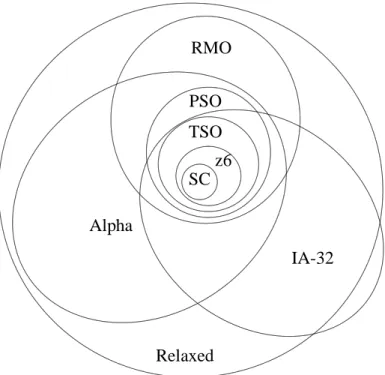
We show a graphic representation that compares the sets of executions ofRelaxed
TSO PSO IA-32 Alpha Relaxed RMO z6 SC
Figure 3.6: A comparison of various memory models.
common, conservative approximation of several memory models (Sun SPARC v9 TSO/PSO/RMO [72], Alpha [13], and IBM 370/390/zArchitecture [41]). All of these models are stronger thanRelaxed, which implies that once code runs correctly onRelaxed, it will run correctly on each of the former.
However, Relaxed is not strictly weaker than the official PowerPC [24], IA-64 [39] and IA-32 [38] models because it globally orders all stores (the execution in Fig. 3.5 illustrates this point). Even so, Relaxed still captures the most important relaxations of those models (store buffers and out-of-order execution) and is useful in determining where to place fences.
3.3
Specification Format
After we studied a number of relaxed memory models in various architecture manu-als, it became clear that there are many subtle differences between them. Although our modelRelaxedis a useful pragmatic approximation, we sometimes wish to spec-ify the memory model more precisely or play with the details of the definitions. Of particular interest are support for ordering constraints created by data or control de-pendencies, and support for memory models that do not rely on a globally consistent store order.
We therefore developed a generic axiomatic format for specifying memory models that generalizes the format of the axiomatic definitions for sequential consistency and
Relaxed we used in Section 3.2.1 and provides the desired flexibility.
3.3.1
Axiomatic Memory Model Specifications
We now describe our format for specifying memory models. Our memory model specifications use boolean formulae to constrain the global traces. Traditionally, this style of specification is called “axiomatic”, and we call the formulae axioms.
First, in order to write axioms that express constraints over global traces, we in-troduce symbols that express properties of the global trace as defined in Section 2.1.4. We need predicates that capture the type of a given instruction, and relations to ex-press the program order, whether two accesses are aliased (go to the same memory location), and the partial function seed which assigns to each load the store that sourced its value.
Definition 13 Define a memory model vocabularyto be a vocabularyσ = (S,F,V)
(as defined in Section 2.2.1) that contains the following set and function symbols: {instr} ⊂ S
{load,store,fence,access} ⊂ Finstr→bool {progorder,aliased,seed} ⊂ Finstr×instr→bool
Throughout the rest of this document, we assume that we are working with some fixed memory model vocabulary σ = (S,F,V). We will thus not bother to mention it explicitly in every definition.
Axiomatic memory models may contain one or more existentially quantified second-order variables. For example, a global trace is defined to be sequentially consistent if and only if there exists a total order over the memory accesses, sub-ject to some constraints (see Section 3.2.2). We formalize such ordering relations as relation variables over instructions. This leads to the following definition:
Definition 14 An axiomatic memory model specificationY is a tupleY = (R, φ1, . . . , φk) such that (k ≥0) and
• R ⊂ Vinstr×···×instr→bool is a set of relation variables
• φ1, . . . , φk ∈ Tbool are formulae with syntax as shown in Fig. 3.7. We call them axioms.
• F V(φ1)∪ · · · ∪F V(φk)⊂ R
We let Axm be the set of all axiomatic memory model specifications.
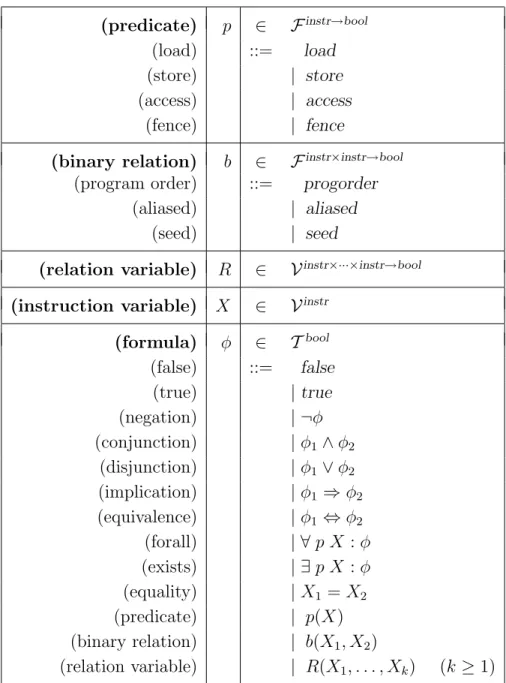
Note that the syntax for axioms as shown in Fig. 3.7 is a specialization of the general syntax for formulae and terms we defined in Fig. 2.3 (Section 2.2.2) with the following restrictions:
(predicate) p ∈ Finstr→bool
(load) ::= load
(store) | store
(access) | access
(fence) | fence
(binary relation) b ∈ Finstr×instr→bool
(program order) ::= progorder
(aliased) | aliased
(seed) | seed
(relation variable) R ∈ Vinstr×···×instr→bool (instruction variable) X ∈ Vinstr
(formula) φ ∈ Tbool (false) ::= false (true) |true (negation) | ¬φ (conjunction) |φ1∧φ2 (disjunction) |φ1∨φ2 (implication) |φ1 ⇒φ2 (equivalence) |φ1 ⇔φ2 (forall) | ∀p X :φ (exists) | ∃p X :φ (equality) |X1 =X2 (predicate) | p(X) (binary relation) | b(X1, X2) (relation variable) | R(X1, . . . , Xk) (k ≥1)