CAViT: a Consistency Maintenance Framework based
on Transformation Contracts
Pieter Van Gorp, Dirk Janssens
Formal Techniques in Software Engineering, Universiteit Antwerpen, {pieter.vangorp,dirk.janssens}@ua.ac.be
Abstract. Model driven engineering is a software engineering methodology that aims to manage the complexity of frameworks by relying on models and trans-formations. Unfortunately it is only poorly understood where and how this new methodology differs from traditional methodologies. Therefore, this paper for-malizes how contract based model transformation extends existing design by con-tract theory. The key extension is that transformation concon-tracts can be maintained automatically by mapping consistency invariants to the postconditions of trans-formation rules. When an invariant is violated, the corresponding transtrans-formation rule will be called provided that its precondition is satisfied. This paper presents the Contract Aware Visual Transformation (CAViT) framework, an implemen-tation of declarative middleware for contract based model transformation. We illustrate how CAViT can be used to integrate UML based visual model transfor-mations with OCL based transformation contracts.
Introduction
Integrating packages and applications written in a variety of languages is a major chal-lenge for the software engineering community [1]. Luckily, programming languages and their associated libraries have gone a long way. Thanks to modern integration plat-forms such as J2EE [2] one can, for example, connect mainstream ERP packages such as SAP [3] with legacy applications written in COBOL and a reasoning engine writ-ten in PROLOG. Unfortunately, this flexibility comes at the cost of high complexity. Managing entities and processes that are scattered over all applications is problematic when there is a lack of documentation on how all applications relate to the overall requirements. Even when such documentation is in place, it is often unfeasible to up-date all sources and documentation affected by a particular business change without advanced tool support. This paper formalizes the mechanics of model-driven engineer-ing tools (1) by definengineer-ing how the languages used to program such tools relate to object oriented design by contract and controlled graph rewriting and (2) by describing their architecture. Section 1 introduces the reader to design by contract and model-driven en-gineering, section 2 presents domain specific models of a sample application, section 3 explains how these models can be kept consistent using a new contract aware visual model transformation approach and section 4 describes the architecture of the tool that validates this approach. Section 5 relates this contribution to related work and section 6 concludes this paper.
1. SUPPORTING TECHNOLOGIES
1
Supporting Technologies
This section first describes two methodologies that were succesfully applied to tackle the complexity of large scale software development: design by contract (DBC) and model driven engineering (MDE). In the context of MDE, we describe “contract based model transformation”, a new application of the design by contract foundations for maintaining the consistency between related models. Finally, this sections covers Model Driven Architecture (MDA) and visual model transformation.
1.1 Design by Contract
DBC is a software correctness methodology for procedural and object-oriented soft-ware. It relies on logical assertions to detect implementation mistakes at run-time or to prove the absence thereof at compile-time.
The fundamentals of DBC were developed by Floyd and Hoare in the late sixties [4,5]. By formalizing the effect of programming language constructs on the state of variables in axioms and inference rules, Hoare illustrated the feasibility of proving pro-gram correctness. The proposed proof systems are based on state assertions, which are logical expressions about the values of program variables. These state assertions are used to state that a program S will ensure a state assertion q (called the postcondition) provided that state assertion p (called the precondition) holds right before it is executed, or {p}S{q}. A correctness proof consists of a deductive sequence of state assertions and axioms or inference rules from precondition to postcondition.
In the early seventies, Hoare and Wirth published a proof system for the program-ming language PASCAL [6]. Meanwhile, verfication condition generators based on backward substitution were built to automatically derive proof obligations [7]. Finding what rules form the shortest path from precondition to postcondition remains a creative activity but a theorem proover can help discharging proof obligations given a library with the required axioms and inference rules. Today, one can rely on industial-strength proof assistants with inference rules for object-oriented languages [8].
DBC has also found its way into incomplete verification methods. In this context, the precondition and postcondition are checked at test execution time. For this purpose, Meyer included support for expressing assertions in the Eiffel programming language [9] while Kramer built iContract for extracting assertions from Java comments [10]. The advantage of the testing approach is that it is applicable even when complete coverage is unfeasible. On the other hand, deviations between the contracts and the implementation may find their way to the production environment due to an incomplete set of test cases.
1.2 Model Driven Engineering
MDE is a methodology that proposes to tackle the complexity of software development by treating models and transformations as first-class software artifacts [11].
1.2.1 Terminology By collecting the mainstream definitions for the core MDE
con-cepts, this section can be used as an introduction and refererence to the MDE terminol-ogy adopted in this paper.
1. SUPPORTING TECHNOLOGIES
Definition 1. A model is a simplified representation of a part of the world named the system [12].
Studies in human-computer interation distinguish between conceptual and mental mod-els [13]. The former refer to representations made by a teacher (or designer) to explain a system to a user (or maintainer). A mental model on the other hand is the system representation that a user (or maintainer) actually applies in his mind when working with (or on) the system. In MDE, one proposes to map models in their conceptual sense to source code by means of transformations [11]. MDE is a relevant methodology in those cases where source code is too far from the mental models of the designers and maintainers of the software. It allows these stakeholders to work and communicate with models that match their minds more closely.
Kleppe et al. define a transformation as “the automatic generation of a target model
from a source model, according to a transformation definition” [14]. We generalize this
definition in order to support transformations that are carried out manually:
Definition 2. A transformation is the construction of a set of target models from a set of source models. A transformation is automatic if it can be applied mechanically ac-cording to a transformation definition.
Since model transformation is the heart and soul of MDE [15] it is not restricted to particular modeling languages, compilers or execution platforms. Rather than enforc-ing one language for cognitive modelenforc-ing (like the UML [16]) it embraces the variety of languages and libraries that need to be reconciled in heterogenous software architec-tures. The fundamental difference with Rapid Application Development (RAD [17]) is that transformation definitions can be created and/or optimized by software architects.
Since a model transformation is intended to manipulate a set of models one can call it a metaprogram. The structure of the input and output modeling languages is represented by so-called metamodels while a transformation definition consists of (1) references to the set of models as data and (2) transformation rules as behavior. Based on Favre’s observations on metamodels [18] we define:
Definition 3. A metamodel is a structural model of a language. It consists of (1) a type system (classes with attributes and associations with cardinalities) for the abstract syn-tax elements and (2) well-formedness rules that capture syntactic validity constraints not covered by (1).
Type system modeling can be done with either UML class diagrams or Entity
Relation-ship (E/R [19]) diagrams but fundamentally one tends to rely on graph based models with attributed nodes and edges. In the graph transformation community, the type sys-tem of a modeling language can be encoded in a type graph. Type graphs cannot enforce that for example “the name of a class should be unique within its package”. Such
well-formedness rules need to be enforced with additional graph constraints, some of which
cannot be represented visually. In the context of object-oriented metamodeling, they correspond to the invariants of metaclasses.
Kleppe et al. define a transformation definition as a set of transformation rules that together describe how a model in the target language can be constructed from a model
1. SUPPORTING TECHNOLOGIES
in the source language [14]. We generalize this definition by considering transformation definitions that manage any non-zero number of models. Moreover, we do not restrict a model to be used as in- or output exclusively:
Definition 4. A transformation definition contains (1) a set of models conforming to metamodels and (2) a set of transformation rules that together describe how its models can be constructed from one another.
Defining model transformations in a general purpose programming language such as Java lies quite far from the conceptual task of model (graph) transformation. In
Re-flective MDE one defines model transformations by means of models themselves [20].
Such transformation models abstract from the complexities and evolution of model management frameworks such as the NetBeans MetaData Repository (MDR [21]) or the Eclipse Modeling Framework (EMF [22]) [23]. Section 1.2.3 will illustrate that transformation models expressed in a visual modeling language based on the UML and graph transformation appear to match people’s mental models of the domain very well.
Definition 5. A transformation rule is a description of how one or more constructs in one model can be constructed from one or more constructs in another model.
Again, this definition is based on the work of Kleppe et al. [14]. Note that these au-thors promote to represent transformation rules as objects. This enables one to store the source-target relationships of a transformation in the object state of the rule that created the target from the source. Instead, we propose to represent transformation definitions
as objects. This design choice was motivated by our intention to represent models and
transformations with ordinary object-oriented data structures. Nevertheless, there are MDE applications that need to reason explicitly about the source-target relationships (so-called traceability links) between models and model elements that were created from one another. The following definition allows one to describe where this informa-tion is stored:
Definition 6. A traceability model consists of relations between models and/or model elements that are generated from one another by one or more model transformations.
1.2.2 Contract based Model Transformation Contract based model transformation
is a new application of the design by contract foundations targeted at maintaining the consistency between related models.
Definition 7. A transformation contract is a pair of constraints (called the pre- and postcondition) that describe the effect of a transformation rule on the set of models contained in its transformation definition. The postcondition describes the model con-sistency states that the rule can establish provided that its precondition is satisfied. The postcondition of a transformation rule corresponds to an invariant of the transforma-tion definitransforma-tion in which it is contained.
The notion of transformation contracts can be used to formalize the notion of incremen-tal consistency maintenance:
1. SUPPORTING TECHNOLOGIES
Definition 8. A transformation contract of a rule can be maintained automatically by calling the rule (1) as soon as the invariant corresponding to its postcondition is vio-lated and (2) provided that its precondition is satisfied.
Note that in model inconsistency states where the preconditions of more than one rule are satisfied, transformation engines are allowed to call the rules in arbitrary order. Some model inconsistency states cannot be resolved automatically. These states do not satisfy the precondition of any transformation rule whose postcondition describes a con-sistent model state. For simple contracts, one can automatically generate the satisfying transformation rules. On the other hand, complex cases require the manual develop-ment of transformation rules. For example, in the context of the WODN case study [24] we considered constraints that asserted that for a particular match in the source model, there should be an element in the target model that shares particular properties with some elements from the source model. A simple violation scenario (or rule
pre-condition) is the case where one has developed an initial version of the source model
and the target model has not been generated yet. A transformation engine can automat-ically instantiate a target model and populate it with a model element that satisfies the constraint.
Contract aware transformation engines should support the creation of traceability
links between model elements that are created from one another. Such links should
be accessible in a model transformation language that integrates with the constraint checking language. This enables the manual development of model transformations for violations occurring in models that were previously generated from one another. Generating transformation rules for such “co-evolution conflicts” is beyond the state-of-the-art of today’s transformation engines and perhaps even unfeasible since there are a lot of ways to reconcile existing models automatically and expert knowledge is required to decide what manual (external) changes to the models should be preserved or overriden. As noted before, Kleppe et al. proposed to include traceability models inside transformation rules but they did not describe how the traceability information could be used for model reconciliation.
1.2.3 Visual Model Transformation Writing transformations manually can be
fa-cilitated by using specialized transformation languages (such as YATL [25]) since they hide the algorithmic details of navigating and manipulating the object graphs represent-ing the models. YATL is a textual transformation language that has been succesfully applied to a number of MDE case studies. However, it is relatively young compared to the languages developed in the domain of graph rewriting. In this domain there is a general consensus that representing transformations visually makes them most under-standable to humans [26]. Therefore, in visual model transformation, one applies the foundations of graph rewriting to model driven engineering by interpreting models as
graphs and metamodels as type graphs [23]. The fundamental research topics raised by
the new application domain are transformation contracts (see Definition 7) and trace-ability models (see Definition 6).
1.2.4 Model Driven Architecture Model Driven Architecture (MDA) is an OMG
1. SUPPORTING TECHNOLOGIES
more stakeholders to exchange models in a language that matches their mental modeling language to an acceptable degree, the UML was extended with a range of new syntax constructs [28].
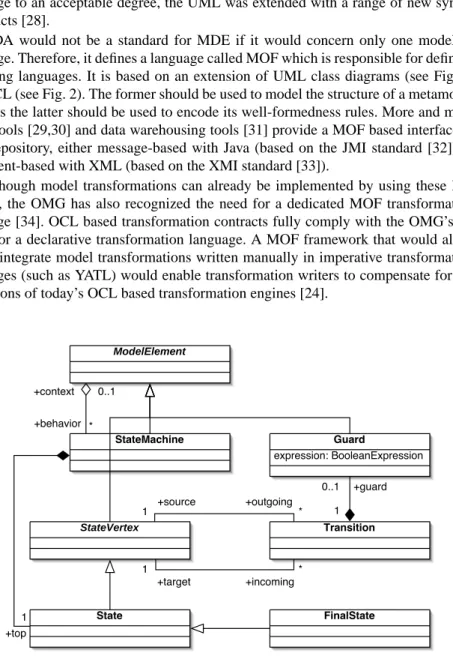
MDA would not be a standard for MDE if it would concern only one modeling language. Therefore, it defines a language called MOF which is responsible for defining modeling languages. It is based on an extension of UML class diagrams (see Fig. 1) and OCL (see Fig. 2). The former should be used to model the structure of a metamodel whereas the latter should be used to encode its well-formedness rules. More and more UML tools [29,30] and data warehousing tools [31] provide a MOF based interface to their repository, either message-based with Java (based on the JMI standard [32]) or document-based with XML (based on the XMI standard [33]).
Although model transformations can already be implemented by using these lan-guages, the OMG has also recognized the need for a dedicated MOF transformation language [34]. OCL based transformation contracts fully comply with the OMG’s re-quest for a declarative transformation language. A MOF framework that would allow one to integrate model transformations written manually in imperative transformation languages (such as YATL) would enable transformation writers to compensate for the limitations of today’s OCL based transformation engines [24].
+context +behavior 0..1 * Guard expression: BooleanExpression ModelElement StateMachine Transition 1 0..1 +guard StateVertex +source +outgoing +incoming +target 1 * 1 * State 1 +top FinalState
Fig. 1. MOF diagram displaying an excerpt of the statemachine part of UML 1.5. A
statemachine is a model element that represents the behavior of another context model element. A statemachine contains exactly one top state that is connected to other states by transitions (incoming and outgoing) that can contain a guard.
2. MODELS OF A MEETING SCHEDULER
1 context FinalState:
2 self.outgoing->size = 0
Fig. 2. OCL Well-formedness rule from the UML metamodel stating that a final state
should never have outgoing transitions.
2
Models of a Meeting Scheduler
To give a realistic idea of models that need to be kept consistent, this section presents some domain specific models of a sample application. The application is based on the
Meeting Scheduler problem statement that was proposed by Van Lamsweerde et al. [35]
as a benchmark for requirements elicitation and software specification techniques. The problem statement of the benchmark was published deliberately imprecise and incom-plete [36]. The first part of the problem statement reads as follows:
Meetings are typically arranged in the following way. A meeting initiator asks all potential meeting attendees for the following information based on their personal agenda:
– a set of dates on which they cannot attend the meeting (hereafter referred
as exclusion set);
– a set of dates on which they would prefer the meeting to take place
(here-after referred as preference set).
A meeting date is defined by a pair (calendar date, time period). The exclu-sion and preference sets are contained in some time interval prescribed by the meeting initiator (hereafter referred as date range).
The initiator also asks active participants to provide any special equipment re-quirements on the meeting location (e.g., overhead-projector, workstation, net-work connection, telephones, etc.). He/she may also ask important participants to state preferences about the meeting location.
Sections 2.1, 2.2 and 2.3 present some illustrative conceptual, robustness and physical
data models repectively. The fragments in this paper should merely illustrate some
re-alistic dependencies between models in different languages and should not be regarded as a complete nor stable specification of a meeting scheduler.
2.1 Conceptual Models
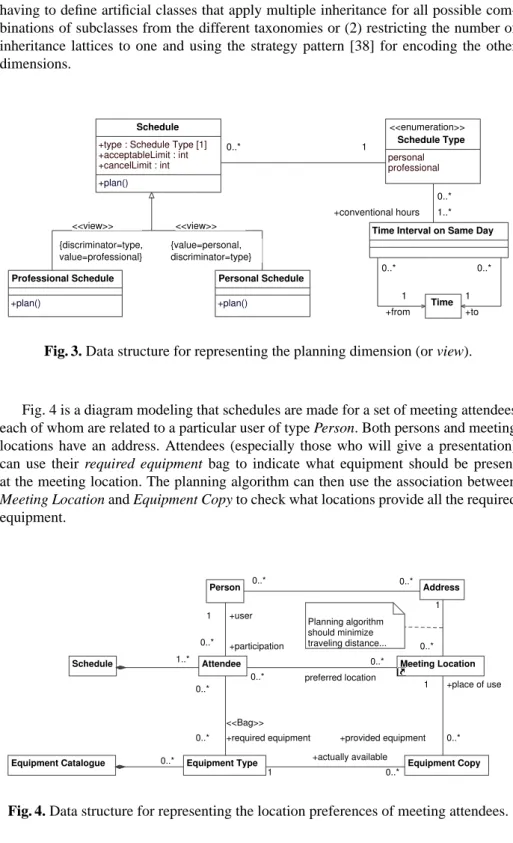
Fig. 3 displays a part of the conceptual model stating that the application distinguishes between personal and professional meetings. Both types of meetings will be planned according to different rules. We define this taxonomy of meeting schedules using the concept view inheritance [37]. The concrete type of a schedule (being either
Profes-sional Schedule or Personal Schedule) is determined dynamically based on the value
of the type attribute (called the discriminator) of the Schedule class. View inheritance allows conceptual modelers to define taxonomies in multiple dimensions without (1)
2. MODELS OF A MEETING SCHEDULER
having to define artificial classes that apply multiple inheritance for all possible com-binations of subclasses from the different taxonomies or (2) restricting the number of inheritance lattices to one and using the strategy pattern [38] for encoding the other dimensions.
Time Interval on Same Day Schedule
+type : Schedule Type [1] +acceptableLimit : int +cancelLimit : int +plan() Professional Schedule +plan() Personal Schedule +plan() <<enumeration>> Schedule Type professional personal Time 0..* 1 0..* +from 1 0..* +to 1 <<view>> {discriminator=type, value=professional} <<view>> {value=personal, discriminator=type} 0..* +conventional hours 1..*
Fig. 3. Data structure for representing the planning dimension (or view).
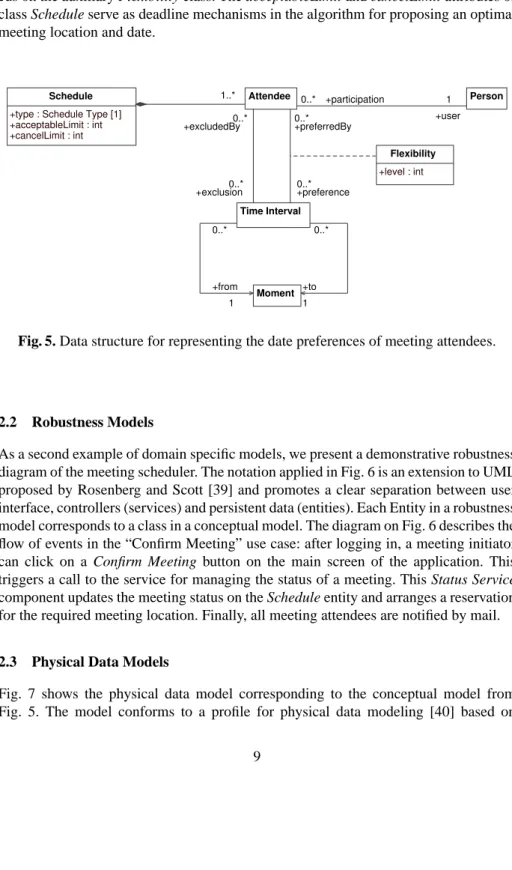
Fig. 4 is a diagram modeling that schedules are made for a set of meeting attendees each of whom are related to a particular user of type Person. Both persons and meeting locations have an address. Attendees (especially those who will give a presentation) can use their required equipment bag to indicate what equipment should be present at the meeting location. The planning algorithm can then use the association between
Meeting Location and Equipment Copy to check what locations provide all the required
equipment. Equipment Catalogue Meeting Location Equipment Copy Equipment Type Attendee Schedule Address Person Planning algorithm should minimize traveling distance... 0..* 0..* preferred location 0..* 0..* 1 +actually available 0..* 1..* 0..* <<Bag>> +required equipment 0..* +place of use 1 +provided equipment 0..* 0..* 0..* 1 +participation 0..* +user 1
2. MODELS OF A MEETING SCHEDULER
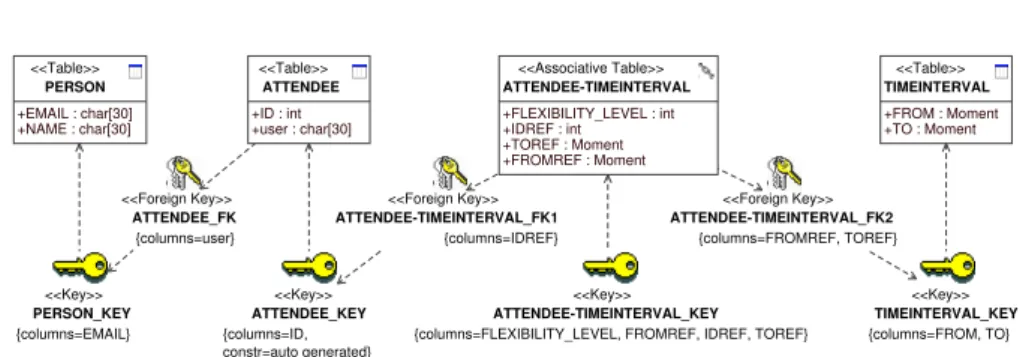
Fig. 5 displays that each attendee can specify (1) in what time intervals he/she can-not attend, (2) in what time intervals he/she would prefer to attend and (3) the flexibility (or priority) for (2). Allowing the use of association classes (such as Flexibility) allows the conceptual modeler to represent the relationship for date preferences directly be-tween its major participants (Attendee and Time Interval) without putting too much fo-cus on the auxiliary Flexibility class. The acceptableLimit and cancelLimit attributes of class Schedule serve as deadline mechanisms in the algorithm for proposing an optimal meeting location and date.
Schedule
+type : Schedule Type [1] +acceptableLimit : int +cancelLimit : int Flexibility +level : int Time Interval Attendee Moment Person +participation 0..* +user 1 1..* +excludedBy0..* +exclusion0..* +preferredBy 0..* +preference 0..* 0..* +from 1 0..* +to 1
Fig. 5. Data structure for representing the date preferences of meeting attendees.
2.2 Robustness Models
As a second example of domain specific models, we present a demonstrative robustness diagram of the meeting scheduler. The notation applied in Fig. 6 is an extension to UML proposed by Rosenberg and Scott [39] and promotes a clear separation between user interface, controllers (services) and persistent data (entities). Each Entity in a robustness model corresponds to a class in a conceptual model. The diagram on Fig. 6 describes the flow of events in the “Confirm Meeting” use case: after logging in, a meeting initiator can click on a Confirm Meeting button on the main screen of the application. This triggers a call to the service for managing the status of a meeting. This Status Service component updates the meeting status on the Schedule entity and arranges a reservation for the required meeting location. Finally, all meeting attendees are notified by mail.
2.3 Physical Data Models
Fig. 7 shows the physical data model corresponding to the conceptual model from Fig. 5. The model conforms to a profile for physical data modeling [40] based on
3. METAMODELS AND MODEL TRANSFORMATIONS Confirm Meeting Account Service <<Entity>> Meeting Location Status Service Main Screen Login Form <<Entity>> Schedule <<Entity>> Person Attendee Initiator Mail
Fig. 6. Robustness Diagram of the “Confirm Meeting” use case. Actors are shown on
the left, followed by interfaces and services in the middle and entities on the right.
the work of Ambler [41]. The mapping from classes and associations with association classes to tables, associative tables, keys and foreign keys corresponds to the mapping from entity sets and relations with attributes to relational schemas as covered in intro-ductory database course books [42].
Each class from the logical data model is mapped to a table. All attributes are in-cluded as columns, along with extra columns for realizing the associations between the classes. The physical data model contains explicit nodes for keys and foreign keys such that all relations are defined precisely.
The associative table ATTENDEE-TIMEINTERVAL maps to the association class
Flexibility. The table maps to two outgoing one-to-many associations. We present this
mapping problem to illustrate that there is a consistency relation between concep-tual models and physical data models demanding that each class maps to a table and vice versa. Büttner and Gogolla have described how the flattened structure can be
constructed from the model with association classes [43] but their rules need to be
plugged into a framework where a constraints are checked permanently. If, for exam-ple, a database administrator migrates all data from the TIMEINTERVAL table to an-other T_RANGE table, then a constraint should fail after the former table is dropped. This violation could be resolved by modifying the constraint or updating the traceability model.
3
Metamodels and Model Transformations
The meta-information of the domain specific models presented in the previous section is defined on the same “meta-level” (see [18]) as the application models of the meet-ing scheduler. This language profile technique is based on decoratmeet-ing model elements with special flags (called stereotypes) and properties (called tagged values). Neither the method of contract based model transformation, nor its implementation in CAViT is
3. METAMODELS AND MODEL TRANSFORMATIONS
<<Key>>
ATTENDEE-TIMEINTERVAL_KEY
{columns=FLEXIBILITY_LEVEL, FROMREF, IDREF, TOREF} <<Foreign Key>> ATTENDEE-TIMEINTERVAL_FK1 {columns=IDREF} <<Foreign Key>> ATTENDEE-TIMEINTERVAL_FK2 {columns=FROMREF, TOREF} <<Associative Table>> ATTENDEE-TIMEINTERVAL +FLEXIBILITY_LEVEL : int +FROMREF : Moment +TOREF : Moment +IDREF : int <<Key>> ATTENDEE_KEY {columns=ID, constr=auto generated} <<Key>> TIMEINTERVAL_KEY {columns=FROM, TO} <<Foreign Key>> ATTENDEE_FK {columns=user} <<Table>> PERSON +EMAIL : char[30] +NAME : char[30] <<Table>> TIMEINTERVAL +FROM : Moment +TO : Moment <<Key>> PERSON_KEY {columns=EMAIL} <<Table>> ATTENDEE +user : char[30] +ID : int
Fig. 7. Physical data model of “date preferences” information.
restricted to the language profile technique. Therefore, the reader is not supposed to master all details of this technique. Nevertheless, the overview given in section 3.1 may be useful for understanding the running example of this paper completely. Section 3.2 shows the UML profiles used in this example. Finally, section 3.3 presents the definition of an illustrative model transformation.
3.1 Language Profiles
Definition 9. A stereotype is a model element that models (or “represents in a simpli-fied manner”) a subtype of an existing metaclass, called the “base class”, when “base class” is part of a metamodel whose type system should be fixed.
Fixing the type system of a language’s metamodel is needed when models that are ex-pressed in that language need to be exchanged with a standard API or data structure. Since our domain specific models are represented naturally in UML editors, we can benefit from the portability of our models across UML tools at the cost of the complex-ity introduced by metamodeling through the language profiling technique.
When the type system of the modeling language is fixed, extra meta-information needs to be expressed in the language itself. In the context of object-oriented metamod-eling, a stereotype is a model element A that is an instance of a metaclass B that has a “name” attribute (instantiated to “A” in this example) and that is associated with the metaclass C part of metamodel D. Although conceptually A is a metaclass that sub-classes C, it is impossible to create instances of A in repositories that are based on the types of D. Instead, one can state that a model element E that is an instance of type C conforms to A by adding A to the set of Bs associated with E.
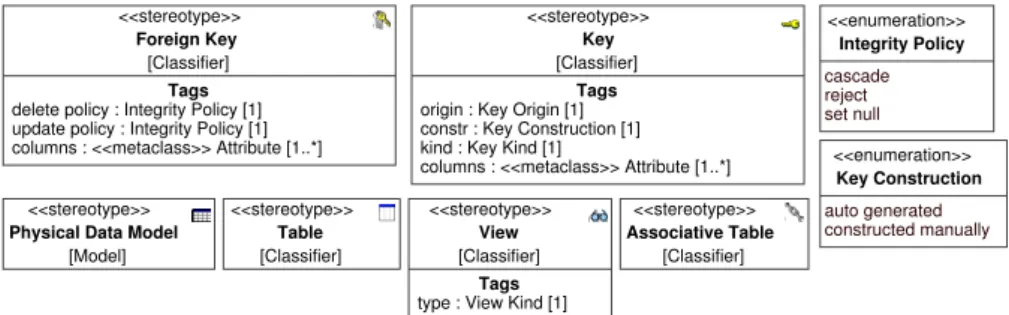
Example stereotypes from Fig. 7 are Table, Foreign Key, Key and Associative Table. In an object-oriented metamodeling environment, these model elements (corresponding to “A”) are instances of the UML metaclass Stereotype (corresponding to “B”). All four stereotypes are defined on UML metaclass Classifier (corresponding to “C”) of metamodel UML (corresponding to “D”). Table, Foreign Key, Key and Associative Table conceptually subclass Classifier but technically they are only associated to Classifier through the base class attribute of UML metaclass Stereotype. Fig. 8 elaborates on the design of profiles in the UML metamodel. The definition of the stereotypes for the
3. METAMODELS AND MODEL TRANSFORMATIONS
physical data modeling profile is visualized on Fig. 9. On Fig. 7, Table is applied to model element Person (corresponding to “E”).
Definition 10. A tagged value is a model element that models an attribute of a stereo-type.
Example tagged values from Fig. 7 are columns and constr which are defined on Fig. 9. Stereotypes and tagged values are distributed in packages, called profiles, that can be included as libraries in applications. Since stereotypes and tagged values are model elements in their own right, they have to be formalized in the metamodel of the mod-eling language being used. Since we have modeled our sample Meeting Scheduler in UML, Fig. 8 displays the part of the MOF metamodel of UML responsible for defining and applying profiles. A model element can have zero or more stereotypes associated with it. The right side of the diagram shows that each stereotype can have a number of contained tag definitions. This enables the composition on the left side of the dia-gram to be populated: a model element can have many tagged values associated with it. Each such tagged value is either string-based (when the dataValue is instantiated) or conforms to exactly one tag definition (when the association with end referenceValue is populated). A tag can associate a model element with multiple values (such as the columns tag on TIMEINTERVAL_KEY on Fig. 7), depending on the multiplicity prop-erty of the tag definition. The language profile technique is also implemented in Java, where tagged values are called annotations.
TagDefinition +multiplicity : Multiplicity [1] +tagType : Name [1] ModelElement +name : Name [1] Stereotype +baseClass : Name [1] +icon : Geometry [1] TaggedValue +dataValue : String [1] +stereotype * +extendedElement * +typedValue * 1 +type +referenceValue * +referenceTag * 1 +taggedValue * +definedTag * +owner 0..1
Fig. 8. MOF diagram of UML metamodel support for profiles.
When working with UML profiles, well-formedness rules (WFRs) are expressed in OCL and in the context of a stereotype at the modeling level (M1 in the OMG metalevel architecture [44]). Contrast this with the MOF approach to metamodeling where OCL metamodel WFRs are defined in the context of metaclasses (M2 types in OMG’s met-alevel architecture). Practically, this difference in metmet-alevels means that profile WFRs will not be validated by generic MOF transformation tools. Consequently, profile con-formance can only be ensured by using an additional M1 constraint checker for UML. Today’s OCL validators [45,46] support both M1 OCL checks on UML models and M2 OCL checks on MOF models.
3. METAMODELS AND MODEL TRANSFORMATIONS
3.2 Metamodel Definitions
All models presented in section 2 conform to the UML metamodel and apply profiles to obtain a domain specific semantics. Figures 1 and 8 are based on the UML specification [16]. We refer the reader to consult this reference for learning how models, packages, classes, attributes and other UML concepts are represented in MOF. This section will briefly present the definition of a domain specific UML profile applied in the Meeting
Scheduler.
Fig. 9 shows a part of the content of the package defining the “physical data mod-eling” profile. The Physical Data Model stereotype can be used to indicate that a UML model describes the relational database implementation of an application. Table,
Asso-ciative Table, Foreign Key and Key are stereotypes applied in Fig. 7. Note that all tags
are defined in the context of a stereotype. The type of the columns tag of the Foreign
Key and Key stereotypes is a nonempty list of Attribute. The latter is a metaclass from
the UML metamodel. The type of the origin tag of stereotype Key is Key Origin, an enumeration type that is also contained in the profile definition package.
One can imagine an arbitrary number of well-formedness rules on this language profile. One possible rule would state that a Classifier marked with the Foreign Key stereotype should have an outgoing dependency link to a Classifier marked with the
Key stereotype.
<<stereotype>> Foreign Key [Classifier]
Tags delete policy : Integrity Policy [1] update policy : Integrity Policy [1] columns : <<metaclass>> Attribute [1..*]
<<stereotype>> Key [Classifier]
Tags origin : Key Origin [1] constr : Key Construction [1] kind : Key Kind [1]
columns : <<metaclass>> Attribute [1..*] <<stereotype>>
Physical Data Model [Model]
<<stereotype>> View [Classifier]
Tags type : View Kind [1]
<<stereotype>> Associative Table [Classifier] <<enumeration>> Key Construction constructed manually auto generated <<stereotype>> Table [Classifier] <<enumeration>> Integrity Policy cascade set null reject
Fig. 9. Part of the UML profile for physical data modeling.
3.3 Transformation Definition
Instead of giving an overview of all transformations that are required to maintain the consistency between conceptual, physical and robustness models, this section provides an in-depth description of one transformation definition.
The example covers the transformation of all classes in the conceptual model to entities in the robustness model. The rationale is that a conceptual model will put all behavior (operations) as closely to the data (attributes) as possible while a robustness model will add to these entities a number of service facades to encapsultate the flow of control between application screens (called interfaces to the actors). Note that similarly
3. METAMODELS AND MODEL TRANSFORMATIONS
one could build the reverse transformations to support a methodology where entities are created manually during their discovery in use case refinement based on robustness modeling [39] and then copied to classes in the conceptual model. The focus of this paper lies on presenting a powerful (yet understandable) framework for automating repetitive model management tasks and not on introducing a new software engineering process.
The transformation rule is implemented by the method cmClasses2rmEntities con-tained in class CM2RM. As Fig. 10 shows, CM2ES has three attributes: (1)
applica-tionModel denotes the UML model containing applications conforming to the profiles
presented in section 3.2, (2) profileDefinitions denotes the UML model containing the definitions of the profiles presented in section 3.2, while applicationName denotes the name of one application package within applicationModel that contains the models that need to be transformed. For our running example, one would use “Meeting Scheduler” as a value for this attribute. The rule cmClasses2rmEntities has three parameters: (1)
aModel corresponds to CM2ES’s attribute applicationModel, (2) pModel corresponds
to profileDefinitions, while (3) aName corresponds to applicationName. This mapping is specified as part of the transformation contract presented in the following section.
CM2ES
+applicationName : String
...
+cmClasses2esEntities( aModel : Model, pModel : Model, aName : String ) : boolean ... ModelElement +role : String Node Classifier Model Trace
Superclass of all types in metamodel of transformed models transitive +traces * +profilesModel 1 +applicationModel 1 * +content1 1 +node*
Fig. 10. Structural model of the “conceptual model to robustness model” transformation
and its related traceability data.
The cmClasses2rmEntities method maintains the transformation contract specified in section 3.3.1 and is implemented with a visual model transformation language as explained in section 3.3.2.
3.3.1 Transformation Contract The consistency relation between conceptual
mod-els and robustness modmod-els can be ensured by a combination of transformation contracts. Note that in the case of multiple contracts with the same postcondition, their precondi-tions should be mutually exclusive to ensure that only one rule is called in a particular model inconsistency scenario. The precondition of the contract presented in this pa-per describes the situation where the robustness model has not been generated yet. The postcondition states that all classes from the conceptual model correspond to entities in an associated robustness model.
3. METAMODELS AND MODEL TRANSFORMATIONS
1 context CM2ES::pim2psm(aModel:Model, pModel:Model, aName:String): Boolean 2 pre :
3 let appPkgs : Package = appFromModel(aModel, aString) in
4 appPkgs->size=1 and
5 this.traces->select(appTrace : Trace |
6 -- the trace refers to a conceptual model in the application package
7 appTrace.node.content->includes(
8 appPkgs.ownedElements->(hasStereotype("Conceptual Model"))
9 ) and
10 -- the trace refers to a robustness model in the application package
11 appTrace.node.content->includes(
12 appPkgs.ownedElements->(hasSteretype("Robustness Model"))
13 )
14 )->isEmpty
This precondition makes use of the “appFromModel” helper operation that looks up the package representing the application with the given name from a UML model:
1 context CM2ES operations:
2 appFromModel(container: Model, appName: String): Set(Package)=
3 allTransParts({container})->select(
4 app : Namespace | app.name=applicationName
5 ).oclAsType(Package)
On the other hand, appFromModel calls the “allTransParts” helper that computes the transitive closure of the “ownedElements” association:
1 context CM2ES operations:
2 allTransParts(s : Set(Namespace)) : Set(Namespace) =
3 if s->includesAll(s.ownedElements->asSet) then s 4 else allTransParts(s->union(s.ownedElements->asSet)) 5 endif
The precondition also calls the helper “hasStereotype” which can be easily de-fined on the UML metaclass “ModelElement”. The operation is expected to return whether or not a stereotype with the given name is applied to a model element.
Invariant The sample invariant expresses that within the package representing a
partic-ular application, the contained conceptual model should trace to the contained ro-bustness model. Moreover, all classes from the contained conceptual model should trace to a class in a contained robustness model. The latter classes should have the “Entity” stereotype applied to it.
1 context CM2ES: inv:
2 let a: Package= appFromModel(applicationModel, applicationName) in
3 this.traces->includes(t1 |
4 t1.node->includes(a.ownedElements->select(hasStereotype("Conceptual Model")
5 and
6 t1.node->includes(a.ownedElements->select(hasStereotype("Robustness Model")
7 ) and
8 allClassesFromSubmodel(a, "Conceptual Model")->forAll(cc: Class |
9 allClassesFromSubmodel(a, "Robustness Model")->exists(rc: Class |
10 this.traces->includes(t2 |
11 t2.node->includes(cNode | cNode.content=cc)
12 and t2.node->includes(rNode | rNode.content=rc)
13 ) and
14 cc.name=rc.name and
15 rc.hasStereotype("Entity")
16 )
3. METAMODELS AND MODEL TRANSFORMATIONS
Postcondition As soon as the CM2RM transformation definition is loaded into contract
based transformation middleware such as CAViT, its invariants need to be ensured. Fig. 11 shows how the postcondition of cmClasses2rmEntities is mapped to our sample invariant. <<Transformation Definition>> CM2ES +applicationModel : Model +applicationName : String +profilesModel : Model
+cmClasses2esEntities( aModel : Model, pModel : Model, aName : String ) : boolean
<<invariant>>
cmClasses-Mapto-rmEntities
<<postcondition>> {contextHandler=<applicationModel,aModel>, <profilesModel,pModel>, <applicationName,aName>}
Fig. 11. Declarative configuration of the CAViT framework for managing the CM2ES
transformation definition.
3.3.2 Visual Model Transformations This section applies the UML profile for Story Driven Modeling (SDM [23]) to implement the cmClasses2rmEntities transformation
rule conforming to the contract from the previous section. Story diagrams are a min-imal extension of plain UML (or object orientation) to implement method bodies as visual specifications based on controlled graph rewriting [47]. The language was for-malized by Zündorf [48] and first implemented in Fujaba [49], a model-based open source CASE tool. The transformation models presented in this section are input for MoTMoT [50], a MOF compliant re-implementation of (a part of) Fujaba’s code gen-erator for story diagrams.
Fig. 12 displays the transformation flow describing the general behavior of trans-formation rule cmClasses2rmEntities. First, the transtrans-formation looks up the stereotypes from the conceptual-modeling and robustness-modeling profiles. If a stereotype cannot be found, or any other error occurs in any state, the transformation ends with reporting a failure by returning false (which is the name of the first final state). This is indicated by the transitions with the < <failure> > stereotype. When no exceptions occur, the transformation goes through four states and ends with reporting succes.
The behavior of the transformation in the first state is further specified in the
lookup-Stereotypes primitive that is shown in Fig. 13. The pattern starts from the profilesAnd-Samples node, which represents the UML model that was passed as an argument to the
transformation. From there, the pattern navigates to the contained Profiles package and binds three stereotypes: one from the Conceptual Modeling profile and two from the
3. METAMODELS AND MODEL TRANSFORMATIONS
Model Management
<<loop>> Mark ES Class as Entity {motmot.transprimitive=markESclassesAsEntities}
Change Name of ES Model {motmot.transprimitive=changeNameOfESmodel}
Lookup Stereotypes in Profiles {motmot.transprimitive=lookupStereotypes}
<<copy>> Deep Copy of Classes {motmot.transprimitive=doCopy} Report success Report failure User Feedback <<failure>> <<failure>> <<failure>> <<failure>> <<success>> <<success>> <<success>> <<success>>
Fig. 12. Flow of the sample transformation process.
RM_Profile : UmlPackage
{motmot.constraint=name.equals("Entity Service Modeling")} CM_Profile : UmlPackage
{motmot.constraint=name.equals("Conceptual Modeling")}
stereotypeOnRM: Stereotype {motmot.constraint=name.equals("Entity Service Model")} {motmot.constraint=name.equals("Conceptual Model")} stereotypeOnCM : Stereotype profileDefinitions : UmlPackage {motmot.constraint=name.equals("Profiles")} {motmot.constraint=name.equals("Entity")} entityStereotype : Stereotype <<bound>> pModel:Model +ownedElement * +ownedElement * +ownedElement * * +ownedElement +ownedElement * * +ownedElement
4. ARCHITECTURE OF THE CAVIT FRAMEWORK
The second transformation primitive is responsible for copying all classes in the conceptual model to entities in the robustness model. Fig. 14 shows the specification of this “copy” story.
A “copy story” is a visual language construct responsible for copying subgraphs. If a match of the < <from> > node is found then it is copied to the < <to> > node. Addition-ally, all nodes and links on a specified composition path starting from the < <from> > node are copied as well. Implicitly, all attributes from a copied node are copied along. Finally, links that connect copied nodes, but that are not part of a specified composition path, can be copied by labeling them with the < <copyRefToCopiedNode> > stereotype. The doCopy primitive shown on Fig. 14 uses the transitive closure construct to find the Meeting Scheduler package within all packages that are recursively contained in the overall model. There, it looks for a node cmModel of type Model that has the
< <Conceptual Model> > stereotype applied. This node is labeled as < <from> > and
will be the source of the copy operation. The outgoing composition path indicates that all contained classes and their attributes should be copied. The pattern could be ex-tended to copy the type of the Attribute nodes as well. After copying the subgraph to the
< <to> > node, the latter is added to the Meeting scheduler package and the < <Entity Service Model> > stereotype is attached.
As shown in Fig. 15, the third story consists of a straightforward attribute assign-ment on the node representing the robustness model. Its name needs to be changed after it has been created in the previous story since otherwise it would have the same name as the conceptual model.
Finally, the markRMclassesAsEntities story shown in Fig. 16 decorates all classes that were copied to rModel with the < <Entity> > stereotype.
4
Architecture of the CAViT Framework
This section briefly illustrates how CAViT is related to existing model management software. Fig. 17 shows that CAViT acts as middleware between an OCL based con-sistency checker (YATL4MDR [51]) and the SDM based model transformer discussed before (MoTMoT [50]).
CAViT is configured by declarative transformation contract specifications that as-sociate violations of OCL consistency constraint with the execution of SDM transfor-mation rules. For example, the CAViT model from Fig. 11 mapped the invariant from section 3.3.1 to the transformation from section 3.3.2.
YATL4MDR and MoTMoT can access the model repository (MDR [21]) through a file-based (XMI [33]) or object-based interface (JMI [32]) interface. CAViT lets them use the latter to eliminate expensive serialization calls. We have extended YATL4MDR with a Violation Reporter interface which is based on the Observer design pattern. Finally, the interface between MoTMoT and CAViT is defined by the signature of the SDM transformation rules. The parameters of MoTMoT transformation rules contain objects representing elements from the inconsistent models. Behind the scenes, these objects implement JMI based interfaces as well.
4. ARCHITECTURE OF THE CAVIT FRAMEWORK wodnApplication : UmlPackage {motmot.constraint=name.equals(aName)} <<bound>> cmStereotype : Stereotype <<bound>> rmStereotype : Stereotype classInCM : UmlClass attribute : Attribute <<from>> cModel : Model <<to>> rModel : Model <<bound>> aModel : Model <<copyRefToCopiedNode>> +type 1 <<closure>> +ownedElement * +ownedElement * <<create>> +ownedElement * +ownedElement * +feature * +stereotype * <<create>> +stereotype * 19
4. ARCHITECTURE OF THE CAVIT FRAMEWORK
<<bound>>
rModel : Model
+name : String = "RM"
Fig. 15. Specification of the changeNameOfRModel transformation primitive.
<<bound>> entityStereotype : Stereotype classInRM : UmlClass <<bound>> rModel : Model <<closure>> +ownedElement * <<create>> +stereotype *
Fig. 16. Specification of the markRMclassesAsEntities transformation primitive.
MDR XMI JMI Violation Reporter Contract Bindings CAViT OCL Invariants YATL4MDR JMI SDM Transfo's MoTMoT
5. RELATED WORK
5
Related Work
The CAViT framework bridges two technological spaces. Object-oriented
metamod-eling is used to define the structure and contracts of transformation definitions. The
behavior of transformation rules is modeled as controlled graph rewriting rules. Con-trolled graph rewriting is a well-known concept in the graph transformation technolog-ical space. By formalizing the technology bridge with mainstream design by contract concepts, this paper is related to both technological spaces.
5.1 Object-Oriented Metamodeling
In this technological space, that is promoted by OMG’s MDA initiative, OCL was al-ready used to specify the contract of refactorings, which are a specific kind of model transformation [52]. Next to the pre- and postcondition, a refactoring contract also contains a constraint that describes a set of code smells. Refactoring contracts can be applied for composing primitive refactorings, verifying the preservation of behav-ioral properties and automatically removing code smells. Cariou et al. investigated how source and target models could be represented such that the contracts of general model transformations could be represented without superfluous extensions to standard OCL [53]. The authors presented two approaches but did not succeed to define all types of transformations (inplace and outplace implementations of rephrasings and translations that are either horizontal or vertical [54]) without an informal extension to the OCL. Akehurst et al. proposed to model transformation definitions as mathematical relations [55]. A relation maps one metaclass to another one and is defined by:
– a domain and a range specification that states which instances of the source and
target metaclass can be mapped onto each-other,
– set-theoretical properties such as bijective, functional, total, etc., and
– relation-specific constraints that consist mainly of equations between attributes of
related elements.
All three constraint types are modeled as invariants on a Relation class. The second class of constraints is made available automatically to all relations by means of inher-itance (from the Relation class described in the appendices of [55]). Since in CAViT all consistency constraints are modeled as invariants on classes as well, it is compati-ble with this framework for contract based model transformation based on set theory. Reasoning about one source and one target model is a special case of the CAViT ap-proach where transformation definitions can hold one, two, or more attribute references to models. Apart from this, the added value of CAViT lies in the definition of behavior for constraint violations: CAViT will delegate to the model transformation rule of which the postcondition is mapped to the failed invariant. By reasoning about invariants, pre-and postconditions, we build upon the well-established foundations of design by con-tract. Moreover, since CAViT is based on SDM, it provides a UML based syntax to describe the behavior of transformation rules. The latter is a natural extension of the
re-lational approach since Akehurst only implemented the bodies of transformation rules
5. RELATED WORK
the extension of OCL as a side-effect free constraint and query language to a transfor-mation language. Initial experiments were already conducted to build consistent model elements automatically for architectural models [57]. More case studies are required to assess the readability and expressiveness of SDM and the OCL action language in practice. Especially, there’s a lack of publications on transformation rules that reconcile inconsistent models.
It should be noted that work in the object-oriented metamodeling space builds upon the results of the logic-based knowledge bases. In the latter area, Balzer was among the pioneers that proposed to decouple the definition of declarative consistency contracts from imperative repair actions. Moreover, he recognized the importance of temporar-ily tolerating consistency violations and the role of manual reconciliation assisted by automatic inconsistency notification [58]. Finkelstein et al. used executable temporal logic [59] to implement transformation rules for maintaining the consistency between software models from different viewpoints [60].
5.2 Graph Transformation
The roots of technological space were developed in the early seventies [61]. The foun-dations of controlled graph rewriting are described by Schürr in the handbook of graph transformation [26].
Interestingly, one can describe the pre- and postconditions of transformation rules within the graph transformation space itself [62]. Based on these concepts, tools can an-alyze whether a rule does not break the well-formedness rules of a modeling language [63]. Tom Mens mapped PROLOG-based work on “reuse contracts” to the graph trans-formation space to illustrate the applicability of graph transtrans-formation to the evolution of object-oriented software [64]. Reuse contracts are model transformation rules that were defined to manage the evolution of class hierarchies and collaborations. By defin-ing a set of primitive reuse contracts as graph rewrite rules, Mens was able to derive a conflict matrix. This idea was later elaborated in collaboration with Täntzer and Runge [65]. One should note that the algorithms for computing conflict matrices have not been designed with the control structures and copy operator from SDM in mind.
Since our definition of a transformation contract is not based on a particular con-straint language such as the OCL, CAViT’s consistency maintenance approach should be applicable to visual specifications of pre- and postconditions as well. This paper complements previous work on pre- and postconditions within the graph transforma-tion space since one only investigated how inconsistency could be prohibited, rather than being tolerated temporarily. Once the work of Mens et al. would be extended to support controlled graph rewriting, it could be used to compute possibly undesired side-effects of executing one transformation rule before another one, when CAViT indicated that both of them could fix a model inconsistency.
As a running example for this paper, we modeled a meeting scheduler system using UML profiles and defined transformations between the different models. We promoted the use of language profiles for prototyping domain specific languages since today’s CASE tools allow one to tune general purpose editors to domain specific ones very easily. Nevertheless, we look forward to applying the results from recent advances in
6. CONCLUSIONS
editor technology that promise a simple decoupling of abstract syntax models from con-crete syntax models. This would significantly simplify our transformation contracts and rules because they would be defined on a dedicated abstract syntax model. Interestingly, it was exactly during the development of such configurable editors that Akehurst et al. proposed to use a contract based model transformation approach as well [66] while Bardohl defines the mapping between abstract and contrete syntax with graph gram-mars [67].
6
Conclusions
The main theoretical contribution of this paper is that it relates new developments in model transformation technology to existing paradigms. More specifically:
– the notions of transformation definitions and transformation rules were mapped
back to classes and methods,
– one or more models are accessible from a transformation definition by storing
ref-erences to model elements in attributes from the transformation class,
– the notion of consistency contracts was mapped back to class invariants,
– we defined how pre- and postconditions of methods relate to class invariants when
automating consistency management, and finally
– the behavior of transformation methods is modeled by executable UML diagrams
based on controlled graph rewriting.
Additionally, we illustrated that traceability can be modeled elegantly in an object-oriented fashion: a transformation class is associated with a set of traceability classes. The latter references a set of model elements that are related by a particular traceability relation.
The proposed theory is validated by the implementation and use of the Contract
Aware Visual Transformation (CAViT) framework. CAViT can be regarded as model
transformation middleware since it integrates two model management frameworks that were developed separately:
– YATL4MDR is used to evaluate model consistency contracts that are specified in
OCL,
– MoTMoT is used to execute the visual transformation models.
By combining the strengths of object-oriented metamodeling with graph rewriting, CAViT enables the development of more complex transformations and the exploration of new research topics such as metamodel and transformation evolution.
Acknowledgements
The authors would like to thank Hans Schippers and Olaf Muliawan for their contribu-tions to MoTMoT. Hans Schippers also provided valuable feedback to make the UML profiles related to MoTMoT and CAViT as readable as possible. This work has been
6. CONCLUSIONS
sponsored by the Belgian national fund for scientific research (FWO) under grants “Foundations of Software Evolution”, “A Formal Foundation for Software Refactor-ing” and “Formal Support for the Transformation of Software Models”. Other sponsor-ing was provided by the European research trainsponsor-ing network “Syntactic and Semantic Integration of Visual Modeling Techniques (SegraVis)”.
References
1. Carlo Ghezzi and Gian Pietro Picco. An outlook on software engineering for modern dis-tributed systems. In Proceedings of the Monterey workshop on Radical Approaches to Soft-ware Engineering, Venice (Italy), 8 2002.
2. Sun Microsystems. Java 2 platform enterprise edition specification, v1.3, July 2001. 3. SAP. mySAP ERP. http://www.sap.com/solutions/business-suite/erp/, 2005.
4. R. Floyd. Assigning meanings to programs. In J. T. Schwartz, editor, Proc. Symposium on Mathematical Aspects of Computer Science, volume 19, pages 19–32. American Mathemat-ical Society, 1967.
5. C. A. R. Hoare. An axiomatic basis for computer programming. Communications of the ACM, 12(10):576–580, 1969.
6. C. A. R. Hoare and N. Wirth. An axiomatic definition of the programming language pascal. Acta Informatica, 2:335–355., 1973.
7. Shigeru Igarashi, Ralph L. London, and David C. Luckham. Automatic program verification i: A logical basis and its implementation. Acta Informatica, 4:145–182, 1974.
8. David Crocker. Safe object-oriented software: the verified design-by-contract paradigm. In F.Redmill and T.Anderson, editors, Proceedings of the Twelfth Safety-Critical Systems Symposium, pages 19–41. Springer-Verlag, 2004.
9. Bertrand Meyer. Eiffel, the Language. Prentice Hall, 1992.
10. R. Kramer. iContractor - The Java Design by Contract Tool. In Technology of Object-Oriented Languages and Systems (26th International Conference and Exhibition), 1998. 11. Jean Bézivin and Olivier Gerbé. Towards a precise definition of the OMG/MDA
frame-work. In Proc. 16th Int’l Conf. Automated Software Engineering, page 273. IEEE Computer Society, November 2001.
12. E Seidewitz. What models mean. IEEE Software, 20, Sept.-Oct. 2003.
13. Donald Norman. Mental Models, chapter Some Observations on Mental Models, pages 7– 14. LEA, 1983.
14. Anneke Kleppe, Jos Warmer, and Wim Bast. MDA explained: the model driven architecture: practice and promise. Object Technology Series. Addison – Wesley, 2003.
15. Shane Sendall and Wojtek Kozaczynski. Model transformation – the heart and soul of model-driven software development. IEEE Software, Special Issue on Model Driven Software De-velopment, 20(5):42–45, 2003.
16. Object Management Group. Unified Modeling Language (UML), March 2003. version 1.5. document ID formal/03-03-01.
17. James Martin. Rapid application development. Macmillan Publishing Co., Inc., 1991. 18. Jean-Marie Favre. Foundations of meta-pyramids: Languages vs. metamodels – episode II:
Story of thotus the baboon. In Jean Bezivin and Reiko Heckel, editors, Language Engineer-ing for Model-Driven Software Development, number 04101 in Dagstuhl Seminar Proceed-ings. Internationales Begegnungs- und Forschungszentrum für Informatik (IBFI), Schloss Dagstuhl, Germany, 2005.
19. Peter Pin-Shan S. Chen. The entity-relationship model: Toward a unified view of data. ACM Transactions on Database Systems, 1(1):9–36, 1976.
6. CONCLUSIONS
20. Jean Bézivin, Nicolas Farcet, Jean-Marc Jézéquel, Benoît Langlois, and Damien Pollet. Re-flective Model Driven Engineering. In Perdita Stevens, Jon Whittle, and Grady Booch, ed-itors, Proc. UML 2003 - The Unified Modeling Language. Model Languages and Applica-tions. 6th International Conference, San Francisco, CA, USA, volume 2863 of LNCS, pages 175–189. Springer, October 2003.
21. Sun Microsystems. NetBeans Metadata Repository, 2002. http://mdr.netbeans.org/. 22. Bill Moore, David Dean, Anna Gerber, Gunnar Wagenknecht, and Philippe Vanderheyden.
Eclipse Development using the Graphical Editing Framework and the Eclipse Modeling Framework. IBM Redbooks. International Business Machines, January 2004.
23. Hans Schippers, Pieter Van Gorp, and Dirk Janssens. Leveraging UML profiles to generate plugins from visual model transformations. Software Evolution through Transformations (SETra). Satellite of the 2nd Intl. Conference on Graph Transformation, 127(3):5–16, 2004. 24. Pieter Van Gorp, Dirk Janssens, and Tracy Gardner. Write once, deploy N: A perfor-mance oriented MDA case study. In Enterprise Distributed Object Computing Conference, (EDOC), pages 123–134, 2004.
25. Octavian Patrascoiu. YATL:Yet Another Transformation Language. In Proceedings of the 1st European MDA Workshop, MDA-IA, pages 83–90. University of Twente, the Nederlands, January 2004.
26. Grzegorz Rozenberg, editor. Handbook of graph grammars and computing by graph trans-formation: volume I. foundations. World Scientific Publishing Co., Inc., 1997.
27. Object Management Group. Model Driven Architecture (MDA), July 2001.
28. Conrad Bock. UML 2 activity and action models. Journal of Object Technology, 2(4), 2003. 29. No Magic. Magicdraw. http://www.magicdraw.com/, 2005.
30. Gentleware. Poseidon for UML, version 2.6, 2005. http://www.gentleware.com.
31. Daniel T. Chang. Cwm enablement showcase: Warehouse metadata interchange made easy using cwm. TDWI, 11(Data Warehousing: What Works?), 05 2001.
32. Java Community Process. Java metadata interface (JMI) specification – JSR 000040, June 2002.
33. Object Management Group. XML Metadata Interchange (XMI), v2.0. formal/03-05-02, 2003.
34. Object Management Group. MOF 2.0 Query / Views / Transformations RFP ad/2002-04-10, October 2002.
35. A. v. Lamsweerde and R. Darimont and P. Massonet. The Meeting Scheduler System -Problem Statement. Technical report, Université Catholique de Louvain - Département d’Ingénierie Informatique, B-1348 Louvain-la-Neuve (Belgium), 1992.
36. M.S. Feather, S. Fickas, A. Finkelstein, and A. van Lamsweerde. Requirements and specifi-cation exemplars. Automated Software Engineering, 4(4):419–438, 1997.
37. Bertrand Meyer. Object-Oriented Software Construction, chapter Mul-tiple Criteria and View Inheritance. Prentice Hall, 2nd edition, 1997. http://archive.eiffel.com/doc/manuals/technology/oosc/inheritance-design/section_10.html#HDR39.
38. Erich Gamma, Richard Helm, Ralph Johnson, and John Vlissides. Design Patterns: Elements of Reusable Object-Oriented Software, chapter 5 (Strategy), pages 315–323. Professional Computing Series. Addison-Wesley, 1995.
39. Doug Rosenberg and Kendall Scott. Use case driven object modeling with UML: a practical approach. Addison-Wesley Longman Publishing Co., Inc., Boston, MA, USA, 1999. 40. Pieter Van Gorp. UML Profile for Data Modeling. http://www.fots.ua.ac.be/
pvgorp/re-search/datamodelingprofile/, 2005.
41. Scott W. Ambler. A UML Profile for Data Modeling.
6. CONCLUSIONS
42. Jeffrey D. Ullman and Jennifer Widom. A first course in database systems, chapter 3.3, pages 103–107. Prentice-Hall, 1997.
43. Fabian Büttner and Martin Gogolla. Realizing UML metamodel transformations with AGG. In Reiko Heckel, editor, Proc. ETAPS Workshop Graph Transformation and Visual Modeling Techniques (GT-VMT’2004), ENTCS. Elsevier, 2004.
44. Object Management Group. Meta Object Facility (MOF) specification. Object Man-agement Group, 2002. Version 1.4. Available for download at url http://cgi.omg.org/cgi-bin/doc?formal/2002-04-03.
45. Birgit Demuth. The Dresden OCL Toolkit and its Role in Information Systems Development. In 13th International Conference on Information Systems Development: Methods and Tools, Theory and Practice, Vilnius (Lithuania), 9 2004.
46. Dan Chiorean. Using OCL Beyond Specification. In Proceedings of the 4th International Conference on the UML "Modeling Languages, Concepts and Tools", number 2185 in Lec-ture Notes in Computer Science, Toronto (Canada), 2001. Springer-Verlag.
47. Lars Grunske, Leif Geiger, Albert Zündorf, Niels Van Eetvelde, Pieter Van Gorp, and Daniel Varro. Model-driven Software Development - Volume II of Research and Practice in Soft-ware Engineering, chapter Using Graph Transformation for Practical Model Driven SoftSoft-ware Engineering. Springer-Verlag, 2005.
48. Albert Zündorf. Rigorous Object Oriented Software Development. PhD thesis, University of Paderborn, 2001.
49. T. Fischer, J. Niere, L. Torunski, and A. Zündorf. Story diagrams: A new graph rewrite language based on the unified modeling language. In G. Engels and G. Rozenberg, editors, Proc. of the6th
International Workshop on Theory and Application of Graph Transformation (TAGT), Paderborn, Germany, LNCS 1764. Springer Verlag, 1998.
50. Olaf Muliawan, Hans Schippers, and Pieter Van Gorp. Model driven, Template based, Model Transformer (MoTMoT). http://motmot.sourceforge.net/, 2005.
51. Remco M. Dijkman. Yatl4mdr: A model transformation engine and ocl checker for the netbeans meta-data repository.
52. Pieter Van Gorp, Hans Stenten, Tom Mens, and Serge Demeyer. Towards automating source-consistent UML refactorings. In Proceedings of « UML » 2003 – The Unified Modeling Language. Springer-Verlag, 2003.
53. Eric Cariou, Raphaël Marvie, Lionel Seinturier, and Laurence Duchien. OCL for the speci-fication of model transformation contracts. In Octavian Patrascoiu, editor, OCL and Model Driven Engineering, UML 2004 Conference Workshop, October 12, 2004, Lisbon, Portugal, pages 69–83. University of Kent, 2004.
54. Tom Mens, Krzysztof Czarnecki, and Pieter Van Gorp. 04101 discussion – a taxonomy of model transformations [online]. In Jean Bezivin and Reiko Heckel, editors, Language Engineering for Model-Driven Software Development, number 04101 in Dagstuhl Seminar Proceedings. Internationales Begegnungs- und Forschungszentrum (IBFI), Schloss Dagstuhl, Germany, 2005. Extended version submitted to GraMoT’05.
55. David Akehurst, Stuart Kent, and Octavian Patrascoiu. A Relational Approach to Defin-ing and ImplementDefin-ing Transformations in Metamodels. Software and Systems ModelDefin-ing, 2(4):215–239, December 2003.
56. David H. Akehurst. Model Translation: A UML-based specification technique and active implementation approach. PhD thesis, December 2000. (unknown variable note).
57. M. W. A. Steen, D. H. Akehurst, H. W. L. ter Doest, and M. M. Lankhorst. Supporting viewpoint-oriented enterprise architecture. In Enterprise Distributed Object Computing Con-ference, (EDOC), pages 201–211, 2004.
58. Robert Balzer. Tolerating inconsistency. In ICSE ’91: Proceedings of the 13th international conference on Software engineering, pages 158–165, Los Alamitos, CA, USA, 1991. IEEE Computer Society Press.
6. CONCLUSIONS
59. Ben Moszkowski. Executing temporal logic programs. Cambridge University Press, New York, NY, USA, 1986.
60. Anthony Finkelstein, Dov M. Gabbay, Anthony Hunter, Jeff Kramer, and Bashar Nuseibeh. Inconsistency handling in multi-perspective specifications. In ESEC ’93: Proceedings of the 4th European Software Engineering Conference on Software Engineering, pages 84–99, London, UK, 1993. Springer-Verlag.
61. Hartmunt Ehrig and Michael Pfender and Hans Jürgen Schneider. Graph-Grammars: An Algebraic Approach. In FOCS, pages 167–180, 1973.
62. Reiko Heckel and Annika Wagner. Ensuring consistency of conditional graph rewriting – a constructive approach. Electronic Notes in Theorectical Computer Science, 2, 1995. Joint COMPUGRAPH/SEMAGRAPH Workshop on Graph Rewriting and Computation. 63. Gabi Täntzer and Olga Runge. AGG – The Attributed Graph Grammar System: A
De-velopment Environment for Attributed Graph Transformation Systems. http://tfs.cs.tu-berlin.de/agg/, 2005.
64. Tom Mens. A Formal Foundation for Object-Oriented Software Evolution. PhD thesis, Department of Computer Science, Vrije Universiteit Brussel, 1999.
65. Tom Mens, Gabriele Taentzer, and Olga Runge. Detecting structural refactoring conflicts using critical pair analysis. Electronic Notes in Theoretical Computer Science, 127(3):113– 128, April 2005.
66. D. Akehurst, H. Bowman, J. Bryans, and J. Derrick. A manual for a model checker for stochastic automata. Technical Report 5-00, University of Kent, Canterbury, 2000.
67. Roswitha Bardohl. A visual environment for visual languages. Science of Computer Pro-gramming, 44(2):181–203, August 2002.