The Journal of Rheumatology
http://www.jrheum.org/content/early/2011/09/12/jrheum.110207
DOI: 10.3899/jrheum.110207
Bombardier
Pencharz, Janet E. Pope, John Thomson, Carter Thorne, Michel Zummer and Claire
Haraoui, Majed Khraishi, Sharon A. LeClercq, Jean Légaré, Diane P. Mosher, James
Vivian P. Bykerk, Pooneh Akhavan, Glen S. Hazlewood, Orit Schieir, Anne Dooley, Boulos
Disease-modifying Antirheumatic Drugs
Management of Rheumatoid Arthritis with Traditional and Biologic
Canadian Rheumatology Association Recommendations for Pharmacological
1. Sign up for our monthly e-table of contents
http://www.jrheum.org/cgi/alerts/etoc
2. Information on Subscriptions
http://jrheum.com/subscribe.html
3. Have us contact your library about access options
[email protected]
4. Information on permissions/orders of reprints
http://jrheum.com/reprints.html
rheumatology and related fields.
Gordon featuring research articles on clinical subjects from scientists working in
is a monthly international serial edited by Duncan A.
The Journal of Rheumatology
Canadian Rheumatology Association Recommendations
for Pharmacological Management of Rheumatoid
Arthritis with Traditional and Biologic
Disease-modifying Antirheumatic Drugs
VIVIAN P. BYKERK, POONEH AKHAVAN, GLEN S. HAZLEWOOD, ORIT SCHIEIR, ANNE DOOLEY, BOULOS HARAOUI, MAJED KHRAISHI, SHARON A. LECLERCQ, JEAN LÉGARÉ, DIANE P. MOSHER, JAMES PENCHARZ, JANET E. POPE, JOHN THOMSON, CARTER THORNE, MICHEL ZUMMER, and CLAIRE BOMBARDIER
ABSTRACT. Objective.The Canadian Rheumatology Association (CRA) has developed recommendations for the pharmacological management of rheumatoid arthritis (RA) with traditional and biologic disease-modi-fying antirheumatic drugs (DMARD) in 2 parts. Part 1 is reported here.
Methods. The CRA Therapeutics Committee assembled a national working group of RA clinical experts, researchers, patient consumers, and a general practitioner. Treatment questions were developed a priori based on results of a national needs assessment survey. A systematic review of all clinical prac-tice guidelines and consensus statements regarding treatment with traditional and biologic DMARD in patients with RA published between January 2000 and June 2010 was performed in Medline, Embase, and CINAHL databases, and the grey literature. Guideline quality was assessed by 2 independent review-ers, and guideline characteristics, recommendations, and supporting evidence from observational studies and randomized controlled trials were synthesized into evidence tables. The full working group reviewed the evidence tables and developed recommendations using a modified Delphi technique.
Results.Five overarching principles and 26 recommendations addressing general RA management strategies and treatment with glucocorticoids and traditional and biologic DMARD were developed for rheumatologists, other primary prescribers of RA drug therapies, and patients with RA.
Conclusion.These recommendations were developed based on a synthesis of international guidelines, supporting evidence, and expert consensus considering the Canadian healthcare context with the inten-tion of promoting best practices and improving healthcare delivery for persons with RA. (J Rheumatol First Release Sept 15 2011; doi:10.3899/jrheum.110207)
Key Indexing Terms:
RHEUMATOID ARTHRITIS DRUG THERAPY PRACTICE GUIDELINES CONSENSUS DEVELOPMENT CONFERENCE QUALITY OF HEALTHCARE
From the Department of Rheumatology, Mount Sinai Hospital, Toronto, Ontario; Division of Rheumatology, Brigham and Women’s Hospital, Boston, Massachusetts, USA; Department of Health Policy, Management and Evaluation, University of Toronto; Toronto General Research Institute, University Health Network; Department of Public Health Sciences, University of Toronto; Arthritis Community Research and Evaluation Unit, Toronto Western Research Institute, Toronto, Ontario; Department of Medicine, University of Montreal, Montreal, Quebec; Division of Rheumatology, Memorial University of Newfoundland, St. John’s, Newfoundland; Division of Rheumatology, University of Calgary, Calgary, Alberta; Credit Valley Family Health Team, Credit Valley Hospital, Mississauga, Ontario; Division of Rheumatology, University of Western Ontario, London, Ontario; Division of Rheumatology, University of Ottawa, Ottawa, Ontario; The Arthritis Program, Southlake Regional Health Centre, Newmarket, Ontario; Service de Rhumatologie, Hôpital Maisonneuve-Rosemont, Montreal, Quebec; and Division of
Rheumatology, University of Toronto, Toronto, Ontario, Canada. Supported by a Canadian Institutes of Health Research (CIHR) Scoping Reviews and Research Syntheses Grant and matched funds from the Canadian Rheumatology Association (CRA). O. Schieir is supported by a Fonds de la Recherche en Santé de Québec (FRSQ) Doctoral Research Award. Dr. Akhavan is supported by a UCB/CRA/TAS Post-Graduate Rheumatology Fellowship. Dr. Hazlewood is supported by a
UCB/CRA/TAS Post-Graduate Rheumatology Fellowship and an Alberta Heritage Foundation for Medical Research Clinical Fellowship. Dr.
Bombardier holds a Pfizer Chair and a Canada Research Chair in Knowledge Transfer for Musculoskeletal Care.
V.P. Bykerk, MD, FRCPC, Assistant Professor, University of Toronto, Instructor, Harvard University, Department of Rheumatology, Mount Sinai Hospital; P. Akhavan, MD, FRCPC; G.S. Hazlewood, MD, FRCPC; O. Schieir, MSc; A. Dooley, BA; B. Haraoui, MD, FRCPC, Clinical Associate Professor of Medicine, University of Montreal; M. Khraishi, MB, BCh, FRCPC, Clinical Professor of Medicine, Memorial University of Newfoundland, Medical Director (Rheumatology), Nexus Clinical Research; S.A. LeClercq, MD, FRCPC, Clinical Associate Professor, Division of Rheumatology, University of Calgary; J. Légaré, Volunteer, Arthritis Patient Advocate; D.P. Mosher, MD, FRCPC, Division Chief, Rheumatology, University of Calgary; J. Pencharz, MD, MSc; J.E. Pope, MD, MPH, FRCPC, Professor, Schulich School of Medicine and Dentistry, University of Western Ontario; C. Thorne, MD, Director, The Arthritis Program, Southlake Regional Health Centre; J. Thomson, MD, FRCPC, Assistant Professor, Department of Medicine, University of Ottawa; M. Zummer, MD, FRCPC, Associate Professor, Department of Medicine, University of Montreal, Hôpital Maisonneuve-Rosemont; C. Bombardier, MD, FRCPC, Professor, Department of Rheumatology, Mount Sinai Hospital, Department of Health Policy, Management, and Evaluation, University of Toronto, and Division of Clinical Decision Making and Health Care, Toronto General Research Institute, University Health Network.
Address correspondence to Dr. V. Bykerk, Mount Sinai Hospital, The Joseph and Wolfe Lebovic Building, The Rebecca McDonald Centre for Arthritis and Autoimmune Disease, 2-005 60 Murray Street, Box 5, Toronto, ON M5T 3L9. E-mail: [email protected]
FULL RELEASE ARTICLE. For details see reprints/permissions at jrheum.org
Accepted for publication June 1, 2011.
Recommendations were based on the highest quality of evi-dence available at the time the working group undertook this review, and are intended to promote best practices and improve healthcare delivery for persons with rheumatoid arthritis (RA). Recommendations, however, should not be interpreted as rigid or legal standards, nor are they meant to replace the clinical judgement of specialists and other trained RA healthcare providers acting according to the individual needs of the patient and the unique clinical circumstance.
Rheumatoid arthritis is a chronic autoimmune disease characterized by inflammation, pain, stiffness, and progres-sive joint destruction currently affecting about 300,000 Canadians1. In addition to higher rates of morbidity and
mor-tality, persons with RA experience significant financial and productivity losses, as well as symptom, emotional and social burdens affecting their health-related quality of life2,3.
The pharmacologic management of RA has progressed substantially over the last decade. Earlier and more aggressive treatment strategies with traditional disease-modifying antirheumatic drugs (DMARD) and the more recent introduc-tion of biologic therapies that target specific mechanisms of inflammation have been shown to alter the clinical course of RA and slow or halt radiographic progression. The most com-monly prescribed traditional DMARD are methotrexate (MTX), leflunomide (LEF), sulfasalazine (SSZ), and hydroxy -chloroquine (HCQ).
Biologic therapies currently approved for use in Canada include (1) tumor necrosis factor inhibitors [anti-TNF; etaner-cept (ETN), infliximab (IFX), adalimumab (ADA), golimum-ab (GOL), and certolizumgolimum-ab pegol (CTZ)]; (2) T cell costim-ulatory inhibitor [abatacept (ABAT)]; (3) B lymphocyte-depleting agent [rituximab (RTX)]; (4) interleukin 6 (IL-6) antagonist [tocilizumab (TCZ)]; and (5) IL-1 antagonist (anakinra), although anakinra is used far less often in RA due to side effects and its decreased magnitude of benefit relative to other biologic agents1,4.
Need for Canadian guidance.There are outstanding questions regarding the optimal use of traditional DMARD, and newer biologic therapies, and the international literature regarding the efficacy and potential harms of RA drug therapies continues to grow exponentially. High quality clinical practice guidelines can be a useful knowledge tool to help translate evidence-based healthcare to the appropriate end-users in an accessible and manageable format5. There are several published interna-tional RA guidelines; however, many individual guidelines have limited scope, and vary in quality and/or timeliness of
evidence reviewed6,7. Canadian RA healthcare providers,
deci-sion makers, and consumers need guidance that has been developed taking into account the Canadian practice setting.
The Canadian Rheumatology Association (CRA) has developed recommendations for the pharmacological man-agement of RA with traditional and biologic DMARD in 2 parts, part 1 providing focused treatment guidance and part 2 providing focused guidance on safety aspects of the pharma-cological management of RA.
Objective. The objective was to develop Part 1 of CRA rec-ommendations for the pharmacological treatment of RA with traditional and biologic DMARD based on a synthesis of international guidelines, supporting evidence, and expert con-sensus of a national Canadian RA working group.
Target patient population. The target population for these rec-ommendations are adult (age 18 years) patients with RA according to prior8 and current classification criteria9 and
patients with early inflammatory arthritis suspected of having RA by a trained RA healthcare provider.
Target users.The target users of these recommendations are rheumatologists or other primary prescribers of RA medica-tions who are treating patients with RA in community and aca-demic practice settings and RA patient consumers. Recommendations may also be of interest to other provincial and federal RA stakeholders and decision makers.
What is covered.These recommendations are the first of 2 parts and include 26 recommendations across the following RA treatment domains: general RA management strategies; treatment with glucocorticoids (GC); treatment with tradition-al DMARD; and treatment with biologic DMARD. Specific key questions are presented in Table 1.
What is not covered. The present document does not include recommendations for nonpharmacological treatments or for other adjunctive therapies for patients with RA, including non-steroidal antiinflammatory drugs (NSAID). Although costs were embedded in the discussion of each recommendation, a formal cost-effectiveness analysis was not performed. Further, there is a lack of direct comparative effectiveness data for RA drug therapies. Detailed guidance for safety and monitoring of traditional and biologic DMARD is published separately in a second instalment of Canadian recommendations10.
Funding and conflict of interest.This guidance was funded through the Canadian Institutes of Health Research (CIHR) and matched funds from the Canadian Rheumatology Association (CRA). Potential conflicts for each working group member including industry funding, consultancies, commercial interests, and direct involvement in any guide-lines included in the systematic review for the last 3 years are shown in Appendix 1.
Applicability/dissemination strategies. These recommenda-tions were endorsed by the CRA on January 17, 2011, for a period of 2 years. Moreover, Canadian recommendations,
supplementary materials including the detailed search strate-gy, overview and evidence tables, and tools to aid rheumatol-ogy healthcare providers in implementing these recommenda-tions will be made available through the CRA website (http://www.rheum.ca). Recommendations will be reviewed after the 2-year period to determine if they remain current in the face of emerging evidence.
MATERIALS AND METHODS
Approach to guideline development.De novo guideline development is both time-consuming and costly (funds, expertise, and human resources). The ADAPTE collaboration, an international group of guideline developers and implementers, has developed a systematic framework for adapting guidelines produced for use in one cultural and organizational context to be used in a dif-ferent cultural and organizational context (see http://www.adapte.org). As there are several RA guidelines published by international rheumatology associations and policy-making organizations, a modified approach based on the ADAPTE framework11,12was used to systematically identify, appraise, synthesize, and adapt international RA guidelines for use in the Canadian healthcare context.
Assembly of the Canadian RA Working Group.We assembled a nationally representative working group of 16 Canadian RA stakeholders (all are coau-thors) on behalf of the CRA. Representatives from all relevant domains of expertise were sought including clinical (rheumatology and primary care), methodological (epidemiologists/health services researchers/information spe-cialist), rheumatology research trainees, and patient consumers. Rheumatologist experts were representatives of the CRA Therapeutics Committee, key opinion leaders in RA, and/or representatives of
regional/local rheumatology associations across the country, from both aca-demic and community settings. Consumer experts had served on multiple RA research projects and decision-making panels and were active members of numerous patient societies including (but not limited to) The Arthritis Society (TAS), the Canadian Arthritis Patient Alliance (CAPA), and the Arthritis Consumer Experts (ACE). Guideline methodology was developed and exe-cuted by a central methods team (CMT) made up of 2 rheumatologist experts and research scientists (CB, VB), 2 rheumatology research trainees (GH, PA), and a project coordinator (OS). Following an integrated knowledge transla-tion approach, the full working group (RA experts, patient experts, and pri-mary care and methods experts) were involved in each phase of guideline development by attending working group meetings and/or contributing to e-mail discussions, revising recommendations, participating in consensus vot-ing procedures, and contributvot-ing to drafts of the document. No representatives of pharmaceutical companies were involved in any phase of guideline development.
Defining the scope.A comprehensive list of potential key questions was devel-oped a priori. Candidate key questions were selected from results of a nation-al needs assessment survey of Canadian rheumatology professionnation-als (n = 164) performed in preparation for guideline development13. Additional questions were identified from executive summaries of CRA Therapeutics Committee meetings and published international guidelines. The full working group reviewed the list of candidate questions at a face-to-face meeting and selected 26 priority treatment questions to be addressed by consensus (Table 1). Search criteria.Included studies were clinical practice guidelines (CPG) and consensus statements (CS) with recommendations for traditional and biolog-ic DMARD currently approved for use in Canada for adult RA populations, and published in English or French between January 2000 and June 2010. Both CPG and CS were included in order to collect the most common pre-Table 1. Key questions regarding the pharmacological treatment of patients with rheumatoid arthritis (RA).
General RA treatment strategies 1. What are the goals of treatment?
2. What are poor prognostic features that should be measured at baseline to inform treatment decisions? 3. How often should disease activity be monitored?
4. How often should the treatment strategy be adjusted in patients with RA? 5. How often should radiographs be ordered?
6. Should therapy be changed in RA patients with adequate clinical response but with unequivocal x-ray progression? Treatment with glucocorticoids
7. What is the role of glucocorticoids in the management of RA? Treatment with traditional DMARD (disease-modifying antirheumatic drugs)
8. When should DMARD be started? 9. Which DMARD should be used first?
10. Which investigations should be ordered prior to starting treatment with MTX? 11. What is the optimal dosing strategy for MTX?
12. When should combination therapy with traditional DMARD be used? 13. Which traditional DMARD combinations are preferred?
14. Should leflunomide be used in combination with MTX? Treatment with biologic DMARD
15. In patients being considered for treatment with biologic DMARD, how should an inadequate response to traditional DMARD be defined? 16. Which investigations should be ordered prior to starting treatment with biologic DMARD?
17. Should MTX be coprescribed with biologic DMARD?
18. When should anti-TNF therapy be used in the treatment of patients with RA? 19. When should abatacept be used in the treatment of patients with RA? 20. When should rituximab be used in the treatment of patients with RA? 21. How should patients be retreated with rituximab?
22. When should tocilizumab be used in the treatment of patients with RA? 23. Which therapeutic strategy is recommended after failure of 1 anti-TNF? 24. Which therapeutic strategy is recommended after failure of 2 anti-TNF?
25. Which therapeutic strategy is recommended after failure of abatacept, rituximab, or tocilizumab? 26. Should therapy be tapered or withdrawn in RA patients who achieve sustained remission? MTX: methotrexate; anti-TNF: tumor necrosis factor inhibitor.
scribed and applied resources used to inform clinical decision-making6. Guidelines that referred to other rheumatic disease populations in addition to RA were included if the major population of interest was RA. Articles were excluded if they were systematic or narrative reviews with recommendations made by a single expert and if they did not address at least one key question posed by the working group. Guidelines were also excluded if they were deemed to be of very poor methodological quality using a validated guideline quality appraisal instrument14. All Canadian guidelines were included given their relevance to the Canadian practice setting.
Search strategy.We performed a systematic search for studies according to the inclusion/exclusion criteria detailed above in Medline, Embase, and CINAHL databases combining keyword and major subject headings for: RA, class and specific drug names for traditional DMARD and biologic agents, and guidelines and consensus statements published in English or French between January 2000 and July 2009. In conjunction with the database search, we performed a comprehensive grey literature search of rheumatology societies, guideline clearinghouses, and bibliographic hand searches accord-ing to published methods15. All search results were screened by 2 independ-ent rheumatology research trainees (GH, PA), and disagreemindepend-ents were resolved by consensus. Search results were updated using the same proce-dures outlined above to include guidelines published up to and including June 2010. A diagram of search results is presented in Figure 1.
Appraisal of guideline quality.Guideline quality was assessed using a vali-dated questionnaire, the Appraisal of Guidelines Research and Evaluation (AGREE) instrument11. The AGREE instrument consists of 23 questions across 6 domains: scope and purpose, stakeholder involvement, rigor of development, clarity and presentation, applicability, and editorial
independ-ence. Domain scores are then used to formulate a single-item overall assess-ment of the guideline as “Recommend” (R), “Recommend with Provisos” (R*), or “Would Not Recommend” (WNR)11.
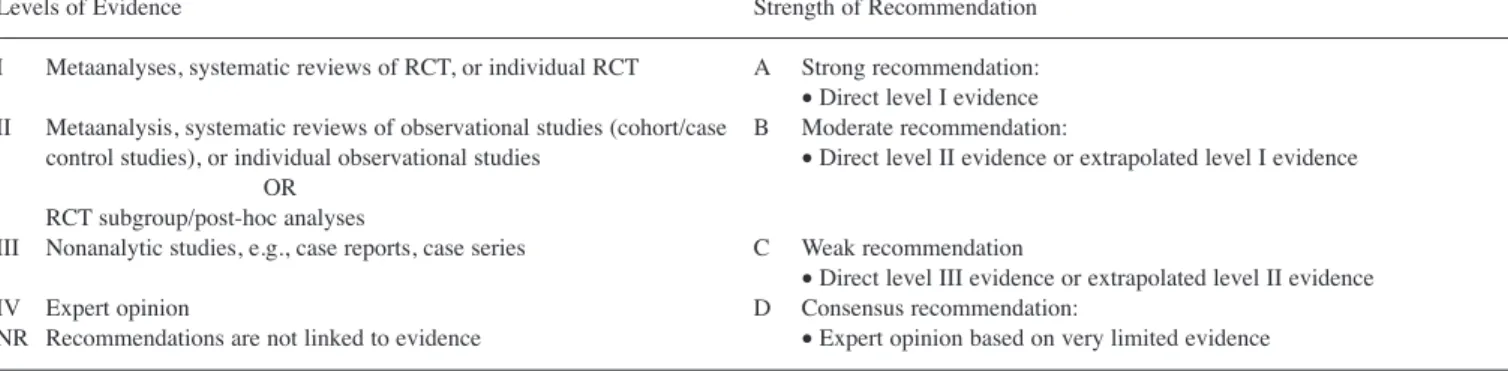
Grading evidence.Systems for assigning levels of evidence differed across guidelines. In order to reconcile these differences we translated each guide-line’s grading system onto a custom system for assigning levels of evidence simplified from that developed by the Scottish Intercollegiate Guideline Network (SIGN)16. A level of evidence and strength of recommendation was assigned for each recommendation according to this custom grading system (Table 2).
Evidence synthesis.Tables of included guidelines containing descriptive char-acteristics (guideline developer, country, year, topic, target audience, funding sources) and detailed AGREE domain scores were prepared for each subsec-tion of the guideline. Evidence tables containing guideline characteristics (developer and year), recommendations, AGREE summary scores, and sup-porting evidence were prepared for each key question.
Development of recommendations.For each key question, the full working group was presented with an overview and evidence table summarizing rec-ommendations and supporting evidence from international guidelines. If the panel agreed with at least one existing recommendation, a Canadian recom-mendation was developed by adapting and rewording existing recommenda-tions. Recent guidelines of high methodological quality were emphasized. Supporting evidence from observational studies and randomized controlled trials (RCT) referenced by the guideline was reviewed in detail. If the panel did not agree with at least one recommendation provided by the guidelines, a recommendation was developed by consensus after considering available evi-dence cited by relevant guidelines. In special circumstances, additional
mary literature identified through supplementary manual literature searches was sought. Canadian recommendations were worded according to published criteria for improving implementability of guidelines17and were voted on using a modified Delphi consensus technique. Each participant registered a vote ranging from 1 (disagree strongly with recommendation) to 10 (agree strongly with recommendation), and disagreements were resolved through discussion and multiple rounds of voting accordingly.
Extended review.Draft recommendations developed by the working group were sent to members of the CRA for review and comment. Feedback from survey respondents (n = 86) was used to finalize recommendations and inform supporting text discussions. The present document was prepared in accordance with the principles outlined by the AGREE instrument V1 (www.agreecollaboration.org) and the Conference on Guideline Standardization checklist18. These recommendations were then sent for final review by the CRA executive and received official endorsement by the CRA.
RESULTS
Key to Understanding This Guidance
Each recommendation is presented with a level of evidence and strength (Table 2) and is accompanied by supporting text that is structured as follows:
Summary of guidelines. A synthesis of recommendations made by international RA guidelines identified from the sys-tematic review.
Recommendation/supporting evidence.Specific source guide-lines that were used for adaptation.
Summary of evidence linked to recommendation.A summary
of the original evidence presented in source guidelines used for adaptation.
Evidence to recommendation.A discussion of the guideline panel’s interpretation of the evidence, clinical experience, and values used to develop the recommendation.
Potential barriers for implementation.Canadian system factors that may influence the applicability of the recommendation. Overarching Principles in the Care of Persons with RA: 1. Patients with RA should be cared for by a rheumatologist or by other healthcare professionals trained and experienced in RA diagnosis, clinical assessment, and appropriate prescrip-tion of RA drug therapies;
2. Every Canadian with RA should have timely and equal access to appropriate rheumatologic care;
3. Treatment of patients with RA should be based on shared decision-making between patient and physician. This should include provision of appropriate RA education materials to patients and caregivers and clear discussion of the benefits and potential risks of treatment;
4. The development of shared-care models with primary care physicians and/or other allied health professionals trained in mus-culoskeletal (MSK) conditions could enhance healthcare delivery for patients with RA, particularly given the current shortage of rheumatologists in Canada. Such models include support for timely identification and referral of early arthritis patients, guid-ance for monitoring disease activity in patients with established disease, and the management of comorbidities;
5. RA healthcare providers should consider opportunities for engaging patients in research both as participants and as potential research partners/consumer representatives to fur-ther the knowledge and understanding of RA.
Recommendations
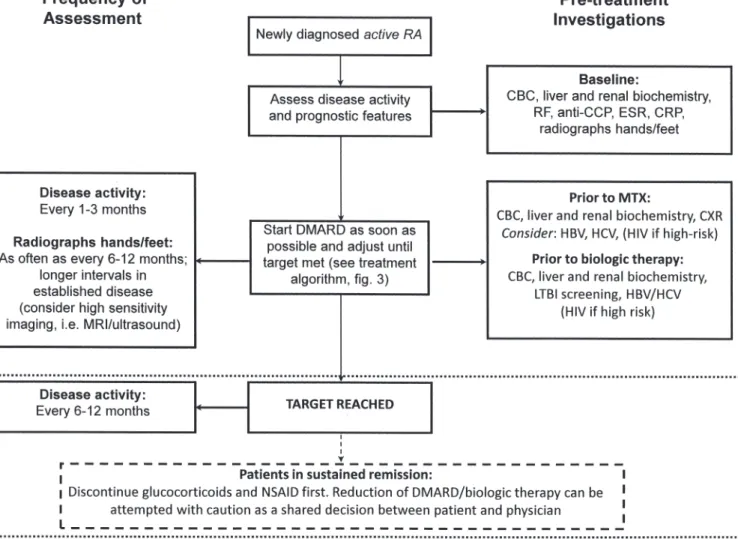
A summary of these CRA recommendations is presented in Table 3. Algorithms summarizing recommendations for the assessment and treatment of patients with RA are presented in Figure 2 and Figure 3, respectively.
Recommendation 1:
The goal of treatment is remission and when not possi-ble, minimal disease activity (I) while controlling symptoms, halting damage, preventing disability, and improving quality of life (IV). (Level I, IV; Strength A)
Summary of guidelines. The search identified 9 clinical prac-tice guidelines (CPG) and 5 consensus statements (CS) that addressed goals of treatment (AGREE rating: Recommend (R) = 7, Recommend with provisos (R*) = 7). Eleven guide-lines recommended that the goal should be remission, and when not possible, low disease activity (LDA)19-29, and 2
guidelines recommended a goal of minimal disease activity/ LDA30,31. Four guidelines specified additional treatment
tar-gets including function, joint destruction, and quality of life outcomes20,28,31,32.
Recommendation/supporting evidence. EULAR 201026 (R), Table 2. Custom system for assigning level of evidence and strength of recommendation.
Levels of Evidence Strength of Recommendation
I Metaanalyses, systematic reviews of RCT, or individual RCT A Strong recommendation: •Direct level I evidence II Metaanalysis, systematic reviews of observational studies (cohort/case B Moderate recommendation:
control studies), or individual observational studies •Direct level II evidence or extrapolated level I evidence OR
RCT subgroup/post-hoc analyses
III Nonanalytic studies, e.g., case reports, case series C Weak recommendation
•Direct level III evidence or extrapolated level II evidence
IV Expert opinion D Consensus recommendation:
NR Recommendations are not linked to evidence •Expert opinion based on very limited evidence RCT: randomized controlled trial; NR: not reported.
Table 3. Canadian Rheumatology Association (CRA) recommendation for the pharmacological management of RA with traditional and biologic DMARD.
Recommendations Level Strength
General RA management strategies
1. The goal of treatment is remission and, when not possible, minimal disease activity (I) while controlling symptoms, halting I, IV A damage, preventing disability, and improving quality of life (IV)
2. The presence of the following poor prognostic features should be assessed at baseline and considered when making treatment II B decisions: RF positivity, anti-CCP positivity, functional limitation, high number of swollen and tender joints, early erosions,
extraarticular features, high ESR or CRP
3. RA care providers should monitor disease activity as frequently as every 1 to 3 months in patients with active RA (I). Patients I, IV A with well controlled disease and patients in remission can be monitored at longer intervals (IV)
4. Traditional and biologic DMARD therapy should be adjusted every 3-6 months, as long as the goal has not been achieved I, IV B 5. Radiographs of the hands and feet are recommended as frequently as every 6-12 months in patients with recent-onset disease II, IV B
(II). Radiographs can be performed at longer intervals in patients with established disease (IV)
6. A change in therapy should be considered in patients with radiographic progression despite adequate clinical response IV D Treatment with glucocorticoids
7. Glucocorticoids (oral, intramuscular, or intraarticular) can be added to DMARD therapy as part of the initial treatment strategy I, IV A/D of patients with RA (I), and may be an option for managing flares, as bridge therapy while waiting for DMARD to take effect,
or for symptom control if no other options exist (IV). Glucocorticoids should be used in the lowest possible dose and tapered as rapidly as clinically feasible (IV)
Treatment with MTX/DMARD
8. In patients with persistent synovitis, DMARD should be introduced as soon as possible I A 9. MTX is the preferred DMARD with respect to efficacy and safety and should be the first DMARD used in patients with RA I A
unless contraindicated
10. A complete blood count (II), liver (I) and renal biochemistry (II), and a chest radiograph (II) should be ordered prior to I-IV B/D initiating MTX therapy. Screening for hepatitis B and C should be considered (III), and HIV testing is recommended in
high-risk patients (IV)
11. Dosing of MTX should be individualized to the patient (IV). MTX should be started oral or parenteral and titrated to a usual I, IV A maximum dose of 25 mg/week by rapid dose escalation. In patients with an inadequate response or intolerance to oral MTX,
parenteral administration should be considered (I)
12. Initial combination therapy with traditional DMARD should be considered, particularly in patients with poor prognostic I B features, moderate-high disease activity, and in patients with recent-onset disease. Combination therapy should also be considered
in patients who have an inadequate response to monotherapy
13. When treating with combination therapy, MTX should be used as the anchor drug unless contraindicated. Combinations not I A including MTX can be considered on a case-by-case basis
14. Combination therapy with leflunomide and MTX should be used with caution as it is associated with higher toxicity I, IV A (gastrointestinal and liver) (I) and has no added benefit relative to other DMARD combinations (IV)
Treatment with biologics
15. In patients being considered for biologic therapy, an inadequate response to DMARD is defined as moderate to high disease IV D activity despite treatment with at least 2 DMARD (including MTX unless contraindicated) in mono or combination therapy after
3 months at target dose
16. Routine laboratory tests (complete blood count, liver and renal biochemistry) and screening for hepatitis B and C (and HIV in IV D high-risk patients) are recommended prior to initiating all biologic therapy. Screening for latent tuberculosis is recommended
prior to anti-TNF, abatacept, and tocilizumab. Baseline antinuclear antibody testing could be considered prior to starting anti-TNF
17. MTX coprescription with biologics is recommended for improved efficacy I A
18. Anti-TNF therapy is recommended for treatment of patients with RA after an inadequate response to DMARD (I). In I A exceptional circumstances involving patients with DMARD contraindications or high disease activity and poor prognostic factors
(particularly early disease), anti-TNF therapy may be an option after failure of DMARD monotherapy or in DMARD naive patients
19. Abatacept is recommended for the treatment of patients with RA after inadequate response to DMARD or anti-TNF therapy I A 20. Rituximab is recommended for the treatment of patients with RF-positive RA after an inadequate response to DMARD or I A
anti-TNF therapy
21. Patients should not be expected to flare before they are retreated with rituximab (IV). Retreatment can occur as early as 6 II, IV C months if the patient has had an initial response but has persistent synovitis (II)
22. Tocilizumab is recommended for the treatment of patients with RA after inadequate response to DMARD or anti-TNF I A therapy
23. In patients who have failed treatment with 1 anti-TNF due to lack of efficacy or toxicity the following options are I, II B recommended: switch to another anti-TNF (I, II), switch to another biologic with a different mechanism of action (abatacept,
rituximab, tocilizumab) (I), or add MTX (or other DMARD) if anti-TNF was used in monotherapy (II)
24. In patients who have failed treatment with 2 anti-TNF a switch to another biologic with a different mechanism of action II/IV C (abatacept, rituximab, tocilizumab)) is recommended
25. In the absence of data on therapeutic strategies after failure of abatacept, rituximab, or tocilizumab the following options can IV D be considered: switch to any biologic not previously tried and failed, add or switch to a traditional DMARD not previously
tried and failed, or enroll the patient in a clinical trial with a new agent
26. If a patient achieves sustained remission after discontinuation of NSAID and glucocorticoids, a reduction in traditional and IV D biologic DMARD can be attempted with caution as a shared decision between the patient and physician
RA: rheumatoid arthritis; DMARD: disease-modifying antirheumatic drug; anti-CCP: anti-cyclic citrullinated peptide antibody; ESR: erythrocyte sedimen-tation rate; CRP: C-reactive protein; HIV: human immunodeficiency virus; MTX: methotrexate; NSAID: nonsteroidal antiinflammatory drug; RF: rheuma-toid factor.
Treat to Target 201025(R), British Society of Rheumatology
(BSR) 200930(R), SIGN 200032(R).
Summary of evidence linked to recommendation. EULAR 2010 guidelines26and the 2010 Treat to Target Taskforce25
referred to evidence from RCT and several observational stud-ies showing that patients who attain a state of remission have better structural and functional outcomes than patients who have residual disease activity. The 2010 Treat to Target Taskforce25qualified, however, that no trial has directly
com-pared targeting remission to other treatment strategies; all strategic trials (studies comparing more intensive treatment strategies to usual care) have used LDA as the threshold to escalate therapy. The 2009 BSR guidelines add that there is evidence from observational studies that remission may be a difficult goal in certain patients30. 2000 Scottish guidelines
review observational studies emphasizing additional out-comes including symptom control, preventing disability and joint damage, and improving quality of life32.
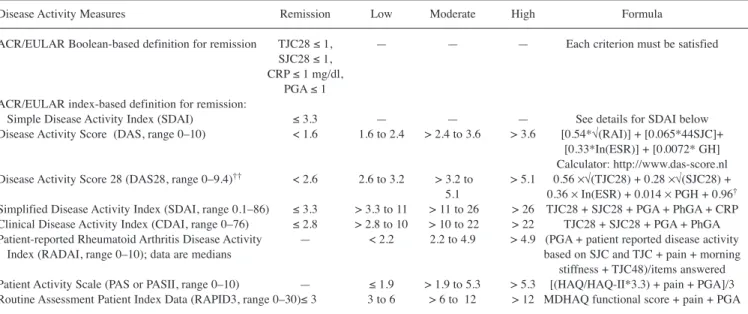
Evidence to recommendation.The guideline panel agreed that remission should be the target but may be difficult in certain patients, particularly those with long-standing RA. Several composite measures of disease activity have been developed and validated in patients with RA. The panel recognizes, how-ever, that composite measures may have limitations in daily routine practice. The panel therefore provides a reference guide of published disease activity criteria/thresholds (Table 4) and agreed that the choice of measure should be left to the discretion of the rheumatologist. Further, the use of patient-centered outcomes (pain, function, quality of life) in addition to disease activity was also emphasized.
Barriers to implementation.None. Recommendation 2:
The presence of the following poor prognostic features should be assessed at baseline and considered when making treatment decisions: rheumatoid factor (RF)
pos-Figure 2.Algorithm based on the Canadian Rheumatology Association (CRA) recommendations for the pharmacological treatment of rheumatoid arthritis (RA) with tra-ditional and biologic disease-modifying antirheumatic drugs (DMARD). LDA: low disease activity; DMARD: disease-modifying antirheumatic drug; CI: contraindicat-ed; IA: intraarticular; IM: intramuscular; MTX: methotrexate; anti-TNF: tumor necrosis factor inhibitor; ABAT: abatacept; RTX: rituximab; TCZ: tocilizumab.
itivity, anticyclic citrullinated peptide antibodies (anti-CCP) positivity, functional limitation, high number of swollen and tender joints, early erosions, extraarticular features, high erythrocyte sedimentation rate (ESR) or C-reactive protein (CRP). (Level II; Strength B)
Summary of guidelines. The search identified 7 CPG that addressed prognostic factors (AGREE rating: R = 5, R* = 2). All 7 guidelines identified the following baseline poor prog-nostic factors: RF and/or anti-CCP positivity, high ESR or CRP levels, early radiographic erosions, and high swollen and tender joint counts22,23,26,33,34,35,36. In addition, 3 guidelines
included baseline functional disability23,34,36, 2 included
extraarticular disease23,34, 2 included demographic
character-istics and disease duration22,23, 2 included genetic
mark-ers22,34, and 1 included grip strength23.
Recommendation/supporting evidence. 2009 NICE23 (R),
EULAR 200733(R*).
Summary of evidence linked to recommendation. The 2009 NICE guidelines23 and 2007 EULAR guidelines33 review
observational studies and indirect evidence from RCT sup-porting the prognostic value of each factor for clinical and radiographic outcomes in patients with recent-onset RA. 2010 EULAR26guidelines state that the titer of anti-CCP and RF is important, but no threshold levels for RF/anti-CCP titers or ESR/CRP values were listed in any of the guidelines. 2009 NICE guidelines23also added that there is some evidence that
patients who are both RF and anti-CCP positive may have a worse prognosis than patients positive for either antibody alone37.
Evidence to recommendation.The baseline poor prognostic factors listed in the recommendation are supported by evi-dence and were agreed to be the most relevant and practical indicators for making treatment decisions. The panel also acknowledged that additional factors influencing prognosis (e.g., comorbidities, sociodemographic, psychosocial, and genetic factors) may also affect treatment decisions.
Barriers to implementation.Anti-CCP testing is not uniform-ly reimbursed by government-funded healthcare across Canada.
Recommendation 3:
RA care providers should monitor disease activity as frequently as every 1 to 3 months in patients with active RA (I). Patients with well controlled disease and patients in remission can be monitored at longer inter-vals (IV). (Level I, IV; Strength A)
Summary of guidelines.The search identified 12 CPG and 3 CS that addressed frequency of monitoring disease activity (AGREE rating: R = 7, R* = 7, WNR = 1). Seven general RA management guidelines recommended assessments every 1–3 months in active disease21,23,25,26,27,30,38, with 5 specifying
longer intervals for patients with well controlled
dis-Table 4. Reference guide of rheumatoid arthritis disease activity measures36,94,95,96,97.
Disease Activity Measures Remission Low Moderate High Formula
ACR/EULAR Boolean-based definition for remission TJC28 1, — — — Each criterion must be satisfied SJC28 1,
CRP 1 mg/dl, PGA 1 ACR/EULAR index-based definition for remission:
Simple Disease Activity Index (SDAI) 3.3 — — — See details for SDAI below
Disease Activity Score (DAS, range 0–10) < 1.6 1.6 to 2.4 > 2.4 to 3.6 > 3.6 [0.54*√(RAI)] + [0.065*44SJC]+ [0.33*In(ESR)] + [0.0072* GH] Calculator: http://www.das-score.nl Disease Activity Score 28 (DAS28, range 0–9.4)†† < 2.6 2.6 to 3.2 > 3.2 to > 5.1 0.56 ×√(TJC28) + 0.28 ×√(SJC28) +
5.1 0.36 ×In(ESR) + 0.014 ×PGH + 0.96† Simplified Disease Activity Index (SDAI, range 0.1–86) 3.3 > 3.3 to 11 > 11 to 26 > 26 TJC28 + SJC28 + PGA + PhGA + CRP Clinical Disease Activity Index (CDAI, range 0–76) 2.8 > 2.8 to 10 > 10 to 22 > 22 TJC28 + SJC28 + PGA + PhGA Patient-reported Rheumatoid Arthritis Disease Activity — < 2.2 2.2 to 4.9 > 4.9 (PGA + patient reported disease activity
Index (RADAI, range 0–10); data are medians based on SJC and TJC + pain + morning
stiffness + TJC48)/items answered Patient Activity Scale (PAS or PASII, range 0–10) — 1.9 > 1.9 to 5.3 > 5.3 [(HAQ/HAQ-II*3.3) + pain + PGA]/3 Routine Assessment Patient Index Data (RAPID3, range 0–30) 3 3 to 6 > 6 to 12 > 12 MDHAQ functional score + pain + PGA †Calculator: http://www.das-score.nl. ††Alternative DAS/DAS28 formulas based on the use of CRP rather than ESR are available from http://www.das-score.nl. Other cut points for the DAS28 have also been proposed (remission 2.4, low activity 3.6, high activity > 5.5)5. DAS: Disease Activity Score based on 44 joint counts; RAI: Ritchie Articular Index; DAS28: Disease Activity Score based on 28-joint counts; TJC28: tender joint count based on 28-joint count; SJC28: swollen joint count based on 28-joint count; ESR: erythrocyte sedimentation rate; PGH: patient global assessment of health [visual analog scale (VAS) 0–100 mm]; PGA: patient global assessment of disease activity (VAS 0–10 cm); PhGA: physician global assessment of disease activity (VAS 0–10 cm); CRP: C-reactive protein, mg/l; TJC48: tender joint count based on 48-joint count; HAQDI: Health Assessment Questionnaire Disability Index (0–3); HAQ-II: modified HAQ (0–3); MDHAQ: Multidimensional Health Assessment Questionnaire (0–10).
ease25,27,30,38,39. One guideline recommended shared-care for
patients with well controlled disease by a general practitioner every 3–6 months and by a specialist every 6–12 months. Seven guidelines recommended assessments at least every 3–6 months for patients taking biologics without providing a distinction based on RA disease status24,35,39,40,41,42,43.
Recommendation/supporting evidence. EULAR 201026 (R),
Smolen 201025(R).
Summary of evidence linked to recommendation.A systemat-ic review of trials on strategy-driven treatment approaches in RA performed to inform the EULAR 2010 guidelines44
con-cluded that intensive treatment strategies produce a better clinical outcome, improved physical function, and less struc-tural damage than less intensive strategies. The 13 RCT that compared target-driven treatment approaches to usual care used followup intervals of between 1 and 4 months in the treatment group. Two of these RCT45,46 showed improved
outcomes with monthly assessments and treatment adjustment to a target of LDA compared to assessments every 3 months with treatment adjustment left to the discretion of the rheuma-tologist. An additional trial showed benefit with monthly assessments and a target-driven treatment approach to routine care with no specified interval for assessment47. The 2010
Treat to Target Taskforce25 also provided evidence from observational studies that radiographic progression can be seen in patients with high disease activity in as little as a few weeks. For patients with established disease, a French guide-line38 provided evidence from prospective cohorts showing
that patient-initiated followup was equivalent to physician-scheduled appointments over 6 years48,49.
Evidence to recommendation.The panel agreed that frequent assessments with appropriate treatment adjustment in patients with active RA are associated with improved outcomes. The panel also recognized that while 1 month is too short to see a
Figure 3.Algorithm based on the Canadian Rheumatology Association recommendations for the assessment of patients with rheumatoid arthritis (RA). DMARD: disease-modifying antirheumatic drug; NSAID: nonsteroidal antiinflammatory drugs; MRI: magnetic resonance imaging; CBC: complete blood cell count; RF: rheumatoid factor; anti-CCP: anticyclic citrullinated peptide antibodies; ESR: erythrocyte sedimentation rate; CRP: C-reactive protein; CXR: chest radiograph; LTBI: latent tuberculosis infection; HBV/HCV: hepatitis B/C.
maximal therapeutic effect of DMARD therapy, modifying the treatment approach (dosage change and/or adding short-term glucocorticoid) may be appropriate within this time-frame. Longer assessment intervals were agreed to be appro-priate in patients with well controlled disease, who should be instructed to consult their rheumatologist in case of flare/worsening. Shared-care models with other healthcare providers trained in the assessment of patients with RA could aid in the optimal monitoring of disease activity and adjust-ment of therapy.
Barriers to implementation.There is a shortage of rheumatol-ogists and other healthcare providers trained in the assessment of patients with RA that could participate in shared-care mod-els in Canada. Shared-care modmod-els are not currently widely available in Canada.
Recommendation 4:
Traditional and biologic DMARD therapy should be adjusted every 3–6 months, as long as the goal has not been achieved (Level I, IV; Strength B).
Summary of guidelines.One CPG and 1 CS provided general strategies for adjusting traditional and biologic DMARD (AGREE rating: R = 2). Both recommended adjusting therapy until the treatment target is reached. EULAR 2010 guidelines26
suggested adjusting therapy every 1–3 months, although major adjustments in therapy (switching or adding a DMARD or bio-logic) should occur every 3–6 months, as outlined by their pro-vided algorithm. The Treat to Target Taskforce25
recommend-ed an adjustment in therapy at least every 3 months.
Recommendation/supporting evidence.EULAR 201026(R).
Summary of evidence linked to recommendation. EULAR 2010 guidelines26referred to strategic trials showing that
fre-quent therapy adjustment based on reaching a target response is associated with better outcomes. Timing of adjustment, however, should also consider the pharmacokinetics of the medications used. 2008 BSR guidelines50suggested that on
average 3 months is sufficient to assess the therapeutic effect for the majority of DMARD (except intramuscular gold: 4–6 months47 and hydroxychloroquine: 4 months29). French
guidelines suggest that a response to anti-TNF can be assessed on average after 3 months39, rituximab and abatacept after 4
months41,42, and tocilizumab after 3–6 months24.
Evidence to recommendation.The panel considered the evi-dence from strategy-driven RCT and agreed that 3–6 months balances minimizing missed opportunities for timely adjust-ment with the time needed to observe a therapeutic effect of most treatments. Adjustment in the context of this recommen-dation refers to changing DMARD strategy (adding or switch-ing agent). Modifyswitch-ing the treatment approach (dosage change and/or adding short-term steroid) can occur more frequently based on the patient’s clinical status (Recommendation 3).
Barriers to implementation.There is a shortage of rheumatol-ogists and other healthcare providers trained in the assessment of patients with RA in Canada.
Recommendation 5:
Radiographs of the hands and feet are recommended as frequently as every 6–12 months in patients with recent-onset disease (II). Radiographs can be per-formed at longer intervals in patients with established disease (IV). (Level II, IV; Strength B)
Summary of guidelines.The search identified 6 CPG and 3 CS that addressed this question (AGREE rating: R = 2, R* = 7). Two guidelines recommended radiographs every 6–12 months for the first few years of disease22,33, and 7 guidelines
recom-mended annual radiographs without further specifica-tion20,24,25,27,31,39,42.
Recommendation/supporting evidence.EULAR 200733(R*).
Summary of evidence linked to recommendation. 2007 EULAR33 guidelines reported that the greatest change in radio graphic progression occurs within the first 2 years of dis-ease onset and reference observational studies showing that structural progression can be reliably assessed in as little as 6 months using a formal scoring system (progression defined as
4 Sharp points).
Evidence to recommendation. The panel agreed that radi-ographs should be ordered more frequently in recent-onset disease than in patients with established disease, particularly in patients with poor prognostic factors. The panel also recog-nized that the timing interval was controversial and depends on the sensitivity to change of the method used for radiograph interpretation and the potential influence of the results on the patient’s therapy. Given that formal radiographic scoring is not performed in routine practice, radiographs every 6 months may not be necessary in all patients. However, in certain cases where there is concern that the patient is developing erosions that were not present initially, repeating radiographs early may be warranted to help guide a change in therapy. Other imaging technologies (ultrasound and magnetic resonance imaging) can also be considered.
Barriers to implementation. Limitations in the reliability of interpreting serial radiographs.
Recommendation 6:
A change in therapy should be considered in patients with radiographic progression despite an adequate clin-ical response. (Level IV; Strength D)
Summary of guidelines.The search identified 3 CPG and 2 CS that addressed this question (AGREE rating: R = 1, R* = 4). Four guidelines27,39,51,52 suggested a change in therapy in
patients with radiographic progression despite an adequate clinical response, while one guideline26 cautioned that lag
periods in radiographic progression should be taken into account.
Recommendation/supporting evidence. EULAR 201026 (R),
FSR 200739(R*).
Summary of evidence linked to recommendation. EULAR 2010 guidelines26and 2007 French guidelines39
recommend-ed that radiographic progression should be considerrecommend-ed when adjusting therapy, especially if joint damage appears to progress markedly despite the achievement of the desired treatment target, but did not provide citable evidence. EULAR 2010 guidelines, however, also referred to indirect evidence from an RCT suggesting that radiographic change lags the achievement of clinical remission53. Evidence is lacking on
the efficacy of adjusting versus maintaining therapy in patients who have radiographic progression despite achieving a clinical response.
Evidence to recommendation.The panel recognized that radi-ographic progression is an important factor in the decision to adjust therapy, but that treatment decisions should take into account progression within the complete clinical context of the patient.
Barriers to implementation. Limitations in the reliability of interpreting serial radiographs.
Recommendation 7:
Glucocorticoids (GC; oral, intramuscular, or intraartic-ular) can be added to DMARD therapy as part of the initial treatment strategy of patients with RA (I), and may be an option for managing flares, as bridge thera-py while waiting for DMARD to take effect, or for symptom control if no other options exist (IV). GC should be used in the lowest possible dose and tapered as rapidly as clinically feasible (IV). (Level I, IV; Strength A/D)
Summary of guidelines.The search identified 8 CPG and 4 CS that addressed the use of GC in RA (AGREE rating: R = 5, R* = 7). Five guidelines recommended using short-term low-dose GC in patients with early RA22,23,26,34,54, 3 recommended
using GC for managing flares20,23,34, 3 as bridge therapy
while waiting for DMARD to take effect20,22,54, and 3 for
other situations28,31,52. Only 2 guidelines recommended
against using GC or stated that their use is controversial29,32.
Recommendation/supporting evidence. EULAR 201026 (R),
2009 NICE23(R).
Summary of evidence linked to recommendation. The
strongest evidence supporting a role of GC in patients with RA is as part of initial short-term combination therapy with other DMARD in patients with early RA. A systematic review of RCT informing the EULAR 2010 guidelines55showed
ben-efit of short-term treatment with GC for symptom control and inhibiting radiographic progression when added to DMARD monotherapy or DMARD combination therapy in patients with early RA, but found insufficient evidence to recommend an optimal tapering strategy. For the use of GC in other situa-tions, the 2009 NICE guidelines23highlighted a discordance
between strong anecdotal evidence of the benefit of using GC as bridge therapy and for managing flares, and the paucity of research studies. EULAR 2007 glucocorticoid guidelines56 state that patients treated with GC should be monitored close-ly and that the risk of adverse events will depend on the dose and duration of GC used.
Evidence to recommendation.The panel agreed with the body of evidence supporting short-term use of GC in the initial management of patients with RA and acknowledged the anec-dotal evidence regarding efficacy of GC for managing flares and as bridge therapy. The panel was concerned with the potential for toxicity associated with use of GC, and while they agreed GC should be used in low doses and tapered rap-idly, an optimal tapering strategy could not be recommended. When choosing a route of administration, intramuscular or intraarticular steroids allow more control over the total cumu-lative dose and may be preferred in certain situations. Intraarticular steroids were agreed to be particularly useful for controlling residual synovitis if a few swollen joints remain, as they avoid systemic toxicity.
Barriers to implementation.None. Recommendation 8:
In patients with persistent synovitis, DMARD should be introduced as soon as possible. (Level I; Strength A)
Summary of guidelines.The search identified 5 CPG and 5 CS that addressed starting DMARD therapy (AGREE rating: R = 4, R* = 6). Five guidelines recommended starting DMARD immediately/as soon as possible once the diagnosis is made21,22,26,27,29 and 5 recommended starting within 2–4
months of persistent symptoms of RA20,23,31, 32,57.
Recommendation/supporting evidence. EULAR 201026 (R),
Spanish Society of Rheumatology (SER) 201027(R*).
Summary of evidence linked to recommendation. EULAR 2010 guidelines26and 2010 Spanish guidelines27referred to
evidence from RCT and observational studies showing that delaying DMARD therapy results in worse clinical, function-al, and radiographic outcomes. EULAR 2010 guidelines26
fur-ther suggested that DMARD fur-therapy may be initiated in sus-pected cases of RA and cited recently published 2010 ACR/EULAR RA classification criteria9, which may assist in
early diagnosis.
Evidence to recommendation.The panel agreed that there is conclusive evidence supporting early treatment with DMARD in patients with RA. The diagnosis of early RA can be diffi-cult, and therefore the recommendation refers to patients with persistent synovitis, including patients with a strong suspicion of RA, but who do not meet full classification criteria.
Barriers to implementation.Lags in appropriate identification and referral of patients with early RA.
Recommendation 9:
efficacy and safety and should be the first DMARD used in patients with RA unless contraindicated. (Level I; Strength A)
Summary of guidelines.The search identified 7 CPG and 6 CS that addressed which DMARD to use first (AGREE rating: R = 6, R* = 7). Seven guidelines recommended starting with MTX as the first DMARD2,20,23,26,28,31,58, 2 recommended
starting with either methotrexate (MTX) or sulfasalazine (SSZ)22,32, and 3 recommended starting with either MTX or
leflunomide (LEF)27,29,59. Two guidelines recommended that
hydroxychloroquine (HCQ) or SSZ could be started first in patients with mild disease22,32. One guideline provided an
algorithm to guide the choice of initial therapy36.
Recommendation/supporting evidence.EULAR 201026(R).
Summary of evidence linked to recommendation. 2010
EULAR guidelines26provided evidence from RCT and obser-vational studies that MTX is effective in DMARD-naive patients with early moderate to severe RA and that no other traditional DMARD or anti-TNF monotherapies have been shown to be superior to MTX in terms of clinical efficacy. They also referred to a systematic review that supports the beneficial longterm safety profile of MTX60. 2007 Spanish guidelines54referred to observational evidence that MTX has a lower rate of treatment dropout in the medium to long term as compared to other DMARD.
Evidence to recommendation.The panel agreed that there is sufficient evidence to support MTX as the preferred DMARD in patients with RA based on its efficacy and safety profile. The panel recognized that other DMARD have also been proven to be effective (e.g., LEF, SSZ, HCQ, etc.) and may be considered in certain situations. Examples include patients with contraindications to MTX, patients with mild disease and/or in situations in which MTX use may not be desirable (e.g., a young woman who may become pregnant).
Barriers to implementation.None. Recommendation 10:
A complete blood cell count (CBC) (II), liver (I) and renal biochemistry (II), and a chest radiograph (II) should be ordered prior to initiating methotrexate (MTX) therapy. Screening for hepatitis B/C should be considered (III), and HIV testing is recommended in high-risk patients (IV). (Level I-IV; Strength B/D)
Summary of guidelines.The search identified 3 CPG and 3 CS addressing investigations for MTX (AGREE rating: R = 2, R* = 4). Five guidelines recommended CBC, liver transaminases, kidney biochemistry, and a recent chest radio -graph20,50,54,61,62, and 1 suggested all except chest radio
-graph36. In addition to the factors above, 4 guidelines also
rec-ommended serum albumin50,54,61,62and 4 recommended
hep-atitis B/C serology20,36,61,62 (2 recommended these in all
patients61,62, and 2 only in patients with risk factors20,36). Two
guidelines recommended pulmonary function tests in select
patients50,61, 2 recommended a liver biopsy in patients with
preexisting liver disease54,61, and 1 suggested considering
ordering an HIV test, fasting glucose, fasting lipids and preg-nancy test62.
Recommendation/supporting evidence. Visser 200962 (R*),
Pavy 200661(R*).
Summary of evidence linked to recommendation. Recom -mended investigations were based on systematic reviews per-formed as part of 2 international consensus statements61,62.
Ordering liver and renal biochemistry and a chest radiograph is based on observational studies showing that renal failure, decreased albumin, elevated transaminases, and baseline chest radiographic abnormalities are associated with increased tox-icity from MTX. Ordering a CBC is based on the increased risk of cytopenias in patients treated with MTX. Ordering hepatitis B/C serology and HIV testing in high-risk patients is based on case reports of hepatitis B/C reactivation while on MTX and expert opinion, respectively.
Evidence to recommendation.The panel chose the specified investigations listed in the recommendation based on the available evidence and clinical experience. Hepatitis B/C and HIV testing was supported by weak evidence and was there-fore worded as “should be considered.”
Barriers to implementation.None. Recommendation 11:
Dosing of methotrexate (MTX) should be individual-ized to the patient (IV). MTX should be started oral or parenteral and titrated to a usual maximum dose of 25 mg per week by rapid dose escalation. In patients with an inadequate response or intolerance to oral MTX, par-enteral administration should be considered (I). (Level I, IV; Strength A)
Summary of guidelines.The search identified 3 CPG and 4 CS that addressed dosing of MTX (AGREE rating: R = 1, R* = 6). Six guidelines recommended a starting dose of 5–10 mg, with a maximum dose of 20–25 mg per week2,27,31,34,50,61, and 1 recommended a starting dose of 10–15 mg with a max-imum dose of 20–30 mg per week62. Five guidelines
com-mented on the schedule for dose escalation; 2 recommended escalating by 2.5–5 mg every 2–6 weeks27,50; 1
recommend-ed escalating by 5 mg every 2–4 weeks62; 1 recommended
escalating every 6 weeks without specifying the dose incre-ment61; and 1 simply recommended rapid dose escalation22.
All guidelines recommend starting with oral (po) MTX and switching to parenteral if there is intolerance or lack of effica-cy, poor compliance61, or dose 15 mg31.
Recommendation/supporting evidence. Visser 200962(R*).
Summary of evidence linked to recommendation. Visser 200962referred to evidence from RCT supporting higher start-ing doses of MTX and rapid dose escalation46,63,64. Two trials
compared a higher versus lower starting dose of MTX in patients with RA: 12.5–20 mg/wk vs 5–10 mg/wk63and 25
mg/wk vs 15 mg/wk64. Both trials showed improved efficacy;
1 trial showed no difference in toxicity63, and the other a trend
toward more gastrointestinal (GI) toxicity64. Visser 2009 also
referred to evidence from retrospective studies that suggested better efficacy and less GI toxicity with parenteral versus oral MTX, potentially explained by the higher bioavailability of subcutaneous (sc) MTX. A recent post-hoc analysis from an RCT65 also showed that over half the patients that were
switched from oral to sc MTX after intolerance or inefficacy showed clinical improvement.
Evidence to recommendation.The panel agreed with starting with higher doses of MTX (e.g., 15 mg) with rapid dose esca-lation, including in certain situations starting directly at target dose. No specific schedule was recommended, as the optimal schedule for dose escalation was acknowledged to depend on the clinical context of the patient. Initial therapy with sc MTX (e.g., > 15 mg) or switching to sc administration after failure of oral MTX due to intolerance or inefficacy were recognized as appropriate options. In the latter case, other alternatives such as adding or switching DMARD could also be considered.
Barriers to implementation.None. Recommendation 12:
Initial combination therapy with traditional DMARD should be considered, particularly in patients with poor prognostic features, moderate-high disease activity, and in patients with recent-onset disease. Combination therapy should also be considered in patients who have an inade-quate response to monotherapy. (Level I; Strength B)
Summary of guidelines.The search identified 5 CPG and 3 CS that addressed when to use traditional DMARD combination therapy (AGREE rating: R = 4, R* = 3, WNR = 1). Two guidelines recommended starting with combination DMARD in all patients with early active RA23,66; 2 recommended
start-ing with combination therapy in certain situations includstart-ing high disease activity and in the presence of poor prognostic factors, or after failure of DMARD monotherapy20,36; 3
rec-ommended combination therapy after failure of DMARD monotherapy29,50,58; and one guideline recommended the use
of DMARD monotherapy over combination therapy26.
Recommendation/supporting evidence.ACR 200836(R); 2009
NICE23(R); EULAR 201026(R).
Summary of evidence linked to recommendation.2008 ACR guidelines36reviewed the RCT evidence showing efficacy of
various specific DMARD combinations in different clinical situations, such as in patients with moderate-high disease activity and poor prognostic factors. 2009 NICE guidelines23
performed a systematic review of RCT and observational studies and found that several combination therapies (most of which included GC) were superior to monotherapy for both clinical and radiographic outcomes, and that combination therapy was also very likely to be cost-effective. EULAR
2010 guidelines26performed a systematic review of RCT67
and noted that trials comparing combination therapy to monotherapy often did not include an appropriate control arm (e.g., switching to another DMARD monotherapy) and com-monly included higher rates of GC use in the combination arm.
Evidence to recommendation.The panel recognized that dif-ferent highly rated guidelines came to difdif-ferent conclusions regarding the same literature. The panel agreed that while the body of evidence supporting combination therapy has some limitations, there is sufficient evidence to consider the use of specific DMARD combinations as initial therapy and/or after inadequate response to monotherapy, particularly in the clini-cal situations highlighted in the recommendation.
Barriers to implementation.None. Recommendation 13:
When treating with combination therapy, methotrexate (MTX) should be used as the anchor drug unless con-traindicated. Combinations not including MTX can be considered on a case-by-case basis. (Level I; Strength A)
Summary of guidelines.The search identified 4 CPG and 2 CS that addressed which combination therapies should be used (AGREE rating: R = 2, R* = 3, WNR = 1). Two guidelines recommended MTX as the anchor drug but did not provide details for specific combinations23,33; 4 guidelines
recom-mended specific combination regimens with most including MTX29,36,58,66.
Recommendation/supporting evidence. 2009 NICE23 (R),
ACR 200836(R).
Summary of evidence linked to recommendation. 2009
NICE23and ACR 200836provided detailed discussions on the
evidence for combination therapy in RA. In most trials, MTX was included as part of the combination therapy, with many individual trials showing increased efficacy for combination therapy over monotherapy. Combination therapies with proven efficacy in at least one RCT include: MTX + sul-fasalazine (SSZ), MTX + hydroxychloroquine (HCQ), MTX + HCQ + SSZ, MTX + leflunomide (LEF) (see Recommen -dation 14 for detailed discussion), MTX + azathioprine (AZA), MTX + cyclosporin A (CsA), MTX + intramuscular (IM) gold, IM gold + HCQ, LEF + SSZ, HCQ + SSZ, CsA + LEF. Detailed descriptions of trials are provided in 2009 NICE23, ACR 200836, and Katchamart 200968.
Evidence to recommendation.After reviewing the evidence, the panel agreed that there was sufficient evidence to support the use of MTX as the anchor drug when using combination therapy, although other DMARD combinations may also be considered. Several different combination therapies have been shown to be effective in the treatment of RA, but direct com-parative effectiveness data of the different combinations are lacking. The panel therefore agreed it was appropriate to pro-vide a list of combinations supported by epro-vidence and the