Perceptions of the Importance of Plant Material
Knowledge by Practicing Landscape Architects
in the Southeastern United States
Robert F. Brzuszek
1,4, Richard L. Harkess
2, and Eric Stortz
1,3ADDITIONAL INDEX WORDS. education, plant knowledge, landscape architecture
SUMMARY. This study evaluates the attitudes and perceptions of practicing landscape
architects in the southeastern United States with regards to the importance of horticultural knowledge for their profession. A 20-question survey instrument was mailed to 120 landscape architects who were listed as members of the American Society of Landscape Architects. The survey included various questions related to education and experience of the respondents and their peers with plants. The response rate was 52.5% (n=63) and the majority of respondents were seasoned landscape architects in the states of Louisiana, Mississippi, Arkansas, Tennessee, Alabama, Georgia, and Florida that primarily served residential and commercial markets. The results from this study showed that the population of respondents strongly felt that plant knowledge is an important part of their professional skills, and recent graduates of landscape architecture and the profession as a whole appear more distanced from having strong plant expertise. Despite the increasing challenges for more formal plant education, there continues to be a need for both formal and informal extended education classes.
D
o landscape architects de-serve a generally bad reputa-tion for not knowing enough about the proper selection, placement, and management of plants in their project designs? There is an ongoing debate within the discipline of land-scape architecture as to how much plant knowledge is required for their practice. In essence, this is an internal struggle that reflects the diversity of job types that are now being practiced within the profession of landscape architecture, which ranges from urban and regional planning to transportation planning to historic preservation. Often, basic plant knowledge is not required nor used for these specializations.However, landscape firms that provide planting and management plans as part of their site-based services require employees with sufficient plant knowledge or at least someone in their office to have a specialization in plants to fulfill this role. As defined by the national landscape architecture pro-fessional organization, the American
Society of Landscape Architects (ASLA), ‘‘Because of their unique com-bination of design skills, technical expe-rience, and plant knowledge, landscape architects are the best choice for a major outdoor design project..’’
(ASLA, 2010a).
There has been recent discussion within the landscape community re-garding the decline of plant materials knowledge within the profession. His-torically, plant knowledge and the abil-ity to select and incorporate plants into the design process has traditionally been a cornerstone in the practice of land-scape architecture (O’Connell, 2000). Early American landscape designers such as Andrew Jackson Downing were known for their excellent plant skills (Griswold, 1994). In the 1800s, with technological advances in trans-portation (e.g., steam powered ships and locomotives), new types of exotic plants were increasingly imported in the United States. This expanded plant palette coupled with a resurgence of European garden styles enhanced plant knowledge opportunities in America (Douglas et al., 1984).
Before the profession of land-scape architecture was established as a society in 1899, those who practiced landscape design were termed ‘‘land-scape gardeners’’ (Griswold, 1994). Frederick Law Olmsted is credited as the father of American landscape archi-tecture and was known for his excellent
plant knowledge (Griswold, 1994). Olmsted promoted the term ‘‘land-scape architect’’ instead of ‘‘land‘‘land-scape gardener’’ to show the emerging pro-fession’s broader scope of work. In addition to planting design, paving, roads, and structures were also included as part of professional services. In the 20th century, landscape architects expanded further into subdivision development, regional planning, and highway construction. Education in technical skills needed to complete these new project types was deemed much more important than the knowledge in horticulture and art (Fredrick, 1994). In spite of these foundational changes to the profession, some land-scape architects continued to achieve recognition for their pioneering plant-ing designs or use of plants. Modern landscape architects who are also noted plant experts include Roberto Burle-Marx, Jens Jensen, Russell Page, and contemporary designers such as Piet Oudolf and Wolfgang Oehme (Eliovson, 1991; Grese, 1992; Oudolf and Kingsbury, 1999; Schinz, 2008; vanSweden and Oehme, 2003).
In a recent study conducted by Glancy and Kvashny (2009), only two courses in planting design were re-quired by the vast majority of accred-ited landscape architecture programs. Although planting design is consis-tently being offered, plant identi-fication and selection are not given due emphasis in landscape curricula (O’Connell, 2000). The purpose of our study was to survey and evaluate the perceptions of practicing landscape architects in the southeastern United States to better understand the impor-tance of plant knowledge within the profession of this region.
Materials and methods
A list of practicing landscape architects in the southeastern United States was obtained from the ASLA. The states within the southeastern re-gion of the United States defined for the purposes of this study are Louisi-ana, Mississippi, Arkansas, Tennessee, Alabama, Georgia, and Florida. There are 1700 individual memberships of varying categories (student, full, affiliate, etc.) within these seven states. From this comprehensive list, the stu-dent or affiliate members were removed and the full members (practitioners) were randomized in a database to pro-duce 120 (n= 120) as a knowledgeable
Mississippi Agriculture and Forestry Experiment Sta-tion Journal Series No. J-11880
1Department of Landscape Architecture, Mississippi State University, Box 9725, Mississippi State, MS 39762 2Department of Plant and Soil Sciences, Mississippi State University, 117 Dorman, Box 9555, Mississippi State, MS 39762
3Graduate Student
4Corresponding author. E-mail: [email protected]. edu.
from an accredited landscape architec-ture program or a program recognized by the Society and/or is state licensed to practice landscape architecture and has three or more years of professional experience’’ (ASLA, 2010b).
A survey instrument was designed and developed with approval from the Mississippi State University Institu-tional Review Board. The survey was composed of 20 fill-in-the-blank and closed-ended questions with topics that concerned demographics, formal and informal plant coursework, firm practice areas, resource materials, and knowledge assessments (Table 1). The mailing included a letter of request explaining the objective of the re-search, instructions for returning the completed questionnaire, and a printed copy of the survey. A self-addressed stamped return envelope was included with each mailing.
Dillman’s tailored design method was chosen for this study as it typically produces the highest response rate for
uses a minimum of three mailings to achieve the best sampling. The survey was initially piloted in Jan. 2006 to a group of Mississippi State Univer-sity landscape architecture students to test validity.
The initial survey mailing was conducted on 28 Feb. 2006. A follow up letter of encouragement to respond was mailed to all non-responders on 15 Mar. 2006, and the final survey request letter was sent on 5 Apr. 2006. As re-sponses were received, the survey infor-mation was entered in SPSS statistical analysis software (version 13.0; SPSS, Chicago, IL) for frequency and cross-tabulation analysis. Cross-cross-tabulations of survey questions were generated to identify relationships between nominal variables. To test the statistical signifi-cance of the cross-tabulations, a chi-square test was performed.
Results and discussion
Of the 120 surveys mailed, 63 were returned for a response rate of
of 20 years in practice, indicating that this was an experienced sample group. When asked their primary type of landscape practice, the three most frequent responses were residential design (41.3%), commercial ment (19%), and housing develop-ment (9.5%).
PLANT MATERIALS EDUCATION.A
majority of respondents (83%) had a bachelor degree in Landscape Archi-tecture while 10% had a Masters De-gree in Landscape Architecture. The majority of schools that the respon-dents attended required formal plant classes (primarily plant identification) to be conducted by the horticulture or a similar department. For those having a Bachelor of Landscape Architecture as the highest level of education, the most frequent response for the num-ber of formal courses taken concerning plant materials was two classes (22%), followed by three classes (13%), and four classes (7%). For those having a Masters of Landscape Architecture as the highest level of education, the most frequent response for the number of formal courses taken concerning plant materials was also two classes (3%).
PLANT MATERIALS KNOWLEDGE ASSESSMENT.Nearly half of the
partic-ipants in this study (48%) responded that they believed they had an average amount of plant materials knowledge. Some firms or designers, including those surveyed, specialize only in urban or regional planning, GIS and land studies, industrial development, mar-keting, and recreation facilities, which preclude much plant knowledge. The majority of our respondents are in the residential market, which may exhibit better plant knowledge than other planning professionals.
Twenty-one percent believed that their plant knowledge was good, and 29% rated themselves as having excellent knowledge of plants. This suggests that a majority of the respon-dents view their plant materials knowl-edge favorably. This may be because many of the respondents (41.3%) list their major area of practice being in residential design, an area of design that requires a detailed understanding of plant selection and usage.
Although a majority of partici-pants in this study have a favorable opinion of their own plant knowl-edge, they do not feel the same way
Table 1. Questions included in the 2006 southeastern United States landscape architecture survey on horticultural knowledge.
Survey question
1. List your education levels.
2. How many years have you been in practice? 3. In which year were you born?
4. What is your gender?
5. How many university-level plant material courses have you taken? 6. Have you ever taken any continuing education courses dealing with
the use of plant materials? If yes, specify.
7. Which of the following categories best describes the type of work that your firm does? (commercial, institutional, housing, zoological/park, historic restoration, ecological restoration, residential design).
8. What is your firm’s major area of practice?
9. How many landscape architects does your firm employ?
10. Does your firm have personnel considered to be experts in plant materials? If yes, what are their qualifications?
11. Which plant material references do you use most often?
12. What factors do you consider when you are selecting plant materials? 13. In your opinion, what are the main reasons plant materials do not survive? 14. Do you find that native plant materials have a higher survivability rate than
ornamental exotics?
15. How would you describe your overall knowledge of plant materials?
16. Do you think landscape architecture has distanced itself from plant knowledge? 17. Do you think new graduates of landscape architecture have sufficient
knowledge of plants?
18. What do you think would help new graduates gain a better understanding of plants? 19. What would help you improve your plant selection process?
20. Which of the following factors do you feel are important in plant selection? (environmental needs, USDA hardiness zone, irrigation needs, maintenance needs, cost, flower color, shape, scent, texture, survival rate, client preference, mature height, soil conditions, available sunlight, foliage color, availability, past experience)
about their peers. When asked if newly graduated landscape architecture stu-dents had a sufficient amount of plant materials knowledge, 71% of respon-dents indicated they did not (Table 2). Those expressing this strong negative opinion of plant knowledge among recent graduates had residential design listed as their major practice area. Six-teen percent of respondents were un-sure if recent graduates had a sufficient amount of plant materials knowledge, and those from the planning disciplines (housing or institutional development) were more evenly divided for this ques-tion. When prompted to explain their responses, 41% believed that experi-ence was a major factor in one’s level of plant knowledge (Table 3). Twenty-two percent of respondents believed that a poor education in plants at the university level was the reason.
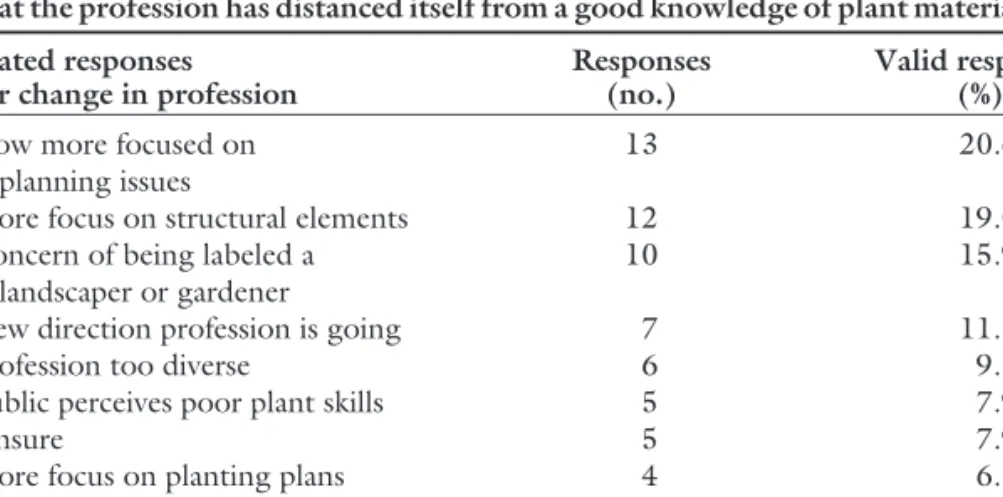
When asked if they felt that the profession of landscape architecture as a whole has distanced itself from plant materials from previous years, 73% agreed and 18% did not believe this to be true. When prompted to explain their answer, the three most frequent responses were as follows (Table 4): 1) plants are of lesser importance in landscape architecture because there is now increased focus upon planning issues (21%); 2) there is increased focus on structural elements in the landscape (19%); 3) plant expertise is not as le-gitimate for the profession as compared with other technical, built, or planning aspects. There is concern among the respondents of being labeled a land-scaper or gardener (15%).
Participants in this study were asked if their firm had ‘‘personnel considered to be experts in plant ma-terials.’’ Of the responses, 59% did have a person employed at their office who is specialized in plants and 40% did not. The data regarding the presence of a plant expert and major area of practice indicates that firms in residential de-sign, commercial development, or do not specialize are likely to have person-nel who specialize in plants. When asked about the qualifications of their plant experts, 38% stated that practical experience was the main factor, 11% had a degree in horticulture, and 6% responded they had a degree in land-scape architecture.
IMPROVING PLANT KNOWLEDGE.
Participants were asked what fac-tors could improve the plant knowl-edge of recent landscape architecture
graduates, and the vast majority felt that experience with plants is the best (76%) followed by more courses on plant materials (21%). Half of those (38%) who answered that experience is best had specifically stated that a plant nursery internship was a good way to learn.
When asked what would best help them in their plant selection process, the answers most often listed included continuing education (36.5%), in-creasing familiarity with more plants
(30.2%), and better references (9.5%) (Table 5). When asked which types of references are most used, the most frequent answers were multiple sour-ces (40%), books (9.5%), and print media (7.9%). As the investigators compared the rate of participation in continuing education to perceived plant knowledge, all the participants who responded that they had taken additional courses in plant materials rated themselves as having average to excellent knowledge in plants.
Table 2. Responses from landscape architects to ‘‘Do you think new graduates of landscape architecture have sufficient knowledge of plants?’’ as reported by landscape architects in the southeastern United States on a survey on
horticultural knowledge conducted in 2006. Stated responses for
sufficient knowledge Responses (no.) Valid responses (%) Yes 8 12.7 No 45 71.4 Unsure 10 15.9 Total 63 100.0 SD= 0.5.
Table 3. Reported reasons why landscape architects in the southeastern United States feel recent graduates have insufficient plant knowledge from a survey on plant material knowledge conducted in 2006.
Stated responses for insufficient knowledge
Responses (no.)
Valid responses (%)
Need experience to become proficient 26 41.3
Poor education in plant materials 14 22.2
No response 9 14.3
Profession too diverse 6 9.5
Requires more learning than schools can provide
5 7.9
Unsure 3 4.8
Total 63 100.0
SD= 1.9.
Table 4. Reported reasons on a survey of landscape architects in the southeastern United States on plant material knowledge conducted in 2006 on why they feel that the profession has distanced itself from a good knowledge of plant materials. Stated responses
for change in profession
Responses (no.)
Valid responses (%) Now more focused on
planning issues
13 20.6
More focus on structural elements 12 19.0
Concern of being labeled a landscaper or gardener
10 15.9
New direction profession is going 7 11.1
Profession too diverse 6 9.5
Public perceives poor plant skills 5 7.9
Unsure 5 7.9
More focus on planting plans 4 6.3
Total lack of knowledge of plants 1 1.6
Total 63 100.0
SD= 2.4.
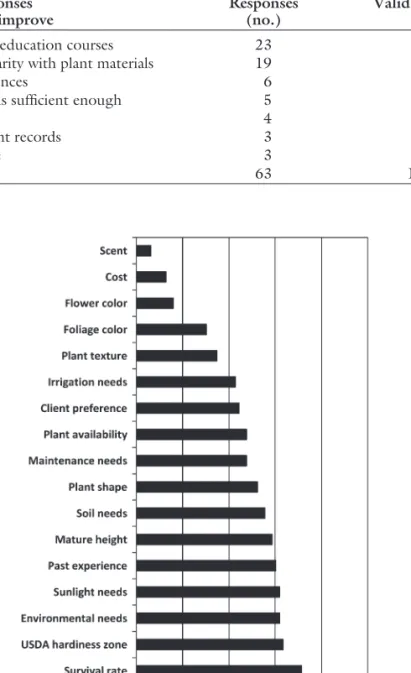
to rate their perceived importance of certain plant characteristics in selecting plants for a landscape de-sign, with categories that ranged from very important to not very important (Gazvoda, 2002). These characteris-tics included traits that were related to a plant’s culture as well as the landscape design process (Fig. 1). These charac-teristics include environmental needs (i.e., a plant’s suitability to the actual
irrigation needs, maintenance needs, cost, flower color, shape, scent, texture, survival rate, client preference, mature height, soil conditions, available sun-light, foliage color, availability, and the respondent’s past experience with plants.
The most frequent responses for the above categories were more concerned with understanding the en-vironmental needs of the plant than
to plant selection include the survival rate (71.4%), the USDA hardiness zone (63.5%), environmental needs (61.9%), sunlight requirements (61.9%), and past experience (60.3%). Of the design attributes, mature height (58.7%), shape (52.4%), and texture (34.9%) ranked the highest, with flower color (15.9%) and the cost of the plant (12.7%) being ranked the lowest.
When comparing the survey re-spondents’ evaluation of their plant materials knowledge to their opinion on the importance of the environmen-tal needs of plants in the landscape, those who viewed their knowledge of plants as being average to excellent responded environmental knowledge as being very important (61.9%). Those who viewed their knowledge of plants as being very poor to average responded environmental knowledge as being neutral to not very important (11.1%).
Conclusions
The results of this regional study clearly reveal that for this group of mostly seasoned practitioners in the residential design market, they feel they have a favorable opinion of their own plant knowledge. Of more concern, they feel that recent graduates in land-scape architecture have insufficient knowledge of plants and that this trend reflects the profession as a whole. Al-though a broad realm of resources and continuing educational courses are available, they felt that experience is the best teacher of plants for new graduates.
This study may show that there is a developing breach in the landscape architecture profession between how it has historically understood itself to perceptions of newly developing mar-kets. While the ASLA definition of a landscape architect defines plant exper-tise as being important and the major-ity of those surveyed in this study did have a person employed at their office who is specialized in plants, the primary responses as to why landscape archi-tects have less expertise is because of increased emphasis upon new planning projects and a shift to hardscape materials.
With shrinking budgets, univer-sities are following a national trend of reducing the total number of credit hours required for graduation (Arnone, 2004). Not only are elective hours
Table 5. Responses by landscape architects in the southeastern United States on a survey on plant material knowledge conducted in 2006 on what will help them improve their plant selection process.
Stated responses for help to improve
Responses (no.)
Valid responses (%)
Continuing education courses 23 36.5
More familiarity with plant materials 19 30.2
Better references 6 9.5
Knowledge is sufficient enough 5 7.9
Not sure 4 6.3
Keeping plant records 3 4.8
No response 3 4.8
Total 63 100.0
SD= 2.0.
Fig. 1. Subcategories of important factors in the plant selection process as listed from landscape architect survey responses reported by landscape architects in the southeastern United States on a survey on plant material knowledge conducted in 2006.
being reduced but landscape architec-ture departments also had to make dif-ficult choices in curriculum revisions of which core courses to keep, including plant materials. This challenges the idea of adding more formal plant courses in the landscape architecture curriculum. As many practicing land-scape architects in this study felt that a nursery internship may be the most valuable to students, required or spe-cial studies internships may be added to landscape architecture curricula. These may be offered during summer sessions when often few core courses are being taught. However, smaller or niche nurseries may offer limited plant knowledge to students on internship.
It is equally difficult to obtain continuing education credits for plant seminars by most landscape architec-ture licensing boards. The Council of Landscape Architecture Registration Boards (CLARB) is the national, non-profit association charged with licens-ing landscape architects. Continulicens-ing education credits are required for land-scape architects by many state licensing boards, and plant identification or cul-ture programs in some states do not meet credit requirements for topics concerning ‘‘health, safety, and welfare’’ (T. Barry, personal communication).
Therefore, the incentives for taking continuing education courses for plant knowledge are most often voluntary. States that currently do not reward landscape architects with continuing education credits for plant identifica-tion and culture may need to recon-sider this as an important component of professional knowledge.
Literature cited
American Society of Landscape Architects. 2010a. Guide to jobs in landscape archi-tecture and related fields. 24 May 2010.
<http://www.asla.org/nonmembers/ publicrelations/guidejobs.htm>. American Society of Landscape Architects. 2010b. Membership. 24 May 2010.
<http://www.asla.org/JoinRenew.aspx>. Arnone, M. 2004. Please leave, already. Chron. High. Educ. 50(22):A20–A21. Dillman, D.A. 2000. Mail and web-based survey: The tailored design method. Wiley, New York.
Douglas, W.L., S.R. Frey, and N.K. Johnson. 1984. Garden design: history, principles, elements, practice. Simon and Schuster, New York.
Eliovson, S. 1991. The gardens of Rob-erto Burle Marx. Timber Press, Portland, OR.
Fredrick, W.H. 1994. The rise and fall of the plant palette. Landscape Architecture 84(5):136.
Gazvoda, D. 2002. Characteristics of modern landscape architecture and its education. Landscape Urban Plan. 60: 117–133.
Glancy, C.L. and A. Kvashny. 2009. Un-dergraduate landscape architecture in-struction in plant materials: A survey. Texas Tech University, Lubbock, TX. Grese, R. 1992. Jens Jensen: Maker of natural parks and gardens. John Hopkins University Press, Baltimore.
Griswold, M. 1994. The horticultural reconnection? Landscape Architecture 84(5):46–53.
O’Connell, K.A. 2000. Pride and preju-dice. Landscape Architecture 90(2):32– 37.
Oudolf, P. and N. Kingsbury. 1999. Designing with plants. Timber Press, Portland, OR.
Schinz, M. 2008. The gardens of Russell Page. Frances Lincoln, London.
vanSweden, J. and W. Oehme. 2003. Gardening with nature. Watson-Guptill, New York.