Purdue University
Purdue e-Pubs
School of Engineering Education Graduate Student
Series School of Engineering Education
4-2018
First-Generation College Students Identifying as
Future Engineers
Dina Verdín
Purdue University, [email protected]
Allison Godwin
Purdue University, [email protected]
Follow this and additional works at:https://docs.lib.purdue.edu/enegs Part of theEngineering Education Commons
Granting Agencies
EEC-1428523, EEC-1428689
This document has been made available through Purdue e-Pubs, a service of the Purdue University Libraries. Please contact [email protected] for additional information.
Custom Citation
Verdín, Dina & Godwin, Allison. (2018, April 13-17). First-Generation College Students Identifying as Future Engineers. Paper presented at the 2018 annual meeting of the American Educational Research Association. Retrieved from the AERA Online Paper Repository.
First-Generation College Students Identifying as Future Engineers
Dina Verdín, Allison Godwin
School of Engineering Education, Purdue University
Paper presented at the 2018 annual meeting of the American Educational Research Association
Abstract
This paper seeks to understand factors that influence how first-generation college students identify as engineers now and in the future. Data used in this study came from four U.S. institutions obtaining a total first-generation college student sample of 596 participants. We used future possible selves as a lens to understand how first-generation college students’ current views of themselves as engineers shape their future identities as engineers. Two separate analyses were conducted. First, a multiple regression analysis was used to determine which career future satisfaction variables predicted first-generation college students current and future identification as engineers. Second, a hierarchical regression analysis was used to determine which measures i.e., belongingness, interest, recognition, performance/competence, and career outcome expectations accounted for most of the variance. Analyzing first-generation college students’ response to identifying as an engineer now and in the future revealed differences in which affective and career satisfaction measures were more salient. This work begins to illustrate which factors are important for first-generation college students’ future identification as engineers and can help broaden the pathways for more students to become engineers.
Objective
Increasing the participation of students obtaining engineering degrees has been echoed in reports by The National Academies (The National Academies, 2011), the 2012 President’s Council of Advisors on Science and Technology, and the National Research Council (2013). Concerned with expanding participation of underrepresented groups, the report by The National Academies (2011) outlined “ingredients for success in STEM”, among them were “motivation to be in [engineering], a sense of belongingness to [the engineering field], or self-identification with the field” (p. 239-240). The objective of this paper is to examine which factors of these listed by the National Academies are the most influential measures for identifying as an engineer for students who are the first in their family to obtain a bachelor’s degree (i.e., first-generation college students). In this work, we answer the following research questions:
RQ1. Which measures of career outcome expectations predict first-generation college students’ responses to the questions, “I feel like an engineer now” and “I will feel like an engineer in the future”?
RQ2. Which factors, i.e., feelings of belongingness, engineering identity measures, and career outcome expectations, account for the most variance in predicting first-generation college students’ responses to the questions, “I feel like an engineer now” and “I will feel like an engineer in the future”?
Theoretical Framing
This work utilizes three different frameworks: students’ feelings of belongingness in engineering, engineering role identity constructs (i.e., interest in the subject, being recognized as an engineer, performance/competence in engineering), and students’ career satisfaction expectations to understand future possible selves.
Future Possible Selves
Possible selves are “hypothetical images about one’s future, including the ideal selves that we would like to become” (e.g., “good student,” “college graduate,” or “successful engineer” and the selves “we are afraid of becoming” (e.g., “bad student,” “college dropout,” or “unsuccessful engineer;” Strahan & Wilson, 2006, p. 3). Markus and Nurius (1986) theorize that possible selves are separate from one’s current view of themselves nevertheless are intimately related. They further conjectured that possible selves are the “direct results of previous social comparisons in which the individual’s own thoughts, feelings, characteristics, and behaviors have been contrasted to those of salient others” (Markus & Nurius, 1986, p. 954). Possible selves are important to one’s identity development as evaluating one’s current self can serve to motivate behavior (Strahan & Wilson, 2006) and provide a mechanism for evaluating and interpretation context (Markus & Nurius, 1986). Through the lens of possible selves, first-generation college students can be viewed as “active producers of their own development” (Markus & Nurius, 1986, p. 955). In this study, we examine not only students’ current perceptions of themselves in the role of an engineer but also their future possible selves as engineers to see if there are differences in how students’ current identities and future possible selves are related to their attitudes about engineering or future goals. Belongingness in Engineering
Research on retention and persistence theorizes that a students’ sense of belonging is reflected on their “sense of affiliation and identification with the university community” and “integration into the college system” (Hoffman, Richmond, Morrow, & Salomone, 2002). In engineering education, research has found that students “social participation are crucially contingent upon an individuals’ sense of belonging within [the engineering] community” (Wilson, Bell, Jones, & Hansen, 2010). Additionally, engineering belongingness was found to be a critical path towards an engineering identity (Meyers, Ohland, Pawley, Silliman, & Smith, 2012).
Engineering Identity
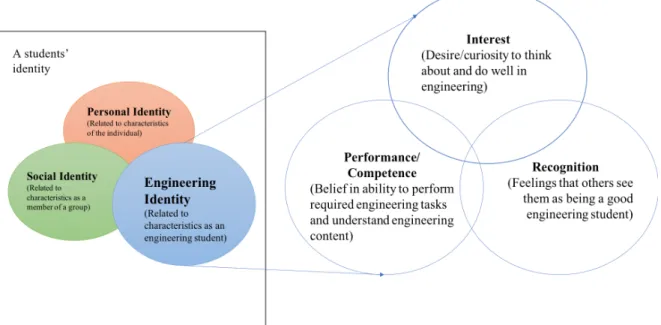
We draw our conceptualization of engineering role identity from significant prior work in physics and engineering education (Calabrese Barton & Tan, 2010; Carlone & Johnson, 2007; Godwin, 2016; Godwin, Potvin, Hazari, & Lock, 2016; Hazari, Sonnert, Sadler, & Shanahan, 2010; Potvin & Hazari, 2013). We measured three interrelated facets, interest in the subject, recognition by others as the type of person that can do engineering, and one’s beliefs in their performance/competence in engineering¾see Figure 1. Being interested in engineering plays a key role in the framing of role identity and involves a personal desire for learning and understanding in each context (Hazari et al., 2010). Recognition is therefore both an external manifestation and internal state, both of which are required for identity development (Carlone & Johnson, 2007; Potvin & Hazari, 2013). How a person is perceived by others is an incomplete
representation of how he/she perceived themselves, it is also important to understand how a student internalizes these beliefs in shaping who they are and how they position themselves in the world (Godwin, Potvin, Hazari, & Lock, 2016; Potvin & Hazari, 2013). Lastly, an individual cannot be recognized as a certain kind of person unless he/she makes visible (performs) their competence in particular domains (e.g., engineering; Carlone & Johnson, 2007). These three constructs have been used in the context of mathematics and physics in order to predict the choice of an engineering major (Godwin et al., 2016). In a previous study, first-generation college students in engineering had significantly higher measures of interest in engineering, beliefs in their performance/competence, and engineering identity when compared to continuing-generation college students (Verdín & Godwin, 2017).
Figure 1. Engineering Identity as conceptualized in Godwin (2016) and adapted from Hazari and colleagues (Hazari et al., 2010).Prior modeling work found that performance and competence measures are not independent of each other (Potvin & Hazari, 2013)
Career Outcome Expectation
Career outcome expectation variables (also thought of as career satisfaction variables) were derived from social career cognitive theory, they are beliefs regarding the results of various courses of action (Lent et al., 2003). Particularly, the career outcome expectation variables reflect the future state of affairs, that is, future outcomes that students’ desire for a particular career choice (Lent, Brown, & Hackett, 2000). The career outcome expectation variables used in this analysis were 1) making money, 2) becoming well known, 3) helping others, 4) supervising others, 5) working with people, 6) inventing/designing things, and 7) developing new knowledge and skills. These outcome expectations have been shown to be important for engineering students (Potvin et al., 2013). Similarly, in a nationally representative study, first-generation college students, when compared to continuing-generation college students, had significantly greater interest in making money, supervising others, inventing/designing things, and developing new knowledge and skills (Verdin & Godwin, 2015).
Methods
In the fall of 2015, the Intersectionality of Non-normative Identities and Cultures of Engineering (InIce) survey (Kirn et al., 2016) was administered at three participating land-grant institutions and one Hispanic-Serving Institution (HSI) in diverse regions of the United States¾Table 1. The InIce survey was designed as part of an NSF-funded grant with the purpose of investigating several factors related to how students felt about their place in the engineering community, their attitudes towards engineering, and their perceptions about their future in engineering. The study was focused on first-year engineering students with an overall sample of N = 2916, which includes both first-generation college students and continuing-generation college students. The survey was administered during the first two weeks of classes in students’ introductory to engineering courses to ensure a representative sample of all engineering disciplines. Students were given a paper-pencil format survey, to ensure high response rates, and the research team later digitized the surveys into an electronic format for further analysis. Data for this study were measured at one point in time and are cross-sectional.
The InIce survey comprised of multiple Likert-type items to measure students’ feelings of belongingness in engineering, STEM identities (i.e., engineering, physics, and math), career expectations, choice of major and other affective measures. All attitudinal responses were measured on a seven-point anchored numeric scale (0 = “strongly disagree” to 6 = “strongly agree”). The generation college student status was coded as a binary variable where 1 = first-generation college students and 0 = continuing-first-generation college students. If students responded
Table 1
Demographic Information for First-Generation College Students Institution Classification
Southwestern Land Grant+ 172 (33%§)
Southern Land Grant 125 (24%)
Midwestern Land Grant 97 (19%)
Hispanic Serving Institution 120 (23%)
Gender
Female 117
Male 394
Different than male or female 3
Race/Ethnicity++
Asian 9%
Black or African American 7%
Hispanic or Latino/a 30%
Native American or Alaska Native 1%
Native Hawaiian or other Pacific Islander 1% Multiple race/ethnicities groups marked 7%
White 45%
+ recently classified as emerging Hispanic Serving Institution.
++Students were given the opportunity to mark all that apply for their race/ethnicity classification, this section represents students who identified with a single group and those who marked more than one race/ethnicity are listed as multiple race/ethnicities.
to a question about their parent/guardian level of education for either parent/guardian with “bachelor’s degree” or “master’s degree or higher,” they were coded as 0 = continuing-generation college students. Students who reported both parents/guardians level of education “less than a high school diploma,” “high school diploma/GED,” or “some college or associate/trade degree,” were coded as 1 = first-generation college students. In this study, we were only interested in understanding first-generation college students alone, as opposed to making comparisons with their generation college peers. Therefore, students who were coded as 0 = continuing-generation college students were removed from our analysis. Similarly, students that chose not to report parent’s education level were also removed from the study.
We used the R programming language and statistical software system version 3.4.3 (R Core Team, 2017) to conduct two analyses. Two separate multiple regressions were employed to determine the significance of career outcome expectation variables in predicting students’ response to “I feel like an engineer now” and “I will feel like an engineer in the future.” To measure students’ career outcome expectations, seven factors were provided; students were asked to rate “How important are the following factors for your future career satisfaction.” The multiple regression models included all career outcome expectation variables and a backward elimination method was used to reduce the model to the most parsimonious one. This first model answers RQ1: Which measures of career outcome expectations predict first-generation college students’ responses to the questions, “I feel like an engineer now” and “I will feel like an engineer in the future”?
Following the multiple regression analysis, a hierarchical regression analysis was performed to analyze the amount of variance accounted for, individually, by each predictor variable (i.e., belongingness, engineering identity measures, and career outcome expectations). This analysis answers RQ2: Which factors, i.e., feelings of belongingness, engineering identity measures, and career outcome expectations, account for the most variance in predicting first-generation college students’ responses to the questions, “I feel like an engineer now” and “I will feel like an engineer in the future”? A hierarchical regression is typically performed when variables are highly correlated, as is the case in social science and educational research (Pedhazur, 1997). The hierarchical analysis procedure estimates the incremental variance accounted for by each set of independent variables organized by causal priority based on theory or hypothesis (Cohen, Cohen, West, & Aiken, 2003). In predicting students’ future identification as engineers, we hypothesized that belongingness accounts for most of the variance, following measures of engineering identity (i.e., interest, recognition and performance/competence), as prior work has found that belonging in engineering was critical towards eventually developing an engineering identity (Meyers et al., 2012). Lastly, the measures of career outcome expectation are included at the end as they are the outcomes of career satisfaction students adopt once their need to belong in a community is met and subsequently see themselves as the kind of people that can do engineering.
Results
To conduct the regression analyses, we first cleaned the data of missing values and outliers, resulting in 514 first-generation college students. Then, we examined the data for multicollinearity, tolerance, and variance inflation factors, which were within acceptable limits for all variables. Additionally, the test of normality showed no evidence of any significant deviation of normality from the residuals.Descriptive statistics for the variables can be found in Table 2. The engineering
identity and belongingness latent factors have strong validity evidence shown by exploratory and confirmatory factor analysis (Kirn et al., 2016). Construct validity for the engineering identity constructs has been previously demonstrated for this sample through confirmatory factor analysis (Godwin, 2016). In this study, we tested the internal consistency using Cronbach alpha, which examines how well a set of items measure a single construct or latent variable (Cronbach, 1951). Analysis yielded Cronbach alpha values of α = 0.88 for engineering interest, α = 0.83 for engineering recognition, α = 0.86 for engineering performance/competence, α = 0.89, and α = 0.91 for belongingness. These constructs were used in the hierarchical regression analysis.
Table 2
Descriptive Statistics
N Mean Std.
Deviation
Skewness Kurtosis Statistic Std. Error Statistic Statistic Statistic
Belongingness 514 4.99 .04 .84 -.69 -.14 Interest in Engineering 514 5.42 .03 .76 -1.33 1.28 Recognition in Engineering 514 4.62 .05 1.08 -.73 .70 Performance/ Competence in Engineering 514 4.71 .04 .90 -.34 -.54
Multiple Regression: “I feel like an engineer now”
A multiple regression analysis was used to predict the relationship between first-generation college
students’ response to I feel like an engineer now and seven factors for future career satisfaction
(i.e., making money, becoming well known, helping others, supervising others, working with
people, inventing/designing things, and developing new knowledge and skills). In predicting the relationship between first-generation college students’ identifying as an engineer now and measures of career satisfaction our analysis was significant at F(3,510) = 21.55, p < .001, Adj. R2 = .11¾Table 3. Three factors of future career satisfaction were significant for first-generation college students’ identifying as engineers now, becoming well known (β = .18, p < .001),helping others (β = .10, p < .05), and inventing/designing things (β = .19, p < .001).
Table 3
Summary of Multiple Regression of First-Generation College Students’ Responses to the statement, “I feel like an engineer now”
Estimate Standard Error Standard Coefficient (β)
Intercept 0.59 0.39 0.000
Becoming well known 0.16 0.04 0.18***
Helping others 0.14 0.06 0.10*
Inventing/designing things 0.28 0.07 0.19***
Adjusted R2 0.11
F 21.55***
*p ≤ .05 level; **p ≤ .01 level; ***p ≤ .001 level.
Hierarchical Multiple Regression: “I feel like an engineer now”
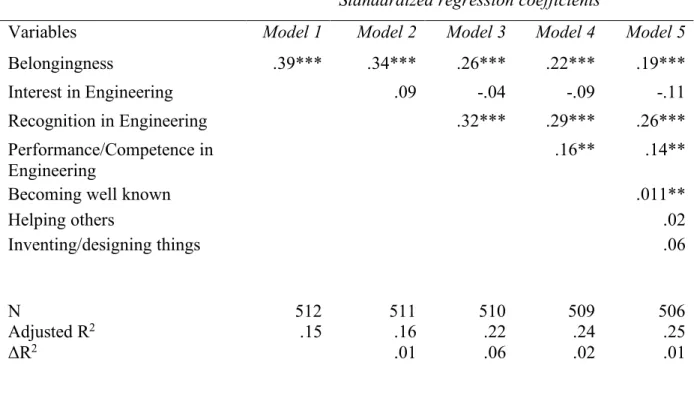
Table 4 outlines the hierarchical predictive relationship between first-generation college students feeling like an engineer now and measures of belonging, interest, recognition, performance/competence and career satisfaction outcomes. Belonging in engineering, alone, significantly contributed 15% of the variance in first-generation college students feeling like an engineer now F(1,512) = 92.52, p < .001. Interest in engineering, introduced in Model 2, had no significance (β = .09, n.s.) and remained non-significant as other variables were introduced. Beliefs about being recognized by others (i.e., family, instructors, peers) as the type of person that can do engineering significantly contributed to students current identification as an engineer (β = .32, p < .001) and explained an additional 6% of the variance at ΔF(3,510) = 46.96, p < .001. First-generation college students feeling of being able to perform well and understand engineering in and outside of the classroom significantly contributed to their feelings of being an engineer now, (β = .16, p < .01). Performance/competence explained an additional 2% of the variance ΔF(4,509) = 40.46, p < .01. Lastly, in model 5 we introduced the career satisfaction variables from Table 4 to determine the variance accounted for beyond the affective measures. Becoming well known was found to be the only significant career satisfaction predictor (β = .11, p < .001), explaining an additional 1% of the variance ΔF(7,506) = 3.85, p < .01.
Table 4
Summary of Hierarchical Multiple Regression Analysis for First-Generation College Students’ Responses to the statement, “I feel like an engineer now”
Standardized regression coefficients
Variables Model 1 Model 2 Model 3 Model 4 Model 5
Belongingness .39*** .34*** .26*** .22*** .19*** Interest in Engineering .09 -.04 -.09 -.11 Recognition in Engineering .32*** .29*** .26*** Performance/Competence in Engineering .16** .14**
Becoming well known .011**
Helping others .02
Inventing/designing things .06
N 512 511 510 509 506
Adjusted R2 .15 .16 .22 .24 .25
F 92.52 48.09 50.6 40.46 25.16
ΔF 3.25 46.96*** 7.96** 3.85**
*p ≤ .05 level; **p ≤ .01 level; ***p ≤ .001 level.
Multiple Regression: “I will feel like an engineer in the future”
We conducted a separate multiple regression analysis to examine how measures of career satisfaction predicted first-generation college students’ response to the statement, “I see myself as an engineer in the future.” Our analysis predicting first-generation college students’ future identification as an engineer using measures of career satisfaction was significant at F(4,509) = 47.87, p < .001, Adj. R2 = .27¾Table 5. Four factors of future career satisfaction were significant for first-generation college students’ seeing themselves as future engineers, helping others (β = .10, p < .05), supervising others (β = .13, p < .01), inventing/designing things (β = .35, p < .001), and developing new knowledge and skills (β = .12, p < .05).
Table 5
Summary of Multiple Regression of First-Generation College Students’ Responses to the statement, “I will feel like an engineer in the future”
Estimate Standard Error Standard Coefficient (β)
Intercept 2.12 0.27 0.000***
Helping others 0.12 0.04 0.10*
Supervising others 0.08 0.03 0.13**
Inventing/designing things 0.27 0.04 0.35***
Developing new knowledge and skills
0.07 0.06 0.12*
N 509
Adjusted R2 0.27
F 47.87***
*p ≤ .05 level; **p ≤ .01 level; ***p ≤ .001 level.
Hierarchical Multiple Regression: “I will feel like an engineer in the future”
Results from the hierarchical regression indicate (Table 6) that the variable belongingness contributes significantly to the regression model F(1,512) = 272.2, p < .001 and accounted for 34.6% of the variance in predicting students beliefs of identifying as an engineer in the future. Introducing the interest in engineering variable in Model 2, an additional 17% of the variation was explained for students’ future identification as an engineer resulting in a significant change in Adj. R2 of ΔF(2,511) = 187.57, p < .01. Recognition in engineering (Model 3) explained an additional 2% to students feelings of identifying as an engineer in the future, this change was significant to Adj. R2 at ΔF(3,510) = 21.814, p < .001. Performance/competence beliefs in engineering (Model 4) yield no significant change to the Adj. R2 value. Similarly, performance/competence beliefs were non-significant in predicting students’ future identification as engineers. Lastly, career
outcome expectation variables were added in Model 5 with two being significant. This addition explained 2% more of the variance in students’ responses to feeling like an engineer in the future. This change was significant for the variance explained (Adj. R2), ΔF(8,508) = 6.376, p < .001.
Table 6
Summary of Hierarchical Multiple Regression Analysis for First-Generation College Students’ Responses to the statement, “I will feel like an engineer in the future”
Standardized regression coefficients
Variables Model 1 Model 2 Model 3 Model 4 Model 5
Belongingness .54*** .28*** .26*** .25*** .22*** Interest in Engineering .48*** .45*** .44*** .40*** Recognition in Engineering .17*** .17*** .14*** Performance/Competence in Engineering .02 .02 Helping others -.01 Supervising others .11*** Inventing/designing things .11**
Developing new knowledge
and skills .00 N 512 511 510 509 505 Adjusted R2 .35 .52 .54 .54 .56 ΔR2 .17 .02 .0 .02 F 272.20 279.50 201.20 150.70 81.74 ΔF 187.57** 21.81*** .245 6.38***
*p ≤ .05 level; **p ≤ .01 level; ***p ≤ .001 level.
Scholarly significance of the study
This work investigated some of the factors that contributed to first-generation college students’ current and future identification as engineers. It is important to understand and capitalize on the factors that allow first-generation college students to identify as engineers early in their college trajectory to promote persistence. In our study, we found distinctions between students identifying as engineers now and in the future in career outcome expectations. Most notably, becoming well known was a significant predictor for first-generation college students identifying as engineers now (β = .18, p < .001), but not in the future. Conversely, first-generation college students feeling of being an engineer in the future encompassed developing new knowledge and skills (β = .12, p < .05) and supervising others (β = .13, p < .01). These career goals were not significant for students feeling like engineers now. Additionally, career outcome expectations that were significant predictors for identifying as an engineer now and in the future were a desire to help others and invent/design things. Often, first-generation college students are thought to enter engineering as a
form of financial stability and upward social mobility as motivators for pursuing engineering (Strutz, Orr, & Ohland, 2012). Our results indicate that first-generation college students hold additional desires for pursuing engineering than financial stability. Leveraging these career outcome expectations in the classroom can help first-generation college students’ see themselves as the type of people that can do engineering.
Feeling like an engineer in the future, has important practical significance in students’ persistence in engineering and motivation to study engineering. In other work, this outcome has been found to be a more important factor in students’ intentions to remain in engineering than their current perceptions of feeling like an engineer (Godwin, Sonnert, & Sadler, 2015). Many students are motivated by their future ideas of who they will become, including being an engineer (Fugate, Kinicki, & Ashforth, 2004; Ibarra, 1999; Oyserman, Bybee, Terry, & Hart-Johnson, 2004). In both hierarchical analyses predicting current and future identification as engineers, feeling as though one belongs in engineering contributed the most variance 15% and 35% respectively. We know from prior literature that belongingness plays a role in underrepresented students’ academic and social success in STEM majors (Strayhorn, 2012). This work empirically found that belongingness and identifying as an engineer were strongly related. Belongingness is especially relevant to students’ experiences and behaviors especially those “who perceive themselves as marginal to the mainstream [college] life” (Strayhorn, 2012). Future work that focuses on practical ways to support belongingness may also promote identity development for first-generation college students. We found that first-generation college students’ interest in engineering was a significant predictor for identifying as an engineer in the future (b = .481, p < .001) and accounted for an additional 17.5% of the variance. Scholars affirm that students’ interests are developed “through interactions with others (e.g., peers, educators, employers, and parents) and the environment” (Hidi & Renninger, 2006, p. 3). Hidi and Renninger (2006) also found that interest has a positive impact on persistence and effort, motivation, and learning in the classroom. Our results suggest that generation college students’ have had experiences that attracted them into engineering. Often, first-generation college students’ family knowledge and accumulated skills may not be the same as engineers or scientists, but closer to the skill sets of technicians or tradespeople based on their family background (Smith & Lucena, 2016). Thus, first-generation college students’ interest may be different than continuing-generation college students based on their unique lived experiences (Smith & Lucena, 2016). Nevertheless, the knowledge and skills they do gain are still supportive in fostering an interest to pursue engineering. Continuing to support first-generation college students’ interest in engineering is vital, scholars who study interest caution that “it is incorrect to assume that people with well-developed interest no longer need support” (Renninger & Hidi, 2016, p. 25). Rather, interest develops in relation to one’s environment, thus support and challenges are required to maintain interest, a facet on which educators can capitalize in the classroom (Renninger & Hidi, 2016). Interventions in the classroom that incorporate interest related to first-generation college students’ backgrounds may have significant and positive outcomes for identity development.
Lastly, we know prior literature tends to paint a deficit perspective of first-generation college students, often blaming these students for their lack of academic preparation (Chen, 2005) and lack of college knowledge or capital (Pascarella, Pierson, Wolniak, & Terenzini, 2004). While we know first-generation college students face different obstacles than their continuing-generation college
peers, they also enter engineering programs with unique and different lived experiences (Smith & Lucena, 2016) that provide significant value in engineering and may or may not be leveraged for students’ success. Our work highlights particular affective variables that promote identification with engineering and may be used to motivate and retain first-generation college students in engineering undergraduate education.
Conclusion
This paper draws attention to the differences that exists in how first-generation college students see themselves as engineers now and future perceptions of themselves as engineers. Whereas performance/competence in engineering plays an important role in feeling like an engineer now, sustained interest in engineering supports first-generation college students’ feeling like an engineer in the future. Feeling as though one belongs in engineering is important for these students’ current and future possible selves. Promoting and maintaining a welcoming environment throughout students engineering pathway is essential for their persistence.
Acknowledgments: The work in this paper was supported through funding by the National
Science Foundation (award numbers EEC-1428523 and EEC-1428689). Any opinions, findings, and conclusions or recommendations expressed in this paper are those of the authors and do not necessarily reflect the views of the National Science Foundation. The authors wish to thank the participants of the surveys and the Intersectionality of Non-normative Identities in the Cultures of Engineering (InIce) research groups including Lisa Benson, Adam Kirn, Geoff Potvin, Hank Boone, Jacqueline Doyle, and Monique Ross, for their support in collecting this data
References
Calabrese Barton, A., & Tan, E. (2010). We Be Burnin’! Agency, Identity, and Science Learning. Journal of the Learning Sciences, 19(2), 187–229.
https://doi.org/10.1080/10508400903530044
Carlone, H., & Johnson, A. (2007). Understanding the Science Experience of Sucessful Women of Color: Science Identity as an Analytic Lens. Journal of Research in Science Teaching, 44(8), 1187–1218. https://doi.org/10.1002/tea
Chen, X. (2005). First-generation students in postsecondary education: A look at their collge transcripts. Postsecondary education descriptive analysis report. NCES 2005-171. U.S. Department of Education, National Center for Education StatisticsNational Center for Education Statistics. Washington, D.C.
Cohen, J., Cohen, P., West, S. G., & Aiken, L. S. (2003). Applied multiple regression/correlation analysis for the behavioral sciences. Lawrence Erlbaum Associates.
Cronbach, L. J. (1951). Coefficient alpha and the internal structure of tests. Psychometrika, 16(3), 297–334.
Fugate, M., Kinicki, A. J., & Ashforth, B. E. (2004). Employability : A psycho-social construct , its dimensions , and applications. Journal of Vocational Behavior, 65, 14–38.
https://doi.org/10.1016/j.jvb.2003.10.005
Godwin, A. (2016, June), The Development of a Measure of Engineering Identity Paper presented at 2016 ASEE Annual Conference & Exposition, New Orleans, Louisiana. 10.18260/p.26122
Godwin, A., Potvin, G., Hazari, Z., & Lock, R. (2016). Identity, Critical Agency, and
Engineering: An Affective Model for Predicting Engineering as a Career Choice. Journal of Engineering Education, 105(2).
Godwin, A., & Sonnert, G., & Sadler, P. M. (2015, June), The Influence of Out-of-school High School Experiences on Engineering Identities and Career Choice Paper presented at 2015 ASEE Annual Conference & Exposition, Seattle, Washington. 10.18260/p.24889 al Conference & Exposition. Seattle, WA.
Hazari, Z., Sonnert, G., Sadler, P. M., & Shanahan, M.-C. (2010). Connecting high school
physics experiences, outcome expectations, physics identity, and physics career choice: A gender study. Journal of Research in Science Teaching, 47(8), 978–1003.
https://doi.org/10.1002/tea.20363
Hidi, S., & Renninger, K. A. (2006). The Four-Phase Model of Interest Development. Educational Psychologist, 41(2), 111–127.
Hoffman, M., Richmond, J., Morrow, J., & Salomone, K. (2002). Investigting “Sense of Belonging” in First-Year College Students. Journal of College Student Retention, 4(3), 227–256.
Ibarra, H. (1999). Provisional Selves : Experimenting with Innage and Identity in Professional Adaptation. Administrative Science Quarterly, 44, 764–791.
Kirn, A., Godwin, A., Benson, L., Potvin, G., Doyle, J. M., Verdín, D., & Boone, H. (2016). Intersectionality of Non-normative Identities in the Cultures of Engineering (InIce). In Proceedings of the 123rd ASEE Annual Conference and Exposition.
Lent, R. W., Brown, S. D., & Hackett, G. (2000). Contextual supports and barriers to career choice: A social cognitive analysis. Journal of Counseling Psychology, 47(1), 36–49. https://doi.org/10.1037/0022-0167.47.1.36
Lent, R. W., Brown, S. D., Schmidt, J., Brenner, B., Lyons, H., & Treistman, D. (2003). Relation of contextual supports and barriers to choice behavior in engineering majors: Test of alternative social cognitive models. Journal of Counseling Psychology, 50(4), 458–465. https://doi.org/10.1037/0022-0167.50.4.458
Markus, H., & Nurius, P. (1986). Possible selves. American Psychologist, 41(9), 954.
Meyers, K. L., Ohland, M. W., Pawley, A. L., Silliman, S. E., & Smith, K. a. (2012). Factors Relating to Engineering Identity. Global Journal of Engineering Education, 14(1), 119– 131.
National Research Council. (2013). Seeking Solutions: Maximizing American Talent by Advancing Women of Color in Academia: Summary of a Conference.
Oyserman, D., Bybee, D., Terry, K., & Hart-Johnson, T. (2004). Possible selves as roadmaps. Journal of Research in Personality, 38, 130–149. https://doi.org/10.1016/S0092-6566(03)00057-6
Pascarella, E. T., Pierson, C. T., Wolniak, G. C., & Terenzini, P. T. (2004). First-Generation College Students: Additional Evidence on College Experiences and Outcomes. The Journal of Higher Education. https://doi.org/10.1353/jhe.2004.0016
Pedhazur, E. J. (1997). Multiple regression in behavioral research: Explanation and prediction. Potvin, G., & Hazari, Z. (2013). The Development and Measurement of Identity across the
Physical Sciences. In Physics Educatoin Research Conference (pp. 281–284). https://doi.org/10.1119/perc.2013.pr.058
Potvin, G., Hazari, Z., Klotz, L., Godwin, A., Lock, R., Cribbs, J. D., & Barclay, N. (2013). Disciplinary Differences in Engineering Students’ Aspirations and Self-Perceptions. In 2013 ASEE Annual Conference & Exposition. Atlanta, Georgia: ASEE Conferences. Retrieved from https://peer.asee.org/19452
President’s Council of Advisors on Science and Technology. (2012). Engage to Excel: Producing One Million Additional College Graduates with Degrees in Science, Technology, Engineering, and Mathematics.
R Core Team. (2017). R: A Language and Environment for Statistical Computing. Vienna, Austria: R Foundation for Statistical Computing. Retrieved from https://www.R-project.org/
Renninger, K. A., & Hidi, S. (2016). The power of interest for motivation and engagement. Routledge.
Smith, J. M., & Lucena, J. C. (2016). Invisible innovators: how low-income, first-generation students use their funds of knowledge to belong in engineering. Engineering Studies, 8629(March), 1–26. https://doi.org/10.1080/19378629.2016.1155593
Strahan, E. J., & Wilson, A. E. (2006). Temporal comparisons, identity, and motivation: The relation between past, present, and possible future selves. Possible Selves: Theory, Research and Applications, 1–15.
Strayhorn, T. L. (2012). College students’ sense of belonging: A key to educational success for all students. Routledge.
Strutz, M. L., Orr, M. K., & Ohland, M. W. (2012). Chapter 7: Low socioeconomic status individuals: an invisible minority in engineering. Engineering and Social Justice: In the University and Beyond, 143.
The National Academies. (2011). Expanding Underrepresented Minority Participation: America’s Science and Technology Talent at the Crossroads. Washington, D.C. Verdín, D., & Godwin, A. (2015). First in the Family: A Comparison of First-Generation and
Non-First-Generation Engineering College Students. Frontiers in Education Conference (FIE), 1–8.
Verdín, D., & Godwin, A. (2019, June), Physics Identity Promotes Alternative Careers for First-Generation College Students in Engineering Paper presented at 2017 ASEE Annual Conference & Exposition, Columbus, Ohio. https://peer.asee.org/28741
Wilson, D. M., Bell, P., Jones, D., & Hansen, L. (2010). A Cross-Sectional Study of Belonging in Engineering Communities. International Journal of Engineering Education, 26(3), 687–698.