International Academy of Production Engineering
P
P
R
R
O
O
CE
C
EE
ED
DI
IN
N
GS
G
S
I
I
n
n
t
t
e
e
r
r
n
n
a
a
t
t
i
i
o
o
n
n
a
a
l
l
C
C
o
o
n
n
f
f
e
e
r
r
e
e
n
n
c
c
e
e
o
o
n
n
C
C
o
o
m
m
p
p
e
e
t
t
i
i
t
t
i
i
v
v
e
e
M
M
a
a
n
n
u
u
f
f
a
a
c
c
t
t
u
u
r
r
i
i
n
n
g
g
2
2
7
7
J
J
a
a
n
n
u
u
a
a
r
r
y
y
-
-
2
2
9
9
J
J
a
a
n
n
u
u
a
a
r
r
y
y
2
2
0
0
1
1
6
6
S
S
t
t
e
e
l
l
l
l
e
e
n
n
b
b
o
o
s
s
c
c
h
h
,
,
S
S
o
o
u
u
t
t
h
h
A
A
f
f
r
r
i
i
c
c
a
a
O
O
r
r
g
g
a
a
n
n
i
i
s
s
e
e
d
d
b
b
y
y
t
t
h
h
e
e
D
D
e
e
p
p
a
a
r
r
t
t
m
m
e
e
n
n
t
t
o
o
f
f
I
I
n
n
d
d
u
u
s
s
t
t
r
r
i
i
a
a
l
l
E
E
n
n
g
g
i
i
n
n
e
e
e
e
r
r
i
i
n
n
g
g
S
S
t
t
e
e
l
l
l
l
e
e
n
n
b
b
o
o
s
s
c
c
h
h
U
U
n
n
i
i
v
v
e
e
r
r
s
s
i
i
t
t
y
y
E
E
d
d
i
i
t
t
o
o
r
r
s
s
:
:
P
P
r
r
o
o
f
f
D
D
i
i
m
m
i
i
t
t
e
e
r
r
D
D
i
i
m
m
i
i
t
t
r
r
o
o
v
v
D
D
r
r
G
G
e
e
r
r
t
t
A
A
d
d
r
r
i
i
a
a
a
a
n
n
O
O
o
o
s
s
t
t
h
h
u
u
i
i
z
z
e
e
n
n
I
I
S
S
B
B
N
N
N
N
o
o
:
:
978-0-7972-1602-0
© 2016 by:
Global Competitiveness Centre in Engineering
Department of Industrial Engineering
Stellenbosch University
Private Bag X1
Matieland 7600
Stellenbosch, South Africa
Tel:
+27 21 808 4234
Fax:
+27 21 808 4245
E-mail:
;
All rights reserved. No part of this publication may be translated, reproduced, stored
in a retrieval system, or transmitted in any form or by any means, electronic,
mechanical, photocopying, recording, or otherwise, without the written permission of
the publisher.
About CIRP
CIRP
was founded in 1951 with the aim to address scientifically, through international
co-operation, issues related to modern production science and technology. The
International Academy of Production Engineering
takes its abbreviated name
from the French acronym of
C
ollege
I
nternational pour la
R
echerche en
P
roductique
(
CIRP
) and includes ca. 500 members from 46 countries. The number of members is
intentionally kept limited, so as to facilitate informal scientific information exchange
and personal contacts. In a recent development, there is work under way to
establish a CIRP
Network
of young scientists active in manufacturing research.
CIRP
aims
in general at:
x
Promoting scientific research, related to
-
manufacturing processes,
-
production equipment and automation,
-
manufacturing systems and
-
product design and manufacturing
x
Promoting cooperative research among the members of the Academy and
creating opportunities for informal contacts among CIRP members at large
x
Promoting the industrial application of the fundamental research work and
simultaneously receiving feed back from industry, related to industrial needs
and their evolution.
CIRP has its headquarters in Paris, staffed by permanent personnel and welcomes
potential corporate members and interested parties in CIRP publication and activities
in general.
CIRP Office, 9 rue Mayran, 75009 Paris, France. Web :
http://www.cirp.net
International Conference on Competitive Manufacturing
Efficiency-Oriented Risk Prioritisation Method for Supply Chains
in Series Production
D. Palm
1, P. Kales
21
ESB Business School, Reutlingen University, Germany
2Horváth & Partners Management Consultants
Abstract
Efficiency in supply chain risk management (SCRM) is a major topic in industries with serial production and a complex supply chain due to limited management and financial resources. A high number of possible risk situations and intertwined processes create a more challenging environment for resource allocation. Managers cannot perform SCRM in all possible supply chain areas and hence have to decide where available resources should be utilised for highest possible risk reduction. This makes it important to quickly and systematically evaluate input and output relationships among risk mitigation actions to determine which actions are deployed first for efficient risk level reduction. This paper introduces a new SCRM method based on the failure mode and effects analysis (FMEA) in order to perform an efficiency-oriented risk action prioritisation. By considering the cost-benefit evaluation of identified risk mitigation actions for each assessed risk and by determining the implementation effort for risk mitigation actions, also considered as the cost for realising a specific risk action the method allows finding those risk and risk mitigation actions, which are most efficient for risk reduction and should be implemented first in the process of risk steering.
Keywords
Supply Chain Risk Management, FMEA, risk prioritisation, series production
1 INTRODUCTION
Businesses have become increasingly aware of the risk potentials arising from supply chains and studies show that supply chain risks and related business interruptions rank as the number one global business risk [1]. These figures clearly indicate an increasing need for a proactive risk management in the supply chain across industries. It is apparent that companies must react to these challenges in order to fully recognise and manage risks in their supply chains, to understand the risks and the vulnerabilities in their supply chains in order to manage them accordingly. Studies [2], [3] showed that companies often have at best only partially implemented risk management systems in the supply chains or are simply not managing risks efficiently. Kersten et al. [4] stated that the biggest challenge in implementing supply chain risk management (SCRM) is resource limitation. This is of particular importance in environments of high complexity like supply chains in series production. A high number of possible risk situations and intertwined processes create a more challenging environment for resource allocation and opens up the problem where available resources should be utilised for highest possible risk reduction. [5]
In this paper, we present an efficiency-oriented risk prioritisation method for supply chains in series production to be used in industrial practice. This implies that the method should have a certain degree of practicability and ease of use.
2 EXISTING MODELS FOR SC RISK MANAGEMENT
2.1 Sources of supply chain risk
Multiple authors approached supply chain risk differently by categorising risks according to their occurrence in supply chains. For example supply risks and demand risks [6], supply chain risks related to design, quality, cost, availability, manufacturability, supplier, legal and environmental, health and safety [7] or the flow of material, information and money [8]. Other authors used the SCOR model structure to categorise risk along the dimensions plan, score, make, deliver and return [9] or introduced risk categories like disruption, delays, systems, forecast, intellectual property, procure-ment, receivables, inventory and capacity [10]. One approach was established by Christopher and Peck [11] and suggests separating risk in a supply chain context into three main categories: organisational risk sources, which are internal to the company, network-related risk sources, which are external to the firm but internal to the supply network, and environmental risk sources, which is external to the network. This classification clarifies the relevant dimensions of potential disruptions in a supply chain setting and therefore provides the basis for a comprehensive risk analysis. The three main categories can be further broken down into five distinct supply chain areas where risk can arise (see Figure 1). In order to evaluate the categories of demand, supply and process risk, four additional
sub-categories are defined to indicate the impact area of respective risks. The sub-categories are quality, delay, loss and cost.
Figure 1 - Sources of supply chain risks [11]
2.2 Supply chain risk management
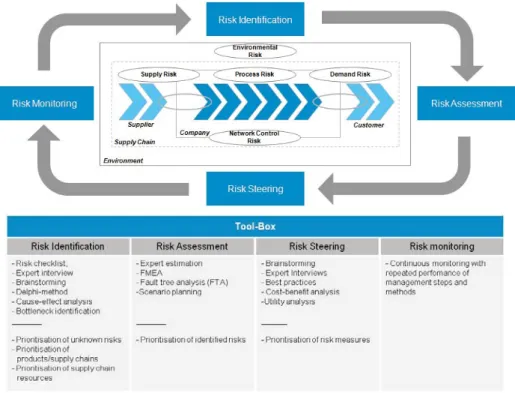
The SCRM process has developed from the traditional risk management function. According to the internationally established guideline ISO 31000 the basic risk management process consist of the steps: definition of risk management framework, risk identification, risk analysis, risk assessment and risk steering as well as two parallel steps of risk communication and monitoring. [12]
For SCRM, several researchers have adapted the generic process steps and aligned them with the purpose of managing supply chain risks. Similar as to the variation in traditional process steps, the SRCM process can have minor deviations (three steps approach [9], [13] or five step approach [14]) but it becomes obvious that the same core steps are part of the process in SCRM. The four steps approach as proposed by Norrman and Jansson [15] or others can be seen in Figure 2.
Figure 2 - Supply Chain Risk Management Process [17]
2.3 Methods of supply chain risk management
Most of the methods to perform and guide the risk management process originate from the classical risk management field and are mainly influenced by functions such as finance, quality management and systems engineering. [16] There are a very high number of classical risk management methods and tools available in literature, which are used for various kinds of approaches to risk management tasks [17]. However, due to specific characteristics of the SCRM compared to other functions it seems obvious that some are more suitable then others. Furthermore also Romeike [18] mentioned that the specific risk profile of a company has to be considered while selecting suitable risk management methods.
2.3.1 Methods for risk identification
For the process of identifying risks in a system, various methods are available. Romeike [18] proposed a categorisation into collection, creative and analytical methods.
2.3.2 Methods for risk assessment
The wide range of different risk assessment
methods available need to be categorised. Multiple researchers distinguished between qualitative and quantitative methods for risk assessment [9], [19]. In the qualitative category the failure mode and effects analysis (FMEA) as well as the expert estimation are important methods [21]. The quantitative methods like fault tree analysis and scenario planning are often associated with higher effort as they are mainly based on hard facts and figures that need to be collected and structured to yield insight about the respective risks. The main obstacle is often the availability of suitable data. [18]
2.3.3 Methods for risk steering
The risk steering process is about determining concrete actions and strategies to mitigate and manage risk in supply chains. In order to identify the most suitable and effective strategies, quantitative and qualitative methods are available. [9]
2.3.4 Methods of risk monitoring
Risk monitoring is about the continuous controlling of the actual risk situation in the supply chain. Method in this risk management step are utilised in order to record identified risks for later review. This is often done by composing risk catalogues dedicated risk management IT-systems, which are company specific and additionally contain a specific risk categorisation. [16]
2.4 Prioritisation methods in supply chain risk management
2.4.1 General methods of risk prioritisation
In literature several risk prioritisation methods in SCRM can be identified in which risks are prioritised according to their importance for further
assessment. It can be distinguished riskwise
between known and unknown risks [9], [13], [15] and by risk prioritisation method (single, two or multiple criteria prioritisation) [5].
2.4.2 Prioritisation of product supply chains
The priorisation of a product specific supply chain is especially useful in business environments that handle a high number of different parts and components from different sources. This is often the case in manufacturing related sectors such as the automobile industry. Ziegenbein [9] proposed a risk portfolio with two dimensions (see Figure 3) To determine the degree for strategic importance of the product and its supply chain it is proposed to analyse its revenue potential. On the other hand, the degree of vulnerability of the product supply chain should be measured in past incidents that happened or the expected risk level.
Figure 3 - Prioritisation of product SC [9] Apart from a segmentation regarding products, supply chains can also be segmented according to the market, the sourcing characteristics or in view of its geographic or commercial environment. [22]
2.4.3 Prioritisation of resources
This was introduced by Lynch [23] where he prioritises the resources of the supply chain regarding their potential risk level. Resources can be labour force, technology, assets and relationships as well as processes.
2.4.4 Prioritisation of risk action effectiveness
Pujawan and Geraldin [23] developed a method to prioritise risk actions, which should be implemented at first in order to realise the most cost-effective risk reduction outcome in SCRM. For the procedure, the so called House of Quality method was utilised, which is also known as a part of Quality Function Deployment (QFD). The authors adapted the House of Quality for the purpose of SCRM.
Engelhardt-Nowitzki and Zsifkovits [24] used a portfolio
visualisation technique with the two dimensions “risk
action benefit” and “risk action implementation effort” to prioritise possible risk actions.
2.5 Critical reflexion of the state of the art
Based on the state of the art in SCRM it was possible to develop a general SCRM framework (Figure 4) which can be used by industry. However, it is of particular importance for practice to have a simple method based approach for the process of reducing risk in the supply chain in order to ensure a systematic and guided procedure for risk management [5], [26]. Here a lack of methodical support in risk steering can be identified. [23] needs intensive knowledge about the House of Quality calculation procedure. Additionally the authors stated that this method requires intensive qualitative data collection from within the focal company. The FMEA is an often used and applied method, which can be easily adapted for the purpose of managing risks in a supply chain. Several possibilities have been outlined in literature, to improve identified weaknesses of FMEA through methodical amendments. The high value of utilising the FMEA also in practical SCRM is specifically stated by [26] in mentioning the benefits to give managers a systematic step-by-step method for risk evaluation in supply chains. An approppriate risk steering method based on the FMEA shall be introduced in the following chapter.
3 PRIORITISATION METHOD FOR EFFICIENT RISK REDUCTION IN SUPPLY CHAINS 3.1 General procedure and overview of the
method
Risk identification: Four sub-steps are necessary in order to ensure detailed and comprehensive risk identification. First, the supply chains, which are
Figure 4 - Supply Chain Risk Management Framework
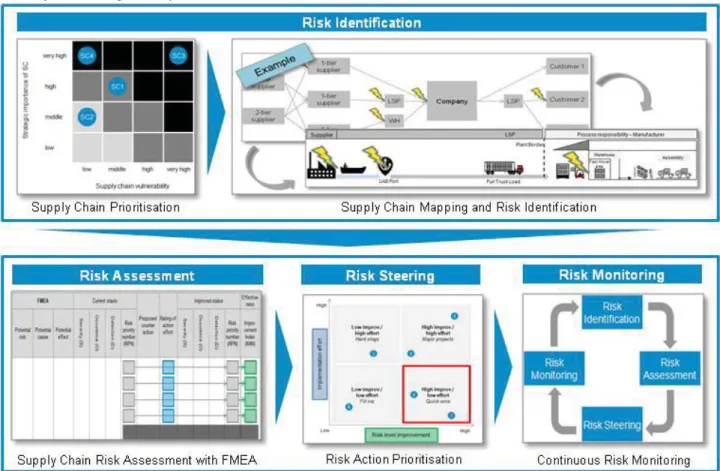
important for the risk assessment, must be selected. This is done by utilising a portfolio prioritisation analysis ([9] see Figure 3). Then the selected supply chains are mapped in order to visualise the structure and possible weak points. Next, the actual risk identification takes place in a workshop with Supply Chain (SC) Risk Experts. Finally, all identified risks are summarised and categorised according to their sources and impact areas in a risk catalogue. Risk assessment: The assessment step consists of two sub-steps and will be based on the FMEA, which is introduced as the pivotal SCRM method. The selected risks should be analysed and evaluated in a workshop of SC Risk Experts according to the respective causes and impact potentials. Then, an individual rating should be assigned to each identified risk. The rating considers the risks in terms of the likelihood of occurrence, the impact severity and the probability of detecting the risk. After the rating of risks and calculation of respective risk levels, a prioritisation takes place in order to define the top risks of the SC. Risk steering: Four sub-steps lead to the final outcome of the procedure. First, risk mitigation actions for top ranked risks must be developed and assessed. Mitigation actions should be developed by SC Risk Experts based on their experience. Following this a re-assessment of the top risks under consideration of anticipated changes to risk levels due to risk mitigation actions is performed. After the initial two steps the FMEA extension takes place by evaluating the implementation efforts for
risk mitigation actions. The Improvement Index (IMIN) for top risks is then calculated based on the old and anticipated new risk priority number (RPN). Finally, the IMIN for top risks as well as the effort value for action implementation are transferred in a portfolio. The portfolio is made up according to [24] by the dimensions of “implementation effort” and “risk reduction potential” in order to determine the most effective risk mitigation actions for implementation. Based on portfolio, it can be decided, which supply chain risks with respective risk mitigation actions should be approached first in order to reduce the risk level of the supply chain most efficiently with available resources.
Risk monitoring: In this step, the risk catalogue as well as the implementation procedure for determined risk actions should be managed. This means, a constant monitoring of those risks in the catalogue is necessary in order to ensure continuous re-evaluation of risk levels by the SC Risk Team. Additionally the progress of implementation work to mitigate the top risks in the supply chain should be observed and if necessary adapted to changing environments.
3.2 Supply Chain Risk Management-FMEA
After assessing all SC-risks by SC Risk Experts, risk mitigation actions and the best selection of a risk management program are necessary. The risk management program consists of the selected risk mitigation actions, which are determined to be implemented to reduce the risk level in the SC.
Figure 5 - General overview of the SCRM method for efficiency-oriented risk prioritisation
Figure 6 - SCRM-FMEA including IMIN and effort rating The rating of counter actions in terms of the
expected overall effort for implementing them (Index 10=’low’ to 50=’very high’) and the assessment of the risk priority number to be expected in the improved status enables the calculation of an improvement index IMIN = 1 - (new RPN / old RPN) as extension of the FMEA (Figure 6) enables the effective prioritization of measures (Figure 7).
Figure 7 - Cost-benefit prioritisation portfolio
4 CONCLUSIONS
The presented method was tested with an inbound supply chain of a vehicle producer with a final assembly in the Middle East and a global network of suppliers. Most of the parts and components for the vehicles are sourced from Europe and the US. The production can be characterized as small-scale series with little variants. In order to show the effectiveness of the risk prioritisation method the risk level of the original inbound supply chain of the vehicle cabin was determined. The risk assessment step (see 3.1) of the supply risks was executed by SC experts. The total supply chain risk level was RPN 1971. In the risk steering step counter-measures for the highest risks that account for 75 % of the total supply chain RPN were taken. With a total implementation effort of 160 (scale from 10 to 50) the total risk level of the added RPN-values dropped from RPN 1.971 to RPN 1.053.
Taken limited resources of 50% of the overall effort for risk reduction (80 of 160 index points) the risk
reduction results based on a traditional FMEA (improving those risks with highest RPN) had 12% less benefit on the total risk of the supply chain than the SCRM-FMEA (improving those risks with highest Improvement Index IMIN). With the same effort the total supply chain risk could have been reduced from RPN 1.971 to 1.257 with the prioritisation of the SCRM-FMEA instead of RPN 1.422 with the traditional FMEA. The method therefore could prove its effectiveness by selecting those risk countermeasures which are most effective with given effort limitations. The focus of action though moved from the individual risk level to the supply chain risk level.
The limitation of this method however is the lacking consideration for risk actions influencing each other what is an inherent weakness of the FMEA in general. But the advantage of having an established and well known method with limited complexity and required input may be of value for the practical use in industry. The usefulness for other industries with less complex supply chains than in series production or other production types still needs further research.
5 REFERENCES
[1] Allianz SE, 2014, Allianz Risk Barometer on Business Risks 2014, http://www.agcs. allianz.com/assets/PDFs/Reports/Allianz-Risk-Barometer-2014_EN.pdf, Accessed 09.08.2014. [2] Supply Chain Risk Leadership Council
(SCRLC), 2011, Supply Chain Risk
Management: A Compilation of Best Practices. http://www.scrlc.com/articles/Supply_Chain_Ris k_Management_A_Compilation_of_Best_Practi ces_final%5B1%5D.pdf, Accessed 08.09.2014. [3] Deloitte Consulting, 2013, Truth or Dare: How to
Manage Global Supply Chain Risks? Deloitte
Consulting Debates 2013, http://www2.deloitte.com/content/dam/Deloitte/
mx/Documents/strategy/gestionar_riesgos.pdf, Accessed on 11.08.2014.
[4] Kersten, W., Hohrath, P., Winter, M., 2008,
Risikomanagement in Wertschöpfungsnetzwerken. Supply Chain Risk
Management. Band 8. bfi Wien 2008.
[5] Wente, I.M., 2013, Supply Chain Risikomanagement: Umsetzung, Ausrichtung
und Produktpriorisierung, Supply Chain,
Logistics and Operations Management, Band 18, Köln: Josef Eul Verlag 2013.
[6] Johnson, E., 2001, Learning From Toys:
Lessons in Managing Supply Chain Risk from
the Toy Industry, California Management
Review. Vol 43 Issue 3, Pp. 106 – 124.
[7] Zsidisin, G., Ellram, L., Carter, J., Cavinato, J., 2004, An analysis of supply risk assessment techniques, International Journal of Physical Distribution & Logistics Management, Vol. 34 Issue 5, Pp. 397 – 413.
[8] Spekman, R., Davis, E., 2004, Risky business: expanding the discussion on risk and the extended enterprise, International Journal of Physical Distribution & Logistics Management, Vol. 34 Issue 5, Pp. 414 – 443.
[9] Ziegenbein, A., 2007, Supply Chain Risiken: Identifikation, Berwertung und Steuerung, Zürich: Vdf Hochschulverlag AG 2007.
[10] Chopra, S., Sodhi, M., 2004, Managing Risk to Avoid Supply-Chain Breakdown, MIT Solan Management Review, Vol. 46 Issue 1, Pp. 52 – 61.
[11] Christopher, M., Peck, H., 2004, Building the Resilient Supply Chain, International Journal of Logistics Management, Vol. 15 No. 2, Pp.1-13. [12] FERMA, 2011, A structured approach to
Enterprise Risk Management and the requirements of ISO 31000, http://www. ferma.eu/app/uploads/2011/10/a-structured-approach-to-erm.pdf, Accessed on 25.11.2014.
[13] Kajüter, P., 2003, Instrumente zum
Risikomanagement in der Supply Chain, In: Supply Chain Controlling in Theorie und Praxis, Wiesbaden: Gabler Verlag 2003.
[14] Peck, H., 2003, Creating Resilient Supply Chains – A Practical Guide, https://dspace.lib. cranfield.ac.uk/bitstream/1826/4374/1/Creating_ resilient_supply_chains.pdf, Accessed 11.2014. [15] Norrman, A., Jansson, U., 2003, Ericsson´s
proactive supply chain risk management approach after a serious sub-supplier accident., International Journal of Physical Distribution & Logistics Management, Vol. 34 Issue 5, Pp. 434 – 456.
[16] Stadtler, H., Kilger, C., 2008, Supply Chain Management and Advanced Planning – Concepts, Models, Software and Case Studies, Wiesbaden: Springer 2008.
[17] Moder, M., 2008, Supply Frühwarnsysteme: Die Identifikation und Analyse von Risiken in Einkauf und Supply Chain Management, Wiesbaden, Gabler, 2008.
[18] Romeike, F., 2004, Risikoidentifikation und
Risikokategorien, Erfolgsfaktor
Risiko-Management – Chancen für Industrie und Handel, Wiesbaden, Gabler, 2004.
[19] Groggert, S., Gelau, T., Gross, W., 2013, A Novel Approach to Risk Analysis: Identification and Assessment of Cause-and-Effects Relationships, Sustainability and Collaboration in Supply Chain Management, Köln: Eul Verlag 2013.
[20] Carlson, C., 2012, Effective FMEAs – Achieving Safe, Reliable, and Economical Products and Processes Using Failure Mode and Effects Analysis, New Jersey: John Wiley & Sons 2012. [21] Lovell, A., Saw, R., Stimson, J., 2005, Product
value-density: managing diversity through supply chain segmentation, The International Journal of Logistics Management, Vol. 16 issue 1, Pp. 142 – 158.
[22] Lynch, G., 2012, Supply Chain Risk
Management, Supply Chain Disruptions: Theory and Practice of Managing Risk, Wiesbaden: Springer 2012
[23] Pujawan, N., Geraldin, L., 2009, House of risk: a model for procative supply chain risk management, Business Process Management Journal, Vol. 15/6, pp. 953 – 967.
[24] Engelhardt-Nowitzki, C., Zsifkovits, H., 2006, Complexity-Induced Supply Chain Risk – Interdependencies between Supply Chain Risk and Complexity Management, Managing Risks in Supply Chains, How to Build Reliable Collaboration in Logistics, Berlin: Erich Schmidt Verlag 2006.
[25] Curkovic, S., Scannell, T., Wagner, B., 2013, Using FMEA for Supply Chian Risk Management, Modern Management Science & Engineering, Vol. 1 issue 2, pp. 252 – 265.
6 BIOGRAPHY
Daniel Palm, Prof. Dr. techn., Dipl.-Ing., is professor at the ESB Business School, Reutlingen University, Germany for logistics management. He is co-leader of the research centre for logistics and value creation at Reutlingen University.
Philipp Kales, MSc is consultant at Horváth & Partners Management Consultants, München, Germany. He holds a Master in Operations Management from ESB Business School and is specialized in international supply chain management.
![Figure 1 - Sources of supply chain risks [11]](https://thumb-us.123doks.com/thumbv2/123dok_us/603615.2572273/5.892.49.399.169.321/figure-sources-supply-chain-risks.webp)