How to Develop Serious Games
for Social and Cognitive Competence
of Children with Learning Difficulties
Cecilia SIK-LANYI, Associate Professor
Department of Electrical Engineering and InformationSystems University of Pannonia Veszprem, HUNGARY [email protected]
Tibor GUZSVINECZ, PhD Student
Department of Electrical Engineering and InformationSystems University of Pannonia Veszprem HUNGARY [email protected]
Veronika SZUCS, Assistant Lecturer
Department of Electrical Engineering and InformationSystems University of Pannonia Veszprem, HUNGARY [email protected]
Petya GRUDEVA, Project Manager
ZGURA-M Ltd.Plovdiv, Bulgaria [email protected]
Shervin SHIRMOHAMMMADI, Professor
Department of Computer Science and EngineeringIstanbul Sehir University Istanbul, TURKEY
Boris ABERSEK, Professor
Institute of Contemporary TechnologiesUniversity of Maribor Maribor, SLOVENIA [email protected]
Karel VAN ISACKER, CEO
PHOENIXKM BVBA Kortemark, Belgium [email protected]
Andrean LAZAROV, Project Manager
ZGURA-M Ltd.Plovdiv, Bulgaria
[email protected] Baris BORU
UbitedIstanbul, Turkey [email protected]
Abstract—In this paper some experiences are described, from requirements gathering to design and implementation, in the European project “Intelligent Serious Games for Social and Cognitive Competence”. The main goal of the project is to develop serious games for social and cognitive competence of children with learning difficulties. The aim of these games is to teach youth with mild disabilities about social skills, basic skills, key cognitive competence skills and work skills. Using these interactive mobile games and 3D simulations helps the social integration and personal development of these children and youth. The project uses serious games and 3D simulations so that teaching and learning becomes interesting, playful, attractive and efficient
Keywords—serious games; social competence; cognitive competence; intellectual disabilities
I. INTRODUCTION
People with intellectual disabilities often face a lack of control and opportunity in their everyday lives, with less than 10% having jobs [1]. People with Intellectual Disabilities experience low levels of employment and face barriers to employment. The UK Valuing People Report [2] and the Learning for Living and Work Report [3] have emphasised the need to promote and develop appropriate training and employment opportunities for this target audience.
In many socially oriented occupations, social competence is a basic competence that provides building of complete and effective working relationships and achievement of objectives. Social Competence (SC) is
present not only in personal development but also in the professional development in all areas. Some earlier studies show the effects of some of the abilities included in SC as empathy, understanding, accepting other’s point of view on social activities and relationships. The effectiveness of many professional activities in the social sphere depends on the level of construction of SC.
In this paper we will address questions related to the design and evaluation of such games and our design solutions to suit the individual learning needs of our target audiences. It is necessary to design the user interfaces for maximum accessibility and usability [4]. In this way we will minimise the additional cognitive load placed on the user when navigating within the software. In order to achieve these goals we have followed published design guidelines and placed emphasis on using graphics, animations, interactivity, choice and auditory output to promote user engagement and provide alternatives to text.
The three fields of media, informatics and communication originally created separate theories, but are gradually merging together today. Cognitive info-communications (CogInfoCom) [5] is an interdisciplinary field that targets engineering applications based on emergent synergies between ICT and the cognitive sciences. CogInfoCom is situated in the region between cognitive informatics and cognitive communications. [6] Those games that develop SC are a part of cognitive media and cognitive informatics.
In this paper the development process of the games under the umbrella of the “Intelligent Serious Games for Social and Cognitive Competence” (ISG4competence) (2015-1-TR01-KA201-022247) [7]. European founded project is introduced.
The main ISG4compentences are the following: Self-esteem, and self-confidence
Managing anger and stress Time keeping (management) Team working
Communication Problem solving
The planned games will help to develop of these competences.
II. BEFORE THE DEVELOPMENT A. Questionnaire
The initial steps were in the project to collect user needs in order to identify context of use data (analysis of target audience characteristics and learning and training needs, tasks, and environments of use) for materials adaptation and development of a suite of serious games for students with learning difficulties. This was realised through country reports and a consolidated survey among stakeholders and
target groups in Turkey, Slovenia, Hungary, Bulgaria and Belgium, resulting in a qualitative and quantitative analysis of findings (national and comparative). Almost 500 individuals contributed to the survey, from a wide range of target groups that were envisaged at the start already by the partnership. The survey reached out to people with disabilities, NGOs, school educators, special education trainers, training providers etc. Many interesting research questions were answered here, such as (from the CFP) the potential of digital games to support disabled learners, issues related to accessibility and usability of serious games for children with learning difficulty, and impression of educators about serious games.
The main findings were:
The definitions of children & youth with learning problems and difficulties differs among countries in the formal definition sense, but in practice the same target groups are identified, while the degree of inclusive education is considerably different among the countries (e.g. Belgium vs. Bulgaria).
Pedagogical methodologies to support the acquisition of social and cognitive competencies are in general very diversified and often dependent on the needs of the specific target groups.
There is a strong willingness to introduce games in the teaching environments, but restrictions are mainly due to financial resources for equipment, bureaucratic issues with the process of provision of permission for their implementation in the mainstream classes and the lack of time (already overstretched curriculum). This was also confirmed when identifying learning approaches which support inclusion (serious games, robotic mediated learning, peer support etc.). Approaches are diversified and depend on the teachers’ abilities, person centred approach and the available school budget. However, there are games available, and especially when they are freely available like will be the case in ISG, the take up should be possible.
The learning challenges which children & youth with learning difficulties face are almost everywhere the same on an educational and social level, with especially basic and key competences skills (on educational level), task management skills, social learning skills, self-presentation skills.
The current usage of games is overall still limited. There is for example also a negative correlation between the usage of games and the size of the schools (mentioned in Belgium), the bigger the school the less educative games are used. Only the process of including educational games in the curriculum can ensure that the use of educational games is integrated in each school. Currently, this is done rather ad hoc, especially also considering the available budget of the school/institution.
Partners have identified a wide range of existing initiatives that could be relevant to the project, but will require customisation according to the needs of the above mentioned target groups.
In all countries, the cognitive competencies students should obtain / enhance during their school years (6-18) are identical, albeit that they are considered with different levels of importance:
Following cognitive competencies scored the highest: self-esteem and self-confidence, communication, problem solving, concentration, team working, motivation, and active listening.
The following were considered somewhat important: creative thinking, managing anxiety, and time management.
The least important were considered (however, these competencies are in fact embedded and overarching all other competencies): decision making, orientation, prioritising, and managing resources.
B. Developing the learning content
The ISG4Competence harmonised European curriculum is based on the principles of collaborative blended learning which involves a student/person with mild learning difficulties and a trainer/teacher. People who have completed this curriculum are expected to have increased social and in particular cognitive competences which correspond to their personal educational and employment needs.
The interaction between the student with learning difficulties and the trainer is on a conceptual basis, therefore there is no recommendation for frequency of activities or duration of the learning process.
C. The curriculum
The curriculum is developed (after the Taba Model) [8] by implementing an inductive approach (beginning with the specifics) with the following sequence:
Identify the needs of the student with mild learning difficulties (what are the current gaps in terms of social and creativity competences).
Develop person-driven aims and objectives.
Select content that matches those aims and objectives.
Organise sessions that take into account the learner’s experience and abilities.
Select an appropriate instructional method that promotes the student’s engagement.
Review mid-term progress after six months.
Regular review of the balance and sequence between different types of activities
Complete monitoring and evaluation forms.
Report to the training coordinators in the respective countries.
D. Philosophy and Principles
The ISG4Competence curriculum is designed on the following principles:
Challenge and enjoyment Progression
Depth
Personalisation and choice Coherence
Relevance
The ISG4Competence curriculum is based on a philosophy of education that incorporates the following five principles:
The full and harmonious development of the individual.
The importance of making due allowance for individual difference.
The importance of activity and discovery methods. The integrated nature of the curriculum.
The importance of problem-based learning. E. Pedagogical principels
The three pedagogical principles dealing with activity and discovery methods, an integrated curriculum and problem-based learning are subsumed into a wider range of learning principles that help to characterise more fully the learning process that this ISG4Competence curriculum envisages. These are:
the sense of wonder and natural curiosity of students with mild learning difficulties is a primary motivating factor;
the student as an active agent in his or her lifelong learning and improvement of his/her social and creativity competences;
improvement of social and creativity competences is developmental in its nature;
learning should involve guided activity and discovery methods;
easy to understand language is central in the learning process;
social and emotional dimensions are important factors in learning;
learning is most effective when it is integrated; skills that facilitate the transfer of learning should be
fostered;
active listening, understanding instructions, problem-solving and observational skills should be developed;
collaborative learning should be a feature in the learning process;
the range of individual differences should be taken into account in the learning process;
assessment of the impact and progress of the student with mild learning difficulties is an integral part of process.
F. Developing learning objects
In the next step, the paper will show the creation process of the learning objects and the suite of serious games with accessible learning objects based on the user needs identified in the previous step. Here, we worked in close connection with user groups from the first step to achieve accessibility and design for all concepts not only theoretically but in the practice too. We will show the actual games developed, mostly for mobile platforms, and analyze them from accessibility and educational perspective for youths with mild disabilities. Some research questions answered here include (again, from the CFP) lessons from the developments of educational technologies, design and development of gaming apps for mobile devices, and design for all or design from particular groups
III. INITIAL GAME SPECIFICATIONS
The ISG4Competence consortium agreed to develop the following serious games for desktop and mobile usage based on the above described curriculum:
MATH game - Math game can be used to teach basic
mathematical operations for children.
Fig. 1. Screenshot of the MATH game
Pair Cards game – It is a card pairing memory game.
After a short memorizing time, all cards roll back, and the user has to find all pairs.
Labyrinth game - The player can navigate in the labyrinth via moving her/his own mobile, this
movement controls the game. The user can learn fine hand coordination. With the collection of gems the player receives letters, after that he /she should organise these letters into words.
Cars Race game – It is a car racing game. The user
can navigate with the car through a track, by using their two-fingers touch on the screen. They can collect small rewards. The bonus track is a word formation game.
Fig. 2. Screenshot of the Cars Race game
VR Shop game – It With the using of VR Shop game
the players can learn and practice the money management, shopping.
Manage Yourself game – It In the game the Avatar (the user) character should be taken care of (keep healthy, happy).
Team Working and Team Building game – Team
building, establish good working relationships and environment. Problem solving, Communication with and without feedback, following the instruction, putting the question
Following the instruction to solve the problem game
– It will be build up special classroom for communication. Two teams will work on the same problem (building the construction). One group will give instruction and other will try to build construction according to this instruction. We will train two task: Communication with and without feedback.
Sequence game – The game enhances
communication and social skills of the children by team building and negotiation. Each player will be assigned to a picture. Everyone will describe their own picture while the pictures are not visible to others. Pictures need to be placed in the correct order such that the sequence of the picture will make sense. There are multiple rooms that the users can log in to and play the game with their group.
Weekend Wonderland game – The background of
this game is a Leisure park therefore it gives many tasks in interesting way.
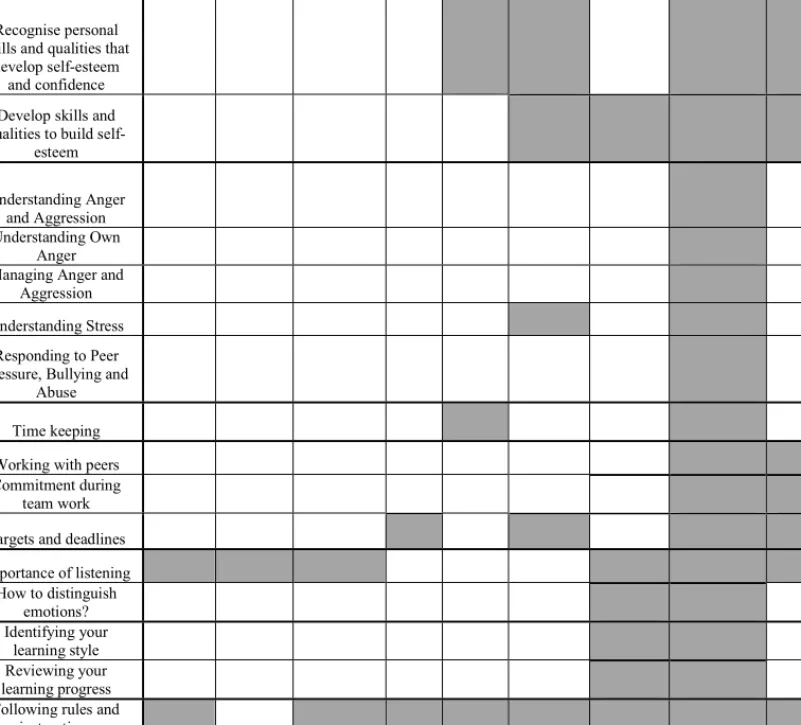
The Game matrix (Table 1) shows which skills could be developed by using the planned games.
TABLE I. GAME MATRIX
ISG4Competence - Games matrix - summary of covered topics of the
curriculum
MATH
GAME CARDS PAIR Labyrinth Cars Race SHOP VR Yourself Manage Team working and team building Following the instruction to solve the problem
Sequence WonderlandWeekend
Self-esteem, and self-confidence
Identify why self-esteem and confidence
is important
Recognise personal skills and qualities that
develop self-esteem
and confidence
Develop skills and qualities to build
self-esteem Managing anger and stress Understanding Anger and Aggression Understanding Own Anger
Managing Anger and
Aggression
Understanding Stress
Responding to Peer Pressure, Bullying and
Abuse
Time keeping
(management) Time keeping
Team working
Working with peers
Commitment during
team work
Targets and deadlines
Communication Importance of listening How to distinguish
emotions? Improving own learning Identifying your learning style Reviewing your learning progress Problem solving
Following rules and
instructions
Be creative in problem solving by using the
five stage model
IV. TESTING
These games are under the testing process. The suggested method for testing is series of classic usability testing techniques, e.g., according to Lazar et. al. [9] or Albert &Tullis [10], or also objectivity-aiming psychophysiology-based advanced methods of Hercegfi [11], or more specifically, applying experiences of usability research of 3D environments (Lógó et al.) [12]. Furthermore, the mentioned collaborative development itself can also be a promising future research scope, usability testing of the team work capability of the game engines, analysing the behaviour of the
team and the coherence of shared mental model and the success of the collaboration (Geszten et al.) [13].
V. EDUCATIONAL SETTINGS OF APPLICATION OF THE SUITE OF SERIOUS GAMES
The ISG4competence serious games will be applicable to support the education and training in the following educational settings:
Classrooms in mainstreaming schools - used as
additional approach to fulfil the learning outcomes of particular learning subject
Extracurricular activities in the schools – used as possible alternative approach for acquisition of basic and key competencies which cannot be covered during compulsory courses at schools
Private lessons – used as an alternative educational approach for students who cannot attend mainstream courses
Private sessions with resource tutors, psychologist or speech therapist – use as a training method for acquisition/improvement of basic and key competencies.
Activities of youth volunteering informal groups – used as a media where peer learning support could be facilitated.
Although that it is not preliminary expected some of the games will be applicable also for kindergarten settings.
VI. CONCLUSION
Altogether 10 games are developed by the ISG4competence project. The target groups of learners who may take benefit from the suite of serious game is related to the following beneficiaries:
Students with mild learning disabilities (slow rate of maturation, reduced learning capacity and inadequate social adjustment)
Students with sensory impairments
Students with low level social skills
Students with specific learning difficulties (dyslexia, dyspraxia, autism spectrum disorder, ADHD
The target groups who may take benefit from the exploitation of the suite of serious games and who are working with the above mentioned learners are:
Professionals involved in education - Inclusive
education; Special education; Public teachers (resource teacher, speech therapist, etc.); Private teachers (resource teacher, speech therapist, etc.); Professionals working with people with disabilities; Educational planning/methodology experts (evaluates the curriculum for schools and suggest changes); Headmasters/principals.
Families of children and youth with disabilities - (Moderate) learning difficulties (dyslexia, dyscalculia, …); (Moderate) learning disabilities (ADHD, autism spectrum); Low social skills / deviant (actions or behaviours that violate social norms) behaviour; Intermediaries - Medical centre/authority; Health care
organization; Social care organization; Development agency
Training centres – in the context of mainstream
education; Inclusive education; Special education
Academicians - (Special) pedagogy; Psychology; ICT /
gaming /Assistive technology etc.
Above mentioned target groups of learners and beneficiaries are included in all stages of the development and testing of the project intellectual outputs as well as with representatives in the national advisory boards in each partner country.
ACKNOWLEDGMENT
The authors would like to thank the support of the “Intelligent Serious Games for Social and Cognitive Competence” (ISG4competence) project. (2015-1-TR01-KA201-022247)
REFERENCES
[1] D.J. Brown, D. McHugh, P. Standen, L. Evett, N. Shopland, S. Battersby, “Designing location-based learning experiences for people with intellectual disabilities and additional sensory impairments”, Computers & Education, (2010) DOI: 10.1016/j.compedu.2010.04.014,
http://www.sciencedirect.com/science/article/B6VCJ-5017HF4-1/2/defa3b3a69261bd67e06f3e8bb1b1e63
[2] Department of Health (2001). Valuing People: a new strategy for learning disability for the 21st century. London: HMSO.
[3] LSC, 2006. Accessed on 11th December 2009 from
www.lsc.gov.uk/LSCGOVUK/
[4] C. Sik Lanyi, D. Brown, P. Standen, J. Lewis, V. Butkute, (2012) “Results of user interface evaluation of serious games for students with intellectual disability”, Acta Polytechnica Hungarica, 2012, vol 9, no 1, pp: 225-245, 2012. http://www.uni-obuda.hu/journal/Issue33.htm
[5] P. Baranyi, Á. Csapó, Á. Balázs, P. Várlaki, “An Overview of Research Trends in CogInfoCom”, 18th International Conference on Intelligent Engineering Systems – INES 2014, IEEE Hungary Section, Tihany, pp. 181-186. 2014.
[6] P. Baranyi, Á. Csapó, “Definitaion and Synergies of Cognitive Infocommunications”. Acta Polytechnica Hungarica, 9(1), pp. 67-83. 2012.
[7] http://www.isg4competence.com/
[8] H. Taba, Curriculum development: Theory and practice, New York: Harcourt, Brace & World. 1962.
[9] J. Lazar, J. H. Feng, H. Hochheiser, Research Methods in Human-Computer Interaction, 2nd. ed., Morgan Kaufman, Cambridge, MA, 2017.
[10] T. Tullis, B. Albert, Measuring the User Experience, 2nd ed., Morgan Kaufman, Waltham, MA, 2013.
[11] K. Hercegfi, “Event-Related Assessment of Hypermedia-Based E-Learning Material With an HRV-based Method That Considers Individual Differences in Users”, International Journal of Occupational Safety and Ergonomics, vol.17, no.2, pp.119-127. 2011
http://archiwum.ciop.pl/43469
[12] E. Lógó, B. P. Hámornik, M. Köles, K. Hercegfi, S. Tóvölgyi, A. Komlódi, “Usability related human errors in a collaborative immersive VR environment.” Proc. CogInfoCom 2014 – 5th IEEE Conference on Cognitive Infocommunications, Nov 5-7, 2014, Vietri sul Mare, Italy, pp. 243-246 http://ieeexplore.ieee.org/document/7020454/
[13] D. Geszten, B. P. Hámornik, K. Hercegfi, “Measurement of team mental model as a part of a new team usability testing method.” Proc. CogInfoCom 2017 - 8th IEEE Conference on Cognitive Infocommunications, Sept 11-14, 2017, Debrecen, Hungary, in press.