Worcester Polytechnic Institute
Digital WPI
Interactive Qualifying Projects (All Years) Interactive Qualifying Projects
May 2010
Studying the Effect of Web Site Tutoring on
Learning
Daniel Francis Mitchell Worcester Polytechnic Institute Matthew Thomas Knapp Worcester Polytechnic Institute Paul Leszek Ksiazek Worcester Polytechnic Institute
Follow this and additional works at:https://digitalcommons.wpi.edu/iqp-all
This Unrestricted is brought to you for free and open access by the Interactive Qualifying Projects at Digital WPI. It has been accepted for inclusion in Interactive Qualifying Projects (All Years) by an authorized administrator of Digital WPI. For more information, please [email protected]. Repository Citation
Mitchell, D. F., Knapp, M. T., & Ksiazek, P. L. (2010).Studying the Effect of Web Site Tutoring on Learning. Retrieved from https://digitalcommons.wpi.edu/iqp-all/1198
Studying the Effect of Web-Site Tutoring on Learning
An Interactive Qualifying Project Report
submitted to the Faculty
of the
WORCESTER POLYTECHNIC INSTITUTE
in partial fulfillment of the requirements for the
Degree of Bachelor of Science
By
Daniel Mitchell
Matthew Knapp
Paul Ksiazek
Date: May 5, 2010
Project number: NTH - 0902
Abstract. The ASSISTment system commonly employs tutoring to help students with math problems. This tutoring usually consists of hints that can be requested by the student. In this method, the hints point out key steps to solving the problem, concluding with the answer to the problem in the last hint. This study examines the benefits of providing the students with a link to a web page that teaches the topic that is most prevalent in the question. The primary purpose is to determine the effectiveness web-page based help versus traditional ASSISTment tutoring.
Table of Contents 1. Abstract 2. Table of Contents 3. Introduction 4. Background Other Systems Mastering Physics Carnegie Learning ASSISTments Developing Content Assigning Content Viewing Content Assessing Results Comparison of Systems 5. Project Goals Building Assistments Creating Problem Sets Content Summary 6. Experimental Design Hypothesis Method Setup Experimental Environment Recording Data Analysis 7. Conclusion 8. Appendices
Introduction
It has been shown that computer assisted tutoring systems can have benefits over traditional classroom teaching. It has also been shown that there are benefits in Intelligent Tutoring Systems, such as ASSISTments, over traditional classroom learning. One benefit from such a system can be found in the immediate tutoring available to students while working on a problem. This tutoring typically follows a pattern of hints, which the student may request. The hints are designed to give very little away initially, and conclude with the answer to the problem. This is to prevent a student from getting “stuck” on a particular problem.
Today, computers are available in most homes, and a large majority of people have internet access. As the internet grows and expands in popularity, children are becoming more and more used to being “online.” The amount of help and tutoring for various school subjects at all levels is also growing at a rapid rate, and is becoming more widely used. School-age children especially grow more and more dependent on information that can be found on the internet, in all different aspects of school.
The goal of this study is to attempt to measure the effectiveness of “online” tutoring, such as can be found on various websites and through different educational videos found online. The effectiveness of the web pages will be studied both in respect to traditional learning with no tutoring and against the tutoring methods prevalent in ASSISTments.
Background
Other Systems:
Mastering Physics:
One intelligent tutoring system is Mastering Physics. Mastering physics is a homework assignment and tutoring system that is used as a supplement to teach physics. It uses a system of hints and sub-questions to lead students through problems as a way of teaching concepts.
Mastering Physics incorporates adaptive tutoring and automatic grading as a way to provide students with feedback. Mastering Physics assignments will lead students to the correct answer if they need help through a system of hints and sub-questions.
Carnegie Learning:
Another intelligent tutoring system is the Cognitive Tutor developed as part of the approach used by Carnegie Learning. The Cognitive Tutor is used in the teaching of math to middle and high school students. The Cognitive Tutors are based on the ACT-R(Adaptive Control of Thought -- Rational) theory of learning, memory and performance which has been widely validated. The tutors are developed through a rigorous empirical testing.
ASSISTments:
ASSISTments is a web-based tutoring program for, but not limited to, 4th to 10th grade mathematics. The system tracks students’ progress and about 120 skills.
Developing Content:
Content is developed by content creators. Content creators consist of teachers, IQP groups, and college students. ASSISTments provides a builder in order to create “assistments”, which contain one or more related problems. Content creators can create problem sets from multiple assistments and tag them with skills. ASSISTments supports variabalized templates for assistments, which randomly generates numbers for variables in problems. This can be used to create a large number of unique problems. Problems can have tutoring strategies associated with them. Tutoring strategies consist of hints and scaffolding. Hints give students one hint at a time to steer them in the right direction. Scaffolding guides students by breaking a problem into separate steps and having a student solve it step by step.
Assigning Content:
Teachers can assign problem sets to their students with a number of different settings. Mastery learning, as used in this study, keeps asking students questions until they master the problem set, and thus the skill associated with it.
Viewing Content:
Students view their teacher’s assignments online, and complete them through ASSISTment’s web tutor.
Assessing Results:
Teachers can assess results through a variety of reports. For example, the mastery report tells teachers which students mastered an assignment and how long it took for them to master it. Teachers can use reports such as this to track their students’ progress over time.
Comparison of Systems:
Unlike Carnegie Learning’s Cognitive Tutor, Mastering Physics, and other applications, ASSISTments is a free system. ASSISTments gives teachers full controls of what problems and problem sets their students have to do. The system does not make any decisions by itself.
Project Goals
Building Assistments:
One goal of this project was to create content for the ASSISTments system. This involves creating ASSISTments, which consist of problems and their associated tutoring. For our study, we created variabilized ASSISTments, which are similar to normal ASSISTments, except that in the problem and in the hints there are variabilized numbers. This allows you to create a single template and then generate many different problems from it.
Each ASSISTment template that is created has two main parts, the problem body and the tutoring. First, the problem body must be made in a way so that the problem is not too complicated or too easy, and so that it also covers the skill well.
Secondly, the tutoring for each problem needs to be made very carefully. Each hint must guide the student in solving the problem without giving too much away. They must also encourage the student to think about the problem in helpful ways. The final hint must also give the student the answer, so that they can move on from the problem, and not get stuck.
Creating Problem Sets:
We created these templates based around different skills. Each skill is stored in the ASSISTments system. They represent different skills that students at various levels should know. In order to test the knowledge of the students, mastery problem sets are created for each skill. Students must take these mastery problem sets, and if they get a certain number correct in a row, they have “mastered” the skill. Using the templates we created for each skill, we then created many different instances of each problem, which were then combined into problem sets. Each problem set will have various settings, the most important of which is the number that a student must get correct in a row in order to “master” the skill and move on. This number depends on varying factors, primarily how difficult the problems or the skill is perceived to be.
For our study, we also had to create problem sets that were specialized for the experiment. They consisted of a randomly selected first problem that would have either normal tutoring or web site based tutoring. Then each problem set had the same second problem to serve as a control. Finally, a student would enter a mastery section, which would behave just the same as a mastery problem set.
The skills for each of our problem sets were the following: Writing Linear Equations from slope and y-intercepts ,Finding Slope in an Equation ,Finding y-intercept from Linear Equation, Finding y-intercept from Linear Situation, Finding Slope in Situation, Substitution, Pattern Finding, Finding Slope from Ordered Pairs, and Recognizing Linear Patterns.
Content Summary:
For the project, we have completed templates, mastery problem sets, and problem sets for the study for several skills, which can be found both on the ASSISTments teacher wiki and in the appendix.
Experimental Design
Hypothesis:
Currently, the cultural and societal trend is towards high utilization of the internet. Most homes in the United States now have internet access, and many children are becoming more and more accustomed to not only browsing the web for fun, but using the internet to help with homework and learning. This experiment was an attempt to validate the theory that some students would be able to learn more from web based tutoring than from the traditional tutoring found in ASSISTments.
Method: Setup:
The setup for this experiment consisted of two main parts. First of all, the content needed to be created. This involved creating the variabilized templates for the various skills. Each template needed to have a problem body as well as tutoring. Each template needed to also have a copy in which the normal tutoring was replaced by web page tutoring.
After the templates were prepared, the problem sets needed to be created for the study. These were designed to give us the most accurate results for the effectiveness of both kinds of tutoring, web site tutoring and the classic ASSISTments tutoring. Each problem set consisted of
a random initial problem from the templates. This problem would either have normal tutoring, web page 1, or web page 2. The second problem was then always the same regardless of the initial condition, with normal tutoring. After the first two problems, the user is sent into a regular mastery condition, where they must get a certain number of problems right in a row to advance and “master” the skill.
The first problem the user encounters will determine which type of tutoring they experience. The second problem was kept constant to determine how well the user could do after receiving the initial tutoring (assuming they got the first problem wrong) and to make comparison between the types of tutoring possible and not affected by varying difficulties for the second problem. The final mastery section also provides valuable data as to how well the
students did who received one type of tutoring versus students who received a different type of tutoring.
Having two different web pages also provided important information. First, it allowed for a more accurate assessment of the overall effectiveness of web sites. Secondly, it allowed more room for possible technical difficulties that the users may encounter with the different sites. Third, it allowed for a direct comparison of different web sites, allowing us to see if one site was significantly better than the other.
Normal Tutoring
One of the web pages used Experimental Environment:
This experiment was carried out on the ASSISTments system by teachers in the classroom. Various teachers from different classes assigned the problem sets from the study to the students in their class. Each student had to then go through and do each problem set, providing us with not only multiple different problem sets with results but also individuals with results in two different problem sets, which cover different skills.
Each teacher was familiar with using the ASSISTments system. Therefore, running the study was the same for them as assigning any other problem set that they would normally assign. The students were also familiar with the ASSISTment system, and experienced nothing different than the normal problem sets they are used to, aside from the web site based tutoring.
Recording Data:
All of the data from the experiment was recorded into the ASSISTments system. As a student worked on a problem set for the study, their results were automatically recorded in the system. Variables such as which problems they saw, what answers they gave, and how long it took them were recorded, along with many others. When it came time for analysis, the data was simply pulled out of the ASSISTments system database and placed into excel spread sheets for easy analysis.
Analysis:
There is a lot of variance in the average z-scores for time to master for problem sets with normal tutoring, as seen in Figure 1. This means that the difficulty levels of the different problem sets also varied quite a bit. This variance is a lot less in the problem sets with web tutoring.
Row Labels Average of z_time 9135 0.133651053 9239 0.258675318 9240 0.657163032 9305 -0.614991198 9306 0.549870132 9317 -0.317760098 9319 -0.476501354 Grand Total -0.007061524 Figure 1
Sum of
time_in_mastery Column Labels
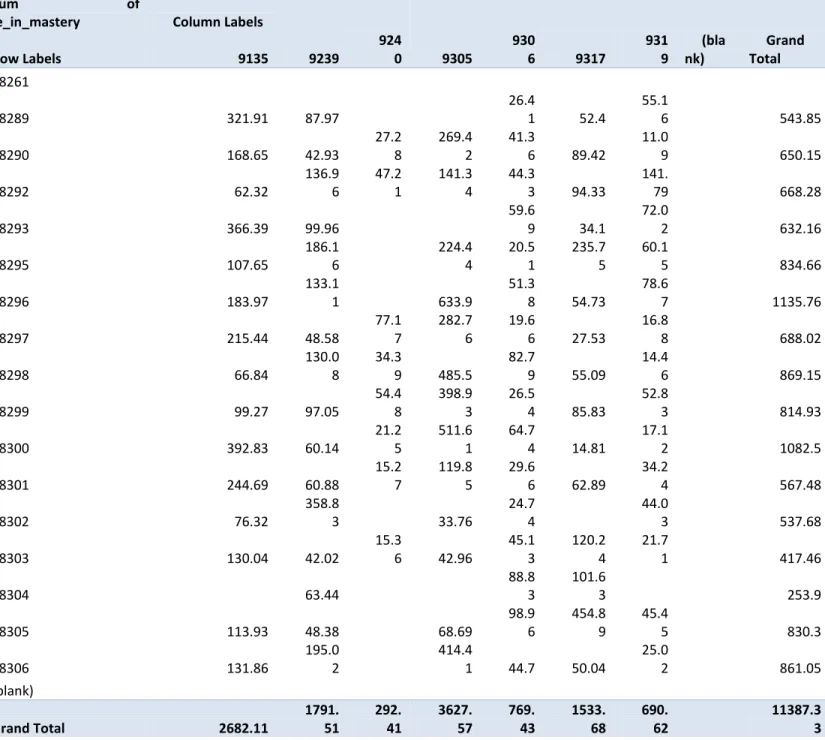
Row Labels 9135 9239 924 0 9305 930 6 9317 931 9 (bla nk) Grand Total 78261 78289 321.91 87.97 26.4 1 52.4 55.1 6 543.85 78290 168.65 42.93 27.2 8 269.4 2 41.3 6 89.42 11.0 9 650.15 78292 62.32 136.9 6 47.2 1 141.3 4 44.3 3 94.33 141. 79 668.28 78293 366.39 99.96 59.6 9 34.1 72.0 2 632.16 78295 107.65 186.1 6 224.4 4 20.5 1 235.7 5 60.1 5 834.66 78296 183.97 133.1 1 633.9 51.3 8 54.73 78.6 7 1135.76 78297 215.44 48.58 77.1 7 282.7 6 19.6 6 27.53 16.8 8 688.02 78298 66.84 130.0 8 34.3 9 485.5 82.7 9 55.09 14.4 6 869.15 78299 99.27 97.05 54.4 8 398.9 3 26.5 4 85.83 52.8 3 814.93 78300 392.83 60.14 21.2 5 511.6 1 64.7 4 14.81 17.1 2 1082.5 78301 244.69 60.88 15.2 7 119.8 5 29.6 6 62.89 34.2 4 567.48 78302 76.32 358.8 3 33.76 24.7 4 44.0 3 537.68 78303 130.04 42.02 15.3 6 42.96 45.1 3 120.2 4 21.7 1 417.46 78304 63.44 88.8 3 101.6 3 253.9 78305 113.93 48.38 68.69 98.9 6 454.8 9 45.4 5 830.3 78306 131.86 195.0 2 414.4 1 44.7 50.04 25.0 2 861.05 (blank) Grand Total 2682.11 1791. 51 292. 41 3627. 57 769. 43 1533. 68 690. 62 11387.3 3 Figure 10
This pivot table shows the raw time data for students in the mastery condition per problem set.
Figure 1 shows the z-score for the time that students spent in mastery for each problem set. Z-scores were used because each problem set by nature is very different, with some being much easier and others being much more difficult. Therefore the time it takes to master for each problem set cannot be directly compared without first taking the z-score. The average z-score for time to master for web tutoring was about 0.025 of a standard deviation less than the time to
master for normal tutoring (Figures 1 and 2). So generally, students mastered problem sets with web tutoring faster than the problem sets with normal tutoring. The t-test performed on the data in Figures 1 and 2 gave a value of 0.865038049 meaning it was not conclusive.
Row Labels Average of z_time
9135 -0.066825527 9239 -0.201191914 9240 -0.219054344 9305 0.111816582 9306 -0.249940969 9317 0.144686076 9319 0.22077393 Grand Total -0.031131335 Figure 2
This pivot table shows the time to master for web tutoring for each problem set as a z-score.
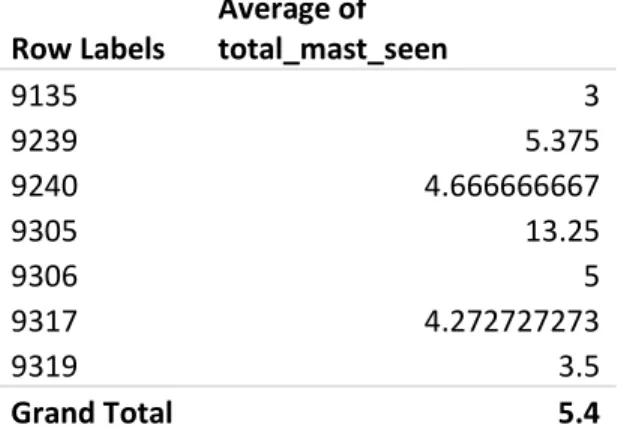
Figure 3 also hints toward the varying levels of difficulties between the different problem sets. Row Labels Average of total_mast_seen 9135 3 9239 5.375 9240 4.666666667 9305 13.25 9306 5 9317 4.272727273 9319 3.5 Grand Total 5.4 Figure 3
This pivot table shows the average number to master per problem set for students who both got the first problem wrong and also eventually mastered.
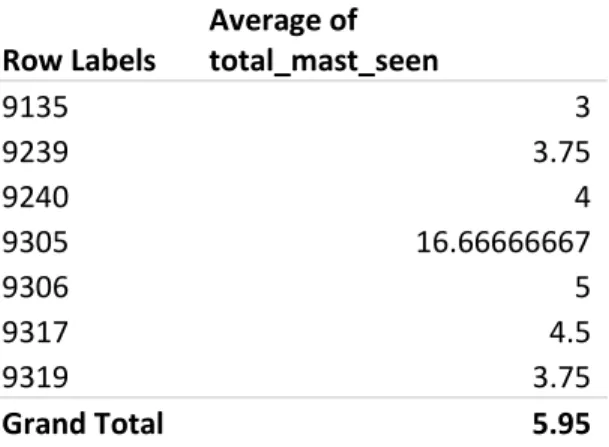
Figures 4 and 5 show that the number of problems to master a problem set is less on average for problem sets with normal tutoring. This seems to contradict the previous analysis of web tutoring problem sets being done faster than normal tutoring. This means that students were doing more problems faster in problem sets with web tutoring than those of normal tutoring. So, the extra time being put into normal tutoring yields better results, as far as the number of problems to master is concerned. This hints towards similar results of Leena Razzaq and Neil Heffernan who discovered that high knowledge kids benefit more from complete solutions than tutoring when time is controlled. The t-test performed on the data in Figures 4 and 5 gave a value of 0.680797 meaning the data is not conclusive.
Row Labels Average of total_mast_seen 9135 3 9239 3.75 9240 4 9305 16.66666667 9306 5 9317 4.5 9319 3.75 Grand Total 5.95 Figure 4
This pivot table shows the average number to master per problem set with web tutoring for students who both got the first problem wrong and also eventually mastered.
Row Labels Average of total_mast_seen 9135 3 9239 7 9240 5 9305 3 9317 4 9319 3 Grand Total 4.666666667 Figure 5
This pivot table shows the average number to master per problem set with normal tutoring for students who both got the first problem wrong and also eventually mastered.
Figure 6 shows that students were fairly consistent with their opinions toward different web pages. That is, if they felt that one webpage was useful, they would feel that the other ones they encountered were useful, and vice versa.
Average of resp
Column Labels
Row Labels 9135 9239 9240 9305 9306 9317 9319 Grand Total
78261 1 1 78289 1 1 78290 2 1 1.5 78295 78296 5 4 5 4.6666667 78297 1 1 1 78298 3 3 3 78299 4 1 3 1 2.25 78300 78302 2 2 78305 3 3 3 3 78306 4 4 4 Grand Total 3.666666667 3 3.2 3 2 2 2.619047619 Figure 6
This pivot table shows the average responses for students as to their overall feeling towards web pages per problem set, with 1 being very unhelpful, 5 being very helpful, and technical difficulties being left blank.
According to Figure 7, the difference in overall feeling between the two different web pages for the same problem set was relatively small.
Row Labels Average of resp 9135 web2 9239 3.666666667 web1 4 web2 3 9240 3 web1 3 9305 3.2 web1 3 web2 4 9306 3 web1 3 9317 2 web1 2.2 web2 1 9319 2 web1 1 web2 2.666666667
Grand Total 2.619047619
Figure 7
This pivot table shows the overall feeling of students towards each of the two possible web pages per problem set.
According to Figure 8, the average feeling of students toward web page tutoring was between unhelpful and neutral.
Row Labels Average of resp 9135 9239 3.666666667 9240 3 9305 3.2 9306 3 9317 2 9319 2 Grand Total 2.619047619 Figure 8
Row Labels Sum of correct2 Count of user_id 9135 1 2 50.00% Normal 0 1 0.00% web2 1 1 100.00% 9239 5 8 62.50% Normal 2 4 50.00% web1 2 3 66.67% web2 1 1 100.00% 9240 3 3 100.00% Normal 2 2 100.00% web1 1 1 100.00% 9305 2 9 22.22% Normal 1 2 50.00% web1 0 4 0.00% web2 1 3 33.33% 9306 1 1 100.00% web1 1 1 100.00% 9317 8 12 66.67% Normal 3 5 60.00% web1 4 5 80.00% web2 1 2 50.00% 9319 6 8 75.00% Normal 2 3 66.67% web1 2 2 100.00% web2 2 3 66.67% Grand Total 26 43 60.47% Figure 9
Percentage of the Students who got the second problem right after getting the first problem wrong for each condition.
Four of the problem sets in this study had 16 students do them, while the others had 15, 13, and 8. It is important to note that the students doing each problem set were not unique for each problem set. To analyze the effects of the different types of tutoring, we had to look at the students who got the first problem wrong. On average, less than half of the students for each problem set got the first problem wrong. The students who did get the first problem wrong were still divided into the 3 different conditions, which left less than 4 students per condition to be analyzed.
The percentage of students who got the second problem correct after getting the first one wrong was generally above 50%, with the exception of one problem set which was at 22.20%. This again points to the difficulty of dealing with problem sets of varying difficulty levels.
Web Pages Used 9239 Web1:http://www.youtube.com/watch?v=oG19cFGRFeA Web2:http://www.mathwarehouse.com/algebra/linear_equation/slope-intercept-form.php 9319 Web1:http://www.algebra-class.com/y-intercept.html Web2:http://www.mathwarehouse.com/algebra/linear_equation/y-intercept-of-a-line.php 9317 Web1:http://www.math.com/school/subject2/lessons/S2U4L2GL.html Web2: http://www.algebra-class.com/calculating-slope.html 9135 Web1:http://www.maths.com/algebra/substitution/index.htm Web2:http://cda.morris.umn.edu/~mcquarrb/BA/Resources/1.8_Substitution_to_Evaluate_Formulas.pdf 9240 Web1:http://www.howcast.com/videos/26129-How-To-Find-the-Slope-Of-a-Line-From-an-Equation Web2:http://www.mathexpression.com/find-the-slope-of-an-equation-of-a-line.html 9305 Web1:http://cnx.org/content/m18278/latest/ Web2:http://www.studyit.org.nz/subjects/maths/math1/1/subjectcontent/linearpatt.html 9306 Web1:http://id.mind.net/~zona/mmts/functionInstitute/linearFunctions/lsif.html# Web2:http://www.analyzemath.com/function/linear_functions.html
Who was the winner: comparing normal tutoring to web pages for individual problem sets
This section describes various statistics about each problem set. Specifically, it talks about the distribution of the types of tutoring for each problem set. This also discusses the percentage of students who got the second problem right after getting the first problem wrong. This is an attempt to examine which students learned the most (after getting the first one wrong) with the second controlled problem. This can give us a small insight into which kind of tutoring is the “winner.”
Row Labels Count of user_id 9135 15 0 2 0 1 Normal 1 1 1 Web2 1 1 13 0 2 Normal 1 Web2 1 1 11 Normal 3 web1 4 Web2 4 9239 16 0 8 0 3 Normal 2 web1 1 1 5 Normal 2 web1 2 Web2 1 1 8 0 1 web1 1 1 7 Normal 3 web1 2 Web2 2 9240 8 0 3 1 3 Normal 2 web1 1 1 5 0 3 web1 3 1 2
web1 1 Web2 1 9305 13 0 9 0 7 Normal 1 web1 4 Web2 2 1 2 Normal 1 Web2 1 1 4 0 1 Web2 1 1 3 web1 1 Web2 2 9306 16 0 1 1 1 web1 1 1 15 1 15 Normal 5 web1 4 Web2 6 9317 16 0 12 0 3 Normal 2 web1 1 1 8 Normal 3 web1 4 Web2 1 (blank) 1 Web2 1 1 4 0 2 Normal 1 Web2 1 1 2 Normal 1
web1 1 9319 16 0 8 0 1 Web2 1 1 6 Normal 2 web1 2 Web2 2 (blank) 1 Normal 1 1 8 0 2 Normal 1 Web2 1 1 6 Normal 3 Web2 3
This figure shows that very few people got the first problem correct and the second problem incorrect.
For Problem Set 9135:
1 of the 2 students who got the first problem incorrect got the second problem correct. None of the students who received normal tutoring got the second problem correct. No students received Web1.
1 student received Web2 and got the second problem correct. Web2 was the winner.
For Problem Set 9239:
5 of the 8 students who got the first problem incorrect got the second problem correct. 2 of the 4 students who received normal tutoring got the second problem correct. 2 of the 3 students who received Web1 got the second problem correct.
1 student received Web2 and got the second problem correct. Web2 was the winner.
For Problem Set 9240:
3 of the 3 students who got the first problem incorrect got the second problem correct. 2 of the 2 students who received normal tutoring got the second problem correct. 1 student received Web1 and got the second problem correct.
No students received Web2.
There was no winner for this problem set. For Problem Set 9305:
2 of the 9 students who got the first problem incorrect got the second problem correct. 1 of the 2 students who received normal tutoring got the second problem correct. None of the students who received Web1 got the second problem correct. 1 of the 3 students who received Web2 got the second problem correct. Normal tutoring was the winner.
For Problem Set 9306:
1 student got the first problem incorrect got the second problem correct.
Only one student received tutoring for the second problem, so there is no winner. For Problem Set 9317:
8 of the 12 students who got the first problem incorrect got the second problem correct. 3 of the 5 students who received normal tutoring got the second problem correct. 4 of the 5 students who received Web1 got the second problem correct.
1 of the 2 students who received Web2 got the second problem correct. Web1 was the winner.
For Problem Set 9319:
6 of the 8 students who got the first problem incorrect got the second problem correct. 2 of the 3 students who received normal tutoring got the second problem correct. 2 of the 2 students who received Web1 got the second problem correct.
2 of the 3 students who received Web2 got the second problem correct. Web1 was the winner.
Conclusion
One of the things our study hints at is that while students master problem sets with web tutoring faster than problem sets with normal tutoring, it takes more problems to actually master the problem set. Based on the generally non-positive feeling toward webpages by students, they could simply be learning by trial and error, rather than from the webpages. However, there is no evidence to support this claim. Because of the asymmetrical nature of this study, the total number of students in the web tutoring group was twice the number of students in the normal tutoring group, due to the combination of the web1 and web2 groups. Because of this fact, there may have not been enough data to effectively compare the two types of groups. There is also the question of which is better: mastering a problem set faster with more problems, or mastering a problem set slower with less problems. While the web tutoring students may have mastered a problem set faster, we have no way of knowing well they retained that knowledge after mastering.
The two different web pages for each problem set with web tutoring received generally similar results in how students felt about them. It would seem that the usefulness of web pages for a problem set’s tutoring greatly depends on the nature of the problem set and its associated skill or skills. That is, some skills are more suited for web page tutoring than others.
References
1) Razzaq, L., & Heffernan, N. (2010). Can We Use Educational Content from the Web? International Conference on Intelligent Tutoring Systems.
Appendix
1) Writing Linear Equations from slope and y-intercepts a) Document Summary
b) Sample Problem with Tutoring 2) Finding Slope in an Equation
a) Document Summary
b) Sample Problem with Tutoring 3) Finding y-intercept from Linear Equation
a) Document Summary
b) Sample Problem with Tutoring 4) Substitution
a) Document Summary
b) Sample Problem with Tutoring 5) Finding Slope in Situation
a) Document Summary
b) Sample Problem with Tutoring 6) Finding y-intercept from Linear Situation
a) Document Summary
b) Sample Problem with Tutoring 7) Finding Equation from Linear Situation
a) Document Summary
Skill Class
Writing
Linear
Equations from slope
and y-intercepts
Algebra 1
Mastery Problem Set #8780 Number of Templates 6 Number to Master 3 in-a-row Number of Attempts
Templates
56516
◦ The slope is positive, non-zero
◦ The y-intercept is positive, non-zero, and given as a single integer
56784
◦ The slope is negative
◦ The y-intercept is positive, non-zero, and given as a single integer
56786
◦ The slope is zero
57704
◦ The slope is positive, non-zero
◦ The y-intercept is positive, non-zero, and given as a point
57703
◦ The slope is negative
◦ The y-intercept is positive, non-zero, and given as a point
57702
◦ The slope is zero
◦ The y-intercept is positive, non-zero, and given as a point Dan Mitchell
1) Assistment #56516 "56516 - Algebra1 Equation from Slope and Y-intercept Mastery Learning" Write an equation in the form "y=______________" using the following information about the equation:
Slope of the equation: %v{yslope}/%v{xslope}
Y-intercept of the equation: %v{yintercept}
Algebra:
%v{yslope}/%v{xslope}x + %v{yintercept} %v{yslope/xslope}x+%v{yintercept}
Hints:
m is the slope and b is they-intercept.
m = %v{yslope}/%v{xslope} because theslope is %v{yslope}/%v{xslope}
We know that b = %v{yintercept} because the y-intercept is %v{yintercept}
%v{yslope}/%v{xslope}x +
%v{yintercept}
Type in %v{yslope}/%v{xslope}x + %v{yintercept}
2) Assistment #64420 "64420 - Algebra1 Equation from Slope and Y-intercept Mastery Learning" Write an equation in the form "y=______________" using the following information about the equation:
Slope of the equation: 10/3
Y-intercept of the equation: 8
Algebra:
10/3x + 8
m is the slope and b is they-intercept.
m = 10/3 because theslope is 10/3
We know that b = 8 because the y-intercept is 8
10/3x +
8
Type in 10/3x + 8
3) Assistment #56784 "56784 - Algebra1 Equation from Slope and Y-intercept Mastery Learning 2" Write an equation in the form "y=______________" using the following information about the equation:
Slope of the equation: %v{yslope}/%v{xslope} Y-intercept of the equation: %v{yintercept}
Algebra:
%v{yslope}/%v{xslope}x + %v{yintercept}
Hints:
m is the slope and b is the y-intercept.
m = %v{yslope}/%v{xslope} because the slope is %v{yslope}/%v{xslope}
We know that b = %v{yintercept} because the y-intercept is %v{yintercept}
%v{yslope}/%v{xslope}x +
%v{yintercept}
Type in %v{yslope}/%v{xslope}x + %v{yintercept}
4) Assistment #64460 "64460 - 56786 - Algebra1 Equation from Slope and Y-intercept Mastery Learning 3"
Write an equation in the form "y=______________" using the following information about the equation:
Slope of the equation: 0 Y-intercept of the equation: 7
Algebra:
7
Hints:
m is the slope and b is the y-intercept.
m = 0 because the slope is 0
We know that b = 7 because the y-intercept is 7
slope is 0, so the equation is y =
7
Type in 7
5) Assistment #56786 "56786 - Algebra1 Equation from Slope and Y-intercept Mastery Learning 3" Write an equation in the form "y=______________" using the following information about the equation:
Slope of the equation: 0
Y-intercept of the equation: %v{yintercept}
Algebra:
%v{yintercept}
Hints:
m is the slope and b is the y-intercept.
m = 0 because the slope is 0
We know that b = %v{yintercept} because the y-intercept is %v{yintercept}
slope is 0, so the equation is y =
%v{yintercept}
Type in %v{yintercept}
6) Assistment #64396 "64396 - Algebra1 Equation from Slope and Y-intercept Mastery Learning 2" Write an equation in the form "y=______________" using the following information about the equation:
Y-intercept of the equation: 8
Algebra:
-2/1x + 8
Hints:
m is the slope and b is the y-intercept.
m = -2/1 because the slope is -2/1
We know that b = 8 because the y-intercept is 8
-2/1x + 8 Type in -2/1x + 8
7) Assistment #57704 "57704 - Algebra1 Equation from Slope and Y-intercept Mastery Learning 6" Write a linear equation for the line with slope = %v{yslope}/%v{xslope} going through the point: (0, %v{yintercept})
Write your equation in the form y= _____________
Algebra:
%v{yslope}/%v{xslope}x + %v{yintercept}
Hints:
m is the slope and b is the y-intercept.
m = %v{yslope}/%v{xslope} because the slope is %v{yslope}/%v{xslope}
We know that b = %v{yintercept} because (0, %v{yintercept}) is on the y-axis so it is the y-intercept
%v{yslope}/%v{xslope}x +
%v{yintercept}
Type in %v{yslope}/%v{xslope}x + %v{yintercept}
8) Assistment #64435 "64435 - Algebra1 Equation from Slope and Y-intercept Mastery Learning 6" Write a linear equation for the line with slope = 10/9 going through the point: (0, 4)
Write your equation in the form y= _____________
Algebra:
10/9x + 4
Hints:
m is the slope and b is the y-intercept.
m = 10/9 because the slope is 10/9
We know that b = 4 because (0, 4) is on the y-axis so it is the y-intercept
10/9x + 4 Type in 10/9x + 4
9) Assistment #57703 "57703 - Algebra1 Equation from Slope and Y-intercept Mastery Learning 5" Write a linear equation for the line with slope = %v{yslope}/%v{xslope} going through the point: (0, %v{yintercept})
Algebra:
%v{yslope}/%v{xslope}x + %v{yintercept}
Hints:
m is the slope and b is the y-intercept.
m = %v{yslope}/%v{xslope} because the slope is %v{yslope}/%v{xslope}
We know that b = %v{yintercept} because (0, %v{yintercept}) is on the y-axis so it is the y-intercept
%v{yslope}/%v{xslope}x +
%v{yintercept}
Type in %v{yslope}/%v{xslope}x + %v{yintercept}
Write a linear equation for the line with slope = -3/8 going through the point: (0, 8)
Write your equation in the form y= _____________
Algebra:
-3/8x + 8
Hints:
m is the slope and b is the y-intercept.
m = -3/8 because the slope is -3/8
We know that b = 8 because (0, 8) is on the y-axis so it is the y-intercept
-3/8x + 8 Type in -3/8x + 8
11) Assistment #57702 "57702 - Algebra1 Equation from Slope and Y-intercept Mastery Learning 4" Write a linear equation for the line with slope = 0 going through the point: (0, %v{yintercept})
Write your equation in the form y = ______________
Algebra:
%v{yintercept}
Hints:
m is the slope and b is the y-intercept.
m = 0 because the slope is 0
slope is 0, so the equation is y =
%v{yintercept}
Type in %v{yintercept}
12) Assistment #64371 "64371 - 57702 - Algebra1 Equation from Slope and Y-intercept Mastery Learning 4"
Write a linear equation for the line with slope = 0 going through the point: (0, 3)
Write your equation in the form y= _____________
Algebra:
3
Hints:
m is the slope and b is the y-intercept.
m = 0 because the slope is 0
We know that b = 3 because (0, 3) is on the y-axis so it is the y-intercept
slope is 0, so the equation is y =
3
Type in 3
Skill Class
Finding slope in an
equation
Algebra 1
Mastery Problem Set #8949 Number of Templates 10 Number to Master 4 in-a-row Number of Attempts
Templates
56520
◦ The slope is positive, non-zero
◦ The equation is given in slope-intercept form
57935
◦ The slope is negative
◦ The equation is given in slope-intercept form
57936
◦ The slope is zero
◦ The equation is given in slope-intercept form
57937
◦ The slope is positive, non-zero
57938
◦ The slope is negative
◦ The equation is given in the form 4y = 3x+7
57939
◦ The slope is zero
◦ The equation is given in the form 4y = 3x+7
60532
◦ The slope is negative
◦ The equation is given in standard form, 4x + 2y = 7
60533
◦ The slope is positive
◦ The equation is given in standard form, 4x + 2y = 7
60534
◦ The slope is 1
Level 1
Mastery Problem Set # 8950 Number of Templates 3 Number to Master 3 in-a-row Number of Attempts10 First Day, 10 Subsequent Days Templates
56520
◦ The slope is positive, non-zero
◦ The equation is given in slope-intercept form
57935
◦ The slope is negative
◦ The equation is given in slope-intercept form
57936
◦ The slope is zero
◦ The equation is given in slope-intercept form Dan Mitchell
Determine the slope from the following equation: y = %v{yslope}/%v{xslope}x + %v{yintercept}
Algebra:
%v{yslope}/%v{xslope}
Hints:
-intercept when it is in slope intercept form:
y = %v{yslope}/%v{xslope}x + %v{yintercept}
%v{yslope}/%v{xslope}. Type
%v{yslope}/%v{xslope}.
2) Assistment #69771 "69771 - 57935 - Algebra1 Finding Slope From Equation Mastery Learning 2" Determine the slope from the following equation:
y = -7/8x + 3
Algebra:
-7/8
Hints:
you can read the slope and y-intercept when it is in slope intercept form:
y = -7/8x + 3
-7/8. Type -7/8.
3) Assistment #57936 "57936 - Algebra1 Finding Slope From Equation Mastery Learning 3" Determine the slope from the following equation:
y = %v{yintercept}
Algebra:
0
Hints:
-intercept when it is in slope intercept form:
m we have:
y = 0x + %v{yintercept}
0.
Type in 0.
4) Assistment #69760 "69760 - 56520 - Algebra1 Finding Slope From Equation Mastery Learning" Determine the slope from the following equation:
y = 10/8x + 2
Algebra:
10/8
Hints:
-intercept when it is in slope intercept form:
y = 10/8x + 2
10/8. Type
10/8.
5) Assistment #57935 "57935 - Algebra1 Finding Slope From Equation Mastery Learning 2" Determine the slope from the following equation:
y = %v{yslope}/%v{xslope}x + %v{yintercept}
Algebra:
%v{yslope}/%v{xslope}
Hints:
-intercept when it is in slope intercept form:
y = %v{yslope}/%v{xslope}x + %v{yintercept}
pe is the coeficient of x, or %v{yslope}/%v{xslope}. Type
%v{yslope}/%v{xslope}.
6) Assistment #69787 "69787 - Algebra1 Finding Slope From Equation Mastery Learning 3" Determine the slope from the following equation:
y = 6
Algebra:
0
Hints:
-intercept when it is in slope intercept form:
y = 0x + 6
0.
Type in 0.
7) Assistment #57937 "57937 - Algebra1 Finding Slope From Equation Mastery Learning 4" Determine the slope from the following equation:
%v{xslope}y = %v{yslope}x + %v{yintercept}
Algebra:
%v{yslope}/%v{xslope}
Hints:
You should try to get it into slope-intercept form: %v{xslope}y = %v{yslope}x + %v{yintercept} %v{xslope} = %v{xslope} y = %v{yslope}/%v{xslope}x + %v{yintercept}/%v{xslope} %v{yslope}/%v{xslope}. Type %v{yslope}/%v{xslope}.
8) Assistment #69727 "69727 - 57937 - Algebra1 Finding Slope From Equation Mastery Learning 4" Determine the slope from the following equation:
6y = 5x + 2
Algebra:
Hints:
You should try to get it into slope-intercept form:
divide each side by 6. 6y = 5x + 2 6 = 6 y = 5/6x + 2/6 5/6. Type 5/6.
9) Assistment #57938 "57938 - Algebra1 Finding Slope From Equation Mastery Learning 5" Determine the slope from the following equation:
%v{xslope}y = %v{yslope}x + %v{yintercept}
Algebra:
%v{yslope}/%v{xslope}
Hints:
To do this, divide each side by %v{xslope}. %v{xslope}y = %v{yslope}x + %v{yintercept} %v{xslope} = %v{xslope} y = %v{yslope}/%v{xslope}x + %v{yintercept}/%v{xslope} %v{yslope}/%v{xslope}. Type %v{yslope}/%v{xslope}.
10) Assistment #93052 "93052 - Algebra1 Finding Slope From Equation Mastery Learning 5" Determine the slope from the following equation:
-8y = 8x + 6
Algebra:
8/-8
Hints:
st solve for y so that you can read the slope. You should try to get it into slope-intercept form:
-8. -8y = 8x + 6 -8 = -8 y = 8/-8x + 6/-8 8/-8. Type 8/-8.
11) Assistment #57939 "57939 - Algebra1 Finding Slope From Equation Mastery Learning 6" Determine the slope from the following equation:
%v{xslope}y = %v{yintercept}
Algebra:
0
Hints:
or y so that you can read the slope. You should try to get it into slope-intercept form:
y = 0x + %v{yintercept}/%v{xslope}
We added in the x so that you can see it. 0x=0
0.
Type in 0.
12) Assistment #69749 "69749 - 57939 - Algebra1 Finding Slope From Equation Mastery Learning 6" Determine the slope from the following equation:
5y = 1 Algebra: 0 Hints: slope-intercept form: %v{xslope}y = %v{yintercept} %v{xslope} = %v{xslope}
y = 0x + 1/5
We added in the x so that you can see it. 0x=0
0.
Type in 0.
13) Assistment #69803 "69803 - Algebra1 Finding Slope From Equation Mastery Learning 7" Determine the slope from the following equation:
3x + 2y = 9 Algebra: -3/2 Hints: slope-intercept form: 5y = 1 5 = 5
First, you must subtract 3x from both sides, giving you: 2y = 9 - 3x
Then, divide each side by 2. 2y = 9 - 3x 2 = 2 y = 9/2 - 3/2x -3/2. Type -3/2.
14) Assistment #60533 "60533 - Algebra1 Finding Slope From Equation Mastery Learning 8" Determine the slope from the following equation:
%v{xslope}y - %v{yslope}x= %v{yintercept}
Algebra:
%v{yslope}/%v{xslope}
Hints:
%v{xslope}y = %v{yintercept} + %v{yslope}x
Then, divide each side by %v{xslope}. %v{xslope}y = %v{yintercept} + %v{yslope}x %v{xslope} = %v{xslope} y = %v{yintercept}/%v{xslope} + %v{yslope}/%v{xslope}x %v{yslope}/%v{xslope}. Type %v{yslope}/%v{xslope}.
15) Assistment #69716 "69716 - Algebra1 Finding Slope From Equation Mastery Learning 8" Determine the slope from the following equation:
7y - 5x= 5 Algebra: 5/7 Hints: slope-intercept form:
ides, giving you: 7y = 5 + 5x
Then, divide each side by 7.
7y = 5 + 5x 7 = 7 y = 5/7 + 5/7x 5/7. Type 5/7.
16) Assistment #60534 "60534 - Algebra1 Finding Slope From Equation Mastery Learning 9" Determine the slope from the following equation:
%v{var}y = %v{var}x Algebra: 1 Hints: slope-intercept form:
this, divide each side by %v{var}. %v{var}y = %v{var}x %v{var} %v{var} y=x 1. Type 1.
17) Assistment #69738 "69738 - Algebra1 Finding Slope From Equation Mastery Learning 9" Determine the slope from the following equation:
10y = 10x Algebra: 1 Hints: slope-intercept form:
e by 10. 10y = 10x 10 10 y=x 1. Type 1. Skill Class
Finding y-intercept
from Linear Equation
Algebra 1
Mastery Problem Set #9180
Number of Templates 10
Number to Master 4 in-a-row
Number of Attempts
Templates
61825
◦ The slope is positive, non-zero
◦ The equation is given in slope-intercept form
61826
◦ The slope is negative
◦ The equation is given in slope-intercept form
61827
◦ The slope is zero
◦ The equation is given in slope-intercept form
61828
◦ The slope is positive, non-zero
◦ The equation is given in the form 4y = 3x+7
61829
◦ The slope is negative
61830
◦ The slope is zero
◦ The equation is given in the form 4y = 3x+7
61831
◦ The slope is negative
◦ The equation is given in standard form, 4x + 2y = 7
61832
◦ The slope is positive
◦ The equation is given in standard form, 4x + 2y = 7
Level 1
Mastery Problem Set # 9181 Number of Templates 3 Number to Master 3 in-a-row Number of Attempts10 First Day, 10 Subsequent Days Templates
61825
◦ The slope is positive, non-zero
◦ The equation is given in slope-intercept form
61826
◦ The slope is negative
◦ The equation is given in slope-intercept form
61827
◦ The equation is given in slope-intercept form Dan Mitchell
1) Assistment #61825 "61825 - Algebra1 Finding Y-intercept from Linear Equation" Determine the y-intercept from the following equation:
y = (%v{yslope}/%v{xslope})x + %v{yintercept}
Algebra:
%v{yintercept}
Hints:
-intercept when it is in slope intercept form:
y = (%v{yslope}/%v{xslope})x + %v{yintercept}
-intercept is the term without the variable, or %v{yintercept}. Type
%v{yintercept}.
2) Assistment #73939 "73939 - Algebra1 Finding Y-intercept from Linear Equation" Determine the y-intercept from the following equation:
y = (3/5)x + 2
Algebra:
2
Hints:
can read the slope and y-intercept when it is in slope intercept form:
y = (3/5)x + 2
-intercept is the term without the variable, or 2. Type
2.
3) Assistment #61827 "61827 - Algebra1 Finding Y-intercept from Linear Equation 3" Determine the y-intercept from the following equation:
y = (%v{yslope}/%v{xslope})x
Algebra:
0
Hints:
-intercept when it is in slope intercept form:
y = (%v{yslope}/%v{xslope})x+ 0
We added in the 0 to this equation so that you could see it.
The y-intercept is the term without the variable, or 0. Type
4) Assistment #73969 "73969 - 61826 - Algebra1 Finding Y-intercept from Linear Equation 2"
Determine the y-intercept from the following equation: y = (5/2)x - 5
Algebra:
-5
Hints:
-intercept when it is in slope intercept form:
y = (5/2)x + (-5)
-intercept is the term without the variable, or -5. Type -5.
5) Assistment #93062 "93062 - 61827 - Algebra1 Finding Y-intercept from Linear Equation 3"
Determine the y-intercept from the following equation: y = (10/10)x
Algebra:
0
Hints:
-intercept when it is in slope intercept form:
y = (10/10)x+ 0
We added in the 0 to this equation so that you could see it.
The y-intercept is the term without the variable, or 0. Type
0.
6) Assistment #61826 "61826 - Algebra1 Finding Y-intercept from Linear Equation 2" Determine the y-intercept from the following equation:
y = (%v{yslope}/%v{xslope})x - %v{yintercept}
Algebra:
-%v{yintercept}
Hints:
-intercept when it is in slope intercept form:
y = (%v{yslope}/%v{xslope})x + (-%v{yintercept})
-intercept is the term without the variable, or -%v{yintercept}. Type -%v{yintercept}.
7) Assistment #61828 "61828 - Algebra1 Finding Y-intercept from Linear Equation 4" Determine the y-intercept from the following equation:
%v{xslope}y = %v{yslope}x + %v{yintercept}
Algebra:
%v{yintercept}/%v{xslope}
Hints:
-intercept when it is in slope intercept form:
To do this, divide each side by %v{xslope}. %v{xslope}y = %v{yslope}x + %v{yintercept} %v{xslope} %v{xslope}
y = (%v{yslope}/%v{xslope})x + %v{yintercept}/%v{xslope}
-intercept is the term without the variable, or %v{yintercept}/%v{xslope}. Type
%v{yintercept}/%v{xslope}.
8) Assistment #93072 "93072 - 61828 - Algebra1 Finding Y-intercept from Linear Equation 4"
Determine the y-intercept from the following equation: 7y = 7x + 2
Algebra:
2/7
Hints:
For a Linear Equation, you can read the slope and y-intercept when it is in slope intercept form:
7y = 7x + 2 7 7
y = (7/7)x + 2/7
-intercept is the term without the variable, or 2/7. Type
2/7.
9) Assistment #61829 "61829 - Algebra1 Finding Y-intercept from Linear Equation 5" Determine the y-intercept from the following equation:
%v{xslope}y = %v{yslope}x + %v{yintercept}
Algebra:
%v{yintercept}/%v{xslope}
Hints:
-intercept when it is in slope intercept form:
%v{xslope}y = %v{yslope}x + %v{yintercept} %v{xslope} %v{xslope}
y = (%v{yslope}/%v{xslope})x + %v{yintercept}/%v{xslope}
-intercept is the term without the variable, or %v{yintercept}/%v{xslope}. Type
%v{yintercept}/%v{xslope}.
10) Assistment #61830 "61830 - Algebra1 Finding Y-intercept from Linear Equation 6" Determine the y-intercept from the following equation:
%v{xslope}y = %v{yslope}x
Algebra:
0
Hints:
-intercept when it is in slope intercept form:
{xslope}. The equation should now look like this: %v{xslope}y = %v{yslope}x
%v{xslope} %v{xslope}
y = (%v{yslope}/%v{xslope})x + 0
We added in the x so that you can see it.
-intercept is the term without the variable, or
0.
Type in 0.
11) Assistment #93092 "93092 - 61830 - Algebra1 Finding Y-intercept from Linear Equation 6"
Determine the y-intercept from the following equation: 1y = 5x
0
Hints:
lope and y-intercept when it is in slope intercept form: 1y = 5x 1 1 y = (5/1)x + 0
We added in the x so that you can see it.
-intercept is the term without the variable, or
0.
Type in 0.
12) Assistment #93082 "93082 - 61829 - Algebra1 Finding Y-intercept from Linear Equation 5"
Determine the y-intercept from the following equation: -9y = 6x + 3
Algebra:
3/-9
Hints:
For a Linear Equation, you can read the slope and y-intercept when it is in slope intercept form:
-9. -9y = 6x + 3 -9 -9 y = (6/-9)x + 3/-9
-intercept is the term without the variable, or 3/-9. Type 3/-9.
13) Assistment #93102 "93102 - 61831 - Algebra1 Finding Y-intercept from Linear Equation 7"
Determine the y-intercept from the following equation: 8x + 8y = 10
Algebra:
10/8
Hints:
on, you can read the slope and y-intercept when it is in slope intercept form:
Then, divide each side by 8. 8y = 10 - 8x
8 8
y = 10/8 - (8/8)x
-intercept is the term without the variable, or 10/8. Type
10/8.
14) Assistment #61832 "61832 - Algebra1 Finding Y-intercept from Linear Equation 8" Determine the y-intercept from the following equation:
%v{xslope}y - %v{yslope}x= %v{yintercept}
Algebra:
%v{yintercept}/%v{xslope}
Hints:
-intercept when it is in slope intercept form:
%v{xslope}y = %v{yintercept} + %v{yslope}x
Then, divide each side by %v{xslope}.
%v{xslope}y = %v{yintercept} + %v{yslope}x %v{xslope} %v{xslope}
y = %v{yintercept}/%v{xslope} + (%v{yslope}/%v{xslope})x
-intercept is the term without the variable, or %v{yintercept}/%v{xslope}. Type
%v{yintercept}/%v{xslope}.
15) Assistment #73961 "73961 - 61831 - Algebra1 Finding Y-intercept from Linear Equation 7"
Determine the y-intercept from the following equation: 4x + 2y = 9
Algebra:
9/2
Hints:
lope and y-intercept when it is in slope intercept form:
2y = 9 - 4x
Then, divide each side by 2. 2y = 9 - 4x
2 2
y = 9/2 - (4/2)x
-intercept is the term without the variable, or 9/2. Type
9/2.
Skill Class
Substitution
P 7
The Mastery Set
Mastery Problem Set #8946 Number of Templates 8 Number to Master 3 Number of Attempts 10 Templates
57744
◦ If x is equal to 4 and y is equal to 19 then what is the value of x + 8(y)?
◦ The value of x is between 1 and 20
◦ The value of y is between 1 and 20
◦ The value y is multiplied by is between 1 and 20
57745
◦ If x is equal to 54 and y is equal to 8 then what is the value of x - 1(y)?
◦ The value of x is between 41 and 60
◦ The value of y is between 1 and 10
◦ The value y is multiplied by is between 1 and 5
57746
◦ If y is equal to -4
then what is the value of 5 + 2(y)?
◦ The value added to y is between 1 and 20
◦ The value of y is between -10 and -1
◦ The value y is multiplied by is between 1 and 5
57749
◦ If y is equal to -7
then what is the value of 8 - 4(y)?
◦ The value added to y is between 1 and 20
◦ The value of y is between -10 and -1
◦ The value y is multiplied by is between 1 and 5
55389
◦ If x is equal to -9
then what is the value of 15 - 3(x)?
◦ The value added to x is between 1 and 20
◦ The value of x is between -10 and -1
◦ The value x is multiplied by is between 1 and 5
55401
◦ If x = 4 and y = 2. what is the value of the following expression? 5x-7y
◦ The value of x is between 1 and 10
◦ The value of y is between 1 and 10
◦ The values of the coefficients of x and y are between 2 and 10
55412
◦ If x = 8 and y = 4 what is the value of the following expression? 5(x - 2(x - y))
◦ The value of x is between 1 and 10
◦ The value of the outside coefficient is between 2 and 6
◦ The value of the inside coefficient is between 2 and 4
62795
◦ If x = 2 and y = 7 what is the value of the following expression? y + (xy + 4x)
◦ The value of x is between 1 and 10
◦ The value of y is between 1 and 10
◦ The value of the coefficient is between 2 and 6
Level 1
Mastery Problem Set #8864 Number of Templates 5 Number to Master 3 Number of Attempts 10
57740
◦ The number for x and the number added to x are randomized between 1 and 20
57741
If x is equal to 25,
then what is the value of x - 4?
◦ The value of x is between 20 and 39
◦ The number subtracted from x is between 1 and 20
57742
If x is equal to 8,
then what is the value of x x 3?
◦ The value of x is between 1 and 10
57743
◦ If x is equal to 47,
then what is the value of x ÷ 6? (round to the nearest hundredths place)
◦ The value of x is between 41 and 50
◦ The value x is divided by is between 1 and 10
57748
◦ If x is equal to 67,
then what is the value of x ÷ 5?
◦ The value x is divided by is between 1 and 11
◦ The value of x is between 1 and 121
By Matthew Knapp 2009
1) Assistment #57749 "57749 - Substitution - Negative - Subtract + Multiply - Difficult" If y is equal to %v{v2}
then what is the value of %v{v1} - %v{v3}y? Algebra: %v{ans} Hints:
Start by substituting %v{v2} in for y. This simply means replacing y with %v{v2}. Remember the Order of Operations
1. Parenthesis
2. Exponents (powers, roots, etc)
3. Multiplication & Division (from left to right) 4. Addition & Subtraction (from left to right) This can be remembered as PEMDAS.
%v{v1} - %v{v3}*y = %v{v1} - %v{v3}(%v{v2}) We start by Multiplying
Remember, positive times negative is negative
= %v{v1} - (%v{v4}) Remember, subtracting a negative number is equal to adding that number = %v{v1} + %v{v4.abs} And now, we Add
= %v{ans} So,
Type in %v{ans}.
2) Assistment #55389 "55389 - Substitution - Negative - Subtract + Multiply - Difficult" If x is equal to %v{v2}
then what is the value of %v{v1} - %v{v3}*x? Algebra: %v{ans} Hints:
Start by substituting %v{v2} in for x. This simply means replacing x with %v{v2}.
Remember the Order of Operations
1. Parenthesis
2. Exponents (powers, roots, etc)
3. Multiplication & Division (from left to right) 4. Addition & Subtraction (from left to right) This can be remembered as PEMDAS.
%v{v1} -
%v{v3}(%v{v2}) =
%v{v1} - %v{v3}(%v{v2})
We start by Multiplying
Remember, positive times negative is negative.
= %v{v1} - (%v{v4}) Remember, subtracting a negative number is equal to adding that number = %v{v1} + %v{v4.abs} And now, we Add
= %v{ans} So,
%v{v1} - %v{v3}(%v{v2}) is equal to %v{ans}. Type in %v{ans}.
3) Assistment #57745 "57745 - Substitution - Double - Subtract + Multiply - Medium" If
x
is equal to %v{v1} and y is equal to %v{v2}then what is the value of
x
- %v{v3}y?
Algebra:
Hints:
Start by substituting%v{v1} in for x, and %v{v2} in for y.
This simply means replacing x with %v{v1}, and replacing y with %v{v2}. Remember the Order of Operations
1. Parenthesis
2. Exponents (powers, roots, etc)
3. Multiplication & Division (from left to right) 4. Addition & Subtraction (from left to right) This can be remembered as PEMDAS.
x +
%v{v3}*y =
%v{v1} -
%v{v3}(%v{v2}) We start by Multiplying.
= %v{v1} - %v{v4} And now, we Subtract
= %v{ans} So,
%v{v1} - %v{v3}(%v{v2}) is equal to %v{ans} for x = %v{v1} and y = %v{v2}.
Type in %v{ans}.
4) Assistment #69460 "69460 - Substitution - Double - Subtract + Multiply - Medium" If
x
is equal to 44 and y is equal to 4then what is the value of
x
- 3y? Algebra: 32 Hints: Start by substituting44 in for x, and 4 in for y.
This simply means replacing x with 44, and replacing y with 4. Remember the Order of Operations
1. Parenthesis
2. Exponents (powers, roots, etc)
3. Multiplication & Division (from left to right) 4. Addition & Subtraction (from left to right) This can be remembered as PEMDAS.
x +
= 44 - 12 And now, we Subtract
= 32
So,
44 - 3(4) is equal to 32 for x = 44 and y = 4. Type in 32.
5) Assistment #57744 "57744 - 27601 - Substitution - Double - Add + Multiply - Medium" If
x
is equal to %v{v1} and y is equal to %v{v2}then what is the value of
x
+ %v{v3}y? Algebra: %v{ans} Hints: Start by substituting%v{v1} in for
x
, and %v{v2} in for y.This simply means replacing x with %v{v1}, and replacing y with %v{v2}. Remember the Order of Operations
1. Parenthesis
2. Exponents (powers, roots, etc)
3. Multiplication & Division (from left to right) 4. Addition & Subtraction (from left to right) This can be remembered as PEMDAS.
x + %v{v3}*y = %v{v1} + %v{v3}(%v{v2}) We start by Multiplying. = %v{v1} + %v{v3*v2} And now, we Add. = %v{ans} So,
%v{v1} + %v{v3}(%v{v2}) is equal to %v{ans} for x = %v{v1} and y = %v{v2}.
Type in %v{ans}.
6) Assistment #69445 "69445 - 27601 - Substitution - Double - Add + Multiply - Medium" If
x
is equal to 4 and y is equal to 15Algebra: 154 Hints:
Start by substituting4 in for
x
, and 15 in for y.This simply means replacing x with 4, and replacing y with 15. Remember the Order of Operations
1. Parenthesis
2. Exponents (powers, roots, etc)
3. Multiplication & Division (from left to right) 4. Addition & Subtraction (from left to right) This can be remembered as PEMDAS.
x +
10*y = 4 + 10(15) We start by Multiplying.
= 4 + 150 And now, we Add.
= 154
So,
4 + 10(15) is equal to 154 for x = 4 and y = 15. Type in 154.
7) Assistment #57746 "57746 - Substitution - Negative - Add + Multiply - Difficult" If y is equal to %v{v2}
then what is the value of %v{v1} + %v{v3}y? Algebra: %v{ans} Hints:
Start by substituting %v{v2} in for y. This simply means replacing y with %v{v2}. Remember the Order of Operations
1. Parenthesis
3. Multiplication & Division (from left to right) 4. Addition & Subtraction (from left to right) This can be remembered as PEMDAS.
%v{v1} + %v{v3}*y = %v{v1} + %v{v3}(%v{v2}) We start by Multiplying
Remember, positive times negative is negative
= %v{v1} + (%v{v4}) Remember, adding a negative number is equal to subtracting that number = %v{v1} - %v{v4.abs} And now, we Subtract
= %v{ans} So,
%v{v1} + %v{v3}(%v{v2}) is equal to %v{ans} for y = %v{v2}. Type in %v{ans}.
8) Assistment #69485 "69485 - Substitution - Negative - Add + Multiply - Difficult" If y is equal to -2
then what is the value of 19 + 2y? Algebra: 15 Hints:
Start by substituting -2 in for y. This simply means replacing y with -2. Remember the Order of Operations
1. Parenthesis
2. Exponents (powers, roots, etc)
3. Multiplication & Division (from left to right) 4. Addition & Subtraction (from left to right) This can be remembered as PEMDAS.
19 +
2*y = 19 + 2(-2)
We start by Multiplying
Remember, positive times negative is negative
= 19 + (-4) Remember, adding a negative number is equal to subtracting that number
= 19 - 4 And now, we Subtract
So,
19 + 2(-2) is equal to 15 for y = -2. Type in 15.
9) Assistment #62795 "62795 - If x = %v{a} and ..."
If x = %v{a} and y = %v{b} what is the value of the following expression? y + (xy + %v{c}x)
Algebra:
%v{ans}
Hints:
Substitute the given values of x and y into the expression.
Here is an Example:
If x = 4 and y = 7 then what is the value of y(xy + 5x)?
y + (xy + 5x)
7 + (4(7) + 5(4))
Remember the Order of Operations 1. Parenthesis
2. Exponents (powers, roots, etc)
3. Multiplication & Division (from left to right) 4. Addition & Subtraction (from