Contents lists available atScienceDirect
International Journal of Educational Research
journal homepage:www.elsevier.com/locate/ijeduresDialogue, thinking together and digital technology in the
classroom: Some educational implications of a continuing line of
inquiry
Neil Mercer
⁎, Sara Hennessy, Paul Warwick
University of Cambridge, United KingdomA R T I C L E I N F O
Keywords: Classroom dialogue Dialogic teaching Professional development Digital technologyA B S T R A C T
This article describes a continuing programme of school-based applied research. The basis of this research, which originated in a project called‘Thinking Together’, lies in the relationship be-tween language and cognitive development postulated by sociocultural theory. The research has developed and tested methods for improving the quality of classroom interaction amongst tea-chers and students, looking for improved levels of collaboration, reasoning, and academic at-tainment as the desirable outcomes. A key strand of this research concerns the use of digital technology for supporting classroom dialogue and students’emerging thinking over time. As we will explain, the outcomes of several research projects pursuing this line of enquiry have yielded positive results which have direct implications for classroom pedagogy and practice.
1. Introduction
This paper is founded on a line of applied educational research aimed at understanding and improving the quality of commu-nication through spoken language in the classroom, and on developing children’s use of language as a psychological and cultural tool for learning and problem solving. The origins of this‘Thinking Together’research have strong roots in educational traditions in the UK that go back to the 1960s (as described inMercer & Dawes, 2014). The classroom pedagogy it developed involves promoting a type of talk considered to be effective for thinking and learning that wasfirst described by Douglas Barnes in the 1970s and called ‘Exploratory Talk’(Barnes, 1976, 2008; Mercer 1995, 2000). Within our own research we have defined Exploratory Talk as dialogue in which:
•
everyone engages critically but constructively with each other’s ideas;•
everyone offers the relevant information they have;•
everyone’s ideas are treated as worthy of consideration;•
partners ask each other questions and answer them, ask for reasons and give them;•
members of the group try to reach agreement at each stage before progressing;•
to an observer of the group, reasoning is‘visible’in the talk.(Littleton & Mercer, 2013, p. 16.)
A very similar kind of productive dialogue is known as‘Accountable Talk’in the USA (Resnick, 1999;Wolf, Crosson, & Resnick,
http://dx.doi.org/10.1016/j.ijer.2017.08.007
Received 8 March 2017; Received in revised form 10 August 2017; Accepted 17 August 2017
⁎Corresponding author at. University of Cambridge Faculty of Education, 184 Hills Road, Cambridge CB2 8PQ, United Kingdom.
E-mail address:[email protected](N. Mercer).
0883-0355/ © 2017 Published by Elsevier Ltd. This is an open access article under the CC BY license (http://creativecommons.org/licenses/BY/4.0/).
Please cite this article as: Mercer, N., International Journal of Educational Research (2017), http://dx.doi.org/10.1016/j.ijer.2017.08.007
2006).
Our work encompasses the mediating role of digital technologies in enabling and extending Exploratory Talk and the joint construction of knowledge in classrooms. It has developed in recent years to exploit a range of technology tools now commonly found in classrooms (primarily in the developed world). In particular, the research explores how classroom dialogue is supported by teachers and learners together creating and manipulating digital knowledge artefacts that constitute records of their collective ac-tivity (Hennessy, 2011). Ongoing work focuses on teachers’uses of technology to foster rich new, multimodal forms of classroom dialogue. This paper also outlines our approach to helping teachers to develop their own skills in using dialogue for teaching and learning, incorporating the use of digital tools, and helping their students to become better at using talk to work collaboratively to learn and solve problems.
2. Thinking Together
2.1. Principles of the Thinking Together approach
The Thinking Together approach is underpinned by an educational principle expounded byVygotsky (1962, 1978); that an important way in which children learn to think individually is throughfirst learning to reason with others. In Exploratory Talk participants pool ideas, opinions and information, and think aloud together to create new meanings, knowledge and understanding. Generating Exploratory Talk depends on the willingness of all participants to respect some basic behavioural norms, which we call ‘ground rules’(Mercer, 1987, 2013;Mercer, 2013). Suitable ground rules for talk can be created and agreed by a teacher and class. They are then used when children talk and solve problems together. The aim is to ensure that children’s repertoire includes the speech genre of Exploratory Talk (not, as some critics have mistakenly claimed, to devalue other habitual ways of talking;Lambirth, 2006; seeMercer & Littleton, 2007, Chapter 6 for more on this). As we will explain, collaborative learning (often, in contemporary class-rooms, supported by digital technologies) is one context in which we have studied the use of Exploratory Talk. Each class can develop its own set of ground rules, but these are variations of the ground rules suggested by the developers of the approach. These are that:
•
All relevant information is shared openly.•
Each group member should be actively encouraged to contribute to the discussion.•
Everyone should listen to others attentively.•
Each suggestion should be carefully considered.•
Group members are asked to provide reasons for ideas and opinions.•
Constructive challenges to ideas are accepted and a response is expected.•
Alternatives are discussed before a decision is taken.•
The group works together with the purpose of reaching agreement.•
The group, not the individual, takes responsibility for decisions made.(Dawes, Mercer, & Wegerif, 2000)
For children, these rules can be expressed in simpler language. We suggest that group work in classrooms (and other settings) is often unproductive because participants are not using appropriate ground rules (Littleton & Mercer, 2013). Working closely with primary teachers, the original Thinking Together research team members (Dawes et al., 2000) produced a series of‘Talk Lessons' for teaching these ground rules and applying them within normal curriculum teaching and learning (Dawes, 2008; also see the pro-gramme website).1The Talk Lessons encourage teachers to model dialogue and create a‘community of enquiry' in their classrooms in which children are guided in their use of language as a tool for both individual reasoning and collaborative problem solving.
There have been several experimental implementations and evaluations of the Thinking Together approach in the UK. These are described in detail, with their outcomes, in several publications (Wegerif, Mercer, & Dawes, 1999;Mercer & Littleton, 2007; Mercer et al., 2000; Wegerif, Mercer, & Dawes, 1999). In 1995, through the support of the British Council for a research link between a research team in the UK and a research team in the psychology faculty of UNAM in Mexico City, Thinking Together was also implemented as‘Learning Together’in Mexican state schools (Rojas-Drummond & Alatorre, 2004; Rojas-Drummond and Mercer, 2004).
2.2. The basis of the research in a sociocultural theory of education
From a sociocultural perspective, education and cognitive development are cultural processes; knowledge is not only possessed individually but also created by and shared amongst members of communities; and the ways that knowledge is created are shaped by cultural and historical factors. Support for this perspective comes from recent research which suggests that human intelligence is intrinsically social and communicative (Mercer, 2013). An important implication of a sociocultural perspective is that one is en-couraged to look for causes of educational success, and failure, in the nature and quality of the social and communicative processes of education rather than simply in the intrinsic capability of individual students, the didactic presentational skills of individual teachers, or the quality of the resources that have been used. This means that the quality of the spoken interactions between students and
teachers, and amongst students, can be of crucial educational significance.
The foundations of sociocultural theory lie in the work ofVygotsky (1962, 1978)who argued that the acquisition and use of language transforms children’s thinking. He described language as both a cultural tool (for the development and sharing of knowledge amongst members of a community or society) and as a psychological tool (for structuring the processes and content of individual thought). He also proposed that there is a close relationship between these two kinds of use, which can be summed up in the claim that‘intermental’(social, interactional) activity forges some of the most important‘intramental’(individual, cognitive) capabilities, with children’s involvement in joint activities generating new understandings and ways of thinking. This sociocultural theory not only links the social and the psychological in an account of cognitive development, but also provides a theoretical basis for the primacy of language as a cultural and cognitive−and hence educational−tool (Mercer & Howe, 2012).
This theoretical case for the prime role of language in cognitive development and learning has several strands. Thefirst strand concerns the collective process of constructing knowledge (whether amongst students or between teacher and students). This process must, by its nature, involve induction into reasoned argument. Although the most obvious focus of education is on the teaching and learning of curriculum knowledge, it would be surprising tofind many teachers who did not think that their students should be learning how to construct arguments to support any opinions, analyses, solutions, or conclusions that they present. The aim here is of course not simply to justify one’s own stance;Schwarz and Baker (2016, Chapter 5) point out that classroom learning through argumentation dialogue is concerned with changes in viewpoint. While arguments can sometimes be presented through other communicative modes (such as the use of mathematical notation, and by physical demonstration in science or music), language is essentially involved in all subjects. The situated learning which enables people to join communities of practice almost always has a linguistic dimension, even if this is not fully recognised in studies of such processes (Lave & Wenger, 1991).
2.3. The quality of talk and joint activity in classrooms
In its initial stages, our research was strongly influenced by classroom-based studies which suggested that group work was often unproductive because children often lacked a clear understanding of the purposes of group discussion activities and of how they might be carried out most effectively (for example,Galton & Williamson, 1992). One reason seemed to be that teachers rarely made their expectations for such activities explicit, perhaps assuming that this was self-evident to pupils (Mercer, 1987, 2013;Mercer, 2013). The need for teachers to provide some guidance became apparent. In one of thefirst systematic reviews of studies of group work in school, Galton and Williamson concluded:‘For successful collaboration to take place, pupils need to be taught how to collaborate so that they have a clear idea of what is expected of them' (Galton & Williamson, 1992, p. 43).
In our research we have worked with teachers to establish conditions which would maximise the educational value of group-based activities. Our investigations suggest that the following conditions are important:
(i) all participants must need to talk to do the task, so their conversation is not merely an incidental accompaniment; (ii) activity should be designed to encourage co-operation, rather than competition, between partners.
(iii) partners should have a good, shared understanding of the point and purpose of the activity;
(iv) partners should have some‘meta-awareness’of how talk can be used for sharing ideas and solving problems effectively. 3. Establishing a dialogic pedagogy in the classroom
Throughout this line of research, which stretches over more than 20 years, we have worked closely with teachers to implement the ideas described above and to evaluate them through a series of classroom-based projects aimed at establishing a dialogic teaching approach in classrooms. By‘dialogic pedagogy’and‘dialogic teaching’we essentially mean an approach to teaching that is predicated on the active, extended involvement of students as well as teachers in the spoken interaction of the classroom, so that teaching and learning becomes a collective endeavour in which knowledge and understanding are jointly constructed (rather than talk being used by teachers merely to transmit curriculum content and assess its acquisition by students). In defining dialogic pedagogy, we draw on the seminal work of other classroom researchers such asBrown and Palincsar (1989);Nystrand et al. (1997);Wells (1999);Mortimer and Scott (2003); andAlexander (2008). In our view, this pedagogy not only requires a teacher to engage students in thoughtful teacher-led classroom discussions; it also requires students to engage in Exploratory Talk when they are working collaboratively in groups without a teacher. As students cannot be assumed, on the basis of their out-of-school experience, to be familiar with the kind of reasoned discussion represented by Exploratory Talk, part of implementing a dialogic pedagogy must involve ensuring that stu-dents know how to engage in that type of dialogue.
There have been some variation in how we have worked with teachers across specific projects, but in summary the procedure has been as follows. Researchersfirst engage in professional development sessions with teachers, in which the notions of Exploratory Talk and‘ground rules’are made explicit and discussed. Teachers then‘model’that kind of talk for students, and each class agrees their own‘customised’set of ground rules for how they will talk together in groups. The children then pursue the rest of the specially designed teacher-led programme over a period of no less than 10 weeks. Lessons have a consistent format, in which teacher-led sessions and group-based activities are integrated, and in which the content of activities is directly related to the study of curriculum subjects. Researchers make observations throughout this process, as well as taking pre- and post-involvement measures of children’s capabilities in language use, reasoning and academic attainment. Central to our approach to working with teachers is making the theoretical underpinning of dialogic teaching explicit; it is not simply a case of imparting new techniques and rules, but of researchers working with teachers to jointly develop a deeper understanding of the teaching and learning process itself, as elaborated in the next
section.
3.1. What is learned through dialogic teaching and learning?
Key researchers in thefield (e.g. see the collections edited byLittleton & Howe, 2010; Mercer & Hodgkinson, 2008) converge on the view that the quality of educational dialogues is a key factor in academic attainment. Our own and others’research (reviewed by Mercer, 2008) indicates that dialogic teaching can increase children’s capacity for dialogue and reflective thought as well as de-veloping subject knowledge. A series of studies has shown that Exploratory Talk training stimulates the development of (individual and group) reasoning skills (Mercer, 2008; N. Wegerif et al., 1999a; R. Wegerif et al., 1999) while also enabling attainment in science (Mercer, Dawes, Wegerif, & Sams, 2004) and mathematics (Mercer & Sams, 2006). Research carried out by our colleagues in Mexico has reported generalisable oracy and literacy gains through collaborative writing activities involving Exploratory Talk ( Rojas-Drummond, Littleton, Hernandez, & Zuniga, 2010).
There has been some debate about whether being able to conduct effective dialogue is a valuable“end in itself”and whether teaching dialogue skills might divert activity from teaching curriculum subjects. While it is certainly the case that teachers often feel under pressure of time to‘deliver the curriculum’, we believe that there need be no conflict between curriculum learning and learning to think and learn together with others; they go hand in hand. AsPhillipson and Wegerif (2016)put it:
Being better at dialogue means learning how to ask better questions, how to listen better, hearing not only the words but also the implicit meanings, how to be open to new possibilities and new perspectives, while of course learning how to think critically about new perspectives through comparing different points of view. More than all these specific skills…to be more dialogic means to be more open to learning (Phillipson & Wegerif, 2016, pp. 1–2).
This learning includes teachers as well as their students; teachers’understandings of the teacher-learner relationship itself may change as they begin to take a sociocultural perspective, use opportunities to generate more productive dialogue with their students, and provide students with guidance on how to think collectively. They can devise suitable activities to create spaces which open up dialogue (as described byNystrand, Gamoran, Kachur, & Prendergast, 1997;Wegerif, 2010).
Having made the case above for language as a cultural tool for knowledge building and argumentation, we also need to consider the important role in learning played by other cultural tools prevalent in classrooms today, especially digital technologies. We have chosen two examples from our various studies in this area to illustrate the key role that technology use can play in supporting joint reasoning through the exploration and evaluation of different ideas.
3.2. Computer-based collaborative activity
We have created computer-based, literacy-related activities in which children can practise and develop their skills in talking and thinking together. One of thefirst was designed by a member of the original research team, Wegerif (seeWegerif, Mercer, & Dawes, 1998). It was a piece of software called‘Kate's Choice'. This offers children an interactive narrative with a moral education/citi-zenship focus, and which is designed to elicit Exploratory Talk. The narrative introduces a girl called Kate, whose best friend Robert tells her that he has stolen a box of chocolates from a shop. He says that they are for his mother who is in hospital. Robert begs Kate
not to‘tell’. She agrees, but subsequent events make it difficult for her to decide whether this promise should be kept. At each stage, the children (working in groups of three) are asked to help Kate resolve her moral dilemma. One frame from Kate’s Choice is shown as Fig. 1. The phrase‘Talk together about what Kate should do' on the computer screen prompts the children to discuss the choices presented. For children who have been involved in the Thinking Together project, the words‘talk together’are expected to cue the use of the ground rules for Exploratory Talk established with their teacher.
The task stimulates talk about the conflict between personal morality (loyalty to a friend) and social morality (stealing is a crime), which children usuallyfind engaging. At each of several stages in the narrative, the children are asked to consider the relevant information at their disposal, and the points of view of each of the characters involved, before coming to a decision and proposing what should happen next. So although the content is focused on citizenship issues, success in the task involves the effective use of various kinds of language skills. Taking a Vygotskian perspective, our hypothesis was if children participated in the task on the basis of appropriate‘ground rules’for talk, there would be good opportunities for them to practise these ways of talking and to develop their reasoning skills. The technology played a key role in structuring this activity, and in probably held their joint attention more effectively than would a shared written text. Also (unlike a human agent such as a teacher), the computer allowed the children whatever time they needed to generate a collective response to the questions raised at each decision point (Wegerif, Littleton, & Jones, 2003).
Our evaluation was not of the software in isolation, but rather as an element of the Thinking Together programme of activities. We wished to know whether this activity generated a productive, joint consideration of the narrative and the moral issues involved in it. We also wished to compare the way that children in the‘intervention’classes who had learned the‘ground rules’for Exploratory talk carried out the activity compared with children in‘control’classes in similar schools (matched for aspects of social catchment) who were given the software without any special preparation for discussion. Mixed attainment and mixed gender groups of Year 5 children (age 10–11 years) in target and control classes were therefore observed and video recorded using Kate’s Choice.
Asfirst described inR. Wegerif et al. (1999), we were able to show that the talk of the target-class groups exhibited significantly more of the following features than did the talk of control groups. Children:
•
asked each other task-focused questions;•
gave reasons for statements and challenges;•
considered more than one possible position before making a decision;•
elicited opinions from all in the group;•
reached agreement before acting.In contrast, the talk of control groups showed more of the following features:
•
the child controlling the mouse made unilateral decisions;•
the choice of the most dominant child was accepted without discussion;•
arbitrary decisions were made without debating the alternatives;•
children spent very little time at each decision point before moving on.It seemed, therefore, that the Thinking Together programme had encouraged more effective use of language as a tool for com-prehending a narrative text and reasoning about it−and that the Kate’s Choice software provided a good framework for exercising those language skills. Target groups responded to the talk prompts provided by the software as an opportunity to engage with one another’s ideas through Exploratory Talk. They also tended to spend much longer at each stage of the narrative as they considered the issues in more detail and made reasoned choices. The software was used by the children as a tool for thinking together, and not as a computer game in which speed of response is important.
Transcript 1 illustrates the talk of a group in an intervention class. It is taken from thefirst decision point encountered in the Kate’s Choice narrative (Fig. 1).
Transcript 1: what do you think?
Gary: Right we've got to talk about it. (T looks at S) Trish: What do you think? (T points at G)
Sue: What do you think?
Gary: I think even though he is her friend then um she shouldn't tell of him because um well she should tell of him um because was, was, if he's stealing it's not worth having a friend that steals is it?
Trish: No.
Sue: Why do you think that? Trish: We said why.
I think that one as well do you? (T points to the screen and looks at S) Gary: I think she should tell her parents. Do you? (G looks at S)
Trish: I think I'm I think even though he is her friend because he's stealing she should still tell her parents and her parents might give her the money and she might be able to go to the shop and give them the money.
Gary: …but then she's paying for the thing she stole so I think he should get the money anyway. He should have his… Sue: I think that he should go and tell his mother.
Gary: …own money Mum
Trish: Even though she has promised?
Sue: Because he's well you shouldn't break a promise really should you? Gary: What's it worth having a friend if he's going to steal?
Trish: If he steals If you know he's stolen if she don't tell her parents then he will be getting away with it (T looking at S) Gary: It's not worth having a friend that steals is it?
(3 s pause)
Sue: OK then (S puts hand on mouse). Trish: Ain't worth it is it?
Sue: Tells her parents. Sue: (clicks mouse) Gary: Yeah go on. (Total time: 109 s)
In this sequence, we can see the children exemplifying several key features of Exploratory Talk (as defined in the Introduction to this article). They all offer relevant information. They ask each other questions to elicit their views (‘What do you think?’) and request and offer reasons to support them (‘Why do you think that?’ ‘I think even though he is her friend because he's stealing she should still tell her parents…’). They engage critically and constructively with each other’s ideas. They appear to consider alternatives carefully before taking a shared decision. They can be seen to be implementing their agreed ground rules for talk. This is not perfect Exploratory Talk; few extra reasons are given in support of the initial position taken by Gary, and it is hard to tell if Sue is persuaded by the reasoning or merely acquiesces to the strength of the majority view. But certainly, to an observer, reasoning is visible in the talk.
4. Dialogue mediated by digital artefacts
As the research has proceeded, our theoretical perspective has been developed to foreground the role of artefacts in mediating dialogue (Hennessy, 2011). This is based on the notion that“we think with and through artefacts”(Säljö, 1995, p 91) that constitute mediational means (Wertsch, 1998) with particular affordances (Gibson, 1979) and constraints. In other words, they can facilitate or inhibit certain patterns of action. Using technology with a dialogic intention thus opens up new kinds of opportunities for learners and teachers publicly to share, explain, justify, critique and reformulate ideas−using language and other symbolic representations. Much of our work has centred on the use of the Interactive Whiteboard (IWB2) in whole-class or group contexts (e.g. Gillen, Littleton, Twiner, Staarman, & Mercer, 2008;Hennessy, 2014; Mercer, Hennessy, & Warwick, 2010; Mercer, Warwick, Kershner, & Kleine Staarman, 2010). Ourfindings indicate that new dialogues can indeed centre and evolve around digital artefacts: provisional knowledge objects jointly created by teachers and learners. For example, in a study of primary school students working together on science tasks at the IWB (Warwick, Mercer, Kershner, & Staarman, 2010;Kershner, Mercer, Warwick, & Kleine Staarman, 2010), it became clear that the creation of a dialogic space for sharing ideas and co-constructing knowledge was possible with relatively simple uses of this complex technology.
In a class of students aged 8–9 (UK Year 4), the task set was to sort objects on the IWB into two categories−solid and liquid. The students used both the IWB and a set of physical objects to reason together about their choices, using the artefacts as‘referential anchors’(Arvaja, Häkkinen, & Kankaanranta, 2008, p. 270) for their discussions. The moveable nature of the objects on the screen meant that they could be provisionally placed as solids or liquids. As group assent was crucial to thefinal placing of an object (for example, wood in the solids category), this provisional placing enabled reasoning to be articulated withoutfinal commitment. Such provisional placing would have been less possible if, for example, they were gluing pictures of objects together on paper.
However, perhaps the most interesting event in this lesson, from a dialogic perspective, was when the teacher introduced air as an ‘object’on the screen. The discussion in Transcript 2 ensued.
Transcript 2: Is air a liquid or a solid?
S3: Air.
S2: Air? Air should go in liquids. S3: Why, it’s not a liquid? S1: No it’s solid.
S3: It’s solid.
S2: No it’s air, you can do that to it couldn't you?
S3: Yeah but you can't drink it or something like that, can you? S1: I drank um air, in my water, you swallow air.
S3: You can't swim in it, can you?
S2: Yeah but it’s like.
S1: You can swim with alcohol, but you can't swim with air. You can swim with air, you can, you can swim in air because in a swimming pool there's loads of air.
S2: The thing is air, it’s like water yeah but, (inaudible) like you could. It’s not like a brick, a solid, you couldn't; it’s like, if you threw it against thefloor (inaudible), you can't get it, could you? You can trap it, but then it justfloats away.
S3: How you know itfloats? S1: Um I think in between them. S2: Can't do that, you can't do that.
(Students place air in between solids and liquids on the IWB) S3: Who votes it should be solid?
S2: It’s in between them. S3: Who votes it should be solid?
(Unable to hear students’conversation due to background noise) T: Hello, where's that one gone? What's that one doing? S3: In between them two.
T: It’s between the two is it? S1: Yeah.
T: Why?
S1: Because (inaudible) T: It’s not a solid or a liquid? S3: No.
T: So you think it’s a bit of a solid or a bit of a liquid? Or you think nothing like either? S3: Nothing like either.
T: So should it go in the middle? S2: No.
T: So you've decided it’s nothing like either of them? S2: Yeah.
The dialogue shows many of the features of Exploratory Talk. The students asked each other task-focused questions (e.g. S3:‘why, it’s not a solid?’), gave reasons for statements (e.g. S2: sequence ending in‘You can trap it, then it justfloats away’); considered more than one possible position before making a decision (the discussion about positioning). They elicited opinions from all in the group and reached agreement, with the teacher’s help, before acting. In this kind of situation, van de Sande and Greeno suggest that:
Someone or something has to be positioned as a source of information for constructing an understanding that at least one of the participants lacks, and another participant (or other participants) need(s) to engage in an effort to understand the information that can be constructed by interpreting the source in a way that results in mutual understanding. We refer to the participant(s) whose positioning involves making this effort as the listener, and the individual(s) or other system that provides information as the source.
(van de Sande & Greeno, 2012:5)
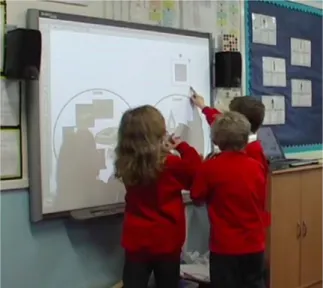
In the dialogic space of interaction at the IWB, control of the screen object was crucial to the‘positional framing’of each student
as listener or source. A screen shot (Fig. 2) illustrates that‘command’of the screen object casts a student into the role of source, open to questions from the listeners.
The example further illustrates how the technology served this process by helping to make different perspectives explicit to the group and the teacher, as the children in turn repositioned the digital objects. Indeed, it afforded a visual representation of the current state of the children’s thinking, embodying the decision making, interpretations and progress made to date, such that the teacher was immediately able to question the group about their“in-between”positioning of air.
Technologies such as a computer or IWB can additionally allow co-constructed artefacts (including annotations during a lesson on images or texts, or positioning of digital objects as above) to be saved, revisited, modified or repurposed at a later time. Thus, these artefacts render both learning histories and trajectories more visible, which can help dialogues progress over time. We have examples from other studies of where this affordance is productively exploited by a teacher−along with the visibility of the large IWB screen– to facilitate and chart the cumulative progress of whole class discussion, both within and across lessons (Hennessy, 2011). The teacher’s role in purposefully linking talk with other modalities such as visual representations on an IWB is pivotal in supporting knowledge building (Gillen et al., 2008). In one study, for instance, we observed how a teacher engaged a secondary English class in annotating, highlighting and progressively transforming a poetry text and series of related images in real time during discussion−to explore a character’s feelings, the significance of an evocative image for the poem’s persona, and the ways in which the image and poem, plus other poems they had studied, were perceived to reflect today’s society (Gillen et al., 2008).
How students are able to engage in such interaction, in semi-autonomous groups or as a whole class, while working with a digital mediating tool, is one of our central concerns. Thefirst clue is usually the task. For example, in the work on solids and liquids illustrated above, though the task was not necessarily‘problem solving’in the manner characterised in some studies of the interaction between digital technologies and dialogue (e.g.Yoon, Ho, & Hedberg, 2005), it provided scope for reasoning and argumentation (Simon, Erduran, & Osborne, 2006;Simon, Johnson, Cavell, & Parsons, 2012). A crucial factor was that the teacher had a dialogic intention for the task, meaning that rather than considering the technology only as a tool for teaching science, he also used it as a tool for mediating dialogue (Coffin, Littleton, Whitelock, & Twiner, 2010; Jewitt, Moss, & Cardini, 2007; Twiner, Coffin, Littleton, & Whitelock, 2010).
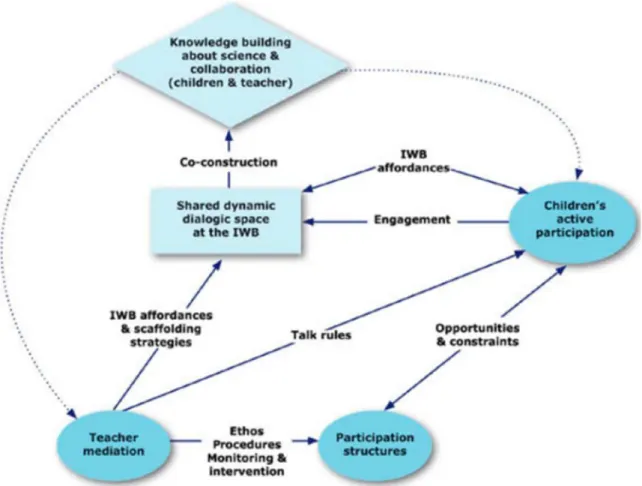
Without developing a‘dialogic classroom’, dialogic intentions for a task can fall veryflat (Barron, 2003). Our research suggested a model (Fig. 3) for productive interaction involving interactive technologies that foregrounds the teacher’s role in constructing a dialogic ethos, modelling dialogic practices and encouraging student agency.
AsMichaels and O’Connor (2012)also conclude, for this kind of activity to be productive teachers need to encourage their students to:
–share, expand upon and develop their own thinking (by giving students time to think, providing opportunities for them to say more, or encouraging them to re-phrase);
–listen carefully to the views of others (by asking other students to re-phrase or repeat the statements of others);
–deepen their own reasoning (by encouraging students to give reasons for their views, or provide a counter-example to the views of others);
–think with others (by asking whether students agree or disagree, whether they can add to what has been said, or whether they can explain what someone else has said).
These procedures, central to the implementation of a Thinking Together approach in classrooms (Dawes, 2010), help to re-frame the classroom participation structures (Hennessy, Deaney, Ruthven, & Winterbottom, 2007;Rogoff, 1995), orientating students to-wards the dialogic in their group’s work. The teacher in our example above not only generated appropriate ‘ground rules’ for discussion with his class, but also reminded them in each lesson of his expectations about how they should talk together; and he expected them to make joint assessments of how well they had collaborated.
5. Supporting teachers through targeted professional development for technology-mediated dialogue
The interactions in our examples above are not typical of group talk in schools; Exploratory Talk is a rare occurrence in classroom life, as is teaching of a very‘dialogic’kind, or the explicit teaching of talk skills. In their seminal review,Howe and Abedin (2013, p. 341)suggest that one reason why this is so is the tension a teacher may feel between allowing students’unfettered exploration of ideas and the need for them to learn the‘right answers’, and so extended group discussion is not encouraged. Another reason may be that teachers of subjects other than language and literacy do not feel that teaching talk skills is within their remit. A third may be that researchers have not been effective in convincing teachers of the value of a pedagogy which foregrounds ways of using language to construct knowledge and understanding.
The research literature reveals that targeted interventions with teachers have inconsistent outcomes; top-down programmes, that offer little practical guidance and fail to develop a clear understanding of dialogic teaching, inevitably do not shift traditional patterns of classroom interaction (e.g.Smith, Hardman, Wall, & Mroz, 2004). In our own recent study, a baseline survey indicated that only 19% of participating teachers initially demonstrated a medium or strong understanding of dialogic teaching, even though some had been involved in teacher professional development (TPD) sessions with this focus (Hennessy, Dragovic, & Warwick, 2017). (Teachers who claimed to understand the distinction between classroom talk and dialogue were asked to describe what they meant by‘ dia-logue’; classification of‘strong’ understanding required explicit statements indicating that dialogue involves building on others’ responses and exploring different perspectives or ideas rather than just‘discussion’.) It seems that new approaches to initial and in-service teacher education need to be developed if more dialogic practices are ever to become widespread. And there is a further consideration. In this technological age, the teacher’s pedagogical stance and understanding of how best to exploit the affordances of digital technologies are critical in determining productive use of these tools in teaching and learning. Yet TPD is often focused primarily on developing technology skills, and the inadequacies of this focus are now well documented (e.g.Carlson & Gadio, 2002; Hennessy & London, 2013). Consequently, interactive use of even ubiquitous technologies is uncommon; even‘dialogic’teachers may not use technology effectively to support dialogue.
Our own approach to helping teachers use digital technology to mediate dialogue is founded on the Thinking Together approach (introduced in Section3), and more recently has drawn on models of effective TPD which have been found to be effective. These encourage critical reflection, collaborative learning with peers, observation and feedback; they are based on teacher ownership and leadership; they include concrete, experiential workshop tasks and iterative classroom trialling; and they focus on immediate teaching needs and support problem solving (Cordingley, Bell, Rundell, & Evans, 2003; Dudley, 2013; Twining, Raffaghelli, Albion, & Knezek, 2013;Wells, 2007, 2014). Such models offer fertile opportunities to encourage, extend and structure professional dialogue, and to sustain TPD over time, enabling teachers to embed practice (Cordingley et al., 2003; Hennessy & London, 2013). The starting point in the process depends on the elicitation of teachers’prior knowledge and experience of dialogic approaches and interactive technology use; TPD needs to be adapted accordingly.
An important feature of our TPD programmes for technology contexts is that they draw on research-based multimedia resources we have created to stimulate discussion, reflection and inquiry. In particular, video footage of teachers using technology interactively (from our previous projects) allows viewers to experience and freely critique a wider range of practices, so that alternative peda-gogical strategies can be compared and contrasted (Sherin, 2007). Workshops then involve teachers in designing and trialling new dialogic teaching approaches that in turn become the focus of peer discussion. We believe that it is important that teachers experience a dialogic approach to their own professional learning in workshops (Hennessy et al., 2010) or through the use of support materials for school-based group study and action (Hennessy et al., 2017). As mentioned briefly above, our approach makes theory explicit to teachers and encourages them to consider its relationship to their own current practices. In some of our research, we have asked teachers to act as co-researchers with us, and to grapple with−and if necessary reformulate−the theory itself. The aim is to develop‘intermediate theory’(Hennessy, 2014): theory that bridges scholarly theory and practitioner knowledge related to a specific setting.Snow (2015, p. 461)likewise notes the virtues of studies where there is‘a commitment to the notion of two sources of knowledge (research and practice). Though the two sources might generate somewhat different types of knowledge, both types are
judged to be of equal value and importance to improving educational outcomes.’In our studies, teachers review and comment on videos of their own lessons or those of their close colleagues, and the university researchers do the same, independently selecting ‘critical episodes’and offering analytic commentary using our own professional lenses, and drawing on theory as appropriate. Ul-timately, joint reflexive critique of the literature and insights emerging from the data by each small team of 2–4‘co-researchers’ culminates in democratically negotiated, enriched understandings of concepts from sociocultural theory, framed in accessible lan-guage to render them suitable for wider use and adaptation. A number of small studies of this kind are reported byHennessy (2014). One such research study involved collaborating with three teachers (who had already adopted dialogic practices) to agree on suitable definitions of dialogue and dialogic pedagogy, and develop new practices for supporting whole class dialogue through IWB use (Hennessy, Warwick, & Mercer, 2011). This culminated in a theoretically informed, practical model which was encapsulated in a published resource for school-based TPD (Hennessy et al., 2014), co-authored by the participating teachers. The book includes their own case stories and an intermediate theory tool for teachers’use in auditing their own practices. It is accompanied by open, online multimedia resources,3including a digital resource bank of annotated screenshots, video exemplars of dialogic classroom practice and IWBflipchart templates for creating activities. The materials are designed for use across phases (primary, middle and secondary schools) and subject areas. They are grounded in the Thinking Together approach and relevant sociocultural theory, and they also illustrate some powerful ways in which teaching can exploit digital technology to serve dialogic pedagogy and improve the quality and quantity of student participation.
In our most recent study we co-developed professional development workshops with teachers, which involved video-stimulated discussions of practices, use of the above-mentioned resource book and online resource bank, and testing the adapted and newly developed IWB-based teaching materials in lessons in between the workshops. Two workshops were conducted in each offive settings, involving a total of 80 teachers from 15 schools (Hennessy et al., 2017). Our research data derived from surveys, interviews, teachers’posters created during workshops, a portfolio of dialogic classroom practices mediated by the IWB (uploaded to the project website for other practitioners to use),4and follow-up lesson observations. This workshop model, with its close connection to daily classroom practice, proved successful−within only a few weeks−in helping teachers to develop their understandings of classroom dialogue and devise new approaches for supporting it. The research additionally confirmed the potential of the IWB as a powerful multimodal tool and teachers’capability for harnessing its distinctive affordances to create dialogic spaces. Teachers devised IWB-supported activities that built in opportunities for exploring and building on others’ideas, using the technology−and open-ended questioning−to develop new opportunities for individual and collective reasoning (Hennessy, 2011).
Teachers were keen to continue developing their practice in new directions after the research project had ended, including wider school development activities. The scope of the impact project was curtailed by limited funding, however, and actual sustainability over the long term is unknown. This is likewise the case with many other dialogic teaching TPD interventions; changes in practice are often observed, but whether these become embedded over the longer term is rarely investigated. Deep changes to practice are a long-term goal and often seem to require many hours/days of TPD (Osborne, 2015), even with teacher researchers engaged in a project. This brings us to a key question regarding the translation of research into practice. Even if targeted interventions are found to be successful in improving educational practice, how can they be rolled out across a larger population of schools in a context of limited funding and consequent lack of sustained involvement from the initiators? Whilst noting that‘it is not just in relation to dialogic pedagogies that scalability issues are massive obstacles to the widespread implementation of good ideas’,Howe & Mercer (2017: 90) point to a clear‘tension between promise and challenge’(Howe and Mercer, 2017: 83) that characterises a‘widening impact di-lemma’facing many research-based initiatives on dialogic teaching and learning in schools. Whilst teachers are a profession open to change and innovation, both large- and small-scale contexts set a tone that determines their focus. Thus, in the UK, the downgrading of the importance of spoken language in a revision of subject requirements across the National Curriculum (DfE, 2013) was a clear indicator to school managements of where to, and where not to, focus their efforts in school development. Luckily, many individual school, school cluster and district managements are not led simply by prevailing (and transient) policy; and from our own work on the dialogic use of IWBs it seems clear that management support is crucial for sustaining innovation (Flitton & Warwick, 2012);Warwick, Hennessy, & Mercer, 2011). Such support includes buy-in from the school leadership team, especially the principal/head teacher; but it also means that dedicated time is found for pedagogy-focussed teacher meetings to take place. In one study we were able to investigate sustainability of an extensive multimedia TPD programme we developed (‘OER4Schools’)5to foster interactive teaching (including whole class and group dialogue), in primary schools in Zambia. Following the success of a peer-facilitated weekly workshop programme with 12 teachers in three grades over one school year, the management decided to roll out the programme to the whole school (35 teachers) as they hoped it would raise attainment levels. We revisited the school 18 months later, after the programme had been running independently of any input from the research team. Despite the many, complex challenges of this very low-resourced context, over half of the earlier participants were found to have maintained and developed their interactive teaching strategies and focus on pupil learning progress; recent joiners developed similarly. New peer facilitators had come on board. Tra-ditional roles of teachers and pupils were shifting and a new classroom culture was emerging. One of the key facilitating factors identified was the national programme for statutory teacher group meetings scheduled outside lesson time, but within the working day (Haßler, Hennessy, Hofmann, with Makonga, forthcoming).
In thinking beyond the school setting, Snow (2015, p. 463)observes that‘time and effort need to be invested in nurturing
3http//tinyurl/OUPIWB.
4http://dialogueiwb.educ.cam.ac.uk/evaluate/. 5www.oer4schools.org.
relationships with districts and schools that are being buffeted by numerous demands and an accumulation of initiatives.’Support from school cluster, regional or district groups might be garnered through allying a focus on dialogue with systematic approaches to TPD. For example, recent work by Dudley and others (Dudley, 2013) has demonstrated how Lesson Study may provide a vehicle for teacher consideration of pedagogical change linked to pupil outcomes, and where this is embraced across schools it may be a powerful mechanism for change (Warwick, Vrikki, Vermunt, & Mercer, 2016). Again,Snow (2015, p. 463)refers to a colleague’s powerful analogy in writing of‘the need to design not just the working end of the tool (the head of the hammer or clamp on the spanner) but also the handle—the end the user has to grasp in order to make use of the tool.’If the‘working end’is a dialogic classroom pedagogy, then the handle in this case is the range of enabling mechanisms; crucial to these are sustainable TPD structures and school management support. And we would further argue that linking digital technologies, as mediating tools, to a dialogic pedagogy strengthens the claims for contemporary relevance for dialogue research linked to TPD. The growing interest inter-nationally in the development of‘21st century skills’6in collaboration, communication and critical thinking provides a contemporary imperative to the work of researchers in dialogue.
6. Current research and future directions
A recent collaboration with our Mexican colleagues7produced the Cam-UNAM Scheme for Educational Dialogue Analysis (SEDA), and a specialised sub-scheme for teachers has since been developed by Hennessy and colleagues: Teacher-SEDA (T-SEDA). This tool supports teachers’systematic inquiry into dialogic practice in their own (or peers’) classrooms; a resource pack contains tools and templates for observation and manageable coding of classroom interaction, a set of reliable dialogue categories with illustrative examples; guidelines for teachers to conduct cycles of reflective inquiry, and worked examples. It is currently being piloted by practitioners in several countries and we welcome the involvement of others.
There is growing evidence that dialogic teaching approaches can foster development of substantive curriculum knowledge; we note that a special issue of the journal Language and Education (2017) focuses on precisely this relationship. However, the evidence remains patchy and mainly small-scale, and such evidence is increasingly important to schools weighed down by accountability measures. Hence we are currently conducting an ESRC-funded study that explores the natural variation between primary school teachers in terms of how they and their students use spoken language (led by Christine Howe).8We are investigating whether teaching which is more‘dialogic’(determined through systematically coding lesson video recordings using an adapted version of SEDA) is related to children’s learning gains on standardised tests in mathematics and English literacy, and also to scientific reasoning and general reasoning. The sample comprises 75 teachers, which allows us to conduct regression-style analyses to answer the question of whether classroom dialogue does in fact make a difference for subject learning. Many of the lessons employed technology, of course, so we will be able to explore its role in mediating dialogue using this wider dataset. If a relationship does emerge, our subsequent analyses of which dialogic moves are correlated with higher attainment should be of practical educational value.
The uses of digital technology that support a dialogic pedagogy need more exploration; research in this area is in its infancy, despite some encouraging results (e.g.Kerawalla, Petrou, & Scanlon, 2013). Many schools are now introducing tablets and other similar mobile devices to support teaching and learning; in our recent study participating schools which had invested in these devices were encouraged to apply new dialogic approaches to their use, and did so with considerable success. In the DiDiAC project,9led by one of the current authors (Warwick) in cooperation with Rasmussen and colleagues at the University of Oslo, the interactional relationship between spoken dialogue and a micro-blogging tool10is being investigated. This builds upon previous research on the editable, manipulable, provisional and temporal nature of screen objects−in this case texts−and the potentially transformative impact that their use may have on classroom dialogue and learning (Rasmussen & Hagen, 2015). The use of the micro-blogging tool is supported by web-based materials that link its use to classroom dialogue.
Overall, then, our research and that of others leads us to the following conclusions. It is clear that teachers can enable their students to develop their use of language as a cultural and psychological tool for reasoning and learning, though this rarely happens in schools today, in any country. While evidence from large-scale empirical projects is not yet available, the research evidence that does exist supports the view that this only promotes the development of valuable communication skills, but also improves educa-tional attainment in curriculum subjects. That evidence also encourages the view that this is best achieved through the use of a ‘dialogic’pedagogy, which requires an awareness by both teachers and students of how language can best be used to enable collective thinking, learning and problem solving. Research indicates that digital technology can provide valuable support for the im-plementation of such a dialogic pedagogy; but the technology must be used with a dialogic intention, in the context of activities which are well designed to promote collective thinking. It is the pedagogy that is paramount, not the technology. Experience from interventional, school-based studies should also encourage researchers to maintain a realistic perspective regards the translation of research findings into changes in classroom practice. For any new procedures or practices regarding classroom talk or digital technology to be welcomed and adopted by teachers, evidence for the value of any innovations in helping teachers achieve their professional goals, and addressing problems they perceive as important, must be made clear−as must practical procedures for
6See for examplehttps://k12.thoughtfullearning.com/FAQ/what-are-21st-century-skills.
7The 3-year British Academy funded project (2013–2015)“A tool for analysing dialogic interactions in classrooms”(http://tinyurl.com/BAdialogue) was conducted in partnership with National Autonomous University of Mexico.
8http://www.educ.cam.ac.uk/research/projects/classroomdialogue/. 9http://www.educ.cam.ac.uk/research/projects/didiac/.
achieving a more interactive, dialogic climate in the classroom. Acknowledgements
We are most grateful to the teachers and the schools who participated in our studies over the years. The work was supported by the UK Economic and Social Research Council (ESRC) through a series of projects, including Interactive Whiteboards and Classroom Pedagogy (Mercer et al., 2004–2005, ref. RES-000-22-1269) Interactive Whiteboards and Collaborative Pupil Learning in Primary Science (Mercer, Warwick, & Kershner: 2007-09, ref. RES-000-22-2556); IWBs and Dialogic Teaching, part of a Research Fellowship programme by Hennessy (2007–2010, ref. RES-063-27-0081) in conjunction with Mercer and Warwick; and a related ESRC Impact Acceleration Pilot Programme grant for the TPD impact study (Hennessy & Warwick, 2014:http://dialogueiwb.educ.cam.ac.uk/ evaluate/).
References
Alexander, R. (2008). Culture, dialogue and learning: Notes on an emerging pedagogy. In N. Mercer, & S. Hodgkinson (Eds.).Exploring talk in schools(pp. 91–114). London: Sage.
Arvaja, M., Häkkinen, P., & Kankaanranta, M. (2008). Collaborative learning and computer-supported collaborative learning environments. In J. Voogt, & G. Knezek (Eds.).International handbook of information technology in primary and secondary education(pp. 267–279). Boston, MA: Springer.
Barnes, D. (1976).From communication to curriculum.Harmondsworth: Penguin Books.
Barnes, D. (2008). Exploratory talk for learning. In N. Mercer, & S. Hodgkinson (Eds.).Exploring talk in school(pp. 1–15). London: Sage. Barron, B. (2003). When smart groups fail.Journal of the Learning Sciences, 12(3), 307–359.
Brown, A. L., & Palincsar, A. S. (1989). Guided, co-operative learning and individual knowledge acquisition. In L. B. Resnick (Ed.).Knowing, learning and instruction(pp. 393–453). Hillsdale, NJ: Lawrence Erlbaum.
Carlson, S., & Gadio, C. T. (2002). Teacher professional development in the use of educational technology. In W. D. Haddad, & A. Draxler (Eds.).Technologies for education(pp. 118–133). Paris/Washington: UNESCO/AED.
Coffin, C., Littleton, K., Whitelock, D., & Twiner, A. (2010). Multimodality, orchestration and participation in the context of classroom use of the interactive whiteboard: A discussion.Technology Pedagogy and Education, 19(2), 211–223.
Cordingley, P., Bell, M., Rundell, B., & Evans, D. (2003).The impact of collaborative CPD on classroom teaching and learning research evidence in education library. Evidence for policy and practice information and co-ordinating centre (EPPI -centre): Social science research unit, institute of education. London: University of London. Dawes, L. (2008).The essential speaking and listening: Talk for learning at KS2.London: Routledge.
Dawes, L. (2010).Creating a speaking and listening classroom: Integrating talk for learning at key stage 2.London: Routledge.
Dawes, L., Mercer, N., & Wegerif, R. (2000).Thinking together: Activities for teachers and children at key stage 2.Birmingham: Questions Publishing Co. Department for Education (2013).English programmes of study: Key stage 1 and 2: National curriculum in England.London: HMSO.
Dudley, P. (2013). Teacher learning in Lesson Study: What interaction-level discourse analysis revealed about how teachers utilised imagination, tacit knowledge of teaching and fresh evidence of pupils learning, to develop practice knowledge and so enhance their pupils’learning.Teaching and Teacher Education, 34(1), 107–121.
Edwards, D., & Mercer, N. (1987).Common knowledge: The development of understanding in the classroom.London: Routledge. Edwards, D., & Mercer, N. (2013).Common knowledge: The development of understanding in the classroom.London: Routledge 1987.
Flitton, L., & Warwick, P. (2012). From classroom analysis to whole-school professional development: Promoting talk as a tool for learning across school departments.
Professional Development in Education, 39(1), 1–23.
Futuresource Consulting (2015).Interactive displays quarterly insight: State of the market report, quarter 1Dunstable Bedfordshire: Futuresource. Galton, M., & Williamson, J. (1992).Group work in the primary classroom.London: Routledge.
Gibson, J. J. (1979).The ecological approach to visual perception.Boston, MA: Houghton Mifflin.
Gillen, J., Littleton, K., Twiner, A., Staarman, J. K., & Mercer, N. (2008). Using the interactive whiteboard to resource continuity and support multimodal teaching in a primary science classroom.Journal of Computer Assisted Learning, 24(4), 348–358.
Haßler, B., Hennessy, S., & Hofmann, R., with Makonga, A. (forthcoming). OER4Schools: Outcomes of a sustained professional development intervention in sub-Saharan Africa.
Hennessy, S. (2011). The role of digital artefacts on the interactive whiteboard in supporting classroom dialogue.Journal of Computer Assisted Learning, 27(6), 463–489. Hennessy, S. (2014).Bridging between research and practice: Supporting professional development through collaborative studies of classroom teaching with interactive
whiteboard technology.Rotterdam Sense Publishers.
Hennessy, S., Deaney, R., Ruthven, K., & Winterbottom, M. (2007). Pedagogical strategies for using the interactive whiteboard to foster learner participation in school science. Learning, Media and Technology.Special Issue on Interactive Whiteboards, 32(3), 283–301 [Special issue].
Hennessy, S., Dragovic, T., & Warwick, P. (2017).A research-informed, school-based professional development workshop programme to promote dialogic teaching with interactive technologies. Professional Development in Education. Advance Online Publicationhttp://dx.doi.org/10.1080/19415257.2016.1258653.
Hennessy, S., & London, L. (2013).Learning from international experiences with interactive whiteboards: The role of professional development in integrating the technology. OECD Education Working Papers No. 89.Paris: OECD Publishing. Retrieved fromhttp://tinyurl. com/ Oecdiwbs.
Hennessy, S., Warwick, P., Brown, L., Rawlins, D., & Neale, C. (Eds.). (2014).Developing interactive teaching and learning using the interactive whiteboard: A resource for teachers. Maidenhead. Open University Press.
Hennessy, S., Warwick, P., & Mercer, N. (2011). A dialogic inquiry approach to working with teachers in developing classroom dialogue.Teachers College Record, 113(9), 1906–1959.
Howe, C., & Abedin, M. (2013). Classroom dialogue: A systematic review across four decades of research.Cambridge Journal of Education, 43(3), 325–356. Howe, C., & Mercer, N. (2017). Commentary on the papers.Language and Education, 31(1), 83–92.
Jewitt, C., Moss, G., & Cardini, A. (2007). Pace, interactivity and multimodality in teacher design of texts for interactive whiteboards in the secondary school classroom.Learning Media and Technology, 32(3), 303–317.
Kerawalla, L., Petrou, M., & Scanlon, E. (2013). Talk factory: Supporting‘exploratory talk’around an interactive whiteboard in primary school science plenaries. Technology.Pedagogy and Education, 22(1), 89–102.
Kershner, R., Mercer, N., Warwick, P., & Kleine Staarman, J. (2010). Can the interactive whiteboard support young children’s collaborative communication and thinking in classroom science activities?Computer-Supported Collaborative Learning, 5(4), 359–383.
Lambirth, A. (2006). Challenging the laws of talk; ground rules, social reproduction and the curriculum.The Curriculum Journal, 17(1), 59–71. Lave, J., & Wenger, E. (1991).Situated learning: Legitimate peripheral participation.Cambridge: Cambridge University Press.
Littleton, K., & Howe, C. (Eds.). (2010).Educational dialogues: Understanding and promoting productive interaction. London: Routledge. Littleton, K., & Mercer, N. (2013).Interthinking: Putting talk to work.Abingdon Routledge.
Mercer, N. (2000).Words and minds: How we use language to think together.London: Routledge.
Mercer, N. (2008). Talk and the development of reasoning and understanding.Human Development, 51(1), 90–100.
Mercer, N., & Hodgkinson, S. (Eds.). (2008).Exploring talk in school. London: Sage.
Mercer, N., & Howe, C. (2012). Explaining the dialogic processes of teaching and learning: The value of sociocultural theory. Learning.Culture and Social Interaction, 1(1), 12–21.
Mercer, N., & Littleton, K. (2007).Dialogue and the development of children’s thinking.London: Routledges1.
Mercer, N. (1995).The guided construction of knowledge: Talk amongst teachers and learners.Clevedon: Multilingual Matters.
Mercer, N. (2013). The social brain, language, and goal-directed collective thinking: A social conception of cognition and its implications for understanding how we think, teach, and learn.Educational Psychologist, 48(3), 148–168.
Mercer, N., & Sams, C. (2006). Teaching children how to use language to solve maths problems.Language and Education, 20(6), 507–527.
Mercer, N., Dawes, L., Wegerif, R., & Sams, C. (2004). Reasoning as a scientist: Ways of helping children to use language to learn science.British Educational Research Journal, 30(3), 367–385.
Mercer, N., Hennessy, S., & Warwick, P. (2010). Using interactive whiteboards to orchestrate classroom dialogue. Technology.Pedagogy and Education, 19(2), 195–209. Mercer, N., Warwick, P., Kershner, R., & Kleine Staarman, J. (2010). Can the interactive whiteboard help to provide‘dialogic space’for children’s collaborative
activity?Language and Education, 24(5), 367–384.
Michaels, S., & O’Connor, C. (2012).Talk science primer.Boston, MA: TERC.
Mortimer, E. F., & Scott, P. H. (2003).Meaning making in science classrooms.Milton Keynes: Open University Press.
Nystrand, M., Gamoran, A., Kachur, R., & Prendergast, C. (1997).Opening dialogue: Understanding the dynamics of language and learning in the English classroom.New York, London: Teachers' College Press.
Osborne, J. (2015). The challenges of scale. In L. Resnick, C. S. C. Asterhan, & S. N. Clarke (Eds.).Socializing intelligence through academic talk and dialogue(pp. 403– 414). Washington, DC: American Educational Research Association.
Phillipson, N., & Wegerif, R. (2016).Dialogic education: Mastering core concepts through thinking together.Abingdon: Routledge.
Rasmussen, I., & Hagen, Å. (2015). Facilitating students’individual and collective knowledge construction through microblogs.International Journal of Educational Research, 72(1), 149–161.
Resnick, L. B. (1999). Making america smarter.Education Week Century Series, 18(40), 38–40.
Rogoff, B. (1995). Observing sociocultural activity on three planes: Participatory appropriation, guided participation, and apprenticeship. In J. V. Wertsch, P. Del Rio, & A. Alvarez (Eds.).Sociocultural studies of mind(pp. 139–164). New York: Cambridge University Press.
Rojas-Drummond, S., & Alatorre, J. (2004). The development of independent problem solving in pre-school children. In N. Mercer, & C. Coll (Vol. Eds.),Explorations in socio-cultural studies: Teaching, learning and Interaction: Vol. 3, (pp. 161–175). Madrid: Infancia Y Aprendizaje.
Rojas-Drummond, S., & Mercer, N. (2004). Scaffolding the development of effective collaboration and learning.International Journal of Educational Research, 39(1–2), 99–111.
Rojas-Drummond, S., Littleton, K., Hernandez, F., & Zuniga, M. (2010). Dialogical interactions amongst peers in collaborative writing contexts. In K. Littleton, & C. Howe (Eds.).Educational dialogues: Understanding and promoting productive interaction(pp. 128–148). London: Routledge.
Säljö, R. (1995). Mental and physical artifacts in cognitive practices. In P. Reimann, & H. Spada (Eds.).Learning in humans and machines: Towards an interdisciplinary learning science(pp. 83–96). Oxford: Pergamon.
Schwarz, B., & Baker, M. (2016).Dialogue, argumentation and education: History, theory and practice.New York: Cambridge University Press.
Sherin, M. (2007). New perspectives on the role of video in teacher education. In J. Brophy (Vol. Ed.),Advances in research on teaching: Vol. 10, (pp. 1–27). Bingley, UK: Emerald.
Simon, S., Erduran, S., & Osborne, J. (2006). Learning to teach argumentation: Research and development in the science classroom.International Journal of Science Education, 28(2–3), 235–260.
Simon, S., Johnson, S., Cavell, S., & Parsons, T. (2012). Promoting argumentation in primary science contexts: An analysis of students’interactions in formal and informal learning environments.Journal of Computer Assisted Learning, 28(5), 440–453.
Smith, F., Hardman, F., Wall, K., & Mroz, M. (2004). Interactive whole class teaching in the National Literacy and Numeracy Strategies.British Educational Research Journal, 30(3), 395–411.
Snow, C. E. (2015). Rigor and realism: Doing educational science in the real world.Educational Researcher, 44(9), 460–466.
Twiner, A., Coffin, C., Littleton, K., & Whitelock, D. (2010). Multimodality, orchestration and participation in the context of classroom use of the interactive whiteboard: A discussion. Technology.Pedagogy and Education, 19(2), 211–223.
Twining, P., Raffaghelli, J., Albion, P., & Knezek, D. (2013). Moving education into the digital age: The contribution of teachers’professional development.Journal of Computer Assisted Learning, 29(5), 426–437.
van de Sande, C. C., & Greeno, J. G. (2012). Achieving alignment of perspectival framings in problem-Solving discourse.Journal of the Learning Sciences, 21(1), 1–44. Vygotsky, L. S. (1962).Thought and language.Cambridge, MA: MIT Press.
Vygotsky, L. S. (1978).Mind in society.Cambridge: Harvard University Press.
Warwick, P., Hennessy, S., & Mercer, N. (2011). Promoting teacher and school development through co-enquiry: Developing interactive whiteboard use in a‘dialogic classroom’.Teachers and Teaching: Theory and Practice, 17(3), 303–324.
Warwick, P., Mercer, N., Kershner, R., & Staarman, J. K. (2010). In the mind and in the technology: The vicarious presence of the teacher in pupil’s learning of science in collaborative group activity at the interactive whiteboard.Computers & Education, 55(1), 350–362.
Warwick, P., Vrikki, M., Vermunt, J. D., Mercer, N., & Halem, N. van. (2016). Connecting observations of student and teacher learning: An examination of dialogic processes in Lesson Study discussions in mathematics.Zdm, 48(4), 555–569.
Wegerif, R. (2010).Mind expanding: Teaching for thinking and creativity in primary education.Buckingham: Open University Press/ McGraw Hill.
Wegerif, R., Littleton, K., & Jones, A. (2003). Stand-alone computers supporting learning dialogues in primary classrooms.International Journal of Educational Research, 39(8), 851–860.
Wegerif, R., Mercer, N., & Dawes, L. (1998). Software design to support discussion in the primary classroom.Journal of Computer Assisted Learning, 14(2), 199–211. Wegerif, R., Mercer, N., & Dawes, L. (1999). From social interaction to individual reasoning: An empirical investigation of a possible socio-cultural model of cognitive
development.Learning and Instruction, 9(5), 493–516.
Wells, G. (1999).Dialogic Inquiry: Towards a Sociocultural Practice and Theory of Education.Cambridge & New York: Cambridge University Press.
Wells, J. G. (2007). Key design factors in durable instructional technology professional development.Journal of Technology and Teacher Education, 15(1), 101–118. Wells, M. (2014). Elements of effective and sustainable professional learning.Professional Development in Education, 40(3), 488–504.
Wertsch, J. (1998). Mediated action. In W. Bechtel, & G. Graham (Eds.).A companion to cognitive science(pp. 518–525). Oxford: Blackwell.
Wolf, M., Crosson, A., & Resnick, L. (2006).Accountable talk in reading comprehension instruction (CSE technical report 670)Los Angeles, CA: Center for the Study of Evaluation, National Center for Research on Evaluation Standards and Student Testing.
Yoon, F., Ho, J., & Hedberg, J. (2005). Teacher understandings of technology affordances and their impact on the design of engaging learning experiences.Educational Media International, 42(4), 297–316.