I
ARABIC GOAL-ORIENTED CONVERSATIONAL AGENTS
USING SEMANTIC SIMILARITY TECHNIQUES
ZAID IZZADIN MOHAMMED NOORI
A thesis submitted in partial fulfilment of the requirements
of the Manchester Metropolitan University for the degree of
Doctor of Philosophy
April 2015
Supervisors
II
Declaration
I declare that no portion of the work referred to in this thesis has been previously submitted for a degree or qualification at any other university or other institute of learning
III
Dedication
To my beloved parents who raised me on Hard work and devotion
IV
V
Acknowledgement
I would like to express my sincere gratitude to my supervisors Dr Keeley Crockett and Dr Zuhair Bandar for their continuous support, true guidance, patience and encouragement during my study.
Besides, I would like to thank Dr Jim O’Shea for his help and support during my research.
Special thanks also to my mother, brothers and family for their continuous help, patience and support during my studies, and also to Mr Mohammed Wed who helped me with his skills in web programming.
Finally, my thanks to my colleagues at the Iraqi Consulate in Manchester who helped in testing and evaluating the programmes, and also my colleagues at the Ministry of Foreign Affairs in Iraq for their help and support.
VI
Abstract
Conversational agents (CAs) are computer programs used to interact with humans in conversation. Goal-Oriented Conversational agents (GO-CAs) are programs that interact with humans to serve a specific domain of interest; its’ importance has increased recently and covered fields of technology, sciences and marketing. There are several types of CAs used in the industry, some of them are simple with limited usage, others are sophisticated. Generally, most CAs were to serve the English language speakers, a few were built for the Arabic language, this is due to the complexity of the Arabic language, lack of researchers in both linguistic and computing. This thesis covered two types of GO-CAs. The first is the traditional pattern matching goal oriented CA (PMGO-CA), and the other is the semantic goal oriented CA (SGO-CA).
Pattern matching conversational agents (PMGO-CA) techniques are widely used in industry due to their flexibility and high performance. However, they are labour intensive, difficult to maintain or update, and need continuous housekeeping to manage users’ utterances (especially when instructions or knowledge changes). In addition to that they lack for any machine intelligence.
Semantic conversational agents (SGO-CA) techniques utilises humanly constructed knowledge bases such as WordNet to measure word and sentence similarity. Such measurement witnessed many researches for the English language, and very little for the Arabic language.
In this thesis, the researcher developed a novelty of a new methodology for the Arabic conversational agents (using both Pattern Matching and Semantic CAs), starting from scripting, knowledge engineering, architecture, implementation and evaluation. New tools to measure the word and sentence similarity were also constructed. To test performance of those CAs, a domain representing the Iraqi passport services was built. Both CAs were evaluated and tested by domain experts using special evaluation metrics. The evaluation showed very promising results, and the viability of the system for real life.
VII
List of publications
The following paper has reported some of work related to this thesis:
Noori, Z., Bandar, Z. , and Crockett, K., 2014. Arabic Goal-oriented Conversational Agent, Based on Pattern Matching and Knowledge Trees. Proceedings of the World Congress on Engineering 2014 Vol I, ISBN: 978-988-19252-7-5, ISSN: 2078-0958 (Print); ISSN: 2078-0966 (Online) 2014.
VIII
List of abbreviations
AI Artificial intelligence
AIML Artificial Intelligence Markup Language
ALICE The Artificial Linguistic Internet Computer Entity
API Application Programming Interface
ASU Applied Science University
AWN Arabic WordNet
AWSD Arabic Word Sense Disambiguation
AWSS Arabic Word Semantic Similarity
BNF Backus–Naur Form
CA Conversation Agent
DARPA Defence Advanced Research Projects Agency
DF Difference between sentences
ECA Embodied Conversational Agents
FAQs Frequently Asked Questions
FW Function Words
GO-CA Goal-Oriented Conversational Agent
GPS Ground positioning System
HR Human Rating
IEEE Institute of Electrical and Electronics Engineers
IPS Iraqi Passport Services
IR Information Retrieval
KE Knowledge Engineering
KIF Knowledge Interchange Format
KMP Knuth–Morris–Pratt string searching algorithm
LAW List of Arabic Words
LCA Linguistic Conversational Agents
LCS Lowest Common Subsumer
MIT Massachusetts Institution of Technology
MMU Manchester Metropolitan University
NLP Natural Language Processing
PM Pattern Matching
PMGO-CA
Pattern Matching Goal-Oriented Conversational Agent.
SCA Semantic Conversational Agent
SCAF Semantic Conversational Agents Framework
SDS Spoken Dialogue System
SGO-CA Semantic Goal-Oriented Conversational Agent
SM Semantic Matrix
SQL Structured Query Language
STASIS Sentence Similarity Based on Semantic Nets and Corpus Statistics
SUMO Suggested Upper Merged Ontology
SUO-KIF Suggested Upper Merged Ontology Knowledge Interchange Format
SV Similarity Vector
TDS Text-based Dialogue Systems
IX
List of abbreviations
WSD Word Sense Disambiguation
WST Word Similarity Threshold
X
Table of Contents
Chapter 1 Introduction ... 1
1.1. Research Aims and Objectives: ... 2
1.2. Research Contributions ... 2
1.3. Background ... 3
1.4. Thesis Outline ... 4
Chapter 2 Conversational Agents ... 8
2.1. Introduction ... 8
2.2. Natural Language Processing ... 12
2.3. Types of Conversational Agents ... 15
2.3.1. Embodied Conversational Agents ... 16
2.3.2. Linguistic Conversational Agents ... 18
2.4. Approaches to Developing Linguistic Conversational Agents ... 19
2.4.1. Pattern Matching ... 19
2.4.2. Sentence Semantic Similarity ... 24
2.5. Arabic Conversational Agents ... 25
2.5.1. Arabic Dialects ... 26
2.5.2. Arabic Morphology... 27
2.5.3. Language Ambiguity ... 28
2.5.4. Non Arabic Words Used in Arabic Dialect ... 29
2.5.5. Arabic Grammar ... 29
2.6. Evaluation of Conversational Agents: ... 30
2.7. Knowledge Organisation in Goal-Oriented Conversational Agents ... 34
XI
2.7.2. Knowledge Base ... 36
2.7.3. Inference engine ... 39
2.7.4. Interfaces to Expert Systems ... 40
2.7.5. Problems Associated With Knowledge Engineering ... 41
2.8. Summary ... 42
Chapter 3 Sentence Similarity Measurement ... 43
3.1. Introduction ... 43
3.2. Challenges of Sentence Semantic Similarity for the Arabic language ... 45
3.2.1. Technical challenges ... 46
3.2.2. Linguistic Challenges ... 46
3.2.3. Challenges Associated with Sentence Similarity Measurement ... 46
3.3. WordNet ... 48
3.3.1. Semantic Relations ... 49
3.3.2. Part of Speech ... 50
3.3.3. Database Structure ... 52
3.3.4. Morphological Analysis ... 52
3.3.5. Suggested Upper Merged Ontology (SUMO) ... 55
3.3.6. AWN browser ... 58
3.3.7. Problems and Challenges Associated with Arabic WordNet ... 59
3.4. Word Semantic Similarity ... 60
3.4.1. Challenges Associated with Word Similarity Measurements ... 66
3.4.2. Evaluation of word similarity measures ... 67
3.5. Sentence Semantic Similarity ... 70
3.5.1. Sentence Similarity Based on Semantic Nets and Corpus Statistics (STASIS)... 71
XII
3.6. Evaluation of Semantic Sentence similarity ... 73
3.7. Summary ... 74
Chapter 4 Arabic Conversational Agents: Architecture and Scripting Language ... 76
4.1. Introduction ... 76
4.1.1. The Methodology for Developing New Arabic Goal-Oriented Conversational Agent (PMGO-CA): ... 78
4.2. Knowledge Engineering of the Domain ... 79
4.2.1. Iraqi Passport Domain and Knowledge Sources ... 80
4.2.2 . Knowledge Transformation ... 82
4.2.3. Creation of Knowledge Trees ... 84
4.2.4. Mapping Conversations to Goals ... 85
4.3. The Proposed Architecture of PMGO-CA ... 85
4.3.1. Arabic Pattern Matching Scripting Language ... 87
4.3.2. Pattern Matching Engine ... 98
4.3.3. Tree Engine... 102
4.3.3.2. Context Switching ... 106
4.3.4. Short-Term Memory (Cache) ... 114
4.3.5. Long-Term Memory ... 117
4.3.6. Conversation Manager ... 125
4.4. Contributions of PMGO-CA ... 130
4.5. Summary ... 131
Chapter 5 PMGO-CA Evaluation ... 132
5.1. Introduction ... 132
5.2. Evaluation Methodology ... 133
5.2.1. Subjective Evaluation ... 138
XIII
5.3. Evaluation Results and Discussion ... 143
5.4. Conversation Samples ... 147
5.5. Problems Associated with Pattern Matching ... 149
5.6. Summary ... 151
Chapter 6 Semantic Goal-Oriented Conversational Agent (SGO-CA) ... 153
6.1. Introduction ... 153
6.2. SGO-CA Overview ... 155
6.2.1. Semantic Similarity Engine ... 156
6.2.2. Information Sources ... 156
6.3. Methodology for the Application of Semantic Similarity within SGO-CA . 161 6.3.1. Word Similarity ... 162
6.3.2. Sentence Similarity ... 165
6.3.3. Sentence Difference Calculation ... 174
6.3.4. Function Words ... 177
6.3.5. Dialogue Act Classification ... 180
6.3.6. Semantic Matching ... 181
6.4. Modification to Scripting Language ... 181
6.4.1. Conflict Resolution Strategy ... 183
6.4.2. Software Tools Used to Construct SGO-CA ... 184
6.5. Implementation of SGO-CA in the Iraqi Passport Domain ... 192
6.6. Summary ... 193
Chapter 7 Experiments and Evaluation of SGO-CA ... 195
7.1. Introduction ... 195
7.2. Experimental Methodology ... 196
7.2.1. Experiment (1): Investigation of Word Similarity Measures ... 201
XIV
7.2.3. Experiment (3) Incorporating the New Word Similarity Measure in
Sentence Similarity Calculation ... 204
7.2.4. Experiment (4) Selection of Word Similarity Threshold (WST) ... 204
7.2.5. Experiment (5): Using Function Words in Similarity Measurement ... 205
7.2.6. Experiment (6): Including Sentence Difference in Similarity Measurement ... 206
7.2.7. Experiments Conclusion and Discussion: ... 207
7.3. Evaluation of SGO-CA ... 210
7.3.1. Evaluating Results and Discussion ... 211
7.3.2. Scripts Comparison ... 214
7.3.3. Semantic CAs vs. Pattern Matching CAs ... 217
7.4. Summary ... 218
Chapter 8 Conclusions and Further Work ... 220
8.1 Research Contributions ... 222
8.1.1 Knowledge Trees ... 222
8.1.2 Evaluation Methodology for Conversational Agents ... 222
8.1.3 Construction of Arabic Semantic CA ... 222
8.1.4 Long-term Memory Management in CA ... 223
8.1.5 Utilising SUMO Mapping with Arabic WordNet... 223
8.1.6 New Measure for Word Semantic Similarity ... 223
8.1.7 Including Sentence Difference in Sentence Similarity Measurement224 8.1.8 Conversational Agent Development Tools ... 224
8.1.9 Adaptability ... 224
8.2 Research Questions ... 225
8.3 Future Work ... 226
XV
APPENDICES ... 245 Appendix 1: ARABIC GOAL-ORIENTED CONVERSATIONAL AGENT BASED ON PATTERN MATCHING ANDKNOWLEDGE TREES ….………..…. 247 Appendix2:KNOWLEDGEENGINEERING..,……….. 256 Appendix 3:EVALUATION QUESTIONNAIRE ………..……….. 269 Appendix 4:STATISTICAL ANALYSIS OF USER QUESTIONNAIRE USING WILCOXON RANKED TEST ……….………..274 Appendix 5: LIST OF ARABIC FUNCTION WORDS ……….………288 Appendix 6: SIMILARITY MEASURES CALCULATION SAMPLE……….292 Appendix 7: EXPERIMENTS RESULTS ON SEMANTIC SIMILARITY MEASURES .……..297
XVI
List of figures
Figure 2-1 Turing Test ... 8
Figure 2-2 ECA's structure (Morency, et al., 2005) ... 16
Figure 2-3 A sample of AIML script ... 21
Figure 2-4 sample of InfoChat scripts (Sammut, 2001) ... 23
Figure 2-5 Semantic network (Shapiro, 1978) ... 37
Figure 2-6 decision trees (Poole, et al., 2010) ... 38
Figure 2-7 snapshot of knowledge tree (Crockett, et al., 2009) ... 39
Figure 3-1 the Suggested Upper Merged Ontology (Pease, 2011) ... 56
Figure 3-2 AWN browser ... 59
Figure 3-3 A portion of Arabic WordNet (Almarsoomi, et al., 2013) ... 65
Figure 4-1 GO-CA phases of development ... 79
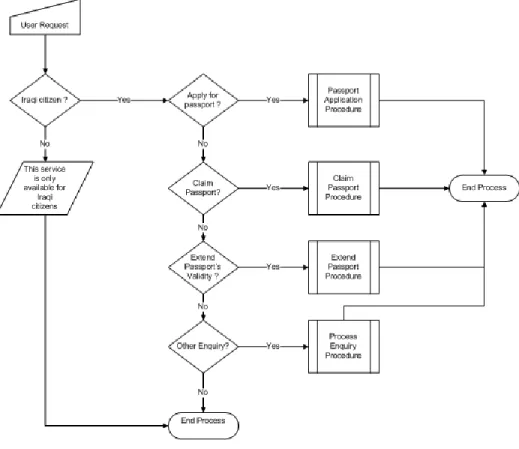
Figure 4-2 A sample of process chart of IPS domain with 4 sub-processes ... 82
Figure 4-3 Sample flow chart for new passport procedure ... 83
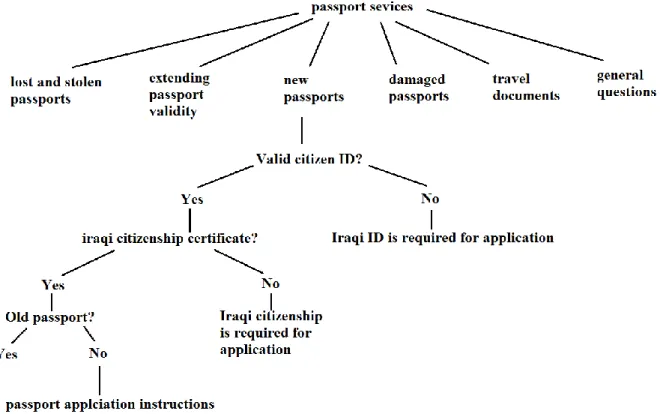
Figure 4-4 a portion of the knowledge tree produced during the KE process ... 84
Figure 4-5 PMGO-CA high level architecture ... 86
Figure 4-6 IPS knowledge tree (Arabic) ... 88
Figure 4-7 IPS knowledge tree (translated to English) ... 88
Figure 4-8 Tree Script Editor ... 89
Figure 4-9 types of tree nodes ... 90
Figure 4-10 attributes of question nodes ... 92
Figure 4-11 adding question nodes... 92
Figure 4-12attributes of value nodes ... 93
Figure 4-13Adding Value Nodes ... 94
Figure 4-14 attributes of report nodes ... 97
Figure 4-15 Adding report nodes ... 98
Figure 4-16 Tree search flowchart ...106
Figure 4-17 Memory flowchart ...125
Figure 4-18PMGO-CA user interface ...126
Figure 4-19 conversation logs interface ...127
XVII
Figure 4-21 Memory variables interface ...129
Figure 4-22 Upload tree file interface ...130
Figure 6-1 SGO-CA architecture ...155
Figure 6-2 SUMO mapping to WordNet (Black, et al., 2006) ...158
Figure 6-3 Portion of SUMO ontology (Sevcenko, 2003) ...159
Figure 6-4 A portion of Arabic WordNet (Almarsoomi, et al., 2013) ...164
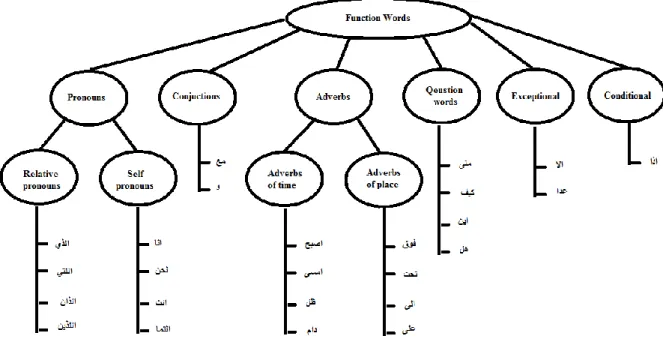
Figure 6-5 Classification of function words in lexical tree ...179
Figure 6-6 Main interface of SGO-CA script editor ...185
Figure 6-7 Lexical tree editor ...186
Figure 6-8 portion of the lexical tree ...187
Figure 6-9 Interface of adding ontology term to the lexical tee ...188
Figure 6-10 Interface of adding Arabic word to the lexical tree ...189
Figure 6-11 Interface of word search ...190
Figure 6-12 interface of word similarity measurement ...191
Figure 6-13 interface of sentence similarity measurement...192
Figure 7-1 SGO-CA sample script ...215
XVIII
List of tables
Table 3-1 Buckwalter transliteration (Buckwalter, 2002) ... 54
Table 4-1 Pattern wildcards ... 98
Table 4-2 patterns examples ... 100
Table 4-3 example of pattern match ... 101
Table 4-4 example of pattern mismatch ... 101
Table 4-5patterns conflict ... 102
Table 4-6 memory variables and parameters ... 118
Table 4-7 A attributes of memory variables ... 121
Table 5-1 subjective evaluation metrics ... 140
Table 5-2 questions related to evaluation metrics ... 141
Table 5-3 Objective evaluation metrics ... 143
Table 5-4 subjective evaluation frequency ... 143
Table 5-5 User’s opinion about PMGO-CA ... 144
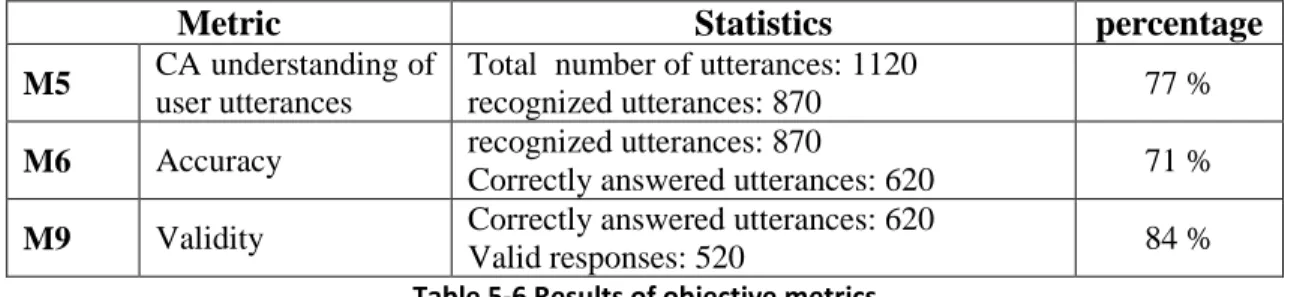
Table 5-6 Results of objective metrics ... 145
Table 5-7 results of PMGO-CA evaluation ... 146
Table 6-1 Similarity matrix between regular answer and the joint word set ... 170
Table 6-2 Similarity matrix between user’s utterance and the joint word set ... 170
Table 6-3 Similarity vector (1) ... 172
Table 6-4 Similarity vector (2) ... 172
Table 6-5 similarity vector (1) ... 173
Table 6-6 Similarity vector (2) ... 173
Table 6-7 Types of Arabic sentences ... 180
Table 7-1 AWSS evaluation dataset (WS) ... 196
1
Chapter 1
Introduction
Machine intelligence has focused researchers’ interest since 1950, it was first inspired by Alan Turing (Turing, 1950) through his famous question “Can machines think?” This question was the motivation for researchers to seek an answer.
To answer this question, researchers developed what were known as chatbots (Chatbots.org, 2005), these Chatbots were designed to converse with human just for the sake of keeping up the conversation for as long as needed to pass the test. Most of these chatbots relied on rephrasing users’ utterances to generate what looked like a viable and reasonable response, however those chatbots lacked any form of intelligence.
At a later stage, Chatbots were developed further into what is known now as Conversational Agents (CAs) (Crockett, et al., 2011) to help solving real life problems by simulating human knowledge not just to strive aimlessly to prolong the conversations. Since then machine intelligence has been an ultimate goal in the history of computer science.
The work in this thesis shall answer the following questions:
1. Can pattern matching CAs be used effectively for the Arabic language in a domain of interest?
2. Is it possible to develop an Arabic semantic conversational agent?
3. Does the semantic CA introduce a significant improvement over pattern matching CAs?
4. Is it possible to simulate human short and long term memory?
6. Are existing methods for sentence similarity suitable to be embedded within an Arabic semantic CA?
1.1.Research Aims and Objectives:
To answer the research questions, the following objectives were set by the author to be achieved
1. Review the existing Arabic and English Conversational Agents, with an emphasis on the Goal Oriented CAs, and also emphasis on adaptable Conversation Agents.
2. Research into semantic word and sentence similarity measures in both English and Arabic language.
3. Investigate the use of short and long term memory within CAs through human semantic memory system and examine if memory mechanism can be developed within CAs 4. Using appropriate Knowledge Engineering methods to obtain user goals which are used
to model the domain knowledge.
5. Design and develop a novel semantic based adaptable Arabic Goal-Oriented Conversational Agent (AGO-CA) which incorporates word and sentence similarity measures.
6. Development of a human semantic similarity memory system to capture and recall short term memory from conversation.
7. Conduct usability evaluation of the AGO-CA for the selected domain.
1.2.Research Contributions
Long-term memory management in CAs.
An evaluation methodology for Conversational Agents.
Development and evaluation of an Arabic pattern matching goal-oriented CA. Development and evaluation of an Arabic semantic goal-oriented CA.
Development and evaluation of new measure for word semantic similarity in Arabic. Including sentence difference in sentence similarity measurement.
Conversational Agent Development Tools.
1.3.Background
Researchers have succeeded in developing many types of CAs; most of them revolved around the idea of using pattern matching techniques, where the scripter writes many different patterns of users’ utterances in order to script a conversation.
Although pattern matching CAs can offer good performance, they still lack any form of intelligence, it is up to the scripter to write enough patterns to handle different users’ utterances. As time passes and information changes, the CA would need an effort by the scripter to update the scripts. This makes the conversational agent cumbersome to manage and these patterns might eventually conflict with one another.
To overcome the weaknesses of pattern matching, another approach to develop conversational agents has emerged recently, relying on semantic relations between texts to estimate similarity instead of the pattern matching approach.
An attempt has been made in English to incorporate similarity measures into conversational agents as a replacement to pattern matching (O’Shea, et al., 2010). Semantic CAs focus on estimating the relatedness of user utterance and the canonical sentences stored within the CA to generate responses.
Unlike pattern matching CAs, semantic CAs are expected to achieve more machine intelligence by eliminating the need for patterns and replace them with similarity measurement between users utterances and prototype sentences stored within the CA. The use of semantic similarity measures also reduces the effort required to update CA’s patterns and rules. Yet, the research on these types of agents is still in its early days, as the work was focused on developing similarity measurement methods and their related tools such as semantic networks and WordNet.
The Arabic language received little attention in the field of CAs development, the only work in this field was attempted by (Hijjawi, 2011) to develop a pattern-matching Arabic CA.. To the best of the researcher knowledge no attempt has been made to develop Arabic semantic conversational agents, this is mainly due to the linguistic complexities of the Arabic language and the absence of a well-developed semantic similarity measures for the Arabic language.
The research presented in this thesis proposes a new architecture for the Arabic conversational agents, which is used to construct an Arabic pattern matching goal-oriented CA to overcome the weaknesses associated with previous Arabic CA constructed by (Hijjawi, 2011). This research also studied the need for semantic CAs and proposed a new one for the Arabic language. Both CAs developed in this work were evaluated by human participants. This thesis ends with a comparative study between pattern matching CAs and semantic CAs and a conclusion.
1.4.Thesis Outline
Chapter 2:Conversational Agents.
This chapter gives an overview of previous work and techniques used within conversational agents, their evaluation methodology and a general outline of the knowledge engineering process. The chapter also describes some of the challenges
associated with developing conversational agents, and the linguistic complexities of the Arabic language such as Arabic grammar and morphology.
Chapter 3:Sentence Similarity Measurement.
Chapter three gives an overview on sentence similarity measurement methods, and the resources used to measure them such as WordNet and SUMO ontology. Then the chapter delves into the details of existing word and sentence similarity measures, discussing their strengths and weaknesses.
This chapter also covers some of the problems associated with using these methods in the Arabic language, and the limitation of linguistic tools used to perform word and sentence similarity in Arabic.
Chapter 4:Arabic Conversational Agents: Architecture and Scripting Language
This chapter begins with the methodology of developing conversational agents, starting with knowledge engineering, architecture design, implementation and evaluation.
The chapter describes the knowledge engineering process starting by gathering information about the domain of study and how this information is modelled and transformed into a knowledge trees to serve as a knowledge base for CAs.
Then this chapter introduces a new architecture for Arabic conversational agents to overcome the weaknesses of previous Arabic CA, such as poor dialogue flow control and slow performance. Each part of the new architecture is explained in details and the role of each in the overall performance of CAs.
A full description of all the features of the new architecture and the new pattern matching goal-oriented CA (PMGO-CA) is also covered, these include: dialogue flow control, Accuracy, user-agent Interaction, Flexibility, Adaptability, and Memory management.
The new scripting language PMGO-CA is also covered with full explanation of the pattern matching process between user’s utterances and patterns stored within the knowledge tree of the CA.
This chapter also provides full description of software tools used to construct the Arabic PMGO-CA; their features and advantages.
Chapter 5:Pattern Matching Goal Oriented Conversational Agent Evaluation
The chapter introduces an evaluation methodology for the conversational agents, including subjective and objective evaluation metrics, human participants, and the questionnaire used to evaluate the agent.
This chapter also covers the results of PMGO-CA evaluation with elaboration and analysis.
Chapter 6:Semantic Goal-Oriented Conversational Agent
This chapter introduces a novel semantic goal orientated Conversational Agent (SGO-CA). The new semantic CA incorporates a similarity measure instead of pattern matching techniques.
The chapter also covers the information sources used to estimate the similarity between words and sentences, and the similarity measures used to calculate them. Finally, the chapter proposed modifications and adaptations for the existing measures and introduces a new measure for computing Arabic word similarity. The chapter ends with the implementation of SGO-CA for the domain of study.
Chapter 7:Experiments and Evaluation of SGO-CA
This chapter is split into two parts. The first part covers a series of empirical experiments to test the proposed word and sentence similarity measures and make changes and adaptations for this measure in the context of SGO-CA. While the second part of the chapter covers human evaluation for the semantic goal-oriented
conversational agent according to the same evaluation methodology developed in chapter (5).
Chapter 8:Conclusion and Future work
This chapter summarises all the work and novelties that have been achieved during the course of this research, and highlights the research results. The chapter ends with a set of recommendations for further research in the field of conversational agents and semantic similarity measurement.
Chapter 2
Conversational Agents
2.1.Introduction
Communicating with computers using natural language has been a goal in artificial intelligence for many decades. It was stimulated by the British code breaker Alan Turing, whodesignedwhatisknownastheTuringTest„TT‟totestwhethercomputerscanreplace humans in communicating with other humans (Turing, 1950).
Turing proposed an imitation game which is played with a man (A), a woman (B) and an interrogator (C) whose gender is unimportant. The interrogator stays in a room apart from A and B. The objective of the interrogator is to determine which of the other two is the woman is while the objective of both the man and the woman is to convince the interrogator that he/she is the woman and the other is not. This situation is depicted in Figure (2-1).
What would happen when a machine takes the part of A in this game? Would the results differ when the game is played with a machine instead of a woman? These questions replace the original, "Can machines think?” (Turing, 1950)
Turing’s ideas have been widely discussed, attacked, and defended. (Saygin, et al., 2000). The Turing test was criticised for the fact that it has a woman and a machine each trying to convince the judge that they are a woman and the judge’s task is still to decide which the woman is, and which is not. But this judge is not thinking about the differences between women and machines, but between women and men. (Hayes, et al., 1995).
Others believe that the game has been misunderstood and judged according to the performance of systems in the Loebner Prize. (Shah, 2011)
In 1990 Hugh Loebner (An American inventor) agreed with The Cambridge Centre for Behavioural Studies to underwrite a contest designed to implement the Turing Test. Dr. Loebner pledged a Grand Prize of $100,000 and a Gold Medal for the first computer whose responses were indistinguishable from a human's. Such a computer can be said "to think.". Each year an annual cash prize and a bronze medal are awarded to the most human-like computer chatbot. This encouraged researchers and experts to develop more CAs to win this prize. Some good examples of the CAs developed especially for the Loebner Prize was TIPS, CONVERSE (Wiks, 2000), ALICE (Wallace, 2003), Ella, Jabberwacky (Carpenter, 2006), Mitsuku (Worswick, 2013) and other CAs.
Computer programmers that interact with users using natural languages are called Chatbots, they usually try to keep the conversation going with users aimlessly in variety of topics. According to (Shawar, 2007) the aim of chatbots was to see if they could fool users that they were real humans.
The first chatbots was known as ELIZA, which was a simple computer program written at the Massachusetts Institute of Technology (M.I.T.) by Professor Joseph Weizenbaum between the years 1964-1966 (Weizenbaum, 1966). ELIZA used few tricks in answering
questions by other questions giving the impression that the program is listening and responding to questions by answers.
ELIZA was primitive Chatbot and incapable of developing any real-world knowledge or considered application of self-awareness. However, it was the first step towards more developed and sophisticated chatbots. PARRY (Colby, 1975) was a development of ELIZA with some modifications. It was developed in 1972 by a psychiatrist called Kenneth Colby at Stanford University and was modelled on the paranoid mind. It tried to add more personality through beliefs and emotional classification (accept, reject, neutral) instead of matching trigger words (Kao, 2007) . PARRY also suffered from drawbacks, it was unable to generate responses, except for a limited number of unrepeated questions. It is worth mentioning that PARRY did not pass the Turing test.
Unlike chatbots which try to keep the conversation going aimlessly, conversational agents are designed to help users in a specific domain of interest through consistent dialogue. (O'Shea, et al., 2011) defined Conversational agents (CAs) as “a computer program which interacts with a user through natural language dialogue and provides some form of service by processing user’s input and providing a suitable response”.
Conversational agents exploit natural language technologies to engage users in text-based information-seeking and task-oriented dialogs for a broad range of applications (Lester, 2004), like web-based guidance (Latham, 2010), database interfaces (Owda, et al., 2011) and tutoring (Graesser, 2005) (Latham, et al.), customer service (Noori, et al., 2014), help desk (Harbusch, et al.), guided selling (Anna3) and technical support. (Acomb, et al.).
The on-going development of internet technologies, web applications, computational linguistics, and the increasing business needs for customer service have contributed into the development of commercial conversational agents, a good sample of these CAs is Anna (Anna3), and Spleak (Chatbots.org, 2005).
The CA Anna engaged with users on a text-based dialogue to help them exploring and buying products. Anna can also respond to other non-related utterance with smooth answers trying to change the conversation to the products domain. The CA answers questions about products, prices, sizes, delivery, spare-parts, and opening hours. Anna has an animated cartoon figure which displays emotions related to her responses, like smiling while she welcomes users, etc.
Anna can respond to non-related utterance by trying to direct the conversation towards the products and services; the most remarkable thing about Anna that it picks up a clue about what the customer wants in abstracts and then offers a menu in which a user can click and select from, once a selection is made, Anna navigates the user to the desired product page where all information is available, thus Anna is not purely based on conversation, it provides services based on both conversation and web navigation.
Spleak is a spoken chatbot, it talks to people in a variety of subjects. It has an access to a number of sites like weather forecast, horoscopes, dictionaries, news, etc. and use information from such sites to keep conversation running with users. Unlike Anna who helps customers with products and services using a meaningful dialogue and web navigation, conversations carried out with Spleak were often random with the sole aim of making a conversation going for the longest period of time.
It is worth to mention that both Anna and Spleak won the Loebner prize in the years 2003 and 2006 consequently.
Conversational agents take too long and cost too much to develop (Razmerita, et al., 2004). They require expertise in the scripting of conversations and a good understanding of the written form of the language (i.e. English or Arabic). Researchers must design their own system architecture, develop knowledge representation and reasoning mechanisms, gather the required domain knowledge, and implement all system modules.
There are many challenges associated with the development of conversational agents, starting with capturing and interpreting users’ utterance, disambiguating the utterance
according to a given domain or context, knowledge representation and reasoning about the world or a particular domain, in addition to other challenges related to agents responsiveness, adaptability and usability.
Many English-based CAs have been developed, some of which were text-based such as ELIZA (Weizenbaum, 1966), ALICE (ALICE, 1995), PARRY (Colby, 1975) among many others. However, the Arabic language Conversational Agents has witnessed less attention, this is mainly due to the complexity of the language itself and the limited researches in Arabic linguistics, in addition to the lack of social acceptance for such applications.
This chapter covers:
A background and review about conversational agents.
The approaches used to develop CAs and the associated challenges A background and review about Arabic language and its challenges. The evaluation of conversational agents.
Knowledge organisation and representation.
2.2.Natural Language Processing
Chowdhury (Chowdhury, 2005) defined Natural Language Processing (NLP) as “The area of research and application that explores how computers can be used to understand and manipulate natural language text or speech to do useful things”. According to (Madnani, 2007), the term “Natural Language Processing encompasses a broad set of techniques for automated generation, manipulation and analysis of natural or human languages”. (Kao, 2007), also defined NLP as “the attempt to extract a fuller meaning representation from free text”. NLP aims to convert human language into a formal representation that is easy for computers to manipulate, and determine who did what to whom, when, where, how and why.
NLP utilises variety of tools and techniques including grammar rules, lexical and morphological analysis (Altabbaa, et al., 2010) (Mohtasseb, et al.) (Mazroui, 2014), noun
phrase generation, word segmentation (Monroe W., 2014), semantic and discourse analysis, word meaning and knowledge representation, lexicons, thesaurus, corpus such as WordNet (Miller, 1994), VerbNet, FrameNet (Ruppenhofer, et al., 2010), the Brown corpus (Francis, et al., 1979) and the Canadian Hansard. (Roukos, et al., 1997)
According to (Nadkarni, 2011), NLP tasks are classified into low-level and a high-level tasks. Low-level NLP tasks include:
Sentence boundary detection (READ, 2012), to determine the beginning and end of sentence.
Tokenization (Stanford tokenizer), which divide texts into a sequence of tokens, which roughly correspond to “words”.
Part-of-speech tagging (Brill, 1992), also called grammatical tagging or word-category disambiguation, is the process of marking up a word in a text (corpus) as corresponding to a particular part of speech, based on both its definition, as well as its context
Morphological Analysis (Altabbaa, et al., 2010), to decompose words and extract their stems and affixes.
Shallow parsing (Abney, 1994), identifying phrases from constituent part-of-speech tagged tokens. For example, a noun phrase may comprise an adjective sequence followed by a noun. (Nadkarni, 2011)
Higher-level tasks build on low-level tasks and are usually problem-specific (Nadkarni, 2011). Including:
Spelling error detection (Gupta, 2012).
Grammatical error identification (Andersen, 2011), to identify poorly formed sentences.
Named entity recognition (Manning), identifying specific words or phrases (‘entities’) and categorizing them.
Word sense disambiguation (WSD) (Rindflesch, 1994) (Weeber, 2001), determine the exact meaning of a word in a given context or sentence.
Negation and uncertainty identification (Chapman, 2001) (Weeber, 2001), inferring whether a named entity is present or absent.
Relation extraction (Bach) to determine relation between words, entities and concepts
NLP have been used widely in applications, including Machine Learning, information extraction ( (Gupta, 2014), InQuery (Callan, 1992)), Document Retrieval (Liddy, 2001) (Richardson, 1998), machine translation, text-summarisation, web-search, human computer interfaces, education, parsing (Green, et al., 2010), customer service (Rosenfeld, et al., 2000), weather forecast (Hazen T., 1998), text mining (NetOwl, 2014) (TextWise, 2014) and conversational Agent (Rozinaj, 2012).
(Chowdhury, 2005) Stated that “at the core of any NLP task there is the important issue of natural language understanding. Building an NLP system imposes several challenges related to the interpretation and analysis of linguistic input, and knowledge representation”.
Thus, a layered approach must be followed to construct an NLP system, starting at the word layer to determine the morphological structure, then the sentence layer to check the syntax according to a defined grammar in order to understand the meaning of the sentence, (who did what to whom, when, why and how) and then to the context layer to determine what this sentence means in this specific context, and what is the required action to be taken. Accurate and efficient natural language processing is essential for an effective conversational agent to respond appropriately to users’ utterances.
According to (Lester, 2004) “A conversational agent must interpret the utterance, determine and perform the actions that should be taken to respond to the utterance”; therefore A language understanding system must have a considerable knowledge about the structure of the language including the meaning of words, the grammar, and how words are combined into phrases and sentences.
However, language grammar is not always applicable since people are always changing the rules to meet their needs; therefore it is not always possible to determine the exact and complete characterisation of utterances.
An example of an NLP based CA is GALAXY (Seneff, 1998), which is a natural language system for spoken language developed at MIT. GALAXY supports English spoken and textual dialogues to help users to access online information. GALAXY interprets the utterance and frames it into defined attributes. This framing helps GALAXY to understand the utterance’s topic and the information that is requested. Then, GALAXY uses a template-based response generator in order to reply with a relevant response.
However, there are strong arguments why NLP approaches are not suitable in the development of CAs. According to (Sammut, 2001), “traditional methods for Natural Language Processing (Allen J., 1995) have failed to deliver the expected performance required in a Conversational Agent” because exact grammar is rarely used in conversations; therefore the CA must have a mechanism to deal with poorly formed utterances. In addition to that, people in their daily life often use some colloquial language and expressions which might look ambiguous to the CA. For example someone might use the phrase “I've never been into baseball” to state that He/ She does not find baseball interesting.
Thus, pragmatic knowledge about the context of the conversation turns out to be a much more important factor in understanding an utterance than traditional linguistic analysis. (Sammut, 2001).
2.3.Types of Conversational Agents
There are two main types of CAs depending on their interfaces. They are Embodied Conversational Agents (ECA), and Linguistic Conversational Agents (LCA).
2.3.1. Embodied Conversational Agents
(Cassell, 2000) Defined embodied conversational agents (ECA) as “computer-generated cartoon-like characters that demonstrate many of the same properties as humans in face-to-face conversation, including the ability to produce and respond to verbal and nonverbal communication”.ECAsstimulatehumanappearanceandbehaviourtocommunicatewithpeople to answer questions and perform tasks for the user through natural language dialogues. (Valle, 2010) described the structure of ECAs consisting of the following main components shown in figure (2-2), they are:
An interface to capture language or gesture input into the ECA, such as audio and gesture analysis.
AnengineoradialoguemanagertodeterminetheECA‟sbehaviour.
A visual component to perform gestures and movement, such as audio and gesture synthesis
Figure 2-2 ECA's structure (Morency, et al., 2005)
ECAs are beneficial in human-computer interactions for a number of reasons. Agents could act as smart assistants, much like the ones used in travel agents or investment advisors (Catrambone, et al., 2002). A conversational interface appears to be a more natural dialogue style because the user does not have to learn complex command structure and functionality. Furthermore, an embodied agent could use intonation, gaze patterns, facial expressions and gestures.
One common trend discovered in studies is that embodied conversational agents appear to attract people’s attention, both in positive and negative senses. Studies have shown that the attention gained by an embodied conversational agent had a more positive, desired
effect. According to (Walker, 1994), people who interacted with a talking face spend more time on an on-line questionnaire, made fewer mistakes, and wrote more comments than those who answered a text questionnaire.
The development of an ECA requires advanced techniques for gesture and speech recognition, ECAs have challenges related to understanding human psychology. For example the ECA must capture and analyse facial expressions and gaze patterns which are different from one person to another and from one situation to another.
ECAs supporting speech commands and utterance encompasses the same challenges the Speech dialogue systems do, recognition systems must support variety of pronunciations and dialects, furthermore there are many differently spelled words but yet they are pronounced the same way such as “sea” and “see”, therefore a disambiguation mechanism is required for such utterances, the matter is even more complicated in Arabic where there are many dialects, with different words and pronunciations.
In addition, an ECA has the same other challenges associated with LCAs which are related to word sense disambiguation, morphological analysis, knowledge representation, reasoning, responsiveness, adaptability, usability, memory, etc.
ECAs have been developed for variety of applications such as tutoring (Massaro, et al.) and customer service (Kopp, et al., 2005).
Due to the complexity of the Arabic language and the variety of Arabic dialects used in the Arab countries, and the limitation of Arabic speech analysis systems, this research is focusing on the development of textual Arabic conversational agent to tackle the problems associated with conversational agents in general, and overcome the challenges associated with the Arabic language in specific. This text-based CA can serve as a base for future development of an Arabic ECA, by adding speech analysis and synthesis modules.
2.3.2. Linguistic Conversational Agents
Linguistic Conversational Agents are categorised according to their interfaces as Spoken Dialogue Systems (SDS) and Textual Dialogue Systems (TDS).
SDS: Spoken Dialogue Systems (SDSs) are concerned with the conversion of speech into text. The average user might expect to interact with a CA by speaking to it directly and having the speech interpreted by SDS algorithms (O'Shea, et al., 2011). The goal of spoken dialogue systems (SDS) is to offer efficient and natural access to applications and services, such as email and calendars, travel and entertainment booking, and product recommendation. (Demberg, 2006).
During the last few years several SDS were developed in many applications including:
o Voiced-based control of home appliances, such as light and air conditioning. (Baig, et al., 2012)
o GPS systems. (Trovato, et al., 1998)
o E-mail services, to help users write, listen and navigate through their emails. (Walker, et al., 1997)
o Other applications such as cinema schedules and bus trip information (P. Madeira, 2003).
TDS: A textual Conversational Agent enables communication through a “User Interface” that has input and output textual boxes in order to receive/send an utterance/response respectively (Hijjawi, 2011).
The problem with SDS is the challenge related to capturing user’s voice, isolating it from other noise in environment, and converting voice utterance into text utterance, considering the fact that users pronounce words differently, in addition to the disambiguation part, where the agent would have to identify the intended word among many similarly pronounced words.
Furthermore an SDS would face the same complexities associated with the TDS after converting the voice utterance into text; all of these issues are magnified with the development of an Arabic conversational agent, due to the diversity of the Arabic dialects, and the lack of neat Arabic speech analysis systems.
TDS also encompasses many challenges in sentence structuring, language grammar, and morphological analysis, and word sense disambiguation. These challenges are fully covered in section 4.2.
Many LCAs have been developed since the last century such as ArabChat (Hijjawi, 2011), InfoChat (Allen J., 1995), ELIZA (Weizenbaum, 1966), (ALICE, 1995) and many others.
2.4.Approaches to Developing Linguistic Conversational Agents 2.4.1. Pattern Matching
Pattern recognition is usually considered as an engineering area which focuses on the development and evaluation of systems that imitate or assist humans in their ability of recognizing patterns (Duin, 2007). Text-based pattern matching systems can be classified into three categories,
Question and Answering systems
Natural Language interfaces to databases. (Susie M. Stephens).
Conversational agents (ArabChat (Hijjawi, 2011), Student debt advisor (Crockett, et al., 2009), Bullying and harassment advisor (Latham, 2010), Intelligent tutoring system (Latham, et al.).
From a CA perspective Text-based Pattern Matching (PM) is the process of searching for a string or sequence of strings in a piece of text to find all occurrences of these strings inside that text. (Hijjawi, 2011).
Pattern matching is a technique that uses an algorithm to handle user conversations by matching CA’s patterns against a user’s utterance. AIML (Wallace, 2003) is the widely used
pattern matching technique in conversational agents; a typical pattern consists of words, spaces, and wildcards. A wildcard is a symbol used to match a portion of the user’s utterance.
Several other pattern matching algorithms have been developed by Knuth (Knuth, et al.), Boyer-Moore (Robert, et al.) Karp-Rabin (Karp, et al.).
The Knuth–Morris–Pratt string searching algorithm (or KMP algorithm) searches for occurrences of a "word" W within a main "text string" S by employing the observation that when a mismatch occurs, the word itself embodies sufficient information to determine where the next match could begin, thus bypassing re-examination of previously matched characters.
The Boyer-Moore algorithm uses information gathered during the pre-process step to skip sections of the text, resulting in a lower constant factor than many other string algorithms. In general, the algorithm runs faster as the pattern length increases. The key feature of the algorithm is to match on the tail of the pattern rather than the head, and to skip along the text in jumps of multiple characters rather than searching every single character in the text. The Rabin–Karp algorithm or Karp–Rabin algorithm is a string searching algorithm created by Richard M. Karp and Michael O. Rabin (1987) that uses hashing to find any one of a set of pattern strings in a text.
The scripting language is the language in which patterns are defined; the most widely known scripting languages are AIML used by ALICE (Wallace, 2003) and Pattern Script used by Info Chat (Sammut, 2001).
2.4.1.1. ALICE
The Artificial Linguistic Internet Computer Entity (ALICE) is a chatbot that converse with users in variety of topics. ALICE uses as a scripting language known as AIML (Artificial Intelligence Mark-up Language) which was originally adapted from a non-XML grammar developed by Prof. Richard S. Wallace (Wallace, 2003), AIML is a scripting language which
enables people to input knowledge into chatbots based on the A.L.I.C.E free software technology.
ALICE is designed to keep the client talking as long as possible, without necessarily providing any useful information along the way. The longer average conversation lengths measured over the years have in fact been a measure of A. L. I. C. E.'s progress.
According to (Wallace, 2003), AIML describes a class of data objects called AIML objects and partially describes the behaviour of computer programs that process them. AIML objects are made up of units called topics and categories. Each category consists of a pattern, a template and an optional context, pattern represents a question, while template represents an answer. The AIML pattern language is simple, consisting only of words, spaces, and the wildcard symbols as demonstrated in figure (2-3).
<category > <pattern>Hi</pattern> <template>Hi there!</template> </category > <category > <pattern>Hello *</pattern> <template><srai>Hello</srai></template> </category > <category>
<pattern> What do you know about Isaac Newton</pattern> <template>
<srai>Who is Isaac Newton</srai> </template>
</category>
Figure 2-3 A sample of AIML script
AIML elements begin and end with opening and closing tags, rules are organized into categories, each category contains pattern and template; the pattern is compared against user’s utterances and the template is the response which is fired once the pattern is matched.
Atomic Categories: are those with patterns that does not have wildcards “*” or “_”
Default Categories: are those with patterns has a wildcards “*” or “_” which are used to replace a part of user’s utterance.
Recursive categories: It is a property of template not pattern. The template calls the pattern matcher recursively using <srai> and <sr> tags which refers to simply recursive artificial intelligence and symbolic reduction.
2.1.1.1 InfoChat and Pattern Script
InfoChat is a pattern matching conversational agent developed by ConvAgent in collaboration with the Human Computer Learning Foundation (Sammut, 2001). InfoChat has its own scripting language that structure any applied domain into a collection of text files, each text file represents a context, and each context has many rules. A rule has many patterns and associated responses.
museum ::
#new topic(museum, museum topics, eliza)
init ==>
[
Welcome to the Powerhouse Museum and our exhibition on the Universal Machine. We can talk about lots of things, including Alan Turing and his ideas on Artificial Intelligence.
|
We have a great exhibit on Charles Babbage and computers in general.
|
We can talk about other things, like Robotics and Machine Learning. ] museum topics :: {* comput~ * | * universal *} ==> [ #goto(universal, [init]) ]
{* control * | * information * | * processing *} ==>
[ #goto(control, [init]) ] {* communications * | * media *} ==> [ #goto(media, [init])
Figure 2-4 sample of InfoChat scripts (Sammut, 2001)
As shown in figure (2-4) InfoChat scripting rules are of the form pattern ==> response. Pattern expressions may contain wildcards such as ’*’, indicating that zero or more words may match and ’˜’ to indicate that zero or more characters may be matched.
Patterns can also contain non-terminal symbols, i.e., references to other pattern expressions. This enables the script writer to create abbreviations for common expressions such as lists of alternatives for the various ways in which the user can enter affirmative and negative answers. Since the definitions of non-terminal symbols may be recursive, pattern expressions are equivalent in expressive power to BNF notation.
Response expressions contain two different types of alternative constructs. Alternatives surrounded by braces (“,“, “-”) indicate that any element may be chosen; at random for output to the user. Alternatives surrounded by brackets (“*“,“+”) are chosen in sequence. Thus, if the same rule fires more than once, the first alternative is chosen on the first firing, the second element on the second firing, and so on.
2.4.1.2. Issues Related to Pattern Matching
In general pattern matching based CAs encompasses the following issues:
It is a process of searching for an occurrence in a string of text, it does not include any semantics about the words and sentence in general.
It requires careful definitions for patterns, as some of those patterns may overlap (apply to different user utterances with different meaning) causing misfired responses.
The scripting of pattern matching is time consuming, for each utterance the scripter must define countless number of patterns.
However Pattern matching has some advantages, in terms of responsiveness, the pattern matching process is fairly fast providing almost real-time response.
2.4.2. Sentence Semantic Similarity
(Oxford dictionary, 2015) defined a sentence as “a set of words that is complete in itself, containing a subject and predicate, conveying a statement, question, exclamation, or command, and consisting of a main clause, and sometimes one or more subordinate clauses”.
Sentence semantic similarity is a measurement of the extent in which two or more sentences are similar to each other from logical perspective. An effective similarity measure should be able to determine whether sentences are semantically equivalent or not, taking into account the variability of natural language expression (Achananuparp, et al., 2008). Measurement of text similarity have been used for a long time in wide range of applications in natural language processing and related areas, including information retrieval, automatic evaluation of machine translation (Papineni, 2002), relevance feedback and text classification, word-sense disambiguation (Resnik., 1999), language modelling (Rosenfeld, 1996), synonym extraction (Lin, 1998), and automatic thesauri extraction (Curran., 2002). In general there are two approaches to measure semantic similarity, a statistical approach which is purely based on mathematical formulae; the other uses humanly constructed sources such as knowledge bases and thesaurus to measure semantic similarity.
Latent Semantic Analysis (LSA) is a statistical method of measuring sentence similarity. According to (Landauer, 1998) LSA is “A fully automatic mathematical/statistical technique for extracting and inferring relations of expected contextual usage of words in passages of discourse”, this method is fully explained in section (3.1)
The other approach for measuring semantic similarity utilises knowledge bases, Corpus statistics, lexicons, grammar and part-of-speech, etc. to determine sentence similarity, this method has been researched by scholars and some algorithms were proposed. The semantic similarity of two sentences is often calculated using information from a structured lexical database and corpus statistics and the semantic distance between sysnets in WordNet. Details about this method and WordNet can be found in sections (3.5.1) and (3.3) respectively
2.5.Arabic Conversational Agents
Little work has been achieved in the development of Arabic Conversational Agents. Mohammed Hijjawi (Hijjawi, 2011) developed the first known Arabic agent known as
ArabChat. ArabChat used pattern matching algorithms and classified users’ utterances to be either question or non-question in order to speed up matching. The prototype agent was developed for the Applied Science University (ASU) in Jordan to work as an information point advisor for their visitor students who are Arabic native speakers. Some good trials were made to test ArabChat and showed some degree of success. However, amending the scripts in the domain in any way resulted in complex reformulation of rules within contexts and was very time consuming similar to English CAs.
Despite being successful in terms of robustness as the first Arabic conversational agent, ArabChat had some drawbacks including slow responsiveness to users’ utterances and a complexity to modify rules and patterns; the scripting of ArabChat requires expertise and careful consideration in rules definition.
This section examines the challenges related to the development of an Arabic conversational agent.
2.5.1. Arabic Dialects
There are three main categories of Arabic language, they are Classic, Modern, and Colloquial Arabic (Ryding, 2005). Arab speakers usually use these different types of Arabic depending on the nature of conversation.
Classical Arabic is the original Arabic language which is used in the Quran. Classical Arabic is very rich in terms of grammar and vocabulary and encompasses a number of diacritics which are used to distinguish Arabic words and determine their pronunciation and grammatical meaning that facilitates and detect their grammatical cases (for instance, noun or verb).
However these diacritics are no longer used in Modern Arabic language, the grammatical meaning is being understood by the context of the sentence or paragraph. Modern Arabic is used as the official language in Arab countries.
The third type, known as Colloquial Arabic, is the dialect language being used in different Arab countries. A dialect spoken in one Arabic country might not be understood by people living in another country. The Arab dialects may have different vocabulary and may even contain words from other languages.
There is no standard grammar for any of the Arabic dialects, this will increase the challenge associated with the development of an Arabic CA to understand or recognize user utterances from various Arab countries.
2.5.2. Arabic Morphology
In linguistics, morphology is the study of the internal structure of words (El Kholy, 2010). It is the identification, analysis and description of the structure of morphemes and other units of meaning in a language (Altabbaa, et al., 2010).
One of the main distinguishing features of the Arabic language is the root-and-pattern morphology. The root is the semantic abstraction consisting of two, three or (less commonly) four constants from which words are derived through the superimpositions of templatic pattern. In Arabic, the word ” KTB” has the broad lexical sense of ‘writing’ from which the words for ‘book’ (KiTaab), ‘writing’ (Maktub), ‘writer’ (KaaTiB), ‘office’ (maKTab) and ‘document’ (KaTi-iBa) are derived, nouns have feminine and masculine gender and singular and plural number, and also dual in some Semitic languages. Adjectives are morphologically like nouns.
Arabic is a morphologically rich and complex language, characterised by a combination of template and affixation morphemes, complex morphological, phonological and orthographic rules, and a rich feature system. (Altantawy, et al., 2011)
Morphology usually focuses on two fundamental issues: derivational morphology, which concerns how words are formed, and secondly, inflectional morphology, which concerns how words interact with the syntax (Ryding, 2005). However, derivational morphology governs the principles of a word’s transformation
Morphological analysis and generation are important to many NLP applications such as machine translation (Diab, 2007); (El Kholy, 2010) and information retrieval (Aljlayl, et al., 2002), and conversational agents (O’Shea, et al., 2010). Much work has been done on Arabic morphological analysis and generation in a variety of approaches and at different degrees of linguistic depths. Habash (Altantawy, et al., 2011) Morphology analyser (XEROX) (Khoja, 1999), ISRI (Taghva, 2005) and Light Stemming (Larkey, 2002). (AraMorph), (Mazroui, 2014), (Mohtasseb, et al.), Qutuf (Altabbaa, et al., 2010)
2.5.3. Language Ambiguity
In Arabic language, multiple words may have different meanings. There are, two types of ambiguity in Arabic: morphological ambiguity and word sense ambiguity. Morphological ambiguity is often a result of not using the Arabic diacritics. For example the word “ بْة ذَر” means gold while the same word with slightly different diacritics “ ذَة ذَر” means “went” . Morphological ambiguity increases the challenge associated with the development of the Arabic conversational agents, because diacritics is usually omitted in modern Arabic language, therefore CA users are not expected to include Arabic diacritics in their utterances, which makes it hard to determine the intended word.
Word sense ambiguity occurs when two words with an exact syntactic form (including diacritics) have different meanings for example the word”شٍسٌ” “walks”, means "شٍسٌ" “easy” as well, the word “ بٌْيذَسيٌُ” means “salute “ and it also means “deliver” at the same time. In addition, word sense ambiguity is a challenge in the development of a semantic conversational agent. A method is needed to distinguish the intended meaning of word. Many word sense disambiguation techniques (Agirre, et al., 2009) (Zouaghi, et al., 2012) (Liu, et al., 2007) (Ide, et al., 2002) (Li, 1995) have been developed but they usually require additional computational and time complexity which might not be desired in a CA environment.
WSD was the central topic of research in Natural Language Processing (NLP) for years, and more recently it was found that it is so important in many NLP tasks such as parsing, machine translation, information retrieval, question answering, conversational agent, information extraction and text mining. WSD is considered as the key step to approach language understanding (Agirre, et al., 2009)
2.5.4. Non Arabic Words Used in Arabic Dialect
The Arabic language contains countless number of non-Arabic words, for instance the word “وٌاتىٍ” “Mobile” is widely used to express the cell phone devices, the word “شذىٍثٍىم” “computer” is used for computer devices, "خسىثسات" is used to define the travel document or passport. These words and other dialect words do not follow the same rules of morphological analysis and grammar. This, of course, is another challenge when developing Arabic Conversational Agent.
2.5.5. Arabic Grammar
The Arabic language has the flexibility of sentence structuring in terms of word order. The sentence structure in Arabic has three forms (El Kholy, 2010), which are: (from right to left): [object][subject][verb] ( ححافرىا ذَحٍ ومأ), [object][ verb][ subject] ( ححافرىا ومأ ذَحٍ), and [verb][subject][ object] (ذَحٍ اهيمأ ححافرىا).In contrast, the sentence structure in English might be *subject+*verb+*object+ (‘Mohammad ate an apple). Consequently, this flexibility of sentence structuring in Arabic will increase the complexity of building an Arabic CA in terms of actual sentence understanding. In Arabic language, the research into computational semantics is much smaller than other areas in NLP, due to high complexity (El Kholy, 2010).
The challenges of Arabic language can be summarised as:
o The rich morphology and the many inflectional morphological categories for Arabic language
o Arabic diacritics, there are many Arabic words with a similar spelling but they differ in diacritics (which are not being used in the modern Arabic language) which causes a morphological ambiguity.
o Word sense ambiguity, there are some Arabic words with the exact spelling and diacritics, yet they might have different meaning based on the context.
o The diverse Arabic dialects used around the world, those dialects may have foreign words, and they usually do not follow the standard Arabic grammar. Building a pattern matching CA does not suffer from any of the challenges stated above, since pattern matching is just a process of searching for a pattern in a string of texts regardless of the spelling and grammatical structure of the sentence.
However these issues impose a real challenge in the development of an Arabic conversational agent based on semantic similarity or natural language processing in which semantic analysis and sentence understanding is required.
2.6.Evaluation of Conversational Agents:
Conversational agents like other programs, must pass rigours testing and evaluation before releasing them for public use. The evaluation of CAs is the process of performing tests on various aspects of a conversational agent by a selected group of qualified participants from different backgrounds to decide whether the agent is suitable to interact with users in real environment, and uncover any weaknesses associated within the agent based on evaluators feedback.
Chatbot evaluations have been conducted using a variety of criteria (usability, user satisfaction, Agent credibility, ease of understanding, efficiency, effectiveness, speed, and error rates etc.). Some evaluation methods tend not to assess all criteria and as there is no benchmark metrics and consistency across evaluation methods. Instead they conclude that evaluations should be adapted to user needs and the application at hand (Shawar, 2007).