SOFTWARE DEVELOPMENT PLAN TEMPLATE
TM-SPP-02 V2.0
APRIL 5, 2005
Systems Engineering Process Office, Code 20203 Space and Naval Warfare Systems Center San Diego
53560 Hull Street San Diego CA 92152-5001
ii
PREFACE
This document was created to provide any project developing software with a template for generating a MIL-STD 498 Data Item Description (DID) DI-IPSC-81427 compliant Software Development Plan (SDP). This template should be tailored and supplemented with project-specific information to produce an SDP that accurately describes the project‟s organization, roles, and responsibilities. Space and Naval Warfare (SPAWAR) Systems Center (SSC) San Diego Software Project Planning Policy is SSC San Diego‟s written organizational policy for
implementing Software Project Planning (SPP) to provide management with appropriate visibility into the process being used by the software project and of the products being built. The process is intended to be an integral part of the SSC San Diego approved Life Cycle Support strategies as defined in the SSC San Diego Software Process Assets document available at
http://sepo.spawar.navy.mil/. This document is intended to supplement the SPP Process by providing an SDP template that a project may use in generating its own project SDP. The SDP is the document that allows the customer insight into all stages of the software
development process and addresses the commitments of the software developer to the allocated requirements. It identifies resources, estimates of size and cost, schedules, constraints,
capabilities of the software developer's organization. The plan serves as a basis for managing and tracking the software activities defined to accomplish the development of the project‟s software. The plan documents each group's responsibility for the development of the software. The items contained in Performing General Software Development Activities, Section 4, identify basic topics that are necessary to create a workable plan for a software project. When a
significant change occurs in the approach to software development, this plan must be updated to reflect that change. In addition, an SDP should be kept current by responding to changes due to programmatic redirection.
SSC San Diego‟s Systems Engineering Process Office (SEPO) assumes responsibility for this document and updates it as required to meet the needs of users within SSC San Diego. SEPO welcomes and solicits feedback from users of this document so that future revisions of this document will reflect improvements, based on organizational experience and lessons learned. Users of this document may report deficiencies and or corrections using the Document Change Request that appears at the end of the document. Updates are completed in accordance with the SEPO Configuration Management Procedure.
RECORD OF CHANGES
*A – ADDED M – MODIFIED D – DELETED
VERSION NUMBER DATE NUMBER OF FIGURE, TABLE OR PARAGRAPH A* M
D TITLE OR BRIEF DESCRIPTION
CHANGE REQUEST
NUMBER
1.0 10/97 Various changes resulting from
Formal Inspection of this Document.
2.0 4/05/05 Throughout Various changes resulting from DCRs and extensive formatting updates DCRs SPDT-0002 to 0007 and 0009
iv
TEMPLATE PROTOCOL
This document provides a template for a generic Software Development Plan (SDP) that addresses the ‟best practices‟ described by the Software Engineering Institute (SEI) Capability Maturity Model (CMM) Version 1.1 Level 2 “Repeatable Processes,” and the guidance of MIL-STD-498. The objective is to assist organizations in documenting software development and management processes in support of the projects under their cognizance. Tailoring this template requires the author to address all requirements for the management, development, test, and
coordination of those functional activities as necessary to delivering a quality product to the fleet. In addition, the generic SDP employs a tailorable software development methodology.
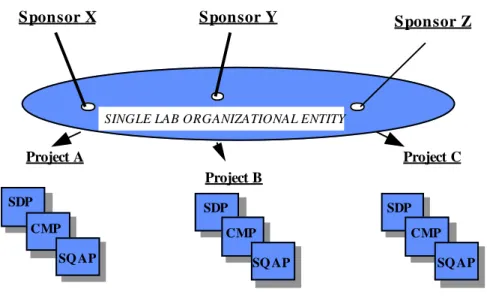
Figure I-1 depicts the traditional practice of developing a sponsor-oriented, project-specific SDP. Often each of the SDPs describes different development methods, configuration management practices, tools; and quality assurance processes.
SDP CMP SQ AP SDP CMP SQ AP SDP CMP SQ AP Project A Project B Project C
Sponsor X Sponsor Y Sponsor Z SPO NSO R DRIVEN O RGANIZATIO N
EAC H PRO JEC T HAS ITS O WN UNIQ UE PRO C ESS
SINGLE LAB ORGANIZATIONAL ENTITY
“PROJECTS TEND TO BE DISJOINT FIFEDOMS”
Figure I-1. Traditional Practice
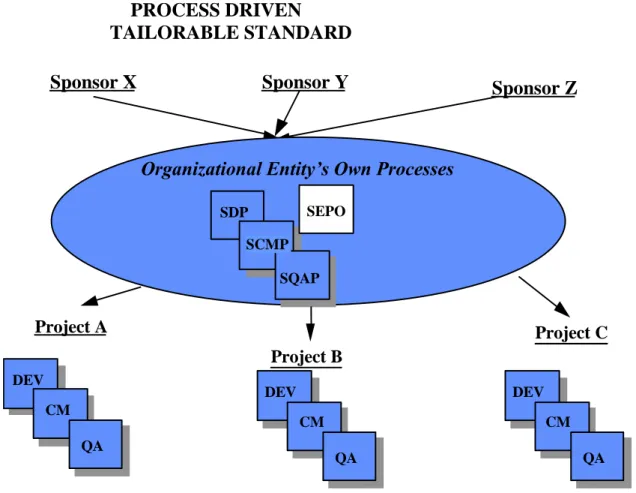
This generic SDP Template, by taking its place in the SSC San Diego Process Asset Library (PAL), will assist in providing the command a focus on a suite of standard mature processes. In addition, it will help projects meet sponsor requirements for an SDP by providing quickly tailorable engineering processes. Other templates available would include those for a Software Configuration Management Plan (SCMP) and a Software Quality Assurance Plan (SQAP). Figure I-2 reflects the change in philosophy from a federation of sponsor driven processes to one of an organization employing standard processes.
Sponsor X Sponsor Y Sponsor Z PROCESS DRIVEN ORGANIZATION TAILORABLE STANDARD PROCESSES SCM P DEV CM QA DEV CM QA DEV CM QA Project A Project B Project C SDP SQAP
Organizational Entity’s Own Processes
SEPO SCMP
Figure I-2. Process Oriented Organization
Relationship to Other Documents
The SDP template contains software engineering process definitions and references to other key templates for software configuration management, and software quality assurance. These companion documents also comply with MIL-STD-498 and its associated DIDs. These
templates comprise a suite of process descriptions that can be packaged in a multitude of formats. MIL-STD-498 was selected as it presents a widely recognized format and its guidance
incorporates „best practices‟ that are Software Engineering Institute (SEI) compliant at Capability Maturity Model for Software (SW-CMM) Level 2.
vi
DOCUMENT CONVENTIONS
Standard conventions are used within this document to direct the reader to specific sections of the text. These sections provide instructions and explanations and require users to substitute their own project-specific information for the generic information provided or to “fill in the blank.” The conventions used in this document are shown below.
Text Global changes. Items that appear in italics represent changes that can be made globally throughout the document.
<Text> Unique changes. Items that appear in <angled brackets> represent items that need to be changed on an individual basis. The <angled brackets> are not meant to appear in the completed version of the document.
Italics Instructions and explanations. Each section of the template has been annotated with a guidance box, derived from the MIL-STD-498 Data Item Description (DID) DI-IPSC-81427, to assist the reader in drafting the content. For example:
Guidance
The guidance box provides instructions and explanations, in italics, as required to assist the user in drafting their own information.
[Sample] Text appearing between these lines is intended to provide an example of the type of
[End Sample] content expected in the section in which it appears.
The samples have been constructed such that if extracted from the template with their associate paragraph number they would create a good first draft of an SDP based on the sound software engineering practices of MIL-STD 498. Combining the DID derived guidance with sample content has created a template in the form of an annotated version of the SDP DID.
Users should first review the generic processes contained in the SDP to ensure an understanding of scope, software engineering processes, management functions, relationships, and
responsibilities for the positions within the model organization. For example, the samples address processes for the positional roles contained in Section 7.1 of the SDP template. A table is included in Section 7.1 as a Note to help define the roles in the model organization. It is important to understand that the sample organization and processes do not fit all projects but serve as a representative example, requiring tailoring to meet project specific needs.
It is recommended that the Section 7.1 organizational diagram and table be printed and kept readily available for reference as one reads the individual samples associated with the guidance information. The model organization and the processes contained in the template reflect a software project that is but one of several projects assigned to a Division. The sample project is tasked to develop software; integrate it into its target hardware environment; support the software through the sponsor‟s acceptance testing; and provide distribution, field support, and follow-on maintenance. It is also assumed that the Project Manager has established and placed in
operation a System Configuration Control Board (SCCB).
The SDP begins on the next page with a SDP title and approval page. Delete this Document Conventions page and all preceding pages in the final version of your PMP. Remember to update the header to reflect the appropriate document identifier for your project‟s SDP.
SOFTWARE DEVELOPMENT PLAN
FOR THE
PROJECT NAME
DOCUMENT IDENTIFIER
DATE
Prepared For: Prepared By: Code Name, Code ####Space and Naval Warfare Systems Center San Diego Street Address
San Diego, CA 92152-####
ii
SOFTWARE DEVELOPMENT PLAN
FOR THE
PROJECT NAME
DOCUMENT IDENTIFIER
DATE
Prepared By: Code Name, Code ####Space and Naval Warfare Systems Center San Diego Street Address
San Diego, CA 92152-####
Software Project Manager Program Manager Senior
Manager
Configuration Management Quality Assurance Hardware
Manager
Systems Engineer Integrated Logistics Support Test
Manager
iv
PREFACE
RECORD OF CHANGES
*A - ADDED M - MODIFIED D - DELETED
VERSION NUMBER DATE NUMBER OF FIGURE, TABLE OR PARAGRAPH A* M
D TITLE OR BRIEF DESCRIPTION
CHANGE REQUEST
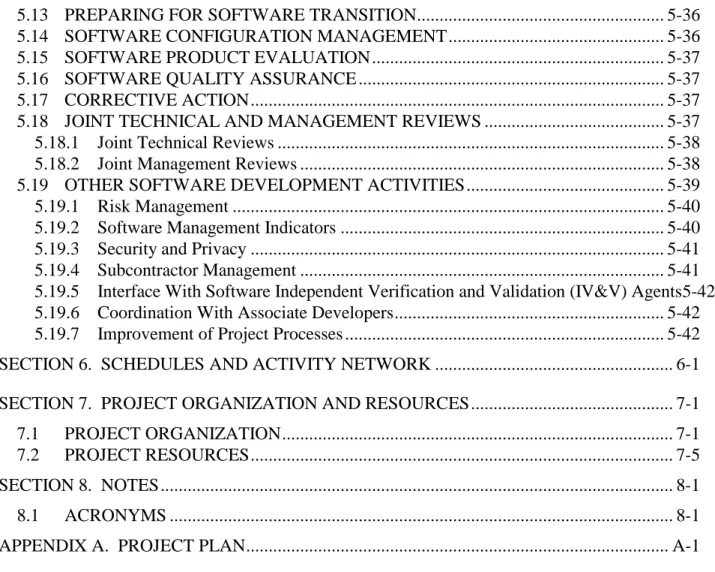
vi TABLE OF CONTENTS Section Page SECTION 1. SCOPE ... 1-1 1.1 IDENTIFICATION ... 1-1 1.2 SYSTEM OVERVIEW ... 1-1 1.3 DOCUMENT OVERVIEW ... 1-2 1.4 RELATIONSHIP TO OTHER PLANS ... 1-4 SECTION 2. REFERENCED DOCUMENTS ... 2-1 SECTION 3. OVERVIEW OF REQUIRED WORK ... 3-1 SECTION 4. PLANS FOR PERFORMING GENERAL SOFTWARE DEVELOPMENT
ACTIVITIES ... 4-1 4.1 SOFTWARE DEVELOPMENT PROCESS ... 4-1 4.2 GENERAL PLANS FOR SOFTWARE DEVELOPMENT ... 4-4 4.2.1 Software Development Methods ... 4-4 4.2.2 Standards for Software Products ... 4-5 4.2.3 Reusable Software Products ... 4-5 4.2.4 Handling of Critical Requirements ... 4-6 4.2.5 Computer Hardware Resource Utilization ... 4-8 4.2.6 Recording of Rationale ... 4-8 4.2.7 Access for Acquirer Review ... 4-8 SECTION 5. PLANS FOR PERFORMING DETAILED SOFTWARE DEVELOPMENT
ACTIVITIES ... 5-1 5.1 PROJECT PLANNING AND OVERSIGHT ... 5-1 5.1.1 Software Development Planning ... 5-1 5.1.2 CSCI Test Planning ... 5-2 5.1.3 System Test Planning ... 5-3 5.1.4 Software Installation Planning ... 5-3 5.1.5 Software Transition Planning ... 5-3 5.1.6 Following and Updating Plans, including Intervals for Management Review ... 5-4 5.2 ESTABLISHING A SOFTWARE DEVELOPMENT ENVIRONMENT ... 5-4 5.2.1 Software Engineering Environment ... 5-4 5.2.2 Software Test Environment ... 5-5 5.2.3 Software Development Library ... 5-5 5.2.4 Software Development Files ... 5-7 5.2.5 Non-Deliverable Software ... 5-8 5.3 SYSTEM REQUIREMENTS ANALYSIS ... 5-8 5.3.1 Analysis of User Input ... 5-9 5.3.2 Operational Concept ... 5-9 5.3.3 System Requirements ... 5-9
5.4 SYSTEM DESIGN ... 5-10 5.4.1 System-Wide Design Decisions ... 5-10 5.4.2 System Architectural Design... 5-10 5.5 SOFTWARE REQUIREMENTS ANALYSIS ... 5-10 5.5.1 Software Requirements Development Process ... 5-11 5.6 SOFTWARE DESIGN ... 5-12 5.6.1 CSCI-Wide Design Decisions ... 5-13 5.6.2 CSCI Architectural Design ... 5-13 5.6.3 CSCI Detailed Design ... 5-17 5.7 SOFTWARE IMPLEMENTATION AND UNIT TESTING ... 5-19 5.7.1 Software Implementation ... 5-20 5.7.2 Unit Testing ... 5-22 5.7.3 Test Case/Procedure Implementation ... 5-22 5.8 UNIT INTEGRATION AND TESTING ... 5-24 5.8.1 Purpose ... 5-24 5.8.2 Roles and Responsibilities ... 5-24 5.8.3 Entry Criteria ... 5-24 5.8.4 Inputs ... 5-25 5.8.5 Process Activities ... 5-25 5.8.6 Outputs ... 5-26 5.8.7 Exit Criteria ... 5-26 5.8.8 Process Measurements ... 5-26 5.9 CSCI QUALIFICATION TESTING ... 5-26 5.9.1 Independence in CSCI Qualification Testing ... 5-27 5.9.2 Testing on the Target Computer System ... 5-27 5.9.3 Performing CSCI Qualification testing ... 5-27 5.10 CSCI/HWCI INTEGRATION AND TESTING ... 5-29 5.10.1 Preparing for CSCI/HWCI Integration and Testing ... 5-29 5.10.2 Performing CSCI/HWCI Integration and Testing ... 5-30 5.10.3 Revision and Retesting ... 5-30 5.10.4 Analyzing and Recording CSCI/HWCI Integration and Test Results ... 5-30 5.11 SYSTEM QUALIFICATION TESTING ... 5-31 5.11.1 Independence in System Qualification Testing ... 5-31 5.11.2 Testing on the Target Computer System ... 5-32 5.11.3 Preparing for System Qualification Testing ... 5-32 5.11.4 Dry Run of System Qualification Testing ... 5-32 5.11.5 Performing System Qualification Testing ... 5-32 5.11.6 Revision and Retesting ... 5-33 5.11.7 Analyzing and Recording System Qualification Test Results ... 5-34 5.12 PREPARING FOR SOFTWARE USE ... 5-34 5.12.1 Preparing the Executable Software ... 5-35 5.12.2 Preparing Version Descriptions for User Sites ... 5-35 5.12.3 Preparing User Manuals ... 5-35 5.12.4 Installation at User Sites ... 5-35
viii
5.13 PREPARING FOR SOFTWARE TRANSITION ... 5-36 5.14 SOFTWARE CONFIGURATION MANAGEMENT ... 5-36 5.15 SOFTWARE PRODUCT EVALUATION ... 5-37 5.16 SOFTWARE QUALITY ASSURANCE ... 5-37 5.17 CORRECTIVE ACTION ... 5-37 5.18 JOINT TECHNICAL AND MANAGEMENT REVIEWS ... 5-37 5.18.1 Joint Technical Reviews ... 5-38 5.18.2 Joint Management Reviews ... 5-38 5.19 OTHER SOFTWARE DEVELOPMENT ACTIVITIES ... 5-39 5.19.1 Risk Management ... 5-40 5.19.2 Software Management Indicators ... 5-40 5.19.3 Security and Privacy ... 5-41 5.19.4 Subcontractor Management ... 5-41 5.19.5 Interface With Software Independent Verification and Validation (IV&V) Agents5-42 5.19.6 Coordination With Associate Developers ... 5-42 5.19.7 Improvement of Project Processes ... 5-42 SECTION 6. SCHEDULES AND ACTIVITY NETWORK ... 6-1 SECTION 7. PROJECT ORGANIZATION AND RESOURCES ... 7-1 7.1 PROJECT ORGANIZATION ... 7-1 7.2 PROJECT RESOURCES ... 7-5 SECTION 8. NOTES ... 8-1 8.1 ACRONYMS ... 8-1 APPENDIX A. PROJECT PLAN ... A-1
LIST OF FIGURES
Figure Page
Figure 1-1. RBC System Software Overview ... 1-3 Figure 4-1. XY Project Software Engineering Process Model ... 4-3 Figure 4-2. Test Roles and Responsibilities ... 4-3 Figure 5-1 Project Planning and Oversight Process ... 5-2 Figure 6-1. Master Build Schedule ... 6-1 Figure 7-1. XY Project Organizational Structure ... 7-2
LIST OF TABLES
Table Page
Table 3-1. Key Features of Three DoD Program Strategies ... 3-1 Table 4-1. Development Activities Group Allocation ... 4-4
Table 4-2. Standards and Specifications Applicable to Software Development ... 4-5 Table 5-1. The XY Project SEE Tools ... 5-4 Table 5-2. Software Test Environment ... 5-5 Table 5-3. XY Project's Non Deliverable Software ... 5-8 Table 7-1. Roles and Responsibilities ... 7-3 Table 7-2. Personnel Requirements (Person yrs) ... 7-6
SECTION 1. SCOPE
Guidance
The Software Development Plan (SDP) describes a developer’s plans for conducting a software development effort. The term "software development" is meant to include new development, modification, reuse, reengineering, maintenance, and all other activities resulting in software products. The SDP provides the acquirer insight into and a tool for monitoring, the processes to be followed for software development, the methods to be used, the approach to be followed for each activity, and project schedules, organization, and resources.
[Sample]
This Software Development Plan (SDP) establishes the plan for software implementation, test, and qualification for the Red/Black Controller (RBC) Computer Software Configuration Items (CSCIs). The RBC is being developed under the direction of the Program Office. Updates to this SDP will address future RBC software upgrades.
[End Sample]
1.1 IDENTIFICATION Guidance
This paragraph shall contain a full identification of the system and the software to which this document applies, including, as applicable, identification number(s), title(s), abbreviation(s), version number(s), and release number(s).
[Sample]
The RBC system consists of the two software CSCIs listed below:
a. The Black Control CSCI shall be identified as the BCC with the identification number CSCI-01.
b. The Red Control CSCI shall be identified as the RCC with the identification number CSCI-02.
The Program Office has a Pre Planned Product Improvement (PPI) cycle for the RBC system that is addressed in Section 6. The respective revision builds of the RBC will be identified by a suffix to the basic CSCI identification numbers. For example „CSCI-01 v02‟ would describe the BCC upgrade for Build 02 of the RBC.
[End Sample]
1.2 SYSTEM OVERVIEW Guidance
This paragraph shall briefly state the purpose of the system and the software to which this
document applies. It shall describe the general nature of the system and software; summarize the history of system development, operation, and maintenance; identify the project sponsor,
acquirer, user, developer, and support agencies; identify current and planned operating sites; and list other relevant documents.
[Sample]
The XY Project involves the development and upgrade for the software of the Red/Black
Controller (RBC), a multipurpose cryptographic system hosted in a desktop configuration. RBC provides the requisite communications security for systems and equipment implementing a
1-2
wireless communication networks. The RBC provides encryption/decryption services for
numerous applications as part of communications systems, subsystems, and networks. The RBC can be applied at either the subscriber level (to provide isolation between users of the network at different clearance levels or differing need-to-know requirements) and at the link level (to provide encryption/decryption of all network control information and secondary
encryption/decryption of all user data). The RBC does not operate in a stand-alone setting, but as a component in an overall Command, Control, Communications, Computation and Intelligence (C4I) system.
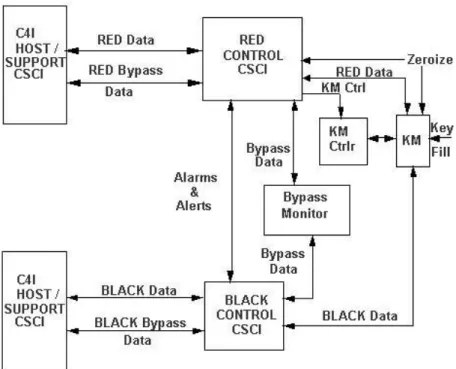
The RBC consists of two interfacing hardware configuration items embedded in the host C4I system. The software consists of the Red Control CSCI (RCC) and Black Control CSCI (BCC) residing in a RED and a BLACK Wintel processor components of the host C4I system. The purpose of the BCC is to handle the BLACK data and BLACK control interfaces, handle the RCC interface, perform BLACK bypass data filtering and control, and conduct self test. The purpose of the RCC is to handle the RED control interfaces, handle the BCC interface, control the Cryptographic Module (KM), perform security management, perform Alarm/Alert
processing, perform RED bypass data filtering and control, and conduct self test. Figure 1-1 is an overview of the RBC system and its hosted software CSCIs.
[End Sample]
1.3 DOCUMENT OVERVIEW Guidance
This paragraph summarizes the purpose and contents of this document. The purpose is usually short enough for one paragraph of one to four sentences. The contents of the various sections of this document are listed below:
a. Section 2 lists all the documents used as references during the preparation of this document as well as all documents referenced herein.
b. Section 3 enumerates the requirements that need to be imposed on developers for this plan to succeed.
c. Section 4 outlines the plans, methods, and processes to be employed by the Re-Engineering effort.
d. Section 5 provides the detail on the complete spectrum of software engineering activities being employed.
[Sample]
This SDP identifies applicable policies, requirements, and standards for XY Project software development. It defines schedules, organization, resources, and processes to be followed for all software activities necessary to accomplish the development. This SDP contains no privacy considerations pertaining to the XY Project.
Figure 1-1. RBC System Software Overview
This SDP was developed in conformance with MIL-STD-498. It is structured in sections following the format and content provisions of Data Item Description (DID) DI-IPSC-81427. Each section identifies tailoring applied to the structure and instructions for content defined in the DID.
Section 2 lists all documents referenced by this SDP and used during its preparation. Section 3 provides an overview of the required work.
Section 4 describes plans for general software development activities.
Section 5 describes the details of all software planning, design, development, reengineering, integration, test, evaluation, Software Configuration Management (SCM), product evaluation, Software Quality Assurance (SQA), and preparation for delivery activities.
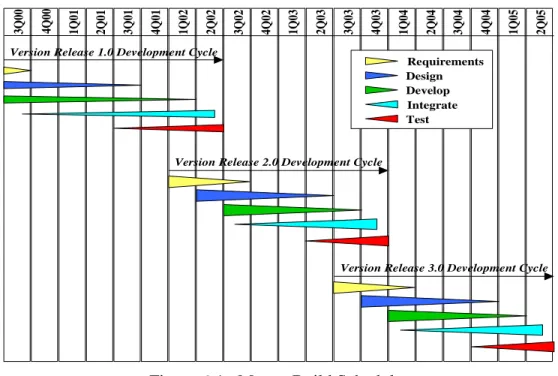
Section 6 defines the project schedule and activity network.
Section 7 describes the project organization and the resources required to accomplish the work. Section 8 contains the acronyms used in this SDP.
Appendices contains the MicroSoft Project plan (Appendix A), coding standards, and other pertinent forms and data.
1-4
1.4 RELATIONSHIP TO OTHER PLANS Guidance
This paragraph shall describe the relationship, if any; of the SDP to other project management plans.
[Sample]
This SDP and its companion documents, the Software Configuration Management Plan (SCMP), and the Software Quality Assurance Plan (SQAP), serve as the guiding documents to develop the software for the XY Project.
SECTION 2. REFERENCED DOCUMENTS
Guidance
This section shall list the number, title, revision, and date of all documents referenced in this plan. This section shall also identify the source for all documents not available through normal Government stocking activities.
[Sample]
The documents listed below were either used to create this document or are referenced in it: a. Software Development and Documentation, MIL-STD-498
b. Technical Reviews and Audits for Systems, Equipment, and Computer Software, MIL-STD-1521
c. Software Development Plan, Data Item Description DI-IPSC-81427 d. Software Project Planning Process, SSC San Diego
e. Software Development Plan Template, SSC San Diego f. XY Project Software Configuration Management Plan g. XY Project Software Quality Assurance Plan
h. XY Project Software Measurement Plan i. Risk Management Process, SSC San Diego
j. A Description of the SSC San Diego Software Process Assets (SPA), SEPO, dated April 2001. See http://sepo.spawar.navy.mil/
k. SSC San Diego COTS Evaluation, Selection and Qualification Process
l. Institute of Electrical and Electronics Engineers (IEEE)/Electronic Industries Association (EIA) 12207 Series, IEEE and EIA, March 1998
m. Etc.
2-2
SECTION 3. OVERVIEW OF REQUIRED WORK
Guidance
This section shall be divided into paragraphs as needed to establish the context for the planning described in later sections. It shall include, as applicable the items listed below:
a. Requirements and constraints on the system and software to be developed. b. Requirements and constraints on project documentation.
c. Position of the project in the system life cycle.
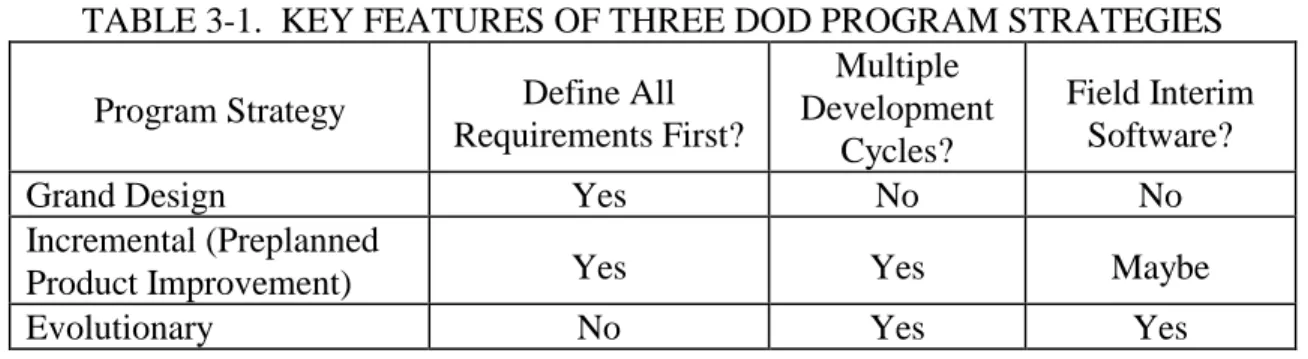
d. The selected program/acquisition strategy or any requirements or constraints on it. The three basic strategies are summarized below and in Table 3-1.
1. Grand design. The "grand design" strategy (not named in DODI 5000.2 but treated as one strategy) is essentially a "once-through, do-each-step-once" strategy. Simplistically: determine user needs, define requirements, design the system, implement the system, test, fix, and deliver.
2. Incremental. The "incremental" strategy (called "Preplanned Product Improvement" in DODI 5000.2) determines user needs and defines the system requirements, then performs the rest of the development in a sequence of builds. The first build
incorporates part of the planned capabilities, the next build adds more capabilities, and so on, until the system is complete.
3. Evolutionary. The "evolutionary" strategy also develops a system in builds, but differs from the incremental strategy in acknowledging that the user need is not fully
understood and all requirements cannot be defined up front. In this strategy, user needs and system requirements are partially defined up front, then are refined in each succeeding build.
e. Requirements and constraints on project schedules and resources.
f. Other requirements and constraints, such as project security, privacy, methods, standards, and interdependencies in hardware and software development.
TABLE 3-1. KEY FEATURES OF THREE DOD PROGRAM STRATEGIES Program Strategy Define All
Requirements First? Multiple Development Cycles? Field Interim Software?
Grand Design Yes No No
Incremental (Preplanned
Product Improvement) Yes Yes Maybe
Evolutionary No Yes Yes
[Sample]
TheXY Project will apply an Incremental (Preplanned Product Improvement) strategy to develop and evolve the functional capabilities of the RBC System Software. The RBC System Software requirements are controlled by the Program Manager’s System Configuration Control Board
3-2
(SCCB). All issues concerning cost, schedule, and incremental build content must be negotiated with the SCCB.
SECTION 4. PLANS FOR PERFORMING GENERAL SOFTWARE
DEVELOPMENT ACTIVITIES
Guidance
This section shall be divided into paragraphs addressing the content specified in each sub header. Provisions corresponding to non-required activities may be satisfied by the words "Not applicable." If different builds or different software on the project require different planning, these differences shall be noted in the paragraphs.
In addition to the content specified below, each paragraph shall identify applicable risks/uncertainties and plans for dealing with them.
4.1 SOFTWARE DEVELOPMENT PROCESS Guidance
This section shall describe the software development process to be used. The planning shall cover all contractual clauses concerning this topic, identifying planned builds, if applicable, their objectives, and the software development activities to be performed in each build. Software development activities include:
a. Project planning and oversight (5.1)
b. Establishing a software development environment (5.2) c. System requirements analysis (5.3)
d. System design (5.4)
e. Software requirements analysis (5.5) f. Software design (5.6)
g. Software implementation and unit testing (5.7) h. Unit integration and testing (5.8)
I. CSCI qualification testing (5.9)
j. CSCI/HWCI integration and testing (5.10) k. System qualification testing (5.11)
l. Preparing for software use (5.12)
m. Preparing for software transition (5.13) n. Integral processes:
1) Software configuration management (5.14) 2) Software product evaluation (5.15)
3) Software quality assurance (5.16) 4) Corrective action (5.17)
5) Joint technical and management reviews (5.18) 6) Other activities (5.19)
[Sample]
The MIL-STD 498 Incremental Life Cycle Model and the DID for the SDP have been used to guide the content and format developing the SDP. Overall, IEEE/EIA 12207 Supporting
Processes and Organizational Process have been applied in to the management and control of the XY Project The integration of the MIL-STD 498‟s Incremental Life Cycle Model into the
4-2
context of IEEE/EIA 12207 disciplines is illustrated in Figure 4-1. Section 5 contains the specifics of the XY Project’s implementation of the processes in Figure 4-1
The allocation of functional requirements for each build will be negotiated with the Program Manager’s System Configuration Control Board (SCCB) and documented in the Build Plan for each build. The Build Plan will also include build specific acceptance criteria and
installation/user training requirements. The process will integrate reusable software from existing sources with newly-developed software. Software design and coding will be performed by the Software Development Group using an object oriented design approach and generate class and object process interaction diagrams. Artifacts and evidence of results of software
development activities will be deposited in Software Development Files (SDFs) and Software Engineering Notebooks (SENs). These artifacts, along with pertinent project references will be deposited and maintained in a Software Development Library (SDL) and made available to support management reviews, metrics calculations, quality audits, product evaluations, and preparation of product deliverables.
Following integration of reusable and new software units by the Software Test and Evaluation Group, a software Formal Qualification Testing (FQT) will be performed in accordance with processes defined in Section 5. A Test Readiness Review (TRR) will be conducted to verify readiness for system level testing.
The System Test Organization will prepare a Test Plan (TP) for a system level FQT and execute test cases defined in the implementing Test Description (TD). They will generate
Problem/Change Reports (P/CRs) to describe software errors uncovered during test results analyses. The System Test Organization will be supported by the XY Project , providing analysis and repair as required.
The separation of organizational entities and their testing responsibilities is illustrated in Figure 4-2.
Software Configuration Management (SCM), Software Quality Assurance (SQA), and Software Product Evaluation, Corrective Action, and preparation for software delivery will follow detailed processes described in Section 5 of this SDP.
Sys Arch Design System Reqts Analysis System Qual Test System Integra-tion Software Installation Software Acceptance Support Hardware items Software Item
Development Process Activities
Software Qual Test Software Integra-tion Software Code & Test Software Detailed Design Software Arch. Design Software Reqts. Analysis
Supporting Processes: Documentation, Configuration Management, Quality Assurance, Verification, Validation, Joint Review, Audit, Problem Resolution
Organizational Processes: Management, Infrastructure, Improvement, Training
Figure 4-1. XY Project Software Engineering Process Model
Figure 4-2. Test Roles and Responsibilities
4-4
4.2 GENERAL PLANS FOR SOFTWARE DEVELOPMENT [Sample]
XY Project software development will conform to MIL-STD-498. The development approach will be to apply SSC San Diego standard management and technical work processes to the project. The SSC San Diego standard work processes are defined in reference (g), A Description of the SSC San Diego Software Process Assets (SPA). The project team has tailored these
standards, practices, and processes to XY Project software development, as described in Section 5 of this SDP.
[End Sample]
4.2.1 Software Development Methods Guidance
This paragraph shall describe or reference the software development methods to be used. Included shall be descriptions of the manual and automated tools and procedures to be used in support of these methods. The methods shall cover all contractual clauses concerning this topic. Reference may be made to other paragraphs in this plan if the methods are better described in context with the activities to which they will be applied.
[Sample]
The XY Project software development will apply the following general methods:
a. The project will follow the defined processes documented in Section 5 to conduct software requirements analysis and manage the Software Requirements Specification (SRS). Express software requirements in language that addresses a single performance objective per statement and promotes measurable verification. Construct a software architecture that will consist of reusable software components and components to be developed. Allocate software requirements to one or more components of that architecture. Use an automated data base tool to capture, cross-reference, trace, and document requirements.
b. The Software Development Group and the Software Test and Evaluation Group
collaborate during software requirements analysis and then each proceed with separate activities that are intended to ensure the software complies with the detailed software requirement specification. These activities for the Software Development Group and the Software Test and Evaluation Group are defined in Table 4-1. The activities for each group will be addressed separately in Section 5.
TABLE 4-1. DEVELOPMENT ACTIVITIES GROUP ALLOCATION
c. The project will only design and develop software to meet requirements that cannot be satisfied by reusable software. New software will be based on principles of object-oriented design and exploit object-object-oriented features associated with the selected
high-level language and development environment. New software design will be defined at top-level and detailed design stages of development in the SDD. Software design will promote ease of future growth, specifically new application interfaces. Top-level design will be expressed in a graphical form. Detailed design will also be expressed in a
graphical form depicting classes, relationships, operations, and attributes.
d. The project will adhere to the standards required by the SDP for design, coding, and test methods for new software.
e. The project will reuse software for requirements that can be satisfied by selected Non-Development Item (NDI) software. Selection of NDI products shall follow the process and procedures as defined in reference (h), the SSC San Diego COTS Evaluation, Selection and Qualification Process.
f. The project will modify (as necessary), unit test, integrate, and document reused software following the same processes used for new software. While reused code will not be expected to conform to a single coding standard, changed source code must be supplemented with sufficient new comments and standard code headers to meet commenting provisions of the coding standard and to promote understandability
[End Sample]
4.2.2 Standards for Software Products Guidance
This paragraph shall describe or reference the standards to be followed for representing requirements, design, code, test cases, test procedures, and test results. The standards shall cover all contractual clauses concerning this topic. Reference may be made to other paragraphs in this plan if the standards are better described in context with the activities to which they will be applied. Standards for code shall be provided for each programming language to be used.
[Sample]
XY Project software development will comply with applicable directions contained in the documents listed in Table 4-2. These documents impose standards that are applicable to software requirements, design, coding, testing, and data.
TABLE 4-2. STANDARDS AND SPECIFICATIONS APPLICABLE TO SOFTWARE DEVELOPMENT
Document Description
<Fill in project specifics>
<Project program coding standards are a good example.> MIL-STD-498 Software Development and Documentation, 5 December 1994 MIL-STD-961D DoD Standard Practice Defense Specifications
MIL-STD-973 Configuration Management Etc.
[End Sample]
4.2.3 Reusable Software Products [Sample]
4-6
This section identifies and describes the planning associated with software reuse during development of the XY Project and provisions to promote future reuse of newly-developed software.
[End Sample]
4.2.3.1 Incorporating Reusable Software Products Guidance
This paragraph shall describe the approach to be followed for identifying, evaluating, and incorporating reusable software products, including the scope of the search for such products and the criteria to be used for their evaluation. It shall cover all contractual clauses concerning this topic. Candidate or selected reusable software products known at the time this plan is prepared or updated shall be identified and described, together with benefits, drawbacks, and restrictions, as applicable, associated with their use.
NOTE: Refer to the following documents available on the SSC San Diego PAL. a. Reuse Adaptation and Management (RAM) Process
b. COTS Evaluation, Selection and Qualification Process
[Sample]
The project will follow the defined processes documented in Section 5 to conduct detailed software design of new software and to capture the design, and reengineer, if necessary, software to be reused.
[End Sample]
4.2.3.2 Developing Reusable Software Products Guidance
This paragraph shall describe the approach to be followed for identifying, evaluating, and reporting opportunities for developing reusable software products.
[Sample]
Emphasis will be placed on good software engineering principles such as information hiding and encapsulation, providing a complete description of processing, and the definition of all software and hardware component interfaces to facilitate software integration and provide a basis for future growth and reuse.
[End Sample]
4.2.4 Handling of Critical Requirements Guidance
This paragraph shall be divided into the following subparagraphs to describe the approach to be followed for handling requirements designated critical.
4.2.4.1 Safety Assurance Guidance
The developer shall identify as safety-critical those CSCIs or portions thereof whose failure could lead to a hazardous system state (one that could result in unintended death, injury, loss of property, or environmental harm). If there is such software, the developer shall develop a safety assurance strategy, including both tests and analyses, to assure that the requirements, design, implementation, and operating procedures for the identified software minimize or eliminate the potential for hazardous conditions. The strategy shall include a software safety program, which shall be integrated with the system safety program if one exists. The developer shall record the
strategy in the software development plan, implement the strategy, and produce evidence, as part of required software products, that the safety assurance strategy has been carried out.
4.2.4.1 Security Assurance Guidance
The developer shall identify as security-critical those CSCIs or portions thereof whose failure could lead to a breach of system security. If there is such software, the developer shall develop a security assurance strategy to assure that the requirements, design, implementation, and
operating procedures for the identified software minimize or eliminate the potential for breaches of system security. The developer shall record the strategy in the software development plan, implement the strategy, and produce evidence, as part of required software products, that the security assurance strategy has been carried out.
[Sample]
XY Project software will be subject to product evaluations, quality assurance, and test and
evaluation activities conducted to assure that developed software meets the security requirements imposed by the following:
a. Navy Security Manual, Executive Order 12958, OPNAVINST 5510.1H b. DoD 5220.22-M.
c. etc.
Software developers, integrators, and testers will adhere to security procedures to assure correct access to and handling of classified software, data, and documentation. Security assurance procedures will be reviewed for compliance by the cognizant SSC San Diego security office.
[End Sample]
4.2.4.3 Privacy Assurance Guidance
The developer shall identify as privacy-critical those CSCIs or portions thereof whose failure could lead to a breach of system privacy. If there is such software, the developer shall develop a privacy assurance strategy to assure that the requirements, design, implementation, and
operating procedures for the identified software minimize or eliminate the potential for breaches of system privacy. The developer shall record the strategy in the software development plan, implement the strategy, and produce evidence, as part of required software products, that the privacy assurance strategy has been carried out.
4.2.4.4 Assurance of Other Critical Requirements Guidance
If a system relies on software to satisfy other requirements deemed critical by the contract or by system specifications, the developer shall identify those CSCIs or portions thereof whose failure could lead to violation of those critical requirements; develop a strategy to assure that the requirements, design, implementation, and operating procedures for the identified software minimize or eliminate the potential for such violations; record the strategy in the software development plan; implement the strategy; and produce evidence, as part of required software products, that the assurance strategy has been carried out.
[Sample]
Compatibility of interfaces with other systems is important in successful development of the XY Project software. These programs will be continually monitored by the Software Project
4-8
Manager to identify, track, and evaluate potential risks as part of the risk management process addressed in Section 5.19.1.
[End Sample]
4.2.5 Computer Hardware Resource Utilization Guidance
This paragraph shall describe the approach to be followed for allocating computer hardware resources and monitoring their utilization.
[Sample]
Computer resource utilization must focus on two constraints; those effecting production in the development environment, and those impacting the operational user‟s environment. The following paragraphs address each issue:
a. Development Environment - The Software Project Manager will establish and maintain a detailed schedule for computer hardware resource utilization that identifies anticipated users, purposes, and scheduled time to support analysis, software design, coding,
integration, testing, and documentation. It will address sharing of resources by multiple users and workarounds to resolve conflicts and equipment downtime. If computer hardware resource scheduling requires supplementing, potential sources of computer hardware resources including other SSC San Diego projects or commercial vendors will be identified. The Software Project Manager will coordinate resource needs with development, integration, and test groups.
b. Operational Users Environment - The Software Project Manager will establish and maintain a database of the site-specific computer hardware and commercial software resources. It will address resources by hardware configurations and commercial software licensing requirements. If a specific site‟s computer hardware resource or licensing needs are insufficient for a planned build then those needs will be communicated to those site notifying them of the configuration enhancements needed for the next build.
[End Sample]
4.2.6 Recording of Rationale Guidance
This paragraph shall describe the approach to be followed for recording rationale that will be useful to the support agency for key decisions made on the project. It shall interpret the term "key decisions" for the project and state where the rationale is to be recorded.
[Sample]
The principle document for recording key decisions, both technical and programmatic, is the Software Engineering Notebook (SEN). The SEN is comprised of a series of white papers on the key issues, each paper documenting the rationale to support its conclusions. Additional rationale required for software development will be provided in future SDP and STP updates. Decisions and rationale on software coding and unit testing process details may also be recorded in SDFs.
[End Sample]
4.2.7 Access for Acquirer Review Guidance
This paragraph shall describe the approach to be followed for providing the acquirer or its authorized representative access to developer and subcontractor facilities for review of software products and activities. It shall cover all contractual clauses concerning this topic.
[Sample]
The Software Project Manager will arrange for periodic reviews of XY Project software
processes and products at appropriate intervals for the Program Manager. The Software Project Manager will provide representatives of the Program Manager’s offices with electronic copies of briefing materials and draft products for review in advance of all reviews, along with
discrepancy forms, in accordance with the project‟s peer review process. The Software Project Manager will direct consolidation of discrepancies and report the status of corrective actions taken in response to reported discrepancies.
4-10
SECTION 5. PLANS FOR PERFORMING DETAILED SOFTWARE
DEVELOPMENT ACTIVITIES
Guidance
This section shall be divided into paragraphs addressing the topics identified in the sub-
headers. Provisions corresponding to non-required activities may be satisfied by the words "Not applicable." If different builds or different software on the project require different planning, these differences shall be noted in the paragraphs. The discussion of each activity shall include the approach (methods/procedures/tools) to be applied to the following items:
a. The analysis or other technical tasks involved b. The recording of results
c. The preparation of associated deliverables, if applicable.
The discussion shall also identify applicable risks/uncertainties and plans for dealing with them. Reference may be made to Section 4.2.1 if applicable methods are described there.
Note: Several of the subparagraphs in Section 5 contain detailed sample processes. These processes could also be stand-alone documents that are merely referenced by the SDP. Doing this makes the maintenance of the SDP easier because changes to these detailed processes do not require an update of the SDP.
5.1 PROJECT PLANNING AND OVERSIGHT Guidance
This paragraph shall be divided into the following subparagraphs to describe the approach to be followed for project planning and oversight. The planning in each subparagraph shall cover all contractual clauses regarding the identified topic.
[Sample]
This SDP shall be maintained and modified to reflect the current plans, policies, processes, resources, and standards affecting the XY Project. It shall be the SoftwareProject Manager’s responsibility to keep abreast of industry technology changes and programmatic direction from the Program Manager that would require modification of this plan.
[End Sample]
5.1.1 Software Development Planning Guidance
The developer shall develop and record plans for conducting the activities required by this standard and by other software-related requirements in the contract. This planning shall be consistent with system-level planning and shall include all applicable items in the SDP.
Also refer to the Software Project Planning (SPP) Process available in the SSC San Diego PAL.
[Sample]
The plan for all software development shall employ software engineering „best‟ practices in verification and validation, configuration management, peer reviews, project tracking and oversight, and software quality assurance. Microsoft Project will be used to develop and maintain the XYProject master plan and schedule. In addition, each build will be subject to the planning process described in Figure 5-1 and the build‟s Microsoft Project plan will be rolled up
5-2
into the master project plan contained in Section 7 of this document. The build project plans will be made available to all participants. The Software Project Manager will use weekly project-wide meetings to maintain the status of the software project and to resolve any conflicts or changes that might occur. The Software Project Manager will employ a database to record action item assignments, status, and resolutions.
Figure 5-1 Project Planning and Oversight Process
[End Sample]
5.1.2 CSCI Test Planning Guidance
The developer shall develop and record plans for conducting CSCI qualification testing. This planning shall include all applicable items in the Software Test Plan (STP).
[Sample]
CSCI Test Planning consists of the two levels of testing listed below: a. CSCI Integration Testing
b. CSCI Qualification Testing.
The XY Project consists of <N number of CSCIs>. CSCI Qualification Test planning will be done for each of the CSCIs as a prerequisite to acceptance into CSCI/HWCI Integration Testing by the System Test Organization. The XY Project CSCIs are: <list>.
There will be an SRS for each CSCI, allowing each to proceed through the life cycle phases independently until integration. Planning for and conducting the individual CSCI component testing is the responsibility of the Software Development Manager and the Software Test and Evaluation Manager. Test procedures will be devised for each functional component of a CSCI. The intent is to verify that the CSCI‟s functional components individually meet their SRS and
Interface Requirements Specification(IRS)/Interface Design Document (IDD) requirements and that the CSCI taken as a whole meets the performance requirements of the SRS for that CSCI. Paragraph 5.9 documents the processes for software test planning; test case construction; test procedure development, conduct, results analysis, and reporting.
[End Sample]
5.1.3 System Test Planning Guidance
The developer shall participate in developing and recording plans for conducting system qualification testing. For software systems, this planning shall include all applicable items in the STP DID. (The intent for software systems is a single software test plan covering both CSCI and system qualification testing.)
[Sample]
The intent of system test planning is to validate that the system meets its performance
requirements. It will be the responsibility of the System Test Manager to direct the development of system test plans and procedures based on the System/Subsystem Specification (SSS), and conduct the system tests. Paragraph 5.11 documents the processes for system test planning, test case construction, test procedure development, test conduct, results analysis, test reporting and participation of the Software Test and Evaluation Group.
[End Sample]
5.1.4 Software Installation Planning Guidance
The developer shall develop and record plans for performing software installation and training at the user sites specified in the contract. This planning shall include all applicable items in the Build Plan.
[Sample]
Software installation is at the direction of the Project Manager and will be performed according to the procedures referenced in paragraph 5.12 of this SDP and as addressed in the Build Plan for each deliverable build.
[End Sample]
5.1.5 Software Transition Planning Guidance
The developer shall identify all software development resources that will be needed by the support agency to fulfill the required support. The developer shall develop and record plans identifying these resources and describing the approach to be followed for transitioning deliverable items to the support agency. This planning shall include all applicable items in the Software Transition Plan (STrP) DID.
Also refer to the Software Transition Plan (STrP) Template available on the SSC San Diego PAL.
[Sample]
The XY Project will remain at SSC San Diego for Life Cycle Maintenance (LCM); therefore, there is no need to identify a transition process.
5-4
5.1.6 Following and Updating Plans, including Intervals for Management Review Guidance
Following acquirer approval of any of the plans in this section, the developer shall conduct the relevant activities in accordance with the plan. The developer’s management shall review the software development process at intervals specified in the software development plan to assure that the process complies with the contract and adheres to the plans. With the exception of developer-internal scheduling and related staffing information, updates to plans shall be subject to acquirer approval.
[Sample]
The Software Project Manager will monitor adherence to project plans and processes and will meet quarterly with the Program Manager’s office to review progress and plan changes using the format guidance contained in Appendix G to the Software Measurement Plan (SMP). The
Software Project Manager will act as the agent to effect changes in plans, schedules and direction as mandated by the Program Manager. The Software Project Manager will supply monthly reports on project metrics as defined in the SMP addressed in Section 5.19.2.
[End Sample]
5.2 ESTABLISHING A SOFTWARE DEVELOPMENT ENVIRONMENT Guidance
The developer shall establish a software development environment in accordance with the requirement specified in Section 5.2.
Note: If a system or CSCI is developed in multiple builds, establishing the software development environment in each build should be interpreted to mean establishing the environment needed to complete that build.
[Sample]
These paragraphs describe the approach to establish and maintain the physical resources used to develop and deliver the XY Project software.
[End Sample]
5.2.1 Software Engineering Environment Guidance
The developer shall establish, control, and maintain a software engineering environment to perform the software engineering effort. The developer shall ensure that each element of the environment performs its intended functions.
[Sample]
The XY Project hardware/software development and integration will take place at SSC San Diego. The initial phase of software development will take place in <Bldg X>, while the
hardware integration will take place at < Bldg Y>. Only one Software Engineering Environment (SEE) will be developed and it will be physically located at SSC San Diego. Table 5-1 provides the SEE tool sets that will be used on the program.
TABLE 5-1. THE XY PROJECT SEE TOOLS
Product Tool(s)
Development <identify compiler, test tools, etc.> Project Schedule <Microsoft Project>
Configuration Management <Revision Control System (RCS) etc. Documentation <Microsoft Word/Microsoft Excel>
<Modify and expand as necessary>
[End Sample]
5.2.2 Software Test Environment Guidance
The developer shall establish, control, and maintain a software test environment to perform qualification, and possibly other, testing of software. The developer shall ensure that each element of the environment performs its intended functions.
[Sample]
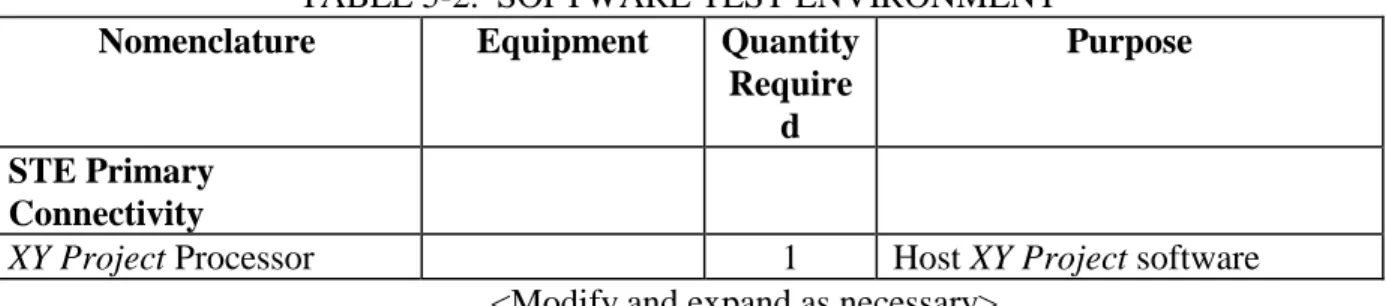
The Software Test Environment (STE) for the XY Project will be housed at <Bldg Y>. Many STE components will be the same as those used in the SEE. Table 5-2 lists the equipment to be used in the STE.
TABLE 5-2. SOFTWARE TEST ENVIRONMENT
Nomenclature Equipment Quantity
Require d
Purpose
STE Primary Connectivity
XY Project Processor 1 Host XY Project software
<Modify and expand as necessary>
[End Sample]
5.2.3 Software Development Library Guidance
The developer shall establish, control, and maintain a Software Development Library (SDL) to facilitate the orderly development and subsequent support of software. The SDL may be an integral part of the software engineering and test environments. The developer shall maintain the SDL for the duration of the contract.
Also refer to the Software Development Library (SDL) Template available from the SSC San Diego PAL.
[Sample]
The Software Development Library (SDL) is the master library of all programs, documents, reports, manuals, specifications, reference documents, and correspondence associated with the XY Project. The SCM Manager functions as the Software Librarian.
The SCM Manager controls the Software Development Files (SDFs), the records/minutes of formal reviews, the SEN series, and the Change Control Documents. The SDF is the control and tracking document for software components during all phases of the software development process. The Change Control Documents include the Problem/Change Report (P/CR) and the Review and Response (R&R) Form.
The SCM Manager will produce the XY Project Master Document Status Summary and the Change Control Document Status Summary. For administrative purposes, the SDL is subdivided into three distinct libraries: Document, Program, and Correspondence & Reference. The XY
5-6
Project Software Development Library is located at SSC San Diego. The XY Project Software Project Manager and SCM Manager will maintain control over all their software support items.
5.2.3.1 Document Library. The Document Library, located in <Bldg X>, consists of all specifications, manuals, documents, the SEN series, and other reports directly related to XY Project software. The associated P/CRs, SDFs, Document Review and Response (R&R) Forms, and the records/minutes of the formal reviews and other formal project meetings are included. Documents approved for baseline by the XY ProjectSoftware Project Manager will be given to the SCM Manager for Configuration Control (CC). The SCM Manager will be responsible for the preparation of the cover and title pages with appropriate signatures and the List of Effective Pages. Both machine (magnetic) and hard (paper) copy will be maintained in the Document Library. Upon receipt of changes to baseline documents, the Software Project Manager will ensure that the change is reviewed for completeness, accuracy, and form. When discrepancies are found, the change will be returned to the change originator for correction or resolution of the discrepancy. Upon approval of changes by the Software Project Manager, the SCM Manager will make changes to the baseline document and print a hard copy.
Clearly labeled drafts and preliminary iterations of XY Project documents may be placed in the Document Library at the discretion of the Software Project Manager until such documents are readied to be baselined. These documents may include technical, operations, maintenance, and specification manuals. Once baselined, all preliminary or draft issues will be disposed of as directed by the Software Project Manager. All updates and subsequent issues of documents must be maintained in the Document Library. Only current editions will be filed.
Document R&R Forms are maintained in the Document Library. A copy of Software Quality Assurance (SQA) review comments will be held in a file until responses are received and signed. The signed R&R forms will then be filed and may not be removed from the library. Working copies may be requested from the SCM Manager. All Test Reports will be maintained in the Document Library. The originals will not be removed from the library. Copies may be requested from the SCM Manager.
Classified documents will be handled in accordance with the Navy Security Manual, Executive Order 12958, and OPNAVINST 5510.1H.
5.2.3.2 Software Program Library. The Software Program Library is located in <Bldg X>, XY Project development site. The library consists of program disks and listings of programs that are under development and are being maintained in the SDL until delivered as a program package. Programs or program changes under development will be maintained by the Software
Development Group. Once ready for baselining, program modules are entered into the Program Library only by the SCM Manager. These procedures are subject to monitoring by the SQA Group’s activities.
5.2.3.3 Correspondence & Reference Library. The XY Project has its Reference Library located at <Bldg X> and consists of hardware technical manuals, military standards,
specifications, and instructions. It also consists of XY Project memoranda, documents, and deliverables related to the XY Project. Reference manuals and documents are categorized and filed by their military identification number. Classified materials are handled in accordance with the Navy Security Manual, Executive Order 12958, OPNAVINST 5510.1H, and DoD 5220.22-M. Only correspondence and items approved by the XY ProjectSoftware Project Manager are
accepted by the SCM Manager for inclusion in the Correspondence Library. Correspondence will be identified by originator, originator serial number, date of origination, and subject matter.
[End Sample]
5.2.4 Software Development Files Guidance
The developer shall establish, control, and maintain a SDF for each software unit or logically related group of Software Unit (SU)s, for each CSC, and, as applicable, for logical groups of CSCIs, for subsystems, and for the overall system. The developer shall record information about the development of the software in appropriate SDFs.
For additional information refer to the SSC San Diego Software Development File (SDF) Template available from the SSC San Diego PAL..
[Sample]
SDFs will provide visibility into the development status of the individual CSCIs. The Software Development Group will maintain SDFs for each Software Unit (SU) or collection of SUs that make up a functional component of a CSCI. SDFs will be the principal working logs for assigned programmers. The Software Development Group will maintain SDFs primarily on electronic media and periodically ensure the completeness, consistency, and accuracy of SDFs with respect to specifications, design, and user manuals.
The Software Development Group will organize SDFs to contain the following information: a. Introduction - Statement of purpose and objectives, lists the contents of the SDF. b. Requirements - SU allocated requirements with a cross reference to the parent CSCI
requirements and pertinent programmer notes.
c. Design Data - Schedules, Status, and the design in the design depiction method selected for the CSCI.
d. Source Code - Contains listings, by directory, of source code files. e. Test Plan and Procedures - Current unit test plan and procedures. f. Test Reports - Unit test results and reports.
g. Review and Audit Comments - Record of reviews and sign-off signatures resulting from reviews and informal audits
5.2.4.1 Software Development File Approach. At the beginning of the software planning phase, an SDF will be created for each CSCI functional component.
SDFs will be maintained by the Software Configuration Control Manager and will be
periodically audited by the Software Development Manager and SQAGroup. With the exception of metrics, each programmer is responsible for submitting all material and information required for preparation and maintenance of the SDFs.
5.2.4.2 Software Development File Format. In the front of each SDF is a task tracking sheet that contains schedules and actual dates of development milestones for the software component. The SDF contains sections applicable to each phase of the development of the software
component. Each section of the SDF begins with a header that identifies the phase, software component, and the contract. Each section contains metrics data, schedules, and phase-specific data such as interfaces or specification paragraph references. The SCM Manager will maintain the SDF database with input from responsible engineers.
5.2.4.3 Software Development File Measurements. The collection of measurements is performed in each software development phase. All defect containment information resulting
![Figure 4-2. Test Roles and Responsibilities [End Sample]](https://thumb-us.123doks.com/thumbv2/123dok_us/9589571.2445122/27.918.239.698.633.945/figure-test-roles-and-responsibilities-end-sample.webp)
![Figure 5-1 Project Planning and Oversight Process [End Sample]](https://thumb-us.123doks.com/thumbv2/123dok_us/9589571.2445122/36.918.127.651.269.675/figure-project-planning-oversight-process-end-sample.webp)