LEARNING OUTCOMES: 3.1 Introduction
1. Explain how cells differ from one another.
3.2 A Composite Cell
2. Describe the general characteristics of a composite cell.
3. Explain how the components of a cell’s membrane provide its functions. 4. Describe each kind of cytoplasmic organelle and explain its function. 5. Describe the cell nucleus and its parts.
3.3 Movements Into and Out of the Cell
6. Explain how substances move into and out of cells. 3.4 The Cell Cycle
7. Describe the cell cycle. 8. Explain how a cell divides. 3.5 Control of Cell Division
9. Describe several controls of cell division. 3.6 Stem and Progenitor Cells
10. Explain how stem cells and progenitor cells make possible growth and repair of tissues.
11. Explain how two differentiated cell types can have the same genetic information, but different appearances and functions.
3.7 Cell Death
12. Discuss apoptosis.
3.1 INTRODUCTION
The cell is the basic unit of structure and function in living things. Cells vary in their shape, size, and arrangement (See Fig 3.1 & Fig 3.2, page 85), but all cells have similar components, each with a particular function. As cells divide they differentiate or become specialized.
3.2. A COMPOSITE CELL
A. Introduction: A COMPOSITE CELL or typical animal cell contains three major cell parts including the CELL (or plasma) MEMBRANE, which is the outer boundary of the cell, the CYTOPLASM, which holds the cellular organelles which perform specific functions of the cell, and the NUCLEUS, or control center of the cell. See Fig 3.3, page 86.
B. Cell Membrane
1. General Characteristics: The cell membrane forms the outermost boundary of the cell and allows the cell to receive and respond to incoming messages = signal transduction (discussed in greater detail in Chapter 13). 2. Membrane Structure = Fluid Mosaic Model
See Fig 3.6, page 88 and Fig 3.7, page 89.
The cell membrane is composed of a double layer (bilayer) of phospholipid molecules with many protein molecules dispersed within it. a. The surfaces of the membrane are "hydrophilic" due to the polar
phosphate heads;
b. The internal portion of the membrane is "hydrophobic" due to the non-polar fatty acid tails;
c. The membrane proteins also have both hydrophilic and hydrophobic properties. There are five types:
See Table 3.1, page 89.
o Integral proteins are firmly inserted into and extend across the lipid bilayer. They serve as either channels (pores), transporters (carriers), receptors (recognition sites) or enzymes.
1. See Clinical Application 3.1, Faulty Ion Channels Cause Disease, page 90.
2. See Table 3A: Drugs that Affect Ion Channels, page 90.
o Receptor proteins
o Enzymes
o Cell Adhesion Molecules – guide cellular movements. See Fig 3.8 page 89.
3.2. A COMPOSITE CELL
C. Cytoplasm (cytosol) = the jelly-like fluid (70% water) that holds the cellular organelles and occupies the space between the nucleus and cell membrane. It contains abundant protein rods and tubules that form a supportive framework (i.e. cytoskeleton, see below).
D. Ribosomes:
1. small granules dispersed throughout the cytoplasm and on the membranes of some endoplasmic reticulum (as rough endoplasmic reticulum); See Fig 3.9a and b, page 91.
2. composed of RNA and protein 3. Function = protein synthesis. 4. Not bound by a membrane
E. Endoplasmic Reticulum (ER): See Fig 3.9, page 91.
1. A network of interconnected parallel membranes (maze), that is continuous with the nuclear membrane.
2. Two types:
a. Rough Endoplasmic Reticulum (RER): Fig 3.9a & b, page 91. o ER studded with ribosomes.
o Function = protein synthesis.
b. Smooth Endoplasmic Reticulum (SER): Fig 3.9c, page 91. o lacks ribosomes
o Function = lipid & cholesterol synthesis. o Stores calcium ions
o Abundant in liver cells (hepatocytes) F. Vesicles
1. membrane transport sacs
2. made by ER and Golgi (see G. below).
G. Golgi Apparatus (Complex): See Fig 3.10, page 92.
1. flattened membranous sacs ("cisternae") arranged in stacks ("stack of pancakes") associated with many vesicles (membrane bound sacs containing proteins).
2. Function = modification, packaging, and transport of proteins.
3. Vesicles pinch off as "secretory vesicles", which are transported out of the cell. See Fig 3.10b, page 92 and Fig 3.11, page 93.
3.2 A COMPOSITE CELL
H. Mitochondria (pl); Mitochondrion (s): See Fig 3.12, page 93.
1. kidney-shaped organelle whose inner membrane is folded into shelf-like partitions called cristae.
2. "Powerhouse" of the cell = site of cellular respiration, where energy is released from glucose.
3. See box on page 94 re: mitochondrial DNA.
4. See Clinical Application 3.2, Disease at the Organelle Level, page 95, MELAS.
I. Lysosomes: See Fig 3.13, page 94.
1. spherical membranous sacs containing digestive enzymes (proteins) 2. "suicide sacs" which destroy anything the cell no longer wants or needs. 3. Autolysis is the process by which worn cell parts are digested by
autophagy.
4. See Clinical Application 3.2, Disease at the Organelle Level, page 95, Krabbe Disease.
See Fig 3.10b, page 92, which summarizes the close relationship between RER and GA and lysosomes in protein transport.
J. Peroxisomes:
1. membranous sacs containing oxidase enzymes
2. Function = detoxification of harmful or toxic substances (i.e. alcohol, formaldehyde, oxygen free radicals).
3. H2O2 (peroxide) → water.
4. See Clinical Application 3.2, Disease at the Organelle Level, page 95, Adrenoleukodystropy (ALD).
K. Centrosome: See Fig 3.14, page 96.
1. pair of microtubules located near the nucleus 2. aid in movement of chromosomes during mitosis. L. Cilia and Flagella and Microvilli
1. Cilia (pl)/ Cilium (s): See Fig 3.15, page 96.
a. short, hair-like cellular extensions (eyelashes) b. help move substances through passageways c. located in lining of trachea and fallopian tube 2. Flagella (pl)/ Flagellum (s): See Fig 3.16, page 97.
a. tail-like projection
b. only one flagellum per cell in humans c. aid(s) in cell locomotion
d. Example is sperm cell 3. Microvilli: See Fig 3.3, page 86.
a. small finger-like extensions of the external surface of the cell membrane
3.2 A COMPOSITE CELL
M. Microfilaments and Microtubules: See Fig 3.17, page 97 and Fig 3.18, page 98. 1. protein structures called microfilaments, microtubules, and intermediate
filaments
2. form "muscles and bones" of the cell
3. allow for intracellular transport and movement * See box on page 97 re: epidermolysis bullosa. N. Other structures
1. inclusions
a. temporary storage
b. pigments (melanin), lipids, and glycogen
O. Cell Nucleus = the central core, control center or "brain" of the cell. See Fig 3.19, page 99.
1. the largest organelle of the cell 2. filled with nucleoplasm
3. contains three distinct regions:
a. Nuclear envelope is a double membrane that separates the contents of the nucleus from the cytoplasm.
o At various points, these two membranes fuse = nuclear pore(s).
o The nuclear membrane is "selectively permeable"; pores serve as sites where mRNA can pass out of the nucleus during protein synthesis, and how ribosomes exit the nucleus.
b. Nucleolus = dense spherical body(ies) within the nucleus; pl = nucleoli
o composed of RNA and proteins; o Function = synthesis of ribosomes.
c. Chromatin = loosely coiled fibers of DNA and histone proteins present in the nucleus.
o Nucleosome = fundamental unit of chromatin; spherical clusters of eight histone proteins connected like beads on DNA string.
o These fibers of chromatin would be condensed into tightly coiled chromosomes if the cell were preparing to divide.
3.2 A COMPOSITE CELL: SUMMARY TABLEOF CELL PARTS See Table 3.2, page 99 in text and key at the end of the outline.
CELL COMPONENT DESCRIPTION/
STRUCTURE FUNCTION(S) CELL MEMBRANE CYTOPLASM RIBOSOMES ROUGH ENDOPLASMIC RETICULUM (ER) SMOOTH ER GOLGI VESICLES MITOCHONDRIA LYSOSOMES PEROXISOMES CENTROSOMES CILIA FLAGELLA MICROVILLI CYTOSKELETON OTHER STRUCTURES NUCLEUS NUCLEOLUS CHROMATIN
3.3 MOVEMENTS INTO AND OUT OF THE CELL (Membrane Transport)
A. Introduction: The passage of a substance through the cell membrane may be physical (passive, requires no energy expenditure) or physiologic (active process, requires energy expenditure).
1. In physical (passive) transport processes, substances move from where they are in high concentration to where they are in low concentration. Passive transport processes include simple diffusion, facilitated diffusion, osmosis, and filtration.
2. In physiologic (active) transport mechanisms, substances move from where they are in low concentration to where they are in high concentration at the expense of cellular energy (ATP). Active processes include active transport, endocytosis, exocytosis and transcytosis.
B. Physical (Passive) Transport Processes (require no energy expenditure): 1. Simple Diffusion
a. Molecules or ions spread spontaneously down a concentration gradient.
b. A state of equilibrium is produced. c. Examples:
o A sugar cube dissolving in water; See Fig 3.20, page 100. o A drop of dye diffusing in water.
o An odor diffusing throughout the air in a room.
o The diffusion of oxygen and carbon dioxide through the cell membrane. See Fig 3.22, page 101.
d. Significance in human metabolism: Cellular respiration.
2. Facilitated Diffusion: See Fig 3.23, page 101. a. a special case of diffusion.
b. Concentration gradient is high to low.
c. Special carrier protein molecules within the cell membrane act as shuttle buses to transport a molecule into/out of a cell.
d. Significant because this is the process by which most glucose enters (and leaves) human cells; Cellular respiration.
3.3 MOVEMENTS INTO AND OUT OF THE CELL (Membrane Transport) B. Physical (Passive) Transport Processes (require no energy expenditure):
3. Osmosis: See Fig 3.24, page 102.
a. Diffusion of WATER molecules through a SELECTIVELY PERMEABLE MEMBRANE (i.e. cell membrane), in an attempt to dilute a particular solute.
b. Remember that water can pass through the membrane, but the solute cannot!!!
c. Osmosis is significant in maintaining the osmotic pressure of our cells at 0.9%.
o The solutes dissolved in the water of our cells, tissue fluid, and blood, measure 0.9% (saline).
o When solutions are infused into our blood or tissues, the solute concentration of the solution must be equal to that of our cells and tissues (isotonic = 0.9%), or our cells will either:
1. lose water and shrink, or
2. gain water and swell; perhaps burst or lyse.
d. Osmosis is demonstrated nicely with red blood cells (rbc's) being placed in solutions of varying tonicity. See Fig 3.25, page 103. o Three (3) conditions may exist:
1. Isotonic
2. Hypertonic
3.3 MOVEMENTS INTO AND OUT OF THE CELL (Membrane Transport) B. Physical (Passive) Transport Processes (require no energy expenditure):
4. Filtration: See Fig 3.26 and Fig 3.27, page 103.
a. Water and solutes are forced through a body membrane by the hydrostatic pressure of blood (i.e. blood pressure).
b. Concentration gradient is high to low.
c. Solutes include glucose, gases, ions, hormones, and vitamins.
d. Example is excretion: blood being filtered through the capillaries (glomerulus) of the kidney to remove wastes.
C. Physiologic (Active) Transport Processes (require energy expenditure) 1. Active Transport: See Fig 3.28, page 104.
a. Molecules or ions move from an area where they are in low concentration toward an area where they are in higher concentration at the expense of cellular energy (i.e. ATP).
o substances include many ions, amino acids, and monosaccharides.
o The Na+- K+- ATPase pump (which maintains the Resting Membrane Potential, RMP in many cells) is an example.
2. Endocytosis
a. Molecules or particles that are too large to enter the cell by passive transport or active transport (above) are brought into the cell within a vesicle formed from a section of the cell membrane.
b. Examples:
o Pinocytosis = cell drinking; the cell brings in liquid droplets which may contain dissolved substances. See Fig 3.29, page 104.
o Phagocytosis = cell eating; the cell engulfs and brings in a solid particle. See Fig 3.30 – 3.31, page 105.
1. Phagocytes (or macrophages) are very important scavenger white blood cells in humans.
2. They will bring in foreign particles, bacteria, etc., a. that then fuses with a lysosome in their
cytoplasm to digest the foreign particles. o Receptor-Mediated Endocytosis
See Fig 3.32, page 106.
3.3 MOVEMENTS INTO AND OUT OF THE CELL (Membrane Transport) C. Physiologic (Active) Transport Processes (require energy expenditure)
3. Exocytosis: See Fig 3.33, page 107.
a. Is the process by which cells transport secretory proteins out? Also see Fig 3.11, page 92 and Fig 3.12, page 93.
b. allows cells to get rid of debris by dumping it to the outside (i.e. into the extracellular fluid).
4. Transcytosis: See Fig 3.34, page 107.
a. combines endocytosis with exocytosis.
b. Particles travel across cell from apical to basal surfaces.
c. enables the immune system to monitor pathogens in small intestine preventing food poisoning.
d. The HIV virus passes through mucous membranes in this fashion. * See Table 3.3, page 108 for a Summary of Transport Processes.
MEMBRANE TRANSPORT SUMMARY TABLE (Keyed at the end of the outline) TRANSPORT PROCESS IS ENERGY REQUIRED? [ ] Gradient GENERAL DESCRIPTION EXAMPLE IN HUMANS SIGNIFICANCE SIMPLE DIFFUSION FACILITATED DIFFUSION OSMOSIS FILTRATION ACTIVE TRANSPORT ENDOCYTOSIS EXOCYTOSIS TRANSCYTOSIS
3.4 THE CELL CYCLE
The life cycle of a cell is divided into two major portions that include interphase and a mitotic phase. Remember that the process of cell division is continuous. It is only divided into stages for convenience and to help you learn.
See Fig 3.35, page 108, which illustrates the cell cycle as a continuum. A. Interphase = cell growth and DNA replication.
See Fig 3.36a, page110.
1. not considered part of mitosis
2. represents the majority of a cell's life and includes: a. cell growth and
b. duplication of DNA prior to prophase 3. Interphase is divided into 3 parts:
a. G1 = rapid growth and replication of centrioles. b. S = growth and DNA replication.
c. G2 = growth and final preparations for cell division. B. MITOTIC PHASE (M):
1. The mitotic phase (M) is divided into 2 parts that include mitosis and cytoplasmic division (cytokinesis).
a. Mitosis = division of nuclear parts includes four parts:
o Prophase: See Fig 3.36b, page 110.
1. Distinct pairs of chromosomes become apparent
(tightly coiled DNA and histone proteins).
a. Chromosomes pairs are composed of identical sister chromatids, held together by centromeres.
2. Centriole pairs migrate to opposite ends of cell, and spindle fibers form between them.
3.4 THE CELL CYCLE
B. Mitotic (M) phase (continued) a. Mitosis (continued)
2. Metaphase: See Fig 3.36c, page110.
o Chromosomes line up in an orderly fashion midway between the centrioles (i.e. along equatorial plate).
o Centromere holding chromosome together attaches to spindle fiber between centrioles.
3. Anaphase: See Fig 3.36d, page 110.
o Centromere holding chromosome pair together splits/ separates.
o Individual chromosomes migrate in opposite directions on spindle fibers toward polar centrioles.
o cytokinesis begins.
4. Telophase: See Fig 3.36e, page 110.
o Chromosomes complete migration toward centrioles. o Nuclear envelope develops around each set of
chromosomes.
o Nucleoli develop and reappear. o Spindle fibers disintegrate.
o Cleavage furrow is nearly complete.
b. Cytoplasmic Division (Cytokinesis; forming of 2 daughter cells)
1. begins during anaphase, when the cell membrane begins to constrict (pinch) around daughter cells.
2. is completed at the end of telophase when nuclei and cytoplasm of two newly formed daughter cells (in interphase) are completely separated by cleavage furrow.
3. See Fig 3.37c, page 111. * See Table 3.4, page 109, Major Events in Mitosis.
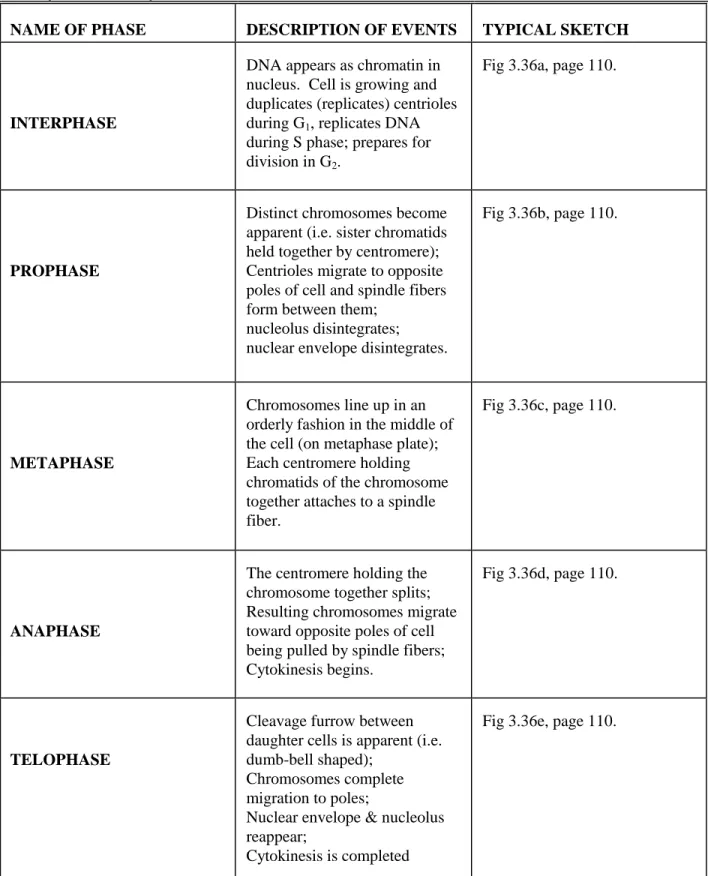
3.4 THE CELL CYCLE: See Table 3.4, page 109 and key at end of this outline.
NAME OF PHASE DESCRIPTION OF
EVENTS TYPICAL SKETCH INTERPHASE PROPHASE METAPHASE ANAPHASE TELOPHASE
3.5 CONTROL OF CELL DIVISION A. Significance
1. to form a multi-celled organism from one original cell 2. growth of organism
3. tissue repair B. Length of the Cell Cycle
1. varies with cell type, location, and temperature 2. Average times are 19-26 hrs.
3. Neurons, skeletal muscle, and red blood cells do not reproduce.
C. Details of Cell Signaling
1. Maturation promoting factor (MPF) induces cell division when it becomes activated.
2. cdc2 proteins are a group of enzymes that participate in the cell division cycle.
a. They transfer a phosphate group from ATP to proteins to help regulate cell activities.
3. Cyclin is a protein whose level rises and falls during the cell cycle.
a. It builds up during interphase and activates the cdc2 proteins of MPF above.
D. Abnormal Cell Division (CANCER) See Table 3.5 page 112.
1. When cell division occurs with no control (goes awry), a tumor, growth, or neoplasm results.
2. A malignant tumor is a cancerous growth; a non-cancerous tumor is a benign tumor;
a. Malignant tumors may spread by metastasis to other tissues by direct invasion, or through the bloodstream or lymphatic system.
3. Oncology is the study of tumors; an oncologist is a physician who treats patients with tumors.
4. See Figure 3.38, page 112, an SEM of normal vs. cancer cells.
5. See box on page 112 re: Granulocyte Colony Stimulating Factor (G-CSF) used in chemotherapy patients to boost white cell counts.
3.6 STEM AND PROGENITOR CELLS: See Fig 3.40, page 114. Allow for continued growth and renewal of cells
A. A Stem cell
1. divides by mitosis to yield another stem cell and 2. a partially differentiated progenitor cell.
B. Progenitor cell See Fig 3.40 page 114. 1. committed to a specific cell line
a. epithelial b. connective c. muscle d. nervous
C. Totipotent cells – can become any cell type.
D. Pluripotent cells – can become many cell types, but not all.
E. Differentiation is the process of specializing cell types. It occurs due to gene activation
* Figure 3.41 page 115 illustrates how a totipotent stem cell becomes pluripotent progenitor cells, which further differentiate into specific cells.
* See From Science to Technology 3.1 on page 116, Stem Cells to Study and Treat Disease.
3.7 CELL DEATH
A. Apoptosis = programmed cell death; a fast, orderly contained destruction that packages cellular remnants into membrane-enclosed pieces that are then removed. 1. is a normal part of development
2. sculpts organs from tissues that naturally overgrow – important in fetal development
3. is protective – peeling skin after sunburn to prevent possible cancer 4. is continuous and step-wise, like mitosis:
a. “Death receptor” on doomed cell cell’s membrane receives a signal to die.
b. Enzymes called caspases are activated and destroy the various cell components.
c. The dying cell’s shape becomes round as it is cut-off from other cells. d. Its cell membrane undulates forming bulges or blebs.
e. The nucleus bursts and mitochondria decompose. f. The cell shatters (within one hour of caspases release).
g. Inflammation is prevented because fragments are membrane encapsulated.
5. See Figure 3.42, page 117.
OTHER INTERESTING TOPICS:
A Disease in a Dish re: Rett Syndrome, see Introduction on page 84. CHAPTER SUMMARY – see pages 117-119.
CHAPTER ASSESSMENTS – see pages 119-120.
SUMMARY TABLEOF CELL COMPONENTS:
CELL COMPONENT DESCRIPTION/
STRUCTURE
FUNCTION(S)
CELL MEMBRANE Bilayer of phospholipids with proteins dispersed throughout
cell boundary; selectively permeable (i.e. controls what enters and leaves cell; membrane transport) CYTOPLASM jelly-like fluid (70% water) suspends organelles in cell
RIBOSOMES RNA & protein; dispersed
throughout cytoplasm or studded on ER
protein synthesis
ROUGH ER Membranous network
studded with ribosomes
protein synthesis
SMOOTH ER Membranous network
lacking ribosomes
lipid & cholesterol synthesis
GOLGI “Stack of Pancakes”;
cisternae
modification, transport, and packaging of proteins
VESICLE Cylindrical membrane sacs Storage and transport
MITOCHONDRIA Kidney shaped organelles
whose inner membrane is folded into “cristae”.
Site of Cellular Respiration; “Powerhouse”
LYSOSOMES Membranous sac of
digestive enzymes
destruction of worn cell parts (autolysis) and foreign particles
PEROXISOMES Membranous sacs filled
with oxidase enzymes (catalase)
detoxification of harmful substances (i.e. ethanol, drugs, etc.)
CENTROSOMES
paired cylinders of microtubules at right angles near nucleus
aid in chromosome movement during mitosis
CILIA short, eyelash-like
extensions; human trachea & fallopian tube
help move substances through passageways
FLAGELLA long, tail-like extension;
human sperm
locomotion
MICROVILLI microscopic ruffling of cell membrane; duodenum
increase surface area
CYTOSKELETON Protein strands
(microtubules, microfilaments,
intermediate filaments) that makeup cellular frame
Provide shape of cell, locomotion; intracellular movement
OTHER STRUCTURES Accumulations of substances
storage
NUCLEUS Central control center of
cell; bound by lipid bilayer membrane; contains
chromatin (loosely coiled DNA and proteins)
controls cellular activity by directing protein synthesis (i.e. instructing the cell what proteins/enzymes to make).
NUCLEOLUS dense spherical body(ies)
within nucleus; RNA & protein
Ribosome synthesis
CHROMATIN DNA wrapped in protein
forming nucleosomes
Protection of genetic material
MEMBRANE TRANSPORT SUMMARY TABLE TRANSPORT PROCESS IS ENERGY REQUIRED? [ ] Gradient GENERAL DESCRIPTION EXAMPLE IN HUMANS SIGNIFICANCE SIMPLE DIFFUSION NO [HIGH] TO [LOW] spreading out of molecules to equilibrium O2 into cells; CO2 out of cells. Cellular Respiration FACILITATED DIFFUSION NO [HIGH] TO [LOW] Using a special cm carrier protein to move something through the cell membrane (cm) Process by which glucose enters cells Gaining necessary material; cellular respiration OSMOSIS NO [HIGH] TO [LOW] water moving through the cm to dilute a solute Mainte-nance of osmotic pressure of 0.9%. Regulation of cell size FILTRATION NO [HIGH] TO [LOW] using pressure to push something through a cm manner in which the kidney filters things from blood removal of metabolic wastes ACTIVE TRANSPORT YES [LOW] TO [HIGH] opposite of diffusion at the expense of energy K+-Na+ -ATPase pump maintenance of the resting membrane potential
ENDOCYTOSIS YES [LOW] TO [HIGH]
bringing a substance into the cell that is too large to enter by any of the above ways; Phagocytosis: cell eating; Pinocytosis: cell drinking. Phagocytos ed (foreign) particles fuse with lysosomes to be destroyed help fight infection; control disease
EXOCYTOSIS YES [LOW] TO [HIGH]
expelling a substance from the cell into ECF Exporting proteins; dumping waste Excretion of waste
TRANSCYTOSIS YES [LOW] TO [HIGH] Endocytosis followed by exocytosis Immune system monitors pathogens in sm int; HIV Protects against food poisoning; manner in which HIV crosses mucous membranes
Cell Cycle Summary
NAME OF PHASE DESCRIPTION OF EVENTS TYPICAL SKETCH
INTERPHASE
DNA appears as chromatin in nucleus. Cell is growing and duplicates (replicates) centrioles during G1, replicates DNA
during S phase; prepares for division in G2.
Fig 3.36a, page 110.
PROPHASE
Distinct chromosomes become apparent (i.e. sister chromatids held together by centromere); Centrioles migrate to opposite poles of cell and spindle fibers form between them;
nucleolus disintegrates; nuclear envelope disintegrates.
Fig 3.36b, page 110.
METAPHASE
Chromosomes line up in an orderly fashion in the middle of the cell (on metaphase plate); Each centromere holding chromatids of the chromosome together attaches to a spindle fiber.
Fig 3.36c, page 110.
ANAPHASE
The centromere holding the chromosome together splits; Resulting chromosomes migrate toward opposite poles of cell being pulled by spindle fibers; Cytokinesis begins.
Fig 3.36d, page 110.
TELOPHASE
Cleavage furrow between daughter cells is apparent (i.e. dumb-bell shaped);
Chromosomes complete migration to poles;
Nuclear envelope & nucleolus reappear;
Cytokinesis is completed