|| Volume || 4 || Issue || 2 || Pages || PP.46-68|| 2015 ||
ISSN (e): 2319 – 1813
ISSN (p): 2319 – 1805
Process-Centred Functionality View of Software Configuration
Management: A Contextualized Model
1
Davis Nyakemwa Onsomu, Msc.
2Elisha Ondieki Makori, PhD
3
Patrick Kinoti , Msc.
1Department of Computing Sciences, Kisii University 2Department of Computing Sciences, Kisii University 3Department of Computing Sciences, Kisii University
---ABSTRACT---
This paper aims to propose a contextualized software configuration management model that is relevant and beneficial to small and medium software development firms operating in developing countries including Kenya. The study involved qualitative and quantitative research that focused on selected small and medium software development firms in Nairobi City, Kenya. Expert opinions and ideas of software engineering professionals especially lead developers and developers provided vital knowledge. Findings from the study indicate that most of the software firms employed the traditional software configuration management models with a significant minority without any model. Interestingly, majority of the firms did not practice conventional and standard phases of SCM. In addition, most firms did not practice software configuration management across all software projects undertaken. There is no specific contextualized SCM model in existence to address the needs of small and medium software development firms in developing countries including Kenya. The study identified numerous challenges faced by these firms such as bureaucratic nature of existing SCM standards and models, time consuming to implement nature of existing standards and models; limited skilled manpower to handle SCM; perception of SCM as being time-intensive and therefore time consuming; frequently changing demands from clients viewed as hindrance to applying SCM; perception of SCM as being cost intensive and therefore uneconomical to practice; perception of SCM as being labour intensive and therefore leads to schedule delays; finding the process of handling the tracking of change requests and defect reports difficult to manage; challenge when it comes to simultaneous update of changes made by different developers; challenge of logical conflict whereby when changes are committed, a component of the program that has not been modified leads to the generation of software errors when the software or program is run; challenges in smoothly managing the various sub-processes involved when practicing SCM. The study proposed SCM model for capturing the aspirations and satisfying the needs of small and medium software development firms. The effectiveness of the employed SCM models was robustly questioned as numerous challenges regarding the SCM practice of such firms were identified. The proposed SCM model was highly approved and recommended by the respondents, a clear indication that it captured the aspirations and needs of a significant majority of the study participants. This study purposively focused on selected sample of the small and medium software development firms in Nairobi city, Kenya in addition to expert opinions and ideas from software engineers in the industry. This study proposed a software configuration management model that is adaptable and customizable to the needs and aspirations of small and medium software development firms. This is significant for the small and medium software development firms that operate in different policy, regulatory, industry and organizational contexts. The applicability of the models designed for developed countries is not always relevant to small and medium software development firms in developing countries. The proposed software configuration management model integrates a process-centered functionality view of the software configuration management process that includes context into process descriptions enabling process owners to design own processes for change and be able to switch such processes during execution resulting in adaptive and modular processes. Moreover, the process designs can be reused by different projects with similar context and also switched during process execution if the given project’s context changes. Approval of the proposed software configuration management model by majority of the respondents is proof enough that the proposed model can meet the needs and requirements of small and medium software development firms operating in developing countries. Willingness to adopt the proposed SCM model by majority of the respondents in own software development firms indicates that small and medium software development firms, lead developers, developers and stakeholders in the software engineering industry are satisfied with the operations of this proposed model, and the need for further development into a software tool for commercial use. Most of the small and medium software development firms do not appreciate and embrace existing software configuration management models due to the bureaucratic nature of the design and perceived bias portrayal towards large firms. Software configuration management is a
key component in the general software engineering process to useful realization of quality software and software products. As a result, there is need to address this particular gap by proposing a contextualized software configuration management model for small and medium software development firms, more so in developing countries. Such firms operate in different policy, regulatory, industry and organizational contexts, and as a result, the applicability of the models designed for developed countries is not always relevant to these firms. There is need to develop a software configuration management model that is relevant to the needs and demands of small and medium software development firms in developing countries including Kenya.
Keywords: Contextualized, functionality view, context definition, process sequence, process abstraction, solid processes.
---Date of Submission: 1 September 2014 Date of Accepted: 06 March.2015 --- ---
I.
INTRODUCTION
Studies indicate that various software configuration management models have been proposed in developed countries such as China, United States of America, Brazil and Denmark. The models have been developed using different architectures and include: component-based software development, POEM, Odyssey-VCS and Ragnarok architectural model (Mei, Zhang & Yang, 2002; Lin & Reiss, 1995; Murta et al, 2007; Christensen, 1999). Component-based software development model was designed to support software development process together with traditional software configuration management in order to solve issues in management of logical software constituents and relationships. The United States of America, POEM, software configuration management model, stores large software artifacts such as source code, object code and documents as files in the underlying file system without allowing users to directly access files and directories of the underlying file system. The Odyssey-VCS model proposed and designed in Brazil, is the integrated software configuration management model for unified modelling language models. This model composes of version control system and two complementary components: customizable change control system and traceability link detection tool that uses data mining to discover change traces among versioned UML model elements and provides the rationale of change traces, automatically collected from the integrated SCM infrastructure. This model is focused towards software configuration management on software developed using fine-grained UML model elements (Murta et al, 2007). In Denmark, Ragnarok architectural Model allows tight version control and configuration management of the architecture of the software system. The model takes the logical software architecture as the starting point and uses this structure to drive the version-and-configuration control process. Ragnarok places strong emphasis on reproducibility of configurations and architectural changes. In addition, this model emphasizes the application to the handling of software with evolving architecture tendency, (Christensen, 1999). Findings reveal that most of the software configuration management models in existence in the world today, evolved completely independent of each other, based on the needs of the unique platforms design and perceived ways in which the software was developed in respective environments. Many companies created home-grown SCM models to meet own specific needs while software vendors responded with a plethora of models, most with bias towards single platform or context (Cravino et al, 2009).
In some developing countries including Kenya, different studies show that there is lack of software configuration management model that specifically addresses the needs of small software development firms (Pino, Garcia & Piattni, 2009; Mohan et al, 2008; Er & Erbas, 2010; Kogel, 2008). Small and medium software development firms in developing countries operate in different policy, regulatory, industry and organizational contexts.
Additionally, the applicability of the models designed for developed countries is not always relevant to small and medium software development firms in developing countries. In addition, there is a lack of a software configuration management model that looks at the SCM practice from a process-centered functionality area view of configuration management functionality requirements with an aim of providing a contextualized approach for small software development firms in addressing pertinent issues, problems and weaknesses inherent in existing SCM models and even systems (Humble & Farley,2010; Balamuralidhar & Prasad,2011; Ochuodho & Brown,1991; Hong et al,2002; Rosenblum& Krishnamurthy,1991).
There are four traditional standard SCM models in existence from which SCM models accepted and applied in business organizations today as exemplified by Feiler (2010) and identified in the literature (Sovran et al, 2011; Dix & Gongora, 2011; Rodriguez et al, 2011; Rubin et al, 2008; Zhu et al, 2011; Kaur & Singh, 2011): the check-out/check-in, composition, long transaction and change set. The classification is based on certain patterns
observed in support of the repository which is the centralized library, that consists of objects that are under configuration management control. Most SCM systems today are essentially based on any one of these models. Despite this, this study has identified paramount weaknesses in these four models and hence shall capitalize on the same to yield contextualized software configuration management model that is specific to the needs of small and medium software development firms in developing countries.
Statement of the Problem
In the current era, small and medium software development companies form large population out of the total number of software companies in the world. Start-up companies play significant role in the booming software economy, although literature discussing the issues of small and medium software development firms in terms of software configuration management process or methods is virtually non-existent.
One of the greatest difficulties in applying software configuration management in small companies is the unawareness of the importance of that activity and, sometimes, the idea that the task is a bureaucratic service that only produces delays.
There is evidence that majority of small and medium software firms are not adopting existing standards, perceiving the standards as being oriented towards large organizations. Existing standards and models are more complex for small enterprises to comprehend owing to inadequate availability of skills and resources. Studies show that small and medium firms’ negative perceptions of process model standards are primarily driven by negative views of cost, documentation and bureaucracy. Different studies indicate lack of software configuration management model that specifically addresses the needs of small and medium software development firms especially in developing countries (Pino, Garcia & Piattni, 2009; Mohan et al, 2008; Er & Erbas, 2010; Kogel, 2008).
Small and medium software development firms in developing countries operate in different business environment that is not always conducive for the applicability of the models designed for developed countries. Additionally, there is lack of software configuration management model that looks at the SCM practice from process-centered functionality area view of configuration management functionality requirements in relation to providing contextualized approach for small and medium software development firms in addressing pertinent issues, problems and weaknesses inherent in existing models and even systems (Humble & Farley,2010; Balamuralidhar & Prasad,2011; Ochuodho & Brown,1991; Hong et al, 2002; Rosenblum & Krishnamurthy,1991).
Purpose of the Study
The main objective of this study was to propose software configuration management model that is suited to the needs and captures the aspirations of small and medium software development firms in developing countries including Kenya.
Objectives of the Study
i. Propose contextualized SCM model that is relevant and beneficial to small and medium software firms in Kenya and other developing countries.
ii. Evaluate the effectiveness of the proposed contextualized SCM model in small and medium software firms.
Research Question
i. To what extent is the proposed SCM model relevant and beneficial to small and medium software firms in Kenya and other developing countries?
II.
LITERATURE SURVEY
2.1 Research Gaps in Existing SCM Models
Existing models have numerous challenges or research gaps as noted by various authors grouped as process functionality, auditing functionality, accounting functionality and controlling functionality.
2.1.1 Process Functionality
Process functionality involves a number of aspects such as clear definition of processes, support and indiscipline indistinction, invalidated effectiveness of life cycle support, unclear task management process, informational indecisions in tool use and invalidation of automated workflow systems.
In the aspect of clear definition of processes, although every SCM system comes with built-in process in the small (check-out/ check-in cycle and long transactions), the degree to which large scale processes are supported varies. Professional experience advises that the big leap forward is the clear definition of software processes. Use of tools is beneficial only if the tools are really supportive although such tools take the role of bureaucrats increasing the number of required interactions for the developers. SCM systems that are too rigid in enforcing the process are cursed by developers and reduce effectiveness (Fruhauf & Zeller, 1999; Loumos et al, 2010; Aiello & Sachs, 2010; Berzisa & Grabis, 2011).Resource implications – particularly that of management time – mean that the implementation process is markedly more taxing for small and medium enterprises than large companies. Consequently, well-designed development process, with clear focus and effective process management improves efficiency and the likelihood of success, (Hudson et al, 2001).
In relation to support and discipline indistinction, the distinction between support (use of tools) and discipline (use of standard) remains to be validated in existing SCM models (Schmidt, 2012).The SCM automated tools used for the project and described in the software configuration management plan need to be compatible with the software engineering environment development or maintenance occurs. SCM tools offer wide range of capabilities, and the most useful tool set for supporting the engineering and management environment has to be chosen from among other available tool sets (IEEE Standard for SCM Plans, 1990).
In the context of quality, SMEs are finding it hard to distinguish between use of tools and use of standards as the requirement for marketing rather than for quality reasons. As a result SMEs in particular are not benefiting sufficiently from the quality industry, and thus, affecting the quality of products and services, confusing the system and displaying alarming lack of appreciation (Jones et al, 2010; Schmidt, 2012; European Telecommunications Standards Institute, 2011).
In invalidated effectiveness of life cycle support, one failure of existing SCM models is that the effectiveness of life cycle support has not been validated. The distinction between support and discipline, and thus, the effectiveness of life cycle support remains to be validated (Fruhauf & Zeller, 1999; Chen et al, 2011; Weinreich & Buchgeher, 2012; Crowston et al, 2012). Software SMEs view life-cycle support as being infeasible (overly time-consuming or costly to implement) rather than non-beneficial. Unlike the high-process focus in life cycle support, SMEs often adopt low process focus electing only to implement process improvements in response to negative business events (Clarke et al, 2010; Baddoo & Hall, 2010; Clarke et al, 2011).
In the aspect of unclear task management process, rather than enforcing activities, more advanced SCM systems offer means to track current and pending processes. Task management is the area overlapping with (project) management. If tools are used then there is need to carefully decide the type of information to be kept in the SCM model and the project management tool. Tight coupling of work activities with the state control of the work results leads to sluggish SCM systems (Fruhauf & Zeller, 1999; Klosterboer, 2010; Sarma & Hoek, 2008); therefore, in the existing models, task management is not clear. Considering evidence of important software process improvement occurring to the system life cycle, SMEs find it difficult to distinguish between task management and project management. This can be the case where there is SCM-specific process that has corresponding parent project level process, for example, the configuration identification and the software configuration identification process. There is strong overlap between task management and project management processes (Clarke et al, 2010; Baddoo & Hall, 2010; Clarke et al, 2011).
Regarding informational indecisions in tool use, task management is the area overlapping with (project) management. If tools are used, then there is need to carefully decide the type of information to be kept in the SCM model and project management tool. Failure of existing SCM models involves where the SCM tools used, is not carefully decided which type of information is kept in the model and project management tool (Fruhauf & Zeller, 1999; Heer et al, 2010; Dabbish et al,2010).
Most SMEs share characteristics that distinguish them from large enterprises. In contradiction, such characteristics may also impose restrictions on such firms’ economic, human and technological aspects such as technology adoption (Rivas et al, 2010).
In invalidation of automated workflow systems, ultimate process support is achieved with automated workflow systems. To the contrary, such systems are not yet validated raising queries on how such systems handle workflow automatically. In practice, work flow is typically organized by informal communication. Most SCM systems support triggers that are associated with specific events like automatic notification by e-mail whenever change occurred. These communication features are well-understood, cheap and effective means for simple work flow support (Wang et al, 2012; Elmroth et al, 2010; Fruhauf & Zeller, 1999).One weakness or failure of existing SCM models is that automated workflow systems that achieve ultimate process support need to be validated. Workflow system that achieves process support in software SMEs is evidently deficient giving room for non-validation of processes within business operations that may hamper process improvement initiatives (Yahaya et al, 2012 & Ozcelik, 2010).
2.1.2 Auditing Functionality
Auditing functionality involves the aspect of traceability of related documents that is lacking in existing SCM models. Queries are raised on how changes during implementation can be traced back to the design phase and the requirements phase. Further queries have been raised regarding the relationship between changes in implementation and in documentation.
Every SCM system provides mature and widely used features to inquire about the change history of specific configuration items. In contrast, the unsolved problem is the traceability of related documents although change-based versioning or activity-change-based SCM (Micallef & Clemm, 1996), allows these changes to be associated with each other. There is still room for improvement in this particular aspect (Anquetil et al, 2010; Mader et al, 2012; Fruhauf & Zeller, 1999).Software configuration status accounting is the record keeping and reporting activity performed by the configuration librarian to maintain the traceability of changes and product versions. This may not be applicable in majority of software SMEs since such firms tend to view the procedure as overly bureaucratic and time-consuming (Habra et al, 2011).
2.1.3 Accounting Functionality
Accounting functionality involves the aspect of deficiencies in tagging. Accounting facilities let users (and managers) inquire about the status of the product. SCM systems at least allow classifying components and versions according to specific properties (experimental, proposed or stable). Consequently, existing SCM models are facing pending problems in the simple tagging method used to facilitate the classification of components and versions according to specific properties (experimental, proposal or stable) (Fruhauf & Zeller, 1999; Treude & Storey, 2009; Kim & Youn, 2010).Software SMEs disregard the techniques and procedures that guarantee proper tagging used to facilitate classification of versions and components during software status accounting of the SCM. This results in misclassification of versions that undermines version and component traceability (Habra et al, 2011; Ozcelik, 2010; Yahaya et al, 2012).
2.1.4 Controlling Functionality
Controlling functionality involves the aspect of failed control processes. Tracking of change requests and defect reports is at the heart of the maintenance process, starting as soon as independent testing begins. The process of handling these, especially responsibility for decisions and definitions of records to be kept, determines the responsiveness of the organization on user needs. In small organizations, simple Excel sheet provides enough support, however, bigger organizations require elaborated database with dedicated queries, failure in existing SCM models. Tracking of product defects is significant SCM topic that provides immediate insight on the current product quality. Bug-tracking tools frequently come as standalone tools, from the freely available GNATS system to elaborated commercial systems. On the contrary, the integration with SCM repositories as well as automated testing facilities still leaves a lot to be desired, raising challenges for SCM vendors and researchers (Rupareila, 2010; Chen & Chen, 2009; Fruhauf & Zeller, 1999).Software SMEs are evidently noted for casually handling the issue of change request tracking and this undermines the quality of the final software product considerably (Rivas et al, 2010; Mader & Gotel, 2012; Loumos et al, 2010).
2.2 Other Research Gaps in Existing SCM Models
Other challenges or research gaps identified in SCM Models are explained as follows: In the aspect of mismanagement of change requests, advanced SCM systems (Whitgift, 2001) offer elaborated management of change requests. The effectiveness of the process remains to be validated, although improvements are more likely to come from SCM vendors than from SCM researchers (Hadden, 1998 & Fruhauf & Zeller, 1999). The effectiveness of the elaborated management of change requests whereby the whole development process is organized along the processing of change requests as depicted in the LIFESPAN SCM system/ model needs to be validated. Software SMEs are evidently noted for casually handling the issue of change request tracking and this undermines the quality of the final software product considerably (Rivas et al, 2010; Mader & Gotel, 2012; Loumos et al, 2010).
Disintegration of interfacing processes is where advanced SCM models like LIFESPAN offer elaborated management of change requests where the whole development process is organized along the processing of change requests. The effectiveness of the process remains to be validated by existing SCM models. Tracking of product defects provides immediate insight on the current product quality, however, the integration with SCM repositories as well as automated testing facilities still leaves a lot to be desired which is failure on the part of existing SCM models (Biffl & Schatten, 2009; Fruhauf & Zeller,1999; Bose et al, 2008).
Integration of product defects tracking, SCM repositories and testing facilities is an area of concern in software SMEs that hampers collaborative software development when in absence, more so in distributed environment like that of small scale offshore software development projects (Boden et al, 2008; Katchow et al, 2011; Duhan et al, 2012).Existing SCM models have not been integrated with the organization’s business process (especially the software development process) and this is the failure on the part of the existing SCM models (Aiello & Sachs, 2010 & Moser et al, 2010). SCM systems and the business process are regarded as two different entities more so in small and medium software SMEs. This may lead to the SCM process that does not bear relevance to the SME’s business agenda leading to the subsequent withdrawal from business operations. This may undermine the quality of the final software product (Clarke et al, 2010; Loumos et al, 2010; Clarke et al, 2011).
In inflexibility of SCM models, the software organizations should employ various software tools for completing projects properly (in terms of budget, schedule and quality) according to defined software process. The necessity of using tools for software development is increasing steadily due to cost and schedule pressures on software projects and increasing complexity of projects in terms of management and technical aspects. Indeed, it is impossible to perform most of the tasks without the use of corresponding tools. As the use and importance of these tools is increasing, the integration of tools becomes an issue under consideration.
The integration of such tools enabling the streamlining of individual tools by providing sharing of data and methods among applications (Nalbant, 2004).There exist studies regarding the integration of these tools, although these studies are not in the desired level (Forte, 1989 & Sharon & Bell, 2000). These studies focus on the achievement of collaborative working of tools with each other. On the contrary, the need for the integration to collect and unify high-level operational information in order to enable quantitative management (planning, execution, monitoring) of software projects, remains uncovered (Nalbant, 2004).
The existing SCM systems/models were initially designed for bigger structures. The cost of evaluation process and its duration is disproportional to the available resources. The number of actors involved in the SCM process is very small and usually, one actor plays many roles. These factors compound to make flexibility of the SCM systems/models to blend with the software SME business process almost impossible (Aggarwal, 2012; Jimenez et al, 2010; Habra et al, 2011).
In the aspect of double maintenance, the problem occurs when the same version of a program, component or file has to be maintained in different places. With the growing maturity and increasingly powerful functionality of SCM systems, parallel development has become a norm rather than an exception. It is rare to find project in which locking is practiced (Sarma et al, 2007). Double maintenance is form of direct conflict and according to (Sarma et al, 2007), direct conflicts are caused by concurrent changes to the same artifact. Double maintenance is a problem to software SMEs as it leads to problematic issues of coordination and communication thus affecting productivity and product quality (Jimenez et al, 2010; Aggarwal, 2012; Duhan, 2012).
Simultaneous update is whereby the problem occurs when two developers check-out a component (Shamsaie & Habibi, 2011).The first developers commits modifications, while the second one checks-in the same, erasing the ones made by the first one. Simultaneous update occurs when two or more developers take the copy of the configuration item and make changes.
When the developer returns the modified configuration item to the master library, modifications made by developers who have returned own configuration item earlier are lost. Charge-out/charge-in or locking mechanism is required to prevent simultaneous update (ESA Board for Software Standardization and Control, 1995). Simultaneous update in software SMEs leads to substantial loss of time and computing resources as the work in question has to be re-done. This strains the already limited resources of the software SME and may affect productivity and product quality in the long run (Ghobakhloo et al, 2011; Alzaga & Martin, 2010; Jimenez et al, 2010).
In logical conflict, the problem occurs when changes are committed while the component or part of the program that has not been modified stops the changes from working (Priedhorsky & Terveen, 2011). The authors add that logical conflict may hamper the development of products in software SMEs leading to vast resource-consumption in solving the subsequent problems encountered under such situations.
In the aspect of bad branching strategy, the problem is manifested when the complex branching strategy applied creates difficulties in knowing the purpose of each branch or how the branches should be merged. In addition, this also can lead to merge problems. In relation to studies conducted by Shihab et al (2012), branching plays major role in the development process of large software. Branches provide isolation so that multiple pieces of the software system can be modified in parallel without affecting each other during times of instability. The need to move code across branches introduces additional overhead whereby the branch in use can lead to integration failures due to conflicts or unseen dependencies. Branches are used extensively in commercial and open source development projects, however, the effects that different branch strategies have on software quality are not well understood. Merge problems as a result of bad branching strategy are common in software SMEs as these firms do not have clearly established structures to manage branching during the firms’ software development process. This may lead to problems in productivity and product quality (Anquetil et al, 2010; Kaur & Singh, 2011; Ruparelia, 2010).
Users need to better understand configuration management processes in order to be able to demand better supportive implementations for such processes. This requires detailed definition of CM processes; understanding of how much control is to be enforced compared to how much guidance is to be given by the process manager; adequate implementations; and monitoring of how well the process is followed and where implementations can be made. Better understanding and implementation of process enables improved support for users in attaining higher quality of product, more time for being productive on creative tasks and better forecasting of software costs (Loumos et al, 2010; Aiello & Sachs, 2010; Berzisa & Grabis, 2011).Certain steps must be carried out in logical or orderly manner, but there is little automated guidance as to which steps should be done when. The order of commands in the menu suggests the command order, but this is really a simple guide. At any point in time user cannot immediately know the next step. Furthermore, to implement the process, more than step sequences (control flow) are needed and some semantic context required too. The configuration and change control (CCC) turnkey system keeps audit trail of the CCC commands that the user issues. On the spotlight is the fact that the audit trail for emergency fixes gives no indication whether any file was checked out and changed. Consequently, there is no data associated with the audit trail, only some logging of actions. This information may be insufficient for particular organization where simple mechanism for the audit trail is provided as customers may want semantic content in the audit trail. In regard to this, the process implementation involving control flow of commands and avoiding capturing of data state is likely to be insufficient for the customer (Loumos et al, 2010; Aiello & Sachs, 2010; Berzisa & Grabis, 2011).
III.
CHALLENGES THIS STUDY ADDRESSED
This study concentrated on the aspect of clear definition of processes in the process functionality requirement of SCM models. The following areas of weakness under this aspect were of major concern to this study, simultaneous update, logical conflict and tracking of change requests and defect reports.
In simultaneous update, charge-out/charge-in or locking mechanism is required to prevent simultaneous update. This study proposed the use of elements of the check-out/check-in model to prevent simultaneous update. Activities that use repository have long duration, while treating the entire activity as one transaction is impractical. Systems crashing during such an activity results in loss of days of work. As a result, the repository manager must support check-out and check-in of objects. The check-out operation copies the object from the shared repository into the user’s private workspace. After working on the object, the user issues the check-in operation, which copies the object from the private workspace into the shared repository. Check-out and check-in execute as (separate) short transactions. Essentially, check-out sets a persistent lock on the object, which is released by check-in. Check-out should support shared and exclusive modes (Ghobakhloo et al, 2011; Alzaga & Martin, 2010; Jimenez et al 2010).
In logical conflict, this study proposed the embracement of elements of the long transaction model in order to address the problem of logical conflict. Transaction is started when making the change. The change is made in the workspace, which represents the working context and provides local data storage visible only within the scope of the workspace. This (workspace) may be mapped into the file system allowing transparent access to the repository for the development tools. The workspace consists of working configuration that are frozen states of previous working configurations. The working space originates from bound configuration in the repository or
preserved configuration of enclosing workspace. When the changes are finished, the transaction is committed, which effectively creates new version of the configuration in the repository or enclosing workspace and makes the changes visible outside the workspace. Finally, the workspace may be deleted or used for further changes. If the workspace originates from another workspace, the results is hierarchy of workspaces. The different levels in the hierarchy represent different levels of visibility. The bottom workspaces belong to the individual developers, one level up is the workspace for the team and the next level may be visible to the testing team and until the hierarchy ends to the repository (Priedhorsky & Terveen, 2011).
In the aspect of tracking of change requests (CRs) and defect reports (DRs), the change process begins when the need for the change occurs. The proposer of the change fills the change request form describing the change, reason, items and versions to be worked on. Each change request should also get an identification number. CRs go through the whole change process and shall be complemented with more information in each stage. After the CR has been initiated, it is evaluated and either approved or rejected by the configuration control board. After the evaluation, the configuration control board (CCB) may reject the CR and include the reason to the change request. If the CR is approved, it is delivered further for implementation. During the implementation of the change request, this study proposed that the change set model shall be applied, after which the process shall be verified (Rupareila, 2010; Chen & Chen, 2009; Fruhauf & Zeller, 1999).
The main concept in the change set model is the change set, which represents the set of modifications to different components making up the logical change. Typically when implementing the requested change to software requires modifications to several components. Change sets involve several aspects. Developers can work with groups of components belonging to the same logical change instead of dealing with each component separately. Change requests, which are descriptions of the changes to be made, may be easily linked to the actual changes made to the components. Queries on the dependencies between logical changes, changed components, and versions of configurations can be made (Rupareila, 2010; Chen & Chen, 2009; Fruhauf & Zeller, 1999).
These queries include determining which:
i. Component has been modified as part of the logical change ii. Change sets are included in the particular configuration iii. Configurations include the particular change
During the stage of change request, who is responsible for decisions and the definition of the records to be kept is determined. The next stage is to determine why the change request has been made. This involves two aspects – enhancements and error corrections. If the change request has been to correct errors, the next level shall be product defect tracking. The product defects tracking is integrated with two levels:
i. SCM repositories under which the check-out/check-in model shall be applied ii. Automated testing facilities
The next stage after product defect tracking is “investigation to ascertain the cause of the error.” At this stage, the cause of the error is determined. The next and final stage shall be “proposal to fix error and cost estimation to fix the error.” To document the product knowledge, this study proposed the use of the SCM repository (Rupareila, 2010; Chen & Chen, 2009; Fruhauf & Zeller, 1999).
IV.
DESIGN AND DESCRIPTION OF THE CONTEXTUALIZED SCM MODEL
To address these challenges, this study proposed process modeling approach that includes the context into process descriptions, enabling process owners to design processes that can be changed and switched during execution. In this approach, the firm is viewed as the value producing mechanism with modular capabilities and flexible organization design for action. Change should be regarded as the switching of context of a software project using the process. The proposed process model integrates the context into software processes, enabling the process owners to “design processes for change” resulting in adaptive and modular processes. Moreover, the process designs can be reused by different projects with similar context and switched during process execution if the given context changes. The proposed model adopts two ideologies to the processes, namely: definition of context and designing for change. In the former ideology, the context includes the reason for being and restraints of the projects set by the environment or the software development firm. Whereas, in the latter ideology, instead of inert process descriptions, a modular and ready-to-change design is suggested by the model. The structural and logical elements of the proposed model are process sequence, process abstraction, context and solid processes. In process sequence, the ISO/IEC 12207 standard is adopted to decompose the software configuration management process. In process abstraction, the unified modelling language is applied to define the operations performed, the inputs and outputs of the processes were portrayed together with the attributes. In context
definition, the context is defined in terms of the strategy of the software firm, whether the firm focuses on research and development, market focused or client-focused. In solid process, each context above is handled with the same abstract process with the same operations, but the way of accomplishment varies according to the context. In adopting these four structural elements that are in line with the two ideologies aforementioned, the “element of contextualization from the study” aspect of the proposed model is realized.The proposed model then focuses on three of the most significant weaknesses/challenges identified in the existing four standard SCM Models to realize a contextualized model that is suitable for small and medium software development firms within the Kenyan context. The proposed model adopts elements of the check-out/ check-in model to solve the challenge of simultaneous update, elements of the long transaction model to solve the challenge of logical conflict and elements of the change set model to solve the challenge of tracking of change requests and defect reports. The process chain of the SCM process is shown below: The processes are broken down until the level where the process is performed by a single owner. At the end of the breaking-down, the process abstraction and the solid processes summarizing the differences in contexts of different projects are illustrated:
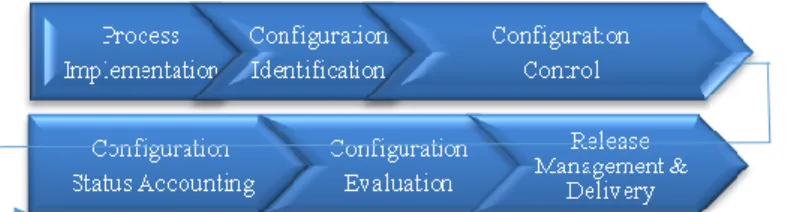
Figure 1: Software Configuration Management Process (adopted from ISO/IEC 12207:2008 Standards)
The element of contextualization from the study can be structured into four main structural elements, namely: process sequence, process abstraction, context definition and solid process. Firstly, in process sequence, the ISO/IEC 12207 Standard is adopted to decompose the software configuration management process.
The software configuration management process is decomposed into the following sub-processes that occur in a successive definite chain: software configuration identification, software configuration control, software configuration status accounting, software configuration auditing and software release and delivery as shown in Figure 1 above.
This provides the model with a process-centric approach that enables it to be easier to apply, easier to adopt, easier to contextualize, easier to adapt to varying scenarios and contexts, easier to debug in case of occurrence of errors and easier to implement due to it modularity. The illustrated “software configuration management process” is decomposed using ISO/IEC 12207 standard, and the process sequence is shown in figure 2 below:
Figure 2:”Software configuration management” sequence (adopted from ISO/IEC 12207:2008 Standards)
Secondly, in process abstraction, assuming that “software configuration management” is performed by a single role in the firm (the process owner can be a person or group of people), breakdown is deemed to be complete and the definition of the process abstraction starts. The portrayal of the abstraction is undertaken by the process owners. The process abstraction is depicted by notation derived from the unified modeling language. The operations performed, the inputs and outputs of the process are represented together with the attributes. The inputs of the process are produced by supplier processes and the inputs are used as inputs to the consumer processes. The supplier processes in this case are the preceding processes to the current process in progress. The consumer processes are the processes being fed by the preceding process. The attributes are the individualities of the process that determine the changing behavior of the operations. For the “software configuration management process”, the operation is “developing software configuration management processes” and the inputs are process implementation, configuration identification, configuration control, configuration status accounting, configuration evaluation and release management & delivery.
The outputs are the “software configuration management processes”. The attributes are the participation of end-users/customers, variety of project features, and diversity of SCM processes. There can be as many operations and attributes as desired. The process abstraction provides the same interface to all projects using the “software configuration management” process. The changes in the context are summarized in solid processes which are determined in accordance with the context. In the next section, determination of context is portrayed.
Thirdly, after process abstraction, the next step in the model is context definition in alignment with the strategy of the software development firm. The firm strategy pervades in the portfolio of projects with different conditions through the context. Since the conditions and limitations can be different for singular projects, several contexts need to be defined. The reason to exist and the restraints of the projects are portrayed through the context. To illustrate the model, three different possible contexts are involved, namely:
Context 1 – Research and development (R&D) focused context: these types of projects exist to develop software for the purposes of gaining technical capability in a certain domain. The restraints are conformance to certain standards, a minimum profit level, and a given level of client satisfaction. There are no or few clients at the time of development.
Context 2 – Market-focused context: whose reason for existence is profit. The restraints are conformance to Capability Maturity Model Integration (CMMI) Level 5, and given level of client satisfaction. The number of clients and/or end-users is high in this kind of projects.
Context 3 – Client-focused context: This type of project aims to fulfill the client’s requirements. The restraints are conformance to Capability Maturity Model Integration (CMMI) Level 5, a minimum profit level and strict adherence to client requirements. These are usually client-specific projects developed with the participation of the client.
For context 1, high technology requirements may exist, whereas for context 2, use of familiar technologies and similarity to previous projects is of importance. For the third context, adherence to client requirements takes priority and the operations need to be carried out accordingly. Integrating the context in the process model enables the firm to act dynamically in response to changes in the environment. Afterwards, the solid processes are described for each context.In context definition, determination of context is portrayed. Context is defined in terms of the strategy of the software firm. That is, whether the firm is focused on research and development, market focused or client-focused. In solid process, each context above is handled with the same abstract process with the same operations, but the way of accomplishment varies according to the context. Fourthly, in solid process, each context is addressed by a solid process as shown in Figure 4 below. Each solid process describes the same abstract process with the same operations, but the way of accomplishment varies according to the context. Thus, the number of solid process portrayals depends on the number of different portfolios in the software firms, and new contexts can be added to respond to the changes in the environment. Moreover, projects having different contexts can use a solid process from the repository suitable to their specific context, by switching the solid process being used. The process models are organized into a library of abstract and solid processes.
Figure 3: Solid Process Representation
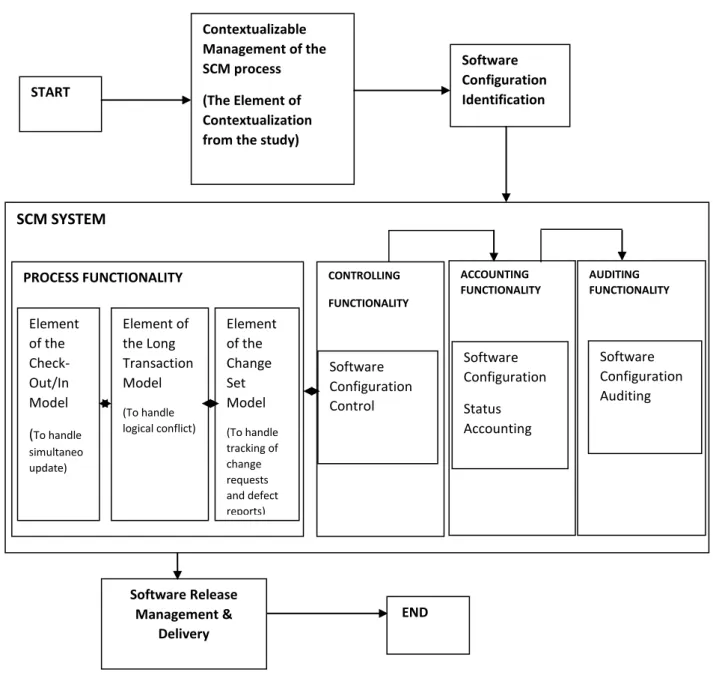
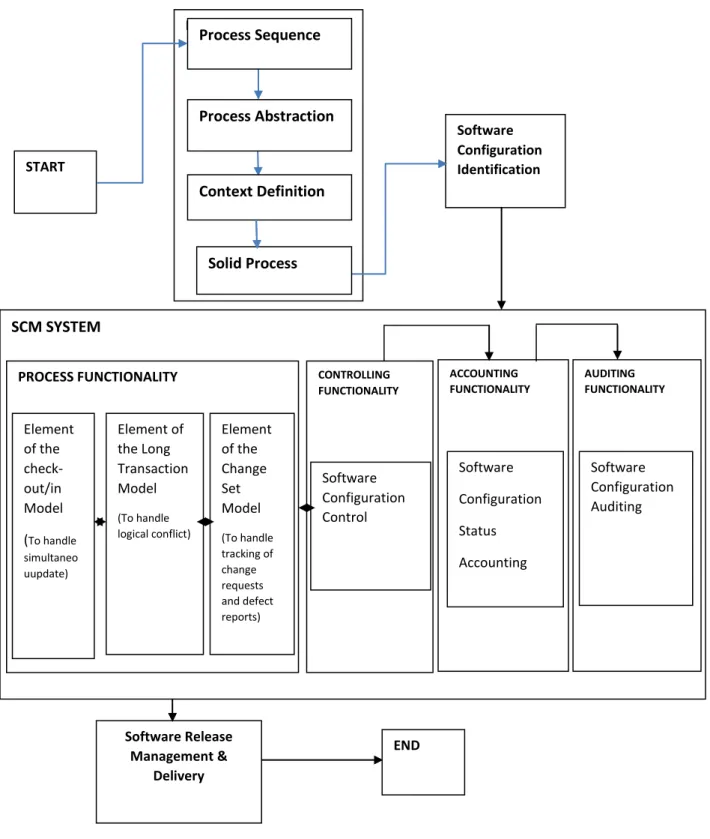
After the contextualizable management of the SCM process, the next process is the software configuration identification, which leads to the software configuration system comprising of the process-centered functionalities of SCM that occur sequentially as process functionality, controlling functionality, accounting functionality and the auditing functionality. To address the challenge of simultaneous update, an element of check-out/check-in element is adopted. To address the challenge of handling logical conflict, an element of the long transaction model is adopted. To address the challenge of handling the tracking of change requests and defect reports, an element of the change set model is adopted. This entire chain of sub-processes forms the SCM system that supplies the final process of software release management and delivery eventually realizing a quality software that has undergone all the necessary rigours, checks and balances of an effective and standard SCM model. The achieved SCM Model has process-centered functionality view of the software configuration management process. This approach includes the context into process descriptions, enabling process owners to design their processes for change and switch processes during execution resulting in adaptive and modular processes. Moreover, the process designs can be reused by different projects with similar context and can be switched during process execution if the given project’s context changes. This contributes significantly to addressing pertinent issues, problems and weaknesses inherent in existing SCM models and even systems that have adopted these existing SCM models in such systems’ functionalities. Figure 4 below illustrates the proposed SCM model:
Figure 4: Summarized Diagrammatic Representation of Proposed SCM Model (Researcher, 2014)
Figure 4: Summarized Diagrammatic Representation of Proposed SCM Model
V.
RESEARCH ELABORATIONS
5.1 Research Design
This is both a qualitative and quantitative study that was confined to selected sample of small and medium software development firms in Nairobi, Kenya. In addition, expert opinions and ideas from software engineering professionals more so lead developers and developers were purposively selected and utilized.
5.2 Population, Sampling Strategy and Techniques
The unit of analysis for the study was any small and medium software development firm. The target population included all small and medium software development firms within the city of Nairobi, Kenya, which develop software for sale as well as in-house development groups within organizations. In this study, the small and medium firms targeted were the firms with employees not exceeding 50 in number. The number of small and medium software development firms in Nairobi is enormous as the influx of new small and medium firms is estimated at 200 - 250 per annum which stood at 1850 firms as at 2013 (Kenya Companies Registry, 2014). The listing of these companies was acquired from the authenticated listing source of Kenyan software development firms at the Government Registrar of Companies Department.
END Software Release Management & Delivery
SCM SYSTEM
ACCOUNTING FUNCTIONALITY AUDITING FUNCTIONALITY Software Configuration Status Accounting Software Configuration Auditing PROCESS FUNCTIONALITY Element of the Check-Out/In Model (To handle simultaneo update) Element of the Long Transaction Model (To handle logical conflict) Element of the Change Set Model (To handle tracking of change requests and defect reports) CONTROLLING FUNCTIONALITY Software Configuration Control START Contextualizable Management of the SCM process (The Element of Contextualization from the study)Software Configuration Identification
The sample of this study comprised of small and medium software development firms drawn from five distinct strata of the city of Nairobi, namely Nairobi central business district, Eastlands, Westlands, Upper Nairobi and Southlands.
In this study, it is clearly indicated which sort of firms fall under the category of small and medium software development firms. The study’s long-term intentions are for the proposed software configuration management model to be internationally acceptable and adopted. The study proposed to use the sample population of small and medium software development firms within the city of Nairobi, Kenya as the yardstick to test the practicability and adoptability of the proposed software configuration management model to the firms. To determine the sample size for the study, Fisher’s formula was employed as follows:
n=Z2pq/d2
Where, n= desired sample size
Z= standard normal deviation, which is set at 1.96 (95% confidence level)
P= proportion of the targeted population that have the characteristic focused in the study, which is estimated at 85% (0.85).
q=1-p
d= degree of accuracy, which is set at 5%. The degree of proportion of error that should be accepted in the study is 0.05, since the study has 95% confidence level.
Therefore, Desired Sample (n) = {1.962*(0.85*(1-0.85)}/0.052 n= 196
Since the total population for each region is less than 10,000, the researcher applied the finite correction formulae (nf). This is applied together with the Fisher’s formulae in successive steps as indicated:
N = 1850, n = 196
nf= 196/(1+196/1850) = 177
Crucial aspect of the sampling technique is determining the unit or level of analysis. This study recognized that research work is often couched in social setting and identified ten different levels (units) of analysis, namely society, profession, external business context, organizational context, project, group team, individual, system, computing element (program) and abstract concept. The unit of analysis for this study is the organization, which is, small and medium software development firms. In the sampling of the population, the study used the cluster sampling technique. The rationale for the sample cluster sampling is where the population is divided into units or groups called strata (usually there are units or areas in which the population has been divided in), which should be as representative as possible for the population, representing the heterogeneity of the population being studied and the homogeneity within each of the strata. The sample of this study was selected from the population of small and medium software development firms within Nairobi city. In sampling of the population, the study area was divided into five distinct strata - Nairobi Central Business District, Eastlands, Westlands, Upper Nairobi and Southlands. Each of these strata represented the heterogeneity of the population being studied and the homogeneity within each of the strata as justified by the fact that the firms are located in the same geographical zone.
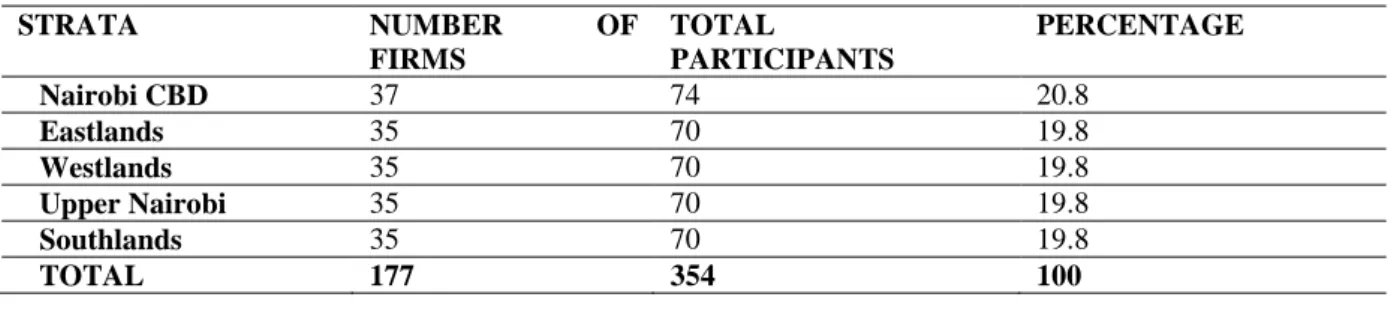
The preferred sample size selected for this study was 177 small and medium software development firms. From each software development firm, 2 software developers were selected to participate in the study. These were preferably the software lead developers and one of the developers, who was selected through the use of simple random method from the other developers/employees. This made total of 354 respondents for the study as tabulated in Table 1.
TABLE 1: SAMPLE DISTRIBUTION
STRATA NUMBER OF FIRMS TOTAL PARTICIPANTS PERCENTAGE Nairobi CBD 37 74 20.8 Eastlands 35 70 19.8 Westlands 35 70 19.8 Upper Nairobi 35 70 19.8 Southlands 35 70 19.8 TOTAL 177 354 100
5.3 Data Collection Methods and Approaches
In this study, only primary data was collected and included both qualitative and quantitative in nature. The data collection procedures or methods employed were questionnaires for the software developers and interviews for the lead developers. The questionnaire comprised of four sections each based on the objectives of the study. The questions were both open and closed ended or structured in such a manner that all objectives of the study were captured. The questionnaire tool was used to collect data from the software developers. This was through drop-and-pick method for the sake of the respondents’ convenience. Data from the lead developers was collected using the interview method. Questions in the interview were designed to acquire both qualitative and quantitative data. The interview questions consisted of four sections each based on the study objectives. The questions captured various themes and sub-themes based on the study’s objectives.
5.4 Data Analysis and Presentation
Data analysis involved the systematic application of statistical and/or logical techniques to turn raw data into information that was used in making decisions. The questionnaires were coded and edited for analysis in Statistical Package for the Social Sciences (SPSS) and the quantitative data analysis was used to give descriptive statistics such as mean and standard deviation that were then presented in form of tables and figures for easy understanding and interpretation. Thematic representations were employed to present the qualitative data obtained from the interviews as well from the questionnaires.
VI.
RESULT AND DISCUSSION
6.1 Proposed Contextualized SCM Model
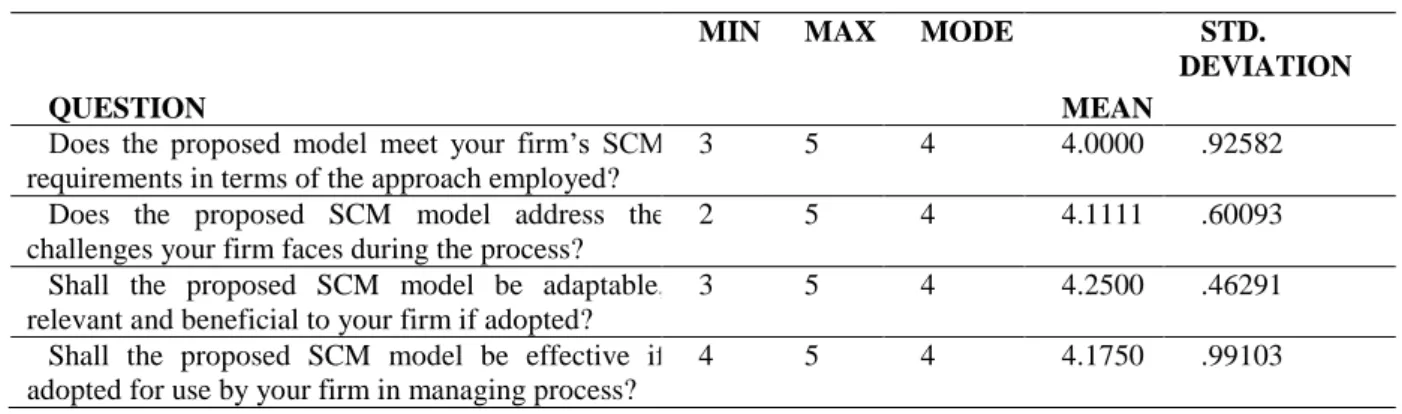
Table 2 provides the means and standard deviations derived from the responses of questions that sought the opinion of the respondents regarding the proposed contextualized SCM model demonstrated to them. Based on the mean values of the responses given, all the means fall within the interval 4.0-4.9. This indicates that the respondents highly approved the proposed contextualized SCM model, and were ready and willing to adopt and assimilate it into the firms’ practice during software development. These findings indicate that the proposed model meets the SCM requirements in terms of the approach employed; addresses the challenges the software development firms face during the process; highly adaptable, relevant and beneficial to the software development firms if adopted as well as being effective if adopted for use by the firms in managing the process. The standard deviations for all the means obtained are all of values less than one. This shows that, the study results could not have been much different from the current ones in a case where the study would have been conducted using the entire population of the study other than a sample (that has been used in this case).
TABLE 2: PROPOSED CONTEXTUALIZED SCM MODEL
QUESTION
MIN MAX MODE
MEAN
STD. DEVIATION
Does the proposed model meet your firm’s SCM
requirements in terms of the approach employed?
3 5 4 4.0000 .92582
Does the proposed SCM model address the challenges your firm faces during the process?
2 5 4 4.1111 .60093
Shall the proposed SCM model be adaptable, relevant and beneficial to your firm if adopted?
3 5 4 4.2500 .46291
Shall the proposed SCM model be effective if adopted for use by your firm in managing process?
4 5 4 4.1750 .99103
6.1.1 Firms’ Recommendation of the proposed SCM model
The participants also suggested recommendations to the proposed SCM model as indicated in Figure 5. From the findings indicated in the figure, all the respondents of the study recommended the application of the proposed contextualized SCM model in software development processes; 20% of the respondents recommended with reservations whereas 80% highly recommended its adoption to software development activities.
Figure 5: Recommendations for the Model Adoption
The study findings indicate that, all the respondents agreed that the proposed SCM model shall be practically beneficial to firms once the model is commercialized and customized to meet the specific individual needs of each firm once adopted. The extent of agreement however varied amongst different respondents. 50.9% of the developers strongly agreed, 42.9% agreed while 6.2% agreed with reservations. Similarly, 53.5% of the lead developers strongly agreed, 41.5% agreed and 5% agreed with reservations. This clearly illustrates that the respondents were highly positive about the benefits that could be reaped from the proposed SCM model.
TABLE 3: COMMERCIALIZATION AND CUSTOMIZATION OF PROPOSED SCM MODEL
RESPONSE DEVELOPERS LEAD DEVELOPERS
FREQUENCY PERCENTAGE FREQUENCY PERCENTAGE Strongly Agree 82 50.9 76 53.5
Agree 69 42.9 59 41.5
Agree with Reservation 10 6.2 7 5.0
TOTAL 161 100.0 142 100.0
The study further tested the difference between the means of the responses given by the developers and the lead developers on the level of agreement, and the benefits of the proposed SCM model. The findings presented in Table 4 below illustrate that the mean response given for the lead developers and the developers has mean value of 1.196 assuming equal variation of the usefulness of the model. The p-value is .004, implying that the difference in means is statistically significant at the .05 level with a 2-tailed test. Thus, based on these results, the study findings are statistically significant and can be relied on to explain the usability and the relevance of the model developed.
TABLE 4: T-TEST FOR DIFFERENCE BETWEEN MEANS
T Df Sig. (2-tailed) Mean Difference
95% Confidence Interval of the Difference
Lower Upper 18.811 71 .004 1.98611 1.7756 2.1966
6.2 Effectiveness of Proposed Contextualized SCM Model
The second objective of this study was to evaluate the effectiveness of the proposed contextualized SCM Model.
6.2.1 Perception towards Proposed SCM Model
On evaluating the respondents’ perception towards the proposed model, the study findings indicated that most of the respondents (47.2%) had high perception towards the proposed model. 38.6% of the respondents were found to have moderate perception while 14.2% of the respondents had low perception. This reveals that a great number of the software developers and lead developers have above moderate level of perception towards the proposed contextualized SCM model.
TABLE 5: PERCEPTION TOWARDS PROPOSED SCM MODEL
FREQUENCY PERCENTAGE
High 143 47.2
Moderate 117 38.6
Low 43 14.2
TOTAL 303 100
6.2.2 Effectiveness of Proposed SCM Model in Software Development Firms
In Table 6, the results on the effectiveness of the proposed SCM model are based on the Likert scale responses given. These were analyzed to give various statistical measures which measure the variation of the effectiveness among different firms. The minimum value, shows the lowest rank given on the level of agreement whereas the maximum value provides the highest rank given. The mode statistics show the rank with the highest number of respondents. The mean provides the average ranks given whereas the standard deviation shows the extent to which various responses varied from the mean.
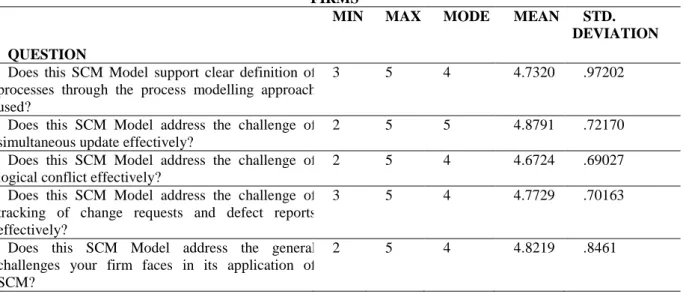
The major statistical measure is the mean, which according to the results in Table 6, for all the aspects, was in the range of 4.0 – 4.9, with all standard deviations less than 1. This indicates that all the aspects had mean response in the interval for agreement, as the respondents agreed to the various aspects. However, the extent of agreement varied for different aspects as minimum and maximum values indicate. Most of the aspects had minimum value of 2 indicating that some respondents disagreed whereas all the aspects had maximum score of 5 for strong extent of agreement. Measuring the mode statistics, most of the aspects in the table obtained mode of 4 meaning that majority of the respondents agreed.
TABLE 6: EFFECTIVENESS OF PROPOSED SCM MODEL IN SOFTWARE DEVELOPMENT FIRMS
QUESTION
MIN MAX MODE MEAN STD. DEVIATION
Does this SCM Model support clear definition of processes through the process modelling approach used?
3 5 4 4.7320 .97202
Does this SCM Model address the challenge of simultaneous update effectively?
2 5 5 4.8791 .72170
Does this SCM Model address the challenge of logical conflict effectively?
2 5 4 4.6724 .69027
Does this SCM Model address the challenge of tracking of change requests and defect reports effectively?
3 5 4 4.7729 .70163
Does this SCM Model address the general challenges your firm faces in its application of SCM?
6.2.3 Effectiveness of Proposed Model in Improving SCM Process Application
According to the results presented in Table 7, majority (81.2%) of the respondents reported that the proposed contextualized SCM model is effective in improving how their firms apply the SCM process. However, 18.8% of the respondents felt that the model had not effectively improved their application of the SCM process. This generally shows that the proposed model has positive significant effect on the firms’ application of the SCM process in their software development projects.
TABLE 7: EFFECTIVENESS OF PROPOSED MODEL IN IMPROVING SCM PROCESS APPLICATION
FREQUENCY PERCENTAGE
Yes 246 81.2
No 57 18.8
TOTAL 303 100.0
6.2.4 Effectiveness of Proposed Model in Comparison to Existing SCM Models
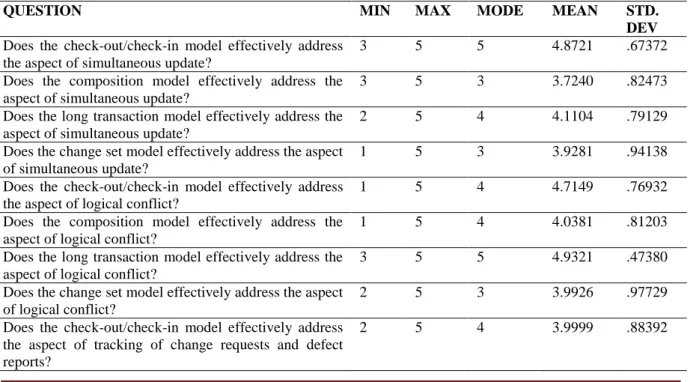
Performing a comparative analysis of the effectiveness of the proposed contextualized SCM model in comparison with the existing SCM models, the results presented in Table 8 illustrate that none of the statements given (aspects studied) had below average level of effectiveness. This is illustrated by the mean statistics obtained, with standard deviations which are all above 3.0 and below 1 respectively.
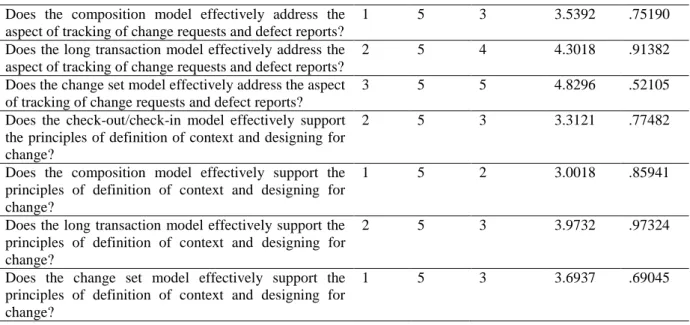
However, of important concern, is that three aspects obtained high mean scores of responses: the check-out/check-in model in the aspect of simultaneous update with a mean value of 4.8721; the Long Transaction model in the aspect of logical conflict with a mean value of 4.9321 and the change set model in the aspect of tracking of change requests and defect reports with a mean value of 4.8296. These had small variance from the mean in the responses given as indicated by the minimum and the maximum values obtained. The minimum value for all the three aspects are all 3 and maximum values of 5.
For the other aspects, the variation was insignificant as the standard deviations are all less than 1. However, some aspects (change set model and simultaneous update, check-out/check-in model and logical conflict, composition model and logical conflict aspect, composition model and tracking of change requests and defect reports, and the change set model and the principles of definition of context and designing for change aspects) indicated a minimum value of 1. This indicated that some respondents felt that these aspects had very low extent of effectiveness. In addition, the aspects had maximum values of 5 as well.
TABLE 8: EFFECTIVENESS OF PROPOSED MODEL IN COMPARISON TO EXISTING SCM MODELS
QUESTION MIN MAX MODE MEAN STD.
DEV Does the check-out/check-in model effectively address
the aspect of simultaneous update?
3 5 5 4.8721 .67372
Does the composition model effectively address the aspect of simultaneous update?
3 5 3 3.7240 .82473
Does the long transaction model effectively address the aspect of simultaneous update?
2 5 4 4.1104 .79129
Does the change set model effectively address the aspect of simultaneous update?
1 5 3 3.9281 .94138
Does the check-out/check-in model effectively address the aspect of logical conflict?
1 5 4 4.7149 .76932
Does the composition model effectively address the aspect of logical conflict?
1 5 4 4.0381 .81203
Does the long transaction model effectively address the aspect of logical conflict?
3 5 5 4.9321 .47380
Does the change set model effectively address the aspect of logical conflict?
2 5 3 3.9926 .97729
Does the check-out/check-in model effectively address the aspect of tracking of change requests and defect reports?