Light, Ben
(2001) The maintenance implications of the customization of
ERP software.
Journal of Software Maintenance and Evolution: Research
and Practice
,
13
(6), pp. 415-429.
This file was downloaded from:
http://eprints.qut.edu.au/61494/
c
Copyright 2001 John Wiley & Sons, Ltd.
The definitive version is available at www3.interscience.wiley.com
Notice:
Changes introduced as a result of publishing processes such as
copy-editing and formatting may not be reflected in this document. For a
definitive version of this work, please refer to the published source:
Research
The Maintenance
Implications of the
Customisation of ERP
Software
Ben Light*†*Information Systems Research Centre, University of Salford, United Kingdom.
SUMMARY
Enterprise Resource Planning (ERP) Software is a dominant approach for dealing with legacy information system problems. In order to avoid invalidating maintenance and development support from the ERP vendor, most organisations reengineer their business processes in line with those implicit within the software. Regardless, some customisation is typically required. This paper presents two case studies of ERP projects where customisations have been performed. The case analysis suggests that while customisations can give true organisational benefits, careful consideration is required to determine whether a customisation is viable given it's potential impact upon future maintenance. Copyright © 2001 John Wiley & Sons, Ltd.
J. Softw. Maint: Res. Pract. 20001;
No. of Figures: 1. No. of Tables: 3. No. of References: 35.
KEYWORDS: Enterprise Resource Planning, Standard Package Software, Software Customisation, and Legacy Information Systems.
Correspondence to: Ben Light Information Systems Research Centre, University of Salford, Ashworth Building, Salford, Greater Manchester, M5 4WT. United Kingdom.
1. INTRODUCTION
A great deal of research has focussed upon the maintenance of legacy information systems (legacy IS) - the existing information technology (IT) and it’s organisational context [1]. From an IT perspective legacy IS problems are well documented. It has been surmised that legacy IT was rarely planned coherently and generally was designed for specific needs at specific times with no integration [2]. Bennet adds that even though the best design and coding techniques may have been used at the time, the main considerations were memory optimisation and processing speed [3]. He states that this may have impacted upon the structure of systems, increasing maintenance problems. The problem is compounded when the skills base required to perform the maintenance is depleted as programmers ‘move on to’ the next language. Furthermore, documentation of legacy software may not be available or may be outdated thereby exacerbating the situation [4][5]. Also, where maintenance has been performed, it may have degraded the system further [6][3]. Organisational legacy problems are equally traceable although they may not be termed as such. The problems of outdated ways of work are an example. Business process reengineering/redesign [7][8] grew from dissatisfaction with narrowly defined tasks where workers focussed upon their function. There was scant attention to the inter-relationships of functions and the impacts upon the supply chain. Consequently, the resulting fragmentation of legacy IS has led to difficulty co-ordinating operations, compounded by issues such as the year 2000 problem, globalisation and multi-nationals with histories of intensive merger and acquisition activity.
In response to the problems of legacy IS the popularity of package software systems has risen. In 1996 PriceWaterhouse reported a trend toward the implementation of off-the-shelf software [9]. In 1998 KPMG stated that around 80 per cent of future IT systems would be standard software – with the remainder being custom developments [10].
Despite the rationale for adopting standard software, some organisations need to customise and this raises maintenance questions. In order to develop an understanding of this, the author analyses two Enterprise Resource Planning (ERP) projects. The following research questions guided the investigation: What types of customisations are carried out to ERP software? Why do organisations undertake ERP software customisation? How might customisations impact upon future maintenance of the ERP software?
The paper begins with an overview of the rationale for the adoption of ERP software and its customisation. The research method is then described. Following this, two cases are presented, describing customisations performed and the maintenance implications. Finally, conclusions and recommendations for further research are offered.
2. THE RATIONALE FOR ERP SOFTWARE ADOPTION AND ITS CUSTOMISATION
The rationale for the uptake of ERP software is dominated by the need to deal with legacy IS problems. It is argued that ERP systems offer:
• Improved software structure and ability to outsource maintenance and development [11][12][13].
• Ability to tap into available a skills base for the software - this is widely available, (although due to the uptake of ERP software, at times this can be difficult to obtain) [14][15][16].
• Reduced levels of entropy and improved documentation - as the software is standard it is supposed to be well organised and documented. The outsourcing of the maintenance and its development is also expected to contribute to this [11][12][14]
• Resolution of the year 2000 problem - ERP software was built as year 2000 compliant [12][17].
• Movement to a common IT and organisational blueprint in order to deal with globalisation and/or previous merger and acquisition activity - ERP software has capabilities to support global operations over multiple, multinational sites. Due to the required reengineering, the aim of the implementation is generally a common business process model [13][18].
• The chance to adopt perceived best practice business models embedded within the software through reengineering activity [19][20].
Even in the light of the benefits of implementing ERP software, some organisations still choose to customise. Organisations such as Reebok have worked with SAP to overcome problems but still cannot completely adopt the standard model [21][22]. Markus et al also report that organisations undertake what they term 'software modification' [23]. In this paper, customisation is meant to describe changes or additions to the functionality available in the standard ERP software. It does not refer to the ‘switching on and off’ of functionality that is part of the blueprint of the software, sometimes referred to as software configuration [18]. In consideration of customisation as described herein, it is possible to argue that organisations may be recreating the problematic legacy conditions the ERP software was originally implemented to resolve. Why then, would they want to take this action? Lucas et al point out that users may have to change procedures in order to work with the package, programs in the package may need to be changed to meet unique requirements, and that users become dependent upon the package vendor for maintenance [24]. ERP software is no different, it is widely acknowledged that organisations change, to varying extents, their ways of work in line with the implicit business model dictated by the ERP software [19][20]. However, it is also clear that for some organisations, the standard model is not satisfactory and therefore customisation may occur [16][25]. With a few notable exceptions, this is generally the limit of the discussion [25][26].
It is with this background that the paper explores the customisation of ERP software and the consequent maintenance implications.
3. RESEARCH METHOD
A qualitative case study research strategy was employed, as the subject of the study poses content, context and process questions which deal with links over time [27][28]
[29]. The research was descriptive in that the data collected was used to describe events in a given context for the purposes of increasing understanding of the area under investigation [30]. The approach sought to conduct case studies of organisations that had customised ERP systems, tracking the impact upon subsequent maintenance efforts. Categorisation of the full range of customisation types and maintenance effort was not the aim, although the author recognises valuable work has been undertaken in this area [23][31].
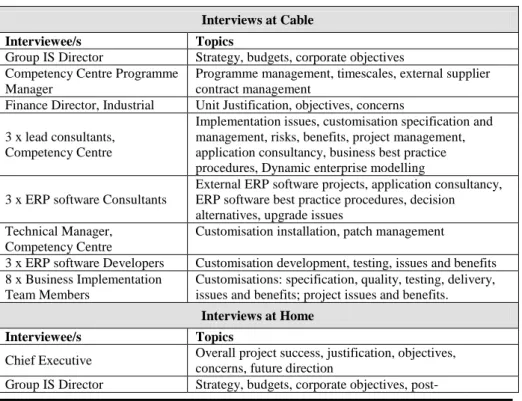
The data was collected using a number of techniques including formal and informal interviews with various people involved in the ERP software projects, observation of the use of ERP software, and documentation such as strategy reports. Formal interviews were undertaken at each implementation milestone (approximately one per month). Informal data gathering and feedback also occurred throughout the span of the project. For example, interviewees reported customisation specific issues as they occurred. The data was collected at the case sites over one year. The validity of the case data was reinforced in several ways. For example, several people in each of the case organisations were interviewed at different times and places [32]. Also, two researchers were involved in the collection and interpretation of the data [33]. Those interviewed at each site, and the topics discussed are shown in Table 1. In addition to the interviews, observation was used in order to find out about what
people did rather than just what they say they did [34]. Table 1 Details of Interviews Conducted.
Interviews at Cable
Interviewee/s Topics
Group IS Director Strategy, budgets, corporate objectives Competency Centre Programme
Manager
Programme management, timescales, external supplier contract management
Finance Director, Industrial Unit Justification, objectives, concerns 3 x lead consultants,
Competency Centre
Implementation issues, customisation specification and management, risks, benefits, project management, application consultancy, business best practice procedures, Dynamic enterprise modelling 3 x ERP software Consultants
External ERP software projects, application consultancy, ERP software best practice procedures, decision alternatives, upgrade issues
Technical Manager, Competency Centre
Customisation installation, patch management 3 x ERP software Developers Customisation development, testing, issues and benefits 8 x Business Implementation
Team Members
Customisations: specification, quality, testing, delivery, issues and benefits; project issues and benefits.
Interviews at Home
Interviewee/s Topics
Chief Executive Overall project success, justification, objectives, concerns, future direction
post-implementation review, external supplier contract management
External Consultant Project Manager
Programme and project management, timescales, external projects
Business User Group Chairperson
Implementation issues, customisation specification and management, risks, benefits, project management, application consultancy, business best practice procedures, Dynamic enterprise modelling Technical Manager Customisation installation, patch management 2 x ERP software Developers Customisation development, testing, issues and benefits 8 x Business Implementation
Team Members
Customisations: specification, quality, testing, delivery, issues and benefits; project issues and benefits. 4. CASE DATA
Follows are details of the two case organisations. For each case, the drivers behind the decision to implement standard ERP software, the customisation points, the maintenance implications and a summary analysis are provided. It is interesting to note at this point, that both organisations undertook an extensive package evaluation exercise to ensure they implemented software that matched their requirements. Many software vendors dropped out of this process when they saw the functionality requirements of the organisations. In both cases the package implemented ended up being the one that most closely mirrored business processes. They did not consider the implementation of a Best of Breed Strategy [35].
4.1. Cable
Cable has sites throughout Europe, America and the Asia Pacific region. The organisation grew by acquisition and as a result, the many business units functioned in individual ways. There was proliferation of systems: Manufacturing had 10 different systems, Sales - 13, Purchasing - 15, Planning - 5, Finance - 18 and Personnel 18. Consequently, there was inconsistent terminology, coding structures, business processes and IS practices. The legacy IS:
• Did not offer a single source of information - for example one instance of a customer's data whether from a financial, commercial or marketing perspective.
• Duplicated data, increasing the amount of data input through re-keying activity.
• Discouraged the ownership of data by the business rather than the IS department.
• Used various coding structures - for instance, five customer structures existed.
• Restricted information transfers and made a global view of the business very difficult to obtain.
4.1.1 The Customisation Points and their Maintenance Implications
Material Requirements Planning (MRP) - The ERP software did not sufficiently
cater for the notion of length. For example, a customer may wish to order a 100-metre length of cable. The ERP software would indicate that the order could be
fulfilled as it held stocks totalling 200 metres. In fact, physical stock levels were comprised of 4 x 50 metre lengths of cable. Therefore, a customisation was specified by Cable to make this clear. However, the ERP vendor decided to build the customisation and it was incorporated into the standard functionality of the ERP software. While the lifetime maintenance costs of the solution were significantly reduced, and the eventual solution incorporated the MRP experience of Cable’s personnel, the complexity of the development was significantly under-estimated. This resulted in a customisation that delayed delivery by 5 months.
Metal Management – Copper is used in cable production and prices vary daily.
Cable dealt with this risk by keeping stocks of copper and pricing products based on the amount of copper they contained, valued at its price when purchased as a raw material. Therefore, Cable required details of the copper within each finished cable and its initial purchase price. In addition, certain customers reserved a quantity of copper (a book) at a specific price for use in the manufacture of their orders. Consequently, Cable also needed to record details of the contract price and the rate of consumption of copper books. The specification and delivery of the customisation was similar to that of MRP. The Metal Management functionality was incorporated into the standard software functionality by the ERP vendor and was renamed Materials Management as the vendor realised that the principles it embedded had wider applicability. It is interesting to note that another company wanted to try and change certain aspects of the Materials management functionality at a later date but the ERP vendor did not allow this. A member of the IS staff at Cable pointed out that if the change had been made this would have led to difficulties when they upgraded. The standard software would have needed to be re-customised in order to re-align the software with the way they managed metal.
Shop Floor Control - The ERP software's progress reporting screens were too
cluttered and complex. A trial of the new shop floor procedures was undertaken and the results were disappointing - 17 per cent of data entry was inaccurate. The company used the ERP software Applications Programming Interface (API) tool to simplify production progress reporting screens. Trials of this new screen reduced the error rate to 8 per cent immediately and virtually eliminated it within two weeks. From a maintenance perspective, Cable feel that this should not have too much impact as they have not fundamentally changed the ERP software. In the worst scenario they said that if an upgrade changed the data that was collected by the system via the process automation - they would need to re-work the customisation.
Despatch Process - Despatch notes must be produced for every sales order. To
do this in ERP software, the despatch session must be run for each sales order that is part of a delivery load resulting in the user performing around 16 different operations. The ERP software API was used to develop one screen to show each cable at the despatch point in the order procedure. The user could then mark each one present on the load. Once that had been done, a single button press removed each cable from stock and produced the despatch documentation. The customisation reduced the average administration time for each despatch from 20 minutes to 5. Cable offered a similar maintenance view to that discussed in relation to Shop Floor Control. They also recognised that the potential for the reworking of the
customisation would be increased as the process relied on more sessions. In Cable's view this increased the likelihood of an upgrade affecting the automation.
Corporate Document Set - Cable modified the Sales Order Acknowledgement,
Despatch Note, Sales Invoice, Credit Note, Financial Invoice, Sales Quotation, Remittance Advice, Purchase Order and the Reminder Note. The document layouts were standardised and the company logo was added. The developments were carried out using IT staff and ERP software vendor/third party consultants. Cable have upgraded since go live and the Corporate Document set has not been affected. However, they have been affected by acquisition activity that has led to the revision of the documents. Development staff could only do this and therefore Cable felt that although it was a less invasive form of customisation, they needed to manage its maintenance carefully so that it did not become a burden.
Terminology and Layout - In the early stages of implementation there were a
number of requests for changes to labels and descriptions on many of the sessions within each of the functional areas. For example, change ‘Ref A’ on sales order header to read ‘Customer’s Purchase Order Number’. These requests conflicted with the strategy for the use of common terminology across the group and they were refused. The decision not to change terminology had quite considerable maintenance implications. Any changes would have needed to be documented extensively as whilst easy to implement, they would have been wiped out by upgrades. Many customisations of this kind, implemented on a global scale, could have used up extensive resources in the re-working of the customisations post upgrade.
Material Visibility - Cable felt that the standard ERP inventory reports were not sufficient to help them manage the costly copper resource. Therefore, a number of raw material movement reports were developed to enable stock movements to be monitored intensively. The maintenance aspect to the reports centred on the effort in creating and revising them. The reports would not be affected by upgrades however, they would take up considerable resource to create and revise as the activity had to be performed by the development team. This led to users creating their own reports. Certain users developed sequel statements to interrogate the ERP software database engine and import the data into a Microsoft Access database. The IT staffs are currently attempting to reign in this activity and have implemented a reporting package that allows them to write reports for users with more ease. The IT staffs argue that they need to write the reports in order to determine the functionality needs of the organisation so that they can assess future maintenance and development work - especially where this may be taken care of via upgrades or bolt-on packages rather than customisations.
Key Performance Indicators - Cable developed a set of reports within ERP
software, which allowed Key Performance Indicators to be measured. Examples include Production Cycle Time, Daily Cost of Production Receipts, Monthly Production Volume Analysis, Daily Cost of Sales Despatches and Goods in Warehouse > 'n' Days. The KPI reports had maintenance implications commensurate with those identified for the Material Visibility customisation as related to IT staffs resource.
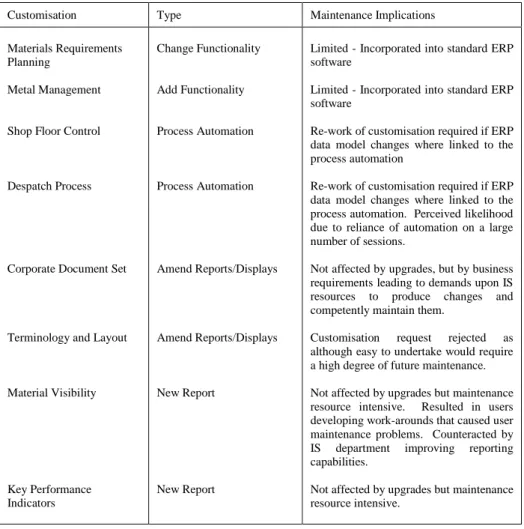
The case data highlights that Cable has customised the ERP software in a number of ways resulting in varied maintenance issues. Table 2 categorises and summarises these.
Table 2 Summaries of Cable's Customisations and Maintenance Implications.
Customisation Type Maintenance Implications
Materials Requirements Planning
Metal Management
Shop Floor Control
Despatch Process
Corporate Document Set
Terminology and Layout
Material Visibility Key Performance Indicators Change Functionality Add Functionality Process Automation Process Automation Amend Reports/Displays Amend Reports/Displays New Report New Report
Limited - Incorporated into standard ERP software
Limited - Incorporated into standard ERP software
Re-work of customisation required if ERP data model changes where linked to the process automation
Re-work of customisation required if ERP data model changes where linked to the process automation. Perceived likelihood due to reliance of automation on a large number of sessions.
Not affected by upgrades, but by business requirements leading to demands upon IS resources to produce changes and competently maintain them.
Customisation request rejected as although easy to undertake would require a high degree of future maintenance.
Not affected by upgrades but maintenance resource intensive. Resulted in users developing work-arounds that caused user maintenance problems. Counteracted by IS department improving reporting capabilities.
Not affected by upgrades but maintenance resource intensive.
4.2. Home
Home has over 20 sites throughout the United Kingdom. The main driver for Home’s ERP implementation was the year 2000 problem. Additional drivers included: to standardise commercial procedures, simplify pricing, improve credit control, reduce cycle times, introduce forecasting, introduce automated purchasing procedures, build closer links with suppliers, introduce common procedures and
adopt business best practice. Furthermore, Home's legacy IS were incredibly fragmented. Some core systems were shared across many divisions and other systems had been developed independently. Some areas, such as purchasing, were mainly manual. Business procedures also differed across sites and producing a corporate view of the organisation was difficult. The ERP software was expected to integrate systems across the group, provide a common source of data, eliminate duplication of effort in data entry and maintenance, replace manual systems without incurring long development timescales, introduce common coding structures, introduce common procedures and provide a corporate view of business information.
4.2.1 The Customisation Points and their Maintenance Implications
Pricing - The detailed geographical breakdown of Home's market is used to assist pricing based on the distance travelled to deliver the product. The combination of this with other cost elements leads to the generation of millions of prices. The customisation is extensive - it applies conditions to the data used to generate the prices lists via custom software developed by an external contractor. The price lists are then integrated with the ERP software. There are a number of maintenance issues associated with this customisation. First, the customisation is not supported by a service level agreement and therefore if it fails, the company is dependent upon their contractor being able to deal with the problem when they can (which many not be as quickly as the company desires). Second, one person within Home understands the operation of the customisation and they have limited experience in the role. The maintenance implications of this customisation are therefore heavily associated with risk management. There is also a cost dimension because if an ERP software upgrade impacts upon the customisation - the re-write is in the hands of an external party.
Delivery Addresses – As delivery costs are based upon the distance from the
despatch site to the delivery address, the latter need to be accurate and easy to find. In standard ERP software these are entered free format. Home however, required the address to be selected from a pre-defined list. This information was taken from post office address files (PAF files), which are licensed on a per annum basis. In some instances delivery may be to a street that does not exist yet. In these cases, ‘Street TBA’ is selected. The PAF files were heavily manipulated as part of the initial load into the new ERP software tables meaning that the regular updates could not easily be applied and instances of ‘Street TBA’ are increasing. The address data has not been updated since go-live in 1999. Any upgrades of the ERP software that affect the sessions associated with the customisation will result in the need for external contractors to re-write source code.
Haulier Self-Billing - Home use many external hauliers who are used to
self-billing, as it existed in the previous system. This functionality was not present in the ERP software. A customisation was therefore implemented that produces Haulier statements each month for all hauliers who delivered during that period. The statement shows the date, time, trip number and price of each trip made with a total at the bottom indicating the amount that Home intends to pay. The hauliers then check these values against their records. Queries are handled and any adjustments made in
the following month. The customisation has been extended over the last year to include a number of enquiries to make the resolution of haulier queries easier. This is an incredibly extensive customisation that is equal in size to a small ERP software module. The maintenance implications of this customisation are more akin to a custom development. For example, the company has realised that it needs to deal with issues such as the archiving of the data the customisation holds and any future maintenance of the link with the ERP software as both applications evolve and are upgraded.
Despatch Procedures - Home found the despatch procedures that were
embedded in the ERP software lengthy involving entry of the same data a number of times. In response, Home used keystroke emulation software to automate these procedures. The script runs constantly in the background looking for new sales orders on the ERP software system. For each sales order it finds, the script copies the sales order information into transport and creates transport orders, creates and costs trips, closes trips and closes transport orders. This means that users concentrate on handling exceptions that cannot be dealt with by the automated procedure. The use of keystroke emulation is an invasive form of process automation. The keystroke emulation waits for certain activity on the screen before automating the next. This customisation depends, to some extent, on the ability of the developer to identify 'automation points' that have longevity, even in the light of upgrades. If this does not happen (and it is likely that it is a near impossible prediction activity) the keystroke emulation is likely to be made redundant and the customisation would need heavy maintenance/redevelopment.
Corporate Document Set - Home amended their external document set
modifying the Sales Order Acknowledgement, Despatch Note, Sales Invoice, Credit Note, Financial Invoice, Sales Quotation, Remittance Advice, Purchase Order and Reminder Note. Home also created an additional document - the Loading Note. The document layouts were standardised and the company logo was added. The developments were carried out using external Development Consultants. Home have yet to upgrade the system following go live. It is recognised though, that upgrades may necessitate changes in this area due to the potential need to include new data or new formats of data for instance. Furthermore, it is recognised that only development staff can undertaken this and therefore it is necessary to manage the maintenance carefully so that it does not overly drain resources.
Changes to Terminology and Layout - Home took the decision to amend many
ERP software screens and remove the fields that were not used. The extents of the layout changes vary by function. Sales have the most with many sessions affected whereas only four are affected in Purchasing. The change to terminology and layout has considerable maintenance implications. The changes have needed to be documented extensively as whilst easy to implement, will be wiped out by upgrades (which have yet to be taken). Post upgrade, these customisations would, if Home decides to, need to be re-implemented.
Control Reports - Home have developed a large number of control reports since
go-live. These control reports are designed to highlight exceptions and are e-mailed to the relevant process managers on a daily basis. The business users have developed
908 control reports (although many of these are the same report recreated with a different parameter set). The maintenance of the control reports is largely concerned with the effort put into creating and revising them. Home states that the reports will not be affected by upgrades but they will require considerable resource to revise when required, as this has to be undertaken by the development staff.
Key Performance Indicators - Home uses a combination of the Control reports
mentioned above and KPI reports to enable them to effectively manage the business. Many KPI's come from the Data Warehouse rather than ERP software directly but some reports have been added to ERP software. Examples include Quotes by Office, Quotes by Employee, Orders by Office, Orders by Employee, Master Quotes Summary Report, Daily Deliveries and Traffic Costing. The maintenance implications of the KPI reports are the same as those for the Control reports. That is, the need for the creation and revision of reports by the IT staffs.
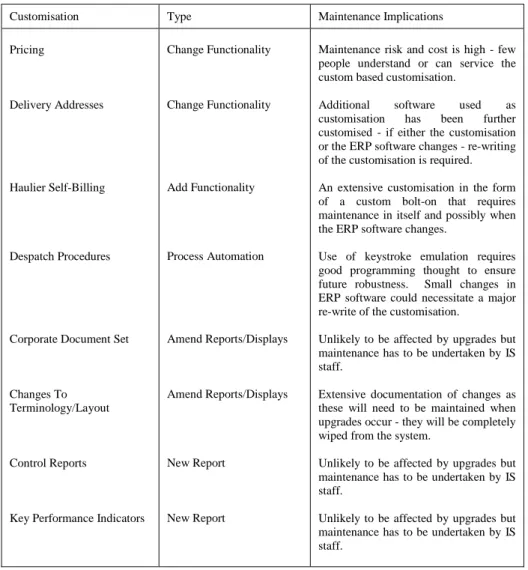
Like Cable, Home has customised the ERP software although it can be argued that overall these are more invasive in nature. Table 3 summarises and categorises the customisations and the associated maintenance implications.
Table 3 Summaries of Cable's Customisations and Maintenance Implications.
Customisation Type Maintenance Implications
Pricing
Delivery Addresses
Haulier Self-Billing
Despatch Procedures
Corporate Document Set
Changes To Terminology/Layout
Control Reports
Key Performance Indicators
Change Functionality Change Functionality Add Functionality Process Automation Amend Reports/Displays Amend Reports/Displays New Report New Report
Maintenance risk and cost is high - few people understand or can service the custom based customisation.
Additional software used as customisation has been further customised - if either the customisation or the ERP software changes - re-writing of the customisation is required.
An extensive customisation in the form of a custom bolt-on that requires maintenance in itself and possibly when the ERP software changes.
Use of keystroke emulation requires good programming thought to ensure future robustness. Small changes in ERP software could necessitate a major re-write of the customisation.
Unlikely to be affected by upgrades but maintenance has to be undertaken by IS staff.
Extensive documentation of changes as these will need to be maintained when upgrades occur - they will be completely wiped from the system.
Unlikely to be affected by upgrades but maintenance has to be undertaken by IS staff.
Unlikely to be affected by upgrades but maintenance has to be undertaken by IS staff.
5. DISCUSSION: TOWARDS UNDERSTANDING THE MAINTENANCE IMPLICATIONS OF ERP SOFTWARE CUSTOMISATION
In this section the aim is to develop a discussion regarding the maintenance implications of undertaking the various forms of customisation identified in the cases. Before discussing the customisations and maintenance implications related to
the case data, it is perhaps useful at this stage to offer a few thoughts arising from the paper as the ideas have developed.
The first is to note that the customisations here are not intended to be an exhaustive list of those to be associated with ERP software or the cases, neither are the associated maintenance implications. Rather they should be seen as an interpretation of the data collected throughout the study of the two case organisations that has usefulness in developing understanding of the area under investigation.
The second is to highlight the need for discussion regarding customisation as a maintenance activity. It is not really possible to enter into a debate about the topic at this juncture, suffice to say that the categorisation of customisation as a maintenance activity may be viewed differently depending upon its context. For example, an organisation may select an ERP software package knowing that they are going to develop the enterprise system further by adding customisations. In this case, the author is inclined to argue that this is not likely to qualify as maintenance activity. However, when customisations occur beyond ERP software selection, and where these had not been planned, the categorisations of customisation as maintenance or development becomes less clear particularly post-implementation and when the system is upgraded.
Finally, the customisations in this paper can be placed on a continuum of implications for future maintenance effort as shown in Figure 1. In this paper, Changes to functionality appear to represent the highest potential maintenance effort and New Reports, the lowest. It is interesting however; that Cable has managed to effectively outsource what could have been considerable maintenance effort (MRP and Metal Management) by working with the ERP software vendor to incorporate it in the standard offering. A further point to make is that Cable and Home highlight a scope dimension to the application of customisations and this too can have maintenance implications. Some customisations were written once and used by the whole organisation (generic customisations) and others were written once but only used locally (local customisations). If this is considered in the context of Figure 1, it is possible to suggest that the scope of the customisation may result in a relative decrease (generic) or increase (local) in maintenance effort.
Figure 1 The Continuum of Maintenance Implications of Home and Cable's Customisations. New Report Amend Existing Reports/Displays Process Automation Add Functionality Change Functionality
Lower Potential Maintenance Effort Higher
This section will now discuss the various categories of customisations and the associated maintenance implications, as identified in Tables 2 and 3.
5.1. Change Functionality
This was probably the most invasive form of ERP customisation as it involved changing the software. Cable and Home offer different ways of dealing with this. Cable's MRP customisation was incorporated into the standard offering of the ERP software vendor. They outsourced responsibility for the maintenance of the software customisation in keeping with the initial reasons for implementing ERP. However, Cable pointed out that this move was not unproblematic. They state that adopting the standard software means it is possible to loose control over the future development of the software. They realised this when the ERP software was rolled out to another customer and that customer tried to make the vendor change the revised MRP module further. This would have invalidated Cable's system. The company invested considerable effort in ensuring that the changes were not implemented. It can be argued that this is a 'hidden' form of maintenance activity. Home's two customisations in this area: Pricing, and Delivery Addresses also raise maintenance issues. Pricing is a custom development that may be affected by upgrades and perhaps more importantly is understood and serviced by a few people. Since go-live, some of the source code for Pricing customisation was deleted in error by an external contractor. Poor management of the source code meant that a copy could not be retrieved. The customisation needed to be re-written, re-tested and re-implemented. The delivery address functionality also represents maintenance challenges. The bolt-on standard software has been customised in additibolt-on to the customisatibolt-on associated with the linkage of the bolt-on software to the ERP software. Therefore, aside from the expectation that upgrades of the ERP software may require maintenance of the customisations, Home are in the position that they also have to deal with upgrades of the customisation software.
5.2. Adding Functionality
Both cases identified functionality absent from the ERP software. As with MRP, Cable worked with the ERP software vendor and incorporated the Metal Management customisation into the standard offering thereby keeping maintenance the preserve of upgrades. Home added Haulier Self Billing, which is an extensive custom development that requires maintenance as any other piece of custom developed software would. The maintenance of the link between this and the ERP software is also required.
5.3. Process Automation
Cable implemented two customisations that aimed to automate processes - Shop Floor Control and the Despatch Process. The company has upgraded and the customisations have not been affected although it is recognised they may be in the future. This is particularly the case with the Despatch Process as it is more interconnected with the ERP software. It is less clear what the maintenance effort will be associated with Home's customisation for process automation purposes. The company has used keystroke emulation and this could require considerable reworking
when upgrades arrive depending upon what the upgrades are and the robustness of the programming of the keystroke emulation.
5.4. Amending Reports/Displays
Cable and Home highlight two customisations in this area: Creating a Corporate Document Set and Changes to Terminology and Layout. Both companies are aware that the maintenance effort associated with the Corporate Document set is very much concerned with the need for developers to undertake this task. It is unlikely that upgrades will require dramatic changes to the customisations – it is more likely that drivers will originate from business decisions (such as Cable’s acquisition activity). Terminology and Layout have been dealt with in very different ways - Cable allowed only a few changes in this area whereas Home's changes are extensive. While each change in itself is small, maintaining all the changes and the associated documentation is a significant under-taking. It consumes 60 per cent of the ERP software administrators' weekly workload. While Home no longer want to expend resource on managing these changes, they feel that removing these cosmetic changes will be difficult with the current culture. The plan is to undertake it as part of the next upgrade of the standard ERP software. They can therefore be seen as re-using the ERP software to reduce maintenance effort - an original driver for the decision to implement.
5.5. New Reports
Cable and Home have added new reports to the software. Neither is likely to be affected by upgrades (unless, for example, new data needs to be included in the reports). In the same way as amended reports, the main maintenance effort is associated with the fact that the development team have to create the reports. Cable experienced difficulties as a result due to staff creating their own reports (which potentially could have led to further maintenance problems for users). Cable have therefore aimed to reduce this maintenance effort by implementing a report generator package in order that the IT staff can produce reports quicker than previously in the hope that users will give up their custom systems.
6. CONCLUSIONS
This paper indicates that the level of organisational acceptance of ERP software is more complex than reported in the academic and business literatures. Cable and Home aimed to reengineer their processes in line with the ERP software in order to take advantage of the strategy - particularly in relation to the outsourcing of maintenance. However, they found that they needed to dilute this benefit, as the ERP software could not accommodate the organisational demands for informing and conducting business processes. From this it has been possible to consider customisation in relation to a continuum of associated maintenance implications. There appears to be a case for the recognition that customisation will require maintenance in the light of upgrades and the effort associated with this can vary
dramatically. Furthermore, customisation may require ongoing maintenance outside of any upgrade implications. The management of risk is also a consideration - How quickly can an organisation deal with maintenance issues where customisation has been performed? Can they deal with them? How much will it cost? A further hidden issue is bound up with the idea that maintenance is outsourced to the ERP vendor where the standard software is not customised. However, thought regarding the appropriateness of future upgrades is necessary - Is it possible that other customers’ customisations could be incorporated into the vendors standard offering? If this happens how will these affect organisations when they upgrade to that version? Will the upgraded standard offering meet organisational needs? Will they need to customise where they had not needed to before and, as a result, acquire unanticipated maintenance work?
The focus of the analysis in this paper has been on the maintenance implications of ERP software customisation but it is also important to consider the lifecycle costs of the ERP software itself. This needs to be examined further, from a number of perspectives such as financial, skills availability and responsiveness implications. Also, ERP software has largely focussed upon the automation of intra-organisational business processes. As organisations demand greater linkage throughout the supply chain the increase in complexity of the software and the parties making the demands for customisations raise significant questions from a number of perspectives, not least - how maintenance in this environment is managed.
7. REFERENCES
1 Kelly S, Gibson N, Holland CP. and Light B. A Business Perspective of Legacy Systems, Communications of the Association for Information Systems 1999, 2(Article 7 – July). http://cais.isworld.org
2 Ward J. Principles of Information Management. Routledge: London, 1995; 252-253.
3 Bennett K. Legacy Systems: Coping with Success. IEEE Software 1994; 12(1): 19-23.
4 Kim Y. Improving Legacy Systems Maintainability. Information Systems Management 1997; 14(1): 7-11.
5 Adolph W.S. Cash Cow in the Tar Pit: Reengineering a Legacy System. IEEE Software 1996; 10(5): 41-47.
6 Lehman MM. Programs, Life-Cycles, and the Laws of Software Evolution.
Proceedings of the IEEE 1980; 68(9): 1060-1076.
7 Hammer M. Reengineering work: Don’t automate, obliterate. Harvard Business Review 1990; 68 (4): 104-112.
8 Davenport TH and Short JE. The New Industrial Engineering: Information Technology and Business Process Redesign. Sloan Management Review 1990; 32(4): 11-27.
9 Price Waterhouse. Price Waterhouse Information Technology Review 1995/1996. Price Waterhouse: London, 1996; 27.
10 KPMG. Exploiting Packaged Software. KPMG: London, 1998; 5.
11 Scheer AW and Habermann F. Making ERP a Success, Communications of the Association for Computing Machinery 2000. 43(4): 57-61.
12 Butler J. Risk Management Skills Needed in a Packaged Software Environment.
Information Systems Management 1999. 16(3): 15-20.
13 Klaus H, Rosemann M, and Gable GG. What is ERP? Information Systems Frontiers 2000. 2(2): 141-162.
14 Sumner M. Risk Factors in Enterprise-wide/ERP Projects. Journal of Information Technology 2000. 15(4): 317-327.
15 Willcocks L and Sykes R. The Role of the CIO and IT Function in ERP.
Communications of the Association for Computing Machinery 2000. 43(4): 33-38
16 Bingi P, Sharma MK, and Godla JK. Critical Issues Affecting An ERP Implementation. Information Systems Management 2000. 16(3): 7-14.
17 Light B and Holland C. Enterprise Resource Planning Systems: Impacts and Future Directions. In Henderson P. (ed.) Systems Engineering for Business Process Change – 2000. Springer: London; 117-126.
18 Holland C and Light B. Global Enterprise Resource Planning Implementation. In
Proceedings Of The 32nd Annual Hawaii International Conference On System Sciences – 1999. IEEE Computer Society Press: Los Alamitos, CA. (CD-ROM) 19 Holland C and Light B. A Critical Success Factors Model for ERP
Implementation. IEEE Software 1999. 16(3): 30-36.
20 Davenport TH. Putting The Enterprise Into The Enterprise System. Harvard Business Review 1998. 76(4): 121-131.
21 Stedman C. Reebok Steps Up Use of SAP Apparel Apps, 1999.
http://www.computerworld.com [29 August 2001].
22 Stedman C. Apparel Makers Anxiously Await SAP Fixes, 1999.
http://www.computerworld.com [29 August 2001].
23 Markus ML, Axline S, Petrie D, and Tanis C. Learning from Adopters' Experiences with ERP: Problems Encountered and Success Achieved. Journal of Information Technology 2000. 15(4): 245-265.
24 Lucas HC Jr, Walton EJ, and Ginzberg MJ. Implementing Packaged Software.
Management Information Systems Quarterly 1988. 12(4): 536-549.
25 Soh C, Kien SS, and Tay-Yap J. Cultural Misfits: is ERP a Universal Solution?
Communications of the Association for Computing Machinery 2000. 43(4): 47-51.
26 Scott JE and Kaindl L. Enhancing Functionality in an Enterprise Software Package. Information and Management 2000. 37(3): 111-122.
27 Pettigrew AM. Contextualist Research: A Natural Way to Link Theory and Practice. In Lawler EE, Mohrman AM, Mohrman SA, Ledford GE, Cummings TG and Associates. (eds) Doing Research that is Useful in Theory and Practice - 1985. Jossely-Bass: San Fransisco CA; 22-274.
28 Miles MB and Huberman AM. Qualitative Data Analysis: An Expanded Sourcebook, 2nd Edition, 1994. Sage Publications Inc: Thousand Oaks CA; 10.
29 Yin RK. Case Study Research: Design and Methods, 2nd Edition, 1994. Sage Publications: London; 4-9.
30 Gummesson E. Qualitative Methods in Management Research 1991. Sage Publications, Inc: Newbury Park, CA; 75.
31 Chapin N, Hale JE, Khan KM, Ramil JF, and Tan W. Types of Software Evolution and Software Maintenance. Journal of Software Maintenance: Research and Practice 2000. 13(1): 3-30.
32 Stake RE. The Art Of Case Study Research 1995. Sage Publications Inc.: Thousand Oaks CA; 113.
33 Gill J and Johnson P. Research Methods For Managers 1991. Paul Chapman Publishing: London; 159-161.
34 Silverman D. Qualitative Research: Meanings or Practices? Information Systems Journal 1998. 8(1): 3-20.
35
Light B, Holland CP, and Wills K. ERP and Best of Breed: A Comparative Analysis. Business Process Management Journal 2001. 7(3): 195-204.ACKNOWLEDGEMENT
The author would like to thank the co-researcher (who wishes to remain anonymous) for the incredibly valuable contribution to the data collection process of this research.
BIOGRAPHY OF THE AUTHOR
Ben is Lecturer in Information Systems and a member of the Information Systems Research Centre at the University of Salford, UK. Prior to this he was Research Fellow at the Manchester Business School, UK. His research interests are information systems strategy and implementation, and he is currently focused on Enterprise Resource Planning and Customer Relationship Management systems. His work is presented at international IS conferences and has been published in journals such as IEEE Software and Electronic Markets.