1 Abstract
The purpose of this research was to determine if the implementation of a commission program paid to top producing agents would increase the amount of new business sold at the Evans Insurance agency along with increasing the sales agent’s motivation levels. Five major approaches are discussed that have led to our understanding of motivation including The Hawthorne Experiments, Maslow’s Need-Hierarchy Theory, McGregor’s X-Y Theory,
Herzberg’s Two-Factor Theory, and McClelland’s Learned Needs Theory. These theories arose from researchers wanting to find what and how employees were motivated.
In this quasi-experimental study participants were collected by a sample of convenience and Paired-samples t- test was ran to analyze some data. The independent variable, a commission program, was used to motivate the sales agents and increase sales production.
It was hypothesized that the commission program would lead to increased sales and motivation levels of the sales agents. From the data, it was evidenced that there was statistical significance from the implementation of the incentive program on both motivational levels and sales.
Future research should focus not on incentives as a whole, but broken down into different types to see which incentives are better motivators than others.
2 Chapter 1
Introduction and Statement of the Problem Statement of Purpose
The purpose of the project was to increase the amount of sales of new business made at the Evans Insurance Agency by individual agents from November 2005 to December 2005. The Evans Insurance Agency implemented a commission program paid to top-producing agents to see if an incentive program worked to increase policies sold to new business at the agency. The project involved surveying agents regarding motivation levels before the incentive program was implemented and two months after the program was implemented. The results of the two surveys were then compared in order to measure the effect on agent sales motivation. In
addition, a production analysis was provided of actual sales numbers, per agent, during the time frame investigated.
The Evans Insurance Agency has been a leader in the insurance industry serving clients in the areas of home, auto, life, health, and financial services to assist clients with the best
insurance options. Agents were supported by incentive programs to increase motivation to reach a larger customer base.
Organizational Context
Setting of the problem. The Evans Insurance Agency, an independent State Farm Agency, was established in 1960. Over the last 45 years, the agency has built a tradition of reliability in the Moore and South Oklahoma City area. Representing the number one home and auto insurer in the nation, the Evans Agency has become one of the largest insurance agencies in Oklahoma.
3 The goals and objectives of the Evans Agency were reflected in its organizational
Mission Statement, Vision Statement, and Shared Values.
--- Insert Figure 1 Here
---
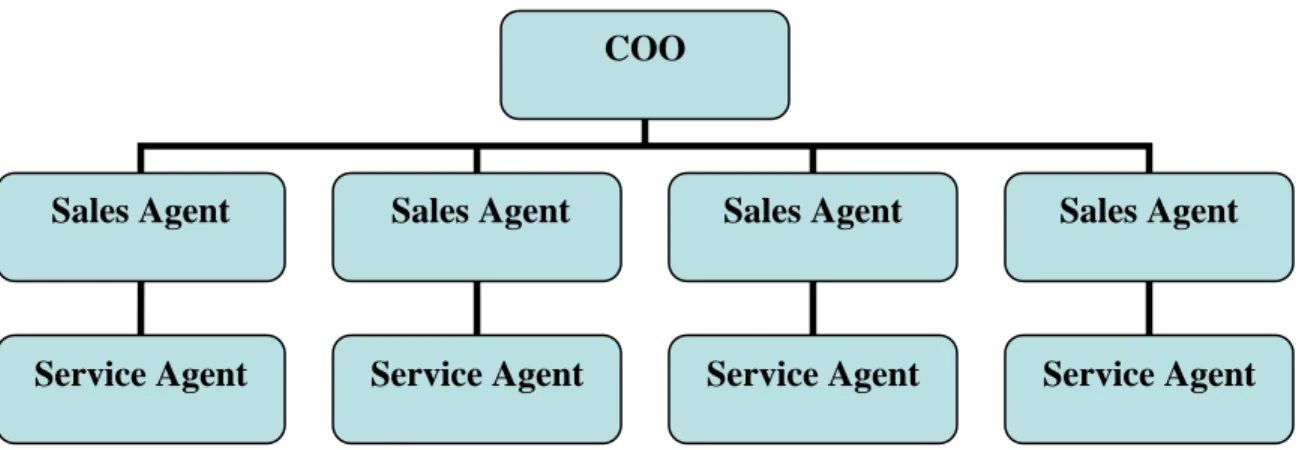
State Farm has grown to include more than 16,700 agents servicing 71.6 million policies in the United States and Canada. The Evans Agency, representing State Farm Companies, has been individually owned and operated by the Chief Operating Officer (COO) since 1960.
--- Insert Figure 2 Here
---
The COO has overseen the three main departments in the agency: sales, servicing, and marketing.
The Department of Sales was studied in this project. It was comprised of five insurance agents. Each of the sales agents was responsible for producing applications, the sole source of income for the agency. Each sales agent had a monthly production goal that was established by the COO. The sales agent then reported directly to the COO. There was no middle manager between the sales agents and the COO.
The sales department agents were responsible for implementing the agency’s marketing and sales plan, contacting new prospects to generate interest in needs based sales appointments, and conducting needs based sales reviews with current clients. In the past, the sales agents had not produced as expected.
Our mission is to help people manage the risks of everyday life, recover from the unexpected and realize their dreams.
We are people who make it our business to be like a good neighbor; who built a premier company by selling and keeping promises through our marketing partnership; who bring diverse talents and experiences to our work of serving the
State Farm customer.
Our success is built on a foundation of shared values -- quality service and relationships, mutual trust, integrity and financial strength.
Vision Statement
Our vision for the future is to be the customer's first and best choice in the products and services we provide. We will continue to be the leader in the insurance industry and we will become a leader in the financial services arena.
Our customers' needs will determine our path. Our values will guide us.
COO
Sales Agent Sales Agent Sales Agent Sales Agent
Service Agent Service Agent Service Agent Service Agent
5 The sales agents were empowered to accumulate work, within individual systems designed to get the required results. However, the system provided little results during the past five years. The agency had not seen any growth since 1999, only maintained policy numbers. The agency as a whole was ready for change and ready to move production to the next level.
History and background. The Evans Insurance agency was established in 1960. Over the last 40 years, the agency has continually had tremendous growth, growing to be one of the largest insurance agencies in Oklahoma. From 2000 until late 2001, the main problem that contributed to the lack of growth was employees. A few of the employees did not have the skill set necessary to support the agency direction. They were released from the agency in October 2001 and two new sales agents were hired. Then, in January 2002, an additional two sales agents were hired.
While focusing on the employee issue, the Evans Agency also had to focus on the waning economy. After the September 11th attack on the twin towers, the economy took a significant downturn. Along with the declining economy, State Farm had been financially impacted with natural disasters such as hurricanes and tornadoes. The combination of both forced State Farm underwriters to limit the business that Oklahoma agents wrote. Restrictions were placed on several lines of business that the sales agents were used to writing. The original plan of action that had been established with the new agents was no longer valid. The restrictions had halted that plan, but instead of modifying the already existing plan with the economy changes, the agency chose to play a reactive role.
At that point, the agency as a whole had no vision. With all of the changes that had taken place, they had set no distinctive goals. The COO was spending more time outside the agency and the employees had become bored with tending to reactive activities on a daily basis. So, not
6 only was the COO of the agency affected by the problem, but the sales agents were affected as well. The attitude then spread throughout the organization to other areas of the agency, which included the service agents. In 2004, dissatisfied with the status of the agency, the COO implemented a strategic plan that would get the agency going in the right direction. Together, with all of the departments of the agency, a new vision was created.
Scope of the problem. Many changes have occurred within the agency since taking action in the beginning of 2004. The sales and service agents have all been key players in all issues and changes within the agency. The sales agents have focused on engaging in proactive activities first and foremost.
This project involved implementing a commission program paid to top-producing agents to see if an incentive program worked to motivate the sales agents to increase the number of policies sold to new business at the agency. The program rewarded the sales agents for focusing on proactive activities rather than reactive. The project involved surveying the sales agents regarding motivation levels before and after the program was implemented. The results of the two surveys were then compared to measure the effect on agent sales motivation. An analysis of sales numbers, per agent, during the implementation time frame was investigated to see if the numbers corresponded.
Because the top priority for the Evans Agency was increasing new policies sold, the service agents were not a part of the focus of this study. It was restricted solely to the
Department of Sales of the agency. The scope of the project focused on theimplementation of commissions paid to sales agents on new policies written at the agency. The project also focused on the motivation levels for the sales agents that resulted from the new commissions paid.
7 Significance of the Project
The significance of the results of this project were valuable to the COO of The Evans Agency as an indicator of whether or not the implementation of commissions paid to sales agents on new policies had a direct result on the agencies growth and increased motivation levels with the sales agents. Since motivated employees are more productive and employee behavior is linked to attitude, then it made sense for the COO of the Evans Agency to implement a reward system that improved the sales agent’s attitudes, motivation, and behaviors.
A survey of motivation levels for the sales agents before and after the implementation of commissions provided data for analysis in regards to the commission system effectiveness implemented at the agency.
8 Definition of Terms
Raw New Business – New business written on a new client; a household that is not currently with State Farm.
Underwriters – State Farm employees who make sure that all business that is written with State Farm meets the required guidelines. Written applications are first looked over and approved by an underwriter.
Sales Agent – A sales agent is an insurance agent who works in the Department of Sales.
Service Agent – A service agent is an insurance agent who works in the Department of Service at the Evans Agency.
Production – The amount of policies written by the sales agents at the Evans Agency. Proactive - Being proactive is the endowment of self-knowledge or self-awareness. It is the ability to choose your own response. You can choose your response to any situation or any person.
9 Chapter 2
Review of the Literature
At one time, employees were considered just another input into the production of goods and services. What perhaps changed this way of thinking about employees was research, referred to as the Hawthorne Studies, conducted by Elton Mayo from 1924 to 1932 (Dickson, 1973). This study found employees were not motivated solely by money and employee behavior was linked to their attitudes (Dickson, 1973). The Hawthorne Studies began the human relations approach to management, whereby the needs and motivation of employees became the primary focus of managers (Bedeian, 1993).
From the earliest of times people worked to promote greater efficiency in the way things were done. Initially, this was mostly concerned with manual working methods. Improved methods, improved tools and incentives to the workforce were all part of the search for greater productivity. The world of work has changed enormously over time. Conditions, attitudes, and expectations that prevailed in the ages before the Industrial Revolution were different from those today. However, the difficulties, dilemmas and opportunities are no less challenging than in previous times.
Improved productivity is something many people have invested interest in. People work better when the environment, working methods, and the equipment have been designed to help them. When human motivation to do a good job at work for an appropriate reward is added in, improved productivity is anticipated.
The fascination with human motivation has been based on the long-held assumption that more motivation leads to better performance. The importance of this topic was attested to by the vast accumulation of research in human motivation.
10 Motivation Theories
The focus of many researchers following the publication of the Hawthorne Study results was determining what motivated employees and how they were motivated (Terpstra, 1979). Five major approaches that have led to our understanding of motivation are The Hawthorne
Experiments, Maslow’s Need-Hierarchy Theory, McGregor’s X-Y Theory, Herzberg’s Two-Factor Theory, and McClelland’s Learned Needs Theory.
The Hawthorne Experiments were conducted from 1927 to 1932 at the Western Electric Hawthorne Works in Cicero, Illinois, where Professor Elton Mayo examined productivity and work conditions. Mayo started these experiments by examining the physical and environmental influences of the workplace such as brightness of the lights and humidity. He later moved into the psychological aspects such as breaks, group pressure, working hours, and managerial leadership. The Hawthorne Effect can be summarized as “Individual behaviors may be altered because they know they are being studied,” (Terpstra, 1979, p.42). Elton Mayo’s experiments showed than an increase in worker productivity was produced by the psychological stimulus of being singled out, involved, and made to feel important.
According to Maslow (1943), employees had five levels of needs: physiological needs, safety needs, social needs, esteem needs, and self-actualization. He arranged these needs into a series of different levels or the order of importance of those basic needs with self- actualization being the summit of his hierarchy needs. Maslow argued that lower level needs had to be satisfied before the next higher level need would motivate employees.
Douglas McGregor made his mark on the history of organizational management and motivational psychology when he formulated the two theories by which managers perceive employee motivation. He referred to these opposing motivational theories as Theory X and
11 Theory Y (McGregor, 1957). Each assumes that management's role is to organize resources, including people, to best benefit the company. However, beyond this commonality, they're quite different. Theory X assumes that the primary source of most employee motivation is monetary, with security as a strong second. Under Theory Y assumptions, there is an opportunity to align personal goals with organizational goals by using the employee's own need for fulfillment as the motivator. McGregor recognized that some people may not have reached the level of maturity assumed by Theory Y and therefore may need tighter controls that can be relaxed as the employee develops.
Herzeberg’s work categorized motivation into two factors: motivators and hygienes (Herzberg, Mausner, & Snyderman, 1959). The lists of factors were based on Maslow’s Hierarchy of Needs, except his version was more closely related to the working environment (Herzberg, 1966). Motivator or intrinsic factors, such as achievement and recognition, produce job satisfaction. Hygiene or extrinsic factors, such as pay and job security, produce job
dissatisfaction.
In his Acquired-Needs Theory, David McClelland proposed that individual’s specific needs are acquired over time and are shaped by one’s life experiences. Most of these needs can be classed as either achievement, affiliation, or power (McClelland, 1985). A person’s
motivation and effectiveness in certain job functions are influenced by these three needs.
McClelland’s theory is sometimes referred to as the Three Need Theory or as the Learned Needs Theory.
Many contemporary authors have defined the concept of motivation. Motivation has been defined as the psychological process that gives behavior purpose and direction (Kreitner, 1995); a predisposition to behave in a purposive manner to achieve specific, unmet needs
12 (Buford, Bedeian, & Lindner, 1995); an internal drive to satisfy an unsatisfied need (Higgins, 1994); and the will to achieve (Bedeian, 1993). Motivation plays a key role when considering employees and organizations.
Employee Motivation
Why do companies need motivated employees? The answer is survival (Smith, 1994). A successful business has depended on the employees using their full talents. Motivated
employees are needed in rapidly changing workplaces. Motivated employees help organizations survive. Motivated employees are more productive. Yet, in spite of the bountiful supply of theories and practices, managers often view motivation as a mystery.
To be effective, managers need to understand what motivates employees within the context of the roles they perform. Of all the functions a manager performs, motivating
employees is the most complex. This is due, in part, to the fact that what motivates employees changes constantly (Bowen & Radhakrishna, 1991). For example, research suggests that as employees’ income increases, money becomes less of a motivator (Kovach, 1987). Also, as employees get older, interesting work becomes more of a motivator. A person’s motivation is a combination of desire and energy directed at achieving a goal. A person’s motivation depends upon two things: the strength of certain things and the perception that taking a certain action will help you satisfy those needs. People can be motivated by such forces as beliefs, values, interests, fear and worthy causes. Some of these forces are internal, such as needs, interests, and beliefs. Others are external, such as danger, the environment, or pressure from a loved one. It is up to the manager to find out what motivates each individual employee.
According to research conducted by Northwestern University (2005), most organizations use a combination or recognition, cash and non-cash incentives to motivate their employees. The
13 Study, Strategic Guidelines to Managing Cash and Non-Cash Employee Rewards, identified the top ten motivation tactics that most companies utilize: employee recognition being the top motivator, special events, e-mail/print communications, gift certificates, merchandise incentives, training programs, work life benefits, cash rewards, variable pay, and sweepstakes was at the bottom of the list.
A study of industrial employees, conducted by Kovach (1987), yielded the following ranked order of motivational factors: (a) interesting work, (b) full appreciation of work done, and c) feeling of being in on things. Another study of employees, conducted by Harpaz (1990), yielded the following ranked order of motivational factors: (a) interesting work, (b) good wages, and c) job security. In the two cited works mentioned above, interesting work ranked as the most important motivational factor. Pay was not ranked as one of the most important motivational factors by Kovach (1987), but was ranked second in the research by Harpaz (1990). Full appreciation of work done was not ranked as one of the most important motivational factors by Harpaz (1990), but was ranked second in the research by Kovach (1987). The discrepancies in these research findings supports the idea that what motivates employees differs given the context in which the employee works.
The key to supporting the motivation of employees is to understand what motivates each of them. Managers cannot just count on cultivating strong interpersonal relationships with employees to help motivate them. Reliable and comprehensive systems in the workplace help to motivate employees such as established compensation systems, employee performance systems, organizational policies and procedures that support employee motivation.
14 Combining the above mentioned motivators and incentive systems in the workplace helps to communicate to the organization as a whole what is most important to the upper management. Implementing incentives alone, without any other motivating force, would be a mistake (Neilson, 2005).
Use of Incentive Programs
The concept of incentive motivation recognizes that the characteristics of the goals we work to obtain influence our behavior. From the perspective of incentive motivation, experts conclude that incentives are the major force underlying what we do (Kruse & Weitzman, 1990). We work to obtain the goals that are emotionally meaningful to us.
An individual is not motivated to obtain every incentive offered to him or her. The incentive has to have perceived value, and when the individual is willing to expend effort to obtain the incentive, it becomes a goal (Igalens & Roussel, 1999). The goal toward which we work should clearly provide a strong sense of motivation. Specific goals increase performance, and difficult goals, when accepted, result in higher performance than easy goals.
Motivation also involves equity. To motivate or direct behavior, the incentive must be equitable for all participants. Research shows that if an employee perceives inequity, he or she will act to correct the inequity by lowering productivity, reducing quality, increasing
absenteeism, or quitting (Conte & Kruse, 1991). In addition to equity, an incentive must have a high perceived value to the participants so he or she can become emotionally involved in
reaching the goal.
Incentives work because people need them. Psychologically, people desire recognition, need to feel a part of a team, and want to do a good job (Igalens & Roussel, 1999). Long-term personal goals often fall prey to daily or weekly frustrations. People find it hard to intertwine
15 personal goals with their organization’s long term goals. Some employees may have trouble developing individual performance goals at all.
Incentives offer a cure. They provide concrete rewards for quality performance that is consistent with short and long term organizational objectives. They present visible goals with visible acknowledgment, helping keep people on track toward personal and company
performance. There are many different options when looking at incentive compensation programs and systems.
Pay strategies and pay systems used for years are outdated, and continued reliance on outdated pay systems is one reason why American business organizations cannot successfully compete internationally (Nurney, 2001). An article in HR Magazine reported this growing realization that traditional pay systems do not effectively link pay to performance or productivity (Pasternak, 1993). As a result, managers have increasingly turned to variable pay plans.
Variable pay can be defined as: “Any compensation plan that emphasizes a shared focus on organizational success, broadens opportunities for incentives to nontraditional groups, and operates outside the base pay increase system” (Gross & Bacher, 1993, p. 83).
In order to implement successful variable pay systems, companies must be sure their plans are based on clear goals, unambiguous measurements, and visible linkage to employees’ efforts. Key design factors include: support by management, acceptance by employees,
supportive organizational culture, and timing (Juebbers, 1999). Incentive compensation assumes it is possible and useful to tie performance directly to pay.
The most widely used plan for managing individual performance is merit pay. Heneman defines merit pay as “individual pay increases based on the rated performance of individual
16 employees in a previous time period,” or a reward based on how well an employee has done the job (IOMA, 2000).
There are several different types of individual incentive plans: straight piecework, standard-hour plan, differential piece rate or Taylor Plan, production bonus systems, and commissions paid to sales employees. Regardless of what type of incentive compensation program a company uses, incentives drive performance (Pophal-Grensing, 2000). Commissions paid to sales employees with a combination of a base salary are the most popular type of
incentive programs used by companies (Risher, 1993). Impact of Incentives on Production Levels
Incentive programs are one of the few business strategies in which cost can be based on actual performance and paid out after the desired results have been realized, and the desired results make a positive impact on the organization’s bottom line (Rynes & Gerhart, 2000). In addition, a study conducted by the International Society of Performance Improvement, called, “Incentives, Motivation, and Workplace Performance: Research & Best Practices,” found incentive programs improve performance. Effectively designed and properly implemented incentive programs increase performance by an average of 22 % (Intini, 2005). Team incentives can increase performance by as much as 44 %. Incentive programs engage participants. The research found that incentive programs can increase interest in work. When programs are first offered for completing a task, a 15 % increase in performance occurs. When employees were asked to persist toward a goal, they increase their performance by 27 % when motivated by incentive programs.
Incentive programs attract quality employees. Organizations that offer properly structured incentive programs can attract and retain higher quality workers than other
17 organizations (Logue & Yates, 1999). An incentive program will not compensate for lack of training, a poor product or inadequate marketing. However, as a part of the integrated business strategy, well-executed incentive programs motivate people at all levels of the organization. The bottom line is organizations that successfully motivate their workforce to achieve specific goals will realize the greatest financial gains over time.
Research shows that increasing payroll costs and competition in the global marketplace have caused managers throughout the United States to search for ways to increase productivity by linking compensation to employee’s performance (Brown & Armstrong, 2000). High performance requires much more than motivation. High performance can be achieved when
motivation and incentives are combined (Caudron, 1996). Conclusion
The importance of incentives on employee motivation is evident. Research showed that motivated employees are more productive. Research also showed that though there are many different types of employee motivators, incentives provide extreme motivation for employees. Most organizations researched showed that most use a combination of recognition, cash, and non-cash incentives to motivate employees. Research indicated that most of the common variations in incentive plans make no difference in performance; any incentive plan, regardless of its structure is better than none at all.
As supported by research, incentive motivation recognized that the characteristics of the goals we work to obtain influence our behavior. From the perspective of incentive motivation, experts conclude that incentives are the major force underlying what we do.
The purpose of this project was to increase the amount of sales of new business made at The Evans Insurance Agency by individual agents by implementing a commission program paid
18 to top producing agents to see if an incentive program worked to increase policies sold at the agency.
19 Chapter 3
Methods and Procedures Hypotheses
The purpose of this research was to determine two factors: The first to see if implementation of a commission program paid to top producing agents would increase the amount of new business sold at the Evans Insurance agency, and the second was to see if the incentive program would increase the sales agent’s motivation levels. It was hypothesized that the commission program would lead to increased sales and motivation levels at The Evans Agency.
The independent variable was a commission program, with sales production and sales agent’s motivation levels as the dependent variables. A Paired-samples t- test was selected to compare motivation and production levels measuring levels before and after the incentive program.
Subjects
Five sales agents from The Evans Insurance Agency were participants of this study. The data from this research were obtained from before-after surveys. All participants were treated in accordance with the Ethical Principles of Psychologist and code of conduct (APA, 2002). Instrumentation
The operational definition for the independent variable, a commission program was to motivate the sales agents and increase sales production. This was an intervention variable that was introduced one month after the first motivation survey and each individual sales agent’s production analysis was administered. The first motivation survey and production analysis was administered in December, 2005. The implemented commission system began with a sales agent
20 staff meeting in December, 2005, which introduced the details of the new commission program to the sales agents. Each individual sales agent would be paid commission on any policy that was written. The sales agents were then given a job motivation survey to see what their current motivation levels were. At this time, each of the sales agents November and December
production number were gathered and recorded from the agencies official production records. When the introduction was completed, the agents started to receive their new
commissions January 1, 2006. The introduction to the commissions program was done by the Chief Operations Officer. In March, 2006, a second job motivation survey was administered to measure the effect of the commission program on overall job motivation among the sales agents at the Evans Agency. At this time, each of the sales agents January and February production numbers were gathered and recorded from the agencies official production records.
The operational definition for the dependent variable was the measure of job motivation, as determined by questions designed to measure that variable, and the measure of production numbers, as determined by analyzing the before-and-after production numbers. The Employee Motivation Survey (EMS) was designed to measure overall job motivation. The survey had subscales of motivation, stress, burnout, commitment level, focus, attitude, and direction. The survey was created by this researcher using a web-based source. The EMS has not been tested for reliability and validity. In addition to the before and after survey, an analysis was provided of the actual sales numbers, per agent, during the time frame investigated.
The dependent variable of job motivation was an interval measurement. The EMS was designed with forced response questions to develop an interval scale which was used to gather factual information and respondent opinions. This rank order relationship used a likert scale for assessing the respondent opinions. Affirmative responses were coded from one to five which
21 corresponded to “strongly agreed” through “strongly disagree” choices on the EMS. Negative responses were coded in the opposite direction. The codes were used to quantify job motivation. The lower the respondent’s total score, the higher the job motivation.
Procedure
This study is a quasi-experimental design. The data were obtained in the following manner. First, the employee motivation survey was administered, collected, and tabulated. At this time, production numbers for each individual agent were collected and recorded for the months of November and December. The independent variable, a commission program, was then initiated. This was followed up with a second employee motivation survey. Again, production numbers for each individual agent were collected and recorded for the month of January and February. The before and after data were recorded by this researcher and was ready for data analyses.
Data Analysis
SPSS was used to analyze the data. Descriptive statistics were gathered after the EMS has been coded for scoring. Motivation was measured by 17 questions from the EMS. This research tested the null hypothesis that a commission program had no effect on job motivation and production levels. The alternate hypothesis was that the introduction of a commission program would result in increased job motivation among the sales agents. The analysis technique used to test the hypothesis was computed using SPSS. Appropriate correlations, percentages, and t-tests were computed to analyze the data.
Limitations
The limitation of this study varied. The information collected to analyze the results was self-reported by the participants and may have contained observer bias. The study was neither
22 comprehensive nor exhaustive over incentive programs on motivation and sales. The study was conducted within a small amount of time. The sample size was small, lacked random assignment, and consisted of only Caucasian participants lacking diversity in ethnicity. Thus the sample used may have not represented the population at hole. The experiment lacked control making it uncertain whether or not the incentive had the effect or an outlier.
23 Chapter 4
Summary of Results
This chapter summarizes the information obtained through the implementation of a commission program paid to top producing sales agents. The chapter provides the empirical data collected and evaluates the effectiveness of the intervention.
Restatement of Hypothesis
The hypothesis stated that the implementation of the commission program would lead to increased sales and motivation levels of the sales agents. The data for this research was obtained from the EMS that was administered to sales agents at The Evans Insurance Agency. The
production analysis was put together from The Evans Agency’s recorded and official production records. Comparison of the data indicated that an increase in production and motivation levels did occur at a statistically significant level.
Descriptive Statistical Information
The hypothesis stated that the intervention of an incentive program would cause a significant increase in sales and motivation levels of the agents. In analyzing the
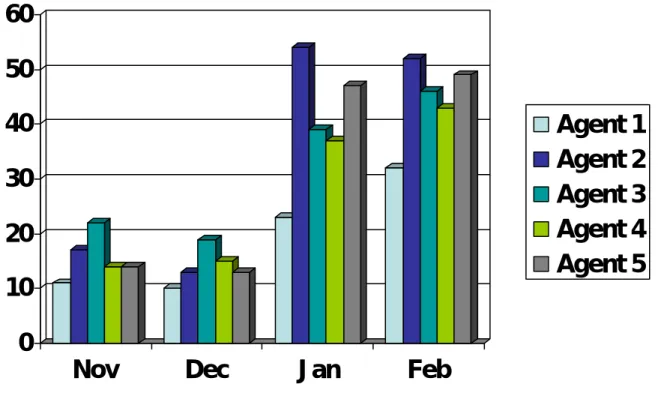
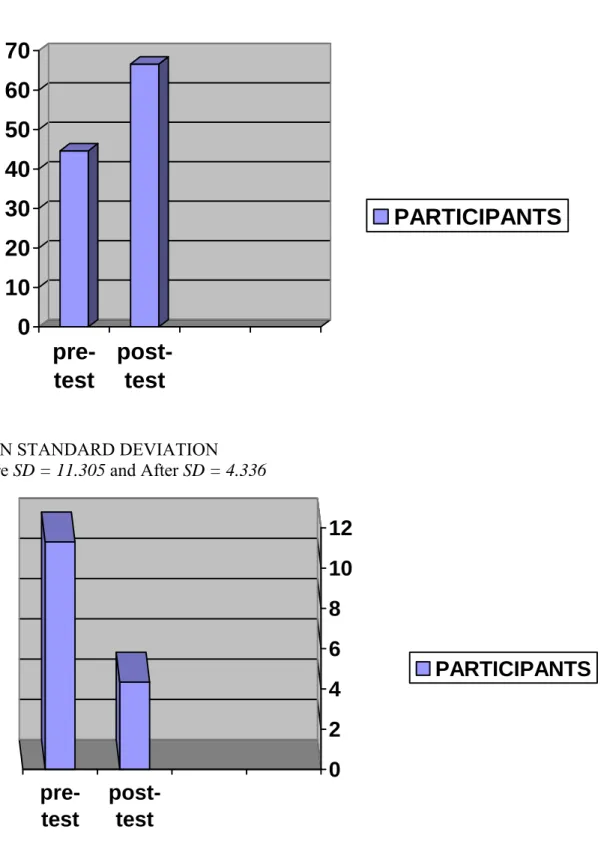
pre-implementation data for sale numbers, a mean of 29.60 was determined with a standard deviation of 7.27. In analyzing the pre-implementation data for motivation levels, a mean of 44.60 was determined with a standard deviation of 11.31. For the post-implementation data a mean of 84.40 was calculated with a standard deviation of 19.27. For the motivation levels, a mean of 66.60 was determined as well as the standard deviation of 4.37. By observing Figure 3 and Figure 4 a before and after comparison can be made about the effect of an incentive program. The months of November and December were before the incentive program was presented while January and February were post-implementation of the incentive program. Figure 4 presents the
24 means and standard deviations for sale agents before and after implementation of the incentive program.. The data used for analysis resulted from a Paired-samples t-test..
--- Insert Figure 3 and 4 Here
--- Results of the Significance Test
The Paired-samples t-test was chosen to be used in this project because there were two double distributions (pre and post) of interval data being compared for possible differences. The hypothesis used in this project was as follows:
H0: µ pre ≥ µ post; H1: µ pre < µ post. An alpha level of .05 was used for all statistical tests.
The hypothesis addressed if there would be a change in motivation levels after an
incentive program was present. Critical regions were set, tcrit =3.182 or -3.182, and a two-tailed,
Paired-samples t-test showed statistical significance t(4) = -6.198, p = .003. From the data it is evidenced that the incentive program did change motivation levels.
The second part of the hypothesis addressed if there would be a change in production level after the implementation of an incentive program. Critical regions were set, tcrit =3.182 or
-3.182, and a two-tailed, Paired-samples t-test showed statistical significance t(4) = -7.031, p = .002. There is a change in production levels after an incentive program was introduced according to the data. This researcher rejected the null hypothesis for the motivation levels and sale
25
0
10
20
30
40
50
60
Nov
Dec
Jan
Feb
Agent 1
Agent 2
Agent 3
Agent 4
Agent 5
Figure 3. Production Analysis Bar Graph
• November and December were pre-implementation months
• January and February were post-implementation months
26 MEAN BETWEEN PRE-IMPLEMENTATION AND POST-IMPLEMENTATION
BEFORE m = 44.60 and AFTER m = 66.60
0
10
20
30
40
50
60
70
pre-test
post-test
PARTICIPANTS
MEAN STANDARD DEVIATION Before SD = 11.305 and After SD = 4.336
0
2
4
6
8
10
12
pre-test
post-test
PARTICIPANTS
27 Chapter 5
Discussion and Conclusions
The purpose of this project was to determine what effect implementation of an incentive program would have on sales and motivation levels. The objective was to determine if the sales of new policies and the sales agent’s motivation levels would increase as a direct result of implementing the incentive program.
This chapter provides a discussion and interpretation of the results obtained from the intervention described. Recommendations are presented and conclusions are tentatively drawn, based on the statistical results.
General Discussions and Conclusions
One conclusion that can be drawn from this study is that motivation for an individual may be altered by various factors. The control group that did not have the incentive program had lower motivation levels than those in the experimental group who had the incentive program. Knowing this, several important factors can be derived from this finding. The first is that a person can be motivated beyond his or her current motivation level. This would be beneficial for marketing companies, coaches, teachers, any business or person who is in competition or needs growth. Motivation is not a set concrete level, but is malleable and can be changed in either a positive or negative direction.
Strengths and Weaknesses of the Study
One of the strengths of the study lay in the availability of data to be analyzed. A second was that the findings from the significance tests were statistically significant.
A weakness of the project was the limited time frame to conduct the study. Another weakness of this project was the small sample size. Also the EMS was created by this researcher
28 and has not been tested for validity and reliability. Answers from the EMS were also
self-reported. The study was neither comprehensive nor exhaustive on incentive programs and the effects it has on motivation and production levels. The design used lacks control and findings are not necessarily confined to that of the incentive program.
Recommendations
Although the two month time period was adequate to acquire results to measure the relative success of this project, a more extensive study of six to twelve months would allow the building of a data base that may be useful in demonstrating the value of a commission program. A larger sample size, 30-40 sales agents, would aid in the reliability of this study. A better diversity of a sample size would better represent the population at a whole.
Suggestions for Future Research
Based on the results of this study, it is recommended that The Evans Insurance Agency perform a controlled study of the implementation of a commission program paid to top
producing sales agents for a time period of six to twelve months. If the production and motivation levels continue to increase or remain static for an appreciable period of time, the further recommendation is to develop a continuous incentive program into the day to day operations of the Evans Agency.
Also, future research should compare various states of age and its effects upon the individual’s motivation levels, looking for any difference in how people may be affected differently by motivations depending on age.
And last, the area for future research would be to study not just incentives as a whole, but break down the incentives into each different type of incentive to see which type of incentives are better motivators than others. In this study, the commission incentive seemed to be a very
29 good motivator, but with a larger sample size, the commissions might not have been as good of a motivator to some agents as it was to the ones in this study. A future study should incorporate implementing different incentive plans such as travel, money, or additional paid vacation days while tracking production and motivation levels with those different incentives to see which produced the highest results.
30 References
American Psychological Association (2002). Ethical principles of psychologist and code of conduct. American Psychologist, 57 1060-1073.
Bedeian, A.G. (1993). Management (3rd ed.). New York: Dryden Press. Bowen, B.E., & Radhakrishna, R.B. (1991). Job satisfaction of agricultural
education faculty: A constant phenomena. Journal of Agricultural Education, 32 (2). 16-22.
Buford, J.A., Jr., Bedeian, A.G., & Lindner, J.R. (1995). Management in Extension (3rd ed.). Columbus, Ohio: Ohio State University Extension.
Brown, Duncan., Armstrong, Michael. (2000). Paying for contributions: performance related pay strategies. New York: Kogan Page. Caudron, Shari. (1996). How pay launched performance. Personnel Journal, 75 (9), 70-76.
Conte, Michael A., Kruse, Douglas. (1991). ESOPS and profitsharing plans: Do they link employee pay to company performance. Financial
Management, 20, 9-100.
Dickson, W.J. (1973). Hawthorne Experiments. In C. Heyel (ed.), The Encyclopedia of Management, 2nd ed. (pp.298-302). New York: Van Nostrand Reinhold.
Gross, Steven E., Bacher, Jeffrey P. (1993, Jan-Feb). The new variable pay programs: how some succeed, why some don’t. Compensation and Benefits Review, 25 (1), 51.
Harpaz, I. (1990). The importance of work goals: an international perspective. Journal of International Business Studies, 21. Herzberg, F. (1966). Work and the Nature of Man. Cleveland: World
Publishing Co.
Herzberg, F., Mausner, B., & Snyderman, B.B. (1959). The motivation to work. New York: John Wiley & Sons.
Higgins, J.M. (1994). The Management Challenge (2nd ed.). New York: Macmillan.
31 Igalens, Jacques, Roussel, Patrice. (1999). A Study of the relationships between
compensation package, work motivation and job satisfaction. Journal of Organizational Behavior, 20 (7), 1003-1026.
IOMA. (2000, March). Four studies reveal how alternative pay in being put to work. IOMAs Pay for Performance Report.
Intini, John. (2005). It’s all in the perks. Naclean’s, 118 (43), 34-39.
Juebbers, Lawrence A., (1999, September). Laying the foundation for global compensation. Workforce, 1-4.
Kovach, K.A. (1987). What motivates employees? Workers and supervisors give different answers. Business Horizons, 30. 58-65.
Kreitner, R. (1995). Management (6th ed.). Boston: Houghton Mifflin
Company.
Kruse, D., Weitzman, M., (1990). Profitsharing and productivity in paying for productivity- a look at the evidence. Blinder (ed.), The Brookings Institution: Washington D.C.
Logue, J., Yates, Y.S., (1999). Worker ownership American style: pluralism, participation, and performance. Economic and Industrial Democracy, 20 (2), 225-262.
Maslow, A.H. (1943, July). A theory of human motivation. Psychological Review, 370-396.
McClelland, D. (1985). Human Motivation. New York: Scott, Foresman. McGregor, D. (1957). Proceedings of the Fifth Anniversary Convocation
of the School of Industrial Management, the human side of Enterprise. Massachusetts Institute of Technology (April 9, 1957).
Neilson, Gary L. (2005). The passive-aggressive organization. Harvard Business Review, 83 (10), 82-92.
Northwestern University. (2005, October). Numbers game. Potentials, 3 (10).
Nurney, Steven P. (July-August, 2001). When to stop negotiating individual packages for international assignees. Compensation and Benefits Review, pp. 62-68.
32 Pophal-Grensing, Lin. (December, 2005). Incentives drive results. Credit
Union Management. Retrieved Jan 6, 2006, from http://cumanagement.org.
Risher, Howard W. (1993, Jan-Feb). Strategic salary planning. Compensation and Benefits Review, 25 (1), 46-50.
Rynes, S.L., Gerhart, B.(2000). Compensation in organizations: Current research & Practice. San Francisco: Jossey-Bass.
Smith, G.P. (1994). Motivation. In W. Tracey (ed.), Human Resources Management and Development Handbook (2nd ed.).
Terpstra, D.E. (1979). Theories of motivation: borrowing the best. Personnel Journal, 58. 376.