201
8
-201
9
CREDO FORMATTING GUIDE
New York Theological Seminary 475 Riverside Drive, Suite 500
New York, New York 10115 (212) 870 1211 (ph) (212) 870 1236 (fax)
2020-2021
Table of Contents FORMAT REQUIREMENTS/GUIDELINES ... A1 Spacing ... A1 Justification ... A1 Margins ... A1 Fonts ... A1 Footnotes ... A1 Printing and Copying ... A1 Paper ... A1 Preliminary Pages ... A2 Text, Appendices and Bibliography ... A2 Table- Pagination and Sequencing ... A3 Formatting Guidelines ... A4 Cover Page ... A4 Chapter or Introduction Page ... A4 Subsequent Pages of Text ... A5 Appendix ... A5 Bibliography ... A6 Appendix A: Citation Guide ... A7 Appendix B Table Citation Guide ... A13 Appendix C Sample Paper ... A19
Table 1 Pagination Sequence ... A3 Figure 1: Cover Page ... A4 Figure 2: Chapter or Introduction Page ... A4 Figure 3: Subsequent Text Pages ... A4 Figure 4: Appendix ... A5
FORMAT REQUIREMENTS/GUIDELINES Spacing
• Double space the general text of the manuscript.
• Single-space within each bibliographical entry and double-space between entries. • Single-space within long tables, long quotations, footnotes, appendices and
multi-line captions.
Justification
• Left justification (not full) for all text, including footnotes and bibliography, unless otherwise specified in the Formatting Guide.
Margins
• First Page of Introduction or Chapter: • Top: 2” (50.8 mm)
• Right, and Bottom 1” (25.4 mm) • Left 1.0” (25.4 mm)
• All other pages:
• Top, Bottom and Right: 1” (25.4 mm) • Left 1.0” (25.4 mm)
(Note: for bound works, the left margin should be increased to 1.5”) Fonts
• Times New Roman (or equivalent), 12-point fonts for text and 10-point font for footnotes and subscripts.
Footnotes
• Footnotes numbers run sequentially from the first to the last page of text.
• Footnote numbers are superscripted before the first character of the footnote text. • Otherwise, footnotes conform to notes/bibliography for in Kate Turabian’s Manual
for Writers, 8th edition, (see Appendix A for examples).
• Citations within the text are limited to Biblical references (as well as other sacred documents).
• Footnotes conform to the margins of the page.
• Footnote text must be in 10 point Times New Roman, with the exception or the footnote number that can be no smaller than 8-point font size.
• Footnotes (along with the footnote number) have a first line indent of .5” (12.7 mm.) from the left margin.
• Footnotes are single spaced within, and double spaced between. Printing and Copying
• No cross-outs, lines, smudges and smears, and white-out. • Print single sided unless professor states otherwise. Paper
PAGE NUMBERING AND PLACEMENT
(See Table 1 on next page)
Preliminary Pages
• “Preliminary pages” refers to all pages that precede the text of the paper • Count, do not number the title page.
• Count and number with roman numerals (iii, iv, v, etc.) the acknowledgement page, and the table of contents.
• Numbers are placed in the center of the page 0.5" (12.7 mm) from the bottom.
Text, Appendices and Bibliography
• Count and consecutively number with an Arabic number (1, 2, 3) all text pages, appendixes and bibliography.
• Appendixes continue numbering from the text of the paper.
• Scanned documents that are already numbered must be reduced so they display the page numbering of the document.
• Page numbers are placed in the footer of each page, centered 0.5" (12.7 mm) from the bottom.
• At the top of the bibliography should be the single word Bibliography followed by a two double spaces.
Table- Pagination and Sequencing
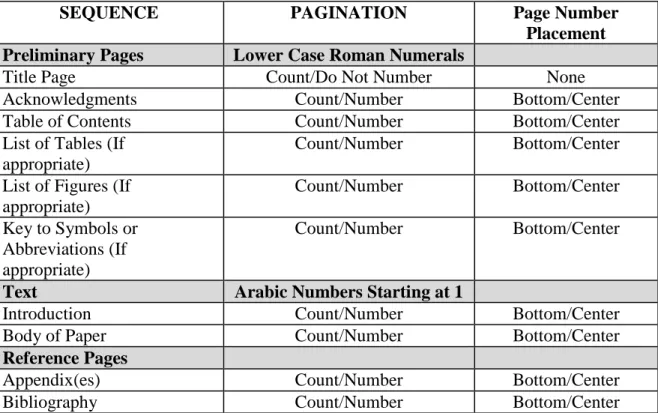
The following table shows the proper sequence for pagination. These areas may or not be applicable to your paper. Required for most academic papers are: title page, body of paper, and bibliography. Your professor will specify which elements that your paper must have.
Table 1 Pagination Sequence
SEQUENCE PAGINATION Page Number
Placement Preliminary Pages Lower Case Roman Numerals
Title Page Count/Do Not Number None
Acknowledgments Count/Number Bottom/Center
Table of Contents Count/Number Bottom/Center
List of Tables (If appropriate)
Count/Number Bottom/Center
List of Figures (If appropriate) Count/Number Bottom/Center Key to Symbols or Abbreviations (If appropriate) Count/Number Bottom/Center
Text Arabic Numbers Starting at 1
Introduction Count/Number Bottom/Center
Body of Paper Count/Number Bottom/Center
Reference Pages
Appendix(es) Count/Number Bottom/Center
Formatting Guidelines
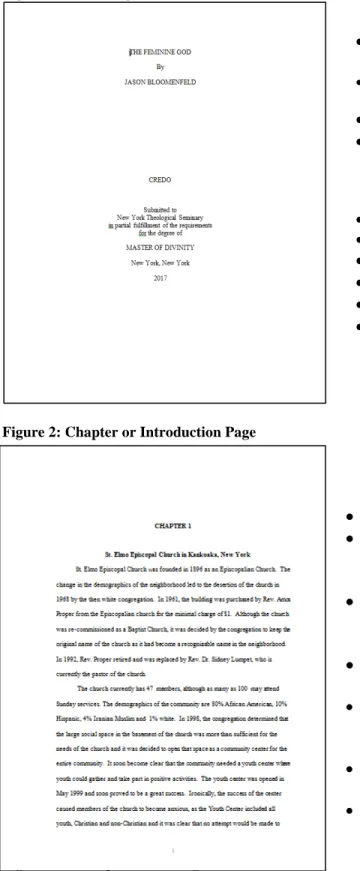
Figure 1: Cover Page
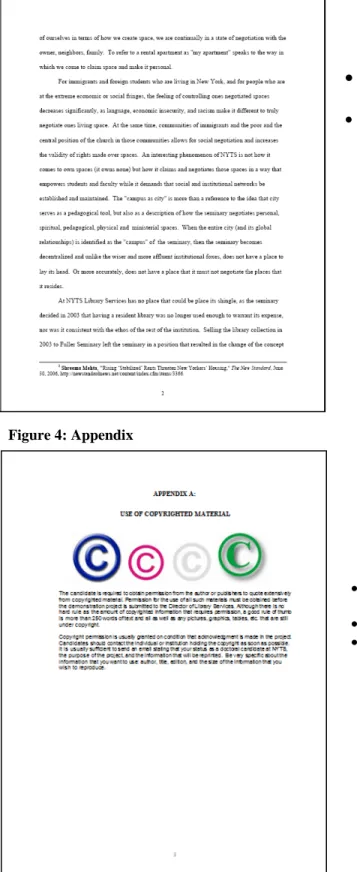
Figure 2: Chapter or Introduction Page
Chapter or Introduction Page • Top margin should be set at 2". • Type “INTRODUCTION" if you are
beginning with an introduction or the name of the chapter or section. • Double-space twice. Begin typing the
double-spaced text, indented at the beginning of each paragraph.
• Note: Do not put extra spacing
between paragraphs.
• Begin counting page numbering at 1 in Arabic numerals (1, 2, 3, etc.) at the
Cover Page
• Centered with 2” top margin type the TITLE in CAPS
• Double Space before and after “By” and type AUTHOR NAME in CAPS
• Space down 3” and type CREDO in CAPS • Type centered and in sentence case:
Submitted to New York Theological Seminary in partial fulfillment of the requirements
for the degree of • Double Space
• Type MASTER OF DIVINITY in CAPS
• Double Space
• Type New York, New York
• Double Space
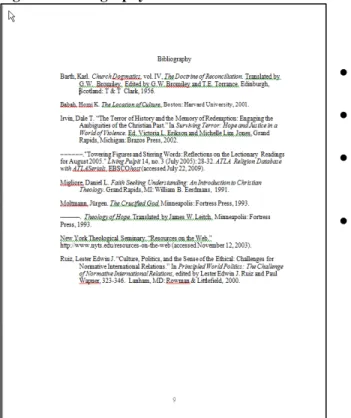
Figure 4: Appendix
Appendix
• APPENDIX A centered 1” (25.4 mm) from the top of the page.
• Double-space and type the title.
• Double space and begin text or input graphic. Subsequent Pages of Text
• Top margin should be set at 1".
• Continue numbers in sequence.
Figure 5: Bibliography
Bibliography
• Type the heading “Bibliography” centered 1” (25.4 mm) from the top of the page. • Double-space twice. Type the list of
sources.
• The list of sources is single-spaced within, and double-spaced between, entries.
• Entries should be formatted with a hanging indent. (The first line is flush left and subsequent lines within the entry are indented .5 inches from the left margin.)
Appendix A: Citation Guide
New York Theological Seminary Citation Guide1
Citing with Turabian/Chicago Style
Kate Turabian, A Manual for Writers of Papers, Theses, and Dissertations, 8th ed. (Chicago: University of Chicago Press, 2013) is the standard for citations at NYTS and a copy should be owned by every student. The relevant citation information is contained in Chapter 17 of Turabian,
"Notes-Bibliography Style: Citing Specific Types of Sources."
There are two major types of citations for textual work (paper or Internet):
1. Exact quotes: the exact words that were spoken or written by your source. Like direct speech, they are set off from the rest of the text. A footnote number immediately follows the closed quotation mark.
The direct quote is appropriate if it is written by a major authority in the field or is written in a way that cannot be improved upon. It is also appropriate if it is text quote is to be exegeted, e.g. the Bible or the Constitution.
If less than five lines, exact quotes are set off with quotation marks, followed by a footnote number.
“Members of the organization met regularly.”1
According to NYTS format, if the quote is five lines of more, the entire quote should be single spaced and indented five spaces from both margins with a blank line before and after. Quotation marks should not appear unless they are in the original text.
Members of the organization met regularly. The organization carried out its business in the northern part of the district, meeting at the homes of members and requiring a unanimous vote for all business.1
2. Paraphrases: the writer's thoughts expressed in your own words. Read the passage thoroughly, close the book and then write out the idea in your own words.
Unlike direct quotes, the text is not surrounded by quotation marks. Like direct quotes a footnote number appears directly after the quote.
In the northern part of the country, business was carried out in private homes. 2
1 Information from Jerry Reisig, Access: Key to Unlocking Information Literacy, 4th ed. (New York: New York Theological Seminary, 2014).
Footnotes
Footnote or Endnote
In the footnote system, citations appear at bottom of the page where the information is cited. In the endnote system, citations appear at the end of the chapter or at the end of the book. Different scholastic institutions or departments may prefer one or the other. The bibliography-footnote system is required at New York Theological Seminary and at most other seminaries.
Footnote Syntax
The footnote appears at the bottom of the page on which the cited information is found. The footnote is a single sentence containing three bibliographic fields (who/what/where): author, title, and publication information, as well as a page number. Fields or clauses are separated by commas or parentheses and the footnote/sentence ends with a period. (I have emphasized the punctuation in the examples.)
Footnote Format
The footnote text and and footnote number are in ten point with a first line indent. They are single spaced within and separated by a 10 point space. (One of the easiest ways to do this is to change the footnote style in your word processor.) Footnote numbers are superscripted and Arabic.
Standard format for a book:
Firstname Lastname of Author, Title of Book in Italics(Place of publication: Publisher, Date of Publication),page number(s).
The footnote for a book with a single author would take the form: (Punctuation is expanded for effect)
Note: Footnote numbers are superscripted and footnote has a first line indent.
First occurrence of footnote:
1 Jerry Reisig, This is My Book about Citing Sources (Lansing, MI: Big Brother is Watching Publishers, 2009), 2.
Subsequent occurrences: 12 Reisig, My Book, 23-24.
122
Jerry Reisig My Book about Citing Lansing MI Interon Press 2004
1
Firstname Lastname Title in Italics City STATE Publisher Pub Date Page
Standard format for a Journal Article:
The name of the journal name is italicized like the title of a book, but the individual article cited within in it is placed in “double quotes.” Unlike books, journals do not usually indicate a place of publication or publisher. The only publication information is the date of publication. There is no comma between the Journal Name and the volume number.
Firstname Lastname of Author(s) of Article, “Title of Article in Double Quotation Marks,”
Title of Journal in ItalicsVolume number, issue number (Date of Publication):page
number(s).
The footnote for a journal article with a single author would take the form: (Punctuation is expanded for effect)
Note: Footnote numbers are superscripted and footnote text has a first line indent. First occurrence of the journal footnote:
1 Jerry Reisig, “Citations,” Journal of Citations 32, no.1 (Jan, 2014): 122. Subsequent occurrences:
12 Reisig, “Citations”: 23-24.
Note: Page number(s) are separated with a colon rather than a comma. Ibid.
Ibid. means "in the same place" and is used to cite works that have just been cited. If the citation is on the same page as the previous one, the word ‘Ibid.’ alone is sufficient; if it is found in the same work but at a different location, the page number(s) must be included, preceded by a comma. (Note: Ibid. is not italicized and is followed by a period as it is an abbreviation for ibidem.)
12 Reisig, My Book, 23-24.
13 Ibid. If the citation occurs on the same page
14 Ibid., 7. If the citation occurs on a different page
122
Jerry Reisig Citations Journal of Citations 32
1
Firstname Lastname Volume Issue Pub Date
Autho Journal Publication Page
no. 1 Jan 2014
Reference Works:
s.v
Sub verbo (under the word) is used with encyclopedia or dictionary entries and replaces any page references with article name. [Note: references from well-known encyclopedias are not included in the bibliography.]
For an article on Salvation in the Encyclopedia Britannica:
14 Encyclopedia Britannica, 15th ed., s.v. “Salvation.”
Wikipedia
Like any encyclopedia, Wiki is not usually sufficient for graduate level research papers, and many professors will not accept Wikipedia citations in papers.
The Bible and Sacred Works
The formatting style sheet for NYTS appears in parenthetical form. (Book Chapter: Verse Translation) such as: (John 4:3 NRSV) where NRSV is the abbreviation for the New Revised Standard Version, the most commonly used citation in academic writing.
Classical Works
Works produced in classical Greece and Rome, Medieval Europe and the Renaissance have a unique citation form. They are organized by into books, sections, and sometimes lines, and are separated by periods without spaces.
The format for a book is:
[Author], [Title] [Book].[Section].[Line #s].
The footnote for Augustine De civitae Dei, Book 20, line 1 is:
1
Augustine, De civitae Dei 20.1.
The format for a poem is:
[Author], [Title] [Stanza]. [Line #(s) cited]
The footnote for Homer’s Iliad, stanza 18, lines 141 through 143 is:
1
Bibliography Entry
A Bibliography lists all works that are cited in a paper—except types that do not normally appear in bibliographies (See Citation Table). In addition, it contains works that influenced the paper but were not cited. Like the footnote, the bibliography is composed of information found in the bibliographic record; unlike the footnote, it usually does not include page numbers—unless they are for complete works that are part of a larger work, e.g., articles in Journals or essays in books. Bibliography entries are composed of a series of bibliographic fields divided by periods and ending with a period. Since the bibliography is in alphabetical order by the last name of the author, the first author listed in an entry is in the format Lastname, Firstname. All subsequent authors in the same entry are in the form Firstname Lastname. All entries have a hanging indent, are single-spaced within and double spaced between.
Standard format for a book:
Lastname, Firstname of Author
.
Title of Book in Italics.
Place of publication: Publisher, Date of Publication.
The bibliography entry with a single author would take the form: (Punctuation is expanded for effect)
Standard format for a Journal Article:
Lastname, Firstname of Author(s) of Article, “Title of Article in Double Quotation Marks,”
Title of Journal in ItalicsVolume number, issue number (Date of Publication):page
number(s).
Reisig Jerry Citations Journal of Citations 32 no. 1 Jan 2014 121-158
Issue
Volume Pub Date Lastname, Firstname
Author of Article Journal Publication Page # (s)
My Book about Citing Lansing MI Interon Press 2004
Reisig Jerry
Title in Italics
Lastname, Firstname City STATE Publisher Pub Date
Two works by the same author:
If a bibliography has two or more entries by the same author, the author's name is spelled out fully in only the first entry. In all subsequent entries, three condensed em dashes (six dashes) replace the author's name. Entries by the same author are sorted alphabetically or by date of publication. In the following example, two entries by Jerry Reisig are sorted alphabetically.
Reisig, Jerry. This is My First Book about Citing Sources and My Name is Spelled Out. Lansing, MI: Big Brother is Watching Publishers, 2009.
———. This is My Second Book about Citing Sources and My Name Is Replaced by Three Em Dashes. Lansing, MI: Big Brother is Watching Publishers, 2009.
Appendix B Table Citation Guide
This is a quick cheat sheet of Footnote and Bibliography entries for different types of sources.
Footnote Bibliography
One Author
1
James Cone, A Black Theology of Liberation (Maryknoll, NY: Orbis Books, 2005), 65.
Cone, James. A Black Theology of Liberation. Maryknoll, NY: Orbis Books, 2005.
Two Authors
2
Dale T. Irvin and Scott W. Sundquist, Earliest Christianity to 1453, vol. 1 History of the World Christian Movement (Maryknoll, NY: Orbis Books, 2001), 65.
Irvin, Dale T., and Scott W. Sundquist. Earliest Christianity to 1453. Vol. 1 History of the World Christian Movement. Maryknoll, NY: Orbis Books, 2001.
Four or more authors
3
Edward Laumann et al., The Social Organization of Sexuality (Chicago: University of Chicago Press, 1994), 262.
Laumann, Edward, John H. Gagnon, Robert T. Michael, and Stuart Michaels. The Social Organization of Sexuality. Chicago: University of Chicago Press, 1994.
Editor, translator, or compiler instead
of author
4
Michael Welker, ed., The Work of the Spirit: Pneumatology and Pentecostalism (Grand Rapids, MI: William B. Eerdmans, 2002), 59.
Welker, Michael, ed. The Work of the Spirit: Pneumatology and Pentecostalism. Grand Rapids, MI: William B. Eerdmans, 2002.
Editor/translator / compiler +
author
5
Thomas Aquinas, Selected Works, ed. and trans. Ralph McInery (New York: Penguin, 1998), 23.
Aquinas, Thomas, Selected Works. Edited and translated by Ralph McInery New York: Penguin, 1998.
Footnote Bibliography
Volume in Multivolume Set
2
Dale T. Irvin and Scott W. Sundquist, Earliest Christianity to 1453, vol. 1 of History of the World Christian Movement (Maryknoll, NY: Orbis Books, 2001), 65.
Irvin, Dale T. and Scott W. Sundquist. Earliest Christianity to 1453. Vol. 1 of History of the World Christian Movement. Maryknoll, NY: Orbis Books, 2001.
Chapter or other part of a book
6
Dale T. Irvin, “The Terror,” in Surviving Terror, edited by Victoria L. Erickson and Michelle Lim-Jones, 10-63 (Grand Rapids, MI: Brazos Press, 2002), 43.
Irvin, Dale T. “The Terror.” In Surviving Terror, edited by Victoria L. Erickson and Michelle Lim-Jones, 10-63. Grand Rapids, MI: Brazos Press, 2002.
Dissertation or DMin Project
8
Jerry Reisig, “Negotiated Space: A Paradigm of Decentralized Library Services” (DMin diss., New York Theological
Seminary, 2010).
Reisig, Jerry. “Negotiated Space: A Paradigm of Decentralized Library Services.” DMin diss., New York Theological Seminary, 2010.
Article in a print journal
7
Obery Hendricks, “The Domestication of Martin Luther King,” The AME Review (April-June 1998): 53.
Hendricks, Obery. “The Domestication of Martin Luther King.” The AME Review (April-June 1998): 51-59.
Book review
11
Obery Hendricks, “The Hand That Interprets Controls History,” review of Stony the Road We Trod, edited by Cain Hope
Hendricks, Obery. “The Hand That Interprets Controls History.” Review of Stony the Road We Trod, edited by Cain Hope Felder. Sojourners 22 (December, 1993):
46-Footnote Bibliography
Newspaper article
10
Michael Paulson, “Americans Claim to Attend Church Much More Than They Do,” New York Times, 17 May, 2014.
Newspapers usually do not appear in bibliographies (See Turabian 11.44)
Lecture
12
Moses Biney, “Social Context” (lecture, New York Theological Seminary, November 14, 2011).
Biney, Moses. “Social Context.” Lecture, New York Theological Seminary, November 14, 2011.
Well known Reference Works
14
Encyclopedia Britannica, 15th ed., s.v. “Salvation.”
Well known Reference Works usually do not appear in the Bibliography.
Abstract
15
Keith Russell, “What About Lazarus? A Theological Reflection On Poverty In The United States,” abstract, Review & Expositor 111, no. 2 (May 2014): 149.
Generally not included in Bibliography
Pamphlets and Reports
13
New York Theological Seminary, 2014 Annual Report (New York Theological Seminary, 2014).
Generally not included in Bibliography
Quote cited by another author
16
Peter Taylor Forsyth, The Principle of Authority (London: Independent Press, 1952), 55, quoted in Donald Bloesch, A Theology of Word & Spirit (Downers Grove, IL:
InterVarsity Press, 1992), 203.
Bloesch, Donald. A Theology of Word & Spirit. Downers Grove, IL: InterVarsity Press, 1992.
Footnote Bibliography
Kindle Book
17
Phyllis Trible, God and the Rhetoric of Sexuality (Philadelphia: Fortress, 1978), Kindle Electronic Edition: Chapter 4, Location 288-90.
Trible, Phyllis. God and the Rhetoric of Sexuality.
Philadelphia: Fortress, 1978. Kindle Electronic Edition.
Google Book (or other online
books)
16
William James, The Varieties of Religious Experience (London: Longman, Greens, and Co., 1911), 15,
http://books.google.com/ (accessed December 22, 2009).
James, William. The Varieties of Religious Experience. London: Longman, Greens, and Co., 1911.
http://books.google.com/books. Accessed December 22. 2009. Online Database (Such as ATLA Religion Database) 23
Sohail H. Hashmi, "The Rights of Muslim Women: a Comment on Irene Oh's The Rights of God," Journal Of Religious Ethics 38, no. 3 (September 1, 2010): 588-593, ATLA Religion Database with ATLASerials, EBSCOhost (accessed November 15, 2011).
Hashmi, Sohail H. "The Rights of Muslim Women: a Comment on Irene Oh's The Rights of God." Journal of Religious Ethics 38, no. 3 (September 1, 2010): 588-593. ATLA Religion Database with ATLASerials, EBSCOhost. Accessed November 15, 2011.
Online Journal
(Journal
14
Afe Adogame, “Dealing with Local Satanic Technology: Deliverance Rhetoric in the Mountain of Fire and Miracles
Ministries,” Journal of World Christianity 5,
Adogame, Afe. “Dealing with Local Satanic Technology: Deliverance Rhetoric in the Mountain of Fire and Miracles Ministries.” Journal of World Christianity 5, no. 1 (2012): 75-101. http://www.journalofworldchristianity.org/.
Footnote Bibliography
Online Magazine
1
Katherine Ozment, “Losing Our
Religion,” Boston Magazine, January, 2003, http://www.bostonmagazine.com/2012/12/losi ng-our-religion-non-religious-parenting/.
Ozment, Katherine. “Losing Our Religion.” Boston Magazine, January, 2003. http://www.bostonmagazine.com/2012/12/losing-our-religion-non-religious-parenting/. Online Newspaper 30
Jodi Rudorenmay, " For Middle East, Region of Religious Conflict, Pope Suggests a Respite in Prayer,”nytimes.com, 27 May 2014, http://www.nytimes.com/2014/05/28/world/m iddleeast/for-middle-east-region-of-religious-
conflict-pope-suggests-a-respite-in-prayer.html.
Newspapers are usually not included in Bibliographies
Website with Author/Identifier
50
John Doe, "Strategic Plan,”
http://www.nyts.edu (accessed July 4, 2014).
Doe, John. “Strategic Plan.” http://www.nyts.edu. Accessed July 4, 2014.
Website without Author/Identifier
51
Columbia University,
http://www.columbia.edu (accessed February 3, 2008).
Columbia University. http://www.columbia.edu. Accessed February 3, 2008.
Wikipedia (Chicago form)
51
Wikipedia, The Free Encyclopedia, s.v. "Plagiarism,” last modified on March 7, 2004, http://en.wikipedia.org/w/index.php?title=Pla giarism&oldid=5139350 (accessed August 10, 2004).
Since Wikipedia is an encyclopedia, it will not occur in the bibliography
Footnote Bibliography
Weblog (Blog) post
52
Martha R. Jacobs, “A Christian Guide to Confronting End of Life Issues” The
Huffington Post, entry posted March 5, 2010, http://www.huffingtonpost.com/rev-martha-r-
jacobs/a-clergy-guide-to-end-of-_b_836865.html (accessed March 10, 2010).
Entries are only cited in the Notes.
Personal interview:
52
Jerry Reisig, interview by author, New York, NY, October 10, 2013.
Entries are only cited in the Notes.
DVD or Video:
53
Cecil B DeMille, et al., The Ten
Commandments (Hollywood, CA: Paramount DVD, 2006).
DeMille, Cecil B., Aeneas MacKenzie, Jesse L. Lasky, Jack Gariss, Fredric M. Frank, Charlton Heston, and Yul Brynner. The Ten Commandments. Hollywood, CA: Paramount DVD, 2006.
Appendix C Sample Paper
THE FEMININE GOD By JASON BLOOMENFELD CREDO Submitted to
New York Theological Seminary in partial fulfillment of the requirements
for the degree of
MASTER OF DIVINITY
New York, New York
2017
Center all text on Page
Double Space Before and After By
Drop 2.5 “ Single Space ALL CAPS 2” Top Margin 1.0” Left Margin 1.0” Right Margin
Double Space Twice Between
Single Space Between
Acknowledgments
I would like to give my thanks to my teachers, my reader, and especially to the
NYTS Librarian. Without them, I would never have come this far.
This page is Optional
1.0” Margin
1.0” Left
1.0” Right Margin
Table of Contents
INTRODUCTION ... 1
CHAPTER I: GOD ... 3
CHAPTER II: JESUS ... 4
CHAPTER III: SPIRIT ... 5
CHAPTER IV: SOTERIOLOGY ... 6
CHAPTER V: ECCLESIAOLGY ... 7
CHAPTER VI: ESCHATOLOGY ... 8
CHAPTER VII: PERSONAL EVALUATION ... 9
CONCLUSIONS... 10
BIBLIOGRAPHY ... 11 Right period leader tab. Do not
use periods or dashes 1.0” Margin
INTRODUCTION
The Credo is one integrated paper, not a series of short papers strung together. It often
helps to find an identifying theme or statement that runs through the entire paper, a single
“thread” running through the tapestry as a whole. Each of the theses statements in each of your
doctrinal chapters should then support and enhance your main theme. To maintain a particular
interpretative lens or methodology, or a minor combination of them will also aid in bringing
coherence to your essay. For example, your theme may be “liberation” and your interpretative
lens or methodology could be the womanist perspective (women of color feminism). Your
context, personal location, or denomination may also serve as a unifying principle for you. You
should find a way to distill your Credo down to a few short sentences that would read as an
abstract of the entire work, which can be included in the Introduction and paraphrased in the
Conclusion. See if you can provide a single paragraph, or a short confession of faith if you will,
that encapsulates succinctly what is the most compelling theme for you at this point in your
theological and professional journey.
Remember that the Credo is essentially a theological work, and it covers areas that are
traditionally defined as being doctrinal. Your work must demonstrate a sound doctrinal and
hermeneutical framework and exegetical skills, and must reflect an adequate engagement, if not
appropriation, of a wider community’s faith identity. What needs to be taught at each point about
what God is saying today? What needs to be said at all cost in order for the Christian movement
to have a relevant future?
1” Bottom Margin
Arabic Page Number 1/2” from Top and Bottom
Font Times Roman 12 2” Top Margin
Introduction or new Chapter has 2” top margin.
1.0” Left
Your theological vision and mission for ministry must also be clearly articulated in light
of your doctrinal affirmations. Hence you should not only draw from your ministry experiences
but also seek to reflect theologically on the practice of ministry. What is the relevance of your
theological understanding for the community or communities of faith of today? How can your
theological stance help provide a response to key issues that plague society and the communities
of believers in your local contexts as well as abroad?
When reading your work, your reader will not have a single standard or model of
orthodoxy in mind that you are expected to uphold. Instead, the reader will be looking internally
within the work itself to find the historical and theological lines of inquiry that are affirmed or
articulated in its pages. The internal coherence of the work overall is what is now important, not
necessarily your external adherence to an ecclesial set of standards (although for many of you
these will still be important in guiding your articulation). If you identify yourself within a
particular tradition and wish to affirm it, your reader will be concerned to see that you can
adequately represent that tradition, as well as where you are seeking to challenge it on various
aspects of faith and practice. Where you are challenging particular aspects of a tradition, the
reader will be especially interested to see that you understand what is at stake theologically both
in the tradition and in your challenge.
Second Page 1” Top Margin 1.0” Left 1.0” Right
CHAPTER I: GOD
Your understanding of God, who is confessed in Trinitarian and/or relational theology.
Trinitarian Christians this has usually meant the One who lives as Three-in-One, or the Trinity.
Even so, the focus should be on the Godhead and the person of the Father/Mother in the Trinity,
remembering that the persons of the Son and the Spirit will be developed in essays that follow. It
will be necessary for the writer to utilize research Richard Kallet defines research as
... the rationale for the application of specific procedures or techniques used to identify, select, and analyze information applied to understanding the research problem, thereby, allowing the reader to critically evaluate a study’s overall validity and reliability..2
The institutional context also includes other relevant research going on in the
institution.”3 In research it is essential that they be well defined in order to be able to produce
reproducible data and conclusions. The project exists in the context of your desire for a grade
and diploma, the contexts and desires of the subjects who are part of the project and the political
historical space in which the project is performed.4
2 Richard Kallet, "How to Write the Methods Section of a Research Paper,” Respiratory Care 49 (October 2004): 1229-1232. Note: direct quotes more than 3 lines in length are blocked .single spaced and 5 inches from the left and right margins.
3 Lisl Klein, Working Across the Gap: The Practice of Social Science in Organizations. London: Karnac, 2005, 138.
4
Paula Willoquet-Maricondi, Framing the World Explorations in Ecocriticism and Film (Charlottesville: University of Virginia Press, 2010), 55. Willoquet-Maricondi analyzes the relationship of the land to “political and historical space and the sacred repository of history, identity and bio-diversity.”
1.0” Left 1.0” Right Margin Block Quote .5” Right Indent Block Quote .5” Left Indent 2” Top Margin
Introduction or new Chapter has 2” top margin.
Footnote numbers run consecutively from the beginning to the end, rather than restarting at the beginning of each chapter or section.
CHAPTER II: JESUS
Your understanding of Jesus (the Christ)
. 2” Top Margin 1.0” Left Margin 1.0” Right Margin
CHAPTER III: SPIRIT
Your understanding of the Divine Spirit
2” Top Margin
1.0” Left
1.0” Right Margin
CHAPTER IV: SOTERIOLOGY
Your understanding of salvation, which includes creation, humanity, sin, grace,
and/or redemption
2” Top Margin
1.0”
Left 1.0”
CHAPTER V: ECCLESIAOLGY
Your understanding of the nature and mission of the church, which could be focused on
discipleship or ministry of the universal community or specific communities of faith.
2” Top Margin
1.0” Left
1.0” Right
CHAPTER VI: OF ESCHATOLOGY
Your understanding of eschatology
2” Top Margin
1.0” Left
1.0” Right Margin
CHAPTER VII: PERSONAL EVALUATION
Several additional pages to provide a personal evaluation of the following
subjects (be as specific as possible):the nature of your experience at NYTS (you may
expound on some of the answers you provided in the Exit Interview Form to reflect at
greater length on this aspect of your NYTS experience)
• Hermeneutical Inventory revisited: Select 3 to 5 areas you consider to have
experienced the most growth or changed, comparing your understanding of the
issues when you first started in the program and how you assess yourself today as
a graduating senior in light of what you’ve learned at NYTS
• Important events or issues in your academic learning over the last several years of
your seminary experience (think of specific classes, professors, conferences,
one-day events that made the most impact in your life. Here you can also expound on
some of the answers you provided in the Exit Interview Form)
• Questions and/or issues that you have yet to resolve or areas for your own
personal growth still with regards to theology, spirituality, ministry, etc.
2” Top Margin
1.5” Left Margin
1.0” Right Margin
CONCLUSIONS 2” Top Margin 1.0” Left 1.0” Right
BIBLIOGRAPHY
Cone, James. A Black Theology of Liberation. Maryknoll, NY: Orbis Books, 2005.Davis, Rupert Eric. Making Sense of the Creeds. London: Epworth Press, 1987
Hendricks, Obery. “The Domestication of Martin Luther King.” The AME Review (April-June 1998): 51-59.
———. “The Hand That Interprets Controls History.” Review of Stony the Road We Trod, edited by Cain Hope Felder. Sojourners 22 (December, 1993): 46-47.
Irvin, Dale T., and Scott W. Sundquist. Earliest Christianity to 1453. Vol. 1 History of the World Christian Movement. Maryknoll, NY: Orbis Books, 2001.Kelly, J. N. D. Early Christian Creeds. London: Longman, 1972.
James, William. The Varieties of Religious Experience. London: Longman, Greens, and Co., 1911. http://books.google.com/books (accessed December 22. 2009
Link, Hans-Georg, ed. Confessing Our Faith Around the World, volumes 3 and 4. Geneva: WCC, 1983-1985.
Pelikan, Jaroslav. Credo: Historical and Theological Guide to Creeds and Confessions of Faith in the Christian Tradition. New Haven: Yale University Press, 2003.
Reisig, Jerry. “Negotiated Space: A Paradigm of Decentralized Library Services.” DMin diss., New York Theological Seminary, 2010.Rogers, Jack. Presbyterian Creeds: A Guide to the Book of Confessions. Philadelphia: Westminster, 1985.
Trible, Phyllis. God and the Rhetoric of Sexuality. Philadelphia: Fortress, 1978. Kindle Electronic Edition.
1” Top Margin
1.0”
Left 1.0” Right
Margin
Entries are single spaced within and have a hanging indent of .5”
Repeated authors name are substituted by 3 em dashes or six
dashes
Entries are alphabetized lastname, firstname of first author.