When Does a Platform Create Value by Limiting Choice?
(Article begins on next page)
The Harvard community has made this article openly available.
Please share
how this access benefits you. Your story matters.
Citation
Casadesus-Masanell, Ramon, and Hanna Haaburda. "When Does a
Platform Create Value by Limiting Choice?" Journal of Economics
& Management Strategy 23, no. 2 (Summer 2014): 259–293.
Published Version
doi:10.1111/jems.12052
Accessed
June 10, 2016 11:04:29 AM EDTCitable Link
http://nrs.harvard.edu/urn-3:HUL.InstRepos:13135311
Terms of Use
This article was downloaded from Harvard University's DASH
repository, and is made available under the terms and conditions
applicable to Open Access Policy Articles, as set forth at
http://nrs.harvard.edu/urn-3:HUL.InstRepos:dash.current.terms-of-use#OAP
When Does a Platform Create Value
by Limiting Choice?
∗
Ramon Casadesus-Masanell
Harvard Business School
Boston, MA 02163
Phone: +1 (617) 496-0176
Email: [email protected]
Hanna Ha laburda
Harvard Business School
Boston, MA 02163
Phone: +1 (617) 495-8544
Email: [email protected]
November 9, 2012
∗We thank two anonymous referees and the coeditor for helpful comments that have helped improve
the paper. We also thank Kevin Boudreau, Kenneth Corts, Jim Dana,Eric Darmon, Chris Dellarocas, Nicholas Economides, Joshua Gans, Andres Hervas-Drane, Doh-Shin Jeon, Elon Kohlberg, Matt Mitchell, Jo˜ao Montez, Emre Ozdenoren, Al Roth, Mike Ryall, Catherine Tucker, Dennis Yao, Pai-Ling Yin, Feng Zhu, seminar participants atHEC Paris,the Second Annual Searle Center Conference on Internet Search and Innovation, IIOC 2011, INSEAD, Wharton, Universitat Aut`onoma de Barcelona, HBS Strategy Unit Research Day and Brown Bag seminars, MIT IO lunch, NET Institute conference, Toronto Rotman, London Business School,the 2011 North American Summer Meetings of the Econometric Society in St. Louis, the 2011 European Summer Meetings of the Econometric Society in Oslo, the Second Annual Searle Center Conference on Internet Search and Innovation in Chicago, and the 9th ZEW Conference: The Economics of Information and Communication Technologies, Mannheim. We also thank Adrianna Lohnes for expert assistance. Yusuke Norita provided excellent research assistance. We gratefully acknowledge financial support from the NET Institute (www.netinst.org) and the HBS Division of Research and Faculty Development.
When Does a Platform Create Value
by Limiting Choice?
Abstract
We present a theory for why it might be rational for a platform to limit the num-ber of applications available on it. Our model is based on the observation that even if users prefer application variety, applications often also exhibit direct net-work effects. When there are direct netnet-work effects, users prefer to consume the same applications to benefit from consumption complementarities. We show that the combination of preference for variety and consumption complementarities gives rise to (i) a commons problem (to better satisfy their individual preference for variety, users have an incentive to consume more applications than the number that maximizes joint utility); (ii) an equilibrium selection problem (consumption complementarities often lead to multiple equilibria, which result in different utility levels for the users); and (iii) a coordination problem (lacking perfect foresight, it is unlikely that users will end up buying the same set of applications). The analysis shows that the platform can resolve these problems and create value by limiting the number of applications available. By limiting choice, the platform may create new equilibria (including the allocation that maximizes users’ utility); eliminate equilib-ria that give lower utility to the users; and reduce the severity of the coordination problem faced by users.
Classification-JEL:D21, D42, L12, L82, L86
Keywords: platform governance, direct network effects, indirect network effects, complements, tragedy of the commons, equilibrium selection, coordination, fore-sight.
1
Introduction
Platforms such as computer operating systems (Windows), video game systems (Nin-tendo), betting exchanges (Betfair), stock exchanges (NYSE), or online gaming sites (Kaixin001) are institutions that facilitate users’ access to applications (defined as oppor-tunities to fulfill users’ particular purposes—such as writing documents, playing games, betting money, or investing capital).1 Among the many governance choices that platforms make, they determine the number of applications users have access to (e.g., how many games to offer by a given online gaming platform, how many firms to list by a given stock exchange, and so on). In this paper, we study the relationship between the number of applications available on a platform and users’ equilibrium utility. We find that narrow choice often increases utility and thus creates value.
Platforms are characterized by the presence ofindirect network effects: the larger the number of users means the more firms are willing to join, thus increasing the diversity of applications available, which in turn raises users’ valuation of the platform. For example, firms’ desire to list their shares in the New York Stock Exchange grows with the number of investors who are expected to trade there; likewise, the larger the number of firms expected to be listed in the NYSE, the more willing the investors are to invest there (Cantillon and Yin 2011). Naturally, indirect network effects induced by users’preference for application variety have played a prominent role in models of platforms, beginning at least from the pioneering work of Church and Gandal (1992) and Chou and Shy (1996), and spanning to recent contributions such as Hagiu (2009) and Weyl (2010).
When the value of a platform increases with the number of applications offered, com-mon wisdom dictates that platforms should provide as many applications as possible. Indeed, suboptimal exploitation of indirect network effects may have dreadful conse-quences; superior platforms (better technology, better capitalized, early movers...) may perish in their competition against second-rate alternatives. Arthur (1990), for example, describes how Sony lost its battle against JVC in the 1980s whose VHS standard was in-ferior to Betamax, due largely to lesser movie availability on Sony’s standard. Likewise, it is widely believed that Apple lost its battle against the PC in the late 1980s because of a dearth of applications. While Microsoft aggressively evangelized independent soft-ware vendors and provided them with tools and support, Apple based its approach on in-house development of a small number of applications. By the early 1990s, the number 1Examples of applications include: word processors or spreadsheet programs (in the case of computer operating systems), games (in video game systems or online gaming sites), sports events (in betting exchanges), and listed companies (in stock exchanges).
of applications available for the Mac was a small fraction to that for the PC.
Given the wealth of evidence suggesting that maximizing application variety is a good idea, it is puzzling that successful platform providers such as Betfair, Nintendo, or Kaixin001 appear to have actively limited the number of applications available on their platforms. Betfair provides an electronic platform that allows its customers to back teams to win in sports such as soccer or horse races, but also to lay odds for others to bet on. The company began operations in the U.K. in 2000 as a second mover after Flutter.com. Although Flutter was the first mover and had better access to capital— its initial funding was $43.7 million vs.£1 million for Betfair—Betfair won over the market.2 A key difference between the two betting exchanges was that while Flutter would allow users to bet on any event they wished to create (such as next week’s weather), Betfair adamantly restricted the number of events (applications) on which users could bet. Interestingly, the platform that offered fewer applications ended up faring better.
Similarly, in the late 1980s, Nintendo restricted the number of games that developers were allowed to release each year for the Nintendo Entertainment System (NES) to five. The company also restricted the number of developers who could sell games for the NES. Nintendo went on to become the dominant player (market share and profit) for the 8-bit generation.3 Likewise, the leading online social networking site, Kaixin001, provides a limited number of games for users to engage in (e.g., Parking Cars and Stealing Crops) when many more could be offered. The site offers the smallest number of social games among the top social networking sites in China and lags behind its competitors in making its platform open to third party application developers;4 however, the site has the most highly active users among them.5 These examples run counter to the conventional wisdom that when considering application variety in platforms “more is always better.”
In this paper, we ask: why might it be rational for a platform to limit the number of applications when indirect network effects are at play? Our answer is that by limiting the number of applications the platform may resolve three problems faced by users: a
commons problem, anequilibrium selection problem, and a coordination problem. When the platform resolves these three problems it creates value because users achieve higher utility. Thus, our analysis focuses on how limiting the number of available applications
2Betfair acquired Flutter in December 2001 and become the dominant betting exchange in Europe. See Casadesus-Masanell and Campbell (2008).
3The NES was the leading second-generation (8-bit) game console. Nintendo’s global market share for 8-bit consoles in 1990 was greater than 90%. See Brandenburger (1995).
4http://www.nth-wave.com/wordpress/?p=32985.
5 http://www.nytimes.com/external/venturebeat/2010/04/07/07venturebeat-chinas-top-four-social-networks-renren-kaixi-55248.html.
affects the value created.6
Our theory is based on the observation that even when platforms enjoy indirect net-work effects, applications often exhibit direct network effects, i.e., users are better off using the same applications as other users due to consumption complementarities. For example, Cantillon and Yin (2010) demonstrate that there are important direct network effects in derivatives’ trading. Specifically, as the number of traders for a particular derivative increases, so does liquidity. Similarly, the richness of gameplay in massively multiplayer online games (MMOG), such as World of Warcraft, is based on the number of interactions between players; MMOGs are not fun if played alone. When users have limited resources (such as finite time to enjoy applications or an income constraint) and there are many applications available, they must pick and choose which ones to use. If direct network effects are at play, users are better off by purchasing and consuming the same limited set of applications.
We show that when users prefer application variety but also benefit from consumption complementarities, three issues may arise. First, the number of applications that maxi-mizes users’ utility may not be part of an equilibrium as each user may find it optimal to unilaterally deviate to consume more applications so as to better satisfy her craving for variety. This is because agents do not internalize the negative externalities they impose on others: a single user suffers almost nothing from the decrease in consumption comple-mentarities when he increases the number of applications consumed while, in aggregate, the loss of consumption complementarities is much greater. Second, multiple equilibria often arise. With the usual assumption that users have perfect foresight, any one of those equilibria could, in principle, be selected. While some equilibria lead to higher user utility than others, nothing guarantees that the equilibrium yielding the highest utility will be selected. Third, if users lack perfect foresight on each others’ choices in equilibrium, it is unlikely that they will end up purchasing and consuming the exact same set of applica-tions, but such coordination is necessary to fully exploit consumption complementarities. Our analysis demonstrates that by limiting the choice of applications, the platform can accomplish three tasks. First, it can create equilibria that did not exist when ap-plication choice was broad. In particular, the allocation that maximizes users’ utility can be guaranteed to be an equilibrium thus relieving the commons problem. Second, it can eliminate socially inferior equilibria, effectively resolving the equilibrium selection 6We do not consider how the platform may capture that value through prices (access prices and/or royalties). We note, however, that generating larger user surplus allows the platform to charge higher access fees to users. A detailed analysis of platform pricing (i.e., value capture) is beyond the scope of this paper and left for future research. See Section 4 for a more detailed discussion of this issue.
problem. Third, it can reduce the severity of the coordination problem faced by users when they do not know other users’ choices in equilibrium. With a smaller choice set, it is more likely that users will end up purchasing and consuming the same applications and are thus more likely to enjoy consumption complementarities. We conclude that when direct and indirect network effects are at play, platforms may create value by limiting choice.
Contrary to the recent literature on multi-sided platforms (e.g., Rochet and Tirole 2003; Caillaud and Jullien 2001; Armstrong 2006; Hagiu 2009; Casadesus-Masanell and Ruiz-Aliseda 2009), which for the most part focuses on pricing and developer entry, we study the behavior of users and consider exogenous application prices. We show, however, that the three problems faced by users due to concurrent direct and indirect network effects (i.e., commons, equilibrium selection, and coordination) arise regardless of the prices of applications.7 The key implication is that the platform cannot induce users to consume the optimal number of applications by manipulating application prices. The conventional wisdom why platforms must promote large numbers of applications is that users’ consumption utility increases with the number of applications available (due to preference for variety). Obviously, larger utility allows the platform to charge higher access prices. Our results imply, counterintuitively, that when direct and indirect network effects are at play, the platform will typically be able to charge higher access prices to users—and thus earn additional profits—if it also restricts the number of applications available.
1.1
Literature
Our paper contributes to the literature on multi-sided platforms and two-sided markets. Pioneering work by Spulber (1996, 1999) examines how firms establish markets acting as intermediaries between buyers and sellers. The platforms that we study also establish markets as they bring users and developers together. The literature on multi-sided plat-forms and two-sided markets has continued to flourish on the basis of industry-specific models. Rochet and Tirole (2003), for example, is inspired by the credit card industry; Armstrong (2006) captures well the economics of newspapers; and Hagiu (2009) considers competition between video game systems. General results have been derived by Spulber (2006) who models centralized and decentralized two-sided markets through network the-ory. Likewise, Rochet and Tirole (2006) proposes a formal definition of two-sided markets 7In this paper, we limit our attention to environments with symmetric prices of applications, i.e., the applications are a priori homogeneous, and each is sold at the same price.
and presents a general framework for the analysis of such markets; and Weyl (2010) de-velops a general theory of monopoly pricing of networks with weak constraints on the nature of user heterogeneity.
While most of the literature on platforms has examined issues related to pricing, there is a new and growing line of work studying platform governance beyond pricing. Hagiu and Jullien (2011), for example, demonstrates that platforms may have incentives to make it harder for users to gain access to the other side of the market. Likewise, Caillaud and Jullien (2003) considers the impact of matching technology on platform competition. Our paper focuses on one aspect of platform governance that has received little attention thus far: the effect of limiting the choice of applications on user behavior, and ultimately on the value created by the platform.
The only two papers we are aware of that are directly related to the question that we address here are Zhao (2010) and Ha laburda and Piskorski (2010). Zhao (2010) studies hardware/software platforms and explores the effects of quantity constraints on product quality and variety on a monopolistic two-sided platform where quality is uncontractible. He finds that when users cannot perfectly observe application quality, developers un-derinvest in quality and the platform can then use quantity restraints to help mitigate free-riding and increase overall application quality.8 While Zhao (2010) studies the effects of quantity limitations on the behavior of developers, we study the effects on the behavior of users. A second point of differentiation is that while he provides an explanation for why it may make sense for the platform to limit the number of applications per developer, in his theory the platform gains nothing from limiting the number of developers. Therefore, contrary to ours, his theory is silent about the benefits of limiting the overall number of applications offered by the platform.
Ha laburda and Piskorski (2010) studies dating platforms, an environment with indirect network effects: men prefer a market with a larger number of women, and women prefer a market with more men. This paper shows that, nonetheless, users may benefit when dating platforms limit the number of candidates among which to find a match. This is because dating platforms limit the number of candidates on both sides. Thus by limiting choice, platforms also limit competition between agents in the same side. Some agents prefer a platform with less choice, because it increases the probability that they will find a match. The current paper differs from Ha laburda and Piskorski (2010) in two ways. First, Ha laburda and Piskorski (2010) is the best suited for markets with one-to-one 8Hagiu (2011), in turn, studies how a platform can increase the average quality of platform participants by imposing restrictions on user access—as opposed to limiting the number of applications available.
matching, like dating or housing markets. The current paper focuses on markets where users can consume a large number of applications. Moreover, applications are infinitely duplicable: when one user consumes an application, it does not limit the availability of the same application to other users. Second, our setting lacks the competitive effect that drives the result in Ha laburda and Piskorski (2010). To the contrary: as a result of consumption complementarity, the direct network effect is positive. Users gain if more users (on the same side of the market) consume the same applications. Thus, users benefit when the platform restricts choice because it helps them take advantage of consumption complementarities to a fuller extent rather than avoiding competition.
The paper is organized as follows. In Section 2 we present the game with perfect foresight, solve for equilibria under direct and indirect network effects, and discuss the utility implications of the platform limiting choice. In Section 3 we recast the model as one where users have no foresight about other users’ choices in equilibrium. In Section 4 we discuss our main modeling choices as well as some extensions to the analysis. Section 5 concludes. Appendix A shows that our results hold for a generalized formulation of the model. All proofs are in Appendix B.
2
Game with perfect foresight
We consider a platform which brings together developers and users of applications. There is a set A of available applications and N users. We denote the cardinality of A by A. We treat N and A as exogenous.
Let xk
a denote user k’s consumption of application a. The consumption utility that
user k derives from consuming xk = (xk1, xk2, . . . , xkA) applications is given by
u(xk;{xl} l6=k) = X a∈A xka1/R R | {z }
preference for variety
+ α X a∈A xkaX l6=k xla | {z } consumption complementarity ,
where α ≥ 0 captures the strength of consumption complementarity, and 1 ≤ R < 2 captures the intensity of the user’s preference for variety.9 The larger is α, the more the 9Note that when α = 0, preferences are as in Dixit and Stiglitz (1977). Moreover, the analysis is only interesting for R < 2. For such R, the marginal benefit from consuming another application is positive but decreasing. Conversely, forR≥2, the marginal benefit from consuming another application is increasing or constant. Thus, since forp < Xa user finds it beneficial to consume one application, then forR≥2 she will always find it beneficial to consumeallapplications. To keep the analysis interesting, we restrictR <2.
users benefit from consuming the same applications. Likewise, the larger is R, the more the users prefer application variety, i.e., consuming a larger number of applications.
Consumption utility u captures both, direct and indirect network effects. Indirect
network effects originate from users’ preference for variety: users prefer platforms with more users because it is more likely that more applications will be developed for that platform. Therefore, when R is larger, the source of indirect network effects is stronger. When R = 1, however, users have no preference for variety, and therefore there are no indirect network effects.
Direct network effects are present when a user’s utility from consuming an application increases with other users’ consumption levels of the same application. For example, users of video games enjoy a given game more if their friends also consume the same game, as they can discuss strategies to beat the game, their experiences, etc. Direct network effects are captured by the term α·xk
a· P
l6=kxla: user k’s enjoyment of her consumption
of application a is larger the more the other users (l 6= k) consume application a. We let α ≥ 0. When α = 0, there are no direct network effects and as α increases, direct network effects become stronger. In summary, user preferences may exhibit direct or indirect network effects, or both, depending on the value of parameters α and R.
We assume that users have a budget of X units of time to consume applications and interpret xk
a ≥ 0 as the amount of time that user k spends consuming application a.
Thus, if user k consumes a set Qk ⊆
A of applications, she must satisfy the time budget
constraint: X ≥P a∈Qkx
k
a. Each application is sold at an exogenous monetary pricep >0,
regardless of how much time users spend consuming it.10 Since the monetary dimension is different from the time dimension, spending pdoes not detract from the time budget X. We assume thatpis sufficiently low for users to find it desirable to purchase and consume at least one application, i.e., we let p < X. Therefore, it follows that users consume at least one application, i.e., Qk≥1, where Qk denotes the cardinality of Qk.
User k’s net utility from consumingxk when price isp is given by U(xk;{xl}l6=k) =u(xk;{xl}l6=k)−p·
X
a∈A
1(xka), (1)
where 1(·) is an indicator function taking value 1 when its argument is different from zero.
10As foreshadowed in footnote 7, this analysis focuses on the case where the prices of applications are symmetric. We leave the analysis of the environment with asymmetric prices for future research. The results for p= 0 can be found in Appendix B of the working paper version (Casadesus-Masanell and Ha laburda 2010).
Since the focus of our analysis is on the value of limiting choice, we also assume that absent action by the platform to constrain the set of available applications, the cardinality ofAis large. Specifically, we assume thatA≥ (R−p1)X2−1R
. We will show(see Remark 2)
this guarantees that there are sufficiently many different applications available for users to satisfy their preference for variety.
We consider the following two-stage game: In the first stage, all users decide simul-taneously which applications to purchase at price p. In the second stage, users decide simultaneously how to allocate their time budgetXacross the applications they have pur-chased. We solve for the subgame-perfect Nash equilibria in pure strategies and follow Katz and Shapiro (1985) in assuming that expectations are fulfilled in equilibrium.11
Formally, given that user k has already purchased a set of applications Qk, in the
second stage she chooses consumption xk to maximize her own consumption utility u
given the expected consumption of all other N −1 users,xl forl 6=k:
max xk a, a∈Qk u(xk;{xl} l6=k) subject to X ≥ X a∈Qk xka. (2)
In the first stage, users choose the set of applications to purchase, Qk ⊆
A, anticipating
their own consumption and that of all other users in the second stage. Userk’s objective is to maximize her own net utilityU.
We end the description of the model by presenting two definitions that are helpful for the discussion of equilibria.
Definition 1 (balanced strategy) Let Qk = {a|xk
a > 0} be the set of applications
consumed by userk, and let Qk be the cardinality of
Qk. We say that user k’s strategy is balanced if xk
a = QXk for all a∈Qk.
Thus, a balanced strategy is one where the user allocates her time budget equally across all the applications she consumes. Note that balanced strategies are pure strategies and that for any Qk there is a unique balanced strategy.
Definition 2 (balanced equilibrium) An equilibrium is balanced if all users play bal-anced strategies.
In this section, we solve the game under the assumption that users have perfect fore-sight about other users’ choices in equilibrium. This is a classic assumption of rational 11As we argue in Section 4, solving for the subgame perfect Nash equilibrium in a two-stage game leads to the same results as the single-stage formulation, but is technically more convenient.
beliefs—a part of Nash equilibrium. Later, in Section 3 we relax the perfect foresight assumption.
In the remainder of this section, we investigate each type of network effect separately before considering the interplay of both types together. We first study the model with direct network effects and find that users consume one single application so as to take full advantage of consumption complementarities (Section 2.1). Then, we move on to the model with pure indirect network effects and find that users choose to consume a large number of applications driven by their preference for variety (Section 2.2). Next, we study the interplay between the two types of network effects and find that there is a tradeoff between harnessing consumption complementarities and the utility gains from product variety. In the equilibrium that yields the highest utility to users, they always consume a smaller number of applications than under pure indirect network effects (Section 2.3). Finally, we show that the platform can create value by limiting the number of applications available even if users have perfect foresight about each others’ purchase and consumption decisions (Section 2.4).
2.1
Direct network effects
There are pure direct network effects when users derive utility from consuming the same applications as other users but not from product variety. Therefore, consumption utilityu exhibits pure direct network effects when R = 1 and α > 0. In this case, user k’s net utility (1) takes the form
UD(xk;{xl}l6=k) = X a∈A xka+α X a∈A xkaX l6=k xla−p·X a∈A 1(xka).
Userk’s consumption of applicationain an equilibrium is denoted by ˆxk
a. LetQkD ⊆A
be a set of applications that userk consumes in equilibrium in an environment with pure direct network effects. Then, the cardinality of Qk
D is QkD = P
a∈A1(ˆx
k
a). Remark 1
characterizes the equilibria in this case.
Remark 1 When R = 1 and α > 0, in every equilibrium Qk
D = QD for all k and the
number of applications consumed is Qk
D =QD = 1 for all k. There are A equilibria. All
equilibria are balanced and yield the highest possible utility to the users.
Because R= 1, users derive no utility from product variety. However, because α >0, they derive utility from other users consuming the same applications for longer periods of time. Indeed, user k’s marginal utility of consuming application a is increasing in other users’ aggregate consumption ofa,
∂ uD(xk;{xl}l6=k) ∂xk a = 1 +α·X l6=k xla .
Therefore, the more other users consume application a, the more user k desires to con-sume a. Since the same applies to all users, in equilibrium all users consume the same application. Users could coordinate on any one of the A applications available, since all users and all applications are homogeneous.
2.2
Indirect network effects
There are pure indirect network effects when users derive utility from product variety but not from consuming the same applications as other users. Therefore, consumption utility u exhibits pure indirect network effects when 1 < R < 2 and α = 0. In such a case, user k’s net utility (1) takes the form
UI(xk;{xl}l6=k) = X a∈A xka1/R R −p·X a∈A 1(xka). (3)
Note that (3) is essentially the same as the setup in Dixit and Stiglitz (1977), with two exceptions. First, the cost of time spent using application a is set in our model to 1 for alla ∈A. Second, we impose a price p >0 that users must pay to use an application.12 Remark 2 characterizes the equilibria under pure indirect network effects.
Remark 2 Assume 1 < R < 2 and α = 0. In every equilibrium the number of appli-cations consumed is Qk
I = QI for each user k, where QI = max{1, ( R−1)X
p
2−1R}. All
equilibria are balanced and yield the highest possible utility to the users.13
12More precisely, our cost of time (which we normalize to 1) corresponds to the application prices in the original Dixit-Stiglitz’s formulation. In contrast to Dixit-Stiglitz, we assume that users must pay a fixed price for access to each application she consumes,p > 0. This price is independent of the usage. For example, when users buy a particular videogame title, they pay for it once regardless of the usage, then they allocate scarce time to playing the game. In our model, the price of the game is pand the opportunity cost of time allocated to playing the game is 1.
13There are N·A!
QI!(A−QI)! pure-strategy subgame-perfect Nash equilibria and continuum mixed strategy equilibria.
Proof. See Appendix B, page 34.
To understand this result, notice that Dixit and Stiglitz (1977) implies that when α = 0 and p →0, the solution to optimization problem (2) is QI → ∞ and ˆxka =
X QI → 0. Users derive utility from product variety and find it optimal to consume as many applications as possible in equal proportions. The result is driven by the fact that, as long asR > 1, applications have infinite marginal consumption utility around zero,
lim xk a→0 ∂ uI(xk;{xl}l6=k) ∂xk a =∞,
and that this marginal utility decreases as consumption increases. Therefore, spreading the time budget evenly across Q+ 1 applications yields more utility than spreading the same time budget acrossQ applications.
To determine how many applications to purchase, users must compare the additional benefit from consuming an additional application and the price p that they must pay for that application. Specifically, if Q applications are consumed by a user in optimal consumption schedule, her utility is Q XQ
1
RR−p Q = QR−1X−p Q. Therefore, the marginal benefit from increasing Qis (R−1)QR−2X. The marginal cost of an additional application is p. The number of applications at which the marginal benefit and marginal cost are equal is (R−p1)X
1 2−R.
As customary in the platforms literature (e.g., Ellison and Fudenberg 2003), we ignore the integer problem and treat the number of applications Qas a continuous variable. As indicated on page 7, users consume at least one application. Thus, if (R−p1)X
1
2−R <1, the user consumes one application. That is, the optimal consumption is characterized by QI = max{1, (
R−1)X p
2−1R
}. As we show later, the number of applications consumed under direct and indirect network effects is never larger than QI. Therefore, to focus on
non-trivial analysis, from now on we assume QI >1,14 which implies QI =
(R−1)X p
2−1R
. Let QkI ⊆ A be the set of applications that user k consumes in equilibrium in an environment with pure indirect network effects. Remark 2 states that all users consume the same number of applications in equilibrium, i.e.,Qk
I =QI for all k. However, it does
not need to be that users consume the same applications, i.e., it may be thatQk
I 6=QlI for
k and l6=k. This is because users gain no utility from consuming the same applications as others. Thus, any N subsets of A with cardinality QI constitutes an equilibrium.
14The working paper version (Casadesus-Masanell and Ha laburda 2010) also considers the case where QI = 1.
2.3
Interplay between direct and indirect network effects
Now we investigate what happens when users in the platform experience both direct and indirect network effects so that they derive utility from product variety and from consuming the same applications as other users. In such a case, 1< R <2 andα >0. Let
QkDI ⊆Abe a set of applications that user k consumes in equilibrium in an environment
with direct and indirect network effects, and let Qk
DI be the cardinality of QkDI. Note
that in the cases of pure direct and of pure indirect network effects, all equilibria could be uniquelly characterized by the number of applications userk consumes in equilibrium, i.e., Qk
D = 1 and QkI =
(R−1)X p
2−1R
> 1. However, as we show below, when both direct and indirect network effects are present, multiple values of Qk
DI are possible.
The study of this hybrid specification is substantially more complex than the cases of pure direct and pure indirect network effects. We will show that there is always a set of equilibria close to QI, the number of applications that users would choose if only
indirect network effects were at play. And if consumption complementarity is sufficiently strong relative to preference for variety, another set of equilibria emerges around con-suming QD = 1 (the equilibrium number of applications consumed under pure direct
network effects). Specifically, under hybrid network effects, equilibria emerge which are not equilibria under pure network effects of either type. Moreover, possible cardinalities of the consumption set in an equilibrium depend on the strength of consumption com-plementarity relative to that of preference for variety. We present the analysis in parts, beginning with two helpful lemmas.
Lemma 1 Assume that 1< R <2andα >0. In every balanced equilibrium Qk
DI =QDI
for all k.
Proof. See Appendix B, page 35.
Lemma 2 Assume that 1< R <2 and α >0. If QDI is the cardinality of the
consump-tion set in a balanced equilibrium, then any set of applicaconsump-tions QDI ⊆ A of cardinality
QDI constitutes a balanced equilibrium.
Proof. See Appendix B, page 36.
Lemma 1 says that in every balanced equilibrium all users consume the same ap-plications. It is driven by presence of direct network effects. Lemma 2 says that if QDI is the number of applications consumed in a particular balanced equilibrium, then
there are CA
QDI equilibria with the same number of applications consumed. For exam-ple, if A = {1,2,3,4}, QDI = 2 characterizes six balanced equilibria: QDI1 = {1,2}; QDI2 ={1,3}; QDI3 ={1,4};QDI4 ={2,3}; QDI5 ={2,4}; and QDI6 ={3,4}. It is easy
to see that users derive the same utility in all of these equilibria and, thus, we think of them as equivalent. The lemmas imply that in the case of 1< R <2 andα >0 we may completely characterize balanced equilibria by simply stating equilibrium cardinalities QDI. For clarity of exposition, we refer to balanced equilibria by just indicating their
cardinality, QDI.
Suppose that all users play balanced strategies and consume the same set of applica-tions of cardinality Q. Then, each user’s net utility (1) is given by V(Q):
V(Q) =QR−1X+αX 2
Q (N −1)−p Q. (4) Function V(Q) is helpful in studying balanced equilibria. Not every Q constitutes an equilibrium. However, Lemma 1 implies that the net utility in every balanced equilibrium must be given by V(Q).
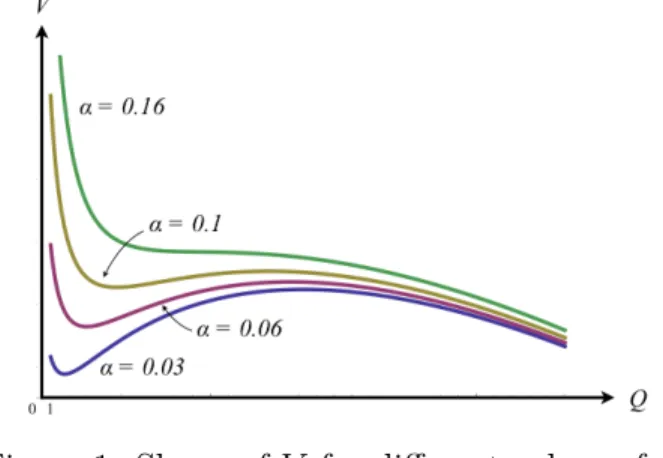
Figure 1: Shape of V for different values of α. (R = 1.7135, A= 30, X = 2, N = 16, p= 0.646.)
Figure 1 illustrates the shape of V for different values of α. The shape of V is driven by the weight of consumption complementarity relative to that of preference for variety. As shown by Remark 1, consumption complementarity and the resulting direct network effects induce users to consume one application only. Remark 2, however, shows that preference for variety and the resulting indirect network effects induce users to consume more applications. The graph in Figure 1 shows that when users have strong preference for variety compared to consumption complementarity (lowαrelative toR), indirect network
effects outweigh direct network effects and the Q that maximizes V is interior. When preference for variety is weak relative to consumption complementarity direct network effects outweigh indirect network effects and Q= 1 maximizes V.
Let b Q= max 1, Qsuch that dV dQ = 0 .
IfV has interior maxima, then Qb is the unique interior maximum. Otherwise,V reaches
its maximum atQb = 1. As we can see in Figure 1, whenαis large,Qb = 1 (cf. α= 0.16 in
the figure). Otherwise, Q >b 1 (other values of α in the figure). The valueQb is important
for the shape of V. Specifically, for Q >Qb, V is always decreasing. However, for Q >b 1,
when Q < Qb, V first decreases and then increases. It is possible for some Q < Qb that
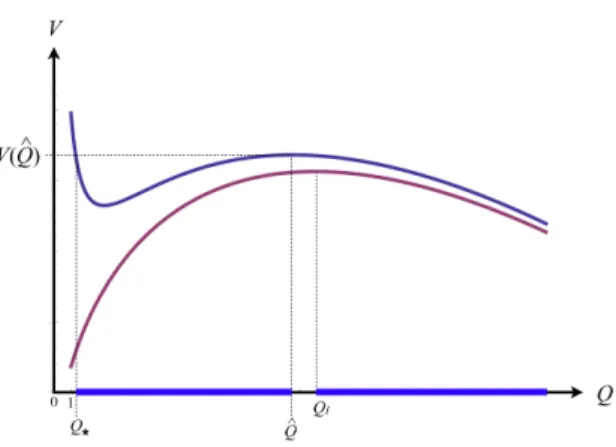
V(Q)> V(Qb). LetQ? be Q <Qb such that V(Q?) =V(Qb), when Q >b 1. (See Figure 2,
below, for an example.)
The following remark states that Qb is lower than QI, the equilibrium number of
applications consumed when there are no direct network effects (as defined in Remark 2). Remark 3 Assume that 1< R <2, α >0 and QI >1. Then Q < Qb I.
Proof. See Appendix B, page 36.
Intuitively, the presence of direct network effects prompts users to allocate their limited time budget to fewer applications. Consumption complementarity, due to other users consuming the same applications, compensates for the loss of application variety. The fact that we consider QI > 1 guarantees that the comparison between Qb and QI is
nontrivial.15
As noted above,Q >b 1 is the unique interior maximum ofV. The following proposition
shows that when Q >b 1, users face a commons problem. Specifically, when all users
consume Q >b 1 applications, every user finds it profitable to unilaterally deviate upward.
However, when all of them deviate, they receive a lower utility. Notice that Q >b 1 when
preference for variety, R, is large relative to consumption complementarity, α.
Proposition 1 (commons problem) Assume that 1 < R < 2 and α > 0. If Q >b 1,
then Qb is not a balanced equilibrium. Specifically, for any user k, U(Qk =Qb+ε,{Ql = b
Q}l6=k)> V(Qb)> V(Qb+ε).
15ForQ
Proof. See Appendix B, page 37.
The proposition states that when Qb is interior, it cannot be a balanced equilibrium.
This is because there is a profitable unbalanced upward deviation, i.e., each user has incentive to consume more applications. To see this, consider a unilateralbalanced devi-ation to ε more applications. The deviator consumes X/(Qb+ε) of each application. We now show that such deviation brings no additional utility. Note that the payoff from this upward deviation under balanced consumption is
UDI(Qb+ε|balanced) = b Q+ε R−1 X+ b Q α X b Q+ε(N −1) X b Q −pQb+ε ,
which is the same as V(Qb+ε). Therefore, because V0(Qb) = 0, V(Qb+ε) is maximized atε = 0. This means that an incremental upward deviation with balanced consumption fromQb yields 0 benefit.
We now argue that an unbalanced deviation is strictly profitable. Note that the Qb applications are also consumed by all other users while the new applications are consumed by the deviator only. Because of consumption complementarity, the marginal benefit from the Qb applications is larger than that from the applications that only the deviator consumes. Therefore, shifting some consumption from the additional applications to any of the Qb applications will lead to higher utility than the balanced deviation. Therefore,
an optimal upward deviation is strictly profitable. Just as in the tragedy of the commons, all users have the same incentives and every user will deviate. When every user chooses to consume Qb+ε, each of them will receive payoff V(Qb+ε), which is lower than V(Qb).
The following lemma shows that there is a large set of Qs that cannot characterize balanced equilibria. The result is helpful because it significantly constrains the set ofQs that may characterize equilibria.
Lemma 3 Assume that 1< R <2 and α >0. Then for any Q such that max{1, Q?} ≤
Q <Qb or Q > QI, Q cannot characterize a balanced equilibrium.
Proof. See Appendix B, page 37. Figure 2 illustrates Lemma 3.
To understand this result, consider first Q > QI. Given that all other users consume
Figure 2: Intervals of Q that cannot be an equilibrium as described in Lemma 3. from deviating toQk < Qis UDI(Qk≤Q) = Qk R−1 X+ α Qk X Qk(N −1) X Q | {z } consumption complementarity −p Qk. (5)
Note that the consumption complementarity term is independent of Qk. Since she
con-sumes Qk < Q, the deviator consumes only applications also consumed by the other
users. Each of those applications is consumed by all other users at the level of (N−1)XQ. The deviator divides her time budgetX amongst the Qk applications that she consumes, Qk· X
Qk. Therefore, the benefit of the direct network effect is constant, no matter what Qk < Q the deviator chooses. However, the net benefit of variety (Qk)R−1X− p Qk is
maximized at QI which is lower than Q. As a consequence, the deviator would want
to deviate to QI. We conclude that Q > QI may not be an equilibrium. Intuitively,
consuming more thanQI applications leads totoo much application variety for the price.
Moreover, if it had an effect, consumption complementarity would push users to consume fewer applications also.
For Q ∈ [max{1, Q?},Qb), however, there is a profitable deviation upward. In what
follows, we impose that the deviator balances her time budget across all the applications that she consumes. Even though this is not the optimal deviation, we show that it is a profitable deviation (and therefore, the optimal deviation is also profitable). Given that all other users consumeQapplications in a balanced way, the utility of the deviator from a balanced consumption of Qk applications is:
UDI(Qk≥Q) = Qk R−1 X+ α Q X Qk(N −1) X Q | {z } consumption complementarity −p Qk. (6)
Note thatUDI(Qk ≥Q) is the same function ofQkasV in equation (4) which has a local
maximum at Q > Qb . Moreover, for all Q ∈ [max{1, Q?},Qb), UDI(Q > Qb ) > UDI(Q).
Thus, for all those values of Q, there is a profitable upward deviation. We conclude that Q∈[max{1, Q?},Qb) may not be an equilibrium.
Intuitively, consuming more applications satisfies the deviator’s preference for variety to a greater extent. However, consuming less of each application consumed by other users means that the utility from consumption complementarity is lower. When Q ∈ [Q?,Qb]
the tradeoff is resolved in favor of consuming more applications.
Note that for Q ∈ [1, Q?] and Q ∈ [Q, Qb I] the same tradeoff is at play. However, it
is possible that the tradeoff is resolved in favor of consumption complementarity which means that it is not worth it for users to deviate upward. In combination with Lemma 4, this observation implies that equilibria are possible in the intervals Q ∈ [1, Q?] and
Q∈ [Q, Qb I]. Lemmas 5 and 6 show that multiple equilibria exist in these intervals. We
show that there are two aspects to this multiplicity. First, as described in Lemma 2, for any given cardinalityQDI there may exist multiple setsQDI—each constituting a separate
equilibrium. Second, there may exist many different values of QDI that characterize
equilibria. The former type of multiplicity is of no consequence to user utility while the latter has important utility implications. Thus, we focus only on the second type of multiplicity in our analysis.
The following lemma assures that so long asQ≤QI, it is never beneficial for userk to
deviate to a strategy with a lower number of applications. Thus, in searching for balanced equilibria we need to focus only on deviations to a larger number of applications.
Lemma 4 Assume that 1< R <2 and α >0. If all users play balanced strategy Q with cardinality Q ≤ QI, then any unilateral deviation by user k to any other strategy with
Qk< Q leads to lower utility for player k.
Proof. See Appendix B, page 38.
To understand this result, suppose that all users are consumingQ≤QI and consider
a deviation toQk< Q. We do not restrict the user to deviate to a balanced strategy with
Qk. However, from among all possible deviations to Qk < Q, a balanced consumption of
Qk applications from the set
profitable deviation to Qk is given by formula (5): UDI(Qk ≤Q) = Qk R−1 X+ α Qk X Qk(N −1) X Q | {z } consumption complementarity −p Qk.
Note that UDI(Qk ≤ Q) is increasing for all Qk ≤ QI and therefore it is maximized at
Qk=Q. Thus, if Q≤Q
I, there is no incentive to deviate downward.
Intuitively, consuming fewer applications satisfies user k’s preference for variety to a lesser extent. At the same time, there is no benefit from consumption complementarity. The reason is that each of the applications used by the deviator are consumed by all other users at the level of (N−1)XQ. Therefore, it is optimal to the deviator to divide her time budget X equally among theQk applications that she consumes, whereby she consumes
X
Qk of each. Since Q
k· X
Qk = X, the benefit of the direct network effect is constant no matter whatQk the deviator chooses.
We use Lemma 4 to prove the result in Lemma 5. Lemma 5 states that there al-ways exists a balanced equilibrium where all users consume QI applications and thatQs
close but lower than QI also characterize equilibria. Together with Lemma 3, Lemma 5
indicates that QI is the equilibrium with the largest number of applications consumed.
Lemma 5 When 1 < R < 2 and α > 0, there always exist balanced equilibria with
QDI =QI, where QI =
(R−1)X p
2−1R
> 1. Furthermore, there exists Qo < Q
I such that
any Q∈[Qo, Q
I] characterizes balanced equilibria, i.e., Q=QDI.
Proof. See Appendix B, page 39.
Figure 3a illustrates the result in Lemma 5. This result means that so long as users exhibit preference for variety, no matter how small, there are balanced equilibria with the same number of applications, QI, that users would choose to consume if there were no
direct network effects.
To understand why QI is an equilibrium, by Lemma 4 we need only consider
devia-tions upward. By the same argument to that following equation (6), a deviation upward (balanced or unbalanced) cannot improve the utility from consumption complementar-ity. Moreover, QI maximizes utility from preference for variety. Therefore, there are no
incentives to deviate and QI is an equilibrium.
A deviation upward always decreases utility from consumption complementarity. Notwith-standing, for Q < QI there is some benefit from increased variety. For Q less than but
close toQI, however, this benefit is infinitesimally small (the FOC is satisfied at QI) and
it is outweighed by the utility loss from consumption complementarity. Therefore,Qs less than but close to QI also characterize equilibria.
Lemma 6 shows that for some parameters there may also exist equilibria withQDI = 1.
Lemma 6 Assume that 1 < R < 2 and α > 0. There exist parameter values such that
QDI = 1 while QI >1.
Proof. See Appendix B, page 40.
Notice that if Q >b 1, it is necessary that V(Q= 1) > V(Qb) for Q = 1 to be an
equilibrium. It follows from Lemma 3. However, there is nothing in the proof that connects QDI = 1 to Qo. So the equilibrium at QDI = 1 may be disconnected from the
set of equilibria aroundQI.
The result of Lemma 6 is illustrated in Figure 3b. There we can see that equilibria exist in two disconnected intervals: one interval around Q = 1 (recall that following Remark 1QD = 1 is the equilibrium under pure direct network effects) and the other one
around QI. In the interval around QD= 1, the strong consumption complementarities
(users consume the same few applications intensely) guarantee that users do not want to deviate to consume more applications. In the interval aroundQI, the weak consumption
complementarities (users consume little of many applications) guarantee that users do not want to deviate to consume fewer applications.
(a) (b)
Figure 3: Intervals of QDI.
Lemmas 5 and 6 show that there are always multiple equilibria. We now show that the equilibria can be ranked according to users’ utility. In particular, equilibria with
fewer applications consumed yield higher utility than equilibria with more applications. However, even when consumption complementarity is large relative to the preference for variety and the allocation that maximizes users’ utility is an equilibrium, the model does not predict which of the many equilibria will be played or the utility that users will achieve. Therefore, users face an equilibrium selection problem.
Proposition 2 (equilibrium selection problem) When 1 < R < 2 and α > 0 there exist multiple balanced equilibria with different values ofQDI. Equilibria with smallerQDI
yield higher utility than equilibria with larger QDI.
Proof. See Appendix B, page 41.
To understand the intuition, recall that function V(Q) is user utility in a situation where every user consumes Q applications in a balanced way. Therefore, for values of QDI that constitute a balanced equilibrium, V(QDI) is the utility that users obtain in
equilibrium. As follows from Lemma 3 and illustrated by Figure 2, equilibria only occur for values of Q such that V(Q) is decreasing. Therefore, equilibrium utility must be decreasing inQDI.
In conclusion, Propositions 1 and 2 identify two undesirable properties of equilib-ria in environments where both direct and indirect network effects are present. When preference for variety is large relative to consumption complementarity, users face a com-mons problem because the allocation that maximizes users’ utility is not an equilibrium. Moreover, regardless of the values of α and R there are always multiple equilibria which yield different levels of utility. Thus, users also face an equilibrium selection problem, even when consumption complementarity is large relative to preference for variety and the allocation that maximizes users’ utility is an equilibrium. In the following subsec-tion we show how the platform can alleviate these problems by limiting the number of applications available.
2.4
On the role of the platform:
creating value by limiting
choice
We conclude Section 2 by showing that users may benefit when the platform limits the number of applications available, but only when both direct and indirect network effects are present. To examine the platform’s choice of the number of applications available,A, we relax the assumption thatA≥ (R−p1)X2−1R.
Notice first that when pure direct network effects are present (i.e., R= 1 and α >0), users achieve the same net utility in all equilibria, for any A ≥ 1. Thus, the platform cannot change the net utility that users achieve in an equilibrium by manipulating A. Likewise, the platform cannot improve the equilibrium outcome under pure indirect net-work effects (i.e., 1 < R <2 and α = 0). From Section 2.2 we know that when A≥ QI
in an equilibrium under pure indirect network effects, every user consumes QI
applica-tions. When the platform sets 1 < A < QI then there exists a unique equilibrium—a
balanced equilibrium in which all users consume allA applications. But this yields lower utility than consuming QI applications. Therefore, in the case of pure indirect network
effects the platform can only decrease users’ utility when limiting the number of available applications.16
We now turn to the case where both direct and indirect network effects are present (i.e., 1 < R < 2 and α > 0). The following definition is helpful for the arguments that follow. Let
Q∗∗ = arg maxV(Q). (7) From the shape of V follows that Q∗∗ may be either 1 or Qb. In both cases Q∗∗ ≤ Q <b
QI.17 When Q∗∗ = Q >b 1, then by Proposition 1, Q∗∗ never characterizes a balanced
equilibrium. When Q∗∗ = 1, it may characterize a balanced equilibrium (as Lemma 6 shows), but it not always does. We show that by limiting choice when Q∗∗ is not an equilibrium, the platform helps users solve the commons problem shown in Proposition 1; i.e., the platform creates an equilibrium at Q∗∗. And when Q∗∗ is an equilibrium, it will typically be one of many equilibria where other equilibria yield lower utility than Q∗∗.
Thus, in this case by limiting choice, the platform helps users solve the selection problem in Proposition 2.
Proposition 3 shows that regardless of whether Q∗∗ is in the equilibrium set of the original game, the platform can ensure thatQ∗∗becomes the only equilibrium of the game by restrictingA to Q∗∗.
Proposition 3 Assume that 1 < R < 2 and α >0. If the platform sets A = Q∗∗, then there exists a unique balanced equilibrium where all users consume Q∗∗ applications.
Proof. See Appendix B, page 41. 16WhenA < Q
I, users strictly gain from access to a larger number of applications. And whenA≥QI,
the users do not gain or lose by having more applications available. 17Notice that whetherQ∗∗= 1 or Q∗∗=
b
Q >1 depends on the value ofαrelative toR. For smallα (asα= 0.03 in Figure 1)Q∗∗=Q >b 1. For largerα(asα= 0.06 andα= 0.1 in the figure),Q >b 1, but
The proposition implies that the equilibrium set may change with changes in A. In particular, when the platform sets A = Q∗∗, Q∗∗ becomes the unique equilibrium.18 Therefore, when Q∗∗ is in the original equilibrium set, if the platform constrains A to be equal to Q∗∗, it eliminates all equilibria that yield lower utility for the users and, thus, eliminates the possibility that users select an inferior equilibrium. Hence,
Corollary 1 Assume that 1 < R < 2 and α > 0. When Q∗∗ is in the equilibrium set, users may benefit when the platform restricts the number of available applications toQ∗∗.
On the other hand, if Q∗∗ is not in the original equilibrium set, when the platform constrains A to be equal to Q∗∗, it creates a new equilibrium that makes users better off than all the original equilibria. Thus,
Corollary 2 Assume that 1 < R < 2 and α > 0. When Q∗∗ is not in the equilibrium set, users strictly benefit when the platform restricts the number of available applications to Q∗∗.
In summary, when consumption complementarity is large relative to preference for variety, thenQ∗∗ is in the equilibrium set and the platform can eliminate other equilibria (which yield lower utility) by limiting the number of applications available. When prefer-ence for variety is large relative to consumption complementarity, then Q∗∗ is not in the equilibrium set, and by limiting the number of applications, the platform creates a new, unique, equilibrium that yields the highest possible utility.
If users gain higher utility from participation in the platform, the platform provider may collect higher access fees from them. For example, in environments where user access fees are the only source of revenue to the platform, users’ utility maximization is perfectly aligned with the platform’s profit maximization. Perfect alignment may be lost when the platform has other revenue streams (such as royalties). We elaborate on this in Section 4.
3
Game with no foresight
Whenever direct network effects are present, the equilibria studied in Section 2 require users to know exactly which applications are consumed by all other users. That is, our 18We note that not all changes inAresult in reducing the equilibrium set to a singleton. Put differently, it is not the case that the platform can ensure that anyQwill be played in equilibrium by settingA=Q. For example, if the platform setsA=QI it cannot ensure that the equilibrium withQI applications will
assumption has been one of perfect foresight about other users’ choices in equilibrium. Under perfect foresight playerkknows the cardinality and the identity of the applications that all other users will consume; moreover, she also knows how much of each application other users consume. In many environments, such perfect foresight may be difficult to achieve. As an alternative, now we assume no foresight by which we mean that users initially assign equal probability to any feasible strategy of other users. However, they refine their beliefs by Bayesian updating and eventually reach equilibrium beliefs.19 The literature has pointed out that in the presence of network effects, equilibria are influenced by the way users form their expectations.20 Therefore, we study in this section how equilibria change when we step away from perfect foresight in beliefs formation.
Only the assumption about user beliefs differentiates this game from the game in Section 2. Recall that xk = {xk
1, xk2, . . . , xkA} such that P
a∈Ax
k
a = X denotes a feasible
consumption vector. We use xk to also denote a pure strategy. Let
X denote the set of
all pure strategies for any given user.21 Let φk
l ∼U[X] denote userk’s beliefs on user l’s
choice of pure strategy. Let φk={φk
l}l6=k be a vector that denotes user k’s beliefs on all
other users’ choices of pure strategy.
With this, user k’s utility from consuming vectorxk is
Eφku(xk) = X a∈A xka1/R R +α X a∈A xka Eφk X l6=k xla,
and the optimization problem (2) becomes: maxxk a, a∈A n Eφku(xk)− p ·Pa∈ A1(x k a) o , subject toX ≥P a∈Ax k a.
It is straightforward to show that under no foresight the expectation over consumption of any application a by any other user l 6= k is Eφk
lx l a = XA and Eφk P l6=kx l a = (N −
1)XA.22 Note that this expectation does not depend on how many applications or which applications all other users consume, therefore there is no interdependence between users’ choices. Given this, we now can find the optimal choice by userk (which in our setting is independent of what all other users do). Whatever is the number of applicationsGk that
userkwishes to consume, her optimal consumption pattern is balanced consumption, i.e., dividing the time budget equally among the applications consumed. Once userk decides that G∗ is the optimal number of applications for her to consume, it does not matter 19We consider such updating to be realistic. In the experiment of El-Gamal and Grether (1995) overwhelming majority of subjects used Bayes updating rule.
20See, for example, Hurkens and Lopez (2010).
21Because all users are identical, they all have access to the same set of pure strategies.
which subset of Ashe chooses, as all yield the same expected utility. Therefore, G∗ fully describes k’s set of best responses.
User k updates her beliefs using Bayes’ Rule. Therefore, she assigns zero probability to dominated strategies and equal probability to undominated strategies. Since with no foresight she does not know which applications they consume, she believes that every subset of A with cardinality G∗ is equally likely to be consumed by user l 6= k. User k recalculates her best response under the updated beliefs, until the recalculated best re-sponse is exactly the same as the original best rere-sponse. If every user behaves this way, beliefs are consistent with strategies and this constitutes a no-foresight equilibrium. We consider the case where both direct and indirect network effects are present (i.e., 1< R <2 and α > 0).23 Let Gk
DI be the number of applications consumed by user k in
a no-foresight equilibrium.
Proposition 4 (coordination problem) Suppose 1 < R < 2 and α > 0. In every no-foresight equilibrium, every user k consumes Gk
DI = GDI = QI applications in equal amount, where QI = (R−1)X p 2−1R
>1. The expected equilibrium net utility is
EUDI(GDI) =GDIR−1X+α X(N −1)
X
A −p GDI. (8)
Moreover, the platform maximizes users’ net utility by setting the number of available applications to A=Q∗∗, where Q∗∗ is given by (7).
Proof. See Appendix B, page 41.
In the game with no foresight, users face a coordination problem. Since users do not know which applications are consumed by other users, some of the benefit to the direct network effects is lost. The utility that users can achieve in this environment is lower than in the environment with perfect foresight, because users cannot exploit consumption complementarities as well due to lack of coordination. In such a situation, the platform can create value by limiting the number of available applications. So long as A > Q∗∗, the equilibrium is inefficient, especially whenAis large. Only when A=Q∗∗, the efficient outcome is an equilibrium. By providing fewer applications, the platform creates a new equilibrium and alleviates this coordination problem. We note that under no foresight, users do not face neither equilibrium selection nor commons problems.
23The analysis of pure direct and pure indirect network effects is straightforward and can be found in the working paper Casadesus-Masanell and Ha laburda (2010).
4
Discussion
In this section we discuss several aspects of our approach.
Consumption complementarity and preference for variety. Although for expo-sitional simplicity we have presented the model with reference to network effects, all that we need for the results to go through is the presence of consumption complementarities and preference for variety. Consumption complementarities always imply direct network effects. Preference for variety, however, does not always imply indirect network effects. To illustrate this point, note a key difference between hardware-software platforms (e.g., Nintendo) and betting platforms (e.g., Betfair). In the case of Nintendo, users benefit from game variety as provided by a large number of independent developers, and devel-opers benefit from a large number of users to sell games. Thus, preference for variety and indirect network effects go hand-in-hand in this case. This contrasts with Betfair where punters (back and lay sides) benefit from a large variety of sporting events to bet on, but where there are no independent event providers that benefit from there being more punters (as Betfair is the only provider of events on its platform). Although there are no indirect network effects in this case, our analysis and results apply.
Exogenous p. We have analyzed the user side only and assumed that the price of accessing an application, p, is exogenous. While to better understand the interactions between users and developers it would be interesting to extend the model to endogenous p, to do so would require imposing substantial assumptions on industry structure on the developer side (entry conditions, production cost, number of games sold by each developer, and so on). Of course, the equilibrium p would not be innocuous to such assumptions. However, a critical implication of our analysis is that the platform cannot induce users to consume the optimal number of applications by manipulating p.24 Put differently, we have shown that regardless of the value of p, the commons, equilibrium selection, and coordination problems will arise when, in addition to preference for variety, there are direct network effects. Therefore, our conclusion that it is valuable for platforms to manage the number of applications available holds regardless of whether pis endogenous
24The exception is a situation where the platform drivesp so high that Q
I = 1, which we assumed
away on page 11. In this case, users consume one application which is the optimal number. For details, see the working paper version (Casadesus-Masanell and Ha laburda 2010).
or exogenous.25,26
Value creation and value capture. We have analyzed how limiting the number of available applications affects value created; that is, user surplus. However, we have not considered how the platform may capture that value through prices (access prices and/or royalties). A detailed analysis of platform pricing is beyond the scope of this paper and left for future research. Pricing decisions may depend on specific institutional or competitive details. Our analysis applies to the user side of the market regardless of these details. One can imagine extending our analysis to a particular institutional setting to find the optimal pricing strategy.
Consider first the case where the platform can only charge access fees to users (no royalties to developers). Then, the profit-maximizing number of applications coincides with Q∗∗ and access price to users is equal to users’ net utility. This will not be the case when the platform charges only royalties and no access fees. In this case, the platform earns higher profit when a larger number of applications are purchased. Therefore, selling QI applications maximizes profits, and the platform does not benefit from limiting the
number of applications below QI. Even when the platform offers QI or more
applica-tions, there are still multiple equilibria. Thus, the platform cannot guarantee that QI
applications are purchased. Nonetheless, in any equilibrium users consume more thanQ∗∗ applications (the number of applications that maximizes user surplus), since the commons problem remains. However, the commons problem does not affect the platform’s revenue. Finally, consider a platform that collects both access prices and royalties. In this case, the profit-maximizing number of applications will lie somewhere between Qb andQI. The
commons problem does not go away but it becomes less relevant to the platform.
Implementing quantity restrictions. While the method we have considered in Sections 2.4 and 3 for correcting the commons, equilibrium selection, and coordination problems—outright restriction on the number of applications available—might seem bru-tally direct, there are indirect ways to implement it. One such way is through manipula-25Althoughpis often endogenous, it is not hard to think of cases where it is exogenous, particularly when technological reasons constrainpto be zero. For example, open television channels are free to users as it is impossible to exclude access to them. In this case, pmay not be used as a coordinating device. Although we have assumed thatp >0, our results apply whenp= 0 as well. Interested readers can find the complete analysis of the casep= 0 in Appendix B of the working paper version (Casadesus-Masanell and Ha laburda 2010).
26In this paper, we have considered a situation where users pay pricep >0 to access each application, and face a time budget constraint X. However, there is no monetary cost of using applications (i.e., no rental cost). Under rental cost, the commons, equilibrium selection, and coordination problems may also occur. For details see Appendix B of the working paper, which considers the case of p= 0, and is equivalent to a setting where there is a rental cost for applications but no access price.
tion of the access fees and/or royalties charged to developers. High prices to developers will lead to less entry and a smaller set of applications available, resulting in possibly more value for users. An interesting and counterintuitive implication of our results is that to the extent that higher access prices to developers result in net utility gains to users, the platform will be able to charge higher prices to the user side. Of course, this runs counter to the conventional wisdom that to earn more from one side of the market, the platform must set lower prices to the other side.
Another indirect way to narrow down the set of applications available is by tinkering with user search. For example, in the late 1980s and 1990s, Nintendo used Nintendo Power—an in-house magazine priced to break even and carried no advertising—to pro-mote particular games. Two years after it had launched, it had become the highest-circulation publication targeted to children in the United States. Games not featured on
Nintendo Power were much less likely to become commercial successes.27 Likewise, the current search capabilities on Apple’s App Store are notoriously deficient.28 Applications appear ranked by number of downloads which, of course, reinforces direct network effects for applications—such as word processors (Pages), spreadsheet programs (Numbers), or presentation software (Keynote)—that exhibit consumption complementarities.
Royalties and double marginalization. Our results suggest a possible resolution to an issue in the video game market that has traditionally been seen as a puzzle. Console makers typically charge royalties to game developers. This seems like a bad idea due to double marginalization. One explanation is that royalties are an instrument to compel developers to raise the quality of games. Because games are more expensive in the pres-ence of royalties, fewer, but better, games are developed. Thus, royalties are often seen as resolving a tradeoff between quality and quantity. Our analysis shows that there may be no tradeoff because the platform may prefer both, better-quality games but also fewer games. Moreover, because they ultimately limit the number of applications available, the motive for royalties in the video game industry could be exactly the same as the rationale for Betfair to limit the number of betting events on its platform. To the best of our knowledge, the idea tha