University of Wollongong University of Wollongong
Research Online
Research Online
Faculty of Engineering and Information
Sciences - Papers: Part A Faculty of Engineering and Information Sciences 1-1-2013
An outlier robust block bootstrap for small area estimation
An outlier robust block bootstrap for small area estimation
Payam MokhtarianUniversity of Wollongong, [email protected] Ray Chambers
University of Wollongong, [email protected]
Follow this and additional works at: https://ro.uow.edu.au/eispapers
Part of the Engineering Commons, and the Science and Technology Studies Commons Recommended Citation
Recommended Citation
Mokhtarian, Payam and Chambers, Ray, "An outlier robust block bootstrap for small area estimation" (2013). Faculty of Engineering and Information Sciences - Papers: Part A. 1933.
https://ro.uow.edu.au/eispapers/1933
Research Online is the open access institutional repository for the University of Wollongong. For further information contact the UOW Library: [email protected]
Small area inference based on mixed models, i.e. models that contain both fixed and random effects, are the industry standard for this field, allowing between area heterogeneity to be represented by random area effects. Use of the linear mixed model is ubiquitous in this context, with maximum likelihood, or its close relative, REML, the standard method for estimating the parameters of this model. These parameter estimates, and in particular the resulting predicted values of the random area effects, are then used to construct empirical best linear unbiased predictors (EBLUPs) of the unknown small area means. It is now well known that the EBLUP can be unstable when there are outliers in sample data, and an outlier-robust EBLUP, or REBLUP, has been proposed by Sinha and Rao (2009), based on modifying the parameter estimating functions to make them less sensitive to sample outliers. Unfortunately, these modified estimating functions can be numerically unstable, and mean squared error estimation for the REBLUP is not straightforward. Taking a somewhat different approach, Chambers and Mokhtarian (2013) proposed an outlier robust block bootstrap approach to fitting a linear mixed model in the presence of both area level and unit level outliers. A natural extension of this bounded block bootstrap can then be used to define an outlier robust version of the EBLUP and a simple way of estimating its mean squared error. This approach is described in this paper, together with simulation results that provides some evidence for our claim that the new method is robust to the influence of outliers. In particular, it leads to an easily
computed version of the REBLUP and an easily computed and stable estimate of its mean squared error. Keywords
Keywords
Mixed models, robust estimation, unit-level models, variance components, random effect block bootstrap Disciplines
Disciplines
Engineering | Science and Technology Studies Publication Details
Publication Details
Mokhtarian, P. & Chambers, R. (2013). An outlier robust block bootstrap for small area estimation. Proceedings of the 59th World Statistics Congress of the International Statistical Institute (pp. 798-803). Hague, Netherlands: International Statistical Institute.
An Outlier Robust Block Bootstrap for Small Area Estimation
Payam Mokhtarian and Ray Chambers
National Institute for Applied Statistics Research Australia University of Wollongong, Wollongong, NSW 2522, AUSTRALIA Corresponding author: Payam Mokhtarian, e-mail: [email protected]
Abstract
Small area inference based on mixed models, i.e. models that contain both fixed and random effects, are the industry standard for this field, allowing between area heterogeneity to be represented by random area effects. Use of the linear mixed model is ubiquitous in this context, with maximum likelihood, or its close relative, REML, the standard method for estimating the parameters of this model. These parameter estimates, and in particular the resulting predicted values of the random area effects, are then used to construct empirical best linear unbiased predictors (EBLUPs) of the unknown small area means. It is now well known that the EBLUP can be unstable when there are outliers in sample data, and an outlier-robust EBLUP, or REBLUP, has been proposed by Sinha and Rao (2009), based on modifying the parameter estimating functions to make them less sensitive to sample outliers. Unfortunately, these modified estimating functions can be numerically unstable, and mean squared error estimation for the REBLUP is not straightforward. Taking a somewhat different approach, Chambers and Mokhtarian (2013) proposed an outlier robust block bootstrap approach to fitting a linear mixed model in the presence of both area level and unit level outliers. A natural extension of this bounded block bootstrap can then be used to define an outlier robust version of the EBLUP and a simple way of estimating its mean squared error. This approach is described in this paper, together with simulation results that provides some evidence for our claim that the new method is robust to the influence of outliers. In particular, it leads to an easily computed version of the REBLUP and an easily computed and stable estimate of its mean squared error.
Keywords: Mixed models, robust estimation, unit-level models, variance components, random effect block bootstrap.
1. Introduction
A standard approach to small area estimation (SAE) for means or totals uses mixed models to express these targets of inference as linear combinations of both fixed and random effects. The standard method of calculating the corresponding small area estimates is to then use maximum likelihood (ML) or restricted maximum likelihood (REML) to estimate the parameters of the mixed model and to substitute these estimated parameter values in the expression for the Best Linear Unbiased Predictor (BLUP) of the small area characteristic of interest. The resulting estimator is referred to as the Empirical Best Linear Unbiased Predictor (EBLUP), see Henderson (1975) and Harville (1977). Although the EBLUP is simple to implement and is efficient under normality assumptions, it can be unreliable in the presence of sample outliers.
Chambers and Tzavidis (2006) and Tzavidis et al. (2010) address this issue by fitting outlier robust M-quantile models to the small area data, using a generalization of quantile regression for SAE. Sinha and Rao (2009) also tackle this issue, using the M-estimation methods set out in Richardson and Welsh (1995) to construct a plug-in outlier robust version of the EBLUP, which they call the Robust EBLUP, or REBLUP. The REBLUP has a low prediction variance but its prediction bias can be high when the sample outliers in a small area of interest are drawn from a distribution with a different mean from the rest of the values from that area. Chambers et al. (2013) discuss this issue and suggest that both the M-quantile estimator and the REBLUP can be improved by addition of an outlier robust bias correction. They also propose two
different analytical mean-squared error estimators for these bias-corrected outlier robust small area estimators.
Small area estimators based on a standard two level linear mixed model are dependent on EBLUPs of random area (level two) effects, which in turn depend on estimates of the variance components of the model. Chambers and Chandra (2012) describe a semiparametric two level block bootstrap method for making robust inferences about the parameters of a linear mixed model. This idea is adapted in Chambers and Mokhtarian (2013) to obtain alternative robust estimates of linear mixed model parameters and random effect predicted values using standard REML fitting methods within the replication structure of a bounded block bootstrap. In this paper we extend this idea to SAE under a linear mixed model, using the bounded block bootstrap to generate a robust alternative to the REBLUP. A key advantage of this approach is its ease of computation, both of the estimate and of an estimate of its MSE, since the bootstrap only computes REML estimates. Since analytic estimation of the mean squared error of outlier robust estimators like REBLUP is either very complex (see Chambers et al., 2013) or has well known computational difficulties, this alternative method of outlier robust small area inference seems promising.
The reminder of this paper is as follows. In section 2, after introducing basic concepts and notation for SAE under a linear mixed model, we briefly review recent work on outlier robust small area estimation under this model. The proposed outlier robust block bootstrap method of small area estimation is set out in section 3. In section 4 we use model-based simulation of outlier contaminated mixture data to evaluate the performance of the proposed approach, both in terms of estimation of small area means in this situation as well as estimation of mean squared error. Section 5 concludes the paper with some final remarks, and discussion of future research on outlier robust small area inference.
2. Robust Small Area Prediction
We suppose that data for a sample of n individuals from a population of size N
are available. These data consist of unit record values from G areas, with ni
individuals in sample in area i. For individual j in area i, let yj denote the value of
the variable of interest, with xj the value of a p×1 vector of individual level covariates and zi the value of a known q×1 vector of area level covariates. The
number Ni of individuals within each area i is assumed to be known, as are the
corresponding small area average xi of xj. The target of inference is the unknown
small area mean yi, and estimation based on a two level linear mixed model is proposed (Battese et al., 1988; Rao, 2003; Chambers and Clark, 2012). Throughout, sampling is assumed to be non-informative given the population values of xj and zi.
Let yU, XU and ZU denote the population level vector of variable of interest and associated matrices of covariates. Then
yU =XUβ+ZUu+eU (1)
where u~N(0,Σu) is a vector of Gq area random effects, eU ~N(0,Σu) is a vector
of N individual specific random effects and u and eU are assumed to be mutually
independent. The variance-covariance matrix of yUis VU=Σe+ZUΣuZU T . The
parameters of the covariance matrices Σu and Σe, typically referred to as the variance components of (1), are denoted by θ=(θ1,…,θk) while the vector β is referred to as
the fixed effects parameter of this model. Let βˆ and uˆ denote the vectors of estimated and predicted values respectively for the fixed and area level random effects in (1). The EBLUP of the area i mean yi under (1) is then
ˆ yi EBLUP =N i −1 n iysi+(Ni−ni) ˆyri
{
}
(2) where yˆ ri=xri Tβˆ+z iTuˆ is the predicted value of non-sample mean of the variable of
interest in area i and the indices s and r denote sample and non-sample quantities, respectively. That is, ysi is the average of the ni sample values of yj in area i and xri is the vector of the area i average values of the Ni−ni non-sample values of xj.
The predictor (2) can be sensitive to sample outliers. Consequently, Sinha and Rao (2009) proposed replacing βˆ and uˆ by outlier robust versions in order to make (2) insensitive to these outliers. That is, they replaced (2) by the robust EBLUP (REBLUP) ˆ yi REBLUP =N i −1 n iysi+(Ni−ni) ˆyri REBLUP
{
}
(3) where yˆ ri REBLUP =x ri Tβˆrob+z iTuˆrob. Here βˆrob and uˆrob are outlier robust estimates of the
fixed and random effects vectors in (1), obtained by solving an outlier robust version of either the maximum likelihood or the restricted maximum likelihood (REML) estimating equations for these parameters. In particular, Sinha and Rao (2009) use a modified version of the robust estimating equations for linear mixed model parameters proposed by Richardson and Welsh (1995). The robust predictors of the random area effects in (1) are then obtained by substituting these outlier robust estimates of the fixed effects and the variance components of (1) into the Fellner (1986) estimating equations for outlier robust predicted values of random effects in linear mixed models.
3. SAE via Outlier Robust Block Bootstrapping
We now describe our proposed alternative outlier robust small area estimation method, based on application of a bounded block bootstrap (hereafter RREB) under (1). The RREB was proposed by Chambers and Mokhtarian (2013), and is an outlier robust extension of the random effect block (REB) bootstrap method of Chambers and Chandra (2012). Also, for notational convenience, we restrict ourselves from now on to the special (but widely used) case of (1) where zi≡1, so Σu is scalar below.
The bootstrap technique (Efron and Tibshirani, 1993) was originally developed for parametric inference given independent and identically distributed data. The block bootstrap extends this to accommodate the hierarchical dependence structure of the clustered and multilevel data that are characteristic of SAE. Although the bootstrap technique is typically used for estimating parametric estimation uncertainty given an assumed model, Chambers and Mokhtarian (2013) adapt this technique to modelling data with group structure, e.g. a linear mixed model. The REB bootstrap replications rely on level-specific empirical residuals to construct bootstrap samples. The RREB restricts the influence of the sample outliers by bounding these residuals. Like the REB, the RREB is semiparametric in the sense that although the bootstrap model is based on estimated parameters defined by fitting the model to the sample data, the dependence structure in the bootstrap model residuals is generated nonparametrically, by replicating groups and then individuals within groups rather than re-sampling the sample data at random. This ensures that the RREB, like the REB, is robust to failure of the distribution assumptions of the model (1).
The RREB procedure for estimating a set of small area means is as follows:
1. Fit a two level linear mixed model (1) to the sample data and use the marginal residuals rs=ys−Xsβˆ to calculate the area (level 2) average residuals r(2)=DGrs, where DG is G-block diagonal matrix whose diagonal elements
are ni −11
ni T. Here
1m denotes a m-vector of ones.
2. Bound the effect of the mean zero level 2 residuals, r(2)c=r(2)−
av(r(2))1G ,
using a suitable bounded influence function. Here av(w) denotes the
averaging operator for the vector w. Also, before we bound these residuals, we scale them to recover the REML estimate Σˆu of the variance of the area
random effect. The vector of outlier robust area specific (level 2) residuals is
r(2)R=ψ G−1
( )
r(2)c Tr(2)c{
}
−1/2 r(2)cΣˆ u 1/2 ⎡ ⎣⎢ ⎤ ⎦⎥.Here ψ is the Huber influence function with tuning constant is 2 ˆΣ1/2u .
3. Calculate mean zero individual effect (Level 1) residuals as
r(1)c= r s−r (2)R⊗1 ni
(
)
−av rs−r (2)R⊗1 ni(
)
1n. As with the Level 2 residuals, these are now scaled to recover the REML estimate Σˆe of the Level 1 variance and then bounded using the Huber ψ function with tuning constant2 ˆΣ1/2e . The set of outlier robust Level 1 residuals is therefore
r(1)R= r i (1)R
( )
=ψ{
n−1( )
r(1)c Tr(1)c}
−1/2( )
r(1)c Σˆ e 1/2 ⎡ ⎣⎢ ⎤ ⎦⎥.4. Let srswr(A,m) denote a sample of size m taken randomly and with replacement from the set A. Level 1 and level 2 bootstrap errors are then defined by sampling independently and with replacement from each set of outlier robust residuals separately:
r*(2)R=srswr(r(2)R,G); ri*(1)R= srswr(rsrswr(1)R({1,…,G},1),ni); r*(1)R= r i *(1)R
( )
.5. Generate outlier robust bootstrap sample data ys*R via
ys
*R=X
sβˆ+Zsr
*(2)R+r*(1)R (4)
6. Fit a two-level linear mixed model to the bootstrap values in (4) to obtain REML estimates of fixed effects parameters and variance components as well as predicted random effects.
7. Repeat steps 4 - 6 B times to obtain the RREB values of the parameter estimates. Denote these by βˆ(b)RREB
, ˆΣu (b)RREB , ˆΣe (b)RREB ;b=1,…,B
{
}
.Let βˆRREB, ΣuˆRREB and ΣeˆRREB denote the bootstrap averages of βˆ(b)RREB, Σˆ u (b)RREB
and Σˆe
(b)RREB respectively. The RREB estimate of the mean of small area
i is then ˆ yiRREB=N i −1 n iysi+(Ni−ni) ˆyri RREB
{
}
(5) where yˆ ri RREB=x ri TβˆRREB+ˆuRREB. There are three versions of uˆRREB (and hence three
versions of yˆi
RREB) depending on the type of bootstrap averaging used to obtain this
predicted value. ˆ uRREB-1= B−1 ni −1Σˆ e (b)RREB+Σˆ u (b)RREB
(
)
−1 ˆ Σu (b)RREB ysi−xsi Tβˆ(b)RREB(
)
{
}
b=1 B∑
ˆ uRREB-2= B−1 ni−1Σeˆ(b)RREB+Σuˆ(b)RREB
(
)
−1 ˆ Σu(b)RREB b=1 B∑
{
}
ysi−xsi TβˆRREB{
}
ˆ uRREB-3= ni−1ΣeˆRREB+ΣuˆRREB
(
)
−1 ˆ ΣuRREB{
}
ysi−xsi TβˆRREB{
}
Finally, we note that the MSE of the RREB estimator (9) can be easily estimated using the observed variability in the RREB bootstrap replications, via
MSERREB( ˆyiRREB
)=B−1 yˆi(b)RREB− ˆ yiRREB
(
)
2 b=1 B∑
. (6)4. Model-Based Simulations
A series of model-based simulation experiments were used to evaluate the performance of the different small area estimation methods discussed in the previous section. In these simulations, we generated data using a two-level model of the form
yij =100+5xij+ui+eij where we fixed the total number of areas at G=40. The population and sample size were the same for all areas and were fixed at Ni=100 and
ni=5, and sampling was at random and without replacement in each area. Values of a
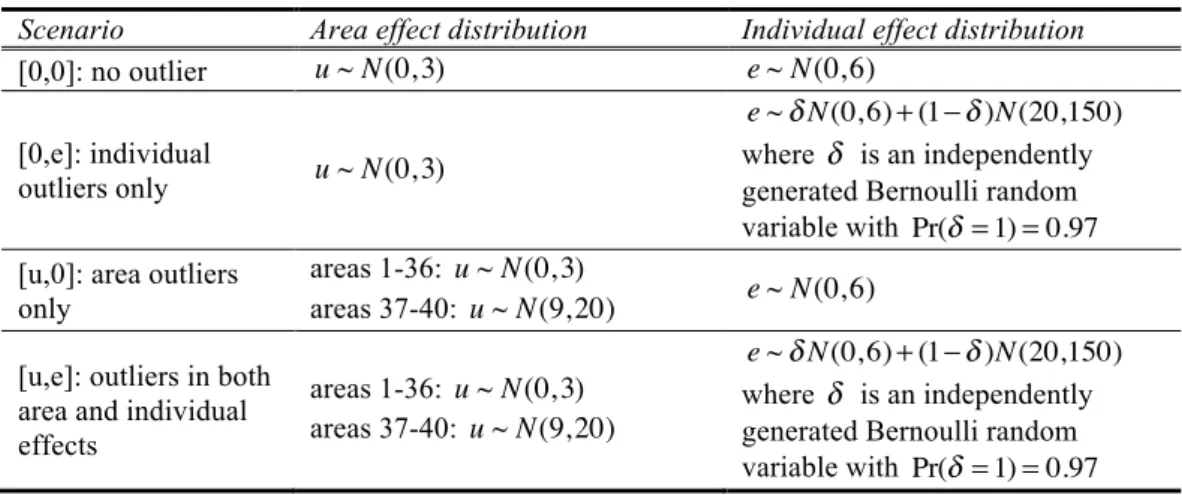
covariate x were generated independently and identically from a log-normal distribution with a mean of 1.0 and a standard deviation of 0.5 on the log-scale. The area specific random effects and the individual specific random effects were generated according to the four contamination-type scenarios set out in Table 1.
Table 1. Simulation scenarios.
Scenario Area effect distribution Individual effect distribution
[0,0]: no outlier u~N(0, 3) e~N(0,6)
[0,e]: individual
outliers only u~N(0, 3)
e~δN(0,6)+(1−δ)N(20,150)
where δ is an independently generated Bernoulli random variable with Pr(δ =1)=0.97
[u,0]: area outliers only
areas 1-36: u~N(0, 3)
areas 37-40: u~N(9,20) e~N(0,6)
[u,e]: outliers in both area and individual effects
areas 1-36: u~N(0, 3)
areas 37-40: u~N(9,20)
e~δN(0,6)+(1−δ)N(20,150)
where δ is an independently generated Bernoulli random variable with Pr(δ =1)=0.97 Table 2. Model-based simulation results for predictors of small area means.
Predictor Results for different outlier scenarios and areas
[0,0] 1-40 [0,e] 1-40 [u,0] 1-36 [u,0] 37-40 [u,e] 1-36 [u,e] 37-40
Median values of RB (%) EBLUP REBLUP RREB-1 RREB-2 RREB-3 0.02 0.03 0.04 0.02 0.04 -0.20 -0.39 -0.34 -0.17 0.32 0.10 0.11 0.91 0.08 0.85 -0.54 -0.47 -6.71 -0.42 -6.70 0.17 -0.30 0.63 0.10 0.58 -1.59 -1.00 -6.81 -0.78 -6.78
Median values of RRMSE (%)
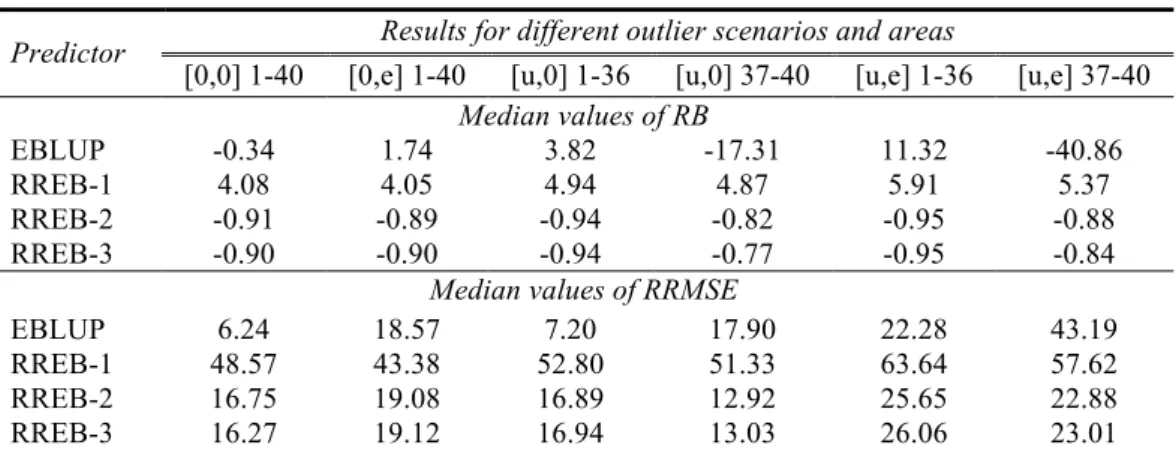
EBLUP REBLUP RREB-1 RREB-2 RREB-3 0.81 0.82 1.71 0.81 0.83 1.22 1.01 1.89 1.03 1.23 0.85 0.84 1.92 0.85 0.82 0.97 1.02 7.55 0.97 2.18 1.37 0.99 1.84 1.02 1.39 2.36 1.44 7.61 1.42 2.21 A total of 500 independent Monte Carlo simulations (population generation, then sample selection) were carried out for each simulation scenario, and within each simulation we calculated the EBLUP (2), the REBLUP (3) and all three versions of the REBB (5) using 1000 bootstrap replications, this number of simulations and bootstrap samples being suitable for evaluating 95 per cent percentile confidence intervals; see Caers et al. (1998). These estimators were then assessed using the median values of their area specific relative bias (RB) and relative root mean-squared error (RRMSE). These performance measures are set out in Table 2. In Table 3 we show the same performance measures, but this time for the bootstrap MSE estimator (6) for the three versions of the RREB estimator (5). Note that the MSE estimator for the EBLUP in this Table is the estimator of Prasad and Rao (1990).
Table 3. Model-based simulation results for RREB bootstrap estimators of MSE
Predictor Results for different outlier scenarios and areas
[0,0] 1-40 [0,e] 1-40 [u,0] 1-36 [u,0] 37-40 [u,e] 1-36 [u,e] 37-40
Median values of RB EBLUP RREB-1 RREB-2 RREB-3 -0.34 4.08 -0.91 -0.90 1.74 4.05 -0.89 -0.90 3.82 4.94 -0.94 -0.94 -17.31 4.87 -0.82 -0.77 11.32 5.91 -0.95 -0.95 -40.86 5.37 -0.88 -0.84
Median values of RRMSE
EBLUP RREB-1 RREB-2 RREB-3 6.24 48.57 16.75 16.27 18.57 43.38 19.08 19.12 7.20 52.80 16.89 16.94 17.90 51.33 12.92 13.03 22.28 63.64 25.65 26.06 43.19 57.62 22.88 23.01 5. Conclusions
Our simulation results show that the bootstrap averaging used in RREB-1 and in RREB-3 is inferior to that used in RREB-2. The reason for RREB-1's overall poor performance is because bootstrap averaging of predicted random effects is effectively the same as zeroing them, resulting in what is essentially a synthetic estimate. In contrast, the reason for RREB-3's poor performance is overshrinkage due to bias in robust estimates of the variance components. However, it is clear RREB-2 performs well in all the scenarios investigated in the study, with bias and mean squared error that is very similar to that of the REBLUP. Furthermore, the easily calculated bootstrap MSE estimator (6) performs well when used with RREB-2.
References
Battese, G., Harter, R. and Fuller, W. (1988) An error-components model for prediction of county crop areas using survey and satellite data, Journal of the American Statistical Association, 83, 28-36.
Caers, J., Beirlant, J. and Vynckier, P. (1998) Bootstrap confidence intervals for tail indices,
Computational Statistics and Data Analysis, 16, 259-277.
Chambers, R. and Chandra, H. (2012) A random effect block bootstrap for clustered data, The Journal of Computational and Graphical Statistics, DOI: 10.1080/10618600.2012.681216
Chambers, R., Chandra, H., Salvati, N., and Tzavidis, N. (2013) Outlier robust small area estimation, Journal of the Royal Statistical Society, Series B, 75 (5), To appear.
Chambers, R. and Clark, R. (2012) An Introduction to Model-based Survey Sampling with Applications. Oxford: Oxford University Press.
Chambers, R. and Mokhtarian, P. (2013) Outlier robust block bootstrap fitting of linear mixed models, CSSM Working Paper, University of Wollongong.
Chambers, R. and Tzavidis, N. (2006) M-quantile models for small area estimation,
Biometrika, 93, 255-268.
Efron, B. and Tibshirani, R.J. (1993) An Introduction to the Bootstrap, Chapman & Hall. Fellner, W.H. (1986) Robust estimation of variance components, Technometrics, 28, 51-60. Harville, D. (1977) The use of linear model methodology to rate high school or college football
teams, Journal of the American Statistical Association, 72, 278-289.
Henderson, C.R. (1975) Best linear unbiased estimation and prediction under a selection model, Biometrics, 31 (2), 423-447.
Prasad, N.G.N. and Rao, J.N.K. (1990) The estimation of the mean squared error of small area estimators, Journal of the American Statistical Association, 85, 163-171.
Rao, J.N.K. (2003) Small Area Estimation. New York: Wiley.
Richardson, A.M. and Welsh, A.H. (1995) Robust restricted maximum likelihood in mixed linear models, Biometrics, 52, 1429-1439.
Sinha, S.K. and Rao, J.N.K. (2009) Robust small areas estimation, Canadian Journal of Statistics, 37, 381-399.
Tzavidis, N., Marchetti, S. and Chambers, R. (2010) Robust prediction of small area means and distributions, Australian & New Zealand Journal of Statistics, 52, 167-186.