Edinburgh Research Explorer
Exploiting separability in large-scale linear support vector
machine training
Citation for published version:
Woodsend, K & Gondzio, J 2011, 'Exploiting separability in large-scale linear support vector machine training' Computational optimization and applications, vol. 49, no. 2, pp. 241-269. DOI: 10.1007/s10589-009-9296-8
Digital Object Identifier (DOI): 10.1007/s10589-009-9296-8 Link:
Link to publication record in Edinburgh Research Explorer Document Version:
Peer reviewed version
Published In:
Computational optimization and applications
General rights
Copyright for the publications made accessible via the Edinburgh Research Explorer is retained by the author(s) and / or other copyright owners and it is a condition of accessing these publications that users recognise and abide by the legal requirements associated with these rights.
Take down policy
The University of Edinburgh has made every reasonable effort to ensure that Edinburgh Research Explorer content complies with UK legislation. If you believe that the public display of this file breaches copyright please contact [email protected] providing details, and we will remove access to the work immediately and investigate your claim.
Noname manuscript No.
(will be inserted by the editor)
Exploiting separability in large-scale
linear Support Vector Machine training
Kristian Woodsend · Jacek GondzioApril 9, 2009
Abstract Linear support vector machine training can be represented as a large quadratic program. We present an efficient and numerically stable
algo-rithm for this problem using interior point methods, which requires onlyO(n)
operations per iteration. Through exploiting the separability of the Hessian, we provide a unified approach, from an optimization perspective, to 1-norm classification, 2-norm classification, universum classification, ordinal
regres-sion and -insensitive regression. Our approach has the added advantage of
obtaining the hyperplane weights and bias directly from the solver. Numerical experiments indicate that, in contrast to existing methods, the algorithm is largely unaffected by noisy data, and they show training times for our imple-mentation are consistent and highly competitive. We discuss the effect of using multiple correctors, and monitoring the angle of the normal to the hyperplane to determine termination.
Keywords Support Vector Machines· Interior Point Method · Separable
Quadratic Program·Large Scale
1 Introduction
With the exponential increases in storage capacity and computing power, and fields such as text categorisation, image recognition, and bioinformatics gen-erating huge real-world data sets, scalability and efficiency become important issues for machine learning approaches. Support Vector Machines (SVMs) are
Kristian Woodsend·Jacek Gondzio
School of Mathematics and Maxwell Institute for Mathematical Sciences, University of Ed-inburgh, The King’s Buildings, EdEd-inburgh, EH9 3JZ, UK
Kristian Woodsend
E-mail: [email protected] Jacek Gondzio
E-mail: [email protected]
a powerful machine learning technique, and they offer state-of-the-art perfor-mance, but the training of an SVM is computationally expensive and relies on optimization. The core of the approach is a convex quadratic optimiza-tion problem (QP) which scales with the number of data points rather than the feature space dimension. This complexity result makes applying SVMs to large scale data sets challenging, and in practise the optimization problem is intractable by general purpose optimization solvers as each iteration scales cubically with the size of the training set.
The standard approach is to build a solution by solving a sequence of small scale problems, e.g. Decomposition [26; 23] or Sequential Minimal
Op-timization [27]. State-of-the-art software such asSVMlight [18] and SVMTorch
[4] use these techniques. These are basically active-set techniques, which work well when the separation into active and non-active variables is clear, in other words when the data is separable by a hyperplane. With noisy data, the set of support vectors is not so clear, and the performance of these algorithms deteriorates. The Incremental Active Set (INCAS) method [9] is an approach where variables change set one at a time, and is better able to handle noisy data.
Other optimization techniques have also been tried. In SVMperf [19], an
equivalent reformulation was developed with fewer variables and suited to cutting-plane algorithms, where time to converge is linear in the size of the training set. Coordinate descent methods update one variable at a time by minimizing a single-variable sub-problem, and this approach is implemented
in theLibLinearsoftware package [17].
Approaches have been proposed to adapt the SVM training problem to one that can be handled more efficiently. Mangasarian and co-workers have proposed several, and the Reduced SVM can be seen as representative [22]. A random subset of the data is chosen to characterize the space, and this is used to select a larger subset of the data for training. The approach of [20] is similar in that a set of feature basis vectors are defined by a relatively small number of points. To provide a continuously differentiable function suitable for unconstrained optimization techniques, both approaches rewrite the SVM training problem to use 2-norms for misclassification errors, and additionally the Reduced SVM maximises the margin with respect to both orientation and location relative to the origin. Both modifications were originally described
in [24], and both are used in theLibLinearsoftware package [17]. We make
some comparisons with this software later, but in general we are interested in developing an efficient method without needing to resort to such modifications. Another family of approaches are based on Interior Point Method (IPM) technology (Section 2), which works by delaying the split between active and inactive variables for as long as possible. IPMs generally work well on large-scale problems, as the number of outer iterations required grows very slowly with problem size [see 34]. A straight-forward implementation of the standard
SVM dual formulation using IPM would have complexityO(n3), where n is
the number of data points, and be unusable for anything but the smallest problems. Within this family, several approaches based on different
formula-tions have been researched [7; 10; 13]. They are discussed further in Section 2.2. They have in common an aim to exploit the low-rank structure of the kernel matrix and reduce the problem to one where the algorithm works on
a small dense matrix of sizem, the number of features, giving a per-iteration
computational complexity ofO(nm2). These approaches, however, inherently
suffer from either numerical instability or memory caching inefficiencies. In this paper, we present a set of efficient and numerically stable IPM-based formulations (Section 3), which unify, from an optimization perspective, linear 1-norm classification, 2-norm classification, universum classification,
or-dinal regression and-insensitive regression. We show that all these problems
can be equivalently reformulated as very large, yet structured, separable QPs. Exploiting separability has been investigated for general sparse convex QPs [28; 25], but not for the SVM problem. Further, we show how IPM can be specialized to exploit separability in all these problems efficiently. We investi-gated performance for 1-norm classification. Our implementation matches the other IPM-based techniques mentioned above in terms of computational com-plexity. In practice it gives consistent and highly competitive training times, and for some problems it outperforms other implementations of the 1-norm classification problem (including the active-set and cutting plane algorithms mentioned above) by a large margin. Performance is confirmed through exten-sive numerical experiments (Section 4).
We now briefly describe the notation used in this paper.xiis the attribute
vector for theithdata point, and are the observation values directly. There are
nobservations in the training set, andmattributes in each vectorxi.X is the
m×nmatrix whose columns are the attribute vectorsxiassociated with each
point. The classification label for each data point is denoted by yi∈ {−1,1}.
The variablesw∈Rmandz∈Rnare used for the primal variables (“weights”)
and dual variables (αin SVM literature) respectively, andw0∈Rfor the bias
of the hyperplane. Scalars and column vectors are denoted using lower case
letters, while upper case letters denote matrices. D, S, U, V, Y and Z are the
diagonal matrices of the corresponding lower case vectors.
2 Interior Point Methods
Interior point methods represent state-of-the-art techniques for solving linear, quadratic and non-linear optimization programmes. In this section the key issues of implementation for QPs are discussed very briefly to highlight areas of computational cost [for more details, see 34].
2.1 Outline of IPM
We are interested in solving the general convex quadratic problem min z 1 2z TQz+cTz s.t. Az=b (1) 0≤z≤u,
whereuis a vector of upper bounds, and the constraint matrixAis assumed
to have full rank. Dual feasibility requires that ATλ+s−v−Qz=c, where
λ is the dual variable associated with the constraints and s, v > 0 are the
dual variables associated with the lower and upper bounds ofz respectively.
An interior point method (outlined in Algorithm 1) moves towards satisfying the KKT conditions over a series of iterations, by monitoring primal and dual feasibility and controlling the complementarity products
ZSe=µe
(U −Z)V e=µe,
where µ is a strictly positive parameter. At each iteration (steps 2–7), the
method makes a damped Newton step towards satisfying the primal feasibility,
dual feasibility and complementarity product conditions for a givenµ. Then
the algorithm decreases µ before making another iteration. The algorithm
continues until both infeasibilities and the duality gap (which is proportional
to µ) fall below required tolerances. An alternative termination criterion is
discussed in Section 4.3.
Algorithm 1Outline of interior point method
Require: Initial point (z0, s0, v0, λ0) 1: (z, s, v, λ) := (z0, s0, v0, λ0)
2: whilestopping criteria is not fulfilleddo
3: Calculate matrixM
4: Factorize matrixM
5: Calculate search direction (∆z, ∆s, ∆v, ∆λ) by solvingM ∆λ=−rbˆ and backsolving for other variables
6: Determine step size and calculate new iterates (z, s, v, λ) 7: Correct (z, s, v, λ) to obtain a more central point 8: end while
9: return (z, s, v, λ)
The Newton system to be solved at each iteration (steps 3–5) can be
trans-formed into theaugmented system equations:
−(Q+Θ−1)AT A 0 ∆z ∆λ = rc rb , (2)
where∆z, ∆λare components of the Newton direction in the primal and dual
defined residuals. Furthermore, the normal equations are a set of equations
found by eliminating ∆z from the augmented system. Solving them requires
calculatingM ≡A(Q+Θ−1)−1AT (step 3), factorizingM (step 4), and then
solvingM ∆λ=−ˆrb for∆λ(step 5). Using multiple correctors to gain a more
central iterate (step 7) is discussed in Section 4.4.
Calculating (step 3) and factorizingM (step 4) are the most
computation-ally expensive operations of the algorithm. Interior point methods are efficient
for solving quadratic programmes when the matrixQis easily invertible;
how-ever, if the matrix is dense the time taken to invertM can become prohibitive.
In such a case, it is advantageous to solve system (2).
2.2 Previous IPM approaches to SVM training
For large-scale data sets, we assume that the number of data pointsngreatly
exceeds the number of features m, and we assume that the kernel matrix
Q ≡ Y XTXY is dense (see Section 3.1). Inverting this dense n×n matrix
directly requires O(n3) operations, and for large data-sets this approach is
impractical.
By exploiting the low-rank representation of the linear kernel, it is possible to design IPM algorithms where the only matrix to be inverted has dimension
m×m, and the overall effort associated with computing its implicit inverse
representation scales linearly with n and quadratically with m. This gives a
significant improvement if n m. A common approach is to use low-rank
corrections in the representation of the Newton system, and exploit it through implicit inverse representation by applying the Sherman-Morrison-Woodbury (SMW) formula. An algorithm based on the dual formulation (4) and SMW
formula has a computational complexity ofO(nm2) for the multiplication and
O(m3) for the inversion at each IPM iteration [7]; a similar approach working
in primal space has the same complexity [10].
The SMW formula has been widely used in interior point methods, where it often runs into numerical difficulties. There are two main causes of the
difficul-ties: if the matrixΘ−1 that is inverted is ill-conditioned; and if there is
near-degeneracy in the data matrix (XY). Ill-conditioning of the scaling matrix
Θ−1is a feature of IPMs, especially in the later iterations. Near-degeneracy in
(XY) will occur if there are multiple data points which lie along or close to the
separating hyperplanes, and this is accentuated if the data is not well scaled. Neither of these problems can really be avoided by a SMW-based algorithm. In [13], data sets of this type were constructed where an SMW-based algorithm required many more iterations to terminate, and in some cases stalled before achieving an accurate solution. The authors also showed that this situation arises in real-world data sets.
Goldfarb and Scheinberg [13] proposed an alternative technique based on Product Form Cholesky Factorization. In this technique, a Cholesky factor-ization is computed for a very sparse matrix and then updated to take into
complexityO(nm2) as the previous approaches (although a small multiple of
flops are required), but better numerical properties: LDLT Cholesky
factor-ization of the IPM normal equation matrix with variables following the central
path has the property thatL remains numerically stable despiteDbecoming
increasingly ill-conditioned, as happens in the later iterations of IPM algo-rithms [12]. Although Goldfarb and Scheinberg exploit symmetries in their technique to reduce the computations required, their approach suffers from some memory caching inefficiencies because each feature is handled separately (this is investigated in Section 4.6). It is also intrinsically sequential, and so does not facilitate a parallel computing implementation.
3 Support Vector Machines
In this section we briefly outline the formulations for Support Vector Machines used for linear classification and regression problems, and by showing how
op-timality conditions between the primal weight variablesw∈Rm and the dual
variables z ∈ Rn can be used to derive equivalent formulations, we present
a new, unified approach for SVM training that combines the separability of the primal formulation with the small number of constraints of the dual
for-mulation. As will be seen, our separable formulations introducem additional
variables and constraints to the standard dual problems, but such an approach enables an IPM algorithm with a complexity that is linear in the dataset size.
Although the decision variableswand ¯zin the following discussion are free, we
chose to give them bounds which brings all variables in line with (1). Efficient setting of these bounds is described in Section 4.2.
3.1 Classification
A Support Vector Machine (SVM) is a classification learning machine that learns a mapping between the features and the target label of a set of data
points known as thetraining set, and then uses a hyperplanewTx+w
0= 0 to
separate the data set and predict the class of further data points. The labels are the binary values “yes” or “no”, which we represent using the values +1
and −1. The objective is based on the Structural Risk Minimization (SRM)
principle, which aims to minimize the risk functional with respect to both the empirical risk (the quality of the approximation to the given data, by minimising the misclassification error) and maximize the confidence interval (the complexity of the approximating function, by maximising the separation margin) [29; 30]. A fuller description is also given in [5].
For alinear kernel, the attributes in the vectorxifor theithdata point are
the observation values directly, while for a non-linear kernelthe observation
values are transformed by means of a (possibly infinite dimensional) non-linear
Training an SVM has at its core a convex quadratic optimization problem.
For a linear SVM classifier using a 2-norm for the hyperplane weights wand
a 1-norm for the misclassification errorsξ∈Rn, this takes the following form:
min w,w0,ξ 1 2w Tw+τ eTξ s.t. Y(XTw+w0e)≥e−ξ (3) ξ≥0
whereeis the vector of all ones, andτ is a positive constant that parametrises
the problem.
Due to the convex nature of the problem, a Lagrangian function associated with (3) can be formulated,
L(w, w0, ξ, z, ν) = 1 2w Tw+τ eTξ− n X i=1 zi[yi(wTxi+w0)−1 +ξi]−νTξ
where ν ∈ Rn is the vector of Lagrange multipliers associated with the
non-negativity constraint on ξ. The solution to (3) will be at the saddle point of
the Lagrangian. Partially differentiating the Lagrangian function gives
rela-tionships between the primal variablesw, w0 andξ, and the dual variablesz
at optimality:
w=XY z yTz= 0
0≤z≤τ e.
Substituting these relationships back into the Lagrangian function gives the dual problem formulation
min z 1 2z TY XTXY z−eTz s.t. yTz= 0 (4) 0≤z≤τ e.
Measuring the misclassification error using kξk2 rather than kξk1 is also
standard practice. The primal formulation is the QP
min w,ξ 1 2w Tw+τ 2ξ Tξ s.t. Y(XTw+w0e)≥e−ξ ξ≥0
and the dual formulation becomes min z 1 2z T(Y XTXY +1 τI)z−e Tz s.t. yTz= 0 (5) 0≤z≤τ e.
The relationshipw=XY zholds for the 2-norm classification problem. Using
the form Q= (XY)T(XY) enabled by the linear kernel, we can rewrite the
quadratic objective in terms ofw, and ensure the relationship betweenwand
z to hold at optimality by introducing it into the constraints. Consequently,
we can state the classification problem (4) as the following separable QP: min w,z 1 2w Tw−eTz s.t. w−XY z= 0 (6) yTz= 0 0≤z≤τ e.
The quadratic matrix in the objective is no longer dense, but simplified to the diagonal matrix
Q= Im 0 0 0n ∈R(m+n)×(m+n)
while the constraint matrix is in the form:
A= Im−XY 0 yT ∈R(m+1)×(m+n).
Determining the Newton step requires calculating the matrix product:
M ≡A(Q+Θ−1)−1AT = (Im+Θ−w1)−1+XY ΘzY XT −XY Θzy −yTΘ zY XT yTΘzy ∈R(m+1)×(m+1). (7)
We need to solveA(Q+Θ−1)−1AT∆λ=rfor∆λ. Building the matrix (7)
is the most expensive operation, of order O(n(m+ 1)2), while inverting the
resulting matrix is of orderO((m+ 1)3).
[11] developed a near-equivalent formulation for M, through successive
block eliminations of the general form of the QP, as part of their OOQP software. Their software appears to have received little attention from the machine learning community.
To determine the hyperplane, we also require the value of the bias w0, a
variable in the primal problem (3). Note that the element ofλcorresponding
to the constraintyTz= 0 is in fact the variablew0. Using our approach and a
This is in contrast to active-set methods, wherew0 has to be estimated from
a subset ofz values.
We use the same technique to develop a formulation for the 2-norm SVM
(5), leading to a separable QP with the following diagonal Hessian matrixQ:
Q= Im 0 0 1τIn ∈R(n+m)×(n+m). 3.2 Universum SVM
An approach to binary classification was proposed [32] where the problem is augmented with an additional data set belonging to the same domain (but not the same classes) as the classification data, called the Universum [31], as intuitively it captures a general backdrop. The SVM is trained to label points from the distributions of the binary classification sets, but make no strong statement for the Universum distribution.
LetCbe the set of classification points, with data XC and labelsyC.
Simi-larly, letU be the Universum set with dataXU and no labels. As with normal
binary classification, data points are penalized for being on the wrong side of
the hyperplane margin, measured by errorξC ∈R|C|. Samples in the
Univer-sum set should lie close to the hyperplane;ξ+U ∈R|U |andξ−U ∈R|U |are the
errors if they are more thanabove or below the hyperplane. It is possible to
use different parameters for misclassification errors in the two sets, here shown
asτC andτU. The primal formulation is then:
min w,w0,ξC,ξ+U,ξ−U 1 2w Tw+τ CeTξC+τU eTξ+U+eTξ−U s.t. XCTw+w0e≥e−ξC XUTw+w0e≥e−ξ+U XUTw+w0e≤ −e+ξ−U ξC, ξ+U, ξ−U≥0.
A dual formulation can be developed by following the procedure described in Section 3.1 of forming the Lagrangian and partially differentiating with respect to the primal variables. Let us define the block matrices and vectors
X = XCXUXU, y = yC eU −eU
, Y = diag(y), and dual variables for the
hyperplane constraintsz= zC z+U z−U
becomes: min z 1 2z T Y XTXY z+ −eC e+U e−U T z s.t. yTz= 0 0≤zC≤τCeC 0≤z+U, z−U≤τUeU.
Using the relationship betweenwandz at optimality
w=XCYCzC +XUz+U−XUz−U
the Universum classification problem can be transformed into an equivalent separable formulation min w,z 1 2w Tw+ −eC e+U e−U T z s.t. w=XY z yTz= 0 0≤zC ≤τCeC 0≤z+U, z−U ≤τUeU. 3.3 Ordinal regression
Ordinal regression refers to a learning technique that bridges classification and metric regression. Training samples are labelled with an ordinal number; in other words the classification categories are ranked. The task of the supervised learning problem is to predict the position on the ordinal scale of new samples. Unlike metric regression problems, the label numbers are discrete and the metric distances between labels do not have any real significance, while unlike multiple classification problems, ordering information is present.
Several approaches have been proposed to move beyond using multiple clas-sification techniques or naively transforming the ordinal scales into numerical values and solving as a standard regression problem. In the formulation of [16],
the goal is to learn a function f(x) = wTx+w
0 which correctly orders the
samples, so thatf(xi)> f(xj)⇔yi> yj for any pair of examples (xi, yi) and
(xj, yj). Using the set of pairingsP ={(i, j) :yi > yj}, the authors formulate
the following ordinal regression SVM: min w,ξ 1 2w Tw+τ X (i,j)∈P ξij s.t. wT(xi−xj)≥1−ξij ∀(i, j)∈ P ξij ≥0 ∀(i, j)∈ P.
The objective promotes a large-margin linear functionf(x) that also minimizes the number of pairs of training examples that are incorrectly ordered. The formulation has the same structure as the classification SVM, and so it is open to the reformulation in Section 3.1.
There are two main disadvantages with the above formulation. The first is
that the hyperplane biasw0does not play a role in the optimization problem,
and has to be estimated afterwards. The second disadvantage is the number of
constraints and the number of variablesξgrow quadratically with the training
data set size. Partly to address that, two new approaches were proposed [3] for support vector ordinal regression where the size of the training problem is linear in the number of samples. The first formulation (“explicit thresholds”) takes only the ranks immediately adjacent to each separating hyperplane to
determine each thresholdw0j. They introduce the constraintsw0(j−1)≥w0j ∀j
explicitly on the thresholds to enforce the correct ordering. The reverse
order-ing of w0j is due to us using wTx+wj
0= 0 to define the hyperplane. Assume
that there arerclasses, indexed withj∈ J ={1,2, . . . , r}, each withnj data
samples.r−1 parallel hyperplanes separate the classes; the hyperplane with
bias wj0 separates class j from class j+ 1. Xj ∈
Rm×n
j
is the data matrix
for class j. We define the misclassification error vector ξ+j ∈ Rn
j
and dual
variableszj+∈Rn
j
for points in classj which should lie above the hyperplane
j−1, and similarly errors ξ−j ∈Rnj and dual variableszj
− ∈Rn
j
for points
in classj below hyperplanej. Variablesξ+j and zj+ are defined for all classes
j= 1, . . . , r−1, whileξj+andz+j are defined for all classesj= 2, . . . , r, but we can write a simplified but equivalent formulation if we add auxiliary variables
ξ1
+, z+1, ξ−r, zr− = 0. We also introduce dual variables βj ∈ R for each of the
ordering constraints. Again it simplifies the formulation if we set w0
0 = +∞
andwr
0=−∞. Then, with j= 1, . . . , r, the primal formulation is:
min w,wj0,ξj−,ξ+j 1 2w Tw+τ r X j=1 eTξ−j +eTξj+ s.t. (Xj)Tw+w0je≤ −e+ξj− ∀j (Xj)Tw+w0(j−1)e≥e−ξj+ ∀j w0j−1≥wj0 ∀j ξ−j, ξj+≥0 ∀j.
By following the same Lagrange duality technique as Section 3.1, and using
formulation is: min w,z−,z+,β 1 2w Tw−X j eT(zj++zj−) s.t. w=X j Xj(z+j −z−j) eTz−j +βj =eTz+j+1+βj+1 ∀j 0≤z−j, zj+≤τ e ∀j βj≥0 ∀j.
In the second formulation (“implicit thresholds”) of [3], there are no con-straints to correctly order the hyperplane biases. Instead, samples from all of the classes are used to define each threshold, and this approach ensures the
correct ordering. Xj is defined as before. ξjk
+ ∈ Rn
k
is the misclassification
error vector for classk that should lie above the hyperplane j, and similarly
ξjk− ∈Rn
k
for classes lying below hyperplanej. zjk+ ∈Rn
k
and zjk− ∈Rn
k
are
the dual variables for the hyperplane constraints. With j = 1, . . . , r−1, the
primal formulation is then:
min w,w0,ξ−,ξ+ 1 2w T w+τ r−1 X j=1 j X k=1 eTξjk− + r X k=j+1 eTξ+jk s.t. (Xk)Tw+w0je≤ −e+ξ−jk ∀j andk= 1, . . . , j (Xk)Tw+w0je≥e−ξ+jk ∀j andk=j+ 1, . . . , r ξjk− ≥0 ∀j andk= 1, . . . , j ξjk+ ≥0 ∀j andk=j+ 1, . . . , r.
Using the relationship w=−Pr−1
j=1 Pj k=1X kzjk − −P r k=j+1X kzjk + , our equivalent separable formulation is:
min z−,z+ wTw−X k eT k−1 X j=1 z+jk+ r−1 X j=k z−jk s.t. w+ r−1 X j=1 j X k=1 Xkzjk− − r X k=j+1 Xkz+jk = 0 j X k=1 eTz−jk= r X k=j+1 eTzjk+ ∀j 0≤z−jk≤τ e ∀j andk= 1, . . . , j 0≤z+jk≤τ e ∀j andk=j+ 1, . . . , r.
3.4 Regression
Support Vector Regression (SVR) uses similar techniques to learn a mapping
between the input vector xand a real-valued target value y. In -insensitive
SVR, the loss function is defined asL≡max(0,|y−f(x)| −). This loss is
represented by the errorsξi and ˆξi, which are the losses if the predicted value
f(xi) of the point xi is above or below the band around y of half-width .
Fuller descriptions are again given in [5, 29, 30].
The dual variablesz,zˆare the Lagrange multipliers relating to the two sets
of constraints. The objective function minimizes risk using the SRM princi-ple (balancing the comprinci-plexity of the function against misclassifications in the training data), resulting in the primal optimization problem
min w,ξ,ξˆ 1 2w Tw+τ eT(ξ+ ˆξ) s.t. y−(wTX+w0e)≤e+ξ (wTX+w0e)−y≤e+ ˆξ ξ,ξˆ≥0 and its dual
min z,ˆz 1 2(z−zˆ) TXTX(z−zˆ)−yT(z−ˆz) +eT(z+ ˆz) s.t. eT(z−zˆ) = 0 (8) 0≤z,zˆ≤τ e.
The relationship betweenwand (z,zˆ) is noww=X(z−zˆ).
We exploit separability in a similar way for Support Vector Regression, by introducing into the standard dual formulation (8) the auxiliary variable ¯
z≡z−zˆand the relationshipw=X(z−ˆz):
min w,z,z,ˆ¯z 1 2w T w+eT(z+ ˆz)−yTz¯ s.t. −z+ ˆz+ ¯z= 0 w−X¯z= 0 eTz¯= 0 0≤z,zˆ≤τ e.
We define decision variables (w, z,z,ˆ z¯) and the corresponding constraint
matrix A= 0−I I I I −X eT ,
while bothQandΘ are diagonal matrices. We need to set bounds on ¯z (i.e.,
−τ e ≤ z¯ ≤ τ e) so that Θ¯z is defined. The matrix M ≡ A(Q+Θ−1)−1AT
requiring factorization is therefore
M = Θz+Θzˆ+Θz¯ −Θz¯XT Θ¯ze −XΘz¯ (Im+Θ−w1)−1+XΘz¯XT −XΘz¯e eTΘ ¯ z −eTΘz¯X eTΘz¯e .
The Cholesky factorizationLDLT of matrixKcan be computed efficiently
using the Schur complement method.
LDLT =M = In F Lm Dn Dm In FT LTm where Dn =Θz+Θˆz+Θ¯z F = −X eT Θ¯zD−n1,
whileLm andDmare found from the Cholesky factorization
LmDmLTm= (Im+Θ−w1)−1 0 + −X eT (Θ¯z−Θz¯Dn−1Θ¯z) −XT e .
The formation of this smaller matrix is an O(n(m+ 1)2) operation, while
the factorization is of order O((m+ 1)3). Calculation of the other variables
requireO(n) operations.
4 Numerical experiments and results
We implemented the 1-norm formulation (6) inHOPDM[14; 1] which was
mod-ified to perform matrix multiplications in dense mode using the BLAS library [21]. The experiments were performed using an Intel Pentium 4 PC running at 3GHz, with 1GB RAM and 1024KB cache. BLAS functions were provided
by Intel’s Maths Kernel Library1.
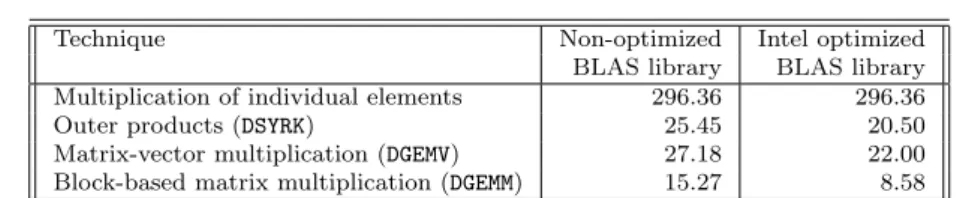
A comparison of several techniques for calculatingA(Q+Θ−1)AT is shown
in Table 1. Any technique that takes advantage of the structure of the problem gave better performance than multiplying the elements individually.
Comput-ingA(Q+Θ−1)AT by outer products most directly exploits the structure (as
(Q+Θ−1) is diagonal), but the computation usingDGEMMon blocks of 32 data
points at a time gave the best performance, probably due to better use of the CPU’s cache.
The numerical results in this section were based on artificial data sets. The training data sets used were created by uniformly sampling points in the
space [−1,+1]m. A separating hyperplane was defined by choosing random
integer values forwin the range [-1000,1000]. Points were labelled based on the
Technique Non-optimized Intel optimized BLAS library BLAS library Multiplication of individual elements 296.36 296.36 Outer products (DSYRK) 25.45 20.50 Matrix-vector multiplication (DGEMV) 27.18 22.00 Block-based matrix multiplication (DGEMM) 15.27 8.58
Table 1 Time taken (in seconds) to train an SVM, comparing different techniques to cal-culateA(Q+Θ−1)−1AT. The data set given contained 5000 points of 320 attributes. 14
IPM iterations were required.
hyperplane. For the non-separable data sets, the required proportion of data points were randomly selected and misclassified. In contrast to the training data, the test data sets contain no misclassified points.
4.1 Confirmation of scalability
The complexity analysis above gave the computations required for each
itera-tion as O(nm2) ifnm. To verify this, the software was trained first using
data sets with 255 features. Figure 1(a) shows that the length of time taken
by an iteration varies linearly with the number of samples n. However, the
total time taken by the algorithm increases super-linearly with the number of samples, as the number of iterations required also increases slowly.
The experiment was repeated for the number of features, using a data set of 20,000 samples, and the number of features varied. Figure 1(b) shows that,
once there is a reasonably large number of features, approximatelym > 250,
the algorithm scales quadratically with m, while the number of iterations
required remains roughly the same.
(a) (b) 0.1 1 10 0 5000 10000 15000 20000 25000 30000 35000 40000 45000 50000 10 15 20 25 30 35 40
Iteration time per sample (s) Number of iterations required
Number of samples Computation time per iteration
Linear growth in time Number of iterations 0.1 1 10 100 0 50 100 150 200 250 300 350 400 450 500 0 10 20 30 40 50 60 70
Time per iteration (s)
Number of iterations required
Number of features Computation time per iteration Quadratic growth in time Number of iterations
Fig. 1 The computational scalability of iteration time is predictable, and results confirm O(nm2). The number of iterations required is less predictable, but grows slowly withn. (a) Computational complexity and iteration count with respect to the number of samples
n, using fully separable data sets with 255 features. (b) Computational complexity and iteration count with respect to the number of featuresm. Data sets were fully separable with 20,000 samples.
4.2 Bounds onw
In the formulation (6) wis free, while the standard IPM formulation (1)
re-quires all variables to be in the positive quadrant. While free variables can
be implemented as w ≡w+−w−, where w+, w− ≥ 0, this approach suffers
from numerical difficulties: logically one of each pair (w+, w−) would be zero,
but this is prevented by the logarithmic barrier used in IPM. The approach
we adopted is to define bounds lw ≤ w ≤ uw, and the problem can then
be adjusted appropriately to shift the bounds to 0 ≤ w0 ≤ uw−lw. From
(6), w = XY z, so bounds can be safely set as τP
imin(yixij,0) ≤ wj ≤
τP
imax(yixij,0). For problems where the solution set of support vectors is
sparse, the optimal values for wdiffer substantially from either bound. Since
large bounds affect the numerical accuracy of the algorithm, it is useful to tighten the bounds to within say a couple of orders of magnitude of the true
values ofwonce these are known (e.g. when searching for the best parameters
through repeated training).
4.3 Accuracy due to termination criteria
Several termination criteria are possible. Normally the measure of most in-terest for an optimization problem is the value of the objective function, and the algorithm stops when this value is reached to within a set relative error,
e.g. 10−8, but for SVMs the objective value is not of interest so may not be
a good basis for termination. Similarly, the errors associated with primal and dual feasibility can be monitored, and the algorithm terminated when these are within a small tolerance.
The approach normally used for SVM is to monitor the set of support vectors, and terminate the algorithm when this is stable. The KKT comple-mentarity conditions are used to determine the support vectors.
With the formulation presented in this paper, we have access to the weights
variableswdirectly. It is therefore possible to monitor these values, and
mea-sure the change in the angleφof the normal to the hyperplane between
iter-ationi−1 andi:
cosφ= (w
(i−1))Tw(i)
kw(i−1)kkw(i)k
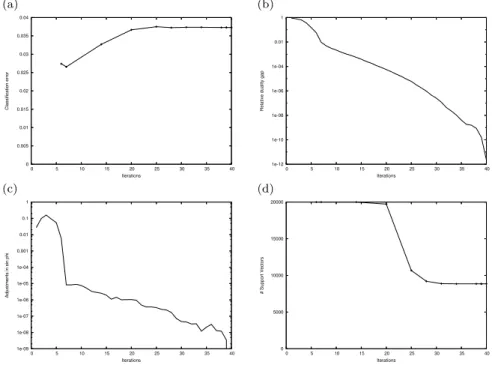
We conducted experiments to see how these measures relate to classification accuracy, using a training set of 20,000 samples and 255 features, with 5% misclassifications, and a separable test set of the same size.
Figure 2 shows how the duality gap and sinφdecrease as the IPM algorithm
progresses. Primal feasibility was reached quickly, while it took the algorithm longer to attain dual feasibility. All measures were sensitive to the scale of
the bounds onw, which made it hard to define a set tolerance for any of the
measures. In particular, the values ofw decrease with each iteration, so it is
A noticeable feature of the figures is that a high classification accuracy is achieved at an early stage in the algorithm, long before the number of sup-port vectors has stabilized, indicating that the hyperplane has been accurately identified at this point. Although at this stage the values of the weights change
in scale, proportionally they are stable, as can be seen by measuring sinφ
(Fig-ure 2). Once suitable bounds onwhave been established, a tolerance of 10−4
on sinφcould be used to give earlier termination.
(a) (b) 0 0.005 0.01 0.015 0.02 0.025 0.03 0.035 0.04 0 5 10 15 20 25 30 35 40 Classification error Iterations 1e-12 1e-10 1e-08 1e-06 1e-04 0.01 1 0 5 10 15 20 25 30 35 40
Relative duality gap
Iterations (c) (d) 1e-09 1e-08 1e-07 1e-06 1e-05 1e-04 0.001 0.01 0.1 1 0 5 10 15 20 25 30 35 40
Adjustments in sin phi
Iterations 0 5000 10000 15000 20000 0 5 10 15 20 25 30 35 40 # Support Vectors Iterations
Fig. 2 Performance of the algorithm relative to the number of IPM iterations, using a training data set with 5% of points mis-classified, 20,000 samples and 255 attributes. (a) Classification error using an unseen test set. (b) Error in the value of the objective. (c) Change in angle of the normal to the separating hyperplane. (d) The number of support vectors.
4.4 Multiple correctors
The use of multiple correctors [15] can reduce the number of IPM iterations required, by improving the centrality of the current iterate. Several
correc-tors can be calculated by repeatedly solvingM ∆λ =−rˆb for∆λ. The same
factorization of M is used for all the correctors in an iteration, so it is
ad-vantageous to perform multiple corrections when the effort involved the
back-solves (hereO(nm+m2)) is significantly less than that of factorizingM (here
We conducted experiments to show the comparative performance of the al-gorithm using multiple correctors, against the alal-gorithm using a single Mehro-tra’s corrector. Both the number of iterations and the overall time were im-proved by using multiple correctors. For example, using a data set of 20,000 samples and 255 features, an average of 2.8 correctors were used in each iter-ation, and the optimization required 2 fewer iterations.
4.5 Stability in case of near-linear dependency in X
We used the data set of [13] that caused an algorithm using the Sherman-Morrison-Woodbury update to fail. This data set (shown in Figure 3) causes
degeneracy in the matrix (XY), as there are multiple data points which lie
along the separating hyperplanes. Scaling one of the dimensions accentuates the numerical instability. With our algorithm, there was no penalty in per-formance, with the number of IPM iterations required always around 20 no matter the scaling imposed on the data set (this is similar performance to that reported by Goldfarb and Scheinberg for their Product Form Cholesky Factorization algorithm). Stability of our approach is a consequence of the use of primal-dual regularization [1]. Regularization improves any ill-conditioning related to the original data, and allows Cholesky factorization to be computed without severe loss of accuracy.
-4 -2 0 2 4 -4 -2 0 2 4
Fig. 3 The data set of [13] causing de-generacy in the constraint matrix.
4.6 Comparison against standard tools
To assess the performance of our algorithmSVM-HOPDM, we tested it against a
range of state-of-the-art SVM tools:SVMlight[18],SVMperf[19],
LibLinear[17], LibSVM[2] andSVMTorch[4]. We also included theSVM-QPactive set algorithm
[9] and the IPM-based algorithm (SVM-QP Presolve) of Scheinberg that uses
the Product Form Cholesky Factorization described earlier [13]. They were all used with their software performance options (such as cache size) set to their
(a) (b) 0.1 1 10 100 1000 1000 10000 Training time (s)
Size of training data set HOPDM SVMlight SVMPerf LibLinear LibSVM SVMTorch SVM-QP SVM-QP Presolve 0.1 1 10 100 1000 1000 10000 Training time (s)
Size of training data set HOPDM SVMlight SVMPerf LibLinear LibSVM SVMTorch SVM-QP SVM-QP Presolve (c) (d) 0.1 1 10 100 1000 1000 10000 Training time (s)
Size of training data set HOPDM SVMlight SVMPerf LibLinear LibSVM SVMTorch SVM-QP SVM-QP Presolve 0.1 1 10 100 1000 1000 10000 Training time (s)
Size of training data set HOPDM SVMlight SVMPerf LibLinear LibSVM SVMTorch SVM-QP SVM-QP Presolve
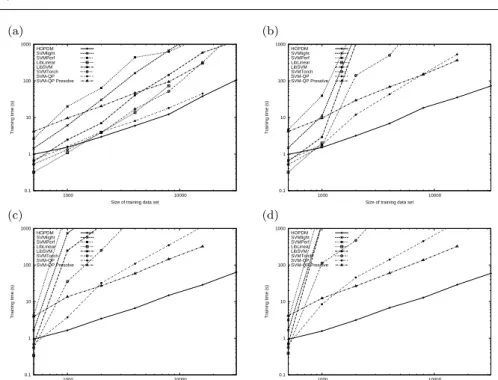
Fig. 4 Comparison of efficiency ofSVM-HOPDMagainst other algorithms, with respect to data set size, as noise is increased. Artificial data sets used of 255 attributes.τ = 1. (a) Fully separable. (b) 1% misclassified. (c) 5% misclassified. (d) 10% misclassified.
default values. We conducted SVM training experiments using
synthetically-constructed data sets as described earlier, with 255 features. SVMTorch has
been used as the comparison tool for other IPM-based techniques, e.g. [7, 10, 13].
Figure 4 shows the comparative efficiency of the algorithms as the size of the data set is increased, with a relatively low penalty for misclassifications
(τ= 1). For separable data sets (a) all the algorithms show linear or sublinear
scaling. But the relative performance changes dramatically when the data set contains noise, as is typically the case with real-world data sets. We used synthetic data sets again, but this time introduced noise by choosing (b) 1%, (c) 5% and (d) 10% of the points randomly and swapping their target label. The computation time required by the active set methods is greatly increased by introducing noise, while other algorithms are less affected.
The experiments were repeated for a higher misclassification penalty of
τ= 100 (Figure 5). It can be clearly seen that all except the IPM algorithms
are greatly affected by the level of noise, with training times increased by several orders of magnitude, or the algorithms fail to converge.
The training times of SVM-HOPDMand SVM-QP Presolver, both based on
interior point methods, are similar in all eight cases, yet there was almost an order of magnitude difference between the two algorithms. This difference
(a) (b) 0.1 1 10 100 1000 1000 10000 Training time (s)
Size of training data set HOPDM SVMlight SVMPerf LibLinear LibSVM SVMTorch SVM-QP SVM-QP Presolve 0.1 1 10 100 1000 1000 10000 Training time (s)
Size of training data set HOPDM SVMlight SVMPerf LibLinear LibSVM SVMTorch SVM-QP SVM-QP Presolve (c) (d) 0.1 1 10 100 1000 1000 10000 Training time (s)
Size of training data set HOPDM SVMlight SVMPerf LibLinear LibSVM SVMTorch SVM-QP SVM-QP Presolve 0.1 1 10 100 1000 1000 10000 Training time (s)
Size of training data set HOPDM SVMlight SVMPerf LibLinear LibSVM SVMTorch SVM-QP SVM-QP Presolve
Fig. 5 Comparison of algorithm efficiency, similar to Figure 4 but with higher penalty for misclassifications (τ= 100). (a) Fully separable. (b) 1% misclassified. (c) 5% misclassified. (d) 10% misclassified.
cannot be accounted for by a complexity analysis. We investigated this further
using Valgrind’s Cachegrind cache simulator2 set as a Pentium 4 processor
cache, and the results for four data sets are shown in Table 2. The algorithms required different numbers of iterations which complicated the comparison, so we considered only the functions associated with forming and solving the nor-mal system matrix, and this accounted for some 70% to 80% of the instructions executed (the “coverage” in Table 2). The final two columns of the table show instruction count and runtime ratios for the two programs. It is clear that the number of executed instructions does not explain the whole increase in runtime. The number of data read cache misses (which is determined by how the algorithm accesses the data structure) is also an important factor in run-time performance, yet it is rarely discussed in comparisons of computational complexity of algorithms.
4.7 Real-world data sets
To investigate what performance results can be expected in real-world appli-cations, we used the standard data sets Adult, Covtype, MNIST, SensIT and
Data set SVM-HOPDM SVM-QPpresolver SVM-QP/SVM-HOPDM n m Time Cov. D2mr Time Cov. D2mr Instructions Time 10000 63 3.69 70% 2.68% 16.44 72% 6.99% 2.36 4.46 10000 127 10.66 83% 1.73% 55.46 80% 7.56% 1.94 5.21 10000 255 15.67 79% 1.34% 127.53 79% 7.72% 2.73 8.14 20000 63 9.13 76% 2.97% 40.74 76% 6.95% 2.15 4.46
Table 2 Comparison of SVM-HOPDM and SVM-QP Presolver in terms of instructions and cache misses. Synthetic data sets of dimensionnsamples andmfeatures were used. Time is the total runtime of the program, running with hardware cache, in seconds. Coverage is the proportion of the program included in the instruction and cache miss count. D2mr is the proportion of Level 2 data read misses to total Level 2 data reads. The final two columns show the ratio between the two programs, for instructions and runtime. The increase in runtime of SVM-QP Presolvercannot be accounted for by instructions alone, and cache performance has a significant effect.
USPS.3Each problem was solved using a linear kernel withτ = 1,10 and 100.
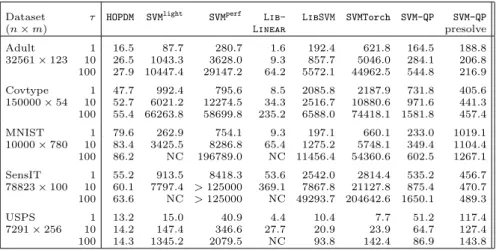
Table 3 shows the wall-clock times to perform the training (including time taken to read the data).
Dataset τ HOPDM SVMlight SVMperf Lib- LibSVM SVMTorch SVM-QP SVM-QP
(n×m) Linear presolve Adult 1 16.5 87.7 280.7 1.6 192.4 621.8 164.5 188.8 32561×123 10 26.5 1043.3 3628.0 9.3 857.7 5046.0 284.1 206.8 100 27.9 10447.4 29147.2 64.2 5572.1 44962.5 544.8 216.9 Covtype 1 47.7 992.4 795.6 8.5 2085.8 2187.9 731.8 405.6 150000×54 10 52.7 6021.2 12274.5 34.3 2516.7 10880.6 971.6 441.3 100 55.4 66263.8 58699.8 235.2 6588.0 74418.1 1581.8 457.4 MNIST 1 79.6 262.9 754.1 9.3 197.1 660.1 233.0 1019.1 10000×780 10 83.4 3425.5 8286.8 65.4 1275.2 5748.1 349.4 1104.4 100 86.2 NC 196789.0 NC 11456.4 54360.6 602.5 1267.1 SensIT 1 55.2 913.5 8418.3 53.6 2542.0 2814.4 535.2 456.7 78823×100 10 60.1 7797.4 >125000 369.1 7867.8 21127.8 875.4 470.7 100 63.6 NC >125000 NC 49293.7 204642.6 1650.1 489.3 USPS 1 13.2 15.0 40.9 4.4 10.4 7.7 51.2 117.4 7291×256 10 14.2 147.4 346.6 27.7 20.9 23.9 64.7 127.4 100 14.3 1345.2 2079.5 NC 93.8 142.4 86.9 143.8
Table 3 Comparison of training times using real-world data sets. Each data set was trained usingτ= 1,10 and 100. NC indicates that the method did not converge to a solution.
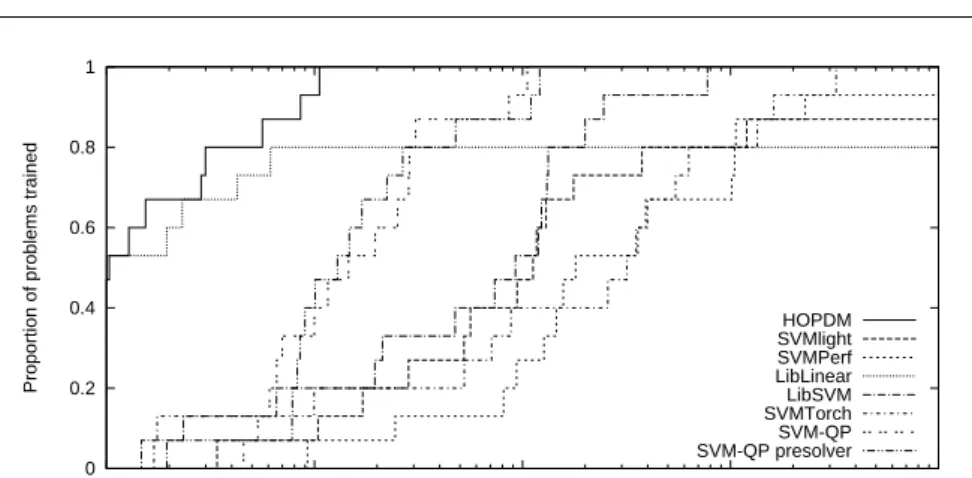
The same results are shown as a performance profile [6] in Figure 6. Here,
the runtimets,p for each solvers∈ S on problemp∈ P is transformed into a
ratio to the fastest solver for problemp:
rs,p =
ts,p
mins∈Sts,p
.
3 All datasets are available from the
LibSVM collection at http://www.csie.ntu.edu.tw/˜cjlin/libsvmtools/datasets/. Due to memory restrictions, some data sets were reduced to the sizes given in Table 3. SVM-QP had tighter memory restrictions, so the datasets were further reduced and the times linearly scaled up; this is probably fair for theSVM-QPpresolver but is rather favourable for the active set solver.
0 0.2 0.4 0.6 0.8 1 1 10 100 1000 10000
Proportion of problems trained
Ratio of training time to best training time
HOPDM SVMlight SVMPerf LibLinear LibSVM SVMTorch SVM-QP SVM-QP presolver
Fig. 6 Performance profile of the SVM tools on the problems in Table 3.
Dataset τ HOPDM LibLinear SVMTorch
Adult 1 85.01% 84.98% 84.95% 32561×123 10 84.98% 84.96% 85.01% 100 84.95% 84.95% 84.97% Covtype 1 61.59% 61.59% 60.85% 150000×54 10 61.92% 61.92% 59.84% 100 61.92% 61.92% 61.46% MNIST 1 86.31% 86.31% 86.40% 10000×780 10 86.43% 86.40% 86.41% 100 86.27% — ??? SensIT 1 85.78% 85.42% 85.78% 78823×100 10 85.80% 85.43% 85.82% 100 85.79% 85.45% 85.85% USPS 1 96.41% 97.11% 97.11% 7291×256 10 97.21% 97.11% 97.21% 100 97.01% 96.61% 96.66%
Table 4 Comparison of prediction accuracy on unseen test sets. For all except Covtype, we used the standard test sets. Covtype does not have a standard test set, so we used the first 150000 samples of the data set for training and the final 100000 samples as the test set (there was no overlap). The results show in terms of accuracy, our method is broadly equivalent to other methods.
The performance profile is the cumulative distribution function of these ratios for each solver
ρs(T) = size{p∈ P:|rs,p ≤T}
size{P} ,
that is the proportion of problems which can be solved with a runtime ratio
rs,p less thanT. The value of ρs(1) is the proportion of problems that solver
problems solved at all. A high proportion of problems solved with small ratios
rs,p is shown by the profile being close to the upper left axes.
The results confirm that real-world data sets do tend to be noisy, as most
methods take considerably longer with highτmisclassification penalty values.
The performance profile highlights that LibLinear is the fastest for many
of the problems, generally involving low values of τ. For higher values of τ,
however, HOPDM is faster than the other solvers. This is due to the training
time of our algorithm being roughly constant, relative to the value ofτ. It was
at most one order of magnitude slower than the fastest solver for any problem, which was the best performance of any of the solvers in this regard: other solvers were two or three orders of magnitude slower, or failed to converge at all. We consider this dependability, in terms of both predictable training times
and ability to train with a wide range ofτ values, to be a valuable property
of our algorithm.
Table 4 confirms that there is no penalty to be paid in terms of prediction accuracy. Experiments using unseen test samples show that the prediction accuracy of our formulation is comparable with other methods.
5 Conclusions
Support Vector Machines are a powerful machine learning technique. However, it is not a trivial exercise to extend it to very large scale problems. Due to the Hessian in the standard dual formulation being completely dense, interior point methods have not traditionally been used. Instead, standard SVM tools have mainly been based around active-set methods. These work well for small and separable problems, but when the split between basic and non-basic variables becomes less clear (as is the case with noisy data sets), the performance of these algorithms starts to scale exponentially with the number of samples. Previous IPM-based approaches have exploited the structure of the linear kernel, to give
algorithms with an overall complexity ofO(nm2). However, these algorithms
have suffered from either numerical instability through use of the Sherman-Morrison-Woodbury formula, or memory caching inefficiencies.
In this paper we have presented a new, unified set of formulations for linear 1-norm and 2-norm classification, universum and ordinal classification,
and-insensitive regression, which all exploit the separability of the Hessian in
the objective of the standard SVM primal formulation, while keeping a small number of constraints as in the dual. Like the other IPM-based approaches,
it has a per-iteration complexity of O(nm2+m3). It relies upon Cholesky
decomposition for its numerical stability, but the factorization is applied to all
m features at once, allowing for a more efficient implementation in terms of
memory caching.
Numerical experiments showed that the performance of the algorithm for large dense or noisy data sets is consistent and highly competitive, and in some cases can surpass all other approaches by a large margin. Unlike active set methods, performance is largely unaffected by noisy data. Using multiple
correctors, tightening the bounds onw, and monitoring the angle of the normal to the hyperplane all positively contributed to efficiency.
It is possible to extend these formulations to non-linear kernels, by
ap-proximating the positive semidefinite kernel matrix K with a low-rank outer
product representation such as partial Cholesky factorization LLT ≈K [8].
This approach produces the firstrcolumns of the matrixL(corresponding to
ther largest pivots) and leaves the other columns as zero, giving an
approx-imation of the matrix K of rank r. It is an attractive algorithm for partial
decomposition, since its complexity is linear with the number of samples, it is
faster than eigenvalue decomposition, and it exploits the symmetry of K. A
separable formulation suitable for non-linear kernels is therefore: min w,z 1 2w Tw−eTz s.t. w−LTY z= 0 yTz= 0 0≤z≤τ e. (9)
Computational complexity isO(nr2+nmr) for the initial Cholesky
factoriza-tion, andO(nr2+r3) for each IPM iteration.
It is also possible to develop this algorithm to handle very large scale
prob-lems in parallel. The key computation part is the calculation of the matrixM;
as described earlier, this was handled on a block basis using the BLAS library. By dividing the sample points equally amongst the processors, the block-based matrix multiplications can be performed in parallel with no communication required between the processors. Then at the end of the multiplication, a single
gather operation is required on the (m+ 1)×(m+ 1) matrix at each
proces-sor to form the matrix M and then factorize it. Implementation details are
addressed in [33]. This could point the way forward for tackling large and complex data sets.
Acknowledgements
We would like to thank the anonymous reviewers for their careful reading of our manuscript and the insightful comments they provided.
References
1. Altman, A., Gondzio, J.: Regularized symmetric indefinite systems in interior point methods for linear and quadratic optimization. Optimization Methods and Software
11, 275–302 (1999)
2. Chang, C.C., Lin, C.J.: LIBSVM: a library for support vector machines (2001). Software available at http://www.csie.ntu.edu.tw/ cjlin/libsvm
3. Chu, W., Keerthi, S.S.: New approaches to support vector ordinal regression. In: ICML ’05: Proceedings of the 22nd international conference on machine learning, pp. 145–152. ACM, New York, NY, USA (2005)
4. Collobert, R., Bengio, S.: SVMTorch: support vector machines for large-scale regression problems. Journal of Machine Learning Research1, 143–160 (2001)
5. Cristianini, N., Shawe-Taylor, J.: An Introduction to Support Vector Machines. Cam-bridge University Press (2000)
6. Dolan, E., Mor´e, J.: Benchmarking optimization software with performance profiles. Mathematical Programming91(2), 201–13 (2002)
7. Ferris, M., Munson, T.: Interior point methods for massive support vector machines. SIAM Journal on Optimization13(3), 783–804 (2003)
8. Fine, S., Scheinberg, K.: Efficient SVM training using low-rank kernel representations. Journal of Machine Learning Research2, 243–264 (2002)
9. Fine, S., Scheinberg, K.: INCAS: An incremental active set method for SVM. Tech. rep., IBM Research Labs, Haifa (2002)
10. Gertz, E.M., Griffin, J.D.: Support vector machine classifiers for large data sets. Tech-nical memo, Argonne National Lab ANL/MCS-TM-289 (2005)
11. Gertz, E.M., Wright, S.J.: Object-oriented software for quadratic programming. ACM Transactions on Mathematical Software29(1), 58–81 (2003)
12. Goldfarb, D., Scheinberg, K.: A product-form Cholesky factorization method for han-dling dense columns in interior point methods for linear programming. Mathematical Programming99(1), 1–34 (2004)
13. Goldfarb, D., Scheinberg, K.: Solving structured convex quadratic programs by interior point methods with application to support vector machines and portfolio optimization. Submitted for publication (2005)
14. Gondzio, J.: HOPDM: a fast LP solver based on a primal-dual interior point method. European Journal of Operational Research85, 221–225 (1995)
15. Gondzio, J.: Multiple centrality corrections in a primal-dual method for linear program-ming. Computational Optimization and Applications6, 137–156 (1996)
16. Herbrich, R., Graepel, T., Obermayer, K.: Advances in Large Margin Classifiers, chap. Large margin rank boundaries for ordinal regression. MIT Press (2000)
17. Hsieh, C.J., Chang, K.W., Lin, C.J., Keerthi, S.S., Sundararajan, S.: A dual coordinate descent method for large-scale linear SVM. In: ICML ’08: Proceedings of the 25th international conference on machine learning (2008)
18. Joachims, T.: Making large-scale support vector machine learning practical. In: B. Sch¨olkopf, C.J.C. Burges, A.J. Smola (eds.) Advances in Kernel Methods: Support Vector Learning, pp. 169–184. MIT Press (1999)
19. Joachims, T.: Training linear SVMs in linear time. In: KDD ’06: Proceedings of the 12th ACM SIGKDD international conference on Knowledge discovery and data mining, pp. 217–226. ACM, New York, NY, USA (2006)
20. Keerthi, S.S., Chapelle, O., DeCoste, D.: Building support vector machines with reduced classifier complexity. Journal of Machine Learning Research7, 1493–1515 (2006) 21. Lawson, C.L., Hanson, R.J., Kincaid, D.R., Krogh, F.T.: Algorithm 539: Basic Linear
Algebra Subprograms for Fortran usage [F1]. ACM Transactions on Mathematical Software5(3), 324–325 (1979)
22. Lee, Y.J., Mangasarian, O.L.: RSVM: Reduced support vector machines. In: Proceed-ings of the SIAM International Conference on Data Mining. SIAM, Philadelphia (2001) 23. Lucidi, S., Palagi, L., Risi, A., Sciandrone, M.: A convergent decomposition algorithm for support vector machines. Computational Optimization and Applications38, 217– 234 (2007)
24. Mangasarian, O.L., Musicant, D.R.: Successive overrelaxation for support vector ma-chines. IEEE Transactions on Neural Networks10(5), 1032–1037 (1999)
25. M´esz´aros, C.: The separable and non-separable formulations of convex quadratic prob-lems in interior point methods. Tech. Rep. WP 98-3, Computer and Automation Re-search Institute, Hungarian Academy of Sciences, Budapest (1998)
26. Osuna, E., Freund, R., Girosi, F.: An improved training algorithm for support vector machines. In: J. Principe, L. Gile, N. Morgan, E. Wilson (eds.) Neural Networks for Signal Processing VII — Proceedings of the 1997 IEEE Workshop, pp. 276–285. IEEE (1997)
27. Platt, J.: Fast training of support vector machines using sequential minimal optimiza-tion. In: B. Sch¨olkopf, C.J.C. Burges, A.J. Smola (eds.) Advances in Kernel Methods:
Support Vector Learning, pp. 185–208. MIT Press (1999)
28. Vanderbei, R.J.: Linear Programming Foundations and Extensions. Kluwer, Boston (1997)
29. Vapnik, V.: Statistical Learning Theory. Wiley (1998)
30. Vapnik, V.: The Nature of Statistical Learning Theory, 2nd edn. Springer (1999) 31. Vapnik, V.: Transductive inference and semi-supervised learning. In: O. Chapelle,
B. Sch¨olkopf, A. Zien (eds.) Semi-supervised learning, chap. 24, pp. 454–472. MIT Press (2006)
32. Weston, J., Collobert, R., Sinz, F., Bottou, L., Vapnik, V.: Inference with the Universum. In: ICML ’06: Proceedings of the 23rd international conference on machine learning, pp. 1009–1016. ACM (2006)
33. Woodsend, K., Gondzio, J.: Hybrid MPI/OpenMP parallel support vector machine training. Technical Report ERGO 09-001, School of Mathematics and Maxwell Institute for Mathematical Sciences, University of Edinburgh (2009). Submitted for publication. 34. Wright, S.J.: Primal-dual interior-point methods. S.I.A.M. (1997)
![Fig. 3 The data set of [13] causing de- de-generacy in the constraint matrix.](https://thumb-us.123doks.com/thumbv2/123dok_us/474770.2556124/19.892.112.356.566.747/fig-data-set-causing-generacy-constraint-matrix.webp)