Secure Privacy-preserving Computing Applications on Cloud
Using Homomorphic Cryptography
A thesis submitted in fulfilment of the requirements for the degree of Doctor of Philosophy
Vu Huy Mai
Bachelor of Computer Science, Honours, RMIT
School of Science
College of Science, Engineering and Health
RMIT University
Declaration
I certify that except where due acknowledgement has been made, the work is that of the author alone; the work has not been submitted previously, in whole or in part, to qualify for any other academic award; the content of the thesis is the result of work which has been carried out since the official commencement date of the approved research program; any editorial work, paid or unpaid, carried out by a third party is acknowledged; and, ethics procedures and guidelines have been followed. I acknowledge the support I have received for my research through the provision of an Australian Government Research Training Program Scholarship.
Vu Huy Mai 9th, August, 2017
Acknowledgement
The thesis is finally finished! I am very happy that I am writing the acknowledgement, indi-cating that it marks the end of a very important chapter in my life.
Six years ago , when I just finished my bachelor degree in IT, I met Associate Professor Ibrahim Khalil to discuss potential research pathways for my graduate study. It has been a great conversation guiding my in the right direction in research until now. When I finished the thesis, I can say that I have made the right decision to do research in security and cryptography. My years as a graduate student have been the most rewarding years in my life. It was a true adventure; a job I greatly enjoyed, working with so many new technologies and technical areas to broaden my knowledge.
First of all, I would like to thank my first supervisor Associate Professor Ibrahim Khalil. I feel blessed to have been given the opportunity to learn from and work with him. He has provided me with a great deal of encouragement and support when I needed it the most. He also provided me with a new perspective on various topics of discussion. He always had time to read my papers, provide valuable comments and boost my spirits and kept me motivated throughout the duration of the PhD.
I would like to thank my family, especially my mother, who always helped me on everything and provided emotional strength often while being thousands of kilometres away.
Finally, I would like to thank all my friends in and outside of RMIT that directly or indirectly supported me throughout this time.
Credits
Portions of the material in this thesis have previously appeared in the following publications or to be submitted soon after the submission of this thesis:
• Mai V, Khalil I. Design and implementation of a secure cloud-based billing model for smart meters as an Internet of things using homomorphic cryptography. Future Gener-ation Computer Systems. 2016 Jun 22.
http://dx.doi.org/10.1016/j.future.2016.06.003
• Mai V, Khalil I. Cloud-based Homomorphic Secret Sharing and Access Control. To be submitted to the International Journal of Future Generation Computer Systems.
• Mai V, Khalil I. Secure Pricing Comparison Model Using Homomorphic Cryptography. To be submitted to the Special Issue on Security and Privacy in Cyber Physical Systems (Future Generation Computer Systems)
Abstract
The advancement of cloud computing technologies has provided users and business organi-sations with various cloud-based options to store and access information externally, across multiple platforms and geographic locations. The cloud also has the ability to deliver scal-able and high-performance computing services on demand and in a cost-effective manner while helping users to avoid the trouble of maintaining large data centres and complex computing facilities. The economies of scale increase revenue for cloud providers and lower costs for cloud users. The resulting on-demand model of computing allows providers to achieve better resource utilization through statistical multiplexing, and enables users to avoid the costs of resource over-provisioning through dynamic scaling.
However, there are major security and privacy concerns when data is stored in external cloud storage systems. For example, when personal information is stored in unencrypted formats on the cloud, service providers can learn many details about the users such as their preferences, past behaviours and biometric identities. The widely distributed nature of cloud architectures means that server farms can be located in many countries or geographic locations that might be under different laws and regulations regarding user privacy. Furthermore, cloud service providers may encrypt data in-transit, but not while user data is stored on their servers, causing the reluctance of many business organisations to outsource the storage of their sensitive and valuable data, which can be major targets for attacks coming from both outside attackers and insiders.
Therefore, encrypting the data when it is stored on the cloud is an important task to guarantee the confidentiality and privacy of users data. However, traditional cryptographic techniques make it difficult for processing tasks such as searching, updating or checking the integrity of encrypted data without asking clients to download and decrypt large amounts of data from the cloud. To realise the full potential of cloud computing, better cryptographic schemes are required. They should enable the cloud to perform various computing operations
on encrypted data and return encrypted results to customers. Another desirable feature is how a cryptographic scheme can allow different parties to combine their encrypted data and perform some computing tasks on the cloud without compromising the confidentiality and privacy of the data of each party.
Recently, homomorphic cryptography has increasingly been the focus of researchers because this technology has a great potential to provide the desirable features described above. Homo-morphic encryption can be implemented either as a symmetric or a public-private asymmetric key paradigm. This technique allows many types of computing operations to be performed on ciphertext and output encrypted results which, when decrypted, are found to be identi-cal to the results of the same operations performed on plaintext data. With a homomorphic cryptosystem, many computational circuits can now be homomorphically evaluated, producing programs that might be run on encryptions of their inputs to produce an encryption of their output. Since the inputs of such programs are encrypted, a computation task can be performed on an untrusted cloud without revealing any inputs and internal states.
In this thesis, we focus on the design and implementation of various application models of homomorphic cryptography so that the cloud can be used more effectively and securely to store and process sensitive customer data. Our research works throughout many chapters of this thesis also provide valuable information regarding the security of homomorphic cryptography in many use case scenarios. We illustrate how homomorphic cryptography can be applied effectively with all of its flexibility, power and usefulness in many applications ranging from smart grid, e-commerce to secret sharing. In this thesis, we also propose approaches to enhance the efficiency and effectiveness of homomorphic cryptography, so that these cryptographic schemes can be applied not only in current cloud-based application, but also in larger, more mission-critical applications in the future.
Contents
Declaration ii Acknowledgement iii Credits iv Abstract v Contents vii List of Figures xiList of Tables xiii
1 Introduction 1
1.1 Security, Privacy-preserving Protocols on Cloud . . . 3
1.1.1 Security and Privacy in Cloud Computing . . . 3
1.1.2 Basic Features of Secure and Privacy-preserving Protocols . . . 5
1.2 Motivations and Problem Statements . . . 7
1.3 Research Questions . . . 9
1.4 Research Outcomes . . . 10
1.5 Contributions . . . 12
2 Preliminaries 13 2.1 Foundations of Homomorphic Cryptosystems . . . 13
2.1.1 The Factoring Problem . . . 14
2.1.2 RSA /e’th Root Problem . . . 15
2.1.4 Thep-Subgroup Problem . . . 17
2.1.5 Discrete Logarithms and the Diffie-Hellman Problem . . . 17
2.1.6 Bilinear Groups and Elliptic Curves . . . 19
2.2 Homomorphic Encryption With The Ability to Compute on Encrypted Data . 20 2.2.1 Partially homomorphic cryptosystems . . . 21
2.3 A Survey of Homomorphic Cryptosystems . . . 23
2.3.1 The RSA Cryptosystem . . . 24
2.3.2 The ElGamal Cryptosystem . . . 24
2.3.3 The Paillier Cryptosystem . . . 26
2.3.4 Fully homomorphic cryptosystems . . . 27
2.4 Requirements of privacy-preserving cloud-based computing applications . . . . 28
2.4.1 Overview of a secure privacy-preserving cloud-based applications . . . . 28
2.4.2 Security and Privacy Threats to Cloud-based Applications . . . 29
2.4.3 Essential Security Requirements of Cloud-based Applications . . . 30
2.5 Review of Existing Secure Privacy-preserving Data Access and Computing Schemes on Cloud. . . 32
2.5.1 Protecting User Identity on Cloud . . . 32
2.5.2 Protecting User Behaviours and Access Patterns on Cloud . . . 34
2.5.3 Protecting the Privacy of User Queries on Cloud . . . 35
3 Design and Implementation of a Secure Cloud-based Billing Model for Smart Meters as an Internet of Things Using Homomorphic Cryptog-raphy 37 3.1 Introduction . . . 38
3.2 Background and Related Works . . . 42
3.2.1 Fully Homomorphic Key Generation, Encryption and Decryption Algo-rithms . . . 42
3.2.2 Encoding Integer Inputs Using The Two’s Complement Numeric System 45 3.2.3 Encrypting Integer Inputs . . . 47
3.2.4 Fully Homomorphic Operations on Encrypted Binary Digits . . . 47
3.2.5 Adding Encrypted Integers . . . 48
3.2.6 Related Works . . . 50
3.3 Cloud-based Smart Meter Data Storage And Processing . . . 52
3.4 Experiments and Analysis . . . 57
3.4.1 Data Structure and Key Generation . . . 57
3.4.2 Homomorphic Billing Computation in Different Billing Periods . . . 59
3.4.3 Homomorphic Billing Computation for Different Numbers of Smart Me-ters in a Fixed Billing Period . . . 59
3.5 Performance of Our Algorithm on Multi-core Cloud Servers . . . 60
3.6 Conclusion . . . 64
4 Secure Pricing Comparison Model Using Homomorphic Cryptography 65 4.1 Introduction . . . 65
4.2 Background and Related Works . . . 68
4.3 Secure Homomorphic Price Checking Model . . . 69
4.3.1 Checking Client Decryption Results . . . 74
4.4 The Security of Our Model in Various Scenarios . . . 77
4.5 Implementation and Experiments . . . 81
4.6 Conclusion . . . 84
5 Cloud-based Homomorphic Secret Sharing and Access Control 85 5.1 Introduction . . . 85
5.2 Background and Related Works . . . 88
5.2.1 Polynomial Interpolation and Its Applications in Shamir’ Secret Sharing 88 5.2.2 Related Works . . . 90
5.3 Secure Homomorphic Encrypted Secret Sharing Model . . . 91
5.3.1 Homomorphic Computation of a Shared Secret on Cloud . . . 93
5.3.2 Cloud-based Homomorphic Access Control Using Encrypted Secret Sharing 99 5.4 The Security of Our Model in Various Scenarios . . . 104
5.5 Implementation and Experiments . . . 107
5.6 Conclusion . . . 110
6 Secure one-time e-commerce transactions using homomorphic cryptog-raphy 112 6.1 Introduction . . . 113
6.2 Background . . . 117
6.2.1 Major components of an online payment system . . . 117
6.2.3 Limitations of existing online payment models . . . 120 6.3 Related Works . . . 122 6.4 Proposed Model: Secure Payment System With Homomorphic Cryptography . 125 6.5 Experiments and the Security of Our Model in Various Scenarios . . . 135 6.6 Conclusion . . . 140
7 Conclusion 141
7.1 Concluding Remarks and Discussion . . . 142 7.1.1 Design and Implementation of a Secure Cloud-based Billing Model for
Smart Meters as an Internet of Things Using Homomorphic Cryptography142 7.1.2 Secure Pricing Comparison Model Using Homomorphic Cryptography . 144 7.1.3 Cloud-based Homomorphic Secret Sharing and Access Control . . . 145 7.1.4 Secure one-time e-commerce transactions using homomorphic cryptography145 7.2 Future Work . . . 147
List of Figures
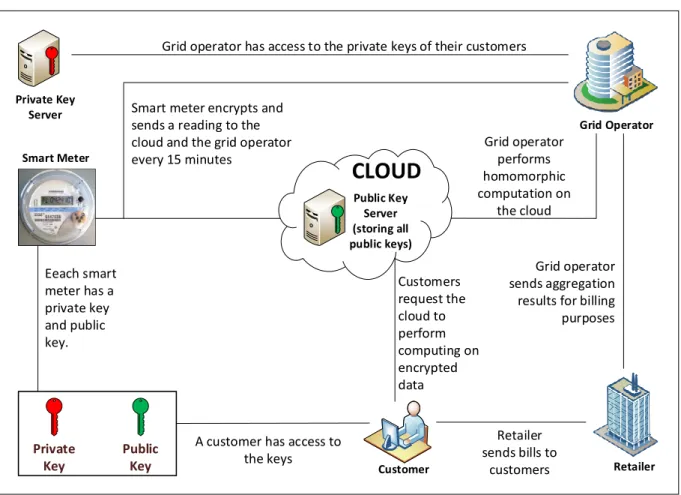
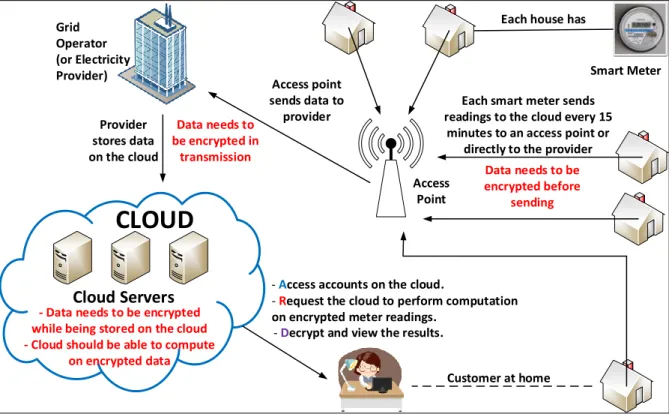
3.1 The vision of our research, a smart grid as an Internet of Things containing a large number of smart meters, access points, users and a grid operator connected to a public network with the strong support of various cloud storage and processing
services working directly on homomorphically encrypted data. . . 39
3.2 Tracking usage pattern using electricity consumption data [Quinn, 2009] . . . 41
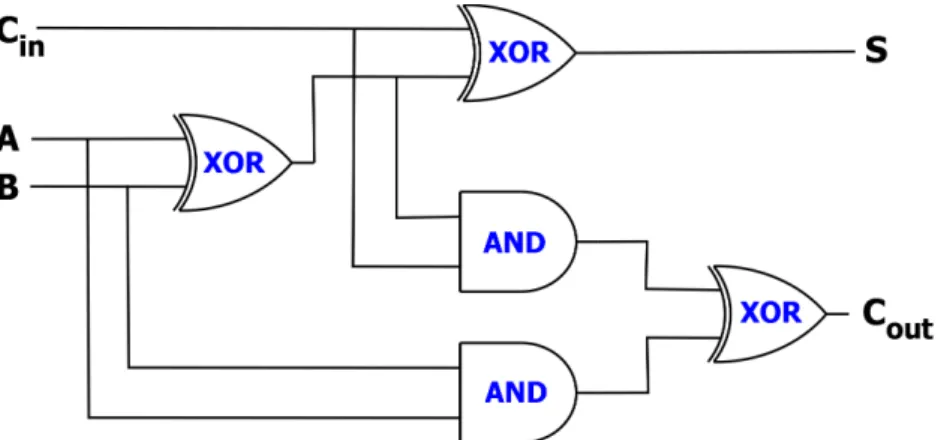
3.3 The full adder circuit . . . 49
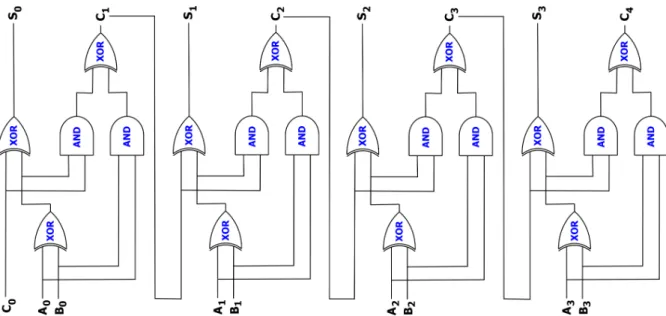
3.4 A 4-bit ripple carry adder . . . 50
3.5 The architecture of our model. . . 53
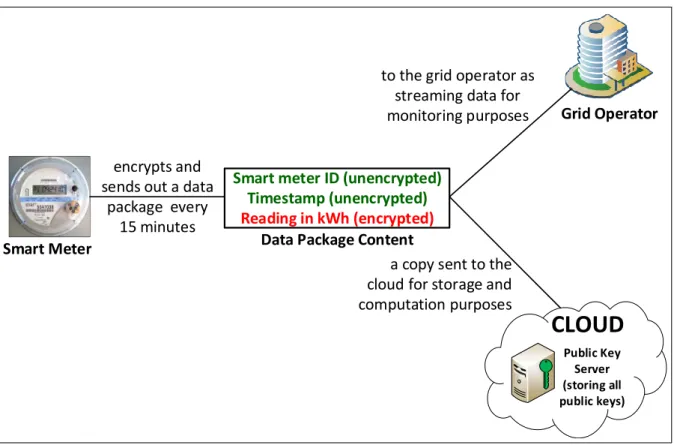
3.6 Content of a data package sent by a smart meter every fifteen minutes . . . 54
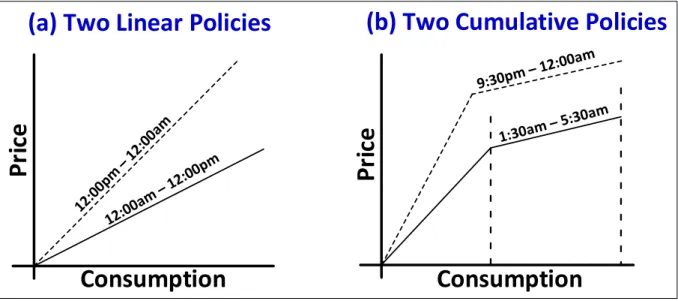
3.7 (a) A linear policy specifies the rate per unit consumption that is applied to determine the price to be paid for each measurement. (b) A cumulative policy specifies a rate per unit that is determined as a function of the consumption allowing non linear functions to be applied for pricing. . . 55
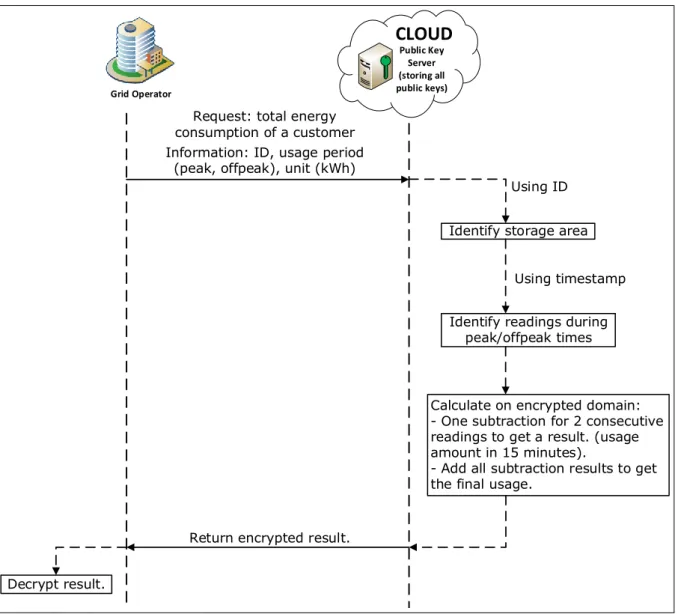
3.8 Cloud-based calculation of total energy consumption on encrypted data for a cus-tomer . . . 56
4.1 An overview of our model. . . 67
4.2 An overview of our model. . . 70
4.3 A more detailed view of the interactions between Client and Server in our model 71 4.4 An overview of how an encrypted check bit is calculated using random encrypted inputs and random homomorphic XOR or AND circuit . . . 78
4.5 The relationship between the number of check bits and the probability of a failed check. . . 83
5.1 Access to encrypted documents stored on the cloud is controlled by a group of users. 87 5.2 The generation and distribution of homomorphic keys to users. . . 92
5.3 Computing a shared secret on the cloud for a group of users. . . 94 5.4 A document is encrypted by a symmetric access key and stored on the cloud while
shares of the access key are distributed among members of the group controlling access to the document. . . 100 5.5 A user who wants to access an encrypted document stored on the cloud needs to
have permission from all managers in the group controlling access to that document.102 6.1 Limitations of existing online payment processing system. . . 114 6.2 The first stage when a transaction begins. . . 127 6.3 The order information message is encrypted with the merchant public key and is
sent to the merchant. The transaction information is encrypted with the homo-morphic public key of the card issuing company which will finally process the data directly on encrypted domain. . . 129 6.4 The homomorphic comparison process is performed over each encrypted bit and
output encrypted results which will be decrypted by using the homomorphic pri-vate key . . . 131 6.5 A trusted time server will generate a timestamp for each transaction and send
to the merchant in encrypted form using the public key of the merchant. The merchant server will distribute the timestamp to other parties using Sercure Socket Layer. . . 132 6.6 The finishing stage of a transaction. . . 134
List of Tables
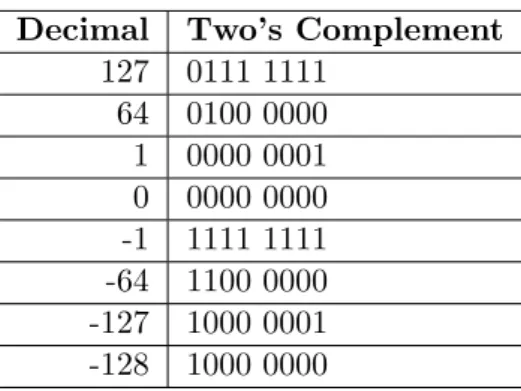
3.1 Some special values of an 8-bit two’s complement numerical system . . . 46
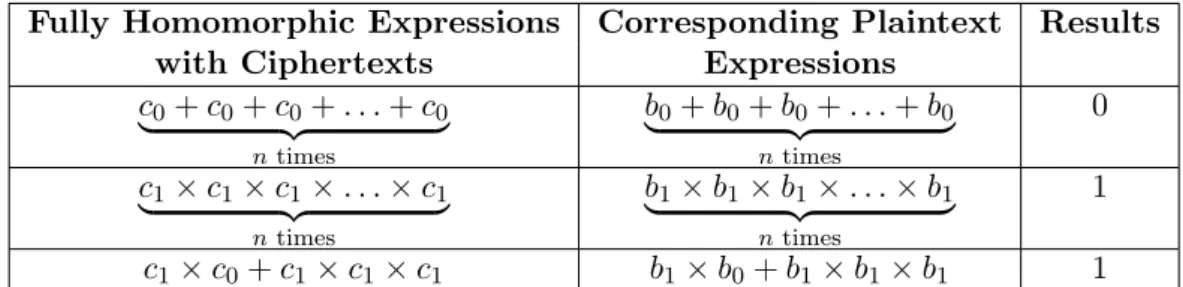
3.2 Examples of fully homomorphic addition and multiplication operations, and the corresponding plaintext expressions . . . 47
3.3 XOR Truth Table . . . 48
3.4 AND Truth Table . . . 48
3.5 Truth table of the full adder circuit . . . 48
3.6 Encrypted Smart Meter Data stored on The Cloud . . . 59
3.7 Time measured for key generation, encryption, decryption and homomorphic ad-dition operations . . . 59
3.8 Time taken to perform homomorphic addition operations to calculate total elec-tricity usage for a smart meter in different billing periods, assuming that a smart meter sends four readings to the cloud in an hour. . . 60
3.9 Time taken to perform homomorphic addition operations to calculate the total electricity usage for different numbers of smart meters in one week, assuming that a smart meter sends four readings in an hour. . . 60
3.10 When the number of terms in a homomorphic expression increases, the fraction of homomorphic addition workload that can be performed in parallel also increases significantly. The symbol t represents the time required to complete one homo-morphic addition operation. . . 62
3.11 The speedups achieved when the parallel fraction of the homomorphic addition algorithm is executed by some common processors having different number of cores and threads. These processors are usually found in desktop computers and cloud servers. These results coming from parallel performance calculations with a varying number of terms in a homomorphic addition expression, i.e. 50, 100, 500, 1000 terms as shown in Table 3.10. The corresponding maximum theoretical speedups are also shown for comparison purpose. . . 63 4.1 Details of the integer comparison algorithm both in plaintext and encrypted formats 73 4.2 Server computes extra ciphertexts based on the encrypted result of the
homomor-phic comparison operations. These ciphertexts are used to check the decrypted comparison result sent from Client. . . 76 4.3 Server performs a series of computing operatios to check if Client has not altered
any decrypted bit, especially the result of the homomorphic comparison, before sending them back to Server. . . 77 4.4 Execution time of homomorphic operations . . . 82 4.5 Experiments carried out with different number of check bits to measure the
prob-ability of a failed check in each case. . . 82 5.1 Execution time of homomorphic operations . . . 110 5.2 The execution time of our method using 8-bit and 16-bit binary word length when
a secret is shared among groups having 2 to 5 members . . . 110 6.1 Measuring homomorphic comparison time when variable numbers of encrypted
bits are used for each encrypted field in the transaction information package pro-cessed by the card issuing company . . . 136 6.2 Measuring homomorphic comparison time when there are a large number of
com-parison operations applied to a variable number of bits used to represent the encrypted fields in the transaction information packaged processed by the card issuing company . . . 136
Chapter 1
Introduction
In recent years, there have been many major advancements in cloud computing technologies, making it an efficient computational paradigm to provide users with high quality, customized and reliable services at reduced cost. Many applications and databases have been moved to the cloud or completely redesigned and implemented to work on large, centralized data centres. Cloud service providers also play a significant roles in redefining the current methods that software and hardware are designed, implemented or purchased. They can provide users and customers around the world with flexible options to purchase on demand storage and computational resources [Armbrust et al., 2010]. As a consequence, business users no longer need to acquire and manage large, complicated and often costly computing infrastructures. These benefits of the cloud is very attractive, especially for start-up businesses and small companies because they only need to pay only for the resources they actually use, thereby reducing operational costs through economies of scale.
Although cloud computing has brought many benefits to its users, there are still major challenges that have to be addressed before cloud platforms can be widely used with reliability. The most outstanding among those challenges are the cloud-based data confidentiality, user privacy and the general security of the platforms [Takabi et al., 2010]. While traditional computing models can provide users with full control of their data storage and computation, this is often not the case when a cloud service is used because most of the physical data and computing infrastructures are managed by cloud service providers. Hence, there is a strong possibility for security breaches to happen when data owners do not have sufficient tools or effective mechanism to control the security of their cloud-based data. It often means that users have no choice but to rely on protection mechanisms offered by cloud service providers.
However, the distributed nature of the cloud means that cloud servers can be stored all over the world in many places having different rules and regulations regarding user privacy and data security.
One very effective method which has been used to provide data security is using cryptog-raphy [Patwal and Mittal, 2014]. Historically, cryptogcryptog-raphy was used to send secret messages through insecure medium with well-known cryptographic schemes such as Caesar Cipher or Hill Cipher. As time goes on, cryptography continues to play a more important role than ever in many computational models, especially when there is a large amount of sensitive data sent and received all over the Internet. Furthermore, many symmetric and asymmetric key encryption schemes have also been applied to secure date stored on the cloud. Data owners will typically encrypt their data before outsourcing the ciphertexts to the cloud. Only selected users possessing the decryption keys are able to download, decrypt and retrieve the plaintext for further processing. Although this approach has offered high levels of security, there is a limitation. Many of the data processing tasks must still be performed on the client side, re-quiring client computers to have significant computing power, especially when there is a large volume of data to be processed. This limitation is likely to become a major disadvantage of cloud-based models that only store encrypted data, when the client side has limited computing resource such as when a mobile phone is used or when there is a large amount of data to be processed.
Simply storing encrypted data on the cloud makes cloud computing less attractive because not many computational operations can be performed when the data is encrypted. The cloud just stores data in encrypted formats and manages access so that only authorised party can download the encrypted data. Therefore, more effective and efficient cloud computing models are required to provide the ability to compute on encrypted data in addition to storing data securely. Such computational models must provide authorised parties with the capability to request the cloud to perform many computing operations securely on encrypted data. The confidentiality and privacy of the data are maintained throughout these computing processes because no decryption will be required at any stage and the outputs will also be in encrypted forms which can be decrypted only by authorised parties.
In this thesis, we will present many novel privacy-preserving cloud-based computation mod-els which allow users to store and process encrypted data securely on the cloud. This feature is achieved through our application of homomorphic cryptography, which not only encrypts data but also provides a mathematical basis for various computing operations to be performed directly on encrypted data. In each core chapter presented in this thesis, we demonstrate
the usefulness and effectiveness of homomorphic cryptography in protecting user privacy and confidentiality of cloud-based data by designing, analysing and implementing various practical application models with the cloud as a centralised computing hub. However, before describing the details of those models, we will explore a few important aspects of privacy in business computing as well as how a privacy-preserving cloud-based computation model is constructed.
1.1
Security, Privacy-preserving Protocols on Cloud
1.1.1 Security and Privacy in Cloud Computing
Privacy is a very important concept in everyday life. It can be understood as the ability of a group or an individual to choose how much information to share or keep to themselves. Although what is regarded as private can be understood differently among cultures and indi-viduals, a common rule is that there always exists sensitive and valuable information which a person or a business organisation wants to protect or strictly control access to. Privacy require-ments are even more significant in the world of cloud computing in which it is the data stored on the cloud that owners want to protect or control disclosure to others. A privacy breach of cloud-based data often has severe and immediate consequences affecting many customers of a business organisation.
Data security is commonly referred to as the confidentiality, availability, and integrity of data. In other words, it is all of the practices and processes that are in place to ensure data isn’t being used or accessed by unauthorized individuals or parties. Data security ensures that the data is accurate and reliable and is available when those with authorized access need it. A data security plan includes facets such as collecting only the required information, keeping it safe, and destroying any information that is no longer needed. These steps will help any business meet the legal obligations of possessing sensitive data.
Companies need to enact a data security policy for the sole purpose of ensuring data privacy or the privacy of their consumers’ information. More so, companies must ensure data privacy because the information is an asset to the company. A data security policy is simply the means to the desired end, which is data privacy. However, no data security policy can overcome the willing sell or soliciting of the consumer data that was entrusted to an organization.
Privacy of information stored on the cloud can also be better understood from examples of cloud-based applications in different areas of our society such as healthcare, business, social networking and education. Following are short descriptions of those areas and how the privacy
of digital data stored on cloud is often addressed:
• Security and privacy of electronic medical records. Healthcare information is one of the most important types of data that need to be protected. Patients going to a hospi-tal often reveal important details regarding their well-being to medical professionals for diagnosis and treatments. These electronic medical records can be stored and managed by a hospital or third-party cloud services especially when there is a large volume of data. To protect the privacy of patients, there are many rules and regulations such as the Health Insurance Portability and Accountability Act (HIPAA) specifying how health-care professionals such as doctors and nurses can obtain access to those data with direct permissions from data owners. Therefore, when the data is stored on cloud, there must be technical means to achieve those privacy requirements.
• Security and privacy of government data. Many governments around the world often create web portals where their citizen can quickly and conveniently get access to many governmental services such as social benefits, healthcare protection plans, job ser-vices, etc. To achieve such functionalities, governments often collect a lot of information from their citizens. This huge amount of data also need to be stored and managed ef-fectively and securely to minimise the chance of a security breach which can compromise the privacy of many citizens. There are laws regarding such protection of privacy as well as the need for better technical solutions to address those challenges.
• Security and privacy of corporate data. For many business organisations, data is the most important part of their operations. There have always been the need to collect more and more data as well as how to store and control access to those data so that the maximum benefit can be achieve while minimising the risk of an information leakage. The privacy of the business data managed by those companies are inherently related to the privacy of their customers. Therefore, while many cloud-based data storage and processing solutions are very attractive due to their scalability and potential to save a significant amount of operational cost, business organisations are facing the risk of losing revenue and the trust of their customers to the point of shutting down if they do not provide solid privacy protection schemes.
• Security and privacy of social network data. Social networks have an ever signifi-cant role in the digital age with prominent websites such as Facebook, Twitter, Instagram, Youtube, Flickr, etc. having millions of users communicating and sharing information
with each other. Despite the capability to provide quick and easy methods to establish connections among people, many social networking sites still lack effective mechanisms to protect the privacy of their users or even exploit those sensitive data for other purposes. Furthermore, the users may not have enough knowledge about their online privacy or are provided with insufficient technical means to control their own privacy.
In the previous paragraphs, we have defined privacy in cloud computing and described how this important concept can be understood from different contexts such as e-health, government, corporate, and social network data. One important conclusion which can be made from this in-vestigation is that protecting user privacy and data confidentiality is one of the most important tasks having direct influence on the success of many cloud computing models. Hence, there is a need for privacy-preserving protocols to not only provide protection to cloud-based data by means of encryption but also enhance a cloud-computing model by having the capability to computing on encrypted data. In the next section, we will describe the common characteristics of such privacy-preserving protocols as well as define the basic security models often found in many research works in this area.
1.1.2 Basic Features of Secure and Privacy-preserving Protocols
Various literature reviews in the area of cloud computing have shown that security, together with interoperability and portability are the three main hurdles preventing a more widespread adoption of cloud solutions. From a security perspective, cloud computing has increased the scale and complexity of many trust and privacy issues. Storing data on cloud also introduces new problems requiring urgent solutions to improve the confidence of cloud-based users. A solution in this context is often presented as a protocol in which the author proposes a cloud computing model and various methods to securely interact with cloud-based data. All of these models and protocols have some basic characteristics which we will describe in the following paragraphs.
A common feature in many privacy-preserving protocol is trust. A cloud computing model must provide mechanisms for its users to establish a solid trust so that they have full confidence when outsourcing their data on the cloud. Cloud providers also need authentication and authorisation methods to trust their customers with access to the services. Without adequate trust establishment mechanisms, malicious users can get unauthorised access to vast amount of data stored on the cloud, causing major damages to a cloud-based business. Therefore,
all cloud computing model provides strong authentication and authorisation mechanisms to validate user credentials as well as control access to cloud-based data.
Aside from establishing and managing trust in cloud-based computation models, another important aspect is security. While users can have full control over data storage and com-putation using traditional computing models, there are certain limitations cloud users will encounter when outsourcing their data to the cloud due to the lack of direct control over how their data is stored and processed. Cloud security can be classified into two major classes which are storage security and computation security. Any strongly secure cloud computing model will have to ensure both aspects. Storage security means maintaining the integrity of user data stored on third-party cloud servers. This can be achieved by using a combination of cryptographic keys, hash functions and various digital signature algorithms. While there are many proposed research works focus on storage security, this feature alone is not enough to cre-ate an effective cloud-based computational model. Another important feature is computation security which is about ensuring the correctness and confidentiality of all types of computing operations executed on cloud servers.
A typical approach to achieve computational security is using a trusted third party to collect data inputs from owners and perform all required computing operations before returning the results to the owners. Privacy is ensured because the trusted entity is responsible for protecting the data from unauthorised access. This approach, however, should not be applied to cloud computing models because cloud servers cannot be fully trusted. Furthermore, the trusted server can easily be the focus of attacks causing major security breaches especially when data is not stored in encrypted forms. Therefore, a common expectations of all cloud-based data management models is that data is encrypted in storage. In this case, it is essential to make sure that computation is performed on encrypted data to produce encrypted results which can only be decrypted by authorised parties having correct decryption keys.
Another common features of all privacy-preserving protocols is that each of them will have to provide details about the privacy model it will be using. The one that has been used in many protocols is the semi-honest (or honest, but curious ) model. Protocols assumed the use of this semi-honest model often allow their participants to monitor and record all transaction details or any other data during the execution steps of such protocols. When a protocol finishes running, participants can perform further analysis of the data they have collected to gain additional information rather than just the inputs and outputs they are supposed to get. Another privacy model which has often been used is the malicious model. This is an adversarial model which is often used to describe situations when one or more participants do not act according to the
predefined set of rules given by a protocol. The set of possible actions in the malicious model is defined very broadly, including all actions in the semi-honest model together with more disruptive behaviours such as skipping immediate steps or aborting the protocol altogether. Therefore, many security and privacy-preserving protocols are often proven to be valid under the semi-honest model first and then their proofs will be generalized to show how such protocols are secure under the malicious model. These proofs are very complicated, requiring the use of complex mathematical tools such as complexity theory, one-way functions and zero-knowledge proof.
1.2
Motivations and Problem Statements
In the previous section, we have defined privacy in different aspects of cloud computing as well as described all common features of privacy-preserving protocols. The most important task in determining the success of a cloud computing model is providing strong security of both data stored on the cloud and all computing operations performed over the encrypted data. This task also requires the protection of user privacy at the lowest levels during the execution stage of a protocol. Following the given definitions and requirements, this thesis will propose an implement of various cloud-based privacy-preserving computing models in different realistic scenarios. There is an important question that this thesis will answer: how to design and implement cloud-based computing models which can both be used for storage and computation of outsourced data as well as protecting data security and preserving the privacy of the users. This thesis will show how to answer that question in three different cloud-computing application scenarios:
• Problem 1: How to design and implement a secure model for smart meters data processed on semi-trusted cloud servers. A smart grid may introduce many outstanding security and privacy issues, especially when smart meters are connected to public networks in which not only personally identifiable information but also energy consumption data relating to behaviours and movements of users is frequently exchanged and processed in large volumes. The security and privacy issues outlined above have prevented the cloud from reaching its full potential in supporting a smart grid, especially when many components of the grid are connected as an Internet of things via the public network. Smart meters are constrained devices having limited capacity and incapable of performing complex computing tasks on energy usage data. A smart grid needs a
cloud computing system with its unlimited storage and processing capabilities to support complex computing tasks such as billings and analysing data. Therefore, we want to propose a cloud-based data storage and processing model applicable for a smart grid which will utilise the full strength of cloud computing and preserves user privacy and the confidentiality of data exchanged on the grid.
• Problem 2: How to create a secure cloud-based pricing comparison model with privacy protection features. Trust is a serious matter in cloud computing as described in the previous section. There are scenarios in which the parties performing the computing operations can not be trusted. Specifically, there are cases where the processing entity is semi-honest or even malicious. In the former case, the computing entity is required to follow the protocol, but are permitted to record all data collected during the execution of the protocol. At the end of a computing session, the entity can analyse the data collected in an attempt to extract more information than just their inputs and the output of the function. If the computing entity is malicious, many unexpected behaviours can happen when the computing protocol is executed. For example, aborting the protocol can be used as a technique to attempt to learn the inputs and tamper with the final results. A practical example of these scenarios is in e-commerce when a client, an ordinary Internet user, who wants to participate in an e-commerce transaction but does not trust the e-commerce cloud server. Therefore, we want to create a privacy-preserving protocol which will process personal details of clients in a secure manner, allowing essential operations such as checking if the client has sufficient fund before approving a purchase while protecting data security and privacy of clients.
• Problem 3: How to design and implement a confidential multi-party secret sharing and access control model on the cloud. In large business organisations, the access to highly sensitive data is usually controlled by a group of users rather than a single user. In this case, members of the group controlling access to those data must have a mechanism to jointly authorise access to encrypted data stored on the cloud. Crypto-graphic keys can be mathematically divided into multiple independent pieces which are delivered to each member of the group controlling access. However, this scheme requires a trusted party to collect and combine shares of the encryption key before performing computation works to recover the original key. This requirement may not be applicable in cloud-based storage and computing scenarios in which the main computing agents are semi-trusted cloud servers located outside the business organisation. Therefore, a new
secure secret sharing model is required to protect the shares while computing and recov-ering the secret to preserve the privacy of each member of the group controlling access to the encrypted data.
• Problem 4: How to propose a confidential e-commerce transaction model with one-time payment processing capability For an e-commerce application to be successful, it must have the capability to secure personal and financial information of all its participants. Not only the data must be secured when stored on servers, but the integrity of these data must also be guaranteed in transit, so that any financial infor-mation which has already been used cannot be replayed in another transaction without the permissions of data owners. Recent incidents involving major data breaches in large e-commerce organisations have proven that potential privacy threats can severely impact the rapid development of electronic commerce. Therefore, in this research, we want to apply homomorphic cryptography to address these security challenges. We aim to pro-pose an e-commerce model with strong privacy preserving features which are built using homomorphic cryptography. We also need to address the challenges of how to provide a novel one-time mechanism allowing all authentication details of a business transaction to be non-reusable immediately after they have been used for the first time. This important feature enables users of our model to purchase goods securely from an online merchant while guaranteeing the authentication and integrity of data.
1.3
Research Questions
In order to overcome the afore-mentioned research problems, the following research questions are defined with the aim of identifying the major objectives of our research as well as proposing effective and efficient solutions using homomorphic cryptography. In the subsequent parts of the thesis, we propose various working models to answer these questions and discuss all related aspects, including future research directions that can be followed based on these research questions. These questions also work as a benchmark to determine the viability of our proposed models. Following are the research questions we focus on in this thesis:
• First: How can homomorphic encryption be applied to secure the storage and compu-tation of data on the cloud while ensuring the correctness of computing results and the confidentiality of user data?
• Second: How to design and implement new computing models that allow multiple users to contribute their data in encrypted formats to build secure cloud-based applications using homomorphic encryption as the main mechanism to compute on encrypted data? • Third: How to apply the proposed models and assess its efficiency and effectiveness in
practical application scenarios such as smart grid, secure e-commerce as well as secret sharing and access control?
1.4
Research Outcomes
With all the research problems identified and defined clearly in the previous section, we now present an overview of the research outcomes of this dissertation. To achieve comprehensive results for all problems listed above, we went through a formal and detailed process which comprises of many steps. Firstly, we tried to understand and analyse the requirements and contexts, ensuring that the problem domains were comprehended from the right perspectives. Then we performed extensive literature reviews so that our research works could inherit and benefit from the latest developments in the research areas of interest. The models that we proposed were carefully designed, implemented and experimented together with detailed se-curity analyses for all models to prove their applicability and solidity in practical scenarios. Therefore, in this section, we can only provide a very brief summary of what we have achieved. For more details and in-depth discussions of these outcomes, readers should consult the core chapters of this dissertation.
• Outcome 1: Design and implement a secure model for smart meters data processed on semi-trusted cloud servers. Using homomorphic cryptography, we have successfully designed and implemented a model which allows the cloud to securely compute the aggregated energy consumption of a customer in a given period of time by performing homomorphic addition operation directly on an arbitrary number of en-crypted fine-grained readings sent from the smart meter of that customer. The cloud does not need to perform any decryption during this computation process. Therefore, user privacy and data confidentiality are protected. We also propose a parallel version of our billing algorithm to utilise the processing capacity of multi-core processors in cloud servers, reducing computation time by about 50 percent compared to using our sequential homomorphic addition algorithm.
• Outcome 2: Create a secure cloud-based pricing comparison model with pri-vacy protection features. We propose a new mechanism based on homomorphic encryption to minimise the use of a trusted third party and allow a client and server to validate e-commerce transaction outcomes in a reliable and secure manner. Specif-ically, our model allows homomorphic addition, comparison and integrity checking of comparison results to be performed over encrypted binary digits. Data security and client privacy are ensured because most of the computing operations are performed on encrypted data. The implementation of our of model is efficient and powerful because the cryptographic scheme we use has small ciphertext and key size with all homomorphic computing operations performed directly on encrypted binary numbers. Our computing model is scalable and can easily be extended to allow an arbitrary number of parties to join the homomorphic cloud-based computation.
• Outcome 3: Propose a confidential multi-party secret sharing and access control model on the cloud. The main focus of our model is the homomorphic secret sharing scheme to help any group of users in a business organisation to create a shared secret with most of the computing tasks to create, distribute and regenerate the shared secret to be done on the cloud. Users in the group are able to keep their own shares of the secret private while still being able to combine these shares on the cloud. We show how the cloud can do most of the computing task in the process of generating the shared secret without affecting data security and privacy of any user in the group. We also implement an access control model which applies the proposed homomorphic secret sharing scheme to provide a group of users with the ability to control access to encrypted documents stored on the cloud. Most of the computing operations required for each group member to authorise access are done on the cloud over encrypted shares of the secret, therefore the power of the cloud can be fully utilised without affecting the security of all shared secrets of the controlling party as well as the security of encrypted data stored on the cloud.
• Outcome 4: Design a one-time e-commerce payment processing model using homomorphic cryptography. In this research work, we propose a detailed design of a secure online payment processing model with all the major components required to protect sensitive customer financial information. An outstanding feature of our model is the separation of transaction information into encrypted packages only accessible to relevant parties involved in a transaction. The robustness of our design is ensured due
to the use of homomorphic cryptography when encrypting data packages and processing payment information directly in encrypted format. The non-reusability of encrypted data in our model is also guaranteed by the use of random factors such as unique time-stamps and random session keys, making sensitive information sent out by customer obsolete after the first use. This is an important mechanism to guard against many security risks such as a replay attack or an identity theft. Our model also have the ability to perform reliably in many different adversarial scenarios as proven in our work.
1.5
Contributions
Through the research works described in this thesis, we have made significant contributions in the area of security and privacy of cloud-based computational model. These contributions can be summarised as followed:
• Privacy-preserving cloud-based computing models with homomorphic compu-tational functions. We have applied homomorphic cryptography in many application scenarios to create various practical cloud computing models with the capability to com-pute on encrypted data. Our models ensure that user privacy and data confidentiality are protected by means of cryptography because encrypted data is stored and processed mostly on the cloud using the public homomorphic key, hence no decryption is required. • Secure multi-party secret sharing on cloud using homomorphic cryptography.
We propose a key management scheme and access control model using homomorphic cryp-tography to allow the key generation work to be executed on semi-trusted cloud servers, opening new possibilities for applications that can fully utilise the computing power of the cloud while providing maximum protection for data security and user privacy. • Accurate and efficient implementations of privacy-preserving protocols. We
demonstrate in this thesis the applicability, effectiveness and efficiency of our computa-tional models in real-world scenarios with practical data. We implement working appli-cations to show that our theoretical models can be realisable in practice with different methods to measure the performance of our applications.
Chapter 2
Preliminaries
At the beginning of this chapter we will provide a broad overview of the computational problems that are related to homomorphic cryptosystems. We provide essential information to under-stand homomorphic cryptography and some of the approaches to this cryptographic paradigm. Then we make a survey of some well known homomorphic cryptosystems, generally in the order they were discovered as well as how these schemes show the homomorphic properties. Next, the basic characteristics of secure cloud-based applications are described with highlights of the major security threats and requirements about how to secure those cloud-based appli-cations. Finally, we will provide an overview of some solutions that have been introduced in the literature to protect the security of those cloud-based applications.
2.1
Foundations of Homomorphic Cryptosystems
In this section, we present the foundations on which homomorphic cryptosystems are built. To show that a cryptosystem is robust, we need to demonstrate that if the encryption function can be inverted or broken its semantic security by an adversary, then the adversary will have no choice but to break some instance of an intractable problem. Therefore, a cryptosystem is only secure when it is based on an intractable problem. All the problems we present in this section will have the associated assumption that if the right parameters are chosen, each problem will be intractable. In the following definition, we describe how a computational problem is polynomially reducible to another computational problem and how two problems are computationally equivalent.
reducible to B if there exists an algorithm that solves A, which uses, as a subroutine, a hypothetical algorithm for solving B, and which runs in polynomial time if the algorithm for solvingB does. IfAis polytime reducible toB, andB is polytime reducible toA, then Aand
B are said to be computationally equivalent.
The hypothetical algorithm used for solving a computational problem is often referred to as an oracle, and works like a black box that, given an instance of the computational problem, returns a solution in polynomial time with non-negligible probability.
2.1.1 The Factoring Problem
The fundamental theorem of arithmetic states that every integer n ≥ 2 can be expressed uniquely as a product of prime factors, i.e.,
n=p1e1p2e2. . . pkek
where the pi’s are distinct primes. The problem of determining the prime factorization of n,
particularly when n is large and has few prime factors (typically two or three), forms the basis of security for many cryptosystems.
Definition 2.2. Given an integer n, the factoring problem is the problem of calculating the
pi’s such that
n=p1e1p2e2. . . pkek
where eachpi is a prime andpi 6=pj wheni6=j
Currently, the best known methods for factoring are the number field sieve [Lenstra et al., 1993] and the elliptic curve method [Lenstra Jr, 1987]. In general, the number field sieve is the most efficient algorithm for factoring n, assuming n has no small prime factors. The running time of the number field sieve depends on the bit-length of n, while the elliptic curve method depends on the bit-length of the smallest factor ofn. In cryptographic applications,nis usually selected such that each of its prime factors are approximately the same bit-length. Whilen=pq
for primes p and q is commonly used, some cryptosystem usen=p2q. The number field sieve remains the most efficient method of factoring numbers of this form; however, some elliptic curve factoring approaches specific to n=p2q have been studied, such as the approach given by Peralta and Okamoto [Peralta and Okamoto, 1996].
The difficulty of factoring n can be parameterized by ε, the bit-length of n, with the assumption that each prime factor of n is approximately the same size. To remain secure against modern attacks, it is generally regarded thatεshould be at least 1024, if not 2048.
2.1.2 RSA / e’th Root Problem
The RSA encryption function is c = memodn where m ∈ Zn and n = pq for distinct odd primes such that the factoring problem is hard onn. Decrypting the ciphertextcis equivalent to taking thee’th root ofc mod n. When the factorization ofn, the private key, is unknown, this task should be intractable.
Definition 2.3. Let n = pq for distinct odd primes p and q. Given integers c, e ∈ Zn with e > 2, the RSA Problem is the problem of finding m such that c = me mod n, without knowledge of pand q.
For efficiency reasons, it is often desirable to choose e to be a small integer, such ase= 3, or any other special form that makes encryption more efficient. Thus, the RSA assumption is often stated in a stronger form.
Definition 2.4. Let n=pq for distinct odd primes p and q. Given c∈Zn, the Strong RSA Problem is the problem of finding m, e >1 such that c =me mod n, without knowledge of p
and q.
An overview of the RSA and Strong RSA problems has been given by Rivest and Kaliski [Rivest and Kaliski, 2005].
A slightly different form of the Strong RSA Problem is also used in some cryptosystems. Letλbe the Carmichael Function, such thatλ(n) =m, the smallest positive integer such that
am≡1 modnfor all a relatively prime ton. The Carmichael function represents the exponent of the groupZ∗n, and can be calculated by:
λ(n) =
φ(n) for n=pα, withp= 2 andα≤2, orp≥3
1
2φ(n) for n= 2
α and α≥3 lcm(λ(piαi)) forn= Πipiαi
The problem of computing e’th roots when gcd(e, λ(n2)) = 1 and n = pq is called the Computational Small e’th Roots Problem, and was posed by Catalano, Gennaro, Howgrave-Graham, and Nguyen [Catalano et al., 2001].
Definition 2.5. Let n = pq for distinct odd primes p and q. Given e ∈ Z2
n2 such that
gcd(e, λ(n2)) = 1, and an integer y, the Computational Small e’th Roots Problem is the problem of computingx such that xe =ymodn2. The Decisional Small e’th Roots Problem is the problem of deciding whether or not a given x is ane’th root modulo n2.
Each of the e’th root problems can be parameterized by, the bit-length of n.
2.1.3 Quadratic Residuosity Problem
The problem of deciding whether or not an integer is a quadratic residue modulo n forms the basis of security for the Goldwasser-Micali cryptosystem. Further variations of residue problems also form the basis for most modern homomorphic cryptosystems.
Definition 2.6. An integer a is said to be a quadratic residue modulo n if there exists 0 < x < nsuch that
x2 ≡amodn
Otherwise,ais said to be a non-quadratic residue modulon.
If n is an odd prime, then determining whether or not an integera is a quadratic residue modulo pis equivalent to calculating the Legendre symbol
a p = 0 if a≡0 modp
1 if a6= 0 and there exists x∈Z such thata≡x2modn
−1 if no suchx exists
which can be efficiently calculated by the formula
a p
=ap−21 modp
For an odd composite number n, the Jacobi symbol can also be calculated
a n = a p1 e1 a p2 e2 . . . a pk ek
wheren=p1e1p2e2. . . pkek is the prime factorization ofn. Unlike the Legendre symbol, na
= 1 does not imply ais a quadratic residue modulo n.
Definition 2.7. Let the set<n denote the set of quadratic residues modulo n. Given an odd
composite integer n > 3 and an integer a such that na = 1, the problem of determining if
Ifn=pqfor distinct odd primespand q, thena∈ <nif and only if a p = 1 and a q = 1. Thus, knowledge of the factorization ofnis sufficient to solve the quadratic residuosity problem. It is currently believed, although unproved, that solving the quadratic residuosity problem is equivalent to factoring. Assuming the truth of this conjecture, the security parameter for the quadratic residuosity problem is the same as the security parameter for the factoring problem.
2.1.4 The p-Subgroup Problem
Letp, q be distinct primes such that p-q−1, and consider the groupZ∗p2q. The order of Z∗p2q
is φ(p2q) = p(p−1)(q−1). By Sylows First Theorem [Gallian, 2009], Z∗p2q has exactly one
subgroup of order p, which is the Sylow p-subgroup. Deciding if an element a 6= 1 ∈ Z∗
p2q
belongs to the unique subgroup of order p can be verified by checking ifap ≡1 modp2q; i.e. the order of a inZ∗p2q is a divisor ofp. Becausepis prime, this can only occur if|a|= 1, which,
by assumption, cannot occur, or|a|=p.
Verifying if an element belongs to the subgroup of orderpis similar to the residue problems presented in the previous section, and it is conjectured to be difficult when then factorization of p2q is unknown.
Definition 2.8. Let n = p2q for distinct odd primes p and q such that p - q−1. Then the
problem of deciding whether or not a random element a 6= 1 ∈ Z∗
n is in the unique Sylow p-subgroup when the factorization ofn is unknown is called thep-subgroup Problem.
As with the residuosity problems, the best known approach to solving the p-subgroup problem is through factoringn=p2q. Thus, thep-subgroup problem can be parameterized by
, the bit-length ofn.
2.1.5 Discrete Logarithms and the Diffie-Hellman Problem
The discrete logarithm is the group equivalent of the logarithm function for real numbers.
Definition 2.9. Given a generator α ∈ G of a cyclic group of order n, and given some β =ax ∈G, the discrete logarithm ofβ in base α is the unique value xmodn. Givenβ, the problem of finding x is called the Discrete Logarithm Problem (DLP).
The difficulty of solving DLP depends on the representation of the group considered. The most general setting is the generic group model, in which no assumptions are made about the underlying structure of the group. Shoup has shown that the time needed to solve DLP in the
generic group model is at least Ω(√n), where n is the size of the group. Solutions to DLP that have expected running timeO(√n), exist, showing this bound as tight. Such approaches include Pollards rho algorithm, Pollards lambda algorithm, and the baby-step giant-step algorithm [lyn Teske, 2001].
A different approach, called the index-calculus method, does utilize the underlying group representation. If group elements can be efficiently represented using a factor base of small factors, such as integers whose prime factorizations contain only small prime powers, then the properties of the logarithm function can be used to reconstruct the logarithm of g from the logarithm of each of gs factors. In general, the index-calculus method is more efficient than the generic square-root methods, so for cryptographic purposes groups are usually chosen such that the index calculus method does not work.
As seen earlier, many definitions of security for cryptographic systems rely on the adver-sarys inability to distinguish between ciphertexts. When building cryptosystems that rely the difficulty of solving DLP, this often translates to the adversary being unable to distinguish between the discrete logarithms of two group elements. The Computational Diffie-Hellman Problem (CDH) and Decisional Diffie-Hellman Problem (DDH) attempt to capture the diffi-culty of problems related to DLP as they naturally arise in cryptography.
Definition 2.10. Given a generatorα∈G, a cyclic group of orderq, and two group elements
αa and αb, the Computational Diffie-Hellman Problem (CDH) is the problem of calculating αab from αa and αb, without knowledge ofaand b.
Clearly, a solution to DLP can be polynomially reduced to a solution to CDH, although it is currently unknown if a reduction in the other direction exists.
The decisional version of CDH requires the adversary to distinguish between αab and αc
for some random integerc, a situation that arises naturally from the IND-CPA game.
Definition 2.11. Given a generatorα∈G, a cyclic group of orderq, and two group elements
αa and αb, the Decisional Diffie-Hellman Problem (DDH) is the problem of distinguishing between tuples of the form (αa, αb, αab) and (αa, αb, αc) for some random integer c, without knowledge of aand b.
As with CDH, a solution to DLP can be polynomially reduced to a solution to DDH; however, unlike CDH, there exist groups for which DDH is tractable, but DLP is not. One such example is an elliptic curve group that supports a bilinear pairing (described in the next
section). Given a pairing e and elements αa, αb, and αc, then one can compute e(αa, αb) =
e(α, α)ab and e(α, αc) =e(α, α)c. If the two values are equal thenab=c, otherwise ab6=c. Assuming that groups are chosen for which the index-calculus method does not work, each of the discrete logarithm problems can be parameterized by , the bitlength of the size of the group. Thus, recalling the running time of DLP algorithms, must be chosen so that solving a problem of order O(√2) is intractable.
2.1.6 Bilinear Groups and Elliptic Curves
Many mathematical functions are linear, that is, the relationf(ax) =af(x) holds for anyxin the domain off, and for any constanta. The concept of a linear function can be extended to higher dimensions, with the two-dimensional, or bilinear case, being of particular interest.
Definition 2.12. Let G and G1 be two cyclic groups of ordern with g a generator of G. A
mape:G×G→G1 is said to be bilinear ife(g, g) is a generator of G1 and e(ua, vb) =e(u, v)ab
for all u, v∈Gand all a, b∈Z.
In cryptography, bilinear functions, are usually generated from elliptic curve groups.
Definition 2.13. An elliptic curve over the a field of characteristic not 2 or 3 is a plane algebraic curve defined by an equation of the form
y2 =x3+ax+b
The set of points on an elliptic curve over a field whose characteristic is not 2 or 3, together with a special point an infinity, forms an abelian group. Boneh, Goh, and Nissim [Boneh et al., 2005] describe the following method for constructing a bilinear pairing over such a group of order n, wherenis square free and not divisible by 3:
1. Find the smallest integerl such thatp=ln−1 is prime andp= 2 mod 3.
2. The curve y2 = x3 + 1 defined over Fp has p+ 1 = ln points in Fp, and thus has a
subgroup of ordern, denoted by Gp.
3. IfG1 is the subgroup of ordernofF2p, then the modified Weil pairing on the curve gives
The Weil pairing is a method of constructing a bilinear pairing on a special subgroup of an elliptic curve group over a field.
When presenting an elliptic curve Paillier cryptosystem, Galbraith [Galbraith, 2002] uses a more general representation of elliptic curves, as the set of points (x : y : z) such that
x, y, z∈R, a commutative ring with unity, and
y2z=x3axz2+bz3
where 6(4a3+ 27b2)∈Ris invertible.
2.2
Homomorphic Encryption With The Ability to Compute
on Encrypted Data
Homomorphic cryptography has long been the focus of many researchers because this tech-nique allows computing operations to be performed on encrypted data. Using this techtech-nique, anyone can let an untrusted party perform a specific algebraic operation on their plaintext by applying the same or different operation on the ciphertext without revealing the plaintext. This characteristic of homomorphic encryption has a great potential for practical applications because any computer algorithm can be converted to a series of arithmetic operations. There-fore, if a homomorphic encryption scheme can allow an arbitrary number of additions and multiplications on the ciphertext, it would be possible to execute many computing application securely on the cloud.
Homomorphic encryption can be better understood by studying the algebraic meaning of the terminology. The termhomomorphic has its origin from a mathematical concept of abstract algebra calledhomomorphism[Gallian, 2009], which refers to a mappingϕbetween two groups (G,) and (H,∗) such that
ϕ(xy) =ϕ(x)∗ϕ(y)
forx, y∈Gandϕ(x), ϕ(y)∈H. This concept can also be defined for similar algebraic objects such as rings with multiple operations. In the homomorphic cryptography context, we will define a mapping called Encryptsuch that
Encrypt: P −→ C
in which (P,+,·) is the ring of plaintexts and (C,⊕,⊗) is the ring of ciphertexts. The mapping
spaceP and produces outputs belonging to the ciphertext spaceCaccording to some probability density function. A space of randomised inputsKwill the determine which of the many possible ciphertexts a plaintext may be mapped to. Therefore, we can broaden the definition of the encryption function to take into account the randomised inputs
Encrypt: P × K −→ C
A decryption function can be formally defined as a mapping calledDecryptfrom the ciphertext spaceCto the plaintext spaceP. This is a deterministic, many-to-one function and is an inverse of the encryption function
Decrypt = Encrypt−1 :C −→ P
The definitions above allow us to formally describe a homomorphic encryption scheme with respect to an operation on two elements m1 and m2 on the plaintext space P for some
operation∗ on the ciphertext spaceC
Decrypt(Encrypt(m1)∗Encrypt(m2)) =Decrypt(Encrypt(m1m2)) =m1m2
The significant potential of homomorphic encryption systems and the difficulty of construct-ing such schemes were first recognised by Rivest, Adleman, and Dertouzos in 1978 [Rivest et al., 1978a], within a year of the development of RSA. Over the years, many homomorphic encryp-tion schemes were proposed that have the capability to compute on encrypted data. Many of those schemes, however, only allow a limited number of either addition or multiplication to be performed on ciphertexts. There are two types of homomorphic encryption techniques, partially and fully homomorphic schemes, which will be described in the following sections.
2.2.1 Partially homomorphic cryptosystems
An encryption scheme is considered to be partially homomorphic if its ciphertexts can be either added or multiplied an unlimited number of times but not both operations at the same time. There are two types of partially homomorphic techniques, namely, additively and multiplica-tively homomorphic encryption.
Given two plaintext integers m1 and m2, an additively homomorphic encryption scheme
has a binary operation⊕that guarantees the following condition is true for an addition ofm1
and m2:
One example of additively homomorphic encryption is the additive variant of the ElGa-mal[ElGamal, 1985] public key encryption scheme. This technique requires a party named Bob to choose a random group elementβ and send it to another party named Alice along with the group order p and the generator α. Bob will keep the secret parameter n, which is used to calculateβ by the equationβ=αn. The public parameters help Alice to compute a temporary keyx=αkmodp and the masking keyβkmodp, which will be used to encrypt the plaintext
message m according to the formulay =αm·βkmodp. The ciphertext that Bob will receive can be written as c= (x, y) which has two components: an encrypted version of the plaintext messagemand the ephemeral keyx. To decrypt a message, Bob computesx−n·y=αmmodp
and then executes a brute force search to recover the message m, assuming that the task of retrievingm is efficiently computable. The decryption process is summarised in the following equation:
x−n·ymodp= (αk)−n·(αm·βk) = (αk)−n·(αm·αnk) =α−ak+m+ak =am modp
Using ElGamal scheme, an encryption of the sum of the plaintexts can be obtained by com-puting the products of each pair of elements in the ciphertexts. Given to plaintextsm1 andm2
and two corresponding ciphertexts c1 = Encrypt(m1) = (x1, y1) and c2 = Encrypt(m2) =
(x2, y2), this additively homomorphic property can be described as follows:
(x1·x2, y1·y2) = (αk1 ·αk2 modp, αm1·βk1 ·αm2·βk2 modp)
= (αk1+k2 modp, αm1+m2 ·βk1+k2 modp) =Encrypt(m1+m2)
Other additively homomorphic scheme have also been proposed such as the Goldwasser-Micali [Goldwasser and Micali, 1982], Benaloh [Benaloh, 1994], Paillier [Paillier, 1999] schemes and the Boneh-Goh-Nissim scheme [Boneh et al., 2005], which allows an unlimited number of addition on ciphertexts, but only one multiplication. Additively homomorphic encryption can be applied, for example, in a simple electronic voting scheme [Micciancio, 2010], in which each vote mi is assumed to be either 0 or 1 and is stored on the cloud in an encrypted
form ci = Encryptk(mi) using the homomorphic key k. The cloud will be responsible for
the entire vote collection and tally process without requesting any decryption task from the users. When the vote collection period is over, the cloud will return the encrypted result
c = Encryptk(m1 +...+mn) to be decrypted locally by a trusted authority possessing the
A multiplicative homomorphic cryptosystem can be defined in a similar way as the addi-tively homomorphic scheme. In this case, there is a binary operation⊗that can be applied on the ciphertexts as if the corresponding plaintexts are multiplied. Given two plaintext m1 and m2, we have
Decrypt(Encrypt(m1)⊗Encrypt(m2)) =Decrypt(Encrypt(m1×m2)) =m1×m2
A typical example of a multiplicative homomorphic encryption system is the unpadded RSA scheme [Rivest et al., 1978b], which was created in 1978 by Ron Rivest, Adi Shamir and Leonard Adleman. Initially, a party named Bob selects two large prime numberspandq and computes
n =p·q. Next, the Euler’s totient function φ(n) is computed to get the number of positive integers less than n and relatively prime to n. If n is a prime number, then φ(n) = n−1. Because Bob has chosenn=p·q, we haveφ(n) =φ(p)·φ(q) = (p−1)·(q−1). The public and private keys are selected by two integers aand bchosen by Bob such thatb=a−1 mod φ(n). The public key is equal to the smaller of the two numbers, kpub =a while the other becomes
the private keykpr=b. Bob will publishnandkpub and keep p,q and kpr as secrets. A party
named Alice can encrypt a message m by computingc=ma mod n. Bob will then calculate
cb mod nto retrieve the plaintext message m, according to the following equation:
cb modn= (ma)b modn=ma·a−1 modn=mmodn
The multiplicative homomorphic property of this scheme can be seen when two plaintexts
m1 and m2 are encrypted to get the corresponding ciphertextsc1 = Encrypt(m1) and c2 =
Encrypt(m2). The product of c1 and c2 can be decrypted to get the product ofm1 and m2
as shown below:
c1·c2 =m1a·ma2 modn= (m1·m2)amodn=Encrypt(m1·m2)
2.3
A Survey of Homomorphic Cryptosystems
In this section, we describe with more details some well-known homomorphic cryptosystems. Their partially homomorphic characteristic has been widely applied in various secure applica-tions. These schemes are also important building blocks for fully homomorphic cryptography schemes invented later. When presenting each cryptosystem in the following subsections, we will define the plaintext space, the ciphertext space, the key space and any required set of ran-domizers. We describe each cryptosystem in terms of the three algorithms, i.e. key generation
Gen, encryptionEnc and decryptionDec. The key generation algorithmGen will take a secu-rity parameter as input and create an instance of the cryptosystem. This secusecu-rity parameter will determine the difficulty of the underlying computational problem of the cryptosystem. The encryptionEnc and decryptionDec algorithms will perform the encryption and decryption of messages given the public and private keys respectively.
2.3.1 The RSA Cryptosystem
The main complexity behind the RSA cryptosystem is the difficulty of calculating the
![Figure 3.2: Tracking usage pattern using electricity consumption data [Quinn, 2009] Refrigerator Oven Stove BurnerRefrigeratorOvenPower (kW) Time (min)1234 10 20 30 400](https://thumb-us.123doks.com/thumbv2/123dok_us/420389.2548224/55.892.130.796.156.491/figure-tracking-pattern-electricity-consumption-quinn-refrigerator-burnerrefrigeratorovenpower.webp)