End-System Optimizations for High-Speed TCP
Jeffrey S. Chase, Andrew J. Gallatin, and Kenneth G. Yocum
Department of Computer Science
Duke University
Durham, NC 27708-0129
fchase, grantg@cs.duke.edu, [email protected]
Abstract
Delivered TCP performance on high-speed networks is often limited by the sending and receiving hosts, rather than by the network hardware or the TCP protocol im-plementation itself. In this case, systems can achieve higher bandwidth by reducing host overheads through a variety of optimizations above and below the TCP proto-col stack, given support from the network interface. This paper surveys the most important of these optimizations and illustrates their effects quantitatively with empirical results from an experimental network delivering up to two gigabits per second of end-to-end TCP bandwidth.
1
Introduction
Modern TCP/IP implementations can transfer data at a high percentage of available network link bandwidth, re-flecting the success of many years of refinements. On the fastest networks, end-to-end (application-to-application) throughput is often limited by the capability of the end systems to generate, transmit, receive, and process the data at network speeds. Delivered performance is deter-mined by a combination of factors relating to the host hardware, interactions between the host and the network adapter, and host system software.
This paper explores the end-system factors that can limit bandwidth for TCP on high-speed networks and the techniques to overcome those limitations. It is tempt-ing to suppose that the advances in CPU power given by Moore’s Law will render these limitations increasingly irrelevant, but this is not the case. The limiting factor is not CPU processing power but the ability to move data through the host I/O system and memory. Wider data-paths can improve raw hardware bandwidth, but more bandwidth is invariably more expensive for a given level of technology. Advances in network bandwidth follow
This work is supported by the National Science Foundation (EIA-9870724 and EIA-9972879), Intel Corporation, and Myricom.
a step function, but the fastest networks tend to stay close to the limits of the hosts. Given a sufficiently fast network, achievable TCP performance depends on opti-mizations to minimize networking overheads. With Gi-gabit Ethernet widely deployed and 10 Gb/s Ethernet on the horizon, these optimizations are highly relevant to-day.
This paper focuses on approaches to low-overhead networking that are now emerging into common prac-tice. The key techniques discussed are interrupt coalesc-ing, checksum offloadcoalesc-ing, and zero-copy data movement by page remapping. We also explore the effect of larger packet sizes, e.g., the Jumbo Frames standard for Ether-net. The network interface plays a key role for each of these features, and an increasing number of commercial network adapters support them. We quantify their per-formance potential and briefly outline alternative struc-tures for high-speed TCP/IP networking that could of-fer similar benefits in a more general way for the next generation of adapters and systems: user-level network interfaces, scatter-gather I/O frameworks, TCP/IP pro-tocol offloading, and Remote Direct Memory Access (RDMA).
This paper is organized as follows. Section 2 gives an overview of approaches to low-overhead TCP/IP com-munication, and their implications for the network inter-face and operating system software. Section 3 describes a complete system for high-speed TCP, with more detail on the interactions between the network interface and the operating system for zero-copy data movement and checksum offloading. Section 4 presents empirical re-sults from two platforms on an experimental 2.5 Gb/s network, illustrating the impact of these techniques. The results provide a quantitative snapshot of the cur-rent state of the art for end-to-end TCP communication, yielding insights into networking behavior on the next generation of networks and hosts. Section 5 concludes.
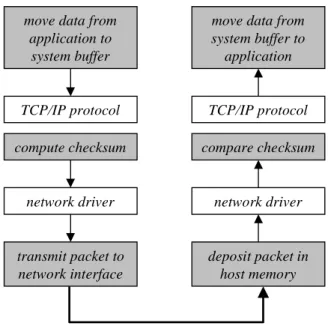
transmit packet to network interface move data from
application to system buffer TCP/IP protocol compute checksum network driver
sender
deposit packet in host memory move data from system buffer to application TCP/IP protocol compare checksum network driverreceiver
Figure 1: Sources of end-system overhead for TCP/IP.
2
End-System Optimizations
This section outlines the factors that affect end-system performance for TCP, and gives an overview of the key optimizations proposed and studied in the literature.
Data transmission using TCP involves the host op-erating system (OS) facilities for memory and process management, as well as the TCP/IP protocol stack and the network device and its driver. Figure 1 depicts the key sources of overhead in transmitting data over a TCP connection in a typical system. End systems incur CPU overhead for processing each network packet or frame. These per-packet costs include the overhead to execute the TCP/IP protocol code, allocate and release memory buffers, and field device interrupts for packet arrival and transmit completion. The systems incur additional costs for each byte of data sent or received. These per-byte costs — incurred at the stages shown in grey in Figure 1 — include overheads to move data within the end sys-tem and to compute checksums to detect data corruption in the network.
At a given packet size, faster networks carry more packets as well as more bytes per unit of time, increas-ing both per-packet and per-byte overheads on the host. At high speeds these costs may consume a significant share of host CPU cycles and memory system band-width, siphoning off resources needed for application processing of the data. The end system ultimately satu-rates under the combined load of application processing and networking overhead, limiting delivered bandwidth. Faster CPUs alone do not help appreciably if the CPU
spends most of its time waiting for memory. Given suf-ficient memory system bandwidth, multiprocessors or multithreading may improve performance to the extent that the software is able to extract parallelism from the network processing; in particular, multiprocessors may yield higher aggregate throughputs for servers handling multiple concurrent streams.
To deliver the maximum performance of the hard-ware, the network interface and OS software must co-operate to minimize both classes of overheads at the end systems. The following subsections give an overview of the approaches to reducing per-packet and per-byte overheads respectively, using optimizations on the net-work interface and in host system software above and below the TCP/IP protocol stack. This can improve the peak bandwidth of individual TCP streams as well as the aggregate throughput across multiple streams.
2.1
Reducing Per-Packet Overheads
Extended frames. One way to limit per-packet
over-heads is to use larger packets, reducing the number of packets needed to carry a given amount of data. For ex-ample, standard IEEE 802.3 Ethernet frame sizes impose a Maximum Transmission Unit (MTU) of 1500 bytes, but many Gigabit Ethernet vendors have followed a pro-posal by Alteon Networks to support “Jumbo” frame sizes up to 9000 bytes. Up-to-date TCP/IP implemen-tations automatically discover and use the largest MTU accepted by the complete network path for a given con-nection. For bulk data transfer over TCP, the MTU is the typical unit of data exchange between the host and the adapter. It is this MTU that affects end-system over-head, independent of the transfer sizes actually carried on the links; for example, ATM networks may transpar-ently segment and reassemble large IP packets for trans-port as 53-byte cells, but the small cell size does not impact TCP/IP performance. Section 4 quantifies end-system performance for MTU sizes up to 32KB.
Interrupt Coalescing. A second way to limit
per-packet overhead is to amortize per-packet handling costs across multiple packets. For example, interrupts to no-tify the host of transmit-complete events and packet ar-rival can impose a significant overhead. Most high-speed network interfaces support interrupt coalescing or interrupt suppression, selectively delaying interrupts if more packets are pending transmission or delivery to the host [6]. This reduces the total number of interrupts de-livered; the host interrupt handler may process multiple event notifications from each interrupt. While some in-terrupt coalescing schemes increase end-to-end latency slightly, they reduce interrupt costs during periods of high bandwidth demand, and may deliver better cache performance for processing the notifications.
2.2
Reducing Per-Byte Overheads
Per-byte costs dominate per-packet costs for bulk data transfer because they are fundamentally limited by the host memory system rather than the CPU. The only un-avoidable per-byte costs occur in the application and in moving data between host memory and the network in-terface. An ideal system would entirely eliminate the remaining per-byte overheads.
Zero-copy networking. In principle, it is possible
to eliminate all data copying within the host. Oper-ating systems need not copy data to make it available to the network interface because advanced network de-vices support scatter/gather DMA, in which the data for a frame may span multiple regions of host memory. The OS can avoid other internal data copying with flexible mechanisms for buffer management.
More problematic is the copying of data between ap-plication memory and OS buffers. On the sender, copy-ing the data protects it from modification if the process reuses the memory before the transmit of the old data completes. On the receiver, copying allows the OS to place the incoming data at arbitrary virtual addresses specified by the application. Avoiding this copying in-volves complex relationships among the network hard-ware and softhard-ware, OS buffering schemes, and the ap-plication programming interface (API).
A basic technique for copy avoidance is to use vir-tual memory to change buffer access or address bindings without copying the data to a new buffer. For exam-ple, virtual memory allows the system to protect against modifications to buffers with pending transmits, even if they are accessible in the process address space. Sec-tion 3.1 discusses a key technique — page remapping or page flipping — in detail, and outlines an implemen-tation that is compatible with a standard socket API for networking. Research systems have used page remap-ping for several years [1, 7], and it is now emerging into more common use. IO-Lite [9] generalizes this tech-nique by replacing sockets with a new scatter/gather I/O API in which the OS rather than the application selects the addresses for incoming data.
Checksum offloading. To detect data corruption in
the network, TCP/IP generates an end-to-end checksum for each packet covering all protocol headers and data. In most implementations, software running on the host CPU computes these checksums on both sending and re-ceiving sides. This requires the CPU to load all of the data through the memory hierarchy for a sequence of add operations. One way to eliminate this cost is to com-pute the checksum in hardware on the network adapter’s DMA interface as the packet passes through on its way to or from host memory [8]. The TCP/IP stack and the network device driver must cooperate in checksum
of-floading, as discussed in Section 3.2.
Integrated copy/checksum. Another approach to
re-ducing per-byte costs is to coalesce multiple operations that touch the data, completing multiple steps in a single traversal of the packet [4]. For example, some TCP/IP implementations integrate checksumming with the data copy to or from application memory. A similar approach could apply to other processing steps such as compres-sion or encryption.
2.3
The Role of the Network Interface
Most of the optimizations outlined above require some support from the network adapter [6]. Advanced net-work interfaces can help reduce end-system overheads by supporting larger packets at the host interface, seg-menting and reassembling packets as needed to match the link frame sizes, depositing packets in host mem-ory intelligently, coalescing interrupts, or incorporat-ing checksum hardware. There is a rebirth of interest in supporting TCP/IP protocol functions directly on the adapter (TCP offloading), with several products on the market and under development.
All techniques to avoid copying of incoming data rely on the network interface to process the incoming packet stream and deposit the data in suitable host memory buffers. For page remapping with the Unix socket API, the adapter must (at minimum) separate incoming packet headers from their payloads and deposit the payloads into buffers aligned to the system virtual memory page size. The OS may then deliver the data to an applica-tion buffer by updating virtual mappings to reference the payload’s physical location, if the virtual address of the application buffer is also suitably aligned. If the MTU is smaller than a page, the adapter would need to recog-nize the TCP connection for each incoming packet and “pack” payloads into page-size buffers for each connec-tion.
Several recent proposals promise more general sup-port for low-overhead networking by a comprehensive restructuring of the end systems. IO-Lite’s redesigned API allows more flexible data placement and reduces copying for inter-process communication and storage access as well [9]. Another approach termed Remote Direct Memory Access (RDMA) inserts directives into the packet stream to name the buffer destinations for in-coming data; the receiving adapter recognizes these di-rectives and “steers” the data directly into its buffers. RDMA is similar to sender-based memory manage-ment [2]: it handles arbitrary MTUs and buffer align-ments, and supports protocols layered above TCP, e.g., for network storage access. RDMA features are already present in the Virtual Interface Architecture (VI); VI supports user-level networking [10] in which
applica-tions interact directly with the network adapter, bypass-ing the kernel bufferbypass-ing system entirely. Adapters sup-porting the VI standard over TCP/IP networks have been announced.
3
A System for High-Speed TCP
This section outlines a complete experimental system for high-speed TCP, in order to illustrate the OS issues and host/interface interactions for zero-copy networking and checksum offloading.
The experimental system is based on FreeBSD 4.0, a free Unix system descending from the Berkeley 4.4 BSD code base. We chose FreeBSD in part because it has a high-quality network subsystem incorporating all relevant TCP/IP refinements. We modified FreeBSD to support zero-copy sockets and checksum offloading, and added code for integrated copy/checksum from a recent Linux release.
The network interface used in our experiments is Trapeze/Myrinet [3]. Myrinet (http://www.myri.com) is a reliable short-haul interconnect with very low latency, configurable maximum frame sizes, and link speeds up to 2.5 Gb/s in each direction. Trapeze is a firmware pro-gram for Myrinet adapters. Trapeze and its associated network driver incorporate support for the optimizations discussed in Section 2.1 and 2.2. While Trapeze/Myrinet is not representative of networks encountered by TCP systems “in the wild,” it is ideal for probing the limits of end-system hardware and software for high-speed net-working.
The FreeBSD extensions described in this section are compatible with network interfaces other than Trapeze. In particular, we have tested the system with an Alteon Gigabit Ethernet network, yielding TCP bandwidths just under the maximum link speed.
3.1
Zero-Copy Sockets
The primary support for zero-copy TCP/IP (page remap-ping) resides at the socket layer in the OS kernel. The optimizations trigger only if the data transfer sizes re-quested by the application are larger than the page
size. On the receiver, page remapping requires an
MTU matched to the page size, page-aligned application buffers, and a network interface that deposits packet data on a page boundary. In general, this last requirement means that the network interface must split the packet header from its data for common protocols such as TCP. Page remapping extends the conventional FreeBSD send/receive path, which is based on variable-sized ker-nel network buffers (mbufs). Standard mbufs contain their own buffer space, while an external mbuf holds a reference to another kernel buffer, e.g., a file buffer or
a physical page frame. Packet data is stored in linked chains of mbufs passed between levels of the system; the TCP/IP protocol stack adds and removes headers and checksums by manipulating the buffers in the chain. On a normal transmission, the socket layer copies data from user memory into a chain, which is passed through the TCP/IP stack to the network driver. On the receiving side, the driver constructs a chain containing each in-coming packet header and payload, and passes the chain through the TCP/IP stack to the socket layer. When the receiving process accepts the data, e.g., with a read sys-tem call, a socket-layer routine copies the payload into user memory and frees the chain.
Page remapping is implemented in a variant of the kernel routine uiomove, which directs the movement of data to and from the process virtual memory for all vari-ants of the I/O read and write system calls. The new code activates when a process requests the kernel to transfer a page or more of data between a network socket and a page-aligned user buffer. Instead of copying data to or from the mbuf chain, uiomove passes the data by reference.
On the sender, uiomove creates a new external mbuf that references the page frame backing the application’s virtual buffer. The mbuf chain and its pages are then passed through the TCP/IP stack to the network driver, which attaches the pages to outgoing messages as pay-loads. In Unix systems, the page remapping scheme must preserve the copy semantics of the existing socket interface [1, 7]. The application may overwrite its send buffer after it requests the send but before the TCP ac-knowledgement is received, completing the transmit. To handle this case, the kernel marks pages with pending transmit as copy-on-write, disabling write access to the page. The copy-on-write mapping is released when the receiver acknowledges the data.
On the receiver, uiomove installs a new virtual trans-lation for the page frame containing the data, as refer-enced by the external mbuf passed up through the pro-tocol stack from the network driver. Copy-on-write is unnecessary because there is no need to retain the kernel buffer after the read; uiomove simply releases the mbuf headers, leaving the buffer page mapped into the appli-cation address space. It also releases any pages left un-mapped by the remapping operations, preserving equi-librium between the process and the kernel buffer pool.
3.2
Checksum Offloading
The network interface and its driver act in concert to im-plement checksum offloading. The Myrinet and Alteon devices support checksum offloading in the host-PCI DMA engine, which computes the raw 16-bit one’s com-plement checksum of each DMA transfer as it moves
data to and from host memory. It is not necessary to change the TCP/IP stack to use this checksum; simply setting a flag in the mbuf chain bypasses the software checksum. However, three factors complicate hardware checksumming for IP:
A packet’s data may span multiple host buffers;
the device accesses each buffer with a separate DMA. On the sender, Trapeze and Alteon adapters combine these partial checksums in firmware using one’s complement addition.
TCP and UDP actually use two checksums: one
for the IP header (including fields overlapping with the TCP or UDP header) and a second end-to-end checksum covering the TCP or UDP header and
packet data. In a conventional system, TCP or
UDP computes its end-to-end checksum before IP fills in its overlapping IP header fields (e.g., op-tions) on the sender, and after the IP layer restores these fields on the receiver. Checksum offloading involves computing these checksums below the IP stack; thus the driver or NIC firmware must par-tially dismantle the IP header in order to compute a correct checksum.
Since the checksums are stored in the headers at the
front of each IP packet, a sender must complete the checksum before it can transmit the packet head-ers on the link. If the checksums are computed by the host-NIC DMA engine, then the last byte of the packet must arrive on the NIC before the firmware can determine the complete checksum.
The last issue may require a compromise between host overhead and packet latency, since the adapter must handle large packets in a store-and-forward fashion.
4
Empirical Results
This section presents quantitative results showing the impact of zero-copy networking, checksum offloading, integrated copy/checksum, and MTU size (extended frames) on TCP performance. We focus on point-to-point bandwidth in a small Myrinet LAN, where the stresses on the end systems are greatest; of course the results apply to WAN networks if they deliver sufficient bandwidth to stress the hosts. We tested two hardware configurations:
Dell PowerEdge. The Dell PowerEdge 4400
servers use a 733 MHz Intel Xeon CPU (32KB L1 cache, 256KB L2 cache), and a ServerWorks Ser-verSet III LE chipset. Each machine has 2-way interleaved RAM and an M2M-PCI64B Myrinet
adapter connected to a 66 MHz 64-bit PCI slot. The Myrinet adapter is a pre-production prototype based on the LANai-9 chip; it has a 133 MHz pro-cessor supporting the Myrinet-2000 link speed of 250 MB/s (2 Gb/s). The prototype adapters run in a test mode with a link speed of 320 MB/s.
Compaq Monet. The Compaq XP1000
Profes-sional Workstations have a 500 MHz Alpha 21264 CPU, a 4MB L2 cache, and the Digital 21272 “Tsunami” chipset. Each machine has an M2M-PCI64A-2 Myrinet adapter connected to a 33 MHz 64-bit PCI slot and an M2M-SW16 Myrinet switch. The Myrinet adapter is based on the LANai-7 chip; it has a 66 MHz processor supporting a link speed of 160 MB/s (1.28 Gb/s).
All machines run extended FreeBSD 4.0 kernels with Trapeze firmware on the Myrinet adapters, as described in Section 3. The machines are configured with suffi-cient buffer memory to maintain the link speed (512 KB socket buffers). All results are from a unidirectional data transfer over a single TCP connection. A single connec-tion delivers enough bandwidth to saturate the receiver, so multiple streams cannot deliver better aggregate per-formance. The application is a modified version of net-perf version 2.1pl3, a standard tool for benchmarking TCP/IP performance. The machines are isolated and otherwise idle.
4.1
TCP Bandwidth
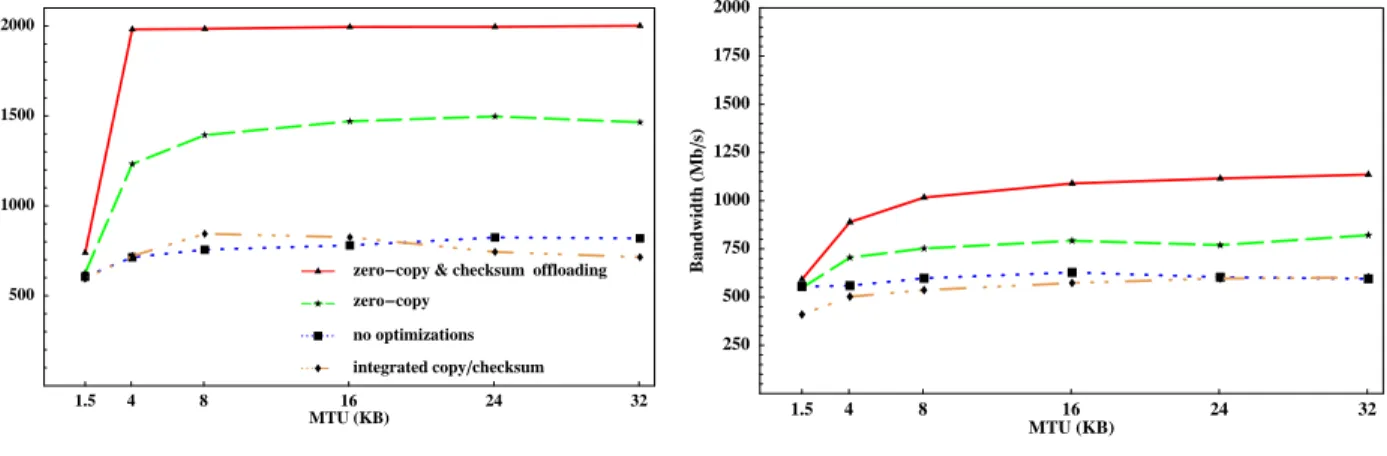
Figure 2 shows TCP bandwidth on the PowerEdge plat-form as a function of the MTU size. The MTUs al-lowed payloads of 1500 bytes (standard Ethernet), 4KB (FDDI), 8KB (Ethernet with Jumbo Frames), and multi-ples of 8KB up to 32 KB. The points are averages from 50 netperf runs that each send data as fast as the system allows for 60 seconds, then compute the average band-width over the interval. The left-hand graph is from a standard netperf that does not access its data; the right-hand graph is from a modified version that accesses all data using longword stores on the sender and longword loads on the receiver.
For the baseline bandwidth results (labeled no opti-mizations) the end systems copy the data in the con-ventional fashion and compute all checksums in soft-ware. The copy and checksum overhead saturates the host CPUs well below the link speed; bandwidth peaks at 824 Mb/s, and stays below 630 Mb/s when netperf accesses its data.
The lines labeled zero-copy show the effect of en-abling page remapping. The size and alignment of net-perf’s buffers and transfer requests allow the systems to avoid almost all copy operations for MTUs equal to or
1.5 4 8 16 24 32 MTUHKBL 500 1000 1500 2000 Bandwidth H Mb s L
integrated copychecksum no optimizations zero-copy
zero-copy & checksum offloading
1.5 4 8 16 24 32 MTUHKBL 250 500 750 1000 1250 1500 1750 2000 Bandwidth H Mb s L
Figure 2: TCP Bandwidth on the PowerEdge 4400 platform. The left-hand graph shows bandwidth when the applica-tion process does not access the data. The right-hand graph shows the impact of this access on delivered bandwidth.
larger than the 4KB system page size. Moving from a 1500-byte to a 4KB MTU enables page remapping, yielding a sudden jump in bandwidth. This illustrates the maximum benefit from page remapping or other zero-copy networking enhancements on this platform. Band-width is lower for MTUs that are not a multiple of the page size because the socket API must copy the “odd” data; Figure 2 omits these points for clarity.
Since checksums are computed in software for the zero-copy line, host CPU saturation again limits band-width, this time at a higher peak of 1.5 Gb/s. The right-hand graph shows that the percentage improvement from copy avoidance is lower when netperf accesses its data, yielding a peak of 820 Mb/s. This results from two fac-tors. First, the additional load drives the CPU to satu-ration at a lower bandwidth, thus the CPU is spending less of its time copying data, diminishing the potential benefit from avoiding the copy. Second, memory caches create a synergy between copying and application pro-cessing; each may benefit from data left in cache by the other. Despite these factors, avoiding the copy yields a 26% bandwidth improvement at the 8KB MTU. We omitted the lines for checksum offloading with copy be-cause the results are similar to zero-copy, although the benefit is slightly lower.
The lines labeled zero-copy & checksum offloading show the combined effect of page remapping and use of checksum hardware. In the left-hand graph the host CPUs never touch the data. Bandwidth jumps to 2 Gb/s at the 4KB MTU as page remapping replaces copying. At this point the host CPUs are near saturation from per-packet overheads including buffer management, inter-rupt handling, and TCP/IP protocol costs. In the right-hand graph netperf touches the data, yielding a much lower peak bandwidth of 1.18 Gb/s for zero-copy & checksum offloading at a 32KB MTU. This is somewhat slower than the left-hand zero-copy points (which
check-sum the data rather than touching it) because the sender stores to the data; on this Xeon P6-based platform, the CPU can store to memory at only 215 MB/s, but it can read at 504 MB/s. Of course these bandwidths are lower when the CPU is competing with the I/O system for memory bandwidth, as it is in this case.
The lines labeled integrated copy/checksum show the effect of combining the conventional copy and checksum into a single software loop, as implemented in Linux 2.3.99-pre8 kernels for this platform. Microbenchmark results confirm a bandwidth limitation of roughly 100 MB/s for this loop, about half the 4400’s memory copy bandwidth of 207 MB/s. The integrated loop may ac-tually reduce bandwidth with large MTUs on this plat-form, but we have not investigated why. What is impor-tant is that the expected benefits of integrating the copy and checksum can be elusive unless the loop is carefully tuned for specific platforms. In the left-hand graph, the integrated copy/checksum appears to offer a benefit at 8KB MTUs, but this effect disappears if the application touches the data.
4.2
Effect of Larger MTUs
Moving beyond 4KB along either x-axis in Figure 2
shows the effect of reducing total per-packet overhead by increasing the MTU. Larger MTUs mean fewer pack-ets, and hence fewer interrupts and less protocol process-ing overhead. Varyprocess-ing MTU size also reveals the likely benefits of other approaches to reducing per-packet over-heads, e.g., interrupt coalescing or TCP offloading.
The data clearly shows a “sweet spot” at the 8KB MTU, which approximates the Jumbo Frames proposal for Ethernet. Standard Ethernet 1500-byte MTUs never yield a bandwidth above 740 Mb/s in these experiments. In addition to reducing per-packet overheads, larger MTUs enable page remapping optimizations for sockets
on the receiver, potentially reducing per-byte overheads. On this platform, bandwidth improvements from in-creasing MTU size beyond 8KB are modest. This is due to two factors. For the bottom two lines on both graphs, performance is dominated by per-byte overheads, mem-ory system bandwidth, and caching behaviors. In the left-hand zero-copy & checksum offloading line, larger MTUs do not improve bandwidth beyond 2 Gb/s be-cause the bottleneck shifts to the network interface CPU; however, host CPU utilization at this speed drops to 45% with the 32KB MTU. Larger MTUs do yield improve-ments for the three remaining zero-copy cases, but this effect diminishes with larger packet sizes as data move-ment overheads increasingly dominate. The effect of larger MTUs is more apparent from a breakdown of how the CPU spends its time.
0% 20% 40% 60% 80% 100%
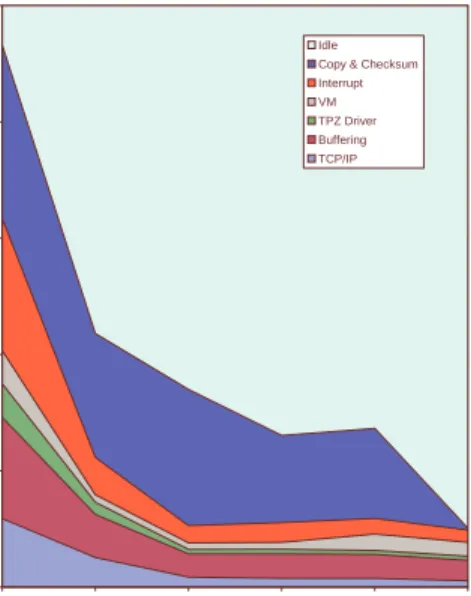
Ethernet MTU 8KB MTU 32KB MTU 32KB MTU, Checksum Offloading 32KB MTU, Zero-Copy 32KB MTU, Checksum Offloading, Zero-Copy C P U U tiliza tion Idle Copy & Checksum Interrupt VM TPZ Driver Buffering TCP/IP
Figure 3: TCP Receiver CPU Utilization Breakdown
4.3
CPU Utilization
Figure 3 shows a breakdown of receiver CPU utiliza-tion on the Monet platform in order to better illustrate the overheads for high-speed TCP. The data is from iprobe suite-4.3 (Instruction Probe), an on-line profiling tool from Compaq that uses the Alpha on-chip perfor-mance counters to report detailed execution profiles with low overhead (3%-5%). We do not report bandwidth re-sults from Monet because its I/O bus is slower than the Myrinet-2000 link speed, but the effects of networking overhead are qualitatively similar on the two platforms.
Figure 3 classifies overheads into five categories: data access for copying and checksums, interrupt handling, virtual memory costs (buffer page allocation and/or page
remapping), network buffer management, the TCP/IP protocol stack, and the Trapeze network driver. The
y-axis in Figure 3 gives the CPU utilization attributed
to each overhead category. The x-axis gives six
dif-ferent configurations to show the effect of varying the MTU size and enabling page remapping and checksum offloading. For these experiments TCP bandwidth was held constant at 370 Mb/s by a slow sender, so it is possi-ble to directly compare receiver CPU overheads for dif-ferent configurations.
With a standard Ethernet MTU the Monet is near 95% saturation. The CPU spends about 65% of its time pro-cessing 30,000 packets per second through the network driver and TCP/IP stack. Total packet handling costs drop to 22% with an 8KB MTU, and to 10% with a 32KB MTU. Iprobe attributes approximately 20% of CPU time to interrupt dispatching at a 1500-byte MTU, and 5% at an 8KB MTU; in each case it is 20% to 25% of total overhead on the Alpha, showing that interrupt coalescing is an important optimization at higher band-widths, even with Jumbo Frames. It is interesting to note that actual TCP/IP protocol overhead accounts for at most 12% of CPU time even with a 1500-byte MTU. Protocol costs are significant but are not the limiting fac-tor for a well-implemented TCP/IP stack [5].
The last three configurations in Figure 3 show the ef-fects of checksum offloading and page remapping on per-byte overheads, with per-packet overheads held low by the 32KB MTU. Avoiding the copy or offloading the checksum drops the total CPU time spent on data ac-cess from 24% to roughly 15%. For page remapping (zero-copy), this effect is partially offset by per-page costs to manipulate translations in the virtual memory system; this overhead totals about 3% of CPU time and is independent of MTU size. Applying both optimiza-tions effectively eliminates all data access costs, and the reduced memory contention causes other overheads to drop slightly; the Monet handles the 370 Mb/s of band-width with a comfortable 10% CPU utilization.
5
Conclusion
Technology trends suggest that the fastest networks will continue to carry link bandwidths close to the memory and I/O subsystem limits on most hosts. Thus the end systems remain the bottlenecks to high-speed TCP/IP performance in current and future hardware.
To achieve end-to-end TCP/IP networking perfor-mance on the fastest networks, it is necessary to min-imize the host overheads to handle packets and their data. This paper reviews the techniques used by oper-ating systems and high-speed network interfaces to re-duce end-system overheads. The approaches to reduc-ing overheads include larger frame sizes (MTUs),
inter-rupt coalescing, copy avoidance by page remapping, in-tegrated copy/checksum, and hardware checksum com-putation. These optimizations increase delivered band-width by delaying saturation of the host CPUs, while leaving more CPU power for the application.
The experiments reported in this paper give a quan-titative snapshot of a high-quality TCP/IP stack supple-mented with these optimizations, running at bandwidths up to 2 Gb/s on current hardware. At these speeds, 8KB frame sizes (e.g., Jumbo Frames for Ethernet) yield bandwidth improvements up to 70%, relative to standard 1500-byte Ethernet frame sizes. However, there is little benefit to increasing frame sizes beyond 16KB. In our system, per-packet overheads are dominated by operat-ing system buffer management, which is more expensive than packet processing in the network driver and TCP/IP protocol stack. Interrupt handling constitutes up to 20% of the per-packet overhead on Alpha systems with an 8KB frame size, showing the value of interrupt coalesc-ing. With 8KB and larger MTUs, per-byte costs domi-nate per-packet costs on the platforms we tested, show-ing that copy avoidance and hardware checksum offload-ing are the most important optimizations. Taken to-gether, these yield bandwidth improvements up to 70%, and can double bandwidth if application processing is ignored.
Acknowledgments
The equipment used in this work was provided by the National Science Foundation, Intel Corporation, and Myricom Inc. We thank Bob Felderman of Myricom for his frequent technical assistance, and Myricom for making Myrinet-2000 prototypes available. Darrell An-derson and the anonymous IEEE reviewers offered valu-able comments on the paper.
Biographical Summaries
Jeffrey S. Chase joined the Computer Science faculty at Duke University in 1995. He holds a Bachelor’s degree in Mathematics and Computer Science from Dartmouth College, and a Ph.D. in Computer Science from the Uni-versity of Washington. His research interests are operat-ing systems, distributed systems, networkoperat-ing, and stor-age systems.
Andrew J. Gallatin is a research staff member in the Network Storage Lab at Duke University. He holds an M.S. degree in Computer Science from Rensselaer Poly-technic Institute and a Bachelor’s degree from SUNY Buffalo. He is a frequent contributor to the FreeBSD Project’s Alpha port, and is working to incorporate the features described in this article into FreeBSD-5.0
Kenneth G. Yocum is a doctoral student in Computer Science at Duke University. His research focuses on high-speed network storage and Internet service virtu-alization. He holds a Bachelor’s degree in Computer Science from Stanford University. He is the primary de-veloper of the Trapeze networking system.
References
[1] J. Brustoloni. Interoperation of copy avoidance in network and file I/O. In Proceedings of IEEE Info-com, pages 534–542, 1999.
[2] Greg Buzzard, David Jacobson, Milon Mackey, Scott Marovich, and John Wilkes. An implemen-tation of the Hamlyn sender-managed interface ar-chitecture. In Proceedings of the Second Sympo-sium on Operating Systems Design and Implemen-tation. USENIX Association, October 1996. [3] Jeffrey S. Chase, Darrell C. Anderson, Andrew J.
Gallatin, Alvin R. Lebeck, and Kenneth G. Yocum. Network I/O with Trapeze. In 1999 Hot Intercon-nects Symposium, August 1999.
[4] David Clark and David Tennenhouse. Architec-tural considerations for a new generation of pro-tocols. In Proceedings of the SIGCOMM Confer-ence, September 1990.
[5] David D. Clark, Van Jacobson, John Romkey, and Howard Salwen. An analysis of TCP processing
overhead. IEEE Communications, 27(6):23–29,
June 1989.
[6] Peter Druschel, Larry L. Peterson, and Bruce S.
Davie. Experiences with a high-speed network
adaptor: A software perspective. In Proceedings of the ACM SIGCOMM Conference, pages 2–13, August 1994.
[7] Hsiao-Keng and Jerry Chu. Zero-copy TCP in So-laris. In Proceedings of the USENIX 1996 Annual Technical Conference, January 1996.
[8] K. Kleinpaste, P. Steenkiste, and B. Zill. Software support for outboard buffering and checksumming. In Proceedings of the ACM SIGCOMM Confer-ence, August 1995.
[9] V. S. Pai, P. Druschel, and W. Zwaenepoel. IO-Lite: A unified I/O buffering and caching system. ACM Transactions on Computer Systems (TOCS), 18(1):37–66, February 2000.
[10] Thorsten von Eicken, Anindya Basu, Vineet Buch, and Werner Vogels. U-Net: A user-level network
interface for parallel and distributed computing. In Proceedings of the Fifteenth ACM Symposium on Operating Systems Principles, 1995.
Keywords: TCP, high-speed network, network adapter, zero-copy, copy avoidance, checksum, operat-ing system, memory management, socket.