Rochester Institute of Technology Rochester Institute of Technology
RIT Scholar Works
RIT Scholar Works
Theses
8-2020
CLAM: Compiler Lease of Cache Memory
CLAM: Compiler Lease of Cache Memory
Ian PrechtlFollow this and additional works at: https://scholarworks.rit.edu/theses
Recommended Citation Recommended Citation
Prechtl, Ian, "CLAM: Compiler Lease of Cache Memory" (2020). Thesis. Rochester Institute of Technology. Accessed from
This Thesis is brought to you for free and open access by RIT Scholar Works. It has been accepted for inclusion in Theses by an authorized administrator of RIT Scholar Works. For more information, please contact
CLAM: Compiler Lease of Cache Memory
by
Ian Prechtl
A Thesis Submitted in Partial Fulfillment of the Requirements for the
Degree of Master of Science in Electrical Engineering
Supervised by
Dr. Dorin Patru
Department of Electrical and Microelectronic Engineering
Kate Gleason College of Engineering
Rochester Institute of Technology
Rochester, NY
August 2020
Approved By:
Dr. Dorin Patru
Associate Professor - Rochester Institute of Technology Department of
Electrical and Microelectronic Engineering
Dr. Chen Ding
Professor - University of Rochester Computer Science Department
Prof. Mark Indovina
Senior Lecturer - Rochester Institute of Technology Department of
Electrical and Microelectronic Engineering
Prof. Carlos Barrios
Lecturer - Rochester Institute of Technology Department of Electrical
and Microelectronic Engineering
Dr. Ferat Sahin
Professor & Department Head - Rochester Institute of Technology
Department of Electrical and Microelectronic Engineering
CLAM: Compiler Lease of Cache Memory
by
Ian Prechtl
Submitted to the Department of Electrical and Microelectronic Engineering August 2020, in partial fulfillment of the
requirements for the degree of Master of Science in Electrical Engineering
Abstract
Caching is a common solution to the data movement performance bottleneck of to-day’s computational systems and networks. Traditional caching examines program behavior and cache optimization separately, limiting performance. Recently, a new cache policy called Compiler Lease of cAche Memory (CLAM), has been suggested for program-based cache management. CLAM manages cache memory by allowing the compiler to assign leases, or lifespans, to cached items over a hardware-software in-terface, known as lease cache. Lease cache affords new performance potential, by way of program-driven cache optimization. It is applicable to existing cache architecture optimizations, and can be used to emulate other cache policies.
This paper presents the first functional hardware implementation of lease cache for CLAM support. Lease cache hardware architecture is first presented, along with CLAM hardware support systems. The cache is emulated on an FPGA, and bench-marked using a collection of scientific kernels from the PolyBench/C suite, for three CLAM lease assignment policies: Compiler Assigned Reference Leasing (CARL), Phased Reference Leasing (PRL), and Fixed Uniform Leasing (FUL). CARL and PRL are able to achieve superior performance to Least Recently Used (LRU) re-placement, while FUL is shown to serve as a safety mechanism for CLAM. Novel spectrum-based cache tenancy analysis verifies PRL’s effectiveness in limiting cache utilization, and can identify changes in the working-set that cause the policy to per-form adversely. This suggests that CLAM is extendable to more complex workloads if working-set transitions can elicit a similar change in lease policy. Being able to do so could yield appreciable performance improvements for large and highly iterative workloads like tensors.
Thesis Supervisor: Dr. Dorin Patru Title: Associate Professor
Acknowledgments
Advisor Dorin Patru Thesis Committee Mark Indovina Carlos Barrios CLAM Group Chen Ding Ben Reber Dong Chen Reviewers Sreepathi Pai Fangzhou Liu Wesley Smith Aaron Gindi Donovan Snyder Elias Neuman-Donihue Joshua Radin Katherine SeemanThis work was supported by a NSF grant sub-award from University of Rochester.
Contents
1 Introduction 10 1.1 Data Locality . . . 10 1.2 Cache . . . 11 1.2.1 Cache Policy . . . 12 1.2.2 Software-Driven Management . . . 14 1.3 Objective . . . 14 2 Background 16 2.1 Reuse Interval . . . 162.2 Lease Cache: CLAM . . . 19
2.2.1 CARL: Compiler Assigned Reference Leasing . . . 20
2.2.2 CARL Extensions . . . 21
3 Lease Cache Hardware Design 25 3.1 Lease Cache Implementation . . . 25
3.1.1 Hardware . . . 26
3.1.2 Software Support . . . 32
3.2 Hardware Support for CLAM . . . 34
3.2.1 Lease Tracking . . . 37
4 Testing 39 4.1 Test System . . . 39
4.1.2 Communication and Control . . . 41
4.1.3 Design Parameters . . . 43
4.2 Cache Performance Metrics . . . 45
4.2.1 Cache Tenancy Spectrum . . . 46
4.3 Benchmark Applications and Policies . . . 47
5 Results and Discussion 49 5.1 Fixed Uniform Leasing . . . 49
5.2 Variable Leasing . . . 54
5.2.1 CARL vs. PRL . . . 56
5.2.2 PRL Resolution . . . 61
5.2.3 Preliminary Set Associativity . . . 63
6 Future Work 66 6.1 Scope Leasing . . . 67
6.1.1 Multiple Dual Leases . . . 68
6.2 Local Clocks . . . 68 6.3 Parallel Assignment . . . 69 7 Conclusion 70 Glossary 73 Acronyms 75 A Tables 78
List of Figures
1-1 Intel Haswell (i7-4770) cache memory hierarchy [1]. . . 12
2-1 Forward reuse interval calculation for an arbitrary access sequence. Red circles indicate the re-access of an item whose original access is circled in black. The first re-access includes directional arrows to show how the reuse interval calculation traces back to the reference that is
associated with the interval. . . 17
2-2 CARL assignment procedure for a budget of one billion. Green items indicate a lease assignment made at the current step. Blue indicates a lease assignment previously made, which is contributing to the overall cost. Red indicates assignment termination due to the budget being
exceeded. . . 24
3-1 Lease cache lookup stage hardware overview for fully and set associa-tive cache. Component and signal sizings are given in Section 4.1.3.
Note that𝑙𝑒𝑎𝑠𝑒_𝑚𝑢𝑙𝑡𝑖𝑝𝑙𝑒𝑥𝑒𝑟_𝑏𝑢𝑠 is driving a NOR reduction gate. . 28
3-2 Lease cache update stage for fully associative cache. Component and
signal dimensions are given in Section 4.1.3. Note that𝑒𝑥𝑝 bus drives
an OR reduction gate. . . 30
3-3 Lease cache update stage for a generic four way set associative cache,
with update circuitry shown for three sets. The 𝑒𝑥𝑝 bits of each set
drive an OR reduction gate in the schematic. Component and signal
3-4 Mapping of lease cache memory partitions in application binary.
Ad-dresses are byte addressable. . . 33
3-5 Hardware reuse interval sampler system overview. Delimited text file shown is output read from the sampler with same field order shown in the buffer. . . 36
4-1 Top level test system diagram. . . 40
4-2 Cache tenancy spectrum for the example stencil (Listing 2.1). . . 47
5-1 FUL policy performance over a 16-bit lease range with 7-bit resolution. FUL curves are normalized to baseline (LRU) performance, indicated
by the dashed lines. . . 50
5-2 FUL policy vacancy of the trials shown in Figure 5-1. . . 52
5-3 Normalized miss ratios of trialed caching policies [27]. Dashed line indicates baseline (LRU) performance. Tabled results given in Figures
A.1 and A.2. . . 54
5-4 Cache aggregate vacancy (left) and cache tenancy spectrum (right) for
doitgen benchmark using CARL (top) and PRL (bottom). . . 57
5-5 Cache aggregate vacancy (left) and cache tenancy spectrum (right) for
nussinov benchmark using CARL (top) and PRL (bottom). . . 58
5-6 Cache aggregate vacancy (left) and cache tenancy spectrum (right) for
mvt benchmark using CARL (top) and PRL (bottom). . . 59
5-7 Cache aggregate vacancy (left) and cache tenancy spectrum (right) for
2mm benchmark using CARL (top) and PRL (bottom). . . 60
5-8 Cache aggregate vacancy (left) and cache tenancy spectrum (right) for
5-9 Comparing CARL and PRL for the four tests. Each PRL variant is labeled with the phase count. The numbers at each bar show the no vacancy ratio (above) and the multiple vacancy ratio (below the bar top). CARL over-allocates the cache with its leases, shown by its vacancy ratios as low as 36%. PRL eliminates over-allocation in the first three tests, shown by their near 100% vacancy ratios [27]. Tabled
results given in Figure A.2. . . 62
5-10 How well set associative caches perform when using leases designed for the architecture and ignoring set constraints. Blue bars are lease assignments made by CARL, which assume a fully associative cache. Red bars are lease assignments made by spatial PRL, which groups RI distributions by set. The numbers at the top of each bar pair is the no vacancy ratio of each bar respectively. Tabled results given in Figure
List of Tables
2.1 Reuse interval (RI) histograms for four of the references of the five-point stencil program. Each row represents a different reuse interval that is observed for each reference. References with no reuses (b[i][j]
and a[i-1][j]) are omitted [27]. . . 19
4.1 Compiler options for RISC-V toolchain. . . 41
4.2 Hardware design parameters for base cache, lease cache, reuse interval sampler, and lease tracker. . . 44
4.3 Benchmark programs and their baseline (LRU) performance. . . 48
5.1 Best FUL miss count reduction over LRU in four benchmarks. . . 51
A.1 Benchmark performance summary for reactive cache policies. . . 78
A.2 Benchmark performance summary for CLAM cache policies. Note: MV Rep (Replacments) are the number of evictions made when there are two or more expired cache lines - the numerator for MVR. . . 79
A.3 Benchmark performance summary for set associative CLAM cache poli-cies. Note: Rep = Replacements. . . 80
Chapter 1
Introduction
For years, processor speeds have increased disproportionately to main memory speeds, limiting computational ability. Distributed networks and servers have seen similar effects in how they have scaled, especially with the rise in popularity of cloud com-puting. As applications and networks continue to increase in size and complexity, the impacts of the data bottleneck become that much more significant and hazardous to performance. Caching has been the long-standing solution to this issue. Using inter-mediate storage nodes, data can be more efficiently and effectively used, but only if the cache itself is appropriately managed. This work studies an alternative method of cache management, aimed at improving memory performance through program-driven analysis. This chapter serves as an introduction to cache theory, practicality, and management.
1.1
Data Locality
Locality is a highly exploitable, and equally dangerous, property of data. It is the tendency of data to be re-accessed, once initially accessed. It arises from program and data structuring, along with being an innate stochastic attribute of computer systems. There are two main categories of locality,
1. Temporal locality - if a data object is accessed, then it is likely that the same object will be re-accessed in the near future. Ex, an iterative control loop.
2. Spatial locality - if a data object is accessed, then it is likely that an adjacent object will be accessed in the near future. Ex, the elements of a data array. In computing, locality is used to improve performance. If data is known to have temporal locality, then it would benefit the system to retain that data (as close to the core as possible in CPU). Similarly, if data has spatial locality, it would benefit the system to store data from the same memory region or node. Identifying these properties gives predictive insight about how a particular computational sequence will occur, which can consequently be used for performance gain.
1.2
Cache
Caching is an application of data locality. It is the practice of keeping often used data closest to where it is needed, to decrease the time required to access it. In the context of hardware, caches are intermediate storages between the processor and main memory that manage data and service requests from the core. Cache is robust in that it can be implemented in various configurations (size, architecture, etc.), but limited in the performance that can be gained from these different designs. Intel’s Haswell (i7-4770) architecture, released in 2013, features several levels of cache in order to optimize the performance of the processor (Figure 1-1). Each level of increasing capacity is characterized by higher latency and associativity (cache freedom). These are common trade-offs; cache near the processor has more restrictive designs to retain low latency, while caches further away are larger and more complex (to accommodate more data, from multiple sources). The objective of the hierarchy is simple: keep data that will be accessed most immediately closest to the processor (L1 cache), and keep data that will be access later farther away (L2 or L3). If correctly managed, the cost of moving data between these levels is minimized.
Registers L1 Instruction Cache 32KB | 8-way 4 Stage Pipeline L1 Data Cache 32KB | 8-way 4 Stage Pipeline Instruction Fetch L2 Unified Cache
256KB | 8-way Unified CacheL3 Shared
8MB | 16-way L3 Shared Unified Cache 8MB | 16-way Processor Package Core (x4) Main Memory 4-5 cycle latency 12 cycle latency 36 cycle latency
36 cycle + 57ns latency (~230 cycles)
Figure 1-1: Intel Haswell (i7-4770) cache memory hierarchy [1].
1.2.1
Cache Policy
Because hardware cache is finite, there is a limit to how many items it can hold, or
how many can be allocated. Conversely, a cache needs to remove, or evict, an item
if it is full when it needs to allocate a new item. Cache must manage its content so that its performance is maximized (i.e. keeping any item that will be used soon, and removing any that will not be). How it manages itself and its content is known as the cache policy.
Cache policy is able to exploit data locality by targeting one or several attributes of data, and managing itself in accordance with this. For example, data with high temporal locality would be best managed by a policy that identifies which items have been accessed least recently, and prioritizes them for eviction. Policy effectiveness is
generally discussed relative to access patterns, or patterns of locality. Examples of
such patterns are stream, thrash, recency-friendly, cyclical and sawtooth. All have unique characteristics relating to recency, frequency, and size. General patterns of recency-friendly, thrash, and stream are given in Equations 1.1-1.3. For these patterns
(𝑎1, 𝑎2, ..., 𝑎𝑘−1, 𝑎𝑘, 𝑎𝑘, 𝑎𝑘−1, ..., 𝑎2, 𝑎1)𝑁 ∀𝑘 (1.1)
(𝑎1, 𝑎2, ..., 𝑎𝑘)𝑁 𝑘 > 𝑐𝑎𝑐ℎ𝑒 𝑠𝑖𝑧𝑒 (1.2)
𝑎1, 𝑎2, ..., 𝑎𝑘 𝑘 =∞ (1.3)
Just as access patterns have unique attributes, there exist cache policies which perform well for some patterns, and poorly for others. For the patterns shown in Equations 1.1-1.3, a cache policy that manages based on preserving the most recently accessed items will perform well for 1.1 and poorly for the others. Conversely, a policy that preserves the least recently accessed items will perform well for 1.2 and poorly for the others. The memory content, in terms of size and pattern, accessed by the overarching algorithm directly affects the cache policy performance. This content is formally called the working-set [12].
Preserving the working-set is the general goal of the cache policy. Optimal caching is given by MIN (minimum) [8] and OPT (optimal) [22]. To achieve the best perfor-mance the items with the nearest future use should be cached. Although optimal, it is not practical because implementation requires future access information, i.e. a level of clairvoyance. Nevertheless, policies such as Hawkeye [17] still aim for OPT-like performance, by way of approximation.
OPT is viewed as prescriptive, in that cache management is externally prescribed.
Conversely, reactive policies can self-manage. Basic policies like Least Recently Used
(LRU) are implemented using simplistic stacks [22], while more modern policies use more complex architectures and theories for management. Enhancements of LRU such as ARC [23], Talas [6], and RRIP [18] decrease susceptibility to non-recency by cache partitioning and dynamic management. Such policies are significant im-provements over earlier ones that require performance tuning, such as SLRU [24], or are particularly sensitive to parameter selection as with GD* [19]. In more niche applications like picture archiving, augmenting LRU with data mining and logistic regression has proven successful [34]. To this point, caching can simply
accommo-date performance hints to improve management, also known as collaborative caching [9, 16].
Caching is not restricted to be performed based purely on recency, frequency, etc. LHD [5], EHC [33], and LACS [20] use alternative metrics for evaluation and eviction (hit density, hit count, and caching cost respectively). Policies that use ranking functions such as EVA [7] and LHD [5] can outperform LRU and can avoid/reduce the impact of its common performance cliff access patterns (thrash). Additionally, these policies are feasible for both hardware and software caches (LHD and EVA respectively), making them highly applicable to general cache use.
1.2.2
Software-Driven Management
Prescriptive policies are realizations of software-driven cache management, while col-laborative policies are software-augmented. Compiler management of the register file [11] is a prime example of how software-driven memory management is performed today. Caches have similarly been examined in this context [35], and there is an in-creasing desire to incorporate static analysis into cache policy [32]. OPT is achieved by retaining items with the most immediate need. Duong et al [13] formalize this
into a concept known as protection distance (PD). PD is essentially a lifespan for a
cached item. An item will remain in cache until the end of the PD, and then it is removed. Their implementation of it, known as Dynamic Reuse Distances (DRD), evaluates and tunes PD at run-time. Optimal Steadystate Lease (OSL) [21] is essen-tially an offline implementation of PD. OSL analyzes memory access behavior at the
page level, and assigns PDs, known as leases, accordingly. This requires trace level
knowledge, which is not available at the program level, so OSL cannot be used by compilers, without back-annotating trace information.
1.3
Objective
Although optimal, MIN [8], cannot be practically realized. Techniques like Hawk-eye [17] approximate this, but neglect software optimization. OSL [21] optimizes
cache performance via software, but is not hardware feasible and cannot be compiler-driven. Separate optimization of cache hardware and program structure ignores what can be an avenue for significant improvement, yet doing both is not traditionally possible. This work studies and implements a new prescriptive caching policy which aims to bridge the gap between OSL, static memory management, and cache hard-ware by using a softhard-ware-hardhard-ware interface for program-driven cache control. This enables application-specific memory optimization, which ultimately improves execu-tion throughput. This is particularly true for large and iterative workloads [15], where a slight improvement in memory management can elicit significant improvements in kernel performance. The significant contributions of this paper are,
• The first hardware implementation of this prescriptive caching policy, lease
cache.
• Hardware support systems for lease assignment and lease cache performance evaluation.
Chapter 2
Background
The optimal replacement policy for fixed size caches is one where the the data object with the furthest future reuse is evicted, as given by MIN and OPT [8, 22]. While optimal, it is not feasible to dynamically forward predict reuses. OSL [21] introduces the concept of lease cache, where at every access the data item is assigned a lease, and remains in cache for the duration of that lease. Although OSL is shown to, at minimum, match OPT performance, it assigns leases per data page and for variable sized caches, neither of which make it practical for hardware implementation. In this chapter an extension of OSL is presented that targets fixed sized hardware caches using reference leases. A general theory on lease caching is presented along with algorithms for assigning leases.
2.1
Reuse Interval
The reuse interval (RI) of a data object is the elapsed time between two accesses to
the item. In the context of this paper, time is defined as logical time, or the memory
access trace length. It is a deterministic measure of how immediately a data object will be reused (it carries no information about first access). If an object is accessed at trace lengths of 2 and 7, then the RI of that object is 5. Similarly, if an object is accessed at traces of 2, 7, 20, and 25, the RI distribution of the object is {5, 5, 13}. Distributions are useful for describing how RIs deviate over the trace (logical time),
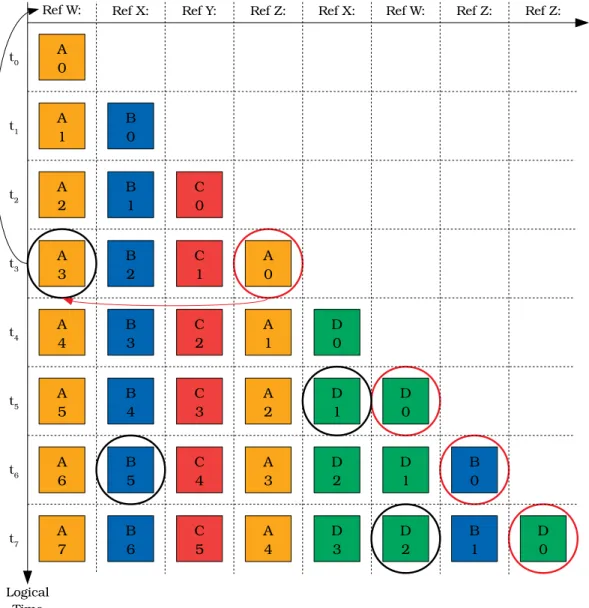
A 0 B 0 A 1 A 2 B 1 C 0 A 3 B 2 C 1 D 0 A 0 D 0 B 0 A 4 B 3 C 2 A 1 D 1 A 5 B4 C3 A2 D 1 D 2 A 6 B5 C4 A3 Ref W: B 1 D 2 D 3 A 7 B 6 C 5 A 4 D 0
Ref X: Ref Y: Ref Z: Ref X: Ref W: Ref Z: Ref Z:
Logical Time t0 t1 t2 t3 t4 t5 t6 t7
Figure 2-1: Forward reuse interval calculation for an arbitrary access sequence. Red circles indicate the re-access of an item whose original access is circled in black. The first re-access includes directional arrows to show how the reuse interval calculation traces back to the reference that is associated with the interval.
and provide information about the locality of the accesses [37].
Access based reuse intervals are introduced by Li et al [21]. These evaluations are made at data page level and are used in dynamic cache allocation (require trace length for assignments), which a compiler cannot use. Alternatively, RIs can be described statically or at the reference level of abstraction. While dynamic RIs are associated with a specific access, a static RI is associated with the reference instruction that results in the access and does not change over the length of the trace. An example of
this is shown in Figure 2-1.
The first and second accesses to data object A occur at 𝑡0 and 𝑡3, resulting in an
RI of 3. This RI is associated with the reference that made the first access to the pair, reference W. The interpretation of this is as follows: after reference W accesses object A, it is known that the object will be accessed, or reused, either by reference W or some other reference in three accesses. Similar to access level RIs, reference
level RIs can be defined by a distribution. Object D is first accessed at 𝑡4 and reused
at𝑡5, resulting in a reuse interval of 1 being associated with reference X. At 𝑡7 object
D is again re-accessed by a different reference, yielding a new RI of 2 (RIs are relative to the direct preceding access). This RI is associated with reference W, and does not affect the previous RI associated with reference X. RIs that project reuses ahead of time are called forward reuse intervals. For the purpose of this paper the term forward reuse interval is synonymous with RI.
A more practical example of a five point stencil (Listing 2.1) is used for subse-quent discussion in this paper. In this example RIs are associated with high level programming language (HLPL) references, but there is no difference in concept be-tween that and an instruction set architecture (ISA) level reference. The resulting RI distributions are given in Table 2.1. The combination of nested loop and index offsets in the stencil formula result in both immediate and long term reuses. There are also two references without an observed reuse. This example has characteristics of all three access patterns: recency-friendly (immediate reuses), scan (no reuses), and thrash (long term reuses) if the array dimension exceeds cache capacity.
Listing 2.1: Example five-point stencil program.
f o r( i =1; i <1024; i++) f o r( j =1; j <1024; j++)
b [ i ] [ j ]=a [ i ] [ j ]+a [ i ] [ j−1]+
a[i][j] a[i][j+1] a[i][j-1] a[i+1][j]
RI Count RI Count RI Count RI Count
7 1,043,462 4 1,043,462 6,128 1,043,462 6,124 1,043,462
6,135 1,021 - - - - 6,128 1,021
Table 2.1: Reuse interval (RI) histograms for four of the references of the five-point stencil program. Each row represents a different reuse interval that is observed for each reference. References with no reuses (b[i][j] and a[i-1][j]) are omitted [27].
2.2
Lease Cache: CLAM
Lease cache is a new prescriptive cache interface where at every access a lease is assigned to the accessed object by the program. The lease is a protection mechanism for the object in that it acts like a lifespan. The object remains in cache for the duration of the lease, and is evicted at the end of the lease term (leaseexpiration). In this way lease cache is prescriptive - when accessed the program allocates a specific amount of cache for the object and when expired the space is de-allocated. When there is a cache miss, any expired cache line can be used for replacement.
This variant of lease cache differs from OSL by assigning leases to references (ISA level memory instructions), calledreference leases. At every access, the reference lease
of the instruction accessing the object is applied to the object (lease assignment or
lease renewal). For example, if reference X and W of Figure 2-1 have reference leases of 1 and 2 respectively, then data object D is assigned a lease of 1 at 𝑡5 and 2 at 𝑡6.
Assigning any smaller lease results in the object’s lease expiring before its next reuse. Conversely, assigning any larger lease results in over-allocation of cache (using more cache resources than is required, limiting the possible resources other objects can use). The relationship between lease and RI is apparent; when the two are equivalent an object is minimally safe in cache until its next access and subsequent lease assignment. In deciding what reference leases to assign the compiler can control how cache memory
resources are utilized. This is called Compiler Lease cAche Management or CLAM.
Both make lease assignments based on reuse interval distributions, but CLAM does so statically at the reference level. Any reference can access any object, so basic properties extend to more complex programs and patterns (OSL reference groups are limited to one target). Because OSL requires a lease per data page it is potentially less scalable than CLAM (number of references can be many magnitudes less than the number of data pages accessed). Furthermore, CLAM considers accesses at cache block granularity, rather than at page level, which makes it applicable for low level hardware caches.
2.2.1
CARL: Compiler Assigned Reference Leasing
Reference leases are assigned by the compiler using an algorithm called Compiler Assigned Reference Leasing, or CARL [10]. CARL assigns reference leases with the highest benefit until a target cache utilization budget is reached. CARL is designed for variable sized caches (network, unified, or shared caches), meaning that it is not absolutely constrained by cache size. Instead, the optimization budget is the product of trace length (time quantity) and target cache size, an aggregate value. When averaged across the trace length the budget is the target cache size, but the instantaneous cache utilization is allowed to deviate from that, hence it is an algorithm for variable sized caches.
The cost and profit of a specific lease assignment, 𝑙, is determined by the RI
distribution or histogram of the references. For simplicity assume RI distributions
are represented as vectors,𝐻, where the index and value refer to the RI and number
of accesses with that RI (RI count) respectively. Lease profit is equivalent to the number of cache hits that result from a specific assignment. The profit (2.1) is then
the number of accesses in 𝐻 whose RI is less than or equal to the assigned lease, 𝑙.
Profit(𝑙, 𝐻) =
𝑙
∑︁
𝑖=0
𝐻[𝑖] (2.1)
The cost associated with a specific lease assignment is the overhead resulting from the lease, i.e. how much cache space does the assignment allocate. Unlike lease
benefit, the cost of a lease is directly dependent on the value of the lease assignment. All RIs less than the lease will only incur cost until they expire or are renewed, while all RIs greater than the lease are limited by the selection of the lease. The first summation of Equation 2.2 is the cost associated with RIs less than the lease, while the second summation is the complementary condition.
Cost(𝑙, 𝐻) = 𝑙−1 ∑︁ 𝑖=0 𝑖*𝐻[𝑖] + 𝑅𝐼𝑚𝑎𝑥 ∑︁ 𝑖=𝑙 𝑙*𝐻[𝑖] (2.2)
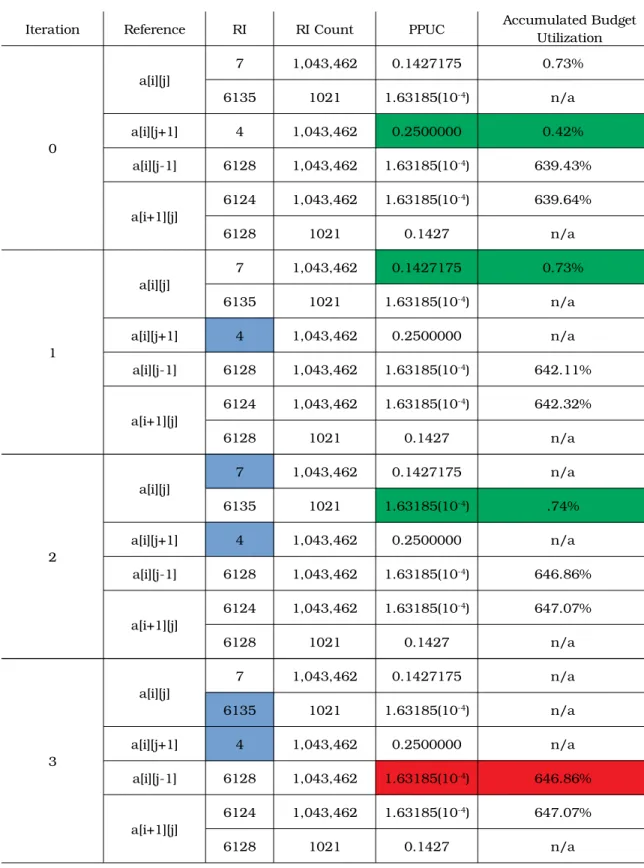
CARL’s objective is to maximize the profit per unit cost (PPUC) of assignment. CARL essentially looks at all references, and assigns the lease that provides the largest PPUC, regardless of past assignments. CARL is a greedy algorithm and hence ignores coverage - i.e. it will assign the highest value lease regardless if a lease has already been assigned to the reference. Lease assignment for the stencil (Listing 2.1, Table 2.1) is shown in Figure 2-2. In this example an arbitrary budget of one billion is used and PPUC is expressed as a marginal value to show the benefit in iteratively updating lease values from prior assignments.
The first observation from the assignment process is that not all references are assigned a lease. The target budget is exceeded at iteration 3 causing all remaining references to be assigned a zero lease. Since the assignment at iteration 3 exceeds the budget it also is not assigned; however, there is still residual budget. In order to
utilize this an extension to CARL, dual leases, is introduced in Section 2.2.2. The
second noticeable outcome is that the large PPUC of𝑎[𝑖+ 1]𝑏[𝑗]does not result in an assignment of that lease. In order to consider this lease the preceding assignment (of a smaller lease) must first be made. The PPUC of this lease is not the largest of all possible candidates, so CARL does not make the assignment.
2.2.2
CARL Extensions
Dual Leases
Assignment by CARL may result in unused residual budget due to further assignment incurring more cost than there is remaining budget. In this case the cache is
under-allocated, which negatively impacts performance. To make use of this budget portion
CARL assigns a dual lease. A dual lease is a lease assignment that can result in
two possible values. Which of the two are assigned at an access is controlled by an assignment probability. The goal of these assignments is to interpolate the cost of assignment so that it equals the remaining budget. For example, if lease assignment
𝑙𝑜𝑣𝑒𝑟𝑏𝑢𝑑𝑔𝑒𝑡 exceeds the remaining budget by a factor of two then 𝑙𝑜𝑣𝑒𝑟𝑏𝑢𝑑𝑔𝑒𝑡 is only
assigned for half of its accesses. The remaining half are assigned a lease of zero so that the budget is not exceeded. Dual leases are functions of the RI distribution while
the assignment probability, 𝑝, is given by Equation 2.3. For the stencil (Figure 2-2)
lease assignment would be terminated at step 3 because further assignment results in over-allocation by a factor of roughly 6.5. With dual leasing CARL assigns the red item with a probability of 15% so that the budget is not exceeded (lease of 4 is assigned 85% of all accesses, lease of 6128 is assigned the remaining 15%).
𝑝= remaining budget
Cost(𝑙′, 𝐻)−Cost(𝑙, 𝐻) (2.3)
PRL: Phased Reference Lease
CARL by design is for variable sized caches. While not guaranteed, it is likely that for specific types of programs and patterns CARL may under-allocate or over-allocate cache at specific points in time. An over-allocated cache, from a lease definition, is one where no lease is expired when an eviction is needed. There is no clear eviction choice in this situation, and arbitrarily evicting a line would most likely incur some performance penalty, as all lines have non-zero leases (will be re-referenced). This type of over-allocation stems from CARL allowing the lease budget to deviate from the average along the entire trace length. The solution to this is to examine the trace in phases, evaluating budget utilization in each. This is called phased reference leasing, or PRL.
PRL splits the trace into 𝑛 phases and associates a local allocation budget of
𝑔𝑙𝑜𝑏𝑎𝑙_𝑏𝑢𝑑𝑔𝑒𝑡/𝑛 and local RI distribution to each phase. Leases are assigned based
incurs a cost based on its respective RI distribution. Leases are assigned in the same manner as CARL until a phase’s budget is fully utilized, whether by dual lease or otherwise. From this point on (to algorithm termination) no other assignments can be made that would increase the cost of the fully utilized phase. Although PRL is described in terms of phases it also extends to set associativity. Instead of splitting a trace into temporal phases it is split into access groups or spatial phases, and leases are assigned in the same manner.
FUL: Fixed Uniform Lease
A program may not be amenable to performance optimization by CARL or PRL. This can be due to compiler restrictions (lack of ISA or hardware clairvoyance) or program
structure (small or very complex programs would not elicit significant benefit). Fixed
uniform lease, FUL[26], is a safety feature extension of CLAM for these cases. As the name suggests FUL assigns one static lease for the entire set of program references. If the appropriate lease is chosen, then LRU equivalent performance is achieved. Thus, FUL can be seen as a safety feature of CLAM in that LRU performance, at minimum, is guaranteed. FUL assignments can be generated in the same manner as variable leases; however, for this work is empirically studied (by parameter sweeping the uniform lease value). FUL may also be used to emulate other cache policies through alternative lease selection/s.
1.63185(10-4) Iteration RI RI Count a[i][j] PPUC Reference a[i][j+1] a[i][j-1] a[i+1][j] 0 7 Accumulated Budget Utilization 4 6128 6124 1,043,462 1,043,462 1,043,462 1,043,462 0.1427175 0.2500000 6135 1021 1.63185(10-4) 0.1427 6128 1021 1.63185(10-4) 1.63185(10-4) 0.73% 0.42% 639.43% 639.64% n/a n/a a[i][j] a[i][j+1] a[i][j-1] a[i+1][j] 1 7 4 6128 6124 1,043,462 1,043,462 1,043,462 1,043,462 0.1427175 0.2500000 6135 1021 1.63185(10-4) 0.1427 6128 1021 1.63185(10-4) 1.63185(10-4) 0.73% n/a 642.11% 642.32% n/a n/a a[i][j] a[i][j+1] a[i][j-1] a[i+1][j] 2 7 4 6128 6124 1,043,462 1,043,462 1,043,462 1,043,462 0.1427175 0.2500000 6135 1021 1.63185(10-4) 0.1427 6128 1021 1.63185(10-4) 1.63185(10-4) n/a n/a 646.86% 647.07% .74% n/a a[i][j] a[i][j+1] a[i][j-1] a[i+1][j] 3 7 4 6128 6124 1,043,462 1,043,462 1,043,462 1,043,462 0.1427175 0.2500000 6135 1021 0.1427 6128 1021 1.63185(10-4) 1.63185(10-4) n/a n/a 646.86% 647.07% n/a n/a
Figure 2-2: CARL assignment procedure for a budget of one billion. Green items indicate a lease assignment made at the current step. Blue indicates a lease assignment previously made, which is contributing to the overall cost. Red indicates assignment termination due to the budget being exceeded.
Chapter 3
Lease Cache Hardware Design
This section presents the first functional hardware implementation of lease cache that supports all CLAM assignment policies. First, fully associative lease cache is consid-ered, followed by an extension for set associative designs. The necessary hardware-software interface and hardware-software level support for the cache is then detailed. In addition to the cache hardware, two CLAM hardware support designs are also presented. One a reuse interval sampling front-end to CLAM, and the other a lease cache dynamics tracker. All three designs are considered the significant contributions of this work. Note that the objective of this work is functionality, not optimal hardware design. The designs outlined in this chapter are presented with generic parameters that are later defined in Section 4.1.3 as they relate to performance testing.
3.1
Lease Cache Implementation
A practical hardware implementation of CLAM must run in real-time without limit-ing the memory system, and its hardware-software interface must be simple enough to integrate into existing technologies. In theory, the reference assignments gener-ated by CLAM are unbounded in quantity and value, yet they must be used effective enough such that CLAM is competitive with latencies seen in other caching policies. Similarly, any overhead from leasing must be justified by the resulting cache perfor-mance. As with traditional caching, lease case must be transparent to the processor
and user, otherwise one of the main benefits of caching is eliminated. The hard-ware and softhard-ware considerations for CLAM are discussed in sections 3.1.1 and 3.1.2 respectively.
3.1.1
Hardware
Lease cache hardware is divided into two stages,
1. Lease lookup - hardware necessary to translate memory access information to lease assignment information; performed in parallel with cache access index/ad-dress translation.
2. Lease update - hardware necessary to modulate/control active leases and gener-ate an eviction victim; occurs after lease information is genergener-ated for an access. In this way the lease cache can be viewed as a general two stage pipeline. The dedicated lease components are built around existing cache infrastructure (traditional communication buses, request-service sequencing/control, pipeline stages, etc.) so that comparisons between lease and other policies are consistent. They in fact can be viewed as system augmentations; the cache can still function under an auxiliary replacement policy (discussed in Section 3.1.1) if leasing is disabled. CARL, PRL, and FUL all utilize the same component structure detailed hereafter.
Lease Lookup
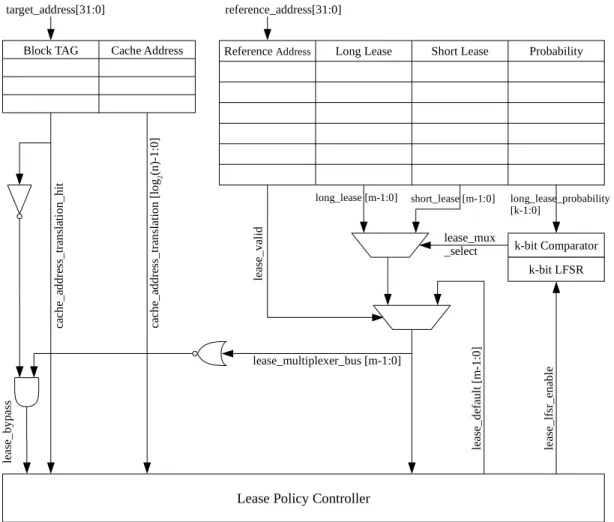
Lease lookup is the stage of lease cache responsible for generating lease information and control signals based on a memory access request. It is implemented in parallel with the cache target address translation (Figure 3-1), in a similar manner. When an access is requested, the core provides an additional field, the reference address (instruction address) of the access. The reference address is searched for in a lookup table called the lease lookup table (LLT), which contains four fields,
1. Reference Address - the search parameter/input of the table. It is the address of the instruction (load/store) responsible for the memory request. This field
results in a match status bit output.
2. Long Length Lease - if assignment is a dual lease, this field is the longer lease assignment of the two. Otherwise, it is the sole lease assignment generated by CLAM. This field is a direct output.
3. Short Length Lease - if assignment is a dual lease, this field is the shorter lease assignment of the two. Otherwise, this value is redundant. This field is a direct output.
4. Long Lease Probability - probability of assigning the long length lease upon an access to the table entry. If the table entry is not a dual lease this field stored in the table as a quantity equivalent to 100%. This field is a direct output. LLT entries are consistently aligned such that finding a reference address match produces all associated fields of that reference without additional hashing (all have the same index). The direct outputs of the table are used to multiplex dual leases while the match bit controls lease assignment.
Dual lease output selection is controlled by a linear feedback shift register (LFSR) circuit. The LFSR output is compared against the long lease probability generated by the LLT at an access. If the LFSR output is less than or equal to the table probability, the long lease is multiplexed; otherwise the short lease is multiplexed. In cases of non-dual leases the long lease is guaranteed to be assigned by fixing the probability field to 100% so that the LFSR output never exceeds the probability field. While leases are integer values (can only have integer reuse intervals), the lease assignment probability is a floating point number. In order to store and use this in hardware the value is discretized according to the bit width of the LFSR (with adjustments for the unachievable space of the LFSR sequence - i.e. zero). The size required to sufficiently discretize the probability values for the LFSR design is dependent on the program being examined; however, this parameter can be constrained to a specified uniform resolution and evaluated by CLAM (in theory - not a current feature of CLAM). The correct adaptation of this is to floor the decimal probability value to the nearest discrete value and incur this as a performance reduction due to under-allocation.
target_address[31:0]
ReferenceAddress Long Lease Short Lease Probability Cache Address Block TAG reference_address[31:0] lease_multiplexer_bus [m-1:0] le as e_ va li d ca ch e_ ad dr es s_ tr an sl at io n_ hi t ca ch e_ ad dr es s_ tr an sl at io n [l og2 (n )-1: 0]
long_lease [m-1:0] short_lease [m-1:0] long_lease_probability [k-1:0] le as e_ lf sr _e na bl e lease_mux
_select k-bit Comparator k-bit LFSR le as e_ de fa ul t [ m -1 :0 ] le as e_ by pa ss
Lease Policy Controller
Figure 3-1: Lease cache lookup stage hardware overview for fully and set associa-tive cache. Component and signal sizings are given in Section 4.1.3. Note that
𝑙𝑒𝑎𝑠𝑒_𝑚𝑢𝑙𝑡𝑖𝑝𝑙𝑒𝑥𝑒𝑟_𝑏𝑢𝑠 is driving a NOR reduction gate.
A secondary multiplexer after the LFSR validates the lease assignment. If the reference address is not found in the LLT during translation (LLT miss) the lease assignment is overwritten by a default value, which is stored as a software configurable register. The default lease serves the primary purpose of accounting for unmatched references; however, this may also be used to reduce the number of LLT entries needed by grouping together similar leases, a hardware resource specific detail. Given an infinitely sized/scalable table and CLAM clairvoyance of program execution the default lease is unnecessary. For an embedded system the LLT can be sized according to the workload; however, CLAM clairvoyance requires that the application sequence is deterministic enough for the compiler to analyze. This issue of program clairvoyance
is addressed in Section 3.2.
Section 2.2.1 describes how a cache is partitioned by CLAM. In cases where no lease can be assigned due to the limited budget, all remaining references are assigned a zero lease so that they do not impact assignment cost. Dual lease assignment is similar in that either the primary or secondary lease can be a zero lease. The hardware
implementation of this is known as azero lease bypass. It is initiated when a request
results in a cache miss, and the item is to be assigned a lease of zero. When this occurs the request is serviced, but not cached so that the working set is preserved; otherwise, this results in the forcible eviction of a cached item in order to allocate an item of no benefit, i.e. zero lease, reducing performance. The occurrence of forcibly evicting a cache line, regardless of its current lease value, is discussed in Section 3.1.1.
Lease Update
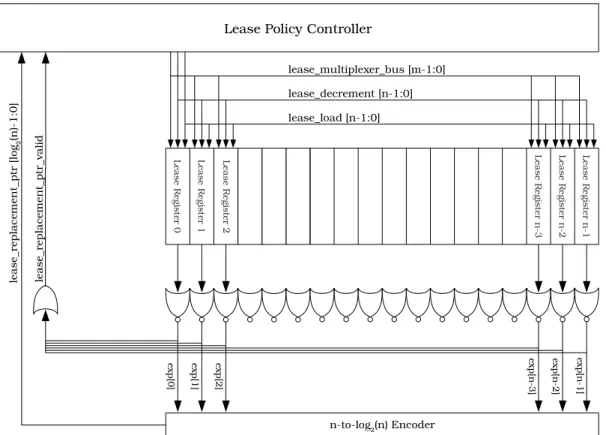
The lease update stage is where all active leases are maintained and updated. Each cache line is associated with a lease register (Figure 3-2) that holds the line’s current lease. At every access, the cache line targeted by the request loads its lease register with the lease assignment generated by the lookup stage, while the lease registers of all other cache lines are decremented, as long as they are non-zero. A cache (not to be confused with LLT) miss necessitates that the stage generates an eviction victim based on the state of the active leases. There are three possible eviction conditions to consider,
1. 1 expired lease - the trivial eviction case; the sole expired cache line is selected for eviction.
2. 2+ expired leases - the lowest address expired cache line is selected for eviction. 3. 0 expired leases - there is no eviction candidate according to lease policy,
re-placement follows an auxiliary policy.
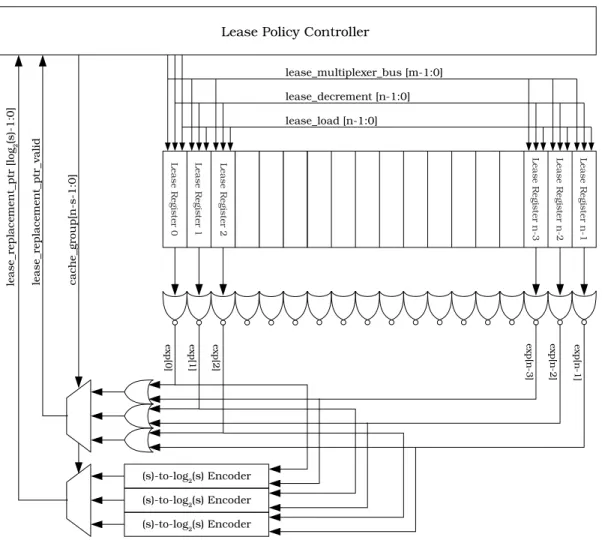
A priority encoder (Figure 3-2) is used for victim selection when there is at least one expired cache line. Each lease register drives a logical NOR reduction gate to
Lease Policy Controller lease_multiplexer_bus [m-1:0] lease_decrement [n-1:0] lease_load [n-1:0] le as e_ re pl ac em en t_ pt r [lo g2 (n )-1: 0] le as e_ re pl ac em en t_ pt r_ va lid n-to-log2(n) Encoder Le as e R eg ist er 0 Le as e R eg ist er 1 Le as e R eg ist er n -1 Le as e R eg ist er n -2 Le as e R eg ist er n -3 Le as e R eg ist er 2 ex p[0 ] ex p[1 ] ex p[2 ] ex p[n -3 ] ex p[n -2 ] ex p[n -1 ]
Figure 3-2: Lease cache update stage for fully associative cache. Component and
signal dimensions are given in Section 4.1.3. Note that𝑒𝑥𝑝bus drives an OR reduction
gate.
create an expired flag (logic high if every bit of the lease register is logic low). The bus of expired flags subsequently drive a priority encoder which generates a pointer to the cache address of the first (least significant bit priority) expired lease register. The pointer is verified (necessary due to default encoder output) by taking the logical OR reduction of the expired flag bus. If at least one flag is logic high the replacement valid flag is driven high. In this way the lease encoding scheme can be efficiently used to determine the trivial case victim, the multi-expired lease victim, and can identify when there is no expired lease. Additionally, there is no theory to suggest that an alternative method of victim selection, for the multiple expired lease case, would result in cache performance improvement. It is shown in Section 2.2.1 that it is possible to assign a reference lease that does not cover the entire RI distribution of a reference due to budget limitations. In this scenario it would be beneficial to replace the "most
expired lease", or the cache line that has been expired for the longest amount of time. Tracking this is unrealistic from a hardware view (additional counter per cache line and comparison/stack circuit). Additionally, there is no guarantee that this is the case for any lease, nor is there a way to predict this in hardware (without additional information encoded in the LLT).
If there is no expired lease (replacement valid flag seen as logic low), the cache is over-allocated and the lease policy cannot identify a victim. An auxiliary replacement policy, random replacement, is then used to choose the victim. Random replacement is used for several reasons,
• The LFSR from the lookup stage is efficiently reused.
• Regardless of the selected victim, a penalty is incurred due to early eviction. • This eviction scenario is thought to be irregular or uncommon. It is assumed
that there will be an expired lease when an eviction is required, according to CLAM theory. CARL budget averages to the target cache size so this may be proved incorrect for certain types of program/patterns.
• Due to a finite budget leases may not be indicative of the actual reuse interval. MIN [8] states that optimal replacement is when the furthest reuse item is evicted. From this viewpoint evicting the largest active lease is best. CLAM however, can irregularly assign leases based on PPUC so there is no guarantee that the largest active lease in fact correlates to the longest reuse interval. Again, from a hardware view the circuit required to identify the largest lease comes at unreasonable cost, especially when a performance penalty will be absorbed regardless of choice. Section 5.1 further supports use of random policy.
Figure 3-2 depicts the update stage for a fully associative cache. The expired flag of every lease register drives the same encoder. A set associative cache can use the same general concept to determine local (set) replacements (Figure 3-3). Each set drives a unique encoder and reduction gate. The output buses of each component are multiplexed by group (sub field of target address) which yields the appropriate
Lease Policy Controller lease_multiplexer_bus [m-1:0] lease_decrement [n-1:0] lease_load [n-1:0] le as e_ re pl ac em en t_ pt r [lo g2 (s )-1: 0] le as e_ re pl ac em en t_ pt r_ va lid Le as e R eg ist er 0 Le as e R eg ist er 1 Le as e R eg ist er n -1 Le as e R eg ist er n -2 Le as e R eg ist er n -3 Le as e R eg ist er 2 ex p[0 ] ex p[1 ] ex p[2 ] ex p[n -3 ] ex p[n -2 ] ex p[n -1 ] (s)-to-log2(s) Encoder (s)-to-log2(s) Encoder (s)-to-log2(s) Encoder ca ch e_ gr ou p[ n -s -1 :0 ]
Figure 3-3: Lease cache update stage for a generic four way set associative cache, with
update circuitry shown for three sets. The𝑒𝑥𝑝bits of each set drive an OR reduction
gate in the schematic. Component and signal dimensions are given in Section 4.1.3.
Parameter s is set size.
set replacement pointer and validation flag. The lookup stage structure for set lease caching is identical to the fully associative hardware shown in Figure 3-1.
3.1.2
Software Support
The architecture presented in Section 3.1.1 assumes that the LLT is populated with all run-time lease information, and provides no mechanism for managing it. One of the objectives of the lease cache implementation is to be transparent to the user, and not require extraneous interaction. In support of this, lease information is embedded in the application binary. Other than the cost of managing and storing more data,
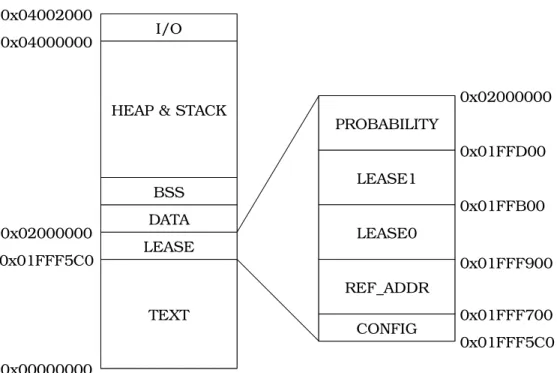
TEXT 0x00000000 LEASE 0x02000000 0x01FFF5C0 DATA BSS 0x04000000 I/O 0x04002000
HEAP & STACK
0x01FFF5C0 0x02000000 0x01FFF700 0x01FFF900 0x01FFB00 0x01FFD00 CONFIG PROBABILITY LEASE1 LEASE0 REF_ADDR
Figure 3-4: Mapping of lease cache memory partitions in application binary. Ad-dresses are byte addressable.
this is a robust way of communicating lease cache information invisibly from software to hardware.
Programs are compiled to executable and linkable formats (ELF), a common Unix format. Figure 3-4 shows how lease cache information is linked in this format. LLT data along with cache configuration information is placed at the end of read only memory. It is sized such that the the benchmarks discussed in Section 4.3 can be allocated in the partitions along with configuration data used in lease cache and the hardware discussed in Section 3.2. The lease cache controller contains an internal read only register initialized with the starting address of the configuration partition. Out of reset the cache controller requests the first block of lease configuration data. The content of this block provides LLT initialization information to the cache such as the number of entries to write into the table. The cache controller then imports
the respective data from main memory to the LLT. This is referred to as static lease
caching.
since it occurs as a preprocess out of reset. It is however, directly extendable, in terms of overhead. For an LLT with 128 entries, 32 block transfers are needed to fully populate the table (1 LLT entry is 4 fields which is one-fourth of a block). Current versions of CARL and PRL only produce one dual lease entry so the minimum number of required transfers to populate the table is reduced to 17 blocks. For a given workload, if leasing decreases the cache miss count (as compared to another policy) by the block transfer overhead associated with filling the table, use of lease cache is justified. Static lease caching incurs no run-time overhead to maintain the LLT.
3.2
Hardware Support for CLAM
Compiler driven analysis of reuse intervals is the basis for CLAM. In Section 2.1 the five point stencil (Listing 2.1) is used to illustrate this. Compilers have the ability to examine the HLPL of an application and analytically determine the resulting RI distribution, as shown in Table 2.1 by the symbolic references. The issue with this representation of references and RIs is that hardware lease cache requires binary map-pings (memory addresses) for lease lookup/translation. CLAM must have both the ISA support for the target environment and the ability to track how the intermediate symbols translate to binary instructions (which first requires ISA support) in order to be of practical use.
The current version of CLAM, which is discussed in this paper, does not have ISA specific support. The proposed solution to this is a hardware front-end that generates binary mapped RI distributions by profiling the target application. CLAM then evaluates these statistical RIs, and generates leases through a CARL/PRL
im-plementation. This is referred to as hardware reuse interval sampling.
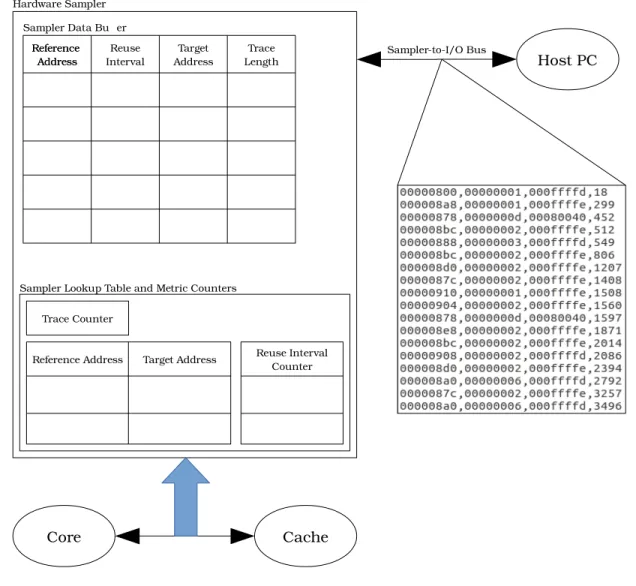
The hardware sampler is essentially a snooping agent placed on the communication bus between the cache and processor core (Figure 3-5). The sampler continuously monitors bus signals, and periodically samples/records transaction data, specifically the reference address and target address. After sampling an item it looks for a re-access of the same item (to calculate a reuse interval), and when one is seen stores
all reuse information about the item. The sampler has three main components, 1. Sample table - small capacity lookup table that holds all sampled data without
an observed reuse.
2. Reuse interval counters - maintain the active/running reuse interval of each entry in the sample table. The counter increment at every observed memory access.
3. Reuse interval buffer - large capacity memory that stores all sampled data with an observed reuse. The buffer can be accessed by external hardware.
The communication bus is sampled at random variable sized intervals using an LFSR to generate the sequence of intervals. Random sampling is chosen over fixed interval sampling in order to improve sampling coverage (fixed interval sampling runs the risk of continuously sampling the same reference and ignoring others). When sampled, the communication bus’s current values are written to the next open location in the table. A sample remains in the table until either: a reuse of the target address is seen (reuse interval found), or the table reaches capacity (no unused table addresses). Unused table locations are kept track of by an address stack (when writing to the stack is popped, when evicting from the table the address is pushed).
When a table entry reuse is seen the entry is evicted from the table and written to the buffer along with its associated reuse interval counter value and the current trace length. The objective of the eviction is to minimize table utilization due to the table’s finite size. Ideally, the sampler would observe at least one reuse for every possible reference, for the application being profiled. It is not possible to track all memory accesses (in most cases), and so once a reuse is identified the entry is removed. This action frees up the table location for a new sample, which is likely to be different from the sample that was just removed, presumably increasing the coverage rate of references with an associated reuse interval.
There are two causes for the table reaching capacity: the table is not sized propor-tionally to the working-set (specifically with respect to array sizes) and/or the table
Core Trace Counter
Target Address
Reference Address Reuse Interval Counter Reference
Address IntervalReuse AddressTarget LengthTrace Reference
Address Sampler-to-I/O Bus
Sampler Data Buffer
Sampler Lookup Table and Metric Counters Hardware Sampler
Cache
Host PC
Figure 3-5: Hardware reuse interval sampler system overview. Delimited text file shown is output read from the sampler with same field order shown in the buffer. contains non-reuse entries (entries that do not have a future reuse - stream pattern characteristics). In these cases a table entry is forcibly evicted so that a new sample can be allocated. The sampler finds the entry with the largest active counter value, and removes it from the table. Although this is not a reuse, it is written to the buffer as a negative RI value to flag this occurrence for CLAM. When sampling is complete, all active table entries are likewise written to the buffer in the same format.
Comprehensive reference coverage is not guaranteed by sampling. There is no analytical method for determining a minimum sampling rate or any similar control parameter, nor is there a proof for what adequate coverage is considered. Moreover,
there is a direct trade-off between the sampling rate and range of reuse interval mag-nitudes that can be captured. The higher the sampling rate, the faster the sampling table reaches capacity (assuming program size > table size). Because the oldest en-try is forcibly evicted when this occurs, only references with short reuses (RI < table size) can be measured. Due to this, sampling is heuristic and highly dependent on the program being profiled. Regardless, it is hypothesized that if sampled sufficiently, all unsampled references are of low benefit due to irregularly large reuse intervals or are part of a stream access pattern (no reuse). Being of low benefit, these references can be associated with any arbitrarily small default lease, such that they do not significantly impact CLAM assignment cost.
3.2.1
Lease Tracking
The state (current active values) of the lease register array is a direct indicator of cache utilization and performance, a topic discussed in Section 4.2. If many leases are expired the cache is under-utilized. Conversely, if no lease is expired the cache is over-utilized. In reactive and collaborative caches, even ones with assumed re-reference intervals [18], there is no concept of the cache state because there is no knowledge of when an item will be reused. Lease caching (being a prescriptive policy) however, enables one to evaluate the cache’s effectiveness by examining the lease register array state. Real-time tracking of this can be used to quantify policy effectiveness and theoretically enables performance adjustments to be made concurrent to execution, such as repartitioning/sharing a network cache for other tasks.
Lease state tracking is possible using the same general infrastructure as the sam-pler (Figure 3-5). Instead of monitoring reuses the tracker simply records the lease register array state at fixed intervals. Comprehensive tracking of every lease register, down to one bit resolution, is costly to perform, manage, and store, so the state is octal approximated by Equations 3.1-3.4 as follows,
𝐴𝑝𝑝𝑟𝑜𝑥𝑖𝑚𝑎𝑡𝑒𝑑 𝐿𝑒𝑎𝑠𝑒[3] = |(𝐿𝑒𝑎𝑠𝑒[31 : 24])224 (3.1)
𝐴𝑝𝑝𝑟𝑜𝑥𝑖𝑚𝑎𝑡𝑒𝑑 𝐿𝑒𝑎𝑠𝑒[2] = |(𝐿𝑒𝑎𝑠𝑒[23 : 16])216 (3.2)
𝐴𝑝𝑝𝑟𝑜𝑥𝑖𝑚𝑎𝑡𝑒𝑑 𝐿𝑒𝑎𝑠𝑒[1] = |(𝐿𝑒𝑎𝑠𝑒[15 : 8])28 (3.3)
𝐴𝑝𝑝𝑟𝑜𝑥𝑖𝑚𝑎𝑡𝑒𝑑 𝐿𝑒𝑎𝑠𝑒[0] = |(𝐿𝑒𝑎𝑠𝑒[7 : 0]) (3.4)
The lease register is subdivided into eight bit groups, each driving a logic OR reduction gate (similar to the NOR reduction array of the lease update stage shown in Figure 3-2). Each bit of the approximation is associated with a reuse quantifica-tion: future, near-future, near-immediate, and immediate (from MSb to LSb). If all bits of the approximation are logic low the lease it is derived from is expired. This approximation is a measure of how cache is allocated by the lease assignment. If tracked over a period of time cache effectiveness for a given application or pattern can be visualized. These quantities are further used in Section 4.2.
Chapter 4
Testing
While cache is an integral hardware of computer systems, it is not a standalone component. The stencil (Listing 2.1) program demonstrates how leases can be used for caching; however, a processing system is still required to execute the program, and generate the related memory accesses. Similarly, the manner by which the program is compiled, in terms of ISA and options, can significantly alter the execution sequence. In this chapter the test architecture for the described lease cache is provided, along with formal metric definitions for lease cache performance. A new visual tool for evaluating lease cache utilization is also presented.
4.1
Test System
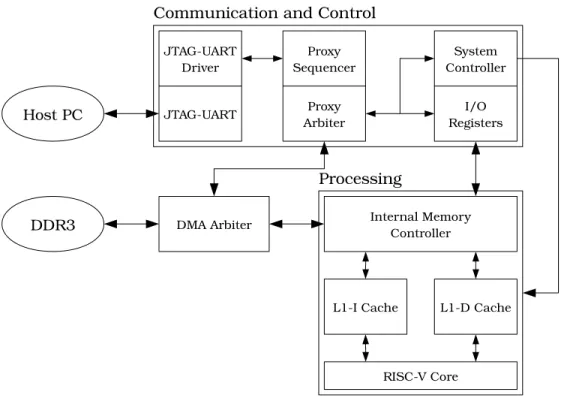
The hardware test system (Figure 4-1) is implemented on a CycloneV-GT FPGA development board [4]. The system is comprised of a processor core, internal and external memory subsystems, and a communication and control subsystem which is interfaced to an external host computer. The lease cache, reuse interval sampler, and lease tracker systems all use the same bare-metal architecture and components. The FPGA hardware is responsible for processing and generating all data, in the case of the sampler and tracker, while the host PC is used for system control and data management. This section outlines the hardware subsystems that support the lease cache.
Communication and Control Processing Host PC DDR3 JTAG-UART JTAG-UART Driver Proxy Sequencer Proxy Arbiter System Controller DMA Arbiter RISC-V Core L1-I Cache Internal Memory Controller I/O Registers L1-D Cache
Figure 4-1: Top level test system diagram.
4.1.1
Processor Core
The processor core is designed according to the RISC-V ISA [36], and supports 32-bit integer base instructions as well as the 32-bit integer multiplication extension (ded-icated multiplication and division hardware). The core features a six stage pipeline that uses fall-through branch prediction, and can be run with memory access laten-cies of either one or two cycles, to support cache pipelines. The cache is integrated with instruction and data buffers to the pipeline memory ports to accommodate this functionality. Additionally, data request ordering is maintained by the data buffer (in the case of multiple cycle access latencies), as requests to I/O addresses have a fixed one cycle latency. When running in single cycle latency mode the buffers are bypassed.
Table 4.1: Compiler options for RISC-V toolchain.
Compiler Option
Option
Value Description
-march rv32im Hardware system supports 32-bit base instructionsas well as 32-bit integer multiplication and division extension.
-mabi ilp32 ’int’, ’long’, and pointers are all 32-bits in width.
-specs nosys.specs Specifies bare-metal compilation (no support forsystem calls). Program linked against ’libnosys’. -mno-div n/a Generate code without using dedicated divisionhardware instructions. Legacy option from
December 2019 FUL system.
RISC-V GNU Toolchain
Applications are cross-compiled for the core using the RISC-V GNU toolchain [2], which supports C/C++ languages. Programs are compiled into generic ELFs for newlib standard libraries, in support of the bare-metal/embedded execution envi-ronment of the FPGA system. A custom linker script links the compiled objects according to the memory segments shown in Figure 3-4. The complete list of com-piler options used is given in Table 4.1. Note that applications for this work are
compiled using a now deprecated variant of the toolchain, riscv-none-embed. This
is a dedicated multilib toolchain for bare-metal applications and has since been
ab-sorbed into the riscv-unknown-elf distribution (set -march flag to include rv32e for
equivalent settings).
4.1.2
Communication and Control
The system runs in a bare-metal environment and requires a supporting infrastruc-ture for testing, control, and data acquisition. Previous versions of the system were emulated on a CycloneV-DE0 [31] which limited the complexity of the hardware sys-tem (resource constraints), and how it could interface with other devices (aside from an archaic PS/2 connector, it has no standardized input connection hardware). The lack of I/O capability was circumvented by using an existing JTAG port connection, which is used for configuring the FPGA through Intel’s proprietary software. This
subsystem is likewise implemented on the CycloneV-GT as a legacy design.
The hardware communication interface is comprised of a JTAG-UART circuit for transmitting and receiving packets, and a communication proxy that sequences the raw packets into a protocol, and communicates with other hardware blocks. The proxy is interfaced to,
1. External memory DMA controller - used to directly write binaries (received from the host) into external memory, DDR3.
2. Test controller - controls the processing system test and execution sequence (resets, transfers, etc.).
3. I/O registers - allows for direct communication with the sampler and tracker data buffers, RISC-V core, and other subsystems.
Test Sequence
The lease cache and sampler/tracker have similar operational sequences. Application binaries are sent, from the host, over the UART-JTAG interface, packetized by mem-ory segments. Those packets are then sequenced into write commands and issued by the proxy. When the transfer is complete, the host pulls all remaining hardware subsystems out of reset and into execution. Depending on the system being run (lease, sampler, or tracker) the host polls different I/O registers to check either the application execution status or for a buffer interrupt.
When the main of the program is exited an I/O register is written to, signaling the event to the host so that a subsequent system command can be issued. When the host acknowledges that the main has been exited, all cache performance data is read. Each cache has a dedicated performance monitor which tracks hits, misses, etc. This hardware (and the analogous sampler and tracker circuits) is enabled by special I/O writes executed before entering and after exiting the kernel of the program, limiting the performance evaluation and data acquisition to it (the kernel). The pre-kernel entrypoint/bootload sequence has little cache utilization impact and is consistent for
all benchmarks and cache policies/systems tested, so the cache is not flushed prior to entering the kernel.
When the hardware sampler or tracker is enabled there is another level of polling required. In addition to checking the execution status, the sampler/tracker buffer interrupt flag is also read. This interrupt signals to the host that the buffer is full, and the core has been temporarily stalled. After reading the data from the buffer, the host clears the interrupt, which subsequently re-enables the core.
FUL is tested using the same interface and methodology as CARL and PRL; however, the best performing lease is not known a-priori. In order to determine this parameter the system is empirically parameter swept with leases of increasing value. The range of trialed leases spans zero to 65536 in 7-bit increments, as leases exceeding the range did not show further improvement for the benchmarks trialed. Aside from altering the lease, the FUL replacement policy configuration is also controlled (FUL was the first policy trialed so it has more variants). In the event of no expired lease the auxiliary policy is either random, eviction of the Largest Remaining Lease (LRL), or eviction of the Smallest Remaining Lease (SRL). When evicting by LRL or SRL the cache lines are randomly pooled. The cache line associated with the largest (LRL) or smallest (SRL) active lease (of the pooled subset), is then evicted. Pool sizes of four and eight are trialed for both SRL and LRL. Pool sizes are non-zero and smaller than the cache size because a zero pool size results in random replacement. Conversely, if every line is evaluated LRL and SRL default to MRU and LRU respectively.
4.1.3
Design Parameters
Sizing of lease cache hardware components is application specific. The main focus of the hardware implementation is functionality, rather than speed or efficient resource utilization. Similarly, the design is not meant to be universally applicable for all workloads (in terms of lease register sizing, LLT size, etc.). Nonetheless, embedded system hardware can be designed according to its narrow workload, making it an appropriate candidate for functional lease cache implementation. Table 4.2 lists the lease cache, reuse interval sampler, and lease tracker design parameters that are used
Table 4.2: Hardware design parameters for base cache, lease cache, reuse interval sampler, and lease tracker.
Design Parameter Value
Sampler table entries 64
Sampler table fields per entry 3
Sampler table field width 32-bit
Sampler RI counter width 32-bit
Sampler trace counter width 64-bit
Sampler LFSR width 9-bit
Sampler average sampling rate 1/256 [samples/access]
Sampler clock frequency 20 MHz
Sampler latency to replace oldest entry 64 cycles
Sampler buffer entries 8192
Sampler buffer fields per entry 4
Sampler buffer field width (excluding trace) 32-bit
Sampler buffer trace field width 64-bit
Tracker buffer entries 4096
Tracker buffer fields per entry 4
Tracker buffer field width 128-bit
Tracker sampling rate 1/256 [samples/access]
Tracker clock frequency 20 MHz
Cache clock frequency 20 MHz
Cache access latency 1 cycle
Cache write-out to main memory latency 16 cycles Cache read-in from main memory latency minimum 17 cycles
Cache transfer throughput 1 word per cycle
Cache write-out buffer entries 1
Cache word size 32-bit
Cache block size 16 words
Cache data bus width 32-bit
Cache levels 1
L1-I capacity 8kB (128 blocks)
L1-D capacity 8kB (128 blocks)
Lease cache clock frequency 20 MHz
Lease cache victim selection latency 1 cycle
Lease cache LLT entries 128
Lease cache LLT reference address width 32-bit Lease cache LLT primary and secondary lease width,m 24-bit Lease cache LLT lease probability width,k 9-bit
Lease cache LLT data bus width 32-bit
Lease cache default lease 1 [-]
Lease cache lease register count (same as cache block size),n 128
Lease cache lease register width 24-bit
Lease cache LFSR width 9-bit
4.2
Cache Performance Metrics
Cache performance is evaluated most commonly by metrics derived from the number of misses incurred by the replacement policy. Lease cache, being prescriptive, can also be evaluated by how efficiently the cache is allocated. CARL and PRL assign leases until a target budget is reached, on average. Ideally for a fixed size cache, both algorithms would make assignments such that the lease cost never exceeds the budget at any point in the trace (i.e. cache block capacity is never exceeded). For this to occur at least one lease in cache must be expired at every access miss, so that the requested/missed item can be safely allocated. If however there is no expired cache line, the resources required by CLAM to cache that item exceeds the average, and the cache is said to be over-allocated. Conversely, having an expired lease at every miss does not strictly equate to optimal performance. An expired lease is associated with an item that has no future benefit, meaning there is no benefit to letting the item remain in cache. If, at a miss, there are multiple expired items in cache, one will be used for replacement while the others continue to serve no future benefit. This is synonymous with cache under-allocation.
While over-allocation is directly related to performance, under-allocation is a rel-ative metric. Assume a cache that is significantly larger than the working s
![Figure 1-1: Intel Haswell (i7-4770) cache memory hierarchy [1].](https://thumb-us.123doks.com/thumbv2/123dok_us/519374.2561200/13.918.136.755.117.421/figure-intel-haswell-i-cache-memory-hierarchy.webp)