A parametric bootstrap for heavytailed distributions
Adriana Cornea, Russell Davidson
To cite this version:
Adriana Cornea, Russell Davidson. A parametric bootstrap for heavytailed distributions. 2009. <halshs-00443564>
HAL Id: halshs-00443564
https://halshs.archives-ouvertes.fr/halshs-00443564
Submitted on 30 Dec 2009
HAL is a multi-disciplinary open access
archive for the deposit and dissemination of sci-entific research documents, whether they are
pub-lished or not. The documents may come from
teaching and research institutions in France or abroad, or from public or private research centers.
L’archive ouverte pluridisciplinaire HAL, est
destin´ee au d´epˆot et `a la diffusion de documents
scientifiques de niveau recherche, publi´es ou non,
´emanant des ´etablissements d’enseignement et de
recherche fran¸cais ou ´etrangers, des laboratoires
GREQAM
Groupement de Recherche en Economie
Quantitative d'Aix-Marseille - UMR-CNRS 6579 Ecole des Hautes Etudes en Sciences Sociales
Universités d'Aix-Marseille II et III
Document de Travail
n°2009-41
A PARAMETRIC BOOTSTRAP FOR
HEAVY-TAILED DISTRIBUTIONS
Adriana CORNEA
Russell DAVIDSON
A Parametric Bootstrap for Heavy-Tailed Distributions
by
Adriana Cornea
Tanaka Business School Imperial College London South Kensington campus
London SW7 2AZ UK [email protected]
and
Russell Davidson
Department of Economics and CIREQ McGill University
Montr´eal, Qu´ebec, Canada H3A 2T7
GREQAM
Centre de la Vieille Charit´e 2 Rue de la Charit´e
13236 Marseille cedex 02, France [email protected]
Abstract
It is known that Efron’s resampling bootstrap of the mean of random variables with common distribution in the domain of attraction of the stable laws with infinite vari-ance is not consistent, in the sense that the limiting distribution of the bootstrap mean is not the same as the limiting distribution of the mean from the real sample. More-over, the limiting distribution of the bootstrap mean is random and unknown. The conventional remedy for this problem, at least asymptotically, is either the mout ofn bootstrap or subsampling. However, we show that both these procedures can be quite unreliable in other than very large samples. A parametric bootstrap is derived by considering the distribution of the bootstrap P value instead of that of the bootstrap statistic. The quality of inference based on the parametric bootstrap is examined in a simulation study, and is found to be satisfactory with heavy-tailed distributions unless the tail index is close to 1 and the distribution is heavily skewed.
Keywords: bootstrap inconsistency, stable distribution, domain of attraction, infinite variance
JEL codes: C10, C12, C15
This research was supported by the Canada Research Chair program (Chair in Economics, McGill University) and by grants from the Social Sciences and Humanities Research Council of Canada, and the Fonds Qu´eb´ecois de Recherche sur la Soci´et´e et la Culture. The paper is based on some chapters of the thesis of the first author. We are indebted to Keith Knight for valuable comments on an earlier version.
1. Introduction
Let F be the distribution of the independent and identically distributed random vari-ables Y1, . . . , Yn. We are interested in inference on the parameter δ in the location
model
Yj =δ+Uj, E(Uj) = 0, j = 1, . . . , n. (1)
It has been known since Bahadur and Savage (1956)that such inference is impossible unless moderately restrictive conditions are imposed on the distribution of the distur-bances Uj. Here, we investigate bootstrap inference when the variance of the Uj does
not exist. Even when it does, there are still further conditions needed for inference to be possible.
The focus of this paper is the set of stable laws, and their domains of attraction. Since we know in advance that complete generality is impossible, we hope that considering laws in the domains of attraction of stable laws will provide at least some generality. Our main requirement is that F is in the domain of attraction of a stable law with a tail index α greater than 1 and smaller than 2. A distribution F is said to be in the domain of attraction of a stable law with α < 2, if centred and normalized sums of independent and identically distributed variables with that distribution converge in distribution to that stable law. We write F ∈DA(α).
The stable laws, introduced by L´evy (1925), are the only possible limiting laws for suitably centred and normalized sums of independent and identically distributed ran-dom variables. They allow for asymmetries and heavy tails, properties frequently encountered with financial data. They are characterized by four parameters: the tail index α (0< α ≤ 2), the skewness parameter β (−1 < β < 1), the scale parameter c (c >0), and the location parameterδ. A stable random variable X can be written as X =δ+cZ, where the location parameter of Z is zero, and its scale parameter unity. We write the distribution of Z as S(α, β). When 0< α <2, all the moments of X of order greater than α do not exist. When 1< α≤2, the parameter δ in model (1) can be consistently estimated by the sample mean.
Since there has been some confusion in the literature occasioned by the existence of more than one parametrisation of the stable laws, we specify here that the character-istic function of what we have called the S(α, β) distribution is
E¡exp(itY)¢= exp¡−|t|α[1−iβtan(πα/2)(signt)]¢.
In simulation exercises, we generate realisations of this distribution using the algorithm proposed by Chambers, Mallows, and Stuck (1976), their formula modified somewhat to take account of their use of a different parametrisation. Specifically, a drawing from the S(α, β) distribution is given by
¡ 1 +β2tan2(πα/2)¢1/2αsin(α(U +b(α, β))) (cosU)1/α ³cos(U −α(U +b(α, β))) W ´(1−α)/α
where U is uniformly distributed on [−π/2, π/2], W is exponentially distributed with expectation 1, and b(α, β) = tan−1¡βtan(πα/2))/α.
It was shown by Athreya (1987) that, when the variance does not exist, the con-ventional resampling bootstrap of Efron (1979) is not valid, because the bootstrap distribution of the sample mean does not converge as the sample size n → ∞ to a deterministic distribution. This is due to the fact that the sample mean is greatly influenced by the extreme observations in the sample, and these are very different for the sample under analysis and the bootstrap samples obtained by resampling, as shown clearly in Knight (1989).
A proposed remedy for failure of the conventional bootstrap is themout ofnbootstrap; see Arcones and Gin´e (1989). It is based on the same principle as Efron’s bootstrap, but the bootstrap sample size is m, smaller than n. If m/n → 0 as n → ∞, this bootstrap is consistent. However, as we will see in simulation experiments, the m out of n bootstrap fails to provide reliable inference if the sample size is not very large. Like themout ofnbootstrap, the subsampling method proposed in Romano and Wolf (1999)makes use of samples of sizemsmaller thann, but the subsamples are obtained without replacement. If mis chosen appropriately, this method too is consistent, and performs somewhat better than the m out of n bootstrap.
In this paper, we introduce a parametric bootstrap method that overcomes the failure of bootstrap tests based on resampling, them out ofn bootstrap, or subsampling, for the parameterδof the model (1). The method is based on the fact that the distribution of the bootstrap P value, unlike the distribution of the bootstrap statistic, turns out to have a nonrandom limiting distribution as n→ ∞.
2. The bootstrap P value
Suppose we wish to test the hypothesis δ = 0 in model (1). A possible test statistic is τ =n−1/α
n
X
j=1
Yj. (2)
Let theYj be IID realisations of a law in the domain of attraction of the law ofY ≡cZ,
where Z ∼ S(α, β), and 1 < α < 2. Restricting α to be greater than 1 ensures that the expectation of Y exists.
By the Generalized Central Limit Theorem, the asymptotic distribution of τ is the stable distributioncS(α, β). Ifα,c, andβ are known, then we can perform asymptotic inference by comparing the realization of the statistic τ with a quantile of the stable distribution cS(α, β). The asymptotic P value for a test that rejects in the left tail of the distribution is
P =cS(α, β)(τ).
Unless the Yi actually follow the stable distribution, inference based on this P value
Now suppose that, despite Athreya and Knight, we bootstrap the statistic τ using the conventional resampling bootstrap. This means that, for each bootstrap sample Y∗
1, ..., Yn∗, a bootstrap statistic is computed as
τ∗ =n−1/α
n
X
j=1
(Yj∗−Y¯). (3)
where ¯Y =Pnj=1Yj is the sample mean. TheYj∗ are centred using ¯Y because we wish
to use the bootstrap to estimate the distribution of the statistic under the null, and the sample mean, not 0, is the true mean of the bootstrap distribution. The bootstrap P value is the fraction of the bootstrap statistics more extreme than τ. For ease of exposition, we suppose that “more extreme” means “less than”. Then the bootstrap P value is PB∗ = 1 B B X j=1 I(τj∗ < τ).
Note that the presence of the (asymptotic) normalising factor of n−1/α is no more
than cosmetic.
As B → ∞, by the strong law of large numbers, the bootstrap P value converges almost surely, conditional on the original data, to the random variable
p(Y) = E∗¡I(τ∗ < τ)¢= E¡I(τ∗ < τ)¯¯Y¢, (4)
where Y denotes the vector of the Yj, and E∗ denotes an expectation under the
bootstrap DGP, that is, conditional on Y. p(Y) is a well-defined random variable, as it is a deterministic measurable function of the data vector Y, with a distribution determined by that of Y. We will see that as n → ∞ this distribution tends to a nonrandom limit.
For convenience in what follows, we let γ = 1/α. Knight (1989) shows that, condi-tionally on the original data, the bootstrap statistic τ∗ has the same distribution (in
the limit when B→ ∞) as τ(W) =n−γ n X j=1 (YjWj−Y¯) =n−γ n X j=1 Yj(Wj −1) =n−γ n X j=1 (Yj −Y¯)(Wj −1),
whereW1, ..., Wn is a multinomial vector withntrials and each cell probability is 1/n.
The last equality follows because Pj(Wj−1) = 0 identically. For large n, the
multi-nomial vector has approximately the same distribution as a vector of n independent Poisson random variables M1, ..., Mn with expectation one. Thus, if we make the
definition τ(M) =n−γ n X j=1 (Yj −Y¯)(Mj−1),
thenτ(W)→d τ(M) asn→ ∞conditionally onY1, ..., Yn. We have the following result.
Proposition 1
Conditionally on theYj, the random variableτ(M) has a distribution of which
the cumulant-generating function is
n X j=1 © exp¡itn−γ(Y j−Y¯) ¢ −1ª (5)
as a function of t. The variance of this distribution is n−2γPn
j=1(Yj −Y¯)2,
and its expectation is zero.
The conditional characteristic function of τ(M), as a function oft, is E∗©exp(itτ(M))ª = E∗hexp©it n X j=1 n−γ(Y j −Y¯)(Mj −1) ªi = n Y j=1 E∗ h exp©itn−γ(Yj −Y¯)(Mj −1) ªi
We have E©exp¡it(M −1)¢ª= exp(eit−1−it) for a Poisson variable M with
expec-tation 1. Thus the above characteristic function is exp hXn j=1 © exp¡itn−γ(Yj −Y¯) ¢ −1−itn−γ(Yj −Y¯) ªi
The cumulant-generating function (cgf) is the logarithm of the characteristic function, and, since Pnj=1(Yj −Y¯) = 0 by construction, it is equal to (5).
The rth cumulant of τ(M) is the coefficient of (it)r/r! in the Taylor expansion of (5)
about t= 0. It is easy to check that the first two moments are as given. Remark 1: The function (5) is random, because it depends on the Yj.
Corollary
The distribution of the self-normalised sum
t(M)≡ n γτ(M) ¡Pn j=1(Yj−Y¯)2 ¢1/2 = Pn j=1(Yj −Y¯)(Mj−1) ¡Pn j=1(Yj −Y¯)2 ¢1/2 (6) has expectation 0 and variance 1 conditional onY, and so also unconditionally.
Let Fn
Y denote the random CDF of t(M). Then, from (4) withτ∗ replaced by τ(M), we have p(Y) = E∗¡I(τ(M)< τ)¢ = E∗ ³ I¡n−γ n X j=1 (Yj−Y¯)(Mj −1)< n−γ n X j=1 Yj ¢´ = E∗ h I ³ Pn j=1(Yj−Y¯)(Mj−1) ¡Pn j=1(Yj−Y¯)2 ¢1/2 < Pn j=1Yj ¡Pn j=1(Yj−Y¯)2 ¢1/2 ´i = E∗ h I ³ t(M)< Pn j=1Yj ¡Pn j=1(Yj−Y¯)2 ¢1/2 ´i =FYn ³ Pn j=1Yj ¡Pn j=1(Yj−Y¯)2 ¢1/2 ´ . (7) 3. Asymptotics
The principal questions that asymptotic theory is called on to answer in the context of bootstrapping the mean are:
(i) Does the distribution with cgf (5) have a nonrandom limit as n→ ∞? and (ii) Does the distribution of the bootstrap P value p(Y) have a well-defined limit as
n→ ∞?
If question (i) has a positive answer, then the cgf (5) must tend in probability to the nonrandom limit, since convergence in distribution to a nonrandom limit implies convergence in probability. Question (ii), on the other hand, requires only convergence in distribution.
A detailed answer to question (i) is found in Hall (1990a). The distribution with cgf (5) has a nonrandom limit if and only if the distribution of the Yj either is in
the domain of attraction of a normal law or has slowly varying tails one of which completely dominates the other. The former of these possibilities is of no interest for the present paper, where our concern is with heavy-tailed laws. The latter is a special case of what we consider here, but, in that case, as Hall remarks, the nonrandom limit of the bootstrap distribution bears no relation to the actual distribution of the normalised mean.
Regarding question (ii), we have seen that the distribution of p(Y) is nonrandom, sincep(Y) is the deterministic measurable function ofY given by (7). The question is whether the distribution converges to a limiting distribution as n→ ∞. A part of the answer is provided by the result of Logan, Mallows, Rice, and Shepp (1973), where it is seen that the self-normalised sum
t≡ Pn j=1Yj ¡Pn j=1(Yj−Y¯)2 ¢1/2 (8)
that appears in (7) has a limiting distribution when n → ∞. In fact, what we have to show here, in order to demonstrate that the bootstrap P value has a limiting
distribution, is that the self-normalised sum and the CDF Fn
Y have a limiting joint distribution.
This can be shown by a straightforward extension of the proof in Logan et al., in which it is demonstrated that, when the Yj follow a law in DA(α), the joint
char-acteristic function of the sum n−γP
jYj (recall γ = 1/α) and any sum of the form
n−pγP
j|Xj|p, with p > α, tends as n → ∞ to a continuous limit. From this it
can be deduced from L´evy’s continuity theorem that the sums have a limiting joint distribution.
The cumulant-generating function (5) can be written as φnY(t)≡ n X j=1 ¡ exp(in−γtYj) exp(−in−γtY¯)−1 ¢ . This is a deterministic function of ¯Y and
e φnY(t)≡ n X j=1 ¡ exp(in−γtYj)−1 ¢ . Consider the joint characteristic function ofφen
Y(t) andUn ≡n−γ P jYj. As a function of arguments s1 and st, it is E¡exp(is1Un+ istφenY(t)) ¢ = h E ³
exp¡is1n−γY + ist(exp(in−γtY)−1)
¢´in
. (9) Let gbe the density of the law of the Yj, assumed to be a stable law with tail indexα,
and 1 < α < 2. The first moment exists, and is assumed to be zero. Then the expectation in (9) can be written as
1 + Z ∞
−∞
³
exp¡is1n−γy+ ist(exp(in−γty)−1)
¢
−1−is1n−γy+sttn−γy
´
g(y) dy, (10) because R−∞∞ g(y) dy = 1 and R−∞∞ yg(y) dy = 0. The density g has the following limiting behaviour:
yα+1g(y)→r and yα+1g(−y)→l as y→ ∞, (11) for nonnegative constantsr andl determined by the skewness of the distribution, that is, by the parameter β of the stable law.
Following the proof in Logan et al., we change the integration variable to x = n−γy.
The expectation (10) becomes 1 + Z ∞ −∞ ³ exp¡is1x+ ist(exp(itx)−1) ¢ −1−is1x+sttx ´ g(nγx)nγdx = 1 + 1 n Z ∞ −∞ ³
exp¡is1x+ ist(exp(itx)−1)
¢ −1−is1x+sttx ´ g(nγx)(nγ|x|)α+1|x|−(1+α)dx ∼1 + 1 n Z ∞ −∞ ³
exp¡is1x+ ist(exp(itx)−1)
¢
−1−is1x+sttx
´
where, on account of (11), K(x) = l for x < 0 and K(x) = r for x > 0. Note that, despite the factor of |x|−(1+α), with exponent between -2 and -3, the integral is still convergent at x= 0, because, in the neighbourhood of x= 0, we have
exp¡is1x+ ist(exp(itx)−1)
¢
−1−is1x+sttx ∼ist
¡
exp(itx)−1¢+sttx+O(x2)∼ −sttx+sttx+O(x2) =O(x2),
so that the integrand behaves like x1−α near x = 0. Since 1−α > −1, there is no
divergence at x= 0.
We conclude that there is a limiting joint distribution of Un andφnY(t) for any real t. It is clear that the same method of proof, essentially that of Logan et al., equally well establishes the existence of a limiting joint distribution of the self-normalised sum and the CDFFY. This is what we need to conclude that the bootstrapP value does indeed have a limiting distribution as n→ ∞.
4. The m out of n bootstrap and subsampling
The m out of n bootstrap is based on the same principle as the ordinary resampling bootstrap, the only difference being that the bootstrap sample size is equal to m, smaller than n. As a consequence, the bootstrap statistic τ∗ of (3) is replaced by
τm∗ =m−γ
m
X
j=1
(Yj∗−Y¯).
The m out of n bootstrap for the stable distributions was first studied by Athreya (1987), whose pioneering work was continued by Gin´e and Zinn (1989), Arcones and Gin´e (1989), Bickel, Gotze, and van Zwet(1997), and Hall and Jing (1998).
The choice of the bootstrap sample sizemis an important matter. It has to be chosen such that the following conditions are satisfied:
m→ ∞, and m/n→0 or m(log logn)/n→0. (12) The motivation behind the first of these conditions is that it allows us to apply the law of large numbers. In addition, we need the second condition in order for the distribution ofτ∗
m to converge in probability, or the third for almost sure convergence,
to the distribution ofτ. Proofs of the appropriate large-sample behaviour of themout of nbootstrap can be found in Athreya (1987) and Arcones and Gin´e (1989). Papers discussing the choice of minclude Datta and McCormick(1995)and Bickel and Sakov (2005).
The subsampling method proposed in Romano and Wolf (1999) is an alternative to the mout ofn bootstrap. The main difference between the two is that, in the former, resampling is done without replacement.
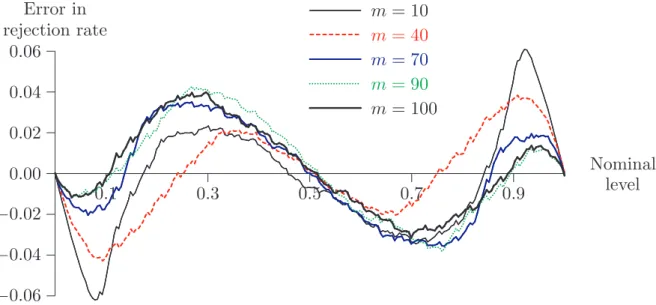
In this section we show in a simulation study that, despite its consistency, the m out of nbootstrap of the statistic τ of (2) does not give reliable inference results in other than very large samples. The subsampling method does better, but still suffers from serious distortion if mis not chosen with care. Figure 1 displays P value discrepancy plots for the m out of n bootstrap. The plots are based on 10,000 realizations of the statisticτ from samples of size 100 generated by the symmetric stable distribution with the value of α = 1.5, supposed known. The bootstrap sample size m took the values 10, 40, 70, 90. The number of bootstrap replications was B = 399. Fig. 1 indicates that the m out of n bootstrap suffers from considerable size distortions for all values of m. Moreover, for the usual significance levels of 0.05 and 0.1, it is outperformed by the inconsistent ordinary bootstrap, which here is the bootstrap with m= 100.
0.1 0.3 0.5 0.7 0.9 −0.06 −0.04 −0.02 0.00 0.02 0.04 0.06 ... ...... ...... ... ...... ...... ...... ......... ... ... ... ... ... ... ... ... ... ... ... ... ... ...... ...... ... ...... ...... ...... ......... ... ... ... ... ... ... ... ... ... ... ... ... ... ... ...... ...... ...... ...... ...... ...... ... ... m= 10 ... ... ... ...... ...... ... ... ... ... ... ... ... ... ...... ... ... ......... ... ... ... ... ... ... ... ... ... ... ... ... m= 40 ...... ... ... ... ... ... ...... ...... ...... ......... ... ... ... ... ...... ... m= 70 ...... ... ... ... ... ... ...... ... ...... ... ... ...... ... ...... ... ... ... ... ... ... m= 90 ......... ... ... ...... ...... ......... ... ...... ... m= 100 Nominal level Error in rejection rate
Figure 1: P value discrepancy plots, m out of n bootstrap,α = 1.5, β = 0, n= 100 In Figure 2 we consider the same scenario as in Figure 1, but with n = 2,000. We show the results only for those values of m that gave the smallest error in rejection probability. We see that the error in rejection probability of the mout of nbootstrap does not vanish even in samples as large as 2,000. The size distortion of the ordinary bootstrap is almost of the same magnitude as that of themout ofnbootstrap. These results indicate that the rate of convergence of the m out of n bootstrap P value to its limit distribution is very slow.
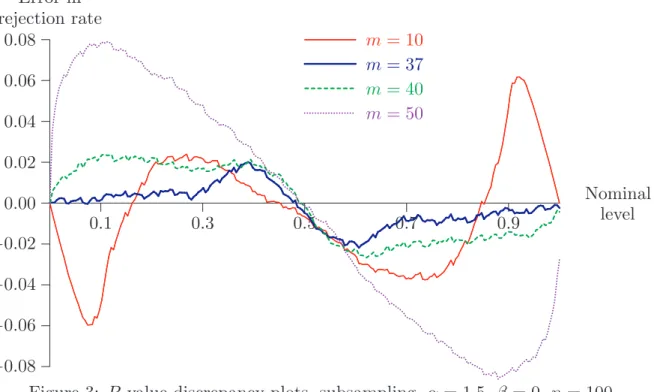
Figure 3 shows comparable results for the subsampling bootstrap with n = 100. For values of m greater than about 50, the distortions become very large, and so are not shown. Note, though, that for m = 37, distortion is quite modest. But even a small difference in m can, as is seen in the figure, give rise to considerable distortion. The size distortions of the subsampling and the mout ofn bootstrap are even larger when we consider data from an asymmetric stable distribution with α = 1.5 and β = 0.5. The simulation results presented here are a manifestation of a result of Hall and Jing (1998), which shows that the difference between the estimate of the distribution of the sample mean given by the m out of n bootstrap and the true distribution tends to
0.1 0.3 0.5 0.7 0.9 −0.04 −0.02 0.00 0.02 0.04 ... ... ... ... ... ... ...... ... ...... ...... ... ...... ... ...... ......... ... ... ... ... ... ... m= 10 ...... ...... ......... ... .... ... .... ... ... .... ... ... ... ... ...... ....... ... ...... ...... ....... ... ... ....... ... ......... ... ... .... ... .... ... ... ...... ...... . ... m= 40 ... ... ... ... ............ ... ... ... ... ... ... ... ... ... ... ... ... ... ...... ... ... ...... ... ...... ... ...... ... ...... ... ... ... ...... ... ... ... ... ... ... ... ... ... ... ... ... ... ... ... ... ... ... ... ... ...... ... m= 1540 ......... ... ... ... ... ...... ...... ...... ...... ...... ...... ......... ... ... ... ... ...... ... m= 1990 Nominal level Error in rejection rate
Figure 2: P value discrepancy plots, m out of n bootstrap,α = 1.5, n= 2000
0.1 0.3 0.5 0.7 0.9 −0.08 −0.06 −0.04 −0.02 0.00 0.02 0.04 0.06 0.08 ...... ... ...... ...... ... ...... ...... ......... ... ... ... ... ... ... ... ... ... ... ... ... ...... ...... ... ...... ...... ...... ...... ... ... ... ... ... ... ... ... ... ... ... ... ... ... ... ... ... ... ... ...... ... ...... ...... ... ...... ...... ... ... m= 10 ... ... ... ...... ... ... ... m= 37 ... ... ...... ... ... ... ... ......... ... ... ... m= 40 ... ... ... ... ... ... ... ... ... ... ... ...... ...... ... ...... ...... ... ...... ... ...... ...... ... ...... ... ...... ...... ...... ... ... ... ... ... ... ... ... ... m= 50 Nominal level Error in rejection rate
Figure 3: P value discrepancy plots, subsampling, α = 1.5, β = 0, n= 100 zero as n → ∞ more slowly than that of an estimate that assumes a stable law with consistently estimated parameters.
5. Studentized statistics
esti-mated. A natural way to avoid this is to employ the studentized statistic: t = n 1/2Y¯ © (n−1)−1Pn j=1(Yj−Y¯)2 ª1/2.
Note that this is equal, apart from a multiplicative constant, to the self-normalised sum in the argument of Fn
Y in (7). The statistic for the usual resampling bootstrap is
t∗ = n 1/2( ¯Y∗ −Y¯) © (n−1)−1Pn j=1(Yi∗−Y¯∗)2 ª1/2,
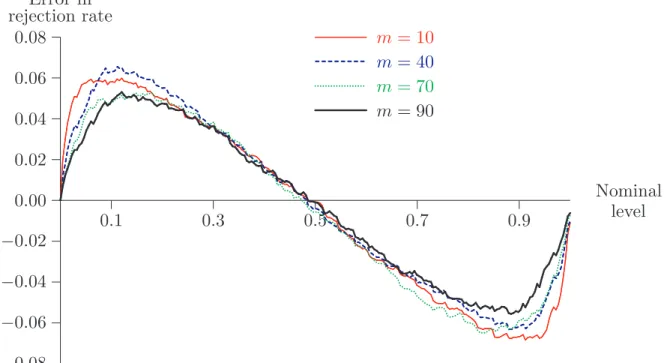
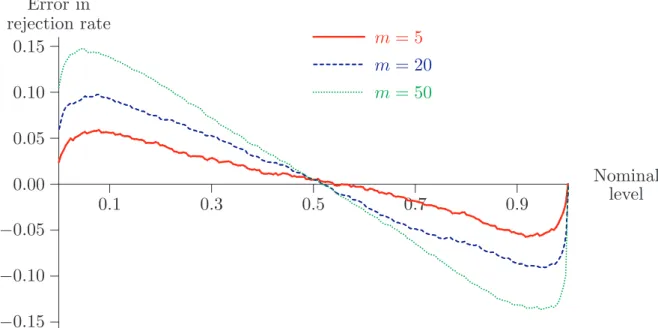
with n replaced by m for the m out of n bootstrap and subsampling. Hall (1990a) shows that the ordinary bootstrap of thetstatistic is not consistent ifF ∈DA(α) with 1< α < 2. But Hall and LePage(1996)prove that themout ofnbootstrap is justified asymptotically. The same is shown by Romano and Wolf(1999)for subsampling. Figure 4 displays the P value discrepancy plots for them out ofnbootstrap based on the t statistic, using samples of sizen= 100 from the stable distribution withα = 1.5 and β = 0, these values again assumed known. This bootstrap suffers from large size distortions for any value of m between 10 and 100. Again, the rate of convergence to the limit is very slow. In addition, the resampling bootstrap performs just as badly. Compared with the bootstrap of the nonstudentized statisticτ, which underrejects for conventional significance levels, the bootstrap of the t statistic systematically overre-jects. Figure 5 shows similar results for subsampling. Distortions are smallest for very small values of m, but increase very quickly as mgets larger.
0.1 0.3 0.5 0.7 0.9 −0.08 −0.06 −0.04 −0.02 0.00 0.02 0.04 0.06 0.08 ... ... ... ... ... ... ... ... ... ... ... ... ...... ...... ...... ... ...... ... ...... ... ...... ...... ...... ...... ...... ...... ...... ... ... ... ... ... ... ... ... ... ... ... ... ... m= 10 ... ... ... ... ... ... ... ... ...... ... ... ...... ... ...... ...... ... ...... ...... ......... ... ... ... ... ... ... ... m= 40 ... ... ... ... ... ... ...... ...... ...... ... ... ... ...... ... ...... ...... ... ...... ... ... ... ... ... ... ... ... ... m= 70 ... ... ... ... ... ...... ...... ...... ...... ...... ... ... ... ... ... m= 90 Nominal level Error in rejection rate
0.1 0.3 0.5 0.7 0.9 −0.15 −0.10 −0.05 0.00 0.05 0.10 0.15 ... ... ...... ...... ... ... ... m= 5 ... ...... ...... ... ...... ... ...... ...... ... ... ... ... ... ... .... ... m= 20 ... ... ... ... ...... ... ...... ... ...... ... ...... ... ...... ... ... ...... ... ... ... ... ... ... ... ... ... ... . ... m= 50 Nominal level Error in rejection rate
Figure 5: P value discrepancy plots, subsampling for t, α = 1.5, β = 0, n= 100 The results of this and the previous section indicate that, although consistency is necessary to avoid bootstrap failure, it does not guarantee reliable inference in samples of moderate size.
6. A parametric bootstrap
In the Corollary of Section 2, the distribution of the statistic t(M) of (6) was shown to have expectation 0 and variance 1. A simulation study not reported in detail here shows that, for values of n in the range from 20 to 2,000, the distribution is not too far removed from standard normal. Suppose for a moment that the CDF of t(M) is actually equal to Φ, the standard normal CDF. Then the bootstrap P value p(Y) of (7) would be Φ(t), wheret is given by (8), and its CDF would be
Pr¡p(Y)≤u¢= Pr¡Φ(t)≤u¢ = Pr¡t≤Φ−1(u)¢.
Recall that Logan, Mallows, Rice, and Shepp (1973) have shown that t has a limiting distribution. This distribution depends on the parameters α and β of the distribution of the Yj; let us denote its CDF by Gα,β. The limiting distribution of p(Y) would
thus have CDF Gα,β◦Φ−1. Provided that α and β can be estimated consistently, an
asymptotically valid test of the hypothesis that the expectation of the Yj is zero could
be based on p(Y) and the estimated CDF Gα,ˆβˆ◦Φ−1.
Such a test would be equivalent to a test based on t itself and its estimated limiting distribution Gα,ˆβˆ. However, for a test based on t, there is no need to assume that the conditional distribution of t(M) is standard normal. Even so, the asymptotic distribution function Gα,β is characterized by a complex integral involving parabolic
therefore, it is easier and preferable to estimate the distribution of t consistently by simulation of self-normalized sums from samples of stable random variables with α and β consistently estimated from the original sample. This amounts to a parametric bootstrap oft. It is not absolutely equivalent to a parametric bootstrap ofp(Y) itself, which would be as computationally intensive as a double bootstrap. It is not unrelated to, but is still different from, a suggestion in Hall and Jing(1998)that, for a symmetric distribution, one might bootstrap ˆcS(ˆα,0)¡n−1/αˆ( ¯Y −δ0)¢, a procedure which they acknowledge to be time-consuming.
An advantage of a parametric bootstrap of tis that its asymptotic distribution applies not only when the Yj are generated from a stable distribution, but also whenever they
are generated by any distribution in the domain of attraction of a stable law. This leaves us with the practical problem of obtaining good estimates of the parameters. The location and scale parameters are irrelevant for the bootstrap, as we can generate centred simulated variables, and the statistic t, being normalized, is invariant to scale. The proposed bootstrap is described by the following steps:
1. Given the sample of random variables Y1, ..., Yn with distribution F ∈ DA(α),
compute the self-normalized sum t.
2. Estimate α and β consistently from the original sample.
3. Draw B samples of sizen from S(ˆα,β) with ˆˆ α and ˆβ obtained in the previous step. 4. For each sample of the stable random variables compute the bootstrap self-normalized sum, t∗ = Pn j=1Yj∗ ¡Pn j=1(Yj∗−Y¯∗)2 ¢1/2.
5. The bootstrap P value is equal to the proportion of bootstrap statistics more extreme than t.
Proposition 2
The distribution of t∗, conditional on the sample Y1, . . . , Y
n, approaches that
of t as n → ∞ when the Yj are drawn from a distribution in the domain of
attraction of a non-Gaussian stable law S(α, β).
The result follows from three facts: first, the consistency of the estimators ˆα and ˆ
β, second, the continuity of the stable distributions with respect to α and β, and, third, the result of Logan et al. that shows that the self-normalized sum has the same asymptotic distribution for all laws in the domain of attraction of a given stable law S(α, β).
Rate of convergence
If the distribution of the variablesYj is in the domain of attraction ofcS(α, β), Loganet
al. (1973)show that the joint characteristic function of the numerator and denominator of t, as a function of arguments sn and sd, is (1 +In/n)n, where f is the density of
the law of the Yj, and
In= Z ∞ −∞ exp(ixsn+ ix2sd)−1−ixsn |x|α+1 (n 1/α|x|)α+1f(n1/αx) dx. (13)
Let I∞ denote the limit of In. Then
¡
1 +I∞/n
¢n
= expI∞+O(n−1).
Hall (1982) introduces a restrictive condition on laws in the domain of attraction of a stable law, as follows. The CDF F of the distribution satisfies
1−F(y) =ry−α¡1 +dry−δr +o(y−δr) ¢ and F(y) =l|y|−α¡1 +d l|y|−δl +o(|y|−δl) ¢ (14)
as y → ∞, where δr, δl > 0, dr and dl are real numbers and r and l are as defined
in (11). If Hall’s condition on the distribution holds, then, for the density in the right-hand tail of (13), we have yα+1f(y) =αr¡1 +d
ry−δr +o(y−δr)
¢
, and so (n1/αx)α+1f(n1/αx) =αr¡1 +dn−δr/αx−δr +o(n−δr/α)¢,
where y = n1/αx. A similar relation holds in the left-hand tail. Thus the rate of
convergence of the integrand in In is that of n−δ/α where δ = min(δr, δl). The rate
of convergence of the joint characteristic function itself is thus the slower of n−1 and n−δ/α, as is therefore the rate of convergence of the distribution of t. In the cases
studied by Hall (1982), δ ≥ α, and so in those cases the rate is n−1, from which it follows that the rate of convergence of the bootstrap distribution is that of the estimators ˆα and ˆβ.
Remark 3
If Hall’s condition (14) is not satisfied, then the rate of convergence can be much slower, as we will see in the simulation study of Section 8.
Remark 4
The test statistic t is neither a pivot nor an asymptotic pivot, since its asymptotic distribution depends upon the parameters α and β. As suggested by Beran (1988), one way to achieve asymptotic pivotalness is to transform t by its limiting distribu-tion funcdistribu-tion. Here that funcdistribu-tion is Gα,β, which can be consistently estimated. The
resulting statistic is an asymptotic pivot with limiting distribution the uniform U(0,1) distribution. Of course, this procedure entails evaluating the integral with parabolic cylinder functions.
7. Methods for the estimation of the parameters
The problem of estimating the parameters α and β is hampered by the fact that the density and distribution function of a non-Gaussian stable law have no closed-form expression. Nevertheless, there are estimation procedures for the stable laws, and also more general procedures that use only the information in the tails of the distributions. In the first category we have maximum likelihood (DuMouchel (1973), Nolan (2001)), characteristic function methods (Koutrouvelis (1980), Kogon and Williams (1998)), the quantile method of McCulloch (1986), the indirect inference method of Garcia, Renault, and Veredas (2006), and the continuous generalized method of moments of Carrasco and Florens(2000). In the second category we may cite Pickands’s estimator (Pickands (1975)), Hill’s estimator (Hill (1975)), and the estimator of de Haan and Resnick (de Haan and Resnick (1980)). We survey some of these in this section. For the tails of the stable law cS(α, β) we have
lim y→∞y αPr(Y > y) =C α 1 +β 2 c α, lim y→∞y αPr(Y <−y) =C α 1−β 2 c α, where C−1 α is R∞
0 y−αsiny dy; see Samorodnitsky and Taqqu (1994). It follows from (11) that
r l =
1 +β
1−β. (15)
On account of (15), for any distribution in the domain of attraction of a stable law cS(α, β), we can estimate the skewness parameter β if we can estimater and l. Hill’s method
The best known estimator that uses only the information in the tails of the distribution is the Hill estimator. It is based on the k largest of the order statistics of a sample of independent and identically distributed random variables Y(1) > Y(2) > ... > Y(n) , and is equal to ˆ αHill= ³ 1 k−1 k−1 X j=1 logY(j)−logY(k) ´−1 .
If k is the number of order statistics used for the estimation of α in the right tail of the distribution, then r is estimated by kYαˆHill
(k) /n. The parameterl is estimated in a similar way, using the information in the left tail of the distribution.
A variant for the estimation ofr andl is introduced by Aban and Meerschaert (2004). They define ˆ µ= logY(k)−αˆHill−1 n X j=k 1 j,
Quantile method
One of the methods for estimating the parameters α and β was introduced by Fama and Roll(1971)for symmetric stable distributions, and extended by McCulloch(1986) for the general asymmetric case. Using the 0.05, 0.25, 0.5, 0.75, and 0.95 quantiles, one computes the following indices:
να = q0.95−q0.05
q0.75−q0.25, νβ =
q0.95+q0.05−q0.5 q0.95−q0.05 .
The indices are then inverted using tables in McCulloch’s paper in order to obtain consistent estimators of α and β. McCulloch suggests that these estimators can be used as a very good starting point for more sophisticated and theoretically superior estimators, such as maximum likelihood.
Maximum likelihood
The maximum likelihood estimators of the parameters α and β are based on numer-ical approximations to the density of the stable distributions. With no closed-form representation of the density, this is not a trivial task. The MLE was first obtained by DuMouchel (1973) by using the Fast Fourier Transform and Bergstrom series expan-sions for the tails. He showed that the standard theory, in terms of root-n asymptotic normality and Cram´er-Rao bounds, applies for the maximum likelihood estimators of the parameters of the stable laws.
Nolan (2001)continued the pioneering work of DuMouchel and optimized the method by employing direct numerical integration of the stable density derived from one of the parametrizations of the characteristic function in Zolotarev (1986)).
Characteristic function methods
The one-one correspondence between the density and the characteristic function mo-tivates the characteristic function approaches for the estimation of the parameters of stable distributions. The methods that fall into this category and have proved to have the best performance are those proposed by Koutrouvelis and Kogon-Williams, by using different expressions of the cumulant generating function of the stable law. Let
ˆ
ζ(s) =n−1Pn
j=1eisYj be the empirical characteristic function. Koutrouvelis’ method is based on a parametrization of the characteristic function given in Zolotarev (1986) that is not continuous in all parameters. The tail index α is estimated by ordinary least squares as the coefficient of logs in the following regression:
log¡−log|ζ(s)ˆ |¢ =αlogc+αlogs+us, s= 1, . . . , K. (16)
where us is a disturbance term. The values of s are chosen, following Koutrouvelis,
as s = πk/25, k = 1, . . . , K. Some experimentation showed us that, for sample size n= 100, the mean squared error of the estimator is minimised nearK = 16. The par-ameter c can be estimated using the estimated constant ˆa from (16) as ˆc= exp(ˆa/α).ˆ
Then β and δ are estimated by running the regression Arg ˆζ(s) =δs+β(cs)αtanπα
2 +us, (17)
where Arg denotes the principal argument of the complex number ˆζ(s), that is, the angle θ such that ˆζ(s) = |ζ(s)ˆ |eiθ and −π < θ ≤ π. In regression (17), Arg ˆζ(s) is
regressed ons and sαˆ, where ˆα is from (16). Then the estimated coefficient of s is the estimate of δ, and the estimate of β is ˆβ = ˆbˆc−αˆcot(πα/2), where ˆˆ b is the estimated coefficient of sαˆ and ˆc is from (16). Koutrouvelis recommends setting the values of s in (17) as s=πl/50, l= 1, . . . , L.
The method of Kogon and Williams is based on another of Zolotarev’s parametrizations of the characteristic function, one that is continuous in all parameters. The regression for the estimation of α is the same as in Koutrouvelis’ method. The parameter β is estimated by ordinary least squares from the following regression
Arg ˆζ(s) =¡δ+βcαtanπα 2 ¢ s+βcstanπα 2 ¡ (cs)α−1−1¢+us. Comments
For the estimation of α we prefer the method of Koutrouvelis in cases in which the underlying distribution is stable. Simulation results, not reported here, indicate that Koutrovelis’ method performs as well as maximum likelihood in terms of the root mean squared error and bias, and is much less time-consuming. The more robust method of Hill is fast and performs well provided the optimal number of order statistics is used, which in practice can be obtained by employing the Hill plot – see Hill (1975) – or the m out of n bootstrap – see Hall (1990b) and Caers and Dyck (1999). For the estimation of the skewness parameter β, provided the underlying distribution is in fact a stable law, the quantiles method is the best, since it does not depend on the estimate of α, unlike Koutrouvelis’ method. For laws that are not stable but belong to the domain of attraction of a stable law, the Aban-Meerschaert estimates ofr andl seem to give the best estimates of β. We made no use of any other of the methods mentioned above.
Rate of convergence of parameter estimates
The distribution of the elements of a sample drawn using the parametric bootstrap is the stable law with parameters ˆα and ˆβ, and the true distribution under the null is a law in the domain of attraction of the stable law with parameters α and β. These distributions differ both because their parameters are different, and because the true distribution is not necessarily a stable law. Therefore the rate of convergence of the distribution of t∗ to that of t is the slower of
(ii) the rate of convergence of the distribution of the self-normalized sumt to its limit distribution.
We dealt with point (ii) in the last section. If we assume that the data are distributed according to a stable distribution, the maximum likelihood and the characteristic func-tion methods give the usual parametric root-nrate. If we suppose only that the distri-bution is somewhere in the entire domain of attraction of the stable laws, then Hill’s method could be used. In this situation an optimal number of order statistics k has to be chosen. Hall (1982) shows that, if the underlying distribution F satisfies condi-tions (14), then it is asymptotically optimal to choose k such that k =O(n2δ/(2δ+α)). In that case,
ˆ
α−α=Op(k−1/2) and ˆr−r =Op
¡
k−1/2log(n/k)¢. (18) From (15) it can be seen that the order of ˆβ −β is that of ˆr−r.
Hall’s condition is more demanding than just requiring the distributionF to be in the domain of attraction of a stable law or even in the domain of normal attraction. But Hall says that, if one relaxes it, then there does not seem a way to characterize the optimal k and to obtain an algebraic convergence rate for the tail index estimator. The stable laws themselves satisfy Hall’s condition withδ =α. For Student’st,δ = 2. Hall lists some other distributions that satisfy his condition.
The optimal number of extreme values used by Hill’s method depends on unknown properties of the tails. In practice k must itself be estimated from the sample. Sim-ulations show that the exponential test suggested by Hill (1975) has very low power and tends to overestimate k. Hall and Welsh (1985)use adaptive methods in order to estimate the size of the extreme subsample. Under conditions (14), the effect of the estimation of k is that
ˆ
α−α =Op(n−γ/(2γ+α)) and ˆr−r =Op(n−γ/(2γ+α)logn).
Thus the rate of convergence of the estimators is slower compared with the case (18) when k is assumed to be known.
The rate of convergence (18) does not hold for all distributions in the domains of attrac-tion of the stable laws. Csorgo and Viharos(1997)and the references therein, extended Hill’s estimators to the entire domain of attraction DA(α). However, they show that the price paid for this generality is a lower rate of convergence. In addition, their results support Hall and Jing’s (1998) point of view indicating that “sophisticated” methods based upon extreme order statistics can improve the rate of convergence, but not up to the parametric rate of n−1/2 without sacrificing robustness.
8. Simulation evidence
In this section we investigate the performance of the parametric bootstrap in samples of size n = 100 in a simulation study. First, we consider the case in which the null hypothesis δ = 0 is true. All results are based on 10,000 replications of the statistic t and 399 bootstrap repetitions in step 3 of the bootstrap algorithm. They are displayed graphically as P value discrepancy plots. The error in rejection probability (ERP), that is, the difference between the actual rejection rate based on the bootstrapP value and the nominal significance level should be close to zero if the parametric bootstrap works well.
In Figure 6, the data were generated from the stable distribution with α = 1.5 and β = 0, 0.5 and 1, all assumed known. The parametric bootstrap performs very well in cases in which, as the simulation results from Section 4 indicate, the subsampling method and the m out of n bootstrap have large ERPs, especially when β 6= 0.
0.1 0.3 0.5 0.7 0.9 −0.02 −0.010.00 0.01 0.02 ............ ... β = 0 ...... ............... ... ... β = 0.5 ............ ... β = 1 Nominal level ERP
Figure 6: P value discrepancy plots,α = 1.5, n= 100
In complete contrast to the results shown in Figure 6, the P value discrepancy plots in Figure 7 show what happens when the data are generated from a loggamma distribution. If X is a random variable from a gamma distribution with density xa−1exp(−x/b)/(baΓ(a)) (here Γ is the gamma function), where a is the shape
para-meter and bis the scale, then Y = expX has the loggamma distribution, with density (logy)a−1y−1/b−1/(baΓ(a)), where 1/b = α is the tail index and a is the scale. The
distribution of Y has tails that behave like 1−F(y)∼ α
a−1
Γ(a)(logy)
a−1y−α,
as y → +∞. For a 6= 1, the loggamma distribution is in DA(α), but not in domain of normal attraction. In particular, Hall’s conditions (14) are not satisfied. For the figure, a = 1.7 and b = 0.666667, so that 1/b= α = 1.5, assumed known. Since the loggamma distribution is totally skewed to the right, we take β = 1.
When n = 100, the smallest ERP for the subsampling method and the m out of n bootstrap was achieved for m = 10. However, even with this optimal choice of the bootstrap sample size, the size distortions are very severe, for instance 0.3 for the 0.05 significance level. The parametric bootstrap performs much better, but the ERPs are not close to zero. For the 0.05 significance level the size distortion is around 0.14 for a sample size of 100 and 0.08 for a sample size of 1,000. Since the parameters of the
0.1 0.3 0.5 0.7 0.9 0.00 0.04 0.08 0.12 0.16 0.20 0.24 0.28 0.32 ... ... ... ... ... ... ... ... ... ... ... ... ... ... ... ... ... ... ... ...... ... ...... ...... ...... ...... ...... ... ... ... parametric bootstrap, n= 100 ... ... ... ... ... ... ... ... ... ...... ...... ...... ...... ...... ... parametric bootstrap, n= 1,000 ... ... ... ... ... ... ... ... ... ... ... ... ... ... ... ... ... ... ... ... ... ... ... ... ... ... ... ... ... ... ... ... ... ... ... ... ... ... ... ... ... ... ... ...... ...... ...... ... ...... ...... ...... ...... ...... ... ...... ... ............ ...... ...... . ... m out of n, n= 100 ... ... ... ... ... ... ... ... ... ... ... ... ... ... ... ... ... ... ... ... ... ... ... ... ... ... ...... ... ...... ...... ... ...... ... ...... ... ......... ...... ...... . ... subsampling, n= 100 Nominal level ERP
Figure 7: P value discrepancy plots, loggamma law,n= 100
bootstrap DGP in the simulations are the true ones, the ERP of the parametric boot-strap is due to the very slow convergence of the distribution of t under the loggamma distribution to its distribution under the limiting stable law.
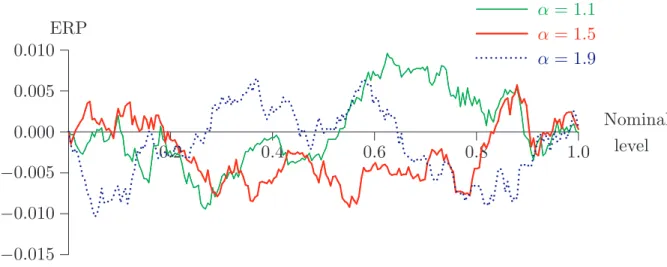
For Figure 8, the data were generated from the stable distribution, with α = 1.1, 1.5 and 1.9, and β = 0. For bootstrapping, the symmetry of the distribution was assumed to be known, and so the skewness parameter β was set to zero in step 4 of the parametric bootstrap algorithm, and was not estimated in step 3. The other parameter, α, was estimated by Hill’s method applied to the absolute values of the data, in order to take advantage of symmetry. The parameter k was set to 33 for α = 1.1, to 42 forα= 1.5, and to 44 for α= 1.9, these values having been determined by some preliminary experimentation to find the best choices.
0.2 0.4 0.6 0.8 1.0 −0.020 −0.015 −0.010 −0.005 0.000 0.005 0.010 ......... ... ... ... ... ... ...... ......... ... ... ............ ... ... ... ... ... ......... ... ... ... ... ...... ... ... ... ... ... ... ... ......... ...... ... ......... ...... ...... ... ...... ......... ... ... ... ... ... ... ... ... ... ... ... ...... ...... ... ... ... ...... ... α= 1.1 ... ...... ... ... ... ............... ...... ... ...... ... ... ... ... ... ... ... ...... ... ... α= 1.5 ... ......... ... ....... ...... .......... ......... ... .......... ... ... ... ......... ... ... ... .... ... ....... ... ... ... α= 1.9 ERP Nominal level
For Figure 9, the data came from Student’s t distribution, with α, which is now identified with the degrees-of-freedom parameter, set to 1.1, 1.5, and 1.9. Again the symmetry is assumed known in bootstrapping. For Hill’s method, we used k = 30, 22, and 17 for α = 1.1, 1.5, and 1.9. Although the estimator of Koutrouvelis’ method would be more precise when the data are generated by a stable law, it does not perform well with the Student’s t data, since it is specific to the stable law. It is in any case clear from Figures 8 and 9 that the parametric bootstrap performs very well under the true null hypothesis, even though α is estimated, and though the data come from a distribution which, although in the domain of normal attraction of a stable law, is not a stable law.
0.2 0.4 0.6 0.8 1.0 −0.015 −0.010 −0.005 0.000 0.005 0.010 ...... ... ......... ...... ...... ... ...... ... ... ... ... ...... ...... ......... ...... ... ... ... ... ...... ... ... ... ... ... ... ... ... ... ............ ......... ... ... ... ... ... ... ... ... ...... ...... ...... ... ... ... ... ... ... ... α= 1.1 ............ ...... ... ... ... ... ... ......... ......... ... ... ... ... ... ... ... ...... ... ... ... α= 1.5 ...... ...... .......... ... ......... ... ......... ... ... ... ... ... ......... .......... ... ... ... ... ... ... α= 1.9 ERP Nominal level
Figure 9: P value discrepancy plots, ˆαHill, Student’s t
In Figure 10, the data are again from the stable law, withα = 1.3, 1.5, and 1.9, and the most extreme case of asymmetry, namely β = 1. For bootstrapping, α was estimated by Koutrouvelis’ method, and β by the quantile method. Hill’s method seems to work poorly with such asymmetric data, and Koutrouvelis’ method forβ is less precise than the quantile method. We see that the performance of the parametric bootstrap is much influenced by the value of the skewness parameter β. Compared with the symmetric case, the ERPs are significantly larger, especially for smaller values of α. Indeed, with α = 1.1 (not shown in the figure), the ERP is unacceptably large.
Even when the data are generated by a symmetric law, an investigator may not be prepared to assume this. Thus it is of practical importance to see how estimating β affects the performance of the parametric bootstrap. The parameters α and β used in the parametric bootstrap that gave theP value discrepancy plots in Figures 11 and 12 were both estimated by Hill’s method, although the true value of β is zero. There is little difference between the results for the stable law in Figure 11 and those for Student’s t in Figure 12, but the size distortions are greater than when it is assumed that β = 0. They are greater the smaller is α, and for α = 1.1, they are again unacceptably large.
Matters can be improved a little by replacing the Hill estimate of β by the variant of Aban and Meerschaert, which we denote by ˆβAM. Results analogous to those of
0.2 0.4 0.6 0.8 1.0 0.00 0.01 0.02 0.03 0.04 0.05 0.06 ... ... ... ... ... ... ... ... ... ... ... ... ... ... ... ... ... ... ... ... ... ... ... ... ......... ... ...... ...... ... ...... ... ...... ...... ...... ...... ... α = 1.3 ... ... ... ......... ... ...... ... ... α = 1.5 ... ... ... ... ......... ...... ..... ... α = 1.9 ERP Nominal level Figure 10: P value discrepancy plots, ˆαKoutrouvelis, ˆβquantiles, stable law β = 1
0.2 0.4 0.6 0.8 1.0 −0.08 −0.04 0.00 0.04 0.08 ... ... ... ... ... ... ... ...... ...... ...... ...... ...... ...... ...... ......... ... ... ... ... α = 1.1 ... ... ...... ......... ... α = 1.5 ... α = 1.9 ... ERP Nominal level
Figure 11: P value discrepancy plots, ˆαHill, ˆβHill, stable law
0.2 0.4 0.6 0.8 1.0 −0.08 −0.04 0.00 0.04 0.08 ... ... ... ... ... ... ... ...... ...... ...... ...... ...... ...... ...... ... ... ... ... ... α = 1.1 ... ... ... ...... ...... ... . ... α = 1.5 ... ... ... α = 1.9 ERP Nominal level
Figure 12: P value discrepancy plots, ˆαHill, ˆβHill, Student’s t law
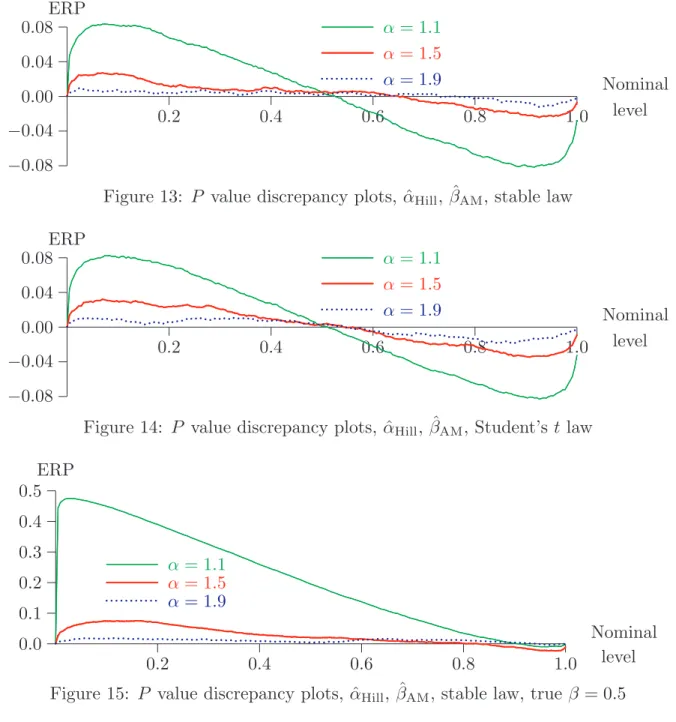
Figures 11 and 12 are given in Figures 13 and 14. It can be seen that the improvement is slight and that the qualitative features are the same as with Hill’s estimator of β. If β is nonzero, performance becomes still worse. The size distortions that we see in Figure 15, where the true β is 0.5, are enormous for small α. In Figure 16, we have β = 1, and the distortions are even greater. For both these figures, we use ˆαHill and
ˆ
βAM. The reason for the large distortions is that, for large β and α close to 1, the distribution Gα,β of the self-normalized sum is exceedingly sensitive to the value of α.
None of the estimates of α that we have considered is precise enough to overcome this phenomenon. In this case, the failure of the parametric bootstrap is due less to any deficiency of its own than to the imprecision of the estimates of α.
0.2 0.4 0.6 0.8 1.0 −0.08 −0.04 0.00 0.04 0.08 ... ... ... ... ... ... ... ... ...... ...... ...... ...... ...... ...... ...... ......... ... ... ... ... α = 1.1 ... ... ... α = 1.5 ... α = 1.9 ERP Nominal level
Figure 13: P value discrepancy plots, ˆαHill, ˆβAM, stable law
0.2 0.4 0.6 0.8 1.0 −0.08 −0.04 0.00 0.04 0.08 ... ... ... ... ... ... ... ...... ... ...... ...... ...... ...... ......... ... ... ... α = 1.1 ... ... ...... ... ... α = 1.5 ... α = 1.9 ERP Nominal level
Figure 14: P value discrepancy plots, ˆαHill, ˆβAM, Student’s t law
0.2 0.4 0.6 0.8 1.0 0.0 0.1 0.2 0.3 0.4 0.5 ... ... ... ... ... ... ... ... ... ... ... ... ... ... ... ... ... ... ... ... ... ... ... ... ... ... ...... ...... ...... ...... ...... ...... ...... ...... ... α= 1.1 ...... ... α= 1.5 ... ... α= 1.9 ERP Nominal level Figure 15: P value discrepancy plots, ˆαHill, ˆβAM, stable law, true β = 0.5 We end this section with some evidence about the behaviour of the parametric boot-strap when the null hypothesis δ = 0 is false, the true δ being −0.5. Except for this change, the setups for Figures 17 and 18 are the same as for Figures 8 and 9. The re-sults are shown as plots of the estimated rejection rates as a function of nominal level. Several interesting facts emerge from the figures. First, power is influenced by the tail index α. The smaller α, the lower the power. Second, compared with the stable distribution, the power is slightly lower when the data come from Student’s t. From Figure 19, we see that power is also influenced by the skewness parameter: the smaller α and the larger β, the lower the power of the bootstrap test. For this last figure, since forα close to 1 the size distortion is considerable, we used thetrue value of αfor bootstrapping, so as to have a better notion of the theoretical power. The skewness
0.2 0.4 0.6 0.8 1.0 0.0 0.1 0.2 0.3 0.4 0.5 0.6 0.7 ... ... ... ... ... ... ... ... ... ... ... ... ... ... ... ... ... ... ... ... ... ... ... ... ... ... ... ... ... ... ... ... ...... ...... ...... ...... ...... ...... ...... ...... ... ... α= 1.1 ... ... ...... ... α= 1.5 ... ... α= 1.9 ERP Nominal level Figure 16: P value discrepancy plots, ˆαHill, ˆβAM, stable law, true β = 1
parameter was estimated by the quantile method. Simulation results not shown here indicate that the power of the tests based upon the subsampling method and of them out of nbootstrap is very similar to the power of the parametric bootstrap test.
0.2 0.4 0.6 0.8 1.0 0.0 0.2 0.4 0.6 0.8 1.0 ... ... ... ... ... ... ... ... ... ... ... ... ... α= 1.1 .. .... .. .... ... ... ... ... ... ... ... ... ... ... α= 1.5 ... ... ... ... ... ... ... ... ... ... ... ... ... ... ... ... ... ... ... ... ... ... ... ... ... ... ... ... ... ... ... ... ... ... ... ... ... ... ... ... ... ... ... α= 1.9 . .. . . .. . . .. . . .. . . .. . . .. . . .. . . .. . . .. . . .. . . .. . . .. . . .. . . .. . . .. . . .. . . . . 45◦ line Power Nominal level Figure 17: Power, ˆαHill, symmetric stable law, δ=−0.5
9. Conclusion
In this paper, we have proposed a parametric bootstrap for the purposes of inference on the expectation of a heavy-tailed distribution when an independent and identically distributed sample generated by that distribution is available. We show that, unlike the conventional nonparametric bootstrap statistic, the bootstrap P value has a non-random limiting distribution when the sample size tends to infinity. By itself, this is no guarantee that inference based on the bootstrapP value is reliable in finite samples, as we see by looking at the finite-sample performance of themout ofn and subsampling bootstraps, which are both consistent but are unreliable with a sample size of 100.
0.2 0.4 0.6 0.8 1.0 0.0 0.2 0.4 0.6 0.8 1.0 ... ... ... ... ... ... ... ... ... ... ... ... ... .. ... α= 1.1 .... .... ... ... ... ... ... ... ... ... ... ... ... α= 1.5 ... ... ... ... ... ... ... ... ... ... ... ... ... ... ... ... ... ... ... ... ... ... ... ... ... ... ... ... α= 1.9 . .. . . .. . . .. . . .. . . .. . . .. . . .. . . .. . . .. . . .. . . .. . . .. . . .. . . .. . . .. . . .. . . . . 45◦ line Power Nominal level Figure 18: Power, ˆαHill, Student’s t, δ =−0.5.
0.2 0.4 0.6 0.8 1.0 0.0 0.2 0.4 0.6 0.8 1.0 ... ... ... ... ... ... ... ... ... ... ... ... ... α= 1.1 ... ... ... ... ... ... ... ... ... ... ... ... ... ... ... ... ... ... ... α= 1.3 .. .. .... .. .. .. .... .. .. ... ... ... ... ... ... ... ... α= 1.5 ... ... ... ... ... ... ... ... ... ... ... ... ... ... ... ... ... ... ... ... ... ... ... ... ... ... ... ... ... ... ... ... ... ... ... ... ... ... ... ... ... ... ... α= 1.9 . .. . . .. . . .. . . .. . . .. . . .. . . .. . . .. . . .. . . .. . . .. . . .. . . .. . . .. . . .. . . .. . . . . 45◦ line Power Nominal level Figure 19: Power, true α, ˆβquantiles, stable law, β = 1.
The study of the distribution of the bootstrap P value shows that, to a good approx-imation, it is a deterministic function of the self-normalised sum of the observations of the sample. This sum also has a nonrandom limiting distribution, and is a bet-ter candidate for bootstrapping than the bootstrapP value itself, which would require computation as intensive as a double bootstrap. The distribution of the self-normalised sum can be estimated consistently if we can estimate the parametersαandβ of the sta-ble law to which the centred and normalized sum of the observations converges. This is most conveniently carried out by simulation, rather than by use of the asymptotic distribution, which, although known, is expressed in terms of integrals of functions of parabolic cylinder functions, and is thus awkward to compute. Our results show that, as long as estimation of α andβ is reasonably precise, the parametric bootstrap