Intellectual Property in Software Development:
Trends, Strategies and Problems
Knut Blind
Version August 2006
Contact:
Prof. Dr. Knut Blind Berlin University of Technology
Chair of Innovation Economics and Fraunhofer Institute for Systems and Innovation Research (Berlin Office) Secr. VWS 2
Müller-Breslau-Str. 10623 Berlin
1.
Introduction
In recent years, we have experienced a change in the regime of intellectual property rights applicable for software in Europe. Whereas in the past, there was simply a copyright on software code, meanwhile the patent offices in Europe also grant pat-ents on software. Based on the discrepancy between the actual policy of the Euro-pean patent office including the national patent offices in Europe and the initial ex-clusion to grant computer-implemented inventions, a lengthy political discussion started in the year 2000 with a first proposal of the European Commission (European Commission 2000). The member states of the European Patent Agree-ment have consulted with the European Patent Office about changes regarding the possibilities of patenting software-related inventions. The main question was whether software-related inventions in Europe in future should be more easily liable to patent protection – according to the model in the USA - or whether in view of assumed idiosyncrasies in the development and economic utilisation of software, patents on software should be awarded more restrictively. Background of the dis-cussions is the fear that the lack of standard legal regulation throughout the EU could hamper the competitiveness and economic growth of the European Union. The debate has been very controversial. The controversy is provoked by the fact that in parts the opinion is being advanced that patents for computer software could promote innovations, as in other technology fields, for they offer the patent-holder an appropriate protection, thus creating greater incentives for further investments in the development of high-performance software. The opposite position recalls that patents, in view of the special specifics of the utilisation and development of soft-ware, would undermine fair competition (easier to form monopolies), disrupt devel-opment interactions, e.g. Open Source, and for this very reason could prevent inno-vations in the long term.
Up till now, this apparently irreconcilable confrontation has been only very partly informed by theoretically supported empirical work on the relationship of patents in the software area and that of the innovation and market behaviour. The studies available up to the present are either purely theoretical or are constructed on a nar-row, rather coincidental empirical basis. Against the background of legal uncertain-ties, the economic controversy and the European fear of losing competitive edge to the United States in the software industry, various studies were carried out. In 1999, the European Commission commissioned a study on the economic impacts of the patentability of computer programmes. However, Hart et al. (2000) merely depicted the present legal situation in Europe, the USA and Japan, and presented economic arguments pro and contra patenting software on a qualitative level, without validat-ing or quantifyvalidat-ing them empirically. Lutterbeck et al. (2000) also discussed, in their expertise carried out on behalf of the German Federal Ministry for Economics and Technology, above all patent law in the economically most important regions, the legal implications of software patents for the Open Source software development and deduce herefrom recommendations for action in future patent policy. Further,
the European Commission (PbT Consultants 2001), the British1 and the French2 governments carried out open, uncontrolled consultations via the Internet.
Whereas in the past, there was simply a copyright on software code, meanwhile the recent developments described above allow also the use of patents for the protection of inventions in software. Since the software development process is characterised by a set of specific features, like sequentiality, interoperability, the use of Open Source and its short development cycles, many critical voices question the adequacy of patent protection for software. There are several authors who discuss the role of intellectual property rights for the development of the software industry as a whole. Bessen and Maskin (2000) prove based on a game-theoretical design that patent protection is negative for the dynamics of a sector if innovators rely strongly on the input from previous innovative activities. Farrell (1989) emphasises the crucial role of intellectual property rights, incl. copyright, in industries which rely on compati-ble interfaces and network externalities. Finally, Lerner and Tirole (Lerner, Tirole 2005) point also to the importance of the use of intellectual property rights in their survey about the economics of Open Source Software.
The main issue and innovative aspect of this paper is to combine empirical material collected in the years 2001 and 2005 about the use of protection instruments includ-ing formal instruments, like copyright and patent protection, and informal methods, like secrecy, to protect intellectual property. First, we just display a comparison of the use and relevance of the instruments in the year 2000 and 2004. Second, we identify determinants for the use and importance of patents as protection strategy in the German software sector. So far only Bessen and Hunt (2003) have developed and tested a demand function for software patents, but they rely solely on data of patent databases and general firm characteristics. Graham and Mowery (2003) have investigated the relative change in use of copyright versus patents in the US within the last 20 years, but only on an aggregated level. The new insights of this paper is on the changes in the driving factors to use software patents, which can be used to enrich the current debate about adequate options of the future IPR regime for soft-ware.
The structure of the paper is the following. First, we present simple descriptive sta-tistics on the use of different protection instruments by software-producing compa-nies in the year 2000 before the discussion on the extension of the patent regime to software began and in the year 2004, in which the software sector suffered already a while from the controversial debate and the high level of legal uncertainty: Then we develop a simple demand function for the use of patents based on some key
1 See Webb (2001), also http://www.patent.gov.uk/about/ consultations/conclusions.htm, access 11.04.2001.
pany characteristics. The changes in the determinants to use software patents allow the derivation of some policy conclusion in the final chapter.
2.
The Use of Protection Instruments in the Software Sector:
An Intertemporal Comparison
Based on a survey among German software companies in the year 2000 (Blind et al. 2005), which resulted in more than 280 completed questionnaires, and the German version of the recent fourth Community Innovation Survey conducted in the year 2004 by the Centre of Economic Research (ZEW) and the Fraunhofer Institute for Systems and Innovation Research (FhG-ISI), which contains more than 140 soft-ware producing companies, we are able to have a look on the changes in the use of protection instruments in the German software sector.
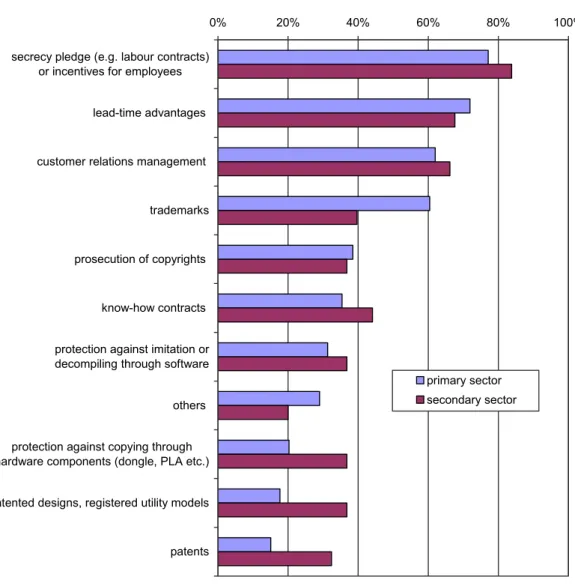
Figure 2.1 shows firstly the number of companies which made use of the various protection strategies in the year 2000. It was shown unequivocally that intellectual property rights have a relatively low importance in the original software sector (= primary sector) and in the sectors producing also software (= secondary sector) and only complement the whole range of possible informal protective measures. By far the most frequently used are various forms of internal confidentiality (secrecy agreements), followed by market leadership (time) advantage and customer rela-tions management. One interesting, significant difference arises from the use of technical protection measures, which are much more widely spread in the secondary sector (41 per cent) than in the primary sector (22 per cent).
The intellectual property rights evince considerable differences between the primary sector and the secondary sector. Trade marks take first place in the primary sector and are utilized by 63.4 per cent of the companies; the upholding of copyright fol-lows at some distance (43.3 per cent of the companies). Patents, on the other hand, are utilized by a mere 15.9 per cent of the companies in the primary sector. In the secondary sector, the divergences in the frequency of use are lower. Although trade marks (43.5 per cent) are also more important for the secondary sector than patents, patents are still utilized in this sector by more than a third of the enterprises (34.6 per cent). Thus the frequency of using patents is statistically significantly higher in the secondary sector than in the primary sector, whereas in the primary sector im-portance of trade marks is significantly higher than in the secondary sector. The independent developers take recourse to patents as a protective mechanism only in exceptional cases (7.9 per cent), whilst their utilization behavior of the other formal property rights is very similar to that of the other two sectors.
Figure 2.1 Use of various instruments to protect software- and computer-related developments in the year 2000
0% 20% 40% 60% 80% 100%
secrecy pledge (e.g. labour contracts) or incentives for employees
lead-time advantages
customer relations management
trademarks
prosecution of copyrights
know-how contracts
protection against imitation or decompiling through software
others
protection against copying through hardware components (dongle, PLA etc.)
patented designs, registered utility models
patents
primary sector secondary sector
Source: Blind et al. 2005
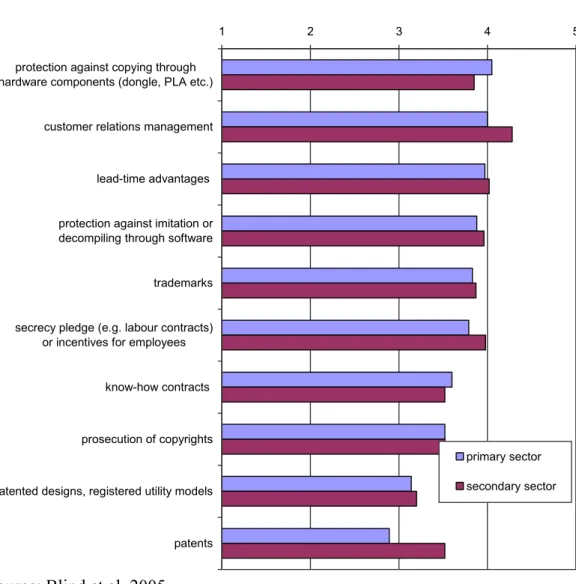
Besides the actual extent of use, the relative importance, which the companies ac-cord to the different protection rights, is interesting (Figure 2.2). The result is un-ambiguous here: the significance of patents was regarded as very low in the year 2000. They have the lowest value in the primary sector, and in the secondary sector also, only registered designs are considered to be of less importance. However, when comparing sectors it appears that the primary sector allots patents a signifi-cantly lower importance than the secondary sector. In combination with the low degree of utilization of patents this permits the conclusion that for the primary sec-tor patents play a relatively small role by comparison with other protective strate-gies and by comparison with the secondary sector – at least assessed in the year 2001.
Figure 2.2 Importance of various strategies to protect software- and com-puter-related developments in the year 2000
(1 = very low, 5 = very high)
1 2 3 4 5
protection against copying through hardware components (dongle, PLA etc.)
customer relations management
lead-time advantages
protection against imitation or decompiling through software
trademarks
secrecy pledge (e.g. labour contracts) or incentives for employees
know-how contracts
prosecution of copyrights
patented designs, registered utility models
patents
primary sector secondary sector
Source: Blind et al. 2005
However, in the primary sector generally intellectual property rights are allotted the lowest marks in the year 2000. The exception to this rule was trade marks alone, which are rated nearly 4 (great significance). It must be remembered though that the main motive in applying for trade marks lies not in the protection of innovations, but above all so that the visibility and the image of the company and its products are in the forefront (Bugdahl 1998, pp. 1-26). Interestingly, for the primary sector, the technical possibilities of protection represent the most important strategy, although compared with other strategies they are relatively less widespread, so that this aver-age figure is based on relatively few responses (n = 40).
In the secondary sector the intellectual property rights also have the lowest scores. Trade marks are also the exception here, which have a similarly high importance as
in the primary sector. The most significant of all strategies are customer commit-ment and lead-time advantage.
In order to achieve a comparison with the assessment made by the software compa-nies in the year 2001, we rely on the German data of the recent fourth Community Innovation Survey CIS addressing the period 2002 until 2004. However, the com-parison requires a restriction of the analysis in two dimensions. First, we just con-centrate on the companies just focusing on software production (= primary sector), identified by the NACE code 722 and not mainly involved in activities of the manu-facturing sector (= secondary sector). Second, we have to restrict the protection in-struments to those covered by the CIS, which are less than those we used in the sur-vey specified for the software industry.
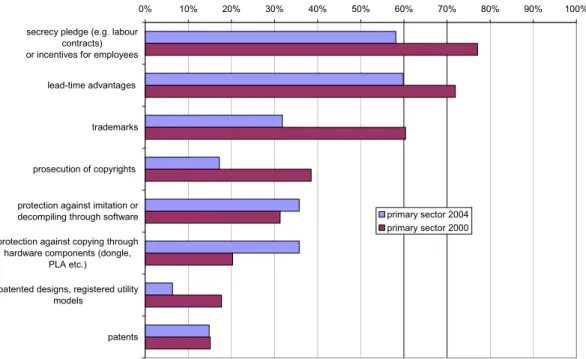
However, the comparison of the use of protection instruments in the software sector reveals interesting patterns (Fig 2.3). In general, there is a tendency to use fewer instruments. Only the use of complex product designs as one option in the CIS is used by a higher share of software companies in the year 2004 compared to the companies using soft- or hardware based technical features in the year 2000. The reduced use of protection instruments in the software sector might be the effect of the further distribution of open source or open innovation (Chesbrough 2003) based business models.
Focusing on the use of patents, we find an identical share of 15% in the both sur-veys. This means that the possible option to receive also patent protection for soft-ware-related inventions has not caused a more intensive use of this instrument. There are two possible explanations. First, the companies have been rather confused by the lengthy, emotional and rather complicated legal discussions. Second, soft-ware companies are rather skeptical about the effectiveness and the efficiency of patent protection in general. The survey results of the year 2000 give indications that the latter reason was at least rather important. Obviously, the legal conflict about the introduction of software patents did not provide further convincing argu-ments for believing in the effectiveness of patent protection.
Figure 2.3 Use of various instruments to protect software- and computer-related developments in the year 2000 and 2004
0% 10% 20% 30% 40% 50% 60% 70% 80% 90% 100% secrecy pledge (e.g. labour
contracts) or incentives for employees
lead-time advantages
trademarks
prosecution of copyrights
protection against imitation or decompiling through software protection against copying through hardware components (dongle,
PLA etc.)
patented designs, registered utility models
patents
primary sector 2004 primary sector 2000
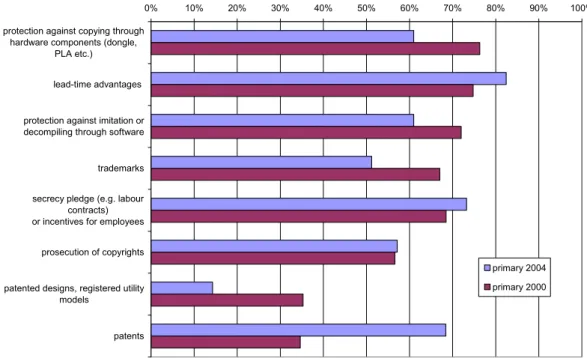
Source: Blind et al. 2005 and ZEW/FhG-ISI Mannheim Innovation Panel 2004 Further insights in the changed relevance of protection instruments in the software sector might give the assessment of the importance of the actually used strategies. However, Figure 2.4 reveals that most instruments lost in importance or remained rather stable (e .g. lead time advantage or secrecy). The only significant difference can be observed in the relevance of patents. The share of those companies assessing patents of high or very high relevance doubled. This means that those involved in patenting software have meanwhile appreciated the advantages of patents as protec-tion instruments. Furthermore, these companies could also not be made confused by the puzzling, lengthy and still not yet decided conflict at the political level.
Taking the results about the share of software companies using patents at all and the assessment of their relevance together, we come to the following preliminary con-clusion. The possible option to extend the patentability to software-related inven-tions did not lead to an extended use of this protection instrument. Companies are obviously not convinced about the effectiveness of the instrument or are not willing to make significant investment in this still rather vague option. However, those al-ready using software patents assess their importance as high as secrecy or even as lead time advantage.3 This means at the end that the discrepancy between
3 This is consistent with the findings of Blind and Edler (2003)based on the survey in the year 2001, that companies already using patents in the manufacturing sector would prefer an extension to the software sector. This tendency can also be found in the case studies conducted after the survey (Blind et al. 2005).
nies using and not using patents as protection instruments has increased. The size bias in the use of patents towards large companies in the year 2000 has also in-creased, since in 2004 only 5% of the very small software companies with less than 20 employees use software patents in contrast to almost 30% of the large companies with more than 250 employees. The debate about the patentability of software has therefore increased the unbalance in the capacities to use protection instruments. This is certainly not positive for the competition in the sector.
Figure 2.4 Importance of various strategies to protect software- and com-puter-related developments in the year 2000 and 2004
(share of respondents assessing high or very high relevance) 0% 10% 20% 30% 40% 50% 60% 70% 80% 90% 100% protection against copying through
hardware components (dongle, PLA etc.)
lead-time advantages
protection against imitation or decompiling through software
trademarks
secrecy pledge (e.g. labour contracts) or incentives for employees
prosecution of copyrights
patented designs, registered utility models
patents
primary 2004 primary 2000
Source: Blind et al. 2005 and ZEW/FhG-ISI Mannheim Innovation Panel 2004
3.
Determinants for the Use and Importance of Patents as
Protection Instruments in the Software Sector
There are several approaches to determine the demand for instruments to protect inventions especially in the manufacturing sector with a strong focus on patents. For the service sector Blind et al. (2006b) develop a conceptual model based on the tan-gibility and codifiability of the assets and outputs of service sectors to derive the demand for formal and informal protection instruments. Based on a restricted sam-ple of case study, they are still able to detect some sector-specific patterns. Bessen and Hunt (2003) construct a demand function for software patents taking into count the changing patent regime in the United States. Oz (1998) compares the
ac-ceptability of patent and copyright protection based on surveys among software developers and attorneys also in the United States. Whereas the later author differ-entiates between the different outputs of the software development process, all au-thors are not able to estimate comprehensive demand functions for different protec-tion instruments, especially reflecting specific features of the software development process.
Modifying the approach of Bessen and Hunt (2003), we estimate the following de-mand function for software patents D based on the information of company j. We distinguish between the use or non-use (Use = 0,1) of instruments applying a Probit estimation and their importance (Importance = 0, 1, ... 5 or 0, 1, 2, 3) applying an ordered Probit model:
)
(
FC
D
Use
j= j (1a))
(
FC
D
Imp
j= j (1b)with FCj as vector of firm characteristics.4
In our regression analysis we use beside the already mentioned size dimension, the R&D intensity, the export share, the competition intensity, and the collaboration activities with customers, suppliers and competitors.
The role of company size for using patents is already discussed decades ago (Mansfield 1986) and still confirmed in recent studies (Peeters, van Pottelsberghe de la Pottene 2006). This size effect is impressively confirmed in all six regression models. The size bias has even increased over time in the German software sector. A second interesting question is whether the R&D intensity is a driving factor for the use and the importance of software patents. Whereas, the R&D intensity has no influence on the use of software patents among the whole sample of software pro-ducing companies in the year 2000, it is a significant explanatory variable for the companies in the primary sector both in the year 2000 and the year 2004. Software companies with high investments in R&D. R&D-intensive companies take obvi-ously advantage of this additional protection instrument in order to secure the ap-propriation of their investments. If we have a look on the role of export shares for explaining the use and the relevance of patenting software inventions, we find a structural change in relation to the year 2000, at which it did not play a role. In the year 2004, an increasing export share leads both to a higher probability to use pat-ents as protection instrument and to a higher assessment of their relevance. The
4 Due to the data availability, the firm characteristics are not completely identically identified in the analyses based on 2000 and 2004 data.
cussion to extend the patentability to software inventions in Europe and world-wide created additional incentives for German companies to make use of this additional protection instrument to secure their market shares abroad. A further change in the explanatory power of a factor can be observed regarding the number of competitors. Whereas in the year 2000 companies with fewer competitors were more likely to use software patents, the role of the number of competitors lost its significance in the year 2004. Finally, we analyse the role of collaborations for the use of software patents. In the year 2000, only the collaboration with customers increased the likeli-hood of using patents for the whole sample of software producing companies. Meanwhile, collaboration activities have a strong, but diverse influence on the use of patents depending on the type of collaboration partners. Investigations in the manufacturing sector show that patents play an important role for the collaborations of companies (Blind et al. 2006a). However, our analysis reveals an interesting pat-tern regarding the influence of the different collaboration partners on the likelihood and relevance of patenting. In the whole sample of software producing companies collected in the year 2001, those collaborating with customers are less likely to use software patents and attribute a lower importance to this protection instrument compared with those companies not having co-operating relations with customers. For the subsample of the companies active in the primary sector, the relevance of the different collaboration partners have neither an influence on the likelihood to use patents nor their importance. In the sample of software companies surveyed in 2005, we observe interesting changes regarding the influence of collaboration pat-terns on the use and relevance of patents as protection instruments. First, companies assessing the relevance of collaboration with customers higher have also a higher likelihood to use patents and assess their relevance higher. The interpretation for this phenomenon is that the customers of software companies are mostly companies of the manufacturing sector which are heavily involved in the usage of patents as protection instruments. Consequently, the software companies try to protect their knowledge assets with similar strategies. Even more surprising is the observation that those companies having intensive collaborations with suppliers and even com-petitors make less use of patents and assess their relevance lower. This pattern is an indication that software companies more often make use of open source software, which is seen by most companies as contradiction to the use of patents. In order to find further explanations and foundations for this hypotheses, further research is required.
Table 3.1: Factors for the Use and Importance of Software Patents: Results of Regression Analyses Use 2000 Impor-tance 2000 Use Pri-mary 2000 Impor-tance Primary 2000 Use Pri-mary 2004 Impor-tance Primary 2004 Size 0.20*** 0.20*** 0.30*** 0.30*** 0.51*** 0.46*** R&D intensity 0.41 0.46 1.13** 1.26** 2.06** 1.90** Export share 0.39* 0.41** 0.23 0.14 2.59*** 2.74*** Competition intensity -0.19 -0.17 -0.44* -0.45* 0.09 0.09 Collaboration Customers -0.17** -0.18** -0.06 -0.02 0.41 0.49* Collaboration Suppliers 0.08 0.11 -0.07 -0.02 -0.47* .-0.45* Collaboration Competitors 0.03 -0.05 0.14 0.02 -1.07 -1.03**
4. Preliminary
Conclusion
The comparison between the use of protection instruments and strategies in the German software sector reveals interesting patterns. Whereas the general use and the relevance of the various protection instruments have not changed, we find an interesting pattern for the use and relevance of patents. On the one hand, we cannot observe an extension of software patents among software producing companies. On the other hand, those companies making use of patents attribute a higher importance to this new and still not legally confirmed protection instrument. Consequently, the discrepancy in the competencies to use this protection instrument has increased, which might generate further imbalances in the software market. Analysing the fac-tors, which determine the use and relevance of patents as protection instrument, confirms the size bias, i.e. the larger the companies the higher the likelihood to use patents and the greater their importance. Furthermore, companies heavily involved in exporting activities are inclined to use this additional protection instrument, espe-cially due to the higher legal insecurity within and outside Europe regarding soft-ware patenting and its implications for infringements and litigations. Finally, the collaboration patterns are important drivers for the use of patents. Companies strongly involved in collaborations with customers, which are well experienced with using patents, are more inclined to use patents. In contrast, intensive collabora-tions with suppliers and even competitors reduce the likelihood for the usage of
patents, since this contradicts probably the open source based collaborations. How-ever, this has further to be investigated also in order to be able to derive policy con-clusions for the future discussion about software patents.
References
Bessen, J.; Hunt, J. (2003): An Empirical Look at Software Patents, Working Paper 03-17, Federal Reserve Bank of Philadelphia.
Bessen, J.; Maskin, E. (2000): Sequential Innovation, Patents and Imitation: MIT Working Paper, No. 1/2000, Cambridge: MIT.
Blind, K.; Edler, J.; Frietsch, R.U. (2006a): Motives to patent: empirical evidence from Germany. In: Research Policy, 35, pp. 655-672.
Blind, K.; Evangelista, R.; Howells, J. (2006b): A Conceptual Model of Knowledge Regimes, Appropriability and Intellectual Property Protection in Services, Karlsruhe, Rome, Manchester.
Blind, K.; Edler, J.; Friedewald, M. (2005): Software Patents: Empirical Evidence and Policy Implications, Cheltenham: Edward Elgar.
Blind, K.; Edler, J. (2003): Idiosyncrasies of the Software Development Process and their Relation to Software Patents: Theoretical Considerations and Empirical Evidence, in. In: netnomics, 5 (1), pp. 71-96.
Bugdahl, V. (1998): Marken machen Märkte. Eine Anleitung zur erfolgreichen Markenpraxis, München: C.H. Beck.
Chesbrough, H.W. (2003): The era of open innovation. In: Mit Sloan Management Review, 44 (3), pp. 35-41.
European Commission (ed.) (2000): Guide to the implementation of directives based on the New Approach and the Global Approach, Luxembourg: Office for Official Publications of the European Communities.
Farrell, J. (1989): Standardization and intellectual property. In: Jurimetrics Journal, pp. 35-50.
Graham, S.; Mowery, D.C. (2003): Intellectual property protection in the US soft-ware industry. In: The Patent System in the Knowledge-based Economy. Cohen, W.; Merrill, S. (eds.). Washington: National Academies Press. Hart, R.; Holmes, P.; Reid, J. (2000): The Economic Impact of Patentability of
Lerner, J.; Tirole, J. (2005): The Economics of Technology Sharing: Open Source and Beyond Source . In: Journal of Economic Perspectives, 19 (2), pp. 99-120.
Lutterbeck, B.; Gehring, R.; Horns, A.H. (2000): Sicherheit in der Information-stechnologie und Patentschutz für Software-Produkte - ein Widerspruch?, report to the Federal Ministry for Economics and Technology (BMWi), Ber-lin.
Mansfield, E. (1986): Patents and innovation: an empirical study. In: Management Science, 32, pp. 173-181.
Oz, E. (1998): Acceptable protection of software intellectual property: a survey of software developers and lawyers. In: Information & Management, 34, pp. 161-173.
PbT Consultants (2001): The Results of the European Commission Consultation Exercise on the Patentability of Computer Implemented Inventions, Notts, UK: PbT Consultants Ltd.
Peeters, C.; van Pottelsberghe de la Pottene, B. (2006): Innovation strategy and the patenting behavior of firms. In: Journal of Evolutionary Economics, 16, pp. 109-135.
Webb, R. (2001): Software & Business Methods Patents: The UK Consultations: lecture at a workshop of the Federal Ministry for Economics and Technol-ogy, Berlin, 10 July 2001.