Conceptual
Design Review
Documents
MCAO for Gemini-South
Gemini Observatory
MCAO
TABLE OF CONTENTS
MCAO Acronyms………...v
1 Project Overview... 1
1.1 The MCAO Project ... 1
1.2 The Project Team... 1
1.3 The Conceptual Design Review... 2
1.4 The Conceptual Design Documentation... 2
1.5 Project Background ... 2
1.6 Project Progress... 3
1.7 Project Plans ... 5
1.8 Science Instruments for MCAO... 6
2 The MCAO Science Case... 7
2.1 Context ... 7
2.2 MCAO versus AO ... 8
2.2.1 Need for lasers ... 8
2.2.2 MCAO Sensitivities ... 8
2.2.3 Sky coverage ... 8
2.2.4 Multiplex gain ... 10
2.2.5 Uniform PSF ... 11
2.2.5.1 On altitude conjugation... 11
2.3 MCAO and the Gemini Science program... 11
2.4 MCAO in the NGST Era... 14
2.4.1 Gemini MCAO and NGST DRM programs ... 15
2.5 The science requirements... 22
3 System Overview... 25
3.1 Primary Subsystems and Their Characteristics... 25
3.2 System Performance ... 27
3.2.1 Image Quality... 27
3.2.2 Science Path Throughput and Emissivity ... 29
4 System Modeling ... 31
4.1 Goals and Tools ... 31
4.2 Background ... 32
4.2.1 Cerro Pachon Site Characterization Summary ... 32
4.2.2 The Need for Multiple Tip-Tilt Natural Guide Stars ... 33
4.2.3 Scintillation Effects and the Ordering of Deformable Mirrors ... 34
4.3 Optimization and Trade Studies... 35
4.3.1 Order of Sensing and Correction ... 35
4.3.2 Deformable Mirror Conjugate Ranges... 36
4.3.3 Corrected Field-of-View... 36
MCAO
4.4 Natural Guide Star Modeling ... 41
4.4.1 Decoupling the LGS and NGS Control Loops ... 41
4.4.2 NGS Magnitude Limits ... 43
4.4.3 PSF Characteristics ... 45
4.4.3.1 Telescope and instrument ... 47
4.4.4 Sky Coverage ... 47
4.5 Summary... 49
5 Subsystem Design... 51
5.1 Adaptive Optics Module ... 51
5.1.1 Optical Design... 51
5.1.1.1 Design Requirements ... 52
5.1.1.2 Science Path... 52
5.1.1.3 LGS Path and Field Corrector... 54
5.1.1.4 LGS collimator and “De-Anamorphoser”... 56
5.1.1.5 NGS WFS Path and NGS/LGS Beamsplitter ... 58
5.1.1.6 Transmittance Calculations... 59
5.1.1.7 Fabricability ... 60
5.1.2 Sensors ... 61
5.1.2.1 LGS Wave Front Sensor ... 62
5.1.2.2 NGS Tip/Tilt Wave Front Sensor ... 63
5.1.2.3 NGS Diagnostic Higher-Order Wave Front Sensor... 64
5.1.3 Deformable and Tip/Tilt Mirrors ... 64
5.1.4 Artificial Sources ... 66
5.1.5 Mechanical Packaging Concepts ... 66
5.2 Laser System... 69
5.2.1 Requirements ... 69
5.2.1.1 Laser power requirement ... 69
5.2.1.2 Other top- level requirements ... 71
5.2.2 Technology Options ... 72
5.2.3 Development Plan... 73
5.3 Laser Launch Telescope (LLT) and Beam Transfer Optics (BTO)... 74
5.3.1 Requirements ... 74
5.3.2 Design Overview... 75
5.3.3 Laser Launch Telescope... 77
5.3.3.1 Optical Design... 77
5.3.3.2 Mechanical Design... 78
5.3.4 Beam Transfer Optics ... 81
5.3.4.1 Laser path... 81
5.3.4.2 Diagnostics... 82
5.3.4.3 Other Components ... 83
5.4 The MCAO Control System ... 85
5.4.1 Overview ... 85
5.4.2 The MCAO Sequencer... 86
5.4.3 The Component Controller and the Laser Controller ... 87
5.4.4 The Real Time Controller ... 97
MCAO
5.4.4.2 NGS Requirements and Algorithm Description ... 99
5.4.4.3 LGS Requirements and Algorithm Description... 100
5.4.4.4 Optimization and Background Processes... 101
5.4.4.5 Calibration Processes ... 104
5.4.4.6 Diagnostics... 105
5.4.4.7 Hardware Options and Baseline Approach... 105
5.4.5 VME Hardware Requirements... 109
5.4.6 Power Requirements ... 110
5.5 Safe Aircraft Localization and Satellite Acquisition system (SALSA) ... 110
6 Commissioning, Calibration, and Concept of Operations ... 113
6.1 Commissioning tasks ... 113 6.2 Instrument setup ... 113 6.3 Concept of operations ... 114 6.3.1 Technical operations ... 114 6.3.2 Science operations/modes... 114 6.4 Operational overheads... 115 7 Interface Summary ... 117
7.1 Instrument Support Structure (ISS) ... 117
7.1.1 Mechanical... 117
7.1.2 Services ... 117
7.1.3 Handling... 117
7.2 Secondary Support Structure interface ... 118
7.2.1 Mechanical interface ... 118
7.2.2 Services ... 118
7.2.2.1 Electrical ... 118
7.2.2.2 Coolant ... 118
7.3 Control System Interfaces ... 118
7.3.1 Telescope Control System (TCS) ... 118
7.3.2 Acquisition and Guiding System (A&G)... 119
Appendices:
A. MCAO Science Case
B. MCAO Functional and Performance Requirements Document C. MCAO Operational Concept Definition Document
D. LGS AO and MCAO Performance as a Function of LGS Signal Level
E. Evaluating and Optimizing Control Algorithms for Combined LGS/NGS MCAO Systems
F. Compensation of the Null Modes with the Gemini MCAO G. Secondary Support Structure Interface
H. MCAO Beam Transfer Optics Requirements Document I. Laser Launch Telescope Requirements Document
J. Beam Transfer Optics and Laser Launch Telescope Design Document K. Electronics, Sensors & Actuators in the Beam Transfer Optics
MCAO
L. LGS AO Photon Return Simulations and Laser Requirements for the Gemini LGS AO Program
M. Laser Requirements and Prospects for the Gemini LGS AO Program N. Durham MCAO Lab Demo Status
Drawings:
- Beam Transfer Optics conceptual design for a single beam (LLT1PLAN.DWG) - Beam Transfer Optics conceptual design for a five beam array
(LLT5PLAN.DWG)
- Deployment concept for the LLT primary mirror (DEPLOY.DWG) - Concept to optimize repeatability of LLT primary mirror deployment
(LLT_MC1.DWG and LLT_MC2.DWG)
- Secondary Support Structure to LLT mounting interface (SSS.DWG) - Conceptual view of the BTO beam path (HROSPATH.DWG)
MCAO
MCAO Acronyms
ADC Atmospheric Dispersion Corrector ADC Analog-to-Digital Converter
AO Adaptive Optics
AOM Adaptive Optics Module APD Avalanche Photo Diode
BS Beam Splitter
BTO Beam Transfer Optics
CAD Command Action Directive Record
CB Circular Buffer
CC Component Controller
CC Corner Cube
CCD Charged Coupled Devices CDR Critical Design Review CoDR Conceptual Design Review
CP Cerro Pachon
CPU Central Processing Unit CW Continuous Wave (laser) DAC Digital-to-Analogue Converter DHS Data Handling System
DM Deformable Mirror
DRM Design Reference Mission
EPICS Experimental Physics and Industrial Control System ESO European Southern Observatory
FWHM Full Width at Half Maximum GIS Gemini Interlock System GRB Gamma Ray Burster GSC Gemini Science Committee GSM Generalized Seeing Monitor
HROS High Resolution Optical Spectrograph HRWFS High Resolution Wave Front Sensor ICS Instrument Control Sequencer IGPO International Gemini Project Office IOC Input/Output Controller
IRMOS Infra-Red Multi-Object Spectrograph
IS Instrument Sequencer
ISS Instrument Support Structure LAN Local Area Network
LC Laser Component
LS Laser System
LEM Laser Electronics Module
LGS Laser Guide Star
LGS CS Laser Guide Star Control System LLT Laser Launch Telescope
MCAO
MCAO Multi-Conjugate Adaptive Optics MCAO CS MCAO Control System
MK Mauna Kea
MK LGS AO Mauna Kea Laser Guide Star Adaptive Optics M2TS Secondary Mirror Tilt System
NGS Natural Guide Star
NGST Next Generation Space Telescope
NIR Near Infra Red
NPO National Project Office OAP Off-Axis Parabola
OCDD Operational Concepts Definition Document OCS Observatory Control System
OIWFS On Instrument Wavefront Sensor OPO Optical Parametric Oscillator OTF Optical Transfer Function QLT Quick Look Tool
PDR Preliminary Design Review PIO Parallel Input Output PMC PCI Mezzanine Card PSD Power Spectral Density PSD Position Sensing Detector PSF Point Spread Function PZT Piezoelectric Translator RFP Request For Proposals
RMS Root Mean Square
RTC Real Time Component SAD Status Alarm Database
SALSA Safe Aircraft Localization and Satellite Acquisition System
SC Sky Coverage
SCS Secondary Control System SFG Sum-Frequency Generation
SH Shack-Hartmann
SHG Second Harmonic Generation SIR Status Information Record SSS Secondary Support Structure TCS Telescope Control System
TT Tip/Tilt
TTM Tip-Tilt Mirror
VME Versa Module Europa – a Eurocard-based bus system WFS Wave Front Sensor
Flops Number of floating point operation per second. A multiply/add corresponds to 2 operations.
MCAO
1
P
ROJECTO
VERVIEW1.1 The MCAO Project
The Gemini Multi-Conjugate Adaptive Optics (MCAO) system is a proposed facility instrument for the Gemini-South telescope that is intended to provide uniform, diffraction-limited image quality at near IR wavelengths across an extended field-of-view. This will yield increases in scientific utility and observational efficiency well beyond what is feasible with a conventional AO system, and provide unique capabilities for Gemini-South in the 2004-9 time frame. For a range of criteria, mean performance over a one square arc minute field-of-view will be comparable to the on-axis performance of the Altair laser guide star (LGS) AO system for Gemini-North. Sky coverage will also comparable or somewhat superior.
The MCAO system will largely eliminate the impact of anisoplanatism on AO performance by compensating atmospheric turbulence in three dimensions. This will be accomplished using multiple deformable mirrors (DM’s) conjugate to distinct ranges in the atmosphere, which will be driven with commands computed from wave front sensor (WFS) measurements of multiple laser- and natural guide stars. At this point, these features have been embodied in an implementation concept that meets the requirements of a practical AO system for the Gemini-South telescope. The basic approaches and nearly all the components used in this design remain highly comparable with the current generation of AO, and the system architecture is a natural generalization of conventional LGS AO systems.
1.2 The Project Team
Figure 1 illustrates the organization of the MCAO project team. Other individuals contributing to this report and its appendices include Mark Chun (IGPO), Glen Herriot (HIA), Ralf Flicker (Lund Univ.), Leslie Saddlemeyer (HIA), Jacques Sebag (IGPO), Ray Sharples (Durham Univ.), and Doug Simons (IGPO).
Figure 1: MCAO Project Organization Chart. HIA is the Herzberg Institute of Astrophysics, ODS is Optical Design Service, and OS is Observatory Services. The remaining team
Real-Time Control Electronics C. Boyer MCAO Control System C. Boyer Launch Telescope/
Beam Transfer Optics Electronics C. Carter Systems B. Ellerbroek Optical Design J. Oschmann Mechanical Design Eric James Science Case F. Rigaut M.Chun Lasers C. d’Orgeville MCAO Project Scientist F. Rigaut MCAO Project Manager B. Ellerbroek Gemini Project Manager J. Oschmann T. Davidge (HIA) I. Jorgensen S. Morris (HIA) Richard Buchroeder (ODS)
Celine d’Orgeville
(David Mongomery) Jim Catone
MCAO
1.3 The Conceptual Design Review
The Conceptual Design Review (CoDR) for the Gemini MCAO system will be presented on the 30th and 31st of May, 2000, at the Gemini-North Hilo Base Facility in Hawaii. The purpose of the CoDR is to determine if the MCAO science case, system performance analysis, system/subsystem design concepts, and cost and schedule estimates are sufficiently well defined and encouraging enough to warrant additional work at the preliminary design level. The review committee consists of nine astronomers and engineers from the Gemini partner counties and ESO with particular interest and expertise in adaptive optics and instrument design. The review will be followed immediately by a two day meeting in Hilo of the Gemini Science Council (GSC), which will review the committee’s findings and assess the MCAO project in the context of the Gemini instrument program overall.
1.4 The Conceptual Design Documentation
The purpose of the documentation is to explain the science case, derived requirements, system architecture, system performance estimates, and subsystem design concepts for the MCAO system. The intended audience is the CoDR committee, other CoDR attendees, and interested GSC members. The main body of the report is written for this readership as a whole, with more detailed and specialized support documentation provided by the Appendices.
The main body of the report is organized to follow the agenda of the CoDR itself. The remainder of this section provides a brief summary of background, progress, and plans for the MCAO project, and outlines its relationship to the Gemini instrument program overall. The following three sections are devoted to system-level topics: (i) The science case; (ii) an overview of MCAO system parameters, performance, and architecture; and (iii) a review of system performance modeling to date. The next and longest section summarizes the functional requirements and design concepts of the individual subsystems such as optical design, real-time control electronics, and lasers. Two brief sections on operational issues and interfaces conclude the main body of the report. The appendices are included as reference material separated by index tabs at the back of the binder.
1.5 Project Background
Since 1992, the top-level performance requirements for Gemini AO systems have included the capability of delivering a Strehl of 0.5 at 1.65 microns under median seeing conditions. Laser guide stars have been viewed as a method for achieving a similar level of performance over a larger fraction of the sky. The initial image quality requirements for Gemini also included a specification for a 50% encircled energy diameter of 0.1 arc second at 2.2 microns over a 1 arc minute field, indicating an interest in high angular resolution over regions much larger than the isoplanatic patch size. A forum was held in April 1999 to discuss the options for achieving and implementing these requirements for the Gemini-South LGS AO system. The review panel for this meeting recommended that:
MCAO
The [Gemini] Project should conduct a significant but time-limited study of a multi-conjugate adaptive optics system for Cerro Pachon…. The study should address the theoretical analysis, science drivers, technical challenges, systems engineering, and programmatics of such an AO system. …. [T]he RP [review panel] recommends that Gemini adopt as aggressive a schedule as possible to bring this capability to the community.
The recommended feasibility study was led by Francois Rigaut and ran from May to September 1999. It concluded that “…for an 8-m class telescope all the required technologies [for MCAO] are available except the laser systems,” and that “we have not identified any fundamental theoretical or technological limit that prevents us from implementing a MCAO system for Gemini-South.” An initial review of the science case identified numerous science areas which would benefit significantly from atmospheric turbulence compensation over 1-2 arc minute fields, including the physics of nearby stars, stars in other galaxies, the evolution of galaxies, and galaxies as probes of high z structure. The feasibility study obtained the first rigorous modeling results indicating satisfactory MCAO performance with laser guide stars. The study also identified the MCAO design space for system-level parameters, including the corrected field-of-view, the number and location of guide stars, and the order of the WFS’s and DM’s. With the exception of the guide star lasers, these parameters were found to be consistent with existing AO technology and practical subsystem designs. The requirements for the guide star lasers do imply engineering advances beyond currently available lasers, but are no different than the requirements for a conventional LGS AO system when viewed on a per-guide-star basis.
The results of the feasibility study were presented to the Gemini partners, Science Committee, and Board in a series of meetings from September to November 1999. The GSC
“…strongly recommend[ed] proceeding with the Conceptual Design…leading to a CoDR in early 2000…. It should culminate in a CoD Review by an independent panel with attendance from the partner countries.”
The Gemini Board next approved proceeding with the Conceptual Design effort and endorsed the recommended review process.
1.6 Project Progress
The MCAO Conceptual Design effort has occupied the interval from December 1999 to May 2000. During this time, the IGPO-led design team has pursued technical and scientific interchange with the Gemini partners and provided written monthly updates to the NPO's. Work during this phase has focused upon (i) refining MCAO system performance estimates via detailed modeling; (ii) updating the science case on the basis of these estimates; (iii) developing a comprehensive and practical system architecture and a corresponding concept of operations; (iv) verifying laser system requirements and initiating a laser development plan; (v) refining and detailing subsystem design concepts in the areas of greatest complexity and risk; and (vi) reviewing the cost and schedule estimates for the MCAO project.
MCAO
Detailed system-level modeling and trade studies during this phase have established the baseline parameters for AO components, and obtained end-to-end performance estimates for this baseline system with Cerro Pachon atmospheric turbulence conditions. Some of these system parameters include: Field-of-view dimensions; DM conjugate ranges and actuator geometries; LGS locations and signal levels; guide star laser beam quality; WFS spatial and temporal sampling rates for both laser- and natural guide stars; and budget allocations for AO implementation errors such as non-common path aberrations and calibration errors. Performance metrics include mean Strehl ratio and Strehl variability as a function of wavelength and zenith angle; PSF full-width half-maxima and encircled energy radii; and estimates of natural guide star magnitude limits and sky coverage for MCAO. An essential milestone in this work has been the development of a control algorithm that effectively decouples the LGS- and NGS-driven components of the control loop. This insight greatly simplifies sky coverage calculations, and facilitates practical implementation of adaptive modal control algorithms that can significantly improve NGS magnitude limits.
Parallel to the modeling efforts, several groups have worked on the MCAO science case. MCAO is not strictly speaking an instrument, but an interface between telescope and instrument than can boost the instrument capabilities and/or allow new programs. As a starting hypothesis, we have assumed baseline instrumentation consisting of a one square arc second well-sampled imager and a multiple deployable IFU spectrograph. This effort was twofold: firstly, MCAO was examined in view of the overall Gemini science drivers. Each science program, as identified in the Abington report, was reviewed and the gains brought by MCAO were estimated. We identified three kinds of programs: (1) The programs that either do not benefit from any kind of AO compensation, or that do not benefit additionally from MCAO (e.g. the search for brown dwarves); (2) the programs that will benefit from the 10-20 multiplex gain provided by MCAO with respect to classical AO; and (3) the programs that are enabled by MCAO because they require a very stable PSF over a ~ 1 square arc minute field. Most programs are in the second category. MCAO performance was also gauged with respect to NGST capabilities. Despite the higher background from its ground-based location, a significant fraction of the Design Reference Mission programs can be started well in advance of the NGST launch. Secondly, two teams made focused efforts on specific science cases: “Probing the early stages of galaxy evolution in nearby galaxies,” led by Tim Davidge, and “Distant galaxies” led by Simon Morris. Both conducted detailed evaluations of MCAO gains, based upon actual data analysis of simulated images, and compared the results with a classical LGS AO system. Again, these studies demonstrated the MCAO multiplex gain, and the increase in sensitivity and robustness brought by a spatially stable PSF.
The overall system architecture of the MCAO design is highly analogous to many conventional LGS systems, such as the Mauna Kea LGS AO system (MK LGS-AOS) for Gemini-North. Major subsystems include the Laser System (LS), Beam Transfer Optics (BTO), Laser Launch Telescope (LLT), AO Module (AOM), MCAO Control System (MCAO CS), and the safety system (SALSA). The physical and functional interfaces of these subsystems are basically similar to the MK LGS-AOS, although of course several
MCAO
subsystems do incorporate multiple laser beams, DM’s, and WFS’s. The Operational Concepts Definition Document (OCDD) describes the system control architecture, concept of operations, and calibration methods developed for MCAO. The approaches used can be considered natural generalizations of the methods already implemented or planned for conventional LGS AO systems.
Three laser risk reduction projects have been initiated after the failure of the Mauna Kea LGS laser system proposal process in November 1999. Two of these projects involve collaborative funding with the Center for Adaptive Optics (CfAO), NSF, and the US Air Force Research Laboratory. All three projects propose laser systems based upon sum frequency mixing beams from solid-state Nd:YAG pump lasers. Two projects intend to demonstrate breadboard lasers in the 25-40 Watt range by early 2001.
Subsystem design work during the CoD phase has concentrated upon those aspects of the feasibility study design of greatest uncertainty, risk, or cost. Approaches have been formulated for propagating multiple beams through the BTO and maintaining correct alignment of the LLT. An integrated tolerance analysis of these closely related designs is now in progress. Optical designs have been developed for the science- and LGS optical paths through the AO module. These designs meet specifications in the areas of image quality and pupil distortion, can be efficiently packaged, and are manufacturable. Vendors have been contacted to verify the basic performance characteristics, interfaces, and price ranges for key AO components including WFS CCD arrays, deformable- and tip/tilt mirrors, and optical filters. A design approach for the real-time electronics has been determined on the basis of benchmark calculations for the real-time control algorithm. This solution appears quite reasonable in terms of the required number of boards, complexity, and cost.
The project cost and schedule estimates presented in the feasibility study have been reviewed and remain essentially valid, granted positive results in the laser risk reduction projects over the course of the next year. Cost and schedule estimates are summarized in a separate volume.
1.7 Project Plans
Pending approval of this conceptual design, the preliminary design phase will begin work towards a Preliminary Design Review (PDR) planned for April 2001. This four month delay from the schedule proposed in the feasibility study report reflects the overall IGPO workload during the first half of 2000, and also brings the PDR date into alignment with end of the laser risk reduction projects. Work packages and/or contracts for design work on the LLT/BTO, AOM, and MCAO CS subsystems will be initiated early in the preliminary design phase, with the IGPO retaining responsibility for system integration, interface control, system modeling, and laser R&D management. The duration of the remaining project phases remain as before, leading to a Critical Design Review (CDR) in April 2002, completion of subsystems by October 2003, and system integration and test by July 2004.
MCAO
1.8 Science Instruments for MCAO
Efficient utilization of the MCAO system will depend upon the availability of a large-field IRMOS and near-IR imager with complementary design characteristics. The IRMOS should include multiple deployable IFU’s (up to ~20), provide sufficient spectral resolution to work between the OH lines, and have a 1-2 arc minute field. It will likely use technology under development now within the UK, Australia, and US for Gemini’s GIRMOS project. The imager should provide at least Nyquist rate sampling over a 60 arc second field. This implies a considerable number of pixels (2k by 2k for Nyquist sampling in K band; about 4k by 4k for J band). Both instruments should be matched to the f/30 output beam from the MCAO system, and provide diffraction-limited image quality over the above fields. Such instruments would yield unique scientific capabilities before the launch of NGST sometime around 2009-10. The IRMOS would remain competitive with NGST given sufficient spectral resolution.
The Gemini instrumentation program is in the midst of replanning to divert resources nominally intended for future non-MCAO instruments into the aforementioned MCAO-optimized imager and spectrometer. Final decisions regarding the continuation or cancellation of planned instruments will be made during June 2000, upon review of the revised plan by the GSC and Instrument Forum. This restructuring must be completed during mid-2000 in order to begin these new MCAO optimized instruments by 2001, and have them completed when MCAO is available on Gemini-South in mid-2004.
MCAO
2
T
HEMCAO S
CIENCEC
ASE2.1 Context
What are the important questions to ask in this reflection on the science case for the MCAO system? The fundamental question is not whether an AO complement should be provided for Gemini South. This point has been settled at the Abingdon meeting with an overwhelming answer from the Gemini astronomical community: All of the science programs of the Gemini mission, but one, do need AO to be effectively addressed. Rather, the case we are going to try to establish here concerns MCAO versus more traditional AO. What are the relative gains brought by MCAO compared to AO? How does it improve the output of the Gemini programs? Does it enable new programs? These are the questions we should try to answer in the following pages. More specifically, we have examined in detail a couple of specific science cases (nearby galaxies stellar population & distant galaxies, in Appendix A)
To start with, MCAO is not a usual instrument. This science case transcends an instrument science case, because (1) MCAO does not improve a handful of science programs, but benefits all –except a few- of them. Solely focusing on a couple of science program would have been too restrictive; this led us to approach the science case more globally. Second, (2) MCAO is not an instrument by itself, but an interface between telescope and instruments; MCAO is a facility improvement. In that respect, we have had to assume an instrument suite. The latter is to be debated within the Gemini user community. Early discussions took place at the Instrument Forum (05/2000), and will be continued at the Gemini Science Committee (06/2000). A dedicated workshop is planned for later this year that should involve the community at large, where the instrumentation program defined at Abingdon will be revisited/re-aimed in view of the opportunities opened by MCAO. In establishing this science case, we have had to make assumptions on future instruments. The baseline we settled on is:
• A 4kx4k Nyquist sampled imager, with pixel scale of 16-20 mas, covering 66’’x66’’ to 80”x80”
• A deployable IFU with 0.1’’ spatial resolution elements or less, with over 15 independent IFUs.
In defining the science case, we should also not forget the context of the use of this Gemini South capability: whatever AO facility is built, it will not realistically become available before 2003-2004. This is over 4 years after the Keck and two years after the ESO-VLT AO systems. It is therefore likely that the “easiest” (most tractable) classical AO programs will be largely started by the time the Cerro Pachon system comes on line. To put its community in the position to address original and important science questions, Gemini will have to provide facility instruments that are a step ahead of what is being built currently.
MCAO
2.2 MCAO versus AO 2.2.1 Need for lasers
Natural Guide Star AO (NGS AO) has been the lot of all AO instruments to date. Because AO was new and 0.1” astronomy was entirely uncovered -before HST-, a number of programs have been done and the targets were not missing. However, limited for decent compensation to the neighborhood of mR ~ 15 guide stars, it proved to most
effectively address galactic astronomy (e.g. solar system, star formation –YSOs, disks- brown dwarves), limiting the application for extragalactic problems to the brightest Seyfert galaxies, starburst and QSOs. The sky coverage with NGS systems is on the order of a percent. To start addressing extragalactic programs, to make AO of wide use, LGS are needed. They do not provide full sky coverage, but boost it to decent values (10 to >90% depending on galactic latitude). In our view, and again, considering that (1) a large fraction of the programs tractable with NGS AO will be well advanced by the time the CP AO comes on line and (2) a very large fraction of the Gemini core science involves objects that are not reachable with NGS AO, LGS should be made a requirement for the CP system.
Before examining in more details the adequacy of MCAO with the Gemini science programs, let us see in exactly what way it differs from AO, in term of impact upon astronomical observations.
2.2.2 MCAO Sensitivities
The derived limiting fluxes of a ground-based telescope with MCAO/AO or without AO at Cerro Pachon, the Hubble Space telescope with NICMOS, and the yardstick NGST are presented in Table 2. We list the 5-sigma, 1 hour limiting magnitudes for spectral resolutions of R=5 and R=10000. The backgrounds were taken from either the expected sky backgrounds for Gemini, the NICMOS manual, or from Gillett & Mountain (1997). The encircled energy fraction in the central 2x2 pixels is taken from simulated PSFs for the MCAO, NICMOS NIC2 growth curves (HST Instrument Science Report NICMOS-99-007), or estimated in the case of NGST (“NGST science instrument capability report”, Dec 29, 1999). We reconfirm the results of Gillett and Mountain that at low resolutions NGST has a significant advantage (2.5 – 3 magnitudes) while at high spectral resolutions there is no SNR advantage. At these spectral resolutions detector noise is important and the Gemini advantage arises from the lower cosmic ray flux and hence fewer frame readouts. In broadband imaging at 2.2 microns MCAO has a 1.2-1.7 magnitude advantage over NICMOS and no AO cases respectively. Note that at high spectral resolution the no-AO case has a fainter limiting magnitude than the MCAO but this is through a slit which is 12 times larger (i.e. a 2 pixel slit width).
2.2.3 Sky coverage
Table 1 summarizes the sky coverage for classical LGS AO (CAO) and MCAO, for two galactic latitude and the three near-infrared bands
MCAO
CAO / MCAO S.C. [%] b=90o b=30o
J 7 / 12 21 / 67
H 16 / 14 44 / 69
K 35 / 24 74 / 82
Table 1: Classical AO and MCAO sky coverage
Assumptions for the MCAO and CAO sky coverage computations are described in section 4.4.3. For both cases, the sky coverage is computed as the fraction of the sky within which the Strehl ratio loss is < 50% with respect with the noiseless performance -on bright stars-. For instance, for the MCAO system, with a K band Strehl ratio of 60% under median seeing, a Strehl ≥ 30% will be achieved over 24% of the sky at galactic pole latitudes. This table shows that the requirements for 3 Tip-Tilt NGS does not impact the sky coverage compared to classical LGS AO. CAO shows some gain at high galactic latitude for the longest wavelengths but MCAO recovers the advantage at shortest wavelengths and shows larger sky coverage for low galactic latitudes. Overall, there is only a moderate advantage for MCAO. The fact that it is less wavelength dependant can be viewed as more easily enabling multi-wavelength imaging, a requisite for any program that need color-color or just J-K diagnostics.
Table 2: Limiting sensitivities for MCAO/AO and no AO at CP, HST, and NGST.
No AO MCAO HST NGST
• Telescope
Diameter [cm] 800 800 240 800
• Throughputs (τATM = 0.92, τTEL = 0.8, τAOS = 0.75, τINST = 0.6)
τTOTAL 0.44 0.33 0.48 0.48
• Background [mag/arcsec2 (Jy/arcsec2)]
λ = 2.1 µm (K’), R~5 13.8(2e-3) 13.8(2e-3) 16.9(1.1e-4) 20.3(5e-6)
λ = 1.25 µm, R~5 16.2(5.5e-4) 16.2(5.5e-4) 20.9(7e-6) 20.9(7e-6)
λ = 2.1 µm, R~10k 17.1(1e-4) 17.1(1e-4) 16.9(1.1e-4) 20.3(5e-6)
λ = 1.25 µm, R~10k 18.0(1e-4) 18.0(1e-4) 20.9(7e-6) 20.9(7e-6)
• Instrument (Ndark = 0.01 e-/s, Nread = 15 e-)
Pixel size 0.2’’ λ/2D λ/2D λ/2D
tlongest integration [sec]
R=5 120 120 1000 1000 R=10000 4000 4000 1000 1000 • PSF εnrg in 2x2 pixels 2.1µ 0.5 0.4 0.3 0.4 1.25µ 0.5 0.2 0.25 0.25
• Limiting magnitudes, 5σ, 3600sec, aperture = 2x2pixels
R~5 [Vega magnitude(nJy)]
2.1 µ2.1 µm (K’) 23.2(370) 24.9(76) 23.7(230) 28.0(4.4)
1.25 µ1.25 µm (J) 24.8(190) 26.3(50) 26.0(66) 28.6(6.0)
R~10000 [Vega magnitude(µµJy)]
2.1 µ2.1 µm (K’) 20.4(4.8) 20.3(4.8) 17.2(92) 20.1(6.1)
MCAO
2.2.4 Multiplex gain
This section addresses the gain in surface area brought by MCAO. To quantify this multiplex gain we must first examine the class of wide field programs that might be addressed:
1. Programs that do not rely on PSF uniformity, other than an approximately constant FWHM, e.g. morphology of relatively bright galaxies, structure of the ISM, color-color photometry in loose and bright clusters
2. Programs that do not rely on PSF uniformity, but that need the SNR gain provided by high Strehl ratio (high Z clusters, stellar population in moderately crowded environments)
3. Programs that rely on a uniform PSF and field of view (arcs/gravitational lenses/weak lensing/high accuracy photometry, e.g. stellar population segregation in globular clusters)
4. Survey programs that require the ultimate sensitivity over large field of view (e.g. survey of Proplids, supernovae at high Z)
The case #3 is quickly settled: These programs (which we will come back to later in this discussion) will hugely benefit – or will simply be enabled- by the uniform image quality of MCAO. For some of them tricky data reduction, as deconvolution or photometry extraction through a field dependant PSF could provide a partial answer, provide –and this is the most difficult- an accurate PSF calibration scheme can be established.
Case #4 represents the archetype of programs enabled by the combined MCAO wide field + sensitivity gain. Some of these programs are presented Table 4 and in Section 2.4. Case #1 and #2 is where the multiplex gain applies. Table 3 shows the ratio of the MCAO/CAO area for which the Strehl is larger than Speak/2.
This actually compares two comparable quantities -comparing the CAO isoplanatic patch with the MCAO 1 square arcmin central area where the PSF is fully uniform does not mean much.-
Table 3: MCAO and CAO compensated surface area
J H K
FoV MCAO Φ [“] 90 110 120 FoV CAO Φ [“] 20 30 40
Area gain 20 13 9
Table 3 shows that, for programs that need field of view, MCAO provides a 10-20 multiplex gain. Such a large number can make possible programs that were not previously –because of the time required to complete. It can also simply increase efficiency, e.g. translate into more time spent on the object(s). This of course requires that this multiplex gain can be exploited, that is, adequate ~ 2 arcmin instrumentation follows.
We note that this multiplexing gain is not simply a matter of doing CAO science faster; the field covered by MCAO enables new opportunities. In particular, in cases #1 and #2,
MCAO
for objects larger than the corrected field of view of CAO, the probability to have enough guide stars to mosaic n fields equals the CAO sky coverage to the n-th power. For example, to mosaic a field with Strehl > Speak/2 at 1.65 microns of a galaxy that is 1
arcmin in diameter requires four CAO fields. Using the numbers in Table 1, the probability that there will be guide stars in each of these fields is less than 4% at 30 degrees galactic latitude and considerably less than 1% at the galactic pole.
2.2.5 Uniform PSF
This feature is, as such, unique to MCAO. Although 0.1 magnitude error can be achieved in some cases on field of 10-30” with CAO (c.f. Davidge), a uniform PSF will likely vastly improve the accuracy of the image/spectra analysis. The actual study carried out in the frame of the science case on nearby and distant galaxies (c.f. Appendix A) quantitatively illustrate this gain1.
More generally, it is the experience AO users that data reduction is a critical problem, because of (1) the lack of proper and simultaneous PSF calibration and (2) PSF spatial variability in the field. For some programs (e.g. stellar population, sparse to moderately crowded field) a PSF can be found in the field itself, by definition, however small the field is. For the majority of the wide field programs (high Z clusters, galaxy morphology/evolution, YSOs, solar system, ISM), this is not the case. Having a large, uniform field goes a long way toward solving this problem: if a star is present in the field of view (1’x1’), it can be used for the whole 1’x1’ uniform field. Since, by definition there are three m < 19 stars to serve as tip-tilt guide stars in a 2 arcmin diameter field, the probability of having at least one in the central 1 square arcmin field is high (60%).
2.2.5.1 On altitude conjugation
Although altitude conjugated AO is a perfectly valid concept for sites with marked dominant turbulence layer(s) at altitude, it is not applicable for CP (see also section 4.2.1). At CP the relative gains of a single-conjugation AOS were found to be rather small -10% in isoplanatic angle-. This is why such a concept has not been explored for Cerro Pachon, nor considered here for comparison with MCAO.
2.3 MCAO and the Gemini Science program
The science case for MCAO can be drawn from multiple sources: we can start with the Abingdon report. Some are spelled out in the Altair science case and the NIFS science case. We will discuss in the following how MCAO vastly improves the science output of most of these programs. However, none of these science cases considered the possibility of wide field AO, and therefore did not expand on science cases that possibly made the most of the MCAO possibilities. The NGST Design Reference Mission (DRM) constitutes an excellent source of inspiration to build upon the MCAO science case. It is ambitious, but we will see that a significant fraction of its programs are not out of reach of Gemini+MCAO. In fact, MCAO, coupled with the right instrumentation, by its
1
to be precise, the additional scatter in the CAO results for the stellar population case is due primarily to SNR loss in the CAO image. In the distant galaxy morphology study, however, errors of 25-50% are found on e.g. half light radii by mismatching the CAO PSF on and off-axis.
MCAO
relatively wide field and/or increased sensitivity, will position Gemini in between current ground based facilities and the NGST.
Before entering the review of the science programs, it is useful to classify the programs into categories that allow comparison of MCAO and Classical AO (CAO). The major step forward brought by MCAO are field of view and PSF uniformity. Sensitivity is similar to that provided by CAO over smaller fields. Three general groups of program can be made:
1. Programs that involve a single isolated compact object (<5”-10”): In general there is no MCAO advantage. There may be a slight advantage in sky coverage and in calibration of the PSF, if there is appropriate calibration stars in the MCAO field of view. An example of this class of programs is the study of individual stellar disks.
2. Programs that involve a single isolated extended object (10-120”): MCAO brings larger field of view, PSF uniformity and possibly PSF calibration. Note that it is likely that this type of object can not be mapped out entirely by CAO if appropriate guide stars are not in all sub-fields. In these cases MCAO enables new observations. An example of this class of programs is studies of galactic nebulae.
3. Programs involving multiple objects: In addition to PSF uniformity and calibration, MCAO brings a multiplexing advantage of 10-20.
Table 4 presents a review of the generic science programs presented in the Abingdon report. The latter is very general, and it is sometime difficult to estimate its full context. However, we have tried to exercise our best judgment.
This table presents each program in light of the MCAO gains. There is no obvious case for which MCAO would actually do worse than classical AO, although there are a number of science programs were an optimized AO+coronograph facility is to be preferred (NICI). The programs that do not require AO, as discussed in the Abingdon report, are indicated in the comment column.
The programs are listed in column 2. Column 3 presents the classification of the program, in the terms presented above. Column 4 is a trial to assess the typical object density that can be expected in a 1 arcmin square field. Some of these numbers have been taken in the Altair science case (table 1 of the Altair OCDD document). Columns 5 to 9 check whether a particular MCAO gain is applicable to this science program. “Enabled” means that the program is actually made possible by MCAO, and would be very difficult to complete without it. Most of these programs are survey programs at the limit of sensitivity of an 8-m telescope. Only the coupled gain of field and sensitivity provided by MCAO can allow these programs to be tackled in a reasonable amount of time. “Mult.” is for “multiplexing”, and indicate the program that benefit from it. “FoV” (field of view), “Uni. PSF” (uniform PSF) are self-explanatory. “Cal.PSF” means that this program could benefit from having a calibration of the PSF simultaneous to the observations, as discussed above. “WF.IM” (wide field imager) and “d-IFUs” is for programs that require/will greatly benefit from these focal plane instruments.
MCAO
Comments coronograph No AO e.g. eta Car, globules in PN env. Large Av, issue for TTGS ? No AO needed Primarily coronograph Large fields survey mode Also coronograph FoV for outflows (corono for driving mechanisms) Enables survey and calibrations e.g. beta Pic No AO Needed e.g. R136 (> 40”) see Appendix A See Appendix A See Appendix A 1:indiv., 2
-3:det
ection/survey
PSF calibration critical PSF calibration important See NGST section
d-IFUs X X X X X X X X X X X “WF” IM X X X X X X X X X X X X X X X X Cal. PSF X X X X X X ? X X X Uni PSF X X X X X X X X X X X X X X FoV X X X X X? X X X X X X X X X X X X Mult. X X X X X X X X X X MCAO Gain vs AO Ena -bled X X X X X X #Obj/p’ 1 - >100 >>100 1 - 1 -10 Struct. Struct. - Struct. - >100 >1000 ~2 00 ~200 ~200 ~50 ~100 1+ 1+ <1 Group 1 1 survey 1 -2 3 1 survey 1 1-2 1 -2 survey 1 -2 1 -2 -3 3 2 3 3 3 1 -2 -3 2 1-2 1 -2 survey
Program Planet and BD search Stellar properties, surface map. Field Brown Drwaves surveys Evolved star envelope kinematic IMF Molecular clouds and core YSO: -
disks - Proplid surveys - Jet motion - Envelopes -
Outflows & jet
-cloud inter.
- -
Substellar companions
-
Debris disks
Mass loss Super star cluster Stellar population Galactic nuclei (B.H, AGN/starburst) Cluster -
Sunyaev -Zeldovich - Cluster at z>1, survey follow up - Tully -Fisher @ z>2
Arc & lenses Weak lensing AGN QSO host and absorption systems Q0 using supernovae
Topic Stars and Planetary system Star formation and ISM Galactic Structure and
Nearby
galaxies Formation and Evolution Of galaxies & Cosmology
MCAO
2.4 MCAO in the NGST Era
The competing capabilities in the time frame of MCAO on Gemini are ground-based telescopes with AO (e.g. VLT, Keck) and space-based telescopes (HST & NGST). Classical, single-DM NGS/LGS AO systems (CAO) with similar performance are planned on at least six large aperture telescopes. All of these were designed for use at near-infrared wavelengths and with the exception of the Gemini-North AOS Altair, all have their correcting element conjugate to the ground. To complement these AOS most facilities have focused the focal-plane instrumentation on narrow-field imaging and single-object imaging spectroscopy (i.e. IFU) Each of the Keck, Subaru, and VLT AOS will have a 10242 InSb imager with critically sampled pixel scales, a single-object slit or integral-field spectrograph with R of a few thousand, and each has provisions for adding a single LGS.
Keck AO
NIRC2: 10242 InSb, Coronographic imaging, R=5k spectroscopy, 9-40mas/pixel NIRSPEC: 10242, 13-74mas slits x 1.1-2.2’ slit lengths, R=2k-27k
Subaru AO
IRCS, 10242 InSb, R~400-20k, imaging at 0.022’’/pixel and 0.060’’/pixel. CIAO, Coronographic imaging
VLT AO
CONICA: 10242 InSb, 13.6-109.2’’/pixel, R=350-1400,
SINFONI: IFU, 32 x 32 elements 0.35’’-0.05’’/element, 1-2.5µm, R<4500
It is clear that the current set of AOS are geared toward detailed studies of single objects. The main area where MCAO does not excel in this respect is in coronographic studies. However, Gemini/NICI will be optimized to address these science cases.
In space there will be HST and NGST. It is very likely that HST will continue to be supported until NGST is online and its capabilities at visible wavelengths are well matched with MCAO. The Advanced Camera for Surveys (ACS), to be installed next year, will provide a Nyquist-sampled field of view of 30” x 30” in the HRC detector and a field-of-view of 3'x3' but with undersampled pixels (0.”049/pixel) in the WF Camera. The HRC detector field of view is comparable to classical single-DM AOS while the WFC provides a field comparable to MCAO. The limiting sensitivity of the ACS (e.g. 27.3 1hr, 10σ in WFC F606W) complements the MCAO broad-band limits making it a good visible wavelength 'companion camera' for MCAO (or vice-versa). At near infrared wavelengths HST will likely have NICMOS during this period but its capabilities will be surpassed by ground-based CAO at 2 microns in field size, angular resolution, and sensitivity.
NGST promises to open exciting new frontiers in astronomy with its high angular resolution and low background. The NGST yardstick capabilities as relevant for a comparison with a NIR MCAO system are an 8m primary telescope with a 0.6-5 micron camera with a FOV of 4' x 4', Nyquist sampled at 2 microns (8K x 8K pixels) and a 1-5 microns 100-object MOS with a FOV of 3'x3' and R=100&1000 (Greenhouse et al. (SPIE March 2000)). An illustrative set of science programs for NGST are the Design Reference Mission (DRM) programs. In general these programs are weighted towards
MCAO
large survey programs; guest observing programs will likely differ in scope considerably. As a challenge, we ask the question of whether Gemini with MCAO can address the science goals outlined in the DRMs. Of the 25 DRM programs, 16 exploit NGST capabilities at 1-2.5 microns. Not surprisingly all the programs require some unique capability of NGST to be completed. However, in roughly 11 (or nearly half of all the NGST DRM cases), Gemini with MCAO can begin to explore the science goals. Of the DRM programs that can not be done the limiting factor is either (1) the required wavelength range (i.e. visible or thermal infrared) or (2) the depth of the observations required to achieve the science goals. In the latter case the observations are generally broad-band imaging programs that in several cases push the limiting depths of NGST. For example, the complete program to map the dark matter distribution at high redshift asks for nearly 200 days of observations. Of the 11 cases where MCAO can do some aspect of the DRM program, the main enabling feature of MCAO with respect to other ground based facilities is the field multiplexing advantage. Additionally, some programs such as dark matter gravitational lensing program, classical AO can not do the science due to variations of the PSF across the field. With the launch date for NGST now 2010, it appears that there is a window of ~6 years for Gemini/MCAO to pursue unchallenged NGST science. An analysis of the individual DRM programs and the potential of MCAO is given in the section below.
Once NGST is operational, Gemini/MCAO will remain competitive in at least two aspects. First, as outlined by Gillett and Mountain (1997) at spectral resolutions R≥10000 the limiting sensitivity is driven in part by the detector readout noise. They extrapolate detector performance and find that at R~10000, there is little or no sensitivity advantage for space. How big an advantage this is depends on the detector characteristics in the respective instruments. Second, within the yardsitck instrumentation for NGST there is no integral-field spectrograph. For a number of DRMs this is required. Assuming that NGST has a single fixed IFU, there would still be a considerable advantage with MCAO and a deployable IFU spectrograph. Gillett and Mountain (1998) show that at R~1000, NGST will have a factor of 3-5 gain in the SNR over a ground-based. Thus if NGST only has a single IFU, then Gemini/MCAO with a ~15-20 dIFU spectrograph at R~1000 will have performance comparable to NGST. Initial estimates from the gIRMOS design studies suggests that as many as 24 are possible.
2.4.1 Gemini MCAO and NGST DRM programs
The following is a very brief summary of NGST DRM programs and a discussion on how Gemini with MCAO might address this science prior to the launch of NGST. No attempt has been made to explore avenues to the DRM science other than as outlined in the DRM programs. When MCAO can make headway into the DRM science, we note that Further information on the DRM programs can be found at the following web page: http://www.ngst.stsci.edu/drm/programs.html. The programs that target another wavelength range (visible only or thermal/mid-IR) have not been listed.
MCAO
Cosmology and the Structure of the Universe:
Mapping the dark matter distribution at high redshift with NGST
This program uses weak gravitational lensing in very deep multi-band images to map the dark matter distribution on scales from individual galaxies, through groups and clusters, up to the large-scale matter distribution in the Universe on scales below about 3 Mpc. Mass determinations of clusters to high redshifts will provide strong constraints on the evolution of structure . Photometric redshifts map the distributions into time.
Requirements:
FWHM/ Strehl λ Depth FOV R
0.1’’ to resolve galaxies V to M KAB~26-29 100am2 – 5deg2 5
MCAO Potential: Fair. This program requires large fields to have a statistical ensemble. For example, to map the dark matter distribution, the authors argue that a 5 square degree field is necessary to obtain enough galaxies within different redshift bins to study the evolution of the distribution. Given that the baseline FOV of NGST is 4’x4’ and that NGST has a large advantage in broadband imaging, a study of this scope is not possible. However, the requirements of resolution and depth (at least on the bright end) can be met in ~ 10000 second integrations with Gemini/MCAO so the science could be explored.
MCAO advantage over CAO: Classical AO can not access this science because (1) the variation of the PSF will be larger than the weak lensing effects and (2) the multiplexing gain of MCAO is needed.
Measuring cosmological parameters with high-z supernovae
This program and the program “The evolution of the cosmic supernova rates” use NGST to find high redshift Type Ia supernovae to measure cosmological parameters and the star formation history of the universe.
Requirements:
FWHM/ Strehl λ Depth FOV R
100mas @ 2 microns J to M KAB>28 4’x4’ 5, 100 (redshift)
MCAO Potential: Good. This program requires high-redshift SNe (z>1). With MCAO at K' and a 4k x 4k imaging camera the 10ksec limiting magnitude is about 26 (KAB~28).
The figure below is figure 3 from Dahlen and Fransson (1998 Liege NGST Meeting). It shows the predicted number density of Type Ia SNe for different bands (M,K,J,I, and R) for three different time delays (the time between the formation of the progenitor star and the supernova). The y-axis is appropriate for the M-band curves while the other sets are offset by factors of 10. Note that the magnitudes are given in AB magnitudes and that the 5-sigma 10000 sec limit for MCAO on Gemini is KAB ~ 28. MCAO is already on the
plateau of the curves and it would take observations of ~2 fields at this depth to find a single Type Ia SNe. Its redshift would likely be around z~1.2 making it of considerable interest. Such a program would require revisiting the fields but in a time similar to that outlined in the DRM, a handful of high redshift Type-Ia SNe at these redshifts would be found. A redshift of the host galaxy would require a low resolution spectrum.
MCAO advantage over CAO: multiplexing gain of MCAO is required to obtain a small sample of high-z SNe in a reasonable amount of time. CAO could do this program but
MCAO
the sensitivity to detecting the SNe would vary across the field and the time required obtain a detection may be prohibitive.
Probing the intergalactic medium out to the reionization epoch
This program proposes to search for the epoch of reionization of the intergalactic medium. The program requires UV bright objects at redshifts z>5. The signature they are looking for is damping of the profile at the redward side of the Lyman alpha forest. This feature appears when the the UV object resides in the neutral era.
Requirements:
FWHM/ Strehl λ Depth FOV R
100mas @ 2µm 0.7-5µm KAB < 29 small 100
MCAO Potential: None. This program relies on the low background of NGST and observations from 0.7µm to 5µm. It is unlikely that Gemini with MCAO can tackle this program. The lowest redshift objects would have the Lyman alpha forest at visible wavelengths.
Observing the IR transients of gamma-ray bursts and their host galaxies
Uses NGST to monitor GRBs and determine the redshift of the host galaxies. Initially the redshift will be inferred by multi-band photometry (1-10µm). The FOV is set by the precision of the high-energy observatories. The NIR bands will only detect the GRB if it is not heavily reddened.
Requirements:
FWHM/ Strehl λ Depth FOV R
100mas @ 2µm 1-10µm KAB ~ 28 4’x4’ 100,1000
MCAO potential: None. In the case of an unreddened GRB, this program (for the NIR bands) is possible. However, without the correspondingly deep thermal IR bands, many GRB will not be found and the redshift of the GRB would require spectroscopy.
MCAO
Microlensing in the Virgo cluster and the role of baryonic dark matter in the universe
This program would monitor the stars in the Virgo cluster for microlensing to map out dark matter within the cluster and M87.
Requirements:
FWHM/ Strehl λ Depth FOV R
30mas @ 1µm 1µm I~29-30 2’x2’ 5
MCAO Potential: None. The predicted fluctuations are too faint.
The Origin and Evolution of Galaxies:
The formation and evolution of galaxies I: the deep imaging survey(s)
This program is a deep multi-band imaging survey to find the first star-forming systems. Eight filter bands are proposed to measure the spectral energy distributions and obtain photometric redshifts. The deepest field is obtained with 168 hours per field and reaches low star-formation rates at redshifts of z~20-40. A shallower but wider field uses ~10 hours per filter and reaches AB=32.5 and samples the z~1-5 universe. Requirements:
FWHM/ Strehl λ Depth FOV R
0.1’’ to resolve galaxies 0.5-5µm AB~32.5 1 sq deg. 5
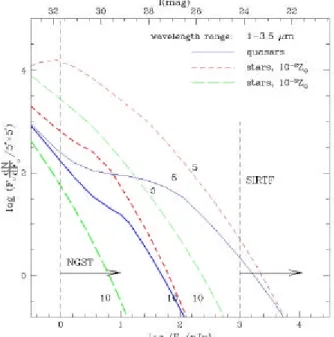
MCAO Potential: Good. As illustrated in the figure below, MCAO can start probing the brightest galaxies to z~5.
MCAO advantage over CAO: There are no preferred locations in the sky for this program so CAO can do similar studies. The MCAO brings multiplexing advantage for imaging and spectroscopy.
Figure 2:Predicted number counts per 5'x5' field of view per logarithmic flux interval in the NGST wavelength range of 1-3.5 micron. The thick lines, labeled 10, correspond to objects located at redshifts z >10, and the thin lines, labeled 5, correspond to objects with z >5. The upper labels on the horizontal axis correspond to Johnson I magnitude (from Haiman & Loeb 1998). See DRM description on web for more details.
MCAO
The formation and evolution of galaxies II: the deep spectroscopic survey(s)
This is a spectroscopic followup program to the “The formation and evolution of galaxies” program. Spectra will be obtained at R~100 to get the redshifts of the galaxies (AB~30-31), at R~1000 to estimate metallicities, stellar ages, star-formation rates and dust extinction levels (AB~27), at R~5000 to study the kinematics and provide masses, and with 2d imaging spectroscopy to a small number of galaxies (~20) to study the physical conditions in the star forming regions (AB~24.5).
Requirements:
FWHM/ Strehl λ Depth FOV R
0.1’’ to resolve galaxies 0.5-5µm AB~25-31 100-3000
MCAO Potential: Fair. At the higher spectral resolutions Gemini with MCAO and a deployable IFU spectrograph will likely do as well as NGST in sensitivity although it will most likely not have the same spectral coverage. This will depend on the sky brightness at R~5000 and the detector read noise characteristics. There is a possible multiplexing advantage if NGST has only one IFU.
MCAO advantage over CAO: Field and multiplexing advantage of a dIFU spectrograph.
The formation and evolution of galaxies III: cluster galaxies
This program is similar to the program “The formation and evolution of galaxies I”. The imaging depth is similar with a goal to observe clusters at z~2. Spectroscopy at R=1000 would be used to obtain line diagnostics as with the field galaxy program. Higher resolution spectroscopy R=10000 would be used to measure kinematics within the galaxies and within the clusters.
Requirements:
FWHM/ Strehl λ Depth FOV R
100mas @ 2µm 1-10µm 33 at I 2’x2’ 5, 1000, 10000 MCAO Potential: Good. MCAO can probe down to below L* in reasonable integration times. Considerable potential for cluster discovery as well as the kinematic study.
MCAO advantage over CAO: Field and multiplexing advantage of a dIFU spectrograph.
The formation and evolution of galaxies IV: the relation between galaxy evolution and AGN
“The principal objectives of this proposal are to compare AGN hosts with the rest of the galaxy population and elucidate any dependencies on AGN type and environment.” With NGST objects at z>3-6 can be studies in the H-alpha – [SII] line diagnostics.
Requirements:
FWHM/ Strehl λ Depth FOV R
100mas @ 2µm 1-10µm 33 at I 2’x2’ 5, 1000, 10000 MCAO Potential: Good. As stated in the DRM program, ground based telescopes will tackle this program to z~2.5. Note that the field requirement in the DRM was set to also observe field galaxies and absorbing systems.
MCAO advantage over CAO: CAO will address this science often using the AGN as the NGS reference source.
The evolution of the cosmic supernova rates
MCAO Potential: Good. See “Measuring cosmological parameters with high-z supernovae” above.
MCAO
MCAO advantage over CAO: See “Measuring cosmological parameters with high-z supernovae” above.
The History of the Milky Way and Its Neighbors
The age of the oldest stars from the faint end slope of the white dwarf luminosity function in globular clusters
This program proposes to determine the absolute magnitude of the end of the white dwarf cooling sequence in nearby globular clusters. Observations must reach H~30-31 to reach the expected end.
Requirements:
FWHM/ Strehl λ Depth FOV R
20mas @ 1µm 1µm H~30-31 2’x2’ 5
MCAO Potential: None. Can not reach required depths.
A complete initial mass function for old stellar populations
Program observes the Galactic bulge, Magellanic Clouds, and the 7 dwarf spheroidals to observe the mass function at the end of the hydrogen burning sequence. In addition to providing a measure of the complete stellar mass function over a range of metallicities, the program will determine the mass function of brown dwarfs in star formation regions.
Requirements:
FWHM/ Strehl λ Depth FOV R
40mas @ 1.65µm 1.65µm H~29 1’-100’ 5
MCAO Potential: Some. The program can be done in the Galactic bulge. As noted by the authors the main problem will be crowding.
MCAO advantage over CAO: This program would be difficult with CAO because: (1) the field of view needed would require stitching together many CAO fields and (2) the field varying PSF would cause variations in the crowding and photometric accuracy.
The ages and chemistry of the oldest stellar halo populations
This program will measure the main sequence turnoff of stars in the local group. This will be used to compare the age distribution of the stars in the halos of other galaxies. In addition, giants as far out as Virgo can be measured to infer the halo metallicities and their relationship to different Hubble types.
Requirements:
FWHM/ Strehl λ Depth FOV R
13 @ 0.5µm 0.5-1µm V=30-32 1’-100’ @ 0.5µm 5
MCAO Potential: None. Program requires visible wavelengths and very high Strehls to counter crowding.
The Birth and Formation of Stars
The origin of sub-stellar mass objects: probing brown dwarfs and extra-solar planets in star-forming regions
This program aims to study the mass distributions, circumstellar properties, and atmospheric properties of forming brown dwarfs and plantary mass objects.
Requirements:
FWHM/ Strehl λ Depth FOV R
MCAO
MCAO Potential: Fair. As noted by the authors, the groundbased telescope will perform a similar study down to brown dwarf masses. MCAO enables this study by multiplexing to get statistically reasonable field sizes and a stable constant PSF across the field to find the objects.
MCAO advantage over CAO: Once objects are identified CAO can be used. CAO can be used to search of objects as well in specific regions.
Dynamics and evolution of the interstellar medium: cosmic recycling
This program explores the evolution of the ISM and what its enrichment and energetics are. A number of observational programs are included from narrow-band imaging to high resolution spectroscopy. Requirements:
FWHM/ Strehl λ Depth FOV R
50mas @ 2µm J-N KAB~14-18 10’x10’ 10000-100000
MCAO Potential: Good. Other than field coverage (which may still be an issue with NGST), all NIR parts of this program can be done as outlined in the DRM. This would require a minimum R=10000 spectrograph and a wide-field imager.
MCAO advantage over CAO: CAO’s varying PSF will affect the morphology, and sensitivity across the field. Directed high resolution on specific objects can be done with CAO.
The Origin and Evolution of Planetary Systems
Detection and characterization of extra-solar planets
“A program aimed at the detection and characterization of planets over a range of mass, age, stellar spectral type, and physical separation from their central stars.”
Requirements:
FWHM/ Strehl λ Depth FOV R
109 in constrast J-M <1µJy small FOV 5,30000
MCAO Potential: None as outlined in the DRM. Requires high contrast. Spectroscopy will be difficult for NGST as well.
Detection and characterization of Jovian Planets and Brown Dwarf Companions in the Solar Neighborhood
This program will try to directly image brown dwarfs to Jupiter mass objects around nearby stars in the M-band. Spectroscopic follow up is included.
Requirements:
FWHM/ Strehl λ Depth FOV R
106 in constrast N ? small FOV 5,100
MCAO Potential: Fair. As noted by the authors, ground-based AO telescope will study the brighter, farther separated brown dwarfs, at shorter wavelength.
MCAO advantage over CAO. No specific advantage but MCAO may provide better PSF calibrations.
A survey of the trans-Neptunian region
An imaging survey to map the structure of the Kuiper belt. Requirements:
MCAO
FWHM/ Strehl λ Depth FOV R
0.6-3µm R~30-31,K~28.5 4’x4’ 5
MCAO Potential: None. As outlined in the DRM this program requires large fields of view and deep imaging.
2.5 The science requirements
After having reviewed the science case and established the broad domain of application of MCAO, let us derive the requirements for the system. In establishing these requirements, a number of parameters have to be considered and balanced:
1. Sensitivity 2. Field of view 3. Resolution 4. PSF uniformity 5. Sky coverage 6. Wavelength range
Other non-science drivers that we have to keep in mind when specifying the system are:
1. Potential instrumentation: How can it take advantage of MCAO? What can realistically be done?
2. Cost/schedule constraints 3. Risks/complexity
4. Technology availability
One of the problems we face in specifying the system is that all these science parameters are not independent (for instance there is an obvious trade-off between field of view, sensitivity and PSF uniformity). In the discussion below, we have made use of our knowledge of the system performance that was investigated in parallel with this science case.
1. Sensitivity is a vital parameter to address most of the Gemini and NGST science programs. It will be driven by the MCAO throughput and Strehl ratio
• MCAO optical throughput should be larger than 75%
• Strehl ratio: Considering the telescope + instrument error budget, plus the technology limits (computing power, DM power supplies, WFS readout), a Strehl similar to what was specified for Altair is adequate; 40% Strehl ratio at H band at zenith angle < 15 degrees, under median seeing conditions. Commensurate performance at other wavelengths. The MCAO system itself and the future instruments optical quality should introduce as little aberrations as possible. Requirement of a Strehl > 95% for the AO module and S > 95% for the instrument, assuming 80 modes are compensated by the MCAO system.
• FWHM: The Strehl ratio specified above implies that the diffraction limit, in term of resolution, will be reached.
2. Sky Coverage should be maximized too. As a guideline, it should be similar or larger than the sky coverage value achieved with a single LGS/TTNGS system everywhere
MCAO
in the sky (≥ 10% at the galactic pole is acceptable). Using laser guide stars is a requirement.
3. Field of view: This is a critical parameter. It has a large weight in the multiplex gain one can achieve with MCAO. However, there is a trade-off. For instance, enlarging the field of view means reducing the Strehl ratio and resolution, therefore the sensitivity, but potentially also means -if one is ready to drill a hole in the instrument support structure, - larger sky coverage. Worse PSF uniformity is also a price to pay when enlarging the field of view. Because:
• Sensitivity is of major importance
• Guide stars constellations covering more than 1 square arcmin induce significant Strehl loss and large PSF uniformity variation everywhere in the field, including close to the center.
• Mechanics limits the field to 2 arcmin in diameter
• Image quality should be as uniform as possible, especially at the center of the field over the imager field of view
• 8k x 8k imager are unlikely and imager should not be grossly undersample
• many science programs have a sufficient number of objects to feed multiple IFUs in a 90” field if view
We feel that an imager covering a field of 70-85” is appropriate, together with a d-IFU covering the whole 2’ transferred through the AO input window. Therefore, the field should be as uniform as possible in the central region covered by the imager. The Strehl ratio outside of this region should be maximized, in view of spectroscopic applications with potentially a slightly large field (2 arcmin circular versus 70-85” square).
4. PSF uniformity has been addressed within the point above. 3% rms variations over the central 1 square arcmin field of view is acceptable, but a goal is to lower this to 1.5%. A scheme to predict the PSF variation due to image motion across the field will have to be worked out, leading to accuracy of 15% of better on the image’s FWHM. 5. Wavelength range: AO gives its best in the near infrared. Therefore the MCAO
should concentrate on the 1-2.5 microns regime. However the 0.8-1 microns is also an interesting range, and should be considered. Observations up to 5 microns should not be precluded.
MCAO
3
S
YSTEMO
VERVIEW3.1 Primary Subsystems and Their Characteristics
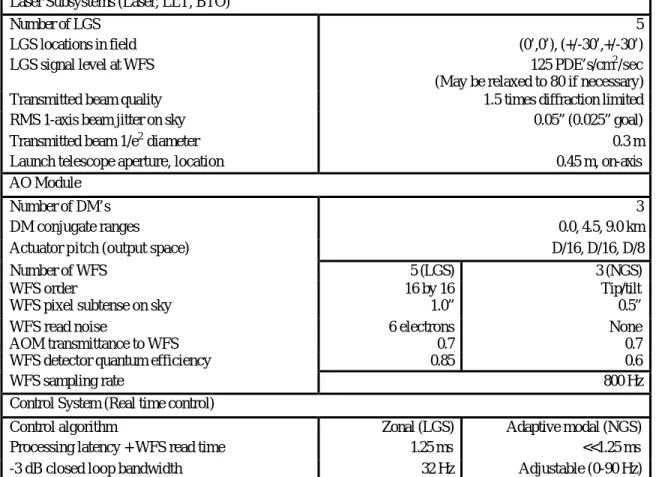
Figure 3 is a schematic of the six primary subsystems of the MCAO system together with their functional and control interfaces. These subsystems are the Laser System (LS), Beam Transfer Optics (BTO), Laser Launch Telescope (LLT), AO Module (AOM), MCAO Control System (MCAO CS), and the Safe Aircraft Localization and Satellite Acquisition System (SALSA). The first-order subsystem parameters relating to AO performance are summarized in Table 5. Following this brief overview, further detail and explanation regarding these design features will be found in Section 4, Section 5, and related appendices.
The Laser System includes all components needed to produce and maintain five laser beams at the sodium D2 wavelength. This
includes the laser head(s), enclosure(s), electronics, control system, cooling system, and diagnostics. The baseline approach is a sum-frequency laser with solid-state Nd:YAG pumps, since all three laser risk reduction projects are pursuing this technology. Further laser system chara