Documents de Treball
Departament d'Economia de l'Empresa
MULTIMARKET CONTACT EXTERNALITIES: THE
EFFECT OF RIVALS’ MULTIMARKET CONTACTS
ON FOCAL FIRM PERFORMANCE
Jaime Gómez, Raquel Orcos, Sergio Palomas
Document de Treball núm.13/2
© Jaime Gómez, Raquel Orcos, Sergio Palomas Coordinador / Coordinator Documents de treball:
David Urbano http://selene.uab.es/dep-economia-empresa/dt e-mail: [email protected] Telèfon / Phone: +34 93 5814298 Fax: +34 93 5812555 Edita / Publisher:
Departament d'Economia de l'Empresa
http://selene.uab.es/dep-economia-empresa/
Universitat Autònoma de Barcelona
Facultat de Ciències Econòmiques i Empresarials Edifici B
08193 Bellaterra (Cerdanyola del Vallès), Spain Tel. 93 5811209
Fax 93 5812555
ISSN:
Apr, Abr 2013
La sèrie Documents de treballd'economia de l'empresa presenta els avanços i resultats d'investiga-cions en curs que han estat presentades i discutides en aquest departament; això no obstant, les opi-nions són responsabilitat dels autors. El document no pot ser reproduït total ni parcialment sense el consentiment de l'autor/a o autors/res. Dirigir els comentaris i suggerències directament a l'autor/a o autors/res, a la direcció que apareix a la pàgina següent.
A Working Paper in the Documents de treballd'economia de l'empresa series is intended as a mean whereby a faculty researcher's thoughts and findings may be communicated to interested readers for their comments. Nevertheless, the ideas put forwards are responsibility of the author. Accordingly a Working Paper should not be quoted nor the data referred to without the written consent of the author. Please, direct your comments and suggestions to the author, which address shows up in the next page.
MULTIMARKET CONTACT EXTERNALITIES: THE
EFFECT OF RIVALS’ MULTIMARKET CONTACTS
ON FOCAL FIRM PERFORMANCE
Jaime Gómez, Raquel Orcos, Sergio Palomas
Document de Treball núm.13/2
MULTIMARKET CONTACT EXTERNALITIES: THE EFFECT OF RIVALS’
MULTIMARKET CONTACTSON FOCAL FIRM PERFORMANCE
JAIME GÓMEZ Generés Research Group Dpto. de Economía y Empresa
Universidad de la Rioja
Edificio Quintiliano 26004 Logroño (Spain) Tel: (+34) 941 299 373 / Fax: (+34) 941 299 393
[email protected] RAQUEL ORCOS Generés Research Group
Dpto. Dirección y Organización de Empresas Universidad de Zaragoza
Gran Vía 2 50005 Zaragoza (Spain) Tel: (+34) 976 764636 / Fax: (+34) 976 761767
[email protected] SERGIO PALOMAS Generés Research Group
Dpto. Dirección y Organización de Empresas Universidad de Zaragoza
María de Luna 3 50018 Zaragoza (Spain) Tel: (+34) 976 765243 / Fax: (+34) 976 762189
MULTIMARKET CONTACT EXTERNALITIES: THE EFFECT OF RIVALS’
MULTIMARKET CONTACTSON FOCAL FIRM PERFORMANCE
Abstract
Given that firms develop their activities in a network of multiple players, interfirm rivalry is not only a matter of direct competitors, but also of indirect competition. In spite of this, the literature on competitive dynamics tends to focus on analyzing rivalry as an exclusive function of the competitive relationship between a focal firm and its direct rivals. In this article, we extend competitive dynamics literature by considering how focal firms are affected by the relationships of their rivals with third-party firms. Specifically, we study the effect that the multimarket contacts of rivals produces on the performance of the focal firm. Additionally, we incorporate the idea that there are different strategic options for operating in an industry that affect the intensity of multimarket contact externalities. Our results show that multimarket contact among firms causes externalities that indirectly affect firms that are not directly involved in this competitive relationship. We find that multimarket contact externalities differ between and within strategic groups.
Keywords
MULTIMARKET CONTACT EXTERNALITIES: THE EFFECT OF RIVALS’ MULTIMARKET CONTACTS ON FOCAL FIRM PERFORMANCE
1. INTRODUCTION
Interfirm rivalry occupies a central place in strategic management research (Hitt, Ireland & Hoskisson, 2007). Although important contributions have been made in this field, competitive dynamics research continues to be constrained by an approach that only analyses the focal firm (Tsai, Su &Chen, 2011). Most works analyze interfirm rivalry exclusively as a function of the competitive relationship between the focal firm and its rivals. However, given that firms develop their activities in a network of multiple players, interfirm rivalry may also depend on the behaviour of firms with which the focal firm does not maintain a direct competitive confrontation. Much less effort has been devoted to evaluating how a focal firm is affected by the competitive relationships of its rivals with other firms. In this article, we go deeper into the effects of competition on firm performance by analyzing how the competitive relationships of rivals may indirectly affect the focal firm. In order to achieve this, we focus on a specific type of competitive relationship: the one that is based on multimarket contact.
It is generally accepted that high levels of rivalry trigger market dynamics that eventually lead to reduced profitability for firms involved in competitive relationships (Porter, 1985). Accordingly, it is in the interest of firms to find mechanisms to reduce rivalry (Porter, 1985; Scherer & Ross, 1990). One of the many mechanisms by which a firm can reduce rivalry is by establishing a high level of multimarket contact against its potential attackers. Multimarket theory analyzes the competitive relationships between firms that share several markets (Bernheim & Winston, 1990; Edwards, 1955; Jayachandran, Gimeno &Varadarajan, 1999). It states that when two firms coincide in multiple markets, their competitive behaviour changes (Fu, 2003; Greve, 2008). For instance, high levels of multimarket contact may help
firms to appreciate the strategic interdependences arising between them and to refrain from intense competition (Bernheim & Whinston, 1990; Spagnolo, 1999). This is what has come to be called mutual forbearance (Karnani & Wernerfelt, 1985)
Multimarket contact theory has been developed from the perspective of the firms that are directly involved in multimarket competition. Consequently, empirical measures usually refer to the dyad of firms under analysis (Baum & Korn, 1996; Baum & Korn, 1999) or aggregate the contacts that the focal firm maintains with all its direct competitors (Fuentelsaz & Gómez, 2006). This implies that, in general, it is assumed that the focal firm is exclusively influenced by its own multimarket contacts. In this article, we extend our understanding of
multimarket competition theory by exploring how a focal firm may be affected by the multimarket relationships of other firms, i.e., by analyzing how multimarket contacts may spread their effects to other firms that are not directly involved in a particular competitive relationship.
The types of situations examined in this paper may be described with an example. Let A and B be two firms that are competing in a given set of markets. Extant research on multimarket contact has analyzed the consequences of the relationship between A and B on their performance. Let C be a third firm that has a high degree of market overlap with B, but that it is not necessarily competing in the same markets as A. Our contention is that firm A may benefit from the reduction in aggressiveness between B and C as a consequence of the multimarket contact existing between the latter two firms. In other words, our contention is that, if firms external to the relationship between a focal firm and its rivals (firm C, in the example) behave aggressively, the focal firm (firm A) is negatively affected as a consequence of the change in the competitive conditions of its rival (firm B, in our example). Conversely, if firms external to the relationship (firm C) refrain from competing aggressively due to high multimarket contact with a rival of the focal firm (firm B), the focal firm (firm A) will
indirectly benefit from this reduction in rivalry. So we will discuss how a focal firm may receive a positive or negative effect from the multimarket contacts of other firms that operate
inits market. We refer to these indirect influences as multimarket contact externalities.
We explore multimarket contact externalities in a context in which firms are
heterogeneous in their strategies. Instead of being uniformly distributed across the strategic space, firms tend to converge around a finite number of strategic configurations (Romanelli, 1991; Short, Payne & Ketchen, 2008). As a result, it is possible to identify groups of firms that occupy a similar strategic position within an industry. Firms within a strategic group are similar to the members of their group, but they are strategically different from firms that belong to other groups. In a context where multiple strategic positions are viable, a firm’s competitive moves will have a different effect depending on its strategic configuration vis a vis that of its rivals. Firms operating from a particular strategic position will experience this effect more intensely. A firm would be especially negatively influenced by an increase of competitive moves that affect its key strategic dimensions, and it would benefit especially from a reduction of competitive moves that affect them. This means that multimarket contact externalities that stem from firms occupying a similar strategic position will be more intense because similar rivals generate or inhibit movements aimed at the strategic dimensions that are relevant to the focal firm.
This research is conducted on the Spanish banking sector in the period 1999-2009. This context is especially suitable for our framework because two important conditions coexist. First, firms operate simultaneously in several geographical markets, which guarantees multimarket competition. Second, firms operating in this sector use different approximations to the provision of financial services (Espitia, Polo & Salas, 1991; Más-Ruiz & Ruiz-Moreno, 2011, Zúniga et al, 2004). Therefore, this setting is an ideal scenario to explore the effect of multimarket contact externalities in a framework of several homogeneous groups of firms.
The rest of the paper is structured as follows. In Section 2, we review the literature on multimarket contact theory. In Section 3, we develop our hypotheses. In Section 4, we present our research setting. Section 5 presents the results of our empirical analyses. Finally, Section 6 concludes the article with the discussion of the main implications of our findings.
2. MULTIMARKET CONTACT THEORY
Multimarket contact theory describes the competitive dynamics that take place among firms that compete against each other across several markets (Karnani & Wernerfelt, 1985 p.87). In the last few years, this theory has gained momentum among strategic management scholars because of its capability to explain competitive behaviour and performance (Anand et al, 2009; Greve, 2008; Guedri & McGuire, 2011; Prince & Simon, 2009; Upson et al., 2012; Yu, Subramaniam & Canella, 2009). At first glance, a coincidence in multiple markets may increase the possibility of direct competition. However, multimarket contact theory argues that, on the contrary, multimarket rivals tend to refrain from aggressive competitive interaction in their common markets. This is what has come to be called the “Mutual Forbearance Hypothesis" (Fu, 2003; Greve, 2008; Jans & Rosenbaum, 1997; Parker & Roller, 1997; Spagnolo, 1999; Bernheim & Whinston, 1990). This hypothesis relies on two mechanisms: deterrence and familiarity (Jayachandran et al, 1999).
Deterrence stems from the increased retaliatory capabilities of multimarket rivals. Multimarket competition implies that firms can respond to an aggression in a given market with an attack in one or more of the other markets in which both firms operate. As a result, the chance of achieving an advantage in one market is balanced against the high risk of retaliatory responses, reducing the motivation to initiate competitive actions (Chen, 1996). The second argument, familiarity, focuses on the social construction of competition. Familiarity stems from a mutual understanding of resources and capabilities among multimarket rivals and their shared competitive history (Chen and Miller, 1994; Jayachandran
et al., 1999). Multimarket contact is a mechanism that helps to transmit strategic information by increasing direct exposure to the strategic actions of rivals with high market overlap (Boeker et al, 1997). The increased familiarity of multimarket rivals makes it easier for them to realize their interdependences, facilitating the establishment of tacit non-aggression agreements among them.
Several papers in the multimarket literature defend a linear relationship between multimaket contact and rivalry (Fu, 2003; Gimeno & Woo, 1996; Gimeno & Woo, 1999; Greve, 2008). Accordingly, increases in multimarket contact would result in a better performance for multimarket rivals. However, a few researchers have suggested that the relationship between multimarket contact and the intensity of rivalry may be represented as an inverted-U shape (Baum & Korn, 1999; Fuentelsaz & Gómez, 2006; Haveman & Nonnemaker, 2000; Stephan et al, 2003). These authors argue that, when multimarket contact is low, firms have incentives to establish a foothold in the market domain of rivals to signal their capacity to defend themselves from aggressive competitive moves (Karnani & Wernerfelt, 1990). These initial actions may provoke similar reactions from competitors, increasing the number of multimarket contacts (Baum & Korn, 1999). As the number of contacts increases, the mechanisms for mutual forbearance are triggered. Therefore, above a certain level of multimarket contacts, firms reduce their entry rate into their rivals’ markets. Initial evidence of an inverted-U shape in the relationship between multimarket contact and competitive behaviour has been found for market entry rates (Baum & Korn, 1999; Fuentelsaz & Gómez, 2006; Haveman & Nonnemaker, 2000; Stephan et al, 2003), exit rates (Baum & Korn, 1999) and growth rates (Haveman & Nonnemaker, 2000).
There are reasons to believe that the inverted-U shape may also be found in other measures of rivalry. Research on rival identification and competitive dynamics has demonstrated that market overlap is a key driver of competitive tension (Chen, 1996; Chen et
al., 2007; Peteraf & Bergen, 2003). As firms coincide in many markets, their dependence on similar resources increases, and there is a greater likelihood of vying for the same productive factors and customers (Hannan &Freeman, 1989). Eventually, firms develop high levels of competitive tension that can result in competitive actions (Chen et al., 2007). From this perspective, multimarket contact increases the possibilities of competitive aggression, leading to greater rivalry. However, following the theory of multimarket competition, after a certain multimarket contact threshold, competition decreases. As multimarket rivals begin to realize their interdependences, the mechanisms for mutual forbearance are triggered and multimarket rivals avoid competitive escalation. As a consequence, the relationship between multimarket contact and rivalry may show an inverted-U shape for other measures of rivalry: for low levels of multimarket contact, there is a process of competitive escalation that results in a direct negative relationship between multimarket contact and rivalry while, for high levels of multimarket contact, mutual forbearance appears and the relationship is reversed. Evidence consistent with this relationship has recently been found in the Spanish banking sector (Fuentelsaz & Gómez, 2012) and in the European telecommunications industry (Fuentelsaz et al, 2012).
3. HYPOTHESES DEVELOPMENT 3.1 Multimarket contact externalities
Firms have many alternatives when preparing competitive actions. They may take the form of price changes, marketing and promotional campaigns, new products, market entry, capacity additions, legal actions and signaling actions (Baum & Korn, 1996; Ferrier, Smith & Grimm, 1999; Young, Smith & Grimm, 1996). Some of these actions are directed at a particular rival and their influence is restricted to that firm. For example, legal actions such as patent litigation focus on a targeted rival (or set of rivals). In contrast, many other competitive actions are localized within specific product and market contexts (Gimeno & Jeong, 2001;
Nayyar, 1993). These competitive actions have an effect on all the firms that operate in the product-market segment affected by the competitive move. For instance, Derfus et al., (2008) found that the number of actions in an industry had a negative effect on the performance of a focal firm, irrespective of whether it was the intended target or not. Therefore, firms are influenced not only by their own capability to attract, or deter, competitive actions, but also by the capability of other firms in their markets to do so. Previous literature has shown that multimarket contact is an important determinant of rivalry. Depending on its level, it can enhance or reduce competitive intensity. At low levels of multimarket contact, firms tend to ignore their interdependences, but still perceive each other as direct competitors. In this situation, multimarket contact and competition are directly related: market overlap implies dependence on similar factors and, consequently, competitive pressure (Chen, 1996; Chen et al., 2007; Hannan & Freeman, 1989). Competitive pressure facilitates competitive escalation (Baum & Korn, 1999; Chen et al., 2007), which frequently leads to the use of competitive moves based on short-run variables, such as price (Kang et al., 2010), whose effect on performance is detrimental to all the firms operating in the market segment in which the competitive move takes place. Although these movements may target certain rivals, given that their effects are not always controllable, they may affect all the firms that operate in the attacked market. Therefore, for low levels of multimarket contact, not only the firms involved in multimarket competition, but also other firms operating in their markets may face competitive escalation.
Competitive escalation is reversed once multimarket contact is high enough to allow the recognition of competitive interdependences. Deterrence and familiarity mechanisms are triggered by multimarket contacts, reducing rivalry levels (Jayachandran et al., 1999). This means that multimarket rivals will be unwilling to initiate competitive actions in the markets where they coincide. However, it is important to stress that this does not necessarily mean that
multimarket rivals do not compete at all. Sometimes the consequences of multimarket contact are reflected in the type of competition that takes place between rivals. Firms with high levels of multimarket contact are more likely to use long-run variables like product introductions, instead of short-run variables such as prices, to compete (Kang et al., 2010). Similarly to the previous case, the lower competition that is a consequence of mutual forbearance may not be focused narrowly enough to benefit only multimarket rivals, but may also benefit all market participants (Bernheim & Whinston, 1990). In these situations, multimarket rivals would act as a shield that protects all the market participants by inhibiting competitivemoves.
Hence, multimarket rivals may generate competitive escalation or induce mutual forbearance in a certain market depending on their level of multimarket contacts. This is what we have termed multimarket contact externalities: damages or benefits received by a firm in
the form of higher or lower rivalry not because of their own multimarket contacts, but due to the multimarket contacts of other firms in its markets. Competition among Ford Motor Company, General Motors Corporation (GM) and Chrysler provides an example of multimarket contact externalities. If we analyze the situation from the perspective of Ford, multimarket contact with GM may be conceived as high enough to seek mutual forbearance, while multimarket contact with Chrysler may be considered as low enough to initiate processes of competitive escalation. Given that competition spillovers make it difficult for Ford to aggressively compete against Chrysler and forbear with GM, Ford might refrain from attacking Chrysler to avoid disrupting mutual forbearance with GM (Upson & Ranft, 2010:52). In this situation, Chrysler would receive a positive externality that stems from the multimarket contact between Ford and GM.
The effect of multimarket contact externalities on firm performance depends on the influence of multimarket contact on rivalry. Given that rivalry has a negative effect on firm performance (Porter, 1985; Scherer & Ross, 1990), when multimarket contact between rivals
induces competitive escalation, multimarket contact externalities will have a negative impact on firm performance. Conversely, if multimarket contact reduces rivalry by inducing mutual forbearance, multimarket contact externalities will exert a positive influence on the performance of the other firms that operate in the same markets. Accordingly, we predict a U-shaped relationship between the performance of a focal firm and the multimarket contacts of other firms operating in its market. For low levels of multimarket contacts, the relationship will be negative, and for high levels, it will turn positive.
Hypothesis 1: The multimarket contact of the firms operating in the markets of a focal
firm will have a U-shaped effect on a focal firm’s performance
3.2 Multimarket contact externalities and strategic similarity
The firms that operate in an industry are heterogeneous in their strategies, goals, structures, targeted customers and the resources they use for their activities (Carroll & Swaminathan, 2000; Hannan & Freeman, 1989; Meyer, Tsui & Hininigs, 1993; Short, Payne & Ketchen, 2008). Strategic groups are a specific type of intra-industry configuration that are usually defined as sets of firms that follow a similar strategy across a set of relevant strategic dimensions (Porter, 1980: 129). The literature on strategic groups and its underlying ideas, based on strategic similarity, have frequently been used in the analysis of rivalry (see, for example, Deephouse, 1999). One of the most recurrent arguments appearing in this literature is that rivalry between and within strategic groups has a different intensity (Barney & Hoskisson, 1990; Caves & Porter, 1977; Peteraf, 1993).
Strategic group theory seems naturally suited to a joint analysis with multimarket theory. In fact, several papers in the multimarket contact literature have integrated the strategic similarity of firms with measures of their market overlap (see, for example, Gimeno & Woo, 1996; Young et al., 2000; Fuentelsaz & Gómez, 2006; Upson et al., 2012). Thus,
considering strategic groups in the context of multimarket contact externalities seems an adequate extension. We argue that the strategic similarity between a focal firm and other firms operating in its market explains the intensity of the multimarket contact externalities received by the focal firm. In other words, we argue that the transference of the detrimental or beneficial effect of the competitive relations of the rivals of a given firm depend on the configuration of the industry in strategic groups. In particular, we argue that the intensity of the competitive spillovers will be different between and within strategic groups.
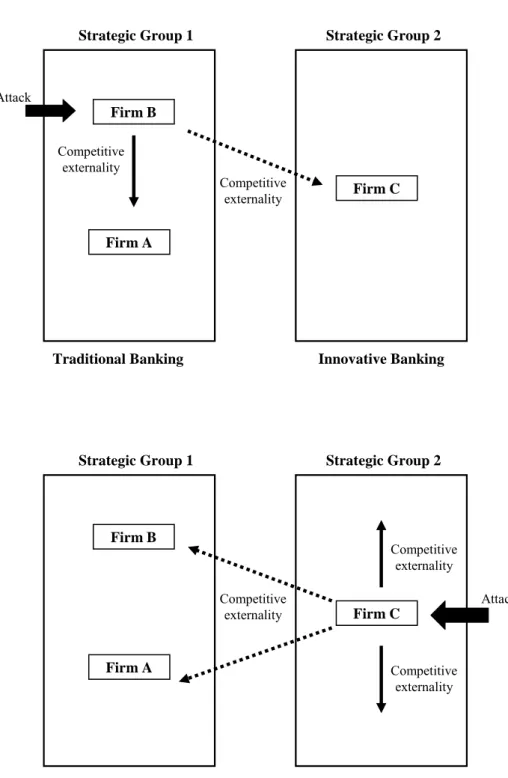
Our contention is that similar rivals will deter (or provoke) competitive actions that are likely to have an effect on strategic dimensions that are central to the focal firm, whereas competitive moves deterred (or provoked) by dissimilar rivals will probably affect strategic dimensions that are not central to the focal firm. For instance, let firms A, B and C be three firms that coincide in a certain market. Firm A and firm B focus on traditional banking while firm C focuses on innovative banking. If firm B receives an attack, it means that some (or even all) of the activities related to traditional banking in that market will be affected. Given that firm A shares the strategic position of B on traditional banking, firm A will also be directly affected by competitive moves against that strategic position. On the other hand, if firm C is attacked, the innovative banking position is damaged in that market. In this situation, firm A will be significantly less affected by any competitive move because innovative banking is not a central strategic dimension of its activities. Consequently, from the perspective of firm A, the effect of multimarket contact externalities generated by firm B will be greater than the effect of multimarket externalities generated by firm C. Figure 1 graphically depicts this hypothetical situation.
--- Insert Figure 1 around here ---
The previous reasoning means that firms of the same strategic group operating in the focal firm’s markets produce more intense multimarket contact externalities. Members of a
strategic group that maintain a low level of multimarket contact with their rivals and, therefore, compete intensively against them, might attract competitive moves targeted at the specific strategic configuration of the group. This would negatively affect other group participants that operate in the same market as the firm under attack. On the contrary, firms that have a high level of multimarket contact with their rivals and, as a result, impede competitive escalation, will inhibit competitive moves that would directly affect their strategic group. In this case, the fact that some group participants benefit from mutual forbearance creates a positive externality that improves the competitive conditions of the group members that operate in the same markets. Regarding multimarket externalities in a context of strategic groups, our second hypothesis establishes that:
Hypothesis 2: The effect of the multimarket contact of other firms operating in the
markets of a focal firm will be more intense if they belong to the same strategic group as the focal firm.
4. EMPIRICAL ANALYSIS
4.1 Research context, sample and data sources
This research is conducted in the context of the Spanish retail banking sector between 1999 and 2009. This is an interesting setting for our analysis because both multimarket competition and different strategic positions are present. First, the multilocal and multibusiness nature of Spanish retail banking guarantees that firms compete simultaneously in several markets (Fuentelsaz & Gómez, 2006). Second, intra-industry heterogeneity, in the form of groups of homogeneous firms that differ among themselves, has been extensively documented (Espitia, Polo & Salas, 1991; Más-Ruiz & Ruiz-Moreno, 2011; Zúniga et al, 2004).
The number of banks included in the sample fluctuates between 163 and 124 depending on the year. This fluctuation is mainly explained by mergers and acquisitions that take place
over the period analyzed. The sample excludes banks that do not exceed four branches in any of the years because this is associated with extreme geographical specialization and insignificant retail activities. Some of these organizations may still be of considerable size. However, as they offer their products exclusively to certain types of customers (e.g., banks with a high investment profile, banks of professional associations) they are not included in the sample. The sample also excludes banks without headquarters in Spain because they do not publish enough information for our analysis on their activities in the Spanish subsidiary. It is important to note that large international banks that carry out retail banking activities in the country have established their headquarters in Spain, so the sample does not exclude large players in the sector. It should also be taken into account that most international banks without their headquarters in Spain do not have an important presence. Therefore, many of the banks not considered because of insufficient data would also have been excluded because of the irrelevance of their retail banking activities (i.e., four branches or fewer). In spite of these exclusions, our sample is clearly representative of the Spanish retail banking sector. For instance, it includes 97.8 percent of the total assets held in 2009.
The data used in this study have been collected from several sources. First, we gather information about every branch located in Spain from the Guia de la Banca, Cooperativas de Crédito y Cajas de Ahorro, which is published yearly by Editorial Maestre Ediban. It offers
information about the location of every branch in the sector, allowing us to identify their addresses and zip codes. Second, we obtain information about financial statements from yearbooks published by the different trade associations in the sector. Finally, information about market level factors and other macroeconomic variables is obtained from the Statistical Bulletin of the Bank of Spain and from the National Institute of Statistics (INE).
4.2 Methodology
We empirically test our predictions in two steps. First, we identify strategic groups in the Spanish retail banking sector. Then, we test the effect of multimarket contact externalities on focal firm performance
4.2.1. Identification of strategic groups
The first step in the identification of strategic groups is to define the strategic configuration of each firm in the industry. Following the traditional approach in strategic management, the market positions of firms are considered as a function of firm scope and resource commitment (Cool & Schendel; 1987; Mehra, 1996; Ferguson, Deephouse & Ferguson, 2000). Decisions about scope include the choice of market segments, while resource commitment involves the assignment of human, capital and financial factors. In this article, the strategy of each firm is described through seven variables based on scope and resource commitments dimensions. All of them have been employed in previous analyses of the Spanish banking sector (Zuñiga et al, 2004; Fuentelsaz & Gómez, 2006; Prior & Surroca, 2006).
The strategic scope of a given firm is measured through the following five variables:
(1) Commercial banking (Commercial loans/Financial investments): This ratio captures
the banks’ orientation towards commercial banking. This strategic orientation is usually characterized by a high percentage of loans to domestic economies and small and medium-sized firms.
(2) Investment banking (Portfolio of securities/Financial investments): This variable
determines the extent of a banking firm’s orientation towards active investments in stock markets.
(3) Institutional banking (Treasury/Financial investments): This ratio indicates an
institutional orientation. Firms that develop this kind of strategy tend to lend money to public institutions.
(4) Net position in the financial system (Net position in the financial markets/Total liabilities): This ratio refers to the bank’s position in the interbank market. Specifically, it
captures the bank’s degree of trust in this market to obtain funds.
(5) Traditional banking (Saving and deposits accounts of the private sector/Total liabilities): This variable identifies the traditional and conservative banking business,
based on the accumulation of family savings. These firms get funds through classical financial products.
Similarly, resource commitment is captured through two ratios:
(6) Human capital (Personnel expenses/Operating income): This variable captures the
importance of human capital.
(7) Risk (Net insolvencies/Operating income): This measure tries to approximate the
degree of risk that the firm is exposed to. It reflects loans with a low probability of being recovered.
Commercial, investment and institutional banking variables distinguish between three kinds of Spanish banking entities according to their tendency in the provision of financial funds. Firms with a commercial orientation tend to lend funds to domestic economies and small and medium-sized firms, investment banking firms focus on investments in stock markets and firms with an institutional orientation mainly lend money to public institutions. The other two variables of strategic scope, net position in the financial system and traditional banking, differentiate between two kinds of Spanish banking entities according to how they obtain their financial resources. While traditional entities use classical financial products to acquire funds, the net position in the financial markets refers to the firms that mainly borrow
money from the interbank market. Finally, human capital shows how Spanish banking firms
commit human resources to developing their activities and risk proxies the risk profile of the
strategy followed by each firm. Human capital refers to the role that human resources play in
the provision of financial services and risk describes the degree of risk to which the financial entity is exposed.
After identifying the strategic position of all the firms in the Spanish retail banking sector, we group them according to the similarity in their strategies. We use cluster analysis to place each firm into one strategic group. Although this methodology is subject to some criticism (Fiegenbaum & Thomas, 1990; Barney & Hoskisson, 1990; Hatten & Hatten, 1987), it has been commonly used to identify groups of similar firms in the strategic management literature (Kim & Lee, 2002; Smith et al, 1997; Short et al, 2007). Following recent advice on improving the use of cluster analysis, before applying it, we use a two-step procedure intended to provide a higher empirical accuracy in the subsequent classification of firms. Thus, we eliminate outliers and, after then, we standardize all the variables.
First, we use the BACON algorithm (Blocked Adaptive Computationally Efficient Outlier Nominators), which is an algorithm proposed by Billor, Hadi, and Velleman (2000) to identify outliers. BACON is an appropriate algorithm for our study because it allows us to recognize outliers in multivariate data. Following prior research (Bush & Sinclair, 1991; Ferguson, Deephouse & Ferguson, 2000), we eliminate 12 outliers before initiating the cluster analysis procedure. All firms identified as outliers show an orientation toward private banking and investment activities. Given that our focus is on commercial banking, all these exclusions seem to be sound. Second, we transform the seven strategic variables to a common scale via
z-scores to avoid scale differences giving rise to a skewed identification of groups (Cool,
1985; Cool & Schendel, 1987). Our study identifies strategic groups in each of the years studied, 1999-2009.
After that, we apply a two-step cluster analysis procedure. Using a two-step process is convenient because it increases the validity of cluster solutions (Ketchen & Shook, 1996). Step one uses hierarchical clustering to determine both the number of groups and their cluster centroids. We select Ward’s method as the agglomerative technique and measure the proximities between the variables using squared Euclidean distances. Step two employs the cluster centroids as “seed points” for a non-hierarchical clustering procedure (i.e., K-means). As a consequence, the two-step cluster procedure eliminates problems associated with random seed setting.
We use visual inspection of tree-plots (Ketchen et al., 1993; Miles, Snow, & Sharfman, 1993) to define the number of clusters appropriately. The number of clusters is confirmed by using the Calinski–Harabasz (1974) pseudo-F index. Milligan and Cooper (1984) evaluate 30 stopping rules, singling out the Calinski–Harabasz index as one of the best. Finally, ANOVA was used to test whether average performance levels persistently differ among strategic groups. We analyze differences in three performance measures: ordinary profitability, exploitation profitability and profitability before taxes. The results confirm that the groups have a different average profitability in each period, providing further support for the classification1.
4.2.2 Variables and model specification
Dependent variable: Our dependent variable is financial performance. We measure it
through an accounting-based measure, return on assets (ROA), which is computed as the ratio of ordinary profitability over total assets. ROA has frequently been used as a measure of financial performance when analyzing the banking sector (Barnett, Greve & Park, 1994; Roberts & Amit, 2003). Each kind of bank was subject to the same accounting requirements, so their financial statements are comparable.
1 Information about the number, size and composition of the groups, as well as the results from the ANOVA
Independent variables: Our main independent variable is multimarket contact externalities. This variable is measured as the average number of markets in which the rivals
of a focal firm coincide with their competitors. We first calculate the multimarket contact of each firm in the sector. Multimarket contact is calculated as the average number of markets where a firm coincides with its rivals, as follows:
where Rivalsi is the number of rivals of firm i. We consider a firm as a rival if it coincides
with the focal firm in at least one geographical market. Coincidencesij is the number of
markets in which a focal firm i and its rival j operate simultaneously. We define markets at
the lowest level of disaggregation we can identify, i.e., the ZIP Code. Each ZIP code identifies geographically proximate areas. Large towns have many codes, while a few small villages can share the same ZIP code. For instance, the city of Madrid had 63 zip codes in 2009, while the code 28430 included three different municipalities in the province of Madrid. Applying zip codes to approximate geographical markets provides a very detailed analysis of the interactions of banks, given that our sample covers up to 5913 different areas. In 2009, the number of branches per zip code ranged from 1 to 148 and the average number of branches in a zip code was 7. Finally, Wij is a weighting factor used to reflect that multimarket rivals are
more important the larger the number of markets in which they coincide with the focal firm. It is calculated as follows:
Once we have calculated a multimarket contact variable for each firm, the variable
multimarket contact externalities is calculated as the accumulated multimarket contact of the
rivals of the focal firm (excluding the contacts with the focal firm). We calculate multimarket externalities in aggregated terms because we consider that the externalities generated by each
rival add value to the degree to which the focal firm is indirectly affected by the behaviour of other firms. Thus, our conception of the variable supposes that multimarket contact externalities are the result of aggregating externalities that come from all the direct rivals.
Wij x MMCj ies Externalit MMC j i
whereTherefore, multimarket contact externalities reflect the accumulated multimarket
contact of the rivals operating in the markets of the focal firm. The measure takes into account the different importance of rivals for the focal firm, those present in a larger proportion of the markets of the focal firm being more important. This variable is introduced in a quadratic form to test hypothesis 1.
Hypothesis 2 maintains that multimarket contact externalities that come from firms of the same strategic group are more intense than the ones coming from members of another group. The variable MMC externalities similar rivals reflects the multimarket contacts
externalities generated by firms that belong to the same strategic group. The variable MMC externalities different rivals captures the multimarket contacts externalities that stem from
firms of other strategic groups. Both variables are also introduced in quadratic form.
Control variables: Our specification includes three controls at market level. We include
credits, measured as the aggregated credits of the provinces where the focal firm operates (in
thousands of Euros). This variable approximates the total demand for banking activities.
Unemployment describes the unemployment rate in the provinces in which the bank operates,
which is a factor that may affect the demand for banking activities. Note that both variables, credits and unemployment, are market controls at the province level instead of at the zip code level. The lack of this information at the zip code level forces us to use the province level as
an approximation. Finally, number of rivals captures the number of firms with which the focal
firm coincides in, at least, one geographical market. This variable allows us to control for two facts. First, the number of rivals approximates competitive intensity. Second, it considers that firms with a high number of rivals may receive more externalities.
We also include several firm-level controls. Inefficiency, measured as the ratio of
exploitation costs over ordinary margin and risk, measured as the ratio of total credits over
total assets, which are specific variables of the banking sector (Carbó, del Paso & Fernández, 2003). Given that there were a number of mergers and acquisitions in the period analysed, our model includes the variables M&A and Post M&A. The first is a dummy variable which takes
the value 1 for the year in which the firms are involved in a merger or acquisition and 0 otherwise. The second is a dummy variable which takes the value 1 in the period after the
M&A. We also control for size, which is measured as the logarithm of total assets. Finally, our
model includes the variable multimarket contact. In accordance with the literature, the
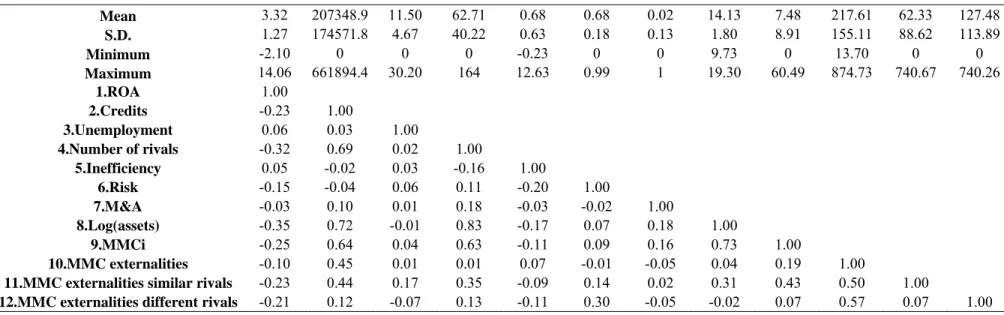
variable is included in its quadratic form to capture a potential U-shaped effect (Fuentelsaz & Gómez, 2012; Fuentelsaz, Maicas & Gómez, 2012). By including this variable, we control for the effect of the multimarket contacts of the firm itself. Descriptive statistics and correlations between variables are shown in Table 1.
--- Insert Table 1 around here
---
Model specification: To choose the appropriate specification we run a number of tests.
The Breusch-Pagan Lagrange Multiplier test rejects the null hypothesis that the variance of firm-level effects is zero. This is interpreted as evidence of individual effects (X2=1146.80
and p-value<0.00 in the model that considers the externalities coming from all the rivals;
X2=1224.26 and p-value<0.00 in the model that differentiates the effect of multimarket
multimarket externalities of all the rivals; X2=384.48 and p-value=0.00 in the model that
considers strategic groups). Furthermore, the model includes year dummies to control for contemporary shocks common to all the firms in the sector. As a consequence, we estimate a two-way fixed effects model.
5. RESULTS
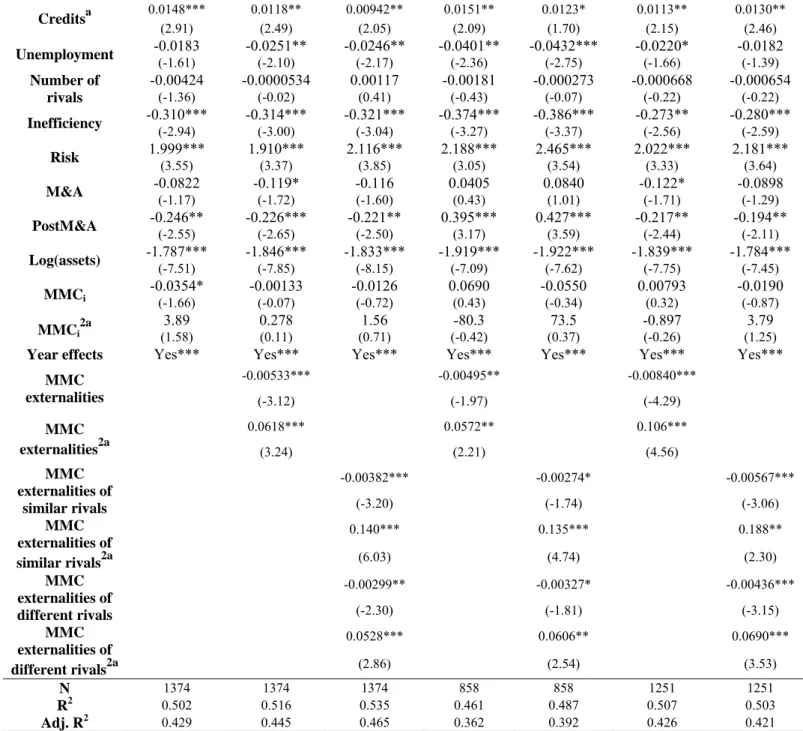
The results of our estimations are shown in Table 2. We test our hypotheses in columns 1 to 3. Columns 4, 5, 6 and 7 present robustness analyses. Column 1 shows the baseline model. It is globally significant, confirming the importance of our controls. Column 2 introduces the direct and squared effect of multimarket contact externalities (hypothesis 1).
Both variables are significant and their introduction slightly improves the fit of the model, as the portion of the variance explained indicates (bottom of the table). Column 3 differentiates between multimarket contact externalities produced by firms that are members of the same group from those that belong to other strategic groups (hypothesis 2). We introduce the direct and the squared effects of both multimarket contact externalities of similar firms, which
measures the externalities produced by the members of the group of the focal firm, and
multimarket contact externalities of different firms, which captures the externalities generated
by rivals of other strategic groups.
--- Insert Table 2 around here ---
Hypothesis 1 states that multimarket contact externalities have a U-shaped effect on focal firm performance. The parameter of the direct effect is negative (β=-0.00533; p<0.01) and the parameter of the squared effect is positive (β=0.0618; p<0.01). This suggests the predicted U-shaped effect but for this U-shape to be meaningful in our estimations, the inflection point has to belong to the range of values of multimarket contact externalities
observed in our sample. The inflection point corresponds to the value 431.229 of the variable, which falls within the range of our sample.
Therefore, our estimations show that the multimarket contacts of focal firms’ rivals have a U-shaped effect on focal firm performance. As a consequence, hypothesis 1 is supported. Graph 1 depicts the effect of multimarket contact externalities within the range of values of our sample. As the graph shows, the influence of multimarket contact externalities generated by all the rivals is negative until certain threshold and, then, it becomes positive as the extent of multimarket contact externalities increases. Based on these findings, we can conclude that the worst situations are those in which firms face moderate levels of multimarket externalities.
--- Insert Graph 1 around here ---
Hypothesis 2 states that the U-shaped effect of multimarket contact externalities is more intense when it comes from firms of the same strategic group. The variable multimarket contact externalities of similar rivals presents a negative direct effect (β=-0.00382; p<0.00)
and a positive squared effect (β=0.140; p<0.00) and the variable multimarket contact externalities of different rivals presents a negative direct influence (β=-0.00299; p<0.05) and
a positive squared effect (β=0.0528; p<0.00). These results confirm that the effects of the multimarket externalities generated by both similar and different rivals adopt a U-shape. Graph 2 depicts the effect of the multimarket contact externalities for the range of variation of the variable in our sample by considering strategic group membership.
--- Insert Graph 2 around here ---
The solid line shows the effect of multimarket externalities proceeding from rivals that are group members and the dotted line shows the influence that comes from multimarket externalities generated by rivals of others strategic groups. As the graph shows, with the exception of the cases in which the value of multimarket contact externalities is low, the solid line is clearly above the dotted line, which means that the influence of multimarket contact externalities originated by similar rivals is more intense. The inflection point of the effect that comes from similar rivals is 136.43 and the inflection point of multimarket externalities generated by different rivals is 283.14. This, in addition to confirming the U-shaped effect, indicates that the level of rivals’ multimarket contacts necessary to benefit from multimarket externalities is higher when these rivals belong to other strategic groups. Therefore, this finding supports hypothesis 2.
Columns 4, 5, 6 and 7 of Table 2 show the robustness of our results. Firms with a very high level of multimarket contact, because of their wide geographical scope, might also face rivals with high levels of multimarket contact. In these cases, the positive effect of multimarket contact externalities could be artificially generated by a firm’s own multimarket contact. Consequently, we test hypotheses 1 and 2 in a reduced sample in which we require the effect of a focal firm’s own multimarket contact to be below the sample average. As columns 4 and 5 show, the results of the main estimations are qualitatively unchanged, and even the magnitude of the coefficients is similar. Therefore, the multimarket contacts of the focal firm are not the mechanism through which our results are obtained.
Finally, columns 6 and 7 show the robustness of our results by considering the current financial crisis. In 2008, an international financial crisis broke out and affected banking
sectors all over the world2. The change in external conditions that the crisis introduced modified the activities of the banks. To check whether this crisis modifies our results, columns 6 and 7 show the estimations of the fully specified models restricted to the period (1999-2007). Again, the results of the main theoretical variables are qualitatively unchanged and the magnitude of the coefficients is similar. Therefore, the financial crisis does not seem to affect our findings.
6. CONCLUSIONS AND DISCUSSION
When designing competitive actions, firms may target a specific rival. However, very often, it is not possible to limit the scope of competitive actions and, thus, to control who will be affected by them. As a consequence, competitive moves, do not only affect targeted rivals but also others firms operating in the same markets (Derfus et al., 2008). Therefore, when defining their competitive strategies, firms should consider all the firms operating in the market in which competitive actions will take place to anticipate potential outcomes and reactions. In this article, we take into account these competitive spillovers study the effects of multimarket contact more deeply.
Multimarket contact theory states that firms modify their competitive behaviour when they coincide with their rivals in several markets simultaneously. The literature is prolific in examples of situations in which firms mutually forbear as a result of their multimarket interdependences. However, as we show in this article, the effect of multimarket contact can spill over to other firms that coincide with multimarket firms, even if they compete in only one or a few markets. We contribute to the field of multimarket theory by exploring how a focal firm is influenced by the multimarket contacts of its direct competitors with other firms. We term this effect multimarket contact externalities. We argue that rivals with low
multimarket contact levels are likely to attract competitive actions that will also eventually
harm the focal firm. Conversely, rivals with high multimarket contact levels deter competitive actions in their markets, which benefits the other firms operating in those markets.
Our analysis confirms the existence of multimarket contact externalities. We find that the multimarket contacts of the rivals of a focal firm with third parties have a significant effect on the focal’s firm performance. Particularly, we find that when the multimarket contacts accumulated by competitors are low, the focal firm’s performance decreases. Conversely, when the firm coincides in the market with rivals with high multimarket contact levels, it benefits from their strong multimarket positions. Therefore, our results suggest that firms with strong multimarket contact positions act as a "shelter" that protects other firms operating in their markets, irrespective of their own multimarket position. As a result, the performance of these firms improves. This finding complements received theory in the multimarket contact research stream which, until now, has focused on a focal firm and the consequences of its own multimarket contacts.
We further explore the role of multimarket contact externalities by analyzing how they are influenced by strategic similarity, a dimension that is intimately related to market overlap (Chen, 1996; Fuentelsaz & Gómez, 2006). To do so, we explore multimarket contact externalities in a context of strategic groups. We find that the intensity of multimarket contact externalities varies depending on whether they come from members of the same strategic group of the focal firm or from members of other groups. Particularly, we find that similar rivals transfer the effect of their own multimarket contact more intensively than firms of others strategic groups. This implies that firms benefit more from the "shelter" provided by rivals that are strategically similar to them than from more dissimilar rivals.
Previous research has suggested that multimarket contact generates externalities in the other firms that operate in the same markets as multimarket organizations (e.g., Baum & Korn, 1996; Upson & Ranft, 2010). It has been argued that, when a firm faces rivals with low levels
of multimarket contact, they concentrate their efforts in competitive exchanges between them and, therefore, their capacity to attack other firms is restricted. Thus, firms located close to these multimarket organizations would benefit from a lower competitive intensity. However, the argument continues, once multimarket firms establish strong multimarket contact positions and begin to mutually forbear between them. As a result, they can divert competitive resources from the multimarket arena to their local markets. All this is contrary to the reasoning proposed in this research: rivals with low multimarket contact levels will generate positive externalities, while high multimarket contact levels among the rivals of the focal firm will lead to negative outcomes. This alternative perspective is theoretically sound and empirically appealing. However, to the best of our knowledge, it has not yet been empirically tested.
These two different predictions can be reconciled by considering the characteristics of the actions that define the competitive patterns in the industry under analysis. Particularly, the specific form of multimarket contact externalities may depend on whether competitive actions affect only targeted rivals or whether they affect all the firms in a market. The perspective described in the previous paragraph (i.e., the competitive release perspective), requires that
attacks only affect the targeted rival. In this case, multimarket rivals engaged in fierce competition will only damage each other and mutually deplete their competitive resources, which eventually benefits third parties. Conversely, when multimarket rivals mutually forbear, they can focus on competitive interaction against their single market rivals. However, in our proposed framework (i.e., the shelter perspective), attacks (e.g., price reductions, new product
introduction) affect all the firms operating in the market to some degree. In this context, multimarket firms that mutually forbear cannot freely initiate competitive attacks because they may elicit retaliatory responses from multimarket rivals operating in the attacked market. Conversely, multimarket firms with low multimarket contacts may attract attacks that also
affect single market rivals. Therefore, in contexts where attacks exclusively affect the targeted rival, multimarket contact externalities should be consistent with the competitive release perspective whereas, in industries where attacks cannot be concentrated on targeted rivals, the shelter perspective should be adopted.
We suspect that the characteristics of competitive actions may be systematically related to certain properties of the industry. In high technology, knowledge-intensive sectors, such as pharmaceutics, software or nanotechnology, standard attacks may include patent-litigation, pre-emption of emerging submarkets and technologies and obstructive patenting. The effects of these attacks are likely to be limited to the targeted rival. Therefore, two firms engaged in fierce competition would concentrate their efforts in their dyadic interaction, and third parties would barely be harmed. In such a context, we would expect multimarket contact externalities to follow the competitive release perspective. In contrast, in low technology sectors or sectors with homogeneous products, such as the banking sector, it will be difficult for firms to restrict the effects of their competitive actions and multimarket contact externalities will show a pattern consistent with the shelter perspective.
Multimarket contact externalities and strategizing
The existence of multimarket contact externalities implies interesting strategic opportunities3. Conventional wisdom suggests that a competitively weak firm (e.g., one with outdated capabilities, inadequate resource endowment or lack of institutional endorsement) should be both a poor defender and a poor attacker. However, if such a firm is located in a market characterized by high multimarket contact externalities (for instance, because strong multimarket organizations are operative), it may benefit from a reduced probability of being attacked. In addition, such a firm may be able to concentrate its resources to initiate competitive actions. For instance, a firm operating in a market in which multimarket contact
3 We assume that the effects of any attacks cannot be restricted to the targeted rival. If this is true, our proposed
externalities soften competitive activity may enter new geographical markets with aggressive strategies, being confident that its home market will not be subject to retaliatory responses. Therefore, multimarket contact externalities may provide firms with a safe place from which to launch attacks or even to begin expansive strategies.
The traditional perspective of multimarket contact theory seems to be useful only for "big players". Multimarket firms tend to be large and diversified organizations that, in addition to scale and scope economies and size-based market power, are able to build strong multimarket positions that offer them the advantages of mutual forbearance with other major players in the industry. Small single-market firms cannot benefit from multimarket dynamics. However, in the presence of multimarket contact externalities, small players also have the opportunity (and necessity) to design a strategy to benefit from multimarket contact dynamics. Interestingly, rather than designing a strategy to build their own multimarket position (with its associated risks and costs), these firms should try to identify ways to free-ride the multimarket positions of major players. Therefore, we can propose two different kinds of multimarket strategies: strategies based on building multimarket positions, for large firms, and strategies based on the exploitation of multimarket contact externalities, for smaller and non-diversified firms. While the first kind of strategy is broadly developed in the literature, the second kind may have been overlooked because the reasearch does not consider multimarket contact externalities.
Limitations and future research
In this research, we argue that many conventional competitive actions hurt not only the intended target, but also other firms that operate in the same markets. This characteristic of competitive actions is what, eventually, would determine the form taken by multimarket contact externalities. Accordingly, it may be interesting to develop a typology of competitive actions in terms of the extent to which they affect targeted rivals. As described above, certain
structural characteristics of an industry may be correlated with the characteristics of competitive actions. As a result, it may be interesting to develop a typology of industries in which usual competitive actions show certain characteristics (e.g., the kind of multimarket contact externalities). Such a typology would be helpful for both practitioners and scholars to better understand the effects of competitive strategies and to predict potential reactions more accurarately.
One limitation of this research is that we have not observed actual competitive patterns. Instead, we have inferred them through their observed effects on focal firm performance. The results are consistent with our predictions. However, they may be strengthened with analyses of actual competitive moves. For instance, some researchers have applied content analysis techniques to different sectorial and economic publications to identify competitive actions. These techniques would be useful to identify whether actual competitive patterns are consistent with multimarket contact externalities, lending further support to their existence and importance. Similarly, market entry patterns could be analyzed to determine whether multimarket contact externalities influence entry decisions. For instance, small and non-diversified organizations may show a preference for entry into markets dominated by strong multimarket organizations, despite their potentially high capabilities. Conversely, large multimarket organizations may avoid those markets or, at best, prefer small-scale, non-aggressive entry in order to establish footholds and improve their multimarket position (Ghemawat & Thomas, 2008; Upson et al., 2012).
Conclusion
Multimarket contact theory has traditionally focused on how firms’ multimarket contacts influence their competitive behaviour and their performance. In this article, we show that multimarket contact dynamics spill over to other firms that operate in the same markets as these multimarket rivals, even when they are not directly involved in multimarket
competition. We call this effect multimarket contact externalities. We also find that these
externalities vary depending on whether they come from strategically similar or dissimilar rivals. Our findings open new avenues for multimarket contact theory research and suggest that even small players in an industry may have the opportunity to design a multimarket strategy.
REFERENCES
Anand, J., Mesquita, L. F., Vassolo, R. S. 2009. The dynamics of multimarket competition in exploration and exploitation activities. Academy of Management Journal, 52(4): 802-821
Barnett W. P., Greve, H. R., Park D. Y. 1994. An evolutionary model of organizational performance. Strategic Management Journal, 15(Special Issue):11-28
Barney JB, Hoskisson RE, 1990. Strategic groups: untested assertions and research proposals. Managerial and Decision Economics, 11(3): 187–198
Baum, J. A. C., Korn, H. J. 1996. Competitive dynamics of interfirm rivalry. Academy of Management Journal, 39: 255–191
Baum, J. A. C. , H. J. Korn 1999. Dynamics of dyadic competitive interaction, Strategic Management Journal, 20(3), pp. 251–278.
Bernheim and Whinston, 1990. Multimarket contact and collusive behaviour. Journal of Economics , Vol. 21, No. 1
Billor, N., Hadi, A., Velleman, 2000. P. BACON: Blocked Adaptive Computationally-Efficient Outlier Nominators, Computational Statist and Data Analysis, vol. 34, pp. 279-298
Boeker W, Goodstein J, Stephan H, Murmann, JP, 1997. Competition in a multimarket environment: the case of market exit. Organization Science 8: 126–142
Bush, R.J., S.A. Sinclair. 1991. A multivariate model and analysis of competitive strategy in the U.S. hardwood lumber industry. Forest Science 37(2):481-499
R. B. Calinski , J. Harabasz, “A Dendrite Method for Cluster Analysis, Communications in Statistics, vol. 3, pp. 1–27, 1985.
Carbó, S., del Paso, R., Fernández, F. 2003. Medición de la Competencia en Mercados bancarios Regionales. Revista de Economía Aplicada 32(11):5-33
Carroll GR, Swaminathan A. 2000. Why the microbrewery movement? Am. J. Sociol. 106:715–62 Caves, R. and M. Porter, 1997. From entry barriers to mobility barriers”. Quarterly Journal of
Economics, pp. 241-261
Chen, M., & MacMillan, I. 1992. Nonresponse and delayed response to competitive moves”. Academy of Management Journal, 35: 539-570.
Chen, M., Smith, K., & Grimm, G. 1992. Action characteristics as predictors of competitive responses. Management Science, 38: 439-455.
Chen, 1996.Competitor Analysis and Interfilm Rivalry: Toward a Theoretical Integration. Academy of Management. The Academy of Management Review; 21, 1; pp, 100-104
Chen, Miller, 1994. Competitive Attack, Retaliation and Performance: An Expectancy- Valence Framework, Strategic Management Journal, vol 12, 85-102
Chen, M. J., Su, K. H., Tsai, W. 2007. Competitive tension: The awareness-motivation-capability perspective. Academy of Management Journal, 50: 101–118
Cool, K., 1985. Strategic group formation and strategic group shifts: A longitudinal analysis of the US pharmaceutical industry, 1963-82 Ph.D Dissertation, Purdue University.
Cool, K., Schendel, D. E. 1987. Strategic group formation and performance: The case of the U.S. pharmaceutical industry, 1963–1982. Management Science, 33: 1102–1124
Deephouse, D. L., 1999. To Be Different, or to Be the Same? It’s a Question (And Theory) of Strategic Balance. Strategic Management Journal, Vol.20, No. 2, pp.147-166
Derfus, P. J., Maggitti, P. G., Grimm, C. M., and Smith, K. G. 2008. The Red Queen effect: Competitive actions and firm performance. Academy of Management Journal, 51: 61– 80.
Edwards, C.D., 1955. Conglomerate bigness as a source of power. In Business concentration and price policy (NBER conference report): 331-352. Princeton, NJ: Princeton University Press
Espitia, M.A., Y. Polo, y V. Salas, 1991. Grupos Estratégicos y Resultados en el Sector Bancario Español, Información Comercial Española, 690, pp. 189-212
Ferguson TD, Deephouse DD, Ferguson WL., 2000. Do strategic groups differ in reputation? Strategic Management Journal 21(12): 1195–1214
Ferrier, W.J., Smith, K.G, Grimm, C.M., 1999. The role of competitive action in market share erosion and industry dethronement: A study of industry leaders and challengers. Academy of Management Journal, 42: 372-389.
Fu WW, 2003. Multimarket contact of US newspaper chains: circulation competition and market coordination. Information Economics and Policy 15: 501-519
Fuentelsaz, L, Gómez, J, 2006. Multipoint Competition, Strategic Similarity and Entry to a Geographic Markets. Strategic Management Journal, 27 (5)
Fuentelsaz, L, Gómez, J, 2009. Multimarket competition, strategic similarity and performance.
Fuentelsaz, L., Maicas, J.P., Gómez, J., 2012. Contacto multimercado y resultados en la industria de las telecomunicaciones móviles en Europa.
Ghemawat, P., and Thomas, C., 2008. Strategic interaction across countries and multinational agglomeration: an application to the cement industry. Management Science, 54(12), 1980-1996 Gimeno, J., E. Jeong., 2001. Multimarket contact: Meaning and measurement at multiple levels of
analysis. In J.A.C.Baum and H.R.Greve (Eds.), Multiunit Organization and Multimarket Strategy, Advances in Strategic Management: 357-408. Oxford, UK: JAI Press
Gimeno J, Woo C., 1996. Hypercompetition in a multimarket environment: the role of strategic similarity and multimarket contact in competitive deescalation. Organization Science 7(3): 322– 341
Gimeno, J. and C. Y. Woo, 1999. Multimarket contact, economies of scope, and firm performance, Academy of Management Journal, 42(3), pp. 239–259.
Greve, H.R., 2008. Multimarket Contact and Sales Growth: Evidence from Insurance, Strategic Management Journal, Vol. 29, p. 229-249
Grimm, C. M., & Smith, K. G. 1997. Strategy as action—Industry rivalry and coordination. Cincinnati, OH: South-Western College Publishing
Guedri, Z., & McGuire J. 2011. Multimarket competition, mobility barriers and firm performance, Journal of Management Studies, 48 (4), pp. 857-890.
Hannan, M. T., Freeman, J., 1989. Organizational Ecology. Cambridge MA. Harvard University Press Hatten, K. J. and M. L. Hatten, 1987. Strategic groups, asymmetrical mobility barriers and
contestability, Strategic Management Journal, 8(4), pp. 329–342.
Haveman, H. A., and Nonnemaker, L. 2000. Competition in multiple geographic markets: The impact on growth and market entry. Administrative Science Quarterly, 45: 232–267.
Hitt, M.A., Ireland, R.D., Hoskinsson, R.E., 2007. Strategic Management: Competitiveness and globalization
Jans I, Rosenbaum D.,1997. Multimarket contact and pricing: evidence from the U.S. cement industry. International Journal of Industrial Organization 15(3): 391–412
Jayachandran, S., Gimeno, J., Varadarajan, P.R., 1999. The theory of multimarket competition: A synthesis and implications for marketing strategy. Journal of Marketing, 63, 49-66
Kang, W., Bayus, B.L., Balasubramanian, S., 2010. The strategic effects of multimarket contact: mutual forbearance and competitive response in the personal computer industry. Journal of Marketing Research, vol XLVII, pp. 415-427
Karnani, A., and Wernerfelt, B. 1985. Multiple point competition. Strategic Management Journal, 6: 87–96
Ketchen, D. J. Jr., J. B. Thomas, C. C. Snow. 1993. Organizational configurations and performance: A comparison of theoretical approaches. Academy Management Journal 36(6) 1279-1314.
Ketchen, D.J., Jr. And Shook, C.L., 1996. The Application of Cluster Analysis in Strategic Management Research: An Analysis and Critique, Strategic Management Journal, 17, 6, pp. 441-459.
Kim,Y. and Lee,B., 2002. Patterns of technological learning among the strategic groups in the Korean Electronic Parts Industry. Research Policy, 31, pp. 543–567
Leask, G., and Parker, D. 2007. Strategic groups, competitive groups and performance within the U.K. pharmaceutical industry: Improving our understanding of the competitive process. Strategic Management Journal, 28: 723-745.
Más-Ruiz, F. J., Ruiz-Moreno, F., 2011. Rivalry within Strategic Groups and Consequences for Performance: The Firm-Size Effects. Strategic Management Journal
Mehra A., 1996. Resource and market based determinants of performance in the U.S. banking industry. Strategic Management Journal 17(4): 307–322.
Meyer, A. D., Tsui, A. S., and Hinings, C. R. 1993. Configurational approaches to organizational analysis. Academy of Management Journal, 36: 1175-1195