WAPTEC: Whitebox Analysis of Web Applications for
Parameter Tampering Exploit Construction
Prithvi Bisht
University of Illinois Chicago, USA [email protected]Timothy Hinrichs
University of Chicago Chicago, USA [email protected]Nazari Skrupsky
University of Illinois Chicago, USA [email protected]V.N. Venkatakrishnan
University of Illinois Chicago, USA [email protected]Abstract
Parameter tampering attacks are dangerous to a web application whose server fails to replicate the validation of user-supplied data that is performed by the client. Malicious users who circumvent the client can capitalize on the missing server validation. In this pa-per, we describe WAPTEC, a tool that is designed to automatically identify parameter tampering vulnerabilities and generate exploits by construction to demonstrate those vulnerabilities. WAPTEC involves a new approach to whitebox analysis of the server’s code. We tested WAPTEC on six open source applications and found previously unknown vulnerabilities in every single one of them.
Categories and Subject Descriptors
D.4.6 [Security and Protection]: Verification; K.4.4 [Electronic Commerce]: Security; K.6.5 [Security and Protection]: Unau-thorized access
General Terms
Languages, Security, Verification
Keywords
Parameter Tampering, Exploit Construction, Program Analysis, Con-straint Solving
1.
INTRODUCTION
Interactive processing and validation of user input is increasingly becoming the de-facto standard for applications programmed for the Web. With the advent of client-side scripting, there has been a rapid transition in the last few years to process and validate user in-put in the browser itself, before it is actually submitted to the server. Some of the advantages of client-side processing is the elimination of delays associated with purely server-side data validation, and re-duction of server-side loads.
Consider the example of a shopping cart application, where in-puts such as the items in the shopping cart, submitted by a user are supplied as parameters to the server side. The server often makes
Permission to make digital or hard copies of all or part of this work for personal or classroom use is granted without fee provided that copies are not made or distributed for profit or commercial advantage and that copies bear this notice and the full citation on the first page. To copy otherwise, to republish, to post on servers or to redistribute to lists, requires prior specific permission and/or a fee.
CCS’11,October 17–31, 2011, Chicago, Illinois, USA. Copyright 2011 ACM 978-1-4503-0948-6/11/10 ...$10.00.
certain assumptions about those parameters, e.g., the credit card expiration date is valid (not a past date). Most of those assump-tions are being enforced by JavaScript on the client side, thereby avoiding extra round trips to the server caused by incorrect data entry. However, malicious clients often circumvent the client-side validation (e.g., craft HTTP requests by hand), and supply invalid data to the server. The correct way to program these applications is to ensure that the server performs the same (or stricter) validation checks that are performed at the client. If this is not the case with a server, then it is vulnerable to parameter tampering attacks.
Prior work [7] identifying such vulnerabilities in web applica-tions used a blackbox approach that involved generating opportu-nities for potential tampering vulnerabilities. This blackbox ap-proach, while being most suitable for testing web sites whose server side code isn’t available, involves human labor in converting oppor-tunities to actual exploits.
This paper improves the state-of-art by seeking a fully automated approach to identify the presence of such vulnerabilities in a web application, thus eliminating the need for a human in the loop. Since there is no human in the loop, our approach must identify such vulnerabilities without resulting in false alarms. Therefore, our approach must include mechanisms toconfirmthe existence of each potential vulnerability it identifies.
The basic problem of detecting parameter tampering vulnerabil-ities is to identify validation checks that are “missing” in a server. This can be done if we have a formal specification of the set of checks that must be performed by the server. Developing such specifications is often done through a manual process, and is a dif-ficult task for legacy applications.
The key idea explored in this paper stems from the observation that in a web application, a client code already constitutes a de-scription of the server’s intentions regarding parameter validation checks. We can therefore, extract a specification directly from the client code. This specification can then be used to check the server side code for vulnerabilities.
Using the above observation, we develop a new formulation of this problem of automatically detecting parameter tampering nerabilities. In our formulation, a web application is said to be vul-nerable when the server-side parameter validation is weaker than client-side validation. In other words, the server performs fewer checks than the client as to the well-formedness of the client sup-plied input. Such weaknesses point to security vulnerabilities on the server that can be exploited by malicious users. Whenever we find such a weakness, our approach automatically generates a con-crete instance of the vulnerability in the form of anexploit.
Our approach tool that we call WAPTEC (Whitebox Analysis for Parameter Tampering Exploit Construction), performs web ap-plication vulnerability analysis by combining techniques from
for-Listing 1: client.js 1 function validateForm(){ 2 3 var q = document.getElementById("quantity"); 4 var n = document.getElementById("name"); 5 6 if(q < 0 || n.length() > 10){
7 return false; // show error, don’t submit
8 } else {
9 return true; // submit form
10 }
11 }
mal logic and constraint solving, symbolic evaluation and dynamic program analysis. Our approach implementation is targeted to-wards applications written using the LAMP (Linux, Apache, MYSQL, PHP) stack, one of the most widely used development and deploy-ment platforms for web applications.
Due to the inherent multi-tiered nature of a LAMP application, the analysis that we need has to reason about the client side code that validates user supplied inputs, the server side transaction pro-cessing logic and (often) the database used for persistent storage. These tiers are implemented as different modules in different lan-guages (HTML / JavaScript, PHP and SQL), and our core analysis needs to abstract the validation logic in each of these tiers and rea-son about them. While the Links [9, 10] programming language and several other frameworks [1, 8, 2] facilitate principled con-struction of multiple tiered applications, they are not applicable to reason across the three tiers of existing (legacy) LAMP applica-tions.
To the best of our knowledge, this paper presents the first anal-ysis that presents a uniform framework to reason about the three different tiers of an interactive LAMP application. Since our anal-ysis spans the client, server and database, it is comprehensive and precise about its understanding of the validation performed on web application inputs, and identifies vulnerabilities “by construction”. We discuss the design and implementation of this framework in this paper.
We evaluated six open source web applications using WAPTEC and were able to find 45 previously unknown vulnerabilities span-ning every single one of these applications. These vulnerabilities have serious real world consequences including privilege escalation to an administrator account, overwriting files on the web server and denial of service. Furthermore, we show how our approach elimi-nates false positives and false negatives that are inherent in a black-box approach.
This paper is organized as follows: Section 2 presents a run-ning example used in the rest of this paper. Section 3 provides a high-level overview of the basic ideas behind our approach. Sec-tion 4 describes the architecture of WAPTEC and its different com-ponents. Section 5 presents the implementation of WAPTEC. Sec-tion 6 presents an evaluaSec-tion of our approach over several open source web applications. Section 7 presents related work. In Sec-tion 8 we conclude.
2.
RUNNING EXAMPLE
Our main thesis is that it is possible to use the client of a web application as a specification of the server’s intended behavior. The basis for this thesis stems from the following observations:
• Validation checks that are implemented at a client convey the “intention” of the server side of a web application.
Listing 2: server.php 1 $ca = $_POST[’card’];
2 if($ca matches ’card-1’|’card-2’)
3 // generate HTML to show a
4 //selected card in the form
5 6 $n = $_POST[’name’]; 7 if( strlen($n) > 10 ) 8 $n = substr ($n, 10); 9 10 if($_GET[’op’] == "purchase"){ 11
12 $cost = $_POST[’quantity’] * $price + $shipping;
13
14 if(isset($_POST[’discount’]))
15 $cost = $cost - $_POST[’discount’] * $cost / 100;
16
17 $q = "INSERT INTO orders (‘name‘, ‘address‘, ‘card‘, ‘cost‘) ";
18 $q .= " VALUES (’$n’, ’$_POST[address]’, $ca, $cost) ;";
19
20 mysql_query($q);
21 if(mysql_error())
22 $html .= " Please specify an address";
23 }
• Server code on occasion does not replicate these intended checks often leading to security flaws.
The second point is worth further elaborating. The reason for the omission of security checks is multi-fold: first, not all web devel-opers are aware of the security concerns about data received from a client cannot be trusted to respect these intended checks and there-fore need to be replicated. Secondly, the client and the server of-ten originate from two different codebases, the typical example is that a client is written in JavaScript and the server in one of the many platforms such as PHP, ASP or Java. When there are two codebases, improvements made to one (such as additional new val-idation checks and maintenance updates) do not always translate to changes to the other, leading to security violations. In this work, our aim is to detect such mismatches through automated code anal-ysis.
We illustrate the general ideas in this work with the help of a run-ning example. Consider a web application that provides a shopping checkout form with textfieldsname,address, itemquantity, a dropdown menu displaying previously used credit cards to pick the
cardfor the current purchase and a hidden fieldopthat is set to “purchase". (These fields assume the usual meaning as in a typical shopping session). Listing 1 and 2 list the client side and server side code of this application, respectively.
The client side code in Listing 1 performs its validation checks at lines 6 through 7. The code checks if thequantityfield is a positive integer, and if the suppliednameis less than 10 characters, and submits input to the server if these conditions are met.
The server side code shown in Listing 2 computes the cost of purchase and inserts this into theordersdatabase. To illustrate the basic parameter tampering attack, notice that the validation check forquantityis not replicated in the server. It is therefore possi-ble that a malicious client can perform this attack by submitting a negative quantity field, reducing the cost computed to a low value.
In order to uncover this attack, the client JavaScript code in List-ing 1 must be analyzed, leadList-ing to the inference that the constraint on thequantityfield restricts it to a non-negative number. Sim-ilarly, the server PHP code in Listing 2 must be analyzed to infer
HTML
/ JS
Analyzer
Constraint
Solver
HTTP
Request
Benign
Instrumented
Server
HTTP
Response
Execution
Trace
Trace
Analyzer
HTTP
Request
Hostile
Confirm
Exploit
1
3
4
5
7
8
9
¬
fc
∧
fs
Success
Benign?
✓
✕
fc
∧
¬
fs
fs
fc
6
9
fc=fclient
fs=fserver
ib
ih
2
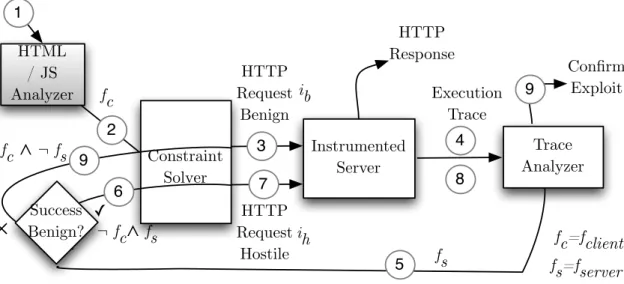
Figure 1: System Workflow
that it does not impose any constraints on this field. In addition, the following challenges need to be addressed as well.
Restrictive servers. While servers occasionally fail to replicate client checks, they are often designed to be more restrictive than clients in processing user input. In our example, note that the client restricts the length of thenamefield to 10 characters or less. On an input that does not meet this constraint (has 11 or more charac-ters), the server chooses to “sanitize” this field by considering only the first 10 characters of the submitted value. A naive approach that doesn’t satisfy the client restrictions and fails to consider the effect of sanitization in reaching a sensitive operation on the server will generate a false alarm. Our analysis is designed to factor such changes to input and avoids generating false alarms (§4.2).
Handling database operations. Any server side analysis should not only consider the effect of server side code, but also the ef-fect of its database operations. For instance, database operations may further constrain data submitted by a client through integrity constraints. Failing to consider these constraints will also generate false alarms. For example, say theaddressfield in database has an integrity constraint that ensures that it is notnull. Failing to con-sider such constraints will generate false alarms. Our approach is designed to correctly handle the effect of such database constraints (§4.3).
Negative Parameter Tampering. Sometimes a server side file, such asserver.phpis written to handle multiple forms. In the above example, the server-side code additionally checks for pa-rameterdiscount. While this code was intended for processing a totally different form that contains discounts for the user, it is not uncommon for LAMP applications to reuse the code that has some shared processing of content. An exploit that introduces this fielddiscountcan result in providing unlimited discounts to the total price. We call thisnegativetampering, as it is performed by an input field that is not present in the original form. By whitebox analysis of server side code, we are able to identify such vulnera-bilities. We found a zero-day negative tampering attack on the open source applicationdcpportalthat enables privilege escalation of an ordinary user to an administrator (§6).
3.
APPROACH OVERVIEW
WAPTEC’s basic approach to identifying parameter tampering exploits (inputs the client rejects but the server accepts) on a web application is a two-step process: (i) find server control paths that if taken result in the input being accepted, i.e., paths that lead to sensitive operations (such as theINSERTquery in line 17 of our running example), and (ii) find inputs leading to each such control path that the client rejects (such as submitting a negative quantity to the server). In WAPTEC, step (i) is accomplished using a form of constraint-guided search that probes the server with inputs that the server ought to accept and then analyzes the code the server executed to determine if that control path led to a sensitive sink. We call any input the server ought to accept that results in execu-tion of a sensitive operaexecu-tion abenign input. Step (ii) is also ac-complished by probing the server with inputs and checking for a sensitive sink on the resulting control path, though this time the inputs are those the server ought to reject. Any input the server ought to reject that results in execution of a sensitive operation is a
hostile input. Hostile inputs arecorrect by constructionparameter tampering exploits.
Unlike many bug-finding program analysis efforts, WAPTEC leverages the existence of client-side code (a web form) for both steps. When searching for a benign input in step (i), WAPTEC only generates inputs that the web form accepts and would submit to the server; moreover, because the client code is relatively sim-ple to analyze, WAPTEC extracts a logical representation of all such inputs (fclient) and utilizes constraint-solving technology to directly construct an input the client accepts (i.e., without fuzzing). While the server does not accept every input the client accepts, therefore requiring constraint-guided search, the client side code is a good enough approximation that WAPTEC often finds a benign input on the first try.
When searching for attacks on a given control path on the server in step (ii), WAPTEC again uses fclient to generate inputs, but in this case the inputs are designed to be hostile. The main thesis of WAPTEC’s approach is that if the client code rejects an input, the server ought to reject it as well; thus, every input satisfying the negation offclientis a potential hostile input (parameter tampering exploit), which constraint solvers can again construct directly.
Fur-thermore, WAPTEC uses the logical representation offclient to group all the potential exploits by the vulnerabilities they illustrate and generates one (or any number) of exploits per distinct vulnera-bility.
Below we describe WAPTEC’s two step approach in more detail and refer to the steps shown in Figure 1.
3.1
Finding benign inputs
The purpose of a web form that validates user input is to re-ject inputs that the server will (or in practiceshould) reject. The converse is also often true: if the web form accepts an input the server will also accept it. We can therefore reasonably treat the constraints the web form checks as an approximate specification for the server’s intended behavior. WAPTEC extracts the con-straints enforced by the web form (which we callfclient) using program analysis, which is accomplished by the HTML / JavaScript Analyzer in step 2 of Figure 1. For our running example, the client formula isquantity ≥ 0∧len(name) ≤ 10∧card ∈ {card-1|card-2} ∧op = “purchase00 where the first two con-straints are contributed by JavaScript and the rest are derived from HTML.
To find a benign input, WAPTEC starts by using its Constraint Solver component to find any input that satisfiesfclientand then submits that input to the server (step 3). To check whether or not the input reaches a sensitive sink (i.e., is benign), WAPTEC an-alyzes the code executed by the server using its Trace Analyzer component (step 4). If the server reaches a sensitive sink, the in-put is benign. However, sometimes the inin-put fails to reach a sen-sitive sink because the server enforces more constraints than the client. These extra constraints can arise, for example, because the server has more information than the client (e.g., the list of ex-isting usernames). In our running example, the input satisfying
fclient might bequantity = 3, name = “J ohnDoe”, card =
card-1, op= “purchase00. The server rejects this input because it requiresaddressto have a non-null value (i.e.,addressis a required value).
When an input that satisfies fclient fails to reach a sensitive sink, WAPTEC attempts to augmentfclientwith additional con-straints, the intention being that any input satisfying the augmented
fclientwill lead to a sensitive sink. To compute this augmentation, WAPTEC examines the execution trace of the code the server exe-cuted on the failed input, and computes a logical formula represent-ing that code trace (calledfserver, computed in step 5, by the Trace Analyzer). The intuition is thatfserverrepresents (the conjunction of) the conditions on the server’s inputs that if true will always lead to the same control path. Since that control path fails to lead to a sensitive sink, every input leading to a sensitive sink must falsify one of the conditions on the path, i.e., it must satisfy the negation of
fserver. Thus, the augmentation offclientwhen no success sink is found isfclient∧¬fserver(step 9). In our example, the augmented
fclient would bequantity ≥ 0∧len(name) ≤ 10∧card ∈ {card-1|card-2} ∧op = “purchase00∧required(address), whererequired(x)means variablexis required to have a value.
This process then repeats, starting with the augmentedfclient, finding an input that satisfies it, and iterating until WAPTEC finds a benign input. At a high level, this process generates a series of inputs, where each subsequent input has a better chance of being a benign input than all of the previous.
Once WAPTEC finds a benign input, it performs a depth-limited version of the procedure above to find additional, nearby control paths that lead to sensitive operations. To do that, WAPTEC ana-lyzes the trace to extractfserver, which is a conjunctionC1∧ · · · ∧
Cn. For eachCi, WAPTEC adds¬Cito (the augmented)fclient,
finds a satisfying input, and checks if that input leads to a sensi-tive operation. We call this process perturbation, since WAPTEC attempts to perturb the constraints leading to one sensitive sink to find additional sinks. Since eachCican potentially produce a distinct control path leading to a sensitive sink, after this depth-limited search WAPTEC has between1andn+ 1control paths leading to sensitive operations. The perturbation process is moti-vated by the intuition that small changes to successful inputs may still drive execution successfully to sensitive sinks, which are often clustered together, and hence after finding a single sink, there is a high likelihood of finding additional sinks nearby. It is noteworthy that WAPTEC does not perturb a path that has no sensitive sinks because all the paths that it would reach by perturbation are already reachable by the augmentation offclientby¬fserver.
3.2
Finding hostile inputs
For each control path WAPTEC finds that leads to a sensitive sink, it attempts to generate inputs that the server ought not ac-cept but that lead to that same sink. Generating inputs the server ought not accept is straightforward: find solutions to the negation offclient, for if the client rejects a given input, we can be assured the server will reject it as well (or else the client fails to expose the server’s full functionality to users). Generating inputs that cause the server to follow the same control path and therefore arrive at the same sensitive sink is likewise straightforward: find solutions to
fserver. Thus, generating inputs that follow the same control path and therefore are accepted by the server but that the server should not accept amounts to finding a solution to¬fclient∧fserver(step 6). Conceptually, every such solution amounts to a parameter tam-pering exploit, but to ensure the input is in fact an exploit, we sub-mit it to the server (step 7) and ensure it reaches a success sink (steps 8 and 9).
Furthermore, instead of generating one input for¬fclient∧fserver, WAPTEC generates one input for each disjunctδin the disjunctive normal form of¬fclientby finding a solution toδ∧fserver. Each of those inputs satisfies a logically distinct set of constraints and hence is likely to represent a logically distinct vulnerability. Each
δ∧fservercan be construed as a distinct server-side vulnerability witnessed by one of the exploits WAPTEC finds.
In our running example, the negation offclientisquantity <
0∨len(name)>10∨op! = “purchase00∨card6∈ {card-1|card-2}. There is a control path through the server wherefserver includes
required(address)∧ ¬len(name) >10. Thus, to construct an exploit, WAPTEC uses the Constraint Solver to find one solution
to the formula
quantity <0∧required(address)∧ ¬(len(name)>10)and
another solution to the formula
len(name)>10∧required(address)∧ ¬(len(name)>10). In the first case, the server executes an INSERT operation, and is deemed an exploit (hostile). This exploit illustrates the vulnerabil-ity wherequantityis given a negative value. The second formula is not satisfiable and therefore there is no exploit reported.
The pseudo-code for steps (i) and (ii) of our approach can be found in Algorithms 1 and 2, respectively.
3.3
Soundness
It is important to describe at a high level the mechanisms that we use for generating the client formulafclientand the server formula
fserver, and their implications for the correctness of our approach. The client formulafclientis generated by the HTML / JavaScript Analyzer (shown in Figure 1), and is based on our prior work [7]. The analyzer uses symbolic evaluation [20] to compute the client formulafclient. Since the formula is statically computed from the
Algorithm 1WAPTEC (url) 1: fclient:=clientAnalyzer(url) 2: Q:={true}
3: loop
4: α:=pop(Q)
5: ν:=solve(fclient∧α)
6: (success, fserver) :=server(url, ν) 7: ifsuccessthen
8: genHostiles(url, fclient, fserver) 9: for allCi| fserver=C1∧ · · · ∧Cmdo 10: ν:=solve(fclient∧α∧ ¬Ci) 11: (success, fserver) :=server(url, ν)
12: ifsuccessthengenHostiles(url, fclient, fserver) 13: else
14: Q:=Q∪ {α∧ ¬Ci| ¬fserver=¬C1∨ · · · ∨ ¬Cm} 15: Q:=simplif y(Q)
16: ifempty(Q)then return
Algorithm 2GENHOSTILES(url,fclient,fserver) 1: for allδ∈DN F(¬fclient)do
2: ν:=solve(δ∧fserver) 3: success:=server(url, ν)
4: ifsuccessthen printExploit found:ν
source, the generated formula is in fact an approximation. Specif-ically, due to the nature of the approximations made in [7],fclient is anunder-approximationof the constraints the client enforces, which means that every time an input is generated that satisfies
fclient, it is indeed the case that this input will lead to a successful form submission from the client. Similarly,¬fclient, represents an
over-approximationof input instances that are rejected by the client (e.g., line 7 of client code listing 1 in our running example). Inputs satisfying¬fclient are therefore not necessarily rejected, but we can always execute those inputs in the actual client code to ensure they are rejected by the client.
In our approach, the server side behavior is obtained by dynamic analysis of server side code. This means that the server side for-mulafserverwill be specifically tied to each run, and is generated from the program trace induced by the run. By its very nature, dy-namic analysis only considers the operations done by code that is executed; hence,fserverprecisely captures the server behavior for the run without any approximations.
Sincefserveris precise, and WAPTEC can verify that any so-lution to¬fclient∧fserver is actually rejected by the client, all the exploits WAPTEC reports are concrete parameter tampering exploits. Our implementation seeks to find such exploits.
3.4
Discussion
Section 2 described several challenges that WAPTEC addresses. Here we explain how those challenges are met by the algorithms just discussed.
Multi-tier analysis. The algorithms above are written as though WAPTEC is faced with analyzing only a single program, but in re-ality there are three programs written in different languages that it must analyze: the web form, the server code, and the database. To reason about the combination of these three programs, WAPTEC analyzes each program individually and extracts the relevant se-mantics into logical formulas (more specifically the logic of strings). Once the important portions of the three programs are expressed in a common language, reasoning about the combination is much sim-pler and can be carried out as described in this section. Details on
translating web forms into logic can be found in Section 4.1; de-tails on translating server code (one trace at a time) into logic can be found in Section 4.2; details on translating database code into logic can be found in Section 4.3.
Negative parameter tampering. Discovering attacks that uti-lize variables not appearing in the client-side web form (i.e., neg-ative parameter tampering attacks) is a natural side-effect of our basic algorithm. Such variables appear in the server-side code, and when the server processes any given input,fserver will therefore include those variables. In our running example, line 14 checks if the variablediscounthas a value. Therefore, everyfserver gener-ated from an input that fails to setdiscountwill always include the constraint¬required(discount). When the input fails to reach a sensitive sink,fclientis augmented withrequired(discount), and when the input succeeds in reaching a sensitive sink, the perturba-tion process includesrequired(discount)as one perturbation. In both cases, subsequent attempts to find satisfying inputs require
discountto be assigned a value.
Sanitization. Sometimes before validating user input, the server sanitizes those inputs. Sanitization violates the premise that if the client rejects an input so should the server. For example, instead of rejecting anamevalue that is longer than 10 characters, the server truncatesnameto 10 characters. WAPTEC can avoid triggering false positives for some sanitization cases because of the way it constructsfserverfrom a trace of the server’s code (§4.2).
4.
WAPTEC ARCHITECTURE
The previous section outlined high level challenges in design-ing a whitebox analysis tool to detect parameter tamperdesign-ing attacks. Specifically, we note that different components of a web application are written in different programming languages: client side code is written in HTML / JavaScript, server side code is written in server side programming languages such as PHP, JSP, etc., and finally, database schema is written in languages such as SQL. To compute formulas that represent restrictions imposed on inputs, we need to bridge the gap between different programming languages and ex-press constraints imposed by them uniformly in terms of first-order logical formulas. Expressing constraints uniformly would then en-able generation of benign and hostile inputs by solving formulas involvingfclientandfserver.
This section discusses technical challenges faced in assimilating constraints from various components of a LAMP web application and algorithms that address them. fclient is computed from the client-side code and involves analysis of HTML / JavaScript code relevant to a web form (Section 4.1). fserver is computed from the server-side code and involves extracting constraints from PHP server-side code (Section 4.2) and SQL databases (Section 4.3).
4.1
Extracting constraints from client-side
code
The client-side web form is typically expressed in HTML and JavaScript both of which encode restrictions on user inputs. We analyze HTML code of the web form to extract constraints implied by various form fields e.g., a drop down menu implies a range con-straint on value of the user input. JavaScript validation code asso-ciated with the form is symbolically executed to extract conditions that, if satisfied, indicate successful input validation at the client. All restrictions imposed by HTML and JavaScript together then provide the client-side formulafclient. Generation offclient is based on our prior work NOTAMPER[7] which provides a detailed treatment.
Listing 3: Trace generated for running example 1 $main_ca = $_POST[’card’]; //
2 if($main_ca matches ’card-1|card-2’){ //
3 4 } 5 6 $main_n = $_POST[’name’]; 7 if(! strlen($main_n) > 10 ) { 8 } 9 10 if($_GET[’op’] == "purchase"){ 11 12 $main_cost = $_POST[’quantity’] * 100 + 10; // where $price is 100 13 14 if(!isset($_POST[’discount’]){ 15 } 16
17 $main_q = "INSERT INTO order (‘name‘,‘address‘, ‘ card‘, ‘cost‘)";
18 $main_q = "INSERT INTO order (‘name‘, ‘address‘, ‘card‘, ‘cost‘)" . "VALUES(’" . $main_n . ", ’" . $_POST[’address’] . "’" . $main_ca
. "," . $main_cost . ");";
19
20 mysql_query ($main_q);
21 $_wb_status = "SUCCESS"; // query execution denoted by SUCCESS status
22 23 }
4.2
Extracting constraints from server-side
code
The formulafserver represents server side validation and san-itization of user inputs. To generatefserver, we first capture a trace comprising of statements that the server executed to process user inputs. For the running example (Listing 2), Listing 3 shows the generated trace for inputscard=’card-1’, name=’alice’,
address=’wonderland’,op=’purchase’andquantity=1. Each line in the generated trace Listing 3 corresponds to the line in the running example Listing 2 that generated it.
To generatefserver, we need to identify statements in a trace that correspond to validation / sanitization done by the server side code. The server-side code may perform user input validation and saniti-zation in the following three ways: a) explicit validation of desired properties of user inputs in conditional statements and b) implicit validation / sanitization of user inputs through inbuilt functions in server-side code and c) implicit validation / sanitization of user in-puts by database. In the running example (Listing 2), validation of thecardparameter at line 2 illustrates explicit validation, trunca-tion of thenameparameter at line 8 illustrates explicit sanitization (as execution of line 8 ensures that value of thenameparameter will contain 10 or less characters) and rejection of null value for the parameteraddressexemplifies database sanitization / valida-tion. fserver is essentially computed by identifying and analyz-ing all the three types of validation / sanitization constructs present in a trace. We focus on the first two types of validation / saniti-zation constructs here and the database validation / sanitisaniti-zation is discussed in the next section (Section 4.3).
Extracting constraints due to explicit validation. Explicit validation of user inputs is captured byIFstatements appearing in a trace e.g., fourIFstatements shown in the trace in Listing 3, capturing validation of parameterscard,name,opanddiscount, respectively. To learn the constraint being checked by anIF state-ment, we analyze its condition argument. Each such condition ar-gument is then repeatedly expanded until it only contains user
in-puts, concrete values and operators. For example, theIFstatement on Line 2 (Listing 3) checks if
$main_ca matches 0card−1|card−20. We expand$main_ca
with$_POST[0card0]because of the assignment statement on Line 1. Intuitively, starting from theIFstatement the above process walks backwards in the trace and replaces server-side variables appearing in conditions with values assigned to them until the condition is expressed in terms of inputs, concrete values and operators.
A challenge in precisely capturing explicit validation inIF state-ments stems from the presence of irrelevant statestate-ments. A naive ap-proach that considers allIFconditions as relevant to a sink would report imprecise results. For example, consider the firstIF state-ment in the trace (Listing 3). ThisIFstatement checks the value of parametercardand sets the HTML form to show the selected en-try. Although the trace contains check oncard, it does not prevent the query computed at line 20 from using malicious values ofcard. Similarly, a form may contain several parameters but a server side sink may only use some of them. Therefore, our analysis must fac-tor whether a tampered parameter is actually going to be used at a sensitive operation.
WAPTEC identifies conditionals relevant to a given sink by em-ploying data- and control-dependency analysis: the data depen-dency analysis identifies conditionals that actually contributed data to a sink, and the control dependency analysis identifies condition-als that actually dictated control flow to a sink. For the running example, the query executed at line 20 is neither data nor control dependent on conditional statement at line 2 and hence this condi-tional is ignored while analyzing sink at line 20.
For the trace in Listing 3 the above process contributes the fol-lowing constraints to thefserverformula:
len(name)≤10∧op= ”purchase”∧ ¬isset(discount).
Extracting implicit constraints due to sanitization. The server-side sanitization of user inputs may inherently enforce constraints on user inputs. For example, at line 8 (Listing 2) server-side vari-able$nwhich contains value of the parametername, is sanitized. In specific, by truncating thenameparameter withsubstrfunction, the server-side code ensures that after this sanitization the contents of$nvariable will have 10 or less characters i.e., it implicitly en-forces the constraintlen(name) ≤ 10.
WAPTEC avoids analyzing paths that would result in generat-ing false alarms due to such sanitization. To see, we revisit the ba-sic process by which WAPTEC identifies paths to a success sink. Notice that we demand that this path is satisfied by an input that satisfiesfclient. In the event the server chooses to apply sanitiza-tion of input to satisfyfclient, such a path will not be considered by WAPTEC for trace analysis, because a benign input will never traverse that path. For example, in Listing 2, the statement in Line 8 will never be executed by WAPTEC.
Nevertheless, an application may have incomplete or partial sani-tization. To handle these cases, we capture such implicit constraints by analyzing the sink expression (e.g., SQL query), and demand-ing thatfclientbe held true by the sink expression. We express the sink expression purely in terms of user inputs and concrete values by following a process similar to expansion ofIFconditions. The resulting SQL sink expressions are then parsed with a SQL parser thus identifying data arguments to SQL queries which contain user inputs (or a function of user inputs). Currently, the restrictions on the operators appearing in the sink expression are limited to the language (shown in Table 1) supported by the underlying solver (as described in §5.2).
4.3
Extracting constraints from database
Database query operations present interesting consequences for approaches that analyze server-side code. With respect to such op-erations, many security analysis approaches limit their reasoning to reachability, e.g., most tainting approaches aim to find if a tainted data item can reach a database query execution location. Without analyzing outcome of the query execution, such approaches will result in imprecision as database engine may either sanitize hos-tile inputs to comply with its schema or reject them. For black-box approaches, database triggered sanitization may result in false alarms. Additionally, whitebox approaches that ignore these con-straints may never generate a benign set of inputs that will be truly accepted at the sink. For our running example, without considering database constraint(NOT NULL) on theaddressfield, it is not possible to generate acceptable benign inputs. Note that this also forbids discovery of legitimately exploitable parameters for such sinks, thus resulting in false negatives e.g., thequantityexploit cannot be constructed without providing a non-null address value.We first note that the database schema is a sequence of SQL queries that creates different tables and views and expresses cer-tain restrictions on data that can be inserted into each column of a table. Suppose we know that a user inputuis being inserted into a columncof a table, then all constraints implied oncby the database schema, must be satisfied (if validation) or will be enforced when data is added to the database (if sanitization). However, finding the mapping betweenu(typically server-side variables) andc (col-umn name in a database table) is challenging as it requires bridging the namespace differences between application code and database schema i.e., application code and database tables may refer to same data with different names. WAPTEC analyzes database schema and queries issued in traces to build a mapping between server-side variables and database columns which enables it to then express constraints imposed by database in terms of user inputs.
In the first step, this analysis parses the schema of an applica-tion’s database. For each table creation statement we analyze the column definitions that typically specify constraints on values that can be stored e.g.,“NOT NULL"clause enforces non-null values whereasenum specifies domain of accepted values. We handle
MySQLformatted schemas and extract such conditions in the solver language.
In the second step, we generate a symbolic query for SQL sinks found in traces and parse them. This parsing enables us to map ta-ble column names to program variata-bles. For example, on parsing a symbolic SQL query“insert into T (uid, ... values( ’$_GET[u]’,...", we can associate column uidof tableT to program variable$_GET[u]. Once this mapping is available, we generate constraints by replacing column names with program vari-ables in constraints generated by the first step e.g., ifuidcolumn had aNOT NULL constraint, this analysis will yield a constraint
(NOT NULL u).
Discussion. The above discussion highlights the relationships between server variable names, client form field names and database field names as intended by typical web applications. These rela-tions are important from the perspective of sanitization as well. We already discussed a precise way to handle the effect of sanitization that requires the client validation to hold at the sink expression, (and is therefore safe for such operation). However, such an ap-proach needs to make an assumption that the database field corre-sponding to the sink expression represents a correcorre-sponding client form field (that is transformed to the sink expression with some form of sanitization). While the discussions in this section suggest that such an assumption is reasonable across a large class of web applications, and indeed holds in the applications that we analyzed,
it is very easy to construe examples where it could break. For in-stance, consider a (contrived) web application which assigns a sink expression to a value that does not satisfy client validation, and the intention behind such an assignment may be beyond the inference of any automated mechanism. More generally, the above discus-sion raises the need for aspecificationthat provides a mapping be-tween client inputs and database fields. While such specifications were not needed for the applications we analyzed, the availability of such specifications will be able to broaden the applicability of our analysis.
5.
IMPLEMENTATION
To generatefserver, we need a trace of statements executed by the server-side code. Section 5.1 provides the high-level details behind a program transformation that enables PHP applications to generate a trace and facilitate computation offserver. Generating benign and hostile inputs entails solving logical formulas and Sec-tion 5.2 describes the implementaSec-tion details of the solver.
5.1
Trace generation transformation
Computation offserverentails reasoning about server-side pro-cessing of user inputs e.g., properties of user inputs checked by the server-side code. We capture the server-side processing of user in-puts in traces which contain program statements executed by the server-side code to process user inputs. To generate such traces we perform source-to-source transformation of applications written in
PHPlanguage. The transformed applications are then deployed and generate traces apart from processing user inputs.
Alternate implementation. The other choice for capturing such traces is to instrument aPHPinterpreter itself. Although, this approach requires less effort on a per application basis, it may re-quire extensive changes to thePHPinterpreter. Also, there are con-siderable analysis needs that led us to adopt a program rewriting route. First, we needed taint tracking to identify the flow of un-trusted inputs. Second, we needed data and control flow analysis required to identify conditions only relevant to the sink. Third, to handle PHP5 object-oriented features, we need to unambiguously identify each object in order to avoid name collisions. While these can be done by hacking various internal parts of a PHP interpreter, such changes would generally not be portable across revisions to the interpreter. Our implementation does so in a much cleaner fash-ion while retaining portability across various PHP interpreters and is not broken by revisions to the interpreter.
Avoiding name collisions. Traces are straight-linePHP pro-grams comprising only of assignments, calls to inbuilt functions andIF-THENstatements. A challenge in reporting variable names in traces is caused by the possibility ofname collisions. As traces are straight-line programs, all functions (exceptPHPinbuilt) exe-cuted by the web application need to be in-lined. As this in-lining merges variables from several lexical scopes it could result inname collisionsand could generate traces that misrepresent run of the web application e.g., name-collisions could result in traces that in-correctly capture use / reachability of an important variable. To avoid name collisions, program transformation attaches a unique prefix to each variable name being reported in the trace. To com-pute these prefixes, we use function / method signatures and for variables appearing in classes, a per object unique identifier is used additionally (as described below).
PHP object-oriented features. Object-oriented features are often used inPHPprograms (2 of the 6 applications we evaluated were object-oriented and used inheritance). As multiple instanti-ations of a class yield objects with same methods, method signa-tures are same for all such objects. Thus prefixing signasigna-tures to
Class Examples Instances Equality * =,6= x6=y
Numeric * +,∗,−,/,<,> x <7
Modal required required(x)
Regex * ∈,6∈ x∈[abc]*
PHP trim,len,concat len(x)< len(concat(y, z))
Table 1:WAPTECconstraint language
variable names may still lead to name collisions in object-oriented programs. Further, a member variable can be accessed using mul-tiple namespaces e.g., by using thethisoperator (inside methods) or by using names assigned to objects. Although, all such instances are accessing the same memory region, a naive renaming scheme may lose precision by failing to identify these accesses with a sin-gle variable name.
The main changes required to classes are for computing unique prefixes for variables. Here, the transformer adds anidmember variable to the class definition to hold the unique identifier for each instance of the class. The constructor methods are augmented to initialize theidvariable to a unique value. Further, inheritance is inherently handled in this scheme as theidmember of inher-iting class shadows theidmember of base class. With the help ofidvariable, accesses to a member variable through an object ($o→member1) or thethisoperator ($this→member1) are uni-formly transformed asv_$id_member1. This enables subsequent analysis to correctly identify accesses to a single memory location from disparate namespaces.
Asfservermainly concerns processing of user inputs, the trans-former ensures that the generated traces only contain statements manipulating user inputs. We use standard taint tracking tech-niques to track user inputs and only include statements manipu-lating tainted arguments in traces. Special care was needed to ini-tialize and propagate taint asPHPrecursively defines some of the inbuilt arrays e.g., super global arrayGLOBALScontains itself as a member.
5.2
String solver
The string solver component analyzes logical formulae to con-struct inputs that are fed to the server; some of those inputs the system was designed to accept, while other inputs are intended to expose server-side vulnerabilities. The string solver component of WAPTEC was built on top of Kaluza [21], a state-of-the-art solver that finds variable assignments satisfying string and numeric con-straints. The main challenge in building the string solver compo-nent was translating the WAPTEC constraint language into the lan-guage supported by Kaluza.
Constraint language. WAPTEC allows all boolean combina-tions of the atomic constraints shown in Table 1. The equality and numeric constraints are standard; regular expression constraints re-quire a variable to belong to a given regular expression;PHP con-straints include functions fromPHPand JavaScript such astrim
(found in e.g., the MyBloggie application) for removing whites-pace from the ends of a string andstrposfor computing the index at which one string appears inside another string. Kaluza roughly supports those categories of constraints marked with an asterisk, plus functions for computing the length of a string and concatenat-ing two strconcatenat-ings. Thus, translatconcatenat-ing WAPTEC’s constraint language to Kaluza’s language requires handling modals andPHPfunctions.
Static versus dynamic typing. Besides the difference in atomic constraints, there is a more fundamental difference between the constraint languages of Kaluza and WAPTEC. Kaluza requires
ev-ery variable to have a single type and does not provide functions to cast from one type to another1, whereasPHPallows variables to
take on arbitrary values. This mismatch makes the translation dif-ficult because a constraint such asx6= 0∧x6= “0”causes a type error in Kaluza but appears frequently in the semantics ofPHP, e.g., when defining whether a variable evaluates to true or false.
Our approach approximates the semantics ofPHPfunctions with a combination of type inference to detect type mismatches, type resolution to choose one type for mismatched arguments, static casting to convert problematic arguments to the chosen types, and type-based simplification to eliminate constraints that do not actu-ally affect the satisfiability of the constraints but cause Kaluza to throw type errors.
Untranslatable constraints. Some of WAPTEC’s constraints cannot faithfully be translated into Kaluza’s constraint language. For example, PHP employs a number of built-in data structures not handled by Kaluza, and PHPfunctions often accept and re-turn such data structures. For example, MyBloggie employs the
preg_replacefunction, which is a regular-expression version of a string replacement operation.preg_replacecan both accept and return arrays as arguments. Arrays are difficult to translate to Kaluza because they correspond to an unknown number of variables, and Kaluza expects a fixed number of variables in the constraints. An-other example of a function we did not translate is found in DCP-Portal application: themd5function computes the MD5 hash of its argument.
For constraints that cannot be translated to Kaluza’s language, WAPTEC simply drops those constraints, producing a constraint set that is weaker than it ought to be, potentially leading to un-soundness and incompleteness in the search for parameter tamper-ing exploits. However, because WAPTEC always checks if the variable assignment produced by the solver satisfies the original constraints, unsound results are never reported.
Disjunction. As mentioned above, disjunction is employed heavily by WAPTEC, and while Kaluza handles disjunction na-tively, the search for parameter tampering exploits sometimes re-quires finding different solutions for different disjuncts in a set of constraints—functionality Kaluza does not support. Thus WAPTEC manages disjunctions itself, sometimes converting to disjunctive normal form (DNF)2explicitly.
6.
EVALUATION
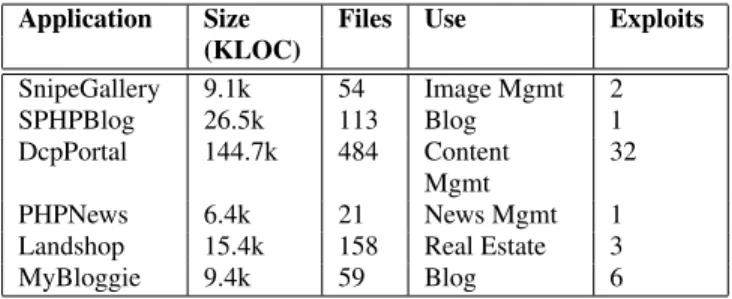
We evaluated the effectiveness of WAPTEC on a suite of 6 open sourcePHPapplications that were chosen to reflect prevalent appli-cation domains in commonplace settings. Table 2 provides back-ground information on these applications (lines of code, number of files, and functionality). The test suite was deployed on a Mac Mini (1.83 GHz Intel, 2.0 GB RAM) running the MAMP applica-tion suite, and WAPTEC was deployed on an Ubuntu workstaapplica-tion (2.45Ghz Quad Intel, 2.0GB RAM).
Experiments. We evaluated our approach by conducting two sets of experiments. In the first set of experiments, we ran WAPTEC to automatically analyze the chosen web forms and identify param-eter tampering exploits that are correct by construction. In the sec-ond set of experiments, we ran NOTAMPER, a blackbox version of WAPTEC developed in our previous work [7], on the same web forms. We compared the results of the two experiments to quantify
1
Type casting functions, while included in the documentation, were unavailable at the time of evaluation.
2
In our experience, converting to DNF was usually inexpensive (despite its worst-case exponential behavior) because of the struc-tural simplicity of the constraint sets.
Application Size Files Use Exploits (KLOC) SnipeGallery 9.1k 54 Image Mgmt 2 SPHPBlog 26.5k 113 Blog 1 DcpPortal 144.7k 484 Content Mgmt 32 PHPNews 6.4k 21 News Mgmt 1
Landshop 15.4k 158 Real Estate 3
MyBloggie 9.4k 59 Blog 6
Table 2: Summary ofWAPTECresults
the benefits of using whitebox analysis over blackbox analysis in the context of parameter tampering attacks.
Results summary.The outcome of the first set of experiments is summarized in Table 2. We evaluated one form in each application. WAPTECfound a total of 45 exploits. We manually verified all of these exploits.For each application shown in column 1, the last column shows reported exploits. As shown in this table, WAPTEC successfully generated one or more exploits for each application in the test suite underscoring a widespread lack of sufficient replica-tion of the client-side validareplica-tion in the corresponding server-side code. A detailed report of exploits found by WAPTEC can be found athttp://sisl.rites.uic.edu/waptec. We discuss a few inter-esting exploits below and use them to motivate discussion in Sec-tion 6.2 that discusses improvements made by WAPTEC (white-box) over our prior work NOTAMPER(blackbox).
6.1
Exploits
Privilege escalation.Thedcpportalapplication allows guests to register for an account. The registration form solicits standard information, such as name, e-mail, username, password, etc. Upon normal registration, a user is provided with an account having ba-sic privileges. When the form is submitted, the server-side form processing code validates the provided information and checks if a cookiemake_install_prnis set. When this cookie is set to 1, the user is registered with administrative privileges. By setting this cookie, it is possible for an attacker to register an account with escalated privileges.
Discovery of the above vulnerability required WAPTEC to con-struct a negative parameter tampering exploit i.e., the client-side formulafclientfor this form did not contain any restriction on the parametermake_install_prnhowever the server side formula
fserver checked its value. The whitebox view of the server-side code enabled WAPTEC to set this additional parameter and esca-late privileges of user being registered to an administrator.
After confirming the exploit, we analyzed the application to un-derstand the root cause of this flaw. We found that the applica-tion used cookiemake_install_prnduring initial installation to allow creation of an administrator account. To patch this vulner-ability, the application can use additional server-side state (e.g., sessions) to avoid depending on the cookie value alone or have a separate form for this purpose.
Duplicate users. Thedcpportalapplication requires unique usernames comprising of at most 32 alphanumeric characters for new account registrations. The client-side allows only 32 alphanu-meric characters, while the server-side enforces uniqueness by check-ing that the database does not contain a matchcheck-ing username be-fore creating an account. Further, during insertion of new user de-tails, the database enforces the length by truncating usernames to 32 characters.
During vulnerability analysis, WAPTEC recognized that the server
fails to enforce the length constraint before checking for existing usernames. For this vulnerability, WAPTEC generated hostile in-puts that exceeded 32 characters, which in this case caused the username existence check to always return false. This is because usernames stored in the database are truncated to 32 characters and checking for usernames of length>32 will always return false. In addition to this, the server also fails to replicate the alphanumeric constraint onusernameand WAPTEC generated a hostile input that contained invalid characters. When confirming these exploits, we were able to refine them. Although true account duplication works only for long usernames, it is possible to create imposter ac-counts by appending url encoded whitespace to existing usernames. Blog category hijacking. mybloggie, a blogging application, allows registered users to submit posts to the blog. When submit-ting a post, users are asked to choose a category for the current post from a drop-down list of existing categories. By submitting a value not in that list, an attacker can submit posts that will appear in a category that will be created in the future. This may negatively im-pact effectiveness / quality of the future category thus this attack can hijack a future blog category. WAPTEC computed formulas
fserver and fclient for this form, revealed missing validation of submitted category value by the server-side code and was exploited by supplying an out of range value.
Additional exploits.Below we briefly describe one exploit from each of the other four applications we evaluated.
phpnews, a news management application, allows administra-tors to modify certain files through a form which contains name of the file as a hidden field. The server-side code fails to validate that the file name is not tampered and as a result attackers can update existing files, create arbitrary files and / or corrupt files of other applications deployed on the same web server.
snipegallery, a photo album application, allows users to arrange albums hierarchically by selecting a parent category for each new album from a drop down list. By selecting a value not in that list, the new album becomes invisible; furthermore, additional analysis shows that a carefully constructed parent album value leads to a SQL injection attack.
landshop, a real estate application, includes a form with a hidden field not pertinent to that form. When the value of this field is set to the ID of an existing listing (which are displayed prominently on the site), that listing is deleted from the application whether the user is the owner or not.
sphpblog, a blogging application, allows users to choose a guage for the blog from a drop down menu. By selecting a lan-guage value not in the drop down menu, an attacker can make the application unusable and thus conduct a denial-of-service attack.
6.2
Comparison of whitebox and blackbox
results
The results of the comparison are summarized in Table 3. For each application, this table reports the number of confirmed ex-ploits found by NOTAMPER(column 2) and WAPTEC (column 3). The next two columns report false positives reported by NO -TAMPER, which were eliminated in WAPTEC, and false negatives reported by WAPTEC that NOTAMPERfailed to find. In total, the blackbox approach resulted in 23 false positives, and 24 fewer con-firmed exploits when compared to the whitebox approach. Further, fordcpportalandmybloggieapplications WAPTEC found sev-eral exploitable sinks for each negated disjunct offcliente.g., for
dcpportalcolumn 3 shows 16(32) - each hostile input generated by negating 16fclient disjuncts was used in 2 distinct sinks and hence were exploitable (total 32 exploits). We wish to note that all
Application Conf. exploits False pos. False neg. BlackB. WhiteB. BlackBox BlackBox
SnipeGallery 2 2 1 0 SPHPBlog 1 1 0 0 DcpPortal 13 16(32) 9 19 PHPNews 1 1 0 0 Landshop 3 3 1 0 Mybloggie 1 5(6) 12 5 Total 21 45 23 24
Table 3: Comparing whitebox and blackbox analysis results
these disjuncts would have contributed to one hostile each, at best, in NOTAMPER.
In the rest of this section we will refer to exploits described in Section 6.1 to highlight features of WAPTEC (whitebox) that en-able it to produce better results than NOTAMPER(blackbox).
Multiple sink analysis. A single form input can be used by the server at multiple sensitive operations and can potentially cause problems at each such operation. The duplicate user exploit in
dcpportaldemonstrates a case where a single hostile input ex-ploited multiple sinks. When WAPTEC negated the 32 alphanu-meric character length constraint, it produced an invalid string that was used at two sinks. The string was first used in a sink that checked if a duplicate username exists in the database, and later it was inserted into the database at a second sink. WAPTEC detected that the malformed username was used at both sinks and reported an exploit for each. On the contrary, NOTAMPERreported a single vulnerability for a similar hostile input. This is because NOTAM
-PERis incapable of reasoning about multiple sinks and, therefore, suffers from false negatives.
Negative tampering. WAPTEC showcased that it can uncover negative tampering vulnerabilities by discovering the privilege es-calation exploit indcpportal. While exploring additional server-side form processing code, WAPTEC found a conditional that de-pended on value of a parametermake_install_prnwhich is not found in the client-side formula. To explore this branch, it satis-fied the conditional by setting the cookiemake_install_prnto 1. By analyzing data and control dependencies, it then determined that this branch modifies parameter values used in the sink, and therefore, reported the exploit. NOTAMPERis inadequate to dis-cover such exploits because that requires analysis of server-side form processing logic to uncover hidden functionality, which is out of scope for a blackbox tool.
Sanitization. As mentioned in Section 4.2, WAPTEC funda-mentally avoids paths that may sanitize inputs by computing benign inputs that satisfyfclientand hence are not needed to be sanitized. For cases where filter functions appear in conditional expressions, WAPTEC maps built-in functions to constraints implied by them. In contrast, NOTAMPERis unable to detect the presence of saniti-zation routines on the server-side beyond using simple heuristics to guess. To account for database constraints, WAPTEC adds them intofserver and checks for errors / warnings on database opera-tions. Ignoring database constraints can lead to false positives e.g., during testing of the registration form fordcpportal, database constraints helped to avoid a false positive. In this example, the hostile input was produced by negating a range constraint on the
birthdateparameter infclient, andfserver did not contain the range constraint. The server’s response returned a success page, so NOTAMPERrecognized a vulnerability. However, the default action by the database converted the invalid date to ’0000-00-00’. Another example was found while testing thesnipegallery
ap-Application Formula Complexity Avg. trace size (KB) Time (sec) SnipeGallery 11 5 11 5 41 SPHPBlog 37 1 1 1 4 DcpPortal 187 2 48 135 10,042 PHPNews 1 1 1 1 12 Landshop 20 2 8 20 60 MyBloggie 37 5 4 738 2,082
Table 4: AdditionalWAPTECresults
plication. The hostile input was produced by negating a length constraint found infclient, andfserver did not contain the repli-cated length constraint. However, database implicitly enforced the length check and this attack did not succeed. Without considering sanitization and database constraints, such false positives cannot be avoided.
Required variables. Another source of false positives for NO -TAMPERis attributed to required variables that are enforced only at the server-side. In these cases, the client contains insufficient in-formation to generate a truly benign input that satisfies the server’s demand for certain variables. Any required variables infservercan easily be identified in a whitebox approach through code analysis, but have to be heuristically determined in a blackbox approach. For example, NOTAMPERfailed to catch the category hijacking exploit in themybloggieapplication because of missed required variables. In this example, the server-side code required the client to set value of eithersubmitorpreviewparameter. As NOTAM
-PERfailed to set any of these values, the server generated a response page containing the same form for both benign and hostile inputs thus resulting in a false positive.
WAPTEC demonstrated that a whitebox approach produces im-proved results over the blackbox approach used by NOTAMPER. WAPTEC uncovered a greater number of exploits and eliminated false positives and false negatives by precisely reasoning about form inputs across the entire application (client and server). In contrast, NOTAMPERis limited to using constraints implied by the client-side code and employs heuristics to determine if the server-side code accepted / rejected inputs and thus inherently suffers from false positives and false negatives.
Although WAPTEC results are consistently better than NOTAM
-PER, both of these approaches have their own utility. As NOTAM
-PERdoes not rely on analyzing server-side code, it could be em-ployed to analyze a wider range of applications and websites. How-ever if the source code is available, a whitebox analysis based ap-proach like WAPTEC could be employed to perform deeper code analysis to pinpoint more security problems. Further, by ensur-ing production of exploits by construction, the whitebox approach can reduce the human effort in confirming exploits that may be un-avoidable in blackbox approaches.
6.3
Complexity and performance
For each evaluated application, Table 4 captures complexity of generated formulas (column 2 clientside constraints, column 3 -server-side constraints, column 4 - database constraints), average size of generated traces (column 5 - kilo bytes) and average time taken to run the tool (column 6 - seconds).
Outliers. The most notable application we tested,dcpportal, included the largest formula complexities, the largest number of exploits, and the longest running time. The larger the formula com-plexity, the larger and more complex the form; hence, a longer running time is to be expected. The large number of exploits is
partially attributed to large formula complexity because the poten-tial number of exploit generation attempts is larger; however, the presence of a large number of confirmed exploits points to poor server-side validation of inputs.
Manual intervention. In a preliminary analysis of the cho-sen applications, we selected forms that contained interesting client side specifications and collected login credentials necessary to ac-cess them (in 5 applications). We also extracted form action param-eters in cases where applications reused processing code between multiple forms (total of 4). These hints were necessary to facilitate automatic analysis and to restrict exploration of server-side code pertaining to other forms. Overall, it required typically less than 5 minutes to collect this data for each form.
7.
RELATED WORK
The related work is organized along the dimensions of various contributions of WAPTEC.
Multi-tier reasoning of web applications. Web applications, those following LAMP model in specific, are inherently multi-tiered: client-side code written in HTML / JavaScript, server-side code written in PHP and database schema expressed in MySQL. To pre-cisely construct parameter tampering exploits, WAPTEC reasons across these tiers and expresses them uniformly in the language of the solver. To the best of our knowledge, WAPTEC is the first work that offers a systematic multi-tiered analysis for legacy web applications. Most existing works on web application analysis do not reason across all tiers. Balzarotti et al. [5] offer a system that tries to reason across modules of a web application to find data and work flow attacks on web applications and in doing so offer limited support for finding URLs embedded in JavaScript and HTML code. Programming languages such as Links [9, 10] and frameworks such as [1, 8] offer principled construction of multi-tiered applications, however do not assist analysis of legacy web applications. In con-trast, WAPTEC offers a much powerful analysis framework that combines concolic analysis of the HTML / JavaScript with static analysis of runtime traces for legacy web applications.
Specification inference. AutoISES [25] is an approach for C program bug detection that mines for common security-related patterns and identifies deviations from these as vulnerabilities. En-gler [12] detects security bugs in C programs by mining temporal safety patterns and checking for inconsistencies. Srivastava [23] et al. exploit the difference between multiple implementations of the same application programming interface to detect security vio-lations. Felmetsger et al. [13] monitor normal execution of a web application to infer a set of behavioral specification to find paths in program that will likely violate these specifications and hence may indicate missing checks. In contrast to these approaches, in our problem context, we are analyzing the two distinctive code bases of a single web application and have developed techniques to check consistencies between these two code bases.
Test input generation. A rich literature exists on automating the task of test input generation [21, 16, 19, 11, 14, 15, 22]. Sax-ena et al. Kudzu [21] combines the use of random test generation and symbolic execution for testing JavaScript applications with a goal to find code injection vulnerabilities in the client-side code that result from untrusted data provided as arguments to sensitive operations. Halfond et al. [16] employ symbolic execution and constraint solving to infer web application interfaces for improved testing and analysis of web applications. Kie˙zun et al. [19] use symbolic execution and a library of attack strings to find code injec-tion attacks in web applicainjec-tions. Sen et al. [22] propose a technique that combines concrete and symbolic execution to avoid redundant test cases as well as false warnings. Authors of [15, 14] propose
techniques to record an actual run of the program under test on ei-ther a well-formed input [15] or random inputs [14], symbolically evaluate the recorded trace, and gather constraints on inputs captur-ing how the program uses these. The collected constraints are then negated one by one and solved with a constraint solver, produc-ing new inputs that exercise different control paths in the program. Although WAPTEC aims to find hostile inputs and in that sense is similar to these approaches, our formulation of the parameter tampering problem as one checking the consistency of the server and client codebases and development of web application specific methods such as perturbation that are specialized to this problem makes it distinctive.
Emmi et al. [11] concolically execute server-side code and an-alyze executed SQL queries to find missing database records to improve branch coverage in testing. WAPTEC tests legacy ap-plications that typically contain relevant records in databases and extracts database constraints to improve precision of results. A key technical difference is that Emmi et al. decode WHERE clauses to reason about “missing records" in the current database and do not elaborate satisfying “database metadata" (typically database table schema) to generate such inputs. WAPTEC’s database handling criteria is based on such schema analysis. In particular, it relies on the insight that database schema encodes constraints that must be satisfied by acceptable hostile and benign inputs.
Input validation. The lack of sufficient input validation is a ma-jor source of security vulnerabilities in web applications, including the type of vulnerabilities reported in this paper. As a result, there is a fairly well developed body of literature in server side techniques that attempt to curb the impact of untrusted data. Attacks such as SQL injection and Cross-site Scripting are well studied (e.g., [24] and many others) examples in which untrusted data can result in unauthorized actions in a web application. WAPTEC is simi-lar to such studies in the sense that it can find vulnerabilities that could be exploited by SQL injection or Cross-site Scripting attacks. However, WAPTEC uses client-side code as a specification of the expected server-side behavior and hence is able to also find logic vulnerabilities that do not necessarily require code injection. Few recent works have focused on automatically discovering parameter pollution [3] and parameter tampering vulnerabilities [7]. Bethea et al. [6] discuss enforcement strategies for misbehaving clients in the context of online games. Jayaraman et al. [18] present an approach to enforce intended sequence of requests in web applica-tions to prevent request integrity attacks.
Sanitization. Sanitization of inputs is an effective layer of de-fense for attacks that ride user inputs. Typically sanitization aims to re-write hostile inputs to render them benign. Unfortunately, there is no standard technique to sanitize user inputs which often results in vulnerable applications that inadequately sanitize inputs. Saner [4] attempts to identify and validate adequacy of sanitization routines in web applications. It models sanitization performed by web application as an automata and detects inadequacy by finding nonempty intersections with automata characterizing successful at-tacks. Recently, BEK [17] proposes a language for writing sani-tizers that enables systematic reasoning about their correctness. To select a server-side control path to analyze, WAPTEC generates inputs that satisfy the client-side validation. In general, this leads to selection of paths in the server-side code that do not sanitize user inputs. For cases where sanitization is performed on all con-trol paths, WAPTEC offers a limited reasoning of sanitization. In summary, all of the above research works provide the much needed starting points for sound reasoning about sanitization in web appli-cations, an important area that needs further research.
8.
CONCLUSION
In this paper, we presented WAPTEC, an approach and tool for automatically generating exploits for parameter tampering vulner-abilities. Our approach uses a combination of formal logic and constraint solving, symbolic evaluation and dynamic analysis. We presented an evaluation of six open source applications and our tool was able to find at least one exploit in every single application. Our paper illustrates that it is indeed possible to extract and use specifications of intended behavior from its own (client side) code. The numerous exploits found by our approach further illustrate that there does exist a gap between validation checks that must happen in a web application and those that actually happen.
Acknowledgements
This work was partially supported by National Science Foundation grants CNS-0845894, CNS-0917229 and CNS-1065537. Thanks are due to Kalpana Gondi for her helpful comments. Finally, we thank the anonymous referees for their feedback.
9.
REFERENCES
[1] Google Web Toolkit.
http://www.google.com/webtoolkit/. [2] Ruby on Rails.http://www.rubyonrails.org/. [3] BALDUZZI, M., GIMENEZ, C. T., BALZAROTTI, D.,AND
KIRDA, E. Automated Discovery of Parameter Pollution Vulnerabilities in Web Applications . In18th Annual Network and Distributed System Security Symposium(San Diego, CA, USA, 2011).
[4] BALZAROTTI, D., COVA, M., FELMETSGER, V., JOVANOVIC, N., KRUEGEL, C., KIRDA, E.,ANDVIGNA, G. Saner: Composing Static and Dynamic Analysis to Validate Sanitization in Web Applications. InSP’08: Proceedings of the 29th IEEE Symposium on Security and Privacy(Oakland, CA, USA, 2008).
[5] BALZAROTTI, D., COVA, M., FELMETSGER, V. V.,AND
VIGNA, G. Multi-Module Vulnerability Analysis of Web-based Applications. InCCS’07: Proceedings of the 14th ACM C