IDS
EVIDENCE REPORT
No
111
Rising Powers in International Development
Development Banks from the BRICS
Barbara Barone and Stephen Spratt
February 2015
DEVELOPMENT BANKS FROM THE BRICS
Barbara Baronea and Stephen Sprattb
a Research Fellow, Interdepartmental Centre for Industrial Research on Agrofood, University of Bologna b Research Fellow, Institute of Development Studies
February 2015
This is an Open Access publication distributed under the terms of the Creative Commons Attribution License, which permits unrestricted use, distribution, and reproduction in any medium, provided the original author and source are clearly credited.
First published by the Institute of Development Studies in February 2015 © Institute of Development Studies 2015
The IDS programme on Strengthening Evidence-based Policy works across seven key themes. Each theme works with partner institutions to co-construct policy-relevant knowledge and engage in policy-influencing processes. This material has been developed under the Rising Powers in International Development theme. The material has been funded by UK aid from the UK Government, however the views expressed do not necessarily reflect the UK Government’s official policies.
Contents
Abbreviations 6
Introduction: The BRICS New Development Bank 10
1 China Country Profile: The China Development Bank 20
1.1 Summary key features 20
1.2 Background 20
1.3 Origin and mission statement 22
1.4 History 22
1.5 Mandate and strategy 23
1.5.1 Domestic operations 23 1.5.2 External operations 23 1.6 Organisational structure 24 1.7 Sector focus 25 1.7.1 Domestic operations 26 1.7.2 External operations 26 1.8 Geographic focus 26 1.8.1 Domestic operations 26 1.8.2 External operations 26 1.9 Financial performance 27 1.10 Sources of finance 27 1.11 Instruments deployed 28 1.11.1 Domestic operations 28 1.11.2 External operations 29 1.12 Financing terms 33 1.13 Conditionality 33 1.13.1 Domestic operations 33 1.13.2 External operations 33
1.14 Environmental and social policies and practices 33
1.15 Debated issues 35
1.15.1 Environmental issues 35
1.15.2 Social issues 36
1.15.3 Adverse impact on the economy 36
1.15.4 Transparency and accountability issues 37
2 Brazil Country Profile: The Brazilian Development Bank (BNDES) 38
2.1 Summary key features 38
2.2 Background 38
2.3 Origin and mission statement 39
2.4 History 39
2.5 Mandate and strategy 40
2.5.1 Domestic operations 40 2.5.2 External operations 41 2.6 Organisational structure 41 2.7 Sector focus 42 2.8 Geographic focus 50 2.8.1 Domestic operations 50 2.8.2 External operations 50 2.9 Financial performance 52 2.10 Sources of finance 53 2.11 Instruments deployed 55
2.13 Conditionality 60
2.14 Environmental and social policies and practices 60
2.15 Debated issues 64
2.15.1 Environmental issues 64
2.15.2 Social issues 65
2.15.3 Adverse impact on the Brazilian economy 65
2.15.4 Transparency and accountability issues 67
3 India Country Profile: The Exim Bank of India 68
3.1 Background 68
3.2 Origin and mission statement 69
3.3 History 70
3.4 Mandate and strategy 70
3.5 Organisational structure 71 3.6 Sector focus 71 3.7 Geographic focus 72 3.8 Financial performance 77 3.9 Sources of finance 77 3.10 Instruments deployed 79 3.11 Financing terms 80
3.11.1 Interest rates and other terms of lending 80
3.11.2 Currency 80
3.11.3 Maturity 81
3.11.4 Exposure norms 81
3.12 Conditionality 81
3.13 Environmental and social policies and practices 81
3.14 Debated issues 82
4 South Africa Country Profile: The Development Bank of Southern Africa 83
4.1 Summary key features 83
4.2 Background 83
4.3 Origin and mission statement 84
4.4 History 84
4.5 Mandate and strategy 85
4.5.1 Domestic operations 86 4.5.2 External operations 86 4.6 Organisational structure 86 4.6.1 Domestic operations 86 4.6.2 External operations 86 4.7 Sector focus 87 4.7.1 Domestic operations 87 4.7.2 External operations 88 4.8 Geographic focus 88 4.8.1 Domestic operations 88 4.8.2 External operations 88 4.9 Financial performance 91 4.10 Sources of finance 91 4.11 Instruments deployed 92 4.12 Financing terms 93
4.12.1 Interest rate policy 93
4.12.2 Maturity 93
4.12.3 Repayment 93
4.12.4 Single obligor limits 93
4.13 Conditionality 94
5 Russia Country Profile: The Vnesheconombank 97
5.1 Summary key features 97
5.2 Background 97
5.3 Origin and mission statement 98
5.4 History 98
5.5 Mandate and strategy 99
5.6 Organisational structure 100 5.7 Sector focus 101 5.8 Geographic focus 102 5.9 Financial performance 102 5.10 Sources of finance 103 5.11 Instruments deployed 104 5.12 Financing terms 104 5.13 Conditionality 106
5.14 Environmental and social policies and practices 106
Annex 1 Summary of results 108
References 115
Boxes
Box 1.1 The CDB vs the China Exim Bank 21
Box 1.2 The land-backed local government finance model via local government
financing vehicles (LGFVs) 28
Box 1.3 The CDB’s energy-backed loans 29
Box 1.4 The CDB’s support to Chinese state-owned companies ‘going global’ 31
Box 1.5 Equity funds 32
Box 1.6 The CDB’s approach to the renewable energy sector 34
Box 2.1 Oil and gas sector 43
Box 2.2 Renewable energy sector 44
Box 2.3 Support to national champions ‘going global’ 56
Box 2.4 The Amazon Fund 61
Box 2.5 The Climate Fund 64
Box 3.1 The Exim Bank’s role in Government of India regional focus
programmes 73
Box 3.2 The Exim Bank’s approach to green growth 81
Box 4.1 The DBSA Development Fund 93
Box 4.2 The Green Fund 95
Box 4.3 DBSA support to the green and renewable-energy sector 96
Box 5.1 The SME Programme 105
Figures
Figure 1.1 Sector distribution of loans and advances to customers (as at 31
December 2012) 25
Figure 2.1 Annual disbursement by business sector from 2002 to 2013 43
Figure 2.2 Electricity generation hydroelectric plants 47
Figure 3.1 Geographic distribution of the operative lines of credit (as at 31 March
2013) 72
Figure 5.1 The VEB’s loan portfolio (as at 31 December 2012) 102
Figure 5.2 Loan portfolio (as at 31 December 2012 in RUB bn) 103
Tables
Table 0.1 Basic principles of development cooperation in the BRICS countries 12
Table 1.1 China Development Bank shareholders 24
Table 1.2 CDB loans by sector, percentage of total 25
Table 1.3 Total CDB operations by geographic area (in yuan millions) 26
Table 1.4 Outstanding loan balance (main activity) 26
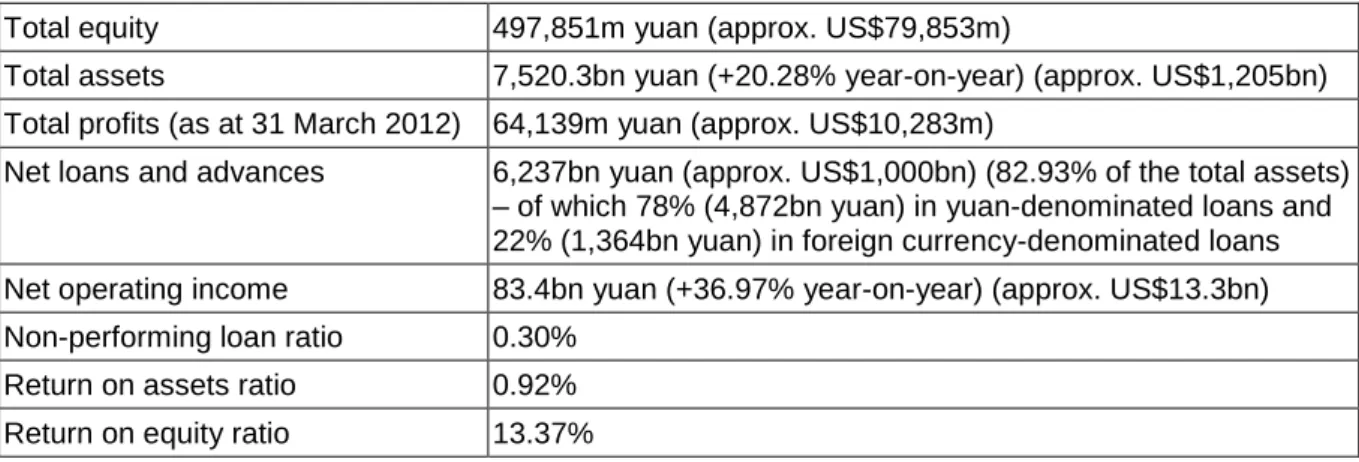
Table 1.5 Selected financial indicators (as at June 2013) 27
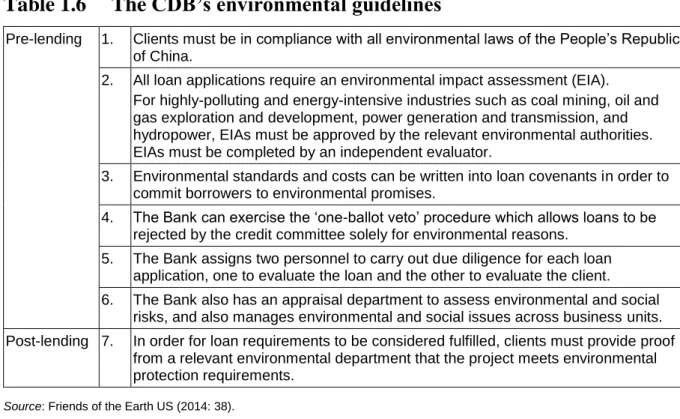
Table 1.6 The CDB’s environmental guidelines 34
Table 2.1 Sectorial distribution of the BNDES portfolio (%) 43
Table 2.2 Disbursement – green economy and climate change (in R$bn) 45
Table 2.3 Annual disbursements by number of projects 45
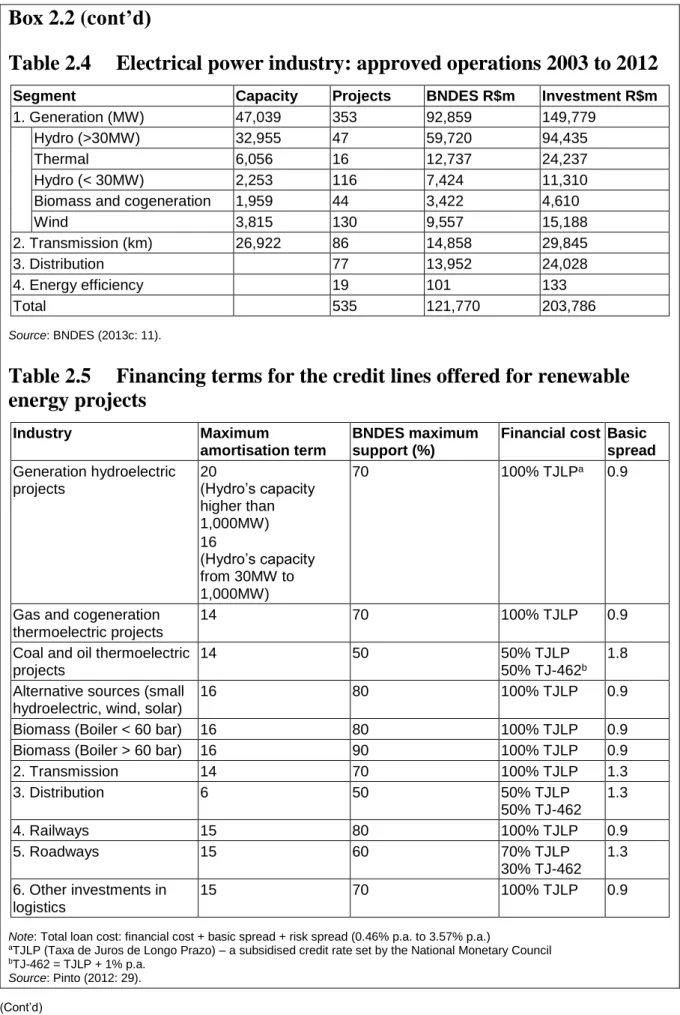
Table 2.4 Electrical power industry: approved operations 2003 to 2012 46 Table 2.5 Financing terms for the credit lines offered for renewable energy
projects 46
Table 2.6 BNDES disbursements to the sugar-ethanol sector (in US$bn) 48
Table 2.7 Distribution of BNDES disbursements per nature of activity (in US$bn) 48
Table 2.8 Evolution of wind turbine capacity power in Brazil (in MW) 49
Table 2.9 BNDES operations in 2012 per region 50
Table 2.10 BNDES expenditures in support of Brazilian exports destined for
infrastructure projects in South American countries 2000–12 (US$m) 51 Table 2.11 BNDES-Exim post-shipment disbursement to Latin America countries
(US$m) 51
Table 2.12 Selected financial indicators(as at June 2013) in US$m 52
Table 2.13 Other financial indicators (as at 31 March 2012) in R$m 53
Table 2.14 BNDES capital structure 53
Table 2.15 Bond issuances held by the BNDES 54
Table 2.16 BNDES instruments for financing and operating procedures 56
Table 2.17 BNDES-Exim instruments (in US$m) 56
Table 2.18 Vale investments in Africa 2009–11 58
Table 2.19 Financing terms agreed with Vale by the BNDES and other financing
partners 59
Table 2.20 Impact risk of the BNDES portfolio 61
Table 2.21 Scale of Amazon Fund operations (as at December of year) 62
Table 3.1 Sector-wise exposure 71
Table 3.2 Geographic distribution of the operative lines of credit (as at 31 March) 72
Table 3.3 Geographic allocation of Exim India credit lines in 2013 73
Table 3.4 Sector allocation of credit lines extended to African countries 74
Table 3.5 Top Indian trade partners in LAC in 2011–12 (in US$m) 75
Table 3.6 Top items of Indian exports to LAC in 2011–12 (in US$m) 75
Table 3.7 Lines of credit extended by the Exim Bank through the LAC programme
(in US$m) 76
Table 3.8 Lines of credit to CIS countries 77
Table 3.9 Total loan disbursements and guarantees 2003/04 to 2013/14 (in rupees
billions) 78
Table 3.10 Origins of the Exim Bank’s resources from 2003 to 2013 (in rupees
billions) 78
Table 3.11 Countries receiving loans from the Exim Bank – terms and conditions 80
Table 3.12 Length of maturity of loans (in rupees billions) 81
Table 4.1 The DBSA’s triple role 86
Table 4.2 Disbursements and non-performing loans by sector (in 1,000 rand) 87 Table 4.3 Disbursements and non-performing loans by geographical region in
South Africa and other SADC countries (in 1,000 rand) 89
Table 4.4 Disbursements and non-performing loans by country (in 1,000 rand) 89
Table 4.5 Other financial indicators 90
Table 4.7 Services provided by the DBSA, its operations and types of client served 92 Table 4.8 Loan facilities for renewable energy projects (in rand millions) 96
Table 5.1 Operating segments of the VEB group 101
Table 5.2 Selected financial indicators (as measured at end of 2012) 102
Table 5.3 Details of the VEB’s SME programme 105
Abbreviations
AAC Asociación Ambiente y Sociedad de Colombia ABC Brazilian Cooperation Agency
ADB African Development Bank ADB Agricultural Development Bank AEBF Asian Exim Banks Forum AEX Foreign Trade Division [Brazil]
AFD Agence Française de Development [South Africa] AfDB African Development Bank
AI Industrial Division AIE Infrastructure Division
AIIB Asian Infrastructure Investment Bank APP Asia Pulp and Paper
ARF African Renaissance Fund
ARPA Amazon Region Protected Areas
ASEAN Association of Southeast Asian Nations
b/d barrels per day
BANDES Bank for Economic and Social Development [Venezuela] BDC Business Development Bank of Canada
BNDES Brazilian Development Bank BNDESPAR BNDES Participações S.A.
BRICS Brazil, Russia, India, China and South Africa CADF China-Africa Development Fund
CBRC China Banking Regulatory Commission CBSS Council of the Baltic Sea States
CCP Chinese Communist Party
CCXG Climate Change Expert Group
CDB China Development Bank
CDC Caisse des Dépôts et Consignations
CDES Centro de Derechos Económicos y Sociales CEBRI Centro Brasileiro De Relações Internacionais CEC Committee for Eligibility, Credit and Capital
CEDLA Centro de Estudios para el Desarrollo Laboral y Agrario CID Center for International Development
CINDES Centro de Estudos de Integração e Desenvolvimento CIS Commonwealth of Independent States
CLN Corredor Logístico Integrado do Norte [Integrated Northern Logistical Corridor]
COFA Amazon Fund Guidance Committee
COMESA Common Market for Eastern and Southern Africa
CR crore
CSR corporate social responsibility CTFA Amazon Fund Technical Committee DAC Development Assistance Committee DAFC Department of Aid to Foreign Countries DAR Derecho, Ambiente y Recursos Naturales DBSA Development Bank of Southern Africa DEA Department of Environmental Affairs
DEFAM Amazon Fund Department
DEMAM Department of Environmental Policies and Studies DEOPE Green Financing Department
DEPRI Department of Priorities and Planning DFI development financing institution
DOE Department of Energy
DRC Democratic Republic of the Congo EAC East African Community
ECA export credit agency
ECGC Export Credit Guarantee Corporation of India ECOWAS Economic Community Of West African States
EDC Export Development Canada
EIA environmental impact assessment EIB European Investment Bank
ELLA Evidence and Lessons from Latin America EPC Engineering, Procurement and Construction
EPE Brazilian Government Energy Research Company ERA Executive Research Associates
ESCO energy service company
EU European Union
EXIAR Russian Export Credit Agency EXIM export-import
FAS Amazon Sustainable Foundation FAT Fundo de Amparo ao Trabalhador FDI Foreign Direct Investment
FGCE Fundo Garantidor de Comércio Exterior [Foreign Trade Guarantor fund] FIDC Fundo de Investimento em Direitos Creditórios
FINAME Machinery and Equipment Financing Programme
FINANEX Machinery and Equipment Export Financing Programme
FMM Merchant Maritime Fund
FND National Development Fund FNMC National Fund on Climate Change FNS Ferrovia Norte-Sul
FOCAC Forum on China-Africa Cooperation
FUNTEC BNDES technology fund
GDP gross domestic product GEF Global Environment Facility
GHG Greenhouse gas
G-NEXID Global Network of Exim Banks and Development Finance Institutions GOI Government of India
GWEC Global Wind Energy Council
HIPC Heavily indebted poor countries
HSRC Human Sciences Research Council
IBASE Instituto Brasileiro de Análises Sociais e Econômicas IBGE Brazilian Institute of Geography and Statistics
IBRD International Bank for Reconstruction and Development IBSA trilateral development initiative
ICT information and communications technology IDB Inter-American Development Bank
IDBI Industrial Development Bank of India IDC Industrial Development Corporation
IDCR Indian Development Cooperation Research
IDEAS India Development and Economic Assistance Scheme IDI India Development Initiative
IDS Institute of Development Studies
IEA International Energy Agency
IEC Independent Electoral Commission IFC International Finance Corporation IFCI Industrial Finance Corporation of India
IOV Ouro Verde Institute
IPC Internationale Projekt Consult
IPEA Instituto de Pesquisa Econômica Aplicada IPR intellectual property rights
ITEC International Travel and Education Company JBIC Japan Bank for International Cooperation KfW Kreditanstalt für Wiederaufbau
LAC Latin America and Caribbean LGFV local government financing vehicle LIBOR London Interbank Offered Rate LIHD Low Income High Level of Debt LLC limited liability company
LOC line of credit
M & E Monitoring & Evaluation MEA Ministry of External Affairs
MIHD Middle Income and Medium to High Debt MILD Middle Income and Low Debt
MOC memorandum of cooperation
MOF Ministry of Finance MOFA Ministry of Foreign Affairs MOFCOM Ministry of Commerce
MOU Memorandum of Understanding
MSMEs micro, small and medium-sized enterprises
MW megawatt
NABARD National Bank for Agriculture and Rural Development NAFINSA Nacional Financiera
NDB New Development Bank
NDRC National Development and Reform Commission NEA National Energy Administration
NEIA National Export Insurance Account
NEPAD New Partnership for Africa’s Development NGO non-governmental organisation
NHB National Housing Bank NIB Nordic Investment Bank NPL non-performing loan NRF National Research Fund
NSSD National Strategy for Sustainable Development and Action ODA Official Development Assistance
OECD Organisation for Economic Cooperation and Development PACB Pan-African Capacity Building Programme
PAG Accelerated Growth Programme PBC People’s Bank of China
PDVSA Petroleum of Venezuela
PNP Progressive Nationalisation Plan PPP public–private partnerships PRC People's Republic of China
PSI Sustainable Investment Programme PTVI PT Vale Indonesia Tbk
PV photovoltaic
PwC PricewaterhouseCoopers
RAISG Amazon Network for Socio-environmental Information RBM results-based management
RDIF Russian Direct Investment Fund
REMT Renewable Energy Market Transformation Project REVE Wind, Energy and Electric Vehicle Review
ROA return on assets ROE return on equity
SAIIA South African Institute of International Affairs SAARC South Asian Association for Regional Cooperation SAD Deforestation Alert System
SADC Southern African Development Community SADPA South African Development Partnership Agency SAMDI South African Management Development Institute SELIC Special Clearance and Escrow System
SIDBI Small Industries Development Bank of India SIP strategic integrated project
SMEs small and medium-sized enterprises SPV special purpose vehicle
TEAM Techno-Economic Approach for Africa-India Movement TFR Trade and Forfaiting Review
TJLP long-term interest rate (Central Bank of Brazil) TMSA TradeMark Southern Africa
TNC The Nature Conservancy
UN United Nations
UNDP United Nations Development Programme UNEP United Nations Environment Programme
US United States
VEB Vnesheconombank (Bank for Development and Foreign Economic Affairs, Russia)
VSE Vale Soluções em Energia
WB World Bank
WRI World Resources Institute WWF World Wildlife Fund ZAE Agroecological Zoning
Introduction: The BRICS New Development
Bank
Background
The BRIC acronym was created at the beginning of the 2000s to represent a group of four fast-growing economies – Brazil, Russia, India and China – and was changed to BRICS in December 2010 with the inclusion of South Africa. At its fifth annual summit in Durban at the end of March 2013, the group announced the future establishment of a New Development Bank (NDB) to meet infrastructure investment needs in the developing world. At their sixth annual summit in Fortaleza the following year (July 2014), the BRICS finally agreed on the broader arrangements for the bank – an initial US$50bn fund – and coupled this
achievement with the launch of the Contingency Reserve Arrangement (CRA) – US$100bn to be accessed to alleviate members’ financial difficulties (US$41bn from China, US$5bn from South Africa and US$18bn from each of the others). The Bank will start lending in 2016. Despite this achievement, commentators estimate that even if the NDB eventually increases its capital to US$100bn with injections from non-BRICS states and institutions (up to a maximum capital share from non-BRICS countries of 45 per cent), most infrastructure needs in the developing world will remain unmet. Compared to the World Bank and Asian
Development Bank – whose subscribed capital is US$223bn and US$162bn respectively – the additional capital available from the NDB is too small to fill the financing gap (Spratt 2014). According to World Bank estimates, South Asia alone requires US$2.5tn over the next ten years, while overall the BRICS states are estimated to need a total of more than
US$4.5tn over the next five years for infrastructure development. In consideration of the limited amount of lending that the NDB may provide, the bank may create ‘special funds’ – i.e. separately funded and managed mechanisms – designed to get round this capital constraint (Spratt 2014).
Although the BRICS countries could choose to finance projects bilaterally, a number of interests have pushed them towards the establishment of the New Development Bank. First is the need to pool risk and limit reputational costs and second is to increase the legitimacy of their operations under the umbrella of South–South cooperation (e.g. China may widen its investments in African land deals or Bolivian bauxite mines under this arrangement).
Along with this progress, some side agreements and arrangements have been made. These include a currency swap agreement between China and Brazil; a China Development Bank loan to South Africa for the development of the Transnet project (a 28,400km high-capacity telecommunications cable connecting the BRICS countries); China–India enhanced
cooperation on military and security matters; and the Asian Infrastructure Investment Bank set up by China and involving India and the BRICS Business Council (a forum composed of private and public business leaders from the BRICS countries).
More importantly, since October 2013 China has put forward a plan to establish the Asian Infrastructure Investment Bank (AIIB) which will specialise in financing infrastructure on commercial terms (Yu Du 2014). This will alleviate the huge demand for infrastructure
financing in the Asian region. Unlike the NDB’s registered capital, the AIIB’s will come mostly from China. This will counterbalance US and Japan dominance within the Asian
Development Bank and ultimately increase Chinese influence in Asia (Yu Du 2014).
Current arrangements of the New Development Bank
The setting up of the New Development Bank was first suggested by India in early 2012 in order to fund its domestic energy and infrastructure needs, namely power transmission,
roads and ports. Finally, the objectives of the bank were agreed as (i) providing emergency funding at the time of global economic turbulence and (ii) ending or marginalising Western dominance. After initial enthusiasm about the creation of the bank, a number of issues revealed the differences between and different interests of countries in the group. Some of the main points of discussion were:
1. Capital stock: China proposed that shares in the bank’s capital stock should be proportionate to GDP, but this encountered opposition from other members. The final solution was to divide the US$50bn founding capital equally among the group’s members and to give equal voting rights to all.
2. Headquarters: The bank’s headquarters will be in Shanghai, after initial opposition from India which wanted them to be in New Delhi.
3. First presidency:India and Brazil competed for presidency of the first term, which will rotate every five years. Presidency of the first term was ultimately won by India, to be followed by Brazil, then Russia, and finally China in 20 years.
What has so far madenegotiations over certain points difficult is the fact that there are strong differences between the BRICS as well as unresolved historical issues, such as the
contentious borders between China and India. About the former, analysts have pointed out the BRICS’ dramatic economic differences in terms of:
Size of economy: China’s economy, for example, is about 28 times that of South Africa.
Trade: Russia, Brazil and South Africa trade predominantly in commodities, while China trades in manufactured products and India in services.
Account balance: Brazil, India and South Africa record a deficit, while China and Russia record a surplus.
Political regime: ranging from Brazil, India and South Africa, which are fully participatory democracies, to Russia, an authoritarian democracy, and finally to China, a single-party socialist state.
The way the New Development Bank will operate largely depends on how the BRICS countries manage to reconcile their views on development cooperation and on the role financial institutions must play in that context. That is why there is increasing interest in understanding BRICS countries’ experiences with their own national development banks in order to derive commonalities and differences in the mandates, strategies, operational models, investment strategies and funding sources, etc., of each bank.
BRICS’ views on development cooperation and their national
development banks
In the aftermath of the cold war, development assistance was a prerogative of Western countries, which promoted their foreign policy objectives and greatly increased their political and economic influence in the recipient countries. Until the mid-2000s, Western countries, grouped under the Development Assistance Committee (DAC) of the Organisation for Economic Cooperation and Development (OECD), represented about 95 per cent of total funds allocated internationally for development projects.
The rules and concepts set out in the OECD-DAC framework, mostly taking the form of Official Development Assistance (ODA), are recognised as different from the modus operandi of the BRICS. These latter countries have worked together to gain voice and to influence development policies in international development fora such as the G20.
Since the 2008 financial crisis, the BRICS have gained greater relevance in world geopolitics and are less keen on being subject to a Westernised framework of development and
development assistance. At the 2011 Busan high-level forum on aid effectiveness in South Korea, the BRICS affirmed their critical role in forging a 'new global partnership' for
development cooperation on an equal footing, emphasising the need to foster commercial ties rather than depending on an aid model. With the Durban Summit in 2013, and a year later in Fortaleza, the BRICS responded to international demand for sustainable
development but with no clear consensus on what this concept actually means and how the New Development Bank will promote sustainable development in the developing world. Despite this lack of consensus, the BRICS’ views on development assistance have conveyed a few common features:
1. BRICS tend to focus mostly on the region in their immediate vicinity.
2. They have a principle of ‘non-interference’ in the recipient country’s affairs and so no conditionality – political, social or environmental – is attached to lending.
3. Development assistance provided is often strongly connected to access to strategic resources or tied to commercial agreements for domestic companies from the donor country.
4. The BRICS engage in South–South cooperation to promote cooperation on an equal footing, which can take the form of exchange of practitioners and providing training, as well as provision of funds at non-concessional rates.
5. Development cooperation encompasses trade, aid and investments.
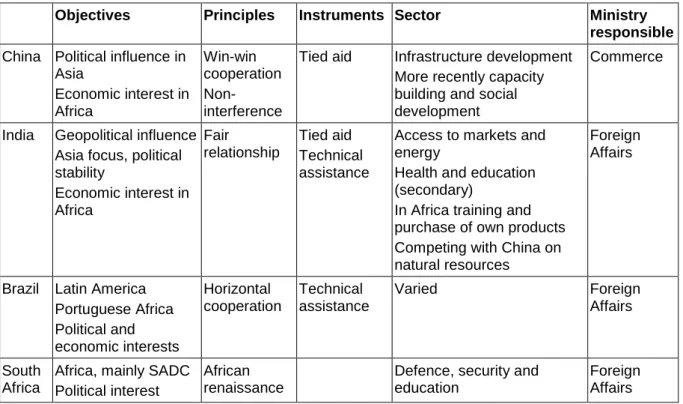
At the same time, the BRICS’ views on development cooperation, as well as the role played by the national development banks in each of those countries, differ substantially. Before moving to a brief overview of each individual country’s development cooperation, Table 0.1 shows some features of the prevailing form of development cooperation of four BRICS countries, as found in the literature.
Table 0.1
Basic principles of development cooperation in the BRICS
countries
Objectives Principles Instruments Sector Ministry
responsible
China Political influence in Asia Economic interest in Africa Win-win cooperation Non-interference
Tied aid Infrastructure development More recently capacity building and social development
Commerce
India Geopolitical influence Asia focus, political stability Economic interest in Africa Fair relationship Tied aid Technical assistance
Access to markets and energy
Health and education (secondary)
In Africa training and purchase of own products Competing with China on natural resources
Foreign Affairs
Brazil Latin America Portuguese Africa Political and economic interests Horizontal cooperation Technical assistance Varied Foreign Affairs South Africa
Africa, mainly SADC Political interest
African renaissance
Defence, security and education
Foreign Affairs
Brazil
Following its domestic socioeconomic achievements, Brazil has increasingly engaged in development cooperation with less developed countries, thus diminishing its position of aid recipient and taking up the role of donor. The terms ‘aid’ and ‘donor’, however, do not truly describe what Brazil pursues in international development cooperation. Brazilian support to other countries is based on Brazil’s successful domestic experiences, which are then ‘exported’ and tailored to the needs of the partner country via technical cooperation. The most appropriate term for such engagement is therefore South–South cooperation.
This enhanced engagement in South–South cooperation, introduced by the administration of President Luiz Inácio Lula da Silva (2003–10), has been interpreted by analysts as related to Brazil’s aspiration to improve its own international positioning in the global economy and to preserve its regional leadership in Latin America. Most of Brazil’s development assistance goes in fact to neighbouring countries, such as Paraguay and Bolivia, and to the broader Andean region (Verdun 2013). Brazilian development aid has also supported the Caribbean region following the 2010 earthquake in Haiti with programmes in education, health and social development. In Africa, Brazil has maintained a leading role in the Portuguese-speaking countries, mostly by providing support via technical assistance and cooperation programmes.
The main agency in charge of development cooperation in Brazil is the Brazilian Cooperation Agency (ABC), which administers received and granted ODA. However, as Brazil’s
cooperation programme goes beyond aid, the private sector component is also significant. In fact, the Brazilian Development Bank (BNDES), which makes little use of ODA, plays an important role by providing tied loans for overseas projects in which Brazilian companies hold stakes. Not surprisingly, there is some alignment between public and private sector interests as the country and the sector focus of Brazil’s development assistance and private
companies is the same.
As a key instrument in the implementation of the Brazilian government’s foreign policy, the BNDES is subject to supervision by the Ministry of Development, Industry and Foreign Trade. Since it was founded in 1952, the bank has been the driving force behind
development of the Brazilian economy. It has also been the only source of medium- to long-term bank credit for private industry, shifting the focus of its operations according to shifts in government priorities. While in the 1990s its operations focused almost exclusively on the privatisation of domestic companies, in the 2000s the BNDES extended its operations
overseas in line with the government’s ‘go global’ policy to increase the internationalisation of domestic ‘champion’ companies.
As will be seen in more detail in the Brazil case study in this report, most BNDES
disbursements have been received by large companies, while over one-third of funds went to the infrastructure sector (mainly electricity and transport connected to the agro-food
industry). BNDES action is restricted by the statutory clause that it only finances projects where Brazilian companies are involved and which increase the export of Brazilian goods. Although the BNDES has been praised for its international outreach under Lula da Silva’s administration, things have changed under President Dilma Rousseff, and mention of the BNDES in foreign policy speeches has disappeared. Time will tell whether the change in political administration will have drawbacks in terms of the role of the BNDES.
Russia
Russia inherited a long history of engagement in development cooperation from the Soviet Union, dating back to the time when ideological motives made the USSR the world’s largest donor and creditor. In 1986, the USSR is quoted as having provided about US$26bn of aid (Brezhneva and Ukhova 2013). In the 1990s, with the fall of the Soviet Union, Russia shifted from donor status to that of net aid recipient.
The re-emergence of Russia as an active leader of development cooperation occurred in 2004 when it once again allocated funds from the federal budget for development aid. This one-off government decision was followed a year later by Russia’s signing of the Paris Declaration on Aid Effectiveness. This event aligned the country to the OECD-DAC’s standard of development assistance, which has created a distance between Russia’s views on development cooperation and those of the other BRICS countries.
In 2007, Russia also issued its Concept of Russia’s participation in international development assistance. Prepared by the Ministries of Foreign Affairs and Finance, the Concept was signed by President Vladimir Putin on 25 June 2007. At the same time, the creation of an agency for international development assistance was announced. Until this institution is formalised, expenditures, priorities and implementation remain subject to decisions taken by individual ministries or through their coordinated action.
In the Concept of Russia’s participation in international development assistance, Russia’s priorities for the delivery of development aid are: (i) to build ties with neighbouring countries, (ii) to stabilise the region, and (iii) to promote the integration of Russian capital, goods and labour into recipient countries. The Concept clearly states the importance to Russia of promoting its own political and economic interests through its development cooperation initiatives (Government of the Russian Federation 2007).
A more recent document, Russia’s 2013 Foreign Policy Concept (Government of the Russian Federation 2013), sets out the country’s programmatic directions and views on foreign
affairs. Importantly, the documents mention the power shift from West to East and the consequent opportunities that friendlier cooperation with China and India opens up, both within the BRICS framework and more widely. Finally, as Russia aims to be a link between Europe and the Asia-Pacific region, the Foreign Policy Concept makes working for the establishment of the Eurasian Economic Union a priority.
Russia’s development strategy follows some of the OECD principles on development cooperation (e.g. the 0.7 per cent target and the Paris Declaration). For this reason, out of the BRICS countries it is the most in line with the OECD-DAC Committee (European Parliament 2012). A considerable amount of financial aid provided by Russia goes through multilateral organisations such as the World Bank, the United Nations and the Eurasian Economic Community. Russia was also part of the G8 group until 24 May 2014 when the group’s Hague Declaration suspended any form of collaboration with Russia in response to the country’s annexation of Crimea and its heavy involvement in the Ukraine crisis.
Furthermore, the US and EU have imposed an array of sanctions on Russian individuals and businesses. In particular, on 16 June 2014 the US imposed sanctions on the Russian
Development Bank (VEB), restricting the bank’s ability to access US capital markets. These recent events have led Russia to deepen its engagement within the BRICS and with the G20 group, as well as bilaterally with countries beyond Western influence (Volchkova and Ryabtseva 2013). An example is the 30-year gas deal worth US$400bn which it signed with China at the end of May 2014 in response to worsening relations with the EU over the Ukraine crisis (Luhn and Macalister 2014). The Ukraine crisis also prompted renewed impetus for the creation of the New Development Bank in Fortaleza in July 2014.
Russian development institutions were created in the 1990s to provide financial support to projects of national strategic interest. The creation of these policy banks occurred mostly by direct order of the government, which provided the capital for their establishment. These are: The Bank for Development and Foreign Economic Affairs (Vnesheconombank) The Investment Fund of the Russian Federation
The Russian Venture Company
The Agency for Housing Mortgage Lending The Russian Agricultural Bank
The Russian State Agricultural Leasing Company (Rosagroleasing).
These banks specialise in different spheres, ranging from the promotion of innovations to export support, venture business development, promotion of housing mortgage lending, small business support, financing of agriculture, etc. By early 2010, the aggregated capital of these banks amounted to RUB 1.2tn (US$26.5bn (about three per cent of Russia’s GDP in 2009) (Maidan 2012).
In this complex financial context, the Vnesheconombank (VEB) provides investment and support for domestic and external projects aimed at boosting the competitiveness of the Russian economy. In particular, as this bank is responsible for external operations (insurance of export credits, export guarantees and credits) as well as operations that support small business development in the whole CIS area, this bank is one of the case studies in this report.
India
India is not an emerging donor, rather an emerging leader in South-South cooperation. The country is in fact heavily reliant on ODA from OECD countries, while at the same time acting as a donor in terms of experience and best practice which it shares with other developing countries through technical assistance initiatives.
Since the early 1950s, India has provided support to its neighbouring Asian countries and later has moved towards African countries. The oldest of its technical assistance
programmes, the International Travel and Education Company (ITEC), was founded in 1964 and entailed the delivery of training by Indian experts in various fields such as information technology, education and enterprise development.
India’s development cooperation is guided by five longstanding principles which were first set out in the Panchsheel Agreement signed by India and China in 1954. These principles are: (i) mutual respect for each other’s territorial integrity and sovereignty, (ii) mutual
non-aggression, (iii) mutual non-interference, (iv) equality and mutual benefit, and (v) peaceful co-existence (OECD 2012).
Similar to other BRICS countries, India’s perspective on development cooperation is therefore based on the values of mutual respect and non-interference in other countries’ internal affairs, thus it does not attach any conditionality to its assistance.
The determinants of India’s engagement in early forms of South–South cooperation were, and still are, strictly connected to the country’s need to foster trade and investments that favour its domestic products and companies. Trade and investments are conceived by India as integral to its development cooperation approach, which aims to engender
Among other drivers related specifically to India’s foreign policy in Africa, the literature quotes India’s quest for strategic autonomy, its desire to play a role in shaping the global system, its need for energy and natural resources, and its diaspora policy (Sahni 2007 in Chidaushe 2010).
Much of Indian financial assistance takes the form of concessional lending via lines of credit (LOCs) tied in some part to the use of Indian exports and often combined with technical assistance and training. The main field targeted by the LOCs is infrastructure development (electricity, energy, irrigation and transport). In June 2012, the India Exim Bank reported over 157 active LOCs worth US$8.2bn. If neighbouring countries in Asia were once the
geographic focus of India, Africa has recently become the primary focus.
In terms of its institutional framework, Indian development cooperation is structured around three main institutions: the Ministry of External Affairs (MEA), the Ministry of Finance, and the Export-Import Bank of India (India Exim Bank). Within the MEA, the Development
Partnership Administration is a recently created division coordinating the activities of Indian development aid. The main financial institution dealing with India’s development cooperation and overseas lending is India Exim, which is one of the country’s numerous specialised policy banks, directly supervised by the Ministry of Finance’s Department of Economic Affairs. Although India has a highly fragmented banking system, as will be discussed in the India case study in this report, the Exim Bank plays a prominent role in South–South Cooperation and the promotion of trade and investments in the developing world.
China
China is the world’s second largest economy in terms of GDP, although its strategic influence in global geopolitics goes much beyond its economic achievements. Indeed, China has a longstanding history of engagement in international development that goes back to the 1960s. At that time, China managed to gain strong influence in Africa, achieving its own objectives in exchange for economic cooperation. A remarkable example of the country’s strategic behaviour is the admission of the People’s Republic of China to the UN Security Council in October 1971, thanks to votes from African countries at the UN General Assembly. Similarly, China has demonstrated preference for extending loans to countries adhering to the ‘One-China’ policy (Dreher and Fuchs 2011).
More recently, after successful implementation of the 1978 market reforms and China’s economic boom, motives shaping the country’s foreign policy have changed. The need for natural resources as well as market access for its manufactured products has increased China’s outward-oriented trade and investment policy and the geographic focus of its external operations has shifted accordingly. While previously China secured its influence in the Asia-Pacific region, since the 2000s the bulk of its funds have focused on resource-rich African countries. The same rationale seems to have guided China’s recent lending to Latin American countries, such as its oil-backed deals with Venezuela.
China has recently placed stronger emphasis on regional cooperation mechanisms. In
particular, the latest released White Paper on Foreign Aid dedicates considerable attention to the Forum on China-Africa Cooperation (FOCAC) and the China-ASEAN summit. These are the two main regional cooperation mechanisms through which the country develops relations with African and Asian countries (State Council of the PRC 2014). It is argued that the
reason behind this renewed interest in regional cooperation stems from the need to tackle issues which are global in nature, thus requiring more efficient concerted actions (UNDP China 2014). China’s enhanced participation in assistance programmes initiated by multilateral organisations, amounting to 1.76bn yuan (US$287.8m) for 2010–12 (State Council of the PRC 2014) probably fall under the same reasoning.
There is often a blurred line between China’s foreign aid and other outward financial flows. Development assistance may indeed be characterised by the simultaneous presence of commercial requirements and investment clauses attached to the extension of grants and loans. For this reason, quantifying China’s aid is difficult, as is the division of labour across the several institutions involved in delivering China’s foreign assistance.
At the top of the system is the Chinese Communist Party (CCP) Leading Grouping for Foreign Affairs, chaired by the CCP General Secretary and State President Xi Jinping. This core structure defines the general policy directions for all government organisations involved in development assistance. Beneath this body is the State Council, a high-level unit
responsible for implementing the CCP’s directives and allocating funds at the beginning of every budgetary year.
Under these political bodies, four ministries are involved in the implementation of development assistance operations: the Ministry of Finance, the Ministry of Commerce (MOFCOM), the Ministry of Foreign Affairs (MOFA) and the Ministry of Social Welfare. This latter ministry is responsible only in those operations relating to humanitarian aid – i.e. in the event of a famine or other natural disaster.
More complex is the division of tasks between the remaining three ministries. The Ministry of Finance is responsible for drawing up the foreign aid budget in consultation with MOFCOM. Under this category, all operations similar to ODA – concessionary loans, debt relief and grants – are financed, as well as trade concessions. This ministry is also responsible for the multilateral aid delivered through international financial institutions.
The main body governing China’s development aid is MOFCOM.This agency is divided into two branches: the Department of International Cooperation, managing incoming aid, and the Department of Aid to Foreign Countries (DAFC), which supervises outgoing aid. As a
measure of the increasing relevance of Africa in China’s development assistance, between 20 and 30 DAFC staff are working solely on Africa (Davies et al. 2008). The DAFC
coordinates China’s foreign policy with the MOFA. The MOFCOM also manages
concessional loans, working with the China Export-Import Bank (China Exim), which is in charge of evaluating requests.
Last but not least, the Ministry of Foreign Affairs (MOFA) is in charge of institutionalising China’s foreign policy, negotiating and defining China’s policy towards all regions of the world. With regards to China’s Africa policy, MOFA operates in international fora such as the Forum on China-Africa Cooperation (FOCAC), where it has recently started to successfully coordinate with MOFCOM in order to formulate a more coherent foreign policy towards Africa. In terms of aid, MOFA plays an advisory role to MOFCOM. China’s engagement in Africa has also benefited from the establishment of the China-Africa Development Fund (CADF), an independent commercial fund created with a capital inception of US$5bn by the China Development Bank in 2006 (see the China case study later in this report for further details).
China’s foreign policy is implemented through two main national development institutions: the China Development Bank (CDB) and China Exim. Both institutions play a major role in
fostering China’s development priorities overseas. While the CDB has mainly been active in the agriculture and infrastructure sectors, particularly in Asia and Latin America, China Exim has operated in the area of export promotion, and with a stronger presence in Africa. The CDB provided US$224.5bn of international funding in 2012, while China Exim provided US$35bn. The China case study in the next section of this report explains the CDB in more detail and also discusses some of the main features of China Exim.
South Africa
South Africa’s view on development cooperation has been primarily Afro-centric as the country’s priority has been to maintain regional security and stability in the African continent as a whole and, more specifically, within the Southern African Development Community (SADC).
Given its leading economic role in the African continent and its favourable relations with other emerging economies, South Africa was invited to join the BRICS and is so far the only
African country in the G20. Indeed, South Africa is the largest African economy. Its GDP is equivalent to a third of sub-Saharan Africa’s GDP, South Africa has a well-developed infrastructure and financial market, and highly ranked institutional development. Over time, the country has also built independent economic relations with all the BRIC countries. In particular, with India and Brazil it has set up a trilateral development initiative (IBSA), a coordinating mechanism envisaged to deepen ties among its members and gain voice on global issues in the international community.
Since the 1994 elections brought an end to the apartheid regime, South Africa’s perspective on development cooperation has changed. Before that date, the drivers shaping South Africa’s development assistance were mainly political, reflecting the regime’s efforts to gain acceptance and votes within the UN. During this period, the bulk of South Africa’s foreign development assistance supported the ‘homelands’, territories set aside for black inhabitants within South Africa, which were not recognised by the international community. Established in 1983, the Development Bank of Southern Africa (DBSA) functioned as a major channel of South African aid to the homelands, also providing technical assistance to these territories. In addition, the DBSA has supported the development of small and medium-sized enterprises (SMEs), agriculture, mining, water, energy, transport and social infrastructure development in the whole country and reached out into the broader Southern Africa region after its mandate was reviewed in 1997.
Largely unstrategic and denoting a lack of emphasis on commercial interests, South Africa’s development assistance in the post-apartheid era has been guided by three main objectives: 1. to strengthen Africa’s institutions
2. to support the implementation of the New Partnership for Africa’s Development (NEPAD)
3. to foster dialogue and cooperation in bilateral political and socioeconomic relations. Although South Africa’s development assistance is not formally tied, most of the projects financed still make use of South African inputs in the form of skilled labour and/or technology. The country’s development assistance has been largely carried out via peacekeeping, post-conflict reconstruction, and research for development. South Africa has also delivered humanitarian assistance in the event of natural disasters.
Since 2000, South Africa has opened up to tripartite partnerships, collaborating with a traditional donor to deliver development assistance programmes to a recipient country (usually in Africa). Its outgoing development assistance in 2006 was estimated at between US$363m and US$475m, equal to 0.18 per cent of GDP (Braude et al. 2008). Around three-quarters of this was channelled through multilateral organisations and regional development banks.
South Africa is also a recipient of development assistance. However, since 2010, ODA directed to South Africa has seen a gradual decline, while concessionary loans in the field of green energy and the climate change agenda have increased.
The institutional framework of development assistance in South Africa has no central agency appointed to the overall management of programmes. The institutions involved in the
process belong to several government departments (with the Department of Defence and the Department of Education accounting for the bulk of expenditures for development
assistance) as well as parastatals, government agencies, and other statutory bodies. Within this last category are the Development Bank of Southern Africa (DBSA), the Independent Electoral Commission (IEC), the Industrial Development Corporation (IDC), the Human Sciences Research Council (HSRC), the National Research Fund (NRF), and the South African Management Development Institute (SAMDI).
In this fragmented framework, the main vehicle for disbursement of development assistance funds since 2000 has been the African Renaissance Fund (ARF), an agency created with the broad mandate of funding ‘activities of cooperation, democracy and good governance, conflict resolution, social and economic development, humanitarian and disaster relief, technical cooperation and capacity development’ (Besharati 2013). The ARF is supervised by the Ministry of Foreign Affairs, which receives recommendations on the disbursement of funds by an Advisory Committee composed of the Director General of Foreign Affairs, three members nominated by the Minister of Foreign Affairs, and two members nominated by the Minister of Finance. The ARF is meant to be reformed and integrated in the South African Development Partnership Agency (SADPA), although this transformation has already been under discussion for several years. However, the SADPA is expected to be set up soon as South Africa needs to better coordinate its aid and development cooperation activities. The SADPA will have a projected annual budget of 500m rand (US$50m) and will overcome the ARF’s shortcomings, notably bureaucratic and structural delays, poor coordination, and lack of strategic direction in development cooperation activities.
Due to the historical role played by the DBSA in developing the infrastructure of the country and the broader Southern Africa region, the South Africa case study in this report analyses in more detail the functioning and operations of this development bank.
1
China Country Profile: The China
Development Bank
1.1
Summary key features
The China Development Bank (CDB) is a financial institution with ‘full ministerial rank’ (Downs 2011: 6), as it is under the direct control of the State Council, China’s highest governing body.
As a ‘hybrid’ policy-commercial bank, the CDB conducts both policy and commercial operations. It played a major role as a ‘policy bank’ during the 2008 global financial crisis and domestically it is supporting the urbanisation of the country through the government’s local government financing vehicles (LGFVs). At the same time it is engaged in various commercial operations to support Chinese state-owned
companies expanding abroad in the name of the ‘going global’ strategy and to secure long-term access to energy and other natural resources.
Thanks to the ‘quasi-sovereign’ nature of its bonds, the CDB is able to provide longer-term loans than other Chinese banks (Provaggi 2013).
Being a policy bank that also operates as a commercial bank, the CDB does not provide concessional loans (Stuenkel 2013; Provaggi 2013; Sanderson and Forsythe 2013). Interest rates are reported to be higher than those of other domestic
(commercial) banks and international banks (such as the World Bank).
The CDB implements rigorous risk management mechanisms both for the approval of domestic loans (Downs 2011: 14) and foreign deals (risks waived by the provision of oil as collateral, e.g. in the case of Venezuela). As a way to mitigate credit risk the bank directly supervises the money transfer both in domestic asset-backed loans (e.g. Tianjin) and in overseas resource-backed loans (e.g. Venezuela), so as to be sure that loans are paid back.
No conditionality is attached to its credit. However, domestic loans are secured with land sales that pay off the debt service; external operations are often energy-backed loans.
1.2
Background
The CDB was established at the time of the central government’s 1994 financial reforms together with two other banks, the Agricultural Development Bank (ADB) and the Export-Import Bank. The three institutions were funded as ‘policy banks’, with the objective of providing policy-driven lending, while China’s other state-owned banks – the Bank of China, Industrial and Commercial Bank of China, China Construction Bank and Agricultural Bank of China – would act as ‘commercial banks’ and deal with regular corporate lending (He 2010). In separating policy from commercial operations, the government intended to gain control over lending management, so as to promote more rational, market-based lending in commercial banks (Steinfeld 1998: 71).
The history of the CDB has been intimately connected with that of the person who presided over the bank for more than 15 years, Mr Chen Yuan. He took office in 1998, when the bank had serious profitability problems, with a non-performing loan (NPL) ratio of over 40 per cent (Sanderson and Forsythe 2013: xvi). Under his guidance, the bank improved its risk
assessment procedures through an enhanced mechanism of independent assessment (see notes on the organisational structure below) and managed to drop the NPL ratio to below 1 per cent. The CDB has since aspired to become a sound top-ranking international bank (Downs 2011: 8), committed to both achieving commercial profitability and pursuing national interests.
One of the most striking features of the financial system in China is that the CDB and other Chinese commercial banks are on an uneven playing field. First, the CDB has a natural structural advantage over the purely commercial banks as it is financed through long-term bonds (up to 30 years) rather than via short-term deposits. Second, commercial banks are subject to the rules and restrictions of the Commercial Bank Law, which prevents banks from having an outstanding balance of loans to a single borrower exceeding 10 per cent of the bank’s capital balance (Downs 2011: 62). As it is also a policy bank, the CDB can conduct both commercial and investment banking activities (Downs 2011: 19; Zhong and Ning 2003). For the same reason, the CDB has greater freedom in major overseas lending than other Chinese commercial banks as it is not subject to China’s Commercial Bank Law. Finally, the CDB has a historical advantage, being the preferred lender by local governments due to its strategy of financing LGFVs (Downs 2011: 18).
Given its position as favourite, the CDB is able to provide bigger loans with longer maturities, both domestically and internationally. So far, the majority of CDB loans to Latin American countries were in fact equal to or greater than US$1bn (Gallagher et al. 2012).
Box 1.1
The CDB vs the China Exim Bank
Both the China Development Bank (CDB) and the China Exim Bank have played a special role in fostering China’s international outreach by supporting the national ‘going out’ strategy and financing development and commercial projects in a number of foreign countries throughout Africa and Latin America. The two banks have created the conditions for business development overseas and have engaged in infrastructure development projects (roads, power plants, oil and gas pipelines, telecom, and water projects). They have also supported the establishment of Chinese businesses overseas in the energy, mining and industrial sectors (Wang 2007).
Although both banks are under the direct control of the State Council and supervised by the China Banking Regulatory Commission, they operate under different mechanisms and have slightly different mandates. The CDB, as we will examine in the following pages, is a bank tasked with implementing the national economic strategy and allocating resources in order to foster China's economic and social development. The China Exim Bank is instead the world’s largest export credit agency, responsible for facilitating the export and import of Chinese products. In 2009, it approved over US$70bn, more than the Export-Import Bank of the United States, the Japan Bank for
International Cooperation, and the Brazilian Development Bank (BNDES) Exim combined, as noted by the World Resource Institute (WRI 2013).
The China Exim Bank offers different products in support of China’s trade, namely export credits, concessional loans, and loans for contracting and outbound investment. It is important to stress that the China Exim Bank is the sole provider of Chinese government concessional loans (Wang 2007). Also, it has been noted that while the CDB has more stringent lending terms – i.e. higher interest rates – the China Exim Bank provides loans at comparatively lower rates than other international providers such as the World Bank and the US Exim Bank (Gallagher et al. 2012).
The two banks also have different sources of funding. The CDB is financed through bonds issued in both the domestic and international markets, while the China Exim Bank receives funds from the People’s Bank of China and public institutions, as well as interbank deposits (Friends of the Earth US 2014).
As of 2013, the China Exim Bank had 21 domestic business branches and three overseas
representative offices, namely the Representative Office for Southern and Eastern Africa, the Paris Representative Office and the St Petersburg Representative Office. Its total assets as at 31 December 2012 were 1,559bn yuan (approx. US$ 249.3bn) and its net profit equalled 3.8bn yuan (approx. US$ 607.8m). From 2001 to 2010, it provided over US$67.2bn of loans to Africa (Sanderson and Forsythe 2013).
Despite this competition between the CDB and other banks, in some cases synergies may arise. In fact, CDB lending has had the effect of attracting further investments, thus
functioning as a sort of ‘guarantee’ for companies wishing to get further short-term loans from other Chinese commercial banks (Provaggi 2013). Overseas, CDB lending generally seems not to overlap with that of Western banks, with the exception of Brazil and Argentina which has received loans from both Chinese and Western banks (Gallagher et al. 2012).
1.3
Origin and mission statement
The China Development Bank (CDB) was founded in March 1994 and is under the direct jurisdiction of the State Council. As reported on its website, the current CDB mission is:
To provide medium- to long-term financing facilities that assist in the development of a robust economy and a healthy, prosperous community. It aligns its business focus with national economic strategy and allocates resources to break through bottlenecks in China's economic and social development.1
Since its foundation, the CDB’s main objective has been to support national macroeconomic policies by focusing on the development of infrastructure and basic key industries, i.e. electric power, road construction, railways, petroleum and petrochemical, coal, postal and telecommunications, agriculture and related industries, and public infrastructure.
1.4
History
The first and major event affecting the nature of and role played by the CDB goes back to the central government’s 1994 budget reform which forbade local governments from running deficits and selling bonds (Sanderson and Forsythe 2013: 4). This situation put local government administrations needing funds to support the development of infrastructure in urban areas under pressure. In this context, the CDB started financing local governments through Local Government Financing Vehicles (LGFVs), companies set up with the specific purpose of enabling local governments to borrow money to develop urban infrastructure. In this way, the CDB has been the driving force behind China’s urban development. The Asian financial crisis further fuelled this role by giving new impulse to the demand for funding in the housing market.
In its initial years, however, CDB performance was poor. Before Chen Yuan took office, in fact, the CDB had accumulated a high non-performing loan (NPL) ratio amounting to over 40 per cent. The whole financing system in China favoured this negative outcome. The high saving propensity of the Chinese combined with the guaranteed three per cent spread between what is paid on deposits and the lending-out rate meant that the Chinese banking system ended up favouring any sort of investment, including non-profitable ones, without any risk control against insolvency. Much of this lending went to inefficient state-owned
enterprises and financed state projects with no expected returns.
Between 1997 and 2001, after Chen Yuan had become head of the CDB, the NPL ratio reduced dramatically (from 42.65 per cent to less than 5 per cent in 2001) (Downs 2011: 12). This was achieved thanks to a series of strategies put in place to improve the bank’s
profitability: the establishment of a better credit risk assessment, the implementation of land-backed deals, and market-based mechanisms to raise funds.
In the early 2000s, when the national priority in supporting growth became the provision of sufficient energy and natural resources, the CDB took on a new role. It started to finance both domestic companies expanding into this sector overseas and foreign companies providing China with energy and natural resources. In 2003, the CDB approved a US$230m
loan to the state-owned company Sinochem to finance its acquisition of Atlantis, a petroleum company based in several countries. Since then, several foreign energy acquisitions have been financed by the CDB.
External operations in the field of energy and natural resources also entailed the
development of infrastructure to supply China with oil and mineral resources. In 2006, the CDB financed the China-Kazakhstan oil pipeline and later the Central Asia-China natural gas pipeline.
The enhanced engagement abroad made it necessary for the CDB to internationalise. Since 2006, the bank has dispatched its teams in several countries overseas and reorganised its structure to meet the new needs (see organisational structure in Section 1.6).
The process of internationalisation also required diversification of the CDB portfolio. In 2003, the bank issued the first US$ bond in China and in September 2005 it sold a US$1bn asset-backed bond in New York. In July 2007, the CDB issued its first yuan-denominated bond in the Hong Kong market (Sanderson and Forsythe 2013: 70).
When the collapse of oil prices in 2007–08 favoured Chinese foreign investments in energy and resource assets, the CDB strongly supported the investment of Chinese companies abroad (e.g. the US$30bn loan to the China National Petroleum Corporation in 2009) as well as selling off bonds abroad.
As overseas activities increased, the CDB has placed increasing emphasis on issuing yuan-denominated bonds as a strategy to limit foreign exchange costs and reliance on the US dollar (Friends of the Earth, Banktrack 2012). In 2011, yuan-denominated bonds reached 61.5bn yuan. The bond with the longest maturity was sold in July 2012 in Hong Kong with a maturity of 20 years (Sanderson and Forsythe 2013: 79).
During the 2008 financial crisis, the CDB acted as a countercyclical lender. While the central government provided just 1.18tn yuan of the 4tn fiscal stimulus, the state-owned banks provided the remainder. The CDB took the lead, with 147 LGFVs reported to have received loans and lines of credit from the CDB for an amount of 928.6bn yuan from 2009 to 2011 (Sanderson and Forsythe 2013).
1.5
Mandate and strategy
1.5.1
Domestic operations
CDB domestic operations were largely driven by the needs arising from China’s rapid urbanisation. The CDB has used the LGFVs – companies set up by local governments – to finance infrastructure development through low-interest, asset-backed loans. This way of operating gave birth to what is also known as ‘the land-backed local government finance model’ (see Box 1.2).
1.5.2
External operations
The CDB engaged in a series of cross-border energy and natural resource deals in order to align to the national government’s ‘going global’ strategy, thus financing the expansion of Chinese firms abroad and securing long-term access to natural resources for China (see Box 1.2).
Among operations that support the ‘going global’ strategy, the CDB contributed to the establishment of China’s special economic zones in Nigeria, Mauritius, Egypt, Algeria, Zambia and Ethiopia, where Chinese firms could find profitable investment opportunities as well as gain contracts for building infrastructures. To foster deeper Sino-African relations, the
Forum on China-Africa Cooperation (FOCAC) was established in 2000. The FOCAC aimed to institutionalise dialogue between China and Africa in order to promote African economic development in the framework of South–South cooperation. Through FOCAC, China has upgraded its Africa policy over the years, thus becoming a key trading and investment financing partner for African countries. In 2006, during a FOCAC summit, President Hu Jintao committed further a US$2.3bn to Africa and announced the creation of the China-Africa Development Fund (CADFund) (see Box 1.5).
More recently, the pressing need for energy has pushed China and, as a consequence, the CDB, to turn attention to the renewable energy sector (see Box 1.6).
1.6
Organisational structure
The CDB has 32 branches and four representative offices across China. Each branch has responsibility for a different part of the world, e.g. Chongqing for the Balkans, Henan for South Africa and Sichuan for Nepal, among others (Downs 2011). There are two CDB representative offices in Egypt and Russia. The CDB-funded CADFund has offices all over Africa.
The CDB also has a securities venture, a private equity division – CDB Capital – a leasing arm and credit guarantee company (Sanderson and Forsythe 2013: 41). It has a special system in place for credit risk assessment that relies on four separate bureaux for the evaluation of loan applications. Final approval is given by a lending committee headed by a rotated vice-governor (Downs 2011: 14; Sanderson and Forsythe 2013: 59).
In 1999, Chen Yuan set up an independent International Advisory Council which has been meeting annually ever since. The council – composed of economists and governors of international reputation – discusses relevant global financial issues and management (Sanderson and Forsythe 2013: 62).
In 2008, the CDB was restructured as a commercial bank. Its shareholders are:
the Ministry of Finance (MoF), which manages the fiscal revenues and expenditures, formulating fiscal and taxation policies and performing financial supervision
Central Huijin Investment Ltd (Huijin), a wholly state-owned limited liability company, which acts as an investor in key state-owned financial institutions
the National Council for Social Security Fund, a government agency responsible for the management and operation of the National Social Security Fund.
Table 1.1
China Development Bank shareholders
Capital contribution Number of shares Total (%)
Ministry of Finance 153.9bn yuan (approx. US$25.5bn) 153,908,000,000 50.18 Central Huijin Investment Ltd 146.092bn yuan
(approx. US$23.4bn)
146,092,000,000 47.63 National Council for Social
Security Fund
10m (approx. US$1.6m) 6,711,409,395 2.19 Total 310bn (approx. US$49.7bn) 306,711,409,395 100
There are two Boards reporting to the bank’s shareholders:
the Board of Directors, made up of 14 directors plus two independent non-executive directors
the Board of Supervisors, appointed directly by the State Council and composed of five members.
1.7
Sector focus
The main focus of CDB operations has been infrastructure and industrial projects (mainly relating to energy, natural resources and transport). It is estimated that until 2011, half of CDB’s loans went to local government lending (Sanderson and Forsythe 2013: 32) for infrastructure development. Among the key large infrastructural projects are the Three Gorges Dam, the Shanghai Expo and the Olympic Games. Along with these major
operations, the CDB has also supported the implementation of social programmes such as slum upgrades, migrant worker training and disaster relief.
Figure 1.1 Sector distribution of loans and advances to customers (as at 31
December 2012)
Source: Adapted from China Development Bank (2013).
Table 1.2
CDB loans by sector, percentage of total
2001 2008 2012 Public infrastructure 9.6 28.8 20.6% Roads 15.9 20.3 17.2% Power 36.7 15.7 11.4% Petrochemicals 4.2 4.4 7.3% Railways 14.4 3.2 7.2% Telecoms 3.3 2.3 1.4% Agriculture – 2 2.2% Coal – 1.2 1.3% Other 16.1 22.1 31.5% Road transportation 17% Water conservation, environmental protection and public utilities 17% Electric power heating and water
production and supply 13% Petroleum petrochemical and chemical industry 8% Manufacturing industry 8% Railway transportation 7% Mining industry 5% Other transportation 3% Finance 3% Urban public transportation 2% Education 2% Telecommunication and other information transmission services 2% Others 13%
1.7.1
Domestic operations
The main focus has been on urban infrastructure: roads, bridges, railroads and
communications, ports, el