BATS ECHOLOCATION-INSPIRED ALGORITHMS FOR
GLOBAL OPTIMISATION PROBLEMS
by
Nafrizuan Mat Yahya
A thesis submitted to the University of Sheffield for the degree
of
Doctor of Philosophy
Department of Automatic Control & Systems Engineering
The University of Sheffield
Mappin Street
Sheffield S1 3JD
United Kingdom
Õæ
Ê
ª
Ë@ ©JÒ
Ë@ ñëð Ñ
» A
K@
ð Aê
¯
P QK é
<Ë@ A
ê
¯
PP
ÉÒ
m
' B
é
K.@
X á
Ó á
K
A
¿ð
"And how many a creature carries not its [own] provision. Allah provides for it and for you. And He is the Hearing, the Knowing."Abstract
Swarm intelligence algorithms, are among popular metaheuristic methods, developed and inspired by the col-lective behaviour of swarms that have attracted significant attention of researchers. The works related to swarm intelligence algorithms include the development of the algorithm itself, its modification and improvisation as well as its application in solving global optimisation problems. This thesis presents works on swarm intel-ligence algorithms that are inspired by real echolocation of a colony of bats and its performance evaluation to solve optimisation problems. The aim of the research is to introduce novel form of swarm intelligence algorithms based on real echolocation behaviour of bats. An adaptive bats sonar algorithm is proposed for solving single objective optimisation problems. A modified adaptive bats sonar algorithm is then proposed for solving constrained optimisation problems. Furthermore, a dual-particle swarm optimisation-modified adap-tive bats sonar algorithm is proposed for solving multi objecadap-tive optimisation problems. The algorithm is a hybrid algorithm that operates using dual level search strategy that takes merits of a particle swarm optimisa-tion algorithm and a modified adaptive bats sonar algorithm. The superior performances of the developed bats echolocation-inspired algorithms are verified through rigorous tests with optimisation benchmark test func-tions and problems. Further, the performances of the developed algorithms are assessed in solving selected practical problems in business, mechanical/manufacturing engineering and electrical engineering fields. The results validate the better performance of the developed algorithms in single objective optimisation, constrained optimisation and multi objective optimisation problems of various fields.
Acknowledgements
In the name of God, the Most Gracious, the Most Merciful.
First and foremost, praise and thanks due to Almighty
é<Ë@
the sole Lord of the universe, whose mercy and blessings have constantly had bestowed upon the author. Peace and blessings are upon His final Messenger Muhammad (ÕÎð éË
@ð éJÊ« é<Ë@ úÎ
).Second, it gives a great pleasure to the author to appreciate and thank the research supervisor, Dr M. Osman Tokhi for his invaluable guidance, assistance and support throughout the research. Under his supervision, many aspects regarding this research have been explored. Moreover, the knowledge, ideas and support received from him ultimately lead this work into its present form.
Third, it gives a great delight to the author to appreciate and thank all colleagues in the research group for their collaborations, help, and support of this work. The atmosphere is very fantastic. Besides, the author also would express gratitude to all academics and staff at the Department of Automatic Control & Systems Engineering for their help, support, and knowledge.
Fourth, it gives a great honour to the author to appreciate and thank the sponsors, the Malaysian Government and Universiti Malaysia Pahang for the financial sponsorship. The supports and efforts from both parties are marvellous.
Fifth, it gives a great gratification to the author to appreciate and thank the ultimate mentor, Dr Wan Azhar Wan Yusoff. He has been and continues to be a constant source of inspiration, motivation and strength.
Finally, it gives a great contentment to the author to appreciate and thank mother, late father, mother-in-law and father-in-law for their support and prayers over years of the study. Special thanks are due to lovely wife, Azlyna, and brilliantly sons, Nafri Nur Ismael and Nafri Nur Ielyas for their extreme patience, understanding and sacrifices.
Table of Contents
Abstract ii
Acknowledgements iii
Table of Contents iv
List of Figures viii
List of Tables xi
List of Algorithms xiv
1 Introduction 1
1.1 Introduction . . . 1
1.2 Research background . . . 1
1.3 Research problem statement . . . 4
1.4 Research aim and objectives . . . 5
1.5 Research methodology . . . 5
1.6 Research contribution and publications . . . 7
1.7 Organisation of the thesis . . . 8
1.8 Summary . . . 9
2 Optimisation problems in brief 10 2.1 Introduction . . . 10
2.3 Single objective optimisation problem . . . 11
2.3.1 Background . . . 11
2.3.2 Approaches for single objective optimisation problems . . . 12
2.4 Constrained optimisation problem . . . 16
2.4.1 Background . . . 16
2.4.2 Constraints handling technique for constrained optimisation problems: a penalty method 17 2.4.3 Approaches to solving constrained optimisation problems by previous researchers . . . 18
2.5 Multi objective optimisation problem . . . 21
2.5.1 Background . . . 21
2.5.2 Weighted sum approach . . . 22
2.5.3 Approaches for solving multi objective optimisation problems using particle swarm optimisation algorithm by previous researchers . . . 23
2.6 Summary . . . 25
3 Bats echolocation and existing algorithms inspired from bats echolocation 26 3.1 Introduction . . . 26
3.2 The colony of bats in nature . . . 26
3.3 Real echolocation behaviour of bats . . . 29
3.4 Bat algorithm . . . 31
3.5 Variants of bat algorithm . . . 33
3.5.1 Improved version . . . 33
3.5.2 Hybrid version . . . 34
3.5.3 Direct application . . . 35
3.6 Bats sonar algorithm . . . 35
3.7 Problems associated with bats sonar algorithm . . . 37
3.8 Importance of bats sonar algorithm for this research . . . 38
3.9 Summary . . . 39
4 Investigation of adaptive bats sonar algorithm 40 4.1 Introduction . . . 40
4.2 Adaptive bats sonar algorithm . . . 40
4.3 Computer simulation and discussion . . . 46
4.3.1 Effects ofnumber of batsandnumber of iterationson performance of ABSA . . . 46
4.3.2 Performance of adaptive bats sonar algorithm onblack-box optimisation benchmarking 2013 functions . . . 55
4.3.3 Performance of adaptive bats sonar algorithm on established single objective optimisa-tion benchmark test funcoptimisa-tions . . . 61
4.4 Summary . . . 74
5 Investigation of modified adaptive bats sonar algorithm 75 5.1 Introduction . . . 75
5.2 Modified adaptive bats sonar algorithm . . . 75
5.3 Computer simulation and discussion . . . 80
5.3.1 Performance of modified adaptive bats sonar algorithm on constrained optimisation benchmark test functions . . . 80
5.3.2 Performance of modified adaptive bats sonar algorithm in engineering design optimi-sation problems . . . 91
5.3.3 Overall comparison of all considered algorithms . . . 110
5.4 Summary . . . 111
6 Hybrid modified adaptive bats sonar algorithm and particle swarm optimisation algorithm 112 6.1 Introduction . . . 112
6.2 A necessity to hybrid algorithm . . . 112
6.3 Particle swarm optimisation algorithm . . . 113
6.3.1 The PSO algorithm in brief . . . 113
6.3.2 The standard PSO algorithm . . . 113
6.4 A dual-particle swarm optimisation-modified adaptive bats sonar algorithm . . . 115
6.5 Computer simulation and discussion . . . 119
6.5.1 Introduction . . . 119 6.5.2 Performance of D-PSO-MABSA on established multi objective benchmark test functions121
6.5.3 Performance of D-PSO-MABSA in engineering design problem . . . 134 6.6 Summary . . . 139
7 Application of bats echolocation-inspired algorithms in selected practical problems 140
7.1 Introduction . . . 140 7.2 Application of adaptive bats sonar algorithm to solve single objective optimisation problems . 140 7.3 Application of modified adaptive bats sonar algorithm to solve constrained optimisation problems149 7.4 Application of dual-particle swarm optimisation-modified adaptive bats sonar algorithm to
solve multi objective optimisation problems . . . 155 7.5 Summary . . . 160
8 Conclusion 161
8.1 Research summary and conclusion . . . 161 8.2 Future direction of the research . . . 163
List of Figures
1.1 Research methodology flowchart . . . 6
3.1 Common and scientific names of bats (Arita and Fenton, 1997) . . . 27 3.2 Portraits of selected Suborder Microchiptera. (a) Underwood’s mastiff bat. (b) Western
pip-istrelle. (c) Mexican long-eared bat. (d) Bennett’s spear-nosed bat. (e) Long-tongued bat. (f) Big-eyed bat (Arita and Fenton, 1997) . . . 28 3.3 A colony of bats roosting where the picture is taken from below with the bats hanging upside
down (Airas, 2003) . . . 28 3.4 Sonar signal of a bat (Suga, 1990) . . . 29
4.1 Single batch of beams transmitted by a bat (Tawfeeq, 2012) . . . 43 4.2 Functions used to evaluate the effects ofBatsandMaxIter on the performances of BSA and
ABSA . . . 47 4.3 McCormick functions: comparison of performance of the original BSA and the ABSA . . . . 51 4.4 Rastrigin functions: comparison of performance of the original BSA and the ABSA . . . 54 4.5 Comparison of convergence performances toward optimum function value between ABSA and
PSO . . . 60 4.6 Locations of 1000 bats using ABSA for 2 dimensional De Jong function . . . 64 4.7 Convergence to global best fitness function achieved by ABSA and BSA for selected test functions 72 4.8 Comparison of average number of iterations to achieve global optimum solution . . . 74
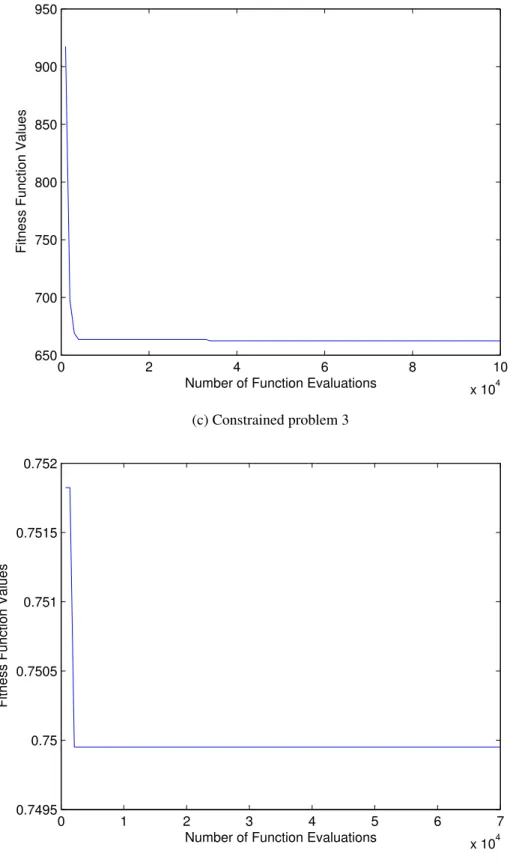
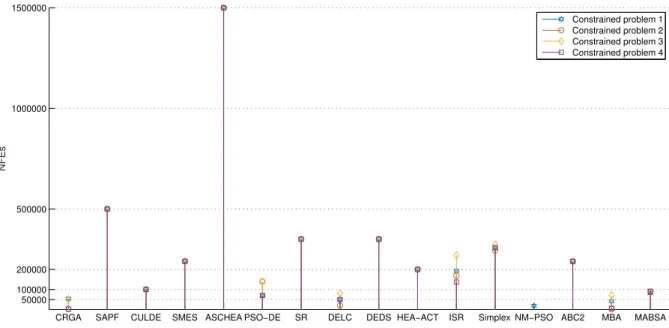
5.1 Bats movement in MABSA approach . . . 79 5.2 Convergence graphs of the best solution of MABSA for four constrained benchmark problems 83 5.3 Comparison ofNFEs used by considered algorithms for all constrained benchmark problems . 84
5.4 Bar plot of statistical results obtained using different algorithms for constrained test function 1 86 5.5 Bar plot of statistical results obtained using different algorithms for constrained test function 2 87 5.6 Bar plot of statistical results obtained using different algorithms for constrained test function 3 89 5.7 Bar plot of statistical results obtained using different algorithms for constrained test function 4 91 5.8 Comparison of NFEs used by considered algorithms for all engineering design optimisation
problems . . . 92
5.9 Convergence graph of the best solution of MABSA for pressure vessel design optimisation problem . . . 94
5.10 Bar plot of statistical results obtained using different algorithms for pressure vessel design optimisation problem . . . 94
5.11 Convergence graph of the best solution of MABSA for three-truss bar design optimisation problems . . . 97
5.12 Bar plot of statistical results obtained using different algorithms for three-truss bar design opti-misation problem . . . 97
5.13 Convergence graph of the best solution of MABSA for gear train design optimisation problem 99 5.14 Bar plot of statistical results obtained using different algorithms for gear train design optimisa-tion problem . . . 100
5.15 Convergence graph of the best solution of MABSA for speed reducer design optimisation problem102 5.16 Bar plot of statistical results obtained using different algorithms for speed reducer design opti-misation problem . . . 103
5.17 Convergence graph of the best solution of MABSA for welded beam design optimisation problem105 5.18 Bar plot of statistical results obtained using different algorithms for welded beam design opti-misation problem . . . 106
5.19 Convergence graph of the best solution of MABSA for tension/compression design optimisa-tion problem . . . 108
5.20 Bar plot of statistical results obtained using different algorithms for tension/compression design optimisation problem . . . 109
6.1 Pareto front for ZDT 1 function . . . 122
6.2 Pareto front for Schaffer function 1 . . . 124
6.4 Pareto optimum solutions for Binh and Korn function with different values ofα andβ . . . . 126
6.5 Pareto optimum solutions for Chankong and Haimes function with different values ofα andβ 128 6.6 Pareto optimum solutions for Kursawe function with different values ofα andβ . . . 129
6.7 Pareto optimum solutions for Osyczka and Kundu function with different values ofα andβ . 131 6.8 Pareto optimum solutions for Constr-Ex function with different values ofαandβ . . . 132
6.9 Pareto optimum solutions for CTP1 function with different values ofα andβ . . . 133
6.10 A four bar plane truss (Coello, 2001) . . . 135
6.11 The true (or global) Pareto front of a four bar plane truss problem (Coello, 2001) . . . 135
6.12 A four bar plane truss problem with 40 Pareto optimum solutions . . . 136
6.13 A four bar plane truss problem with 100 Pareto optimum solutions . . . 137
6.14 A four bar plane truss problem with 500 Pareto optimum solutions . . . 137
6.15 A four bar plane truss problem with 1000 Pareto optimum solutions . . . 138
6.16 A four bar plane truss problem with 4000 Pareto optimum solutions . . . 138
7.1 Convergence performances toward optimum fitness function of optimising the cost of shipping refined oil problem . . . 144
7.2 Tanker size and refinery capacity obtained in 30 independent runs of the ABSA to optimise the cost of shipping refined oil problem . . . 144
7.3 Convergence performances toward optimum fitness function of optimising the profit of selling television sets problem . . . 147
7.4 Number of function evaluations and time to finish recorded in 30 independent runs of the ABSA to optimise the profit of selling television sets problem . . . 148
7.5 A finite element method (FEM) model of car side impact (Zhang et al., 2015) . . . 149
7.6 Optimum fitness function of car side impact design problem obtained by 30 independent runs . 152 7.7 Optimum fitness function of brushless wheel DC motor problem obtained by 30 independent runs154 7.8 Pareto front of the metal cutting process problem . . . 156
7.9 The IEEE 30-bus 6-generator electrical network configuration (Ghasemi, 2013) . . . 158
7.10 Pareto optimum solutions with Pareto front of the IEEE 30-bus 6-generator unit electrical net-work problem . . . 159
List of Tables
4.1 Best global optimum value achieved by BSA and ABSA for McCormick function with different
Batsover differentMaxIter . . . 47
4.2 Best global optimum value achieved by BSA and ABSA for Rastrigin function with different Batsover differentMaxIter . . . 48
4.3 Five test functions selected from BBOB 2013 functions . . . 56
4.4 Simulation results of considered algorithms on BBOB2013 functions . . . 57
4.5 Benchmark functions used to validate the performance of ABSA . . . 62
4.6 Statistical results obtained for ABSA with 10 test functions of different dimensions over 30 independent runs of 100 iterations each . . . 65
4.7 Thebest solution obtained by BA, BSA and ABSA with 10 test functions of different dimen-sions over 30 independent runs of 100 iterations each . . . 66
4.8 Theworstsolution obtained by BA, BSA and ABSA with 10 test functions of different dimen-sions over 30 independent runs of 100 iterations each . . . 67
4.9 Themeansolution obtained by BA, BSA and ABSA with 10 test functions of different dimen-sions over 30 independent runs of 100 iterations each . . . 68
4.10 Thestandard deviation obtained by BA, BSA and ABSA with 10 test functions of different dimensions over 30 independent runs of 100 iterations each . . . 69
4.11 Performance comparison using one-way analysis of variance (ANOVA) between BA, BSA and ABSA with 10 test functions of different dimensions over 30 independent runs of 100 iterations each . . . 70
4.12 Performance comparison in terms of faster convergence to global optimum in 100 iterations using one-way analysis of variance (ANOVA) between BA, BSA and ABSA with 10 test func-tions of different dimensions over 30 independent runs . . . 73
5.1 Results of thebestsolution obtained from MABSA for constrained benchmark test functions . 81 5.2 Comparison of statistical results obtained using different algorithms for constrained test
func-tion 1. ("n/a" means not available) . . . 85 5.3 Comparison of statistical results obtained using different algorithms for constrained test
func-tion 2. ("n/a" means not available) . . . 87 5.4 Comparison of statistical results obtained using different algorithms for constrained test
func-tion 3. ("n/a" means not available) . . . 89 5.5 Comparison of statistical results obtained using different algorithms for constrained test
func-tion 4. ("n/a" means not available) . . . 90 5.6 Results of the best solution obtained from MABSA for pressure vessel optimisation design
problem . . . 93 5.7 Comparison of statistical results obtained using different algorithms for pressure vessel design
optimisation problem. ("n/a" means not available) . . . 95 5.8 Results of the best solution obtained from MABSA for three-truss bar design optimisation
problem . . . 96 5.9 Comparison of statistical results obtained using different algorithms for three-truss bar design
optimisation problem. ("n/a" means not available) . . . 96 5.10 Results of thebestsolution obtained from MABSA for gear train design optimisation problem
problem . . . 98 5.11 Comparison of statistical results obtained using different algorithms for gear train design
opti-misation problem. ("n/a" means not available) . . . 99 5.12 Results of thebestsolution obtained from MABSA for speed reducer design optimisation problem102 5.13 Comparison of statistical results obtained using different algorithms for speed reducer design
optimisation problem. ("n/a" means not available) . . . 103 5.14 Results of thebestsolution obtained from MABSA for welded beam design optimisation problem105 5.15 Comparison of statistical results obtained using different algorithms for welded beam design
optimisation problem. ("n/a" means not available) . . . 106 5.16 Results of thebestsolution obtained from MABSA for tension/compression spring design
op-timisation problem . . . 107 5.17 Comparison of statistical results obtained using different algorithms for tension/compression
5.18 Rank of algorithms for constrained optimisation benchmark test functions . . . 110
5.19 Rank of algorithms for engineering design optimisation problems . . . 111
6.1 ZDT 1 function test results . . . 122
6.2 Schaffer function 1 function test results . . . 124
7.1 Result for 30 runs of ABSA to optimise the cost of shipping refined oil problem . . . 142
7.2 Result for 30 runs of ABSA to optimise the profit of selling television sets problem . . . 146
7.3 Performance results of MABSA to optimise the weight of the car side impact design . . . 151
7.4 Performance results of MABSA to optimise the efficiency of brushless wheel DC motor . . . . 154
7.5 Results of D-PSO-MABSA to optimise the metal cutting process problem . . . 157
7.6 Generator cost and emission coefficients of the IEEE 30-bus 6-generator unit electrical network 159 7.7 Best simulation result of the IEEE 30-bus 6-generator unit electrical network . . . 160
List of Algorithms
1 Bat algorithm . . . 31
2 Bats sonar algorithm . . . 36
3 Adaptive bats sonar algorithm . . . 45
4 Modified adaptive bats sonar algorithm . . . 78
5 Particle swarm optimisation algorithm . . . 116
6 Dual-particle swarm optimisation-modified adaptive bats sonar algorithm . . . 117
Chapter 1
Introduction
1.1
Introduction
This chapter introduces an overview of the research conducted. It starts with a discussion of the research background to highlight the problem statement. Then, the aim and objectives of this research are formulated followed by a description of the research methodology. This chapter also dedicates a section to preview the contribution of the research to the world of knowledge at large as well as the list of publications as outcomes of the research, and finally the overall organisation of the thesis is presented.
1.2
Research background
A quote by George Bernhard Dantzig1(Zeidler, 1995) :
"True optimisation is the revolutionary contribution of modern research to decision processes".
Optimisation according to the definition of Merriam-Webster Dictionary (Merriam-Webster, 2015) isan act, process, or methodology of making something (as a design, system, or decision) as fully perfect, functional, or effective as possible.
In general, optimisation is the process of obtaining either the best minimum or maximum result under specific circumstance (Rao, 2009; Yang and Deb, 2014). Bandyopadhyay and Saha (2013), Statnikov et al. (2012) and Yang (2005) added that the optimisation process engages with defining and examining objective or fitness function that suits some parameters and constraints. Nowadays, a vast range of business, management and engineering applications utilise the optimisation approach to save time, cost and resources while gaining better profit, output, performance and efficiency (Yang and Deb, 2014).
1George Bernhard Dantzig (November 8, 1914 – May 13, 2005) was a famous American mathematical scientist who made important
Optimisation problems can be divided into two categories: continuous and combinatorial (discrete) (Lovász, 2010). A combinatorial optimisation problem has a finite number of solutions but this is not in the case with a continuous optimisation problem where the number of solutions is infinite. This research concentrates only on continuous optimisation problems. So in this thesis, optimisation will refer solely to continuous optimisation problems.
Normally, the optimisation problems can further be classified into two major types namely; single objective optimisation and multi objective optimisation (Rao, 2009). Naturally, solving a single objective optimisation is about finding an optimised solution to the problem at hand based on the single objective. Multi objective optimisation, on the other hand, is multifaceted and solving the problem is to seek compromised solutions based on a set of conflicting objectives (Castro-Gutierrez et al., 2010; Cvetkovic and Parmee, 1998; Stanimirovic, 2012; Yang, 2011). As there will be no unique solution to a multi objective optimisation problem (Ngatchou et al., 2005), a set of ’trade-off’ solutions, referred to as Pareto optimum solutions, compromising the objectives is produced (Coello, 2006; Zhou et al., 2011). As addition, multi objective optimisation with at least four or more objectives are often referred to as many objective optimisation (Bingdong et al., 2015; Hughes, 2005; Ishibuchi et al., 2008), although a few researchers specified three objectives also as many objective optimisation (Wang et al., 2015).
Meanwhile, the single objective optimisation can be designated as either unconstrained or constrained de-pending on whether or not the problem contains constraints (Rao, 2009). Conn et al. (1997) elaborates the un-constrained single objective optimisation problem (or widely known as single objective optimisation problem) as a problem that has no constraints specified on the variables and usually is less complicated. However, a con-strained single objective optimisation problem (or widely referred as concon-strained optimisation problem) comes with lack of explicit mathematical formulation but has discrete definition domains, mixed with continuous and discrete design variables and also strong nonlinear objective functions with multiple complex constraints (Cagnina et al., 2008; Garg, 2014; Fei et al., 2010).
According to Lee and Geem (2005) and Rao (2009), over the past forty years, many techniques have been established to solve different optimisation problems efficiently. On the words of Coello (2006), Jones et al. (2002) and Lee and Geem (2005); many optimisation problems work with mathematical or numerical linear and nonlinear programming methods and use simple and ideal models to get the optimum result. However, Lee and Geem (2005) stressed that the numerical optimisation method tends to improve the solution locally which is different from a real world problem, often more complex and unpredictable. In addition, due to their computational drawbacks, plus the requirement of substantial gradient information, traditional numerical programming strategies have been incapable of solving any optimisation problem consistently (Cagnina et al., 2008; Fei et al., 2010; Sadollah et al., 2013).
Due to stated limitations and other downsides as listed by Coello (2006), the alternative prospect to solve an optimisation problem is by heuristic2 or metaheuristic3 method (Coello, 2006; Gao et al., 2010; Hsieh, 2014; Jones et al., 2002; Moore and Chapman, 1999). Even though the metaheuristic methods are computationally laborious and give no guarantee of the quality of the results as stated by Yang (2005), the methods are still in the top ranking of optimisation solving tools. Metaheuristic methods offer significant advantages such as; easy to develop and implement, with a broad range of applicability, able to give a global perspective to the problem domains that are needed to be solved (Afshar et al., 2007) and the convergence rate of the global or nearly global optimum results are better than other optimisation approaches (Yıldız, 2009).
For the past decades, evolutionary algorithms that are part of metaheuristic methods have become popular among the researchers to deal with the complexity of a wide variety of single and multi objective optimisa-tion problems (Coello, 2006; Gong et al., 2014; Moore and Chapman, 1999; Wang et al., 2009; Yang, 2011; Yang and Hossein, 2012). Evolutionary algorithms have been derived from a combination of a set of rules or restrictions and randomness by populations in generations. Evolutionary algorithms imitate or simulate the successful characteristics of natural phenomena of physical systems (e.g. simulated annealing algorithm) or biological systems (e.g. animal behaviours-based algorithms) (Afshar et al., 2007; Becerra and Coello, 2006; Coello, 2006; Lee and Geem, 2005; Sadollah et al., 2013; Yang, 2011).
Evolutionary algorithms offer some advantages. According to Banks et al. (2007), the major advantages of evolutionary algorithms are that they are very good in general applicability that cover the vast range of problems as well as prior knowledge of the problem considered as inessential. An evolutionary algorithms only needs an explicit or implicit objective function to optimise the problem (Brest et al., 2006; He and Wang, 2007b). An evolutionary algorithm kicks off with some guessed solutions, updates solutions in a synergistic manner then navigates the search agents to balance between exploitation of good found-so-far positions and exploration of new anonymous search positions toward the optimum global solution (Brest et al., 2006; Liu et al., 2010; Mezura-Montes and Coello, 2005b; Zhang et al., 2008). Banks et al. (2007) divided the evolutionary algorithms to some sub-fields. The subfields include genetic algorithm (GA) by Holland in 1975, evolutionary strategy (ES) by Rechenberg in 1965, evolutionary programming (EP) by Fogel et al. in 1966, genetic programming (GP) by Koza in 1992 and differential evolution (DE) by Storn and Price in 1995.
Among most popular evolutionary algorithms that have already captured the attention of researchers today are swarm intelligence algorithms. Swarm intelligence algorithms are inspired by the collective behaviour of swarms through a complex interaction between individuals and their neighbourhood with nature such as a colony of ants, bacteria, bees, bats, birds and fishes (Afshar et al., 2007; Coelho and Mariani, 2008; Cuevas and Cienfuegos, 2014; Hashmi et al., 2013; Hsieh, 2014). In general, swarms have self-organisation and decen-tralised control features and all the swarm follows the same system where a population of swarm cooperates
2a way of trial and error to produce acceptable solutions to a complex problem in a reasonably practical time. 3metameans ’beyond’ or ’higher level’ and generally perform better than simple heuristic.
and interacts with each other in the group and the environment under certain rules during foraging or social-ising (Coelho and Mariani, 2008; Hashmi et al., 2013; Yang, 2005). The most remarkable features of any swarm intelligence algorithm are that it has advantages of memory, diverse multi-characters capability, rapid solution improvement mechanism and is adaptable to internal and external changes (Cuevas and Cienfuegos, 2014; Garg, 2014).
There are some well-known swarm intelligence algorithms developed over the past two decades. Kennedy and Eberhart (1995) pioneered particle swarm optimisation (PSO) algorithm that simulates the social behaviour and choreography of a bird flock. It was followed by ant colony optimisation (ACO) algorithm by Dorigo (1999). The algorithm simulates the activity of ants while seeking a path to a food source. In micron scale of swarm intelligence algorithms, the characteristics and behaviour of the vertebrate immune system have led Hofmeyr and Forrest (2000) to introduce an artificial immune system (AIS) algorithm. Passino (2002) successfully imitated the social foraging behaviour ofEscherichia coli(E.−coli) for search of nutrients with the bacterial foraging optimisation (BFO) algorithm.
In 2007, the artificial bee colony (ABC) optimisation method that was modelled from a colony of bee raised attention of research community after explored by Karaboga and Basturk (2007b). Then, Havens et al. (2008) initiated roach infestation optimisation (RIO) algorithm that was inspired from social characteristics of an intrusion of cockroaches. Later, Yang (2010) introduced bat algorithm (BA) which imitated the echolocation of bats to find prey with different levels of pulse and loudness emitted. The algorithm was the third from him after a cuckoo search (CS) algorithm (Yang and Deb, 2009) encouraged from compellation of social parasitism practised by a group of cuckoo and the firefly algorithm (FA) (Yang, 2009) idealised from the flashing behaviour of fireflies a year before.
Tawfeeq (2012) also utilised the concept of echolocation of bats to find prey to design a new swarm intel-ligence algorithm. Different from the algorithm investigated by Yang (2010) as cited before, this algorithm models the principles of bats sonar used in echolocation to search for the optimum solution to a specific prob-lem (Tawfeeq, 2012). It is worth mentioning, to strengthen the swarm intelligence algorithms or to cater for a specific problem, the versions of swarm intelligence algorithms hybridised between each other or with other conventional approaches have also existed (Yang, 2005; Yıldız, 2009).
1.3
Research problem statement
The problem with most of the swarm intelligence algorithms introduced before is that they still do not perform well to achieve the best accuracy while maintaining good precision and fast convergence to the global optimum solution. Besides, excellent balance between exploration and exploitation processes of the algorithm is essential as insufficient diversification or excessive intensification results in the system falling into the local optimum instead of the global optimum. These problems must be tackled to ensure the swarm intelligence algorithms
are more reliable, efficient, and effective so that it would be the most prominent method to solve any single or multi objective optimisation problems.
1.4
Research aim and objectives
This research will try to resolve the difficulties faced by the various swarm intelligence algorithms as stated before by exploring better swarm intelligence algorithms that simulate the social characteristics of a colony of bats. However, it is not the research aim to investigate the algorithms that outperform all other existing algorithms in all types of problems; it is rather to introduce novel form of swarm intelligence algorithms based on real echolocation behaviour of bats that employ an innovative problem solving approach that is not found in any existing metaheuristic methods.
There are four objectives to perform this research. These are:
1. To research and test an effective bats echolocation-inspired algorithm to solve single objective optimisa-tion problems.
2. To research and test an effective bats echolocation-inspired algorithm to solve constrained optimisation problems.
3. To research and test a hybrid of an effective bats echolocation-inspired algorithm with an established swarm intelligence algorithm to solve multi objective optimisation problems.
4. To apply the effective bats echolocation-inspired algorithms to selected practical optimisation problems.
1.5
Research methodology
Figure 1.1 shows the flow chart of the major research milestones. This research activity has five major phases. In the first phase, an intensive literature review is conducted. This includes the study of the type of opti-misation problems, the characteristics of a colony of bats in nature (especially during echolocation behaviour) and existing bats echolocation-inspired algorithms. The purpose of the literature review is to acquire better understanding of existing techniques and to explore the latest developments in the subject area.
The second phase is to research an improved adaptive bats sonar algorithm compared to one of the existing bats echolocation-inspired algorithms for solving single objective optimisation problems. The algorithm will be tested on several single objective optimisation benchmark test functions. The results will be compared with other swarm intelligence algorithms. If the results have shown the superior performance of the algorithm over the existing swarm intelligence algorithms, the research activity will move forward to the next phase. However, if the results are not optimised, the algorithm will be experiencing some fine-tuning on its properties to achieve the optimised results.
Start Literature review Phase-1 Research an adaptive bats sonar algorithm Phase-2 Test on single objective optimisation benchmark test functions Compared results with other swarm intelligence algorithms Problem optimised? Research a modified adaptive bats sonar algorithm Phase-3 Test on con-strained optimisation benchmark test functions Compared results with other swarm intelligence algorithms Problem optimised? Research a dual searching process of PSO and MABSA algorithms Phase-4 Test on multi objective optimisation benchmark test functions Evaluate results conform to appropriate optimum solution targeted Target achieved?
Apply all bats echolocation-inspired algorithms to selected practical optimisation problems Phase-5 Evaluate results conform to appropriate optimum solution targeted Target achieved? End yes no yes no yes no yes no
During the third phase, the adaptive bats sonar algorithm will be modified and injected with new elements. By doing this, the modified adaptive bats sonar algorithm is aimed to optimise the constrained optimisation problems. Then, the algorithm will be tested to solve sets of constrained optimisation benchmark test functions and engineering design optimisation problems. Next, the research activity will continue in the fourth phase if the algorithm perform better in achieving optimised solutions as compared with other swarm intelligence techniques. If not, the fine-tuning of the properties of developed algorithm is essential to achieve the desired outcomes.
The fourth phase will focus on hybridisation of the modified adaptive bats sonar algorithm with one influen-tial swarm intelligence algorithm. The poteninfluen-tial candidate for this is the particle swarm optimisation algorithm. The synergy between the two algorithms is expected to achieve solutions to multi objective optimisation prob-lems. The hybrid algorithm will be tested on a platform of multi objective optimisation benchmark test func-tions. The results will be evaluated to show the capability of the hybrid algorithm to achieve targeted optimum solution. If so, this will lead to the final research activity phase. However, if the results are not convincing, the properties of the hybrid algorithm will be fine-tuned appropriately.
The final phase (fifth phase) is about to test and evaluate performance of all the bats echolocation-inspired algorithms in selected practical optimisation problems. The considered case studies will cover single objective optimisation problems, constrained optimisation problems and multi objective optimisation problems. The results collected will be evaluated to confirm with appropriate optimum solutions targeted. If the algorithms perform as desired, the research activity will end. However some adjustment on the algorithm properties and/or considered problems will be made if poor results are delivered.
The research activities including algorithms investigation stage, algorithms testing stage and algorithms per-formance analysis and discussion stage, are conducted on similar types of computer and software platforms. The specification of the computer isIntelRCoreTM
i5 processor of 2400 CPU @ 3.10GHzwith 4.00GB RAM
while, the MATLAB software versionMAT LABRR2013ais used throughout.
1.6
Research contribution and publications
The main scientific contributions to knowledge of this research include the following:
1. An adaptive bats sonar algorithm (ABSA) for solving single objective optimisation problems. 2. A modified adaptive bats sonar algorithm (MABSA) for solving constrained optimisation problems. 3. A dual-particle swarm optimisation-modified adaptive bats sonar algorithm (D-PSO-MABSA) for
solv-ing multi objective optimisation problems.
However, in real terms, the ABSA, MABSA and D-PSO-MABSA algorithms may outperform other methods in certain types of problems and may underperform in others. The choice of a suitable algorithm for any
optimisation problem is, to a large extent, dependent on the user’s experience in solving similar problems. Hence, the research creates another form of swarm intelligence algorithm that employs a different signature problem-solving approach in optimisation problems which the approach is rooted in the echolocation behaviour of a colony of bats. Then, the findings of the research will produce a set of new contribution to knowledge that will benefit the study in solving the optimisation problems on the platform of the swarm intelligence algorithm in a larger context.
Several publications have been produced through the course of the research. These include:
1. N.M. Yahya, M.O. Tokhi and H.A. Kasdirin. A new bats echolocation-based algorithm for single objec-tive optimisation. Evolutionary Intelligence (Published online on 18thFebruary 2016, DOI 10.1007/s12065-016-0134-5).
2. N.M. Yahya and M.O. Tokhi. A modified bats echolocation-based algorithm with application to con-strained optimisation problems. International Journal of Bio-Inspired Computation (submitted on 22th April 2015,under review).
3. N.M. Yahya and M.O. Tokhi. Dual level searching approach for solving multi objective optimisation problems using hybrid particle swarm optimisation and bat echolocation-inspired algorithms. Applied Soft Computing (submitted on 15thDecember 2015,under review)
1.7
Organisation of the thesis
The overall thesis is organised as follows:
Chapter 1 : Introduces the research background, research problem statement, aim and objectives of the re-search, methodology of the rere-search, contribution and list of publications resulted from the research and organisation of the thesis.
Chapter 2 : Introduces single objective optimisation problems, constrained optimisation problems and multi objective optimisation problem.
Chapter 3 : Describes the colony of bats in nature, bat algorithm, variants of bat algorithm, bats sonar algo-rithm and several problems existed in bats sonar algoalgo-rithm.
Chapter 4 : Explores the investigation and computer simulation of adaptive bats sonar algorithm for solving single objective optimisation problems.
Chapter 5 : Discusses the investigation and computer simulation of modified adaptive bats sonar algorithm for solving constrained optimisation problems.
Chapter 6 : Deliberates the particle swarm optimisation and investigation as well as computer simulation of a dual searching process of PSO and MABSA algorithms for solving multi objective optimisation
Chapter 7 : Presents performance assessments of the algorithms in case studies of single objective optimisa-tion problems, constrained optimisaoptimisa-tion problems and multi objective optimisaoptimisa-tion problems.
Chapter 8 : Highlights the overall research summary and conclusion as well as future direction of the research.
1.8
Summary
This chapter has discussed the research background, instituted the research problem statement and setting up the research aim and objectives. Moreover, the research methodology has been formulated with statement of contribution of the research to knowledge.
The next chapter will briefly discuss the optimisation problems. The chapter is a part of the first research methodology phase.
Chapter 2
Optimisation problems in brief
2.1
Introduction
This chapter briefly discusses the optimisation problems. The chapter is divided into four sections. The first section discusses the general concept of optimisation. Then, the second section concentrates on single objective optimisation problems as well as several research methods to solve such problems. The third section reviews constrained optimisation problems. In this section, a penalty method as one of the constraints handling tech-nique for solving constrained optimisation problems is also highlighted. The last section of this chapter will explore multi objective optimisation problems. This section also gives emphasis to a weighted sum approach as one of the ways to solve multi objective optimisation problems. Some literature review on the preceding research on solving multi objective optimisation problems using particle swarm optimisation (PSO) algorithm are also included in this section.
2.2
Optimisation problem
Optimisation theory is a division of mathematics about the study of techniques, methods, procedures or algo-rithms to find the optimum solution to the problem considered (Antoniou and Lu, 2007). The optimisation problem takes place in most disciplines. In the engineering field, optimisation problem occurs in modelling and characterising; design of devices, circuits and systems; design of tools, instruments and equipment; design of structures and buildings, production planning and scheduling, quality, inventory and process control as well as maintenance and repair of equipment or systems (Antoniou and Lu, 2007).
The optimisation process starts by formulating the problem first (Antoniou and Lu, 2007). A performance criterionFmust be derived in terms ofnvariablesx1,x2, . . . ,xnas:
Fis usually referred to the objective function or fitness function or cost function that can be assumed in numer-ous forms. It can be the cost of a product in a manufacturing environment or the difference between the desired performance and the actual performance in a system (Antoniou and Lu, 2007). On the other hand, the variables
x1,x2, . . . ,xn need to be adjusted in such a way to optimiseF. Variablesx1,x2, . . . ,xn are the parameters that
influence the product cost in the first case or the actual performance in the second case (Antoniou and Lu, 2007). They can be independent variables, decision variables, design variables or control parameters.
Antoniou and Lu (2007) and Deb (2014) agreed that the word ‘optimise’ is more specific than the word ‘improve’ in delivering the meaning to achieve an optimum. In accession to that, ‘optimum’ is a technical term appropriately referring to quantitative measurement and is better than daily-use-word ‘best’. Subject to circumstances, optimise is taken to mean ‘minimise’ or ‘maximise’ (Antoniou and Lu, 2007).
2.3
Single objective optimisation problem
2.3.1 Background
A single objective optimisation is an objective function ofnnumbers of variables (x) that tie to lower bound and upper bound variables as:
OptimiseF(x), x= (x1,x2, . . . ,xn) where x(iL)≤xi≤x (U) i , i=1,2, . . . ,n (2.2)
Herex(iL)represent the lower bounds andxi(U)represent the upper bounds of variablexiwithnvariables
respec-tively.
The purpose of an optimisation algorithm is to find a solution of variable(s),xfor which the functionF(x)is optimum. According to Deb (2014), there are two categories of solutions:
1. Local optimum solution: A point or solution x∗is said to be a local optimum solution if there exists no point in the neighbourhood ofx∗which is better thanx∗. For minimisation problem, a pointx∗is a local minimum solution if no point in the neighbourhood had a function value smaller thanF(x∗).
2. Global optimum solution: A point or solutionx∗∗is said to be a global optimum solution if there exists no point in the entire search space which is better than the pointx∗∗. Similarly, a pointx∗∗ is a global minimum solution if no point in the entire search space has a function value smaller thanF(x∗∗). Bandyopadhyay and Saha (2013) have identified three major techniques available to solve the single objective optimisation problem. The first technique is calculus-based techniques or numerical methods. This technique uses a set of local requisite and sufficient condition to satisfy the solution of problem (Bandyopadhyay and
Saha, 2013). Example of algorithms that use this technique are direct search methods and indirect search methods. According to Bandyopadhyay and Saha (2013), the technique is excellent to solve a small class of unimodal problems but is inefficient to apply to many real life applications.
According to Bandyopadhyay and Saha (2013), enumerative techniques are the second set to solve the single objective optimisation problem. These techniques evaluate each and every point in the search space to arrive at the optimum solution. Most of the algorithms that apply these techniques, for example, dynamic programming, will break the considered problem into a smaller size and lower complexity because it is difficult to search all the points in the search space (Bandyopadhyay and Saha, 2013).
The guided random techniques are other techniques to solve single objective optimisation problems as men-tioned by Bandyopadhyay and Saha (2013). These techniques are enumerative methods-improved where ad-ditional information about the search space is used to lead to potential solution points. The randomly guided techniques are further classified into single-point search and multi-point search. Swarm intelligence algorithms as part of evolutionary algorithms utilise the multi-point search where a highly explorative searching process with a random choice of parameters are adopted to search for several points at a time (Bandyopadhyay and Saha, 2013). These robust techniques have advantages to find acceptable near-optimum solution of the problems that have large search space, and are multimodal and discontinuous.
2.3.2 Approaches for single objective optimisation problems
In general, the algorithms used to solve for single objective optimisation problems can be divided into two categories, namely direct methods and gradient-based methods (Deb, 2014). Direct methods are solely depend on the objective function values to guide the search process and do not utilise any derivative information of the objective function (Deb, 2014). Meanwhile, according to Deb (2014), gradient-based methods utilise derivative information (either first or second-order) to guide the search process.
Swarm intelligence algorithm which is a type of direct methods has attracted a lot of attention of the research community. There are many swarm intelligence algorithms that have been introduced over the last decade for solving single objective optimisation problems. Yang (2005) introduced a virtual bee algorithm (VBA) that simulates the swarm interactions of social honey bees. The VBA follows the process of bees searching for honey as: a bee finds a food source; brings back honey to the hive; recruits others by performing ‘waggle dance’; recruits bee to learn the distance and direction from the dance; forages the same source and becomes the favoured path. Yang (2005) compared the performance of VBA with genetic algorithm (GA) to optimise De Jong’s test function and Keane’s multi-peaked bumpy test function. The results suggested that VBA works better than GA due to the parallelism factor inside the algorithm.
Then, Yang et al. (2007) proposed a hybrid algorithm of PSO and GA to solve single objective optimisation problems. The hybrid algorithm is a combination of the flying behaviour of particles and population diversity
of PSO that are enhanced by the genetic mechanism of GA. The hybrid algorithm divided the searching process into two stages. The first stage utilised the PSO procedures while the second stage adopted the GA procedures. According to Yang et al. (2007), the hybrid algorithm can improve the performance of PSO and GA as well as it is able to avoid premature convergence. The hybrid algorithm was tested on three single objective optimisation benchmark test functions, namely Sphere function, Rosenbrock function and Rastrigrin function. The hybrid algorithm recorded a better performance as compared to PSO and GA.
Karaboga and Basturk (2007b) introduced an artificial bee colony (ABC) algorithm that was also inspired from a nectar searching process by a bee colony. The ABC algorithm divided bees into three groups; the employed bees go to the located food source, the onlooker bees wait on the dance area to choose a food source and the scouts bees search for food randomly. Karaboga and Basturk (2007b) compared the ABC algorithm with GA, particle swarm optimisation (PSO) and hybridised algorithm of particle swarm-inspired evolutionary algorithm (PS-EA) on five high dimensional multi modal single objective optimisation benchmark test functions. The simulation results concluded that the ABC algorithm can escape from local optimum as well as can be used to solve multivariable and multi modal function optimisation problems.
Havens et al. (2008) introduced roach infestation optimisation (RIO) algorithm motivated from the collective and individual behaviours of cockroaches. The RIO algorithm works based on three behaviours of intrusion of cockroaches: like the darkest location, enjoy to socialise with a company of friends and periodically become hungry. The RIO algorithm was tested on eight single objective optimisation benchmark test functions. Ac-cording to Havens et al. (2008), the results showed that the RIO algorithm could find global optimum as well as perform on par with PSO.
Yang (2009) presented a firefly algorithm (FA) that was encouraged from the unique pattern of flashing light by a swarm of fireflies. The FA was idealised from three rules; all fireflies are unisex, attractiveness is propor-tional to their brightness and objective function landscape determines the brightness. Yang (2009) compared the performance of FA with GA and PSO on ten single objective optimisation benchmark test functions. The results indicated that FA outperformed both of the algorithms in terms of the efficiency and success rate.
Yang and Deb (2009) reported a cuckoo search (CS) algorithm that was based on the obligate brood parasitic behaviour of some cuckoo species. This algorithm is also integrated with the Lévy flight behaviour of some birds and fruit flies. The CS algorithm operates based on three rules inspired by cuckoo breeding behaviour. The rules are: each cuckoo lays one egg in a random nest at a time, the best nest with the highest quality of eggs will bring forward to next generations and fixed number of available host nests. The CS algorithm has been verified and compared with GA and PSO on ten single objective optimisation benchmark test functions. The simulation results showed that CS performed better as compared to both established algorithms especially for multi modal objective functions (Yang and Deb, 2009).
Kang et al. (2011) have proposed a Rosenbrock artificial bee colony (RABC) algorithm that integrates a Rosenbrock’s rotational direction method for an exploitation phase with original ABC algorithm for explo-ration phase. The Rosenbrock method is a classical derivative-free local search technique with adaptive search orientation and size while the ABC algorithm is a swarm intelligence algorithm that is inspired from a colony of bee searching for nectar. Kang et al. (2011) tested and compared RABC algorithm with other well-known algorithms on 41 single objective optimisation benchmark test functions taken from various literatures. The nu-merical results validated that the proposed algorithm demonstrated better performances in terms of robustness, convergence speed, efficiency and accuracy as compared to other algorithms.
In 2012, a new swarm intelligence algorithm, the krill herd (KH) algorithm was proposed by Gandomi and Alavi (2012). The KH algorithm is based on the herding behaviour of krill individuals. The KH algorithm sets the minimum distances and highest density of krill herd from food as the objective function. Besides, KH algorithm also has taken movement induced by the presence of other individuals, foraging activity and random diffusion as three main factors to determine the time-dependent position of each krill. The KH algorithm has been compared with other eight algorithms to solve twenty single objective optimisation benchmark test functions. The result validated a better performance of the KH algorithm with the benchmark test functions as well as outperform other established algorithms (Gandomi and Alavi, 2012).
Rizk-Allah et al. (2013) presented a hybrid algorithm of ant colony optimisation and firefly algorithm (ACO-FA) for solving single objective optimisation problems. The ACO-FA combined the advantages of both swarm intelligence algorithms where ant colony works as a global searcher and firefly colony works as a local searcher. Rizk-Allah et al. (2013) tested the ACO-FA algorithm on a set of fifteen single objective optimisation bench-mark test functions. The simulation results suggested that the ACO-FA algorithm demonstrated better perfor-mance for searching the global optimum solution as compared to other prominent algorithms.
Another variant of bee colony algorithm was proposed by Kumar (2014). The algorithm was named directed bee colony (DBC) algorithm, and modelled a group decision-making process of nest site selection by a colony of honey bees. The ability of bees to perform tasks, the constant population of bees, environment of bees and information exchange process among bees are the main criteria in the DBC algorithm. According to Kumar (2014), the DBC algorithm was tested on nine single objective optimisation benchmark test functions of unimodal and multimodal types. The simulation results show better performance in terms of robustness and accuracy of DBC algorithm over other metaheuristic algorithms.
Askarzadeh (2014) explored an algorithm inspired by bird mating strategy during mating season. The bird mating optimiser (BMO) algorithm is aimed to solve single objective optimisation problems. In BMO algo-rithm, the population is called societyand in each society member is called abird that represent a feasible solution. There are five groups ofbirds in the society based on the real birds mating system. The groups are parthenogenetic, polyandrous, monogamous, polygynous and promiscuous. The BMO algorithm was tested on three categories of single objective optimisation benchmark test functions. The categories are unimodal
functions, multimodal functions and low-dimensional multimodal functions. The simulation results showed a better performance of BMO algorithm to provide a good balance between global and local search effectively as compared to other algorithms (Askarzadeh, 2014).
Campos et al. (2014) presented a bare bones particle swarm optimisation with scale matrix adaptation (SMA-BBPSO) aimed to solve single objective optimisation problems. This algorithm is an improved version to settle premature convergence problem suffered by the original bare bones particle swarm optimisation (BBPSO). In the SMA-BBPSO, each particle chooses new position in the search space using a multivariate t-distribution with a rule for adaptation of its scale matrix. The strategy induces accumulated learning in each particle and increases the ability of particles to escape from a local optimum. Campos et al. (2014) verified the performance of the SMA-BBPSO on fifteen single objective optimisation benchmark test functions. Statistical test results showed significant improvement of SMA-BBPSO to get good solutions for all test functions compared to other swarm algorithms.
Recently, Liang et al. (2015) proposed a social network-based swarm optimisation algorithm (SNSO) tar-geted for solving single objective optimisation problems. The SNSO algorithm adopted a social network evo-lution model of the swarm to improve the search performance of a swarm. The SNSO introduced a dynamical population topology, extended neighbourhood structure and divided the individuals into two groups based on their fitness. Results from computer simulation on twelve single objective optimisation benchmark test func-tions showed that SNSO achieved better performance as compared to seven others distinguished population-based algorithms (Liang et al., 2015).
Swarm intelligence algorithms based on bats have also appeared in the literature, among which significant one are bat algorithm (BA) by Yang (2010) and bats sonar algorithm (BSA) by Tawfeeq (2012). Both algorithms are inspired from echolocation of a colony of the bats. However, both algorithm will be detailed in the next chapter such that the BA and especially BSA will be a base for this research to research a new set of bats echolocation-inspired algorithms.
2.4
Constrained optimisation problem
2.4.1 Background
A constrained optimisation comprises an objective function together with some equality and inequality con-straints subject to lower bound and upper bound of variables as:
OptimiseF(x), x= (x1,x2, . . . ,xN) subject to gj(x)≥0, j=1,2, . . . ,J hk(x) =0, k=1,2, . . . ,K where x(iL)≤xi≤x (U) i , i=1,2, . . . ,n (2.3)
Heregj(x)represents inequality constraint functions withJinequality constraint. hk(x)represents equality
constraints functions withKis equality constraints.x(iL)represents the lower bounds andx(iU)the upper bounds of variablexi withnvariables respectively.
According to Jiao et al. (2013); Yang et al. (2006); Zahara and Kao (2009), a constrained optimisation problem deals with interferences between multi-variable and multi-constraint features. So it is difficult to solve the constrained optimisation problem as compared to unconstrained optimisation problem in a way that ensures efficient, optimum and constraint-satisfying convergence condition (Antoniou and Lu, 2007). If the constraints can be handled, it is easier to solve the constrained optimisation problem (Antoniou and Lu, 2007; Garg, 2014). The most popular way that researchers have adopted is to convert the constrained optimisation problem to be unconstrained optimisation problem by getting in all constraints into the objective function (Antoniou and Lu, 2007; He and Wang, 2007a).
Another challenge in a constrained optimisation problem is how to balance the search for feasible individuals and infeasible individuals throughout the search process (Tessema and Yen, 2006; Zhang et al., 2008). Feasible individuals are the individuals that satisfy all of the equality and inequality constraints and variables bound at that point, while infeasible individuals are individuals that do not satisfy at least one of the constraints (Deb, 2014; Tessema and Yen, 2006). The conventional way to solve this problem is by ignoring the existence of infeasible individuals but continue the process of discovering for optimum solution with the feasible individual only (Tessema and Yen, 2006).
So, a better searching approach for the optimum solution in part with the correct constraint handling tech-nique plays an important role to solve a constrained optimisation problem effectively (Wang and Li, 2010).
2.4.2 Constraints handling technique for constrained optimisation problems: a penalty method Constraint handling techniques will be used to direct the search for the algorithm towards feasible solution in the search space (Cuevas and Cienfuegos, 2014). There are several major approaches reported in the literature for handling constraints (Akay and Karaboga, 2012; Koziel and Michalewicz, 1999; Ray and Liew, 2003; Yang et al., 2006). These include:
1. Approach based on the preference of feasible solutions over infeasible ones with some operators. 2. Approach based on penalty functions that use a penalty term to convert constrained optimisation problem
into a non-constrained optimisation problem.
3. Approach based on multi objective optimisation concept such as Pareto ranking scheme. 4. Approach that makes a clear distinction between feasible solutions and infeasible solutions.
5. Approach based on a separate treatment of objective function and the constraint violation, for instance; stochastic ranking (SR).
6. Hybrid methods combining evolutionary computation techniques with deterministic procedures for nu-merical optimisation.
An approach based on penalty function as constraint handling mechanism in constrained optimisation prob-lems has gained more attention of researchers (Amirjanov, 2006; Coello, 2000; He and Wang, 2007a; Mezura-Montes and Coello, 2005a; Wang and Cai, 2012). Besides of its simplicity and easy implementation (He and Wang, 2007a,b; Parsopoulos and Vrahatis, 2005), the key successful factor of this approach is that an individual in the infeasible region is penalised to move toward the feasible region and provide useful information to help others to move in (Afshar, 2013; Mezura-Montes and Coello, 2005a; Runarsson and Yao, 2005). The penalty function also offers as leverage balance between objective function and constraint violation (He and Wang, 2007a; Runarsson and Yao, 2000). Even though many variants of penalty functions exist such as dynamic penalty, adaptive penalty and death penalty (Rao et al., 2011; Ray and Liew, 2003), the static penalty function (which is the basic one) will be adopted in this research.
In the static penalty function, the original objective functionF(x)is replaced by a substituted functionC(x) which considers the original objective functionF(x)add a penalty functionP(x)that introduces a tendency term to penalise constraint violations produced byx. Therefore, considering the constrained optimisation problem defined previously, the substituted function is defined as follows:
C(x) =F(x) +P(x) where P(x) =µ· J
∑
j=1 gj2(x) +v· K∑
k=1 hk2(x) (2.4)whereµ andvrepresent the penalty coefficients which weigh the relative importance of eachgj(x)(inequality
2.4.3 Approaches to solving constrained optimisation problems by previous researchers Various research works have been reported over the past two decades on dealing with constrained optimisation problems. This section will highlight some by dividing the approaches into four main bases, namely swarm intelligence algorithms, other evolutionary algorithm strategies, hybridised approaches and multi objective op-timisation methods.
There are several swarm intelligence algorithms that have been used to solve the constrained optimisation problem. The PSO was the most favourable technique among them. Parsopoulos and Vrahatis (2005) has pro-posed a variant of PSO scheme, a unified particle swarm optimisation (UPSO) method with a penalty function approach. The proposed algorithm has abilities to explore and exploit the search process without needing extra requirements of function evaluations and also preserves feasibility of the encountered solutions. Yang et al. (2006) introduced a master-slave particle swarm optimisation (MSPSO) where master swarm and slave swarm particles were created to fly toward better feasible and infeasible particles, updating and sharing information between them. This approach brings better global exploration ability and keeps away from being trapped into the local optimum.
He and Wang (2007a) reported a two-swarm groups mechanism in a co-evolutionary particle swarm opti-misation (CPSO). Both groups were used to evolve decision solution and adapt penalty factors for solution evaluation. Cagnina et al. (2008) investigated simple constrained particle swarm optimiser (SiC-PSO) which was coupled with a constrained-handling technique. The algorithm was faster, more reliable and efficient after combining local best (lbest) and global best (gbest) models to update the velocity as well as addinggbestto the best position of the particles and in its neighbourhood. Recently, Afshar (2013) designed a fully constrained particle swarm optimisation (FCPSO) and three versions of partially constrained PSO (PCPSO) to deal with the real world water resources management problems. The proposed algorithms eliminated the infeasible region in the search space before and during a search process. As compared to the original PSO, the methods are computationally effective and less sensitive to initial swarm and swarm size.
Another popular swarm intelligence algorithm used is the artificial bee colony (ABC) algorithm. For in-stance, Garg (2014) introduced a penalty function guided ABC algorithm to solve several structural engineering design problems. Before that, Karaboga and Basturk (2007a) adopted Deb’s rule for the selection of mechanism to deal with the constraints of the ABC algorithm to solve a set of constrained numerical optimisation problems and extended previous version by adding constraint handling technique into the selection steps to solve large scale and constrained engineering design problems (Akay and Karaboga, 2012).
The rest of the techniques shall be categorised under swarm intelligence algorithms such as, bat algorithm (BA) (Yang and Hossein, 2012) which is based on the level and loudness of pulse emitted in bats echolocation, a bacterial gene recombination algorithm (BGRA) that was inspired from virus resistance process in real bacteria (Hsieh, 2014) and the social spider optimisation (SSO-C) algorithm which is based on the cooperative behaviour in a colony of social spiders (Cuevas and Cienfuegos, 2014).
Besides swarm intelligence algorithms, several researchers applied other evolutionary algorithms to solve the constrained optimisation problems. Koziel and Michalewicz (1999), for instance, utilised an evolutionary algorithm with decoder (a technique that uses a chromosome as in genetic algorithm), incorporated with a homomorphous mapping between an n-dimensional cube and a feasible search space. According to the origi-nators, the proposed algorithm was an alternative approach to nonlinear programming (NLP).
Differential evolution (DE) which is among the popular methods in evolutionary algorithms is also widely applied to constrained optimisation problems. Huang et al. (2008) modified the algorithm to an archived DE (ADE) algorithm where an archive of all the best solutions from previous evolution process will be utilised to estimate new solutions. The algorithm also collaborated with dynamic penalty functions and fitness calculation of individuals. Later, Li et al. (2012) proposed an improved DE with a self-adaptive strategy to determine the control parameters paired with the dynamic constraint-handling mechanism. The approach was enhanced with a self-adaptive parameter from its original version, DE with dynamic constraint-handling (DCDE) to seek and improve for a feasible solution and objective function. Recently, Gong et al. (2014) studied an improved constrained DE variant; improve mutation dynamic DE (rank-iMDDE). The improved algorithm introduced a ranking-based mutation operator to accelerate the convergence rate of DE as well as improve the dynamic diversity mechanism to maintain feasible and infeasible solutions in the population under the multiple trail vectors generation technique.
Other research works on evolutionary algorithms to solve the constrained optimisation problems include the adaptive segregational constraint handling evolutionary algorithm (ASCHEA) (Hamida and Schoenauer, 2002) that targeted to preserve feasible and infeasible individuals and the improvedα constrained simplex method by Takahama and Sakai (2005) to control the convergence speed. To take advantage of the information hidden in infeasible individuals efficiently, a self-adaptive penalty function-genetic algorithm (Tessema and Yen, 2006) was introduced, while an effective global harmony search (EGHS) based on natural music performance was applied to optimise pressure vessel design problems (Gao et al., 2010). Other techniques are teaching-learning-based optimisation (TLBO) algorithm inspired by the real influence of a teacher on learners (Rao et al., 2011), a novel selection evolutionary strategy (NSES) with a self-adaptive selection method (Jiao et al., 2013) and mine blast algorithm (MBA) inspired from bomb explosion to clear the mines field (Sadollah et al., 2013).
There has also been attempts on hybridisation of two or more methods to solve constrained optimisation problems. The combination techniques desire features of each so that the new breed algorithm is better than the individual components. For instance, Coello (2000) and Amirjanov (2006) respectively hybridised GA with
another strategy to improve the capabilities of GA to solve constrained optimisation problem. Coello (2000) embedded evolution concepts to adapt the self-adaptive penalty factors of fitness function into GA. The co-evolution was applied to create two populations that interact with each other and can also be used to determine the penalty factor and optimise the objective function. The technique is easy to implement and is suitable to use on parallelisation to improve overall performance. On the other hand, Amirjanov (2006) injected GA with the changing range of design variable feature using a stochastic ranking method with the shifting and shrinking mechanism (SSM). The algorithm would move and shrink the search space towards the feasible region resulting in speedy convergence to the global optimum within reasonable precision.
PSO also became the subject of hybridisation method for producing a new strong algorithm to solve con-strained optimisation problems. He and Wang (2007b) introduced a hybrid PSO (HPSO) after combining feasibility based rule and simulated annealing (SA). SA acted as a means to shun premature convergence, while the feasibility-based rule was used as an alternative to penalty function approach for the constraint-handling mechanism. Zahara and Kao (2009) integrated the Nelder-Mead simplex method and PSO (NM-PSO) which combine the advantage of efficient local search in Nelder-Mead method and better global search in PSO. PSO also has been paired with DE (Liu et al., 2010), known as PSO-DE to accelerate the convergence process. DE, which has a strong searching ability, was used to help PSO escape from stagnation condition. Deb’s feasibility-based rule to compare the updated particle is used in this hybrid method.
Further, Runarsson and Yao (2000) introduced aµandλ evolution strategy, (µ+λ)ES with stochastic ranking method. The algorithm plans to balance dominance of penalty function and objective function stochastically and it is achieved through a ranking procedure based on the stochastic bubble-sort algorithm. Runarsson and Yao (2005) improved the algorithm by exploring an improved stochastic ranking (ISR) method to show the im-portance of search bias in constrained optimisation. Ray and Liew (2003) introduced a society and civilisation algorithm modelled from the intra and inter-society interactions within a formal society and the civilisation. The algorithm combined the features of GA, machine learning model and Pareto ranking scheme. Later, Be-cerra and Coello (2006) investigated a cultural algorithm with a differential evolution population, where the cultural algorithm is an evolutionary computation technique that uses domain knowledge to improve process performance. Few more examples are the dynamic stochastic selection in multi-member differential evolution (DSS-MDE) by Zhang et al. (2008), a hybrid evolutionary algorithm and an adaptive constraint handling tech-nique (HEA-ACT) by Wang et al. (2009) and a differential evolution with level comparison (DELC) by Wang and Li (2010).
Another significant method by researchers to optimise the constrained optimisation problems is by imple-menting a non-constraint handling mechanism or a multi objective optimisation method. For example, Coello and Mezura-Montes (2002) introduced a niched-Pareto GA (NPGA) where the new constraint handling ap-proach was introduced based on multi objective optimisation technique. This method adopts concepts from multi objective