ORNL/TM-2004/176
ELEVATED-TEMPERATURE FERRITIC
AND MARTENSITIC STEELS
AND THEIR APPLICATION TO FUTURE
NUCLEAR REACTORS
November 2004
This report was prepared as an account of work sponsored by an agency of the United States government. Neither the United States government nor any agency thereof, nor any of their employees, makes any warranty, express or implied, or assumes any legal liability or responsibility for the accuracy, completeness, or usefulness of any information, apparatus, product, or process disclosed, or represents that its use would not infringe privately owned rights. Reference herein to any specific commercial product, process, or service by trade name, trademark, manufacturer, or otherwise, does not necessarily constitute or imply its endorsement, recommendation, or favoring by the United States government or any agency thereof. The views and opinions of authors expressed herein do not necessarily state or reflect those of the United States government or any agency thereof.
ORNL/TM-2004/176
Metals and Ceramics Division
ELEVATED-TEMPERATURE FERRITIC AND MARTENSITIC STEELS AND THEIR APPLICATION TO FUTURE NUCLEAR REACTORS
Date Published: November 2004
Prepared by
OAK RIDGE NATIONAL LABORATORY Oak Ridge, Tennessee 37831-6285
managed by UT-BATTELLE, LLC
for the
CONTENTS
Page
ABSTRACT... vii
1. INTRODUCTION ...1
2. FERRITIC/MARTENSITIC STEELS IN NUCLEAR APPLICATIONS ...3
2.1 FISSION REACTORS ...3
2.2 FUSION REACTORS ...3
3. IRRADIATION EFFECTS ON FERRITIC/MARTENSITIC STEELS ...5
3.1 EFFECT OF IRRADIATION ON MICROSTRUCTURE...5
3.2 EFFECT OF IRRADIATION ON MECHANICAL PROPERTIES...6
4. HIGH-CHROMIUM (9–12% CR) STEELS ...10
4.1 EVOLUTION OF STEELS FOR POWER-GENERATION INDUSTRY ...10
4.2 MICROSTRUCTURE...13
4.2.1 Normalized-and-Tempered and Quenched-and-Tempered Microstructure...13
4.2.2 Effect of Elevated-Temperature on Microstructure ...14
4.2.3 Effect of Composition on Microstructure ...16
4.2.3.1 Effect of Carbon and Nitrogen ...17
4.2.3.2 Effect of Chromium ...17
4.2.3.3 Effect of Tungsten and Molybdenum...17
4.2.3.4 Effect of Vanadium, Niobium, and Tantalum...18
4.2.3.5 Effect of Boron and Phosphorus ...18
4.2.3.6 Effect of Nickel, Manganese, and Cobalt...18
4.2.3.7 Effect of Copper...19
4.3 CREEP AND MICROSTRUCTURAL EVOLUTION ...19
4.4 CREEP MECHANISMS ...30
4.5 HIGH-CHROMIUM STEELS FOR NUCLEAR APPLICATIONS ...32
5. LOW-CHROMIUM (2–3% CR) STEELS ...34
5.1 ADVANTAGES OF 2–3% CR STEELS ...34
5.2 MICROSTRUCTURE OF LOW-CHROMIUM STEELS...34
5.3 BAINITIC STEELS...35
5.3.1 New 3Cr Steels ...35
5.4 LOW-CHROMIUM STEELS FOR OUT-OF-CORE NUCLEAR APPLICATIONS ...36
6. FERRITIC AND MARTENSITIC STEELS FOR THE FUTURE ...42
7. SUMMARY...45
8. ACKNOWLEDGMENTS ...46
LIST OF FIGURES
Figure Page
1 Swelling behavior of six commercial heats of ferritic/martensitic steels compared to type 316 stainless steel after irradiation in EBR-II at 420°C to ≈80 dpa ...6 2 Yield stress and ultimate tensile strength of normalized-and-tempered,
thermally aged, and irradiated modified 9Cr-1Mo (9Cr-1MoVNb) steel...7 3 Uniform and total elongation of normalized-and-tempered, thermally aged,
and irradiated modified 9Cr-1Mo (9Cr-1MoVNb) steel ...7 4 Charpy curves for half-size specimens of Sandvik HT9 (12Cr-1MoVW) steel
before and after irradiation to 10 and 17 dpa at 365°C in FFTF45...8 5 Comparison of the unirradiated and irradiated Charpy curves for
one-third-size specimens of HT9 and ORNL 9Cr-2WVTa steels irradiated in FFTF at 365°C6...9 6 Optical photomicrograph of normalized-and-tempered modified 9Cr-1Mo
steel showing tempered martensite microstructure...14 7 Transmission electron micrographs of 12Cr-1MoVW (HT9) steel in (a)
normalized and (b) normalized-and-tempered conditions ...15 8 Creep-rupture curves for heats of 0.5 Mo steels showing the sigmoidal shape
of the curves for tests at 450, 500, and 550ºC90...20 9 Schematic illustration taken from Kimura et al. for an explanation of the
mechanism for sigmoidal creep-rupture curves90...21 10 Larson-Miller plots for creep-rupture stress of low-alloy Cr-Mo steels that
show a large variation for the different steels at low Larson-Miller parameters (short-time tests, low temperatures), but differences narrow at high
Larson-Miller parameters (long-time tests, high temperatures)90...22 11 Larson-Miller plots for Vickers hardness of creep specimens of
12Cr-1Mo-1W-0.3V and 9Cr-1Mo-V-Nb steels that show how the steels have a large difference in hardness for low Larson-Miller parameters but similar values for high parameters90...22 12 Creep-rupture curves for E911 steel showing the downward curvature for
low-stress tests at high temperatures92...23 13 Creep-rupture curves for P9, P91, P92, and 12Cr1MoV steels tested at
600°C56...24 14 Transmission electron micrographs of (a) P91, (b) P92, and (c) 12Cr1MoV
steels56...25 15 Dislocation density for P91 and P92 as a function of exposure time in a creep
test at 600ºC56...28 16 Dependence of steady-state creep on stress for NF616 (P92) steel tested at
600 and 650°C ...30 17 Dependence of steady-state creep on stress for modified 9Cr-1Mo steel at
LIST OF FIGURES (continued)
Figure Page
18 Comparison of new 3Cr-3WV and 3Cr-3WVTa steels in the normalized (N) and normalized-and-tempered conditions with normalized-and-tempered T23 (2.25Cr-1.6WVNb) and T24 (2.25Cr-1MoVTi) steels116………36 19 Creep-rupture curves for 3Cr-3WV and 3Cr-3WVTa steels in the
normalized and normalized-and-tempered conditions (a) at 600°C compared to T23 (2.25Cr-1.6WVNb), T24 (2.25Cr-1MoVTi), and T91 (9Cr-1MoVNb) steels and (b) at 650°C compared to T91 steel116...37 20 Larson-Miller Parameter for 3Cr-3WVTa steel in the normalized and
normalized-and-tempered condition compared to T23 (2.25Cr-1.6WVNb)
and T22 (2¼Cr-1Mo) steels116...38 21 Optical microstructure of (a) 3Cr-3WV and (b) 3Cr-3WVTa steels showing
the bainite microstructure and grain refinement provided by tantalum116...39 22 Photomicrographs of (a) 3Cr-3WV and (b) 3Cr-3WVTa steels showing the
fine needle precipitates that provide the creep strength of the steels117...40 23 Photomicrographs of (a) 3Cr-3WV and (b) 3Cr-3WVTa steels after
creep-rupture test at 650°C, 83 MPa; 3Cr-3WV creep-ruptured in 1141 h and 3Cr-3WVTa in 3086 h...41
ABSTRACT
In the 1970s, high-chromium (9–12% Cr) ferritic/martensitic steels became candidates for elevated-temperature applications in the core of fast reactors. Steels developed for conventional power plants, such as Sandvik HT9, a nominally Fe-12Cr-1Mo-0.5W-0.5Ni-0.25V-0.2C steel (composition in wt %), were considered in the United States, Europe, and Japan. Now, a new generation of fission reactors is in the planning stage, and ferritic, bainitic, and martensitic steels are again candidates for in-core and out-of-core applications. Since the 1970s, advances have been made in developing steels with 2–12% Cr for conventional power plants that are significant improvements over steels originally considered. This paper will review the development of the new steels to illustrate the advantages they offer for the new reactor concepts. Elevated-temperature mechanical properties will be emphasized. Effects of alloying additions on long-time thermal exposure with and without stress (creep) will be examined. Information on neutron radiation effects will be discussed as it applies to ferritic and martensitic steels.
1. INTRODUCTION
The expected increasing world-wide demand for energy in the twenty-first century has spurred international cooperation to consider ways to meet energy needs while maintaining and improving the environment. This has led naturally to nuclear energy, since it can be produced without the environmental effects that accompany the use of coal or petroleum products. Although renewable energy sources offer the possibility of clean energy, there are concerns about economic efficiency and reliability, whereas the
economic reliability of nuclear energy has been demonstrated by the reactors operating today. Rather than relying on the present generation of reactors, an international
collaboration is directed toward developing a new generation (Generation IV) of reactors that will produce abundant, reliable, inexpensive energy in safe and proliferation-resistant reactors.1
Generation IV reactor concepts include thermal and fast water-cooled (Super Critical Water Reactor⎯SCWR-Th and SCWR-F), gas-cooled (Very High-Temperature
Reactor⎯VHTR, Gas Fast Reactor⎯GFR), and liquid-metal-cooled (Sodium and Lead Fast Reactors⎯ Na-LMR and Pb-LMR) designs. Reactor conditions, such as the elevated temperatures of the VHTR and the liquid sodium and lead/bismuth coolants of Na-LMR and Pb-LMR, offer a challenge for engineers and designers on structural and cladding materials selection.1
For several proposed reactor concepts (VHTR, GFR, SCWR-Th, SCWR-F, Na-LMR, and Pb-LMR), ferritic and martensitic steels are contemplated as possible structural and/or cladding materials. This paper will examine some of the “new” ferritic and martensitic steels that should be considered for this challenge, based primarily on the major advances in steel technology made in recent years for non-nuclear power
generation systems.2-4 These advances were driven by the need for improved efficiencies that come through higher operating temperatures of new ultrasupercritical coal-fired power plants that are envisioned for the future. In Japan and Europe, these plants are being put into operation already, and they are eventually expected to push power-plant efficiencies above 40%, thus reducing the environmental impact (reduced SOx, NOx, and CO2 emissions) produced by burning coal. To meet this challenge, steels are being developed for operation to 650ºC and at higher steam pressures than used in the past.2-4
In this paper, the discussion will be directed primarily at high-temperature mechanical properties (i.e., creep) of the new 9–12% Cr steels. It will have two objectives: (1) to demonstrate the improvement achieved for these types of
ferritic/martensitic steels since they were last seriously considered for advanced reactor applications, and (2) to demonstrate why these steels should be considered for Generation IV reactors. Lower-chromium bainitic steels will also be discussed briefly to
demonstrate advantages of new steels that are available for use at lower temperatures (e.g., for pressure-vessel applications). Before discussing the steels, a brief introduction to the effects of irradiation on ferritic and martensitic steels will be presented.
It is recognized that because of the high temperatures and various, possibly harsh, operating environments envisioned for some of the Generation IV reactors, corrosion and compatibility could present problems for the steels. However, this paper will concentrate on mechanical properties, and corrosion and compatibility will not be addressed.
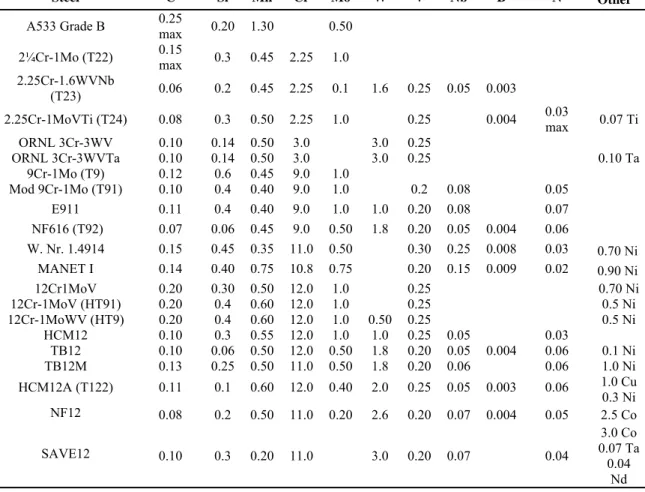
Throughout the paper, various commercial and experimental steels will be referred to, and in Table 1, the compositions of the steels to be discussed are presented for reference.
Table 1. Nominal Composition of Commercial and Experimental Steels (wt %)
Steel C Si Mn Cr Mo W V Nb B N Other
A533 Grade B 0.25 max 0.20 1.30 0.50
2¼Cr-1Mo (T22) 0.15 max 0.3 0.45 2.25 1.0 2.25Cr-1.6WVNb (T23) 0.06 0.2 0.45 2.25 0.1 1.6 0.25 0.05 0.003 2.25Cr-1MoVTi (T24) 0.08 0.3 0.50 2.25 1.0 0.25 0.004 0.03 max 0.07 Ti ORNL 3Cr-3WV 0.10 0.14 0.50 3.0 3.0 0.25 ORNL 3Cr-3WVTa 0.10 0.14 0.50 3.0 3.0 0.25 0.10 Ta 9Cr-1Mo (T9) 0.12 0.6 0.45 9.0 1.0 Mod 9Cr-1Mo (T91) 0.10 0.4 0.40 9.0 1.0 0.2 0.08 0.05 E911 0.11 0.4 0.40 9.0 1.0 1.0 0.20 0.08 0.07 NF616 (T92) 0.07 0.06 0.45 9.0 0.50 1.8 0.20 0.05 0.004 0.06 W. Nr. 1.4914 0.15 0.45 0.35 11.0 0.50 0.30 0.25 0.008 0.03 0.70 Ni MANET I 0.14 0.40 0.75 10.8 0.75 0.20 0.15 0.009 0.02 0.90 Ni 12Cr1MoV 0.20 0.30 0.50 12.0 1.0 0.25 0.70 Ni 12Cr-1MoV (HT91) 0.20 0.4 0.60 12.0 1.0 0.25 0.5 Ni 12Cr-1MoWV (HT9) 0.20 0.4 0.60 12.0 1.0 0.50 0.25 0.5 Ni HCM12 0.10 0.3 0.55 12.0 1.0 1.0 0.25 0.05 0.03 TB12 0.10 0.06 0.50 12.0 0.50 1.8 0.20 0.05 0.004 0.06 0.1 Ni TB12M 0.13 0.25 0.50 11.0 0.50 1.8 0.20 0.06 0.06 1.0 Ni HCM12A (T122) 0.11 0.1 0.60 12.0 0.40 2.0 0.25 0.05 0.003 0.06 1.0 Cu 0.3 Ni NF12 0.08 0.2 0.50 11.0 0.20 2.6 0.20 0.07 0.004 0.05 2.5 Co SAVE12 0.10 0.3 0.20 11.0 3.0 0.20 0.07 0.04 3.0 Co 0.07 Ta 0.04 Nd
2. FERRITIC/MARTENSITIC STEELS IN NUCLEAR APPLICATIONS
2.1 FISSION REACTORS
High-chromium (9–12% Cr) ferritic/martensitic steels were first considered for elevated-temperature in-core applications (cladding, wrappers, and ducts) for fast reactors in the 1970s, because of their excellent thermal properties and irradiation resistance (low swelling) relative to austenitic stainless steels.5 Sandvik HT9, nominally Fe-12Cr-1Mo-0.5W-0.5Ni-0.25V-0.2C (all compositions are in wt %), which was developed in Europe in the 1960s for the power-generation industry, was chosen as the material for
investigation in the U.S. fast reactor program. Similar types of steel were chosen in Europe and Japan (EM-12, FV448, DIN 1.4914, and JFMS in France, United Kingdom, Germany, and Japan, respectively). A large amount of information was generated in the respective nuclear programs on the properties of these steels before and after irradiation.6 Because of the high temperatures envisioned in the designs of Generation IV reactors (up to 650ºC and higher) where ferritic and martensitic steels are considered for
application, the primary emphasis here will be on the high-chromium (9–12% Cr) steels. However, in some designs, the out-of-core components (e.g., pressure vessel, piping, etc.) will operate at lower temperatures, thus providing an opportunity to use a lower-alloy steel. In commercial light-water reactors, low-alloy ferritic and bainitic steels such as A533B (nominally Fe-1.25Mn-0.5Ni-0.5Mo-0.2C, see Table 1) are used for the pressure-boundary components. Because of the higher operating temperatures of the Generation IV reactors, the pressure-boundary components will also operate at higher temperatures, thus probably negating the use of steels such as A533B. However, steels with lower chromium than 9–12% could possibly be used for this application, and such steels will be discussed.
2.2 FUSION REACTORS
When ferritic/martensitic steels were considered as structural materials for fusion reactors in the late 1970s, Sandvik HT9 was the first one considered in the U.S.
Program.6,7 Similarly, the first such steels in the programs in Europe and Japan were the steels previously considered in their fast reactor programs mentioned above.6,8 In the mid-1980s, the idea of low-activation materials was introduced into the international fusion programs.9-17 The objective was to build reactors from materials that would either not activate when irradiated by neutrons or, if activated, develop low-level radiation or the radioactivity would decay quickly, allowing for improved safety of operation as well as hands-on maintenance.9,10 Truly “low-activation” steels defined in this way are not possible, because they are limited by the decay of the products from transmutation of iron atoms. “Reduced-activation” steels, where the activity decays in a relatively short time, thus allowing for shallow land burial, as opposed to deep geological storage, were considered possible, and their development was pursued.
activation” ferritic/martensitic steels for use in a fusion energy demonstration reactor and subsequent power reactors.10-28 The development evolved from calculations to determine which elements must be replaced in conventional Cr-Mo steels to obtain a rapid decay of induced radioactivity after irradiation in a fusion reactor.9,10 Such calculations indicated that the typical steel-alloying elements Mo, Nb, Ni, Cu, and N must be eliminated or minimized to obtain “reduced activation.” Proposals for reduced-activation ferritic steels involved the replacement of molybdenum in conventional Cr-Mo steels by tungsten12,14-19 and/or vanadium.14,18
Fusion materials programs in Japan, the European Union, and the United States have developed Cr-V and Cr-W-V steels11-22 to which tantalum is sometimes added as a replacement for niobium.12,14-16,22 Steels with 7–9% Cr were favored, because of the difficulty of eliminating δ-ferrite in a 12% Cr steel without increasing carbon or
manganese for austenite stabilization. Delta-ferrite can lower toughness, and manganese promotes chi-phase precipitation during irradiation, which can cause embrittlement.18 Low-chromium (2.25% Cr) steels were also considered,11,12,18,21,22 but in the end, 7–9% Cr steels were chosen for further study and development.
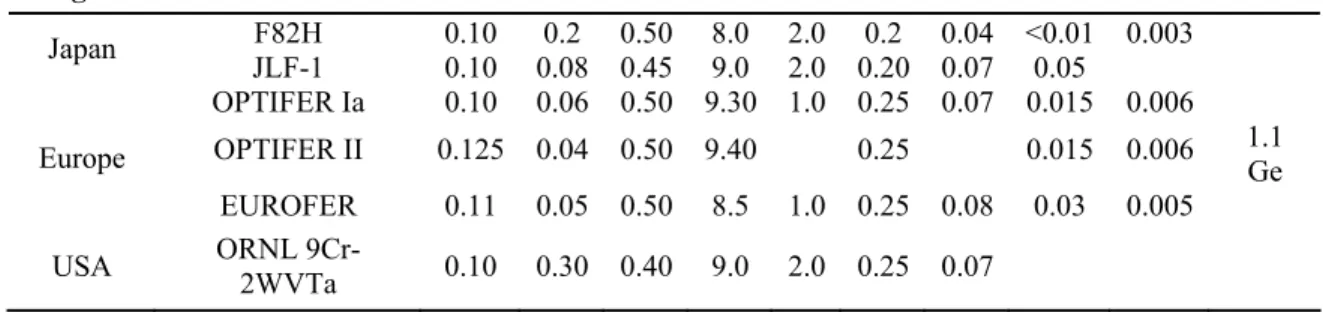
In Japan, an Fe-7.5Cr-2.0W-0.2V-0.04Ta-0.10C (F82H)15,23,24 and Fe-9Cr-2W-0.2V-0.07Ta- (JLF-1)21,25,26 steel were chosen, and in Europe, an Fe-9.3Cr-1.0W-0.25V-0.04Cu-0.10C (OPTIFER Ia) and Fe-9.4Cr-1.1Ge-0.30V-0.13C (OPTIFER II) were originally chosen and investigated.20,27 The steel with the best properties in the U.S. was ORNL 9Cr-2WVTa steel.12,17,22,28 Based on the earlier work on the reduced-activation steels, a new composition was more recently developed in Europe called EUROFER.29 Compositions of reduced activation steels presently of interest in international fusion programs are given in Table 2.
Table 2. Nominal Composition of Reduced-Activation Steels (wt %)
Program Steel C Si Mn * Cr W V Ta N B Other F82H 0.10 0.2 0.50 8.0 2.0 0.2 0.04 <0.01 0.003 Japan JLF-1 0.10 0.08 0.45 9.0 2.0 0.20 0.07 0.05 OPTIFER Ia 0.10 0.06 0.50 9.30 1.0 0.25 0.07 0.015 0.006 OPTIFER II 0.125 0.04 0.50 9.40 0.25 0.015 0.006 1.1 Ge Europe EUROFER 0.11 0.05 0.50 8.5 1.0 0.25 0.08 0.03 0.005 USA ORNL 9Cr-2WVTa 0.10 0.30 0.40 9.0 2.0 0.25 0.07
3. IRRADIATION EFFECTS ON FERRITIC/MARTENSITIC STEELS
The effect of neutron irradiation on microstructure and mechanical properties of ferritic/martensitic steels has been reviewed recently,6 and only a brief discussion of these subjects will be presented here, giving selected examples of irradiation effects on some of the steels discussed above.
3.1 EFFECT OF IRRADIATION ON MICROSTRUCTURE
High-energy neutron irradiation in a fast reactor or fusion reactor displaces atoms from their normal matrix positions to form vacancies and interstitials. It is the disposition of the “displacement damage,” measured as displacements per atom (dpa), that affects the mechanical properties (discussed below). The general progressive change in
microstructure with irradiation dose and temperature involves the agglomeration of vacancies and interstitials into voids and dislocation loops that cause swelling. Loops form below 400–450ºC. Loop size increases and loop number density decreases with increasing temperature, eventually becoming unstable.30-34 In ferritic/martensitic steels, agglomeration of vacancies can lead to void swelling up to about 500ºC.
Ferritic steels first became of interest for the fast reactor program because they are low swelling compared to conventional austenitic stainless steels (e.g., type 304 or 316 stainless steels) when irradiated in the Experimental Breeder Reactor (EBR-II) (Fig. 1). Swelling is defined as ∆V/V0, where ∆V and V0 are volume change and original volume, respectively. At the maximum swelling temperature of around 400–420ºC, less than 2% swelling was observed for HT9 and modified 9Cr-1Mo (T91) irradiated to 200 dpa in the Fast Flux Test Facility (FFTF).32
Irradiation-induced precipitate changes can also affect properties.30-32,34,35
Precipitates formed in the 9–12% Cr steels during irradiation include α΄,30,35 G-phase,35 M6C,31,34 and chi-phase.32,35 For most of the 9–12% Cr Cr-Mo steels investigated, Laves phase, which forms during thermal aging at ≈400 to 600ºC,30,32,34-36 can cause
embrittlement;36 it does not form if irradiation is above ≈600ºC.30,32,35,36
Displacement damage produced by the neutron irradiation will lead to transmutation reactions of neutrons with metal atoms to produce a new atom (usually another metal atom with a smaller atomic number) and a gas atom—helium or hydrogen. The new non-gaseous atom is generally thought not to affect the properties of the steel, although this atom is the source of the radioactivity that “activates” the structural material and
provided the impetus for the search for a “low-activation” material in the fusion program. The effect of the hydrogen was generally thought to be minimal, because most of it was expected to migrate out of the lattice at reactor operating temperatures. However, ion37 and proton38,39 irradiations have produced evidence for retention of considerable amounts of the hydrogen, but it is not expected to be an issue in martensitic steels above about 250ºC.39 For a fusion reactor, where the helium:dpa ratio is about 10, indications are that helium can affect swelling,31 although the 9–12% Cr steels still remain low swelling. The
Fig. 1. Swelling behavior of six commercial heats of ferritic/martensitic steels compared to type 316 stainless steel after irradiation in EBR-II at 420°C to ≈80 dpa (from D. S. Gelles, unpublished research).
helium:dpa ratio for ferritic/martensitic steels in most fission reactors is about two orders-of-magnitude lower and has a minimal effect on swelling.
3.2 EFFECT OF IRRADIATION ON MECHANICAL PROPERTIES
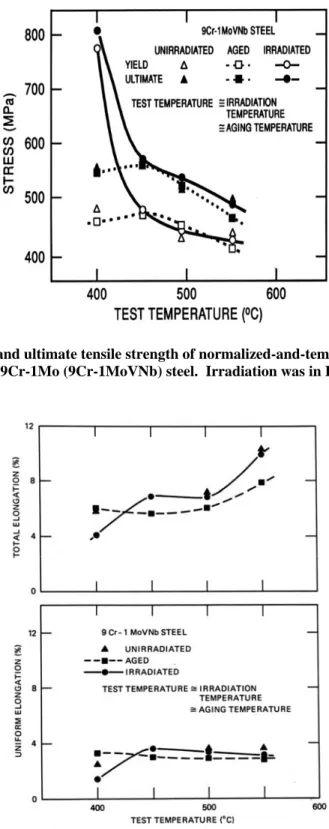
The effect of irradiation on the tensile behavior of the 7–12% Cr ferritic/martensitic steels depends on temperature.40-43 Hardening, as measured by an increase in yield stress and ultimate tensile strength (Fig. 2), occurs at irradiation temperatures up to 425–
450ºC.42 The hardening causes a decrease in ductility (Fig. 3). This irradiation hardening is caused by the high density of dislocation loops and tangles that form from
displacement damage, along with irradiation-induced precipitate changes.30,32,34,35,44 Hardening saturates with increasing fluence, and saturation occurs by 10 dpa.41 For irradiation above 425–450ºC, properties are generally unchanged (Figs. 2 and 3), but there may be enhanced softening, depending on fluence.40,41 At these temperatures, microstructures change slowly through dislocation recovery processes and precipitates coarsening. Irradiation enhances diffusion and/or precipitate redistribution, which can enhance recovery and coarsening, and thus, increase the rate of softening.
Irradiation hardening affects other properties, such as fatigue and toughness. The latter is of considerable concern and will be discussed briefly. Irradiation effects on toughness are the greatest concern for fusion applications of ferritic/martensitic steels and for pressure-vessel steels for light-water reactors. The effect is observed in a Charpy impact test as an increase in ductile-brittle transition temperature (DBTT) and a decrease in upper-shelf energy (USE),45-50 as shown in Fig. 4 for HT9 irradiated in FFTF. As seen
Fig. 2. Yield stress and ultimate tensile strength of normalized-and-tempered, thermally aged, and irradiated modified 9Cr-1Mo (9Cr-1MoVNb) steel. Irradiation was in EBR-II to 9 dpa.42
Fig. 3. Uniform and total elongation of normalized-and-tempered, thermally aged, and irradiated modified 9Cr-1Mo (9Cr-1MoVNb) steel. Irradiation was in EBR-II to 9 dpa.42
Fig. 4. Charpy curves for half-size specimens of Sandvik HT9 (12Cr-1MoVW) steel before and after irradiation to 10 and 17 dpa at 365ºC in FFTF.45
in the figure, the shift saturates with fluence (the shift is the same after 10 and 17 dpa). The magnitude of the shift varies inversely with irradiation temperature.
Although all 7–12% Cr conventional and reduced-activation steels irradiated to date to high displacement damage (>100 dpa) demonstrate this effect on toughness, there are differences among different steels, as shown in Fig. 5, where the shift in DBTT for HT9 is compared with the shift for reduced-activation ORNL 9Cr-2WVTa steel.6 The reduced-activation steel showed much less shift (about 10ºC vs. 125ºC). Part of this difference was attributed to the larger carbon concentration in the HT9 (0.2%) than the 9Cr-2WVTa (0.1%); the tantalum in the 9Cr-2WVTa has also been shown to have a favorable effect on the impact properties. Modified 9Cr-1Mo (T91) has a DBTT shift about half as large as HT9 for similar test conditions, which is still more than twice that for the 9Cr-2WVTa steel.
The effect of irradiation on the shift can be affected by the
normalizing-and-tempering treatment49 and by the processing used on the steel during manufacture.47 It has been demonstrated that part of the reduction in USE on the MANET steel can be recovered by annealing 0.5 h at 535ºC.49 Such an anneal would dissolve irradiation-induced defects (particularly tiny clusters and the dislocation loops) that lead to hardening.30
The above discussion on embrittlement concerned high-chromium steels and irradiations to high displacement damage (>1 dpa). In the pressure vessel steels of the light-water reactors (e.g., A533B) operating today, hardening and embrittlement in these low-alloy steels are observed for irradiations of <1 dpa,51 where there is little effect on the high-alloy steels.
As measured by a shift in DBTT in Charpy tests, there are indications that transmutation helium increases the embrittlement of the higher-chromium steels in a
Fig. 5. Comparison of the unirradiated and irradiated Charpy curves for one-third-size specimens of HT9 and ORNL 9Cr-2WVTa steels irradiated in FFTF at 365ºC.6
fusion neutron environment50 after irradiation in the hardening range (below ≈425ºC). However, because of the much lower amount of helium formed in fission light-water and fast reactors, such as the Generation IV designs, helium should not be a factor for this type of embrittlement in those reactors, and it will not be discussed.
Intergranular low-ductility fractures attributed to helium effects are observed in tensile tests of austenitic stainless steels for irradiation temperatures Ti / 0.5Tm, where Tm is the melting temperature (temperatures in Kelvin). Such elevated-temperature helium embrittlement in austenitic stainless steels can occur with as little as 1 appm He or less, depending on the composition, thermomechanical processing, irradiation conditions, and test conditions (temperature, strain rate, etc.). All indications are that the
4. HIGH-CHROMIUM (9–12% CR) STEELS
Despite the fact that numerous steels have been developed that are improvements over HT9, FV448, EM-12, DIN 1.4914, and JFMS, some of these compositions are still under consideration for Generation IV reactors.1 Most of these steels were developed for conventional fossil-fuel power plant applications. Since the 1970s when these steels were first considered for nuclear applications, improved steels for conventional power plant applications have been developed. Although not as yet tested under irradiation, these steels need to be considered for nuclear applications. The evolution of the new steels will now be reviewed by considering the compositional changes that have led to improved microstructures and properties.
4.1 EVOLUTION OF STEELS FOR POWER-GENERATION INDUSTRY
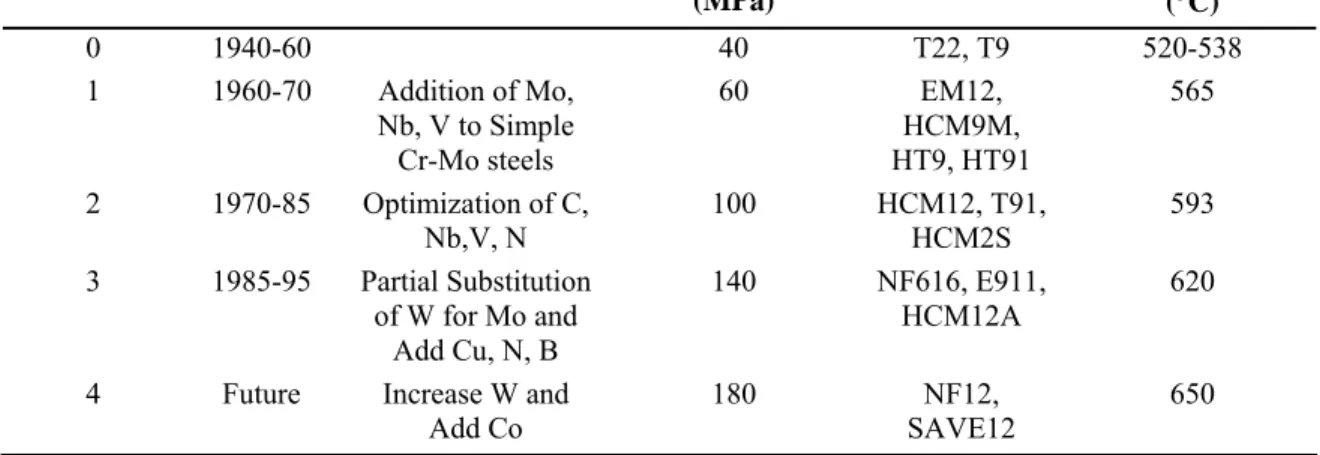
The first Cr-Mo steels were used for conventional power-generation applications in the 1920s. The 2¼Cr-1Mo (nominally Fe-2.25Cr-1.0 Mo-0.3Si-0.45Mn-0.12C) steel, designated by ASTM as Grade 22,* was introduced in the 1940s and is still widely used today. Along with Grade 22, 9Cr-1Mo (T9), and Fe-9.0Cr-1.0Mo-0.6Si-0.45Mn-0.12C composition, was an early development, the additional chromium added for corrosion resistance. Since then, there has been a continual push to increase operating temperatures of conventional fossil-fired power-generation systems. This led to the development of several “generations” of steels with improved elevated-temperature strengths. The evolution of steel compositions (Table 1), which began with T22 and T9 (zeroth
generation) with 100,000 h creep-rupture strengths at 600ºC of about 40 MPa (Table 3), has allowed for increased operating steam temperatures and pressures.2-4 Three
generations of steels have been introduced since the introduction of T22 and T9, and a fourth generation is in the development stage (Table 3).
Steels beyond the zeroth generation contained mainly 9–12% Cr for improved corrosion and oxidation resistance for elevated-temperature operating conditions. The first generation, in addition to increased chromium, involved primarily the addition of the carbide formers vanadium and niobium to T22 and T9 compositions to add precipitate strengthening. In some cases, a small tungsten addition was made for further solid-solution strengthening, in addition to that provided by molybdenum. These steels, introduced in the 1960s for applications to 565ºC, included 2¼Cr-1MoV, HT9 0.5Ni-0.5W-0.6Mn-0.4Si-0.2C), HT91 (Fe-12.0Cr-1.0Mo-0.25V-0.5Ni-0.6Mn-0.4Si-0.2C), and EM12 (Fe-9.5Cr-2.0Mo-0.30V-0.40Nb-1.1Mn-0.4Si-0.10C). These steels, which included those later considered for fast reactor applications in the 1970s, had increased 105 h rupture strengths at 600ºC of up to 60 MPa.
*Grade 22 and the other commercial steels discussed here (Table 1) are given designations by ASTM (e.g., Grade 9 is 9Cr-1Mo and Grade 91 is modified 9Cr-1Mo). The steels are further distinguished as T22 or T91 for tubing, P22 and P91 for piping, F22 and F91 for forgings, etc. The “T” designation will mainly be used in this paper, since many of the steels were developed for boiler tubing, although they are also used as other product forms.
Table 3. Evolution of Ferritic/Martensitic Steels for Power-Generation Industry
Generation Years Steel Modification
105 h Rupture Strength, 600ºC
(MPa)
Steels Max Use Temperature (°C) 0 1940-60 40 T22, T9 520-538 1 1960-70 Addition of Mo, Nb, V to Simple Cr-Mo steels 60 EM12, HCM9M, HT9, HT91 565 2 1970-85 Optimization of C, Nb,V, N 100 HCM12, HCM2S T91, 593 3 1985-95 Partial Substitution of W for Mo and Add Cu, N, B 140 NF616, E911, HCM12A 620 4 Future Increase W and
Add Co
180 NF12, SAVE12
650
Generally, the microstructures of the 9 and 12% Cr steels are designed by balancing austenite and ferrite stabilizers to produce 100% austenite during austenitization and 100% martensite during a normalizing (air cooling) or quenching treatment following austenitization, although a small amount of δ-ferrite (<1%) may be present in some cases, especially in the 12% Cr steels. Some duplex steels containing martensite and δ-ferrite have been developed and used. For example, because of the 2% Mo in the EM12 composition (Table 1), it contains about 50% δ-ferrite. Unless otherwise stated, the microstructures discussed here are assumed to be ≈ 100% martensite.
For the second generation, developed in 1970–1985, carbon, niobium, and vanadium were optimized, nitrogen (0.03–0.05%) was added, and the maximum operating
temperature increased to 593ºC. The new steels included modified 9Cr-1Mo, designated T91 9.0Cr-1.0Mo-0.0.2V-0.08Nb-0.05N-0.40Mn-0.40Si-0.10C) and HCM12 (Fe-12.0Cr-1.0Mo-1.0W-0.25V-0.05Nb-0.55Mn-0.30Si-0.03N-0.10C), which has a duplex structure (tempered martensite and δ-ferrite). These steels have 105 h rupture strengths at 600ºC of about 100 MPa. Of these latter steels, T91 has been used most extensively in the power-generation industry throughout the world.2-4
The third generation of steels was developed based on the previous generation, primarily by the substitution of tungsten for some of the molybdenum, although boron and nitrogen were also utilized. These steels, which will be discussed in detail below, are typified by NF616 (Fe-9.0Cr-1.8W-0.5Mo-0.20V-0.05Nb-0.45Mn-0.06Si-0.06N-0.004B-0.07C), designated Grade 92, E911 (Fe-9.0Cr-1.0Mo-1.0W-0.20V-0.08Nb-0.40Mn-0.40Si-0.07N-0.11C), TB12 (Fe-12.0Cr-0.5Mo-1.8W-1.0Ni-0.20V-0.05Nb-0.50Mn-0.10Ni-0.06Si-0.06N-0.004B-0.10C), and HCM12A (Fe-12.0Cr-0.5Mo-2.0W-1.0Cu-0.25V-0.05Nb-0.30Ni-0.60Mn-0.10Si-0.06N-0.003B-0.10C), designated Grade 122. They were developed and introduced in the 1990s for 620ºC operation with 105 h creep-rupture strengths at 600ºC of 140 MPa.
0.004B-0.08C), differ from the previous generation primarily by the use of up to 3.0% cobalt; they have projected 105 h creep-rupture strengths at 600ºC of 180 MPa.2-4
The reduced-activation steel compositions were patterned after existing conventional steels being used or developed at the time the reduced-activation steels were being
developed. The ORNL 9Cr-2WVTa, for example, was patterned after modified 9Cr-1Mo steel, with the molybdenum replaced by tungsten and niobium replaced by tantalum.12 As a result, most of these steels should, at best, be ranked as second generation. For the present discussion where elevated-temperature properties, especially creep, are of most importance, the steels generally have creep properties similar to those of modified 9Cr-1Mo (T91). The possible exception is the EUROFER composition, which was developed most recently;29 the composition has characteristics of third-generation steels, in that it contains boron and nitrogen (Table 2). It remains to be seen if the steel has the properties of a third-generation steel.
The remainder of the discussion in this section on ferritic/martensitic steels will focus on the present (third) and next generation of steels developed for conventional power plants. The 9Cr steels of the third generation⎯NF616 (T92), developed in Japan, and E911, developed in Europe⎯are both simple modifications of T91 (Table 1). In the NF616, half the molybdenum was replaced by tungsten, whereas in the E911, 1% W was added to the T91 composition. Both steels contain slightly more nitrogen (0.06–0.07%) than T91 (≈0.05%), and the NF616 contains a boron addition (0.004%).
As operating temperatures were increased to 600ºC, emphasis shifted from 2.25 to 9 and 12% Cr for oxidation and corrosion resistance. Chromium is a ferrite stabilizer, and when it is increased from 9 to 12%, it is necessary to balance the effect of the addition of this ferrite stabilizer with an austenite stabilizer if complete austenitization is to be achieved and a 100% martensitic structure is to be obtained. Carbon is the most potent austenite stabilizer, and it along with nickel was used in HT9 and HT91 for this purpose (0.2% C and 0.5% Ni). However, for the third-generation 12Cr steels, the carbon, in most cases, was kept to about 0.1% for better weldability, thus requiring some other austenite-stabilizing element to be added if δ-ferrite was to be avoided. The HCM12 (Table 1) is a duplex steel because it has the same composition as modified 9Cr-1Mo except it contains 3% more chromium, and there is an addition of 1% W. Both Cr and W are ferrite stabilizers, and since no austenite stabilizers were added to compensate for these additions, the microstructure contains over 30% δ-ferrite.
The TB12 steel (Table 1), an advanced third-generation 12 Cr steel, is a similar modification of T91 as NF616 with regard to the W, Mo, N, and B, and it has a duplex structure of δ-ferrite and martensite because the extra ferrite-stabilizing element
(chromium) is not offset by enough austenite-stabilizing element. It contains only 0.1% Ni to offset the 3% Cr addition (it also contains 0.05% N, an austenite stabilizer). In TB12M, up to 1% Ni is added to produce a 100% martensitic steel. HCM12A is a somewhat similar 12Cr composition to that of TB12M, but with a 1% Cu addition as the austenite stabilizer. Copper was used instead of nickel, which was generally used in the past (e.g., as it was for TB12M, HT9 and HT91), because nickel reduces creep strength (this nickel effect will be discussed below).
It should be noted that the replacement of molybdenum by tungsten was also used to develop T23 (HCM2S), an advanced 2¼Cr steel (Fe-2.25Cr-1.6W-0.1Mo-0.25V-0.05Nb-0.45Mn-0.20Si-0.003B-0.06C). The 100,000 h creep-rupture strength at 600ºC of this
steel is above that of first generation steels, and it can exceed that of T91 under some conditions.2-4 However, because of the lower chromium and, therefore, lower oxidation and corrosion resistance, its maximum operating temperature in most environments is similar to that of the second generation steels (e.g., T91).
For the fourth generation of high-chromium martensitic steels, two 12% Cr
compositions (12% Cr is believed necessary for operation above 600–620ºC), designated NF12 and SAVE12, are in the development stage in Japan (Table 1).2-4 In these steels with about 0.1% C, molybdenum has been further reduced or eliminated, and tungsten (2.6–3.0%) has been increased compared to third-generation compositions. Because of the adverse effect of nickel on creep, cobalt (2.5–3%) has been used as an austenite stabilizer instead of nickel. Another reason for using cobalt instead of nickel for a steel with 0.1% C is that nickel lowers the A1 temperature, the equilibrium temperature where ferrite transforms to austenite on heating. For the amount of nickel required for a steel with only 0.1% C to insure complete austenitization (and thus a completely martensitic structure), a lower A1 (below 700ºC) reduces the effective tempering temperatures too much (tempering must be carried out below A1 to avoid untempered martensite). The SAVE 12 also has small additions of Nd (0.04%) and Ta (0.07%).
4.2 MICROSTRUCTURE
For the Generation IV reactors, high-chromium ferritic/martensitic steels are being considered for elevated-temperature in-core applications and, in some cases, out-of-core applications where the low-alloy steels do not have sufficient corrosion resistance. The effect of microstructure on creep and the change in microstructure during elevated-temperature exposure will be discussed to demonstrate the difference between the early versions of the steels and the improvements that have been made. Generally, these steels contain 9–12% Cr, but similar conclusions probably apply if the chromium is reduced to 5–7%. This is in contrast to the 2–3% Cr steels (discussed below), which are expected to have mostly tempered bainite or bainite plus ferrite microstructures when in the
normalized-and-tempered and quenched-and-tempered conditions.
4.2.1 Normalized-and-Tempered and Quenched-and-Tempered Microstructure
For this discussion, it is assumed that the steel will be used in the normalized-and-tempered or quenched-and-normalized-and-tempered condition, and unless otherwise stated, a 100% tempered martensite microstructure (Fig. 6) is assumed for the 9–12% Cr steels. For these conditions, the strength of the 9–12% Cr steels will depend on the tempered martensite microstructure and the precipitates therein. The general microstructures (prior-austenite grain boundaries, lath/subgrain boundaries, dislocations, and precipitates) of most of the new 9 and 12Cr steels are similar, and they are similar to the
microstructures of the steels of earlier generations, as is the general change in microstructure that occurs during elevated-temperature exposure.52-60 Strengthening mechanisms in the steels will include solid-solution strengthening, dislocation-particle
Fig. 6. Optical photomicrograph of normalized-and-tempered modified 9Cr-1Mo steel showing tempered martensite microstructure.
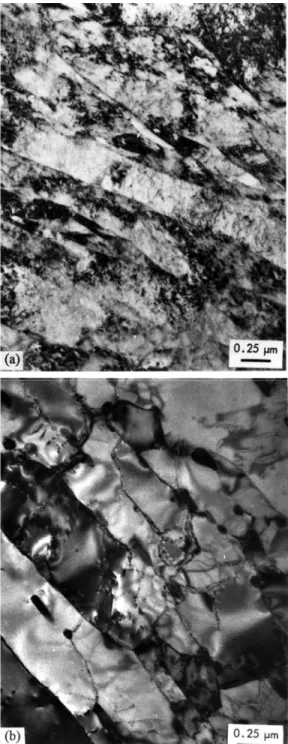
In the normalized or quenched conditions [Fig 7(a)], martensite laths with a high dislocation density are observed. When tempered, the dislocation structure recovers, and the laths become elongated subgrains with a typical average width of 0.25–0.5 µm [Fig. 7(b)]. Laths are contained within the prior-austenite grain boundaries, and they contain a relatively high dislocation density (1013–1014 m-2), depending on the tempering conditions.56 The dominant precipitates are large (60–150 nm) M23C6 particles that are mainly on lath boundaries and prior-austenite grain boundaries.59-62 If V and Nb are present in the composition, there will also be a fine distribution of small (20–80 nm) MX particles that have generally been concluded to be vanadium nitrides and/or niobium carbonitrides, depending on the composition.56 Small amounts of M2X (a high-chromium, high-nitrogen precipitate) are also found in some cases. The M23C6 helps stabilize the lath boundaries during elevated-temperature exposure, and the MX particles pin the dislocations, both processes helping to retard recovery.52-62
4.2.2 Effect of Elevated-Temperature on Microstructure
Significant microstructural changes of the 9–12% Cr ferritic/martensitic steels occur when exposed to elevated temperatures during service, thermal aging, or in a creep test at typical service temperatures of 550–650ºC, with the of rate the changes increasing with increasing temperature.52-63 Elevated-temperature exposure causes a reduction in the dislocation density, with the reduction generally greater during a creep test than for thermal aging without a stress. This is reflected in the hardness, as there is a greater reduction in hardness in the gage section of a creep specimen than in the unstressed shoulder.60-63 Along with the reduction in dislocation density, the M23C6 particles coarsen (higher coarsening rate in the gage section), allowing the martensite laths to
Fig. 7. Transmission electron micrographs of 12Cr-1MoVW (HT9) steel in (a) normalized and (b) normalized-and-tempered conditions.
transform to more equiaxed subgrains, with the subgrains being fully recovered in a crept specimen after about 30,000 h at 600ºC. Along with the coarsening of the M23C6, there is also a coarsening in the MX precipitate distribution, although these particles coarsen much more slowly than M23C6. During coarsening, changes occur in the composition of the M (e.g., enrichment in chromium in the M23C6, etc.) in the precipitates as equilibrium is approached.52-63
In addition to the coarsening of M23C6 and MX, another important effect of elevated-temperature exposure is the formation of Laves phase, (FeCr)2(Mo,W). Laves phase forms during thermal aging and creep, and at 600ºC and above, it quickly coarsens, with the coarsening proceeding more quickly under stress.52-66 Laves phase formation is important because it removes the solid-solution strengthening elements tungsten and molybdenum from solution. In thermal aging studies of NF616, HCM12A, and TB12 for 10,000 h at 600 and 650ºC, particles up to 1 µm were observed.52 The amount of
tungsten and molybdenum in the alloy determines the amount of Laves that forms, as observed for T91 and E911, where smaller amounts of Laves formed at 600ºC in T91 compared to E911, which contains 1% W and 1% Mo, compared to only 1% Mo for T91. Further, almost no Laves formed in T91 at 650ºC compared to E911, where, because of the higher tungsten and molybdenum concentrations, Laves is stable at a much higher temperature.53
After exposure for long times at elevated temperatures, a large portion of the tungsten and/or molybdenum in the steels is contained in the precipitates (Laves and M23C6). For NF616 steel containing 1.84% W,computational thermodynamics and kinetics
calculations were used to estimate that at equilibrium approximately 0.6 and 0.85% W remained in solution at 600 and 650ºC, respectively,54 which was verified with tests at 600ºC. Measurements of precipitates from thermally aged steel65,66 combined with thermodynamics calculations65 indicated that the equilibrium concentration of tungsten in solution at 600ºC will approach 0.5%, regardless of the starting concentration.
Thus, elevated-temperature exposure pushes the evolution of the microstructure toward equilibrium, which will consist of large, relatively equiaxed subgrains within the prior austenite grain boundaries. The interior of the subgrains will contain a very low dislocation density.53 Ostwald ripening produces a lower density of large M23C6 and MX precipitates than in the tempered microstructure. Although a relatively fine distribution of Laves phase forms during the elevated-temperature exposure, it quickly coarsens at 550–600ºC. This general microstructural evolution will apply to all 9–12% Cr-Mo-W-V steels containing small amounts of Nb, B, N, etc. (Table 1), and, with minor variations, to the 2–3% Cr Cr-Mo-W-V steels, although in the latter, the chromium-rich M7C3
precipitate may dominate instead of M23C6.
4.2.3 Effect of Composition on Microstructure
Although the overall microstructures of the 9–12% Cr steels are quite similar for most compositions that have been developed, it is the compositional changes made over the years that have resulted in the improved properties. Generally, the developers of the new steels have used modified 9Cr-1Mo, T91 (9Cr-1MoVNb), as a benchmark for comparison, and for this discussion, T91 will be used as a basis for comparison of the effects of the different elements that have been added to improve the properties.
4.2.3.1 Effect of Carbon and Nitrogen
Carbon and nitrogen are strong austenite stabilizers with a relatively large solubility in austenite. They have a very small solubility in ferrite, which gives rise to the
formation of carbides, nitrides, and carbonitrides, as discussed in the following sections.
4.2.3.2 Effect of Chromium
Chromium is a ferrite-stabilizing element that is generally added to steels for oxidation and corrosion resistance. It provides little solid-solution strengthening when added to iron.67 Chromium reacts with carbon to form carbides; the chromium-rich carbides usually encountered in the 2–12% Cr steels are M7C3 and M23C6. The latter carbide dominates in the 9–12% Cr steels; it forms during tempering and remains present throughout the elevated-temperature exposure. The M7C3 forms in lower-chromium steels (.7% Cr), although M23C6 may also form in these steels after prolonged exposure at elevated temperatures.68 In steels containing nitrogen, chromium-rich M2X (Cr2N) can also form.
4.2.3.3 Effect of Tungsten and Molybdenum
In developing steels beyond T91, tungsten was added to the modified 9Cr-1Mo composition (E911, HCM12) or substituted for part of the molybdenum (NF616, T23, TB12), which was based on work of Fujita et al.69 Independent of the Fujita work and at about the same time, molybdenum was replaced by tungsten for nuclear considerations in the development of reduced-activation steels for fusion applications. In this case,
tungsten was a natural choice to replace molybdenum because it was in the same column of the periodic table and behaved similarly in steel (formed similar-type carbides, etc.).12
Molybdenum and tungsten are ferrite stabilizers, and depending on other ferrite stabilizers (i.e., Cr, V, Si, Nb) and austenite stabilizers (i.e., C, N, Ni, Co, and Cu) present in a steel, the amount must be limited to avoid δ-ferrite. In the tempered condition, Mo and W are distributed between the solid solution and that incorporated in the M23C6 and MX. The two elements provide relatively high solid-solution strengthening of iron.67-72 Tungsten diffuses more slowly than molybdenum, which slows recovery and Laves precipitation processes.64-66,73 The elements generally do not form carbides or nitrides in the 9–12% Cr steels, although M2C (Mo2C or W2C) does form in low-chromium steels (e.g., Mo2C in 2¼Cr-1Mo).68
A molybdenum equivalent, Moeq, defined as Mo+0.5W (concentrations in wt. %) in solid solution, has been established, and a value of about 1.5% before thermal exposure has been found to be appropriate in one investigation.70 Because of Laves precipitation, it has been stated that at equilibrium the Moeq cannot be expected to exceed 1%.71 Exposure of the 9–12% Cr steels with Mo and/or W at a Moeq $1 at 600–650ºC has been shown to result in the precipitation of Laves-phase,54,65,66 which removes the element from solid solution and reduces solid-solution strengthening. Other work indicated that
before thermal exposure, after which precipitation during thermal aging at 600ºC for 10,000 h lowered the value to ≈0.5%.71
4.2.3.4 Effect of Vanadium, Niobium, and Tantalum
Vanadium and niobium are strong carbide, nitride, and carbonitride formers, and in the 9–12 Cr steels, they are expected to form MX, where V and Nb are enriched in the M, and X is either carbon, nitrogen, or a combination of the two, resulting in carbides (MC), nitrides (MN), or carbonitrides [M(C,N)].71 At one time it was believed that
strengthening by vanadium was caused by the formation of vanadium carbide. More recent work indicated that the vanadium-rich MX is rich in nitrogen.71 Niobium carbides are extremely stable, and it is necessary to heat to temperatures beyond normal
austenitizing temperatures for them to dissolve completely. However, undissolved niobium carbides restrict grain growth during austenitization, thus producing a refined prior-austenite grain size relative to a steel without niobium.
Tantalum is generally expected to behave like niobium. However, TEM74 and atom-probe analyses75 indicated that for the normalized-and-tempered 9Cr-2WVTa steel, 75– 90% of the tantalum unexpectedly remained in solution after normalization.
Nevertheless, the tantalum did produce austenite grain refinement,22 similar to what is observed for niobium-containing steels.
4.2.3.5 Effect of Boron and Phosphorus
Boron is a surface-active element with a low solubility in ferrite, and it is often used to increase hardenability. In many of the 9–12% Cr steels, about 0.005–0.01% B is added. It has been found to segregate to the surface of the M23C6 and decrease the rate at which the carbide can coarsen, thus stabilizing the microstructure, since the M23C6 helps pin the subgrain boundaries.58,59,76-79 Recent studies of P122 and P9277 steels using secondary ion mass spectroscopy, energy filtered transmission electron microscopy, and atom probe field-ion microscopy revealed that the boron segregates to austenite grain boundaries during cooling after austenitizing, then during the first few minutes of tempering, it is incorporated into the M23C6. Boron slowed the coarsening rate during aging and creep to 10,000 h. It was not found in any other precipitates when present at
.0.005%.77-79 However, when present at levels of 0.0092 and 0.0139% in a 9Cr-3W-3Co-VNb steel, undissolved coarse FeW2B2 was observed.79
Phosphorus can also segregate to the surface of M23C6, and a small amount of it is found in the Laves phase.58
4.2.3.6 Effect of Nickel, Manganese, and Cobalt
Nickel, manganese, and cobalt are austenite stabilizers. The main reason for adding them to 12Cr steels is to ensure 100% austenite formation (no δ-ferrite) during the austenitization treatment, thus ensuring 100% martensite when cooled.54,55,59,70,80-83 Nickel and cobalt both increase the toughness of ferritic/martensitic steels.55,81,84
Although nickel has been the element most often used to prevent δ-ferrite, indications are that it accelerates precipitate coarsening, thus lowering long-time creep
strength.55,62,84,85 Nickel promotes the formation of M6C,55,84 thus destabilizing the M23C6, which stabilizes the subgrain structure. Manganese is a weaker austenite stabilizer than nickel, and it has a similar effect on carbide coarsening.70,72
In one investigation, cobalt was found to be a weaker austenite stabilizer than nickel in preventing δ-ferrite formation in a 12% Cr steel (2 wt. % Co was required compared to 1% Ni),81 while in another investigation, little difference was found between the two.85 Cobalt and nickel have similar weighting in some nickel-equivalent equations.72,80 Cobalt has been credited with being a solid solution strengthener86 and beneficial to creep strength by some investigators.73 However, this is contrary to earlier work that indicated cobalt contributed little to solid-solution strengthening in binary Fe-Co alloys.67,72 Nickel and manganese have been shown to have a much stronger solid-solution strengthening effect in iron than cobalt.67 Cobalt has also been grouped with Ni and Mn as having a negative effect on precipitate coarsening and creep strength by some investigators,87,88 who suggested Pd, Rh, Pt, and Ir be used as austenite stabilizers, since they concluded that elements that raise the melting point of the steel strengthen it.88 Cobalt does have one advantage over nickel and manganese in that it does not lower the A1.80
4.2.3.7 Effect of Copper
Copper is an austenite-stabilizing element, but it is different from Ni, Mn, and Co in that it has a low solubility in ferrite.58,59 It can remain in solution during a normalization or quenching treatment, but it will precipitate during tempering and aging. Copper precipitation can strengthen the steel and can play a role in the nucleation of other phases during thermal aging or creep. Several investigators have concluded that copper
precipitates increase elevated-temperature strength,4,58,75,89 but other investigators
grouped copper with nickel and cobalt as accelerating precipitate coarsening.88 A recent study of P122 concluded that the copper precipitates contribute to the production of,77 “a finer distribution and a faster growth time of Laves phase precipitates, which should be beneficial for the creep strength.”
4.3 CREEP AND MICROSTRUCTURAL EVOLUTION
Creep-rupture curves (graphs of the log of stress vs. log of time to rupture) are commonly plotted as straight lines. However, for many materials this relationship only applies to short-time tests, and data deviate from a linear relationship at long times and low stresses. This is true for the Cr-Mo-W-V-type steels being discussed here.65,84,89-92 Thus, linear extrapolation of data from high stresses and short rupture times to low stresses and long rupture times will not produce reliable results. That is, the extrapolated rupture life will be an over estimate of the actual value.
Creep tests on Cr-Mo-W-V-type steels tested at low stresses and out to long rupture times have shown that the creep-rupture curves have a sigmoidal shape (Fig. 8).65,84,90 The change in shape with increasing rupture time (lower stress) is indicative of a change in microstructure brought on by stress and elevated-temperature exposure.
Fig. 8. Creep-rupture curves for heats of 0.5 Mo steels showing the sigmoidal shape of the curves for tests at 450, 500, and 550ºC.90
To explain sigmoidal behavior, it was postulated that every steel has an “inherent” creep strength (Fig. 9).90 This is essentially the rupture strength of the equilibrium microstructure at the creep temperature. For the steels under discussion, the equilibrium microstructure consists of coarsened M23C6, MX, and Laves-phase precipitates in a recovered matrix of large subgrains containing a low dislocation density, with the precipitates in equilibrium with the elements in solid solution. At this stage in the microstructural evolution, it can be assumed that the large precipitates and low
dislocation density will have only a minimal effect on creep strength. Therefore, inherent strength is determined primarily by solid-solution strengthening. The rate of approach to the inherent strength will increase with an increase in temperature.
As proof of an inherent strength, Larson-Miller plots of data for low-alloy Cr-Mo steels (0.5Cr-0.5Mo, 1Cr-0.5Mo, 2.25Cr-1Mo, etc.) were cited.90 Creep-rupture tests on these steels showed large data scatter at high creep stresses and low temperatures, but as the stress decreased and the temperature increased, the scatter was greatly reduced (Fig. 10). Larson-Miller plots of Vickers hardness of crept specimens of 12Cr-1Mo-1W-0.3V and modified 9Cr-1Mo steels were presented as a vivid illustration of this effect (Fig. 11).90 The 9Cr steel was significantly harder than the 12Cr steel for short time/high temperature tests (low Larson-Miller parameter), but the two had similar hardness values for high Larson-Miller parameters. Thus, despite differences at high stresses due to different compositions, once hardening due to the high number density of dislocations and fine precipitate distribution of the original microstructure ceased to have a dominant effect on strength, the solid solution strength at equilibrium approached a similar value for the different steels (chromium is not a potent solid-solution strengthener).
Fig. 9. Schematic illustration taken from Kimura et al. for an explanation of the mechanism for sigmoidal creep-rupture curves.90
A similar observation and conclusion was made for 2¼Cr-1Mo steel tested in the normalized-and-tempered (bainitic microstructure) and annealed (mainly polygonal ferrite and pearlite microstructure) conditions.91 Although the normalized-and-tempered steel was stronger at short times because of the higher dislocation density and finer precipitates, the properties approached a common curve as stress was lowered or
temperature increased. This observation was also attributed to the approach of a common equilibrium structure for 2¼Cr-1Mo steel, which is determined primarily by the solid-solution strength, regardless of the starting strength and microstructure.91 In this case, as in many cases, sigmoidal curves were not observed. Data were fit by lines that appeared to merge as the stress decreased. In most cases, the sigmoidal shape will not be observed because of limited data and/or the lack of long-time data. Instead straight lines will be assumed, or there will appear to be a gradual change in slope in the creep-rupture curve, indicating that the transition to the inherent strength stage is beginning, as illustrated in Fig. 12 for E911.92 (Note in Fig. 12 how curvature in the creep-rupture curves increases with test temperature.)
Fig. 10. Larson-Miller plots for creep-rupture stress of low-alloy Cr-Mo steels that show a large variation for the different steels at low Larson-Miller parameters (short-time tests, low
temperatures), but differences narrow at high Larson-Miller parameters (long-time tests, high temperatures).90
Fig. 11. Larson-Miller plots for Vickers hardness of creep specimens of 12Cr-1Mo-1W-0.3V and 9Cr-1Mo-V-Nb steels that show how the steels have a large difference in hardness for low Larson-Miller parameters but similar values for high parameters.90
Fig. 12. Creep-rupture curves for E911 steel showing the downward curvature for low-stress tests at high temperatures.92
If it is accepted that at long rupture times at high temperature―low stresses― creep-rupture life of any steel is ultimately determined by the inherent strength, which depends basically on the solid-solution strength, then there are obvious ways to increase the useful elevated-temperature strength. The difference in creep-rupture strength of different steels at high stresses (short rupture times) will be determined by differences in dislocation density, dispersion strengthening due to precipitates, and solid-solution strengthening. Differences in any of these three processes could lead to differences in rupture life at a given stress. The level of the short-time strength will be determined by the composition and heat treatment (i.e., different tempering treatments lead to different strengths). Therefore, one way to increase the strength is to develop a combination of heat treatment and composition that increases the initial strength and prolongs the early stage of the sigmoidal curve. Increased creep-rupture strength is also promoted by a prolonged transition to the final stage. It does not necessarily follow that a steel with high strength at high stresses (short time) will also have a long transition period, since the transition will be determined by the stability of the microstructure. Finally, the third strengthening possibility is to produce a steel that has a high inherent creep strength (high solid-solution strengthening). All of these procedures have been cited by developers of the advanced martensitic steels as reasons for improved properties.
Based on the discussion of the microstructural evolution when steels are exposed at high temperatures, the dislocation structure begins to recover, and the precipitate structure established during tempering begins to coarsen. With the coarsening of the M23C6 precipitates, they are no longer able to stabilize the subgrains, and they begin to grow. Likewise, the coarsening of the fine MX precipitates, although much slower under
coarsening of the M23C6, but Laves coarsens rapidly,93,94 thus eliminating its initial strengthening effect.
Work by Ennis et al.56 on 12Cr1MoV, modified 9Cr-1Mo (P91), and NF616 (P92) demonstrated the effect of some of these microstructural elements. Creep-rupture curves for the steels (Fig. 13) indicated that the P91 and P92 had similar rupture stresses at short times, both of which were larger than for 12Cr1MoV. The difference between P91 and P92 increased with rupture time (the longest rupture time mentioned was 17,551 h). Literature data for 9Cr-1Mo (P9) in the figure show it to have significantly lower creep-rupture strength than the other steels.
Fig. 13. Creep-rupture curves for P9, P91, P92, and 12Cr1MoV steels tested at 600ºC.56 As normalized and tempered, the 12Cr1MoV, P91, and P92 steels had similar dislocation densities (7–7.5 x 10¹⁴ m-2) and mean subgrain sizes (0.35–0.42 µm)
(Fig. 14).56 The average diameter of the M23C6 particles were estimated at 170, 99, and 90 nm for the 12Cr1MoV, P91, and P92, respectively; average diameters of the smaller MX carbides were estimated at 63, 16, and 22 nm, respectively. The P92 also contained complex M(C,N) particles (78 nm) that were not present in the other steels, and Laves phase precipitated in this steel after testing for longer times at 600 and 650ºC.
The different behavior of the four steels in Fig. 13 can be attributed to differences in chemical composition (Table 4 gives nominal compositions of important elements) and the subsequent different microstructures and microstructural evolution that resulted therefrom. The P9 is expected to have the lowest strength, since it contains no strong carbide former (i.e., Nb, V, etc.). Thus, only the large globular M23C6 precipitates are expected to form during tempering, and this precipitate morphology has little
inherent strength. In the case of the 12Cr1MoV steel, M23C6 is also the dominant precipitate, because although the presence of vanadium gives rise to some MX, there is less MX present than in a steel like P91 and P92.95,96 One difference between the
12CrMoV and the other steels is that the 12Cr steel contains about 0.20% C. As a result, considerably more M23C6 forms than in the other three steels that contain 0.1–0.12% C. For example, HT9 steel, a 12Cr steel which also contains 0.2% C, was shown to contain over twice as much precipitate (mostly M23C6) as modified 9Cr-1Mo steel (0.1% C).96 It is the larger amount of M23C6 precipitate and the presence of some MX that gives the 12CrMoV an advantage over P9.
Table 4. Nominal Compositions of Steels for Microstructural Studies56
Element P9 12Cr1MoV P91 P92 C 0.12 0.20 0.10 0.12 Cr 9.0 11.60 8.10 9.10 Mo 1.0 0.90 0.90 0.50 W 1.80 V 0.25 0.20 0.20 Nb 0.07 0.06 B 0.003 N 0.05 0.04 Ni 0.70 0.30 0.10
The difference between P91 and 12CrMoV and P9 involves the presence of nitrogen and niobium in P91. These elements along with the vanadium promote fine MX
precipitates that initially stabilize the dislocation and subgrain structure. Finally, the superiority of the P92 over P91 has to be attributed to the tungsten and boron present in the P92 and not in P91, since this is the main difference in the two steels. Minor differences in nickel (0.06% in P92 and 0.33% in P91) and Si (0.02 in P92 and 0.4 in P91) may play a secondary role in the differences. Nickel could play a role in the
difference, since it has been observed to cause an increase in the rate of coarsening of the M23C6 precipitates, but the effect of nickel has been seen generally for higher nickel concentrations,55,84,85 although in one study an effect of 0.4% Ni was observed.97
Boron makes a difference in the creep behavior of P92 and P91 because it has been found to lower the rate of M23C6 precipitate coarsening, which, in turn, slows recovery due to subgrain coarsening.58,59,73,77,80,82,88,89,98-102 In one study where boron-alloyed variants of Cr-Mo-W-V steels were tested, the boron-containing steel exhibited the greatest stability in the low-stress (long-time) regime.73 Another mechanism for a boron effect, termed “latent creep resistance,” has been proposed,61 where it was suggested that boron causes precipitation and dissolution of MX to occur continuously during creep. Precipitates are envisioned to form on and pin the dislocations. When the dislocations pull away from the MX precipitates, they dissolve, after which new precipitates form on other dislocations, and the process is repeated continuously.61
Some investigators have attributed the superiority of tungsten-bearing steels to an artifact of the extrapolation from short-time tests.61 That is, for the short-time tests (.10000 h), the tungsten still contributes to the solid-solution strengthening, and precipitation hardening by Laves phase contributes to the strength, even though Laves removes tungsten from solution. In a study where experimental heats containing Mo and
W were creep tested, it was found that all the tungsten-alloyed heats showed high
strength below 10000 h, after which the tungsten-containing steels declined to the level of P91.61 In another study, a 1% W addition to a 10.50% Cr steel containing 1% Mo
showed the steel with tungsten to have improved creep properties, although in another study, the tungsten was concluded not to have an added effect as a solid-solution strengthener.
Laves-phase precipitation caused by the presence of tungsten has an initial strengthening effect, although this is a short-lived effect, since Laves coarsens
quickly.61,71,82 For P92 and P91, a greater effect of Laves on the P92 might be expected, because of the larger molybdenum equivalent before thermal exposure⎯approximately 1.4 and 0.9 for P92 and P91, respectively. 56 It has been suggested that tungsten and molybdenum additions are not effective beyond a Moeq of 1%, because they are solid-solution strengtheners, and they are removed from solid-solution by the formation of Laves phase and M6C by about 104 h.71 Another investigation concluded a Moeq of 1.5 was optimum.65 A 2% W composition similar to P92 was concluded to be optimum in
another study,100 where it was found that increasing chromium from 9 to 12% accelerates Laves-phase formation, because higher chromium can replace tungsten in the M23C6.
Solid-solution strengthening by tungsten has been cited most often as the reason tungsten-containing steels are superior to those with just molybdenum,56,66,70,82,87
although molybdenum is also known to be a potent solid-solution strengthener.67,72,80 It may be that the lower diffusion coefficient for tungsten means that the equilibrium tungsten concentration in solution just takes longer to be reached. If so, this difference should give the P92 in Fig. 13 longer short-time and transition stages in the sigmoidal creep-rupture curve than the P91. The other advantage in the short time is the Laves phase that appears in the P92 and gives short-time strengthening. The boron effect discussed above also provides a short-time advantage for P92.
The difference between P91 and P92 is explained by the Ennis et al.56 to involve two effects. The first effect is a slower recovery of the martensitic structure of P92, which was illustrated by the change in dislocation density as a function of creep-test duration, with the density for the P92 decreasing more slowly (Fig. 15).56 They attribute this to tungsten increasing the A1 temperature, although it could also be attributed to the slower diffusion of tungsten versus molybdenum. Obviously, the figure indicates that the dislocation densities in the two steels are approaching a common value somewhere beyond 10,000 h. The second enhancement was attributed to strengthening by Laves phase, which is transitory.56 Therefore, it is probably the short-time stage being seen in the tests illustrated in Fig. 13, which indicates that the difference in the two steels is significant under the test conditions illustrated. However, long-term tests are required to determine whether this advantage persists (no creep data were presented, but it is not clear if tests beyond 10,000 h were conducted).56
There is no information on the length of the transition region of the creep-rupture curve or how it will differ for different steels. This transition must be caused mainly by precipitate coarsening, dislocation recovery, and loss of solid-solution-hardening elements from solution. If the initial linear and the transition regimes of the sigmoidal creep-rupture curve do not last the service lifetime, then the inherent strength of the steel
Fig. 15. Dislocation density for P91 and P92 as a function of exposure time in a creep test at 600ºC.56
will ultimately determine the conditions at which the steel can be used (i.e., rupture behavior at >300,000 h, the expected lifetime of power plants).
The question then becomes: Is the inherent creep strength of the P92 significantly greater than that of the P91 under these conditions? Since the inherent creep strength is essentially the strength of the solid-solution, it is not clear that there would be a
significant difference in the two steels. Although tungsten has been credited with adding solid-solution strengthening to the steels at equilibrium,66,70,89 only 0.5–0.8% W will remain in solution,52,66,71 and its solid-solution strengthening effect may therefore be small.101 Furthermore, molybdenum also produces solid-solution strengthening, so it is not clear that there should be a large difference in the inherent creep strength of the two steels⎯especially since less Laves may form in the P91, thus perhaps leaving the two steels with similar amounts (atom percent) of solid-solution strengthening elements.
The fourth-generation steels, NF12 and SAVE12, have been developed based on the experience of the previous generations. Both are 11Cr steels, with the major
compositional changes involving more tungsten (2.6% in NF12 and 3.0% in SAVE 12), less molybdenum (0.2% in NF12 and 0% in SAVE 12), and the addition of cobalt (2.5% in NF12 and 3.0% in SAVE 12). The NF12 contains 0.004B, 0.06% N, and 1.0% Cu, while the SAVE 12 does not contain boron and only 0.04% N; it also contains 0.07% Ta and 0.04% Nd. The tantalum and neodymium are added because they are expected to form fine carbides.4 The copper used to stabilize the austenite will precipitate, and it can affect the strength and the nucleation of the Laves phase, as discussed above.
The exact effect of cobalt on mechanical properties still appears to be an open question, as discussed above. It does not contribute to solid-solution strengthening in iron binary alloys,67,72 and it may act like nickel with respect to the coarsening of the M23C6 88 or, perhaps at best, does not affect the coarsening. If this is the case, then its function might be solely as an austenite stabilizer that does not lower the A1 as much as nickel and improves the toughness as nickel does. In recent creep tests, the creep-rupture