Human Reproduction vol.11 no.4 pp.9O3-9O7, 1996
Impact of the in-vitro fertilization process on emotional,
physical and relational variables*
Jacky Boivin1-3-4 and Janet E.Takeftnan2
'institut de M6decine de la Reproduction de Montreal, Concordia University, Montreal, H3G 1M8 and 2Institut de Me"decine de la
Reproduction de Montreal, Montreal, H3P 3H5,Canada
3Present address: School of Psychology, College of Cardiff,
University of Wales, PO Box 901, Cardiff CF1-3YG, UK "•"To whom correspondence should be addressed
The purpose of the study was to examine the stress associated with in-vitro fertilization (TVF) concurrently with other physical and relational variables, and to compare these reactions with those reported during a menstrual cycle without treatment Women (n = 20) completed a daily symptom checklist for one complete menstrual cycle without treatment and one complete IVF cycle. The check-list included items related to stress, optimism, physical discomfort and marital and social relationships. Daily ratings during IVF were compared with those obtained during the no-treatment menstrual cycle. IVF was associ-ated with more stress, optimism and physical discomfort than a menstrual cycle without treatment, and with greater changes to marital and social relationships. The pattern of results shows that the stress associated with IVF is less salient when examined in the context of reactions in other areas of functioning. The findings suggest that the emotional impact of IVF might be less pronounced during the actual treatment process than is generally assumed from studies focusing on the impact of treatment failure. Variables such as optimism and physical discomfort which have previously received less attention in the literature were significantly affected by IVF treatment
Key words: infertility/in-vitro fertilization/stress factors
Introduction
In-vitro fertilization (TVF) and embryo transfer treatment is considered to be one of the most demanding options available to infertile couples (Koptizke et al, 1991). Although much attention has been directed at the reactions of patients after IVF failure, relatively little is known about the impact of treatment during the actual IVF process. Similarly, most studies have focused on the stress associated with IVF, with less attention being paid to its effects on marital and social relationships. The purpose of our study was to examine the
*This work was presented at the Annual Meeting of the Canadian Fertility and Andrology Society, Montebello, Canada, September 2 0 -23, 1995.
stress of IVF in the context of its physical and relationship effects using a prospective controlled design.
Given the complex nature of IVF and its significance to patients, it is reasonable to postulate that treatment would affect women in a number of ways. However, the only prospective studies available to date have focused primarily on anxiety. Newton and Yuzpe (1992) assessed anxiety at four time-points during IVF and found a slight increase over these measurement days. In contrast, Demyttenaere et al (1991) found that anxiety increased significantly before oocyte retrieval and embryo transfer, but returned to baseline values immediately after these procedures had been performed. These findings indicate that there may be variations in anxiety over the course of IVF, with fluctuations occurring in response to specific interventions.
The results of retrospective studies suggest that emotional reactions such as anxiety represent only one aspect of a woman's response to IVF. Several studies (Leiblum et al, 1987; Mahlstedt et al, 1987) have found that couples report experiencing a surge in optimism after a successful embryo transfer. Leiblum et al. (1987) also reported that physical discomfort, specifically breast tenderness and abdominal pain, was significant and most pronounced at the time of oocyte retrieval. The impact of treatment on social relationships is less clean some have suggested that patients actively avoid their social network during treatment (Dennerstein and Morse, 1985), while others suggest that patients actively seek out support from family members, especially during the waiting period after transfer (Callan and Hennessey, 1988). Callan and Hennessey (1988) have also emphasized the support role of clinic staff for patients undergoing treatment. Finally, a number of studies have reported that successful embryo transfer fosters feelings of closeness and intimacy between the spouses (Leiblum et al, 1987; Seibel and Levin, 1987). The results of these studies suggest that emotional reactions to IVF need to be examined in the wider context of a woman's varied response to treatment In addition, from these studies it seems clear that multiple measurement time-points would be required to assess the reactions to IVF because these seem to vary as a function of the specific stage of treatment
A number of studies have found that what is most stressful about IVF is not the medical procedures per se, but the fact of trying to become pregnant and not succeeding (Leiblum
et al., 1987; Baram et al., 1988; Callan and Hennessey, 1988;
Connolly et al, 1993). Consequently, the types of reaction women experience during treatment, particularly emotional reactions, may be similar to those they experience when trying to conceive naturally. Hence, controlling for the types of reaction that infertile women experience during a menstrual 903
cycle without treatment could provide a different basis from which to interpret the reactions experienced during FVF.
The purpose of our study was to examine (i) the stress experienced during IVF and (ii) the impact of treatment on physical and relational variables. Women were interviewed prior to treatment. Then they recorded, on a daily basis, the extent to which they experienced a number of emotional, physical, marital and social reactions. Daily reports during IVF were compared with those obtained from the same women during a previous menstrual cycle without treatment.
Materials and methods
Sample
The study sample consisted of 20 women about to begin a trial of IVF at a private infertility clinic in Montreal, Canada. While patients were not paid for their participation in the study, the fee for the mandatory psychological evaluation prior to IVF was waived. The selection criteria for the study were that women: (i) met the medical admission requirements for an IVF cycle; (ii) had never attempted IVF or a related reproductive technology (e.g. gamete intra-Fallopian transfer); (iii) underwent one complete IVF cycle; and (iv) spoke and understood English or French sufficiently to be interviewed and complete study materials in either language.
A total of 72 women were recruited for the study. Of these, 52 were not invited to participate in the study for the following reasons: 27.8% (n = 20) could not provide a no-treatment menstrual cycle of monitoring prior to IVF; 30.6% (n = 22) did not complete the IVF cycle for various reasons [i.e. cancelled protocol (n = 8), not accepted for IVF (n = 3), withdrew from IVF (n = 7), pregnant on waiting list (n = 3) or suffered from hyperstimulation (n = 1)]; and 13.9% (n = 10) did not complete the psychological study [i.e. withdrew from the study (n = 6) or did not complete the study materials as required (n = 4)]. The mean scores for demographic and medical variables for women who did not complete the psychological study were not markedly different from those who completed it.
The demographic and medical profiles of the final sample (n = 20) were comparable with that reported for women initiating IVF at other fertility clinics (Mazure et al., 1992). On average, women were in their mid-30s (mean ± SD, 33.6 ± 3.9 years), had some college education (70%) and were employed primarily in secretarial (55%) or managerial (20%) positions. Women had been married to or living with their partners for ~7 years (mean ± SD, 7.46 ± 3.50). Most women had primary infertility (70%) and a diagnosis of tubal infertility (50%). Women had been infertile for 4 years (mean ± SD, 4.25 ± 1.50) and receiving treatment for ~2 years (mean ± SD, 2.20 ± 1.3). In all, 45% of the women had had surgery and/or medication as infertility treatments, and 30% had had one or more cycles of artificial insemination using their husband's spermatozoa.
Measures
Women were interviewed prior to IVF and then completed the daily monitoring form for one menstrual cycle without treatment (~30 days) and one IVF cycle (~45 days). During the interview, infonnation about each patient's demographic situation (i.e. age, education) and reproductive history (i.e. years infertile, years in treatment) was collected. The interview was conducted as part of patient screening prior to IVF and took, on average, ~1 h to complete (a more detailed presentation of the interview data can be found in Boivin and Takefman, 1995).
The daily record-keeping sheet (Takefman et aL, 1992) was the
instrument used to assess reactions during the no-treatment cycle and the IVF cycle. The daily record-keeping sheet consisted of two sections. The first section contained negative emotional (e.g. nervous) and physical reactions (e.g. breast tenderness), while the second section contained items related to marital and social relationships. The psychometric properties of the daily record-keeping sheet have been reported previously (Takefman et al, 1992; Boivin and Takefman, 1995). For the purposes of this study, the stress score consisted of the average of 11 emotional descriptions (i.e. nervous, anxious, moody, pessimistic, angry, frustrated, tense, irritable, hassled, touchy/sensitive, stressed), while physical discomfort consisted of the average of four physical descriptions (i.e. breast tenderness, ovarian pain, abdominal discomfort and bloating). Intimacy with the spouse consisted of the average of two items: 'affection with spouse' and 'discussion with spouse', while 'optimism about pregnancy', 'received social support' and 'fatigue' were based on single items. The daily record-keeping form is available upon request.
Each daily record-keeping sheet contains space for 7 days of daily monitoring (i.e. seven columns). For each day of the two cycles, women filled out the day of the cycle, the date, whether they had sexual intercourse that day (no-treatment only) and then rated the extent to which they had experienced each of the reactions listed on an analogue scale ranging from 'none' to 'severe' (or 'a great deal'). For the IVF cycle, women also indicated whether they had received a medical intervention that day [e.g. human menopausal gonadotrophin (HMG), oocyte retrieval] based on a list of treatment codes provided on the sheet.
Procedure
Physicians discussed the study with patients. Those interested scheduled an appointment with the psychologist During the interview the objectives of the study were explained and women signed a consent form. At the end of the interview, the day of the woman's current menstrual cycle and the anticipated date of IVF were recorded so that women could be informed when to begin daily monitoring using the daily record-keeping sheet For the no-treatment cycle, women completed the daily record-keeping sheet from the first day of menstrual bleeding until the first day of the following menstrual cycle. For the IVF cycle, women monitored from the first day of ovarian stimulation until the day before the pregnancy test. Women completed the daily record-keeping sheet on a daily basis and mailed it back every week in the stamped, pre-addressed envelope provided. All women completed the no-treatment cycle prior to IVF. On average, women completed the no-treatment month of monitoring 1—2 months (mean ± SD, 2.15 ± 1.18) before IVF, with a range of 1-4 months.
Data analysis
To make daily scores from the no-treatment menstrual cycle compar-able with those from the IVF cycle, average scores were computed to represent each phase of the menstrual cycle: follicular, ovulatory and luteal. The daily scores obtained during the no-treatment menstrual cycle were determined by the day of menstrual bleeding. The ovulatory phase was identified by counting back 14 days from the first day of menstrual bleeding. Days 13-15 were considered to be the ovulatory phase. Days preceding this phase were considered to be follicular while those days between ovulan'on and subsequent menstrual bleeding were considered to be luteal. The stages of IVF corresponding to the menstrual cycle phases were, respectively, ovarian stimulation, oocyte retrieval-embryo transfer and the 2 week waiting period. The various stages of IVF were identified by the treatment codes that women indicated on their monitoring forms. All average scores were computed on an individual basis because the number of days within each stage
Reactions to IVF
varied among women. The average phase scores served as dependent measures in the analyses.
The statistical analyses consisted of a multivariate analysis of variance (MANOVA) and a series of 2 (cycle: no-treatment, IVF)X3 (phase: follicular, ovulatory, luteal) analyses of variance (ANOVA) with both factors as repeated measures. Because the assumption of sphericity was violated in these analyses, conservative Greenhouse-Geisser adjusted probability values (Stevens, 1992) were reported. Significant interactions were followed up with simple effects tests computed on separate eiror terms. The magnitude of factor effects (i.e. effect size) was assessed by partial f\2 (Stevens, 1992). Partial
•n2 is based on the F-ratio for a given effect and expresses the relative
magnitude of a factor effect compared with other effects in the ANOVA model.
Results
A MANOVA was computed assessing all six dependent variables (i.e. stress, optimism, physical discomfort, fatigue, intimacy and social support) simultaneously. The multivariate F-tests with Pillai's criterion (Tabachnik and Fidell, 1989) were significant for the main effects of cycle [Pillais = 0.805, approximate F(6, 14) = 9.67, P < 0.001], phase [Pillais = 0.910, approximate F(12, 8) = 6.75, P < 0.006] and the
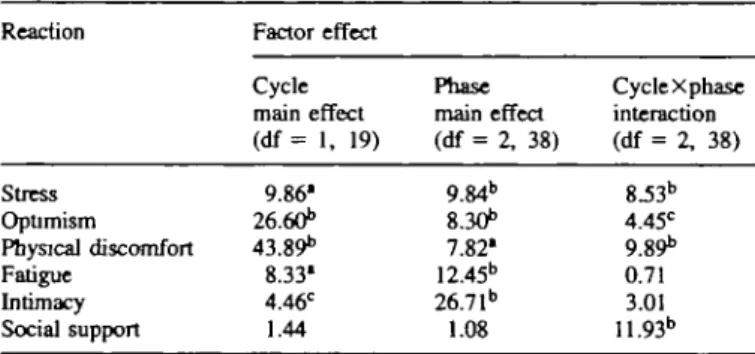
liable L The magnitude of factor effects as a function of type of reaction
Reaction Stress Optimism Physical discomfort Fatigue Intimacy Social support Factor effect Cycle main effect (df = 1, 19) 9.86' 26.6Ob 43.89b 8.33' 4.46C 1.44 Phase main effect (df = 2, 38) 9.84" 8.30" 7.82* 12.45b 26.71" 1.08 CycleXphase interaction (df = 2, 38) 8.53" 4.45C 9.89b 0.71 3.01 11.93" Values presented are F-ratios. df = degrees of freedom.
•/» < 0.01. bP < 0.001. CP < 0.05.
cycle X phase interaction [Pillais = 0.911, approximate F(12, 8) = 6.87, P < 0.005]. Table I presents follow-up ANOVA results for the multivariate analysis of variance. F-ratios are presented as a function of the type of factor in the ANOVA model and the type of reaction (e.g. stress, optimism). The main effects of cycle and phase were qualified by a significant cycle X phase interaction for all variables except intimacy and fatigue. To identify the source of the interaction for each reaction, the simple main effect of cycle at each phase of the cycle was computed. In these follow-up tests, mean cycle scores were compared at each phase of the cycle. To reduce the number of graphs necessary to illustrate these cycle differences, mean difference scores rather than raw scores are plotted in Figure 1 for each reaction showing a significant interaction. On this figure, zero represents the point at which there was no difference between the severity of reactions reported during IVF and the menstrual cycle without treatment. Scores plotted above this zero line indicated that the reaction was more extreme during IVF, while scores plotted below this line indicated that the reaction was more extreme during the no-treatment menstrual cycle.
As shown in Figure 1, the interaction for stress was caused by differences in stress between the no-treatment and IVF cycle which occurred only during the retrieval-transfer stage [f test, f(19) = 3.88, P < 0.001] and the waiting period [f(19) = 3.80, P < 0.001]. For optimism and physical discomfort, the interaction was because the magnitude of cycle differences was greater for the stage of retrieval-transfer than for the other stages of treatment. Thus women reported more optimism and physical discomfort throughout IVF, but more so during the last two stages. Finally, for social support the interaction was the result of women reporting fewer social contacts than usual at the time of retrieval-transfer [/(19) = 2.17, P < 0.05], while they reported more contacts during ovarian stimulation [/(19) = 2.05, P < 0.05] and the waiting period W19) = 4.90, P < 0.01] than the corresponding stages of the no-treatment cycle.
The main effect of cycle for the fatigue variable showed that overall women reported being more tired during IVF than
8
V5
OvuUtory/ retrieval-trinsfej Phase/stage Lutul/ waiting periodFigure 1. Mean difference between in-vitro fertilization and no-treatment daily scores as a function of the phase/stage of the cycle and the type of reaction.
during the no-treatment menstrual cycle. The main effect of phase for this variable revealed that for both cycles women reported more fatigue during the follicular (stimulation) and ovulatory (retrieval—transfer) phases than during the luteal (waiting period) phase [r(19) = 3.01, P < 0.01] of the cycle. For the intimacy variable, the cycle main effect revealed that women reported overall more intimacy with their spouse during IVF than during the menstrual cycle without treatment The phase main effect for this variable indicated that for both cycles intimacy was greatest at the time of ovulation (retrieval-transfer) compared with the follicular [r(19) = 3.37, P < 0.01] or luteal [7(19) = 6.53, P < 0.001] phase.
Partial T|2 values showed that, overall, treatment had a greater
impact on physical discomfort (r\2 = 0.70) and optimism (T|2 =
0.58) compared with its effect on stress (T|2 = 0.34), fatigue
Ol2 = 0.19) and social support (r\2 = 0.07). Thus, 70 and
58% of the variability in daily physical discomfort and optim-ism scores respectively could be accounted for by IVF treat-ment, while it accounted for less variability in other reactions. A final one-way ANOVA was computed to examine whether the degree of stress reported during the no-treatment cycle differed as a function of when this cycle occurred in relation to IVF: 1, 2, 3 or 4 months prior. The analysis was not significant [F(3, 16) = 0.45, P > 0.10), showing that differ-ences in stress between the no-treatment and the IVF cycle were not affected by the time interval between these two cycles.
Discussion
The purpose of our study was to examine the stress associated with IVF concurrently with other physical and relational variables and to compare these reactions with those reported during a menstrual cycle without treatment It will be recalled that the stress subscale used in our study was based on an average of a variety of negative affective reactions such as nervousness, pessimism, infertility stress and frustration. It is clear from the results of this study that emotional reactions such as stress represent only one aspect of the woman's response to treatment IVF also affected the woman's hopeful-ness about becoming pregnant their health, their relationship with their spouse and their social network. When considered in the context of these other reactions, the difference in stress between the IVF and the no-treatment cycle was relatively less pronounced Although this finding was unexpected given the prominent role of stress in discussions of IVF treatment and the significant emotional impact of IVF failure (Leiblum
et al., 1987; Callan and Hennessey, 1988), it is consistent with
the results of other prospective studies (Demyttenaere et al., 1991; Newton and Yuzpe, 1992) which have also found slight variations in anxiety over the course of treatment
The results of our study provide some support for the suggestion that the type of reaction experienced during IVF and its severity vary according to the stage of treatment (Leiblum etal, 1987; Demyttenaere etaL, 1991). The cumulat-ive hormonal effect of HMG peaks at the time of oocyte retrieval and, as shown in this study, so too does the physical discomfort associated with ovarian stimulation (breast tenderness, ovarian pain, abdominal discomfort). The
magni-tude of cycle differences in physical discomfort clearly indicates that symptoms can be substantial. In this sample, 20% of women rated symptoms as so severe that they interfered with their usual daily activities. Given the peak in physical symptoms and the medical procedures involved in retrieval, it is not surprising that social contacts were lower than usual during retrieval.
As has been found previously, successful embryo transfer was also associated with an increase in optimism (Leiblum et al., 1987; Seibel and Levin, 1987). Although transfer does not guarantee pregnancy, Seibel and Levin (1987) have reported that it is difficult for women not to 'feel pregnant' at this time. In addition, because most couples in this study (70%) had never achieved a pregnancy with their partner, a successful embryo transfer may also have increased the feelings of optimism because it provided couples with the additional knowledge that they were biologically compatible. Although the spouse has been found to be the single most important source of support during IVF (Callan and Hennessey, 1988), it was also found in our study that women sought support from other members of their social network both during the initial stages of treatment and while waiting for the results of their treatment. In summary, these findings highlight the need to use multi-item inventories at repeated time-points during IVF to capture accurately the stage-like nature of a woman's varied experiences during treatment
From a practical perspective, the results of our study provide some useful data to help prepare patients for a first IVF attempt. For instance, the peak in physical discomfort at the time of retrieval and the greater fatigue experienced during treatment suggest that patients may want to reduce their schedule of activit-ies during treatment particularly at the time of retrieval-transfer. The findings also suggest that attempts to help patients maintain realistic expectations about IVF may need to be focused at the time of successful embryo transfer, when the surge in optimism occurs, rather than prior to treatment as has been suggested previously (Leiblum et al, 1987). The findings of our study also emphasize the importance of social support during the initial and final stages of treatment and suggest that for those who do not have such support available, there may be greater pressure for clinic staff to fulfil this need at such times.
In conclusion, the results of our study demonstrate the impor-tance of examining the emotional impact of FVF in the context of other reactions women have to treatment and their reactions when trying to conceive naturally. From a research perspective it would seem worth while to investigate the similarities between the ways in which women experience and cope with IVF versus other treatment modalities or natural attempts to conceive. For these studies, the selection of measurement time-points must be decided carefully in the light of the stage-like nature of the reactions of the patient In addition, studies could investigate the personality characteristics that may influence the degree to which various reactions are experienced (Moreno et aL, 1994) and the usefulness of psychosocial interventions designed to minimize the distress that couples experience when participating in infertil-ity treatments (Schover et aL, 1994). These studies would be of particular significance in the light of recent findings showing an altered physiological and hormonal response to stress in women
Reactions to IVF
undergoing IVF and other infertility treatments (Lindheim etal., 1995). Finally, although IVF has been singled out as a particu-larly stressful form of treatment, the findings indicate that such emotional reactions represent only one aspect of the treatment experience.
Acknowledgements
The authors thank the following individuals from the Institut de Metiecine de la Reproduction de Montreal for their help with subject recruitment: D.Bernard, F.Bissonnette, J.Bourque, T.Falcone, L.Granger, R.Hemmings and P.Miron. In addition, the authors thank Louise Raymond for her technical assistance. J.B. was supported by a Fellowship from the Social Sciences and Humanities Research Council of Canada, Ottawa, Canada.
References
Baram, D., Tourtelot, E., Muechler, E. and Huang, K.E. (1988) Psychosocial adjustment following unsuccessful in vitro fertilisation. J. Psychosom. Obstet. Gynaecol., 9, 181-190.
Boivin, J. and Takefman, J.E. (1995) Stress level across stages of in vitro fertilisation in subsequently pregnant and nonpregnant women. FertiL Steril., 64,802-810.
Callan, VJ. and Hennessey, J.F. (1988) Emotional aspects and support in in vitro fertilisation and embryo transfer programs. / . In Vitro Fertil. Embryo Transf., 5,290-295.
Connolly, KJ., Edelmann, RJ., Bartlett, H. et aL (1993) An evaluation of counselling for couples undergoing treatment for in-vitro fertilization. Hum. Reprod.,%, 1332-1338.
Demyttenaere, K., Nijs, P., Evers-Kiebooms, G. and Koninckx, P. (1991) Coping, ineffectiveness of coping and the psychoneuroendocrinological stress responses during in vitro fertilisation. /. Psychosom. Res., 35,231-243. Dennerstein, L. and Morse, C. (1985) Psychological issues in IVF. Clin. Obstet.
Cynecol., 12,135-140.
Koptizke, EJ., Berg, BJ., Wilson, J.F. and Owen, D. (1991) Physical and emotional stress associated with components of the infertility investigation: professional and patient perspectives. FertiL Steril., 55, 1137-1143. Leiblum, S.R., Kemmann, E. and Lane, M.K. (1987) The psychological
concomitants of in vitro fertilisation. J. Psychosom. Obstet. Gynaecol., 6, 165-178.
Lindheim, S.R., Legro, R.S., Morris, R.S. et aL (1995) Altered responses to stress in women undergoing in-vitro fertilization and recipients of oocyte donation. Hum. Reprod., 10,320-323.
Mahlstedt, P.P., MacDuff, S. and Bernstein, J. (1987) Emotional factors and the in vitro fertilisation and embryo transfer process. J. In Vitro FertiL Embryo Transf., 4, 232-236.
Mazure, CM., Takefman, J.E., Milki, A.A. and Lake-Polan, M. (1992) Assisted reproductive technologies: II: psychologic implications for women and their partners. J. Women s Health, 1,275-281.
Moreno, J.R., Garcia, C.V.G., Merita, M.L. and Martinez, M.G.T. (1994) Personality characteristics analysis in couples undergoing artificial insemination. Hum. Reprod., 9, 172-175.
Newton, C.R. and Yuzpe, A A (1992) Psychological monitoring of patients in assisted reproduction. Assist. Reprod. Rev., 2, 184—193.
Schover, L.R., Greenhalgh, L.F., Richards, S.L and Collins, R.L. (1994) Psychological screening and the success of donor insemination. Hum. Reprod., 9, 176-178.
Seibel, M.M. and Levin, S. (1987) A new era in reproductive technologies: the emotional stages of IVF. J. In Vitro FertiL Embryo Transf., 4,135-140. Stevens, J. (1992) Applied Multivariate Statistics for the Social Sciences. 2nd
edn, Lawrence Erlbaum, Hillsdalen, NJ, USA, p. 177.
Tabachnik, B.G. and Fidell, L.S. (1989) Using Multivariate Statistics. 2nd edn. Harper & Row, New York, NY, USA, p. 398.
Takefman, J.T., Boivin, J. and Braider, W. (1992) In Psychological Evaluation of Infertile Couples Participating in GIFT (Gamete Intra-Fallopian Transfer), Al (Artificial Insemination), and Ovulation Induction: Final Report. Conseil Qu6becois de la Recherche Sociale, Quebec, Canada, pp. 61-71.
Received on October 27, 1995; accepted on February 3, 1996