Shekhar T Venkataraman MD
Introduction
Prediction of Physiologic Changes With Heliox During Mechanical Ventilation
Lower-Airway Obstruction
Noninvasive Ventilation With Heliox High-Frequency Oscillation
Effect of Heliox on Aerosol Delivery and Nebulizer Functioning During Mechanical Ventilation
Performance of Ventilators With Heliox
Explanation for the Differences in Performance of Different Ventilators With Heliox
Practical Considerations When Using Heliox With Mechanical Ventilation Heliox During Ventilator Weaning
Summary and Recommendations
The indications for heliox during mechanical ventilation are lower-airway obstruction, especially with hypercarbia; need to enhance aerosol delivery to lung periphery; and need to facilitate wean-ing from mechanical ventilation. Certain ventilators perform relatively well with heliox and are not substantially affected by it. It is preferable to connect the heliox to the air inlet of the ventilator, because this results in more consistent delivery of oxygen and tidal volume. When administering heliox, pay close attention and directly monitor the actual tidal volume and fraction of inspired oxygen.Key words: chronic obstructive pulmonary disease, heliox, mechanical ventilation, noninvasive positive-pressure ventilation. [Respir Care 2006;51(6):632– 639. © 2006 Daedalus Enterprises]
Introduction
Helium-oxygen mixtures (heliox) have been used in me-chanically ventilated patients with airway obstruction. He-liox has been used with conventional ventilators, high
fre-quency ventilators, and noninvasive ventilators. For ventilators that have not been designed for use with heliox, technical concerns with the performance of the ventilator in the presence of heliox must be considered. This paper addresses the physiologic and technical aspects of heliox delivery during mechanical ventilation.
Prediction of Physiologic Changes With Heliox During Mechanical Ventilation
Slutsky et al1published a detailed experimental
inves-tigation of steady flow through a realistic model of human lungs. Papamoschou, using the data from Slutsky et al, constructed a simplified fluid-mechanical model of the lungs to predict the behavior of various gases in the lower airways.2Based on heliox’s known properties, we can
pre-dict the behavior of respiratory system mechanics and the performance of flow meters and ventilators during
me-Shekhar T Venkataraman MD is affiliated with the Pediatric Intensive Care Unit, Children’s Hospital of Pittsburgh, Pittsburgh, Pennsylvania. Shekhar T Venkataraman MD presented a version of this paper at the symposium, “Heliox Therapy: Practice, Evidence, Risk, and Opportuni-ties,” at the 51st International Respiratory Congress of the American Association for Respiratory Care, held December 3–6, 2005, in San Antonio, Texas.
Correspondence: Shekhar T Venkataraman MD, Pediatric Intensive Care Unit, Children’s Hospital of Pittsburgh, 3705 Fifth Avenue, Pittsburgh PA 15213-2583. E-mail: [email protected].
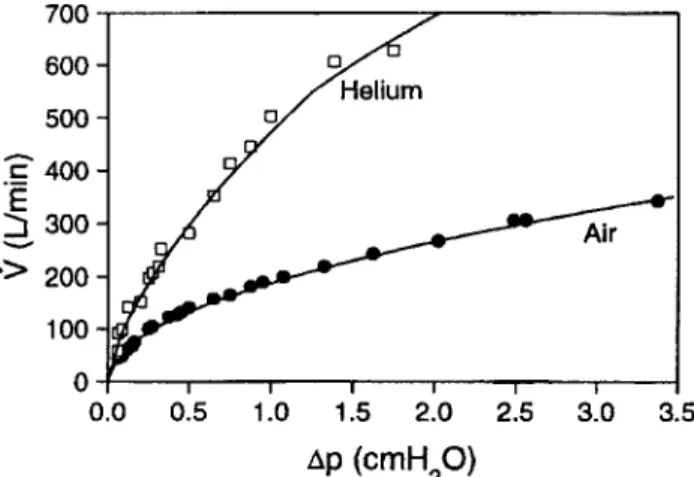
chanical ventilation with heliox. Briefly, during turbulent gas flow, when transairway pressure is held constant, he-liox will have a higher flow through the airways than will air or air-oxygen mixtures. The higher the concentration of helium, the higher the flow (compared to air or air-oxygen at a given pressure) (Fig. 1). At a given flow, the transair-way pressure will be lower with heliox than with air or air-oxygen. The higher the concentration of helium, the lower the pressure. A density-dependent flow transducer that is calibrated for air or air-oxygen will give an inac-curately low flow reading with heliox. Breathing heliox decreases air-trapping in (and hyperinflation of) the lungs (caused by lower-airway obstruction), thereby reducing intrinsic positive end-expiratory pressure (PEEP). Heliox decreases dyspnea and work of breathing, and improves distal-airway deposition of aerosol particles.
Lower-Airway Obstruction
Several prospective and retrospective studies have found heliox beneficial during mechanical ventilation of patients with lower-airway obstruction. No randomized controlled trials have compared heliox with air-oxygen during status asthmaticus or chronic obstructive pulmonary disease (COPD); all the published studies are either prospective case studies or retrospective analyses.
In a prospective study by Gluck et al,3heliox reduced
peak airway pressure and PaCO2and helped correct
respi-ratory acidosis in 7 intubated patients with status asthmati-cus. Kass and Castriotta4had similar findings with a group
of 12 patients, five of whom were mechanically ventilated. Schaeffer et al5reported that heliox improved the
alveolar-arterial oxygen difference in 11 adult and pediatric pa-tients mechanically ventilated for status asthmaticus. On the other hand, Gross et al6found that in children
mechan-ically ventilated for bronchiolitis, heliox did not improve
ical history, other treatments, clinical cardiorespiratory vari-ables, or gas exchange on admission to the emergency department. Among those who received heliox, the intu-bation rate was lower (8% vs 50%, p⬍ 0.01), mortality was lower (3% vs 24%, p⬍0.01), and intensive-care-unit (ICU) admissions were nonsignificantly lower (46% vs 60%, p⫽0.23). Among the survivors, mean ICU stay was shorter (8 vs 18 d, p⬍0.01).
Tassaux et al9reported a prospective interventional study
performed in a medical ICU, which included 23 intubated, sedated, paralyzed, and mechanically ventilated patients with COPD who were enrolled within 36 h after intuba-tion. Heliox was associated with a mean reduction in trapped lung volume of 116 mL (a 54% reduction), intrinsic PEEP of 4 cm H2O (a 45% reduction), peak airway pressure of
5 cm H2O (a 17% reduction), and mean airway pressure of
1 cm H2O (a 12.5% reduction) (Fig. 2). These variables all
rose to their baseline values on cessation of heliox. There were no significant differences in arterial blood gases, heart rate, mean systemic arterial blood pressure, pulmo-nary artery pressure, right- or left-ventricular filling pres-sure, cardiac output, pulmonary or systemic vascular re-sistance, or venous admixture. More recently, Jolliet et al10
found that in patients with COPD on mechanical ventila-tion, heliox reduced intrinsic PEEP, trapped gas volume, and the inspiratory and expiratory resistance of the respi-ratory system. Heliox did not significantly affect the ven-tilation-perfusion relationships.
Patients with lower-airway obstruction and air trapping may exhibit pulsus paradoxus, which increases in severity as the hyperinflation gets worse. Lee et al11 found that
heliox improves hemodynamics in mechanically ventilated patients with COPD and systolic pressure variations (Fig. 3). In a prospective, interventional study involving 25 me-chanically ventilated patients with severe COPD and acute respiratory failure who had systolic pressure variations⬎15 mm Hg, heliox decreased trapped lung volume and intrin-sic PEEP. Concomitantly, the respiratory changes in sys-tolic arterial pressure variations decreased from 29.5% to 13.7%. In the 10 patients with pulmonary arterial cathe-ters, heliox decreased mean pulmonary arterial pressure,
Fig. 1. Flow (V˙) versus change in pressure (⌬p) with air and helium in a lung model. (From Reference 2, with permission.)
right atrial pressure, and pulmonary arterial occlusion pres-sure, and heliox increased cardiac index. Pre-heliox pulse pressure correlated with the magnitude of reduction in intrinsic PEEP during heliox ventilation. Age, pre-heliox PaCO2, and the ratio of the forced expiratory volume in the
first second to forced vital capacity correlated inversely, whereas pre-heliox pulse pressure correlated positively with increases in cardiac index.
Noninvasive Ventilation With Heliox
Noninvasive positive-pressure support with heliox re-duces the work of breathing during a COPD exacerbation. Jolliet et al hypothesized that combining heliox with non-invasive ventilation would benefit decompensating COPD patients, and they found that noninvasive positive-pressure support with heliox decreased PaCO2and dyspnea.
12
Sub-sequently, they performed a prospective randomized mul-ticenter study that found that noninvasive ventilation with heliox decreased post-ICU stay by about 6 days and de-creased the total cost of hospitalization.13
High-Frequency Oscillation
The combination of heliox with nonconventional venti-lation modes has been investigated in animal studies. In an animal model of acute lung injury, Katz et al14found that
high-frequency oscillation with heliox improved oxygen-ation and ventiloxygen-ation. A subsequent study by the same investigators using the same animal model found that when the tidal volume (VT) delivered during high-frequency
ven-tilation with heliox was controlled to the same level as during ventilation with air-oxygen mixture, there was no difference in gas exchange.15Therefore, the improvement
seen in the first study was related to the larger VTdelivery
by the oscillator with heliox.
Effect of Heliox on Aerosol Delivery and Nebulizer Functioning During Mechanical Ventilation
Currently available nebulizers are designed to be pow-ered by air, oxygen, or air-oxygen mixture, so nebulizer performance is affected by using heliox to power the
neb-Fig. 2. A: Individual measurements of intrinsic positive end-expiratory pressure (PEEPi) before, during, and after administration of helium-oxygen mixture (heliox). B: Individual measurements of trapped end-expiratory lung volume before, during, and after administration of helium-oxygen mixture (heliox). (Adapted from Reference 9, with permission.)
ulizer. With an in vitro model, Hess et al found that, com-pared with air, powering the nebulizer with heliox de-creased both the fraction of the dose and the aerosol’s respirable mass.16In a pediatric model of mechanical
ven-tilation, albuterol delivery from a metered-dose inhaler (MDI) was higher when the aerosol was delivered with heliox than with air-oxygen mixture.17
Goode et al18examined nebulizer performance with
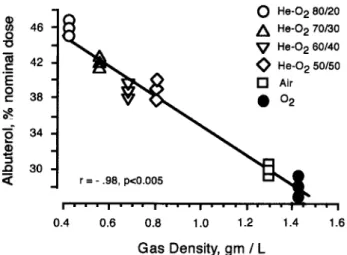
he-liox during mechanical ventilation, using an in vitro model. Delivery of albuterol from an MDI with chamber was greater with heliox than with air-oxygen, and the amount delivered increased with increasing concentration of he-lium. For both heliox and air-oxygen, the delivery of al-buterol was significantly lower when the ventilator circuit was heated and humidified than when the circuit was dry, though in both conditions heliox delivered more albuterol (Fig. 4). When using an MDI with spacer, heliox enhanced the delivery of albuterol through the ventilator circuit so a greater proportion of the drug was delivered distally, and this efficiency increased with increasing concentration of helium (Fig. 5).
On the other hand, heliox decreases nebulizer output efficiency. At a given gas flow, nebulizer aerosol output is higher with oxygen than with heliox (Fig. 6). The best
albuterol output is obtained when the nebulizer driving gas is oxygen and the rest of the gas in the circuit is heliox (Fig. 7).
Performance of Ventilators With Heliox
Understanding the effects of heliox on ventilator per-formance requires understanding the principles of valve design and gas flow. Administering heliox during mechan-ical ventilation requires vigilance and continuous monitor-ing, because helium can interfere with ventilator function-ing and the accuracy of the pneumotachometer. Four studies have examined the effects of heliox on ventilator perfor-mance.19 –22
Tassaux et al19evaluated 7 ICU ventilators (Veolar FT,
Galileo, Evita 2, Evita 4, Servo 900C, Servo 300, Puritan Bennett 7200) with heliox and a lung model to determine correction factors for the flow difference between heliox and air-oxygen. They studied 78:22 heliox and various mixtures of heliox and oxygen, and they determined he-liox’s behavior on inspiratory valves and gas mixing. All measurements of flow and volume were made with a den-sity-independent test lung. The actual delivered fraction of inspired oxygen (FIO2) was within 5% of the set FIO2with
all the ventilators except the 7200, with which the deliv-ered FIO2 exceeded the set FIO2 by about 125% (at and
below FIO2 0.6).
19 During volume-controlled ventilation
the delivered VT was greater than the set VT with the
Veolar FT, Galileo, Evita 2, Evita 4, and Servo 900C.19
With the 7200, the delivered VTwas smaller than the set
VT, and this relationship was inversely related to the set
Fig. 3. Pulse pressure tracings within a respiratory cycle during mechanical ventilation with air-oxygen (top) and helium-oxygen mixture (bottom). The maximum systolic pressure (PS-max) and
max-imum pulse pressure (PP-max) occur during inspiration. The
mini-mum systolic pressure (PS-min) and minimum pulse pressure (PP-min)
occur during expiration.⌬PP(%) ⫽ 100⫻ ([PP-max – Pp-min]/0.5
⫻[PP-max⫹PP-min]. (From Reference 11, with permission.)
Fig. 4. Gas density versus albuterol delivery (percent of nominal dose) from a metered-dose inhaler to a filter placed at the “bron-chi” of the lung model. Albuterol delivery is inversely related to gas density in the ventilator circuit. The highest aerosol delivery occurs with the lowest-density gas, which in these experiments was the mixture of 80% helium and 20% oxygen (He-O2 80/20). (From
FIO2.
19With the Servo 300, the delivered V
Twas not
sig-nificantly different from the set VT.19 During
pressure-controlled ventilation the delivered VT was identical to
control measurements with all the ventilators except the 7200, which malfunctioned in that mode. Tassaux et al developed correction factors that can be applied to most ventilators with similar design characteristics.
Oppenheim-Eden et al20examined the effects of helium
on the performance of 5 ICU ventilators: Siemens 300 and 900C, Puritan Bennett 7200, Evita 4, and Bear 1000. They also studied the functioning of a commercially available Pitot tube sidestream spirometer (Datex CS3 Respiratory Module). All the VT measurements were made with a
density-independent volume-displacement spirometer. Un-like the study by Tassaux et al19, pure helium was
con-nected to the compressed-air inlet. The 7200 ventilator did not function correctly with helium. The delivered FIO2was
lower than the set FIO2with all the other ventilators.
Sim-ilar to the study by Tassaux et al, the delivered VTwas
unaffected by helium with the Servo 300. With the other 3 ventilators the delivered VT was greater than the set VT
and was dependent on helium concentration. The Pitot tube spirometer consistently underestimated the delivered VT, and the underestimation depended on the helium
con-centration.20
Berkenbosch et al21examined the effects of heliox on
the performance of 4 ventilators that are used with in-fants and children: Bird VIP, Bird VIP Gold, Servo 300, and Servo 900C. They employed a “bag-in-a-box” spi-rometer attached to a pulmonary mechanics monitor to obtain density-independent measurements (Fig. 8). He-lium consumption was greater with pressure-limited time-cycled ventilation than with volume-controlled ven-tilation because of the high flow in pressure-controlled ventilation. During both ventilation modes, the Servo 300 was the most efficient in its helium consumption. Using the Servo 300 as the reference value, the helium consumption with the Bird VIP was 8 times higher dur-ing volume-controlled ventilation and 17 times higher during pressure-controlled ventilation. With the Servo 900C the helium consumption was 4 times higher dur-ing volume-controlled ventilation and 7 times higher
Fig. 5. Drug deposition (percent of nominal dose) of albuterol from a metered-dose inhaler, in the spacer chamber, the ventilator cir-cuit, the endotracheal tube, and on filters on the “bronchi” of the lung model, under dry conditions during controlled mechanical ventilation. RH⫽relative humidity. He-O2⫽helium-oxygen
mix-ture. (From Reference 18, with permission.)
Fig. 6. Albuterol delivery as a function of the density of the gas used to power a small-volume nebulizer at 6 L/min. Albuterol de-livery from the nebulizer is positively correlated with gas density (r⫽0.94, p⫽0.001). The densest gas (oxygen) gave the greatest nebulizer output. He-O2⫽helium-oxygen mixture. (From
Refer-ence 18, with permission.)
Fig. 7. Drug delivery to filters placed on the “bronchi” of the lung model when the nebulizer was operated with oxygen or heliox, while the ventilator circuit contained heliox (open bars) or oxygen (hatched bars). Albuterol delivery was greatest when the nebulizer was operated with oxygen and the ventilator circuit contained a gas consisting of 70% helium and 30% oxygen (He-O2). (From
during pressure-controlled ventilation. With the Bird VIP and Servo 900C, the delivered FIO2 was less than
the set FIO2, and the relationship between these variables
was nonlinear, with a maximum difference of 9% for both ventilators. Delivered FIO2was identical to set FIO2
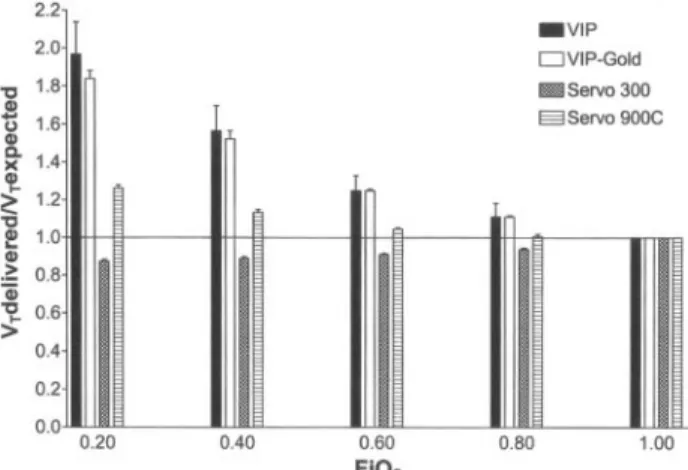
with the Servo 300. During volume-controlled ventila-tion, the delivered VT was larger than the set VTwith
the Bird VIP, Bird VIP Gold, and Servo 900C (Fig. 9). With the Servo 300, delivered VT was slightly smaller
than the set VT(Fig. 10). With the Bird VIP, Bird VIP
Gold, and Servo 900C, during pressure-controlled ven-tilation the delivered VT increased significantly with
increasing concentration of helium, despite the fact that there were no changes in the peak inspiratory pressure limit. The magnitude of the increase was smaller than
that during volume-controlled ventilation. With the Servo 300, delivered VTwas unaffected by FIO2during
pressure-controlled ventilation.
Brown et al studied the Inspiration and Servo-i ventila-tors,22using a density-independent test lung similar to that
in the Tassaux et al study.19With the Inspiration the
de-livered VT was always higher than the set VT, whereas
there was no such difference with the Servo-i. Delivered FIO2 varied ⬍ 5% with both the ventilators. The
perfor-mance of the exhaled-VTmonitor was quite different
be-tween the ventilators. The Inspiration functioned under all the tested conditions, though with heliox the displayed VT
was always less than the actual VT. On the other hand, the
expiratory volume monitor in the Servo-i constantly alarmed, displaying a very low value or no value at all.22
Explanation for the Differences in Performance of Different Ventilators With Heliox
The Veolar FT, Galileo, and Servo 900C each have a single inspiratory valve located downstream from the gas mixer, which is calibrated using a single given FIO2.
Since there is no built-in system designed to adjust for changes in gas density, the gas flow through the circuit should increase during volume-controlled ventilation with heliox, and the effect will be greater with higher concentrations of helium.19The higher gas flow makes
the delivered VThigher than the set VT. The mixing of
gases in these ventilators occurs upstream from the in-spiratory valve, so the delivery of oxygen is not influ-enced by the addition of helium.19 On the other hand,
ventilators such as the Evita 2 and Evita 4 are fitted with
Fig. 8. “Bag-in-a-box” spirometer. The study gas is delivered to the test lung via the ventilator. Expansion of the test lung displaces room air through the top port, which is connected to the pneu-motachometer, which is connected to the monitor. (From Refer-ence 21, with permission.)
Fig. 9. Effect of helium on actual delivered tidal volume (VT) versus
expected VTduring volume-controlled ventilation with 4 ventilator
brands: Bird VIP, Bird VIP Gold, Servo 900C, and Servo 300. FIO2
⫽fraction of inspired oxygen (balance helium). (From Reference 21, with permission.)
Fig. 10. Effect of helium on actual delivered tidal volume (VT)
ver-sus expected VTduring pressure-controlled ventilation with 4
ven-tilator brands: Bird VIP, Bird VIP Gold, Servo 900C, and Servo 300. In these experiments, the gas was helium-oxygen mixture. FIO2⫽
fraction of inspired oxygen (balance helium). TCPL⫽time-cycled, pressure-limited ventilation mode. PC⫽pressure-controlled ven-tilation mode. (From Reference 21, with permission.)
2 proportional inspiratory valves, one for air, the other for oxygen, and gas mixing occurs downstream from these valves (Fig. 11). This should increase delivered VTduring volume-controlled ventilation and lower the
FIO2proportional to the helium concentration.
19In
ven-tilators such as Evita 4, which has leak compensation, the expiratory flow sensor malfunctions with heliox, and this is interpreted as a gas leak in the circuit, which triggers an increase in inspiratory-valve opening, which further increases the delivered VT. With the Servo 900C,
gas mixing occurs proximal to the inspiratory valve, so FIO2delivery is consistent. On the other hand, the Servo
900C has a scissors valve that is affected by the gas density, so the delivered VT differs from the set VT.
With the Servo 300 and the Servo-i, the air and oxygen modules are separate, each with their own temperature and supply pressure transducer. When helium is intro-duced into the air inlet, the increased flow results in a higher volume in the chamber, increasing the pressure, which terminates the flow and thus prevents VT
over-shoot. When pure helium is connected to the air inlet, the delivered VT is affected more than with heliox.
Practical Considerations When Using Heliox With Mechanical Ventilation
When using ventilators that do not deliver a consistent FIO2, to ensure greater consistency the FIO2must be
mea-sured close to the patient by devices that are density-in-dependent.
To ensure consistent VTdelivery there are 2 practical
solutions. One is to use a conversion factor derived for each ventilator, as suggested by Tassaux et al,19and
esti-mate the delivered VTfrom the set VTor the exhaled VT.
Alternatively, one can measure the VTdirectly at the
en-dotracheal tube, using a density-independent pneumota-chometer or one that is calibrated for helium. The CO2SMO pulmonary function monitor is calibrated for helium, and its measured VT with heliox is accurate, matching the
volume measurements made with a volume-displacement (density-independent) spirometer (unpublished data).
Heliox During Ventilator Weaning
Diehl et al23studied heliox used at the end of the
wean-ing process to determine its effects on work of breathwean-ing. They conducted a prospective randomized crossover study with 13 patients with COPD, who were evaluated just before and after extubation. Heliox and air-oxygen were administered sequentially, for 20 min each, in a random-ized order, just before extubation. With five of the pa-tients, the study was repeated after extubation. Though heliox did not affect the breathing pattern, it reduced the work of breathing by 21%, mainly by reducing the resis-tive component of the work of breathing. They also found lower intrinsic PEEP with heliox. All patients who had an improvement in work of breathing had very high initial values. There was a 15% reduction in respiratory rate, a 30% increase in VT, a 13% increase in minute ventilation,
and a 29% increase in maximum inspiratory flow.
Summary and Recommendations
Based on the evidence available (which is mostly low-level evidence [class III and IV]), the indications for the use of heliox during mechanical ventilation are:
1. Lower-airway obstruction, especially with hypercar-bia
2. Need to enhance aerosol delivery to lung periphery 3. Need to facilitate weaning from mechanical
ventila-tion
Certain ventilators perform relatively well with heliox and are not substantially affected by it. It is preferable to connect the heliox to the air inlet of the ventilator, because this results in more consistent delivery of oxygen and VT.
When administering heliox, pay close attention and di-rectly monitor the actual VTand actual FIO2.
REFERENCES
1. Slutsky AS, Berdine GG, Drazen JM. Steady flow in a model of human central airways. J Appl Physiol 1980;54(3):417–423. 2. Papamoschou D. Theoretical validation of the respiratory benefits of
helium-oxygen mixtures. Respir Physiol 1995;99(1):183–190. 3. Gluck E, Onorato D, Castriotta R. Helium-oxygen mixtures in
intu-bated patients with status asthmaticus and respiratory acidosis. Chest 1990;98(3):693–698.
4. Kass J, Castriotta R. Heliox therapy in acute severe asthma. Chest 1995;107(3):757–760.
Fig. 11. Inspiratory valve and gas mixing apparatus in the Evita 2, Evita 4, and Servo 300 ventilators (left panel) and in the Veolar FT and Galileo ventilators (right panel). The arrows indicate the gas-flow path. VT-set⫽set tidal volume. FIO2set⫽set fraction of
in-spired oxygen. Heliox⫽helium-oxygen mixture. FIO2del⫽
deliv-ered FIO2. VT-del⫽delivered tidal volume. (From Reference 19, with
mechanically ventilated patients with severe chronic obstructive pul-monary disease. Crit Care Med 2000;28(8):2721–2728.
10. Jolliet P, Watremez C, Roeseler J, Ngengiyumva JC, de Kock M, Clerbaux T, et al. Comparative effects of helium-oxygen and exter-nal positive end-expiratory pressure on respiratory mechanics, gas exchange, and ventilation-perfusion relationships in mechanically ventilated patients with chronic obstructive pulmonary disease. In-tensive Care Med 2003;29(9):1442–1450.
11. Lee DL, Lee H, Chang HW, Chang AY, Lin SL, Huang YC. Heliox improves hemodynamics in mechanically ventilated patients with chronic obstructive pulmonary disease with systolic pressure varia-tions. Crit Care Med 2005;33(5):968–973.
12. Jolliet P, Tassaux D, Thouret JM, Chevrolet JC. Beneficial effects of helium:oxygen versus air:oxygen noninvasive pressure support in patients with decompensated chronic obstructive lung disease. Crit Care Med 1999;27(11):2422–2429.
13. Jolliet P, Tassaux D, Roeseler J, Burdet L, Broccard A, D’Hoore W, et al. Helium-oxygen versus air-oxygen noninvasive pressure sup-port in decompensated chronic obstructive disease: a prospective, multicenter study. Crit Care Med 2003;31(3):878–884.
delivery with helium-oxygen mixtures during mechanical ventila-tion. Am J Respir Crit Care Med 2001;163(1):109–114.
19. Tassaux D, Jolliet P, Thouret JM, Roeseler J, Dorne R, Chevrolet JC. Calibration of seven ICU ventilators for mechanical ventilation with helium-oxygen mixtures. Am J Respir Crit Care Med 1999;160(1): 22–32.
20. Oppenheim-Eden A, Cohen Y, Weissman C, Pizov R. The effect of helium on ventilator performance: study of five ventilators and a bedside Pitot tube spirometer. Chest 2001;120(2):582–588. 21. Berkenbosch JW, Grueber RE, Dabbagh O, McKibben AW. Effect
of helium-oxygen (heliox) gas mixtures on the function of four pe-diatric ventilators. Crit Care Med 2003;31(7):2052–2058. 22. Brown MK, Willms DC. A laboratory evaluation of 2 mechanical
ventilators in the presence of helium-oxygen mixtures. Respir Care 2005;50(3):354–360.
23. Diehl JL, Mercat A, Guerot E, Aissa F, Teboul JL, Richard C, Labrousse J. Helium/oxygen mixture reduces the work of breath-ing at the end of the weanbreath-ing process in patients with severe chronic obstructive pulmonary disease. Crit Care Med 2003;31(5): 1415–1420.