Signatures in Self-initialized Ad Hoc Network
Jeonil Kang, DaeHun Nyang, Abedelaziz Mohaisen, Young-Geun Choi, and KoonSoon Kim
Information Security Research Laboratory, INHA University, Republic of Korea
[email protected], [email protected]
{asm, choizak, soony}@seclab.inha.ac.kr
Abstract. In ad hoc network, it is very crucial to issue certificates safely in the
self-initialized scheme where the system authority exists only at the beginning of the network operation. In order to solve this problem, early studies have presented some suggestions by removing the system authority itself and using certificate chain, or by making nodes act as system authorities for issuing other nodes’ tificates. In this paper, using proxy and threshold signatures, we introduce a cer-tificate issuing scheme that can solve many problems in the previously proposed solutions. We demonstrate our scheme’s performance through the simulation re-sults. Also, we discuss the security value of our scheme’s in various aspects.
1
Introduction
In ad hoc network, certificates of public keys have been a general solution for key distribution and authentication. However, single point of failure and bottleneck prob-lems which are caused by single certificate authority makes it hard to apply certificate-based public key cryptography to ad hoc network. To solve these problems, many researches have been performed [1,2,3]. One of the solutions is self-initialized (a.k.a. self-organized) certificate management scheme in which each node generates its own public and private keys. Due to the individual generation of keys, the central node which has to issue the certificates for other nodes can distribute its burden to other nodes. For the authority itself, there are two types of configuration. In the first configuration, the authority never exists all through the operation of the network while in the second con-figuration it only exists at the beginning of the network operation. For the first configu-ration, it is required to provide an additional method to verify other certificates because these certificates are independently issued by different nodes and signed by different private keys. The researches of Capkun et al. [1] and Li et al.[2] are well-know in han-dling this configuration. For the second case where the system authority exists only at the beginning of the network, it does not require much cost for verifying certificates
This research was supported by the MIC(Ministry of Information and Communication), Korea,
under the ITRC(Information Technology Research Center) support program supervised by the IITA(Institute of Information Technology Advancement)(IITA-2006-C1090-0603-0028).
Corresponding Author
O. Gervasi and M. Gavrilova (Eds.): ICCSA 2007, LNCS 4707, Part III, pp. 886–899, 2007. c
because all certificates are singed by a single private key. However, the problem that a node can sign certificates after the beginning still remains. To solve this, the diffusion
wave method as by Luo et al. [3] has been considered.
In the diffusion wave method, the node which gathers several partial certificates and makes a complete certificate gains the authority for issuing other partial certificates. Therefore, the population of nodes that have the authority increases gradually. How-ever, the diffusion wave may have another problem named the originality of authority in which a misbehaving node may obtain a valid certificate legally. The originality of au-thority problem may also lead to another problem in which a misbehaving node moves to other place in the network and misuse the network resources or mislead other nodes using its own valid certificate. Also, from the complexity perspectives, the diffusion wave requires much network traffic because some single nodes should gather several partial certificates and find other nodes for one certificate.
In this paper, we consider the complexity of the diffusion wave based scheme. To re-duce the former work’s complexity represented in the communication overhead, we in-troduce a novel certificate issuing scheme based on the proxy and threshold signatures. In addition to the communication reduction, our scheme provides a breaking-through for the required time for the signing operation.
2
Related Works: Self-initialized Certificate Management
2.1 Self-initialization
In the self-initialization network scenario, a node in the network generates its private and public key pair. To use the self-generated key pair, a node must ensure that other nodes’ private keys are not modified by a third entities. On other side, even though two nodes are in one hop neighborhood, they cannot be perfectly sure of that in application layer unless they have additional protocols. Generally, certificates are used for inform-ing the public key which is used when a node confirms the integrity of the message signed by the corresponding private key. However, the certificates must be signed by a trusted private key.
2.2 Trusted Certificate Chain
If there are not any system authority in the network and the certificates are individually signed by different private keys, a node must have the way or simply the criteria upon which it trusts other public keys. Unfortunately, on the side of the node, nothing can be trusted but its own private and public key pair. However, once a certificate issuing is performed, the issuer himself trust the public key associated with the issued certificate. In addition, the issuer can trust other certificates that can be verified by the trusted public key. In that way, a node can make trusted certificate chain started from its own keys as rewards for issuing other nodes’ certificates.
To find out a trusted certificate chain between two nodesAandBwhich both have their own chains, Capkun et al. suggested a method in which the resulting chain of con-catenating two sub-chains beginning from an intersecting point of the two chains and
ending by the two nodes’ corresponding certificates (i.e., certificate ofAand certifi-cate ofB respectively) is used [1]. In this method, however, each node should have a number of certificates for making sub-chain. Also, even each node has that number of certificates, this does not ensure the existence of the trusted certificate chain.
In another method suggested by Li et al., to establish the certificate chain, the routing path is used to forward the certificate request message using the resulting routing path if a node issues certificate for all one-hop neighbors. If a node sends the certificate request message, all nodes on backward route add their certificates in the response message sequentially. As a node, it is enough to store the neighbors’ certificates only. However, this increases the total network overhead even under usual communication pattern in local area [4].
2.3 Certificate Signed by System Private Key
If all certificates are signed by the system authority’s private key, all certificates are verifiable by the system authority’s public key that all nodes know. However, it is hard to expect that the authority is always in the same coverage area because of the nodes’ mobility. Also, if an attacker succeeds in cracking the authority, the whole system will collapse. Therefore, it is better that the system authority’s private key should be frac-tionized and distributed to several nodes while no node possesses the whole private key. To obtain a complete certificate, a node should gather several partial certificates signed by partial private keys leading to that a few nodes that have a partial private key suffers from lots of service requests. Also, a node can be delayed from obtaining a complete certificate due to the deficiency of the nodes that have partial private keys.
Luo et al. introduce a method named the diffusion wave (illustrated in Fig. 1(b)) to reduce the time delay for obtaining a complete certificate. In their work, they enable the node that gains a complete certificate to have the authority for issuing a partial certifi-cate. By doing so, the burden of a few nodes can be decentralized to many other nodes. However, this cannot reduce the overall network traffic. Also, an attacker can meet nodes which have a partial private key in the neighborhood and can try attacking them just after small movement. In addition, the diffusion wave should have strict rules for authenti-cating nodes. As time goes on, the originality of authority will be degraded so that we cannot expect those strict rules to apply to the nodes which newly join in the network.
3
Proposed Certificate Issuing Scheme
3.1 Preliminaries
Secret Sharing and Threshold Signature: A secret sharing is a cryptographic scheme in which a secret of an entity is distributed as partial secrets among other entities [5]. If many partial secrets over threshold are gathered, the secret can be recovered. Once the a secret is recovered, it is not secret anymore leading to that the secret owner (i.e. the corresponding entity) need to re-make and re-distribute the secret shares among other entities. However, the required operations upon secret recovery are resources’ consum-ing ones. Therefore, for usconsum-ing the secret without recovery, threshold cryptography are suggested.
In the threshold signature scheme, we can obtain a signature of a document by gath-ering partial signatures over threshold value [6]. This is possible when the signer need to sign a document while revealing the overall secret is undesirable. In this paper, we use the threshold signature scheme for assigning the proxy signature keys to the proxy signers.
Proxy Signature: A proxy signature scheme consists of an original signer, proxy sign-ers, and verifiers [7]. The original signer commits his warrant to sign to proxy signers. According to who can make the same signature as the original one, there are two types of proxy signature schemes which are proxy-unprotected and proxy-protected. In this paper, we use the proxy-protected signature scheme because the role of the proxy sign-ers is not clear if we assume that the original signer can make proxy signature.
Bilinear Pairing: Consider a groupGof problems for which it is hard to solve CDHP (Computational Hellman Problem) but easy to solve DDHP (Decision Diffie-Hellman Problem). Those problems are called GDHP (Gap Diffie-Diffie-Hellman Problem) [8], and the bilinear pairing is one of their solutions [9].
LetG1andG2be cyclic groups with order of a primeq. LetP be a generator ofG1.
IfG1is an additive group andG2is a multiplicative group, the bilinear pairing is a map ˆ
e:G1×G1→G2that satisfies the following properties on elliptic curves over finite
field.
- Bilinear:e(aP, bQ) = ˆˆ e(P, Q)ab
- Non-degenerate: there existsP, Q∈G1such thate(P, Q)ˆ = 1.
- Computable: there exists an efficient algorithm to computeˆe(P, Q)for allP, Q∈
G1.
Using those properties, we can easily verify whetherxyP = zP or not when we haveP, xP, yP andzP on the elliptic curves.
3.2 Basic Protocol
Our proposed scheme is based on the signature schemes and its relative methods de-scribed in [10] and [11]. We assume that a system authority exists at the beginning of the network operation. Also, all nodes in the network generate their public and private key pair in self-initialization. The following is the procedure of our scheme:
1) By using secret sharing scheme, the authority shares its partial private key with the first initialized nodes which are called chair nodes. Also, the authority directly assigns proxy signature keys to delegation nodes which are called proxy nodes. 2) By using threshold signature scheme, the chair nodes which are assigned partial
private key from the system authority can assign proxy signature key to a proxy node without the system authority.
3) A proxy node which has proxy signature key can issue proxy certificates for normal nodes which should receive their proxy certificates from the proxy nodes only. A simple illustration of our scheme versus other schemes (i.e. multiple CA and dif-fusion wave) is in Fig. 1(c).
CA CA CA CA : Certification Authority (a) Multiple CA FI FI
FI : First Initialized Node (b) Diffusion Wave
C P
C P
C : Chair Node / P : Proxy Node (c) Our Scheme
Fig. 1. Certificate Issuing Schemes
Common Parameters: ConsiderP KoandSKosuch thatP Ko =SKoP ∈G1are
the system public and private key pair (P is a generator of groupG1). Also, consider P KpandSKpsuch thatP Kp=SKpP ∈G1are proxy node’s public and private key
pair. Then,(G1,G2,e, q, P,ˆ H1,H2)are common parameters whereH1 : {0,1}∗ →
ZqandH2:{0,1}∗→G2are two different hash functions.
Proxy Signature Key: The system authority generates a(t−1) degree polynomial
f(x) =SKo+a1x+· · ·+at−1xt−1with random coefficientsa1, a2,· · ·, at−1∈RZ∗q and the private keySKo. For all chair nodesi ∈ I where I = {1,2,· · ·, n}, the authority distributesxi =f(i). If a node collects all elements of a subsetS ⊂Isuch that|S| ≥t, it can recover the secret keySKoby using Lagrange interpolation in which
SKo=
i∈SLixiwhereLi=
j∈S−xj/(xi−xj).
The proxy signature key can be assigned for the proxy node by two ways. In the first way, it is assigned by the system authority directly while in the other way it is assigned by the chair nodes.
- From the system authority: the system authority makes a warrantwand computes its hash valueH2(w). The authority then assignswandSKow=SKoH2(w)to a
proxy node.
- From the chair nodes: the chair nodeimakes a warrantwfor a proxy node and computesxiH2(w). The chair nodeithen sends the result to the proxy node. The
proxy node can make the proxy signature key such thatSKow = SKoH2(w) =
i∈SLixiH2(w)if it gathers the partial signatures overt. In this case, the
war-rantwmust not include specific information of the chair nodes for using threshold signature scheme.
The proxy node should check ife(SKˆ ow, P) = ˆe(H2(w), P Ko). Only when this is
satisfied, the proxy node makes proxy signature keySKw=SKow+SKpH2(w) = (SKo+SKp)H2(w). If DLP (Discrete Logarithm Problem) is hard to solve, thenSKo is hard to be revealed during those process.
Certificate Issuing Through the Proxy Node: A node’s certificate that includes its self-initialized public key can be issued by a proxy node only. A proxy node gen-erates a valid proxy certificateΛ, c, U, wfor the unsigned certificateΛ wherec =
H1(Λ ˆe(P, P)r),r ∈R Z∗q, andU =cSKw+rP. In addition,r,ˆe(P, P)r, andrP can be computed in the idle time so that a proxy node needs only one hash computa-tion, one addicomputa-tion, and one multiplication operations on the elliptic curves in real time for signing a certificate.
Certificate Verifying: A node needs to verify other nodes’ certificates to communi-cate with them trustfully. To verify a certificommuni-cateΛ, c, U, w, a node can be sure of the validation of a certificate by checking if equality in Equation (1) is satisfied.
c=H1(Λ ˆe(U, P)ˆe(H2(w), P Ko+P Kp)−c) (1)
3.3 Other Certificate Management Issues
Certificate Revocation: If the chair or other proxy nodes find a misbehaving node that is harmful to the system or the other nodes, they may exchange that information through the CRL (Certificate Revocation List). There is the information about issuer (e.g. the proxy node) of a revoked certificate in the CRL so that other nodes can know what proxy node mass-produces the certificates for the misbehaving nodes. Therefore, the discipline measure for that proxy node may be desired.
Delegation Deprivation: If some chair nodes want to deprive the authority of a proxy node, they should firstly make a report signed by system private key to notify that report. To do so, they should cooperate with other chair nodes to gather partial reports. Through this cooperation, threshold signature can be used. The report to notify the deprivation has to flood into network for all nodes. If a node receives the report that has the same issuer information with its certificate’s issuer, the node must revoke its certificate and try to obtain a new certificate from other proxy nodes.
Also, the chair nodes should assign new proxy nodes when the number of proxy nodes decreases below a specific number.
Certificate Renewal: If the valid date of a certificate is expired or the corresponding deprivation report is arrived, a node can obtain a new certificate from the proxy nodes. If necessary, a node can obtain several certificates in anticipation.
Selection of a New Chair Node: The number of the nodes that have the partial sys-tem private keys must be over the threshold valuet. Otherwise, no more nodes can be proxy nodes. So that, the chair and proxy nodes cannot maintain their interoperability. Therefore, a new chair node need to be selected though extremely strict authentication rules and a new partial private key should be assigned to that chair node.
4
Simulation
4.1 Simulation Environment
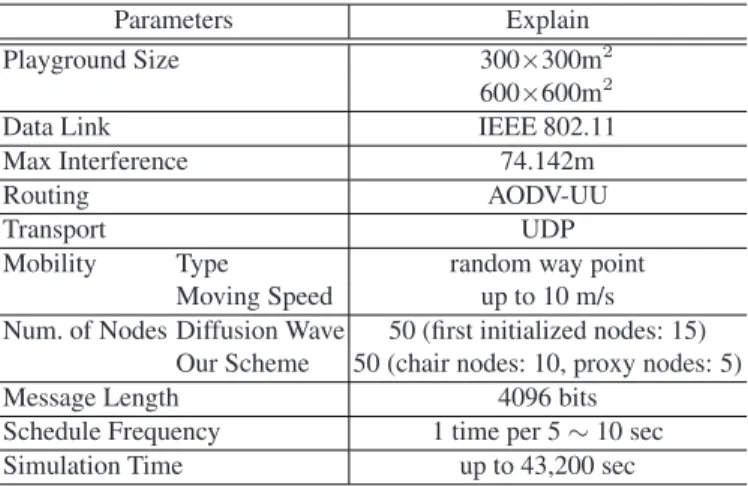
In oder to analyze the performance of our scheme, we built our simulation on the OM-NeT++. The simulation parameters are shown in Table 1.
Table 1. Simulation Parameters
Parameters Explain
Playground Size 300×300m2
600×600m2
Data Link IEEE 802.11
Max Interference 74.142m
Routing AODV-UU
Transport UDP
Mobility Type random way point
Moving Speed up to 10 m/s
Num. of Nodes Diffusion Wave 50 (first initialized nodes: 15)
Our Scheme 50 (chair nodes: 10, proxy nodes: 5)
Message Length 4096 bits
Schedule Frequency 1 time per 5∼10 sec
Simulation Time up to 43,200 sec
Playground Size and Coverage: LetNtbe the total number of nodes,Psizebe the size of playground, andCsizebe the coverage area of a node. The average number of neighbor nodesNncan be obtained as in Equation (2).
Nn= Nt Psize× Csize= Nt Psize × πr2 (2)
whereris the maximum interference distance of a node. Note that,Nt/Psizerefers to the node density on the whole area of playground.
If the playground sizePsizeis 300×300m2and the maximum distance for transmis-sionris about 74m, a node can directly communicate with 9.55 nodes on average. In 600×600m2playground, however, a node can directly communicate with only about 2.38 nodes on average.
Mobility and Communication Chances: In our simulation, the node’s moving speed increases from 1 m/s to 10 m/s. Even though we assume that one node has a fixed position and another node directly passes through the surrounding of that node, the maximum connection time is 148 seconds in 1 m/s and 14.8 seconds in 10 m/s.
Mean Distance= 2r×2 π π 2 0 sinθdθ= 4r π (3)
Therefore, the distance for passing the circumference of a node is about 94.2m on av-erage. So that, the link between two nodes is kept for 94.2 seconds in 1 m/s and 9.4
seconds in 10 m/s. Since one message is sprang up every 7.5 seconds on average, a node has 12.5 chances of communication in 1 m/s and 1.3 chances in 10 m/s.
Transport Protocol: In our simulation, we use UDP (User Datagram Protocol) as a transport protocol instead of TCP (Transmission Control Protocol) even though our scheme needs high integrity. Our selection is based on that the congestion control mech-anism of TCP unexpectedly makes lots of burden if the network channel is not error-free like the case of wireless communication environment[12,13]. The integrity of datagram can be guaranteed by re-transmission if the error is detected in the application layer. In spite of the fact that there are several suggestions for TCP implementation in wireless communication environment, we could not be sure of correctness of these suggestions and feasibility due to the un-integrity with our simulator.
Message Frequency and Operation Time: Basically, the time for encryption and decryption on elliptic curves over finite filed is known to take hundreds of milliseconds on typical embedded devices including those with ARM-based micro controller [14]. In addition, we used the random delay up to 0.2 seconds for avoiding packet loose caused by radio interference in our simulation. Therefore, our assumption of 5∼10 seconds as the message schedule interval in the application layer makes the required time for encryption and decryption operations negligible. So that, those time parameters are expected not to make any congestion in the application layer.
4.2 Simulation Results: Network Performance
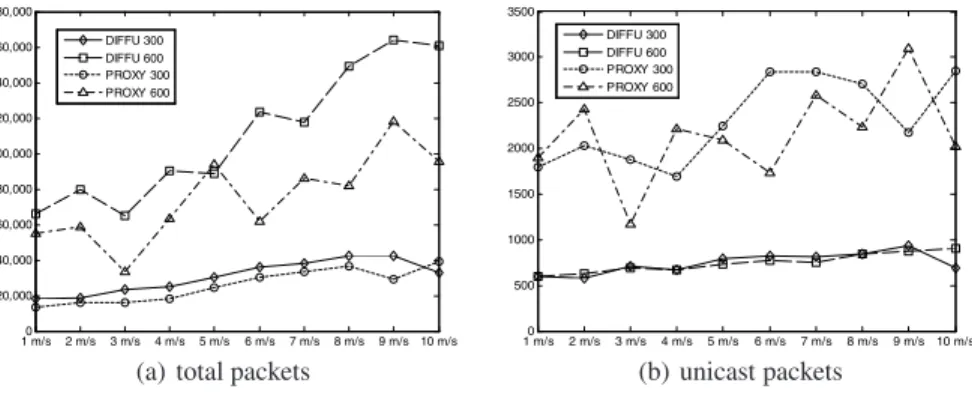
From the simulation results, as shown in Fig. 2(a), the total amount of generated packets in our scheme is much less than that of the diffusion wave. In both cases, however, the total amount of packets gradually increases by nodes’ speed. On the contrary, we can see that the amount of unicast packets in our scheme is more than the diffusion wave in Fig. 2(b). The reason of more unicast packets is that our scheme in the simulation uses a number of unicast packets to inform proxy nodes’ identifiers. Those informing packets seem to be significantly larger than partial signature gathering packets.
The number of stacked packets sent from UDP are shown in Fig. 3. In an early stage, the number of packets in our scheme is rapidly decreased because the proxy nodes can issue certificates for some nodes nearby them. On the contrary, the number of packets in the diffusion wave is kept in the similar level at the point of that time, but it is decreased at an accelerating pace after certain time because the nodes that can issue partial certificates for other nodes are increased. However, the diffusion wave does not work in 600×600m2playground environment by the moving speed of 10 m/s. The
overall number of packets in our scheme decreases linearly by the lapse of time. The reason of why there is some long intervals in which the number of packets is kept in the same level is due to that a few number of nodes suffer from its bad environment caused by the random movement for searching the proxy nodes.
The increase of the number of nodes that have a complete certificate also reflects the difference between the diffusion wave and our scheme as shown in Fig. 4. The shape of Fig. 4 is very similar with Fig. 3(a) because the nodes that obtain a complete certificate
1 m/s0 2 m/s 3 m/s 4 m/s 5 m/s 6 m/s 7 m/s 8 m/s 9 m/s 10 m/s 20,000 40,000 60,000 80,000 100,000 120,000 140,000 160,000 180,000 DIFFU 300 DIFFU 600 PROXY 300 PROXY 600
(a) total packets
1 m/s0 2 m/s 3 m/s 4 m/s 5 m/s 6 m/s 7 m/s 8 m/s 9 m/s 10 m/s 500 1000 1500 2000 2500 3000 3500 DIFFU 300 DIFFU 600 PROXY 300 PROXY 600 (b) unicast packets
Fig. 2. The total amount of packets sent from UDP according to the increment of moving speed
0 5100 11100 17100 23100 29100 36300 43500 0 500 1000 1500 DIFFU 300 - 5 m/s DIFFU 300 - 10 m/s DIFFU 600 - 5 m/s DIFFU 600 - 10 ms/s PROXY 300 - 5 m/s PROXY 300 - 10 m/s PROXY 600 - 5 m/s PROXY 600 - 10 m/s
(a) 300 seconds stacked
0 51000 11100 17100 23100 29100 3630043500 0 20,000 40,000 60,000 80,000 100,000 120,000 140,000 160,000 180,000 DIFFU 300 - 5 m/s DIFFU 300 - 10 m/s DIFFU 600 - 5 m/s DIFFU 600 - 10 ms/s PROXY 300 - 5 m/s PROXY 300 - 10 m/s PROXY 600 - 5 m/s PROXY 600 - 10 m/s (b) totally stacked
Fig. 3. The number of stacked packets send from UDP by the lapse of time
do not make the broadcast messages any more. As shown in Fig. 2(b), the number of the unicast messages is very small as compared with the number of the broadcast messages. Therefore, the main reasons that the diffusion wave method suffers from lots of network traffic is not only due to transmitting several partial certificates, but also for finding the nodes that can issue partial certificates.
4.3 Simulation Results: Node Performance
The diffusion wave requires more decryption even though the proxy nodes should sign as much as the number of normal nodes in our scheme. In our simulation, one node in the diffusion wave signs about 3 times while one proxy node signs about 7 times on average. However, the overall number of times for signing certificates in the diffusion wave is about 5 times greater than in our scheme. If the threshold is lager than our simulation threshold parameter, the burden will be larger. This situation is shown in Fig. 5.
0 5100 11100 17100 23100 29100 36300 43500 0 10 20 30 40 50 60 DIFFU 300 - 5 m/s DIFFU 300 - 10 m/s DIFFU 600 - 5 m/s DIFFU 600 - 10 ms/s PROXY 300 - 5 m/s PROXY 300 - 10 m/s PROXY 600 - 5 m/s PROXY 600 - 10 m/s
Fig. 4. The number of nodes which have a complete certificate by the lapse of time
1 m/s 2 m/s 3 m/s 4 m/s 5 m/s 6 m/s 7 m/s 8 m/s 9 m/s 10 m/s 50 100 150 200 250 300 DIFFU 300 DIFFU 600 PROXY 300 PROXY 600
Fig. 5. The number of times for signing certificates in each scenario
5
Protocol Evaluation
5.1 Flexibility
Our proposed scheme is similar to multiple CA model (illustrated in Fig. 1(a)) in that both have several certificate issuers. However, the proxy nodes in our scheme are trans-fered certificate issuing competence from one authority (i.e. system authority) on con-trary with multiple CA model which has several authorities. A node in multiple CA model should request its CA the validations of other nodes’ certificates. So that, the CAs in multiple CA model should prepare the certificate chain to other CAs. However, in our scheme, there is not need for such request due to the warrant from system author-ity though a node also should know other proxy nodes’ public keys. The validations of proxy nodes’ public keys are guaranteed by the warrant signed by system private key. 5.2 Network Performance
From the shown simulation results, it is clear that the diffusion wave takes much time for obtaining first authentication (i.e. a complete certificate). However, the diffusion wave also has the positive effect such that it shortens the time to take a complete certificate with increasing speed. Instead of that effect, many nodes make lots of network traffic for
finding the nodes which are available in service and for requesting the several partial certificates. In addition, the diffusion wave provide stable and equal chances for all nodes to take their certificate in a good network environment. However, it is very hard to obtain a complete certificate in bad network environment.
The proxy signature method requires less traffic for issuing the certificates than the diffusion wave but there is a large difference of difficulty to obtain certificate for each node. Also, if the system authority at the beginning of the network operation initialize a few chair nodes only but any proxy nodes, the network will not work because of the rarity of the proxy nodes. Also, proxy nodes can exist after the chair nodes distribute the proxy signature keys for the proxy nodes. Therefore, even though we did not simulate that case, it is expected that the system authority must initialize not only the chair nodes but also the proxy nodes.
5.3 Security Consideration
There are many direct or indirect security issues about certificate management in ad hoc network, but we consider two direct security issues that the diffusion wave holds but our scheme mitigates.
Random Attack on the Network: Letτbe the threshold for recovering the secret,Ns be the number of nodes that have the secret, andNa be the number of nodes that the attacker can attack. The attacker cannot obtain any information from neighbor nodes by attacking directly.
If the attacker cannot analyze the network traffic so that he cannot attack the nodes selectively(or simple, if the nodes behave very carefully for hiding their roles from the attackers), the attacker can try to attack only randomly selected nodes. Therefore, the expected number of nodes that have the secret is only(NsNa)/NtwhenNanumber of nodes are randomly selected fromNtnodes. Since the secret can be recovered only if
(NsNa)/Nt≥τ, the attacker needs to attackNanumber of nodes shown in Equation (4) to obtain the system secret on average.
Na≥
Ntτ
Ns
(4)
Based on that, in the diffusion wave, the attacker can recover the system secret if the attacker successfully attacks onlyτnodes becauseNsNt.
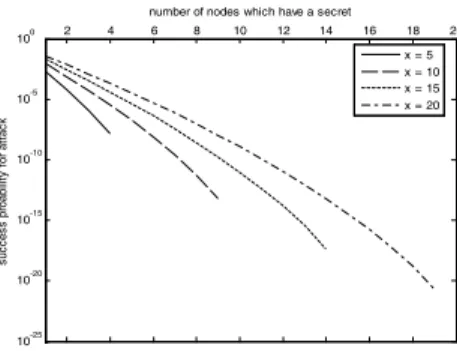
In our scheme, the probabilitypthat an attacker can succeed in performing such an attack is shown in Equation (5) because all nodes selected by the attack should have the secret. Fig. 6 shows those probabilities.
Pr[p] = Ns n (Ns−1) (Nt−1) (Ns−2) (Nt−2) · · ·(Ns−τ+ 1) (Nt−τ+ 1) =Ns!(Nt−τ)! Nt!(Ns−τ)! = NsPτ NtPτ (5)
Originality of the Authority: The authentication and the certificate issuing are totally two different operations. However, we can consider that the certificate issuing is a part of the authentication if the authentication is a condition for obtaining the certificate.
2 4 6 8 10 12 14 16 18 20 10-25 10-20 10-15 10-10 10-5 100
number of nodes which have a secret
s uc c es s pr oabi lit y f or at tac k x = 5 x = 10 x = 15 x = 20
Fig. 6. The success probability for attack with the threshold and the number of nodes that have
the secret
Self-initialized Nodes
Misbehaving Node System Authority
(a) diffusion wave
Misbehaving Node Proxy Nodes
Chair Nodes System Authority
(b) proxy signature
Fig. 7. The problem of the originality of the authority
Therefore, we can state that the proxy nodes have a part of the authority for authen-tication. In that point of view, the discussion about the originality of the authority is required.
Let us refer to nodes initialized by the system authority at the beginning of the net-work operation as the1stgeneration and those authenticated by the nodes of1st gen-eration as the2nd generation and so on. If the nodes in certain generation are authen-ticated by the nodes of previous generation, the originality of authority will degrade increasingly as the generation raises. That is, the misbehaving nodes can join the net-work legally because of low originality of authority even though the system authority initially does not want them to join in the network. The diffusion wave scheme (shown in Fig. 7(a)) does not consider this problem.
However, in our scheme (an illustration is shown in Fig. 7(b)), the nodes that can authenticate other nodes are only the proxy nodes authenticated by the system authority
or the chair nodes of1stgeneration. Therefore, the number of the generation does not exceed3in our scheme. So that, it is expected that the problem caused by the originality of the authority rarely happens.
6
Conclusion
In this paper, we introduced the certificate issuing scheme using proxy and threshold signatures for self-initialized ad hoc network. In our introduced scheme, chair nodes that can distribute partial proxy keys for proxy nodes are authenticated by the sys-tem authority. In addition, proxy nodes that can issue certificates for other nodes are authenticated and initialized by the system authority or the chair nodes. As it is demon-strated in the simulation results, our scheme has many advantages over the diffusion wave which is a main scheme for the certificate issuing in the self-initialized ad hoc network. If, however, the system authority does not authenticate and initialize any proxy nodes, it is expected that more time is required until there are enough num-ber of the proxy nodes for well-operating network. Therefore, it is recommended that the system authority authenticate the proxy nodes with the chair nodes to save the time.
References
1. Capkun, S., Butty´an, L., Hubaux, J.-P.: Self-organized public-key management for mobile ad hoc networks. IEEE Transactions on Mobile Computing 2, 52–64 (2003)
2. Li, R., Li, J., Hisao, K., Liu, P.: Localized public-key management for mobile ad hoc net-works. In: IEEE Global Telecommunications Conference, pp. 1639–1646 (2004)
3. Luo, H., Kong, J., Zerfos, P., Lu, S., Zhang, L.: Ursa: ubiquitous and robust access control for mobile ad hoc networks. IEEE/ACM Transactions on Networking 12, 1049–1063 (2004) 4. Li, J., Blake, C., Couto, D.S.J.D., Lee, H.I., Morris, R.: Capacity of ad hoc wireless networks. In: ACM Conference on Mobile Computing and Networking, pp. 61–69. ACM Press, New York (2001)
5. Shamir, A.: How to share a secret. Communications of ACM 22, 612–613 (1979)
6. Desmedt, Y., Frankel, Y.: Threshold cryptosystems. In: Brassard, G. (ed.) CRYPTO 1989. LNCS, vol. 435, pp. 307–315. Springer, Heidelberg (1990)
7. Mambo, M., Usuda, K., Okamoto, E.: Proxy signatures for delegating signing operation. In: ACM Conference on Computer and Communications Security, pp. 48–57. ACM Press, New York (1996)
8. Okamoto, T., Pointcheval, D.: The gap-problems: A new class of problems for the security of cryptographic schemes. In: Kim, K.-c. (ed.) PKC 2001. LNCS, vol. 1992, pp. 104–118. Springer, Heidelberg (2001)
9. Menezes, A., Okamoto, T., Vanstone, S.A.: Reducing elliptic curve logarithms to logarithms in a finite field. IEEE Transactions on Information Theory 39(5), 1639–1646 (1993) 10. Boldyreva, A.: Threshold signatures, multisignatures and blind signatures based on the
gap-diffie-hellman-group signature scheme. In: Desmedt, Y.G. (ed.) PKC 2003. LNCS, vol. 2567, pp. 31–46. Springer, Heidelberg (2002)
11. Zhang, F., Safavi-NainiTatsuaki, R., Lin, C.Y.: New proxy signature, proxy blind signature and proxy ring signature schemes from bilinear pairings. Cryptology ePrint Archive (2003)
12. Lakshman, T.V., Madhow, U.: The performance of tcp/ip for networks with high bandwidth-delay products and random loss. IEEE/ACM Trans. Netw. 5, 336–350 (1997)
13. Lefevre, F., Vivier, G.: Understanding tcps behavior over wireless links. In: IEEE Symposium on Communications and Vehicular Technology, SCVT-200, pp. 123–130. IEEE Computer Society Press, Los Alamitos (2000)
14. Gura, N., Patel, A., Wander, A., Eberle, H., Shantz, S.C.: Comparing elliptic curve cryptogra-phy and rsa on 8-bit cpus. In: Joye, M., Quisquater, J.-J. (eds.) CHES 2004. LNCS, vol. 3156, pp. 119–132. Springer, Heidelberg (2004)