Trust Building in Consumer Learning
Process and Its Effect on Consumers’
Behavioral Intention toward Mobile
Payments
Full Papers
Lin Jia
Beijing Institute of Technology
[email protected]
Dianne Hall
Auburn University
[email protected]
Suning Zhu
Auburn University
[email protected]
Abstract
The era of mobile commerce is coming, and mobile payments will become an important channel for conducting transactions, especially concerning mobile commerce. However, we are still in the early days for global adoption of mobile payments. This research explores consumers’ trust building in the consumer learning process and its effect on consumers’ behavioral intention toward mobile payments. Results indicate that exposure to mobile payments has a positive relationship with consumers’ information searching and trust in mobile payments, which in turn affect their behavioral intention. When we compared our results across the user and the non-user groups, the similarities and differences in the cognitive processes involved for adoption and post adoption become apparent. Theoretical and practical implications of the findings are also presented.
Keywords
Consumer learning, trust, information searching, mobile payments, adoption, post adoption.
Introduction
Mobile payments are payments that use mobile devices to pay for goods, services, and bills or perform bank transactions by using mobile technology (Dahlberg, Mallat, Ondrus, & Zmijewska, 2008). Many researchers and business analysts believe that mobile payments will flourish in coming years. It is estimated that worldwide mobile payment revenue will rise to $998.5 billion in 2016 (Business Wire, 2012). However, the acceptance rate of mobile payments is low although the growth forecast for mobile payments is very positive (Duane, O’Reilly, and Andreev, 2012). Consumers are not ready to broadly accept mobile payments. In the U.S., only 37% of smartphone owners have used their phones to make a mobile payment (Nielsen, 2014). In China, only twenty nine percent of consumers have used mobile payments, among which only six percent of consumers use mobile payments frequently and twenty three percent of consumers use mobile payments occasionally (iResearch, 2013).
Meanwhile, we are still in the early days for the adoption of mobile payments globally (MasterCard, 2014). According to the MasterCard mobile payments readiness index, no country has achieved a mainstream consumer acceptance, and we are still in the early days for the adoption of mobile payments globally (MasterCard, 2014). Singapore ranks first with an index of 45.6, and the indexes for the United States and China are 41.5 and 36.5, respectively (MasterCard, 2014). In the other side, recent launcher of Apple Pay, the mobile payment process of the Apple Company, indicates that users are willing to engage in using mobile payments. More research is needed to explore the drivers of mobile payment acceptance.
Trust is an important driver of consumers’ acceptance of IT innovations, especially when there is a high level of risk associated with IT innovations (Coleman, 1990; Gefen et al., 2003). Mobile payments operate based on mobile Internet and there is high uncertainty and perceived risk associated with using them (Zhou, 2014). Zhou (2015) posited that trust in mobile payments will stimulate consumers switch from online payments to mobile payments. Thus, trust plays a vital role in affecting acceptance of mobile payments.
Consumers’ trust in mobile technology is dynamic (Lin, Wang, Wang, & Lu, 2014). Consumers modify their trust in mobile payments according to new information they obtain during the consumer learning process. In this process, external factors play an important role in affecting consumers’ trust in mobile payments (Liebana-Cabanillas et al., 2014). Liebana-Cabanillas et al. (2014) posited that social influences and social norms are two types of external factors that have a positive relationship with consumers’ trust in mobile payments. They proposed that future research should explore the influence of other external elements on consumers’ trust in mobile payments (Liebana-Cabanillas et al., 2014). For example, word of mouth and media usage are considered external factors that affect consumers’ trust in mobile payments (Chandra et al., 2010; Kim et al., 2009).
In this article, we view adoption of innovation as an “on-going process involving persuasive communication and learning (Lee & Xia, 2011, P. 289)” and separate consumer learning into passive and active consumer learning, which are represented by exposure to mobile payments and information searching, respectively. Exposure to mobile payments refers to the degree to which an individual has acquired or exchanged information about mobile payments and its usage (Khalifa, Cheng, & Shen, 2012). Exposure to mobile payments is viewed a construct that is composed of media usage, positive word of mouth (pWOM), and explicit and implicit social influence. Information searching in this study is the process by which individuals seek information about a problem, situation, or artifact such as how to use mobile payments (Browne, Pitts, & Wetherbe, 2007). We then view consumer learning as the source of quality information and explore the effect of consumer learning on consumers’ trust building and behavioral intention toward mobile payments.
The objective of this research is to explore consumers’ trust building in the consumer learning process and its effect on consumers’ behavioral intention toward mobile payments. Our research questions are: (1) whether consumer learning can increase consumers’ trust in mobile payments and hence affect their behavioral intention toward mobile payments; and (2) what factors differentiate the users and non-users. The rest of the paper proceeds as follows. The theoretical background and conceptual model are presented first. Then, the hypotheses are developed. Data collection and analysis are explained next followed by presentation of the results.
Theoretical Background
Multi-Stage Decision Making Model
Dewey (1910) first proposed the multi-stage buying decision process, which includes problem/need recognition, information searching, alternatives evaluation, purchase decision, and post purchase behavior. Consumers’ decision making processes start when they recognize the need to make a decision. They will search for some information to solve the problem or to make a decision about whether to use the product. The information they obtain will be used to evaluate the alternative to decide which one to choose. Then, the final decision will be made after the evaluation.
A similar model of decision making is proposed by Bruyn and Lilien (2008). The model includes three stages: awareness, interest, and final decision. Consumers first become aware of the existence of an object because of exposure to the object or receive of information about the object from the external environment. Then, individuals will search for information to see whether the object meets their needs. With the information they obtain, they will evaluate the object and its alternatives and make final decisions about whether to use and which one to use.
Initial Trust Building Theory
McKnight et al. (1998) and McKnight, Choudhury, and Kacmar (2002) proposed the initial trust building model, explaining the trust building mechanism and the role of trust in affecting behavioral intention as follows:
Trust building levers Trust in vendorTrust intention
Trust building levers refer to some environmental or personal factors that help build trust. They used disposition to trust and institution-based trust to represent trust building levers. Trust intentions refer to intention to engage in trust related behaviors and are positively related with trust related behaviors such as adoption and purchase (McKnight et al., 2002). According to the model, disposition to trust and institution-based trust each have a positive effect on trust belief and in turn, affects trust intention. McKnight et al. (2002) suggested that trust plays a central role in helping consumers overcome the uncertainty and risk of purchasing from online sellers and encourages consumers to adopt e-commerce. They applied the initial trust building model to e-commerce and tested the items they proposed to measure disposition to trust, institution-based trust, trusting belief, and trust intention. They found that disposition to trust is positively related to both trust belief and institution-based trust. Trust belief then positively affects individuals’ trusting intention.
Research Model and Hypotheses Development
Research Model
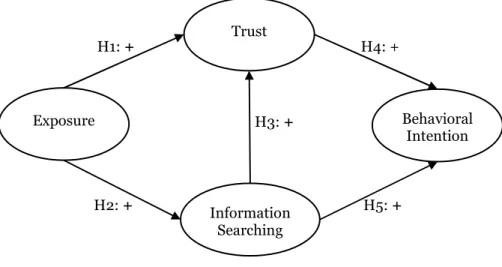
A conceptual research model (Figure 1) is proposed by combining the theories listed above. According to the model, consumers will search for information after getting exposed to mobile payments. Consumers’ exposure to mobile payments and information searching together encourage them to trust mobile payments. Trust and information searching will then affect consumers’ behavioral intention toward mobile payments.
Figure 1. Trust Building in Consumer Learning Process
Hypotheses Development
Zuckers (1986) mentioned that characteristics-based trust is an important mode of building trust. Characteristics-based trust refers to trust that is built on characteristics of trustees such as perceived reputation. PWOM is a socially generated signal of product or service (Amblee & Bui, 2011), which we use to represent consumers’ positive feelings about mobile payments in this research. Meanwhile, media usage, the extent to which messages of an innovation are transmitted through mass media such as television, newspapers, magazines, radio, and the Internet, is used to attract consumers by providing
H5: + H4: + H3: + H1: + H2: + Exposure Trust Information Searching Behavioral Intention
them with advantages of products or services (Wei et al., 2011). Thus, pWOM and media usage have a positive relationship with consumers’ perceived reputation of mobile payments, which encourages consumers to trust in mobile payments (Chandra et al., 2010; Kim et al., 2009). Additionally, social influence, consumers’ perceived pressure of important others that they should use a particular technology (Venkatesh et al., 2012), serves as a special connection between important others and mobile payments. Trust always transfers from trusted objective to new objective if there is a connection between these two parties (Steward, 2003). Consumers trust people they respect, and thus they tend to trust mobile payments if they feel those individuals think they should use mobile payments. Thus,
Hypothesis 1. Exposure to mobile payments will encourage consumers to trust mobile payments.
Awareness and interest about innovations may occur concurrently after consumers are exposed to the innovation (Yoo, 2008). Exposure to WOM and media usage are two methods by which consumer’s interest may be elevated (Kulkarni, Kannan, & Moe, 2012). After consumers become aware of and interested in IT innovations, they are motived to search for information about them before making further adoption decisions (Bruyn & Lilien, 2008). Consumers may communicate with others or search independently to explore how IT innovations function; this is the knowledge stage of the innovation-decision process (Rogers, 2003). Thus,
Hypothesis 2. Exposure to mobile payments will encourage consumers to search for information about mobile payments.
Information is considered an important prerequisite to trust (Flavia’n et al., 2006). By searching for information about mobile payments, consumers become familiar with mobile payments (Gefen et al., 2003). Consumers’ familiarity with mobile payments allows them to accumulate trust-relevant knowledge about the trustee (Komiak & Benbasat, 2006). Trust reflects an individual’s positive expectation toward another party’s future behavior (Mayer et al., 1995). Consumers will use the information and knowledge they obtain through information searching to predict the trustee’s behavior in the future (Doney & Cannon, 1997). Hence, familiarity can enhance consumers’ trust in mobile payments (Zuckers, 1986). Thus,
Hypothesis 3. Consumers’ information searching will have a positive relationship with their trust in mobile payments.
Trust is especially important when it comes to financial related services because consumers always worry about money loss (Coleman, 1990). Mobile payments are also risky because they operate based on mobile Internet and there is high uncertainty and perceived risk associated with using mobile payments (Zhou, 2014). The relationship between trust and behavioral intention is supported by the initial trust building theory. According to the initial trust building theory, trust belief toward a behavior will have a positive relationship with trust behavior such as adoption of mobile payments in this research (McKnight et al., 1998, 2002). Thus,
Hypothesis 4. Consumers’ trust in mobile payments will have a positive relationship with their behavioral intention toward mobile payments.
Consumers search for information before they make acceptance decisions (Bruyn & Lilien, 2008; Dewey, 1910). Information of an innovation will help consumers break different kinds of acceptance barriers such as usage, value, risk, and image barriers (Laukkanen & Kiviniemi, 2010). As a result of information searching, consumers form an overall assessment of the utility of mobile payments based on the information they obtain. This overall assessment, referred to as perceived value (Zeithaml, 1988), has a positive relationship with consumers’ behavioral intention toward mobile payments (Setterstrom et al., 2012). Meanwhile, consumers can actively search for relevant, sufficient, accurate, and timely information about mobile payments through information searching. Information quality has a positive relationship with individuals’ intention to use mobile payments (DeLone & McLean, 1992, 2003). Thus,
Hypothesis 5. Consumers’ information searching will have a positive relationship with their behavioral intention toward mobile payments.
Data Collection
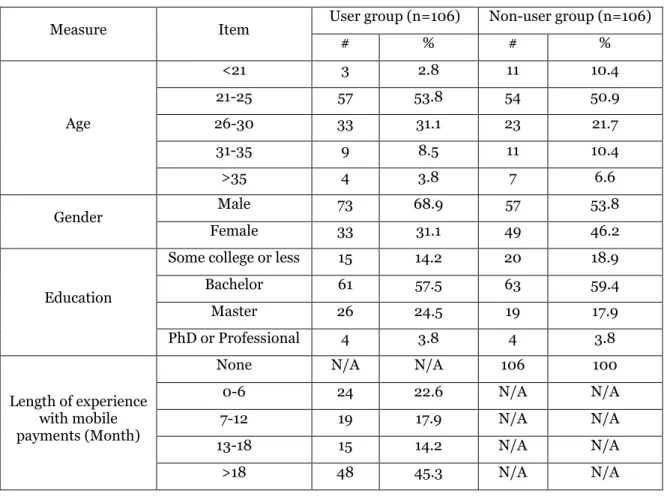
A survey was used for data collection. Three hundred and forty questionnaires were collected from the general public in China. Eighteen questionnaires were excluded from the dataset because of high rate of same answers, making the final sample size 322, in which 216 respondents are users and 106 respondents are non-users. Sample size will affect the significance of path coefficients (Cohen, 1988). The bigger the sample size, the bigger the tendency of statistically significance. In order to minimize the effect of sample size on significance test and make a comparison of the user and the non-user groups in China, we randomly selected 106 questionnaires from each group. 106 questionnaires were randomly selected from the 216 users, leading to two groups: the user group and the non-user group, each of which has 106 respondents. Table 1 summarizes the demographic information of the participants of the two groups.
Measures
Wherever possible, items were drawn from existing scales. Some minor modifications were made to the adopted measures. All items are measured on a seven-point Likert scale, ranging from strongly disagree (1) to strongly agree (7). Because data will be collected from both users and non-users, two versions of the questionnaire were used. One version is for users, and the other is for non-users. The original English instruments were translated into Chinese by following the back translation approach. A pilot test was conducted using a group of volunteer respondents in China to test the wording and reliability of the items.
Table 1. Demographic Information
Positive word of mouth was assessed with three items adapted from Alexandrov and Babakus (2013). Media usage was assessed with five items adapted from Loibl et al. (2009) and Wei et al. (2011). Explicit social influence was assessed with three items adapted from Venkatesh et al. (2012), and implicit social influence was assessed with three items adapted from Kim et al. (2007). Information searching was assessed with five items adapted from Barki et al. (2007). Trust in mobile payments was assessed with eight items adapted from Chandra et al. (2010) and Lu et al. (2011). Intention to use was assessed with
Measure Item User group (n=106) Non-user group (n=106)
# % # % Age <21 3 2.8 11 10.4 21-25 57 53.8 54 50.9 26-30 33 31.1 23 21.7 31-35 9 8.5 11 10.4 >35 4 3.8 7 6.6 Gender Male 73 68.9 57 53.8 Female 33 31.1 49 46.2 Education
Some college or less 15 14.2 20 18.9 Bachelor 61 57.5 63 59.4 Master 26 24.5 19 17.9 PhD or Professional 4 3.8 4 3.8 Length of experience with mobile payments (Month)
None N/A N/A 106 100
0-6 24 22.6 N/A N/A
7-12 19 17.9 N/A N/A 13-18 15 14.2 N/A N/A >18 48 45.3 N/A N/A
three items adapted from Gu et al. (2009), and intention to continued use was assessed with three items adapted from Venkatesh et al. (2012). Perceived ease of use was assessed with three items adapted from Lin et al. (2011). Perceived usefulness was assessed with three items adapted from Kim et al. (2010). The technology acceptance model supports the effect of perceived ease of use and perceived usefulness on behavioral intention. Perceived ease of use and perceived usefulness were used as control variables.
Data Analysis and Results
The PLS algorithm was conducted to analyze the data by using SmartPLS 2.0 (Ringle, Wende, & Will, 2005). PLS was chosen for its ability to handle non-normality in the data, and because the goal of this research is to explain variance in the outcome variable (Gefen et al., 2000). Exposure to mobile payments was measured by multiple subscales, which are media usage, positive WOM, explicit social influence, and implicit social influence. We condensed exposure to mobile payments by using latent variable scores of the subscales as items of the higher order construct as suggested by Williams and Hazer (1986).
Common Method Bias
All data was collected through a self-report survey. Thus, there is a potential of common method bias (Podsakoff et al. 2003). This research examined common method bias using three tests. First, the Harmon’s single factor test was performed. More than one single factor emerges from the unrotated factor solution, and none single-factor accounts for the majority of the covariance in the variables (Podsakoff et al. 2003). Second, researchers compared correlations among constructs by following the procedure established by Pavlou, Liang, and Xue (2007). The results revealed no constructs with correlations over 0.7. Third, the unmeasured latent method construct (ULMC) technique (Liang et al. 2007) was performed. For the user group, the ratio of substantive variance to method variance is about 68.4:1. For the non-user group, the ratio of substantive variance to method variance is about 89.4:1. All results indicate that common method bias is unlikely to be a serious concern for this study.
Measurement Model
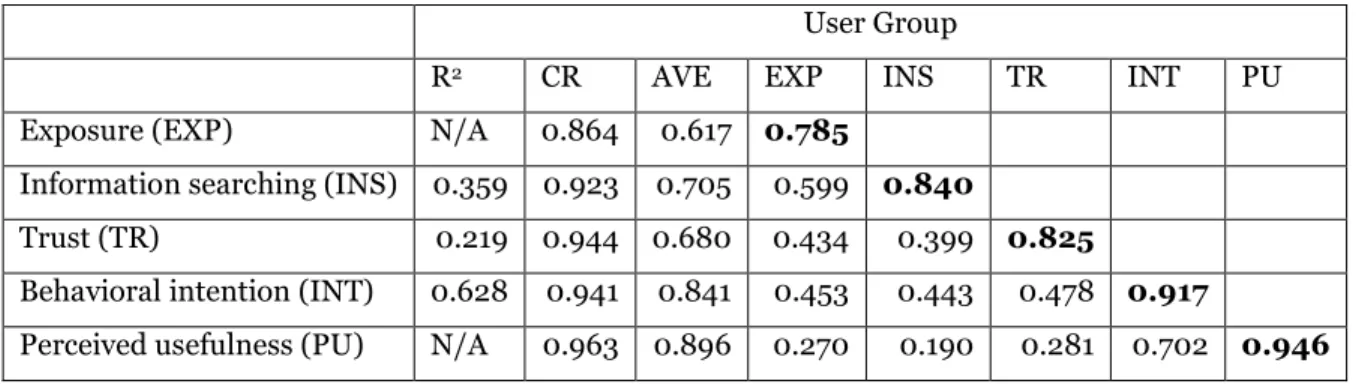
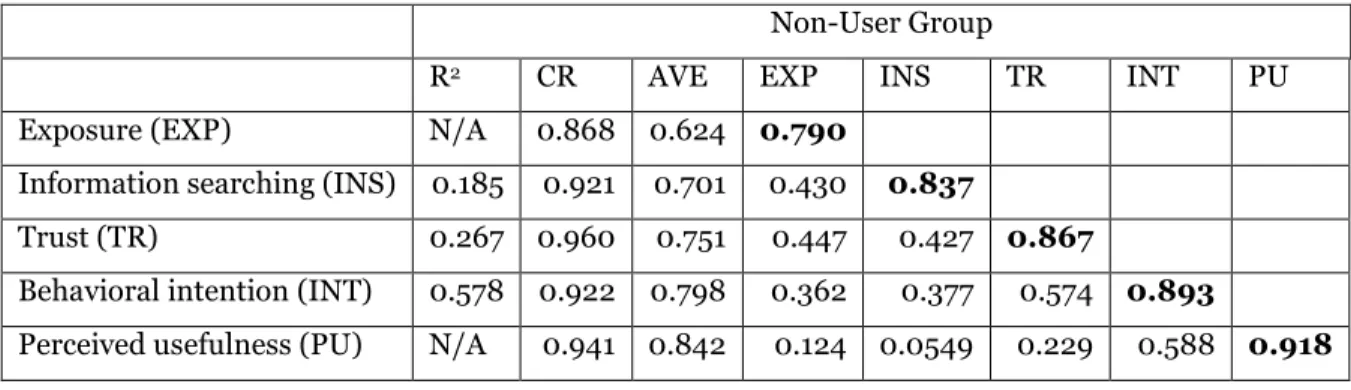
Perceived ease of use does not have a significant impact on behavioral intention. Thus, results of the model with perceived usefulness as the control variable are reported below. Results are reported and were evaluated in a two-step approach suggested by Hair et al. (1998) (See Table 2 and Table 3). Composite reliability (CR) ranged from 0.864 to 0.963 for the user group and from 0.868 to 0.960 for the non-user group, indicating valid internal consistency reliability (Chin, 1998). All AVEs are larger than 0.5, indicating valid convergent validity (Fornell & Larcker, 1981). Additionally, all squared roots of AVEs are greater than the correlation shared between the construct and other constructs in the model, and all items load appropriately on their intended construct, indicating discriminant validity (Chin, 1998). None variance inflation factors (VIFs) of the independent variables exceeds 3, suggesting that multicollinearity is not a concern (Petter et al. 2007).
User Group
R2 CR AVE EXP INS TR INT PU
Exposure (EXP) N/A 0.864 0.617 0.785
Information searching (INS) 0.359 0.923 0.705 0.599 0.840
Trust (TR) 0.219 0.944 0.680 0.434 0.399 0.825 Behavioral intention (INT) 0.628 0.941 0.841 0.453 0.443 0.478 0.917
Perceived usefulness (PU) N/A 0.963 0.896 0.270 0.190 0.281 0.702 0.946 Note: bold is the square root of AVE.
Non-User Group
R2 CR AVE EXP INS TR INT PU
Exposure (EXP) N/A 0.868 0.624 0.790
Information searching (INS) 0.185 0.921 0.701 0.430 0.837
Trust (TR) 0.267 0.960 0.751 0.447 0.427 0.867 Behavioral intention (INT) 0.578 0.922 0.798 0.362 0.377 0.574 0.893
Perceived usefulness (PU) N/A 0.941 0.842 0.124 0.0549 0.229 0.588 0.918 Note: bold is the square root of AVE.
Table 3. Measurement Validity for the Non-User Group
Structural Model
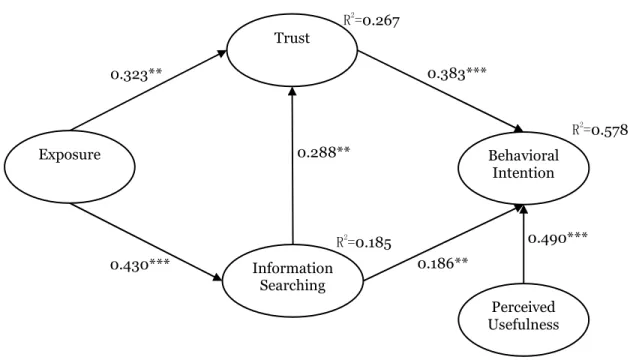
The path coefficients and explained variances of the structural model for both groups are shown in Figure 2 and Figure 3. PLS does not generate the model fit statistics but uses R2 to assess the explanatory power
of a structural model. The model explained 62.8% of the variance in users’ intention to continue use (adjusted R2=0.617), and 57.8% of the variance in non-users’ intention to use (adjusted R2=0.566),
validating the predictive power of the model.
Note: *p<0.05, **p<0.01, and ***p<0.001.
Figure 2. Structural Model for the User Group
0.595*** 0.212** 0.246** 0.599*** 0.217* R2 =0.628 R2= 0.359 R2= 0.219 0.304* Exposure Trust Information Searching Behavioral Intention Perceived Usefulness
Note: *p<0.05, **p<0.01, and ***p<0.001.
Figure 3. Structural Model for the Non-user Group
For both groups, the results indicate that exposure to mobile payments has a positive impact on trust (Users: b=0.243, p<0.01; Non-users: b=0.243, p<0.01) and information searching (Users: b=0.243, p<0.01; Non-users: b=0.243, p<0.01), supporting H1 and H2. Information searching has a positive impact on consumers’ trust (Users: b=0.243, p<0.01; Non-users: b=0.243, p<0.01). Thus, H3 is supported. Trust (Users: b=0.243, p<0.01; Non-users: b=0.243, p<0.01) and information searching (Users: b=0.243, p<0.01; Non-users: b=0.243, p<0.01) each has a positive relationship with consumers’ behavioral intention toward mobile payments, supporting H4 and H5.
Multi Group Analysis
In the structural model, the path coefficients vary across the two groups. A multi group analysis with PLS was conducted in order to test whether these differences are significant (Chin, 2000; Keil et al., 2000). Parametric t-test was performed to identify any significant difference between path coefficients of the two groups (Chin, 2000; Keil et al., 2000). According to the results, one path coefficient is different between the user and non-user groups, which is “Trust -> intention” (buser=0.211, bnon-user=0.385, ∆b=-0.174,
p<0.05).
Discussion
Key Findings
The results provide insight into the importance of exposure to mobile payments and its relationship with information searching and trust, which then affect consumers’ behavioral intention toward mobile payments. The findings suggest that consumers who have more exposure to mobile payments are more likely to search for information about mobile payments than those who have less exposure to mobile payments. Meanwhile, exposure to mobile payments will also encourage consumers to trust in mobile payments. Moreover, our results show that consumers’ information searching has a positive relationship with their trust in mobile payments. Meanwhile, information searching and trust each has a positive relationship with their behavioral intention toward mobile payments. Our results also suggest that trust in mobile payments is more important for non-users than for users in encouraging them to use mobile payments. The quick adoption of Apple Pay supports our findings. Consumers are greatly exposed to Apple Pay because of high reputation of IPhone and Apple, Inc. and consumers’ close attention to new
0.490*** 0.383*** 0.186** 0.430*** 0.288** R2= 0.578 R2= 0.185 R2= 0.267 0.323** Exposure Trust Information Searching Behavioral Intention Perceived Usefulness
payment function of IPhone. This increases consumers’ interest in searching for information of Apple Pay and helps build their trust in Apple Pay, boosting their acceptance of Apple Pay.
Limitations
Some limitations should be considered when interpreting the findings. First, the data was collected by using a self-report survey. Hence there is potential for common method biases (Podsakoff et al., 2003). However, common method bias was tested and is not a significant problem in this research. Second, the limited source and special characteristics of the sample restrict the generalization of the findings in this research. However, most of our respondents are under 30 years old, who are more willing to adopt mobile payments than other age groups (Scevak, 2010).
Implication for Theory
For technology acceptance research, this research explores the similarity and difference across adoption and post adoption. This research suggests that exposure to mobile payments, information searching, and trust in mobile payments can be used to predict both adoption and post adoption behavior. Moreover, our research explores the difference in the strength of relationships between the user and the non-user groups and finds that the importance of trust varies across the user and the non-user groups.
This research also contributes to trust building research. This research explores the trust building during the consumer learning process. Results indicate that consumer learning, represented by information searching and exposure to mobile payments, has a positive relationship with consumers’ trust in mobile payments.
Our findings about the positive impact of information searching on trust and behavioral intention also guarantee some discussions. Information searching, refers to time and energy consumers spent on learning how to use mobile payments, is a type of sunk cost (Park et al., 2012). If there is any sunk cost, consumers may be less likely to make a change and thus are more likely to accept mobile payments (Polites & Karahanna, 2012).
Implication for Practice
This research also provides mobile payments practitioners with some suggestions on how to attract non-users and retain non-users. Practitioners need to increase consumers’ exposure to mobile payments because it will encourage consumers to search for information and build trust in mobile payments. For example, mobile payment service providers can give users a bonus to encourage them to recommend mobile payments to their friends. Advertising and free applications are also good choices to increase consumers’ exposure to mobile payments.
Moreover, practitioners need to utilize possible mechanisms to boost consumers’ trust in mobile payments. For example, mobile payment service providers can cooperate with insurance companies and purchase insurance for their users to protect their transactions. If users encounter fraud and lose money, the insurance will cover their loss.
Meanwhile, practitioners should show non-users their endeavor to protect consumers’ property and right to encourage non-users to trust in mobile payments. Some examples of trust building mechanisms are company reputation, structural assurance, information quality, and system quality (Chandra, et al., 2010; Zhou, 2011).
Conclusion
This research verifies the vital role of consumer learning in building trust and encouraging consumers to accept mobile payments. Results indicate that exposure to mobile payments encourages consumers to search for information and trust in mobile payments, which in turn affect their behavioral intention. When we statistically compared our results across the user and non-user groups, the similarities and differences in the cognitive processes involved for adoption and post adoption became apparent. Theoretical and practical implications of the findings are also presented. This research deepens our
understanding of how consumer learning, represented as exposure to mobile payments and information searching, can be used to help consumers build trust and encourage them to accept mobile payments.
References
Alexandrov, A., Lilly, B., and Babakus, E. 2013. “The Effects of Social- and Self-Motives on the Intentions to Share Positive and Negative Word of Mouth,” Journal of the Academic Marketing Science, DOI 10.1007/s11747-012-0323-4.
Amblee, N., and Bui, T. 2011. “Harnessing the Influence of Social Proof in Online Shopping: The Effect of Electronic Word of Mouth on Sales of Digital Microproducts,” International Journal of Electronic Commerce (16:2), pp. 91-113.
Barki, H., Titah, R., and Boffo, C. 2007. “Information System Use-Related Activity: An Expanded Behavioral Conceptualization of Individual-Level Information System Use,” Information Systems Research (18:2), pp. 173-192.
Browne, G. J., Pitts, M. G., and Wetherbe, J. C. 2007. “Cognitive Stopping Rules for Terminating Information Search in Online Tasks,” MIS Quarterly (31:1), pp. 89-104.
Bruyn, A. D., and Lilien, G. L. 2008. “A Multi-Stage Model of Word-of-Mouth Influence through Viral Marketing,” International Journal of Research in Marketing (25:3), pp. 151-163.
Bui, M., Krishen, A. S., and Bates, K. 2011. “Modeling Regret Effects on Consumer Post-Purchase Decisions,” European Journal of Marketing (45:7), pp. 1068-1090.
Business Wire. 2012. Global Mobile Payment Market Revenues to Rise to $998.5 Billion in 2016, a CAGR of 83.7%. Retrieved from http://search.proquest.com/docview/920559352?accountid=8421.
Chandra, S., Srivastava, S. C., and Theng, Y. 2010. “Evaluating the Role of Trust in Consumer Adoption of Mobile Payment Systems: An Empirical Analysis,” Communications of the Association for Information Systems, 27, pp. 561-588.
Chin, W. W. 1998. “Issues and Opinion on Structural Equation Modeling,” MIS Quarterly (22:1), pp. 7-16. Chin, W. W. 2000. Multi-Group Analysis with PLS. Retrieved from
http://disc-nt.cba.uh.edu/chin/plsfaq/multigroup.htm.
Cohen, J. 1988. “Statistical Power Analysis for the Behavioral Sciences (2nd ed.), New York: Psychology
Press.
Coleman, J. S. 1990. The Foundations of Social Theory, Cambridge, MA: Harvard University Press. Dahlberg, T., Mallat, N., Ondrus, J., and Zmijewska, A. 2008. “Past, Present and Future of Mobile
Payments Research: A Literature Review,” Electronic Commerce Research and Applications (7:2), pp. 165-181.
DeLone, W. H., and McLean, E. R. 1992. “Information Systems Success: The Quest for the Dependent Variable,” Information Systems Research (3:1), pp. 60-95.
Delone, W. H., and McLean, E. R. 2003. “The Delone and Mclean Model of Information System Success: A Ten Year Update,” Journal of Management Information System (19:4), pp. 31-47.
Dewey, J. 1910. How We Think. Boston: D.C. Heath.
Doney, P. M., and Cannon, J. P. 1997. “An Examination of the Nature of Trust in Buyer-Seller Relationships,” Journal of Marketing (61:2), pp. 33-51.
Duane, A., O’Reilly, P., and Andreev, P. 2012. “Realising M-Payments: Modelling Consumers’ Willingness to M-Pay Using Smart Phones,” Behavior and Information Technology, iFirst article, pp. 1-17.
Flavia’n, C., Guinali’u, M., and Gurrea, R. 2006. “The Role Played by Perceived Usability, Satisfaction and Consumer Trust on Website Loyalty,” Information & Management (43:1), pp. 1-14.
Fornell, C., and Larcker, D. F. 1981. “Evaluating Structural Equation Models with Unobservable Variables and Measurement Error,” Journal of Marketing Research (18:1), pp. 39-50.
Gefen, D., Karahanna, E., and Straub, D. 2003. “Trust and TAM in Online Shopping: An Integrated Model,” MIS Quarterly (27:1), pp. 51-90.
Gefen, D., and Straub, D. 2000. “The Relative Importance of Perceived Ease-of-Use in IS Adoption: A Study of E-Commerce Adoption,” Journal of Association for Information Systems (8:1), pp. 1-30. Gu, J., Lee, S., and Suh, Y. 2009. “Determinants of Behavioral Intention to Mobile Banking,” Expert
Systems with Applications (36:9), pp. 11605–11616.
Hair, J. F., Anderson, R. E., Tatham, R. L., and Black, W. C. 1998. Multivariate Data Analysis (5th ed.), Englewood Cliffs, NJ: Prentice Hall.
iResearch. (2013). 2012-2013 China mobile payment user behavior report. Retrieved from: http://www.iresearchchina.com/reports/4875.html.
Keil, M., Tan, B. C. Y., Wei, K., and Saarinen, T. 2000. “A Cross-Cultural Study on Escalation of Commitment Behavior in Software Projects,” MIS Quarterly (24:2), pp. 299-325.
Khalifa, M., Cheng, S. K. N., and Shen, K. N. 2012. “Adoption on Mobile Commerce: A Confidence Model,”
Journal of Computer Information Systems (53:1), pp. 14-22.
Kim, C., Jahng, J., Lee, J. 2007. “An Empirical Investigation into the Utilization-Based Information Technology Success Model: Integrating Task-Performance and Social Influence Perspective,” Journal of Information Technology, 22, pp. 152-162.
Kim, C., Mirusmonov, M., and Lee, I. 2010. “An Empirical Examination of Factors Influencing the Intention to Use Mobile Payment,” Computers in Human Behavior (26:3), pp. 310-322.
Kim, G., Shin, B., and Lee, H. G. 2009. “Understanding Dynamics between Initial Trust and Usage Intentions of Mobile Banking,” Information Systems Journal (19:3), pp. 283-311.
Komiak, S. Y. X., and Benbasat, I. 2006. “The Effects of Personalization and Familiarity on Trust and Adoption of Recommendation Agents,” MIS Quarterly (30:4), pp. 941-960.
Kulkarni, G., Kannan, P. K., and Moe, W. 2012. “Using Online Search Data to Forecast New Product Sales,” Decision Support Systems (52:3), pp. 604-611.
Laukkanen, T., and Kiviniemi, V. 2010. “The Role of Information in Mobile Banking Resistance,”
International Journal of Banking Marketing (28:5), pp. 372-388.
Lee, G., and Xia, W. 2011. “A Longitudinal Experimental Study on the Interaction Effects of Persuasion Quality, User Training, and First-Hand-Use on User Perceptions of New Information Technology,”
Information & Management (48:7), pp. 288-295.
Liang, H., Saraf, N., Hu, Q., and Xue, Y. 2007. “Assimilation of Enterprise Systems: The Effect of Institutional Pressures and the Mediating Role of Top Management,” MIS Quarterly (31:1), pp. 59-87. Liebana-Cabanillas, F., Sanchez-Fernandez, J., and Munoz-Leiva, F. 2014. “The Moderating Effect of Experience in the Adoption of Mobile Payment Tools in Virtual Social Networks: The M-Payment Acceptance Model in Virtual Social Networks (MPAM-VSN),” International Journal of Information Management (34:2), pp. 151-166.
Lin, J., Lu, Y., Wang, B., and Wei, K. K. 2011. “The Role of Inter-Channel Trust Transfer in Establishing Mobile Commerce Trust,” Electronic Commerce Research and Applications (10:6), pp. 615-625. Loibl, C., Cho, S. H., Diekmann, F., and Batte, M. T. 2009. “Consumer Self-Confidence in Searching for
Information. Journal of Consumer Affairs (43:1), pp. 26-55.
MasterCard. 2014. “Mobile Payments Readiness Index,” Retrieved from http://mobilereadiness.mastercard.com/the-index/.
McKnight, D. H., Choudhury, V., and Kacmar, C. 2002. “Developing and Validating Trust Measures for E-Commerce: An Integrative Typology,” Information Systems Research (13:3), pp. 334-359.
McKnight, D. H., Cummings, L. L., and Chervany, N. L. 1998. “Initial Trust Formation in New Organizational Relationships,” Academy of Management Review (23:3), pp. 473-490.
Nielsen. (2014). The digital consumer. Retrieved from: http://www.nielsen.com/content/dam/corporate/us/en/reports-downloads/2014%20Reports/the-digital-consumer-report-feb-2014.pdf.
Park, S. C., Keil, M., Kim, J. U., and Bock, G. 2012. “Understanding Overbidding Behavior in C2C Autions: An Escalation Theory Perspective,” European Journal of Information Systems, 21, pp. 643-663. Pavlou, P. A., Liang, H., Xue, Y. 2007. “Understanding and Mitigating Uncertainty in Online Exchange
Relationships: A Principal-Agent Perspective,” MIS Quarterly (31:1), pp. 105-136.
Petter, S., Straub, D., and Rai, A. 2007. “Specifying Formative Constructs in Information Systems Research,” MIS Quarterly (31:4), pp. 623-656.
Podsakoff, P., MacKenzie, S., Lee, J., and Podsakoff, N. 2003. “Common Method Biases in Behavioral Research: A Critical Review of the Literature and Recommended Remedies,” Journal of Applied Psychology (88:5), pp. 879-903.
Ringle, C. M., Wende, S., and Will, A. 2005. SmartPLS 2.0 M3 (Beta), SmartPLS, Hamburg, Germany. Rogers, E. M. 2003. “Diffusion of Innovations (5th),” Detroit, MI: Free Press.
Polites, G. L., and Karahanna, E. 2012. “Shackled to the Status Quo: The Inhibiting Effect of Incumbent System Habit, Switching Costs, and Inertia on New System Acceptance,” MIS Quarterly (36:1), pp. 21-42.
Scevak, N. 2010. “Forrester Research Mobile Media and Messaging Forecast, 2010 to 2015 (Western
http://www.forrester.com/Forrester+Research+Mobile+Media+And+Messaging+Forecast+2010+To +2015+Western+Europe/-/E-RES57671?objectid=RES57671.
Setterstrom, A. J., Pearson, J. M., and Orwig, R. A. 2012. “Web-Enabled Wireless Technology: An Exploratory Study of Adoption and Continued Use Intention,” Behavior & Information Technology, iFirst article, pp. 1-16.
Steward, K. J. 2003. “Trust Transfer on the World Wide Web,” Organization Science (14:1), pp. 5-17. Venkatesh, V., Thong, J. Y. L., and Xu, X. 2012. “Consumer Acceptance and Use of Information
Technology: Extending the Unified Theory of Acceptance and Use of Technology,” MIS Quarterly
(36:1), pp. 157-178.
Wei, Y., Frankwick, G. L., Gao, T., and Zhou, N. 2011. “Consumer Adoption Intentions toward the Internet in China: The Effects of Impersonal and Interpersonal Communication Channels,” Journal of Advertising Research (51:4), pp. 594-607.
Williams, L. J., and Hazer, J. T. 1986. “Antecedents and Consequences of Satisfaction and Commitment in Turnover Models: A Reanalysis Using Latent Variable Structural Equation Methods,” Journal of Applied Psychology (71:2), pp. 219–231.
Yoo, C. Y. 2008. “Unconscious Processing of Web Advertising: Effects on Implicit Memory, Attitude toward the Brand, and Consideration Set,” Journal of Interactive Marketing (22:2), pp. 2–17.
Zeithaml, V. A. 1988. “Consumer Perceptions of Price, Quality, and Value: A Means-End Model and Synthesis of Evidence,” Journal of Marketing (52:3), pp. 2-22.
Zhou, T. 2011. “An Empirical Examination of Initial Trust in Mobile Banking,” Internet Research (21:5), pp. 527-540.
Zhou, T. 2014. “An Empirical Examination of Initial Trust in Mobile Payment,” Wireless Personal Communication. DOI 10.1007/s11277-013-1596-8.
Zhou, T. 2015. “An Empirical Examination of Users’ Switch from Online Payment to Mobile Payment,”
International Journal of Technology and Human Interaction (11:1), pp. 55-66.