CATEGORIZING BLOG SPAM
A Thesis presented to
the Faculty of California Polytechnic State University, San Luis Obispo
In Partial Fulfillment
of the Requirements for the Degree Master of Science in Computer Science
by
Brandon Bevans June 2016
©2016 Brandon Bevans ALL RIGHTS RESERVED
COMMITTEE MEMBERSHIP
TITLE: Categorizing Blog Spam
AUTHOR: Brandon Bevans
DATE SUBMITTED: June 2016
COMMITTEE CHAIR: Foaad Khosmood, Ph.D.
Assistant Professor of Computer Science
COMMITTEE MEMBER: Alex Dekhtyar, Ph.D.
Professor of Computer Science
COMMITTEE MEMBER: Bruce DeBruhl, Ph.D.
ABSTRACT Categorizing Blog Spam
Brandon Bevans
The internet has matured into the focal point of our era. Its ecosystem is vast, complex, and in many regards unaccounted for. One of the most prevalent aspects of the internet is spam. Similar to the rest of the internet, spam has evolved from simply meaning ‘unwanted emails’ to a blanket term that encompasses any unsolicited or illegitimate content that appears in the wide range of media that exists on the internet.
Many forms of spam permeate the internet, and spam architects continue to develop tools and methods to avoid detection. On the other side, cyber security engineers continue to develop more sophisticated detection tools to curb the harmful effects that come with spam. This virtual arms race has no end in sight. Most efforts thus far have been toward accurately detecting spam from ham, and rightfully so since initial detection is essential. However, research is lacking in understanding the current ecosystem of spam, spam campaigns, and the behavior of the botnets that drive the majority of spam traffic.
This thesis focuses on characterizing spam, particularly the spam that appears in forums, where the spam is delivered by bots posing as legitimate users. Forum spam is used primarily to push advertisements or to boost other websites’ perceived popularity by including HTTP links in the content of the post. We conduct an experiment to collect a sample of the blog posts and network activity of the spambots that exist in the internet. We then present a corpora available to conduct analysis on and proceed with our own analysis. We cluster associated groups of users and IP addresses into entities, which we accept as a model of the underlying botnets that interact with our honeypots. We use Natural Language Processing (NLP) and Machine Learning (ML) to determine that creating semantic-based models of botnets are sufficient for distinguishing them from one another. We also find that the syntactic structure of posts has little variation from botnet to botnet. Finally we confirm that to a large degree botnet behavior and content hold across different domains.
ACKNOWLEDGMENTS
Thank you to my advisor Dr. Foaad Khosmood for the constant guidance and the initial idea. This thesis introduced me to many new concepts in Computer Science that I have grown a passion for, and for that I am very grateful.
Thank you to my family and friends for their unconditional love, support, and guid-ance.
TABLE OF CONTENTS
Page
LIST OF TABLES . . . viii
LIST OF FIGURES . . . ix CHAPTER 1 INTRODUCTION . . . 1 1.1 What Is Spam . . . 1 1.2 Blog Spam . . . 2 1.3 Our Contribution . . . 2 2 BACKGROUND . . . 7 2.1 Spam . . . 7 2.2 Honeypots . . . 11
2.3 Natural Language Processing . . . 13
2.4 Machine Learning . . . 14
3 TOOLS & TECHNOLOGIES . . . 17
3.1 AWS . . . 17
3.2 Drupal . . . 17
3.3 Python . . . 17
3.4 NLTK . . . 18
3.5 Alchemy . . . 18
3.6 Google Language Detection . . . 19
3.7 SANS Internet Stormcast Center (ISC): Common Vulnerabilities and Exposure (CVE) . . . 19
3.8 Stanford POS Tagger . . . 19
3.9 Geolocation Tool . . . 20 3.10 Megam . . . 20 3.11 Porter Stemmer . . . 21 4 EXPERIMENTAL DESIGN . . . 22 4.1 Data Collection . . . 24 4.2 Corpora Formation . . . 24
5 ANALYSIS AND RESULTS . . . 28
5.1 Corpora . . . 28 5.1.1 User Table . . . 28 5.1.2 Access Table . . . 31 5.1.3 Content Table . . . 33 5.2 Entities . . . 36 5.3 Content Analysis . . . 40 5.3.1 Feature Sets . . . 41 5.3.1.1 Bag Of Words . . . 41 5.3.1.2 Alchemy Taxonomy . . . 42 5.3.1.3 Link . . . 43 5.3.1.4 Vocab . . . 43
5.3.1.5 PoS . . . 43
5.3.1.6 N-Grams . . . 44
5.3.2 Algorithmic Classification Analysis . . . 45
5.3.3 Maximum Entropy Classification . . . 49
5.3.4 Naive Bayes Classification . . . 57
5.4 Behavior Analysis . . . 63
5.4.1 Access Behavior . . . 63
5.4.2 Domain Agnostic Behavior . . . 66
5.5 Special Items . . . 74
5.5.1 Uncompiled Content . . . 75
5.5.2 Top Meta Entity . . . 78
6 CONCLUSION . . . 79
7 FUTURE WORK . . . 81
7.1 Classification Modularization . . . 81
7.2 Multilingual Classification . . . 82
7.3 Target Link Analysis . . . 82
7.4 Contamination Identification . . . 82
7.5 Naive Bayes Classifier . . . 83
LIST OF TABLES
Table Page
5.1 General User Table Characteristics . . . 28
5.2 Number of Access Requests per Honeypot . . . 31
5.3 General Content Table Characteristics . . . 34
5.4 General Entity Characteristics . . . 36
5.5 Entity User Characteristics . . . 37
5.6 Entity IP Characteristics . . . 37
5.7 Entity Post Characteristics . . . 38
5.8 An example of a Boolean modification of a feature set. . . 46
5.9 An example of a normalization modification of a feature set. . . 46
5.10 Number of Honeypots Spanned by Meta Entities . . . 67
5.11 The distribution of the top 10 taxonomies for example meta entity’s ggjx posts. . . 72
5.12 The distribution of the top 10 taxonomies for example meta entity’s gjams posts. . . 72
5.13 The distribution of the 10 taxonomies for example meta entity’s npcagent posts. . . 72
LIST OF FIGURES
Figure Page
2.1 The Main Steps Involved in a Spam Filter [11]. . . 9
4.1 The ggjx honeypot as it appears to a human viewer. . . 23
5.1 User Distribution for top geographic locations. . . 29
5.2 Registrations Per Day. . . 30
5.3 Access Requests Per Day. . . 31
5.4 ‘Action’ type distribution. . . 32
5.5 Register requests per day for all three honeypots. . . 33
5.6 Examples of ‘OTHER’ requests received. . . 34
5.7 Posts Per Day. . . 35
5.8 Post Frequency Distribution. . . 38
5.9 Cumulative Post Distribution when only considering entities who posted at least once. . . 39
5.10 IP Frequency Distribution. . . 40
5.11 Number of Documents per Group of Entities. . . 45
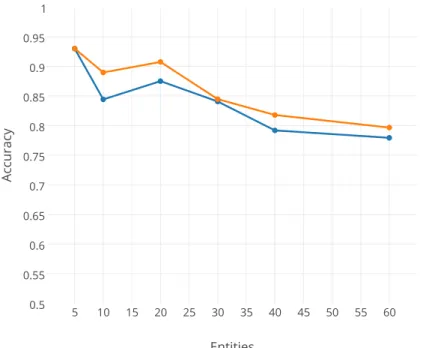
5.12 Prediction Accuracy With the Boolean feature set modification. . . 47
5.13 Prediction Accuracy With the normalization feature set modification. 48 5.14 Prediction Accuracy of the Maximum Entropy classifier with the two feature set modifications. . . 49
5.15 Accuracy of Megam classifier with a varying top word Threshold. . 50
5.16 Accuracy of Entity Classification using Naive Bayes with a varying top word threshold. . . 51
5.17 Accuracy of Megam classifier with the BoW feature set. . . 52
5.18 Accuracy of Megam classifier with the Alchemy Taxonomy feature set. 53 5.19 Accuracy of Megam classifier with the Link feature set. . . 54
5.20 Accuracy of Megam classifier with the PoSBigram feature set. . . . 55
5.21 Accuracy of Megam classifier with the PoSTrigram feature set. . . . 56
5.22 Accuracy of Megam classifier with the Vocab feature set. . . 57
5.23 Accuracy of Megam classifier with the Taxonomy, BoW, and Link feature set. . . 58
5.24 The Confusion Matrix of the top 10 posting entities. . . 59
5.25 Accuracy of Naive Bayes classifier with the BoW feature set. . . 60
5.26 Accuracy of Naive Bayes classifier with the Alchemy Taxonomy fea-ture set. . . 61
5.27 Accuracy of Naive Bayes classifier with the Link feature set. . . 62
5.28 Accuracy of Entity Classification using Naive Bayes with the PoS Bigram feature set. . . 63
5.29 Accuracy of Entity Classification using Naive Bayes with the PoS Trigram feature set. . . 64
5.30 Accuracy of Entity Classification using Naive Bayes with a combined
feature set of Taxonomy, Link, and BoW. . . 65
5.31 Access requests split into entity and non-entity. . . 66
5.32 The ‘action’ category of access requests for entities. . . 67
5.33 Number of entities vs. number of scouting IPs . . . 68
5.34 Access Requests for Scout IPs . . . 69
5.35 The post frequency distribution for meta entities, stacked by honeypot. 70 5.36 The meta entities’ post distribution compared to IP address distri-bution. . . 71
5.37 The accuracy of feature types with a collective feature set. . . 73
5.38 The accuracy of feature types with an isolated test set. . . 74
5.39 The possible links from one of the uncompiled posts. . . 75
5.40 The possible word choices from one of the uncompiled posts. . . 76
5.41 The MySQL error received when trying to access any of the ‘uncom-piled’ posts. . . 77
CHAPTER1
INTRODUCTION
1.1 What Is Spam
Spam has grown from simply meaning ‘email junk’ to a general term used to refer to any unsolicited commercial communications. As the internet has evolved, spam has become much more advanced in both its sophistication and breadth. There are many reasons why spam is detrimental to the well being of the internet and its users. For one, it consumes valuable bandwidth resources. In 2015, over half of all emails sent were spam [24]. This costs precious processing time for email servers. It also costs person hours to keep spam filters up to date, and for consumers to manually process spam that makes it through the filters. Additionally, when spam isn’t detected by spam filters or the victim, it can often lead to the download of malware and the loss of sensitive information. Spam is even used to deliver harmful malware such as ransomware, which holds the victim’s data captive until a fee is paid. Additionally, spambots, the agents responsible for the delivery of spam, have much more capability now. This includes automated forum registration, confirming email verifications, and even passing tests that are specially designed to identify them. As a consequence, detecting spam has become both more difficult and more important.
1.2 Blog Spam
Currently, a common use for spambots is to pose as a forum attendant, who con-tributes new posts or responds to the posts of other users. This subcategory of spam is referred to as ‘forum spam’ or ‘blog spam’. A spambot has two objectives when posting blog spam. The first is advertisement. Because blog spam is posted in actively browsed websites, other users will likely observe it, so the spam constitutes a channel for which the spambot can advertise to users. The second objective of blog spam is to boost the perceived popularity of a target website to search engines. The way the blog spam accomplishes this is by including link spam in it’s content. Link spam is any HTTP link that exists within the content of the spam. The link spam is observed by a search engine’s crawlers, and then the link’s target receives a boost in perceived popularity. This leads to an overrepresentation of how popular the target website is, which degrades the service that the search engine provides. The goal of this thesis is to gain a deeper understanding blog spam and where it comes from.
1.3 Our Contribution
In the past, the vast majority of efforts regarding spam have been toward prevention. Email spam filters are generally effective, and there are reasonably effective safeguards available to tell between a human and a robot when performing critical actions on a website, such as posting content or registering an account. Very little research has been done to characterize the spam on a macro level. In this thesis, we set up an experiment to collect a sample of the forum spam present in the wild. To do this, we set up three honeypots, or fake websites, that appear legitimate to spambots. Each one is homogenous with the exception of the theme that the first contains, which was purposely put there by us to see if it influences the content that the spambots post. The observation period of the experiment is 42 days. We observe the data
left by the spambots. This includes the network activity, the actual content of the spam posts, and the user information for all of the users that were registered by the spambots.
After we conduct the experiment, our research commences. Our research results in the following contributions:
• Corpus: From the data that we gathered in the experiment, we form a corpus from which to conduct the rest of our analysis from. The corpus consists of three tables for each honeypot. The corpus is made publicly available for other researchers to conduct analysis on. The tables are described below:
User Table: The User table contains all of the log in information of the users that the spam bots created. This includes the username, the number of times they logged in, and all of the IP addresses and respective geolocations that they logged in from.
Access Table: The Access table describes all of the network requests logged from the honeypots. It contains raw data such as the request path, the source IP address, and the request type, and also some lightly processed data such as the desired ‘action’ of the request.
Content Table: The content table houses all of the blog posts and com-ment posts that were made during our expericom-ment. Contained in each entry is the raw content of the post, the type of post, the time of the post publication, the ID of the user who posted, and some other useful metrics such as the num-ber of hits it received, a list of links that were in the post, and a taxonomy of the posted content.
• Entities: We model the botnets that interact with our honeypots. We do this in order to understand the underlying mechanisms that generate blog spam. For
each honeypot, we combine users who are directly or indirectly connected to each other into collections called ‘entities’. A connection in this case is defined as any user who shares an IP address with another user. The result is a model of the botnets that interact with our website, which provide grounds for the classification analysis that we perform next.
• Classification: Using the entities outlined above, we determine the most dis-tinct features of each entity through the use of Natural Language Processing (NLP) and Machine Learning (ML). We derive a number of feature sets that express a particular attribute of the content posts, such as the Part Of Speech (PoS), which represents the syntactical structure of a post, or the Bag Of Words (BoW), which gives an idea of the semantic content of a post. We find that among the attributes we consider, semantic modeling is the most effective way of distinguishing one entity from another, both by using the actual words present in the content of the spam, or more efficiently, a derived taxonomy of the con-tent.
• Behavior: We then combine all of the honeypot-specific entities into ‘meta entities’, a new class of entities that are distinct across all honeypots. We use the same formation process as before, only this time with the entities instead of each honeypot instead of the users. We find a number of the active entities are present in each honeypot, and then perform a similar classification process on the meta entities. We find that some of the semantic models, namely BoW, have nearly the same classification accuracy in a domain-agnostic setting as it does in a domain specific one. We take it a step further by dividing the feature sets into domains, and then introducing a test set whose domain is completely unknown to the classifier. The BoW classifier is slightly less accurate, yet still adequate in determining which meta entity the posts come from, which suggests that our classification system could be installed into a fresh website
and still gain accurate classification information. Additionally, in some meta entities there were multiple entities from the same domain. This means the IP addresses gained from the other honeypots effectively linked two entities within the same honeypot that our model considered separate before. The combination of these two findings suggest that a central database with many distributed data collection points could potentially model the entire internet’s botnet ecosystem. The rest of this paper is organized as follows:
Background: This section provides an overview of the technologies and ideologies we use to design our experiment and an-alyze our findings. It also covers related works that are relevant to our cause. This includes a review of spam in general, as well as honeypots, natural language process-ing, and machine learning.
Tools & Technologies: This section describes the various 3rd party packages that we use to aid us in our findings. We use various programs, libraries, frameworks, and APIs to help with our honeypot setup, NLP, and machine learning analy-sis.
Experimental Design: This section goes into detail about how our experiment is set up. It describes what Content Management Sys-tem (CMS) and server configuration we use, the time span we run the experiment for, and the data set we collect. It also explains the reasoning behind our de-sign decisions and the initial hypothesis in mind when forming our experiment.
Results: This section describes: the corpus we formed from the experiment, the methods used for analyzing our data, and all of the findings that result from our analysis. Conclusion: This section recaps the experimental process, the
analy-sis techniques we used to analyze the data we collected, and the results that find.
Future Work: This section suggests future work that could be done based on the findings of this experiment.
CHAPTER2
BACKGROUND
2.1 Spam
The definition of spam continues to evolve. Once simply meaning ‘email that is not wanted’, a more broader definition is now required, such as ‘any unsolicited commercial communication’. As the internet becomes increasingly complex, so does spam. There are now many variations of spam that attackers use, including ‘blog’ spam. Blog spam, also known as ‘forum spam’ or ‘splogs’, is disingenuous content posted to an otherwise legitimate forum, presumably made by a program rather than a human user. Blog spam has become an increasingly popular avenue for spammers [25]. Blog spam is used for a variety of purposes. Many sources agree that the two main motives of generating splogs are to create a source of profitable advertising and to create a link farm that unjustifiably increases the PageRank of affiliated sites [13][25]. A site’s PageRank is a score assigned by Google in order to determine the importance of a website. When a site’s PageRank increases illegitimately it causes search engines to rank the page as more important than their legitimate PageRank warrants. In addition to blog spam, comment spam is a popular channel for spammers. In 2007, the spam classification service Akismet classified 95% of the submitted comments it received as spam [25]. Although spam is a big problem, research shows that a
variety of detection methods are effective in detecting spam. This includes focusing on certain metrics of spam that distinguish it from legitimate, normal content, often times referred to as ‘ham’, . One study [9] found that training classifiers with a specially added malicious feature set significantly improved the classifiers ability to detect spam, even when the spam only accounted for 16.5% of the dataset.
Researchers have gone through great lengths to find out how the underlying mecha-nisms of spam work. In one study [22], the researchers fully evaluated how one of the most popular spam automation program works. The program, called XRumer, offers a suite of tools that provide a huge amount of utility to the botmaster, or the party responsible for deploying a spam campaign. XRumer includes means for target col-lection, automated forum registration and posting, and detection avoidance. It also has the utility to use proxies and integrate other popular spam tools to gain more functionality. Among these other tools, Hrefer stands out as a crucial tool for the target collection process. To find target forums, XRumer allows the user to scrape Google, Yahoo, and a number of other search services. Hrefer is the tool that allows the user to do this, and it comes free with the purchase of XRumer. Hrefer uses the standard APIs that all of these services offer to get a comprehensive list for the spambot to target. Hrefer does this in a sophisticated way, accessing the API in a way that makes its detection difficult. Hrefer also makes searching easy for the user; based off of a given keyword, it infers more keywords through the malevolent use of Google AdWords Keyword Tool [10]. For the actual generation of spam, XRumer allows the use of macros and macro variation, essentially allowing the user to produce a lightweight grammar for post variation. Finally, XRumer incorporates the tool We-balizer to incorporate what’s known as ‘Refspam’, which allows the spam to boost a target URL’s PageRank through malicious HTTP header manipulation, even if the spam itself is detected. There are other tools that mimic what XRumer is used for, but it appears that XRumer is the most popular and effective. The authors also
pro-vided a graph that describes the basic process when determining if spam is legitimate or not, as can be seen in Figure 2.1.
Figure 2.1: The Main Steps Involved in a Spam Filter [11].
Other research has focused more on how to detect and reverse the specific effect that spam has on search engine ratings. In [2], a program called SpamRank is introduced that successfully detects and mitigates the effect of PageRank boosting. Their success depended on two key properties of the internet that allowed them to automatically detect link spam abuse with success. The two properties they find are as follows:
• Portions of the web are self-similar. For any sufficiently large set of honest supporter pages, a representative graph of it will look similar to any other sufficiently large set, even if the sets in question are completely disjoint. Put in a more specific way, the PageRank of distribution of the pages that link and promote a given page will naturally follow a power law distribution, and this trend follows for any given page of the web. Contrarily, if a page receives its PageRank from only very low ranked pages, and a high volume of them, this is regarded as suspicious because of the flat distribution; the supporter doesn’t fit into power law.
page, ‘unimportant’ structures are not replicated (like the power law distribu-tion).
This work was focused on how to improve PageRank algorithms to detect and penalize a page whose rank has been inflated illegitimately. It would be applied to search engine algorithms and other website scraping applications. Our work is peripheral to this. Rather than detect if a page has been spam-boosted, we analyze and characterize the very spam campaigns that are responsible for page boosting.
Another point of interest within the topic of spam is the underground ecosystem built around it. One group of researchers [23] was able to infiltrate some inner circles of botnet operators and gain knowledge about the ecosystem of spam campaigns. Through undisclosed means they were able to gain enough trust to be allowed access to protected forums and privileged information. From this, they were able to see what was valuable to spammers, such as active email lists. As a whole, their infiltration led to three major contributions, listed below:
• Deep analysis of the Cutwail spam operation (one of the biggest botnet pro-grams known on the internet), based on information directly collected from the botmaster’ s hosts. This includes a manual written for botmasters on how to manage the botnet.
• The botmaster’s role in delivering and managing a spam campaign, including the software architecture used and its role in the economy.
• The analysis of the ‘Spamdot.biz’ forum and the transactions of the spammers to gain an understanding of the economics of spam campaigns.
Aside from their research contributions, they also gained access to 16 servers that belonged to the botnet. In addition, through notification of the respective ISPs, over 20 malicious servers were identified and shut down thanks to the efforts of the
researchers. Our work is similar to theirs in that we are trying to understand the spam ecosystem. Their research was focused on the economy of spam campaigns, where we are more focused on the distribution and classification of spam on the internet as a whole. Additionally, we take a much less intrusive approach, analyzing only what the spam mechanisms forcibly make available to us, and without any active intrusion on our part.
The active landscape of spam is quickly evolving. As new technologies emerge to allow us to interact and communicate with each other in different ways, spam will continue to follow suit. According to the most recent Internet Security Threat Report by Symantec [24], the rate of spam is actually going down, however the spam is becoming more malicious. Instead of advertisements and promotions, spam is heading in a darker direction, being more likely to contain malware than in previous years.
2.2 Honeypots
A honeypot is a decoy system whose purpose is to lure in fraudulent cyber activity. They’re used by researchers to study the techniques and heuristics that adversaries use to attack a system. They’re deployed in a controlled, isolated environment, and they don’t present any useful data in the case that the honeypot is compromised. To an attacker, a properly deployed honeypot is indistinguishable from a genuine system. The honeypot may have additional logging or surveillance attached to it to gain more fine-grained information about the attackers methods. Honeypots are used for a number of reasons, from gathering clusters of malicious IP addresses for blacklists, to detecting and analyzing new malware. There are two broad categories of honeypots, high-interaction and low-interaction honeypots. High-interaction honeypots allow the hacker to interact with the system as if it were any regular system. The advantage of high-interaction honeypots is that it more accurately portrays a real environment, and
therefore has the potential to gain the most information on the hacker’s techniques and activities. There are minimal restrictions on what the attacker can do once they compromise the system. On the other hand, low-interaction honeypots only allow for a limited subset of functionality that they would expect. Usually the honeypot server will only support the services needed for the honeypot operators to identify that the exploit is being attempted [18]. Honeypots have a number of advantages over other security measures. This includes fewer false positives since no legitimate traffic will go through the honeypot [18]. This is crucial to our analysis since we can assume that very little to none of the traffic that come through our honeypots is legitimate traffic, and therefore speculate with the assumption that all of our data is valid. Although we didn’t require the use of an explicit honeypot framework, they could be classified as mid-interaction. In [20], a virtual honeypot daemon called Honeyd is introduced. Honeyd allows for the easy deployment of a virtual honeypot that simulates computer systems on the network level. It has the ability to simulate complex network topologies, which lets it fool network-fingerprinting tools such as Nmap. This is crucial so that attackers can’t distinguish between a honeypot and a legitimate system.
In [17], a honeyclient tool, PhoneyC, is introduced. Much like a honeypot allows insight into server-side attacks, a honeyclient is a tool that provides insight into client-side attacks. PhoneyC is designed to mimic the behavior of a user-driven application like a web browser, and then be exploited by malicious content. From there it can pinpoint attack vectors and use dynamic analysis to remove obfuscation from malicious pages.
2.3 Natural Language Processing
The field of Natural Language Processing (NLP) has the goal of converting human language into a formal, well defined representation that is easily read and processed by computers [6]. Although remarkable progress has been made, it is a huge un-dertaking; the uncertainty of language and the discrete nature of computers do not mix well. Language in its natural format is full of exceptions to rules, interpretation, ambiguity, and a myriad of other headaches that computers must overcome in order to understand. The process of taking loosely formed language structures and extract-ing discrete, concrete meanextract-ing structures from it is inherently difficult. There have, however, been great strides to aid the process of digesting language. In [4], many NLP fundamentals are outlined, such as part-of-speech tagging and other methods to programmatically extract the meaning of linguistic structures.
There are also ways of determining how effective a given feature set of a language is. In [3], the authors focus on the maximum entropy principle. By following the maximum entropy principle, it allows one to select a model within a set of features that nets the greatest entropy. They also discuss algorithms for constructing a maximum entropy model. Outside of [4], there has been effort to create NLP frameworks to speed up the process of converting human language into computer-workable data structures. In [6], the authors outline a general task list that falls under NLP, listed below:
• Part-Of-Speech Tagging (POS): This step aims at tagging each individual word with a tag that represents its syntactic role within the sentence, such a noun or a verb.
• Chunking: A step up from POS, chunking is the process of labeling groups of associated words, such as noun phrases or verb phrases.
sentence into categories such as ’person’ or ’location’.
• Semantic Role Labeling (SRL): This step aims at giving semantic roles to syn-tactic constituents within a sentence. This step aims to disambiguate a word that could have multiple parts of speech.
• Language Models: A model is then built to estimate the probability of what the next word will be within a sequence.
• Semantically Related Words: This is the process of predicting whether two words are semantically related.
2.4 Machine Learning
The efforts of proper NLP often result in a structured set of data for which to perform machine learning (ML) algorithms on. The objective of machine learning is to learn from and make predictions on data. The most widely used form of machine learning is classification. A classifier is a system that inputs a vector of feature values and outputs a single value, the class [8]. In the context of textual data, NLP is used to form these feature values, which can then be fed as input into a machine learning system. There are multiple components to a machine learning system, such as the learner. The learner takes as input a set of training examples in which the expected answer is provided, and outputs a classifier.
We are not the first to apply ML algorithms in a spam context. In [11], the cur-rent ML approach to spam filtering is reviewed. A few common ML algorithms are explained, namely Naive Bayes classification, artificial neural networks, and logistic regression. This paper discusses machine learning in the context of spam filtering, which is where the vast majority classification efforts regarding spam have been fo-cused. This is a peripheral topic to our research; in our context we already know that
the data we’re using is spam. We’re aiming for a more distinct classification. The conclusion that although progress has undoubtedly been made, there is still work to be done, particularly in the context of keeping filters updated in a cheap and accurate fashion.
When [13] was published, there were no known machine learning approaches to de-tecting blog spam. The techniques used at the time included much less effective tech-niques such as URL patterns, URL and IP blacklists, and manual checking. They introduce the first machine learning system to classify blogs. The advantages are a substantial boost in blog spam detection, and the ability to easily be retrained as the blog spam changes. Their results are a good sign for us; they indicate that ML processing is effective with blog content.
In [21], automated text classification is a major research area within information sys-tems. The author attributes its rise to such importance to many factors, namely:
• Given the rise of digital documents, the domains of application for text classifi-cation are numerous and important, and are bound to increase in both number and importance.
• Many times, the sheer number of the documents to be classified and short response time required make the manual alternative implausible.
• It has reached effectiveness levels comparable to those of trained professionals. The rate of automated text classification effectiveness of is growing, and though they probably will not reach 100%, they are likely to plateau at a more effective level than manual text classification effectiveness levels.
Anti-Spam filtering has been the main focus of spam-related research, so the asso-ciated algorithms have been tested and evaluated many times through. In [1], the authors investigate a Naive Bayesian classifier to be used to filter spam emails from
legitimate emails. They’re findings include that although the Naive Bayesian classifier has high spam recall and precision, it isn’t viable when blocked messages are deleted, and additional safety nets are needed to make it have a significant positive contribu-tion. These strict aspects of classification systems are important to developing the highest quality filters over time. In another paper [16], the authors recognize that there are several forms of Naive Bayes to consider. They compare the positive and negatives of 5 different versions of Naive Bayes. They find that when all things are considered, the multinomial Naive Bayes with Boolean attributes is superior. This version gave the best trade-off between ham and spam recall, and also had a lower computational complexity. The multinomial Naive Bayes classifier treats each mes-sage as a bag of tokens, eventually representing each mesmes-sage as a vector that reflects the presence of words in the message. Machine learning is crucial in the process of classifying spam, both in the traditional spam vs. anti-spam classification, and in the more sophisticated classification objective of this paper.
CHAPTER3
TOOLS & TECHNOLOGIES
3.1 AWS
We host our honeypots on Amazon Web Services (AWS). This allows us to have a consistent IP and maximize server ability.
3.2 Drupal
To set up our honeypot, we use the Drupal Content Management System (CMS) [5]. Drupal is quick to set up and provides a wide range of add-ons to allow for additional logging that proved helpful in our data collection. Also, its configurability is fine grained enough to maximize our availability to spam bots.
3.3 Python
Python is the only programming language we used for our data extraction and anal-ysis. It has powerful libraries such as NLTK to assist in the type of analysis we are
interested in, and its file I/O is quick and easy to use. Additionally, its list comprehen-sion capabilities proved to be essential in terms of readability and succinctness.
3.4 NLTK
One of the tools most relevant to our work is the Natural Language ToolKit (NLTK) for Python [4]. NLTK is full of tools that do much of the heavy lifting for a developer who wishes to use Natural Language Processing (NLP) on a set of textual data. NLTK comes with a suite of tools flush full of language processing programs. NLTK also includes a wide variety of corpora, spanning multiple languages. Some of these corpora are pre-tagged, and can be used in machine learning to train a classifier. Some of the corpora serve as useful content to practice using the language processing tools on. The corpora come in many flavors, spanning from classical texts, to political speeches, and even to internet chat room text. The corpora are extremely well organized and serve many purposes. It comes with easy to use graphing and display capabilities, which allows for a deep and unique understanding of language characteristics that a given language set possess. NLTK also comes with ready-to-run clustering algorithms, which are discussed later in this work. Along with NLTK, a free book is provided that not only teaches the user how to navigate around NLTK within Python, but also provides great insight into the basic principles and mechanisms of NLP as a whole. The aid that NLTK provides made many of the results in this paper plausible, and was essential in the understanding and processing of the data that we collected.
3.5 Alchemy
Alchemy is an API which takes a chunk of text and returns many useful features of it, using its own behind the scenes analysis tools. These features includes but is not
limited to extracting keywords and concepts, the taxonomy of the text, and proper nouns that otherwise would be difficult to extract. [14]
3.6 Google Language Detection
In order to programmatically detect what language a post was written in, we used a ported version Google’s language detection. The API is also capable of detecting multiple languages. Analyzing posts in languages other than English is outside the scope of this paper, so we only considered posts in English for our data set and analysis.
3.7 SANS Internet Stormcast Center (ISC): Common Vulnerabilities and Exposure (CVE)
CVE is a system designed to provide structured data for information security vul-nerabilities. Any security researcher can request a CVE number for a vulnerability found in a piece of software or product. For our use we used a public API provided by the Luxembourg CERT (CIRCL) which stores a publicly accessible CVE database. [15]
3.8 Stanford POS Tagger
In order to obtain the most accurate POS assignment to our blog spam, we used the Stanford Log-linear Part-Of-Speech Tagger. The tagger is a Java implementation of the tagger described in [26]. At the time this paper was published, the tagger resulted in a 97.24% accuracy on the Penn Treebank WSJ, 4.4% better than any
previous tagger of its class. This tagger achieved this accuracy based on the following ideas:
• Using both preceding and following tag contexts via a dependency network representation.
• Broad use of lexical features, including jointly conditioning on multiple consec-utive words.
• Effective use of priors in conditional log-linear models. • Fine-grained modeling of unknown word features.
3.9 Geolocation Tool
Cal Poly’s Information Technology Services (ITS) department allows us to send in a list of IP addresses and in return get a list of the IP addresses paired with their geolocation. This helps us categorize the corpora and entities.
3.10 Megam
NLTK’s built-in classifiers are highly functional, however they’re primarily academic and not necessarily meant for heavy lifting. To get a higher performing classifier, we implemented MEGA Model Optimization Package (Megam) [7] into NLTK. Megam’s performance was both more accurate and much faster.
3.11 Porter Stemmer
‘Stemming’ is the act of reducing words to their stems. There are many algorithms that stem words, and NLTK offers a few implementations. For our use, we use the Porter stemmer. The Porter stemmer is a common stemmer used in the normalization words within the NLP pipeline. [19]
CHAPTER4
EXPERIMENTAL DESIGN
The objective of our experiment is to gather a sample of blog, comment, and link spam that is representative of the internet as a whole, create corpora from the collected samples, and then analyze and draw conclusions from that corpora. One of our hypotheses is that we can identify a set of botnets that dominate the bulk of spam entries we receive, and then train a classifier that can accurately identify which botnet the spam comes from.
We want to make our sites as easily accessible to the spam bots as possible, while introducing controlled, calculated differences between the three of them. To do so, we set up an Apache server on an Amazon Web Server (AWS) virtual machine. Within the Apache server we enable virtual hosting, which allowed us to host the three websites on one Apache instance. Each website deployment used the same Content Management System (CMS), Drupal, with the same configuration, to give each site the same accessibility options so that the bots had the same capabilities within each site. In order to post content, a user has to be logged in. The bot has to go through the registration process, which includes email verification, in order to post content. Making the registration process slightly involved creates a sophistication threshold for the spambots who can interact with our sites. We do this in the hope of reducing
noise, so that only well formed spambots can post content.
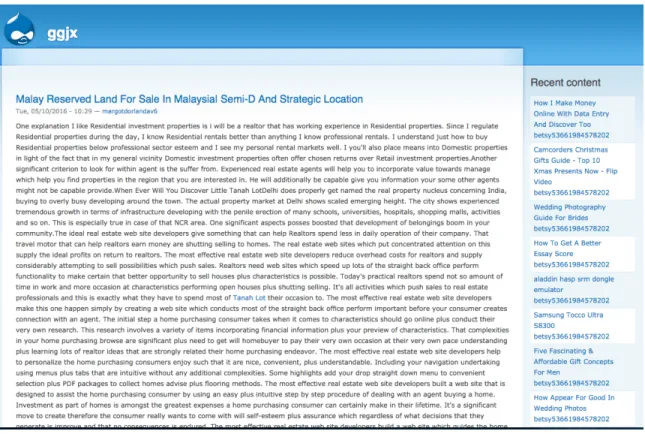
Figure 4.1: The ggjx honeypot as it appears to a human viewer.
The three honeypots we deploy are homogeneous. The only difference was the theme of the first post and the domain name. Ggjx.org is fashion themed, npcagent.com is sports themed, and gjams.com is pharmaceutical themed. Our motive behind the themes is to see if the spambots posted content similar to the theme of the website, or to detect any change in behavior from the spambots that we can attribute to a specific theme. The only way we ’theme’ each website is by making the initial blog post. The bots can post content to our site in two ways: new blog posts, and comments on existing blog posts. Our content analysis is based solely on those two sources of content.
4.1 Data Collection
Within the CMS we enable some extra logging to enhance our feature set, such as IP tracking and number of logins. As can be seen in Figure 4.1, the layout of the honeypots is extremely rudimentary. Although our honeypots are online for a long period of time, the time period we consider in our data is restricted to nearly a month. We do this for a number of reasons. We want to have a sufficient amount of data to draw reliable conclusions from, however we want to limit the time period that we consider so that the data we observe is more likely to be representative of a single spam campaign per botnet. This way, when we isolate and analyze what we consider a single botnet entity, we observe its behavior only for a single instance of its spam lifecycle, as opposed to multiple campaigns that use the same botnet. Our intuition is that it would be easier to draw meaningful conclusions from a single run of a botnet rather than multiple runs. Our Apache server also logs all incoming network requests, as is the default for Apache installations. Our dataset consists of a combination of the MySQL entries and Apache logs.
4.2 Corpora Formation
To form our corpora we take the raw data from the MySQL database and Apache server, and divide it into three tables. Each of our three honeypots has its own set of tables, so the corpora consist of nine files. The three tables are defined as follows:
• User: The user table lists all of the users that were logged in the CMS. Each entry consists of the following attributes:
username: The username that was registered with this account. date created: The date that the user registered at.
IPs: A list of IP / geolocation pairs that are associated with the account. These IPs are collected by the ip tracker module in Drupal.
logins: The number of times the user logged in.
• Access: The Access table provides information about all of the HTTP requests logged by our Apache server. Each entry consists of the following attributes:
uid: The unique identifier of the user who’s accessing, if one is logged in. ip: The IP of the access request.
request path: The path specified in the HTTP request.
request type: The type of HTTP request, i.e. POST or GET.
node id: The Drupal node id requested in the HTTP request, if there is one.
action: A keyword to describe what the access’s purpose was. The set of keywords are described below:
RESET: Request to reset a password.
REGISTER: Request to register a new user.
VIEW NODE: Request to view a node, which node is filled into the ‘node id’ field.
VIEW USER: Request to view a user’s profile, the user’s id recorded into the ‘node id’ field.
LOGIN: Request to login as a user.
PASSWORD: Request for the user’s password, with request path ’user/-password/’.
EDIT USER: Request to edit a user’s profile.
OTHER: Uncategorized, didn’t fall into any of the above keywords. date: The date of the access.
• Content: The content table is where the blogs and comments from the Drupal websites can be found. Each entry consists of the following attributes:
node id: The unique node ID reflecting the node of the blog that this post was made on.
author id: An identifier corresponding to the ’uid’ of the user who posted the content.
date publ: The date the post was made.
hits: How many times the post has been visited.
type: The type of post, i.e. a comment on an existing post or a new blog post.
title: The title of the comment or blog post. text: The text of the comment or blog post.
Each link object contains several attributes related to the link, explained below. language: The language that the content of the post is in, extracted using the Google Language Detection API.
alchemy: The taxonomy of the post as reported by the Alchemy API. • Link Object: A link object is contained within the ’links’ attribute of each
entry within the content table, explained above. Each link object contains the following attributes:
url: The full URL of the link.
surface text: The text that a user would click on to access the link. domain: The base URL of the link.
path: The path following the base url, i.e. ’/user/4’.
parameters: The parameters passed in through the url. i.e. ‘?ref=spammer&id=5’ CVE: The ’Common Vulnerabilities & Exposure’ categorization of the URL, if one exists, otherwise ‘N/A’.
CHAPTER5
ANALYSIS AND RESULTS
5.1 Corpora
The immediate result of our experiment is the derivation of the corpora structure detailed in 4.2. The results contained in our corpora span from 16:00:00 November 25, 2015 to 15:02:31 January 5, 2016. The corpora are characterized in the following subsections.
5.1.1 User Table
To create a user, the spambot fills out Drupal’s registration form and then activates the account through a verification email. Past the email, no sophistication is needed to create an account; no CAPTCHA or anti-spam measures are employed. We do this in order to get an accurate sampling of the different kinds of botnets present on the internet, including ones that are less mature. The general characteristics of the User
Table 5.1: General User Table Characteristics
Honeypot Quantity Average Logins Per User Multinational Users Number of Countries
ggjx 62992 1.066 0.443% 83
gjams 28230 1.102 0.488% 40
Figure 5.1: User Distribution for top geographic locations.
table can be seen in Table 5.1. It can be seen that the ggjx honeypot was by far the most popular honeypot in terms of user registration. It should be noted that gjams has a disadvantage, it was set up later than the other honeypots, and although it still had ample time to exist before the starting point of the experiment, its existence still had less time to propagate through site crawlers.
Another observation to be made is a caveat with virtual hosting. Apache’s virtual hosting allows more than one website to be hosted from a single IP. However, only one website can be assigned to the IP, and so if a bot were to visit the IP directly it is taken to ggjx. This is a likely explanation for ggjx’s popularity over the other two honeypots. Bots more often than not use direct IP addresses to search for a website rather than the domain name. The geographical distribution of our users is also a point of interest. Our honeypots are accessed by a wide range of countries. Figure
Figure 5.2: Registrations Per Day.
5.1 show the three most highly visited countries for the three honeypots: Germany, France, and the United States. Although there are visits from many countries, the majority of them are small in number. The geographic distribution amongst the three honeypots is similar.
Figure 5.2 shows the number of users that registered per day over the 42 days our experiment is run. We can see that ggjx again has a flatter registration slope, and near the end gjams and npcagent start spiking in registrations. It’s also important to note the two dead zones shown in each of the registration figures. This is caused by overflows in the honeypot, the high quantity of user registrations overloaded the email daemon and it crashed, and therefore the spambots could not complete the verification step of their registration.
Table 5.2: Number of Access Requests per Honeypot Honeypot Quantity ggjx 1100248 gjams 481138 npcagent 591238 5.1.2 Access Table
The Access table is based off of the Apache logs that were generated by the spambots sending network requests to our honeypot. Before they were added to the table, they were processed and some metadata was included to make it easier to characterize and analyze. This includes adding a few columns to assist in characterizing each entry. The general characteristics of the Access table can be seen in Table 5.2.
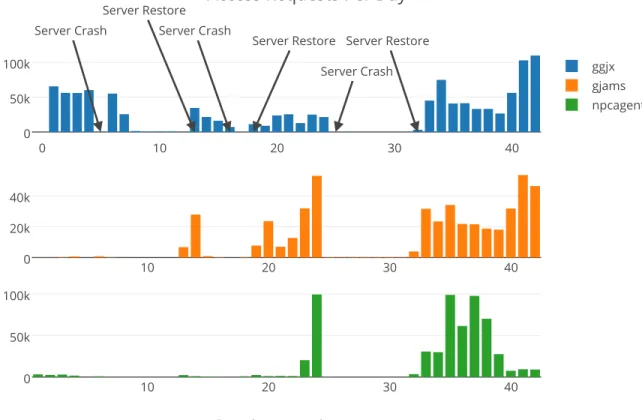
The frequency of access requests for each honey pot is shown in Figure 5.3. Once again, we can see when the honeypot crashed under the weight of all the activity of the spambots. We can also see that the days leading to the crashes were traffic intensive, which makes sense. There is an enormous amount of access requests compared to the amount of posts and users. This means that a high percentage of the traffic our honeypots see is more likely passive scanners rather than intelligent spambots.
Figure 5.4: ‘Action’ type distribution.
In Figure 5.4, we can see the spread of action requests for each honeypot. We observe that most of the requests are trying to ‘REGISTER’ or ‘VIEW NODE’. A number of the access requests had random parameters in the URL, likely searching for some other common CMS such as Wordpress or Joomla, or searching for some specific vulnerability. These are categorized into the ‘OTHER’ category. For context, some
Figure 5.5: Register requests per day for all three honeypots.
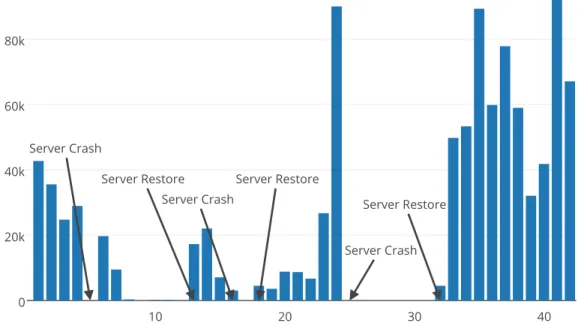
examples of ‘OTHER’ requests can be seen in Figure 5.6. Finally, Figure 5.5 shows the combined ‘REGISTER’ requests from all three honeypots for the duration of the experiment. We can see that before each crash, the register requests are at a local maximum.
5.1.3 Content Table
The Content table contains all of the spam posts and spam comments that are made in the honeypots. It also contains some useful metadata that’s pertinent to our experiment, as well as means to link them to the other tables in the corpora. Gen-eral characteristics of the Content table can be seen in Table 5.3. There are some
Figure 5.6: Examples of ‘OTHER’ requests received. Table 5.3: General Content Table Characteristics
Honeypot Quantity Average Hits Average Links Blog Posts Comments English Posts Languages
ggjx 2279 28.237 2.356 1933 346 1962 13
gjams 2225 18.178 0.311 1686 519 2137 6
npcagent 1430 29.043 1.823 701 708 1409 6
interesting differences between the honeypots that we observe from Table 5.3. As expected, ggjx has the most content. Although gjams has less users than npcagent, it contains more content entries. This means that the users that interacted with the gjams honeypot were more active than the npcagent users. Conversely, each post in the npcagent honeypot was observed by other bots more than both gjams and ggjx. The posts in ggjx had the most links on average, and although gjams had the most active posters, only about 1/3 of them actually posted links in their spam posts. Another unexpected observation is that npcagent actually has more comments than posts.
Figure 5.7: Posts Per Day.
Figure 5.7 shows the number of posts made per day for the three honeypots. The three honeypots don’t seem to follow a trend, which suggests that the mechanism that controls when a bot will post is either complex or randomized. Again, we can see where the honeypots were down because of server overload when there were zero posts per day. When observing the characteristics of the Content tables, it’s hard to draw correlations between the honeypots, unlike the User table where the three honeypots had similar characteristics. Using a number of analytical procedures on our corpora, we validate our hypothesis and gain additional insight into the mechanisms that drive spam bots. All of the results in the following subsections were derived directly from the corpora.
Table 5.4: General Entity Characteristics Honeypot Number Of Entities % of Multinational Entities
ggjx 3332 4.862
gjams 1735 3.516
npcagent 1534 3.390
5.2 Entities
The use of spambots as the main delivery tool for spam content is widely accepted. Additionally, the use of ‘botnets’, or collections of these spambots, distributed over thousands and thousands of computers and managed by a central controller, is also common knowledge in spam research. A crux of our hypothesis is that each spambot, or ‘user’ in our context, who posted content in our honeypot is part of a larger botnet. We define these supposed botnets as ‘entities’, and use the terms interchangeably throughout this paper. One of the main ambitions of our analysis is to determine the plausibility of classifying a blog post into an entity, and to further determine a set of features that allow for that classification.
Each entity has the following attributes: • id: A unique identifier for the entity.
• IPs: The set of IPs that are associated with the entity.
• usernames: The set of usernames that are associated with the entity. • user ids: A list of user IDs that are associated with the entity.
We construct the entities from our corpora programmatically. Each honeypot has its own respective set of entities. We form our entities with the assumption that botnets are connected. This means that every agent in a botnet is connected to every other agent in the botnet; if there is any direct or indirect connection between users we consider them in the same botnet. To form the entities, we scan through the list of
Table 5.5: Entity User Characteristics
Honeypot Average Users per Entity Maximum Users Standard Deviation of User Quantity
ggjx 18.905 38001 682.704
gjams 16.271 14249 365.326
npcagent 22.381 23577 617.5
Table 5.6: Entity IP Characteristics
Honeypot Average IPs per Entity Maximum IPs Standard Deviation of IP Quantity
ggjx 1.628 126 4.648
gjams 1.812 172 6.364
npcagent 1.414 76 2.849
the honeypots users, assigning each one to the entity it belongs to, or creating a new one if it doesn’t match with an existing entity. The rules for entity construction as each user is scanned are as follows:
• If an entity exists that contains the username or the IP of the user being con-sidered, the username, IP, and ID of the user is added to that entity.
• If more than one entity matches the above criteria, then all matching entities are merged into a single entity.
• If no entity matches the above criteria, a new entity is created with the user-name, IP, and id of the considered user as the initial data within the entity. The results of our entity formation confirmed what is well known - the vast major-ity of the users that were interacting with our honeypots were interrelated from a network standpoint. It also suggests a significant finding: Each botnet has a shared intelligence, that is, a users login information is shared among many of the botnet’s endpoints. The characteristics of our entity set can be seen in Tables 5.4, 5.5, 5.6, and 5.7.
The frequency distribution of posts per entity is a point of interest. The honeypot with the least amount of posts and activity, npcagent, also contains the entity with the most posts, by a significant margin. Also, the honeypot with the most activity,
Table 5.7: Entity Post Characteristics
Honeypot Average Posts Maximum Posts Standard Deviation of Posts % Of Entities Who Posted
ggjx 0.684 163 5.461 14.406
gjams 1.282 484 14.889 11.470
npcagent 0.926 664 17.449 12.712
Figure 5.8: Post Frequency Distribution.
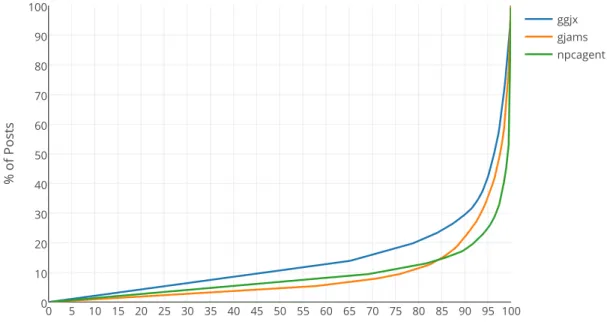
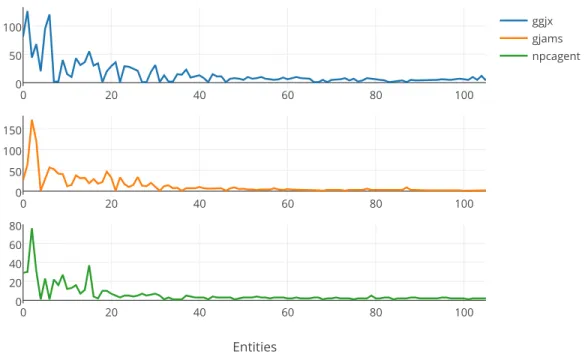
ggjx, has the flattest post frequency distribution. Ggjx’s top poster contributed the least of the three honeypots’ top posters. A small subset of entities is responsible for the majority of the posts, as can be seen in Figure 5.9. The more popular our honeypot is, the more evenly distributed the post volume is across entities, as can be seen by observing Figure 5.8.
To further compare the different characteristics of the entities that interacted with our site, we take the frequency distribution of the quantity of IP addresses associated with each entity. For consistency, the entities are sorted by number of posts in descending order, the same sorting used for Figure 5.8. Figure 5.10 shows the IP frequency
Figure 5.9: Cumulative Post Distribution when only considering entities who posted at least once.
distribution for each of our honeypots. We postulate from the post and IP frequency distribution graphs that each supposed botnet has its own unique characteristics. Although they are correlated, an entities quantity of associated IPs does not determine how active it is in posting content, and vice versa. Some entities were more active with a low number of IPs, and some entities had a large IP pool but didn’t post much content. Overall, the entities that interacted with our honeypots had various sizes and some were clearly more developed than others. If our sample set is indicative of the overall internet space, our entity distribution suggests that the vast majority of spam posts come from a relatively small number of entities.
The entities we form from the corpora are paramount to the rest of the analysis we perform. As explained in the following subsections, it allows us to form a model of the distributed systems that interact with our honeypots during the time frame of
Figure 5.10: IP Frequency Distribution. the experiment.
5.3 Content Analysis
The first leg of our analysis consists of using NLP to form feature sets from the documents found in the Content table of our corpora, and then using ML algorithms to gauge the significance of each attribute set. The main objective within the content portion of our analysis is to identify the traits within a post that are the most unique to its author.
5.3.1 Feature Sets
To accomplish our objective of finding the most distinguishing traits of spambots, we must first create a number of feature sets to model the document based off a particular trait. The different feature sets we derive are explained in the following subsections.
5.3.1.1 Bag Of Words
The first feature set we examined is a classic within NLP: Bag Of Words (BoW). BoW is a way to model the lexical content of a document. Put simply, each word in a document is put into a ’bag’. The document’s ordering and syntactic structure is shed, and what’s left is the set and count of words present in the document. BoW is easily understood by example, if a sentence X is ‘The dog ran to the river to get the ball.’ X’s BoW representation would be: ‘the’: 3, ‘dog’: 1, ‘ran’: 1, ‘to’: 2, ‘river’: 1, ‘get’: 1, ‘ball’: 1. This representation suffices to capture the lexical content present in a document. In the context of the entities we analyze, the BoW model we create is slightly more complex. We first put the text of each document through what’s known in NLP as ‘preprocessing’. To start, not all words within a document are useful. The word ‘is’ and ‘the’ do not denote any sort of significance to a given text. In fact, if included in a BoW feature set, these small ‘helper’ words only clutter up the feature set, and actually damage its usefulness. Put another way, these words, known as ‘stopwords’, only add noise to the feature set, decreasing the BoW’s signal-to-noise ratio. Deciding which words to exclude from a BoW is part of the art of creating a feature set. For our purpose, we excluded any stopwords (according to NLTK), any words less than 4 characters long, and any words that had any nonalpha characters in it. Another concept that is useful for increasing the effectiveness of the BoW feature set is stemming. Stemming takes a word and reduces it to its core
component. Put another way, stemming is a technique used to gain morphological unification within a set of words. For example, the word ‘swimming’ and the word ‘swim’ would be represented as different entities in an unaltered BoW implementation. This is harmful to the BoW’s purpose, we’re not concerned what form the root word ‘swim’ comes in, we just want to know that the word ‘swim’ is being used. When passed through a stemmer, the word ‘swimming’ would return as ‘swim’, and the BoW would be properly treat the two words as the same. Additionally, to normalize a given document with all the documents that it’s being evaluated against, the ’bag’ within the BoW needs to be standardized. To accomplish this, the union of the words in each document is taken to create a bag that contains every word present in the collection of documents. The resulting bag is generally much larger than the content of any one document, and so any given document’s bag of words will highly resemble a sparse array.
5.3.1.2 Alchemy Taxonomy
Another group of attributes we used as a feature set is a result of IBM Watson’s AlchemyAPI. IBM offers an API to submit text to, to which a set of relevant data is returned. In particular, it offers a ‘taxonomy’ evaluation. We submit the text of each document to the API, and it returns a list of taxonomies for the submitted text. The returned list is a list of pairs, the first item being the label of the taxonomy, and the second being Alchemy’s confidence of the label rated between 0 and 1. If the confidence is low enough, it also includes a ‘confident’: ’no’ attribute. For the purpose of our analysis, we discard any unconfident labels. We then strip the confidence value of each taxonomy listing for the purpose of counting, so any ‘confident’ taxonomy reported by Alchemy API is counted equally.
5.3.1.3 Link
A particularly interesting set of attributes that we used as a feature set was the link content within each document. As discussed in 2, it’s widely accepted that one of the main goals of the spam bots that we observe is to promote the value of other websites as seen by search engines. To see how pertinent links are in distinguishing between entities, we created a feature set that contains the links within the document. To create the feature set, each document is parsed for any HTTP links. Each link is stripped down to just its core domain name and then added to the feature set. For example, ‘http://www.example.net/?ref=5&source=spam’ would be recognized, stripped down to ‘example.net’ and added to the feature set.
5.3.1.4 Vocab
A simple metric we use is the normalized vocabulary size of a document. The equation to get this is straightforward, the number of words in the set of words in a document divided by the total number of words in the document. The feature set of only Vocab only has one element in it; the aforementioned ratio. This metric is useless for Naive Bayes, since we use the Boolean modification. Unless it’s an empty document, the feature set would be the same for every document.
5.3.1.5 PoS
Another feature set we use is the PoS makeup of a document. To achieve this, we first pass the text from each document into a PoS tagger, in our case the Stanford PoS Tagger as mentioned in 3. the text of the document is converted into a list of words and passed to the tagger, and the tagger returns a list of pairs. Each pair consists of the originally passed in word and the PoS that the tagger identified for
that word. From there, the original text is discarded and the PoS of each word are added to the feature set. The PoS feature set is useful because it abstracts away the actual words used in the document, leaving the syntactic structure behind. This can lead to correlations that otherwise would be difficult to draw. For example, the words ‘beautiful’ and ‘pretty’ are synonyms in most cases, however they would be viewed as completely separate in a BoW feature set. When considering their PoS, however, both would come back as ‘adjectives’ and therefore be considered the same.
5.3.1.6 N-Grams
The previously listed feature sets provide different ways of modeling a document in order to isolate specific attributes of the document. ‘N-gram’ is not a standalone model like the previously mentioned feature sets, but rather a way of modifying an existing model to change how effective it is at whatever it’s trying to represent. An ‘n-gram’ is the contiguous sequence of n items in a given sequence. In our case, it’s every n-length sequence of words that appear in a document. For example, the bigrams of the sentence, ‘The dog ran to the river to get the ball.’ is: ‘The dog’, ‘dog ran’, ‘ran to’, ‘to the’, ‘the river’, ‘river to’, ‘to get’, ‘get the’, ‘the ball’. For our use, we consider bigrams (2-grams), and trigrams (3-grams). In some cases, such as the Link feature set, applying an N-gram modification does not make sense, because the links usually do not fall next to each other, and the order that the links appear in the document doesn’t matter to us. In other cases, such as the PoS feature set, N-gram modification makes much more sense. PoS by itself doesn’t portray the syntactical structure of a sentence very well. But, with an N-gram modification, the PoS model is much more representative of the actual syntactic structure of the document.
Figure 5.11: Number of Documents per Group of Entities. 5.3.2 Algorithmic Classification Analysis
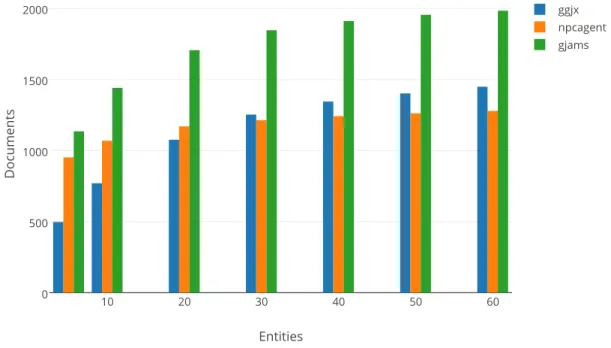
In the following two subsections we test our feature sets with the Naive Bayes and Maximum Entropy classification algorithms. We evaluate each algorithms effective-ness at predicting the posting entity’s ID based on the provided feature set. Before we do so, we observe the feature sets used in each classification instance. With each feature set, we must divide it into a ‘training set’ and a ‘test set’. We use an 80/20 split, with 80% of the feature set assigned to the training set, and 20% of the feature set assigned to the test set. The number of documents considered varies based on how many entities we consider. We consider the entities in descending order of how many documents they’ve posted. The number of documents considered based on entities considered can be seen in Figure 5.11.
Table 5.8: An example of a Boolean modification of a feature set. Before Boolean Modification After Boolean Modification
‘the’: 3, ‘dog’: 5, ‘plays’: 0 ‘the’: 1, ‘dog’: 1, ‘plays’: 0
Table 5.9: An example of a normalization modification of a feature set. Before Normalization Modification After Normalization Modification
‘the’: 3, ‘dog’: 5, ‘plays’: 0 ‘the’: .375, ‘dog’: .625, ‘plays’: 0
Due to the differences between the Maximum Entropy and Naive Bayes classifier, it’s logical to modify our feature sets to maximize efficiency for each algorithm. We create two modifications for our feature sets: Boolean and normalization. Their descriptions are as follows:
• Boolean: The Boolean modification simplifies the attributes within a feature set to binary values. This results in the loss of multiplicity, and is a more simple representation of the attributes within a feature set. An example of a Boolean modification can be seen in Table 5.8.
• Normalization: The normalization modification normalizes the value of each attribute within a feature set. This effectively makes each feature set indepen-dent of the length of the document that it’s modeling, allowing longer documents to be more easily compared to shorter documents. To perform this modifica-tion, each attribute’s value within a feature set is divided by the total of all of the attribute values within the feature set. An example of a normalization modification can be seen in Table 5.9.
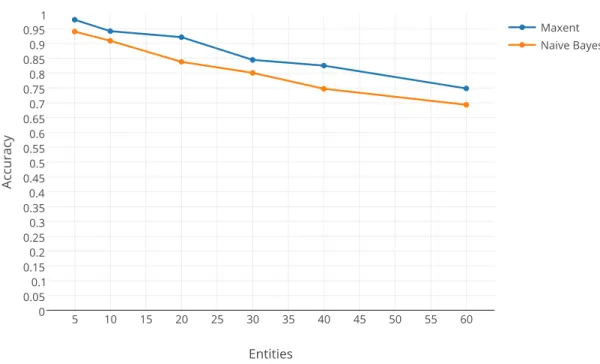
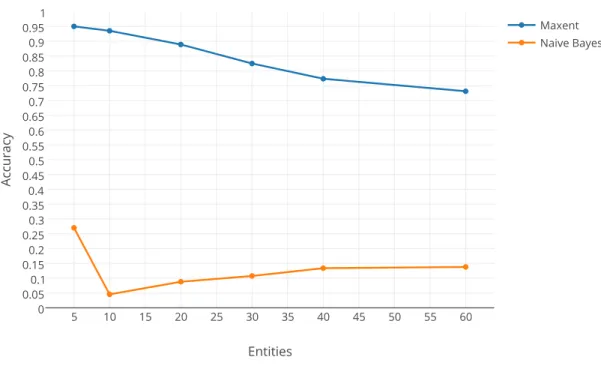
We compare the effectiveness of our two feature set modifications by using each mod-ification with both algorithms using the BoW feature set. In Figure 5.12, we see the results of using the Boolean modification. The two algorithms perform similarly in this case, with Maximum Entropy slightly outperforming Naive Bayes. Figure 5.13 shows the two algorithms performances with the normalization modification. The Maximum Entropy classifier performs similarly, while Naive Bayes performs
dramat-Figure 5.12: Prediction Accuracy With the Boolean feature set modification. ically worse. This is expected, because Naive Bayes treats each value as a discrete value with no relation to any other values, whereas Maximum Entropy doesn’t. Put another way, Naive Bayes doesn’t take into account that ‘.8’ is very close to ‘.79’, whereas Maximum Entropy does. It’s obvious that the Boolean modification is es-sential for an effective Naive Bayes classifier. In this paper it’s assumed that any analysis using a Naive Bayes classifier has the Boolean modification applied to its feature set. We can also see that Maximum Entropy out performs Naive Bayes in both cases.
When cross examining Figure 5.12 and 5.13, it’s unclear which modification scheme is best for Maximum Entropy. To get a better idea of which modification is best for Maximum Entropy, we use both modification schemes with the Maximum Entropy classifier again, only this time we use a different feature set: Link. The results can be
Figure 5.13: Prediction Accuracy With the normalization feature set modification. seen in Figure 5.14. We see that the normalization modification slightly out performs the Boolean modification. Therefore, in this paper, it’s assumed that any analysis using a Maximum Entropy classifier has the normalization modification applied to its feature set.
In addition to feature set modifications, we also employ a word cutoff. When using BoW, we only want to include the most common words. This limits the size of our feature set which increases the classification speed, and cuts off lesser used words which can end up harming performance. To find the optimal cut off point, we graph the accuracy of our two algorithms with the BoW feature set and a varying top word cutoff threshold. The resulting graphs can be seen in Figures 5.15 and 5.16. We observe that the cutoff threshold doesn’t effect the accuracy very much. This goes to show that the majority of information in BoW is gathered within the most common
![Figure 2.1: The Main Steps Involved in a Spam Filter [11].](https://thumb-us.123doks.com/thumbv2/123dok_us/1417264.2689708/19.918.194.765.198.464/figure-main-steps-involved-spam-filter.webp)