Hetrosis at F2 Generation and Combining Abilities of White Pea
Bean Genotypes for Important Traits
Tsegau Senbetay1 Abush Tesfaye2
1. Ethiopian Institute of Agricultural Research/Jimma Agricultural Research Center, ; P.O.B: 192, Jimma ,Ethiopia
2. Jimma University College of Agriculture and Veterinary Medicine; P.O.B- 307, Jimma, Ethiopia
Abstract
The diallel mating design, that produces all possible single crosses among a set of inbred lines has been widely utilized to provide information on the potential of parents involved in hybrid combinations as well as inferences on genetic control of the traits under investigation. Therefore, this study was conducted with the objective of determining heterosis, general combining ability (GCA) and specific combining ability (SCA) of seven lines of export quality white pea bean genotypes and their diallel crosses. Full Diallel cross 7 x 7 (42 F2 cross and 7 parents) including their reciprocal crosses was evaluated in Jimma Agricultural Research center. Significant (P<0.01) differences were found among the entries for number of branches on the main axis, internode length, Leaf area, grain yield, pod length, pod diameter, seed length and seed diameter. GCA and SCA mean squares were also significant for all the traits except number of nodes on the main axis. TA-04-AJ and Crestwood are god combiner parents for leaf area. There is also positive and significant heterosis in most of the crosses out of the 42 cross. Thefore, Evaluating heterosis at F2 generation and the effect of additive and non-additive gene action in the segregating generation is important in common bean.
Keywords: Common Bean, Heterosis, Specific combining ability, general combining ability, reciprocal effects, maternal effects, Non-maternal effects.
1. Introduction
White pea bean (Phaseolus vulgaris L.; 2n = 2x = 22) belongs to order Rosales, family Leguminosae, subfamily Papilionideae, tribe Phaseolea, subtribe Phaseolinae, genus Phaseolus (CIAT, 1986a). It is an erect or twinning, annual, herbaceous plant with various growth habits, morphological traits, and seed and pod characteristics. The bean flower is perfect, possessing both male and female organs on the same flower, and is self-fertilized. Pollination coincides with the time when the flower opens (Purseglove, 1968).
It is generally accepted that all species of the genus Phaseolus originated in tropical America (Mexico, Guatemala, and Peru). The main evidence of their origin is the genetic diversity of the materials that exists in this region; in addition, archaeological findings prove the antiquity of their cultivation in Mexico and Peru (CIAT, 1986a). Beans were introduced into Africa probably by the Portuguese and spread into the interior faster than European exploration (Sauer, 1993).
The crop is adapted to an altitude ranging from sea level to nearly 3000 m.a.s.l (CIAT, 1986a), but doesn't grow well below 600 m.a.s.l due to poor pod set caused by high temperature (Acland, 1971; Cobley, 1976). Suitable production areas of bean in Ethiopia have been indicated as areas with an altitude between 1200 – 2200 m.a.s.l, mean maximum and mean minimum temperature of less than 320 C and greater than 120 C, respectively, and a rainfall of 350-500 mm well distributed over 70-100 days (Imru, 1985; Amare and Haile, 1989). Almost all types of soil with good drainage and reasonably high nutrient content are suitable for haricot bean production (Purseglove, 1968; Acland, 1971).
Adoption of common bean breeding practices represents one of the most important strategies for elevating grain yield in Ethiopia. However, the success of common bean breeding programs is intimately related to the appropriate choice of divergent parents which, when crossed, must provide wide genetic variability to be used for selection among segregating populations (Ramalho et al., 1993).
Diallel analysis provides a systematic approach for the detection of appropriate parents and crosses. It also aids plant breeders in choosing the most efficient method for parental selection by allowing them to estimate several genetic parameters (Ramalho et al., 1993). Greater bean grain yield could be obtained by hybridizing superior cultivars. Moreover, diallel analysis method has been widely used by plant breeders to select appropriate parents and crosses and to determine the combining abilities of parents in the early generation. This method was utilized to improve self- and cross-pollinated species (Griffing, 1956). In addition to this the use of diallel analysis procedures for choosing parents in Phaseolus vulgaris breeding programs has recently received higher emphasis from bean breeders (Abreu et al., 1999; Barelli et al., 1998, 2000a, 2000b, 2000c; Machado et al., 2002; Silva et al., 2004a, 2004b).
According to Lima et al. (2003), the most commonly used diallel analysis methods are those proposed by Griffing (1956) and Gardner & Eberhart (1966). Griffing's methodology is based on the effects estimation of the general combining ability (GCA) of possible parents and the specific combining ability (SCA) of the
respective hybrid combinations (Cruz et al., 2004). Combining ability describes the breeding value of parental lines to produce hybrids. Sprague & Tatum (1942) defined general combining ability as the average performance of a line in hybrid combinations, and the specific combining ability as those cases in which certain combinations do better or worse than expected, based on the average performance of the parents involved.
In contrast, the methodology proposed by Gardner & Eberhart (1966) is based on measurement of the varietal effect, as well as of the heterosis resulting from hybridization between the respective parents (Cruz et al., 2004). Heterosis is defined as superior performance of individual hybrids compared to the phenotypic means of their parents. Regarding previous studies on heterosis in common bean, researchers reported different heterosis values for yield components and plant height characteristics. The amount of exploitable heterosis for common bean yield components ranged from 15.5% (Albuquerque & Vieira, 1974) to 35% (Barelli et al., 1998). Alternatively, for grain yield, Barelli et al. (1998) obtained heterosis estimates up to 23.13%, in hybrids from diallelic crosses among six cultivars of common bean.
Research results demonstrate, therefore, that the diallel analysis can be effective as an initial step in common bean breeding programs, for the identification of parents that provide more productive cultivars.
2. MATERIALS AND METHODS
The experiment was conducted in the experimental field of Jimma Agricultural Research Center. Jimma is located in the South West of Ethiopia at about 355 km from Addis Ababa, and Jimma Agricultural Research Center is 14km away from Jimma town. The area is characterized by one long rainy season (May to October) with mean annual rainfall of 900-1754 mm, and an altitude of 1750 m.a.s.l. The minimum and maximum air temperature for the area is 11oC and 26oC, respectively.
Seven white pea bean varieties ( Avanti, OR-04-DH, ARGENE, ER-04-AJ, TA-04-JI, Crest wood and Starlight) were used in this study. These varieties were used for commercial and canning purpose. A complete diallel including reciprocal was obtained giving 49 combinations consisting of seven parents (n), 21F2s [n (n-1)] and 21F2s reciprocals. The selection of parental lines was mainly based on their observed yield potential, some qualitative traits including quality of seed and distinct morphological characteristics. Crossing was made among the seven parents in all possible combinations in a full diallel fashion at Jimma agricultural research center.
Full diallel (including reciprocals) were produced at Jimma Agricultural Research Centre during August to September 2011/12 during the rainy period, and furrow irrigation was provided when the rain stopped, October to November 2011/12. Artificial pollination was conducted in the morning (7:00 AM to 10:00 AM). Plants were hybridized using emasculation with protected rubbing or hook methods where the fertilized stigma of the male parent that carried ample pollen was hooked onto the stigma of the female parent. Sepals were kept intact to protect the bud, and pollination quickly followed (CIAT, 1977).
The experiment was laid out in a simple lattice design with two replications. A spacing of 40 cm between rows was used to facilitate supplemental irrigation, and plants were spaced 20 cm apart within the row. To ascertain full stand in a plot, two seeds per hill were planted and thinned to appropriate stand 10 days after emergence. A plot of four rows each 4 m long (1.6Χ4m) were used, and 100 kg/ha DAP fertilizer was applied at the time of planting. All necessary agronomic practices were done uniformly as per the recommendations. The correct stand count (80 plants per plot) was maintained after thinning. Stand count at harvest was also done.
Internode length (INL) (cm): The distances between any two successive nodes on the main axis of five randomly selected plants were measured. Number of nodes on the main axis (NNMA): The number of nodes on the main axis of 5 randomly selected plants was counted: Number of branches on the main axis (NBMA): The numbers of branches on the main axis of 5 randomly selected plants were counted.
5. Leaf Area per Plant (LA) (cm2/plant):- Leaf area of five randomly selected plants were measured using square paper measurement to measure the leaf length and leaf breadth and then measured actual area by counting the number of squares and multiplying by 0.5 cm and measured estimated area by multiplying leaf breadth and leaf length in cm then dividing the actual to estimated area to get the constant k. Thus the constant number is multiplied with individual estimated area to get the recommended areas at final harvesting stage.
Grain yield per plot (g): The seed yield in grams harvested fromthe plot.
Diallel analysis was carried out according to Griffing (1956) Method one, Model one (fixed effects), which involved parents and one-way F2 hybrids (including reciprocals). Griffing portioned the total sum of squares due to the genotypes with p(p-1)/2 –1 degree of freedom into sum of squares due to GCA with p-1 degree of freedom and sum of squares due to SCA with p(p-1)/2 degree of freedom. Here the experimental material itself was the population about which inferences were drawn and hence the estimates obtained from the analysis were applied to those genotypes only. Combining ability analyses was carried out using SAS computer software. Relative importance of GCA, SCA, and the reciprocal cross effects were computed as a proportion of cross effects sum squares. Similarly relative importance of maternal and non-maternal effects was computed as a proportion of reciprocal cross effects sum of squares.
=
=
=
+
+
+
+
=
∑∑
.
,...,
1
,
,...,
1
,
,...,
1
.
1
c
l
b
k
p
j
i
e
bc
s
g
g
x
k l ijkl ij j i ijµ
Where
µ
is the population mean, gi (gj) is the g.c.a. effect, sij the s.c.a. effect, such that sij = sji, and eijkl is the effect peculiar to the ijklth observation, p,b and c are number of parents, blocks and sampled plants. The restrictions0
,
0
+
=
=
∑
∑
ii j ij i iand
s
s
g
for each i are imposedWhere Sij is specific combining ability of a cross between the ith and jth parent and Sii is the specific combining ability of a parent selfed. Such linear model for analysis of variance helps to determine whether there is a significant difference among the genotypes tested using the F – ratio as:
If the effect of genotypes is significant, the sum of squares due to genotypes will be partitioned in to GCA, SCA and reciprocal effects. Then the additive leaner model for diallel analysis can be written as:
bc
e
r
S
g
i ij ij ijkl ij=
+
+
+
+
∑
∑
/
×
µ
g = GCA S = SCA r = reciprocal effects b = no. of blocks c = no. of individualse = effects of environmental factors µ = overall means
Diallel analysis is limited to the following conditions: i j j i
S
S
=
∑
g
i=
0
j i j ir
r
=
−
∑
S
ij=
0
i 2.1. HeterosisSignificance of heterosis estimates was determined using t-test. Standard error for testing the significance between heterosis was calculated as follows. The better parent heterosis (BPH) and average heterosis (AH) in percent, both having commercial breeding implication, particularly for self pollinated crops, was calculated for those characters which showed significant difference between genotypes (crosses plus parents) following the method suggested by Falconer and Mackay (1996):When heterosis was estimated over mid parental value i.e. average of two parents it is referred as average or relative heterosis.
Average heterosis = [(F1 - MP) / MP] x 100
Where, F1 = value of F1, MP = mean value of two parents Heterobeltiosis
When heterosis is estimated over better parent it is called as heterobeltiosis
BPH (%) = ((F1 –BP)/ BP)*100 Where, F1 = value of F1, BP = value of better parent Tests for significance of heterosis will make using t-test
Standard error of the differences between heterosis will calculate as follows: SE (d) for BP=+
r
Me
2
, where, SE (d) is standard error, Me is error mean square and r is the number of replications And the t be obtained will test against the tabular t-value at error degree of freedom. t (better parent) = BPH/SE (d)
3. RESULT AND DISCUSSION
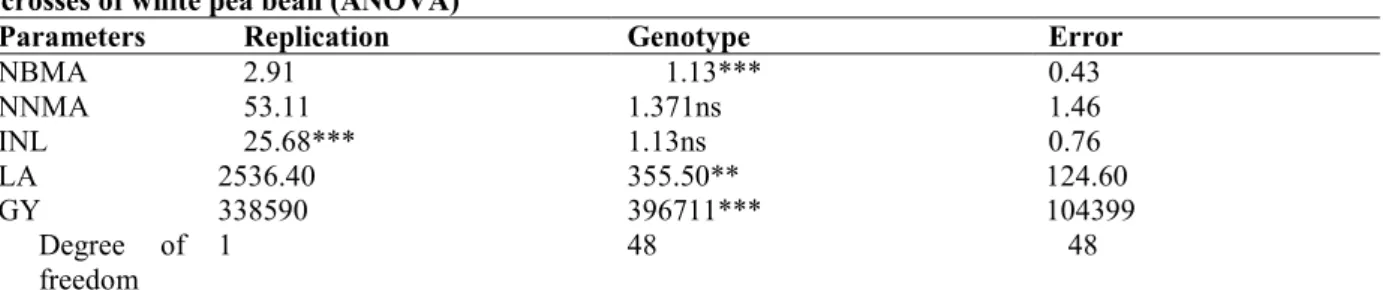
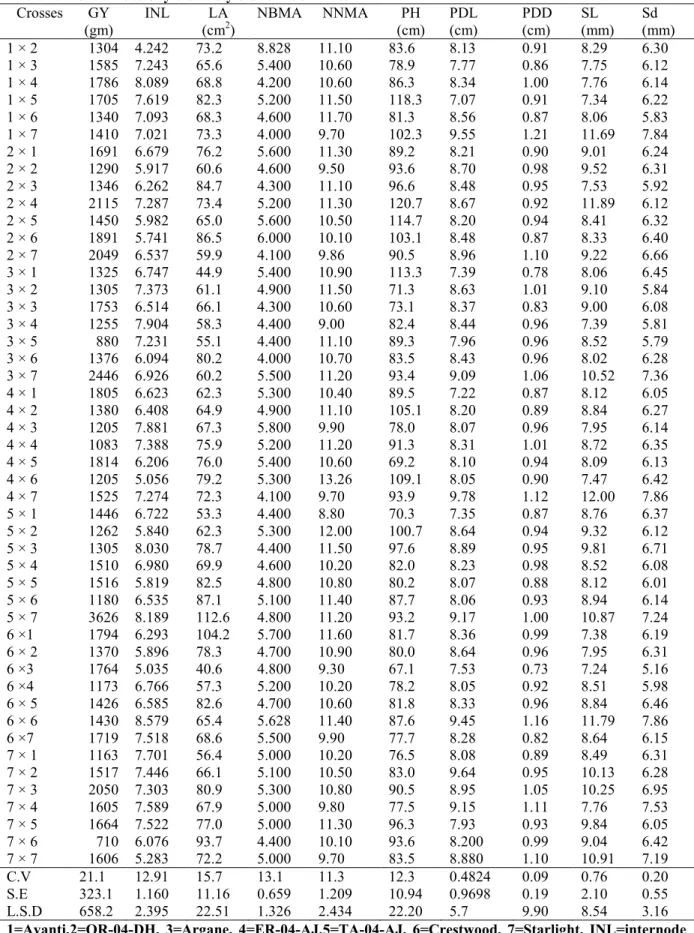
Analysis of variance(ANOVA) showed that there is significant (P<0.01) variations among the 49 genotypes except number of nodes on the main axis and inter node length for the traits investigated (table 1).Crosses Argene x Starlight and TA-04-AJ X Starlight displayed the maximum grain yield (3626gm, and 2446gm) respectively. However, the minimum yield was exhibited in the cross Starlight X Avanti. The cross TA-04-AJ X Starlight displayed the highest inter-node length (8.19cm). Moreover, it also exhibited the maximum leaf area (112 cm2). The minimum leaf area was also displayed in the cross Crestwood X OR-04-DH. The maximum
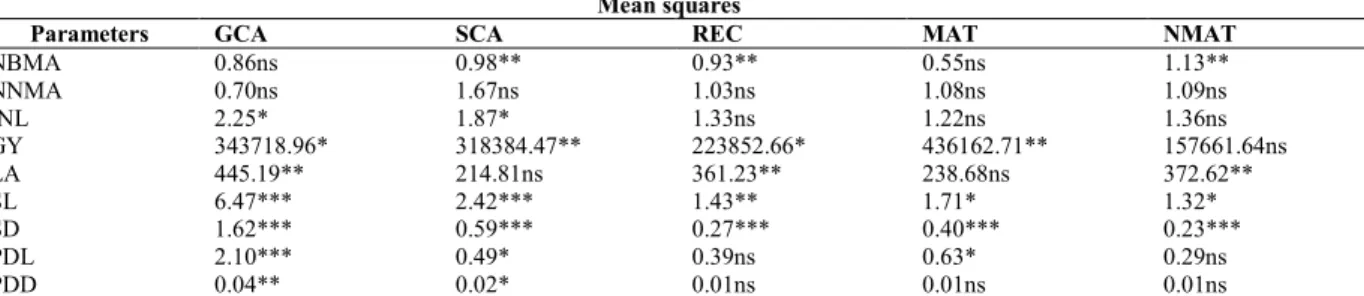
Number of branches on the main axis was exhibited in the cross Avanti X OR-04-DH (9). However, the minimum number of branches (4) on the main axis was displayed in the cross Avanti X Starlight. The maximum number of nodes (13)on the main axis was observed in the cross ER-04-AJ X Crestwood. The cross Argene X ER-04-AJ and Avanti X TA-04-AJ displayed the highest plant height (120.7, 118.3cm) respectively. There is also significant GCA effect for all of the traits except number of branches on the main axis and number of nodes on the main axis. Implies that the additive gene action displayed more contribution than the non-additive gene action in the inheritance of the traits. There is also significant SCA effect in all of the traits except Leaf area and number of nodes on the main axis. Significant Reciprocal and non-maternal effects were also displayed in almost all of the traits except inter-node length, number of nodes on main axis, pod diameter and pod length. This implies that the cytoplasm and the interaction of cytoplasm and nuclear gene contributed for the inheritance of the traits investigated. Therefore, there is maternal, non-maternal and the inter-action of cytoplasm and nuclear gene effects in white pea bean varieties.
Results of several investigators of combining ability analyses for seed yield, yield components and architectural traits in common beans demonstrated that both additive and non-additive types of gene actions are important in the inheritance of these traits (Foolad and Bassiri, 1983; Vaid et al., 1985; CIAT, 1987). However, the additive gene action was more important than the non-additive components for most traits (Vaid et al., 1985; Wassimi et al., 1986; Nienhuis and Singh, 1986; 1988). On the contrary, the importance of non-additive gene action (Foolad and Bassiri, 1983; Singh and Saini, 1983) was reported for some traits including seed yield.
A study on the combining ability in common beans utilizing F1 hybrids of eight varieties showed significant GCA (P<0.01) for days to flowering and days to maturity, plant height, number of pods per plant, number of seeds per plant, number of seeds per pod, pod diameter, pod length and 100-seed weight, but non-significant for seed yield per plant. In addition to GCA, specific combining ability was also non-significant (P<0.05) for days to flowering and maturity, pod length, pod diameter and number of seeds per pod, implying that both additive and non additive types of gene actions are important for these traits, although the magnitude of additive gene action was higher than non-additive type of gene action (Melaku, 1993).
In a combining ability analyses involving bean lines with different growth habit Nienhuis and Singh (1986) found that GCA were significant for seed yield per plant, number of pods per m2, number of seeds per pod, seed weight, and architectural traits, whereas SCA was significant for all traits studied except seeds per pod. Although the magnitude of GCA was greater than SCA, both additive and non-additive types of gene actions were important in the inheritance of most of the traits studied. Similarly, the result presented by Vaid et al. (1985) indicated that both GCA and SCA mean squares were significant for days to flowering and maturity, plant height, number of branches and pods per plant, pod length, number of seeds per pod, 100-seed weight and yield per plant in F1 crosses of Phaseolus vulgaris L.
In a 7 x 7 diallel cross of French bean, Singh and Saini (1982) reported that both additive and non-additive gene actions were important in the inheritance of the traits studied i.e., plant height, pod length, pod diameter, number of pods per plant, number of seeds per pod, 100-seed weight and seed yield per plant. However, in general, GCA was more important than SCA for all the characters as its magnitude was greater. In an experiment involving a 9 x 9 complete diallel cross that was conducted at CIAT at two locations (CIAT, 1984) also, GCA was more important than SCA for yield, yield components (pods per m2, seeds per pod, seed weight) and architectural traits.
There is positive and significant gca effect in the genotype starlight for grain yield, pod length, pod diameter, seed length and seed diameter. This implies that this genotype is good general combiner for yield and yield components. However, the genotype TA-04-AJ displayed positive and significant leaf area. This indicates that this genotype is good combiner for leaf area. Crosses TA-04-AJ X Starlight and Crestwood X Starlight exhibited positive and significant sca effect for grain yield. Significant reciprocal effects were displayed in crosses TA-04-AJ X Avanti and Crestwood X Argane for leaf area. Moreover, The cross Crestwood X Argane was also displayed positive and significant reciprocal effect.The cross Starlight X Avanti displayed significant reciprocal effects for seed length and see diameter and the cross OR-04-DH X Avanti displayed positive and significant Number of branches on the main axis. Therefore, these genotypes should be used for breeding program aiming for increasing yield. Similar results reported that there is positive correlation between number of seeds per plant and grain yield resulting in increasing grain yield(Bonett et al., 2006).
Several reports showed that in a 5 X 5 diallel analysis of Snap bean (Phaseolus vulgaris l.)varieties for some important traits i.e., days to flowering, plant height, number of pods per plant, pod weight per plant, pod length, and pod diameter Arunga, Van Rheenen and Owuoche, (2010) reported that both additive and non additive gene effects were involved in the genetic control of the traits investigated which implies that both gene effects should be considered when developing breeding schemes for the selection of superior lines. Consequently, both parents need not necessarily have high GCA during breeding because the dominance gene effects could also be exploited to enhance these traits.
flowering and maturity, number of seeds per pod, number of pods per plant and 100-seed weight was governed mainly by non-additive gene action in Phaseolus vulgaris L., as indicated by high heritability values, but low predicted genetic advance. Goncalves-Vidigal (2008) reported that significant GCA and SCA effects for plant height, number of pods per plant, number of seeds per pod, number of seeds per plant, 50-seed weight and grain yield. Similar results were reported by Machado et al. (2002), who verified the predominance of an additive effect on grain yield in F2 segregant populations, derived from diallel hybrids of common bean.
Heterosis
Heterosis has been reported for a wide range of crop species including both self and cross-pollinated crops. Shull (1952) was the first to coin the term heterosis to explain the superiority in performance (increased vigor, size, fruitfulness, speed of development, resistance to pests, or to climatic rigors of any kind) of hybrid individuals compared with their parents.
Scientists proposed three different bases to measure heterosis/hybrid vigor, which were mid-parent heterosis, better parent heterosis and standard/economic heterosis. Mid-parent heterosis refers to the superiority of the F1 hybrid over the mean of the two parents (Stuber, 1999). Better parent heterosis is the superiority of the F1 hybrid over the better parent (Surendran and Vinayarai, 1994). Commercial hybrid breeders, these days, however, measures heterosis relative to the standard/economic variety and this type of heterosis is called standard/economic heterosis (Virmani and Edwards, 1983).
Even though heterosis, or hybrid vigor, is a widely documented phenomenon in diploid organisms that undergo sexual reproduction, the genetic basis of heterosis has been debated for many years and is still not resolved. Two major hypotheses have been proposed to explain this phenomenon: the dominance hypothesis and the over dominance hypothesis. The dominance hypothesis supposes that heterosis is due to the canceling of the effect of deleterious recessive alleles contributed by one parent through dominant alleles contributed by the other parent in the heterozygous F1 (Bruce, 1910; Jones, 1917). The over dominance hypothesis, proposed by East (1908), on the other hand, assumes that the heterozygous combination of the alleles at a single locus is superior to either of the homozygous combination of the alleles at that locus.
Wright (1968) visualized a ‘‘net-like’’ structure o f population genotypes such that the variations of most characters are affected by many loci and that each gene replacement may have effects on many characters. In this perspective, epistasis should be one of the most important genetic components in the inheritance of quantitative characters. In support of Wright (1968), Li et al. (1997) analyzed the genetic components underlying yield and its component traits by using an F2:3 populations derived from highly heterotic rice cross, and detected a large number of digenic interactions involving loci distributed throughout the entire rice genome. They suggested that epistasis plays an important role as the genetic basis of heterosis. Li et al. (2001) and Luo et al. (2001) also suggested that epistasis and over-dominance are the primary genetic basis of inbreeding depression and heterosis.
It is critical to have the appropriate experimental design and materials for the genetic analysis of heterosis. It is well known that the F2 generation provides theoretically the most complete and most informative population for many genetic analyses with limitations in representativeness and repeatability for quantitative traits (Allard, 1960). Although genetic analyses using F3 populations can produce useful information on genetic components underlying heterosis, such analyses suffer from several shortcomings that are inherent in the data generated from the populations (Hua et al., 2002). Populations derived by backcrossing recombinant inbred lines (RILs) with the parents have been used for genetic analyses of heterosis (Li et al., 2001; Luo et al., 2001). For QTL analyses, however, such populations are incomplete interms of geneticcomposition.
Although many investigators favored one hypothesis over the other (Hallauer and Miranda, 1988), data allowing for critical assessment of the hypothesis remained largely unavailable until recently with the advent of molecular marker technology and high-density molecular linkage maps. Genetic analyses of heterosis based on molecular marker linkage maps have been reported recently in maize and rice. Stuber et al. (1992) analyzed the genetic factors contributing to heterosis in a hybrid from two elite maize inbred lines, and showed that heterozygotes of almost all quantitative trait loci (QTL) for yield had higher phenotypic values than the respective homozygotes. They suggested that both over-dominance and QTL detected by single locus analysis play a significant role in heterosis. On the other hand, Xiao et al. (1995), conducted a genetic study of quantitative traits in an intersubspecific cross of rice, and suggested that dominance was the genetic basis of heterosis in rice. Both the dominance and the over dominance hypotheses are based on single locus theory.
Moreover all previous molecular marker-based genetic analyses of heterosis, except one case using the backcross type of populations (Li et al., 2001; Luo et al., 2001), were based on the performance measurement of the trait rather than heterosis, and the genetic basis of heterosis was inferred from genetic components estimated for the trait performance. Although heterosis and trait performance are closely related, they are however distinct in many respects both statistically and biologically (Hua et al., 2002). To have a real picture of the genetic components underlying heterosis, it is necessary to use the measurements of heterosis as the data input in the analyses. Accordingly, Hua et al. (2002), using the immortalized F2 population produced by randomly
permutated intermating of recombinant inbred lines of rice, concluded that all kinds of genetic effects, including partial-, full-, and over dominance at single-locus level and all three forms of digenic interactions (additive by additive, additive by dominance, and dominance by dominance), contributed to heterosis, indicating that these genetic components were not mutually exclusive as the genetic basis of heterosis.
There is also positive and significant heterosis commercial white pea bean genotypes. The maximum Significant and positive better parent heterosis(16.32***) was displayed in the cross ER-04-AJ X Crestwood for number of nodes on the main axis. The cross TA-04-AJ X Starlight exhibited positive and significant better parent heterosis for inter-node length and leaf area(40.73***, 36.49***) respectively at F2generation.Significant and positive better parent heterosis (76.56***) was displayed in the cross ER-04-AJ X Avanti for number of branches on the main axis at F2generation. However, non significant but the maximum and positive heterosis was observed in the cross ER-04-AJ X Avanti for grain yield.
Gonçalves-Vidigal (2008) reported the highest magnitude of heterosis for plant height in some of his crosses. He also reported a single cross provided positive heterosis value for number of pods per plant, but with very low maginitude. Expression of heterosis for various agronomical and physiological characters in beans has been determined by several investigators. It was confirmed in various studies that genetic divergence plays a significant role in the expression of heterosis. A nine parent diallel cross of common beans carried out at CIAT head quarter (CIAT, 1984) gave significant F1 mid-parent heterosis for yield and three yield components (pods per m2, seeds per pod and seed weight). Better parent yield heterosis was as high as 35.9% and an increasing heterotic value was noted in crosses between parents of increasingly divergent growth habit.
Nienhuis and Singh (1983) tested F1 hybrids of bush beans (Phaseolus vulgaris L.) and found significant mid-parent and better parent yield heterosis in 29 of the 36 families and 17 of the 36 families, respectively. In another study involving bean lines of different growth habits, Nienhuis and Singh (1986) obtained F1 mid-parent heterosis for all traits studied including yield, yield components and architectural traits such as number of nodes and branches per plant and internodes length. The extent of better parent yield heterosis was 29.5 percent. In general, mid-parent and better parent heterotic values showed a tendency to increase with increasing divergence between growth habits (Nienhuis and Singh, 1986).
Large and significant mid-parent heterotic values for yield, number of pods per plant, number of seeds per plant, number of seeds per pod, and number of days to flowering were obtained in crosses of four common bean cultivars belonging to pinto and kidney groups (Foolad and Bassiri, 1983). Overall better parent heterosis was large for seed yield and number of seeds per plant, and negative for 100-seed weight and number of days to flowering. No heterosis was expressed in crosses of varieties belonging to the same group.
A study involving crosses of seven French bean (Phaseolus vulgaris L.) lines with pole and bush growth type showed significant better parent heterosis in 16 crosses for yield, in 13 crosses for number of pods per plant and in all crosses for pod diameter (Singh and Saini, 1983). In this study pole x bush crosses gave higher seed yield than crosses involving pole x pole or bush x bush, indicating the importance of divergence in the expression of heterosis.
The extent of heterosis for grain yield and yield components in crosses of six lines of French beans was estimated. Mid-parent heterosis was positive for seed yield per plant, number of seeds per pod and plant height, and it was negative for number of pods per plant, seeds per plant and length of pod. Average better parent heterosis was negative for all traits studied, except for number of seeds per pod. Significant and positive mid-parent heterosis was exhibited in three crosses for seed yield, in one cross for plant height (Patil and Chaudhari, 1986).
In a study conducted by Adams (1967), although not significant, 10 crosses exhibited positive better parent heterosis for number of seeds per plant. Only one cross gave significantly lower number of seeds per plant (-35.2%) than the best parent. One cross exhibited significant and positive better parent heterosis for 100-seed weight; this was the cross that showed the maximum negative heterosis for number of pods per plant. Such occurrence could possibly be explained by the phenomenon of component compensation.
Extent of heterosis for grain yield, yield components and some architectural traits in eight diverse cultivars of haricot bean were estimated (Melaku, 1993). Average mid-parent heterosis was positive for seed yield per plant, number of seeds per pod, number of seeds per plant, number of pods per plant, 100-seed weight, plant height and pod length, while average better parent heterosis was negative for all traits studied, except for seed yield per plant. Most crosses exhibited negative mid parent and better parent heterosis for days to flowering and maturity out of which, some are statistically significant. Such crosses are useful, when earliness is the major objective of the breeding program (Melaku, 1993).Significant and positive mid parent heterosis was displayed in commercial white pea bean genotypes in all of the traits except grain yield with high magnitude but non-significant heterosis in some of his crosses.
4. CONCLUSION
genetic variation among the seven white pea bean genetypes. Both the GCA and SCA Mean squares are also significant in almost all of the traits. This indicates that both the additive and non-additive gene action contributed in the inheritance of these traits. However, the ratio of GCA is Greater than the ratio of SCA. Implies that the additive action have more contribution in the inheritance of these traits in white pea bean genotypes. Starlight, Avanti, OR-04-DH, and Argene are good general combiner parents for yield and yield related traits. Especially for seed and seed related parameters like 100 seed weight, grain yield, seed length, seed diameter, seed thickness, pod length and diameter. There is also positive and highly significant Better parent and mid parent heterosis in all of the traits except grain yield which showed positive with high magnitude of heterosis but not significant. Crosses TA-04-AJ X Starlight and Argane X ER-04-AJ displayed the maximum heterosis with positive magnitude. In general there is still high heterosis in F2 Generations with the predominance of additive gene action in white pea bean genotypes. There is also a great variation in the forward and reciprocal crosses of these genotypes especially for seed size, seed weight, grain yield and leaf area. Implies that there is high maternity effect of the crop in every cross. Therefore, the seeds of forward cross should not be mixed with the seeds of reciprocal cross.
ACKNOWLEDGMENT
Thanks to God for Successful completion of this research. Thanks to my mother for her prayer and kindness. My heart full gratitude goes to my Supervisor Dr Abush Tesfaye for preparing bean materials, day to day guidance and follow up. The last but not the least i would like to thank to Jimma Agricultural Research Center Pulse, oil and fiber crop Assistants for their kindness in data collection.
REFERENCE
ABREU, A. de F.B.; RAMALHO, M.A.P.; FERREIRA, D.F. Selection potential for seed yield from intra- and inter-racial populations in common bean. Euphytica, v.108, p.121-127, 1999.
Acland, J.D., 1971. East African Crops. Longman Group limited. London. p. 20-25.
Adams, M.W., 1967. Basis of yield component compensation in crop plants with special reference to the field bean, Phaseolus vulgaris. Crop Sci.7:505-510.
ALBUQUERQUE, M.M. de; VIEIRA, C. Manifestações da heterose em Phaseolus vulgaris L. Revista Ceres, v.21, p.148-166, 1974.
Allard, R.W., 1960. Principles of Plant Breeding. John Wiley and Sons, Inc., New York.
Arunga, Edith Esther, Henk A. Van Rheenen, and James Otieno Owuoche. "Diallel analysis of Snap bean(Phaseolus vulgaris L.) varieties for important traits." African Journal of Agricultural Research 5.15(2010): 1951-1957.
BARELLI, M.A.A.; GONÇALVES-VIDIGAL, M.C.; AMARAL JÚNIOR, A.T. do; VIDIGAL FILHO, P.S.; SCAPIM, C.A. Combining ability among common bean cultivars adapted to the Northwest region of Paraná State, Brazil.Bragantia, v.59, p.159-164, 2000a.
BARELLI, M.A.A.; GONÇALVES-VIDIGAL, M.C.; AMARAL JÚNIOR, A.T. do; VIDIGAL FILHO, P.S.; SCAPIM, C.A. Diallel analysis of the combining ability of common bean (Phaseolus vulgaris L.) cultivars. Brazilian Archives of Biology and Technology, v.43, p.409-414, 2000b.
BARELLI, M.A.A.; GONÇALVES-VIDIGAL, M.C.; AMARAL JÚNIOR, A.T. do; VIDIGAL FILHO, P.S.; SCAPIM, C.A. Heterose relativa em feijoeiro (Phaseolus vulgaris L.). Acta Scientiarum. Agronomy, v.20, p.257-262, 1998.
BARELLI, M.A.A.; GONÇALVES-VIDIGAL, M.C.; AMARAL JÚNIOR, A.T. do; VIDIGAL FILHO, P.S.; SCAPIM, C.A.; SAGRILO, E. Diallel analysis for grain yield components in Phaseolus vulgaris L.
Acta Scientiarum. Agronomy, v.22, p.883-887, 2000c.
BONETT, L.P.; GONÇALVES-VIDIGAL, M.C.; SCHUELTER, A.R.; VIDIGAL FILHO, P.S.; GONELA, A.; LACANALLO, G.F. Divergência genética em germoplasma de feijoeiro-comum coletado no Estado do Paraná, Brasil. Semina. Ciências Agrárias, v.27, p.547-560, 2006.
Bruce, A.B., 1910. The Mendelian theory of heredity and the augmentation of vigor. Science32:627-628. Centro International de Agricultura Tropical (CIAT), 1986a. The cultivated species of phaseoulus: study guide to
be used as supplement to the audotutorial unit on the same topic. Cali, Colombia. CLAT.
Centro International de Agricultura Tropical (CIAT), 1987. Bean program. Annual report 1987. Cali, Colombia. Cobley, L.S., 1976. An introduction to the Botany of Tropical crops. 2nd ed. Long man group limited. London.
CRUZ, C.D.; REGAZZI, A.J.; CARNEIRO, P.C.S. Modelos biométricos aplicados ao melhoramento
genético. Viçosa: UFV, 2004. v.1. 480p.
East, E.M., 1908. Inbreeding in Corn. Reports of the Connecticut Agricultural Experiment station for years 1907-1908. p. 419-428.
Foolad, M. R. and A. Bassiri, 1983. Estimates of combining ability, reciprocal effects, and heterosis for yield and yield components in a common bean diallel cross. J. Agric. Sci. 100: 103-108.
GARDNER, C.O.; EBERHART, S.A. Analysis and interpretation of variety cross diallel and related populations.Biometrics, v.22, p.439-452, 1966.
Gonçalves-Vidigal, M. C., Silvério, L., Elias, H. T., Vidigal Filho, P. S., Kvitschal, M. V., Retuci, V. S., & Silva, C. R. D. (2008). Combining ability and heterosis in common bean cultivars. Pesquisa Agropecuária Brasileira, 43(9), 1143-1150.
GRIFFING, B. Concept of general and specific combining ability in relation to diallel crossing systems.Australian Journal of Biology Science, v.9, p.463-493, 1956.
Hallauer, A. R. and J. B. Miranda, 1988. Quantitative genetics in maize breeding. 2nd ed., Iowa State Univ. Press, Ames.
Hua, J. P., Y. Z. Xing, W. R. Wu, C. G. Xu, X. L. Sun, S. B. Yu and Q. Zhang, 2002. Single-locus heterotic effects and dominance by dominance interactions can adequately explain the genetic basis of heterosis in an elite rice hybrid. Genetics 100: 2574-2579.www. Pnas. Org/cgi/doi/10. 1073/ pnas.
Jones D.F., 1917. Dominance of linked factors as a means of accounting for heterosis. Proc. Natl. Acad. Sci. USA 3:310-312.
Li, Z. K., Luo, L. J., Mei, H. W., Wang, D. L., Shu, Q. Y., Tabien, R., Zhong, D. B., Ying, C. S., Stansel, J. W., Khush, G. S., and Paterson, A.H., 2001. Genetic basis of inbreeding and heterosis in rice (Oryza sativa L.) :1. biomass and grain yield. Genetics, 158 (4): 1737–1753.
Li, Z. K., S. R. M. Pinson, A. H. Paterson, W. D. Park, and J. W. Stansel, 1997. Epitasis for three grain yield components in rice (Oryza sativa L.). Genetics 145:453-465.
LIMA, P.C.; FERREIRA, D.F.; BUENO FILHO, J.S. de S.; RAMALHO, M.A.P. Somas de quadrados e hipóteses associadas ao modelo dialélico de Gardner e Eberhart. Ciência e Agrotecnologia, v.27, p.1113-1121, 2003.
Luo, L. J., Z. K. Li, H. W. Mei, Q. Y. Shu, R. Tabien, D. B. Zhong, C. S. Ying, J. W. Stansel, G. S. Khush and A. H. Paterson, 2001. Over dominant Epistatic Loci are the primary genetic basis of inbreeding depression and heterosis in rice. I. Biomass and grain yield. Genetics 158, 1755–1771.
MACHADO, C. de F.; SANTOS, J.B. dos; NUNES, G.H. de S.; RAMALHO, M.A.P. Choice of common bean parents based on combining ability estimates. Genetics and Molecular Biology, v.25, p.179-183, 2002.
Melaku Ayele, 1993. Heterosis and combining ability for yield and other quantitative characters in haricot bean (Phaseolus vulgaris L.). An MSc Thesis Presented to the School of Graduate Studies of Alemaya Univeristy. 103p.
Navale, P.A. and M.M. Patil, 1982. Genotypic variation and character association in French bean. J. Maharashtra Agric. Univ. 1:267-268.
Nienhuis, J. and S.P. Singh, 1986. Combining ability analysis and relationships among yield, yield components, and architectural traits in dry bean. Crop Sci. 26: 21-27.
Nienhuis, J. and S.P. Singh, 1988. Genetics of seed yield and its components in common bean (Phaseolus vulgaris L.) of Middle American origion. I. General combing ability. Plant Breeding 101: 143-154. Occasional Publication Series No. 11, Dar es Salaam, Tanzania.
Patil, M.M. and A.N. Chaudhari, 1986. Heterosis in French bean. J. Maharashtra Agri. Univ. 11:72-73. Purseglove, J.W., 1968. Tropical crops: Dicotyledons 1. Longmans Green and Co. Ltd. London. p. 304-310.
RAMALHO, M.A.P.; SANTOS, J.B. dos; ZIMMERMANN, M.J.O. Genética quantitativa em plantas
autógamas: aplicações ao melhoramento do feijoeiro. Goiânia: UFG, 1993. 271p.
Sauer, J. D., 1993. Historical geography of crop plants-a select roster. CRC Press, Boca Raton, and Florida.Science 41:1659-1675.Seven answered and unanswered questions. p. 95-123. In Proceedings of the 7th.
Shull, G. H., 1952. Beginnings of the heterosis concept. In: Heterosis J. W. Gowen (ed.). Iowa State College Press, Ames.
SILVA, M.P.; AMARAL JÚNIOR, A.T. do; RODRIGUES, R.; DAHER, R.F.; LEAL, N.R.; SCHUELTER, A.R. Análise dialélica da capacidade combinatória em feijão-de-vagem. Horticultura Brasileira, v.22, p.277-280, 2004a.
SILVA, M.P.; AMARAL JÚNIOR, A.T. do; RODRIGUES, R.; PEREIRA, M.G.; VIANA, A.P. Genetic control on morphoagronomic traits in snap bean. Brazilian Archives of Biology and Tecnology, v.47, p.855-862, 2004b.
Singh, A.K., and S.S. Saini, 1982. A note on combining ability in French bean (Phaseolus vulgaris L.). Haryana J. Hort. Sci. 11: 270-273.
SPRAGUE, G.F.; TATUM, L.A. General vs. specific combining ability in single crosses of corn. Journal of American Society of Agronomy, v.34, p.923-932, 1942.
Stuber, C. W., Lincoln, S. W., Wolff, D. W., Helentjaris, T. & Lander, E. S., 1992. Genetics 132, 823–839. Stuber, C. W., Lincoln, S. W., Wolff, D. W., Helentjaris, T. & Lander, E. S., 1992. Genetics 132, 823–839.
Stuber, C.W., 1999. Biometry, Molecular Biology, and Physiology of Heterosis. p.173-183. In: J.G.Coors and S.Pondey CSSA and SSSA. Madison,Wiscon sin,USA.
Surendran, C.M.P. and R.S. Vinayarai, 1994. Use of biometrical techniques in tree improvement. The Malaysian Forester. 57:132-139.
Vaid, K., R.M. Singh, and V.P. Gupta, 1985. Combining ability in dry beans (Phaseolus vulgaris). Crop Improrment. 41: 252-254.
Virmani, S.S. and I.B. Edwards, 1983. Current status and future prospects for breeding hybrid rice and wheat. Adv. Agron., 36: 145-157.
Wassimi, N.N., T.G. Isleib and G.L. Hosfield, 1986. Fixed effect genetic analysis of a diallel cross in dry beans (Phaseolus vulgaris L.). Theo. and Appl. Genet. 72: 449-454.
Wright, S., 1968. Evolution and Genetics of Populations (Univ. of Chicago Press, Chicago), Vol. 1.
Xiao, J. H., J. M. Li, L. P. Yuan and S. D. Tanksley, 1995. Dominance is the major genetic basis of heterosis in rice as revealed by QTL analysis using molecular markers. Genetics 140: 745–754.
Table 1. Mean squares due to genotypes and error for yield and yield related traits of 7*7 full diallel crosses of white pea bean (ANOVA)
Parameters Replication Genotype Error
NBMA 2.91 1.13*** 0.43 NNMA 53.11 1.371ns 1.46 INL 25.68*** 1.13ns 0.76 LA 2536.40 355.50** 124.60 GY 338590 396711*** 104399 Degree of freedom 1 48 48
Where, NBMA= number of branches on the main axis, GY=grain yield; LA=leaf area, root volume, TRL= tape root length, INl=internode length, **=significant at (p<0.01) and *** =significant at (p<0.001).
Table 2: Mean values of yield and yield related traits: Crosses GY (gm) INL LA (cm2) NBMA NNMA PH (cm) PDL (cm) PDD (cm) SL (mm) Sd (mm) 1 × 2 1304 4.242 73.2 8.828 11.10 83.6 8.13 0.91 8.29 6.30 1 × 3 1585 7.243 65.6 5.400 10.60 78.9 7.77 0.86 7.75 6.12 1 × 4 1786 8.089 68.8 4.200 10.60 86.3 8.34 1.00 7.76 6.14 1 × 5 1705 7.619 82.3 5.200 11.50 118.3 7.07 0.91 7.34 6.22 1 × 6 1340 7.093 68.3 4.600 11.70 81.3 8.56 0.87 8.06 5.83 1 × 7 1410 7.021 73.3 4.000 9.70 102.3 9.55 1.21 11.69 7.84 2 × 1 1691 6.679 76.2 5.600 11.30 89.2 8.21 0.90 9.01 6.24 2 × 2 1290 5.917 60.6 4.600 9.50 93.6 8.70 0.98 9.52 6.31 2 × 3 1346 6.262 84.7 4.300 11.10 96.6 8.48 0.95 7.53 5.92 2 × 4 2115 7.287 73.4 5.200 11.30 120.7 8.67 0.92 11.89 6.12 2 × 5 1450 5.982 65.0 5.600 10.50 114.7 8.20 0.94 8.41 6.32 2 × 6 1891 5.741 86.5 6.000 10.10 103.1 8.48 0.87 8.33 6.40 2 × 7 2049 6.537 59.9 4.100 9.86 90.5 8.96 1.10 9.22 6.66 3 × 1 1325 6.747 44.9 5.400 10.90 113.3 7.39 0.78 8.06 6.45 3 × 2 1305 7.373 61.1 4.900 11.50 71.3 8.63 1.01 9.10 5.84 3 × 3 1753 6.514 66.1 4.300 10.60 73.1 8.37 0.83 9.00 6.08 3 × 4 1255 7.904 58.3 4.400 9.00 82.4 8.44 0.96 7.39 5.81 3 × 5 880 7.231 55.1 4.400 11.10 89.3 7.96 0.96 8.52 5.79 3 × 6 1376 6.094 80.2 4.000 10.70 83.5 8.43 0.96 8.02 6.28 3 × 7 2446 6.926 60.2 5.500 11.20 93.4 9.09 1.06 10.52 7.36 4 × 1 1805 6.623 62.3 5.300 10.40 89.5 7.22 0.87 8.12 6.05 4 × 2 1380 6.408 64.9 4.900 11.10 105.1 8.20 0.89 8.84 6.27 4 × 3 1205 7.881 67.3 5.800 9.90 78.0 8.07 0.96 7.95 6.14 4 × 4 1083 7.388 75.9 5.200 11.20 91.3 8.31 1.01 8.72 6.35 4 × 5 1814 6.206 76.0 5.400 10.60 69.2 8.10 0.94 8.09 6.13 4 × 6 1205 5.056 79.2 5.300 13.26 109.1 8.05 0.90 7.47 6.42 4 × 7 1525 7.274 72.3 4.100 9.70 93.9 9.78 1.12 12.00 7.86 5 × 1 1446 6.722 53.3 4.400 8.80 70.3 7.35 0.87 8.76 6.37 5 × 2 1262 5.840 62.3 5.300 12.00 100.7 8.64 0.94 9.32 6.12 5 × 3 1305 8.030 78.7 4.400 11.50 97.6 8.89 0.95 9.81 6.71 5 × 4 1510 6.980 69.9 4.600 10.20 82.0 8.23 0.98 8.52 6.08 5 × 5 1516 5.819 82.5 4.800 10.80 80.2 8.07 0.88 8.12 6.01 5 × 6 1180 6.535 87.1 5.100 11.40 87.7 8.06 0.93 8.94 6.14 5 × 7 3626 8.189 112.6 4.800 11.20 93.2 9.17 1.00 10.87 7.24 6 ×1 1794 6.293 104.2 5.700 11.60 81.7 8.36 0.99 7.38 6.19 6 × 2 1370 5.896 78.3 4.700 10.90 80.0 8.64 0.96 7.95 6.31 6 ×3 1764 5.035 40.6 4.800 9.30 67.1 7.53 0.73 7.24 5.16 6 ×4 1173 6.766 57.3 5.200 10.20 78.2 8.05 0.92 8.51 5.98 6 × 5 1426 6.585 82.6 4.700 10.60 81.8 8.33 0.96 8.84 6.46 6 × 6 1430 8.579 65.4 5.628 11.40 87.6 9.45 1.16 11.79 7.86 6 ×7 1719 7.518 68.6 5.500 9.90 77.7 8.28 0.82 8.64 6.15 7 × 1 1163 7.701 56.4 5.000 10.20 76.5 8.08 0.89 8.49 6.31 7 × 2 1517 7.446 66.1 5.100 10.50 83.0 9.64 0.95 10.13 6.28 7 × 3 2050 7.303 80.9 5.300 10.80 90.5 8.95 1.05 10.25 6.95 7 × 4 1605 7.589 67.9 5.000 9.80 77.5 9.15 1.11 7.76 7.53 7 × 5 1664 7.522 77.0 5.000 11.30 96.3 7.93 0.93 9.84 6.05 7 × 6 710 6.076 93.7 4.400 10.10 93.6 8.200 0.99 9.04 6.42 7 × 7 1606 5.283 72.2 5.000 9.70 83.5 8.880 1.10 10.91 7.19 C.V 21.1 12.91 15.7 13.1 11.3 12.3 0.4824 0.09 0.76 0.20 S.E 323.1 1.160 11.16 0.659 1.209 10.94 0.9698 0.19 2.10 0.55 L.S.D 658.2 2.395 22.51 1.326 2.434 22.20 5.7 9.90 8.54 3.16
1=Avanti,2=OR-04-DH, 3=Argane, 4=ER-04-AJ,5=TA-04-AJ, 6=Crestwood, 7=Starlight, INL=internode length, GY=grain yield, NBMA=number of branches on the main axis,NNMA=number of number of nodes on the main axis, LA=Leaf area, PDL=pod length, PDD=pod diameter, ph= plant height
Table 3: Mean squares of GCA, SCA, REC, MAT, and NMAT effects for yield and yield components
Mean squares
Parameters GCA SCA REC MAT NMAT
NBMA 0.86ns 0.98** 0.93** 0.55ns 1.13** NNMA 0.70ns 1.67ns 1.03ns 1.08ns 1.09ns INL 2.25* 1.87* 1.33ns 1.22ns 1.36ns GY 343718.96* 318384.47** 223852.66* 436162.71** 157661.64ns LA 445.19** 214.81ns 361.23** 238.68ns 372.62** SL 6.47*** 2.42*** 1.43** 1.71* 1.32* SD 1.62*** 0.59*** 0.27*** 0.40*** 0.23*** PDL 2.10*** 0.49* 0.39ns 0.63* 0.29ns PDD 0.04** 0.02* 0.01ns 0.01ns 0.01ns
Where; ns=non significant,*=significant at 5%,**=highly significant at 1%,***= highly significant at 0.1%, Where;
GCA=general combining ability, SCA=specific combining ability,REC= reciprocal effects, MTA=maternal effects, NMAT=non maternal effects, NBMA= number of branches on the main axis, NNMA=number of nodes on the main axis, INL=inter node length, GY= Grain yield
Table 4. Estimates of GCA,SCA and reciprocal effects for days to fifty percent flowering, days to maturity, plant height, hundred seed weight, grain yield, number of pods per plant and number of seeds per plant obtained 7 X 7 diallel cross including reciprocals.
Genotypes GY (gm) INL LA (cm2) NBMA NNMA PDL (cm) PDD (cm) SL (mm) Sd (mm) GCA effects Avanti -85.86 ns -0.10ns -2.81ns 0.23ns -0.015ns 0.8*** -0.023 ns -0.41** 0.03ns OR-04-DH -21.89 ns -0.48** -1.60ns 0.24ns 0.04ns 0.21* -0.006 ns 0.07ns -0.16*** Argene -16.92 ns 0.25ns -6.10** -0.23ns -0.06ns -0.07ns .035* -0.35** -0.23*** ER-04-AJ -81.35 ns 0.29ns -1.85ns -0.03ns -0.12ns -0.06ns 0.013 ns 0.02ns -0.03ns TA-04-AJ 51.74 ns 0.06ns 5.11** -0.14ns 0.19ns -0.24** -0.022 ns -0.28* -0.14*** CRESTWOOD -124.98 ns -0.22ns 4.45* 0.06ns 0.21ns 0.03ns -0.011 ns -0.17ns 0.03ns STARLIGHT 279.26 *** 0.20ns 0.80ns -0.14ns -0.25ns 0.50*** 0.083*** 1.12*** 0.56*** SCA effects Avanti x OR-04-DH 71.07 ns -0.32 8.00ns ns 1.72*** 0.48 ns -0.04 ns -.022 ns 0.09ns 0.058 ns Avanti x Argene 18.74 ns -0.32 ns -6.94 ns 0.37ns 0.14 ns -0.35 ns -.078 ns 0.10ns 0.15 ns Avanti x ER-04-AJ 418.80* 0.38 ns -0.86 ns -0.48 -0.05 ns -0.17 ns -.011 ns 0.41ns -0.17 ns Avanti x TA-04-AJ 65.72 ns 0.44 ns -5.59 ns -0.32ns -0.71 ns -0.56** -.021 ns 0.13ns 0.10 ns Avanti x CRESTWOOD 238.80 ns 0.028 ns 13.52* -0.17ns 0.77 ns 0.42* 0.008 ns 0.29ns -0.24** Avanti x STARLIGHT -88.48 ns -0.36 ns -4.35 ns - 0.13ns -0.31 ns -0.20 ns -0.056 ns 0.13ns 0.28 ns OR-04-DH X Argene -179.58 ns 0.08 ns 9.51* -0.44ns 0.63 ns 0.04 ns 0.065 ns 0.33ns -0.10 ns OR-04-DH X ER-04-AJ 306.84 ns 0.99* 1.51 ns -0.19ns 0.59 ns -0.20 ns -.058 ns 1.05** -0.16 ns OR-04-DH X TA-04-AJ -212.88 ns -0.53 ns -10.96* 0.32ns 0.33 ns 0.07 ns 0.012 ns 0.01ns 0.08 ns OR04DHXCRESTWOOD 238.09 ns -0.10 ns 8.46 ns 0.02ns -0.44 ns -0.07 ns -.024 ns 0.55ns 0.05 ns OR04DHXSTARLIGHT 186.99 ns -0.15 ns -2.00 ns 0.37 ns 0.96 ns 0.30 ns -0.044 ns 0.41ns -0.39* Argene X ER-04-AJ -210.52 ns 0.19 ns -0.31 ns 0.33ns -1.06* 0.00 ns 0.026 ns 0.65ns -0.18 ns Argene X TA-04-AJ -481.35* 1.14** -3.22 ns 0.266ns 0.48 ns 0.35 ns 0.056 ns 0.74 * 0.14 ns Argene X CRESTWOOD 172.87 ns -1.04* -9.02 ns -0.46ns -0.83 ns -0.37 ns -.064 ns 0.39ns -0.45*** Argene X STARLIGHT 203.67 ns 1.41 ns -4.50 ns 1.01 ns 0.59 ns 0.07 ns 0.107 ns 0.23ns 0.23 ns ER-04-AJ X TA-04-AJ 157.43 ns -0.96* -1.43 ns 0.13ns -0.36 ns 0.07 ns 0.013 ns -0.71* -0.09 ns ER-04AJXCRESTWOOD -143.96 ns -0.32 ns -5.42 ns 0.18ns 0.94 ns -0.31 ns -.047 ns 0.46ns -0.13 ns ER-04-AJ XSTARLIGHT 59.11 ns -0.30 ns -10.57 ns -0.43 ns -1.56 ns 0.42 ns 0.020 ns 0.99ns 0.57** TA-04AJXCRESTWOOD -167.65ns -0.15 ns 4.22 ns -0.05ns -0.09ns 0.01 ns 0.022 ns 0.06ns -0.01 ns TA-04-AJ XSTARLIGHT 911.19** 2.38* 14.62 ns 00.10 ns 0.89 ns -0.26 ns -0.020 ns 0.30ns -0.038 ns CRESTWOODXSTARLIGHT 942.61** 1.37* 11.58 ns 0.20 ns 0.71 ns -0.11 ns 0.074 ns 0.01ns -0.11 ns Reciprocal effects OR-04-DH X Avanti -188.64 ns -0.99 ns -1.53 ns 1.62*** -0.10 ns -0.04ns 0.005 ns 0.19 ns -0.00 ns Argene X Avanti 130.00 ns 0.33 ns 10.36 ns 0.00*** -0.15 ns 0.19ns 0.040 ns -0.11 ns -0.10 ns ER-04-AJ X Avanti -14.36 ns 0.84 ns 3.23 ns -0.55ns 0.10 ns 0.56* 0.065 ns -0.09 ns -0.03 ns TA-04-AJ X Avanti 134.36 ns 0.60 ns 14.51** 0.40ns 1.35* -0.14ns 0.020 ns -0.16 ns -0.04 ns Crestwood X Avanti -227.00 ns -0.02 ns -17.93** -0.55ns 0.05 ns 0.10ns -.060 ns 0.07 ns -0.06 ns Starlight X Avanti 128.36 ns 0.26 ns 8.45 ns -0.50ns -0.25 ns 0.74** 0.160** 1.68*** 0.78*** Argene X OR-04-DH 15.64 ns -0.47 ns 11.79* -0.30ns -0.20 ns -0.08 ns -.030 ns 0.21 ns 0.12 ns ER-04-AJ X OR-04-DH 362.64 ns 0.18 ns 4.23 ns 0.15ns 0.10 ns 0.24 ns 0.015 ns 1.77*** 0.00 ns TA-04-AJ X OR-04-DH 94.00 ns 0.07 ns 1.33 ns 0.15ns -0.75 ns -0.22 ns -.000 ns 0.08 ns 0.12 ns Crestwood X OR-04-DH 260.25 ns -0.09 ns 4.09 ns 0.65* -0.40 ns -0.08 ns -.045 ns 0.29 ns 0.17 ns Starlight X OR-04-DH 270.86 ns -0.25 ns -3.08 ns -0.50ns -0.33 ns -0.34 ns 0.075 ns -0.13 ns 0.23* ER-04-AJ X ARGENE 24.75 ns -0.53 ns -4.47 ns -0.70* -0.45 ns 0.16 ns 0.000 ns -0.38 ns -0.16 ns TA-04-AJ X ARGENE -212.50 ns -0.69 ns -11.81* 0.00*** -0.20 ns -0.47 ns 0.005 ns -0.72 ns -0.40*** Crestwood X ARGENE -203.72 ns 0.78 ns 19.84*** -0.40ns 0.70 ns 0.45 ns 0.115 ns 0.31 ns 0.53*** Starlight X ARGENE 193.14 ns -0.34 ns -10.36 ns 0.10ns 0.20 ns 0.07 ns 0.005 ns 0.31 ns 0.10 ns TA-04-AJ X ER-04-AJ 156.86 ns -0.88 ns 3.06 ns 0.40ns 0.20 ns -0.07 ns -.020 ns 0.09 ns 0.06 ns Crestwood X ER-04-AJ 16.25 ns -0.82 ns 10.97* 0.05ns 1.52* 0.00 ns -.010 ns 0.13 ns 0.14 ns Starlight X ER-04-AJ -102.79 ns -0.62 ns 2.05 ns -0.34ns -0.29 ns 0.14 ns -.010 ns 0.10 ns 0.03 ns Crestwood X TA-04-AJ -118.14 ns -0.23 ns 2.28 ns 0.20ns 0.40 ns -0.14 ns -.015 ns 0.19 ns -0.02 ns Starlight X TA-04-AJ 971.28*** 0.58 ns 17.76* -0.10ns -0.05 ns 0.62 ** 0.035 ns 0.62 ns 0.41*** Starlight X crestwood 504.25* 0.79 ns -12.58 ns 0.55ns -0.10ns 0.04 ns -.085 ns -0.01 ns 0.18 ns MAT effects Avanti -5.33 ns 0.14 ns 2.44 ns 0.06 ns 0.14 ns 0.20* 0.033 ns 0.23 ns 0.08* OR-04-DH 170.29* 0.06 ns 2.84 ns -0.21 ns -0.21 ns -0.06 ns 0.00 ns 0.29 * 0.09* Argene -49.14 ns -0.09 ns -4.13* -0.10 ns 0.09 ns 0.02 ns 0.016 ns -0.08 ns 0.01 ns ER-04-AJ -43.24 ns -0.40* 1.87 ns 0.17 ns 0.24 ns -0.13 ns -.017 ns -0.14 ns 0.06 ns TA-04-AJ 97.20 ns 0.18 ns 1.85 ns -0.12 ns -0.04 ns 0.20* 0.002 ns 0.22 ns 0.09 ** CRESTWOOD 110.94 ns 0.17 ns -4.55* 0.08ns -0.34 ns -0.04 ns -.010 ns -0.14 ns -0.13*** STARLIGHT 280.73*** 0.56 ns -0.32 ns 0.11ns 0.12 ns -0.18* -0.026 ns -0.37** -0.20***
Where, MAT=maternal effects, NMAT=non-maternal effects, GCA, general combining ability, SCA=specific combining ability, ns=non significant
Table 5. Precent better parent heterosis for yield and yield related traits in 7 X 7 diallel crosses of white pea bean varieties
Percent parent hetrosis (%) Mid parent Hetrosis (%)
Treatments NNMA INL LA NBMA GY NNMA INL LA NBMA GY
1 × 2 5.71*** -31.83 ns 15.09ns 76.56*** 1.08 ns 2.778* -30.115ns 17.874ns 83.917*** 13.698ns 1 × 3 0.00ns 11.19*** -0.76ns 3.85*** -9.61 ns 0.474ns 13.732*** 1.157 ns 16.129*** 14.993ns 1 × 4 -5.36ns 9.49*** -9.35ns -19.23ns 65.21 ns -2.304ns 18.860*** -1.362 ns -17.647ns 71.415ns 1 × 5 6.48*** 22.43*** -0.24ns 4.00*** 12.51 ns 7.981*** 26.540*** 12.663 ns 6.122*** 35.404ns 1 × 6 2.63* -17.32ns 4.43ns -18.27ns -6.32 ns 6.849*** -4.162ns 5.891 ns -13.436ns 10.103ns 1 × 7 -7.62ns 12.82*** 1.52ns -20.00ns -12.24ns -3.960ns 22.041*** 7.953 ns -20.000ns 8.035ns 2 × 1 7.62*** 7.33*** 19.81ns 12.00*** 31.21ns 13.000*** 31.489*** 22.705* 16.667*** 47.571ns 2 × 3 4.72*** -3.87 ns 28.14* -6.52ns -23.28 ns 10.448*** 0.748ns 33.702** -3.371ns -11.57ns 2 × 4 0.90ns -1.37ns -3.29ns 0.00ns 64.20 ns 9.179*** 9.538*** 7.546 ns 6.122*** 78.587ns 2 × 5 -2.78ns 1.10ns -21.21ns 16.67*** -4.37 ns 3.448** 1.943* -9.154 ns 19.149*** 3.362ns 2 × 6 -11.40ns -33.08ns 32.26** 6.610*** 32.35 ns -3.35ns -20.79ns 37.302** 17.325*** 39.188ns 2 × 7 1.65ns 10.48*** -17.04ns -18.00ns 27.67 ns 2.708* 16.732** -9.789 ns -14.58ns 41.649ns 3 × 1 2.83* 3.58*** -32.07ns 8.00*** -24.49 ns 3.318** 25.456*** -30.763 ns 16.129*** -3.930ns 3 × 2 8.49*** 13.19*** -7.56ns 6.52*** -25.63 ns 5.991*** 18.623*** -3.552 ns 10.112*** -14.276ns 3 × 4 -19.64ns 6.98*** -23.19ns -15.39ns -28.49ns -17.431ns 13.710*** -17.887 ns -7.368ns -11.536ns 3 × 5 2.78* 11.01*** -33.21ns -8.33ns -49.94ns 3.738** 17.263*** -25.841 ns -3.297ns -46.303ns 3 × 6 -6.140ns -28.97ns 21.33ns -28.93ns -21.57 ns -2.727ns -19.247ns 21.977 ns -19.420ns -13.583ns 3 × 7 5.66*** 6.33*** -16.62ns 10.00*** 39.65 ns 10.345*** 17.420*** -12.943 ns 18.280*** 45.775ns 4 × 1 -7.14ns -10.36ns -17.92ns 1.92** 66.98ns -4.147 ns 13.895*** -10.681 ns 3.922*** 73.244ns 4 × 2 -0.89ns -13.27ns -14.49ns -5.77ns 7.00 ns -0.448 ns -3.675ns -4.908 ns 0.000ns 16.377ns 4 × 3 -11.61ns 6.67*** -11.33ns 11.57*** -31.35 ns -9.174 ns 13.379*** -5.211 ns 22.105*** -15.074ns 4 × 5 -5.36ns -16.00ns -7.88ns 3.85*** 19.72ns -3.636 ns -6.020ns -4.040 ns 8.000*** 39.745ns 4 × 6 16.32*** -41.07ns 4.35ns -5.83ns -25.05 ns 17.345*** -36.669ns 12.102 ns -2.106ns -4.115ns 4 × 7 -13.39ns -1.54ns -4.74ns -21.15ns -5.06 ns -7.177 ns 14.813*** -2.363 ns -19.608ns 13.475ns 5 × 1 -18.52ns 8.02*** -35.39ns -12.00ns -4.63 ns -17.371 ns 33.625*** -27.036 ns -10.204ns 14.775ns 5 × 2 11.11*** -1.30ns -24.49ns 10.42*** -16.81 ns 9.589*** -0.477ns -12.928 ns 12.766*** -10.086ns 5 × 3 6.48*** 23.27*** -4.61ns -8.33ns -25.63 ns 7.477*** 30.220*** 5.922 ns -3.297ns -20.221ns 5 × 4 -8.93ns -5.52ns -15.27ns -11.54ns -0.40 ns -7.273ns 5.702*** -11.742 ns -8.000ns 16.261ns 5 × 6 0.00ns -23.83ns 5.58ns -9.38ns -22.24 ns 2.703* -9.224ns 17.782 ns -2.186ns -19.959ns 5 × 7 3.70** 40.73*** 36.49** -4.00ns 126.17ns 9.268*** 47.523*** 45.572 *** -2.041ns 132.712ns 6 ×1 1.75ns -26.65ns 26.30* 1.28ns 25.54ns 5.936*** -1.833ns 61.550 *** 7.264*** 47.546ns 6 × 2 -4.39ns -31.27ns -5.09ns -16.49ns -4.21 ns -3.111ns -18.653ns 24.286 * -8.095ns 0.738ns 6 ×3 -18.42ns -41.31ns -38.58ns -14.71ns 0.63ns -15.455 ns -33.280ns -38.251 ns -3.304ns 10.873ns 6 ×4 -10.53ns -21.13ns -24.51ns -7.61ns -18.04 ns -9.735 ns -15.250ns -18.896 ns -3.953ns -6.672ns 6 × 5 -7.02ns -23.24ns 0.12ns -16.49ns -5.96 ns -4.505 ns -8.529ns 11.697 ns -9.858ns -3.202ns 6 ×7 -13.16ns -12.37ns -16.81ns -2.27ns 7.06 ns -6.161 ns 8.469*** -0.291 ns 3.500*** 13.285ns 7 × 1 -2.86ns 23.55** -21.88ns 0.00ns -27.67ns 0.990 ns 61.701*** -16.937 ns 0.000ns -10.957ns 7 × 2 8.25*** 25.84** -8.45ns 2.00** -5.56ns 0.962 ns 32.964*** -0.452 ns 6.250*** 4.782ns 7 × 3 1.89ns 12.11** 12.05ns 6.00*** 16.99 ns 6.404*** 23.811*** 16.992 ns 13.978*** 22.126ns 7 × 4 -12.50ns 2.72** -10.54ns -3.85ns -0.06ns -6.220ns 19.785*** -8.305 ns -1.961ns 19.448ns 7 × 5 4.63*** 29.27** -6.67ns 0.00ns 3.62ns 10.244*** 35.507*** -0.452 ns 2.041*** 6.620ns 7 × 6 -11.40ns -29.18ns 29.78* -21.82ns -55.97ns -4.265 ns -12.336ns 36.192** -17.200ns -53.404ns
Where,***=Probability at 0.001,**=probability at 0.01, and *=probability at 0.05, 1=Avanti,2=OR-04-DH, 3=Argane, 4=ER-04-AJ,5=TA-04-AJ, 6=Crestwood, 7=Starlight,
HSWT=Hundred seed weight,GY=Grain yield,NPPT=Number of pods per plant,NSPPT=number of seeds per plant, NSPD=Number of seeds per pod, MD= Days to maturity, DFPF=Days to Fifty percent Flowering, INL= internode length,