VOL. 3, NO. 2, PAGES 191–197, DECEMBER 2002
Recovering data gaps through neural network methods
A. Gorban and A. Rossiev
Institute of Computational Modeling, Krasnoyarsk, Russia
N. Makarenko and Y. Kuandykov
Institute of Mathematics, Almaty, Kazakhstan
V. Dergachev
Ioffe Physical and Technical Institute, St. Petersburg, Russia
Abstract. A new method is presented to recover the lost data in geophysical time series. It is clear that gaps in data are a substantial problem in obtaining correct outcomes about phenomenon in time series processing. Moreover, using the data with irregular coarse steps results in the loss of prime information during analysis. We suggest an approach to solving these problems, that is based on the idea of modeling the data with the help of small-dimension manifolds, and it is implemented with the help of a neural network. We use this approach on real data and show its proper use for analyzing time series of cosmogenic isotopes. In addition, multifractal analysis was applied to the recovered14C concentration in the Earth’s atmosphere.
1. Introduction
It is well known that the dynamics of most global pro-cesses under investigation have a long time range. So, to study them properly requires good data sets. Data here are represented by means of historical time series of cosmogenic isotopes14C and10Be, and a number of natural characteris-tics such as Wolf numbers,AAindex, and other indexes are associated with them. Here, the term “good data samples” denotes long range, equidistant, solid data without gaps, but because of imperfection of astronomical tools that were used by researchers over the years, the inadequacy of these time series for strict scientific investigation is typical.
Copyright 2002 by the American Geophysical Union. Paper number GAI01384.
CCC: 1524–4423/2002/0302–0384$18.00
The online version of this paper was published 9 December 2002. URL: http://ijga.agu.org/v03/gai01384/gai01384.htm
Print companion issued December 2002.
Since the recovery itself serves not only to restore impor-tant lost information but also to process data gained as well, we suppose the multifractal analysis and time series process-ing are useful for demonstratprocess-ing that statement. So, to fur-ther clarify such problems influence on the whole application area of time series analysis, let us consider the details.
The goal of time series analysis is to ascertain and de-scribe the nature of sources that produce signals. As a rule, the information consisting in a time series frequently contains different processes with different scales of coher-ence. In many cases, correlation structure of the time series specifies the resulting property of stochastic self-similarity, that is, invariance under the group of affine transformations
X→arX,t→rt, wherearis a random variable [Veneziano, 1999]. The values having stochastic self-similarity properties are often considered as multifractal measures, which are de-scribed with the help of scaling exponents [Falconer, 1994], characterizing singularities, and irregular structures. It is important to study the irregular structures to infer proper-ties about the underlying physical phenomena [Davis et al., 1994a]. Until recently, the Fourier transform was the main mathematical tool for analyzing singularities [MacDonald,
All of these factors lead to complex, nonlinear, and non-stationary cosmogenic time series. The investigation of such data is not trivial. For time series that arise from chaotic systems of low dimension, there are certain quantities, for example, the dimension of the attractor or the Lyapunov exponents that can be obtained using up-to-date topology tools [Sauer et al., 1991]. The values are especially inter-esting because they characterize intuitively useful concepts, for example, the number of active degrees of freedom or the rate of divergence of nearby trajectories for underlying phys-ical systems. Algorithms for estimating these quantities are available. If we cannot assume the existence of underlying low dimension dynamics, we can use the Wold decomposi-tion [Anderson,1971] time series. The Wold theorem states that any (linear or nonlinear) stationary zero-mean process can be decomposed into the sum of two non-correlated com-ponents: deterministic and nondeterministic. It follows from the theorem that any stationary process can be modeled as an autoregressive moving-average (ARMA models).
However, almost all methods of time series analysis, whe-ther traditional linear or nonlinear, must assume some kind of stationarity. Testing the nonstationarity of time series is a difficult task [Schreiber, 1997], and a number of statistical tests of the stationarity have been proposed in the literature. If it is absent, one could expect that the differentiation of time series can remove nonstationarity in the mean. Another way is to divide data into segments over which the process is essentially stationary and then use the wavelet scale spec-trum to estimate the parameters of the time series [Bacry et al., 1993]. Thus, investigators now have a few tools for analyzing complex data. Nevertheless, to apply these tech-niques one should have enough long, equidistant time series; however, such cosmogenic data do not exist.
Besides the short length of historical time series, another substantial problem remains: how to obtain correct results about phenomenon in a time series if there are no fragments of data, as is typical for cosmogenic isotope data. Non-equidistant data distorts even ordinary statistic character-istics. Traditional methods of filling gaps are not highly effective for nonstationary and nonlinear time series [Little and Rubin,1987]. When a great number of data are missed and when their location is random, there is no solution to this problem. We suggest some approaches for solving the problems of recovering missed data in time series based on neuromathematical methods.
The structure of this paper is as follows. In Section 2 we give a full description of the proposed method and, moreover,
proach to the problem of gap recovery [Gorban et al.,1998;
Rossiev,1998]. The method is founded on Anzatz reasoning, and it only one allows to obtain plausible values of missed data. However, the testing of time series with artificial holes has shown a good result. So, a method of modeling data with gaps by using a sequence of curves has been developed. The method is a generalization of iterative construction of singular expansion of matrices with gaps [Hastie and Stuet-zle, 1988;Kramer, 1991].
2.1. The Model
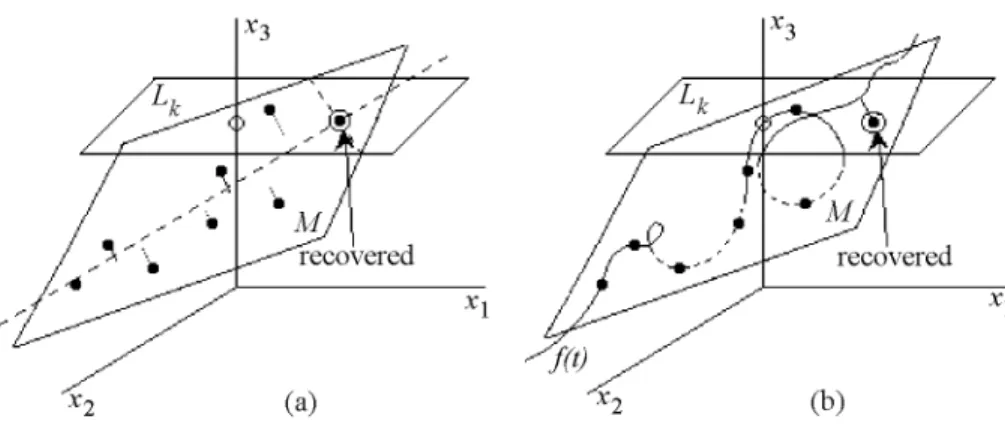
The idea of modeling data with the help of manifolds of small dimension was conceived a long time ago. The most widespread, oldest, and feasible implementation for model-ing data without gaps is the classical method of principal components. The method calls for modeling the data by their orthogonal projections over “principal components” — eigen vectors of the correlation matrix with corresponding largest eigen values. Another algebraic interpretation of the principal component method is a singular expansion of the data table. Generally, to present data with sufficient accu-racy requires relatively few principal components. Imagine a table of data A ={aij}; its rows correspond to objects, and its columns correspond to features. Then, let a por-tion of informapor-tion in the table be missing. Let us look at the object x whose features are represented in a vector form (x1, x2, ..., xn). There may bek gaps in the vector x,
that is, some components of x are lost. We suppose that this vector is represented as akdimensional linear manifold
Lk, parallel tokcoordinate axes corresponding to the miss-ing data. Under a priori restrictions on the missmiss-ing values instead ofLk, we use a rectangular parallelepiped. A man-ifold M of a given small dimension (in most cases a curve) approximating the data in the best way and satisfying cer-tain regular conditions is sought. For the complete vectors of data, an accuracy of approximation is determined as a regular distance from a point to a set (the lower bound of the distances to the points of the set). For the incomplete data, the lower bound of the distances between the points ofM and Lx (or, accordingly,Pk) may be used. From the data closest to them, points ofM are subtracted. We obtain a residue, and the process is repeated until the residues are close enough to zero. Proximity of the linear manifoldLk, or parallelepipedPk, to zero means that the distance from zero
Figure 1. Geometrical interpretation of the linear model (a) and the quasilinear model (b).
to the point ofLk (accordingly,Pk), which is closest to it is small. Desired approximation can be constructed recursively [Gorban et al., 2000;Rossiev, 1998] for three models: linear, quasilinear, or essentially non-linear (self-organizing curves (SOC)). We illustrate the idea using an example of a linear model. Let there be a rectangular tableA={aij}, the cells of which are filled with real numbers or with some symbol @ denoting absence of data. The problem is to approximate
Awith a matrixP1 in a form ofxiyj+bj, by means of the
least squares method
Φ =X
i,j
(aij−xiyj−bj)2→min (1)
where aij 6= @. If there are any two known vectors, then the third one will be calculated through explicit formulas. As a result, for the given matrix A, we will find the best approximation, that is the matrixP1. Further on, we look
for a matrix, P2, that is the best approximation ofA−P1
and so on, while the norm of A is not sufficiently close to zero. Thus, the initial matrixAis presented in the form of a sum of matrices of rank 1, that is,A=P1+P2+. . .+Pq. The
Qfactorial recovering of the gaps consists in their definition through the sum of matricesPq. For incomplete data after a number of iterations, we get a system of factors that we will use for recovery. Further, we again construct a system of factors with the help of already recovered data and so on. Geometrical interpretation of a linear model is shown in Figure 1a, forA ⊂R2. We considered our example inR3
space, so our data pointxis presented as (x1, x2, x3).
Imag-ine there is a point and that two of its coordinates are lost (we have onlyx3 coordinate), so a plane, Lk, corresponds
to it. The plane Lk is modeled by the vector y that is an inclined line approximating known data in a best manner; vectorx is a set of projections of initial data ony (≡M). The lost coordinate now is substituted by the intersection
Lk∩M.
Quasilinear models [Gorban et al., 2000; Rossiev, 1998] are based on the algorithm of linear model construction de-scribed above. First, we construct a linear model, then the vector-function f(t) (a cubic spline or a polynomial) that
minimizes the functional:
Φ =X i,j (aij−f(X k aikyk))2+α +∞ Z −∞ (f00(t))2dt (2)
whereα >0 is a smoothing parameter.
So, first we are looking for the projection of data vec-toraon a manifold of small dimension y: P r(a) =ty+b,
t= (a, y), then we find a point on the curvef(t). For incom-plete data, the closest pointt(a) is taken on the manifold. And after that, we take the corresponding point on the curve
f(t) fort=t(a). After construction off(t), the matrixAis substituted by the matrix of deviations from the model (Fig-ure 1b). The process is repeated several times, and at the end the initial table,Ais represented in a form ofQfactorial model: aij∼=Pi,jfi(tj).
The third model is based on the Kohonen self-organizing maps theory or, more exactly, on the paradigm of self-organizing curves. These curves are defined by a set of points (a kernel) situated on a curve (at the first approach this curve is a polygonal one), on which a set of data point (taxon) must be mapped. Under fixed decomposition of the data set on taxons, the SOC is constructed uniquely. Under fixed location of kernels, taxons are easily constructed, too, with the help of minimizing of some functional, which con-sists of three addends: a measure of the best approximation, a measure of connectedness, and a measure of nonlinearity [Gorban et al., 2000]. Successive searching; kernels→taxons
→kernels →... leads to the convergence of the algorithm. The computational process is implemented on the neural conveyor Famaster 2 made by Gorban’s team at the Insti-tute of Computational Mathematics of the Siberian Division of the Russian Academy of Sciences.
3. Results
We carried out the experiments with different time se-ries. The results of some experiments are shown in Fig-ure 2. About 50% of the points in the annual Wolf num-ber time series were delete. For gap recovery, we used the
Figure 2. A fragment of the annual Wolf index time series, SOC; number of nodes is 10. SOC model. Strings of the initial data table were F. Takens
mdimensional delay vectors [Sauer et al., 1991]. The time delay equals 1, and the embedding dimension equals 6. The strings look as follows: akj = xk, xk+1, ..., xk+5. The
em-Table 1. A Fragment of the Real and Recovered Values for Ten-Year14C and Annual10Be Time Series
14
C 10Be
Real Recov. Real Recov.
67.90 71.00 1.00 1.04 85.10 85.50 0.61 0.63 89.30 89.52 0.90 0.83 86.70 87.94 0.57 0.59 89.30 89.70 1.11 1.09 92.40 92.37 0.85 0.85 89.70 90.54 0.57 0.64 83.40 83.89 0.82 0.85 87.70 87.40 1.25 1.21 87.10 86.57 1.19 1.18 86.20 86.44 1.26 1.32 77.20 77.03 0.82 0.80 76.10 76.32 0.95 0.91 71.40 72.97 0.62 0.74 77.50 77.04 1.01 0.96 78.60 76.63 0.72 0.70 78.30 78.21 1.34 1.30 79.00 80.34 1.40 1.30 76.00 76.04 0.85 1.17 77.30 75.60 1.29 1.28
bedding dimension was estimated with the help of the False Nearest Neighbours’ (FNN) method [Abarbanel et al., 1993]. Thus, deleting a point in a time series implied deleting the whole diagonal corresponding to that point. As you can see, the neural conveyor even recovered the peaks of cycles well. Figure 3 shows a fragment of the cosmogenic isotope 14C time series. The whole time series ranges from 5995 BC to 1945 AD. We give only the results recovering 30% of deleted points of the fragment from 5995 BC to 10 AD. And the last time series used in our experiment was10Be (1428–1999 AD,
annual data), and about 10% of points were deleted (Fig-ure 4). Some results of recovery (in numerical form) are provided in Table 1. The construction of the initial table by F. Takens (unlike the arbitrary method of construction mentioned inGorban et al. [2000];Rossiev[1998] essentially changes the situation. Really, a lost value ofy component of the vector on Figure 1a induces a gap ofxcomponent in the next (by F. Takens) vector. The intersection of two lines recovers a missed value. In the multidimensional case, the problem is reduced to the search of a transverse intersection of hyperplanes [Sauer et al., 1991]. Thus, the method of gap recovery takes on a formal context.
3.1. Multifractal Spectrum of 14C Time Series
After applying the recovery procedure to the time series, we had an equidistant and complete one, so it became possi-ble to use more refined tools to implement our investigations. We used an approach in which time series is considered as multifractal random measures. Remember [Barreira et
Figure 3. A fragment of the14C time series, quasilinear model; number of nodes is 8.
Figure 5. Multifractal spectrum of annual14C data, after recovery by a quasilinear model.
al. 1997] that multifractal spectrum of singularities of Borel finite measureµon a compact setXis a functionf(α) de-fined by a pair (g, G). Here,g:X→[−∞,+∞] is a func-tion, which determines the level sets: g : Kg
α = {x∈ X : g(x) =α}and produces a multifractal decompositionX:
X= [
−∞≤α≤+∞
Kαg
LetGbe a real function, which is defined on Zi ⊂X such that G(Z1) < G(Z2) if Z1 ⊂Z2. Then multifractal
spec-trum isf(α) =G(Kαg). Let g be determined as pointwise
dimensiondµof measureµat all pointsx∈Xfor which the limit
g≡dµ(x) = lim
r→0(logµ(B(x, r))/log(r))
exists, where µ(B(x, r)) is a “mass” of measure in the ball of radius r centered at x. Since we have chosen g = dµ, we can omit the subscript from further references to Kg
α.
Then Kα = {x : dµ(x) = α}, where the exponent is a local density of µ. The singular distribution µ can then be characterized by Hausdorff dimension of Kα, that is,
f(α) = G(Kα) = dimH(Kα). If µ is self-similar in some
sense,f(α) is a well-behaved concave function off(α) [ Fal-coner, 1994]. To estimate f(α), we applied the method of the partition sum [Riedi, 1997]. For analysis, annual 14C
time series (1510–1954) was used. Initial time series had a fragment, where known data values were given in a period of 2 years (1890.5–1910.5), and there were some real data gaps (1911–1912, 1914, 1946). With the help of the method
suggested above, this time series was recovered and became equidistant. Thus, the time series is applicable for multi-fractal analysis. In Figure 5, af(α)-spectrum of this time series is shown. It shows that14C records have multifractal
properties in a large range of scales (1–2.2).
4. Conclusion
Our experiments have shown that the neural method for gap recovery in a time series is quite eligible for analyzing cosmogenic isotopes. This method allows equidistant time series to be obtained, which can be researched by using the modern tools of non-linear analysis.
References
Abarbanel, H. D. I., R. Brown, J. J. Sidorowich, and L. Sh. Tsim-ring, The analysis of observed chaotic data in physical systems,
Rev. Mod. Phys., 65(4), 1331, 1993.
Anderson, T. W.,The Statistical Analysis of Time Series, Wiley, New York, 1971.
Bacry, E., J. F. Muzy, and A. Arnedo, Singularity spectrum of fractal signals from wavelet analysis: Exact results,J. Statist. Phys., 70(3/4), 635, 1993.
Barreira, L., Y. Pesin, and J. Schmeling, On a general concept of multifractality: Multifractal spectra for dimensions, entropies, and Lyapunov exponents. Multifractal rigidity, Chaos, 7(1), 27, 1997.
Davis, A., A. Marshak, W. Wiscombe, and R. Cahalan, Mul-tifractal characterizations of nonstationarity and intermittence in geophysical fields: Observed, retrieved, or simulated,J. Geo-phys. Res., 99(D4), 8055, 1994a.
Davis, A., A. Marshak, and W. Wiscombe, Wavelet-based multi-fractal analysis of nonstationary and/or intermittent geophysi-cal signals, inWavelets in Geophysics, edited by Efi Foufoula-Georgiou and Praveen Kumar, 249 pp., Academic Press, New York, 1994b.
Falconer, K. J., The Multifractal spectrum of statistically self-similar measures,J. Theor. Probab., 7(3), 681, 1994.
Gorban, A. N., S. V. Makarov, and A. A. Rossiev, Neural con-veyor to recover gaps in tables and construct regression by small samplings with incomplete data,Mathematics, Computer, Ed-ucation (in Russian), 5(II), 27, 1998.
Gorban, A. N., A. A. Rossiev, and D. C. Wunsch II, Self-organizing curves and neural modeling of data with gaps,Proceeding of Neuroinformatics 2000 (in Russian), Part 2, p. 40, Moscow, 2000.
Hastie, T., and W. Stuetzle, Principal curves,J. Am. Stat. As-soc., 84(406), 502, 1988.
Kramer, M. A., Non-linear principal component analysis using autoassociative neural networks,AIChE J., 37(2), 233, 1991. Little, R. J. A., and D. B. Rubin,Statistical Analysis With
Miss-ing Data, John Wiley & Sons, Inc., New York, 1987.
MacDonald, G. J., Spectral analysis of time series generated by nonlinear processes,Rev. Geophys., 27(4), 449, 1989. Riedi, R. H., An Introduction to Multifractals, Rice University,
1997.
Rossiev, A. A., Modeling data by curves to recover the gaps in tables, Nueroinformatics Methods, 6, KGU Publishers, Kras-noyarsk, 1998.
Sauer, T., J. A. Yorke, and M. Casdagli, Embedology, J. Stat. Phys., 65(3/4), 579, 1991.
Schreiber, T., Detecting and analyzing nonstationarity in time se-ries using nonlinear cross predictions,Phys. Rev. Lett., 78(5), 843, 1997.
Veneziano, D., Basic properties and characterization of stochasti-cally self-similar processes,Rd. Fractal., 7(1), 59, 1999.
V. Dergachev, Ioffe Physical and Technical Institute, St. Pe-tersburg, Russia.
A. Gorban and A. Rossiev, Institute of Computational Model-ing, Krasnoyarsk, Russia.
N. Makarenko and Y. Kuandykov, Institute of Mathematics, Almaty, Kazakhstan.