This is an author produced version of
Digraph-based joint routing and resource allocation
in software-defined backhaul networks
.
White Rose Research Online URL for this paper:
http://eprints.whiterose.ac.uk/126925/
Proceedings Paper:
Li, H., Zhang, J., Hong, Q. et al. (2 more authors) (2017) Digraph-based joint routing and
resource allocation in software-defined backhaul networks. In: Computer Aided Modeling
and Design of Communication Links and Networks (CAMAD), 2017 IEEE 22nd
International Workshop on. 2017 IEEE 22nd International Workshop on Computer Aided
Modeling and Design of Communication Links and Networks (CAMAD), 19-21 Jun 2017,
Lund, Sweden. IEEE . ISBN 9781509063024
https://doi.org/10.1109/CAMAD.2017.8031525
promoting access to
White Rose research papers
[email protected] http://eprints.whiterose.ac.uk/Digraph-Based Joint Routing and Resource
Allocation in Software-Defined Backhaul Networks
Hao Li
1, Jiliang Zhang
2, Qi Hong
1, Hui Zheng
1, and Jie Zhang
1,31
Dept. of Electronic and Electrical Engineering, University of Sheffield, Sheffield, UK
Email:
{
hli33, qhong2, hzheng6, jie.zhang
}
@sheffield.ac.uk
2
School of Information Science and Engineering, Lanzhou University, Lanzhou, P. R. China
Email: [email protected]
3
Ranplan Wireless Network Design Ltd., Cambridge, UK
Abstract—By decoupling the control plane from the data plane and providing programmability for network applications, software-defined network (SDN) is positioned to offer more efficient management, higher flexibility and better performance. Routing and resource allocation are two closely related ap-plications in wireless networks. With close cooperation, better performance and lower complexity can be achieved in an SDN architecture. However, work that jointly studies routing and resource allocation is rarely seen. In this paper, the joint routing and resource allocation problem is investigated in OFDMA-based software-defined backhaul networks (SDBN). To exploit the SDN programmability, an SDBN system model is proposed, where the control panel can use high complexity algorithms in configuration phase in order to simplify algorithms in operation phases. Then the joint routing and resource allocation problem is formulated as a system throughput optimization problem. By constructing the interference digraph of the network and analysing the vertex degree characteristics, a digraph-based greedy algorithm (DBGA) is proposed. Simulation results have shown that, the proposed DBGA works well to increase the system throughput.
Index Terms—Software-defined backhaul network, joint rout-ing and resource allocation, graph theory.
I. INTRODUCTION
Owing to its simplified management, high flexibility and improved performance, software-defined network (SDN) has drawn considerable attention in recent years [1–3]. By sep-arating the control plane and the data plane, SDN can offer logical centralization of network management and introduce the programmability, which open up new approaches to con-trol functions in the application layer. Routing and resource allocation are main functions of wireless networks. Tradition-ally, routing and resource allocation designs are based on distributed approaches, which may confront problems such as high complexity and performance limitations. With the introduction of SDN, problems can be broken into tractable pieces and decisions can be made based on global network information.
Several works have been presented to utilize the SDN features for better routing and resource allocation designs separately. In [4], the authors built a model and developed
1This work was funded by the European Unions Horizon 2020 Research
and Innovation Programme project ”DECADE” under Grant Agreement No 645705.
algorithms for load balancing with packet forwarding rules. By migrating traffic from heavy loaded switching devices to lightly loaded ones, the proposed algorithm in [5] achieved load balancing routing reactively. Multipath routing, where traffic can be forwarded with multiple paths, was exploited in [6] to provide load balancing and improve network throughput. In [7], a novel method was proposed to build multicast topology in SDN. In [8], a price-based joint allocation model of network resource in SDN is built by introducing the price for each of the resources, which can get the proportional fair allocation of link bandwidth and Sthe minimum global delay at the same time. However, work that jointly considers both routing and resource allocation is rarely seen in SDN.
Strong interactions exist between routing and resource allo-cation procedures. For instance, to hold the forthcoming traffic, the available spectral resources of the different links should be considered. In return, when all routes are settled, the spectral resources are assigned based on the traffic amount in each link. Especially with interferences existing in the network, the routed traffic may impact the resource allocation strategy and further affect the capacity of the network. Hence, jointly considering routing and resource allocation is of fundamental importance to increase the reusability of spectrum to load the explosively growing traffic over wireless networks [9].
In this paper, we investigate joint routing and resource allocation in an OFDMA-based software-defined backhaul network (SDBN), where multi-hop transmission and mesh topology are applied. We proposed an SDBN system model for routing and resource allocation functions in consideration of SDN features. Based on our system model, we formulated the joint routing and resource allocation problem as a system throughput optimization problem. To solve the problem in a decomposition manner, an interference digraph was con-structed. Through analysing the indegree and outdegree of vertices in the digraph, a low complexity greedy algorithm was proposed, which has been proven by simulations to work well to improve the system throughput.
The remainder of the paper is organized as follows. In II, we propose the SDBN system model in detail. Then, the joint routing and resource allocation problem is formulated in III. Next, we analyse the problem on an interference digraph
basis and propose our digraph-based greedy algorithm in IV. Simulation results and analyses are presented in V. Finally, we conclude this paper in VI.
II. SYSTEMMODEL
A. Software-Defined Backhaul Network
Backhaul network is considered in this work, in which basic SDN architecture is adopted. It includes two parts: SDN controller in the control plane and switching devices in the data plane. The SDN controller is a centralized software-defined control unit, which communicates with all switching devices through control panel. Switching devices or nodes for simplification are responsible for collecting and sending network status to controller and processing data packets based on rules provided by the controller. It is worthy noticing that communications between any two nodes may be required with caching techniques [10]. N nodes andLdirectional links are considered in this paper.
B. Service-Oriented Virtual Sub-Network
In SDNs, network virtualization is a key technique which enables distinct control over different services (e.g. VoIP and download) in the very same architecture[11]. For one specific service, the SDN controller assigns nodes and links based on the demand (e.g. throughput and latency) of the service, which forms the service-oriented virtual sub-network.
In the configuration phase of one sub-network, the nodes and links can be processed to produce feasible paths between any two nodes with depth-search algorithm [12]. All feasible paths from nodemto nodenare recorded in setRoute(m, n)
whose size is F(m, n). The fth
feasible path is denoted as
Routef(m, n)
whose elements are link indices.
In the operation phase of the sub-network, we consider the traffic request as multi-hop transmission rate demand. For one traffic request from nodemto noden, the demand is denoted by D(m, n) bits/s. Further, we use Di to denote the traffic
that passes through link li. If traffic request D(m, n) routes
through linkli,Di(m, n) =D(m, n). Otherwise,Di(m, n) =
0. The total number of traffic requests is denoted byM.
C. Resource Pool
In SDN, the controller is responsible to monitor the usage of spectral resources and control the resource allocation and the routing strategy of the network. We assume that the spectral resource is divided into W sub-channels, and there are T
time slots in one second. One sub-channelw in one time slot
t is called a resource blockb(w,t). Nodes can transmit and receive data on any combination of the resource blocks. We propose to construct resource pool P in the controller to help manage the resource usage. Each link li has its resource pool
matrix Pi(w,t). If Pi(w,t) =1, it means that the resource
blockb(w,t)is assigned to linkli. Otherwise, resource block
b(w,t)is not in use in the corresponding link.
D. Interference Model
Compared with access network, a special issue of SDBN is that the architecture and topology are stationary. Thus, it is rea-sonable to assume that every node and link are preconfigured with appropriate parameters that impact interferences between links. With such precondition, protocol model [13] is adopted in this paper, which simply considers that link failure occurs when nodes are out of transmission range or the transmission is interfered by nodes occupying the same resource blocks in the interference range.
With the stationary network topology and configuration, two inherent interference properties of links are certain and vital, which should be defined and recorded in the SDN controller. The set of links that interferes link li is denoted by Ai.
Likewise, the set of links that are interfered by link li is
denoted byBi.Ai andBi are called the interference sets of
linkli.
E. System Throughput
We further assume that each link has its fixed link trans-mission rate ri bits/s if one resource block is assigned based
on the stationary topology of SDBN. With resource blocks assigned to linkli, the link throughput is computed by:
Ri=ri W X w=1 T X t=1 Pi(w, t). (1)
At the network level, the system throughput is given by the sum of throughputs of all links. If the resource allocation schemeS is applied to the network, the system throughput is computed by: RS = I X i=1 Ri= I X i=1 (ri W X w=1 T X t=1 Pi(w, t)). (2) III. JOINTROUTING ANDRESOURCEALLOCATION
PROBLEM
In SDNs, routing and resource allocation are two basic and closely related issues. Different routing strategies may lead to different resource allocation schemes, which may further seriously impact the system performance. In return, resource allocation algorithms may also impact the routing decisions. In the following, we try to jointly consider the routing and resource allocation problem to improve the throughput of SDBNs.
A. Problem Formulation
In the background of traffic explosion, it is always of great interest to obtain the optimal achievable system throughput to be able to load more traffic in SDBNs. Thus, the objective function of the resource allocation problem becomes:
MaximizeRS = I X i=1 Ri= I X i=1 (ri W X w=1 T X t=1 Pi(w, t)) (3)
Meanwhile, we have the following resource block con-straint:
Pi(w, t)∈ {0,1}
∀i= 1,2, . . . , L ∀w= 1,2, . . . , W ∀t= 1,2, . . . , T. (4)
Link interference constraint is required to avoid interference between links:
Pi(w, t) +Pj(w, t)≤1 ∀i= 1,2, . . . , L ∀j∈Ai
∀w= 1,2, . . . , W ∀t= 1,2, . . . , T
(5) whereAi is one of the interference sets of linkli.
Though many feasible paths are predefined for any two nodes, only one path can be chosen. Thus, the following routing constraint should be obeyed:
f ∈F(m, n) Di(m, n) =D(m, n)
∀i∈Routef(m, n) ∀m= 1,2, . . . , N ∀n= 1,2, . . . , N.
(6) To satisfy the traffic requests, following traffic request constraint should be considered:
ri× |Pi| ≥Di= N X m=1 N X n=1 Di(m, n) ∀i= 1,2, . . . , L ∀m= 1,2, . . . , N ∀n= 1,2, . . . , N (7) To this end, an optimization problem of joint routing and re-source allocation for backhaul networks has been formulated. In summary, the objective in (3) needs optimization subject to constraints in (4)-(7).
IV. DIGRAPH-BASEDJOINTROUTING ANDRESOURCE
ALLOCATION
As the resource allocation variable P is restricted to be an integer, the developed optimization problem is inherently NP-hard [14]. In dense wireless networks, to adapt to the dynamic traffic requests, a relatively fast algorithm is required to solve the problem. More seriously, the system may not be able to redo all the routing and resource allocation assignments glob-ally whenever a traffic variation occurs. Thus, the algorithm should be able to work well on a single traffic request basis. Considering low computational complexity, a greedy algorithm based on interference digraph is proposed in this section.
A. Interference Digraph Construction
The network topology can be abstracted into an interference digraph G= (V,E). V is a vertex set whose elements are links in the network, whereli ∈V. The edge setE consists of
directed edges which present potential interferences between links. For instance, edge e(li,lj) means that link lj is in the
interference range of li.
In graph theory, for any vertex, the number of head ends adjacent to the vertex is defined as the indegree of the vertex, which is denoted bydeg−(
li). It presents the number of links
that may cause interference to linkli. Likewise, the number of
tail ends adjacent to the vertex is defined as the outdegree of
the vertex, which means the number of links that may receive interference from linkli and is denoted by deg+(li).
B. Problem Analysis
The goal of the problem is to maximize the system through-put. For single traffic request, we try to make the decision of routing and resource allocation on the benefit of network throughput to approach the optimal solution.
In the interference digraph, the degrees of link clearly char-acterise the potential interference between links. The resource allocation of link li and its outdegree characteristics may
impact the network throughput to a certain extent. For instance, if deg+(l
i)·Pi is larger, the available resources for links in
interference set Bi is smaller and so will be the network
throughput. Though the above theory is not guaranteed to be always true in the global perspective, it is helpful to approach the local optimal solution by reducingdeg+(li)·Pi
reasonably.
From load balancing point of view, the available resource blocks of links need consideration when routing a traffic request, which is relevant with the link indegree deg−(
li).
For example, largerdeg−(
li)means that more links interfere
link li. Resource blocks that are assigned to such links are
not available for link li. To characterise the resource block
status of linkliquantitatively, we introduce interference matrix
Qi(w, t). IfQi(w, t) = 1, it means that linkli or links in set
Ai have already occupied resource block b(w, t). Otherwise,
resource blockb(w, t)is still available to linkli.
Based on above discussion, a routing cost function for link
li is defined as:
cost(li) =D(m, n)·deg+(li) +Qi. (8)
Thus, the cost function of pathf is calculated by:
Cost(Routef(m, n)) = X
∀li∈Routef(m,n)
cost(li).
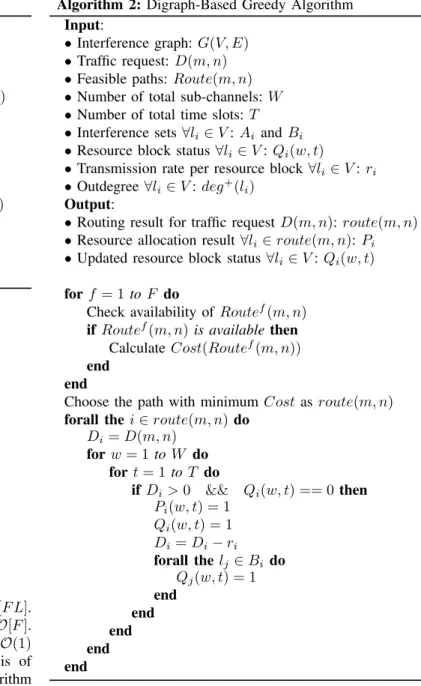
(9) During the routing process, all the links in the chosen path should be able to load the traffic. We developAlgorithm1to check ifRoutef(m, n)is available.
C. Proposed Algorithm
Considering the requirement of low computational complex, a digraph-based greedy algorithm (DBGA) is proposed in
Algorithm2, of which the details are explained as follows. For single traffic request, the available paths are valued with the routing cost function. Then the path with minimum cost is chosen and the traffic request is assigned to each link. Lastly, available resource blocks are assigned to each link considering avoidance of interference to satisfy the demand. When more than one traffic requests occur, the one with larger rate demand is a priority to process.
The complexity of DBGA is analysed as follows. In the algorithm, there are two main variables, which are the number of feasible pathsF and the number of linksL. The number of links in one feasible path is also a variable, which is less than L in any case. First, the complexity of feasible path
Algorithm 1: Availability Check of Feasible Path
Input:
• fthfeasible path:Routef(m, n) • Number of total sub-channels:W
• Number of total time slots:T
• Resource block status ∀li ∈Routef(m, n): Qi(w, t) • Transmission rate per resource block
∀li∈Routef(m, n):ri Output: • Availability ofRoutef(m, n) if ∀li∈Routef(m, n), ri·(W T − |Qi|)> D(m, n) then Routef(m, n)is available. else
Routef(m, n)is not available.
Fig. 1: Network topology
availability check and cost function calculation is O[F L]. The selection of minimum cost path is of complexity O[F]. Then, assigning resource blocks to one link requires O(1)
and the update of resource block status for set Bi is of
complexity O[L]. Thus the total complexity of the algorithm is O[F L] +O[F] +L·(O(1) +O[L]) =O[L(F+L)].
V. PERFORMANCEEVALUATION
A. Simulation Setup
The network is generated in an area of 1000 m×1000 m with 20 nodes in total. The transmission and interference range are set as 250 m and 400 m, respectively.
For the resource block settings, the whole spectral resource is divided into 50 sub-channels and one time slot is set as 5 ms. In this work, link transmission rate is not a variable that impacts on the results. So we simply assume that all links achieve 0.1 Mb/s rate with one resource block assigned.
Four services are considered in the simulations. The rate requests of the four services are set as 0.5, 1, 1.5, 2 Mb/s, respectively. The service-oriented virtual sub-network is con-structed by selecting random connected nodes. The traffic requests are randomly generated between 2 nodes in the
Algorithm 2: Digraph-Based Greedy Algorithm
Input:
• Interference graph:G(V, E) • Traffic request:D(m, n) • Feasible paths:Route(m, n) • Number of total sub-channels:W
• Number of total time slots:T
• Interference sets∀li ∈V:Ai andBi • Resource block status∀li∈V: Qi(w, t)
• Transmission rate per resource block∀li∈V:ri • Outdegree∀li∈V:deg+(li)
Output:
• Routing result for traffic requestD(m, n):route(m, n) • Resource allocation result∀li∈route(m, n):Pi • Updated resource block status∀li∈V:Qi(w, t)
forf = 1toF do
Check availability ofRoutef(m, n) if Routef(m, n)is availablethen
CalculateCost(Routef(m, n)) end
end
Choose the path with minimum Costas route(m, n) forall thei∈route(m, n)do
Di=D(m, n) forw= 1toW do fort= 1 toT do if Di>0 && Qi(w, t) == 0then Pi(w, t) = 1 Qi(w, t) = 1 Di=Di−ri forall thelj ∈Bi do Qj(w, t) = 1 end end end end end
corresponding sub-network. Feasible paths are produced with depth-first search algorithm in advance.
B. Performance Analysis
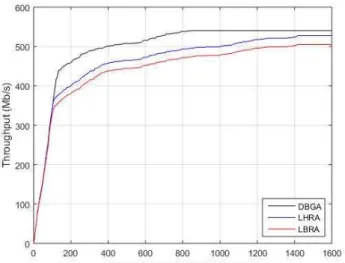
The performance of network throughput with increasing traffic requests in one topology-fixed network is our primary concern. Fig. 1 shows the topology of the network for this simulation. Typical star, chain, tree and ring topologies can all be found in this topology, which makes it suitable for our performance evaluation. Two commonly used and effective algorithms, which are least hop routing algorithm (LHRA) and load balancing routing algorithm (LBRA), are compared with the proposed DBGA. To check the network throughput performance of these algorithms, we gradually add new traffic requests to the network. Fig. 2 shows the simulation results. In the beginning, all algorithms work well to route the traffic
Fig. 2: System throughput against increasing traffic requests
Fig. 3: Average system throughput performance
requests. Then the lines separates when some traffics are not successfully routed. At last all lines become steady as the network cannot load more traffic. As can be seen, the line of DBGA ends up higher than other algorithms. Then, we employ genetic algorithm to obtain a near-optimal solution. The result shows that the system throughput can achieve 550.5 Mb/s, which is only slightly larger than the proposed DBGA. As a conclusion, our proposed algorithm improves the ability to load traffics and achieve fair network throughput compared to the near-optimal benchmark.
Lastly, to verify the generality of our algorithm in different network topologies, we run another 25 sets of simulations with randomly generated networks. We show the average network throughput of the algorithms in Fig. 3. The results also show that our proposed DBGA is better in terms of increasing network throughput.
VI. CONCLUSIONS
In this paper, the joint routing and resource allocation problem in OFDMA-based SDBN is investigated. Based on the proposed SDBN system model, the problem is formulated as a system throughput optimization problem. Considering real time computational complexity, a digraph-based greedy
algo-rithm is proposed through analysing the relationship between degree of vertices in the constructed interference digraph and the system throughput. Simulation results have shown that, the proposed DBGA works well in terms of improving the ability of traffic load bearing and increasing system throughput.
VII. ACKNOWLEDGEMENT
This project has received funding from the European Unions Horizon 2020 research and innovation programme under the Marie Skodowska-Curie grant agreement No 645705.
REFERENCES
[1] B. A. A. Nunes, M. Mendonca, X.-N. Nguyen, K. Obraczka, and T. Turletti, “A survey of software-defined networking: Past, present, and future of programmable networks,”IEEE Commun. Surveys Tuts., vol. 16, no. 3, pp. 16171634, 3rd Quart., 2014.
[2] D. Kreutz, F. M. V. Ramos, P. E. Verssimo, C. E. Rothen-berg, S. Azodolmolky, and S. Uhlig, “ Software-defined networking: A comprehensive survey,” Proc. IEEE, vol. 103, no. 1, pp. 14-76, Jan. 2015.
[3] W. Xia, Y. Wen, C. H. Foh, D. Niyato and H. Xie, “ A survey on software-defined networking,”IEEE Commun. Surveys Tuts., vol. 17, no. 1, pp. 27-51, 1st Quart., 2015. [4] R. Wang, D. Butnariu, and J. Rexford, “ OpenFlow-based server load balancing gone wild,” Proc. 11th USENIX Conf. Hot-ICE Netw. Serv.,p. 12, 2011.
[5] P. Pisa et al., “ OpenFlow and Xen-based virtual network migration,” Communications: Wireless in Developing Countries and Networks of the Future., Berlin, Germany: Springer-Verlag, pp. 170181, 2010.
[6] M. F. Ramdhani, S. N. Hertiana and B. Dirgantara, “ Multipath routing with load balancing and admission control in Software-Defined Networking (SDN),” 4th ICoICT, pp. 1-6, 2016.
[7] S. Q. Zhang, Q. Zhang, H. Bannazadeh and A. Leon-Garcia, “ Routing Algorithms for Network Function Vir-tualization Enabled Multicast Topology on SDN,” IEEE Transactions on Network and Service Management, pp. 580-594, Dec. 2015.
[8] T. Feng, J. Bi and K. Wang, “ Allocation and scheduling of network resource for multiple control applications in SDN,”China Communications, vol. 12, no. 6, pp. 85-95, Jun. 2015.
[9] Cisco, “Global mobile data traffic forecast update, 2011-2016,” White Paper, Feb. 2012, pp. 129.
[10] C. Liang, F. R. Yu and X. Zhang, “ Information-centric network function virtualization over 5g mobile wireless networks,” IEEE Network, vol. 29, no. 3, pp. 68-74, May/Jun. 2015.
[11] Q. Duan, N. Ansari and M. Toy, “ Software-defined network virtualization: an architectural framework for integrating SDN and NFV for service provisioning in future networks,” IEEE Network, vol. 30, no. 5, pp. 10-16, Sep./Oct. 2016.
[12] H. S. Stone and P. Sipala, “ The average complexity of depth-first search with backtracking and cutoff,”IBM Journal of Research and Development, vol. 30, no. 3, pp. 242-258, May 1986.
[13] K. Jain, J. Padhye, V. Padmanabhan, and L. Qiu, “Impact of interference on multi-hop wireless network
perfor-mance,” Wireless Netw., vol. 11, no. 4, pp. 471-487, Jul. 2005.
[14] C. H. Papadimitrious and K. Steiglitz, “Combinatorial optimization: algorithms and complexity,” Mineola, NY: Dover, ISBN 0486402584, Jan. 1998.