Communications of the IBIMA
Text Entry Factors and Texting Satisfaction:
An Analysis among Malaysian Users
Vimala Balakrishnan, Faculty of Information Science & Technology, Multimedia University, Melaka, Malaysia, [email protected]
Paul, H.P.Yeow, Faculty of Business & Law, Multimedia University, Melaka, Malaysia [email protected]
Abstract
This paper investigates the effect of respondents’ age in relation to the experience of using mobile phone for sending text messages. The text entry factors considered in the study were speed, special character selections, case conversions, simplicity, learnability, menu traversals and audio feedback. One hundred and ten Malaysians aged between 17 – 39 years old were interviewed. Special character selections, learnability and simplicity were found to be the three most important predictors for users’ texting satisfaction. Effects of age were significant for satisfaction towards learnability, speed and special character selections, with the younger respondents being more satisfied than the older respondents. Similarly, the younger respondents were also found to be more satisfied with their texting satisfaction than the older respondents. Results can be used by mobile phone designers and manufacturers to further improve mobile phone designs by focusing on important text entry factors. This may increase their customers’ texting satisfaction.
Keywords: Text entry factors, texting satisfaction, age, interviews
1. Introduction
Short Message Service (SMS) is a service for sending short messages of up to 160 characters (224 characters if using a 5-bit mode) to mobile devices, including cellular phone, smart phone and Personal Digital Assistant (PDA). SMS gained extreme popularity among its users, especially the youngsters throughout the world. For example, a study in England among 1,058 young users aged between 11 to 21 years old revealed that nine out of ten users send SMS at least daily, with 54% do so more than five times per day [12]. In Malaysia, according to the communication and multimedia facts and figures released by Malaysian Communication and Multimedia Commission (MCMC), there were approximately 9.9 billion SMS subscribers in 2006 and this number shot to 14.7 billion in 2007 [18]. SMS is popular as it is cheap, fast and convenient.
Mobile phones, however, are not well suited for text input. The mobile phones are equipped with only 12 – 15 keys for alphabets, numbers and punctuations. Therefore each key is mapped with
three or four characters, and this requires the users to make repetitive key presses to make character selections. The most prevalent forms of text entry are multitap and predictive text entry. Multitap works by cycling through letters on a key with each successive press. For example, first press on key-3 enters a ‘d’, a second press enters an ‘e’ and a third enters an ‘f’. When the intended character is placed on the same key, the users will either have to wait for a short time before making another key press or press a next key to skip the time delay. Multitap is simple and unambiguous but it is often criticized for being slow [19]. Predictive methods such as T9® and eZiText® were developed to expedite messaging. In this method, the phone attempts to predict the word as it is being entered, and often a next key (e.g. ‘#’) is used to cycle through the potential words. For example, HELLO is entered as 4-3-5-5-6, requiring only 5 keystrokes in total. However, the first problem arises when multiple words match the same key sequence. In this situation, the next key is used to cycle through the word matches.
Works related to text entry are numerous, however, mostly focused on the efficiency of the text entry method used. For example, experiments comparing both multitap and predictive methods reported rates of 14.9 words per minute (wpm) for multitap and 17.6 wpm for predictive text entry [4]. Some have attempted to modify the predictive technology [9] whilst others optimized text entry performance by creating keypad designs that reduce the number of keystrokes needed to enter a word [9] and [20]. The possibility of using gestural interactions and speech for text entry were also investigated by [1] and [3], respectively. Studies related to mobile phone usability have been conducted by all targeting the elderly people [13] and [21]. Work directly related to mobile phone design and user satisfactions are very few, namely done [11] and [14]. These studies however, focused on the overall mobile phone design and its applications and services, including making and receiving calls. Design factors that are specifically related to SMS were not investigated. Similarly, some researchers have also investigated the SMS language, use of emoticons and dialects based on gender and age differences [7], [15] and [16].
The current study aims to identify the mobile phone text entry factors that affect users’ texting satisfaction, moderated by their age. As the study
Communications of the IBIMA solely focus on the text entry factors and age, other
design factors (e.g. keypad design) and demographic factors like gender and ethnicity will be not be taken into consideration.
2. Research Framework
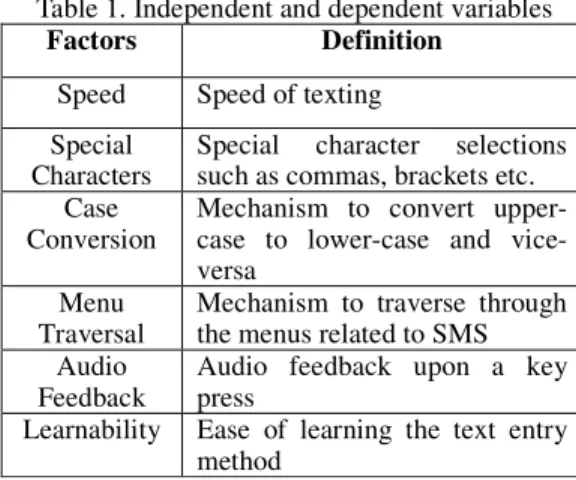
Six independent variables (Fig. 1) and one dependent variable were identified from various literature reviews. For example, the independent variables such as speed, menu traversal and learnability were identified from [4], [21] and [8] respectively, whereas the dependent variable was identified from [11], that is, a study conducted to identify mobile phone design features that are critical to users’ satisfactions. On the other hand, age was identified as the moderating variable based on [6], [15] and [16].
Fig 1. Research Framework
Table 1. Independent and dependent variables
Factors Definition
Speed Speed of texting Special
Characters
Special character selections such as commas, brackets etc. Case
Conversion
Mechanism to convert upper-case to lower-upper-case and vice-versa
Menu Traversal
Mechanism to traverse through the menus related to SMS Audio
Feedback
Audio feedback upon a key press
Learnability Ease of learning the text entry method
Simplicity Ease of using the text entry method
Texting Satisfaction
Subjective satisfaction of using mobile phone to text
Table 1 provides all the operational definitions for the independent and dependent variables.
3. Materials and Methods
Respondents
Mobile phone users encompass all ages, thus respondents were recruited from three main age categories: teens, twenties and thirties. A total of 110 respondents aged between 17 – 39 (M = 23.9, SD = 6.3) were recruited (male = 54, female = 56) using convenience sampling. All the respondents were Malaysians from the three major ethnicities, that is, Malays, Chinese and Indians. The number of respondents in each category is as follows: teen (male = 19, female = 21), twenties (male = 18, female = 22) and thirties (male = 17, female = 13). All the respondents have experience in mobile phone texting, with a mean of 4.15 years and standard deviation of 0.89. The majority of them (72.7%, 80/110) used multitap for text entry, eight (7.3%) used predictive text entry and 22 (20%) used both these techniques interchangeably.
Interview questionnaire design
The interview questionnaire was designed in English with two major sections, A and B. Section A comprised of 22 questions related to the respondents background information, such as age, gender, years of experience, text entry method used and many more. Section B consisted of questions related to users’ satisfaction/dissatisfaction of texting based on the text entry factors and these were measured using Likert five-point scale. Point 1 denotes strongly dissatisfied, 2 denotes dissatisfied, 3 denotes neutral, 4 denotes satisfied and 5 denotes strongly satisfied. A copy of the questionnaire used is attached as Appendix 1. The questionnaire has an acceptable level of internal consistency with a Cronbach’s alpha value of 0.773.
Interviews
Face to face interviews were conducted on a one-to-one basis using the interview questionnaire. All the questions were read out to the respondents to eliminate non-response bias. The interviewers helped to clarify some of the meaning of words or questions where deemed necessary. Two interviewers were involved in these exercises, each interviewing one respondent at a time to eliminate peer influences. Most of the interviews (60%) involved students and working professionals from a local university. The rest of the respondents were recruited from various places including local libraries and offices. Each interview session lasted between 15 – 30 minutes. The respondents were encouraged to give their opinions, suggestions and recommendations and all the subjective comments were noted by the Independent variables Simplicity Learnability Menu Traversal Speed Texting Satisfaction Dependent variable Case Conversion Special Characters Audio Feedback Age
Communications of the IBIMA interviewers. This enabled in the collection of rich
data that reflected the respondents’ real feelings towards their texting satisfaction or dissatisfaction based on the text entry factors. These data are used to help explain some points in Section 6.
4. Results
Statistical Package for the Social Sciences (SPSS) version 13.0 was used to analyze the collected data. Multiple regressions (stepwise) were used to determine the important predictors. Analysis of variance (ANOVA) and Tukey Post-Hoc analysis
were used to analyze the significant differences (if any) between the age groups, with respect to text entry factors effect on texting satisfaction. All the results are considered significant at p < 0.05.
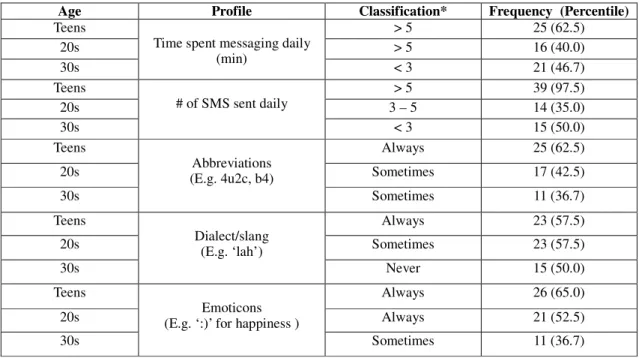
Table 2.Summary of SMS usage based on age *: Highest frequency classification
Table 2 shows the summary of SMS usage based on the categories of age. Generally, the younger users were found to have spent more time texting and sent more messages daily than their older counterparts. Moreover, as the age increases, the frequency of using abbreviations, dialects and emoticons decreases as well.
Table 3. Regression for users’ texting satisfaction
Text entry factors Beta t p
Special characters .27 3.18 .002* Learnability .26 2.91 .004* Simplicity .18 1.99 .049* Menu traversal .11 1.22 .23 Speed .07 .77 .44 Audio feedback .07 .73 .45 Case conversion .03 .55 .61 *: Significant at p < 0.05; Adjusted R2 = 0.29; F = 8.65
Table 3 shows special characters, learnability and simplicity to be the three most important predictors for users’ texting satisfaction. The model was also found to be significant with an F-ratio of 8.65 and an adjusted R2 of 29%. Factors such as menu
traversal, speed, audio feedback and case conversion were not found to be significant predictors for users’ texting satisfaction.
Table 4. Text entry factors satisfaction based on age
Text entry factors F ratio (p-value)
Special characters 6.22 (0.003*) Learnability 7.84 (0.001*) Simplicity 2.54 (0.084) Menu traversal 1.72 (0.184) Speed 3.21(0.044*) Audio feedback 1.55 (0.211) Case conversion 1.03 (0.490) *: Significant at p < 0.05
Table 4 shows significant main effects of age on satisfaction towards special characters, learnability and speed. Tukey post-hoc analysis revealed that teenagers are more satisfied than users in their thirties for speed (p = 0.02) and learnability (p = 0.018). They are also found to be more satisfied with special character selections than those in twenties (p = 0.007) and thirties (p = 0.012).
Age Profile Classification* Frequency (Percentile)
Teens
Time spent messaging daily (min) > 5 25 (62.5) 20s > 5 16 (40.0) 30s < 3 21 (46.7) Teens # of SMS sent daily > 5 39 (97.5) 20s 3 – 5 14 (35.0) 30s < 3 15 (50.0) Teens Abbreviations (E.g. 4u2c, b4) Always 25 (62.5) 20s Sometimes 17 (42.5) 30s Sometimes 11 (36.7) Teens Dialect/slang (E.g. ‘lah’) Always 23 (57.5) 20s Sometimes 23 (57.5) 30s Never 15 (50.0) Teens Emoticons (E.g. ‘:)’ for happiness )
Always 26 (65.0)
20s Always 21 (52.5)
Communications of the IBIMA Table 5. Effect of age on users’ texting satisfaction
Dependent variable F ratio (p-value)
Texting satisfaction 20.21 (< 0.001*) *: Significant at p < 0.05
Finally, Table 5 shows significant effect of age on users’ texting satisfaction. Tukey post-hoc analysis showed teenagers being more satisfied with texting compared to those in their twenties (p < 0.001) and thirties (p < 0.001).
5. Discussions
Multitap versus predictive text entry
The adoption rate of multitap was found to be higher than predictive text entry (72.7% vs. 7.3%, respectively). This accord with data from Norway that showed about half of mobile phone users in the country uses the multitap system [17]. However, most of the respondents (68.1%, 75/110) claimed that multitap technique is time consuming as every character needs to be entered compared to predictive text entry where the words are guessed by the software as the characters are entered. On the other hand, eleven respondents who used both the text entry methods interchangeably reported predictive text entry can be fast if one has learned the art of using it. However, texting activity becomes tedious when the words entered are not recognized by the predictive text entry software. This often happens when users use abbreviations, dialects and even language other than English, e.g. ‘4u2c’ instead of ‘for you to see’.
Texting satisfaction predictors
Special character selections, learnability and simplicity were found to be the important predictors for users’ texting satisfaction. The positive associations indicate that an increase in any of these variables will subsequently increase users’ texting satisfaction as well. These findings are in consonant with other studies that have highlighted the importance of special character selections, learnability and simplicity of the text entry method. For example, participants in an experiment comparing multitap and predictive text entry were found to be similarly frustrated with both the methods. It was also found that although text entry rates using predictive method were faster, however, the participants were not eager to adopt predictive method as it requires one to train and learn the art of using it [8]. Selection of special characters such as commas, semi-colons etc. are also important especially for the younger users who have a higher tendency in using abbreviations, emoticons and dialects (Table 2: Profile – Frequency of using abbreviations, emoticons and dialects).
The adjusted R2 value obtained from the prediction model (Table 3) is only 0.29 indicating that special character selections, learnability and simplicity account for 29% of the variation to users’ texting satisfaction. The low adjusted R2 value can be attributed to the fact that many other factors have been found to be important predictors in using a mobile phone in other studies. For example, a study investigating the mobile phone usage in Malaysia reported factors such as peer chatting and family coordination, etc. to be important predictors for users’ overall satisfaction in using mobile phones (adjusted R2 = 0.53) [22]. However, the researchers did not assess users’ satisfaction in terms of text entry factors. Other studies have also highlighted that factors such as low price, speed and convenience to be contributing to the popularity of text messages among mobile phone users [5] and [16], however, the adjusted R2 values were not available.
Age differences
The younger respondents were found to send more messages daily as opposed to the older respondents (Table 2: Profile – Time). This result tallies with many other statistics worldwide. In Korea, a survey in 2003 showed that 93% of Koreans aged 17-19 sent or received at least one SMS daily. This percentage, however, decreases with age: 92% for 20-24 years old, 79% for 25-29 years old, 58% for 30-34 years old and 47% for 35-39 years old [2]. As the age increases people prefer to make calls for information exchanging and gathering. In contrast, younger users prefer to text for the same purposes [15]. Moreover, as the age increases, the frequency of using abbreviations, dialects and emoticons decreases as well. Findings from [6] and [16] have also reported a similar pattern.
Age was also found to significantly affect users’ satisfaction with respect to speed, learnability and special character selections, with the teenagers being more satisfied with speed and learnability compared to those in their thirties. In [15], it was reported that texting is gradually replaced with voice telephony as the age increases, notable especially after the age of 20. Apart from the dissatisfaction caused by text entry factors, having a steady flow of income could be another reason for the move from text to audio among users over 20 years old. On the other hand, teenagers with no source of income find texting cheap [5], hence they spend more time texting and send more messages daily than the older users (Table 2: Profile – Time and # of SMS). Having spent a lot of time texting would have made them more familiar and skilful with the art of texting; hence they have higher satisfaction for speed.
Younger users are also keener in learning and fast in adapting to changes, especially in the use of new technologies. This probably explains why the youngsters are more satisfied with learnability than
Communications of the IBIMA older users. A similar pattern was observed in [7]
among their adolescent participants who experienced learning new technologies with greater pleasure than adults. In addition, younger users may have more time or iniative to learn as opposed to older users. Texters also need to learn the SMS language in order to be able to message and decipher messages written in unconventional ways. As shown in Table 2, the younger respondents have a higher tendency to use abbreviations, emoticons and dialects in their messages, indicating that the messages written by the younger users are very informal and are normally exchanged among friends as a form of keeping in touch. On the contrary, the older users prefer to use text in a more formal manner, hence keeping abreast with the evolving SMS language becomes tedious. Thus, having to master the technique of text entry, especially using the various abbreviations and symbols, and also being able to communicate successfully using SMS language affects learnability and special character selections among the older users.
Finally, teenagers were also found to have a higher texting satisfaction as compared to those who are in their twenties and thirties as shown in Table 5. This can be attributed to the fact that they are more satisfied with speed, learnability and special character selections, as depicted in Table 4. Their higher levels of satisfaction towards these three factors have resulted in them being more satisfied with their texting experience using their mobile phones.
6. Recommendations
The study discovered that the older users have issues with text entry speed, learnability and use of special characters. They would prefer voice communication rather than SMS. However, SMS communication has some advantages over voice communication, e.g. no interruption as the current event or task need not be stopped because of a phone call; no public disturbances as there is no verbal conversation that could disturb people nearby; and minimum radio frequency radiation effects as the transmission of SMS is short and the phone is not placed near the head. Telecommunication companies should promote these advantages and encourage older users to send more SMS. This would enhance the profit and the value of customer service offered by the companies. However, the companies have to help the older users with the three issues faced by offering newer text entry methods that is faster, easier to learn and easier to reach special characters (with lesser key presses).
Extended keypad could also be designed and introduced which consists of more keys where it is more straight-forward to press special characters. For example, Nokia E70 comes with a QWERTY keypad that is foldable. This keypad requires
mobile phone users to use both their hands for text entry, however, the increased number of keys results in a faster and easier text entry, particularly in the selection of special characters. Other mobile phone manufacturers should design similar keypads to be included in their respective mobile phones.
7. References
[1] Brewster, S., Lumsden J., Bell, M., Hall, M., and Tasker, S. "Multimodal ‘eyes-free’ interaction techniques for wearable devices," in ACM Computer Human Interaction, 2003, pp 473–480
[2] Cheil Communications. Exploring P-Generation, Retrieved April 3, 2005, from http://www.cheil.co.kr. [3] Cox, A. L., Cairns, P.A., Walton, A., and Lee, S. "Tlk or txt? Using voice input for SMS
composition," Personal and Ubiquitous Computing, 2007.
[4] Dunlop, M. D. and Crossan, A. "Predictive text entry methods for mobile phones," in Personal Technologies, London, 2001, pp. 134-143. [5] Eldridge, M.A and Grinter, R.E. "Studying text messaging in teenagers,"in Proceedings of the ACM Conference on Human Factors in Computing Systems, Seattle WA, 2001.
[6] Faulkner, X., and Culwin, F. "When Fingers Do The Talking: A Study of Text Messaging, " Interacting with Computers, (17:2), February 2005, pp. 167–185.
[7] Fortunati, L. and Magnaneli, A. M. "Young people and the mobile telephone," Journal of Studies on Youth, (57), 2002, pp. 59 – 78.
[8] Friedman, Z., Mukherji, S., Roeum, G.K., and Ruchir, R. Data Input into Mobile Phones: T9 or Keypad?, Retrieved April 2, 2007, from
http://www.otal.umd.edu./SHORE2001/mobilePhone/index.h tml
[9] Gong, J., and Tarasewich, P. "Alphabetically Constrained Keypad Designs for Text Entry on Mobile Devices," in Computer Human Interaction, 2005, pp. 211–220.
[10] Gong, J., Haggerty, B., and Tarasewich, P. "An enhanced multitap text entry method with predictive next-letter highlighting," in Computer Human Interaction, Oregon, 2005.
[11] Han, S.H, Kim, K.J, Yun, M.H., Hong, S.W., and Kim, J. "Identifying Mobile Phone Design Features Critical to User Satisfaction," Human
Communications of the IBIMA Factors and Ergonomics in Manufacturing, (14:1),
2004, pp. 15-29.
[12] Haste, H. Joined-up Texting, The role of mobile phones in young people’s lives. Retrieved February 10, 2007, from http://
www.ipsos-mori.com/polls/2004/pdf/nestlesrp3.pdf
[13] Kurniawan, S., Mahmud, M., and Nugroho, Y. "A Study of the Use of Mobile Phones by Older Persons,"Computer Human Interaction, 2006, Canada.
[14] Ling, C., Hwang, W and Salvendy, G. "Diversified users’ satisfaction with advanced mobile phone features, “Universal Access in the Information Society, (5:2), pp. 239 – 249. [15] Ling, R. "Adolescent Girls and Young Adult Men: Two Sub-Cultures of the Mobile
Telephone,"Kjeller, Norway: Telenor Research and Development (Report r34/2001)
[16] Ling, R. "The socio-linguistics of SMS: An analysis of SMS use by a random sample of Norwegians," in Mobile Communications: Renegotiation of the Social Sphere in London, R. Ling and P. Pedersen (eds.), 2005, pp. 335 – 349
[17] Ling, R. "The Length of Text Messages and Use of Predictive Texting: Who Uses It and How Much Do They Have To Say?," Retrieved June 1, 2007, from http://www.american.edu/tesol/CMCLingFinal.pdf
[18] Malaysian Communications and Multimedia Commission. 2007. Communications and
Multimedia: Selected Facts and Figures. Retrieved March 16, 2008, from
http://www.mcmc.gov.my/facts_figures/stats/index.asp [19] Mackenzie, S.I. "Mobile Text Entry Using Three Keys," in Second Nordic Conference on Human-Computer Interaction, 2002, pp. 27–34. [20] Nesbat, S.B. "A System for Fast, Full-Text Entry for Small Electronic Devices," in International Conference on Machine Conference, Vancouver, 2003.
[21] Soriano, C., Raikundalia, G.K., and Szajman, J. "A Usability Study of Short Message Service on Middle-Aged Users,” in OZ Computer Human Interaction, Canberra, 2005.
[22] Yeow, P.H.P., Yuen, Y.Y. and Connolly, R. "Mobile phone usage in a developing country: A Malaysian empirical study, " Journal of Urban Technology, (15:1), 2008, pp. 85-116
Communications of the IBIMA
APPENDIX 1
Interview Questionnaire Section A: Demographic Profile
Instruction to the interviewer: Circle or Tick (√) where appropriate.
Respondent’s Particulars
1.Gender: a) Male b) Female
2. What race are you? a) Malay b) Chinese c) Indian 3. Which state are you from? ___________________ 4. Your age is between:
5. Which one of these best describes you? a) Student (jump to 8) b) Working (jump to 6)
c) Others (jump to 7)
6. What do you for a living? ____________________________ 7.Can you specify what you do? ____________________________ 8.Your dominant hand is: a)Right b) Left
9.Which finger do you use to SMS? You may specify more than one answer.
a) Thumb b) Second finger c) Third finger d) Fourth finger e) Fifth finger 10. How do you normally hold your mobile phone while messaging?
a) Single hand b) Both hands
11. How long have you been using a mobile phone to send SMS?
a) < l year b) 1- 2 years c) 2- 3 years d) 3- 4 years e) > 4 years 12. What is the average time you spend on SMS in a day?
a) <1 minute b) 1 - 3 minutes c) 3 - 5 minutes d) 5 - 7 minutes e) > 7 minutes
13. What is the average number of SMS you send in a day? a) 1 - 3 b) 3 - 5 c) 5 - 7 d) > 7
14. What is the average number of SMS you receive in a day? a) 1 - 3 b) 3 - 5 c) 5 - 7 d) > 7
17 - 19 20 - 29 30 - 39
Communications of the IBIMA 15. What is the average length (number of characters) of your SMS? a. Less than 25 characters b. Between 25 – 75
c. Between 75 – 160 d. More than 160 16. Which text entry method do you use to SMS?
a) Multi-tap b) Predictive text entry c) Both d) Others (Please specify): _________ 17. How often do you use abbreviations? (e.g. “hru?” instead of “how are you?”)
20.
18. How often do you use slangs? (e.g. “lar”, “ler”, “hor”)
19. How often do you use emoticons? (e.g. a smiley “:-)” to indicate happiness)
Mobile phones
20. What is the brand of your current mobile phone? _________________ 21. What model is it? _________________
22. Predictive Text Entry: Yes/No
Section B
*Convey the type of scale to the respondent (repeat if necessary). Read the questions one at a time. Note any remarks given. May probe depending on the answer, if deemed necessary.
Please answer all the questions in this section based on your current mobile phone design. These questions are related to SMS use only.
You are required to state your level of agreement or disagreement based on the scale given: Always
Sometimes (Ask the respondent why): _____________________________ Never (Ask the respondent why): _________________________________
Always
Sometimes (Ask the respondent why): _____________________________ Never (Ask the respondent why): _________________________________
Always
Sometimes (Ask the respondent why): _____________________________ Never (Ask the respondent why): _________________________________
Communications of the IBIMA
1 =Strongly Disagree 2 = Disagree 3 = Neutral 4 =Agree 5 = Strongly Agree
These items are related to text entry mechanism used to SMS. How would you rate your satisfaction level for: a. The speed of text entry method used to compose SMS. 1 2 3 4 5 b. The simplicity of messaging based on the text entry method 1 2 3 4 5 c. The simplicity of looking for SMS functions based on the menu hierarchies 1 2 3 4 5 d. The ease of using special characters like blank space, symbols etc. 1 2 3 4 5 e. The ease of converting between upper case and lower case letters. 1 2 3 4 5 f. The ease in which someone inexperienced in using SMS can learn the text entry
method in your mobile phone.
1 2 3 4 5
g. The audio feedback to indicate a successful key press. 1 2 3 4 5 Comments:
---THE END---
Copyright © 2008 by the International Business Information Management Association (IBIMA). All rights reserved. Authors retain copyright for their manuscripts and provide this journal with a publication permission agreement as a part of IBIMA copyright agreement. IBIMA may not necessarily agree with the content of the manuscript. The content and proofreading of this manuscript as well as and any errors are the sole responsibility of its author(s). No part or all of this work should be copied or reproduced in digital, hard, or any other format for commercial use without written permission. To purchase reprints of this article please e-mail: [email protected].