On: 21 April 2015, At: 03:47 Publisher: Routledge
Informa Ltd Registered in England and Wales Registered Number: 1072954 Registered office: Mortimer House, 37-41 Mortimer Street, London W1T 3JH, UK
Click for updates
The International Journal of Human
Resource Management
Publication details, including instructions for authors and subscription information:
http://www.tandfonline.com/loi/rijh20
Reporting on sustainability and HRM:
a comparative study of sustainability
reporting practices by the world's
largest companies
Ina Ehnerta, Sepideh Parsab, Ian Roperc, Marcus Wagnerd & Michael Muller-Camene
a
Louvain School of Management, CRECIS, Université Catholique de Louvain, Louvain-la-Neuve, Belgium
b
Accounting and Finance Department, Middlesex University, London, UK
c
Leadership, Work and Organisation Department, Middlesex University, London, UK
d
Chair for Entrepreneurship and Management, Julius-Maximilians-University of Würzburg, Würzburg, Germany
e
Department of Management, WU Vienna, Vienna, Austria Published online: 01 Apr 2015.
To cite this article: Ina Ehnert, Sepideh Parsa, Ian Roper, Marcus Wagner & Michael Muller-Camen (2015): Reporting on sustainability and HRM: a comparative study of sustainability
reporting practices by the world's largest companies, The International Journal of Human Resource Management, DOI: 10.1080/09585192.2015.1024157
To link to this article: http://dx.doi.org/10.1080/09585192.2015.1024157
PLEASE SCROLL DOWN FOR ARTICLE
Taylor & Francis makes every effort to ensure the accuracy of all the information (the “Content”) contained in the publications on our platform. Taylor & Francis, our agents, and our licensors make no representations or warranties whatsoever as to the accuracy, completeness, or suitability for any purpose of the Content. Versions of published
Taylor & Francis and Routledge Open articles and Taylor & Francis and Routledge Open Select articles posted to institutional or subject repositories or any other third-party website are without warranty from Taylor & Francis of any kind, either expressed or implied, including, but not limited to, warranties of merchantability, fitness for a
are the opinions and views of the authors, and are not the views of or endorsed by Taylor & Francis. The accuracy of the Content should not be relied upon and should be independently verified with primary sources of information. Taylor & Francis shall not be liable for any losses, actions, claims, proceedings, demands, costs, expenses, damages, and other liabilities whatsoever or howsoever caused arising directly or indirectly in connection with, in relation to or arising out of the use of the Content.
This article may be used for research, teaching, and private study purposes. Terms & Conditions of access and use can be found at http://www.tandfonline.com/page/terms-and-conditions
It is essential that you check the license status of any given Open and Open Select article to confirm conditions of access and use.
Reporting on sustainability and HRM: a comparative study of
sustainability reporting practices by the world’s largest companies
Ina Ehnerta*, Sepideh Parsab, Ian Roperc, Marcus Wagnerd†and Michael Muller-Camene
a
Louvain School of Management, CRECIS, Universite´ Catholique de Louvain, Louvain-la-Neuve, Belgium;bAccounting and Finance Department, Middlesex University, London, UK; c
Leadership, Work and Organisation Department, Middlesex University, London, UK; d
Chair for Entrepreneurship and Management, Julius-Maximilians-University of Wu¨rzburg, Wu¨rzburg, Germany;eDepartment of Management, WU Vienna, Vienna, Austria As a response to the growing public awareness on the importance of organisational contributions to sustainable development, there is an increased incentive for corporations to report on their sustainability activities. In parallel with this has been the development of ‘Sustainable HRM’ which embraces a growing body of practitioner and academic literature connecting the notions of corporate sustainability to HRM. The aim of this article is to analyse corporate sustainability reporting amongst the world’s largest companies and to assess the HRM aspects of sustainability within these reports in comparison to environmental aspects of sustainable management and whether organisational attributes – principally country-of-origin – influences the reporting of such practices. A focus in this article is the extent to which the reporting of various aspects of sustainability may reflect dominant models of corporate governance in the country in which a company is headquartered. The findings suggest, first and against expectations, that the overall disclosure on HRM-related performance is not lower than that on environmental performance. Second, companies report more on their internal workforce compared to their external workforce. Finally, international differences, in particular those between companies headquartered inliberal market economiesand coordinated market economies, are not as apparent as expected.
Keywords: comparative HRM; global reporting initiative; sustainability reporting; Sustainable HRM
Introduction
As a response to a higher global public awareness and sensitivity to the contributing role that business organisations play in ecological, social and economic problems, there is a growing readiness for the world’s largest companies to demonstrate their commitment to corporate sustainability. In this context, increasing numbers of organisations appear willing to report their economic, social and ecological sustainability performance (Schaltegger & Wagner, 2006) and this is further supported by the growth in reporting standards such as the global reporting initiative (GRI). A more recent addition to the broader sustainability agenda has been that of ‘Sustainable HRM’ which embraces a growing body of practitioner and academic literature connecting the notions of corporate sustainability to HRM practices as well as exploring the role of HRM in integrating the more general corporate sustainability practices and strategies in organizations (Cohen,
q2015 The Author(s). Published by Taylor & Francis.
This is an Open Access article distributed under the terms of the Creative Commons Attribution-NonCommercial-NoDerivs License (http://creativecommons.org/Licenses/by-nc-nd/4.0/), which permits non-commercial re-use, distribution, and reproduction in any medium, provided the original work is properly cited, and is not altered, transformed, or built upon in any way. *Corresponding author. Email:[email protected]
†
Current affiliation: Chair of Management, Innovation and International Business, Augsburg University, Germany and Bureau d’Economie The´orique et Applique´e, Universite´ de Strasbourg, France.
http://dx.doi.org/10.1080/09585192.2015.1024157
Taylor, & Muller-Camen,2012; Ehnert,2009b; Ehnert, Harry, & Zink,2014b; Kramar,
2014; Mariappanadar,2003; Osland, Drake, & Feldman,1999; SHRM,2011; Wilkinson, Hill, & Gollan, 2001). In this context, the key roles of Sustainable HRM are both to contribute to developing sustainable business organisations economically, ecologically and socially and to make HRM systems per se become more sustainable (Cohen et al.,
2012; Ehnert & Harry,2012; Ehnert et al.,2014b; Wilkinson et al.,2001). However, in spite of the growing number of publications on Sustainable HRM and corporate sustainability reporting (Ehnert,2009a,2009b), much of this work has been conceptual and exploratory in nature. Prior research has neglected in particular the quantitative empirical examination of the corporate sustainability reporting and its possible focus on HRM. This article seeks to close this gap by analysing corporate sustainability reporting amongst the world’s largest companies and by assessing the HRM aspects of sustainability within these reports in relation to (a) other aspects of sustainable management and (b) whether organisational attributes – principally country-of-origin – influences the reporting of such practices. In doing this, we seek to contribute to the wider understanding of the HRM or ‘people management’ aspects of sustainability within these reports as a basis for informing actions of HRM. We focus on large multinational companies (MNCs) because they are recognised as influential in the dissemination of best practice through their position at the apex of global value chains (Gereffi,2014). It is important to note that this paper is not about how the theoretical concept of Sustainable HRM translates into practice or about how Sustainable HRM can be distinguished from Strategic HRM. Instead, our paper is about how companies acknowledge Sustainable HRM by reporting on their labour and environmental aspects once claiming adherence to the GRI reporting guidelines – which they choose among others because of the lack of appropriate suggestions from academia and other professional bodies until recently.
In this paper, we first review the emergence of Sustainable HRM, the role that corporate sustainability reporting can play in identifying which Sustainable HRM practices and indicators are chosen by MNCs, and international differences or ‘varieties’ of Sustainable HRM. In the next section, we derive from the literature review key concepts and deduce our hypotheses. Following this, we describe the methods used to analyse the data in corporate sustainability reports and how companies focused on Sustainable HRM. Then, we present our results and finally, we suggest some implications for practice and future research while outlining the limitations of this paper.
The emergence of Sustainable HRM
The World Commission on Environment and Development (WCED,1987, p. 43) has defined sustainable development as ‘development that meets the need for the present without compromising the ability of future generations to meet their own needs.’ This definition at the societal level has greatly influenced the emergence of definitions of sustainable development at the corporate (e.g. Bansal,2005; Gladwin, Kennelly, & Krause,1995; Hahn & Figge,2011) and HRM levels (e.g. Boudreau & Ramstad,2005; Mariappanadar,2003; Wagner,2013). In this sense, sustainability ‘entails the preservation, regeneration, and development of the ecological, economic, and social resources of a system’ (Senna & Shani,2009, p. 84) and that a firm controls its impact on various economic, social and ecological environments (Ehnert,
2009b; Ehnert & Harry,2012; Mariappanadar,2003). Firms operate in a sustainable way if they do not only perform financially well but also socially and environmentally (Ehnert et al.,
2014b; Wagner,2013). Based on Mariappanadar (2003), Wagner (2013, p. 443) defines a ‘. . .sustainability-oriented human resource management as a management of human
resources that meets the current needs of a firm and society at large without compromising their ability to meet any future needs’. Although this definition is in line with recent developments in corporate sustainability reporting, we apply a more specific definition of Sustainable HRM by Ehnert (2009b, p. 74), Ehnert et al. (2014b, p. 19) and Kramar (2014, p. 16), as it highlights the extension of HRM goals from a sustainability perspective (Ehnert,
2009b, p. 74; Ehnert et al.,2014b, p. 19; Kramar,2014, p. 16). Sustainable HRM can be defined as the adoption of HRM strategies and practices that enable the achievement of financial, social and ecological goals, with an impact inside and outside of the organisation and over a long-term time horizon while controlling for unintended side effects and negative feedback. This definition highlights two components of Sustainable HRM: (1) the recognition of multiple, potentially contradictory, economic, ecological and social goals such as human sustainability (Docherty, Kira, & Shani, 2009; Wilkinson et al., 2001) or ecological sustainability (Jackson, Renwick, Jabbour, & Muller-Camen, 2011) and (2) complex interrelations between HRM systems and their internal and external environments with particular emphasis on relationships which allow the long-term reproduction of resources (Ehnert,2009b) and which control externalities (Mariappanadar, 2003). As a theoretical background for operationalising Sustainable HRM, three approaches have been suggested in the literature, namelyparadox theory(Ehnert,2009b), a theory ofnegative externalities and
stakeholder harm(Mariappanadar,2012,2013) andstakeholder theory(Guerci,2011; Guerci
& Pedrini,2014). For two reasons our paper contributes to the latter stream of research. First, stakeholder theory allows conceptualising organisational performance of HRM beyond the financial bottom line (Ehnert, Harry, & Brewster,2014a; Guerci, Shani, & Solari,2014). Second, developing relationships to multiple stakeholders has been the key idea for designing global reporting standards such as the GRI and the choices about which interests are considered and identified in a participative process (Reynolds & Yuthas,2008, p. 53).
There are two consequences of this. First, in Sustainable HRM, there is the commitment to refraining from pursuing short-term cost-driven HRM practices that harm workers, their families and their communities (Mariappanadar, 2003, 2012). Second, however, Sustainable HRM involves taking proactive steps to developing mutually beneficial and regenerative relationships between internal and external resource providers (e.g. employees, their families, education systems, natural environment) (Ehnert,2009b; Kramar,2014). This implies a stronger commitment to nurturing the employee as a longer term investment to achieve greater functional flexibility in preference to the short-term cost benefits associated with numerical flexibility (Harcourt, Wood, & Roper, 2007). As Cohen et al. (2012) assert, ‘one option for HRM is to review the performance requirements and reporting indicators listed by the GRI, and use this as a framework for action’ (p. 23). We use GRI reporting guidelines to examine what companies report and how much information companies report on Sustainable HRM – which is one indicator for how much attention companies pay to Sustainable HRM.
Sustainable HRM and corporate sustainability reporting
Considering the increasing pressures for sustainability reporting (e.g. Hahn & Kuhnen,
2013), companies have responded by voluntarily reporting on various aspects of
sustainability (KPMG,2011, 2013). Companies report information in order to become more transparent and eventually discharge their accountability to their stakeholders (e.g. Gray, Kouhy, & Lavers, 1995; Gray, Owen, & Adams, 1996, Roberts, 2009). The accountability exists as companies have a responsibility to each of their stakeholder groups to use the resources responsibly. However, it is important to note that enhanced
reporting does not necessarily mean enhanced transparency (i.e. in the absence of standardized and mandatory audit of such information, companies can report irrelevant information in order to project a desirable and transparent image), neither that it means that companies have successfully discharged their accountability (Roberts,2009).
In the absence of any regulatory requirements (Manetti & Becatti, 2009), the GRI provided the first set of guidelines that not only allowed the comparison of reporting practices by companies around the globe but also challenged companies to report on a range of negative practices by setting clear guidelines. The GRI guidelines are now regarded as ‘thede factoglobal standard’ for sustainability reporting by the leading global companies (Hahn & Lu¨lfs, 2014; KPMG, 2011, 2013) and are commonly used by researchers in the field of sustainability reporting.
The GRI framework provides reporting guidelines on six main categories, reflecting the broad range of issues commonly identified within corporate sustainability. These are economic, environmental, social, product responsibility, human rights and decent work. Of the six categories, two are related to Sustainable HRM. First, the ‘labour practices and decent work’ (LA) category – which includes nine core performance indicators – is intended to ‘reflect the quality of work and the working environment’ (GRI,2011, p. 2). The performance indicators included in this category explicitly originate from the ILO
Decent Work Agenda with its four elements of employment, dialogue, rights and
protection. For example, one performance indicator (LA4) sets out the guidelines for the reporting of the ‘percentage of employees covered by collective bargaining’. According to the GRI, ‘collective bargaining is an important form of stakeholder engagement’ which ‘. . . contributes to responsible management [and enhances]. . . the positive social impacts of an organization’ (GRI,2011, p. 2). Other core LA categories include the reporting of the profile of the workforce (in terms of socio-demographic categories and employment contract type), notice periods, health and safety, training and pay equity. The second Sustainable HRM-related GRI category is ‘Human Rights’ (HR) and is driven by the 1998 ‘ILO Declaration on Fundamental Principles and Rights at Work’ (Hassel,2008, p. 237). It has six core performance indicators that focus on issues such as non-discrimination or the avoidance of forced and compulsory labour. For MNCs headquartered in developed countries, the human rights indicators will mainly apply to their subsidiaries in developing countries and/or in their supply chains.
‘Varieties’ of Sustainable HRM?
While there is now an agenda for Sustainable HRM, this does not mean that Sustainable HRM is likely to be adopted uniformly among MNCs. A focus in this article is the extent to which the reporting of various aspects of sustainability may reflect dominant models of corporate governance in the country in which a company is headquartered. In the international HRM literature, while much discussion focuses on the internal dynamics of MNCs as complex organisations, and on the structural dynamics of the resulting global chains, it is also widely accepted that the country of origin still has an impact on the HRM practices of the foreign subsidiaries (Almond et al.,2005). Country of origin is likely to be even more important in sustainability reporting as sustainability reports are prepared and published by companies’ headquarters. Thus, the reports reflect the institutional environments in which the reports have been prepared and presented.
An established feature of comparative HRM has been the ‘institutionalist turn’ (Hall & Wailles,2010) in recognising national differences in the approach taken to HRM. While there are recognised and well-established factors explaining differences in MNC
behaviour that are confined to a variety of factors linked to the internal power dynamics of MNCs as entities in themselves (Edwards & Kuruvilla, 2005), the GRI reporting guidelines are designed to suit the reporting practices for companies operating in all countries (GRI, 2014). The institutionalist literature is informative in categorising countries in which an MNC may be headquartered into broad types, which also is likely to relate to how approaches to corporate governance and HRM contexts could influence the uptake of Sustainable HRM (see also Ehnert et al.,2014b; Taylor & Lewis,2014). With this in mind, the broad categorisation identified in Hall and Soskice’s (2001) ‘varieties of capitalism’ (VoC) approach will be adopted. While there are now established critiques of this approach and while there are alternative typologies available (Amable,2003; Whitley,
1999), the VoC typology is appropriate for the present paper as it classifies countries’ approaches to – among other things – the conduct of HRM according to the path-dependent national systems forindustrial relations and for corporate governance. The VoC typology essentially divides countries into two major categories. Inliberal market
economies(LMEs), company behaviour is shaped by a form of corporate governance that
adheres to ‘shareholder value’. Accountability of company executives is tied exclusively to the interests of shareholders. LME countries are also faced with minimal regulatory pressure to engage with internal stakeholders such as unions. LME countries are predominantly those also identified as ‘Anglo-Saxon’ countries. In contrast to the LMEs
are the coordinated market economies (CMEs). CMEs are characterised by a much
reduced reliance on being accountable to short-term shareholder pressure. They are also much more subject to pressures from internal stakeholders such as unions through regulatory arrangements such as works councils andco-determinationarrangements with workers’ representatives. CME countries include Germany, Austria, the Scandinavian countries and also Japan. That said, some convergence is likely between CMEs and LMEs originated companies when the issue of corporate reputation is considered as a motivating factor. The take-up of the GRI, as a benchmark in which to match sustainability reporting, has been more prominent in those countries where voluntarist approaches to regulation apply (the LMEs; Brown, de Jong, & Lessidrenska,2009).
Hypotheses
Much public awareness and the subsequent sustainability literature have been strongly influenced by environmental issues, whereas attention being paid to the human factor (Pfeffer,2010) and the role of HRM (e.g. Cohen et al.,2012; Egri & Hornal,2002; Ehnert et al.,2014b; Jabbour & Santos,2008; Preuss, Haunschild, & Matten,2009) have been more recent. It is therefore likely that companies headquartered in LME and CME countries will consistently report more extensively on environmental issues (Wagner,
2005a). HRM-related policies, in contrast, are more likely to be tied to the national-institutional archetypes whereby CME-headquartered companies are associated with arrangements such as collective bargaining and ‘freedom of association’ while LME-headquartered companies could be equally obliged – in the name of maximising shareholder value – to minimise any voluntary commitments beyond shareholders. Thus, companies headquartered in LME countries may be expected to be hostile to: (1) practices seen to impinge upon the managerial prerogative and (2) external scrutiny of their internal employment practices. While some influence has been sought to create more consistency between certain EU countries that straddle the LME/CME divide (the UK and Germany, for example) through the ‘Social Chapter’, such measures have been seen to have had no influence on the key issues considered here: for example, the European Works Council
Directive was weakly implemented into national employment law making it ineffective in changing UK-based companies’ consultation practices (Wills,2000) and singularly failed to act as a catalyst for any union recognition agreements. Based on the above-mentioned argument, we expect the same level of ENs being reported by LMEs and CMEs while for LA issues, LMEs are expected to report more than CMEs. Hence:
Hypothesis 1. In comparison to companies headquartered in CMEs, companies
headquartered in LMEs are less likely to report on labour-related indicators (LA) than on environmental indicators (EN).
The sustainability discourse, in parallel with the global value chains literature, recognises that MNCs invariably have people employed directly or indirectly by other organisations and/or in other countries. MNCs with their supply chain connections in a developing country are exposed to increasing pressures from external stakeholders to improve working conditions and human rights in their supply chains (Stigzelius & Mark-Herbert,2009) especially where internal stakeholders – workers’ representatives – do not comply with the ILO definitions in terms of independence from employers (Chan,2010; Chen & Chan,2010). In order to maintain standards at an international level, some MNCs have set their own standards and guidelines, but still there remain incentives for local companies to seek ways to avoid compliance (Chan,2005). As a result, the employment rights of workers in supply chains become a more important issue for studying the broader issue of HRM in MNCs (Hobelsberger,2014; Wild,2003). To date there is relatively little on operationalising this external facet of HRM. But this has been recognised within the GRI framework, where ‘human rights’ is one of the six categories. Consistent with Sustainable HRM, therefore, we take the view that all MNCs, irrespective of whether they are LME- or CME-headquartered, would be more likely to report more on their internal workforce (LA indicators), than on the workers in their supply chains (HR indicators). This is because, pragmatically, the internal indicators are much more within the scope of control of the reporting respondent. It is also, however, because it is quite reasonable to assume that in many cases, activities conducted within the supply chains are those activities to which the MNCs seek labour cost advantages in choosing not to conduct such activities in-house – with the associated implication that lower cost is linked to a lower commitment to HRM (Hofmann, Busse, Bode, & Henke, 2014; Park-Poaps & Rees,
2010). Hence:
Hypothesis 2. Companies are more likely to report on human resource activities related to their internal workforce (LA) than to activities pertinent to employees in the supply chain (HR), regardless of whether the company is headquartered in a CME or LME.
Considering different institutional frameworks, we also anticipate differences in sustainability reporting by companies headquartered in LMEs and CMEs (Hall & Soskice,
2001). The ideal type LME faces few social constraints to follow anything other than market and shareholder-driven management practices. The USA most exemplifies this and other Anglo-Saxon countries are also in this category (Australia, Canada, New Zealand, the UK). In contrast, CMEs, such as those in northern Europe (but also Japan), are more pluralist and stakeholder oriented. There are also fewer constraints on their managerial decision-making from short-term shareholder interests, allowing management to more easily weigh-in other stakeholder interests. Conversely, however, CME-headquartered companies have greater exposure to the demands of other stakeholder groups. For instance, in Germany, employees have the legal right to be involved in decision-making
processes. Hence, they are better informed about their rights in comparison to their counterparts from LMEs (Parsa,2010). It would be reasonable to extend the logic of this institutionalist explanation of difference to that of Sustainable HRM. Thus, companies headquartered in CMEs are likely to report more on their Sustainable HRM than their LME counterparts – because they are more likely to be adhering to such an approach and may be under more internal pressure to do so from their internal (especially works council and union) stakeholders. Hence, the third hypothesis:
Hypothesis 3. Companies headquartered in CME countries are more likely to report on Sustainable HRM-related performance indicators (LA, HR) than companies headquartered in LME countries.
Methods
This paper analyses the sustainability reports of the Forbes top 250 global companies, by identifying the extent to which each company identifies its adherence to the GRI reporting guidelines in an index table. While the disclosure of social and the use of environmental data have no tradition in HRM research, it has a long tradition in sustainability reporting research (e.g. Cho, Roberts, & Patten,2010; Gray, Kouhy, & Lavers,1995; Wagner,2004,
2005b). For this paper, the GRI indicators are selected as appropriate indicators on the basis of (1) the high level of adoption among the largest companies (KPMG,2011,2013) and (2) their potential approximation to sustainable practices, including HRM practices. Between April and October 2010, we downloaded the latest sustainability reports of the Forbes 250 companies. Because there is no consistency in when, in any single year, a company would post a sustainability report, an arbitrary cut-off date was required to establish a specific time-frame reference point to ensure reliability between all the reports analysed. While a more recent time-frame would have been ideal, the date selected is valid because (a) it falls after the global financial crisis of 2007/2008 thereby ensuring that our analysis captures any possible impacts that the crisis could have had on sustainability reporting practices, (b) that while the take-up of the GRI had seen some acceleration in the years preceding our selected timeframe, there was no noticeable increase afterwards (KPMG,2011,2013) and (c) that as there has been no other comparable study, this cut-off date should prove as valid as any other as a benchmark from which to make any future comparison in a repeat of this process.
Of the Forbes 250, 32 companies had no sustainability report (neither a stand-alone, integrated nor web-based) and a further 80 companies had not adopted the GRI as their disclosure framework. These companies, together, were excluded from our sample. This left 138 companies in our final sample, of which a further one was filtered from analysis due to missing data on other variables needed for estimating the regression model. Methodologically, focusing exclusively on MNCs for the examination of information reported on Sustainable HRM has precedent. For example, Perego and Kolk (2012) and Kolk and Perego (2010) used samples of large companies selected from the Fortune Global 250 and Perego (2009) used an international sample of companies. In addition, our sample includes a fair representation of LME and CME firms: Of the 100 LME firms in the Forbes 250, 40 are included in our analysis and of the 86 CME firms in the Forbes 250, 55 are included. Therefore, in each case a sizeable number of firms are available which suggests that meaningful LME versus CME comparisons can be made.
In this article, we applied indexing, a widely used technique (Owusu-Ansah, 1998; Parsa & Kouhy, 2008), that measures the extent of adherence to GRI indicators.
Companies electing to report according to the GRI are required to cross-reference the details of information disclosed against the specific GRI reporting guidelines in an index table. The use of GRI Index tables meant a richer data-set for this paper for a number of reasons. First, while sustainability reports are designed by the companies per se, the information content companies are expected to divulge for each indicator is stipulated in a standardised manner by the GRI. Second, while the GRI does not require auditing of reports, there is a secular trend towards external verification (KPMG,2013; Pleon,2005). Third, and most important, because the GRI provides standardised and detailed guidelines to reporting, disclosure to any sub-category of the GRI is less likely to be subject to individual company interpretation and, thus, provides enhanced face validity.
The GRI distinguishes between ‘core’ indicators and ‘others’ – which can be assumed to be supplementary. We therefore focused on the core indicators and weighted all core indicators equally. Similar to Parsa and Kouhy (2008, p. 351), we started the scoring procedure on a dichotomous basis where an item was assigned a score of ‘one’ if disclosed (either fully or partially) or ‘zero’ in the case of non-disclosure. Using a relative scoring procedure, disclosure scores were calculated by dividing the actual score of a company by its maximum possible score. The relative index score for each company is the ratio of the actual number of items disclosed divided by the total maximum score potentially awarded had the company disclosed all applicable items. While many companies did not list indicators that they did not report, others proactively indicated ‘non-disclosure’ or provided additional information such as ‘not applicable’ or ‘not material to our business’. We counted all of these as ‘non-disclosure’.
In our analysis, we differentiate between companies from LME countries and those from CME countries based on Hall and Gingerich’s (2009, p. 453) classification. The former consists of companies from Anglo-Saxon countries (in our sample: Australia, Canada, the UK and the USA, corresponding to 29% of the companies) and the latter consists of companies from Continental Europe (in our sample Belgium, Denmark, Luxembourg, Finland, Germany, the Netherlands, Norway and Switzerland, correspond-ing to 28% of the companies) and Japan (correspondcorrespond-ing to 12% of the companies).1Some countries in the sample are not covered by the Hall and Gingerich’s VoC categorisation of LMEs and CMEs. One cluster is that of South European mixed market economies (MMEs; in our sample France, Italy and Spain, corresponding to 15% of the companies). A final cluster are those commonly classified as ‘BRIC‘ countries (Brazil, Russia, India and China), corresponding to 10% of the companies. These clusters are retained in the analysis as a control variable over country-related influences of the differences expected between LME- and CME-headquartered companies. A cross-tabulation of clusters with industries provides a more comprehensive description of the sample and shows that the primary industries have for all clusters the lowest share (between 2.5% and 25%), whereas the manufacturing has in the CME, BRIC and MME clusters the second largest share (between 21% and 53%), after the services. Thus, there is no strong association between different regions (i.e. clusters) and between different industries that would cause multi-collinearity or could distort otherwise our econometric analysis.
Testing hypotheses
The hypotheses are examined using multivariate regression analysis. Our statistical model for this is: Dependent Variablei¼aþb1£Firm Size (logged total assets)þb2£
Pro-fitability (return on sales)þb3£LMEþb4£CMEþb5£MMEþb6£BRICþ
b7£Primary Industriesþb8£Manufacturing Industries, where the dependent variables
are specified separately for each hypothesis as described later. Inspection of the pairwise Pearson correlations provided in Table A1 of the Appendix suggests that this is a feasible option since there was no multi-collinearity: that is, the correlation between any two of the independent (explanatory) variables is so high, that regression estimations become unfeasible. More specifically, all correlations are less than 0.8 so that multi-collinearity clearly is no issue (Ramanathan,2002). Firm size (logarithm of total assets of the firm) and profitability (measured as the ratio of profit to sales, i.e. return on sales) were included as firm-level control variables. Also industry effects were controlled by including dummy variables for the primary and manufacturing sectors (with the service sector being the omitted category).2 To test the first hypothesis, H1, the difference between the firm-specific average scores for EN, representing ‘Environmental’ performance indicators, and LA, representing ‘Labour and Decent Work’ performance indicators, (i.e. EN-LA) and to examine the second hypothesis, H2, the difference between the firm-specific average scores for LA and HR, representing ‘Human Rights’ performance indicators, (i.e. LA-HR) are employed. Using ordinary least square (OLS) regression with robust (hetero-skedasticity-corrected) standard errors, we then analyse whether the differences have the sign predicted by H1 and H2 and whether there are significant differences in the regression coefficients across VoC. To test the third hypothesis, H3, we used binary logit regression to examine whether there are significant differences in the association of country types in the prediction of individual GRI indicator reporting in the categories LA and HR.
Results
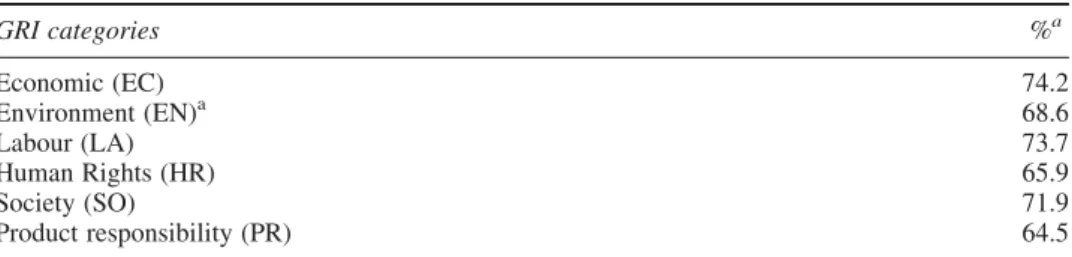
Our overall descriptive statistics (shown inTable 1) illustrates that ‘Labour’ together with ‘Economics’ indicators are the GRI categories with the highest disclosures and ‘Human Rights’ along with ‘Product Responsibility’ indicators are the least disclosed categories. A closer look at the basic statistics (shown inTable 2), confirms that more companies have reported on LA indicators than on HR indicators.
Considering single performance indicators, almost all companies disclose information on workforce indicators such as LA1 and LA13, as well as occupational health and safety (LA7 and LA8) and ‘training and education’ (LA10; see Table 2). In contrast, fewer companies report on minimum notice periods (LA5), equal pay (LA14) and on investment agreements that include human rights clauses (HR1) and incidents of discrimination (HR4).
Starting with the first hypothesis (H1), the regression results (see Table 3) do not support our initial expectation that companies in LMEs are less likely to report on ‘Labour and decent work’ (LA) than on their ‘Environmental’ (EN) indicators. Both LMEs and CMEs had positive significant effects on reporting differences between
environmental-Table 1. Disclosures for GRI categories.
GRI categories %a Economic (EC) 74.2 Environment (EN)a 68.6 Labour (LA) 73.7 Human Rights (HR) 65.9 Society (SO) 71.9 Product responsibility (PR) 64.5
aNote: The percentage number of companies reporting on each category.
related and HRM-related issues. While the coefficient for LMEs is slightly higher (at 0.215) than that of CMEs (at 0.168), the difference is not statistically significant (F¼0.73, p¼0.39). These results are stable under extensive sensitivity analysis including estimation of the models without BRIC and MME controls and with four additional dummies for environmental intensity of individual industries.3In this case, the effects for LMEs and CMEs become slightly larger, which suggests that including the BRIC and MME controls is leading to more conservative estimates and thus avoiding a possible omitted-variable bias. Also all findings remain qualitatively unchanged (i.e. in terms of the magnitude, sign and significance of the estimated coefficients), when the set
Table 2. Core performance indicators of GRI categories ‘Labour’ and ‘Human Rights’. Social performance: labour practices & decent work (%)a
Employment
LA1 Total workforce by employment type, employment contract and region 92 LA2 Total number and rate of employee turnover by age group, gender and region 67 Labour/management relations
LA4 Percentage of employees covered by collective bargaining agreements 67 LA5 Minimum notice period(s) regarding significant operational changes, including
whether it is specified in collective agreements
53 Occupational health and safety
LA7 Rates of injury, occupational diseases, lost days and absenteeism, and number of work-related fatalities by region
83 LA8 Education, training, counselling, prevention and risk-control programs in
place to assist workforce members, their families or community members regarding serious diseases
84
Training and education
LA10 Average hours of training per year per employee by employee category 79 Diversity and equal opportunity
LA13 Composition of governance bodies and breakdown of employees per category according to gender, age group, minority group membership and other indicators of diversity
90
LA14 Ratio of basic salary of men to women by employee category 48 Social performance: human rights (%)a
Investment and procurement practices
HR1 Percentage and total number of significant investment agreements that include human rights clauses or that have undergone human rights screening
59 HR2 Percentage of significant suppliers and contractors that have undergone
screening on human rights and actions taken
70 Non-discrimination
HR4 Total number of incidents of discrimination and actions taken 57 Freedom of association and collective bargaining
HR5 Operations identified in which the right to exercise freedom of association and collective bargaining may be at significant risk, and actions taken to support these rights
69
Child labour
HR6 Operations identified as having significant risk for incidents of child labour, and measures taken to contribute to the elimination of child labour
76 Forced and compulsory labour
HR7 Operations identified as having significant risk for incidents of forced or compulsory labour, and measures to contribute to the elimination of forced or compulsory labour
75
Note: The content of the above-mentioned description of categories is extracted from the GRI website.
a
The percentage number of companies reporting on each information item.
of four indicator variables representing the environmental impacts of individual industries based on the classification by Butz and Plattner (1999) is added to both prior versions, with and without BRIC and MME controls.
We also observe that three control variables, namely size, profitability and the industrial affiliation, had significant effects. For size, the coefficient was significantly negative (at the 5% level), indicating that larger companies tend to report more on their LAs than on their ENs and also that companies from certain industries tend to report more on their ENs relative to their LAs. These significant effects are in line with other research suggesting that the level of social and environmental information disclosed by companies varies with firm size and industrial affiliation (e.g. Gray, Javad, Power, & Sinclair, 2001; Milne & Patten 2002). It is worth noting that the existing literature, unlike our analysis in this paper, does not distinguish between labour-related and environmental-related issues and mostly focuses on environmental issues (Adams,
2004).
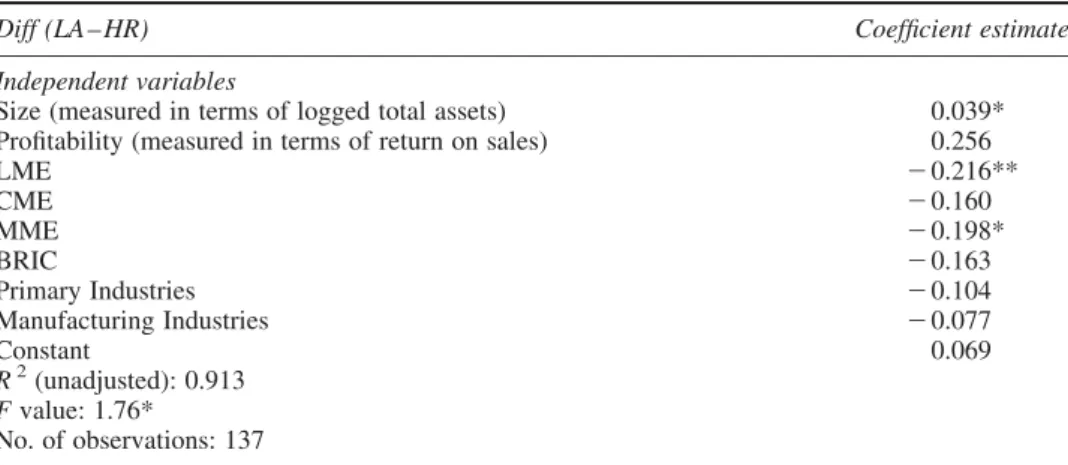
In order to test the second hypothesis, H2, again a regression model is run using the same set of independent variables as for H1. Yet this time, the dependent variable represented the difference between LA and HR indicators. AsTable 4shows, companies attached more importance to reporting on their LA than HR indicators. As we also found no significant group differences between LME and CME firms in terms of their association with the dependent variable (F¼0.87, p¼0.35), the second hypothesis is supported. Again, this result remains qualitatively stable under the sensitivity analyses described earlier. Hence, our overall result suggests that all companies, irrespective of the variety of capitalism they belong to, pay more attention to their internal workforce (LA) than to workers in their supply chains (HR).
The third hypothesis, H3, was tested by regressing the same set of independent variables as used when testing H1 and H2 on each of the nine labour and six human rights indicators (as shown in Table 5) as dependent variables. Out of all the 15 indicators (shown inTable 2), only 5 of the estimated models were significant overall and only these could be used to test H3. Out of these, H3 is supported for LA14, LA2 and HR6 but not for HR2 and LA13 (for more details, see Table 5). As the results
Table 3. OLS Regression Model for Hypothesis H1: In comparison to companies headquartered in CMEs, companies headquartered in LMEs are less likely to report on labour-related indicators (LA) than on environmental indicators (EN).
Diff (EN – LA) Coefficient estimate
Independent variables
Size (measured in terms of logged total assets) 20.039** Profitability (measured in terms of return on sales) 20.087
LME 0.215*** CME 0.168** MME 0.055 BRIC 0.056 Primary industries 0.145** Manufacturing industries 0.125*** Constant 0.071 R2(unadjusted): 0.2613 Fvalue: 7.17*** No. of observations: 137
Note: Significance levels: ***p,0.01, **p,0.05, *p,0.1 (two-tailed tests).
illustrate, the evidence for H3 is thus somewhat mixed, yet there is more support for companies from CMEs being more likely to report on LA and HR indicators than firms from LMEs.
The indicators that did not support H3 mainly relate to the details and diversity of the governing bodies of companies (LA13) and human rights issues in the supply chains (HR2) indicating that companies headquartered in CMEs reported slightly less in
Table 4. OLS Regression Model for Hypothesis H2: Companies are more likely to report on human resource activities related to their internal workforce (LA) than to activities pertinent to employees in the supply chain (HR), regardless of whether the company is headquartered in a CME or LME.
Diff (LA – HR) Coefficient estimate
Independent variables
Size (measured in terms of logged total assets) 0.039* Profitability (measured in terms of return on sales) 0.256
LME 20.216** CME 20.160 MME 20.198* BRIC 20.163 Primary Industries 20.104 Manufacturing Industries 20.077 Constant 0.069 R2(unadjusted): 0.913 Fvalue: 1.76* No. of observations: 137
Note: Significance levels: ***p,0.01, **p,0.05, *p,0.1 (two-tailed tests).
Table 5. Binary Logit Regression Models for Hypothesis H3: Companies headquartered in CME countries are more likely to report on Sustainable HRM-related performance indicators (LA, HR) than companies headquartered in LME countries.
Coefficient estimate
Independent variables LA2 LA13 LA14 HR2 HR6
Size (logged total assets) 0.086 0.448 0.139 20.195 20.304* Profitability (return on sales) 20.517 27.407 22.200 26.111* 2.0936 LME 21.364 20.233 22.261** 0.430 20.942 CME 20.197 21.490 21.561* 20.029 20.012 MME 0.943 20.316 20.351 1.181 0.422 BRIC 0.209 0 observations 0.979 0.062 0.729 Primary Industries 0.670 21.443* 0.180 0.348 0.800 Manufacturing Industries 20.370 20.623 0.411 0.897* 0.845* Constant 0.858 2.049 0.427 1.604 2.50* Pseudo-R2 0.121 0.145 0.141 0.079 0.109 Waldx2test 20.98** 16.77** 19.93*** 13.74* 17.10** Log-likelihood 276.24 237.88 281.422 277.016 266.891 No. of observations 137 129 137 137 135
Test LME vs. CME coefficient (if coefficients significant) Coefficients insignificant Coefficients insignificant x2¼ 2.16, p¼0.14 Coefficients insignificant Coefficients insignificant
Note: Significance levels: ***p,0.01, **p,0.05, *p,0.1 (two-tailed tests); minor deviations in estimation sample size for individual regressions result from missing data on single GRI indicators but were deemed acceptable under the maximum information principle.
comparison to companies from LMEs. This is somewhat surprising given our earlier argument that in most CMEs, employees are, either directly or indirectly, represented in corporate governance structures. There are several reasons why there may be an apparent similarity of reporting practices between CME- and LME-headquartered companies. First, it may be that those companies – from all locations – that chose to disclose their non-financial sustainability credentials are exemplary in their own right: that is, they are self-selecting. A second possibility is that ‘disclosure’ (for a given category) does not necessarily mean compliance with the GRI guidelines (pertinent to that category). Third, it is possible that companies headquartered in CME countries may have been less willing to report on subsidiary operations if the decision to offshore was explicitly motivated by a desire to escape the very constraints that characterise the CMEs’ employment systems. Finally, it is also possible that, due to the internal power dynamics that can exist within MNCs, the assumption that the subsidiary automatically complies with the wishes of the headquarters (e.g. to provide information about suppliers in host countries) is not always guaranteed (Edwards & Kuruvilla,2005).
At the same time, as employees take part in decision-making processes in CME-headquartered companies, more detailed attention may have been paid to human rights issues that are pertinent to their supply chains. In two categories (LA2, employee turnover, and LA14, basic salary of women to men), H3 was supported illustrating, perhaps, that in CME countries, companies reported more on their employees than companies in LME countries. Furthermore, when doing a more omnibus test for H3 by estimating our models with the average number of LA and HR indicators per company (instead of individual indicators), we find qualitatively that the difference between the LME and CME coefficients is as proposed, though not significantly – which further suggests our basic argument may hold.4
Discussion
‘Sustainable HRM’ is an emerging concept that offers broad possibilities for contribution. One way, little considered by HRM scholars, but widely used by scholars in the field of social accounting, is to examine the contents of corporate sustainability reports. Assessing companies’ sustainability reports, benchmarked to the GRI framework, provides a close indicator of how companies are aspiring to the ideal of Sustainable HRM. This study enhances our understanding of the characteristics of those aspiring companies in terms of where they are more likely to be headquartered and which of the attributes of Sustainable HRM are more eagerly reported on than others.
One of the key contributions of this paper is that it links the scholarly work on Sustainable HRM with parallel contributions on sustainability reporting and thus generates new insights for a changing role for HRM in organizations striving for sustainable development. Our overall research findings suggest that, at least in terms of ‘disclosure’, the world’s largest corporations, contrary to expectations, donotreport less on ‘labour and decent work’ than on ‘environmental’ indicators as a result of the perceived higher visibility of such environmental issues to consumer opinion in the developed world (Eccles & Serafeim, 2013). Therefore our results do not support the notion that organisations focus their attention in sustainability activities on ‘green matters’ while neglecting ‘people matters’. However, the data do indicate that the world’s largest
corporations are more concerned with the internal dimensions of Sustainable HRM
compared to theexternalones. In other words, they are significantly more likely to report
on their ‘labour and decent work’ indicators which mainly refer to HRM issues affecting their core workforce in developed countries compared to their ‘human rights’ indicators which mainly relate to workforces in the supply chains and frequently in developing countries.
A second contribution of this article has been that of exploring international differences in Sustainable HRM which had so far been neglected. Here, the corporate governance structures of those companies headquartered in CME countries were expected to be more subject to internal stakeholder scrutiny (e.g. unions, works councils, co-determination arrangements) than their LME counterparts (exclusive focus on shareholder value) and, thus, be more likely to disclose on all labour and human rights categories. Surprisingly, international differences and in particular those between MNCs from LMEs and CMEs are less pronounced than expected. It is not clear what the reasons may be for this convergence, but there are three possibilities. First, it may be that the national-regulatory influences on sustainable practices are offset by counter-national influences on the uptake of voluntary codes like the GRI (i.e. that while the GRI may be more suitable to the ‘stakeholder’ approaches to corporate governance associated with CME countries, the GRI system itself has its origins in LME corporate governance environments), a finding not dissimilar to that of Ho¨llerer (2013). A second possibility is that the variation in the internal dynamics within MNCs – as defined by typologies of global value chains (Gereffi,
2014) – offset the influence of national-level issues, even though the sustainability reports have to, by definition, be published according to the norms and standards expected in the country of origin. A third possibility is that there may be more to uncover beneath what is being examined. The analysis in this article is not intended as a measurement of Sustainable HRM practices per se – this would necessarily involve case-study work to examine actual practices – but of what companies are willing to disclose about their practices.
The third key contribution of our paper sheds new light on the internal/external dimensions of the HRM role. Historically, the HRM role has always focused on internal employment issues. With the expanded goal setting implied in Sustainable HRM, however, this exclusive internal focus would be seen as anachronistic as the fragmentation of the traditional employment model of the firm – direct employment – is supplanted by employment models using a myriad form of indirect, contract-based and often insecure work both within the firm and throughout the global value chains (Gereffi, 2014). Sustainable HRM would suggest a holistic approach on employment beyond the traditional boundaries of the firm extending also the role of HRM (Ehnert,2009b; Ehnert et al.,2014b; Mariappanadar,2003). Evidence from our study indicates that this aspect of Sustainable HRM is not occurring and future research might be aiming at, for example, greater attention to labour-related human rights categories affecting workers in the supply chains.
Scope and limitations
While this paper provides an examination of information reported on Sustainable HRM, there are some limitations. As we note at the outset, Sustainable HRM is a relatively recent area of research and much future research needs to be done to examine the concept. For example, there are no unanimously agreed indicators to measure its prevalence. While the academic debate on measuring Sustainable HRM has started only recently (e.g. Guerci & Pedrini,2014; Mariappanadar,2012,2013; Osranek & Zink,
2014) and while a consensus for what practices may constitute a definitive checklist of Sustainable HRM practices is currently not available, there are a number of core
attributes and concepts that overlap significantly with those associated with sustainability reporting. Hence, our use of the GRI reporting guidelines which allowed us to shed light on the attention companies pay to Sustainable HRM is an additional contribution to this debate.
A second limitation emanates from the home-country influence of MNCs. Whilst alternative forms of analysis to the national-level home-country influence were always going to be relevant to a study of MNCs – particularly that associated with global value chain analysis (Hobelsberger,2014; Neilson, Pritchard, & Yeung,2014) – the approach taken was specifically about identifying the influence of corporate governance mechanisms as defined by national-regulatory environments of the country-of-origin as the basis for analysis. The fact that our study has failed to identify significant home-country affect surely indicates the greater significance of transnational dynamics occurring not just between global value chains, but within them (Gereffi, 2014). However, the analysis of a relatively small sample of reports using a commonly acceptable set of reporting guidelines to approximate a more complex array of variables to capture the typologies used in such an approach would have proven impossible. It would certainly warrant future attention.
Third, our use of the two main categories of LMEs and CMEs coupled with the small size of our sample prevented us from having a closer look at the international differences for broad groups of countries. As a result, we neglected the differences between individual countries such as the UK and the USA or Japan and Germany in their approach to Sustainable HRM. Also, there could be considerable differences between countries that are clustered as CMEs (as pointed out in the literature). For example, the practice of sustainability reporting among Japanese companies is observed to be distinct from companies in other developed countries (Fukukawa & Teramoto,2009).
Implications for research and practice
Although this paper has revealed that organisations and scholars are becoming increasingly more interested in ‘Sustainable HRM’, further research is needed to shape this concept and develop clear research-guided practical implications. In particular, we highlight three main areas that we believe to provide interesting yet essential pathways to expand the existing research on Sustainable HRM.
The first area deals with our surprising finding of little or no international differences in Sustainable HRM practices even when comparing the relative effects of varying employment regimes on LA categories to those of the more internationally consistent environmental regulations on EN categories. We do not have an explanation to this beyond asserting that the VoC typologies do not, maybe, explain as much in the area of sustainability reporting as might be expected. However, the comparative HRM literature often argues that international cultural and institutional differences should result in different HRM practices (Brewster,2007). In this regard, most large continental European employers closely work together with trade unions. In contrast, many US firms follow a non-union strategy, which is contrary to the GRI performance indicators that prescribe a collectivist approach. Depending on the importance MNCs attach to the reporting standards, the GRI could have a coercive effect and may not only diminish international differences between MNCs, but also differences between performance indicators. Assuming that reporting has at least some impact on practice, this may mean that MNCs from LMEs may adopt a less hostile approach towards trade unions at local levels even if not at the level of host country. This is possible, but not likely. However, to further
understand whether there are differences in understanding Sustainable HRM across different countries or cultures, we suggest that combining quantitative and qualitative research methods will be beneficial for interpreting data. For example, in addition to the quantitative analysis of disclosure, as done here, we recommend a more detailed and textual analysis of the full reports to supplement this analysis. We also suggest that panel data could be useful for looking at developments of reporting over time because we assume that industry competitive effects could play a role in companies’ reporting behaviour.
The second area refers to the problem of ‘window dressing’ or of reported versus actual and perceived HRM practices and long-term effects of Sustainable HRM practices. As discussed earlier, our sample differs significantly from the remaining firms in the population of Forbes 250 in terms of their corporate characteristics (size, profitability, market value and reputation). While this is not a weakness per se (as the focus is specifically on those companies that do adopt the GRI), contrasting future studies could concentrate on examining companies that donotadopt the GRI guidelines in order to compare.
The third area for future research on Sustainable HRM refers to potential challenges for the role of HRM. Sustainability reporting increases the need for HRM departments to become active in sustainability management (Bhattacharya, Sen, & Korschun, 2008; Cohen et al.,2012; Ehnert,2009b). Missing this ‘sustainability paradigm shift’ (Boudreau & Ramstad,2005, p. 129) could have disadvantageous effects on both HR professionals’ legitimacy and the pursuit of corporate sustainability goals. Thus the HRM function needs to redefine and extend its scope (see also Kramar,2014). First of all, HRM could increase its strategic importance if it would actively contribute to the managing and measuring of corporate social and ecological impacts. This could, for example, imply the redesigning of HRM practices such as performance review, whereby explicit reference to sustainability criteria could be used. While there is a long tradition in standardising HRM practices with an MNC on a global basis, a new field of activity for the HRM function could be to influence employment practices in the supply chains (Fisher, Graham, Vachon, & Vereecke, 2010). We suggest that future Sustainable HRM research could explore how HRM and sustainability departments respond to the challenges of having to act ‘in concert’ on managing people in organisations and how this impacts the performance of HRM roles. A practical implication of this is the question of how to integrate the role of coordinating the external aspects of Sustainable HRM with the conventional internal activities. We have no obvious practical solution because it is beyond the scope of this article to be able to identify the process of report writing and, in particular, the role that human resource practitioners may have had, as experts, in this process – as recommended by, for example, Cohen et al. (2012). However, while it remains true that the human resource function inside the MNC is likely to have theexpertiseto deal with supply chain labour practices, does it have themotivationor theauthorityto exercise this expertise? For any credible claim to Sustainable HRM, the integration of the MNC’s HRM managers, into supply chain employment issues, would seem to be essential.
Disclosure statement
No potential conflict of interest was reported by the authors.
Notes
1. Our sample includes: 29% of the companies from LME countries, 40% from CME countries (of which 12% are Japanese), 15% from MME countries and 10% from BRIC.
2. Company distribution for each sector is as follows: primary (10%), services (49%) and manufacturing (41%).
3. To address a possible ‘dirtier’ industries effect, we use the environmental impact classification of Butz and Plattner (1999) for different industries and generate four additional variables corresponding to an impact much below, somewhat below, much above and somewhat above the average impact across all industries. These variables are included in addition to the primary/ manufacturing dummies and the results of the sensitivity analysis are available upon request. 4. The results of this sensitivity analysis are available upon request.
References
Adams, C. A. (2004). The ethical, social and environmental reporting-performance portrayal gap. Accounting, Auditing and Accountability Journal, 17, 731 – 757. doi:10.1108/ 09513570410567791
Almond, P., Edwards, T., Colling, T., Ferner, A., Gunnigle, P., Mu¨ller-Camen, M.,. . .Wa¨chter, H. (2005). Unravelling home and host country effects: An investigation of the HR policies of an American multinational in four european countries.Industrial Relations,44, 276 – 306. Amable, B. (2003).The diversity of modern capitalism. Oxford: Oxford University Press. Bansal, P. (2005). Evolving sustainably: A longitudinal study of corporate sustainable development.
Strategic Management Journal,26, 197 – 218. doi:10.1002/smj.441
Bhattacharya, C. B., Sen, S., & Korschun, D. (2008). Using corporate social responsibility to win the war for talent.MIT Sloan Management Review,49, 37 – 44.
Boudreau, J. W., & Ramstad, P. M. (2005). Talentship, talent segmentation, and sustainability: A new HR decision science paradigm for a new strategy definition. Human Resource Management,44, 129 – 136. doi:10.1002/hrm.20054
Brewster, C. (2007). Comparative HRM: European views and perspectives.International Journal of Human Resource Management,18, 769 – 787. doi:10.1080/09585190701248182
Brown, H. S., de Jong, M., & Lessidrenska, T. (2009). The rise of the Global Reporting Initiative: A case of institutional entrepreneurship. Environmental Politics, 18, 182 – 200. doi:10.1080/ 09644010802682551
Butz, C., & Plattner, A. (1999).Nachhaltige aktienanlagen: Eine analyse der rendite in abha¨ngigkeit von umwelt- und sozialkriterien[Sustainable investment: An analysis of returns depending on environmental and social criteria]. Basel: Sarasin Sustainable Investment.
Chan, A. (2005). China says no to developed countries corporate social responsibility.International Union Rights,12, 18 – 19.
Chan, A. (2010). Corporate accountability and the potential for workers’ representation in China. In K. MacDonald & S. Marshall (Eds.), Fair trade, corporate accountability and beyond (pp. 259 – 276). Aldershot, UK: Ashgate.
Chen, M., & Chan, A. (2010). Occupational health and safety in China: The case of state-managed enterprises.International Journal of Health Services,40, 43 – 60. doi:10.2190/HS.40.1.c
Cho, C. H., Roberts, R. W., & Patten, D. M. (2010). The language of US corporate environmental disclosure.Accounting, Organizations and Society,35, 431 – 443. doi:10.1016/j.aos.2009.10.002
Cohen, E., Taylor, S., & Muller-Camen, M. (2012). HRM’s role in corporate social and environmental sustainability. Research Report, SHRM.
Docherty, P., Kira, M., & Shani, A. B. (2009).Creating sustainable work systems: Developing social sustainability. Abingdon: Routledge.
Eccles, R. G., & Serafeim, G. (2013). The performance frontier: Innovating for a sustainable strategy.Harvard Business Review,91, 50 – 60.
Edwards, T., & Kuruvilla, S. (2005). International HRM: National business systems, organizational politics and the international division of labour in MNCs.The International Journal of Human Resource Management,16, 1 – 21. doi:10.1080/0958519042000295920
Egri, C. P., & Hornal, R. C. (2002). Strategic environmental human resource management and perceived organizational performance: An exploratory study of the Canadian manufacturing sector. In S. Sharma & M. Starik (Eds.),Research in corporate sustainability: The evolving theory and practice of organizations in the natural environment(pp. 205 – 236). Northampton, MA: Edward Elgar Publishing.
Ehnert, I. (2009a). Sustainability and human resource management: Reasoning and applications on corporate websites.European Journal of International Management,3, 419 – 438. doi:10.1504/ EJIM.2009.028848
Ehnert, I. (2009b).Sustainable human resource management: A conceptual and exploratory analysis from a paradox perspective (contributions to management science). Heidelberg: Springer. Ehnert, I., & Harry, W. (2012). Recent developments and future prospects on sustainable human
resource management: Introduction to the special issue.Management Revue,23, 221 – 238. Ehnert, I., Harry, W., & Brewster, C. (2014a). Sustainable HRM in Europe: Diverse contexts and
multiple bottom lines. In I. Ehnert, W. Harry, & K. J. Zink (Eds.),Sustainability and human resource management: Developing sustainable business organizations(pp. 339–357). Heidelberg: Springer. Ehnert, I., Harry, W., & Zink, K. J. (2014b). Sustainability and HRM: An introduction to the field. In I. Ehnert, W. Harry, & K. J. Zink (Eds.),Sustainability and human resource management: Developing sustainable business organizations(pp. 3 – 32). Heidelberg: Springer.
Fisher, S. L., Graham, M. E., Vachon, S., & Vereecke, A. (2010). Guest editors’ note: Don’t miss the boat: Research on HRM and supply chains. Human Resource Management, 49, 813 – 828. doi:10.1002/hrm.20386
Fukukawa, K., & Teramoto, Y. (2009). Understanding Japanese CSR: The reflections of managers in the field of Global operations.Journal of Business Ethics,85, 133 – 146. doi: 10.1007/s10551-008-9933-7
Gereffi, G. (2014). Global value chains in a post-Washington consensus world. Review of International Political Economy,21, 9 – 37. doi:10.1080/09692290.2012.756414
Gladwin, T. N., Kennelly, J. J., & Krause, T. S. (1995). Shifting paradigms for sustainable development: Implications for management theory and research. Academy of Management Journal,20, 874 – 907.
Gray, R., Javad, M., Power, D., & Sinclair, D. (2001). Social and environmental disclosure and corporate characteristics: A research note and extension. Journal of Business Finance and Accounting,28, 327 – 356. doi:10.1111/1468-5957.00376
Gray, R., Kouhy, R., & Lavers, S. (1995). Constructing a research database of social and environmental reporting by UK companies.Accounting, Auditing & Accountability Journal,8, 78 – 101. doi:10.1108/09513579510086812
Gray, R., Owen, D., & Adams, C. (1996).Accounting and accountability: Changes and challenges in corporate, social and environmental reporting. London: Prentice Hall.
GRI. (2011). Indicators protocol set LA. Retrieved from http://www.globalreporting.org/NR/ rdonlyres/B52921DA-D802-406B-B067-4EA11CFED835/3880/G3_IP_Labor_Practices_ Decent_Work.pdf
GRI. (2014). About GRI. Retrieved from https://www.globalreporting.org/information/about-gri/ Pages/default.aspx
Guerci, M. (2011). La gestione delle risorse umane per la sostenibilita’ dell’impresa [The management of human resources through corporate sustainability]. Franco Angnelli.
Guerci, M., & Pedrini, M. (2014). The consensus between Italian HR and sustainability managers on HR management for sustainability-driven change – towards a ‘strong’ HR management system. The International Journal of Human Resource Management, 25, 1787 – 1814. doi:10.1080/ 09585192.2013.860388
Guerci, M., Shani, A., & Solari, L. (2014). A stakeholder perspective for Sustainable HRM’. In I. Ehnert, W. Harry, & K. J. Zink (Eds.),Sustainability and human resource management. Developing sustainable business organisations(pp. 205 – 224). Heidelberg: Springer.
Hahn, R., & Ku¨hnen, M. (2013). Determinants of sustainability reporting: A review of results, trends, theory, and opportunities in an expanding field of research. Journal of Cleaner Production,59, 5 – 21. doi:10.1016/j.jclepro.2013.07.005
Hahn, R., & Lu¨lfs, R. (2014). Legitimizing negative aspects in GRI-oriented sustainability reporting: A qualitative analysis of corporate disclosure strategies.Journal of Business Ethics,123, 401 – 420.doi:10.1007/s10551-013-1801-4
Hahn, T., & Figge, F. (2011). Beyond the bounded instrumentality in current corporate sustainability research: Toward an inclusive notion of profitability.Journal of Business Ethics,104, 325 – 345. doi:10.1007/s10551-011-0911-0
Hall, P. A., & Gingerich, D. W. (2009). Varieties of capitalism and institutional complementarities in the political economy: An empirical analysis.British Journal of Political Science,39, 449 – 482. doi:10.1017/S0007123409000672
Hall, P. A., & Soskice, D. (2001). Varieties of capitalism: The institutional foundations of comparative advantage. Oxford: Oxford University Press.
Hall, R., & Wailles, N. (2010). International and comparative human resource management. In A. Wilkinson, T. Redman, N. Bacon, & S. Snell (Eds.),The sage handbook of human resource management(pp. 115 – 132). London: Sage.
Harcourt, M., Wood, G., & Roper, I. (2007). The importance of legislated employment protection for worker commitment in coordinated market economies.Journal of Economic Issues,41, 961 – 980. Hassel, A. (2008). The evolution of a global labor governance regime.Governance,21, 231 – 251.
doi:10.1111/j.1468-0491.2008.00397.x
Hobelsberger, C. (2014). Sustainability and HRM in international supply chains. In I. Ehnert, W. Harry, & K. J. Zink (Eds.),Sustainability and human resource management. Developing sustainable business organisations(pp. 379 – 400). Heidelberg: Springer.
Hofmann, H., Busse, C., Bode, C., & Henke, M. (2014). Sustainability-related supply chain risks: Conceptualization and management. Business Strategy and the Environment, 23, 160 – 172. doi:10.1002/bse.1778
Ho¨llerer, M. (2013). From taken-for-granted to explicit commitment: The rise of CSR in a corporatist country.Journal of Management Studies,50, 573 – 606. doi:10.1111/joms.12029
Jabbour, C. J. C, & Santos, F. C. A (2008). The central role of human resource management in the search for sustainable organizations. The International Journal of Human Resource Management,19, 2133 – 2154. doi:10.1080/09585190802479389
Jackson, S. E., Renwick, D. W. S., Jabbour, C. J. C., & Muller-Camen, M. (2011). State-of-the-art and future directions for green human resource management: Introduction into the special issue. Zeitschrift fu¨r Personalforschung,25, 99 – 116.
Kolk, A., & Perego, P. (2010). Determinants of the adoption of sustainability assurance statements: An international investigation.Business Strategy and the Environment,19, 182 – 198. KPMG. (2011).KPMG international survey of corporate responsibility reporting. London: KPMG. KPMG. (2013).The KPMG survey of corporate responsibility reporting 2013. Amsterdam: KPMG
International Cooperatives.
Kramar, R. (2014). Beyond strategic human resource management: Is sustainable human resource management the next approach?The International Journal of Human Resource Management, 25, 1069 – 1089. doi:10.1080/09585192.2013.816863
Manetti, G., & Becatti, L. (2009). Assurance services for sustainability reports: Standards and empirical evidence.Journal of Business Ethics,87, 289 – 298. doi:10.1007/s10551-008-9809-x
Mariappanadar, S. (2003). Sustainable human resource strategy: The sustainable and unsustainable dilemmas of retrenchment. International Journal of Social Economics, 30, 906 – 923. doi:10.1108/03068290310483779
Mariappanadar, S. (2012). Harm of efficiency oriented HRM practices on stakeholders: An ethical issue for sustainability.Society and Business Review,7, 168–184. doi:10.1108/17465681211237628
Mariappanadar, S. (2013). A conceptual framework for cost measures of harm of HRM practices. Asia-Pacific Journal of Business Administration,5, 103 – 114. doi:10.1108/17574321311321595
Milne, M. J., & Patten, D. M. (2002). Securing organizational legitimacy: An experimental decision case examining the impact of environmental disclosures. Accounting, Auditing and Accountability Journal,15, 372 – 405. doi:10.1108/09513570210435889
Neilson, J., Pritchard, B., & Yeung, H. W. (2014). Global value chains and global production networks in the changing international political economy.Review of International Political Economy,21, 1 – 8.
Osland, J., Drake, B., & Feldman, H. (1999). The stewardship of natural and human resources. In C. Dempsey & R. Butkus (Eds.),All creation is groaning(pp. 168 – 192). Minneapolis, MN: Liturgical Press.
Osranek, R., & Zink, K. J. (2014). Corporate human capital and social sustainability of human resources: Towards an integrative measurement framework. In I. Ehnert, W. Harry, & K. J. Zink (Eds.), Sustainability and human resource management. Developing sustainable business organisations(pp. 105 – 126). Heidelberg: Springer.
Owusu-Ansah, S. (1998). The impact of corporate attributes on the extent of mandatory disclosure and reporting by listed companies in Zimbabwe.The International Journal of Accounting,33, 605 – 631. doi:10.1016/S0020-7063(98)90015-2
Park-Poaps, H., & Rees, K. (2010). Stakeholder forces of socially responsible supply chain management orientation.Journal of Business Ethics,92, 305–322. doi:10.1007/s10551-009-0156-3