Cranfield University
Debarpita Bardhan Correia
An examination of the relationship
between frontline employees’ perceptions
of people management practices and their
prosocial service behaviours
A case study of an employee-owned organization
School of Management
PhD Thesis
Supervisor: Professor Clare Kelliher
Academic year 2014-2015
© Cranfield University 2015. All rights reserved. No part of this publication may be reproduced without the written permission of the copyright holder.
i
Abstract
With a growing body of literature examining HR systems’ influence on organizational performance outcomes, there has been a plea for research that examines the underlying mechanisms that facilitate this in a service setting. This study adopts the notion of people management which incorporates the management of HR implementation and line managers’ leadership behaviour in its investigation of how HR affects performance. This study, by examining how frontline employees’ perception of people management practices affects individual level prosocial service behaviours, and by using a qualitative approach in data collection and analysis, offers an explanation of the underlying mechanisms in the causal chain. Furthermore, the setting of this research in an employee-owned organization affords a context-rich account of how HR systems affect individual level performance in a service setting. Thirty one semi-structured interviews were conducted, of which twenty three were conducted with frontline employees to elicit how their experiences of people management practices affected their display of prosocial service behaviours. Eight semi-structured interviews were arranged with frontline managers to offer an alternate perspective to data gathered from the employees.
The research identifies bundles of practices, comprising both “employment” and “work practices” as instrumental in employees’ display of prosocial service behaviours. The results confirm the AMO framework as being a suitable explanation of mediating mechanisms in the HR-performance chain, whilst not only confirming the presence of a few existing intervening influences but also identifying novel factors not previously studied within the HR-performance discussion. It also demonstrates that adopting multiple theoretical perspectives in investigating HR-performance relationships offers a more comprehensive picture.
Finally, the research confirms the role of the line manager as a protagonist within the HR-performance discussion whilst also demonstrating the significance of co-workers. The ownership context emerges as important in this enquiry – specifically work atmosphere and relationships – in influencing employees’ service behaviour.
ii
ABBREVIATIONS
ABC – Approach Build Close
AMO – Ability, Motivation, Opportunity EO – Employee ownership
FLE – Frontline employee FLM – Frontline manager
HCWPs/HCWSs – High-commitment work practices/systems HIWPs – High-involvement work systems
HPWPs – High-performance work practices HPWSs – High-performance work systems HR – Human Resource
HRM – Human Resource Management JLP – John Lewis Partnership
LM – Line manager
OBSE – Organization-based self-esteem OC – Organizational commitment
OCB – Organizational Citizenship Behaviour PDP – Partner development programme POS – Perceived Organizational Support PSSB(s) – Prosocial Service Behaviour(s) RBV – Resource based view
iii
Contents
1. INTRODUCTION ... 2
1.1 The background to the research ... 2
1.2 The academic background ... 5
1.3 The research gap and research questions ... 10
1.4 Plan of the thesis ... 12
2 LITERATURE REVIEW ... 14
2.1 Literature Review on HR and performance ... 15
2.1.1 Human Resource Management and Performance ... 16
2.1.1.1 Differing perspectives in Strategic HRM ... 17
2.1.1.2 Human resource practices ... 22
2.1.1.3 HRM and the LM ... 26
2.1.2 Understanding performance ... 30
2.1.2.1 Employee outcomes of performance ... 31
2.1.3 Existing theories on associations between HR and performance ... 34
2.1.3.1 The black box discussion ... 34
2.1.3.2 Theoretical perspectives on how HR affects performance ... 35
2.1.3.3 Empirical studies on how HR affects performance ... 41
2.1.4 Concerns in the HR-performance research ... 46
2.1.5 Summary of the HR-performance discussion ... 52
2.1.6 Developing the research question ... 53
2.2 Literature review on HR-performance in services ... 54
2.2.1 Introduction to services... 54
2.2.2 HRM and service ... 55
2.2.2.1 Studies on service climate ... 58
2.2.2.2 HR and Performance research in service setting ... 59
2.2.2.3 A focus on employee service behaviours... 64
iv
2.2.4 Refining the research question ... 68
2.3 The research question ... 69
2.4 Conclusion ... 70
3 METHODOLOGY ... 71
3.1 Philosophical approach ... 71
3.1.1 Beliefs ... 73
3.1.2 Critical realism as an option ... 74
3.1.3 Philosophical viewpoints in the field of Human Resource Management and Performance ... 82
3.2 Research designs for a critical realist approach... 84
3.2.1 The rationale for a single case study ... 87
3.3 Fieldwork ... 89
3.3.1 Semi-structured interviews ... 90
3.3.2 Documents ... 93
3.3.3 Physical artefacts ... 93
3.3.4 Exploratory study ... 94
3.3.4.1 Exploratory study findings ... 96
3.3.5 Main data collection ... 98
3.3.5.1 Reflexivity... 102
3.4 Data analysis ... 102
3.4.1 Developing the template ... 103
3.4.2 Quality in case studies ... 105
3.4.3 Quality in interviews ... 106
3.5 Conclusion ... 107
4 THE RESEARCH CONTEXT ... 109
4.1 The case study site in its context: John Lewis Partnership ... 110
4.2 The context of employee ownership ... 113
4.2.1 Employee ownership and performance ... 113
v
4.2.2 Summary of the Employee ownership literature ... 120
4.3 John Lewis (Milton Keynes) – the store setting ... 121
4.3.2 Understanding the role of participants for this study ... 122
4.3.3 Conclusion ... 122
5 FINDINGS: PEOPLE MANAGEMENT PRACTICES THAT ENABLE THE DELIVERY OF PSSBS – THE SELLING PARTNERS’ PERSPECTIVE ... 124
5.1 Customer service conceptualised ... 125
5.1.1 Conceptualisation of going the extra mile ... 127
5.2 Drivers of PSSBs ... 128
5.3 Perceptions of people management practices and enactment issues ... 129
5.3.1 Training and development ... 130
5.3.1.1 Content-related ... 130
5.3.1.2 Process of how training happens ... 131
5.3.1.3 Role of other Partners... 132
5.3.1.4 Other influences ... 133
5.3.1.5 Outcomes of training ... 134
5.3.2 Performance management ... 137
5.3.2.1 Content-related – on what is measured ... 137
5.3.2.2 Process of how performance is managed ... 141
5.3.2.3 Outcomes of performance ... 144
5.3.3 Job autonomy (work practice) ... 148
5.3.3.1 Allowed to make decisions ... 148
5.3.3.2 Process aspects – enactment of the actual work practice ... 150
5.3.3.3 Outcomes of job autonomy ... 155
5.3.4 Communication ... 158
5.3.4.1 Content of communication ... 158
5.3.4.2 The manager’s role in organizational communication ... 161
5.3.4.3 Outcomes of being kept informed ... 161
5.3.5 Employee voice ... 164
5.3.5.1 Having a say ... 165
5.3.5.2 Participating in decision-making ... 168
5.3.5.3 Outcomes of employee voice ... 170
vi
5.3.6.1 Recognition at an organisational level ... 174
5.3.6.2 The role of the LM ... 174
5.3.6.3 Role of other Partners... 177
5.3.6.4 Outcomes of non-financial recognition ... 178
5.3.7 Financial rewards and benefits ... 181
5.3.7.1 Financialand leisure benefits ... 184
5.3.7.2 Outcomes of financial rewards and benefits ... 185
5.4 LM’s management and leadership style ... 187
5.4.1 The many facets of support ... 188
5.4.2 Leading by example ... 190
5.4.3 Nice treatment of Partners ... 191
5.5 Employee welfare ... 192
5.6 The Ownership context ... 194
5.6.1 The role of the Partnership ... 196
5.6.1.1 The work environment ... 197
5.6.1.2 Outcomes of the work environment ... 200
5.6.2 The role of the Partner ... 203
5.6.3 The Partnership influence on PSSBs ... 208
5.7 Conclusion ... 211
6 FINDINGS: PEOPLE MANAGEMENT PRACTICES THAT ENABLE THE DELIVERY OF PSSBS – THE SECTION MANAGERS’ PERSPECTIVE ... 212
6.1 Expectations of customer service ... 213
6.2 Perceptions of people management practices and PSSBs – the section managers’ perspective 213 6.2.1 Training and development ... 216
6.2.2 Managing performance ... 218
6.2.3 Job autonomy ... 220
6.2.4 Communication ... 222
6.2.5 Employee voice ... 223
6.2.6 Non-financial recognition ... 224
6.2.7 Financial Rewards and benefits ... 226
vii
6.3 The Partnership and PSSBs – the section managers’ view ... 227
6.3.1.1 The work environment ... 230
6.4 Comparing Partner and manager accounts of people management practices ... 231
6.5 Conclusion ... 234
7 ANALYSIS AND DISCUSSION ... 236
7.1 Analysis: Perception of people management practices and how they affect PSSBs ... 237
7.1.1 The HR system focused on frontline selling Partners engaging in PSSBs ... 237
7.1.2 Identifying patterns within the practices in how their perceptions translate into behaviours 239 7.1.2.1 Common routes to PSSBs... 247
7.2 Theoretical Discussion: Perception of people management practices and how they affect PSSBs 249 7.2.1 The HR practices influencing PSSBs ... 249
7.2.2 Bundles of practices ... 252
7.2.3 Unravelling the linking mechanisms from a theoretical perspective ... 258
7.2.3.1 Individual human capital ... 259
7.2.3.2 Perceived organizational support (POS) ... 260
7.2.3.3 Psychological empowerment ... 262
7.2.3.4 Perceptions of fairness ... 264
7.2.3.5 Organization–based self- esteem (OBSE) ... 266
7.2.3.6 Job-related affect ... 268
7.2.3.7 Job satisfaction ... 269
7.3 Analysis: The organizational actors in people management ... 269
7.3.1 The role of the LM in implementing people management practices ... 269
7.3.2 The role of other Partners ... 271
7.4 Theoretical Discussion: The organizational actors in people management ... 272
7.5 Analysis: The employee ownership context ... 273
7.5.1 Perception of the ownership context ... 276
viii
7.7 Closing discussion: Developing a schematic representation of how perceptions translate into
behaviours ... 288
7.8 Conclusion ... 292
8 CONCLUSION ... 294
8.1 The research background ... 295
8.2 Contribution ... 297
8.2.1 Contribution to knowledge – theoretical ... 297
8.2.1.1 Primary contributions ... 298
8.2.1.2 Secondary contributions ... 303
8.2.2 Contribution to knowledge – empirical ... 305
8.3 Implications for practice ... 307
8.4 Limitations ... 310 8.5 Future research ... 312 8.6 Personal reflection... 313 9 REFERENCES ... 316 APPENDIX 1 ... 350 APPENDIX 2 ... 355 APPENDIX 3 ... 363 APPENDIX 4 ... 366 APPENDIX 5 ... 367 APPENDIX 6 ... 369
ix APPENDIX 7 ... 371 APPENDIX 8 ... 374 APPENDIX 9 ... 377 APPENDIX 10 ... 380 APPENDIX 11 ... 382 APPENDIX 12 ... 387 APPENDIX 13 ... 389 APPENDIX 14 ... 391
x
List of tables
Table 1: Different types of bundles used in the HR-performance studies... 21
Table 2: Mediators in the black box (adapted from Jiang, Takeuchi, and Lepak, 2013) 43 Table 3: HR-performance in service settings incorporating specific service outcomes . 62 Table 4 : Opposing research philosophies in management research (Saunders, Lewis and Thornhill, 2012, p. 119) ... 73
Table 5: Adapted from Reed (2005, pp. 430-448) ... 75
Table 6: Adapted from Domains of reality (Blaikie, 2007, p.147) ... 76
Table 7: Sources of evidence in case study research and their strengths and weaknesses (Adapted from Yin, 2008 cited in Gray, 2014) ... 90
Table 8: Seven stages of interviewing (Adapted from Kvale (2013) and applied to the current study) ... 92
Table 9: Interviewee pseudonyms and demographics ... 95
Table 10: Sample question with probes to explore mechanisms (laddered approach) ... 97
Table 11: Sample from departments ... 100
Table 12: Coding Structure ... 104
Table 13: How I will present the data to reflect different levels of intensity of the findings ... 107
Table 14: The John Lewis Partnership's principles, The Constitution (John Lewis Partnership, 2012, pp. 7-8) ... 111
Table 15: Practices that make it a Partnership ... 196
Table 16: The job cluster ... 242
xi
List of Figures
Figure 1: People -performance causal chain (Purcell and Hutchinson, 2007) ... 3
Figure 2: My research study ... 10
Figure 3: The content of HRM bundles (Subramony 2009, p. 746) ... 21
Figure 4: Levels of HR practice (Brewster, Golan and Wright, 2013, p. 831) ... 23
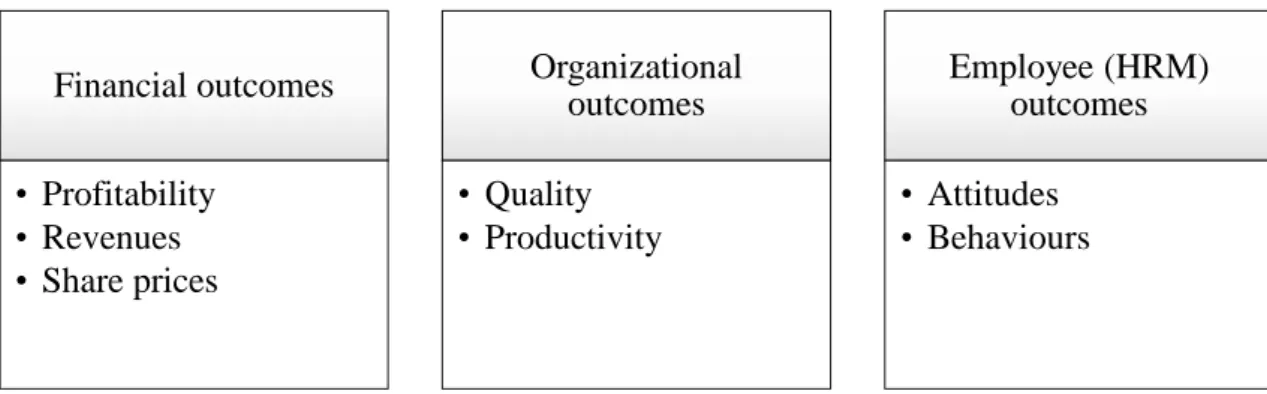
Figure 5: Performance outcomes ... 30
Figure 6: A model of the HR–shareholder value relationship (Becker et al., 1997, p. 40) ... 36
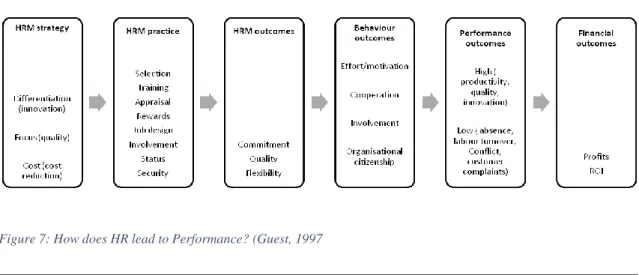
Figure 7: How does HR lead to Performance? (Guest, 1997 ... 36
Figure 8: The HR-performance link (Appelbaum et al., 2000) ... 37
Figure 9: The Bath People-Performance model (Purcell et al., 2003) ... 39
Figure 10: Purcell and Hutchinson (2007) People Management - performance causal chain ... 40
Figure 11: How does HR affect organizational outcomes (Paauwe, 2009)... 41
Figure 12: Representation of realist explanation (Robson, 2011, p. 33) ... 77
Figure 13: Applying critical realism to this study ... 78
Figure 14: Applying the realist explanation to this research study (adapted from Robson, 2011, p. 33) ... 80
Figure 15: Stages in explanatory research in critical research (Danemark et al., 2002) 81 Figure 16: Comparison of methodological journey (my study vs. extant research) ... 84
Figure 17: Types of case study designs (Yin, 2008, p. 46) ... 89
Figure 18: Research design used for this research ... 94
Figure 19: Sample selection criteria ... 99
Figure 20: Employee ownership and employee attitudes (adapted from McCarthy, Reeves and Turner (2010) ... 117
Figure 21: Purpose of selling Partner and section manager roles (Wolfe, 2013) ... 122
Figure 22: Sample going the EM incidents based on themes ... 127
Figure 23: Factors affecting PSSBs ... 128
Figure 24: People management practices associated with Partners engaging in PSSBs ... 129
xii
Figure 25: Inside the People-performance black box (Training) ... 136
Figure 26: Inside the People-performance black box (Performance management) ... 147
Figure 27: Inside the People-performance black box (Job autonomy) ... 157
Figure 28: Inside the People-performance black box (Communication) ... 163
Figure 29: Inside the People-performance black box (Employee voice) ... 173
Figure 30: Inside the People-performance black box (Non-financial recognition) ... 180
Figure 31: Inside the People-performance black box (Financial rewards) ... 186
Figure 32: Inside the People-performance black box (LM’s management/leadership) 192 Figure 33: Inside the People-performance black box (Registry/employee welfare) .... 194
Figure 34: How the work environment affects PSSBs ... 202
Figure 35: Outcomes of being a Partner ... 206
Figure 36: Partnership context and PSSBs ... 208
Figure 37: Factors affecting PSSBs ... 214
Figure 38: People management practices associated with Partners engaging in PSSBs ... 215
Figure 39: Comparing Partner and manager account of people practices ... 232
Figure 40: Bundles of practices ... 240
Figure 41: Paths leading to Partners feeling good ... 248
Figure 42: How practice clusters affect employee behaviours ... 254
Figure 43: Linking mechanisms between AMO bundle and PSSBs ... 256
Figure 44: The ownership context and PSSBs ... 275
Figure 45: Perceptions of people management practices and PSSBs - the paths ... 290
1
Preface
My passion for all things service
From 1994-2000 I worked for The Oberoi Group of Hotels in India, where I learnt and lived the art of providing exceptional service. Starting my role there as a Housekeeping Executive and working with frontline housekeeping staff exposed me to the pressures of frontline work. I then moved to work in Sales and Marketing where I undertook a different kind of frontline job, particularly key account management. Even though the two jobs were as different as two jobs could possibly be, they both instilled in me the same thing – a passion for service. Fuelled by this desire to understand, explore and study how service companies could provide exceptional service, I looked for academic institutions that specialised in the study of service businesses. I joined the University of Buckingham and graduated with an MSc in Service Management in 2000. I was then invited to teach at the same university which I did, and this led me to pursue an academic path that I never envisaged. Over the next couple of years, even though I now understood how service businesses functioned, I nevertheless felt this niggling desire to explore more in depth how and why frontline employees delivered exceptional service. By 2006, convinced that a PhD route was the only way I could challenge myself, coupled with the fact that my husband had just finished his DPhil, my PhD dream seemed realistic. Being a working mum by this time I chose Cranfield because of its reputation in the people management area and also because it was close to home. This led me to pursue this doctorate in Cranfield – a journey I have enjoyed immensely and one that has enabled me to cultivate new skills and knowledge.
2
1.
Introduction
This thesis is concerned with investigating how frontline employees’ (FLEs) perceptions of people management practices affect their prosocial service behaviours. Within a business context, I explore the mechanisms through which perceptions of both HR and line management practices affect FLEs’ service interactions with customers through a case study approach in an organization reputed for its customer service provision. This, I believe,
affords an in-depth understanding of the relationship between human resource management and performance in a service setting. This chapter sets out the road map for this doctoral thesis and situates the research subject in the larger discussion of HR and performance. Section 1.1 presents the background to this research; in section 1.2 I explain the academic context; section 1.3 presents the proposed research questions and the definitions of the key terms employed; finally section 1.4 condenses the ensuing chapters of this doctoral paper.
1.1 The background to the research
My interest in the management of people in organizations stems from my need to understand how employees could be managed to display exceptional service levels in organizations. This involved researching the domain of managing Human Resources (HR) in service organizations within academic literature. The context of service
Chapter 1: Introduction • Outlines the rationale for this
study, sets the context, presents the research problem, and presents the structure of this thesis
Chapter 2: Literature review • Reviews and synthesises the
domains of extant literature relavent to the research problem; Refines the research question (s)
Chapter 3: Methodology • Presents a rationale of the
research design employed to answer the research question
Chapter 4: The research context
• Presents an overview of the unique context of this research and organizational information relevant to the study.
Chapter 5/6: Findings • Presents the key findings of
this study
Chapter 7 : Discussion • Discusses the findings in the
light of the research question against a backdrop of the extant literature
Chapter 8: Conclusion • Discusses the summary
findings, contributions to knowledge and limitations
3 organizations is relevant and important because, in the UK, more than 78.9% of the GDP comes from the service sector (Central Intelligence Agency, 2015). Service industries currently contribute more than any other industry to the UK economy with 85% of the labour force by occupation being employed in the service sector (Jones, 2013). This makes it a very relevant context for any investigation within the business discipline. Within the domain of managing people in businesses, the literature suggests that HR practices affect organizational performance as shown in Figure 1 (Boselie, Dietz and Boon, 2005; Combs et al., 2006) but the evidence suggested an “association rather than a causation” (Guest, 2011, p. 3). It is clear that HR affects organizational performance
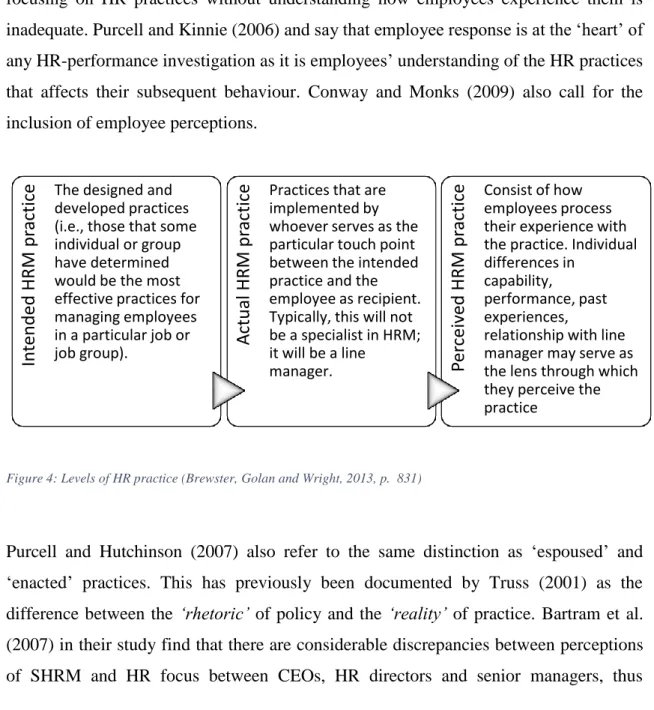
but what is not really clearly understood is how this happened. This is generally referred to as the black box discussion (Paauwe, 2004, p. 56). The black box discussion involves the following questions: How is HR actually translated into performance? What are the intervening variables that explain the relationship between HR practices and firm performance? (Paauwe and Farndale, 2005). The black box studies attempt to explore the linking mechanisms between HR practices and performance. Within the HRM black box, Purcell and Hutchinson (2007) conceptualised the people management – performance causal chain to indicate how people practices were ultimately translated into unit level outcomes and theirs was the first study to include both employee experiences and the line manager (LM) in any HR-performance investigation. They clarified the distinction between practices and how employees perceived them. Purcell and Hutchinson’s (2007) study also confirmed the crucial role of frontline managers (FLMs) in two ways: implementation of HR practices and general leadership in how employees experience HR practices. They labelled this as People Management activities in an organization. I wished to use this model to explore how perceptions of people management practices (not only HR practices) affected individual level outcomes.
Intended practices Actual practices Perception of practices Employee attitudes Employee behaviour Unit level outcome
4 Additionally, a point noted by academics was that most of the seminal works of HR-performance have been conducted in manufacturing settings (Arthur, 1994; Batt 2002; Guest et al., 2003; Ichniowski, Shaw, and Prennushi, 1997; Redman and Mathews, 1998) even though the global economy was primarily a service economy (Gronroos, 2007). This led me to explore the black box (Paauwe, 2004, p. 56) in a service setting. In this service business, for many organizations the interaction between FLEs and customers is paramount in creating customer satisfaction (Bowen and Schneider, 1988; Sergeant and Frenkel, 2000). As a consequence of the intangibility and inseparability (Zeithaml, Bitner, and Gremler, 2009) inherent in services, FLEs in service roles are absolutely crucial. Because services may not have a tangible component the customer experience becomes central in the assessment of the overall service experience. In service settings where there is high-contact between FLEs and customers, the service employee plays a vital role. The inseparability of production from consumption also signifies that to consume a service, they may have demands and needs as customers which the FLEs providing the service have to fulfil. This demonstrates the significance of the FLE in any service context. Within performance in a service context, it is the FLEs’ behaviour in service interactions between customers and employees that influences to a great extent whether customers’ are satisfied or not (Sergeant and Frenkel, 2000; Zeithaml, Bitner, and Gremler, 2009). Therefore frontline service employee performance at the individual level was deemed to be relevant for consideration in the exploration of the black box in a service setting. In particular, employee behaviour during service encounters requires employees to engage in behaviours to satisfy customers’ expectations. Customers may have demands that necessitate employees not only to display behaviours defined by their roles but also to engage in behaviours that go beyond what is expected of them. The service organization’s goal is to create satisfied customers and the role of the FLE in this cannot be underestimated. Therefore, service organizations would benefit from knowing how they can support and manage their FLEs such that they exhibit behaviours during service encounters that can result in satisfied customers. Employee behaviours directed at customers are known as prosocial service behaviours (PSSBs) (Bettencourt and Brown, 1997). These are not simply citizenship behaviours directed internally within the organization’s context but in addition, helping out behaviours that are directed at targets outside the organization, i.e. towards customers. Therefore PSSBs go beyond
5 Organizational citizenship behaviours (OCBs) (Organ, 1988) and Service-OCBs (Sun, Aryee and Law 2007) as they incorporate not only the internal- or organization-directed extra-role behaviours but also include the extra-role behaviours directed towards customers, who are fundamental to the evaluation of any service performance. Even though Bettencourt and Brown’s (1997) conceptualisation of PSSBs also include a cooperation element, involving employees cooperating behaviours with fellow co-workers, for this study I chose only the behaviours that were targeted at external customers as I was interested in their direct impact on customers. The following section provides the academic context in more depth in my investigation into how perceptions of people management practices affect FLEs’ prosocial service behaviours.
1.2 The academic background
This section seeks to establish the academic context for my doctoral study which does not deliberate on the association between HRM and performance per se, but centres on the black box (Paauwe, 2004, p. 56) exploring how this actually happens in reality in a specific service setting. I start by introducing the literature surrounding the black box and then go on to identify some research gaps within that discussion.
Over the last three decades research investigating the role of human resources in organizations has grown increasingly sophisticated. Boxall (2012) describes HRM, i.e. the management of work and people, as an indispensable function in organizations that influences organizational performance. In the 1990s, research around this topic revealed a positive relationship between HRM and firm performance (Arthur, 1994; Becker and Gerhart, 1996; Delery and Doty, 1996; Huselid, 1995; MacDuffie, 1995). Empirical research in this area has evolved to establish how a system of practices composed of bundles of HR practices – high-performance work systems (Becker and Huselid, 1998); high-commitment work systems (Arthur, 1994); and high-involvement work systems (Guthrie, 2001) – affect organizational performance. The body of knowledge in the area of strategic human resource management (SHRM) indicates that high-performance work systems (HPWSs), or systems of HR practices could improve organizational performance (Batt, 2002; Delery and Doty, 1996; Huselid, 1995; Ichniowski, Shaw, and Prennushi
6 1997; Wright et al., 2005). These systems of HR practices are a set of distinct but interrelated practices (Takeuchi et al., 2007) aimed at increasing employees’ ability, motivation and opportunities to contribute (Appelbaum et al., 2000; Boxall and Purcell, 2003) consequently, leading to organizational performance. The two main reviews of research in the area of HR and performance (Boselie, Dietz and Boon, 2005; Combs et al., 2006) confirmed that the bulk of available studies established a relationship between HRM and performance; “but both also emphasised that their analysis provided evidence of an association rather than causation” (Guest, 2011, p. 3). Some commentators have stated that it was unclear how practices actually translated into performance (Batt, 2002; Shore et al., 2004; Wright, Gardner and Moynihan, 2003). Guest (2011, p. 7) comments on how the HR-performance discussion has developed from “What impact does HR have on performance?” to “What is the process whereby HRM can have an impact on performance?” This is known as the black box of HR and Performance (Paauwe, 2004, p. 56). Academics have, of late, proceeded to explore the black box or mechanisms through which HR practices influence organizational performance (Chuang and Liao, 2010; Sun, Aryee, and Law, 2007; Takeuchi, Chen and Lepak, 2009; Takeuchi et al., 2007), i.e. “unlocking the black box” (Purcell, Kinnie and Hutchinson, 2003). Purcell et al., (2003) include several variables between HR practices and firm performance, such as employee motivations, employee skills, discretionary effort etc. Deeper examination of these mediating variables illustrates that different theoretical standpoints inform them – social exchange, human capital, (Chuang and Liao, 2010; Schuler and Jackson, 1987; Sun, Aryee, and Law, 2007; Takeuchi et al., 2007; Takeuchi, Chen, and Lepak, 2009). Additionally, the AMO theory (Appelbaum et al., 2000) is perceived as an acceptable framework for stipulating the mediating variables between HRM and performance (Boselie, Dietz and Boon, 2005). However, only a limited number of studies have investigated the HR-performance linkage from a job characteristics and empowerment perspective (Snape and Redman, 2010). The concept now is that HR practices (organizational level) affect the attitudes and behaviour of employees (individual level), which in turn, when aggregated, affect HR behavioural outcomes, which could then lead to organizational outcomes (Paauwe, 2009). Purcell and Hutchinson (2007) elaborate on the HRM-performance causal chain, portraying a chain of links from intended practices to unit level performance.
7 Specifically within this, they adopted Wright and Nishii’s (2007) idea of the differences between intended, actual and perceived practices. Perceptions of the HR practices are influenced by how LMs implement them and it is these perceptions that shape employees’ attitudes and behaviour, thus in turn influencing organizational level outcomes. Through their research, Purcell and Hutchinson (2007) find that, both independently and additively, satisfaction with HR practices (perception) and (frontline) leadership affects employee attitudes; thus, both employees’ perceptions of HR practices and leadership behaviours are crucial in affecting employee attitudes. They coin the term ‘people management’ to reflect this. Within the discussion on implementation, even though Purcell and Hutchinson’s (2007) study proved that both satisfaction with HR practices and LM leadership were instrumental in affecting employee’s performance, the LM’s role is not really included in many HR-performance studies. Bos-Nehles (2010) note that even if HR practices are designed appropriately, if LMs do not execute them well, then they would fail to be effective (Bowen and Ostroff, 2004). Alfes et al. (2013), Knies and Leisink (2014) and Purcell and Hutchinson (2007), are the only studies, to the best of my knowledge that have actually addressed how LMs implement practices. Equally, even though it is actually the perception of people management practices that affect employee attitudes and behaviours, most of the studies investigating the black box have not addressed this distinction. In fact, only a few studies have in reality examined actual practices or included employee perceptions in such investigations (Aryee et al., 2012; Den Hartog et al., 2013; Jensen, Patel and Messersmith, 2013; Liao et al., 2009). I came to the conclusion that any study looking into the black box needed to include employees’ perceptions of HR practices and furthermore needed to incorporate the LM as a crucial actor in not only in the implementation of HR practices but also from a general leadership perspective.
My interest in service organizations, coupled with recognising that HR-performance studies that were limited to service settings were lacking, meant that employee-level outcomes, in order to be measured, required adaptation to help organizations acquire a more realistic understanding of what HR practices are actually perceived by employees as helping them to deliver excellent customer service. Employees who interact with customers are FLEs and it is the behaviour of these FLEs that affects customer perception of service quality (Schneider and Bowen, 1985). Recently, there has been a move to study
8 the relationship between HR and organisational outcomes within a service setting (Cho et al., 2006; Chuang and Liao, 2010; Gittell, Seidner and Wimbush, 2010; Karatepe and Vatankhah, 2014; Messersmith et al., 2011; Nishii, Lepak and Schneider, 2008; Sun, Aryee, and Law, 2007; Ueno, 2012; Yang, 2012). Individual level outcomes include commitment (Boselie, 2010; Den Hartog et al., 2013; Veld, Paauwe and Boselie, 2010) and service performance/behaviour (Aryee et al., 2012; Browning, 2006; Liao et al., 2009). In particular, there is a focus on OCB and in-role and extra-role behaviour (Alfes, Shantz and Truss, 2012; Boon et al., 2011; Boselie, 2010; Karatepe, 2013; Knies and Leisink, 2014; Snape and Redman, 2010; Yang 2012). Behaviour, including OCB, service-focused OCB and in-role/extra-role behaviour is highly relevant in a service context as it the actual behaviour of the FLEs when interacting with the customer that is regarded to impact on perceptions of service quality (Zeithaml, Bitner, and Gremler, 2009). The reason behaviours emerge as important in service settings is because the display of behaviour is crucial in a service context. Even if employees have favourable attitudes, without the actual behaviours being displayed during service encounters, this attitude may not result in satisfied customers. Within the Services Management literature, employee behaviours directed at customers are known as PSSBs (Bettencourt and Brown, 1997). These are not simply citizenship behaviours directed internally within the organization’s context but in addition, helpful behaviours that are directed at targets outside the organization, i.e. towards customers. Peccei and Rosenthal (2001) conceptualise this in a slightly different way, calling them customer-oriented behaviours. Initially, Peccei and Rosenthal (1997) theorised this as commitment to customer service and then in 2001, relabelled it as customer-oriented behaviour. On comparing these two constructs, I decided to employ Bettencourt and Brown’s (1997) measure for PSSBs as the individual employee-level outcome within the black box discussion.
I also noticed that within this HR-performance discussion there seemed to be no agreement over the actual list of practices that are included in the HPWS discussion (Boselie, Dietz and Boon, 2005; Lepak, Marrone and Takeuchi, 2004; Wall and Wood, 2005); although typically studies used a similar set of practices incorporating training and development, contingent pay and reward schemes, performance management and recruitment and selection (Paauwe, 2009). For any sort of understanding on how perceptions of HR practices translate into behaviours, it is fundamental to understand
9 which the actual practices are. However, it has been noted that terms such as high-performance work systems; high-commitment work systems and high-involvement work practices are often used interchangeably (Wood, de Menezes and Lasaosa, 2003). Both Wood and Wall (2007) and Wood and de Menezes (2011) observe that the opportunity component of the HPWS is often not considered in studies. Most studies looking into the black box adopt a select group of practices from the larger collection of all practices with HPWSs. This could mean that practices may have been overlooked that are relevant to the business being investigated. How would one know that in studies in which the opportunity component has been not included in the list of practices, that it is not important for employees?
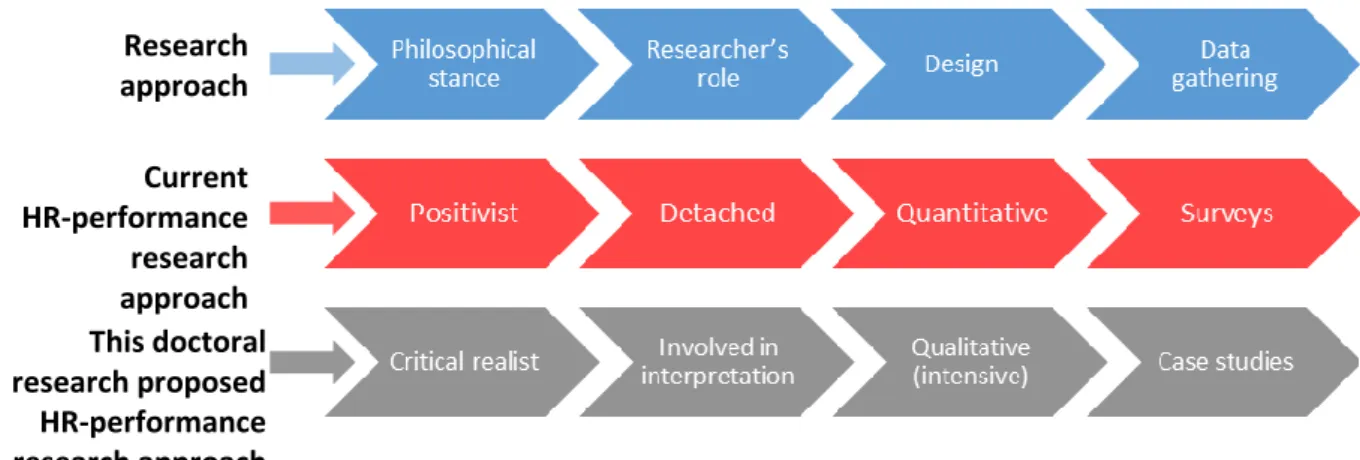
Most of the studies in this area have adopted a quantitative route adopting stringent statistical methods in examining the linking mechanisms within the black box, with the exception of a few studies (Harney and Jordan 2008; Monks et al., 2013). Notwithstanding the contribution to knowledge that this stream of literature has made, it does not allow for a full and nuanced understanding of how HR practices actually affect performance. Fleetwood and Hesketh (2006, p. 1978) reiterate that the “scientific approach to studying the HRM-performance link is under-theorized” and lacks “explanatory power”. They add that most researchers in this area confront this problem of under-theorisation by conducting more and more empirical work and believe that theory will emerge as a result of this scientific work. Furthermore, Hesketh and Fleetwood, (2006, p. 678) comment that a statistical relationship between measures of HR and measures of performance by no means “constitute a theory nor an explanation”. They argue that empirical research in the area of HR and performance lacks explanatory power and therefore they are opposed to this view of examination of the HR-performance link (Fleetwood and Hesketh, 2008). In-depth examinations of how HR affects performance can only be achieved through qualitative research.
My study contributes to the current deliberation about how people management translates into performance. First, specific to the context of services, which accounts for more than 80% of the GDP in the UK (Central Intelligence Agency, 2015), it investigates how the perception of people management practices affects employee behaviours in a service setting as shown in Figure 2. The employee group I chose for this study was that of the FLE, by considering the relative importance of this group in creating satisfied customers.
10 Secondly, it considers PSSBs as an individual-level outcome. PSSB is an employee-level behaviour specifically relevant to the service context which incorporates FLEs exhibiting both in-role and extra-role behaviours. To the best of my knowledge there is only one other study (Tsaur and Lin, 2004) which employs PSSB in examining the role it plays as a mediator between perceptions of HR practices (selected from a list of practices) and service quality. Tsaur and Lin (2004) find that perceptions of HR practices affect service behaviour; however, they do not investigate how it does so. Furthermore, my study differs from their specific study in other ways: 1) I consider the role of people management and not solely of HR practices; 2) Related to the HR practices, I do not select HR items from a list of pre-existing practices but generate the HR practices from the FLEs; 3) I include the LM as a central actor affecting perceptions of HR practices, which they do not. Thirdly, in contrast to most previous studies that utilise a quantitative hypothesis testing route, my study employs a qualitative approach to explore how perceptions of people management practices actually translate into behaviours.
Figure 2: My research study
1.3 The research gap and research questions
As I have outlined above, research into the HR-performance discussion has demonstrated links but not necessarily a relationship and there have been calls to explore how HR practices actually affect performance, i.e. what is known as the black box. My research is positioned in the broader context of HR and performance, even though it does not focus on the relationship between HRM and performance per se, but concentrates on exploring the linking mechanisms in the black box. I decided to adopt Purcell and Hutchinson’s
Perception of people management practices Employee behaviours (Prosocial service behaviours)
?
11 (2007) People-performance model and within that look specifically at the linking mechanisms between perceptions of people management practices and a particular employee-level behaviour in a service business context, PSSB. This will help identify the linking mechanisms in the black box. The principal question that has been identified is:
How do frontline employees’ perceptions of people management practices affect their prosocial service behaviours?
A few sub-questions were also identified which would help answer the main research question:
Sub-question 1a: What are the perceptions of people management practices that lead to frontline employees’ prosocial service behaviours?
Sub-question 1b: What, from the line managers’ perspective, are the people management practices that lead to frontline employees’ prosocial service behaviours?
Sub-question 1c: Are there any other factors that affect the people–performance discussion?
At this point I wish to articulate the definitions of the key items in the research questions outlined above:
People management practices include all human resources and line management practices that are used to manage the employees in an organization (Purcell and Hutchinson, 2007).
Frontline employee is defined as the employee who is in direct contact with the customer.
Prosocial service behaviour(s) is defined as helpful behaviours that are directed towards customers and this includes both in-role and extra-role behaviours (Bettencourt and Brown, 1997).
12 It is pertinent to comment that this research is intended to build theory with respect to the HRM-performance link, with specific emphasis on the linking mechanisms between perceptions of people management practices and PSSBs.
The site where this research is conducted is a company that has an excellent reputation in customer service, namely the John Lewis Partnership, where one particular store was selected for this research study. John Lewis is unique in its nature by also being the largest employee-owned organization in the UK (John Lewis Partnership, 2015a; Employee Ownership Association, 2015a). The FLE in John Lewis is known as the selling Partner1 and the frontline manager is the section manager. The distinctive setting for this doctoral study will be presented in detail in Chapter 4.
1.4 Plan of the thesis
The further chapters of this thesis can be précised as follows:
Chapter 2 focuses on the extant literature in depth and positions the research question in the context of the existing discourses in this area. In this chapter I review the literature and crystallize ideas and also explain certain decisions that were made in relation to how data were collected. I explore the literature not only surrounding HR and performance but also specifically looking into literature that investigates the linking mechanisms. Keeping the service setting in mind, I also ensure that this chapter covers discussions surrounding the people-performance discussion in a service setting.
Chapter 3 then makes explicit my research approach and methodology and the philosophical roots of this research. I present in a detailed manner how I endeavour to gather data aligned with my philosophical perspective of critical realism and how that affects every aspect of my research data gathering design. I also lay out in detail the data gathering, i.e. semi-structured interviews, and the use of analysis tools such as NVivo in this chapter. I also present my research site, the Milton Keynes branch of John Lewis UK, an organization that is reputed for its customer service but which is also the largest employee-owned organization in the UK.
1 Throughout this dissertation, the term Partner will be shown as “Partner” and not “partner” as that is how
13 In Chapter 4 I present the specific employee-ownership context of this study providing a brief discussion of employee ownership from academic literature and also present an overview of John Lewis as a research site. The objective of this chapter is to aid in a better appreciation of the unique nature of this research site.
I then set out to present the data that were actually gathered for the study with a view to addressing the research question. I do this in Chapters 5 and 6. In chapter 5 I present the findings from the 23 interviews with the selling Partners, who are the FLEs, to collect not only the perception of the people management practices instrumental in their displaying PSSBs, but also to explore the role of context in this. In Chapter 6, I present the findings of the eight interviews with the section managers, the FLMs. The purpose of these selected interviews was to help understand from these LMs which were the people management practices that they thought helped their selling Partners to display PSSBs. The objective of these interviews was not to explore in depth their perceptions of these practices but only to add more reliability to the data about the practices obtained from the selling Partners. To that end, this would provide some indication of practices implemented by the LMs.
After having presented the findings from the selling Partners and the section managers, I then go on to discuss these findings in Chapter 7. The discussion is done in two stages: first, I discuss the empirical findings per se in the light of the research questions set out and following that, I discuss the findings in the light of the extant literature reviewed in Chapter 2. Where the findings are novel, I also present a brief academic piece on the concept to allow for a clearer understanding of this emerging outcome in this study. I particularly look to draw conclusions on how perceptions of people management practices affect PSSBs in a specific service-ownership context.
I conclude this doctoral dissertation in Chapter 8 with some clear contributions to existing knowledge, theory and practice, present the limitations associated with my work and also discuss future research thoughts. The thesis ends with my personal reflection on the research journey.
14
2
Literature review
Bryman and Bell (2011) assert that the purpose of a literature review is to provide justification for a research question and to help guide the researcher’s choice of subsequent research design. Thus, this chapter will seek to present a review of the literature pertaining to the research question I introduced in Chapter 1. It will also make transparent to the reader the process of how the final research question was developed. The research question seeks to investigate how perceptions of people management practices affect
PSSBs. This research question is situated within the black box of the broader framework of the HR-performance discussion in a service setting, with PSSBs as the identified employee-level performance outcome to be investigated specific to the service backdrop. This required conducting a literature search on the theme of HR-performance in general, first, before proceeding to position the HR-performance in a service setting. Consequently, this chapter has two main sections: Section 2.1 starts with a critical analysis of the literature surrounding HRM and organizational performance and then follows this by linking the two concepts; Section 2.2 presents the academic discourse surrounding HRM and performance in a service setting to specifically reflect the context of services for this study. These two sections both follow the same structure; starting with a discussion of the relevant literature followed by a discussion on developing the research question. Two smaller sections follow: Section 2.3 presents the final research question and sub-questions in relation to the gaps identified through the review and finally, Section 2.4 provides a brief conclusion to this chapter.
Chapter 1: Introduction • Outlines the rationale for this
study, sets the context, presents the research problem, presents the structure of this thesis
Chapter 2: Literature review • Reviews and synthesises the
domains of extant literature relevant to the research, refines the research question(s)
Chapter 3: Methodology • Presents a rationale of the
research design employed to answer the research question
Chapter 4: The research context
• Presents an overview of the unique context of this research and organizational information relevant to the study
Chapter 5/6: Findings • Presents the key findings of
this study
Chapter 7 : Discussion • Discusses the findings in the
light of the research question against a backdrop of the extant literature
Chapter 8: Conclusion • Discusses the summary
findings, contributions to knowledge and limitations
15 2.1 Literature Review on HR and performance
Over the last three decades, the field of human resource management (HRM) has evolved and within this domain the link between HRM and organizational performance has particularly grabbed the attention of researchers (Singh et al., 2012). Researchers have devoted significant empirical effort towards understanding the HRM–organizational performance relationship (Combs et al., 2006). Since 1994 this discussion has evolved through distinct stages, with the initial focus on seeking to establish the impact of single practices, to examining the impact of a system of HR practices on several facets measuring organizational performance (Lepak et al., 2006). In their study, Huselid and Becker (2000) found that a one standard deviation change in the HR system gave rise to a 10-20% increase in a firm’s market value. The two main reviews of research in the area of HR and performance (Boselie, Dietz and Boon, 2005; Combs et al., 2006) confirmed that the bulk of available studies established a relationship between HRM and performance; “but both also emphasised that their analysis provided evidence of an association rather than causation” (Guest, 2011, p. 3). But over the last few years, several researchers have been more guarded in their interpretation of the link between HR and performance, with a few suggesting that this link is weak (Boselie, Dietz and Boon, 2005; Wright, Gardner, and Moynihan, 2003). Over the last 20 years, there have been several reviews in the area of HR and performance with Boselie, Dietz and Boon (2005), Wall and Wood (2005) and Combs et al. (2006) furnishing the most comprehensive reviews. Boselie, Dietz and Boon (2005, p. 81) in their review of 104 articles, conclude that “though by no means all of the empirical research HRM in its 'system' form has been found to matter (in a positive sense) for organisational performance; however the 'Holy Grail' of decisive proof remains elusive”. Wall and Wood (2005, p. 454) comment from their review of 25 articles “it is premature to assume that HRM initiatives will inevitably result in performance gains, either in all situations or even where deemed appropriate by contingency arguments”. Furthermore, they add that even though 19 out of the 25 studies “report some statistically significant positive relationships between HRM practices and performance” (p. 451) most of the inter-linkages between HR and performances should be “treated with caution” because they employed inadequate methodologies (p. 454). Guest (2011, p. 7) highlights how the HR-performance discussion has developed from
16 “What impact does HR have on performance?” to “What is the process whereby HRM can have an impact on performance?”
2.1.1 Human Resource Management and Performance
Boxall, Ang, and Bartram (2011, p. 1504) defines HRM as “the process of managing work and people in organizations”. This definition is used in this study in that it articulates the management of not only human resources within a firm but also includes the management of work that human resources perform to help organizational objectives. Several studies measure HRM in terms of individual HR practices (Batt, 2002) or systems/bundles of HR practices (Cappelli & Neumark, 2001; MacDuffie, 1995; Subramony, 2009). Strategic HRM is the study of how HRM can help an organization achieve its objectives (Wright, Gardner, and Moynihan, 2003). Strategic HRM consists of looking at a group of practices within a system and uncovering its effect on some organizational performance outcome. Guest (2002, p. 79) remarks that “there is little agreement over which practices should be combined to constitute effective HRM”. On the nature of HRM, Boselie, Dietz and Boon (2005, p. 81) conclude that “A steady body of empirical evidence has been accumulated since the pioneering studies in the mid-1990s, yet it remains the case that no consistent picture exists on what HRM is or even what it is supposed to do”. Equally, Wall and Wood (2005) observe the diversity of HR practices across HR-performance studies. As recent as 2012, Jiang et al (2012a) remark that there is still no clarity on what exactly constitutes this HR system and questions still remain about the exact make-up of this bundle of practices and its constituents. Heavey et al. (2013) note that there are issues with the substantive content of HR practice items with work practice items varying more across the studies than HR practice items. It was found that compensation, training, selection, performance appraisal, communication and organization structure were assessed in more than 56% of the studies. Other functional categories, such as autonomy, job control, teamwork and career development, were studied in less than 4% of the articles reviewed. The main issue was in how authors defined what constitutes HR practices; in some studies this included both employment and work practices whereas others only included employment aspects. Guest (2011, p. 8)
17 concludes that the question of what combinations of practices are likely to have greater impact on performance is hitherto unresolved. The next section will present a discussion of the differing perspectives in SHRM, with the focus on providing an in-depth understanding of the practices used so far in HR-performance research.
2.1.1.1 Differing perspectives in Strategic HRM
Strategic human resource management (HRM) calls for a study of a bundle of human resource (HR) practices, in lieu of individual practices, when considering the HR-performance relationship, essentially because HR practices do not work in isolation but in tandem (MacDuffie, 1995). This has led to the emergence of a systems-led perspective in the investigation of HR and performance (Wright and Boswell, 2002). Three major theoretical perspectives employed in the HR-performance debate are the contingency (Schuler and Jackson, 1987), universalist (Pfeffer, 1994) and configurational schools (Delery and Doty, 1996). Martin-Alcazar, Romero-Fernandez and Sanchez-Gardey, (2005) posited a comprehensive model integrating different strategic perspectives. The question is which HR practices included in the best practices list, in reality, contribute to firm performance (Collins and Smith, 2006).
The contingency or best fit approach (Delery and Doty, 1996; Schuler and Jackson, 1987) puts forward the view that in order to be effective, an organization’s HR practices must fit with the business strategy of the organization and the relationship between HR and performance will vary according to internal and external factors. HRM will only have a positive impact on performance if the HR practices fit with the firm’s business strategy (Martín‐Alcázar, Romero‐Fernández and Sánchez‐Gardey, 2005). In the best practices approach, Pfeffer (1998) outlined a set of seven HR practices that he proposed, when implemented, would result in superior organizational performance, irrespective of country, sector and industry (Huselid, 1995). These include employment security, selective hiring, self-managed teams, high pay contingent on performance, extensive training, reduction of status differentials and sharing information. Boxall and Purcell (2003) and Paauwe and Boselie (2005) argue that the universalist and contingency-based practices are relevant in looking at the HRM-performance research in more depth,
18 whereby some practices by themselves universally yield positive results but their actual design would depend on the context in which they operate.
Most studies using the best practice approach have investigated the effect of individual practices on firm performance (Boselie, Dietz and Boon, 2005). Essentially, the universalist position posits that there is no requirement for HR practices to match a firm’s specific strategy or a precise organizational environment (Lengnick-Hall et al., 2009). Within the universalist school, there exists the idea of high-performance work systems(HPWSs) or high-performance work practices (HPWPs) (Appelbaum et al., 2000) or high-commitment work systems/practices (HCWSs/HCWPs) (Guest et al., 2003; Walton, 1985) or high-involvement work practices (HIWPs) (Guthrie, 2001; Lawler, 1986) or alternative work practices (Godard, 2001) wherein more than one HR practice is combined to affect firm performance via enhanced employee skills, motivation and involvement in decisions (Appelbaum et al., 2000). Based on their reviews of studies in the HR-performance area, Wood and Wall (2007, p. 1368) remark that researchers “treat terms like high involvement, high commitment and high performance management as synonymous, and the studies as if they were measuring the same phenomenon. Yet, it is evident that they are not”. Boxall and Macky (2009) note that HIWPs focus on the work practice items whereas HCWSs focus more on the employment practices of HR systems. The focus of HIWPs is on (i) the power to perform and take decisions regarding work; (ii) information around processes and business results; (iii) rewards attached to business performance; and (iv) knowledge of the entire work system (Vandenberg, Richardson and Eastman, 1999). Boxall and Macky (2009, p. 8) note that involvement and high-commitment are less laden terms than high-performance purely because they do not automatically assume that the bundle of practices is performance-enhancing. They also note that a high-involvement system may lead to high commitment but the reverse may not be true. Datta, Guthrie and Wright (2005) describe HPWSs as a structure of HR practices intended to improve employees’ skills, commitment and productivity in a manner that results in employees emerging as the competitive advantage for an organization. Lepak and Snell (1999) discuss the concept of HR architecture whereby different HR configurations exist within an organization. Boxall (2012) and Conway and Monks (2008) advise that it would add value to the theory and practice of HRM if
19 researchers appreciated the diversity imminent in work contexts and how that affected the manner by which HPWSs worked in particular contexts and why.
HPWPs enhance organizational performance via two interactive and overlapping processes: first, by equipping employees with the requisite knowledge, skills and abilities to execute their daily jobs and tasks, and increase their motivation and opportunity to use those abilities, and secondly by improving the internal social structure through superior communication and collaboration within the workforce (Combs et al., 2006). Following on from Combs et al.’s (2006) review of HR’s impact on performance, there has emerged a body of research on exploring the linkages between HPWSs and performance (Chuang and Liao, 2010; Gong et al., 2010; Hsu et al., 2007; Messersmith et al., 2011; Sun, Aryee, and Law, 2007; Takeuchi et al., 2007). This will be discussed in more depth in Section 2.1.3.1. Marchington and Grugulis (2000) comment that the list of best practices normally lacks work organization items and those related to employee voice. US research suggests that HCWPs work best for organizations that seek to differentiate on quality and service (Boxall and Purcell, 2000). HRM practices in the form of HPWSs are associated with positive performance outcomes and financial success (Appelbaum et al., 2000, Huselid, 1995).
In addition to financial measures, several studies (e.g. Becker and Gerhart, 1996; Guthrie, 2001) have shown that improving HR practices also increase productivity and lowers employee turnover rates. Most of the research in the HR-performance area has been using high-commitment HR practices (Bowen and Ostroff, 2004; Collins and Smith, 2006; Combs et al., 2006; MacDuffie, 1995; Youndt et al., 1996) and Wood and de Menezes (2011) note the paucity of research encompassing the involvement element in HPWSs. Some academics suggest that it is essential to group together the appropriate combinations of HRM practices to realise the synergistic effects that result from the exchanges between them (Ichniowski, Shaw, and Prennushi , 1997; MacDuffie, 1995). As Gooderham, Parry and Ringdal (2008) highlight, within the best practices school it is becoming widespread to cluster practices in order to build more sound explanations of the HRM-performance link.
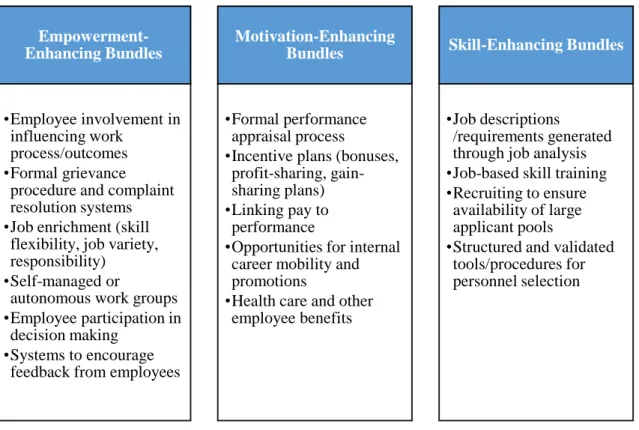
20 The configurational perspective proposes that there exists a bundle of complementary HR practices that affect firm performance as a whole and these are known as HR bundles or clusters (MacDuffie, 1995). Subramony (2009) observes that HPWSs employed in most studies typically encompass practices that are part of the ability-, motivation- and opportunity-enhancing bundles, thus demonstrating that HR bundles are part of the HR system of practices. Arthur (1994) published one of the first studies using the system approach and this initiated the first of many studies on HR systems and bundles of practices. This was followed by studies from Dyer and Reeves (1995), Huselid (1995) and MacDuffie (1995), in which they studied the effect of HR bundles on organizational performance. This emphasises that the bundles include practices that are interrelated and demonstrate internal fit within the bundle (Boxall, 2012). Ichniowski, Shaw, and Prennushi (1997) suggest that bundles of complementary HR practices have a greater effect on organizational performance than individual practices and it is the synergistic interaction between complementary HR practices that results in enhanced outcomes leading to better firm performance. Monks and Loughnane (2006) comment that not all practices within a bundle are of equal importance and suggest the notion of core and ancillary bundles. Subramony (2009) finds that HRM bundles have considerably larger positive effects than their individual component practices on business outcomes. These bundles also display effects akin to, or larger than, those of HPWSs. Subramony (2009) further identifies that most of the practices are classified into empowerment, motivation and skill enhancing bundles, as presented in Figure 3. However, as noted earlier, Wood and de Menezes (2011) observe an increasing disregard for the involvement component (what Subramony (2009) refers to as the empowerment bundle) in examinations of the relationship concerning HRM systems and performance, and furthermore note that in the industrial relations tradition, the involvement component is central to high-performance management.
21
Figure 3: The content of HRM bundles (Subramony 2009, p. 746)
Several recent studies have employed this concept of bundles in their pursuit of a better understanding of HR-performance as can be seen from Table 1. Different authors are seen to employ different types of bundles depending on their theoretical stance.
Table 1: Different types of bundles used in the HR-performance studies
Study Kinds of HR bundle
Bal et al. (2013) Developmental and accommodative HR system
Batt and Colvin (2011) Investments and inducement bundle and performance enhancing bundle
Chang et al. (2013) Flexibility-oriented HR practices
Collins and Clark (2003) Network-building HR practices
Gardner, Wright and Moynihan (2011)
Skill-enhancing practices Motivation-enhancing practices Empowerment-enhancing practices
Lopez-Cabrales et al. (2009) Knowledge-based HRM practices Collaborative HR systems
Teo et al. ( 2011) Human capital-enhancing practices
Empowerment-Enhancing Bundles •Employee involvement in influencing work process/outcomes •Formal grievance
procedure and complaint resolution systems •Job enrichment (skill
flexibility, job variety, responsibility)
•Self-managed or
autonomous work groups •Employee participation in
decision making •Systems to encourage
feedback from employees
Motivation-Enhancing Bundles
•Formal performance appraisal process
•Incentive plans (bonuses, profit-sharing, gain-sharing plans) •Linking pay to
performance
•Opportunities for internal career mobility and promotions
•Health care and other employee benefits
Skill-Enhancing Bundles
•Job descriptions
/requirements generated through job analysis •Job-based skill training •Recruiting to ensure
availability of large applicant pools
•Structured and validated tools/procedures for personnel selection
22 In addition, Kinnie et al. (2005) have found, through their research, that different employee groups are satisfied with different HR practices. In recent years, the thinking has evolved to reflect that organizations rarely have only one HR system in operation (Lengnick-Hall et al., 2009) and different HR systems are purported to be applicable to different groups of employees within a single organization (Lepak and Snell, 2002). Boxall (2012) urges researchers to identify a target employee group in any study, rather than including all employees, as different groups of employees make sense of practices differently. The issue here is, therefore, identifying the set of practices particular to specific groups and within them, identifying the complementary bundles.
2.1.1.2 Human resource practices
Any HR system involves both work and employment practices. Work practices entail how work and processes are organized, whilst employment practices comprise the procedures utilised to recruit people into the firm, manage, motivate and enable them to perform their jobs while they are in the firm, and also incorporate processes to retain them but if needed, to end their work contract (Boxall and Macky, 2009). In the studies there seems to be no agreement on the nature of HRM (Paauwe and Boselie, 2005) or agreement on the list of practices used (Boselie, Dietz and Boon , 2005; Lepak, Maronne and Takeuchi, 2004; Wall and Wood, 2005). However, there seem to be some common practices, such as training and development, contingent pay and reward schemes, performance management and recruitment and selection (Paauwe, 2009), although both Wood and Wall (2007) and Wood and de Menezes (2011) observe that the opportunity component of the HPWSs is often not considered in studies.
2.1.1.2.1 Intended, actual and perceived practices
Boxall and Macky (2007) in their commentary on HPWSs and organizational performance, conclude that “better information on employee perceptions of, and