Papers
Volume2,Issue1 2002 Article2
Price-Matching Guarantees
Sridhar Moorthy
∗Ralph A. Winter
†∗University of Toronto, [email protected] †University of British Columbia, [email protected]
Copyright c2002 by the authors. All rights reserved. No part of this publication may be reproduced, stored in a retrieval system, or transmitted, in any form or by any means, elec-tronic, mechanical, photocopying, recording, or otherwise, without the prior written permission of the publisher, bepress, which has been given certain exclusive rights by the author. Review of Marketing Science Working Papers is produced by The Berkeley Electronic Press (bepress). http://www.bepress.com/roms
Sridhar Moorthy and Ralph A. Winter
Abstract
Are matching guarantees anticompetitive? This paper examines the incentives for price-matching guarantees in markets where information about prices is costly. Under some conditions the conventional explanation of price-matching announcements as facilitating collusion finds sup-port, and is even strengthened. But our model provides an additional explanation for the practice. A price-matching guarantee may be a credible and easily understood means of communicating to uninformed consumers that a firm is low-priced. The credibility of the signal to uninformed con-sumers is assured by the behaviour of informed concon-sumers. We contrast the testable implications of our model with those of the anticompetitive theories and discuss supportive evidence from an illustrative sample of retailers.
Price-Matching Guarantees
Sridhar Moorthy
∗University of Toronto
[email protected]
Ralph A.Winter
University of British Columbia
[email protected]
August 2002
∗We thank Aaron Edlin, Edward Iacobucci, Ganesh Iyer, Carolyn Pitchik, and seminar audiences at University of California-Berkeley, UBC, University of Toronto, University of Calgary, and University of Texas at Dallas for useful discussions.
Abstract
Are price-matching guarantees anticompetitive? This paper examines the incen-tives for price-matching guarantees in markets where information about prices is costly. Under some conditions the conventional explanation of price-matching an-nouncements as facilitating collusionÞnds support, and is even strengthened. But our model provides an additional explanation for the practice. A price-matching guaran-tee may be a credible and easily understood means of communicating to uninformed consumers that a Þrm is low-priced. The credibility of the signal to uninformed consumers is assured by the behaviour of informed consumers. We contrast the testable implications of our model with those of the anticompetitive theories and discuss supportive evidence from an illustrative sample of retailers.
1
Introduction
In many retail markets, sellers not only set prices but announce a guarantee that they will match the lowest advertised price that a customer can Þnd in the market. Price matching is observed in markets for sporting goods, personal computers, books, consumer electronics, luggage, tires, and many others.1 Price-matching guarantees,
or meeting-competition clauses as they are sometimes called, would appear to be pro-competitive. Customers do not complain about getting guaranteed low prices.2
Investment analysts have viewed announcements of such guarantees as an increase in the intensity of competition.3
In the economics and antitrust literatures, however, price-matching guarantees have a bad name. These guarantees are seen as a way to collude. The argument is that the guarantees facilitate cartel pricing by removing the incentive to undercut (Hay 1982, Salop 1982). The Þrm offering a price-matching commitment to buyers is in fact guaranteeing to its competitors that any lower price by them would be matched immediately–eliminating the gains from the price cut. A second theory explains price matching as a means of price discriminating among consumers (Png and Hirshleiffer 1988). Firms offering price-matching guarantees provide discounts selectively to customers who shop for and are aware of lower prices in the market while charging a high list price for non-searchers. Edlin (1997) uses this argument to suggest that the market-wide impact of the practice is to limit the disciplining power of active shoppers on market prices: whereas price searchers usually provide a positive externality to non-searching customers by driving the price down for everyone, in a
1 Edlin (1997) and Arbatskaya, Hviid and Shaffer (1999). A well-publicized example of a price
matching guarantee is Gateway’s announcement on May 30, 2001 that it would match key competi-tors’ prices on comparable PC’s. The Gateway Guarantee promises customers that if they “present a current ad from Compaq, Hewlett-Packard, Dell, IBM, Sony or Toshiba for a new PC or server with speciÞcations at least equal to Gateway’s speciÞcations,” then Gateway will sell them a comparable PC “for as much as $1 less than the advertised price of its rivals” (The Wall Street Journal, May 31, 2001). The press release accompanying the announcement notes that the guarantee will be launched “with broadcast and cable TV advertising, as well as a full-page ad inUSA Today and dozens of local daily newspapers across the country.”
2 For example, see the consumer reactions to the Gateway Guarantee in Geek.com (May 30,
2001).
3Investment analysts viewed Gateway’s announcement of price matching as a step up in the P.C.
market with price-matching guarantees, the pro-competitive beneÞts of active price shopping are limited to the active shoppers themselves. AÞrm need not lower price to all consumers just to capture the searchers. The theory of price matching as anti-competitive is thus extended to markets with large numbers of sellers.
Neither of the theories of anticompetitive price matching is compelling as an expla-nation of the wide range of markets in which the guarantees are observed. Prices do not appear to jump to monopoly levels when price-matching guarantees are offered,4 and the large number of Þrms in the markets where the practice is observed is also inconsistent with the basic cartel theory. The price discrimination theory accounts for the observation of price matching in markets with large numbers of Þrms. It also accounts for the fact that in most cases only some Þrms in a market offer the guar-antees. But this theory requires that the price-matching Þrms set higher list prices than at least some non-price matchingÞrms. This prediction is inconsistent with the limited evidence available.5 Moreover, the price discrimination theory requires that a substantial number of consumers actually invoke their rights under the guarantee. No evidence of a signiÞcant rate of cashing-in of the guarantees has been offered by the theory’s proponents. Our own data (discussed below) show redemption rates of 5% or less for most price-matchingÞrms in an illustrative sample and much lower for some price-matchingÞrms in the sample.6
This paper examines the incentives for price matching guarantees generated by
4For example, Hess and Gerstner (1991)’s study of grocery stores in the Raleigh, North Carolina
market found a 1.6% increase in market prices when one of the supermarkets adopted a price-matching policy. Given that the supermarkets in question collectively had 92% of the market, and the products in question are largely staples, this price increase seems too small to suggest a cartel.
5Arbatskaya, Hviid, and Shaffer (1999) examine advertised tire prices across the U.S., andÞnd a
statistically signiÞcant lower price for dealers offering low-price guarantees (although only for price-beating dealers; for price-matching dealers the results are inconclusive). Second, consumers believe that price-matchingÞrms are lower priced than non-price-matchingÞrms (Jain and Srivastava 2000; Srivastava and Lurie 2001). These papers report results from simulated shopping experiments where consumers were asked about their perceptions of, and shopping preferences between, price-matching and non-price-matching stores. They Þnd that (1) subjects perceive price-matching stores to be lower priced than non-matching stores, (2) they are more likely to choose to shop at price-matching stores than at non-price-price-matching stores, and (3) they are more likely to stop searching, by as much as 25 percent, after they have been to a price-matching store than after they have been to a non-price-matching store. Consumers can be wrong, of course, but in general the observed behaviour of economic agents deserves some weight.
6For other theories of price-matching see Hviid and Shaffer (1999), Jain and Srivastava (2000)
three assumptions about retail markets. Our Þrst central assumption is that infor-mation about prices is costly (Stigler 1961, Salop and Stiglitz 1977). These costs, which vary across consumers, are interpreted very generally as the costs of obtaining, organizing and memorizing information on the prices of hundreds of products offered at different retailers. Our second assumption is that, unlike prices, aÞrm’s pricing policy–whether it offers a price-matching guarantee or not–is easily observed by consumers. The third assumption is that Þrms are heterogenous in a way that is reßected in variety in optimal prices.
We propose that price matching guarantees are a credible way to communicate to high information-cost consumers that “we are a low-priced outlet.” This signal is valuable to the Þrm because it increases the Þrm’s demand. The signal is credible because of the vigilance of the low time-cost consumers, the consumers who are di-rectly informed about prices. Where optimal prices vary acrossÞrms, a high-priced store that offered a price-match guarantee would be delegating its pricing decision for informed consumers to its rival. It would thus be forced to offer a low (and suboptimal) price to informed consumers.
By directing busy consumers towards low-priced Þrms, price matching allows the low prices induced in the market by low-time-cost customers to be shared by busy customers. Thus price matching guarantees can facilitate the positive search exter-nalities that active shoppers provide in markets with imperfect consumer information and transactions costs. This is the opposite of Edlin’s argument that price matching limits the extent of these externalities.
We start our analysis of price-matching guarantees by re-examining the cartel-facilitating theory of price matching in a traditional duopoly model with homogeneous products and zero transactions costs. We then add, in sequence: product diff eren-tiation (or travel costs), consumer heterogeneity in price information costs, and Þrm heterogeneity in optimal pricing. Surprisingly, the explanation of price-matching as a facilitating device is strengthened under some conditions along this path. The full set of assumptions, however, supports our theory of price-matching as conveying information about prices. We contrast the testable implications that emerge from our theory with thoseßowing from the two theories of price matching as
anticompet-itive and compare the predictions with the facts ßowing from an illustrative sample of retailers. In the conclusion, we discuss a Grossman-Stiglitz (1980) paradox that emerges when one endogenizes consumers’ choices between active shopping, investing in information about prices, and inference shopping, relying solely on announced price policies in decisions about where to shop.
2
The Model
2.1
Assumptions
We list at the outset the full set of assumptions of our model. This is the simplest set of assumptions that supports our theory of price matching as information conveyance. We will invoke various subsets of these assumptions as we reexamine the traditional theory of price matching as a facilitating device and extend it, in steps, to markets where consumers face information costs.
1. Two Þrms, located at opposite ends of a unit line segment, compete in prices for the sale of a physically identical product.
2. Consumers are uniformly distributed along the line segment, with unit density. A consumer’s location is indexed by s.
3. Consumers bear a common travel cost, t, that is independent of the quantity purchased.
4. Consumers have a common, quasi-linear utility, u(q) +e, whereqis the amount of the product consumed and e is expenditure on other goods. u(.) is strictly increasing and concave. Travel costs are independent ofq, so the net surplus for a consumer at s travelling to, say, Þrm 1 and purchasing at price p isv(p)−st
where v(·) is the indirect utility function corresponding to u(·). We assume that v(0) is Þnite. A consumer’s demand function upon reaching a Þrm is
5. Firms face random, independent draws on unit costs of production: cL with
probability λ andcH with probability (1−λ); cL< cH.
6. After the simultaneous realization of costs, observed by both Þrms, the Þrms simultaneously decide whether or not to announce price-matching guarantees. A price-matching guarantee means that any consumer of a Þrm who has infor-mation as to the price charged by the other Þrm can obtain the same price at the price-matching Þrm. After the price-matching guarantee decisions, Þrms simultaneously decide on list prices.
7. A fraction α of the consumers at any location are uninformed about the list prices charged at the Þrms.7 The remaining fraction, 1− α, are informed about list prices. Price-matching guarantees, however, are observed by all con-sumers.8
8. After prices are decided upon, consumers decide from which Þrm to purchase. Uninformed consumers condition their expectations of prices at the two Þrms on theÞrms’ price-matching decisions, and purchase where their expected con-sumer surplus net of transportation costs is higher. Once inside a store, they pay list prices. With respect to informed consumers, we must distinguish be-tween list prices and transaction prices. The transaction price at a store that has announced price-matching is, for informed consumers, the minimum of its list price and the list price of its rival; the transaction price at a store that has not announced price matching is its list price.
9. When α = 0, total proÞts are concave in the common price charged by both Þrms, and individual proÞt functions satisfy strategic complementarity, and the contraction-mapping property.9
7We emphasize that we are exploring the consequences of costly price information, but do not
explain in the modelwhy this information is costly. In reality, there are thousands of retail prices to keep track of at each outlet and price information costs are largely the time costs of organizing and retaining this information; in our model, however, each store sells a single product at a single price.
8In keeping with the assumption of bounded consumer rationality, we assume that consumers can
remember only whether or not aÞrm has announced that it willat least match prices. Pricebeating
policies, such as “we will refund 110 percent of any price difference” are therefore not considered.
2.2
Price-matching as a facilitating device
To develop the theory of price-matching guarantees as supporting cartel pricing con-sider two Þrms selling an identical product with identical costs, c, which decide si-multaneously whether to announce price-matching guarantees prior to competing in prices. In terms of the above set of assumptions, t = 0, α = 0 and the distribution of costs is degenerate at c. Let m denote the monopoly price given demandq(p)for the product, and let “PM” and “no-PM” refer to decisions to announce PM and not to announce PM, respectively.
Proposition 1 If t = 0, α = 0 and cL = cH ≡ c, then in the subgame following
{PM,PM}, any p∈[c, m] can be supported as the Nash equilibrium transaction (and list) price for both Þrms. For the entire game, the set of subgame-perfect Nash equilibria includes PM adopted by both Þrms, PM adopted by only one Þrm, and PM adopted by neither Þrm.
The Þrst part of this proposition follows from the facts that if each Þrm chooses
p∈[c, m] as its list price, following {PM, PM}, then neither has a positive incentive to increase its list price since this will leave its transaction price unchanged; and either Þrm would lose by dropping its list price because this would decrease the transaction prices of both Þrms.10 The only equilibrium of the pricing subgame following {no-PM, no-PM} is clearly the Bertrand equilibrium(c, c).Following PM by only oneÞrm (say, Firm 1), the best response of Firm 2 to anyp1 ∈[c, m]is to matchp1: abovep1, Firm 2 faces payoffs from(p1, p2)identical to those of the unrestricted Bertrand game and will therefore not price higher thanp1 under Assumption 9, and Firm 2 will not
after the introduction of necessary concepts. Strategic complementarity means that each Þrm’s best response is a strictly increasing function of its rival’s price; the contraction mapping property is that the slope of the reaction function is strictly less than 1. The conditions on demand that are sufficient for these properties are the following: Given the parameters t, cL,and q(·) : for all su∈(0,1) and allp1, p2∈(cL,1), the demandD1 facing Firm 1 satisÞes: (1) ∂
2 lnD1(p1,p2;su) ∂p1∂p2 >0, (2)¯¯¯∂lnD1(p1,p2;su) ∂p1 ¯ ¯ ¯> ∂lnD1(p1,p2;su) ∂p2 , and (3) ¯ ¯ ¯∂2lnD1(p1,p2;su) ∂p2 1 ¯ ¯ ¯> ∂2lnD1(p1,p2;su)
∂p1∂p2 and similarly for
the demand facing Firm 2.
10 In addition, the pair of transactions prices{m, m}can be supported by a Nash equilibrium in
undercut p1 since it knows that any price drop would be matched automatically by its rival. Firm 1, however, will always undercut any price higher thanc on the part of Firm 2. Therefore (c, c) is the only equilibrium of this pricing subgame, as well. From this characterization of the equilibria in the subgames, it follows that {PM,PM} is part of a subgame-perfect Nash equilibrium (e.g. the equilibrium in which (m, m)
follows {PM, PM}). The action pairs {no-PM, PM} and {PM, no-PM} are supported as actions of one subgame-perfect Nash equilibrium by the selection of (c, c) as the equilibrium of the pricing subgame following {PM, PM}. This selection leaves neither Þrm with the incentive to match a PM strategy. Finally, the pair {no-PM, no-PM} is part of a subgame-perfect Nash equilibrium (whatever the equilibrium selected for the pricing subgame under {PM, PM}) since a unilateral move by one Þrm to PM has no impact on subsequent prices.
Thus, if we restrict ourselves to the conventional equilibrium concept, subgame-perfect Nash equilibrium, the claim that cartel pricing can be supported by price-matching guaranteesÞnds relatively weak formal support. It is one possible outcome of the appropriate game, but only one. Decisions on the part of both Þrms to refrain from price-matching is always an equilibrium. Moreover, even when price matching is adopted by bothÞrms, it may be followed by the competitive, Bertrand prices that would emerge without price matching.11
2.3
Price matching with product di
ff
erentiation
The extension to product differentiation is captured by a single change in assumptions: lett >0. Spatial models are often used to represent product differentiation in general (Eaton and Lipsey (1989)). In our context of retail markets, we have in mind a literal interpretation of travel costs, with the location of a consumer representing the relative
11 The multiplicity of equilbria under price matching was pointed out, Þrst, we believe, by Chen
(1995) in a model with no product differentiation, no heterogeneity among Þrms, and perfectly informed consumers. He invokes a reÞnement of Nash equilibrium to support monopoly pricing as the only equilibrium, as we will do, but he uses a forward induction argument rather than our approach, which uses trembling-hand perfection. The elimination of other equilibria in Chen’s model requires both another transaction cost–thatÞrms incur aÞxed cost in announcing a low price guarantee–and the assumption thatÞrms can implement price-beating guarantees just as easily as price-matching guarantees.
convenience to the consumer of one store versus the other to purchase an identical good. Retail shopping is not costless and it is natural to ask how these costs affect the use of price matching guarantees as a facilitating device.
Proposition 2 If t > 0, α = 0 and cL = cH ≡ c, then in the subgames following
no-PM by at least one Þrm, the unique Nash equilibrium has both Þrms listing the Bertrand price pB, which satisÞes c < pB < m. In the subgame following {PM,
PM}, any p∈ [c, m] can be supported as the Nash equilibrium transaction (and list) price for both Þrms. For the entire game, the set of subgame-perfect Nash equilibria includes PM adopted by both Þrms, PM adopted by only one Þrm, and PM adopted by neither Þrm.
The proposition reads identically to Proposition 1, except that t > 0, and the proof is the same. But in this case of product differentiation, price matching carries the threat to the Þrms of making the market more competitive: the equilibrium list price in the subgame following {PM, PM} could be less than pB, the Bertrand price without any price matching whatsoever. The threat of greater competition can rationally–i.e., as part of a subgame-perfect equilibrium–deter aÞrm from matching its rival’s PM strategy. Product differentiation introduces the “strategic uncertainty” that PM can lead to more intense competition, weakening the power of price matching as a facilitating device.
To the extent, however, that one is willing to trust a reÞnement of the sub-game equilibrium concept, the theory of PM as a facilitating device is sustained. Suppose that in the subgame under {PM, PM}, in either the traditional case or the product differentiation case, we assume that an individual player is unsure of which price its rival going to play. Contrary to the assumptions of Nash equilibrium, the player does not know with certainty which action the rival is going to take but instead perceives the rival as having a “trembling hand,” setting each price with positive probability. Then each player would adopt the monopoly price as its list price: whatever the realization of its rival’s strategy, the player is never worse off by adopting m rather than any other pricepb, since if the rival’s price is belowpbthe rival’s price determines the same transactions price for both Þrms whether m or bp is played whereas if the rival’s price is above pb, then the play ofm ensures a higher set of transactions prices
(but not higher than m) and therefore yields a higher payoff. The requirement that a Nash equilibrium be robust in this sense is captured by the reÞnement of “normal form trembling—hand perfection”.12 In a trembling—hand perfect equilibrium, the
(m, m) price pair is ensured following price matching by both players since m is the only price that is not weakly dominated.
Moving up the game tree to the price matching decisions requires another appli-cation of trembling—hand perfection. The pair of actions in which neither player is adopting PM is part of a subgame-perfect Nash equilibrium since unilateral adoption of PM has no impact on payoffs. Again, however, the attribution to each player of the anticipation of a “tremble” on the part of the rival leads to {PM,PM} as the predicted outcome since no-PM is for each player weakly dominated by PM. In sum:
Proposition 3 If α= 0, t ≥0, and cL =cH ≡c , the only trembling—hand perfect
equilibrium in the pricing subgame following {PM,PM} is(m, m). The normal-form trembling—hand perfect equilibrium for the entire game yields {PM,PM} and (m, m).
2.4
Price matching with uninformed consumers
The next transaction cost ingredient along the path towards our full set of assumptions is heterogeneous consumer information about prices. We now assume α ∈ (0,1): some consumers are uninformed about prices. While uninformed consumers do not observe prices, they can observe the price-matching policy of the Þrm. This captures in extreme form the ease with which price-matching policies are observed relative to prices. We shall see that even an arbitrarily small number of uninformed consumers strengthens the facilitating-device theory of price-matching guarantees. Whereas the prediction of cartel pricing following price-matching previously required a reÞnement of the Nash equilibrium concept, with even a small number of uninformed consumers, this outcome arises as an equilibrium in strictly dominant strategies.
12 DeÞne a totally-mixed strategy as a mixed strategy that puts positive probability on each
element in a strategy set. A normal form trembling-hand perfect equilibrium is a strategy pair
(σ1, σ2)that is the limit of some sequence(σn1, σn2)of totally mixed strategies withσibeing a best
response toσn
Demand and proÞt functions: First we characterize the Þrms’ demand func-tions. Informed consumers choose stores based on their list prices and on their price-matching policies; uninformed consumers choose stores based on their expectations of list prices at the two stores (which can be a function of the observed price-matching policies). The uninformed consumers’ price expectations result in a marginal un-informed consumer, su. Uninformed consumers to the left of su buy from Firm 1;
uninformed consumers to the right of su buy from Firm 2. It is important to note
that at the stage of the game when the two Þrms compete in prices, each is taking its set of uninformed consumers as an exogenous endowment, over which it has monopoly power.
Suppose neither Þrm offers a price-matching guarantee. Then list prices and transaction prices are the same for everyone. Given list prices (p1, p2), the demand facing Firm 1 is given by
D1(p1, p2;su) = [(1−α)sI(p1, p2) +αsu]·q(p1) (1) where sI(p1, p2) ≡ (1/2) + [v(p1)−v(p2)]/2t is the marginal informed consumer. Note that the elasticity of demand ßowing from the uninformed consumers is solely from q(.), the market demand. All consumers who purchase from a particular Þrm purchase the same amount, by Assumption 4. We denote proÞts as π1(p1, p2;su) = (p1−c1)D1(p1, p2;su).It is also convenient to deÞneπI1(p1, p2) = (p1−c1)sI(p1, p2)q(p1) as Firm 1’s proÞts per unit density of informed consumers. Similarly πU
1(p1;su) = (p1−c1)suq(p1)so that π1(p1, p2;su) = απU1(p1;su) + (1−α)πI1(p1, p2).
If both Þrms offer price-matching guarantees, then Firm 1’s demand function is
D1(p1, p2;su) = (1−α)(1/2)q(min(p1, p2)) +αsuq(p1) (2) In this case,π1(p1, p2;su) =απU1(p1;su) + (1−α)πI1(min(p1, p2),min(p1, p2)).
Finally, if Firm 1 is the only one to offer a price-matching guarantee, then its demand function depends on whether its list price is greater or less than Firm 2’s list price.
D1(p1, p2;su) = ½
[(1−α)sI(p1, p2) +αsu]·q(p1) if p1 ≤p2
In the region p1 ≤ p2, Firm 1’s demand function is the same as its demand func-tion when neither Þrm offers a price-matching guarantee, and its proÞt function is
π1(p1, p2;su) =απU1(p1;su) + (1−α)πI1(p1, p2). In the regionp1 > p2,Firm 1’s proÞt function isπ1(p1, p2;su) =απU1(p1;su) + (1−α)πI1(p2, p2).
Firm 2’s demand and proÞt functions are deÞned analogously.
To characterize the pricing outcomes, we Þrst extend the regularity assumptions on demand (Assumption 9) to the price games induced by arbitrary su:
9A. The demand functions conditional upon arbitrary su yield total proÞts that
are concave in a common price charged by both Þrms, and individual proÞt functions that satisfy strategic complementarity and the contraction-mapping property.13
Proposition 4 If α > 0 and cL = cH ≡ c (whether t = 0 or t > 0), then in the
subgame following {PM,PM}, (m, m)is a dominant strategy equilibrium.
Equilibrium in strictly dominant strategies is the strongest form of prediction in game theory, stronger in particular than Nash equilibrium in that it relies simply on the assumption that each player chooses a strategy that guarantees strictly higher payoffs than any other strategy (regardless of the strategy chosen by its rival). With
α > 0, following {PM,PM}, each Þrm’s payoff now includes both the payoff from selling to informed consumers in competition with the otherÞrm, as well as the pay-off as a monopolist selling to half of the α uninformed consumers. The price m is a weakly dominant strategy with respect to the game played for the demand of in-formed consumers, but is a strictly dominant strategy with respect to the uninin-formed consumers. Adding the payoffs from selling to the two groups of consumers yields m
as a strictly dominant strategy, for arbitrarily small α, proving the proposition. This result contrasts sharply with Hviid and Shaffer (1999) who argue that even an epsilon amount of transactions costs of a different kind–costs of redeeming a
13 The conditions that must be satisÞed by the demand functions are given in footnote 7. These
have been veriÞed for a wide range of numerical parameters for the model, but are violated in some ranges, where only mixed strategy equilibria exist. In considering the range of parameters where payoffs are well-behaved, we follow a long tradition in the economics of spatial models (see Eaton and Lipsey (1989)).
price-matching offer–moves a price equilibrium following price-matching from col-lusive pricing to marginal cost pricing.14 The mere presence of an epsilon of
high-transactions cost consumers in our model serves to strengthen, not weaken, the cartel-facilitating role of price-matching in that it eliminates completely the coordination problem that arises when there is a continuum of equilibria between marginal cost and monopoly price. As a general matter, the impact of even an arbitrarily small amount of transactions costs on market organization can be very sensitive to the nature of the transactions costs.
2.5
Price matching as information provision
TheÞnal ingredient in our transactions cost theory isÞrm heterogeneity. Any source of Þrm heterogeneity that leads to differences in optimal prices acrossÞrms will do. Possible sources of heterogeneity in reality include vertical differentiation, e.g., choice of an up-market location versus an inconvenient but low-rent location, a difference in the service levels provided by stores, or cost differences between Þrms. The key is that whatever the source of heterogeneity, a high-priced Þrm would Þnd it costly to delegate its pricing decision to a low-pricedÞrm because their interests differ. Price-matching inherently involves delegation of the decision on transaction prices to the Þrm that is, in equilibrium, lower priced. Market conditions that make it costly for a high-priced store to delegate its transaction prices to a low-priced store means that a high-priced store will not mimic the price-matching behavior of a low-priced store, and thus provide some foundation for a theory of price-matching as signaling low prices. We adopt the simplest source of such market conditions, namely a random difference in the unit cost of the two Þrms.
We thus have the full set of assumptions laid out at the beginning of this
sec-14 When Þrms sell undifferentiated products even a penny of consumer transactions cost in
re-deeming a price-matching offer is enough to allow aÞrm proÞtably to undercut the prevailing price, making the entire collusive arrangement unravel. This is because consumers, having observed an undercuttingÞrm, would prefer to buy from the undercuttingÞrm rather than incur the transaction cost of invoking his or her rights under the price-matching guarantee at the higher priced store. This argument, however, depends upon Þrms being completely identical from the perspective of each consumer and hence is ruled out if one recognizes an additional transaction-cost based feature of retail markets, that a consumerÞnds some stores more convenient to shop at than others.
tion. We look for the perfect Bayesian Equilibrium in the game described by these assumptions. The equilibrium consists of price match and pricing strategies (for Þrms) that are rational given expectations of uninformed consumers; purchase deci-sions of informed and uninformed consumers that are rational given the expectations of the uninformed consumers; and an expectational distribution of prices for each uninformed consumer, as to the price set by each Þrm, given the Þrms’ observable price-matching decisions, that satisÞes Bayes’ law (along the equilibrium path of the game) given the equilibrium price-match decisions by Þrms and the probability λ.
The equilibrium that we have described cannot be solved for via backwards in-duction since there are no proper subgames (subgames not linked by uninformed consumers’ information sets).15 However, the simple demand structure of the model
provides an approach to solving the game, which involves Þnding expectations that are self-realizing.
Consider an arbitrary set of price expectations on the part of uninformed con-sumers, i.e., an expected price at each outlet for each combination of price-match decisions. Let Vb = (bv00,bv01,bv10,bv11) represent the surplus expected from Firm 1 by each uninformed consumer, gross of transportation costs, in each of the consumer’s information sets. bv01, for example, is the consumer’s expected surplus following the consumer’s observation that Firm 1 has not announced price-matching and Firm 2 has announced price-matching. Expected surplus from Firm 2 is given symmetrically.
These expectations determine a partition of the set of uninformed consumers, some going to Firm 1, the others to Firm 2. This partition, in turn, determines for eachÞrm a measure of “captive” uninformed consumers, each with demandq(p), over which the Þrm has monopoly power: uninformed consumers have rational price ex-pectations in equilibrium but do not respond, in their decisions of where to shop, to (off-equilibrium) changes in aÞrm’s price. Let(i, j)represent the pair of price match-ing decisions, with i = 1 if Firm 1 has announced price-matching, etc. Following symmetric price-match decisions by the twoÞrms, the partition is[0,1/2]and[1/2,1]; following asymmetric price-match decisions, such as (1,0), the partition is[0,bsu] and [bsu,1],wheresbu,the marginal uninformed consumer, satisÞesvb10−bsut=bv01−(1−bsu)t,
15 By contrast, in the previous section, the pricing subgames were proper subgames because
i.e., bsu = 12 + (bv10−bv01)/2t. The impact of the game’s history at the point of simul-taneous decisions on prices is summarized by these captive consumers, as well as by which of the two Þrms are competing under the constraint of a binding price-matching agreement. We refer to the pricing game that is induced by an arbitrary set of expectations as an induced price game.
Consider the induced price games generated by the expectations vector Vb for a given pair of cost realizations. For each pair of price-match decisions, our assumptions guarantee a unique equilibrium in the induced price game. These equilibria, in turn, deÞne a set of payoffs for each Þrm for each pair of price-match decisions. The mapping from pairs of price-match decisions to payoffs determines the equilibrium price-match decisions of each Þrm given a pair of cost realizations. Extending this procedure to each pair of cost realizations, a mapping from pairs of cost realizations to pairs of equilibrium price-match decisions, and, Þnally, to pairs of equilibrium price distributions is deÞned. This mapping, in conjunction with λ, determines a set of “actual” expected surpluses at each Þrm for the uninformed consumers. In other words, this procedure deÞnes an operator Φ, via Φ(Vb) = V, on the possible set of surplus expectations in R4. A Þxed point of Φ, V∗, yields a Perfect Bayesian
equilibrium of the entire game.
In fact, theÞxed-point problem admits an even simpler representation. Given that what matters at the price competition stage is the marginal uninformed consumer determined by the uninformed consumers’ expectations, the Þxed-point problem is to Þnd anbsu such that the vector of marginal consumers following the four possible
combinations of price match decisions,(1/2,1−bsu,bsu,1/2), induces price games that
rationalize this vector. In other words, the task is to Þnd price-matching decisions and pricing decisions that are individually rational for the Þrms given an bsu, and
which in turn generate sbu as rational on the part of consumers.16
We shall show that it is possible to Þnd absu >1/2 that has this property. That
is, we will show that uninformed consumers expecting to pay equal prices at the two Þrms following symmetric matching decisions, and a lower price at the price-matching Þrm following asymmetric price-matching decisions, can be rational given
16 The summary of expectations by a single parameter, in the search for self-realizing expectations,
theÞrms’ optimal responses to these expectations.
Induced price games
Figure 1 depicts the game tree in a substantially summarized form. At the top of the tree, nature draws random costs for eachÞrm from{cL, cH}. The four possibilities
are summarized in the diagram by the outcomes of symmetric costs (c1 = c2), and the asymmetric cost outcomes c1 < c2 and c1 > c2. Following the cost realization, Þrms make price-match decisions, which then result in expectations that induce a vector (1/2,1−bsu,bsu,1/2). The price games following price match decisions (1,0)
are grouped in an “information set,” which (again, in summary form) corresponds not to the information of players taking decisions at the nodes in the set but rather to the information of consumers. Consumers cannot distinguish among these three nodes. The price games in this information set are induced by the same su > 1/2,
the single parameter summarizing consumer expectations; the remaining price games depicted in the diagram follow symmetric price-match choices and are induced by
su = 1/2. After a symmetric cost realization, it is enough to keep track of three
price-match histories: both Þrms choose 1, both choose 0, or only one Þrm (say, Þrm 1) chooses 1. After asymmetric cost realizations, however, we must keep track of both asymmetric price match decisions, (1,0) and (0,1). In sum, there are ten induced price games that must be solved for. Symmetry allows us to reduce these to the eight games labelled 1 through 8 in Figure 1.
We discuss the equilibria in the induced price games in the following order, in pairs: {1, 4}, {2, 7}, {3, 5}, {6, 8}. The induced price game at node 1 is simply the Bertrand game with symmetric costs and su = 1/2. The equilibrium price is
between cost and the monopoly price; it reßects the endowment by eachÞrm of half of the captive (uninformed) consumers. The equilibrium at node 4 is also a Bertrand equilibrium, conditional upon su = 1/2, but with asymmetric costs.
The games at node 2 and node 7 are also induced by su = 1/2.At node 2, we get
cartel pricing,(m, m). In fact this is a dominant strategy equilibrium per Proposition 4. The equilibrium at node 7 also yield monopoly prices, (m1, m2). At this node, the low-costÞrm, Firm 1, sets its monopoly price as its list price since this maximizes both its proÞts from informed consumers (for which this Þrm has been effectively
Costs realized Price-match decisions Price-match decisions 0,0 1,1 1,0 0,0 1,0 0,1 1,1
*
c1 = c2 c1 < c2Price-match decisions: “1,0” : price-matching by firm 1 only “1,1”: price-matching by both firms, etc.
1 2 3 4 5 6 7
Price-match decisions
1,0
8
Induced price game:
n
c1>c2
*
“delegated” the pricing decision) and its proÞts from uninformed consumers. The high-cost Þrm, Firm 2, delegates its pricing for informed consumers to the low-cost Þrm, and simply sets its own (higher) monopoly price as its list price for uninformed consumers. Firm 2 has no incentive to reduce its price within the range (m1, m2) since this only lowers its proÞts from uninformed consumers, and has no incentive to lower its price belowm1 since this price drop would be automatically matched by Firm 1 with a consequent drop in Firm 2’s proÞts.
Turning now to node 3, ifsu ≥1/2, only a mixed-strategy equilibrium exists with
support[pB
1(su), m]. To see this, noteÞrst that Firm 2’s transaction price for all
con-sumers is its list price. Its best response function is BR2(p) =p for all p∈[pB, m] where pB is the Bertrand equilibrium price that would set in a price game induced
by the same su but without price-matching. This is because (a) Firm 2 knows that
any price cut below p will be automatically matched for its informed consumers by Firm 1, and sinceπ2(p, p) is decreasing inpin this range such undercutting does not pay; and (b) under the regularity conditions (9A) on demand, π2(p, p2)is decreasing inp2 for p2 ≥p≥pB so responding with a price p2 > p would not be proÞtable. (To summarize (a) and (b), were it not for the price-match guarantee, it would pay Firm 2 to undercut any price p ∈ (pB, m] by Firm 1, but facing a price-match guarantee,
the best that Firm 2 can do is match Firm 1.) Firm 1’s proÞts, however, are always higher by settingmthan by matching any pricepless thanmsince by raising its price tom Firm 1 collects maximum proÞts from the captive uninformed consumers with-out affecting its price p (obtained under the price-matching guarantee) to informed consumers. It follows that the only possible pure strategy equilibrium is (m, m). But this pair is not an equilibrium: BR1(m) < m because the elasticity of D1 at
(m, m) exceeds the elasticity of the demand curve q(p) (as seen from equation (1)); i.e. it pays Firm 1 to undercut Firm 2 at this price pair.
A mixed strategy equilibrium exists per Glicksberg’s (1952) theorem since the payofffunctions of the Þrms are continuous. Using a conventional argument, we can show that under the regularity assumptions on demand, the strategy subset[0, pB)can
be eliminated through iterated strict dominance.17 Moreover for Firm 2, (m,
∞] is
17 To prove that the strategy subsets[0, pB
1)and[0, pB2)can be eliminated through iterated strict
strictly dominated bymsinceπ2(p1, p2)is decreasing inp2 for anyp1and anyp2 > m and similarly for Firm 1. Thus only the strategy subset [pB, m] for each player
survives iterated elimination of strictly dominant strategies. The supports of mixed strategy equilibrium strategies are always contained within strategy sets surviving the iterated elimination of strictly dominant strategies. In sum, the induced price game at node 3 yields a mixed strategy equilibrium with supports in [pB, m].
At node 5, if su ≥ 1/2, note Þrst that pB1 may or may not be greater than pB2:
su ≥1/2encouragespB1 > pB2 whilec1 < c2 encouragespB1 < pB2.IfpB1 < pB2,there are two possibilities for an equilibrium: a pure-strategy equilibrium or a mixed-strategy equilibrium. If a pure strategy equilibrium exists, it is the same as the asymmetric-cost Bertrand equilibrium in node 4. But a pure-strategy equilibrium will not exist if Firm 1’s best response to pB
2(su) is to raise its list price to m1, thus charging the monopoly price to its share of uninformed consumers and leaving the transaction price for its informed consumers atpB2 (> pB1). The condition determining whether
can be eliminated through iterated strict dominance of the unconstrained pricing game because under the regularity conditions in assumption 9A, this game has a unique Bertrand equilibrium and satisÞes strategic complementarity. The results of Milgrom and Roberts (1990) imply that in any strategic complementarity (more generally, supermodular) game with a unique equilibrium, the equilibrium can be solved via iterated elimination of strictly dominated strategies. Next, the same iterated elimination procedure eliminating the strategy subsets[0, pB
1)and[0, pB2)in the unconstrained pricing
game continue to hold in the game following price-matching by Firm 1 only. For Firm 2, if a particular interval[0, P2]is eliminated from Firm 2’s strategy set because anyp∈[0, P2]is dominated
by somep > Pb 2, thenpbcontinues to dominatepin the price-game following price-matching by Firm
1, because raising price fromptopbnow not only increase’s Firm 2’s own price but possibly its rival’s price as well. To make the analogous argument for Firm 1, let p∈ [0, P1] is dominated by some b
p > P1. Raising price from pto pbis still dominant against any p2 < p since this would increase
price for the uninformed consumers while leaving the price for the informed consumers unchanged; if raising price topbwere proÞtable in the unconstrained game, an increase to this price must be proÞtable for only the uninformed consumers. Raising price frompto pbis dominant against any
p2 > bp is proÞtable since over this range the proÞt of Firm 1 is unaffected by the price-match
constraint. Finally, consider anyp2 ∈[p,pb]. Raising price from pto p2 is proÞtable for Firm 1 in
the unconstrained game because assumption 9A ensures the concavity of proÞts in price for Firm 1 in this game; the same increase is proÞtable in the price-match game since over this range Firm 1’s proÞts are unaffected by the constraint. Raising price further fromp2 to pbis proÞtable since this
increase has no effect on the price paid by informed consumers but does increase the price paid by uninformed consumers. Thuspcontinues to dominated by bpin the price-match game. Since the iteration of strictly dominant strategies eliminates[0, pB
1)and[0, pB2)in the unconstrained game, it
the pure strategy equilibrium will emerge is the inequality in π1(pB1, p B 2;su) = απU1(p B 1;su) + (1−α)πI1(p B 1, p B 2) ≥ απU1(m1;su) + (1−α)πI1(p B 2, p B 2) =π1(m1, pB2;su) (4)
TheÞrst term on the right hand side of this inequality is greater than theÞrst term on the left hand side; Firm 1 gains proÞts from the uninformed consumers by raising its price. But the second term decreases moving from the left hand side to the right hand side: pB
2 > pB1,and the best response topB2 with respect toπI1 is less thanpB1 (which is the best response with respect toπ1) since the demand from informed consumers alone is more elastic than the total demand. The inequality is satisÞed if α is sufficiently small or the cost difference, cH −cL, is sufficiently large. Since small α and large
cost differences will be required for our main proposition, we focus on the case where condition (4) is satisÞed.18 (If condition (4) is violated, then only a mixed strategy
equilibrium with supports [pB
1(su), m1] and [pB2(su),max(m1, BR2(m1))]exists.) Finally, at node 6, where only Firm 2, the high-cost Þrm, offers a price-matching guarantee, pB
1 < pB2 when su ≤1/2. The equilibrium when su ≤1/2may involve the
monopoly prices (m1, m2) that arise when both Þrms offer price-matching. Clearly, Firm 1 has no incentive to deviate at these prices. Firm 2, however, may have an incentive to undercut m1: Firm 2’s proÞt at its (Bertrand) best response to
m1 may exceed its proÞt from accepting transaction prices m1 and m2 in response to m1. In this case, only a mixed strategy equilibrium with supports [pB2(su), m1] and [pB
2(su), m2] exists. Similarly for node 8 with su ≥ 1/2. This completes the
characterization of equilibria in the induced price games.
Equilibrium price-match decisions
Suppose su = 1/2 at node 3 (as well as at nodes 1 and 2) in Figure 1. By
Proposition 4, now both Þrms will choose price-matching in a subgame-perfect Nash equilibrium. In other words, node 3 will not be reached in equilibrium undersu = 1/2.
The same applies whensu >1/2at node 3: now Firm 2, by adopting price matching,
can increase its share of captive consumers from less than 1/2to 1/2.
If su > 1/2 following (1,0), then the information set drawn is also not reached
18 Smallαand largec
through node 8. To see this, consider node 9, the induced price game followingc2 < c1 and(1,1); this induced price game yields equilibrium prices (m1, m2) just as node 7 does, but at node 9,m2 < m1. At node 8, as argued above, there are two possibilities for the price equilibrium: a pure-strategy equilibrium (m1, m2), or a mixed-strategy equilibrium with supports[pB
1(su), m1]and[pB2(su), m2]. In the former case, Firm 2’s proÞts areπ2(m1, m2;su >1/2);in the latter case, they are less thanπ2(m1, m2;su > 1/2)because there is a positive probability that Firm 1 will price belowm2 when Firm 2 prices atm2.By matching Firm 1’s price-match announcement and moving to node 9, Firm 2 ensures the prices (m1, m2). In addition, it gains uninformed consumers. Together these two effects yield π2(m1, m2;su = 1/2) > π2(m1, m2;su >1/2). Node
8 is thus not reached in equilibrium if su >1/2.
ToÞnd a Perfect Bayesian Equilibrium of the entire game, it remains to show that (a) at the single node, 5, remaining in the information set, self-fulÞlling expectations on the part of the uninformed consumer can support a marginal uninformed consumer
su >1/2; and (b) (1,0) is the optimal price-match decisions following a cost realization
in which Firm 1 alone has a low cost. To show (a), consider the marginal informed consumer , sI, that results from the price game at node 5 by an arbitrary su, and
deÞne the functional relationship between su and sI by sI = G(su). To Þnd
self-fulÞlling expectations, it is sufficient to Þnd a Þxed point s∗
u of G, i.e., a marginal
uniformed consumer that elicits an identical marginal informed consumer, since then assigning as expectations to the uninformed consumers the prices that actually result from s∗
u will result in prices that conÞrm these expectations.19 Stated differently, in
equilibrium, uninformed consumers infer the same prices that the informed consumers observe. To this end, note thatGis a strictly decreasing function, since a shift in the share of captive consumers from Firm 1 to Firm 2 will lower p1 and raise p2 in the induced price game, thus inducing more informed consumers to shop at Firm 1. Note further that G is continuous and, sincec1 < c2, G(1/2)>1/2. The three properties of G suffice, by the intermediate value theorem, to show that G has a Þxed point
s∗
u >1/2.
The Þnal ingredient is the demonstration that (1,0) can be individually rational
19 Here we take advantage of the assumption that informed and uninformed consumers have the
price-match decisions for the two Þrms following a cost realization (cL, cH), when
su >1/2.In this case, as discussed above, a pure-strategy equilibrium(p1B(su), pB2(su))
exists whencH−cLis sufficiently large andαis sufficiently small. Firm 1, by choosing
price-matching, is responding optimally to no-price-matching on the part of Firm 2, since the only impact of its price-match announcement is to attract more captive consumers to a Bertrand price game. As for Firm 2, given c2 >> c1 and1−α≈1, Firm 2 will only lose proÞts by matching Firm 1.20 To see this, select an extreme cost difference: suppose that the cost difference is so large that m1 < c2. In this case, by matching Firm 1’s price-match announcement, Firm 2 causes its transaction price to informed consumers to fall below its cost. If the proportion of informed consumers is large, then Firm 2 clearly loses from this strategy. In sum:
Proposition 5 Under assumptions 1 to 9A, if cH−cL is sufficiently large and α is
sufficiently small, ceteris paribus, then a Perfect Bayesian Equilibrium exists in which under an asymmetric cost realization only the low-cost Þrm adopts price matching.
The critical parameter separating the case of price-matching emerging as a strat-egy signalling a low price from the role of price-matching as a cartel-facilitating device is the cost difference in the twoÞrms. The logic of this proposition hinges on the dele-gation aspect of price-matching: when invoked by a high-costÞrm, a price-matching guarantee essentially delegates to the low-cost Þrm the pricing decision for the in-formed consumers. Such delegation has the attraction that the price will be set closer to the cooperative level than the Bertrand price of the high-cost Þrm. How-ever, the cooperative price that the low-cost Þrm sets will be its monopoly price. When cost differences are large, this price may be too low for the high-cost Þrm. In contrast, by not offering a price-matching guarantee, the high-cost Þrm controls its own destiny, albeit in a Bertrand game. So when the number of informed con-sumers is large and the cost difference between the twoÞrms is large, uninformed–but rational–consumers know that the behavior of informed consumers in invoking their
20 Now, there are clearly parameters in the model for which Firm 2 will respond by matching
Firm 1’s price-match announcement. SpeciÞcally, if the possible cost difference between theÞrms is sufficiently small and the proportion of uninformed consumers is sufficiently large, then the only equilibrium is the collusive equilibrium(m1, m2).
price-matching rights would penalize the high-cost Þrm if the latter offered a price-matching guarantee. These consumers know, therefore, that the announcement of price-matching signals a relatively low-cost, low-price Þrm.
The proof of the proposition, as outlined, adopts an extreme cost difference, re-sulting in m1 < c2. A cost difference this large, however, is not necessary for the equilibrium described to emerge. Moreover, we have in mind that the group ofÞrms that are interacting strategically face some competition from possibly close substitutes outside the model, i.e., q(p) is very elastic, so that even a moderate cost difference brings the “monopoly” price of the low-cost Þrm near the cost of the high-costÞrm. Now that we have established that price-matching can play the role of signalling a low price, the question arises as to the impact of price-matching on prices in the market. The following proposition shows that, surprisingly, the impact of price-matching, when it is used to signal a low price, is to increase the price of the Þrm adopting price-matching.
Proposition 6 Compared to the equilibrium of the game in which price-matching is not allowed, the effect of price-matching, when it is adopted in equilibrium by the low-cost Þrm only (following an asymmetric cost realization), is to increase the price of the price-matching Þrm and to decrease the price of the non price-matching Þrm. The proposition describes a second surprising effect of price-matching. The impact of adopting the practice is to decrease a rival’s price. In the conventional model of price-matching as a facilitating device the very point of a price-match announcement by aÞrm is to induce its competitors to maintain high prices. In our model, however, uninformed, captive consumers are reallocated to the price-matchingÞrm in the move from the non-price-matching game to the price-matching game. This leads to the convergence of the two prices under price-matching relative to the non-price-matching equilibrium because of the direct effect of the respective changes in price elasticity of demand caused by changes in the quantities of captive consumers (see equation (1)). The direct effect of the change in the own-elasticity of demand for eachÞrm is mitigated, but not completely offset, by the change in the rival’s price under strategic complementarity.
The allocative effects of price-matching in the market are two-fold: the effect of the information conveyed by the price-matching announcement on uninformed consumers’ decisions of where, and if, to buy; and the effect of the price changes on the purchases of all consumers. TheÞrst of these impacts can only be a positive impact on overall welfare since consumers shop under full information. The second impact on welfare is mixed–but being a price impact on welfare is only of second order. As the parametric example in the following subsection illustrates, the overall welfare impact of price-matching in this model is positive for a wide range of parameters. We caution, however, that a third allocative effect of price matching, its impact on consumers’ incentive to invest in information about prices (i.e., to price shop) is missing in the simple model. This effect is discussed in the conclusion.
2.6
Example
Assume a linear demand function q(p) = 1−p. Then v(p) = (1/2)−p+p2/2, and the monopoly prices are
mL = 0.55,
mH = 0.77.
Lett = 0.2, α= 0.2, cL = 0.1,and cH = 0.54.
Suppose the cost realization isc1 = 0.1, c2 = 0.54,and we are at node 5 in Figure 1 where only Firm 1 offers a price-matching guarantee. The equilibrium in the induced price game, given asu >1/2,is simply the Bertrand prices when neitherÞrm offers a
price-matching guarantee. The demand functions for the two Þrms are given by (1), and it is easy to see that the proÞt functions satisfy Assumption 9A. The Þrst-order conditions deÞning price choices yield cubic equations. Solved numerically, they yield the Bertrand prices pB
1(su), pB2(su) as functions of su. In turn, these Bertrand prices
deÞne a mapping from su to sI via sI(su) = (1/2) + (v(pB1(su))−v(pB2(su)))/2t.
We calculate theÞxed point to besu = 0.809. The equilibrium (Bertrand) prices
pB1 = 0.417, pB2 = 0.695,
and the Þrms charge these transactions prices to both informed and uninformed con-sumers (Firm 1’s price-matching guarantee has no force given that its list price is lower). The two Þrms’ proÞts are calculated to be
π1 = 0.149,
π2 = 9.032×10⁻³.
Note thatv(.417)−(.809)(.2)>0: consumers at0.809would get a positive surplus by traveling to Firm 1, a necessary condition for an equilibrium. In addition, we need to check that neither Þrm would want to deviate unilaterally to a different price-matching policy. Firm 1 would not want to withdraw its price-price-matching guarantee because at node 4 Bertrand prices prevail once again but with fewer captive consumers for Firm 1 (su = 1/2).Would Firm 2 deviate unilaterally to a price-matching policy?
Suppose it did. This will lead to the price game at node 7 withsu = 1/2. At node 7,
as discussed previously, both Þrms will list their respective monopoly prices, so Firm 2’s uninformed consumers will pay mH = 0.77 and its informed consumers will pay
mL = 0.55. Its proÞt, given su = 1/2, will be 7.09×10⁻³, which is less than what it
gets at node 5. So Firm 2 will not deviate to a price-matching policy, and we have a Perfect Bayesian Equilibrium.
Are consumers better off in this equilibrium vis-a-vis the situation where neither Þrm offers a price-matching guarantee? In the equilibrium, both informed and un-informed consumers split between the two Þrms according to su = sI = 0.809. The
prices are as given above, so aggregate consumer welfare is given by
·Z .809 0 (v(.417)−ts)ds+ Z 1 .809 (v(.695)−t(1−s))ds ¸ = 0.077.
How does this compare to the situation when price-matching guarantees are not allowed? Without price-matching guarantees, uninformed consumers have no basis
for choosing between the twoÞrms. Therefore, they split evenly between the twoÞrms, and theÞrms’ prices are the Bertrand prices corresponding tosu = 1/2. These prices
are pB
1(.5) = .409, pB2(.5) = .709. The marginal uninformed consumer shopping at Firm 2 ends up with negative overall surplus,v(.709)−(.5)(0.2) =−.058,even though she expected positive surplus at each store a priori (providedλ > .407).Note that the informed consumers observe prices, and sI = (1/2) + (v(pB1(su))−v(pB2(su)))/2t =
.831. Aggregate consumer welfare is given by
(0.2) ·Z .5 0 (v(.409)−t.s)ds+ Z 1 .5 (v(.709)−t.(1−s))ds ¸ + (1−0.2) ·Z .831 0 (v(.409)−t.s)ds+ Z 1 .831 (v(.709)−t.(1−s))ds ¸ = 0.0756.
In short, consumers are in aggregate better off with Firm 1 offering a price-matching guarantee compared to the situation where neither Þrm is allowed to offer a price-matching guarantee.
3
Empirical Implications
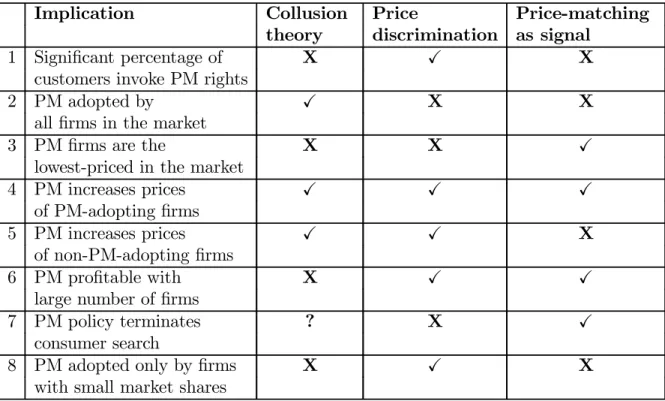
How can we distinguish our signalling theory from the other two main theories in the literature, collusion and price discrimination? The testable implications of the three theories, as summarized in Table 1, are discussed and evaluated against existing and new evidence in this section. To preview theÞrst three implications, for example: the observation of a signiÞcant proportion of consumers actually invoking price-matching rights is consistent only with the price discrimination theory, and required by that theory; the adoption of price matching by all Þrms in the market is consistent only with the collusion theory; the adoption of price matching only by the lowest priced Þrms in the market is consistent only with the theory of price-matching as a signal of low prices.
Implication Collusion Price Price-matching
theory discrimination as signal
1 SigniÞcant percentage of X X X
customers invoke PM rights
2 PM adopted by X X X
allÞrms in the market
3 PMÞrms are the X X X
lowest-priced in the market
4 PM increases prices X X X
of PM-adopting Þrms
5 PM increases prices X X X
of non-PM-adopting Þrms
6 PM proÞtable with X X X
large number of Þrms
7 PM policy terminates ? X X
consumer search
8 PM adopted only byÞrms X X X
with small market shares
Table 1: Summary of testable implications
The number of customers invoking price-matching rights
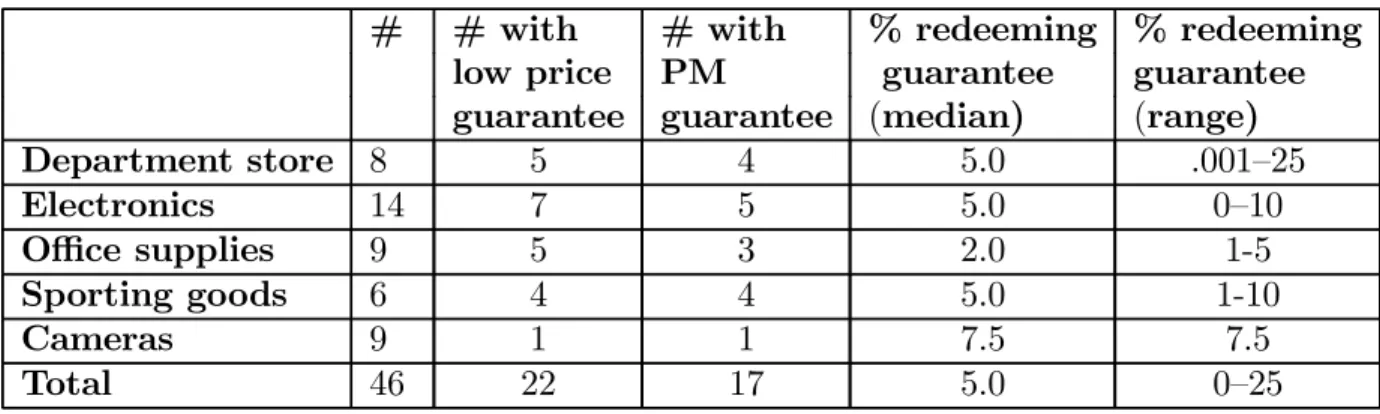
If price matching is used for the purpose of price discriminating, then a signiÞcant number of customers must exercise their rights under the guarantee to obtain lower prices from the price-matching Þrm. Gateway, for example, would not incur the expenses of an advertising campaign to advertise its price-matching guarantee in order to offer selective discounts to, say, 2 or 3 percent of its customers. On the other hand, if price matching is a cartel coordinating device, then the guarantee of matching discounts is a credible threat which the theory predicts will not be exercised in equilibrium, and if price-matching is a signal of low prices, then its purpose is solely as a credible signal that is costly for higher-priced (and higher cost)Þrms to duplicate. Since it is offered by only the lowest-pricedÞrms in the market, the rights under the guarantees are again not exercised. In short, the observation that none or very few customers invoke the guarantee to obtain lower prices from the price-matching Þrm is consistent with the cartel theory and the signalling theory but not with the price discrimination theory.# # with # with % redeeming % redeeming
low price PM guarantee guarantee
guarantee guarantee (median) (range)
Department store 8 5 4 5.0 .001—25 Electronics 14 7 5 5.0 0—10 Office supplies 9 5 3 2.0 1-5 Sporting goods 6 4 4 5.0 1-10 Cameras 9 1 1 7.5 7.5 Total 46 22 17 5.0 0—25
Table 2: Summary of data
no published data on this question. Accordingly, we surveyed 46 prominent retail-ers in the U.S. and Canada, from Þve categories: department stores (e.g., Sears, Bloomingdales), electronics stores (e.g., Radio Shack, Audio Accessories), camera stores (e.g., Central Camera, B&H Photo/Video), sporting goods (e.g., Oshman’s, Academy Sports), and office supply stores (e.g., Office Max, Goeller’s Office and Art Supplies).21 Each of these retailers was asked a series of questions about their price matching policies: whether they offered a low price guarantee, and if so, whether it was a price-matching or a price-beating guarantee, percent of customers redeeming a low price guarantee, and whether the redemption rate reported was based on a study by the Þrm or a “best guess.” In addition, we have information on whether the retailer is a “chain store” (one outlet of a multi-outlet retailer) or not.22 Not
all retailers with a low price guarantee reported a redemption rate–four of the 22 retailers offering a low price guarantee refused to divulge their redemption rate–and Þfteen of the eighteen retailers who did report, acknowledged that the redemption rate was a "best guess" rather than based on an internal company study. Table 1 summarizes the data.
21This was not a random sample of retailers. Our aim, however, is to show that examples of price
matching that can be plausibly explained only by the signalling motivation are found in actual retail markets.
22In general, we spoke with people in middle or senior management: the most common rank of
person surveyed, among the chain stores, was vice-president, and among the non-chain stores, store manager.
Percentage of customers Number of stores redeeming guarantee 0 1 0.001 1 1 2 1.5 1 2 1 5 7 7.5 2 10 3 25 1
Table 3: Reported Frequency of Redemption of Guarantee
The average reported redemption rate across the 18 retailers who offered a low price guarantee is 5.8% and 12 of the 18 reported redemption rates of 5% or less. Critically, among the four retailers whose reported redemption rates were based on internal studies rather than managers’ perceptions, the redemption rates were .001%, 1%, 2% and 10%. The 3 cases of redemption rates of 10%, and 1 case with 25%, are perhaps consistent with the price discrimination story (assuming, of course, that the reporting is accurate). But the majority of the cases are not. At a minimum, it seems highly unlikely that these retailers are using their low price guarantees to price discriminate between informed and uninformed consumers if only 5 percent or less of consumers are redeeming. Certainly, in 3 of the 4 most reliably reported data points, the price discrimination theory is not plausible. On the basis of this empirical implication alone, we are left with the price signalling theory and the cartel facilitation theory to explain the majority of cases in our data set.
Universality of price-matching within a market
The cartel theory, as it has been developed in the literature, predicts that allÞrms in the market offer price matching. In the absence of some asymmetries in the incentives forÞrms to cheat on a cartel price, there is no reason for the device to be adopted by only someÞrms within a given (product and geographic) market. An extension to the theory would allow a high-cost Þrm to offer a price-matching guarantee in order to deter a lower-cost Þrm from cheating: lower-cost Þrms generally have more incentive
to cheat on cartels than higher-costÞrms. The signalling theory predicts, by contrast, thatonly the lower-costÞrms adopt price-matching. The price-discrimination theory is also inconsistent with allÞrms adopting price-matching, since a Þrm can use price-matching as a price discrimination device only if some otherÞrm charges a lower price in equilibrium. This theory predicts, as well, that the higher-costÞrm would have a greater incentive to offer a price-matching guarantee since higher-costÞrms would like to charge higher prices than lower-costÞrms. In sum, the adoption of price-matching by all Þrms in a market is consistent only with the cartel theory, and to the extent not allÞrms do so, the signalling theory predicts that only the lower-costÞrms would offer them, whereas the other theories predict the opposite.
Our data clearly show that not all retailers in a given market offer price-matching guarantees. For instance: among electronics retailers, Best Buy offers a price-matching guarantee, but Radio Shack does not; among department stores, Dillards offers a price-matching guarantee, but Bloomingdale’s does not; among office supply stores, Staples offers a price-matching guarantee, but Berger Brothers Office Supply (in Wilmington, Delaware) does not; among sporting goods retailers, Oshman’s offers a price-matching guarantee, but Academy Sports does not; among camera stores, all except one retailer (Merkle Camera in Toronto) does not offer a price-matching or a price-beating guarantee.
Who invokes price-matching?
What distinguishes the retailers who offer a low price guarantee from those who do not? We would like to have direct measures of costs, or indices of prices for similar products across the sample of stores. Instead, we suggest that the status of a store as a chain store outlet is negatively correlated with price. In Table 2 we show a cross-tabulation of the retailer’s low price guarantee policy and whether or not it is a chain store. Clearly, whether the retailer is a chain store or not matters (Pearson’s
χ2(1) = 19.01, p < .001). Since chain-store retailers are likely to have lower costs than non-chain-store retailers, this supports the signalling theory, but not the cartel or price discrimination theories.
Chain store Not a chain store
Low price guarantee 21 1
No guarantee 8 16
Table 4: Cross-tabulation of low price guarantee provision and whether or not the retailer is a chain-storer
guarantees shows that in a substantial number of cases the rate is very small, sug-gesting that in these cases the price-matchingÞrms are at or near the low-price point of the market.23
Impact of price-matching on prices of price-matching
Þ
rms
If one is examining prices in a given product market across a variety of geographic markets or areas, or comparing prices in a given region before and after price-matching is adopted, then the prediction of the cartel theory is that price-matching causes the prices of the price-matching Þrms to increase. After all, the purpose of the instrument is to protect cartel pricing in this theory. Under the price discrimination theory, the list prices of aÞrm will also rise with the adoption of price-matching as the Þrm avails itself of the opportunity to charge higher prices to consumers with more inelastic demands. (The average transactions price, net of price-matching refunds, may rise or fall.) In the signalling theory, where the purpose of price-matching is to23Edlin (1997) offers an argument as to why the price-matching Þrms might not be the highest
priced in the market:
"Another reason that price will vary among sellers and that only some sellers should be expected to adopt price matching is that sellers often have different costs. When costs differ, the monopoly price for a low-cost seller will be lower than for a high-cost one. The low-cost seller will have no reason to raise its price above its own monopoly price, but the high cost seller will typically charge a higher price. If a seller has costs so high that it is unproÞtable to sell at the price of low-cost
Þrms, it will abandon its matching policy and specialize in selling to uninformed buyers. . .Thus, in practice, we should not necessarily expect everyÞrm to post the same price, nor everyÞrm to offer a matching policy." (footnote deleted). However. in Edlin’s model, the only basis for price-matching is price discrimination, under which theory the lowest Þrms in the market have no incentive for invoking the practice.