The Potential Impact of Explicit Basel II Operational Risk Capital Charges on the Competitive Environment of Processing Banks in the United States*
Patrick de Fontnouvelle Victoria Garrity
Scott Chu Eric Rosengren
Federal Reserve Bank of Boston January 12, 2005
Executive Summary
Basel II replaces Basel I’s implicit capital charge on operational risk with an explicit charge. Certain U.S. banks concentrated in processing-related business lines – which have significant operational risk – could thus face an increase in overall minimum regulatory capital requirements. Some have argued that, as a result, these so-called “processing banks” would be disadvantaged vis-à-vis competitors not subject to regulatory capital requirements for operational risk.
This paper evaluates these concerns. To do so, we first describe the five markets where processing banks have concentrated their activities: securities custody,
institutional asset management, mutual fund management, private wealth management, and general processing. Second, we investigate whether the major competitors in each market are expected to be subject to regulatory capital requirements for operational risk. Third, we consider whether the processing banks would actually need to raise capital to accommodate the new operational risk charge.
*
The opinions expressed in this paper do not necessarily reflect those of the Federal Reserve Bank of Boston or the Federal Reserve Board.
The information we gather suggests that processing banks are well positioned for the introduction of an explicit operational risk charge. In global custody, almost all competitors are banks that are expected to adopt Basel II. The likelihood that the operational risk charge would have a competitive impact on the processing banks in this business line thus appears small.
In institutional asset management, the main competitors who will not be subject to a regulatory charge for operational risk are firms that specialize in asset management and are not part of a bank holding company or other financial conglomerate structure. These “stand-alone” asset managers’ high equity-to-assets ratios suggest that the market already requires them to hold capital sufficient to cover their operational risk exposures. The asset management affiliates of two European insurance groups also rank among the top institutional asset managers. However, both of these insurance groups already
incorporate operational risk in their internal risk-based capital calculations.
The processing banks do not have a dominant presence in the mutual fund market. Only one processing bank ranks among the top thirty U.S. mutual fund providers, and that bank is expected not to be required to adopt Basel II. Thus, it would seem that the new operational risk charge is not a significant competitive issue in this business line. In any case, the main competitors in mutual fund management who would not be subject to an operational risk charge are stand-alone asset managers, who appear highly
capitalized and might not need to raise additional capital even if subject to Basel II. Three processing banks rank among the top U.S. private wealth managers. They face competition in this market from investment banks, large U.S. banks, and foreign banks, all of which are expected to face regulatory capital requirements for operational
risk. Smaller U.S. banks that will not be required to adopt Basel II – and will thus not be subject to an explicit capital charge for operational risk – are also active in this market. However, these banks would remain subject to Basel I’s implicit operational risk charge, and are expected to face higher overall minimum regulatory capital requirements than if they were to opt in to Basel II.
In general processing, competitors include many other financial firms that are expected to face a regulatory capital requirement for operational risk. Processing banks also face potential competition from firms that are not subject to capital regulation. However, these non-financial competitors tend to be highly capitalized – as evidenced by their high equity-to-assets ratios – and do not have the benefits from the federal safety net that banks enjoy. Although they are not subject to any regulatory capital requirement, these firms appear to be subject to a market-determined capital requirement to cover all of their risks including operational risk. Thus, the playing field in general processing appears level in the sense that banks will be held by the regulators to certain capital standards under Basel II, and non-banks will be held to similar or higher standards by the market. The competitive impact of the operational risk capital charge in the processing business line could be blunted further by the fact that many processing services are bundled with custody services, a business line where almost all of the major providers are banks that are expected also to face an operational risk charge.
We next consider the relationship among minimum regulatory capital
requirements and other capital measures at the processing banks to evaluate whether an increase in regulatory capital requirements might force these banks to raise additional capital. We address two questions in this regard: whether the processing banks are
currently holding capital in excess of minimum regulatory requirements, and whether they are doing so because they are already being required by the market to hold sufficient capital to cover their operational risks. If the market currently demands a significant capital “buffer” over current minimum regulatory requirements that do not include an explicit operational risk capital charge, it is unlikely that Basel II would require the bank to raise additional capital.
We find that the U.S. processing banks hold a significant amount of capital in excess of current regulatory minima. The results are suggestive that the processing banks would be able to align regulatory capital with levels suggested by their internal models without raising additional capital. In fact, the amount of capital actually held by processing banks – either because of market or rating agencies’ demands or because of their own internal risk evaluations – suggests that these institutions may already be holding capital for operational risk.
These arguments and evidence suggest that the potential competitive effects of the Basel II operational risk charge will be, at most, modest. The processing banks hold considerable capital in excess of the regulatory minima under Basel I, suggesting that they are already covering their operational risks in order to satisfy market/rating agency demands. Furthermore, many of the processing banks’ competitors are banks and other firms who will likely face a regulatory charge for operational risk. Although the
processing banks also compete against firms that will not face an explicit operational risk charge, the market appears to require these latter firms to hold sufficient capital to cover their operational risk exposure.
This having been said, the operational risk charge under Basel II could still reduce the buffer between actual capital held and minimum regulatory requirements to levels below what is desired by management for financial flexibility. If, as a result, processing banks raised additional capital, their costs could rise, adversely impacting their
competi-tive position. Although our analysis of capital ratios suggests that U.S. processing banks
are most likely to be able to accommodate the new charge for operational risk without increasing total actual capital levels, the analysis is not definitive. If the processing banks’ total actual capital held does increase due to Basel II, and the non-banks’ total actual capital held is unchanged, processing banks could face reduced profits or market share.
However, this possibility should be viewed in perspective. Although the minimal leverage (i.e., high equity-to-assets ratios) displayed by non-banks does not eliminate the potential for a competitive impact on banks, it does affect the interpretation of this possible impact. As none of the non-banks has access either to the federal safety net provided to banks or faces any regulatory capital requirements, their relatively high equity-to-assets ratios could be considered a proxy for the capital the market requires for asset management and processing activities. Thus, even if the operational risk charge leads to an increase in total actual capital held by processing banks, it appears that the new requirements would still be less than the amount of capital held by prudently-run asset management and processing firms that do not have access to the benefits of the federal bank safety net.
The Potential Impact of Explicit Basel II Operational Risk Capital Charges on the Competitive Environment of Processing Banks in the United States*
Patrick de Fontnouvelle Victoria Garrity
Scott Chu Eric Rosengren
Federal Reserve Bank of Boston January 12, 2005
Abstract
This paper considers the potential competitive impact of the Basel II capital charge for operational risk. Some have expressed concerns that this new charge could lead to an increase in total minimum regulatory capital for U.S. processing banks, as they face more operational risk relative to credit risk than most other banking organizations. In this case, some believe that processing banks could be placed at a competitive disadvantage vis-à-vis some of their competitors who do not face a similar charge for operational risk. To address these concerns, we consider the processing banks’ main business activities: custody, general processing, and asset management. We find that in custody, the main competitors are banks, almost all of which are expected to face an operational risk charge under Basel II. In processing, many non-bank competitors display a minimal degree of financial leverage, and thus appear to have higher capital levels than the processing banks would be required to have under Basel II. In asset management, many competitors are expected to face Basel II-based capital charges for operational risk, or already have much higher capital ratios than the processing banks. We also note that the U.S. processing banks generally hold significant capital buffers in excess of regulatory capital
requirements, so that any increase in minimum regulatory capital may not necessarily lead to an increase in actual total capital held. Overall, the information we present suggests that the competitive effects of the Basel II operational risk charge will be, at most, extremely modest.
*
The opinions expressed in this paper do not necessarily reflect those of the Federal Reserve Bank of Boston or the Federal Reserve Board. The authors thank Linda Barriga, Robert Crepinsek, Kimberly DeTrask, Kabir Dutta, Amy Kingsley, Paul Marcotte, Cynthia Martin, Peter McAvoy, Phil Patch, Jason Perry, Michael Ravid, Ricki Sears, and Maureen Tighe for their significant contributions. We also thank Roger Cole, Steven Durfey, Edward Ettin, Diana Hancock, Erik Heitfield, Daryl Hendricks, Beverly Hirtle, David Jones, Myron Kwast, Michael Macchiaroli, Eugene Morris, Mark O’Dell, Mark Schittig, Amrit Sekhon, and Mitch Stengel for their helpful comments on an earlier draft of this paper.
1. Introduction
Over the past decade, financial institutions have been developing statistical models to assess their overall risk profile, and to ensure that capital is sufficient to cover unexpected losses. Such models, generally referred to as economic capital models, have many applications. In addition to serving as risk management and measurement tools, economic capital models are used to guide investment decisions and determine executive compensation.
As financial institutions have increased the sophistication of their economic capital models, they have also expanded the range of risks they attempt to measure. One area where significant progress is being made in this regard is the measurement of
operational risk. Traditionally, operational risk exposure was either measured in an ad
hoc manner (e.g., as a fixed percent of revenues) or was not measured at all. Many banks
have now incorporated operational risk in their economic capital models, and are using the models’ output to allocate operational risk capital across the organization. Some are even publicly disclosing estimates of their aggregate operational risk exposure, together with the capital that they hold for operational risk.
As banks have developed improved economic capital models, regulators have undertaken a concerted effort to incorporate the improvements into regulatory capital requirements. The intent is to use the principles of economic capital to better align minimum regulatory capital requirements with banks’ actual risk exposures. As part of this effort to leverage banks’ progress in economic capital modeling, Basel II, the current
proposal to revise the capital regulations for depository institutions, introduces an explicit
minimum regulatory capital charge for operational risk.1
Some banks have voiced support for an operational risk capital charge based on internal models and procedures. Others have expressed concern that banks concentrating on processing-related business lines – which have significant operational risk – could face a significant increase in overall minimum regulatory capital. As banks that have chosen to concentrate in processing activities compete against firms not subject to similar regulatory requirements, they argue that the new regulatory charge could place the banks at a competitive disadvantage.
This paper evaluates these concerns. To do so, we first describe the three markets where processing banks have concentrated their activities: securities custody, asset management, and general processing. Second, we investigate whether the major competitors in each market would be subject to an operational risk capital charge under the proposed minimum capital requirements. Third, we examine the relationship among other capital measures and minimum regulatory capital requirements at the processing banks to evaluate whether an increase in regulatory capital requirements might force these banks to raise additional capital.
Two significant caveats regarding our analysis are in order. First, sizing the
charge is complicated by the fact that the U.S. processing banks have not publicly
1
In June 2004, central bank governors and the heads of bank supervisory authorities in the Group of Ten (G10) countries issued a press release and endorsed the publication of “International Convergence of Capital Measurement and Capital Standards: a Revised Framework,” the new capital adequacy framework commonly known as Basel II. In the U.S., Basel II will be mandatory only for the largest banks – those with more than $250 billion in total assets or $10 billion in international exposure. Other banks will be allowed to opt in, provided that their risk management infrastructure meets the same standards required for the mandatory banks. Banks that do not opt in will remain under the current Basel I-based capital regime. Another notable feature of U.S. implementation is that participating banks will be required to adopt the advanced methods for determining capital requirements for both credit and operational risk.
disclosed estimates of their operational risk exposure. Second, detailed and
comprehensive data regarding these markets and the relevant firms are difficult to come by. Much of our analysis is thus more narrative than empirical, and should be interpreted accordingly.
The above caveats notwithstanding, the information we gather suggests that
processing banks are well positioned for the introduction of an explicit operational risk minimum capital requirement. In custody services, the most important activity for processing banks, all of the main competitors will be subject to capital requirements for operational risk. In processing, in which bank competitors are active, many non-bank competitors display a minimal degree of financial leverage, and thus appear to have significantly higher capital levels than the processing banks would be required to have under Basel II. The results are less clear in asset management. However, many asset managers will either also have Basel II-based mandatory operational risk capital charges or are much less leveraged than are processing banks.
We also find that the U.S. processing banks hold a significant amount of capital in excess of current regulatory and supervisory minima. The results are suggestive that the processing banks would be able to align regulatory capital with results from their internal models without raising additional capital. In fact, the amount of capital actually held by processing banks – either because of market or rating agencies’ demands or because of their own internal risk evaluations – suggests that these institutions may already be holding capital for operational risk.
The remainder of this paper is organized as follows. Section 2 identifies the processing banks, and discusses the markets in which they operate. Section 3 provides a
summary of Basel I and Basel II, as well as other U.S. and E.U. capital requirements faced by the processing firms identified in Section 2. Section 4 considers whether the processing banks would need to raise capital to accommodate the new operational risk charge. We consider two questions in this regard: whether the processing banks are currently holding a capital buffer over minimum regulatory requirements, and whether they are doing so because they are already basing their capital allocation decisions on economic capital models or are already being required by the market to hold excess regulatory capital to cover their operational risks. If a bank’s economic capital model suggests – or if the market demands – holding a significant capital buffer over current minimum regulatory requirements (that do not include an explicit operational risk capital charge), it is unlikely that the proposed changes in regulatory requirements would require the bank to raise additional capital. On the other hand, if the reduction in buffer capital erodes the processing banks’ flexibility to absorb shocks more than is tolerable to management, the new regulations might require processing banks to raise additional capital. Section 5 brings together the information from the previous sections to assess whether the new capital charge could place the processing banks at a competitive disadvantage, and if so relative to what competitors. Section 6 concludes.
2. Market Identification
To examine the potential competitive impact of an operational risk capital requirement on U.S. bank holding companies (BHCs), we focus on those firms with a small volume of credit-related activities relative to their operational activities. Under Basel II, such firms could have a higher percentage of operational risk capital to total
capital than other BHCs, and would likely not receive much of a benefit from reduced capital charges for lower-risk credit exposures. In contrast, U.S. institutions that are primarily engaged in lower-risk credit activities are expected to face a lower minimum regulatory credit risk (and total) capital charge than is required under current rules.
To identify firms focused on operational activities, we select those with a high share of income from such activities and a relatively small loan portfolio. More
precisely, we select firms with an operational income-to-total income ratio of more than
50 percent, and a loans-to-assets ratio of less than 50 percent.2 While these thresholds are
somewhat arbitrary, examination of Table 1 indicates that they do seem to distinguish between traditional commercial banks and those that have chosen to concentrate in processing activities.
Table 1 lists the top fifty U.S. BHCs, together with the ratio of operational income to total income and the ratio of loans to assets for each. Of the seven institutions meeting our selection criteria, we focus on the four domestic banks not primarily engaged in brokerage activities: State Street Corporation (State Street), Mellon Financial
Corporation (Mellon), Northern Trust Corporation (Northern), and The Bank of New
York Corporation (BNY).3 We refer to these four institutions as “the processing banks.”
To assess the potential competitive impact of the proposed Basel II operational risk capital charge, we first consulted with staff at the processing banks to determine the non-credit related business lines in which these firms participate. We also reviewed
2
Operational income is defined as income from the following sources: fiduciary activities; investment banking, advisory, brokerage, and underwriting; venture capital; servicing; and other non-interest income earning activities as defined in the instructions to the form FR Y-9C. Total income is defined as net interest income plus noninterest income. Insurance underwriting income is excluded from both non-interest income and total income.
management’s description of business activities contained in annual reports, and
considered the primary sources of reported non-interest income for each bank. Based on this information, we found that the processing banks are primarily engaged in the
following three non-credit related businesses lines: custody, asset management, and general processing.
We then consulted with knowledgeable industry sources to understand the nature and structure of these business lines, and to identify the main competitors in each. These sources included staff at banks, asset managers, and rating agencies, as well as Federal Reserve examiners specializing in each of the processing banks. Table 2 lists the external sources with which we held discussions to gather information for this paper. Our
findings for each of the three business lines are presented in Sections 2.1-2.3, below.
2.1 Custody
Custody is a primary business line for each of the four processing banks. At its most basic level, custody is defined as the business of providing safekeeping and settlement for client assets. Custodians are responsible for holding a broad range of financial assets, including equities and bonds on behalf of their clients, and for handling the back-office portion (settlement) of a securities trade which involves the exchange of a financial instrument for cash. Typical custody clients include pension and retirement funds, asset managers, insurance companies, and banks.
3
We do not consider Taunus or CIBC Delaware as they are owned by foreign parents (Deutsche Bank and CIBC, respectively). We do not consider Charles Schwab because they are primarily a securities firm rather than a bank.
Global custody is the business of providing settlement and safekeeping on a cross-border basis. Global custody is distinguished from domestic custody in that domestic custody relates to financial assets from only one country, while global custody involves handling assets and currencies from different countries. Technically, a custodian could be called “global” if it services assets in at least two countries. However, the major global custodians typically cover 100 national markets or more.
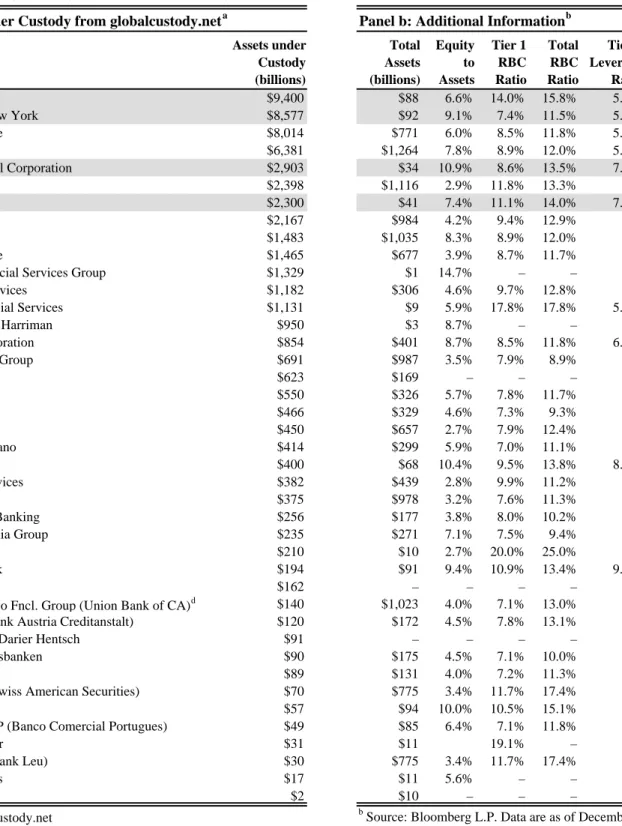
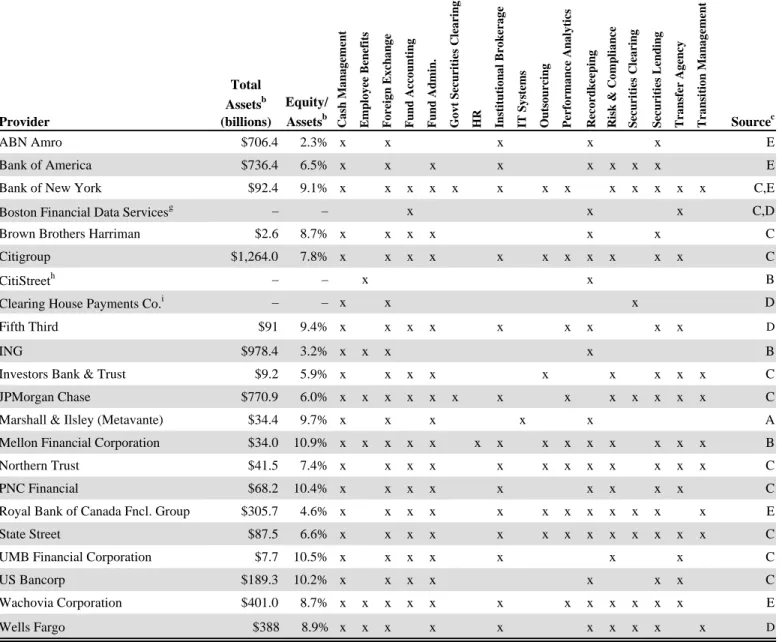
Tables 3 and 4 list the largest global custodians by assets under custody (AUC), the standard size measure in the custody business, as well as some background
information about the custodians. A custodian’s size and the breadth of its global network are two important factors in determining its success in the global custody market, as custody involves significant economies of scale and scope. Within the group listed in Table 3 is a subset of firms that are viewed by the industry as major global custodians. This subset can be identified by the indicators in the table that report which companies were included in two industry-recognized surveys of the top providers in the
custody business (panel b).4 Table 3 also includes an indicator for the geographic areas
in which each custodian services clients and a list of the types of clients served.
Table 3 indicates that most global custodians are banks.5 That the only U.S.
institutions on the list are banking groups may reflect certain features of the infrastructure of the U.S. banking system. Fedwire, the Federal Reserve System’s electronic payment processing service, provides custodians with the ability to move funds through the
4
The Buttonwood Survey is an annual survey that provides specific information on companies that Buttonwood International, an industry research group, deems to have the size and scale to be significant competitors in the global custody market. The institutions in this survey overlap significantly with those on the list of the largest global custodians by assets under custody (AUC). The Global Investor Magazine survey is an annual survey of custody clients that identifies the predominant global custodians and measures customer satisfaction with these custodians.
financial system for same day settlement, but an entity must be structured as a bank to access Fedwire. Fedwire also allows custodians to move government securities through the financial system with the same rapidity and finality as funds; trades in these securities can be settled only on Fedwire or on the books of a depository institution with access to Fedwire. The bank infrastructure also provides U.S. banks with access to the discount window, which provides the benefit of an emergency source of liquidity, and thus a competitive advantage vis-à-vis non-bank competitors, since the ability to transfer funds and securities rapidly and with certainty is highly valued by custodial customers.
2.2 Asset Management
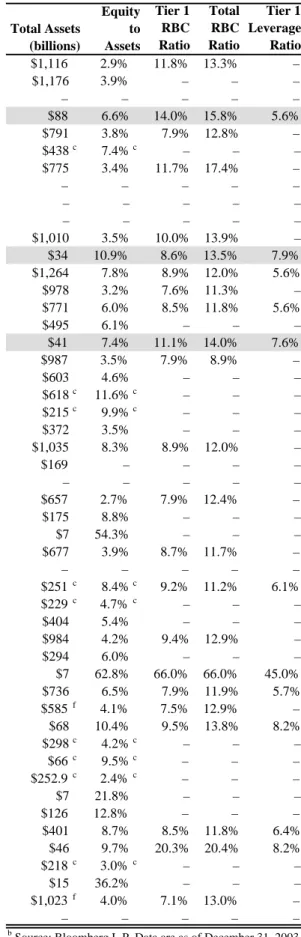
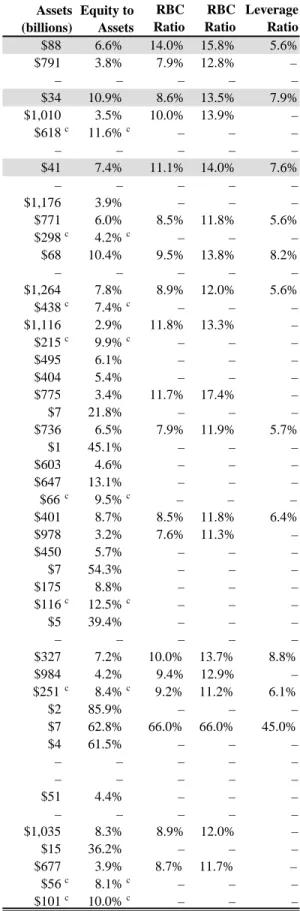
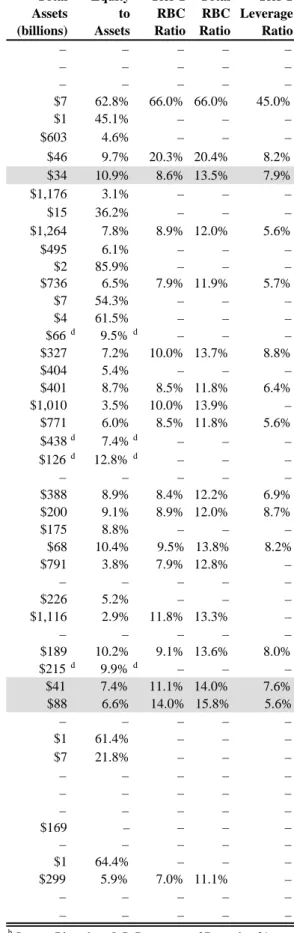
Asset management is the process of investing client assets according to specified objectives, monitoring such investments, and changing investment allocations as market factors change. Table 5 provides a list of the largest asset managers based on worldwide assets under management (AUM) as of 12/31/03. AUM, the volume of funds invested on behalf of clients, is the standard measure of market share in the asset management industry. Table 5 also reports total balance sheet assets, as well as equity-to-assets ratios and risk-based capital ratios (panel b). For insurance companies reported in Table 5 (and in all other tables), separate account assets are excluded from both total assets and
equity-to-assets.6 This is done in order to put these figures on the same basis as those for banks,
whose assets under management are not included in balance sheet assets.
5
Except for SIS Segaintersettle AG which is owned by a group of Swiss banks (including UBS and Credit Suisse) and serves as a central securities depository for Switzerland.
6
In the U.S. and certain other countries, separate account assets are included as offsetting line items in the asset and liability portions of insurance companies’ balance sheets.
As Table 5 shows, the top asset managers include not just banks, but also insurance affiliates and non-depository firms specializing in asset management. In contrast to the custody function, the ability to access Fedwire or the discount window (or more generally being a bank) adds no special advantage (or disadvantage) to the asset management function. As will be seen in Section 3, each of the entity types that conduct asset management is subject to different regulatory requirements regarding operational risk capital. This will make the analysis of the operational risk capital charge more complex as compared to global custody, where most competitors were banks.
Interviews with industry experts, as well as multiple trade publications and data sources, suggest that the asset management market can be broken down into three submarkets based on the type of client served: institutional asset management, mutual fund management, and private wealth management. The following sections provide an overview of each.
a. Institutional Asset Management
Institutional asset managers provide investment management services, typically in the form of separate accounts, to clients such as pension funds, financial institutions, and foundations and endowments. All four processing banks offer institutional asset
management services to clients on a worldwide basis. For the purposes of this analysis, the institutional market is viewed as a global market, and competition is measured by worldwide AUM. Table 6 lists the fifty largest institutional asset managers by worldwide AUM.
As shown in Table 6, three of the four processing banks under consideration (Mellon, Northern, and State Street) are among the top ten global institutional asset
managers. (BNY manages $58 billion in institutional assets, ranking 56th among global institutional asset managers.) Several non-banking U.S. firms specializing in asset
management (Fidelity, Wellington, and Vanguard) also rank among the top ten, as do two foreign banks (Barclays and Deutsche Bank). Rounding out the top ten are several affiliates of insurance companies (AIG and Allianz). The top of the list is dominated by firms with large passive management businesses (State Street, Barclays, and Vanguard),
because there are significant scale economies in this area.7
Interviews with industry participants suggested that firms are typically classified along multiple dimensions within the institutional asset management market. Two of the most important such dimensions are asset classes offered (e.g., equity, fixed income, cash), and types of strategies offered (e.g., active vs. passive, quantitative vs.
fundamental).8 To keep the length and complexity of the paper manageable, we did not
pursue these additional dimensions. This approach can be considered conservative, as segmenting institutional asset management into multiple submarkets would reduce the likelihood of any two firms being considered direct competitors.
b. Mutual Fund Management
A mutual fund pools money from shareholders and invests it in a diversified portfolio of securities. In the U.S., mutual funds are structured as investment companies with their own governance structure, and are owned by the fund shareholders. A fund
7
Passive management refers to the strategy of managing a portfolio to match the return of a benchmark, such as a market index. Active management refers to the strategy of managing a portfolio with the aim of exceeding the return on a benchmark. Scale economies arise in asset management because the number of staff required to manage a large pool of assets is not much greater than the number of staff required to manage a small pool of assets. For active strategies, however, these scale economies are offset by the difficulty and cost of taking large positions in individual securities, which is necessary if the benchmark is to be exceeded.
manager is hired by the mutual fund to manage the investment portfolio in accordance with the stated objectives of the fund prospectus.
All of the processing banks provide mutual fund management services.9 As they
offer mutual funds mostly to U.S. clients, our analysis will focus on the U.S. market.10
Table 7 lists the largest mutual fund companies in the U.S. It is worth noting that due to data limitations, the mutual fund assets reported in Table 7 come from both institutional and retail investors, so that there is some overlap with the institutional assets considered
in section 2.2a.11 However, the firms listed as top competitors in Table 7 all have a
significant presence in the retail segment of the mutual fund market.
The top three U.S. mutual fund companies are firms that specialize in asset
management and are not part of a bank holding company or other conglomerate structure. (We will refer to such firms as “stand-alone asset managers.”) None of these three firms
is publicly traded, so there are very limited financial data for them.12 As with the
institutional asset management market, banks and insurance affiliates are also competitors.
The mutual fund market can be segmented along multiple dimensions. Like institutional asset managers, mutual fund managers can be classified by asset classes and strategies offered. However, the mutual fund market could also be segmented by
8
A quantitative manager selects his portfolio via mathematical formulae, whereas a fundamental manager relies on more traditional “stock picking” techniques.
9
BNY’s mutual fund assets (approximately $11 billion) were not large enough to place it among the top 50 firms reported in Table 7.
10
It is natural to segment the market is this way, as SEC regulations permit only U.S.-registered mutual funds to market themselves to customers in the U.S.
11
Our data on mutual funds are collected from the CRSP mutual fund database. Based on the information provided in this database, it is not possible to segregate retail and institutional assets. In its 2004 Mutual Fund Fact Book (p. 138), the Investment Company Institute reports that 46 percent of all mutual fund assets were held in institutional accounts as of year-end 2003.
distribution channel. For example, some mutual fund companies “own” their distribution channel; some distribute via commissioned brokers; and some distribute via mutual fund “supermarkets.” Some of the industry experts we interviewed suggested that firms operating via different distribution channels would not tend to view themselves as direct competitors. We also believe that the relationship between size and competitiveness is quite nuanced in mutual fund management. On one hand, smaller companies not shown on Table 7 can be viable competitors against even the largest firms, especially if they have one or two successful niche strategies. On the other hand, size does offer several benefits in this market, as larger firms are typically more well-known, and there may be scale economies in mutual fund marketing and distribution. As with institutional asset management, however, we will take the conservative approach of not pursuing more granular segmentations of the mutual fund market.
c. Private Wealth Management
Private wealth managers provide investment management services to wealthy individuals and families. Mellon, Northern, and BNY provide private wealth
management services and focus this business primarily on U.S. clients.13 As a result, our
analysis focuses on companies that compete for U.S. clients.14 The 40 largest such firms
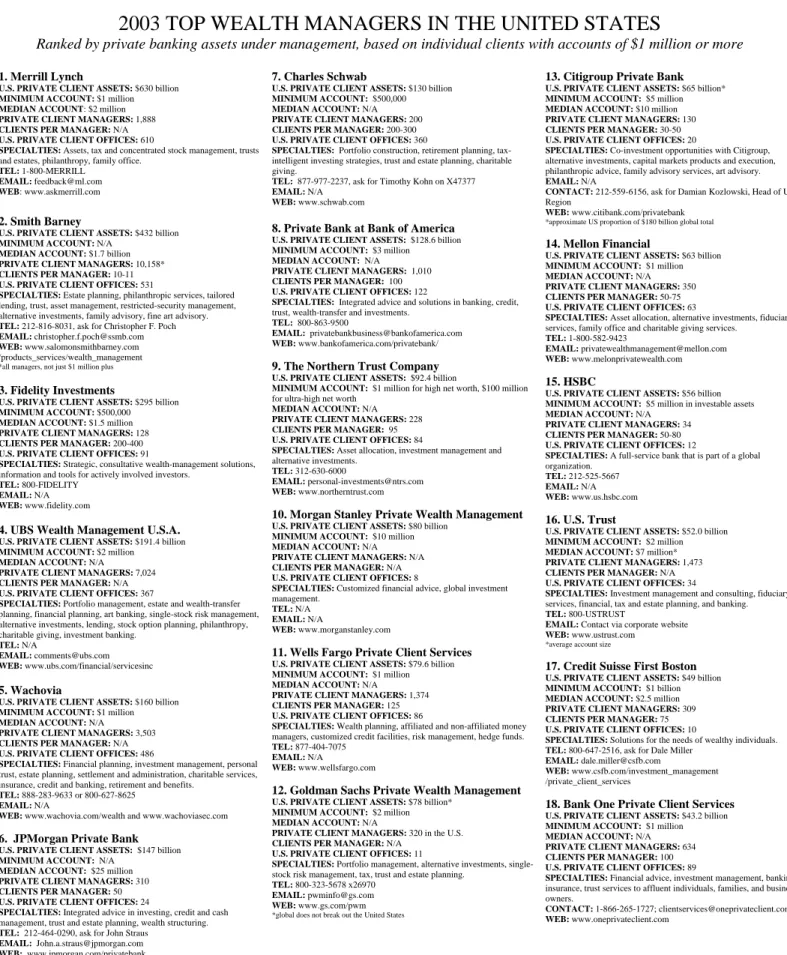
as of June 2003 are listed in Table 8. Northern, Mellon and BNY are ranked 9, 14, and 24, respectively.
12
Fidelity and The Capital Group Companies are privately held, and Vanguard is a mutual company (owned by the shareholders of its funds).
13
State Street sold its private wealth management business in 2003 to US Trust.
14
It is possible that certain wealthy U.S. citizens may seek out a private banker that has no presence in the U.S. However, our interviews with industry participants suggested that a physical presence in the U.S. is required to compete in this market, as this is a highly relationship-driven business.
Merrill Lynch and Citigroup (Smith Barney) dominate this market with $630 billion and $497 billion in assets under management, respectively. Fidelity ranks third, with $295 billion in AUM. Most of the other firms listed in Table 8 are banks. These bank competitors include large U.S. banks (e.g., J.P. Morgan Chase), smaller U.S. trust companies (Bessemer Trust), and foreign banks (UBS). The predominance of banks in this market may be explained by cross-selling (e.g., banks have other products besides asset management that high net worth individuals are interested in) or by marketing (e.g., being a bank is a natural advantage in a market where stability and dependability are key attributes of any player). Interestingly, only one processing bank (Northern) ranks among the top ten private wealth managers.
2.3 Processing
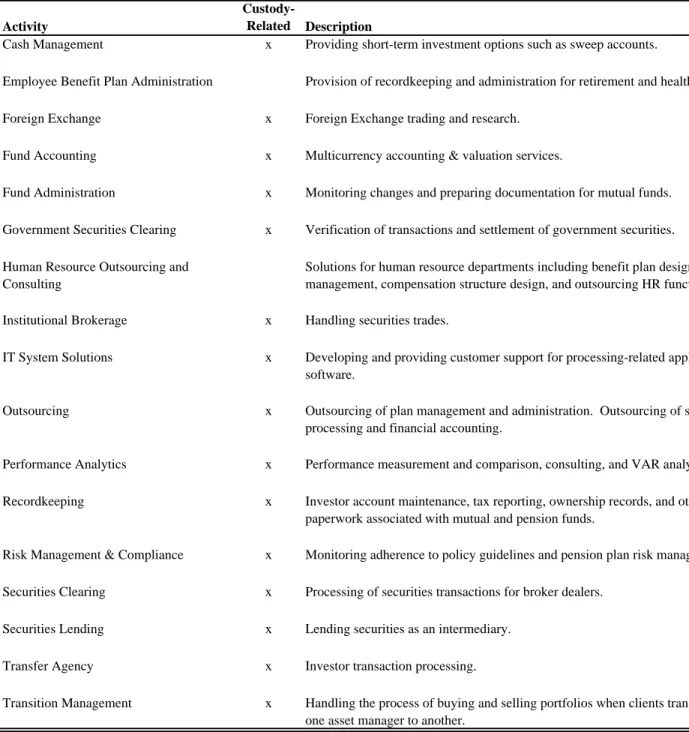
The focus of this paper is on activities undertaken by the processing banks that do not involve the extension of credit. We have already considered the two most important such activities, custody and asset management. In this section, we will define the term “processing” to include all other material non-credit business lines undertaken by the processing banks. To identify these business lines, we gathered information from various documents (e.g., annual reports, websites) for each processing bank, and confirmed this information with resident examiners and with staff at the banks themselves. The business lines we identified via this process are listed in Table 9.
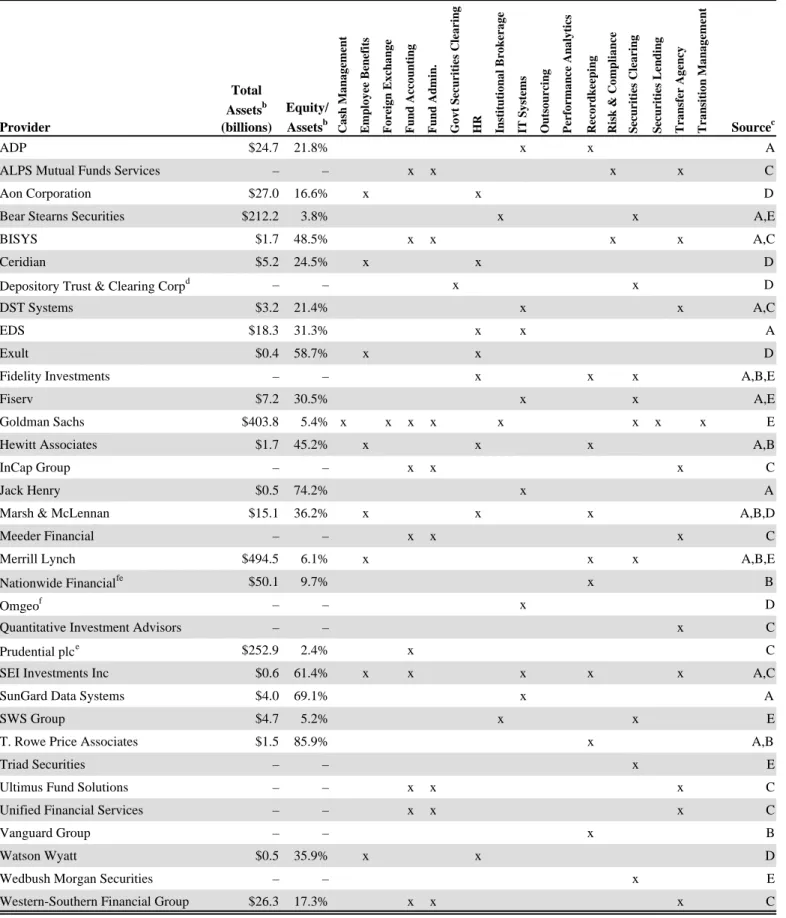
There is no comprehensive list of firms engaged in the processing business lines listed in Table 9. We consulted multiple sources to construct such a list. These include Hoovers’ list of major competitors for each processing bank, industry surveys, and
business line overviews published in various trade journals. We confirmed this information and also added a few firms through interviews with examination staff, the processing banks, and other industry participants. The resulting list is limited to the U.S. processing market, as that was the focus of most of the data sources we identified. Otherwise, the list is probably overly inclusive, in that it includes firms that may not be direct competitors of the processing banks. Table 10 lists all of the processing firms identified, as well as the processing activities in which they compete.
In recent years, the custody market has become more complex as custodians have expanded their service offerings. It is now typical for global custodians to provide a bundled custody product to clients, which includes the provision of one or more of the
processing services listed in Table 9, along with custody.15 Banks may enjoy a
competitive advantage when custody-related activities are bundled with the core custody product. Many clients also prefer to obtain processing services from their custodian, as it can be more efficient from both management and cost perspectives. As indicated in
Table 9, fifteen of the seventeen processing activities we consider are custody-related.16
While custody and related processing services are often purchased as a bundled product, there are instances when custody clients choose to obtain one or more of the custody-related services in Table 9 from a company other than a global custodian. Non-financial technology-oriented companies such as Sungard and BISYS may provide a few
15
See “Custody Clients Demand More,” Global Investor, May 2000, p. 14; “Searching for the Cream: Added Value,” Financial Times, 7/14/00, p. 7.
16
We have identified only two processing activities that are not related to custody: employee benefit plan administration, and human resource outsourcing and consulting. State Street provides benefit plan administration primarily in the U.S. through CitiStreet, a joint venture with Citigroup. Mellon, through their Human Resources & Investor Solutions business line, provides human resource services that include outsourcing human resource functions and consulting on issues such as employee retention and health care costs.
of these services or the technology for a client to perform the service themselves. However, such companies do not provide the core custody product or a full range of processing services. They also tend to focus on smaller clients and have a more limited geographic scope than the global custodians.
At this point, it is unclear to what extent the non-bank entities are directly
competing with the processing banks to provide processing services. On one hand, most processing activities are closely related to custody, where banks have special advantages. On the other hand, customers can purchase processing services separately from non-bank providers, and in certain instances have done so. For the purposes of this paper, we will assume that non-banks are fully competitive with banks for the provision of custody-related services. This is a conservative assumption, in that it increases the likelihood of identifying a potential competitive impact for the operational risk capital charge, since non-banks would not be subject directly to Basel II capital requirements.
3. Capital Regulation Faced by Processing Banks and Their Competitors
This section reviews current and future operational risk capital requirements for firms competing in the custody, asset management, and processing markets. We first discuss the two Basel Accords, and then focus on U.S. regulatory capital requirements for the processing banks and their competitors. We conclude with a parallel discussion of capital requirements for non-U.S. firms. As almost all of these are domiciled in Europe, we focus our attention on the E.U. regulatory environment.
3.1 The Basel Accords
In 1988, the Basel Committee on Banking Supervision issued the Basel I
framework governing capital adequacy for internationally active banks. The Committee sought to strengthen the soundness and stability of the international banking system and to foster regulatory consistency across different countries, thereby reducing an existing source of competitive inequality. Basel I set minimum regulatory capital at 8 percent of risk-weighted assets, and also specified two tiers of capital. Tier 1 capital is primarily equity capital and retained earnings, and must represent at least 4 percent of risk-weighted assets. Tier 2 capital includes such elements as loan loss reserves, hybrid capital instruments, and subordinated debt.
Basel I incorporated only crude proxies for risk: the calculation of risk-weighted assets captured primarily credit risk based on a simple classification of exposures into four buckets. Banks’ internal economic capital models, being more risk-sensitive than Basel I, derived different capital assessments than the regulatory framework. In general, regulatory capital exceeded economic capital for banks’ less risky assets, while economic capital exceeded regulatory capital for the more risky assets. On average, regulatory minimum capital was probably exceeded by economic capital at the typical bank. The minimal risk-sensitivity of the Basel I capital weights – with their resultant deviations from economic capital estimates – encouraged banks to move safer assets off balance
sheet through securitizations. Because of this regulatory arbitrage, regulatory capital
ratios have become increasingly disconnected from banks’ true financial risk profiles. The new Basel Accord is intended to use the principles of economic capital to better align minimum regulatory capital with banks’ actual risk exposures. Banks will be
expected to have sufficient capital to cover significant but not catastrophic losses. Basel II will require banks to use formal procedures (e.g., internal ratings) to measure credit risk, and will require them to hold capital for unexpected losses based on those
procedures.17 Another major innovation is the introduction of an explicit capital charge
for operational risk.
Basel II lays out a series of increasingly sophisticated approaches for measuring both credit and operational risk. The most sophisticated are the Advanced Internal Ratings Based (AIRB) approach for credit risk, and the Advanced Measurement
Approach (AMA) for operational risk.18 The intent of the Basel Committee is to calibrate
the simpler approaches to yield a higher capital charge than would be expected under the advanced approaches, thus encouraging banks to migrate to the AIRB and AMA. It is expected that for many banking organizations using the advanced approaches, the sum of the credit and operational risk charges may result in a somewhat lower total minimum regulatory capital charge than under Basel I, particularly if the portfolio exposures at the particular bank are less risky than average.
The Advanced Measurement Approach allows a bank to hold regulatory capital for operational risk based on its own internal procedures, provided that these conform to a general framework laid out by the regulators. One key element of this framework is the formal definition of operational risk, which is “the risk of loss resulting from inadequate
17
Basel II does not require banks to hold credit risk capital to cover expected losses (EL), provided that eligible loan loss reserves meet or exceed EL. If eligible reserves fall short of EL, Basel II reduces measured Tier 1 and Tier 2 capital.
18
The two simpler models for operational risk are the Basic Indicator Approach and the Standardized Approach. Banks using the Basic Indicator Approach must hold capital for operational risk equal to the average over the previous three years of a fixed percentage of positive annual gross income. In the Standardized Approach, banks’ activities are divided into eight business lines, and the capital charge for
or failed internal processes, people and systems or from external events.” To convey a less formal and more intuitive understanding of what operational risk is and why it is important, we also consider four causal categories into which operational losses can be
classified.19 The first such category is fraud, which includes activities such as rogue
trading, embezzlement, and theft. The second category consists of lawsuits arising from improper business practices; this category is very broad, and the alleged behavior can range from anti-competitive practices to false advertising to employee discrimination. A third category covers losses caused by system failures (e.g., computer and
telecommunications equipment breakdowns) and process failures (e.g., “fat finger” trades and model errors). The final category covers losses arising from physical causes such as terrorism, natural disasters, and workplace safety.
Banks will also be required to incorporate four major elements into their operational risk quantification methodology. These are:
• Internal loss data. Institutions must collect data on their own operational loss
history. The data must cover at least five years, and should cover all loss types and all material business lines.
• External loss data. The term “external loss data” refers to data on operational
losses that have occurred at other financial institutions. AMA banks are required to consider such data as a supplement to internal data for low-frequency risks to which they are exposed.
• Scenario analysis. Scenario analysis refers to a systematic process for
obtaining expert opinions regarding the likelihood and potential impact of large operational losses. Like external data, scenario analysis is meant to supplement internal data in cases where a bank’s own experience is limited.
19
We have diverged somewhat from the standard Basel loss types for expositional purposes. The standard loss types are: internal fraud; external fraud; employment practices and workplace safety; clients, products, and business practices; damage to physical assets; business disruption and system failure; and execution, delivery, and process management.
• Business environment and internal control factors. Banks are required to monitor and measure both the external business environment and the internal control environment, and to adjust capital for changes that have not been reflected in the other three components of the framework (internal data, external data, and scenarios).
The rules allow banks considerable flexibility in combining these four elements, and impose no minimum standards on how much weight should be given to each. However, banks are required to consider each when estimating their Aggregate Loss Distribution (ALD), which represents the total losses they may face over a one year period. Basel II requires a bank to hold capital for unexpected losses (UL) from operational risk, where
UL is defined as the difference between the mean and the 99.9th percentile of the ALD.20
As noted, the expectation is that most banks adopting the AIRB and AMA will have a modest reduction in their minimum regulatory capital stemming mostly from the treatment of certain low-risk credit exposures. However, processing banks, by definition, have modest credit exposures and relatively high operational risk exposures. As
operational risk is not explicitly addressed under Basel I, processing banks might well
have their minimum regulatory capital increased under Basel II. However, as we shall
see, this may not necessarily imply an increase in total capital held.
3.2 The Regulatory Framework for U.S. Financial Institutions
This section introduces current and proposed regulatory frameworks for financial institutions in the U.S., and seeks to identify which firms discussed in Section 2 would be subject to an explicit operational risk capital charge under Basel II.
20
The Basel II Accord states that “to base the minimum regulatory capital requirement on UL alone, the bank must be able to demonstrate to the satisfaction of its national supervisor that it has measured and accounted for its EL exposure.” See Basel Committee on Banking Supervision (2004, p. 144). The
a. The U.S. Implementation of Basel II
There are two notable features of the U.S. implementation of Basel II. First, Basel II will be mandatory only for the largest U.S. banks – those with more than $250 billion in total assets or $10 billion in international exposure. Other banks will be allowed to opt in, provided that their risk management infrastructure meets the same standards required for the mandatory banks. Banks that do not opt in will remain under the current Basel I-based capital regime.
U.S. banks do not publicly disclose their international exposure, nor have they
been required to announce their intention to opt in.21 It is thus difficult for the agency the
authors represent to identify those U.S. banks that will adopt Basel II. For these reasons,
we will refer to a list recently published in the American Banker to identify U.S. banks
that, in that newspaper’s opinion, will likely adopt Basel II. (Our use of such a list is neither an endorsement nor a statement regarding its accuracy.) The list is reproduced in Table 11. Three of the so-called processing banks (BNY, Northern, and State Street) are expected to adopt Basel II. The fourth, Mellon, is listed as undeclared.
The second notable feature of U.S. implementation is that participating banks will
be required to adopt the advanced methods for determining capital requirements for both
credit and operational risk. It is expected that overall capital will be somewhat lower for many banks under the advanced approaches of Basel II than under Basel I, and the
potential capital reduction provides an incentive to opt in.22 However, developing the
21
U.S. banks are required to report their material foreign exposures on form FFIEC 009a, which is publicly available. However, full information regarding banks’ aggregate foreign exposure is reported only on form FFIEC 009, which is not publicly available.
22
Industry comments, regulatory reviews, and data collection exercises such as the previous Quantitative Impact Studies, all suggest that credit risk capital at a typical bank would decline upon implementation of the AIRB approach. For banks with a high credit risk exposure relative to their operational risk exposure, the decline in the credit charge may more than offset the new operational risk charge.
data and models necessary to quantify credit and operational risk requires a sizable fixed cost investment. As the net benefits of capital reduction are variable, it is expected that smaller institutions will choose at least initially to forego both costs and benefits and remain under the current Basel I-type U.S. regulatory capital rules.
It should also be noted that rating agencies recognize the exposure operational risk poses and have begun phasing in an assessment of this risk and the associated risk management practices in their analyses of bank creditworthiness. Operational risk management practices are becoming an important factor considered for all rated banks regardless of the regulatory capital regime to which they are subject (Basel I or Basel II).23
The remainder of this section will review the regulatory capital requirements faced by competitors to processing banks, both banks that are unlikely to be required to adopt (or choose to adopt) Basel II and non-banks that operate under entirely
different capital regimes. Many of the latter firms face regulatory capital charges, some specifically for operational risk. Others do not face regulatory capital charges, but nonetheless appear to hold a significant amount of economic capital.
b. Mutual Funds
SEC regulations do not impose capital requirements on either mutual funds or their managers. However, if a mutual fund manager is part of a Financial Holding Company (FHC), the Federal Reserve Board may take into account the manager’s activities in assessing the consolidated capital of the FHC. If the FHC is subject to Basel
23
See Ramadurai, Krishnan et al. “The Oldest Tale but the Newest Story: Operational Risk and the Evolution of its Measurement under Basel II,” A Special Report by FitchRatings, January 7, 2004; and Young and Theodore, “Moody’s Analytical Framework For Operational Risk Management Of Banks,”
II, a mutual fund manager’s operational risk exposure would be reflected in the parent’s regulatory capital requirement. If a mutual fund manager is not part of a FHC subject to Basel II, then it will not be subject to an operational risk charge – either directly or indirectly via a parent company.
c. Asset Management Affiliates of Insurance Companies
In the U.S., asset management and processing activities of insurance companies conducted outside the legal structure of the insurance company are not subject to any insurance regulatory capital charges either directly or indirectly at the consolidated level. Not surprisingly, most insurers conduct these activities via subsidiaries held directly under the parent company. In fact, almost all of the insurance-affiliated asset managers and processors considered in this paper adopt this capital-efficient (i.e., regulatory capital
avoiding) legal structure.24
d. Investment Banks
The Securities and Exchange Commission (SEC) has adopted a final rule entitled “Alternative Net Capital Requirements for Broker-Dealers That Are Part of Consolidated Supervised Entities,” which amends the SEC’s existing net capital rule by establishing a voluntary, alternative method of computing certain deductions for net capital purposes for certain broker-dealers. The rule became effective on August 20, 2004.
The rule was enacted in part to provide a mechanism for E.U. affiliates of U.S. broker-dealers to comply with the E.U.’s Financial Conglomerates Directive (FCD), which requires that such affiliates be subject to consolidated group-wide supervision and
24
The one exception is Jackson National Life, which provides fund accounting services within the insurance entity. However, there is no explicit capital charge for operational risk in the U.S. even in the case of an asset manager held under an insurance underwriter.
capital requirements in their home country. For affiliates that are not subject to such consolidated supervision, the FCD would require E.U. or European nation “host”
oversight of the European affiliate or possibly the establishment of an E.U. – or European nation “host” – regulated holding company and the restriction of exposures between the E.U. sub-group and the worldwide group. To avoid such non-U.S. regulation, a U.S. institution can apply for consolidated group-wide supervision by the SEC, in which case
it would be referred to as a “Consolidated Supervised Entity” (CSE).25 Only the largest
broker-dealers, with tentative net capital of at least $1 billion and net capital of at least $500 million, are eligible. According to SEC staff, Goldman Sachs, Morgan Stanley, Merrill Lynch, Lehman Brothers and Bear Stearns have expressed keen interest in CSE status.26
The CSE regime allows broker-dealers to calculate net capital deductions for market risk with mathematical models that are consistent with the framework of Basel II. There would be no explicit charge for operational risk at the broker-dealer level.
However, the ultimate holding companies of broker-dealers would be required to compute capital reflecting market, credit, and operational risks across the entire organization, if they elect Basel II at the outset. Otherwise, a broker-dealer may elect Basel I pending formal implementation of Basel II.
25
The Commission in addition adopted rules which create a new framework for allowing the holding company of a registered broker-dealer to elect to become a supervised investment bank holding company, which would subject it to supervision on a consolidated basis comparable to the supervision envisioned under the CSE proposal. No net capital exemption would be available, but the minimum capital required of the broker-dealer would be substantially less than that required of CSE broker-dealers.
26
See “US SEC clears new net-capital rules for brokerages,” Reuters News, April 28, 2004. According to this newswire story, “Goldman Sachs, Morgan Stanley, Merrill Lynch, Lehman Brothers and Bear Stearns have expressed keen interest in CSE status, SEC Market Regulation Director Annette Nazareth told reporters after the meeting.” The meeting in question is the open meeting at which the Commission voted
The treatment of operational risk under the CSE regime follows Basel II very closely. One significant difference is that the former allows the simpler approaches for
operational risk capital (as well as the AMA), whereas the latter allows only the AMA.27
However, the intent of the Basel Committee is for the simpler approaches to yield higher operational risk capital charges than the AMA. The staff of the SEC have advised that they expect that each of the investment banking firms will elect the AMA approach eventually, in part to avoid unfavorable comparison with the larger banking institutions.
3.3 European Union Regulatory Capital Requirements for Operational Risk
This section reviews current and future operational risk capital requirements for the non-U.S. firms identified in Section 2. As almost all of these non-U.S. firms are
domiciled in Europe, we focus our attention on the E.U. regulatory environment.28
Regulations in other foreign countries are discussed on an as-needed basis throughout the paper.
a. Banks and Investment Firms
The European Union will implement Basel II via a new Capital Adequacy Directive, CAD3. There are two key differences between the proposed E.U. and U.S. implementations of Basel II. First, E.U. implementation will have a wider scope of application than U.S. implementation, as CAD3 will apply to all credit institutions and investment firms. Recall that in the U.S., Basel II will be required only for a select group
27
See footnote 18 for a discussion of the simpler approaches.
28
Several of the firms (e.g., Credit Suisse and UBS) that compete with the processing banks are domiciled in Switzerland, which is not part of the E.U.. For the purposes of this paper, however, Swiss implementa-tion of Basel II is similar to the E.U. implementaimplementa-tion. In particular, banks will have the opimplementa-tion of choosing one of the simpler approaches to operational risk in addition to the AMA. It is anticipated that the simpler approaches will yield higher operational risk capital charges than the AMA.
of large commercial banks, and will be voluntary for smaller commercial banks (and thrifts) as well as large investment banks (under the SEC’s CSE regime). Second, CAD3 would allow all banks to apply one of the simpler approaches for determining the capital
charge for operational risk (in addition to the AMA).29 In the U.S., the AMA will be the
only option for quantifying operational risk exposure. However, as noted, the intent of the Basel Committee is for the simpler approaches to yield higher operational risk capital charges than the AMA, in which case an E.U. bank or investment firm would face an operational risk capital charge that is at least as great as a U.S. bank with a similar risk profile. E.U. implementation of Basel II will begin in 2007 with the simpler approaches for both credit and operational risk, with the advanced approaches (including the AMA) starting in 2008.
b. Supervisory standards in the U.S. and Europe
Although all European banks will face a capital charge for operational risk under Basel II, it can be argued that the charge will depend as much on supervisory
implementation in each jurisdiction as it does on the actual regulations. It is not possible to address this argument directly, as the rigor with which various supervisors implement the Basel II framework will not be observable until 2008. However, the argument can be addressed indirectly, by observing the actions of the banks and interpreting these as a signal on how demanding they expect their supervisors to be. Specifically, if a bank anticipates rigorous supervision of its AMA model, then we would expect it to begin work early on a comprehensive modeling approach.
Table 12 lists all U.S. and European banks exceeding $500 billion in total assets as of December 31, 2002, and reports information regarding each institution’s publicly stated plans to pursue an AMA. The table reports whether each bank has already published estimates of its operational risk exposure, and whether it is pursuing each of the four required AMA elements. This information was obtained from public sources including annual reports, SEC filings, and other official documents, as well as
presentations that bank staff have made at industry conferences.
The three U.S. banks reported in the table appear to have made significant progress towards AMA implementation. Two (Citigroup and J.P. Morgan Chase) have disclosed an operational risk capital estimate. All three have acquired both internal and external loss data, and have also conducted risk self-assessments. Furthermore, two of the three U.S. banks have constructed scenarios to better understand those operational
risk exposures for which internal and external data are either limited or nonexistent.30
The European banks have also made significant progress: all of the European institutions reviewed have begun collecting internal loss data, 13 of 15 have acquired external loss data, 10 have incorporated self-assessment results in their capital model, and 6 have incorporated scenario analysis. Of course, it is difficult to conclude based on public information whether U.S. or European banks are more advanced in AMA implementation. Based on their substantial progress in this regard, however, it would appear that banks in both the E.U. and the U.S. are expecting rigorous supervision of the AMA standards.
To address potential differences in supervisory approaches within G-10 countries and outside the G-10 countries, the Basel Committee created the Accord Implementation
Group (AIG). The aim of the AIG is to promote consistency in the application of the Accord through the sharing of plans, experiences, ideas, and approaches. Additional assurance that foreign banks will be held to the same standards as U.S. banks is derived from the disclosure requirements under Basel II, which will provide investors, clients, and regulators access to details regarding an institution’s application of the advanced approaches.
c. Affiliates of E.U. Insurance Companies
In the E.U. as in the U.S., asset management and processing activities of insurance conglomerates conducted outside of the legal structure of an insurance
company are not subject to any insurance regulatory capital charges.31 Like their U.S.
counterparts, the insurance-affiliated asset managers we considered (Allianz, AXA, and Generali) have chosen a regulatory capital-avoidance structure where these entities are held directly under the parent holding company.
Beginning in 2005, insurance entities with other financial services holdings will be subject to supplementary prudential supervision on a group-wide basis under the Financial Conglomerates Directive (FCD). The FCD will use existing E.U. rules in each sector as building blocks for capital requirements at the conglomerate level. As there is some degree of uncertainty regarding which sectoral rules will apply to asset
management affiliates, it is unclear whether these entities will be subject to a regulatory capital charge for operational risk.
30
None of these U.S. banking organizations are processing banks.
31
The E.U. is considering a supervisory capital charge for operational risk as part of the proposed new capital framework for insurance, known as Solvency II. However, Solvency II will not impose any charges
However, two of the firms we consider (Allianz and AXA) already calculate risk-based capital (RBC) requirements for their various business entities, and both firms
explicitly include operational risk in their RBC calculations.32 So whether or not these
firms face an explicit regulatory charge, they are already calculating and allocating economic capital for operational risk using methods that appear to be consistent with the Basel II AMA.
4. Would the Operational Risk Charge Imply an Increase in Total Actual Capital Held?
In considering the impact of an explicit regulatory capital charge for operational risk on processing banks, it is useful to distinguish between not only economic and
regulatory capital, but also among a number of other capital concepts. Economic capital,
referred to frequently already, is the amount of capital that bank management believes it
should hold to reflect the risks arising from the bank’s various positions and activities.33
To implement economic capital, banks have generally taken the approach of setting capital such that losses would exceed capital with no more than a small probability. In the context of market risk, such an approach is typically referred to as Value at Risk (VaR). The use of VaR models for market risk is now almost universal among large complex banks. Similar techniques have been applied to credit risk, and more recently to operational risk.
32
See Allianz’s 2003 Annual Report (p. 25) and AXA’s 2003 Annual Report (pp. 150-151).
33
The Federal Reserve has issued a supervisory letter on economic capital allocation, generally referred to as SR 99-18. This letter directs bank supervisors to “evaluate internal capital management processes to judge whether they meaningfully tie the identification, monitoring, and evaluation of risk to the determination of the institution’s capital needs.”
Regulatory capital, also discussed extensively above, is the minimum amount of
capital that regulators require a bank to hold, and is defined under both Basel I and Basel
II in terms of a minimum capital ratio of 8 percent of risk weighted assets. Under Basel
II, there is also a supervisory minimum capital ratio that is expected of banks, a minimum
that varies with the supervisors’ evaluation of risk profiles. In the United States, there is already an explicit supervisory minimum concept under Basel I; a U.S. bank must maintain a Tier I risk-based capital ratio above 6 percent, a total risk-based capital ratio above 10 percent, and a Tier I leverage ratio above 5 percent in order to be designated as “well-capitalized.” Banks must be well-capitalized in order to conduct various activities, and must cease such activities if their capital falls toward the regulatory minimum.
A capital concept not yet discussed is market-determined capital, which is the
amount of capital that market participants require an institution to hold. In principle,
market capital should equal economiccapital, but the two may differ because of a lack of
transparency or because of investor uncertainty. Rating agencies play a key role in determining a bank’s market capital. Many banks aim to hold sufficient capital to maintain target risk profiles (e.g., a AA debt rating), and adjust capital if rating agencies and analysts view actual capital to be inconsistent with the desired profile.
Virtually all U.S. banks hold capital above the regulatory and supervisory minima
in order to meet economic and/or market-determined capital requirements. Such excess
regulatory capital may also be driven by a bank’s desire to hold buffer capital in excess
of regulatory and supervisory requirements. Buffer capital is necessary to absorb
unexpected shocks to the balance sheet and earnings (e.g., unexpected losses from market risks undertaken, from investments made, or from business operations) without either
facing more expensive or reduced funding, or being required by the supervisor or by statute to raise additional capital under adverse conditions.
Note that regulatory minimum capital and the total actual amount of capital held
are the only capital concepts that can readily be observed by the public. Neither economic capital, market capital, supervisory capital, nor buffer capital are readily compared across institutions, even though they might be the real driver of actual capital held. Note also that the Basel II operational risk capital charge directly affects only regulatory capital. It would affect the other measures only if these measures did not already include capital for operational risk.
By design, regulatory minimum capital is the smallest of all the capital concepts (and does not include any buffer capital) so as to minimize the risk that regulatory rules
would affect business decisions.34 Basel II retains the minimum regulatory capital
concept of Basel I, but uses principles of economic capital to make the minimum
regulatory capital measure more risk-sensitive. Basel II also requires that banks adopting the AIRB and AMA approaches implement more modern and quantitative risk
measurement and management techniques. Nonetheless, Basel II’s minimum regulatory capital requirements are to be supplemented by supervisory judgment of any special risk characteristics of the individual bank. Moreover, U.S. supervisors have made it clear that they expect banking organizations to continue to operate with capital above regulatory minima. Similarly, at least one rating agency has indicated it would reduce its rating of
any bank that lowered its capital to the new Basel II regulatory minimum.35
34
Basel I’s regulatory capital charge on residential mortgages is an example where that principle was not met, with the result that banks securitize a high percentage of their high-quality mortgage originations.
35