Multi-resolution speech analysis for automatic
speech recognition using deep neural
networks: Experiments on TIMIT
Doroteo T. ToledanoID*, Marı´a Pilar Ferna´ndez-Gallego, Alicia Lozano-Diez
AuDIaS - Audio, Data Intelligence and Speech, Universidad Auto´noma de Madrid, Madrid, Spain
Abstract
Speech Analysis for Automatic Speech Recognition (ASR) systems typically starts with a Short-Time Fourier Transform (STFT) that implies selecting a fixed point in the time-fre-quency resolution trade-off. This approach, combined with a Mel-fretime-fre-quency scaled filterbank and a Discrete Cosine Transform give rise to the Mel-Frequency Cepstral Coefficients (MFCC), which have been the most common speech features in speech processing for the last decades. These features were particularly well suited for the previous Hidden Markov Models/Gaussian Mixture Models (HMM/GMM) state of the art in ASR. In particular they produced highly uncorrelated features of small dimensionality (typically 13 coefficients plus deltas and double deltas), which was very convenient for diagonal covariance GMMs, for dealing with the curse of dimensionality and for the limited computing resources of a decade ago. Currently most ASR systems use Deep Neural Networks (DNN) instead of the GMMs for modeling the acoustic features, which provides more flexibility regarding the definition of the features. In particular, acoustic features can be highly correlated and can be much larger in size because the DNNs are very powerful at processing high-dimensionality inputs. Also, the computing hardware has reached a level of evolution that makes computational cost in speech processing a less relevant issue. In this context we have decided to revisit the prob-lem of the time-frequency resolution in speech analysis, and in particular to check if multi-resolution speech analysis (both in time and frequency) can be helpful in improving acoustic modeling using DNNs. Our experiments start with several Kaldi baseline system for the well known TIMIT corpus and modify them by adding multi-resolution speech representations by concatenating different spectra computed using different time-frequency resolutions and dif-ferent post-processed and speaker-adapted features using difdif-ferent time-frequency resolu-tions. Our experiments show that using a multi-resolution speech representation tends to improve over results using the baseline single resolution speech representation, which seems to confirm our main hypothesis. However, results combining multi-resolution with the highly post-processed and speaker-adapted features, which provide the best results in Kaldi for TIMIT, yield only very modest improvements.
a1111111111 a1111111111 a1111111111 a1111111111 a1111111111 OPEN ACCESS
Citation: Toledano DT, Ferna´ndez-Gallego MP,
Lozano-Diez A (2018) Multi-resolution speech analysis for automatic speech recognition using deep neural networks: Experiments on TIMIT. PLoS ONE 13(10): e0205355.https://doi.org/ 10.1371/journal.pone.0205355
Editor: Ewan Dunbar, Universite Paris Diderot/
CNRS, UNITED STATES
Received: April 10, 2018 Accepted: September 24, 2018 Published: October 10, 2018
Copyright:©2018 Toledano et al. This is an open access article distributed under the terms of the Creative Commons Attribution License, which permits unrestricted use, distribution, and reproduction in any medium, provided the original author and source are credited.
Data Availability Statement: All files of the TIMIT
corpus are available from the Linguistic Data Consortium (https://www.ldc.upenn.edu/) catalogue (catalogue number LDC93S2, see https://catalog.ldc.upenn.edu/LDC93S1).
Funding: This work has been supported by project
“DSSL: Redes Profundas y Modelos de Subespacios para Deteccion y Seguimiento de Locutor, Idioma y Enfermedades Degenerativas a partir de la Voz" (TEC2015-68172-C2-1-P), funded by the Subsecretarı´a de Estado de Investigacio´n,
Introduction
Automatic speech recognition (ASR) aims at converting speech signals into textual representa-tions and is an essential part in data analysis applicarepresenta-tions that process multimedia (audio/ video) content, such as keyword spotting and speaker detection, and in applications that use voice in human-machine interfaces, such as intelligent personal assistants, interactive voice response (IVR) systems and voice search, to name a few.
For a period of over two decades, the main paradigm in ASR was to use Hidden Markov Models (HMMs) to model the temporal evolution of speech and Gaussian Mixture Models (GMMs) to model the acoustic characteristics of speech at each phonetic state [1], using statis-ticaln-gramlanguage models to improve recognition accuracy by modeling the probabilities of different word sequences. In the last few years, ASR has experienced a rapid improvement in accuracy, mainly driven by the adoption of the recent advances in deep learning [2]. Deep learning, and in particular deep neural networks (DNNs), have replaced GMMs to model the acoustic characteristics of speech at each phonetic state, but the rest of the architecture is still kept for many practical systems. This gives rise to what is usually calledhybridASR systems, because they make use of the classic HMM/GMM architecture and, only after the HMM/ GMM system has been trained, replace the GMM with a DNN whose role is to estimate the posterior probabilities of each HMM state, given the acoustic input. Recurrent Neural Net-works (RNNs) have also been used successfully for language modeling as a replacement for the classical statistical n-gram models [3] [4].
There is currently active research in developing what is calledend-to-endASR approaches in which all theoldHMM/GMM machinery is dropped and DNNs are directly trained just from speech and word/phone transcriptions to optimize aloss functionrelated to the ASR problem, such as the Word or Phone Error Rates (WER, PER). This approach has the theoreti-cal advantage that the optimization is performed in a single step and with the direct goal of improving ASR accuracy, whereas in thehybridapproach the DNNs are trained to minimize the cross-entropy between the predicted and actual HMM states, which is obviously related, but not directly the ASR accuracy. Theend-to-endapproach, on the other hand, requires the DNNs to handle the time evolution of the speech signal, which leads naturally to the use of Recurrent Neural Networks (RNNs) such as Long Short-Term Memory (LSTM) RNNs [5] and more recently Gated Recurrent Unit (GRU) RNNs [6]. The target task in theend-to-end
ASR approach is a sequence-to-sequence mapping in which a sequence of feature vectors, typi-cally obtained from the speech signal each 10 ms., has to be mapped to a (much shorter) sequence of phones or words, and the loss to optimize is the phone/word error rate.
Probably the first success in these attempts was the introduction of the Connectionist Tem-poral Classification (CTC) approach [7], which achieved excellent results on the TIMIT corpus [8]. TIMIT is very commonly used in the ASR community to compare acoustic-phonetic modeling, particularly at early stages of a novel proposal, but it is small and does not contain the usual problems found in realistic ASR such as background noise and spontaneous speech. CTC was later successfully applied to more complex speech recognition corpora such as the Wall Street Journal corpus [9] and the Switchboard corpus [10].
More recently, attention models have been introduced in deep learning systems to help DNNs focus their attention on specific parts of the input (for instance in relevant parts of an image [11]), and have also been applied to help RNNs focus their attention on specific parts of a speech signal to allowend-to-endDNN speech recognition with excellent results [12] on TIMIT and also in a larger corpus such as the Wall Street Journal corpus [13].
Although the search for new deep learning paradigms to improve ASR is very exciting, we have decided to focus our research on a different area. In particular, in this article we are
Desarrollo e Innovacio´n, Ministerio de Economı´a y Competitividad (http://www.mineco.gob.es/), Spain, and FEDER. The funders had no role in study design, data collection and analysis, decision to publish, or preparation of the manuscript.
Competing interests: The authors have declared
interested in trying to find representations of the speech signal that can improve ASR using different deep learning approaches, and explore the use of a multi-resolution (both in time and in frequency) representation of the speech signal to facilitate DNNs learning of the acoustic characteristics of the different phones.
Motivation
There are a number of reasons to start this research at this point. First, the acoustic-phonetic models employed in ASR have changed from Gaussian Mixture Models (GMMs) to Deep Neural Networks (DNNs). This means that the best speech representation (parametrization) developed for GMMs (Mel-Frequency Cepstral Coefficients, MFCCs, usually with some post-processing) may well not be the best possible representation for DNNs. For instance, GMMs in ASR were typically modeled using a diagonal covariance matrix, which means that the dif-ferent dimensions of the feature vector are assumed to be uncorrelated. This is approximately true for MFCCs thanks to the Discrete Cosine Transform (DCT) that is applied to the Mel-fre-quency scaled filterbank outputs, achieving a high degree of uncorrelation among MFCCs. These filterbank outputs are themselves strongly correlated and therefore they are a bad choice to be modeled with a diagonal covariance GMM. On the other hand, DNNs do not require their inputs to be uncorrelated, and therefore can deal very well with the outputs of the filter-bank, achieving even better results than using MFCCs [2].
A perhaps stronger difference is that deep learning came with the promise of its capability to deal with raw signals without the need for hand-crafted features [14]. The rationale is that the successive levels of information processing corresponding to the different layers of the DNNs are able to extract successively more complex features. While for image processing it is quite common to have the raw image as input to the DNN, in the case of speech processing it is still much more common to use some form of speech processing and use as input for the DNNs the output of a mel-scaled filterbank or even the classic MFCCs [2]. Typical dimension-alities per 10 ms. speech frame considering the different speech representations are: 13 MFCCs, 20-40 filterbank outputs, 129 or 257 spectral coefficients, or 200 / 400 waveform sam-ples for a 25 ms. window and 8 / 16 KHz. sampling. This leads to another important difference between GMMs and DNNs: while GMMs are heavily affected bythe curse of dimensionality, it is well known [15] that Neural Networks can cope very well with high dimensionality inputs. For this reason features used in the HMM/GMM paradigm need to be very compact, while for DNNs the impact of input dimensionality is mainly in computational complexity, a factor that the technological evolution of hardware tends to make less relevant. For this reason, we will not try to avoid high dimensionality in the input, which will be required for multi-resolution representations of the speech signal.
One of the main motivations for using a multi-resolution representation of the speech sig-nal arises from the different duration of the phones in speech.Table 1presents duration statis-tics for the longest and shortest phones in the TIMIT corpus (considering the reduction from the original 60 phones to the set of 48 phones proposed in [16] for acoustic modeling). It can be observed that the mean duration ranges from less than 18 ms. (for the /b/ phone) to over
Table 1. TIMIT phone duration statistics for the longest (/aw/) and shortest (/b/) phones in the set of 48 phones used for training. Columns show mean, standard
deviation, maximum and minimum duration. The last column indicates the percentage of phones with a duration shorter than 25ms.
Phone Mean (ms) SD (ms) Max (ms) Min (ms) <25ms (%)
/aw/ 163.62 51.59 415.00 62.69 0.00
/b/ 17.50 7.16 98.63 2.94 86.08
150 ms. (for the /aw/ phone). In the HMM/GMM setup it was customary to use a speech anal-ysis stage based on windows (typically Hamming) with a length of 25 ms. and advancing 10 ms. from one window to the next. This was found to be a good approximation on average (in fact it is smaller than the average duration of most phones) but it is possible that using longer and shorter windows could be beneficial for certain phones. In the HMM/GMM setup this possibility was impractical due to the negative effects of the curse of dimensionality as the fea-ture input vectors increased with multi-resolution representations of speech, but this should not be an important problem with the advent of DNNs for acoustic modeling.
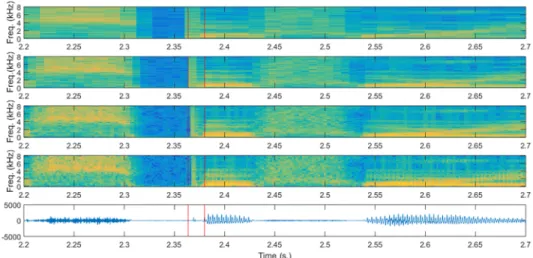
Having all that in mind, this article tries to determine whether acoustic modeling can bene-fit from using multi-resolution spectral representations of speech. Figs1and2represent
Fig 1. Spectrograms with different time-resolution trade-offs for a short phone. Spectrograms obtained for a
segment of 0.5 seconds around the /b/ phone in the wordbeforein the sentence “Drop five forms in the box before you go out” (Speaker FAKS0, sentence SX313). The only difference in the spectrograms is the length of the Hamming windows used: 32, 16, 8 and 4 ms. from top to bottom. Vertical red lines show the limits of the /b/ phone. There are substantial differences in the spectral representation of the short /b/ phone, for which an analysis using shorter windows is probably better.
https://doi.org/10.1371/journal.pone.0205355.g001
Fig 2. Spectrograms with different time-resolution trade-offs for a long phone. Spectrograms obtained for a
segment of 0.5 seconds around the /aw/ phone (more precisely, dipthong) of “out” in the sentence “Drop five forms in the box before you go out” (Speaker FAKS0, sentence SX313). The only difference in the spectrograms is the length of the Hamming windows used: 32, 16, 8 and 4 ms. from top to bottom. Vertical red lines show the limits of the /aw/ dipthong. There are substantial differences in the spectral representation of the long /aw/ dipthong, for which an analysis using longer windows is probably better.
several spectral representations of two segments of the same phrase (“Drop five forms in the box before you go out”) which contains two examples of the shortest phone (/b/) and an exam-ple of the longest phone (/aw/). It can be seen that, particularly for the shortest phones there is a big difference in the spectrogram obtained with different windows. Our hope is that having multiple spectral representations can be beneficial for acoustic modeling with DNNs, particu-larly for these short phones, but maybe also for longer phones.
Paper organization
The rest of the paper is organized as follows. First, Section Speech analysis and time-frequency resolution provides a brief introduction to speech analysis and the limitations in time and fre-quency. DNNs and their use in speech processing are introduced in Section Deep neural net-works and speech processing. After that, we will present the dataset, tools and evaluation metrics in Section Materials and methods. Then, the baseline systems will be described in Sec-tion Baseline systems. In SecSec-tion Multi-resoluSec-tion systems we will describe the systems we have developed to analyze if a multi-resolution representation of the speech signal can help in acoustic modeling with DNNs. After that, experimental results will be presented and analyzed in Section Results and discussion, and finally conclusions will be presented in Section Conclusion.
Speech analysis and time-frequency resolution
Short Time Fourier Transform (STFT) and time-frequency resolution
The analysis of the speech signal typically starts with a time-dependent Fourier transform, also calledShort-Time Fourier Transform(STFT), which is a method to analyze signals whose Fou-rier transform (i.e.spectrum) changes over time, as it is the case of the speech signal. The STFT of a signalx[n] is defined as X½n;oÞ ¼ X 1 m¼ 1 x½nþmw½me jom¼DTFTfx½nþmw½mg ð1Þ
werew[m] is awindowsignal,nis the sample ofx[m] at which we start applying the window (i.e. the time at which our analysis starts) andωis the discrete-time frequency in rads/sample. The STFT is in fact the Discrete-Time Fourier Transform (DTFT) of the time-displaced signal
x[n+m] multiplied by the windoww[m] where the DTFT is given by DTFTfx½mg ¼XðoÞ ¼ X
1
m¼ 1
x½me jom
ð2Þ
The DTFT is defined on a continuous frequency variableωwhich makes it not computable in finite time. However, for finite-duration signals constrained to be null outside [0,N− 1], samples of the DTFT atω= 2πk/Ncan be computed using the Discrete Fourier Transform (DFT) DFTNfx½mg ¼X½k ¼Xðok¼ 2pk N Þ ¼ XN 1 m¼0 x½me jom ð3Þ
which can be computed efficiently using the Fast Fourier Transform (FFT) algorithm. If we choose a windoww[m] constrained to be null outside [0,L− 1] withLN, we can replace the DTFT by the DFT in the definition of the STFT to get to the STFT sampled in
frequency X½n;k ¼X½n;ok¼2pk N Þ ¼ XN 1 m¼0 x½nþmw½me j2pkm N ¼DFT Nfx½nþmw½mg ð4Þ
While the STFT sampled in frequency can be computed in finite time, in practice comput-ing the whole STFT sampled in frequency would be a waste of time because it computes a spec-trum per input signal sample, and two consecutive spectra would differ very little since the time signals from which they are computed differ only in one sample. To get a spectral repre-sentation of a time-varying signal more efficiently, the STFT is also sampled in time eachR
samples, which gives rise to the STFT sampled in time and frequency
Xr½k ¼X½rR;k ¼X½rR;ok ¼
2pk
N Þ ¼DFTNfx½rRþmw½mg ð5Þ
In this way, a spectrum is computed everyRsamples of the input signal (a frame period, whereris the frame number) and as long asRL(assuming alsoLN) the STFT is invertible (i.e. no information is lost in the transformation).
A typical setting for speech analysis is to use windowsw[m] of length 25 ms. and a displace-ment between spectra computations of 10 ms. For a signalx[m] sampled at 16000 Hz. this means selectingR= 160 andL= 400 samples, for which normally a DFT ofN= 512 points is used.
While this analysis of the speech signal does not lose information, it implies selecting a par-ticular point in the trade-off between time and frequency resolution.
It is obvious that the time resolution is affected by the time sampling of the STFT because a spectrum is computed eachRsamples of the input signal, and therefore events of the signal less thanRsamples apart could be mixed in the speech analysis. This means that with the typi-cal speech analysis used it would be difficult to distinguish events closer than 10 ms. However, the time resolution is also affected by the window lengthLsince the window restricts the amount of signal that is considered to compute a single spectrum (DFT). Computing a DFT removes the time variable, and therefore it means that the spectrum will depend on the signal observed through that window. The effect of having longer windows is that short events tend to extend their apparent effect in the spectrogram for at least the duration of the window, as it can be observed inFig 1, which means that it could be difficult to distinguish events closer than 25 ms. for a typical setting in speech analysis for ASR.
The frequency resolution is affected by the sampling in frequency produced by using the DTF instead of the DTFT. This sampling is produced atωk= 2πk/Nin rads/s, or equivalently
atfk=k/NTSHz., whereTS= 1/fSis the sampling period in seconds. For a typical setting of
N= 512 (orN= 256) and a sampling frequency of 16000 Hz. we obtain one sample of the spec-trum every 31.25 Hz. (or 62.5 Hz.). However, more important than this effect is the reduction of the frequency resolution imposed by windowing. When a signal is multiplied by a window, its spectrum is convolved with the spectrum of the window as stated by the multiplication property of the DTFT x½nw½n $DTFT 1 2p Z 2p 0 Xðejy ÞWðejðo yÞ Þdy ð6Þ
As a consequence, the spectrum of the windowed signal isblurredorsmoothedby the effect of the main lobe of the spectrum of the window. As a consequence the frequency resolution of the STFT analysis is also reduced by this effect, which makes difficult to distinguish frequencies that are closer than the width of the main lobe of the window spectrum. The main lobe of a
window is approximately inversely proportional to the length of the window,L, so for instance for the Hamming window the width of the main lobe is 8π/L− 1 rads/s [17]. For the typical case in speech processing of windows of 25 ms. (which meansL= 400 samples forfS= 16000
Hz.) the width of the main lobe is 8π/399 rads/s or 4fS/399 = 160.4 Hz. The effect of windowing
on frequency resolution is normally more important than the effect of sampling in frequency of the STFT analysis as long asNL.
Given the previous analysis, we can conclude that a typical STFT analysis used in speech processing has a time resolution of about 25 ms. and a frequency resolution of about 160 Hz. (being both conservative estimations). In this work, we try to explore if using more than just one time-frequency resolution in the speech analysis can help DNNs for ASR acoustic model-ing. In order to do so, we need to modify some of the parameters of the STFT analysis: • To improve time resolution we need to reduceRandL. However, reducingLwill also
worsen frequency resolution.
• To improve frequency resolution we need to increaseL(we have decided not to experiment with different window types at the moment), which will also worsen time resolution.
To use different time-frequency resolutions we will experiment with several STFTs using different values ofRandLand make DNNs have as input several STFT representations of the signal (or more complex features derived from them). Instead of Fourier analysis, we could have used Wavelets, which are a direct way to represent signals at different time-frequency scales, but using STFT at this point made comparisons easier.
Filterbank analysis, MFCC and frequency resolution
The STFT is just the first part of speech analysis, but normally DNNs do not take as input the spectrum directly. Instead, they usually take more compact features derived from the results of the STFT. Here we will briefly review the most common modifications giving rise to the Mel-frequency cepstral coefficients (MFCC), paying particular attention to the influence of these transformations in the time-frequency resolution.
The phase of the STFT is discarded in speech analysis and only the module (|Xr[k]|) is kept,
based on the knowledge that the human auditory system is somewhat insensitive to the phase information. This operation does not affect the time-frequency resolution.
To model the non-uniform frequency response of the human auditory system a filterbank using a non-uniform frequency transformation is applied to this power spectral density. One of the most common non-uniform frequency transformations is the Mel frequency scale [18]:
MelðfÞ ¼2596log10 1þ
f
700
ð7Þ
Typically, betweenM= 20 andM= 40 triangular filters are evenly distributed in the Mel-frequency scale (seeFig 3). The output of each of these filters for |Xr[k]| in logarithmic scale
(dB) constitutes the filterbank features,FBr[j] wherejnow is the index of the filter. Clearly the
filterbank analysis affects the frequency (but not the time) resolution, providing less frequency resolution for a smaller number of filters.
Finally, a Discrete Cosine Transform (DCT) is applied to the filterbank features,
Cr½i ¼ ffiffiffiffiffi 2 M r XM j¼0 FBr½jcos pi Mðj 0:5Þ ð8Þ
of keeping less DCT coefficients than the number of filterbank features issmoothingthe filter-bank output in a process that loses some information. This means that decreasing the number of coefficients kept we reduce the frequency resolution again. IfM=C(i.e. we use the same number of MFCC coefficients as filters in the filterbank) the DCT is invertible and therefore no information is lost and therefore the frequency resolution remains the same.
After this analysis we can conclude that the operations to obtain the filterbank features or the MFCC features from the STFT affect the frequency resolution of the analysis but not the time resolution. Therefore we will have to take into account the number of filters in the filter-bank analysis,M, and the number of MFCC features computed,C, in our experiments.
Deep neural networks and speech processing
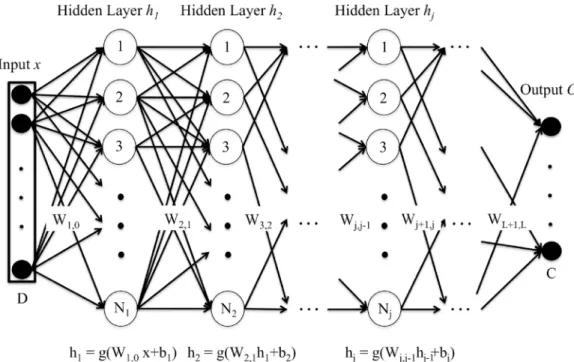
Deep neural networks (DNN) are machine learning tools which allow for the learning of com-plex non-linear multidimensional functions of a given input in order to minimize an error cost. A graphical example of a standard deep neural network is presented inFig 4.
This way, a feedforward DNN used to perform a classification task might have the following general structure: an input layer, which is fed with some input vectors representing the data; two or more hidden layers (in opposition to shallow architectures, which had just one hidden layer), where a transformation is applied to the output of the previous layer, obtaining a higher level representation as we move away from the input layer; and an output layer, which com-putes the output of the DNN.
The model is defined by its parameters: weight matrices,Wj,j−1, and bias vectors,bj, withj
going from 1 to the number of hidden layers plus one. Given an input vectorx, each hidden layer applies a non-linear activation functiongto an affine transformation of the output of the previous layer defined by the weight matrices,Wj,j−1, and bias vectors,bj, according to the
fol-lowing equations:
h1ðxÞ ¼gðW1;0xþb1Þ ð9Þ
hjðxÞ ¼gðWj;j 1hj 1ðxÞ þbjÞ; j¼2;. . .;N 1 ð10Þ
In these equations the non-linear activation function of the hidden layers,g, is often sig-moid, hyperbolic tangent (tanh) or Rectified Linear Unit (ReLU) or some of its variants. For a classification task, the output layer uses normally asoftmaxactivation function that normalizes the outputs to be in the interval [0, 1] and sum to one, so that they can be interpreted, for a
Fig 3. Mel-frequency scaled filterbank. The figure shows the amplitude response of the 23 filters of a Mel-scaled filterbank
ranging from 0 to 8000 Hz.
well trained network, as the posterior probabilities of the different classesc, given the inputx: PðcjxÞ ¼gsoftmax W c LhLðxÞ þbc ¼ expðW c LhLðxÞ þbcÞ PC c¼1expðWcLhLðxÞ þbcÞ ð11Þ
wherehL(x) refers to the last hidden layer activations for inputx,WLcis the weight vector
con-necting the last hidden layer and the output unit for classc,bcis the bias value of the output
unit for classcand there are a total ofCpossible classes.
For a classification task, supervised training starts with a training set (xi,yi) wherexiis a
given input vector andyia vector representing the output for the true (or target) class (for
clas-sification tasks, normally a one-hot codification of the output is used, in which a 1 is assigned to the correct class and 0 are assigned to the rest). The parameters to adjust in the learning pro-cess are the weight matrices and the bias vectors. These are normally initialized in a random way and then adjusted iteratively to minimize the cost function, typically with backpropaga-tion and stochastic gradient descent or other optimizabackpropaga-tion approaches. For this purpose, in the last layer, the output is compared to the reference label (true or target value) and the errors are back-propagated to modify the weights. In the early stages of deep learning, and particularly for limited training sets, it was found useful employing unsupervised initialization of the DNN weights using Restricted Boltzmann Machines (RBMs) to find suitable weights and biases in a layer-by-layer way [20]. With large datasets and other strategies nowadays this is not common in practice.
Fig 4. Deep Neural Network (DNN). This is a graphical representation of a standard feedforward DNN architecture. The
DNN is fed with an input vectorxof dimension D which is transformed by the hidden layershj(composed ofNjhidden units) according to an activation functiongand the parameters of the DNN (weight matricesWand bias vectorsb). Finally the output layerOproduces the output of the DNN for the target task (for the case of classification, the posterior
probability of an input vector to belong to each of the C classes). Reprinted from [19] under a CC BY license, with permission from Alicia Lozano et. al., original copyright 2017.
Materials and methods
This section describes the dataset, the evaluation metrics and the tools used for the experimen-tal part of this research paper.
Dataset
The experiments presented in this paper have been carried out on the well-known TIMIT corpus [21]. This corpus contains read speech spoken by a total of 630 speakers covering 8 dia-lectal regions in the U.S. Each speaker read the same 2 diadia-lectal sentences (SA sentences) designed to expose dialectal differences, 5 out of 450 phonetically balanced sentences (SX sen-tences) and 3 out of 1890 phonetically diverse sentences (SI sensen-tences). This provides a total of 6300 utterances. The 30% of speakers were female, while the remaining 70% were male. The audio is distributed with a sampling frequency of 16 KHz. and a signed, linear, 16 bits per sam-ple encoding.
The corpus defines acore test setcomposed of 24 speakers but excluding the SA sentences, which yields a total of 192 utterances. It also defines acomplete test setthat includes thecore test testplus all the utterances spoken by speakers in thecore test set. This complete test set includes 168 speakers and 1344 utterances (again the SA sentences are excluded). Finally, the corpus defines atrain setthat includes the utterances read by the remaining 462 speakers.
Evaluation metrics
In all the experiments the SA sentences were excluded both for training and testing, as it is common practice. Also the original set of 60 phones is mapped to a reduced set of 48 phones for training the acoustic models, and these are mapped to an even more reduced set of 39 phones for Phone Error Rate (PER) measurement, as is customary since the paper by Lee and Hon [16]. All the speakers in thetrain setwere used for training. The main results are provided on thecore test set, while we also provide results on adevelopment setcomposed of 50 speakers from thetest setthat are not included in thecore test set. All results include a phone bigram lan-guage model trained on the training set.
The primary evaluation metric is the Phone Error Rate (PER) computed with a reduced set of 39 phones as in [16], and defined as
PER¼SþIþD
N 100 ð%Þ ð12Þ
wereS,IandDare the number of phone substitutions, insertions and deletions found when comparing the recognized and the reference phone transcriptions, andNis the total number of reference (true) phones in the evaluation set.
In some experiments we also use the frame-by-frame phone state classification accuracy, expressed as the percentage of frames in the evaluation set for which the phone state predicted by the DNN coincides with the phone state determined in a forced alignment performed with a previously trained HMM/GMM system.
Tools
For the experiments we have used one of the most commonly used software packages in speech recognition research: Kaldi [22]. We have also used HTK [18], mainly to analyze the results obtained with Kaldi in more detail. We have also performed a set of experiments, focus-ing on the frame classification accuracy of the DNNs and not in the overall speech recognition
performance using standard deep learning packages such as Theano [23] and KERAS [24]. The spectrogram features were computed using MATLAB [25].
Baseline systems
The baseline systems chosen for our experiments are the standard Kaldi DNN recipes for TIMIT included in the Kaldi distribution. In all cases (both for baseline systems and the sys-tems proposed in this article) the recipe starts with a common training procedure for the HMM/GMM system, which includes:
• STFT: Computation of the STFT using windows of size 25 ms. (L= 400 forfS= 16000 Hz.)
and a frame shift of 10 ms. (R= 160 forfS= 16000 Hz.) with FFTs ofN= 512 points. The
window used in the STFT is a special window calledpovey, named after the main developer of Kaldi, but results using the Hamming window are similar.
• MFCC: Computation of 13 MFCCs per frame using a Mel-scaled filterbank with 23 triangu-lar filters distributed between 20 Hz. and 8000 Hz.
• CMVN: Cepstral Mean and Variance Normalization. It consists in normalizing the mean and variance of the MFCCs to make them have zero mean and unit variance. The baseline Kaldi recipes applies CMVN per speaker.
• Monophones: Training of a monophone HMM/GMM system starting from an uniform seg-mentation of the files and iteratively re-aligning the data.
• Triphones1: Training of a triphone HMM/GMM system using MFCC + delta + delta-delta features.
• Triphones2: Training a more advanced triphone HMM/GMM system using features derived from the MFCCs. In particular the MFCC features are spliced taking the central frame±4 frames and these matrices are projected into vectors of 40 dimensions using LDA. Later these vectors are diagonalized using Maximum Likelihood Linear Transform (MLLT) [26].
• Triphones3: Finally, Speaker Adapted Training (SAT) is performed. This consists in apply-ing a feature-domain speaker adaptation technique known as feature-space Maximum Like-lihood Linear Regression (fMLLR) [27] that transforms the features and training the triphone HMM/GMM system using these speaker-adapted features.
These first steps for training the HMM/GMM system are shared across multiple recipes for many different databases, and are a very common way to start training the acoustic models. All thehybridsystems in this article are built from these HMM/GMM systems.
For the experiments in this article we have considered two baselinehybridsystems included in the standard Kaldi distribution:
• FC-sigmoid-RBM-pretrain: The first one (developed by Karel Vesely and corresponding to thennet1setup in Kaldi,http://kaldi-asr.org/doc/dnn1.html) uses a Fully Connected (FC) DNN with six hidden layers of 1024 units each, withsigmoidactivation function, plus an out-put layer with 1936 outout-puts andsoftmaxactivation funcion. In this case, the DNN is pre-trained layer by layer in an unsupervised way using Restricted Boltzmann Machines (RBMs) [20]. Later the weights and biases are trained using Stochastic Gradient Descent and cross-entropy, using a validation set (10% of the training set reserved for this purpose only) for early stopping. Typically training stops after about 13 epochs. The input for the DNN are the
features used for Triphones3 spliced to include the central frame±5 frames. The phone state alignments used are those obtained using the Triphones3 models.
• FC-tanh: The second one (developed by Daniel Povey and corresponding to thennet2setup in Kaldi,http://kaldi-asr.org/doc/dnn2.html) uses a Fully Connected (FC) DNN with two hidden layers of 300 units andtanhactivation functions, and an output output layer of 1947 units andsoftmaxactivation function. Its weights are initialized randomly and trained for a total of 30 iterations of 200K examples using a parallel approximation of Natural Gradient for Stochastic Gradient Descent [28] and the cross-entropy as loss function. The network is initially trained with a single hidden layer and the second hidden layer is added after two iterations. The output units are augmented after 12 iterations to 3136mixtures(i.e. the soft-maxlayer with 1947 units is augmented to a largersoftmaxlayer and a last layer is added that sums thesoftmaxoutputs corresponding to the same original output unit). There are also many details that we cannot cover in this article, such as preconditioning in the hidden lay-ers and a decorrelation input transformation, which are described in the Kaldinnet2setup documentation. The inputs for the DNN are basically the same features used for Triphones3 with a±4 frame splicing so that the input dimension is 360. The phone state alignments used as targets are those obtained using the Triphones3 models.
Apart from these baseline systems included in the Kaldi recipes for TIMIT, we have built other two baseline systems based on Kaldi recipes for another corpora:
• FC-pnorm: This network (developed by Daniel Povey and also corresponding to thennet2
setup in Kaldi,http://kaldi-asr.org/doc/dnn2.html) is similar to the FC-tanh network. The main difference is that instead of using thetanhactivation function it uses thep−norm acti-vation functions [29], which are dimensionality reducing non-linearities inspired inmaxout, but outputting for a group ofGunits thep−normvalue of theG-dimensional vector instead of just the maximum:
y¼ jjxjjp ¼ X G i¼1 jxij p !1=p ð13Þ
where the sum is over the set of input units that are grouped together. In the particular setup used herep= 2 and the group size isG= 10. The two hidden layers have 3000 units, which are then reduced to 300 units with thep−normnon linearity. Additionally, the outputs of thep−normnon-linearities are normalized to avoid the outputs grow over a RMS value of 1 to facilitate convergence. Another difference is that the last layer is not augmented as in the
FC-tanh network. The rest of the network is similar to the FC-tanh network.
• TDNN-pnorm This network (developed by Daniel Povey and corresponding to thennet3
setup in Kaldi,http://kaldi-asr.org/doc/dnn3.html) also uses the parallel approximate Natu-ral Gradient SGD [28] but the structure of the network changes to a Time Delay Neural Net-work (TDNN). TDNNs were introduced in ASR long time ago [30]. They are DNNs designed to recognize sequences of input vectors (as speech parameter vectors) so that they could be aware of time variations and at the same time provide some time shift invariance to avoid the need for a precise segmentation. The main idea is that the output of an unit at a time step depends on the outputs of the previous layer at a time interval including that time step, with different weigths for different time steps and previous layer units. In this way, the network can learn temporal patterns and at the same time the output of TDNN layers is somehow insensitive to (small) time shifts. In our case, the DNN has 6 hidden layers, and only the hidden layers 3 and 5 are TDNN layers that take as input the output of the previous
layer at±2 and ±4 frames, respectively. The non-linear activation functions of all hidden lay-ers arep−normas in the FC-pnorm system having 3000 units that are then reduced to 300 units withp−norm. The rest of the network is again similar to the FC-pnorm.
• TDNN-ReLU This network is exactly the same as the TDNN-pnorm DNN but changing the
p−normdimensionality reduction non-linearities by standard Rectified Linear Units (ReLU) non-linearities. The hidden layers have 3000 units (which are not reduced to 300 units), which results in a much larger number of parameters.
In all cases, learning rate is reduced exponentially during the first iterations and is kept fixed for a few final iterations (except for the FC-sigmoid-RBM-pretrain).
All the previous systems used features with a high degree of post-processing, including trained transformations and speaker adaptation. In order to analyze the influence of this post-processing and speaker adaptation we have also performed experiments with the FC-pnorm baseline system but using as input the raw MFCCs, Filterbank outputs, and amplitude spectro-gram in dB. These will serve as a baseline to compare the systems we developed using raw multi-resolution features.
Multi-resolution systems
We are interested in experimenting with DNNs fed with input features that include different time-frequency resolution representation of the speech analysis to verify our hypothesis that this could improve acoustic-phonetic modeling. Perhaps the easiest and most direct way to do this is by conducting different STFT analyses of the speech and combining the different spectra obtained into a single feature vector to be used as input to the DNNs. In this way, we are only modifying the input to the network, so we keep the rest of the parameters of the baseline sys-tems described in Section Baseline syssys-tems.
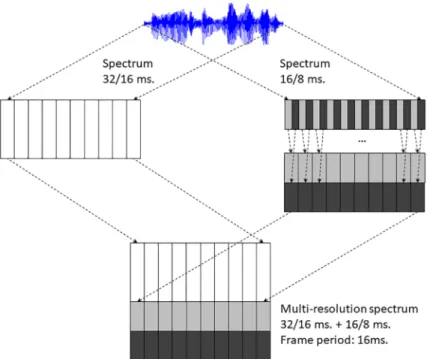
The parameters of the STFT analysis that we modify to change the time-frequency resolu-tion are the window length,L, and the frame period,R. In order to make it easier to use differ-ent scales we are starting our experimdiffer-ents with both parameters being powers of two. So we take for our baseline STFT analysis a window length of 32 ms. (L= 512 samples) and a frame period of 16 ms. (R= 256 samples). In order to include different time-frequency resolutions we compute other spectra halving both parameters each time to have analyses with window length/frame periods of: 16/8, 8/4, 4/2, 2/1, 1/0.5 and 0.5/0.25 ms. One problem that arises is that the frame period of the different STFT analyses is different, but as long as we proceed by halving the frame period this problem can be solved by re-arranging two frames of an analysis using a halved frame period as a single (double-length) vector, so that in the end the multi-res-olution analysis can be represented as an augmentation of the original spectrum features at a fixed frame period of 16 ms.Fig 5shows the scheme followed to combine two spectral analyses with different window lengths and frame periods (in this particular case 32/16 and 16/8 ms.) to form an augmented speech feature vector sequence with a fixed frame period (in this partic-ular case 16 ms.). Using this approach recursively we can build augmented multi-resolution feature vectors representing many different time-frequency trade-offs but using a single frame period, which makes easier to use this sequence as input to a typical hybrid HMM/DNN ASR system.
In particular, we have used this approach to augment the input of the FC-pnorm and the
TDNN-ReLU baseline systems using the raw spectrogram to check if this additional
informa-tion helped the DNNs learn the acoustic-phonetic decoding. To double check that this was platform independent (i.e. independent of Kaldi) we also performed experiments using Fully
Connected networks using Keras and Theano and evaluated the frame accuracy provided by the network.
Finally, since using the raw spectrogram provided performance below that obtained with the original features used in the baseline (which included speaker adaptation) we also used the same approach shown inFig 5to augment the MFCC+CMVN+Splice+LDA+MLLT+fMLLR features (used as input for all the baseline systems) so that they contain multi-resolution infor-mation, and used them as input to the best baseline system we had, the
FC-sigmoid-RBM-pre-train system.
Results and discussion
Baseline results
Table 2presents the results, in terms of Phone Error Rates (PER), obtained by the baseline sys-tems on the TIMIT development and core test sets. All these results were obtained using fea-tures with a high degree of post-processing and including speaker adaptation. The best results
Fig 5. Multiresolution spectrum computation. The figure shows an example of combination of two spectra
computed with different window lengths and frame periods to produce a multi-resolution spectrum with a fixed frame period.
https://doi.org/10.1371/journal.pone.0205355.g005
Table 2. Baseline results with Kaldi. In all cases features are MFCC+CMVN+Splice+LDA+MLLT+fMLLR (the same used in the Triphones3 HMM/GMM setup. Feature
splicing indicated in the table is performed at the input of the DNN.Input Dim. is the dimension of the input of the network including feature splicing.Param. is the num-ber of trainable parameters of the network.
DNN type and activations Feature Splicing Input Dim. Param. (×106) % PER (Dev) % PER (Test)
FC-sigmoid-RBM-pretrain (±5) 440 7.78 17.5 18.5 FC-tanh (±4) 360 1.14 21.1 22.6 FC-pnorm (±4) 360 2.57 19.6 21.1 TDNN-pnorm (±4) 360 7.25 18.7 20.6 TDNN-ReLU (±4) 360 69.21 19.5 21.0 https://doi.org/10.1371/journal.pone.0205355.t002
are obtained with the FC-sigmoid-RBM-pretrain which uses unsupervised initialization of the weights of the DNN using RBMs [20]. This type of initialization is not very commonly used nowadays, particularly for large datasets, but for this rather small dataset it seems that this initialization of the network weights is still important. We should mention that this best result with the Kaldi toolkit is currently a bit far from the best published results on TIMIT, among which we have to mention a 17.7% PER using the Connectionist Temporal Classifica-tion (CTC) technique and an RNN transducer [8], a 16.7% PER using Time and Frequency Convolutional Networks [31] and a 16.27% PER using a dropout technique specifically designed for RNNs [32], all of them in the core test set. Anyway, in this work our intention is not to outperform the current state of the art systems, but to check if our proposed multi-reso-lution strategy can improve our baseline results.
Results with simplified features
Table 3presents results obtained with the FC-pnorm setup with simplified features. The first row corresponds to the baseline FC-pnorm system with the fully processed and speaker-adapted features. The rest of the rows correspond to the same system with speaker-indepen-dent simplified features, and presents a clear degradation with respect to the baseline system. This is important because many of our experiments are performed on raw spectrograms and we have to take this into account to properly interpret the results. We have included a last row in which the FC-pnorm setup has been modified to include a third hidden layer. Given that the spectrogram amplitudes are very raw features, using them probably requires more process-ing levels in the DNN. Results seem to confirm this, so we have decided to use three layers in the rest of the experiments with spectrograms and the FC-pnorm setup.
Multi-resolution results
In this section we present our results using multi-resolution speech analysis. Our first experi-ment consists in using a system with the FC-porm setup with three hidden layers (identical to the last row inTable 3) and compare results using as input a single-resolution spectrogram and a multi-resolution spectrogram using different window lengths and frame shifts. To sim-plify multi-resolution analysis we use window lengths and frame shifts that are powers of two, so we start with a single-resolution system using a window length of 32 ms. and a frame shift of 16 ms. Results using this system are shown in the first row ofTable 4. They are very similar to the system shown in the last row ofTable 3which uses a window length of 25 ms. and a frame shift of 10 ms. The other lines of the table show results using the same system with multi-resolution systems including 32 and 16 ms. window lengths with 16 and 8 ms. frame shifts respectively, and progressively adding a window length and a frame shift that are half of
Table 3. Results with simplified features. In all cases the DNN is similar to the FC-pnorm with the only difference that the input layer is modified to fit the input
dimensionality. In all cases a frame splicing of±4 is used at the input of the DNN.Input Dim. is the dimension of the input of the network including feature splicing.
Param. is the number of trainable parameters of the network.
Feature Description
Input. Dim. Param. (×106) % PER (Dev) % PER (Test)
MFCC+CMVN+Splice+ +LDA+MLLT+fMLLR 360 2.57 19.6 21.1 MFCC 117 1.84 22.2 24.3 Filterbank 216 2.11 24.1 26.1 Spectrogram 2313 8.43 22.1 24.2
Spectrogram (3 hidden layers) 2313 9.33 20.7 23.5
the smallest previous ones. Results show that when adding multiple resolutions, PER tends to decrease, reaching a minimum with 3 window lengths (32, 16 and 8 ms.) which is slightly bet-ter (0.6% absolute PER improvement) than using the single-resolution spectrum.
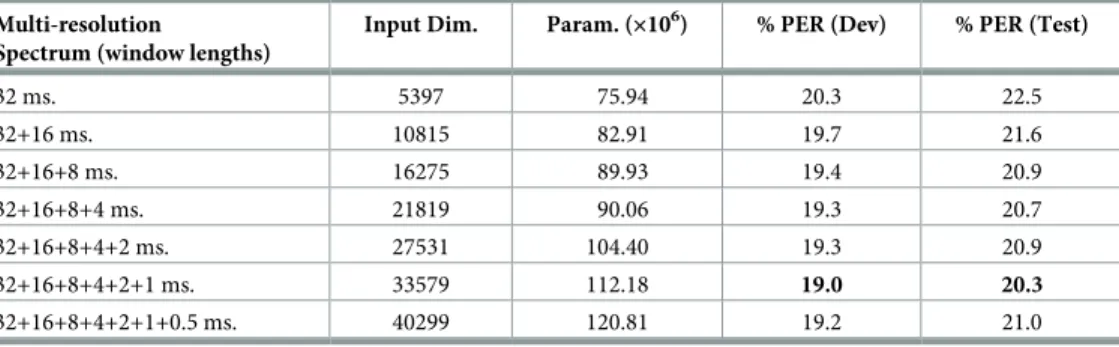
To rule out the possibility that this result was something particular to this setup we repeated essentially the same experiment with the TDNN-ReLU setup and present results inTable 5. These results show a similar trend: PER tends to improve as we add more time-frequency reso-lutions to our speech analysis. The main difference with respect toTable 4is that this time the minimum is reached when 6 different time-frequency resolutions are used (window lengths from 32 to 1 ms. and frame shifts from 16 to 0.5 ms. in powers of two). Probably, the reason for this is that this DNN is much more complex than the FC-pnorm network used inTable 4
(in particular the number of parameters is about 10 times larger). This seems to allow the DNN to learn better from the very large-dimensionality input vectors. In fact, the improve-ment using multi-resolution speech analysis in this table (absolute reduction of 2.2% in PER from the single-resolution system in the first row) is much better than that obtained in
Table 4. Actually, the 20.3% PER obtained using TDNN-ReLU and multi-resolution spectrum outperforms all baseline systems shown inTable 2, with the only exception of the
FC-sig-moid-RBM-pretrain system. We should remark that this is achieved using raw
multi-resolu-tion spectrograms that are not processed in any way (except for being normalized to have zero mean and unit variance) and are not speaker-adapted as all the features used for results in
Table 2are.
Previous results showed consistent improvements in terms of PER when multi-resolution speech analysis is used as input to the DNNs. However, all previous results were obtained using the Kaldi toolkit, so we performed a different experiment in which we extracted the
Table 4. Results with multi-resolution spectrograms and FC-pnorm networks. In all cases DNNs have three hidden
layers and include±4 splicing of input features features, which are raw spectrograms in dB obtained with Hamming windows.Input Dim. is the dimension of the input of the network including feature splicing.Param. is the number of trainable parameters of the network.
Multi-resolution
Spectrum (window lengths)
Input Dim. Param. (×106) % PER (Dev) % PER (Test)
32 ms. 2313 9.35 21.3 23.4
32+16 ms. 4635 16.31 21.2 23.1
32+16+8 ms. 6975 23.33 20.6 22.8
32+16+8+4 ms. 9351 30.46 20.7 23.0 https://doi.org/10.1371/journal.pone.0205355.t004
Table 5. Results with multi-resolution spectrograms and TDNNs-ReLU networks with±10 feature splicing. In all
cases features are raw spectrograms in dB obtained with Hamming windows.Input Dim. is the dimension of the input of the network including feature splicing.Param. is the number of trainable parameters of the network.
Multi-resolution
Spectrum (window lengths)
Input Dim. Param. (×106) % PER (Dev) % PER (Test)
32 ms. 5397 75.94 20.3 22.5 32+16 ms. 10815 82.91 19.7 21.6 32+16+8 ms. 16275 89.93 19.4 20.9 32+16+8+4 ms. 21819 90.06 19.3 20.7 32+16+8+4+2 ms. 27531 104.40 19.3 20.9 32+16+8+4+2+1 ms. 33579 112.18 19.0 20.3 32+16+8+4+2+1+0.5 ms. 40299 120.81 19.2 21.0 https://doi.org/10.1371/journal.pone.0205355.t005
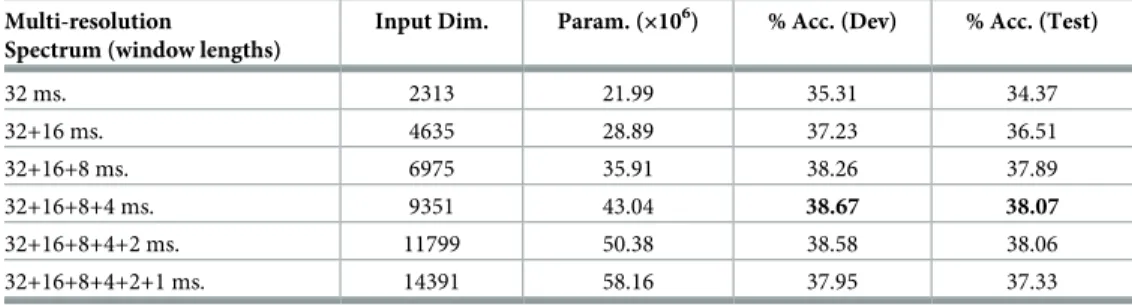
same training examples and used Keras and Theano to train a standard Fully Connected DNN with ReLU activations in the hidden layers andsoftmaxactivation in the output layer to classify the input frames as one of the 1936 phone states. The optimizer used is Adam and the net-works were trained for a total of 20 epochs. InTable 6we show frame accuracies obtained with single resolution and multi-resolution spectra as input to the DNN. We can observe the same trend as in previous tables: results tend to improve as more time-frequency resolutions are considered, up to a certain point. In this case the best results are obtained at an intermediate point between the one found inTable 4and that found inTable 5. In particular the best result is achieved with 32, 16, 8 and 4 ms. windows, reaching a frame accuracy of 38.07%, which rep-resents an absolute improvement of 3.7% in frame accuracy from the single-resolution system in the first row.
Our previous results with multi-resolution speech analysis were consistent and encourag-ing. However, they start with a huge disadvantage that becomes clear observingTable 3again. Here we see that from the speaker-adapted and highly processed features (first row of the table) to the raw spectrogram features (4throw of the table) we lose over 3% absolute PER. We mitigate this a bit (last row of the table) by using more hidden layers (since we are using less processed features) but still we lose 2.4% absolute PER. So the natural question to ask is: can we use a multi-resolution approach and still get the benefits from speaker-adapted and highly processed features? We have applied a very simple approach to address this question, with the hope that it is good enough to show that it is possible. We have used modified Kaldi scripts to obtain speaker-adapted and highly processed features (MFCC+CMVN+Splice+LDA+MLLT +fMLLR) using different configurations for speech analysis. We kept the baseline speech pro-cessing, using 25 ms. windows with a frame period of 10 ms., 23 filters in the Mel-scaled filter-bank and 13 MFCCs, to obtain the fully processed features corresponding to 25 ms. Then we added other fully processed features computed using other configurations, as shown in
Table 7. Given that the original scripts were written using a frame period of 10 ms., we decided to use this final frame period for our multi-resolution features. For windows larger than the original (32 ms.) we kept the same frame period of 10 ms. However, for smaller windows (16, 8 and 4 ms.) we decided to use smaller frame periods (Initial frame Periodin the table) and combine several consecutive feature vectors into a single feature vector as represented in the right part ofFig 5. Specifically, for each window length we combine exactly the number or fea-ture vectors indicated in columnInitial frames per final frameto have in all cases a final frame period of 10 ms. Once we have the final speaker-dependent features including MFCC+CMVN +Splice+LDA+MLLT+fMLLR for each window length we combine them to form larger input
Table 6. Results with multi-resolution spectrograms and Fully Connected feedforward DNNs trained with Keras and Theano with ReLU activation functions and±4 feature splicing. In all cases features are raw spectrograms in dB
obtained with Hamming windows. Results are given as frame by frame phone state recognition accuracy considering 1936 different phone states.Input Dim. is the dimension of the input of the network including feature splicing.Param. is the number of trainable parameters of the network.
Multi-resolution
Spectrum (window lengths)
Input Dim. Param. (×106) % Acc. (Dev) % Acc. (Test)
32 ms. 2313 21.99 35.31 34.37 32+16 ms. 4635 28.89 37.23 36.51 32+16+8 ms. 6975 35.91 38.26 37.89 32+16+8+4 ms. 9351 43.04 38.67 38.07 32+16+8+4+2 ms. 11799 50.38 38.58 38.06 32+16+8+4+2+1 ms. 14391 58.16 37.95 37.33 https://doi.org/10.1371/journal.pone.0205355.t006
vectors using again the scheme shown inFig 5with the important difference that, in this case, the vectors are not spectra but these highly processed and speaker-adapted feature vectors derived from the MFCCs. We have decided to keep all the MFCCs available from the filterbank output to avoid losing information in the DCT transformation. We also decided to use a differ-ent number of filters in the filterbank for differdiffer-ent window lengths because shorter durations of the window implied less frequency resolution and, therefore, we will require less filters for a representation with less frequency resolution (besides, for the smallest window of 4 ms., the spectrum has only 33 points computed from a 64-point DFT and it was impossible to fit a mel-scaled filterbank with 10 or more filters).
Besides the use of simplified, speaker-unadapted features, previous results shown in this paper present a second disadvantage that becomes clear observingTable 2. the best result obtained in our baseline systems uses the FC-sigmoid-RBM-pretrain setup which achieves 2.1% better PER in absolute terms than any of the other setups, probably due to the RBM pre-training and the small size of the dataset.
Our next experiments try to overcome these two disadvantages by combining multi-resolu-tion highly post-processed and speaker-adapted features with the FC-sigmoid-RBM-pretrain.
Table 8shows the initial results we obtained. Given that the differences were very small we per-formed 10 different experiments with 10 different random seeds and present the mean and the standard deviation. Mean results for the baseline (first row ofTable 8) are slightly different from the results obtained using the standard Kaldi random seed (first row ofTable 2). Multi-resolution features achieved slight improvements (less than 0.2% absolute PER) in develop-ment and in the core test set for all the the cases except the one including the 4 ms. windows. A Wilcoxon signed rank test shows that the difference between the baseline and the best result (32+25 ms.) is statistically significant at the 0.05 level for the development results but not for the test results.
Table 8. Results with multi-resolution features and FC-sigmoid-RBM-pretrain DNNs with hidden layers of 1024 units. In all cases features are MFCC+CMVN+Splice
+LDA+MLLT+fMLLR. Input is spliced±5 frames.Input Dim. is the dimension of the input of the network including feature splicing.Param. is the number of trainable parameters of the network.
Multi-resolution Window lenghts
Input Dim. Param. (×106) % PER (Dev) % PER (Test)
25 ms. (Baseline) 440 7.78 17.52± 0.08 18.90± 0.20
32+25 ms. 880 8.13 17.37±0.14 18.73±0.20
32+25+16 ms. 1320 8.58 17.42± 0.10 18.84± 0.22
32+25+16+8 ms. 1760 9.04 17.46± 0.13 18.81± 0.15 32+25+16+8+4 ms. 2200 9.49 17.62± 0.13 18.96± 0.29 %PER is shown asmean±s.d. obtained in 10 runs with different random seeds.
https://doi.org/10.1371/journal.pone.0205355.t008
Table 7. Configurations used with multi-resolution highly processed and speaker-adapted features and FC-sigmoid-RBM-pretrain DNNs.
Window length (ms) Initial frame period (ms) # Filters in FBank # MFCCs # Initial frames per final frame Final frame period (ms)
25 10 23 13 1 10 32 10 32 32 1 10 16 5 16 16 2 10 8 2.5 8 8 4 10 4 1.25 4 4 8 10 https://doi.org/10.1371/journal.pone.0205355.t007
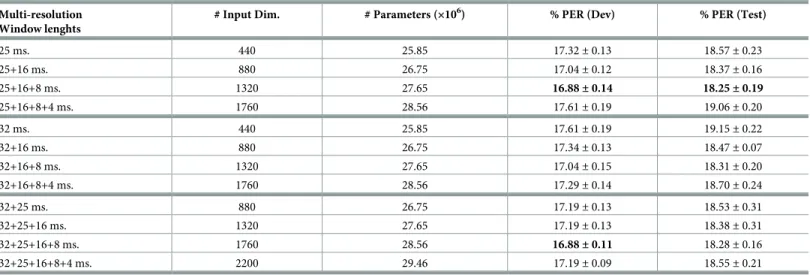
We suspected, based on the results of Tables4and5, that this result was in part due to the small number of parameters of the FC-sigmoid-RBM-pretrain DNN, so we decided to increase the number of weights of the DNN by doubling the number of units in the hidden lay-ers. This leads to results inTable 9, in which we can observe again that in general PER results improve with multi-resolution features (except for the cases in which the 4 ms. window is applied). The best results (obtained with windows of 25, 16 and 8 ms.) show an absolute decrease in PER of 0.64% and 0.65% in PER with respect to the baseline system ofTable 8in development and in the core test set, respectively. However a good part of this improvement is due to the increase in complexity of the DNN: the first row of Tables8and9shows that increasing the number of units in the hidden layers from 1024 to 2048 and keeping the single resolution features yields a improvement of 0.20% absolute PER in development and a 0.32% in the core test set. A Wilcoxon signed rank test finds these two differences statistically signifi-cant at the 0.05 level. The improvement achieved by the use of multi-resolution features (com-paring with the first row ofTable 9) is a bit larger than that found with 1024 hidden layers (Table 8), but still very small: 0.44% in development and 0.32% in the core test set. In this case, a Wilcoxon signed rank test shows that these two differences are statistically significant at the 0.05 level.
We have also computed the frame accuracies obtained with the DNNs used in Tables8and
9. Frame accuracies provide a different view of the results with more resolution (since it is eval-uated frame by frame instead of phone by phone) and focusing more on the DNN itself (because no language modeling is taken into account). Frame accuracies are shown in Tables
10and11.
Results with 1024 units in the hidden layers (Table 10) are a bit surprising because no improvement is found in frame accuracy when applying multi-resolution features, while small improvements were found in PER (with the only exception of the combination including win-dows of 4 ms.). A possible explanation for this could be that in this case multi-resolution may be helping the DNN to make softer estimations of the frame-by-frame posterior probabilities, so that even being less accurate frame by frame results are slightly better when integrated over
Table 9. Results with multi-resolution features and FC-sigmoid-RBM-pretrain DNNs with hidden layers of 2048 units. In all cases features are MFCC+Splice+LDA
+fMLLR. Input is spliced (±5 frames).Input Dim. is the dimension of the input of the network including feature splicing.Param. is the number of trainable parameters of the network.
Multi-resolution Window lenghts
# Input Dim. # Parameters (×106) % PER (Dev) % PER (Test)
25 ms. 440 25.85 17.32± 0.13 18.57± 0.23 25+16 ms. 880 26.75 17.04± 0.12 18.37± 0.16 25+16+8 ms. 1320 27.65 16.88±0.14 18.25±0.19 25+16+8+4 ms. 1760 28.56 17.61± 0.19 19.06± 0.20 32 ms. 440 25.85 17.61± 0.19 19.15± 0.22 32+16 ms. 880 26.75 17.34± 0.13 18.47± 0.07 32+16+8 ms. 1320 27.65 17.04± 0.15 18.31± 0.20 32+16+8+4 ms. 1760 28.56 17.29± 0.14 18.70± 0.24 32+25 ms. 880 26.75 17.19± 0.13 18.53± 0.31 32+25+16 ms. 1320 27.65 17.19± 0.13 18.38± 0.31 32+25+16+8 ms. 1760 28.56 16.88±0.11 18.28± 0.16 32+25+16+8+4 ms. 2200 29.46 17.19± 0.09 18.55± 0.21 %PER is shown asmean±s.d. obtained in 10 runs with different random seeds.
phone durations. In any case, the differences found in PER and frame accuracy with 1024 hid-den layers are very small.
Results with 2048 units in the hidden layers (Table 11), however, follow a similar trend to results in PER with 2048 units in the hidden layer (Table 9). We can observe again that frame accuracy tends to be better when multi-resolution features are applied. The best results are obtained again for the same combination of windows (25, 16 and 8 ms.) and represent an abso-lute improvement of 0.5% and 0.68% in frame accuracy over the result of the first row with sin-gle-resolution features. These differences in frame accuracies are clearly statistically significant (a Wilcoxon signed rank test confirms that they are statistically significant even at the 0.01 level).
Conclusion
Normally, automatic speech recognition starts with a Short-Time Fourier Transform (STFT) which defines a fixed point in the time-frequency resolution trade-off. This approach, tradi-tionally followed by the calculation of Mel-Frequency Cepstral Coefficients (MFCC) that
Table 10. Frame accuracies with multi-resolution features and FC-sigmoid-RBM-pretrain DNNs with hidden layers of 1024 units. In all cases features are MFCC
+CMVN+Splice+LDA+MLLT+fMLLR.Input Dim. is the dimension of the input of the network including feature splicing.Param. is the number of trainable parameters of the network.
Multi-resolution Window lenghts
Input Dim. Param. (×106) % Acc. (Dev) % Acc. (Test)
25 ms. (Baseline) 440 7.78 52.12±0.10 51.34±0.15
32+25 ms. 880 8.13 51.98± 0.11 51.07± 0.13
32+25+16 ms. 1320 8.58 51.80± 0.16 51.02± 0.16
32+25+16+8 ms. 1760 9.04 51.73± 0.12 50.98± 0.16 32+25+16+8+4 ms. 2200 9.49 51.17± 0.09 50.36± 0.15 %Acc. is shown asmean±s.d. obtained in 10 runs with different random seeds.
https://doi.org/10.1371/journal.pone.0205355.t010
Table 11. Frame accuracies with multi-resolution features and FC-sigmoid-RBM-pretrain DNNs with hidden layers of 2048 units. In all cases features are
MFCC+-Splice+LDA+fMLLR.Input Dim. is the dimension of the input of the network including feature splicing.Param. is the number of trainable parameters of the network.
Multi-resolution Window lenghts
# Input Dim. # Parameters (×106) % PER (Dev) % PER (Test)
25 ms. 440 25.85 52.66± 0.12 51.95± 0.17 25+16 ms. 880 26.75 53.12± 0.08 52.53± 0.15 25+16+8 ms. 1320 27.65 53.16±0.08 52.63±0.13 25+16+8+4 ms. 1760 28.56 51.04± 0.13 50.63± 0.18 32 ms. 440 25.85 51.52± 0.11 52.17± 0.17 32+16 ms. 880 26.75 52.70± 0.06 52.05± 0.10 32+16+8 ms. 1320 27.65 52.93± 0.13 52.31± 0.11 32+16+8+4 ms. 1760 28.56 52.18± 0.09 51.47± 0.08 32+25 ms. 880 26.75 52.99± 0.08 52.17± 0.13 32+25+16 ms. 1320 27.65 52.90± 0.13 52.16± 0.15 32+25+16+8 ms. 1760 28.56 53.02± 0.10 52.20± 0.10 32+25+16+8+4 ms. 2200 29.46 52.32± 0.12 51.70± 0.12 %PER is shown asmean±s.d. obtained in 10 runs with different random seeds.
produced reasonably uncorrelated features was very well suited to theoldstate-of-the-art in Automatic Speech Recognition (ASR), dominated by the use of Hidden Markov Models (HMMs) to model the speech dynamics and Gaussian Mixture Models (GMMs) (with diago-nal covariance matrices) to model the features extracted from a speech frame. Nowadays, one of the most commonly used frameworks in practical ASR systems consists on the adoption of Deep Neural Networks (DNN) as a replacement of the GMMs, giving rise to thehybridHMM/ DNN systems. For these systems, since the acoustic features are fed directly as the input to a DNN, several restrictions on the speech features have vanished. For instance, input features do not need to be uncorrelated, and we have more freedom to enlarge the input feature vector because DNNs can handle better thecurse of dimensionality.
In this context, and knowing that speech phones vary considerably in length (from an aver-age of less than 18 ms. for the /b/ phone to over 150 ms. for the /aw/ phone in the TIMIT cor-pus) we have hypothesized that using multiple time-frequency resolution trade-offs would be beneficial to model the diversity in time-frequency resolutions present in the speech signal.
To confirm our hypothesis we have experimented taking as baseline the Kaldi TIMIT reci-pes and extending them to have a complete set of baselinehybridHMM/DNN systems. We have modified these systems because they worked on highly post-processed and speaker-adapted features (MFCC+CMVN+Splice+LDA+MLLT+fMLLR) and we were interested to test our hypothesis directly on spectral features. Our experiments showed that including multi-resolution spectral features (by concatenating features with different time-frequency res-olutions as the input vector) provided consistent improvements using different setups for the DNNs (this included a FC-pnorm, a TDNN-ReLU using Kaldi and a conventional Fully Con-nected DNN built using Theano and Keras). While our results are consistent in showing that multi-resolution speech analysis improves Phone Error Rate (PER) and frame classification accuracy, we obtained differences in terms of the amount of multi-resolution that provided the best results and we hypothesized that this difference was due to the different complexities of the DNNs, with more complex (in terms of the parameters) DNNs having more capability to exploit multi-resolution information.
Results using raw multi-resolution spectral features were able to provide slightly better results than equivalent systems using highly post-processed and speaker-adapted features. However, using raw spectral features instead of highly post-processed and speaker adapted fea-tures, as well as not using the best Kaldi DNN setup for TIMIT (FC-sigmoid-RBM-pretrain) as a starting point, was a handicap to improving the best baseline results. In our last experi-ments we used this best Kaldi DNN setup for TIMIT as starting point, but replaced the original features with multi-resolution features including all the post-processing and speaker adapta-tion of the baseline Kaldi systems (MFCC + CMVN + Splice + LDA + MLLT + fMLLR). Com-bining this with an increase in the complexity of the DNN (changing the number of units in the hidden layers from 1024 to 2048) we achieved an improvement with respect to the best results provided by Kaldi, which are lowered from 18.90% to 18.25% PER on TIMIT core-test set. These results are the mean of 10 runs with different random seeds (a single run with the standard Kaldi seed provided an improvement from 18.5% to 17.9%). A deeper analysis of this result showed that just by changing the number of units in the hidden layers from 1024 to 2048 improved PER from 18.90% to 18.57%, while multi-resolution provided the remaining improvement from 18.57% to 18.25%, which is a very limited improvement but resulted in a statistically significant difference. We analyzed the frame accuracies obtained with similar results: we improved from 51.34% to 52.63% combining an increase in the number of hidden units and multi-resolution, but just the use of multi-resolution provided an improvement from 51.95% to 52.63%, which again is small but statistically significant.