ORIGINAL PAPER
COMPUTERIZED SYSTEM FOR CONTROLLING PACKAGE
ENCASING IN THE FOOD INDUSTRY
CRISTIAN LOGOFATU1, VIVIANA FILIP2, DANIELA CIOBOATA1, DANUT STANCIU1
1 National Institute of Research and Development in Mechatronics and Measurement Techniques -
INCDMTM, 022401, Bucharest, Romania
2Valahia University of Targoviste,Faculty of Materials Engineering, Mechatronics and Robotics,
130082, Targoviste, Romania
Abstract. The computerized system for controlling package encasing in the food
industry is an integrated system of computing and control created for a total control of the encasing of the canned product. Thus, there shall be measured the encasing parameters and the dimensional and shape parameters of the packages subject to the sterilization process to find out defects that may lead in time to the alteration of the content.
Keywords: computerized system, encasing of the canned product, sterilization.
1. INTRODUCTION
The increase in the national economy competitiveness in producing high quality products in compliance with the international standards and especially, the alignment of quality at technical performances thereof to the requirements imposed by the European Union is one of the main targets.
According to the data furnished by the Sanitary Veterinary National Authority for Food Safety (ANSVSA), more than 500 units of the food industry could be closed, unless they are modernized and restructured, so that to comply with the European regulations. This is due to the fact that according to the commitments taken over by Romania before the EU, any unit considered to be „unacceptable” shall be closed.
The immediate consequences of such situation could be summarized as follows: a serious risk people’s food safety;
weak presence of the Romanian canned products on the European market though Romania has a high agricultural potential (vegetables, fruits), and the Danube Delta represents a huge fishing capacity (canned fish);
cost price increase of the products, if, due to market requisites, control equipment for the food industry packages are to be imported;
neglecting the scientific capacity of the Romanian researchers and specialists.
The computerized system for controlling package encasing in the food industry, dimensionally verify the packages, according to the European Union regulations, furnishing information on certain parameters that may influence the quality of the canned product and decides if it has any potential risk for consumer’s food safety.
The geometrical parameters of the package are extremely important, as the quality of the encasing of such food stuff depends on them. The encasing is one of the most important stages in the technology for canned product manufacturing, being decisive for the conservations interval and implicitly food safety of such product.
Considering the long life canned products should have (2-3 years) and the fact that the defects (content alteration) are not immediately detectable, as they appear after a long time
and being extremely dangerous for consumer’s health, a special attention should be granted the control of canned stuff packages [3].
2. SCIENTIFIC AND TECHNICAL DESCRIPTION
The computerized system for controlling package encasing in the food industry is an integrated system of computing and control, which is used for a total control of the encasing of the canned product. thus, there are measured the encasing parameters and the dimensional and shape parameters of the packages subject to the sterilization process to find out defects that may lead in time to the alteration of the content.
From a constructive point of view, the computerized system for the control of package encasing in the food industry has the following functional structure:
● The equipment for checking package encasing
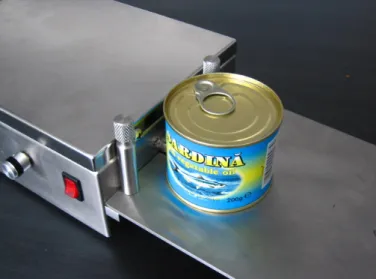
Fig. 1. The equipment for checking package encasing.
The equipment for checking package encasing (Fig. 1) is an integrated system of optical-electronic control [1], containing a high resolution video camera (Fig. 2) and a telecentric lighting system (Fig. 3).
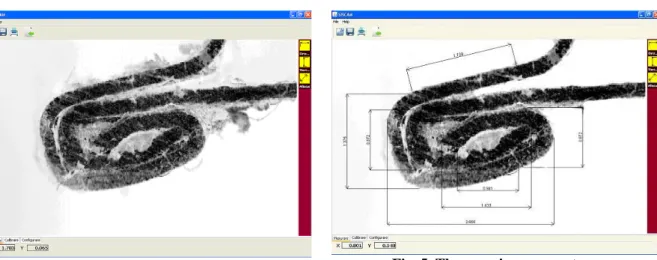
The camera takes over the real image of the encasing (welt) of the controlled package and sends it to the main computer, which display the image on a LCD screen. (Fig. 4)
The computer measures the encasing parameters and calculates the real union. (Fig. 5)
Fig. 4. The image of the encasing on the LCD display.
Fig. 5. The encasing parameters.
The real union represents the synthesis of all composing elements of the encasing, is expressed in percentages of total union and consists in the welt portion where sealing effectively takes place, by gripping the rubber seal between the hook of the body and that of the tap. A welt is correctly formed when the real union has a value above 50%. Below the mentioned value, the welt may be suspected of leakage. The results of the measurements are displayed on the electronic block and are sent to the main computer.
● The cutting device carries out the cutting of the tin with the view to measuring it, being acted by a mono-phase motor with an electronic command block (Fig. 6).
The cutting system is made up of two parallel milling discs, with the width of 0,5mm, that by a system of manual advance, cuts the falt section that is to be measured [2]. The revolution of the mills may vary between 400rpm and 800rpm, depending of the materials [5].
The cutting device is provided with safety systems meant to prevent possible accidents.
In the cutting areas is placed a proximity sensor that validates the presence of the box, and prevents the accidental start of the mill (Fig. 7).
Stopping the cutting process is carried out automatically, with a stroke limiter, the operator no longer being required to push another button. The device is also provided with an emergency switch, mushroom-like, that at a simple fast push interrupts the cutting process instantaneously. The device no longer sets in motion until the switch is no longer connected.
● The main computer correlated the measurements directly on the package, to those obtained after encasing and identifies the elements that could cause a defect.
The measurements bulletin is typed by the editing system of the computer to the complete data of the measurements, including the lot, change, date and time. All these operations are made with no intervention of the human factor (operator). There is a possibility of printing the real image of the welt for a complex analysis of the material and sealing after the encasing process. All measured date shall be stored for monitoring the entire process in time. Thus, there shall be statistically monitored the evolution of such elements in time and the appropriate measures can be taken as soon as there may be found out deviations from the interval considered normal.
The values thus obtained may furnish accurate indices as to the causes having generated an inappropriate encasing.
3. PERFORMANCE AND QUALITY PARAMETERS
The level of performance and quality parameters of the suggested solution can be found in the technical characteristics aimed at by the new product [3]:
- the resolution of the measuring system for the linear quotas: 0,01mm;
- resolution of the system for the measuring of shape and surface deviations: 0,01mm; - accuracy of measurement: ± 0,01mm;
- optical enlargement on the LCD screen: 30X;
- parameters measured at encasing: welt thickness and height, tap depth, body hook, tap hook, outer reinforcement and inner indentation (in line with the body union), as well as encasing percentage [6];
- encasing parameters of the taps: outer diameter, tap height, edge height, area „elongated metal” [7].
Due to the high flexibility provided by the equipment, it may be used for checking an important sort of packages for the food industry [4]. There should be underlined the fact that when designing the equipment, there shall be considered the possibility of permanently adjusting the measuring accuracy and field to the demands of the future beneficiaries. There shall also be considered the future evolution of the field, by the occurrence of new typo-dimensions of packages [5].
4. DEGREE OF NOVELTY AND COMPLEXITY
The idea of this project proposal occurred because of the many requests which were received from certain trade agents of the food industry. They are interested in acquiring some systems measuring the encasing, but also the dimensional and shape deviations of the packages that may influence on their encasing.
Accurate control systems were requested where the operator’s influence be manifest as little as possible to avoid any possibility of occurring objective or subjective errors. For this reason, this project proposes the creation of a computer-assisted system, to carry out the control and monitoring of the technological process for the encasing of packages and to automatically issue the measurement bulletin with all the identification data on it, with no intervention of the operator.
Project contribution to the settlement of certain high complexity problems, in the area of industrial applications, is that it settles the problem of encasing control for packages used in the food industry. This issue is very important as canned products should resist long time (2-3 years), and the consequences of a package defect (content alteration) are not immediately detectable; occurring after a long time and may become extremely dangerous for consumer’s health.
By mathematical models and dedicated measuring software to be worked out, the project directly contributes to the development of new S/T field, determining its research character at the border of scientific and technical border [8]. From this point of view, we should mention: the use of dimensional measurements, and computer-assisted deviations in industrial applications and transfer of the decisional factor of the control operation, from man to computer [9].
The degree of novelty and originality of this project is represented by the creation for the first time of a computerized system for the control of package encasing to be integrated in the manufacturing technology of trade agents producing packages for the food industry and meat, fish, vegetable and fruit canned products, in order to comply with the quality demands set by the European Union.
Another objective sustaining the high degree of novelty and originality on international level of the project is represented by the working out of a dedicated flexible software, so that the measuring diagram may contain as many data as required by the user of the equipment. This original software shall be designed in a modular (reconfigurable) way as reusable elements.
The hardware and software components shall be the basis for the subsequent development, in order to refit the systems and to adjust them to the new types of packages to appear in the future. For this reason, we may say that the project has a high degree of novelty and originality, falling within the major tendencies manifested on international level.
5. CONCLUSIONS
The realization of the project: “Computerized system for controlling package encasing in the food industry”, was funded by the National Research Program Development PNCD2.
This project shall have a significant technical, economic, scientific and social impact. The technical-economicimpact consists in:
- the creation of a new, salable product demanded by the market;
- the creation of a new product and the implementation of modern technologies for control in the production processes;
- increase of consumer’s food safety;
- economic growth in regional plan, including in the developed areas, but with a significant potential for the food industry;
- increase of the turnover and profit by the significant increase of the productivity, quality and viability;
- increase of economic competitiveness by economic re-launching of the field-related trade agents.
The scientific impact shall be evidenced by:
- increase of the personal capacity of research - development;
- training young researchers with experience in complex research-development projects;
- scientific knowledge obtainable after the completion of the project tat shall be easily usable in other projects;
- developing a system of acquisitions and data processing of high velocity; - use of highly accurate mechanical elements;
- development of algorithms for the control of products and processes in the food industry.
The social impact of implementing the project in the mechanical processing fields shall be significant as well:
- boosting the regional economic growth by providing trade units with modern equipment;
- increase of the canned stuff production with a positive impact on the raw material producers;
- providing an important data basis for the Romanian technical education;
- establishing better labor and life conditions by reducing the risk of occurrence of accidents at the working place;
- reducing the level of noise in the canned stuff production units.
REFERENCES
[1] Dodoc, P., Teoria şi construcţia aparatelor optice, Ed. Tehnică Bucureşti, 1989. [2] Demian, T. et al., Elemente constructive de mecanică fină - Aplicaţii, Ed. Didactică
şi Pedagogică Bucureşti, 1980.
[3] Guţulescu, I., Dautner, M., Tehnologia conservelor, Ed. Didactică şi Pedagogică Bucureşti, 1981.
[4] Banu, C., Manualul inginerului de industrie alimentară, vol. I, II, Ed. Tehnică, Bucureşti, 1998, 1999.
[5] Turtoi, M., Materiale de ambalaj şi ambalaje pentru produsele alimentare, Ed. ALMA, Galaţi, 2000.
[6] *** STAS 1687/1-81 - Ambalaje metalice. Cutii cilindrice pentru conserve. Conditii tehnice generale de calitate.
[7] *** STAS 1687/2-82 - Ambalaje metalice. Cutii cilindrice pentru conserve. Dimensiuni.
[8] Paine, F.A., Paine, H.Y., A Handbook of Food Packaging, Blackie&Son Ltd., Glasgow, UK, 1983.
[9] Robertson, G. L., Food Packaging. Principles and Practice, Marcel Dekker, Inc. New-York, 1993.
__________________________________________________ Manuscript received: 30.04.2010 Accepted paper: 15.09.2010