NATURAL RESOURCES CONSERVATION SERVICE
CONSERVATION PRACTICE STANDARD
WASTE STORAGE FACILITY
(No.) CODE 313
DEFINITION
A waste storage impoundment made by constructing an embankment and/or excavating a pit or dugout, or by fabricating a structure.
PURPOSE
To temporarily store wastes such as manure, wastewater, and contaminated runoff as storage function component of an agricultural waste management system.
CONDITIONS WHERE PRACTICE APPLIES
• Where the storage facility is a component of a planned agricultural waste management system • Where temporary storage is needed for organic wastes generated by agricultural production or
processing
• Where the storage facility can be constructed, operated and maintained without polluting air or water resources
• Where site conditions are suitable for construction of the facility
• To facilities utilizing embankments with an effective height of 35 feet or less where damage resulting from failure would be limited to damage of farm buildings, agricultural land, or township and country roads.
• To fabricate structures including tanks, stacking facilities, and pond appurtenances.
CRITERIA
General Criteria Applicable to All Waste Storage Facilities.
Laws and Regulations. Waste storage facilities must be planned, designed, and constructed to meet all federal, state, and local laws and regulations.
Location. Siting of manure storage facilities must consider potential contamination of ground water and the production of undesirable odors. Locate manure storage at least 100 feet from the well. Waste storage facilities, if located within flood plains, must be protected from inundation or damage from a 25 – year flood event or larger if required by laws, rules or regulations.
Storage Period. The storage period is the maximum length of time anticipated between emptying events. The minimum storage period must be based on the timing required for environmentally safe waste utilization considering the climate, crops, soil, equipment, and local, state, and federal regulations.
Design Storage Volume. The design storage volume equal to the required storage volume must consist of the total of the following as appropriate:
(a) Manure, wastewater, and other wastes accumulated during the storage period
(b) Precipitation on the surface area (at the design storage volume level) of the facility during the storage period and normal runoff from the facility's drainage area during the storage period. The precipitation amounts for winter storage should be based on the figures for 90% capacity for both the 6 months and 8 months figures found in FOTG section II under climate data.
(c) 25-year, 24-hour precipitation on the surface (at the required design storage volume level) of the facility
(d) 25-year, 24-hour runoff from the facility's drainage area
(e) Residual solids after liquids have been removed. A minimum of 6 inches must be provided for tanks (f) Additional storage as may be required to meet management goals or regulatory requirements Inlet. Inlets must be of any permanent type designed to resist corrosion, plugging, freeze damage and ultraviolet ray deterioration while incorporating erosion protection as necessary.
Emptying Component. Some type of component must be provided for emptying storage facilities. It may be a facility such as a gate, pipe, dock, wet well, pumping platform, retaining wall, or ramp. Features to protect against erosion, tampering, and accidental release must be incorporated as necessary.
Accumulated Solids Removal. Provision must be made for periodic removal of accumulated solids to preserve storage capacity. The anticipated method for doing this must be considered in planning, particularly in determining the configuration of ponds and type of seal, if any.
Safety. Design must include appropriate safety features to minimize the hazards of the facility. Ramps used to empty liquids must have a slope of 4 horizontal to 1 vertical or flatter. Those used to empty slurry, semi-solid, or solid waste must have a slope of 10 horizontal to 1 vertical or flatter unless special traction surfaces are provided. Warning signs, fences, ladders, ropes, bars, rails, and other devices must be provided, as appropriate, to ensure the safety of humans and livestock. Ventilation and warning signs must be provided for covered waste holding structures, as necessary, to prevent explosion, poisoning, or asphyxiation. Pipelines must be provided with a water-sealed trap and vent, or similar device, if there is a potential, based on design configuration, for gases to enter buildings or other confined spaces. Ponds and uncovered fabricated structures for liquid or slurry waste with walls less than 5 feet above ground surface must be fenced and warning signs posted to prevent children and others from using them for other than their intended purpose.
Erosion and Sediment Control. An erosion and sediment control plan must be developed for all disturbed areas. For disturbed areas greater than one acre, the erosion and sediment control plan must meet the planning, installation, and maintenance requirements of NYS Pollutant Discharge Elimination System General Permit for Storm water Discharges. All erosion and sediment structures and measures must be installed prior to earth disturbing activities unless otherwise directed in the construction drawings. Critical Area Seeding (342) will be used to vegetate disturbed areas not protected by other measures. Liners. Liners must meet or exceed the criteria in Pond Sealing or Lining (521).
Additional Criteria for Waste Storage Ponds
Soil and foundation. The pond must be located in soils with an acceptable permeability that meets all applicable regulation, or the pond must be lined. Information and guidance on controlling seepage from waste impoundments can be found in the Agricultural Waste Management Field Handbook (AWMFH), Appendix 10D.
The pond must have a bottom elevation that is a minimum of 2 feet above the seasonal high water table unless special design features are incorporated that address buoyant forces, pond seepage rate and non-encroachment of the water table by contaminants. The water table may be lowered by perimeter drains, if feasible, to meet this requirement.
Maximum Operating Level. The maximum operating level for waste storage ponds must be the pond level that provides for the required volume less the volume contribution of precipitation and runoff from the 25-year, 24-hour storm event plus the volume allowance for residual solids after liquids have been removed. A permanent marker or recorder must be installed at this maximum operating level to indicate when drawdown should begin. The marker or recorder must be referenced and explained in the O&M plan.
Outlet. No outlet must automatically release storage from the required design volume. Manually operated outlets must be of permanent type designed to resist corrosion and plugging.
Embankments. The minimum elevation of the top of the settled embankment must be 1 foot above the waste storage pond’s required volume. This height must be increased by the amount needed to ensure that the top elevation will be maintained after settlement. This increase must be not less than 5 percent. Table 1 shows the minimum top widths. . The combined side slopes of the settled embankment must not be less than 5 horizontal to 1 vertical, and neither slope must be steeper than 2 horizontal to 1 vertical unless provisions are made to provide stability.
Table 1 – Minimum Top Widths Total embankment Top Width,
Height, ft. ft. 15 or less 8 15 – 20 10 20 – 25 12 25 – 30 14 30 – 35 15
Excavations. Unless supported by a soil investigation, excavated side slopes must be no steeper than 2 horizontal to 1 vertical.
Additional Criteria for Fabricated Structures
Foundation. The foundations of fabricated waste storage structures must be proportioned to safely support all superimposed loads without excessive movement or settlement.
Where a non-uniform foundation cannot be avoided or applied loads may create highly variable
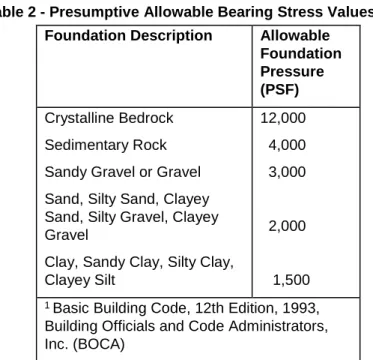
foundation loads, settlement should be calculated from site-specific soil test data. Index tests of site soil may allow correlation with similar soils for which test data is available. If no test data is available, presumptive bearing strength values for assessing actual bearing pressures may be obtained from Table 2 or another nationally recognized building code. In using presumptive bearing values, adequate
detailing and articulation must be provided to avoid distressing movements in the structure. Foundations consisting of bedrock with joints, fractures, or solution channels must be treated or a
separation distance provided consisting of a minimum of 1 foot of impermeable soil between the floor slab and the bedrock or an alternative that will achieve equal protection.
Table 2 - Presumptive Allowable Bearing Stress Values1
Foundation Description Allowable
Foundation Pressure (PSF) Crystalline Bedrock
Sedimentary Rock Sandy Gravel or Gravel Sand, Silty Sand, Clayey Sand, Silty Gravel, Clayey Gravel
Clay, Sandy Clay, Silty Clay, Clayey Silt 12,000 4,000 3,000 2,000 1,500 1 Basic Building Code, 12th Edition, 1993, Building Officials and Code Administrators, Inc. (BOCA)
Liquid Tightness. Applications such as tanks, that require liquid tightness must be designed and constructed in accordance with standard engineering and industry practice appropriate for the construction materials used to achieve this objective.
Structural Loadings. Waste storage structures must be designed to withstand all anticipated loads including internal and external loads, hydrostatic uplift pressure, concentrated surface and impact loads, water pressure due to seasonal high water table, and frost or ice pressure and load combinations in compliance with this standard and applicable local building codes.
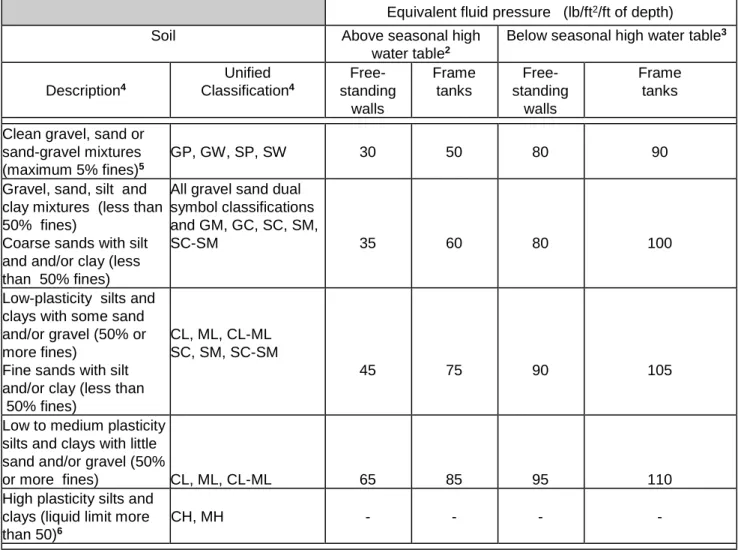
The lateral earth pressures should be calculated from soil strength values determined from the results of appropriate soil tests. Lateral earth pressures can be calculated using the procedures in TR-74. If soil strength tests are not available, the presumptive lateral earth pressure values indicated in Table 3 must be used.
TABLE 3 - LATERAL EARTH PRESSURE VALUES
1Lateral earth pressures based upon equivalent fluid assumptions must be assigned according to the following conditions:
• Rigid frame or restrained wall. Use the values shown in Table 3 under the column “Frame tanks,” which gives pressures comparable to the at-rest condition.
Flexible or yielding wall. Use the values shown in Table 3 under the column “Free-standing walls,” which gives pressures comparable to the active condition. Walls in this category are designed on the basis of gravity for stability or are designed as a cantilever, having a base wall thickness to height of backfill ratio not more than 0.085.
Internal lateral pressure used for design must be 65 lb/ft2 where the stored waste is not protected from precipitation. A value of 60 lb/ft2 may be used where the stored waste is protected from precipitation and will not become saturated. Lower values may be used if supported by measurement of actual
Equivalent fluid pressure (lb/ft2/ft of depth)
Soil Above seasonal high
water table2
Below seasonal high water table3
Description4 Unified Classification4 Free-standing walls Frame tanks Free-standing walls Frame tanks Clean gravel, sand or
sand-gravel mixtures (maximum 5% fines)5
GP, GW, SP, SW 30 50 80 90
Gravel, sand, silt and clay mixtures (less than 50% fines)
Coarse sands with silt and and/or clay (less than 50% fines)
All gravel sand dual symbol classifications and GM, GC, SC, SM,
SC-SM 35 60 80 100
Low-plasticity silts and clays with some sand and/or gravel (50% or more fines)
Fine sands with silt and/or clay (less than 50% fines)
CL, ML, CL-ML SC, SM, SC-SM
45 75 90 105
Low to medium plasticity silts and clays with little sand and/or gravel (50%
or more fines) CL, ML, CL-ML 65 85 95 110
High plasticity silts and clays (liquid limit more than 50)6
CH, MH - - - -
1 For lightly-compacted soils (85% to 90% maximum standard density.) Includes compaction by use of typical farm equipment.
2 Also below seasonal high water table if adequate drainage is provided. 3 Includes hydrostatic pressure.
4 All definitions and procedures in accordance with ASTM D 2488 and D 653. 5 Generally, only washed materials are in this category
pressures of the waste to be stored. If heavy equipment will be operated near the wall, an additional two feet of soil surcharge must be considered in the wall analysis.
Tank covers must be designed to withstand both dead and live loads. The live load values for covers contained in ASAE EP378.3, Floor and Suspended Loads on Agricultural Structures Due to Use, and in ASAE EP 393.2, Manure Storages, must be the minimum used. The actual axle load for tank wagons having more than a 2,000 gallon capacity must be used.
If the facility is to have a roof structure it must be designed and certified by a Professional Engineer licensed in the State of New York.
Roof structures must be designed to prevent waste located under the roof from becoming a pollution problem. Structural practices for collecting roof runoff must follow criteria outlined in NRCS
conservation standard Roof Runoff Structure (367). All outside surface water must be diverted from the roofed area
Structural Design. The structural design must consider all items that will influence the performance of the structure, including loading assumptions, material properties and construction quality. If the facility is to serve as part of a foundation or support for a building, the total load must be considered in the structural design. Design assumptions and construction requirements must be indicated on standard plans.
Tanks may be designed with or without covers. Covers, beams, or braces that are integral to structural performance must be indicated on the construction drawings. The openings in covered tanks must be designed to accommodate equipment for loading, agitating, and emptying. These openings must be equipped with grills or secure covers for safety, and for odor and vector control. All structures must be underlain by free draining material or must have a footing located below the anticipated frost depth. Fabricated structures must be designed according to the criteria in the following references as appropriate:
• Steel: “Manual of Steel Construction”, American Institute of Steel Construction.
• Timber: “National Design Specifications for Wood Construction”, American Forest and Paper Association.
• Concrete: “Building Code Requirements for Structural Concrete, ACI 318”, American Concrete Institute.
• Masonry: “Building Code Requirements for Masonry Structures, ACI 530”, American Concrete Institute.
Slabs on Grade. Slab design must consider the required performance and the critical applied loads along with both the subgrade material and material resistance of the concrete slab. Where applied point loads are minimal and liquid-tightness is not required, such as barnyard and feedlot slabs subject only to precipitation, and the subgrade is uniform and dense, the minimum slab thickness must be 4 inches with a maximum joint spacing of 10 feet. Joint spacing can be increased if steel reinforcing is added based on subgrade drag theory.
For applications where liquid-tightness is required such as floor slabs of storage tanks, the minimum thickness for uniform foundations must be 5 inches and must contain distributed reinforcing steel. The required area of such reinforcing steel must be based on subgrade drag theory as discussed in industry guidelines such as American Concrete Institute, ACI 360, and “Design of Slabs-on-Grade”. When heavy equipment loads are to be resisted and/or where a non-uniform foundation cannot be avoided, an appropriate design procedure incorporating a subgrade resistance parameter(s) such as ACI 360 must be used.
CONSIDERATIONS
Waste storage facilities should be located as close to the source of waste and polluted runoff as practicable.
Non-polluted runoff should be excluded from the structure to the fullest extent possible except where its storage is advantageous to the operation of the agricultural waste management system.
Freeboard for waste storage tanks should be considered.
Solid/liquid separation of runoff or wastewater entering pond facilities should be considered to
minimize the frequency of accumulated solids removal and to facilitate pumping and application of the stored waste.
Consideration should be given to environmental concerns, economics, the overall waste management system plan, and safety and health factors.
Considerations for Minimizing the Potential for and Impacts of Sudden Breach of Embankment or Accidental Release from the Required Volume.
Features, safeguards, and/or management measures to minimize the risk of failure or accidental release, or to minimize or mitigate impact of this type of failure should be considered when any of the categories listed in Table 4 might be significantly affected.
The following should be considered either singly or in combination to minimize the potential of or the consequences of sudden breach of embankments when one or more of the potential impact
categories listed in Table 4 may be significantly affected:
• An auxiliary (emergency) spillway
• Additional freeboard
• Storage for wet year rather than normal year precipitation
• Reinforced embankment -- such as, additional top width, flattened and/or armored downstream side slopes
• Secondary containment
The following options should be considered to minimize the potential for accidental release from the required volume through gravity outlets when one or more of the potential impact categories listed in Table 4 may be significantly affected:
• Outlet gate locks or locked gate housing
• Secondary containment
• Alarm system
• Another means of emptying the required volume
Table 4 - Potential Impact Categories from Breach of Embankment or Accidental Release 1. Surface water bodies -- perennial streams, lakes, wetlands, and estuaries
2. Critical habitat for threatened and endangered species. 3. Riparian areas
4. Farmstead, or other areas of habitation 5. Off-farm property
6. Historical and/or archaeological sites or structures that meet the eligibility criteria for listing in the National Register of Historical Places.
Considerations for Minimizing the Potential of Waste Storage Pond Liner Failure.
Sites with categories listed in Table 5 should be avoided unless no reasonable alternative exists. Under those circumstances, consideration providing an additional measure of safety from pond seepage when any of the potential impact categories listed in Table 5 may be significantly affected.
Should any of the potential impact categories listed in Table 5 be affected, consideration should be given to the following:
• A clay liner designed in accordance with procedures of AWMFH Appendix 10D with a thickness and coefficient of permeability so that specific discharge is less than 1 x 10⁻⁶ cm/sec
• A flexible membrane liner over a clay liner
• A geosynthetic clay liner (GCL) flexible membrane liner
• A concrete liner designed in accordance with slabs on grade criteria for fabricated structures requiring water tightness
Considerations for Improving Air Quality
To reduce emissions of greenhouse gases, ammonia, volatile organic compounds, and odor, other practices such as Anaerobic Digester, Controlled Temperature (366), Roofs and Covers (367), and Composting Facility (317) can be added to the waste management system.
Adjusting pH below 7 may reduce ammonia emissions from the waste storage facility but may increase odor when waste is surface applied (see Waste Utilization, 633).
Some fabric and organic covers have been shown to be effective in reducing odors. Using naturally aerated or mechanically aerated lagoons
Using a methane digester and capture system or other treatment system PLANS AND SPECIFICATIONS
Plans and specifications must be prepared in accordance with the criteria of this standard and must describe the requirements for applying the practice to achieve its intended use.
OPERATION AND MAINTENANCE
An operation and maintenance plan must be developed that is consistent with the purposes of the practice, its intended life, safety requirements, and the criteria for its design.
The plan must contain the operational requirements for emptying the storage facility. This must include the requirement that waste must be removed from storage and utilized at locations, times, rates, and volume in accordance with the overall waste management system plan.
In addition, for ponds, the plan must include an explanation of the permanent marker or recorder installed to indicate the maximum operating level.
Table 5 - Potential Impact Categories for Liner Failure 1. Any underlying aquifer is at a shallow depth and not confined
2. The vadose zone is rock
3. The aquifer is a domestic water supply or ecologically vital water supply
The plan must include a strategy for removal and disposition of waste with the least environmental damage during the normal storage period to the extent necessary to insure the pond’s safe operation. This strategy is for the removal of the contribution of unusual storm events that may cause the pond to fill to capacity prematurely with subsequent design inflow and usual precipitation prior to the end of the normal storage period.
An emergency action plan will be developed for all storages that includes site-specific provisions for emergency actions that will minimize significant impacts.
Erosion and sediment control structures will be maintained periodically and after every major runoff event until the disturbed area is fully protected.
REFERENCES
NRAES Earthen Manure storage design Manure Production and Characteristics ASAE D384.2 March 2005, Published by the American Society of Agricultural and Biological Engineers, St. Joseph, Michigan www.asabe.org
Earthen Manure Storage Design Considerations, April 1999,
Northeast Regional Agricultural Engineering Service. NRAES-109 NRAES, Cooperative Extension
B-16 Morrison Hall Ithaca, New York 14853-4801