econ
stor
www.econstor.eu
Der Open-Access-Publikationsserver der ZBW – Leibniz-Informationszentrum WirtschaftThe Open Access Publication Server of the ZBW – Leibniz Information Centre for Economics
Nutzungsbedingungen:
Die ZBW räumt Ihnen als Nutzerin/Nutzer das unentgeltliche, räumlich unbeschränkte und zeitlich auf die Dauer des Schutzrechts beschränkte einfache Recht ein, das ausgewählte Werk im Rahmen der unter
→ http://www.econstor.eu/dspace/Nutzungsbedingungen nachzulesenden vollständigen Nutzungsbedingungen zu vervielfältigen, mit denen die Nutzerin/der Nutzer sich durch die erste Nutzung einverstanden erklärt.
Terms of use:
The ZBW grants you, the user, the non-exclusive right to use the selected work free of charge, territorially unrestricted and within the time limit of the term of the property rights according to the terms specified at
→ http://www.econstor.eu/dspace/Nutzungsbedingungen By the first use of the selected work the user agrees and declares to comply with these terms of use.
zbw
Olivella, Pau; Vera-Hernandez, Marcos
Working Paper
Testing for adverse selection into private medical
insurance
IFS Working Papers, Institute for Fiscal Studies (IFS), No. 06/02 Provided in Cooperation with:
Institute for Fiscal Studies (IFS), London
Suggested Citation: Olivella, Pau; Vera-Hernandez, Marcos (2006) : Testing for adverse selection into private medical insurance, IFS Working Papers, Institute for Fiscal Studies (IFS), No. 06/02, http://dx.doi.org/10.1920/wp.ifs.2006.0602
This Version is available at: http://hdl.handle.net/10419/71493
T
ESTING FOR
A
DVERSE
S
ELECTION INTO
P
RIVATE
M
EDICAL
I
NSURANCE
Pau Olivella
Marcos Vera Hernández
Testing for Adverse Selection into Private
Medical Insurance
∗
Pau Olivella
†and Marcos Vera-Hernández
‡February 6, 2008
Abstract
We develop a test for adverse selection and use it to examine private health insurance markets. In contrast to earlier papers that consider either a purely private system or a system in which private insurance supplements a public system, we focus our attention on a system where privately funded health care is substitutive of the publicly funded one. Using a model of competition among insurers, we generate predictions about the correlation between risk and the probability of taking private insurance under both symmetric information and adverse selection. These predictions constitute the basis for our adverse selection test. The theoretical model is also useful to conclude that the setting that we focus on is especially attractive to test for adverse selection. Using the British Household Panel Survey, we find evidence that adverse selection is present in the British private health insurance market.
JEL: D82 I19 G22
Key Words: Contract theory, Testing, Health Insurance
∗We are grateful for useful comments from Jerome Adda, James Bank, Richard Blundell,
Si-mon Burgess, Winnand EmSi-mons, Emla FitzsiSi-mons, Matilde Machado, Bernard Salanie. Carol Propper, Lise Rochaix-Ranson, and other participants at seminars in Bristol, University Col-lege London, City University in London, as well as the European Health Economics Workshop in Oslo, International Industrial Organization Conference in Chicago, the International Health Economics Association Conference in Barcelona, and the ASSET meeting in Ankara. All re-maining errors are our only responsibility. Vera acknowledges financial support by a Marie Curie Fellowship of the European Community program, Improving Human Research Poten-tial and the Socio-economic Knowledge Base, under contract no. HPMF-CT-01206. Olivella acknowledges financial support from the Departament d’Universitats, Recerca i Societat de la Informació, Generalitat de Catalunya, projects 2001SGR-00162 and 2005SGR00836; as well as from Programa Nacional de Promoción General del Conocimiento, project BEC2003-01132, and the Barcelona Economics Progamme of CREA.
†Department of Economics and CODE, Universitat Autònoma de Barcelona, 08193
Bel-laterra, Spain; E-mail: [email protected]
1
Introduction
Although adverse selection is one of the main assumptions of contract theory, empirical papers find mixed evidence of its existence. Yet the existence of ad-verse selection is important because it is one of the main justifications for public intervention in insurance markets (Dahlby, 1981).
In this paper we test for the existence of adverse selection in health insurance markets. We do this in a framework where a public health administration fi-nances health care in full through income taxes, so that individuals with private insurance may resort to an alternative source of care. In other words, privately funded and publicly funded care are, de facto, mutually exclusive. We refer to this setting as the “substitutes framework,” and test propositions emanating from a theoretical model that incorporates the features of this framework. This distinction is important because the competitive equilibrium that arises within this framework has, to our knowledge, never been studied under either symmet-ric information or adverse selection. Previous literature has focused either on a “supplements framework,” where the private insurance is supplemental to the public one, or on one where the public insurance is absent, which we call a “purely private framework.”
As our theoretical model shows, the consequences of adverse selection are more dramatic in our framework than in the other two. Consequently, our in-stitutional setting is better suited to test for the existence of this phenomenon. Our theoretical model also shows that, as far as our test of adverse selection is concerned, the supplements framework and the purely private framework yield similar predictions.
Let us illustrate our terminology by applying it to a few real world examples. In the US, a large segment of the population is not eligible for either Medicaid or Medicare and must resort to private insurance. Hence, this is an example of a purely private framework. In France and Belgium, as well as for the part of the population covered by Medicare in the US, an individual obtains a basic insurance
contract from the insurer of his choice and receives funding from the government to cover this basic coverage. In addition, the individual can buy a supplementary contract to cover whatever copayments and services are not covered by the ba-sic insurance contract. Hence these are examples of the supplements framework. Finally, in the UK, Spain, Italy, and many other European countries, the public insurance system provides treatment instead of just financing some basic cover-age. Moreover, except for prescriptions and dental care, copayments in the public system are nil so there is no room to supplement the public coverage. Instead, an individual can only substitute the treatment funded by the public system by receiving care funded through private insurance.
Consistently with the above discussion, we perform a test of adverse selection in the UK, a substitutes framework (Besley and Coate, 1991). Everyone is pub-licly insured through the British National Health Service (NHS). The NHS is, in turn, financed through taxation. Hence individuals contribute to the financing of public care whether they use it or not (Propper, 1989). It may seem a puzzle why, in such a system, anyone would purchase private insurance in the first place. A possible explanation is that private care is perceived to be of higher quality along some dimension (Besley and Coate, 1991). For instance, private insurance enrollees are able to obtain treatment from the private sector without having to put up with long waiting lists (Propper and Maynard 1989, Besley et al. 1998 and 1999, Propper et al. 2001). Another possible reason is that health care ob-tained through private insurance offers better hotel services. We reflect this in our model by assuming that the private insurer offers better coverage than the public one.
The contributions of this paper are two-fold. First, we solve a theoretical model of competition among insurers under the substitutes framework. We com-pare the equilibrium set of contracts and choices under symmetric information with those under adverse selection. In order to draw comparisons, we also briefly reproduce the well-known equilibrium contracts predicted both under the sup-plements and the purely private frameworks. For each setting, we adapt and
extend the perfectly competitive paradigm developed by Rothschild and Stiglitz (1976). As a second contribution, we test for adverse selection in the UK. To our knowledge, this is the first time such a test has been carried out under a substitutes framework. In this sense, our theoretical contribution is important for our empirical test, as we need to know the equilibrium features under the substitutes framework to be able to test for adverse selection there.
According to our theoretical results, under the substitutes framework and under adverse selection, high-risk individuals are the ones who purchase private insurance. In contrast, under this framework and in the absence of adverse selec-tion, low-risk individuals are the ones who purchase private insurance. In other words, under the substitutes framework the sign of the correlation between the probability of purchasing private insurance and risk is positive in the presence of adverse selection and negative in its absence.
Unlike the substitutes framework, the predictions of the supplements frame-work are related to the amount of coverage purchased rather than the purchase of insurance itself. According to the basic Rothschild-Stiglitz model, all individ-uals buy insurance, although the amount of coverage purchased might vary with the individual’s risk. Our theoretical model of the supplements framework shows (and this is not new) that, under adverse selection, high-risk individuals tend to purchase more coverage. That is, under adverse selection a positive correlation between risk and coverage would be observed.1 In the absence of adverse
selec-tion, all individuals purchase high coverage contracts in equilibrium, hence there is no correlation between risk and coverage.
Notice that there are two differences between the substitutes and the supple-ments frameworks. First, the test under the latter must be based on observations on each individual’s coverage, whereas in the former, it suffices to observe whether
1When there is private information on both the probability of risk and the taste for insur-ance (e.g., risk aversion), the positive correlation between coverage and risk is not a necessary condition for the existence of adverse selection, see Finkelstein and McGarry (2006). Accord-ing to them, ignorAccord-ing the private information on taste for insurance might misleadAccord-ingly lead to conclude that adverse selection on the probability of risk is absent. This implies that our estimate of adverse selection is be a lower bound.
private insurance is purchased or not. Second, in a supplements framework, we need to distinguish a positive correlation from zero correlation, while in a sub-stitutes framework we need to distinguish a positive correlation from a negative one. This gives more power to our test.
We test for adverse selection using the British Household Panel Survey. Our test compares the probability of hospitalization of employees who receive private health insurance as a fringe benefit with that of individuals who buy private health insurance directly. The advantage of using only individuals that have private health insurance is that they will have the same access conditions to hos-pitalizations. Hence, any difference in the probabilities of hospitalization between the two groups is due to differences in risk. We find that individuals who purchase medical insurance have a higher probability of hospitalization than individuals who receive private medical insurance as a fringe benefit. This constitutes ev-idence in favour of the presence of adverse selection in the UK private medical insurance market.
We carry out several robustness exercises of our main result. Our test could be biased if individuals in worse health status look for jobs with employer-provided medical insurance. However, if this bias were present, it could only reinforce the empirical results found. One could also argue that our findings could be due to heterogeneity in the coverage provided by employer-provided and individually purchased medical insurance. We use the same dataset to rule out this possibility. Let us briefly review the theoretical literature on adverse selection where pri-vate health insurance coexists with the public system. In the supplements frame-work, the Medigap system in the US (supplemental to Medicare) has received the most attention. Gouveia (1997) studies the political outcome in a model of supplementary private health insurance in the absence of adverse selection. Feld-man et al. (1998) study the equilibrium under adverse selection. Delipalla and O’Donnell (1999) combine the two previous papers in a supplementary private health insurance market.
the substitutive public provision of private goods (such as health care or edu-cation) has focused on its role as a redistributive device. A seminal paper here is the one by Besley and Coate (1991), who propose the NHS in the UK as an example of a substitutes framework. Blomquist and Christiansen (1998) study when should governments implement supplementary rather than substitutive sys-tems.2 In contrast to them, we do not aim to analyze the redistributive role of
the substitutive system, we instead focus on how informational assumptions on health risk heterogeneity influence the equilibrium.
The literature on empirical testing of adverse selection has recently gained attention. On the one hand, some works cast doubts on the presence of adverse selection. For example, in his review, Chiappori (2000) concludes that the im-portance of adverse selection is limited. Cardon and Hendel (2001) do not find evidence of adverse selection in the US employer-provided health insurance mar-ket either. Chiappori and Salanie (1997 and 2000) find no evidence of adverse selection in the automobile insurance market. In the life insurance market, nei-ther Cawley and Philipson (1999) nor Hendel and Lizzeri (2003) find evidence of adverse selection.
On the other hand, Ettner (1997) and Finkelstein (2004) find evidence of ad-verse selection in the Medigap market in the US and Gardiolet al. (2005) provide evidence of adverse selection in a strongly regulated private insurance market in Switzerland. Finkelstein and Poterba (2004, 2006) find evidence of adverse selec-tion in the UK annuity market. It is therefore clear that more research is needed to obtain a better assessment of the presence of adverse selection in insurance markets, especially in private health insurance markets in which public insurance is also provided.3
2See also this paper for a literature review on publicly provided private goods.
3Cameronet al. (1988), Coulsonet al. (1995), Vera-Hernández (1999) and Schellhorn (2001) focus on estimating how coverage influences health care use while controlling for the endogeneity of insurance coverage, i.e., for adverse selection. As a subproduct, it is tempting to interpret the results of the endogeneity test as evidence of asymmetric information. However, as Chiappori (2000) emphasizes this approach is likely to overestimate adverse selection substantially, as most specification errors will give evidence of endogeneity even in the absence of adverse selection.
As for the UK, our testing arena, several papers have investigated the de-terminants of private medical insurance (King and Mossialos, 2002; Propper et al., 2001; Besleyet al., 1999; Besley et al., 1998; Propper, 1993; Propper, 1989). These papers highlight the role of political ideology, quality, resources available to the private sector, insurance premiums and income. However, to our knowledge, adverse selection has not been investigated in this particular market.
Our paper is organized as follows. In Section 2 we introduce the model of the substitutes framework. In Section 3 we study the equilibrium of the substitutes framework both under symmetric information and under adverse selection. In Section 4 we study the equilibrium under the supplements framework, comment on those predictions that are important when testing for adverse selection and compare them with the substitutes framework. In Section 5 we perform the empirical analysis. We first describe the data, we then explain the test in detail, and thirdly we report our main results. At the end of Section 5 we discuss three different potential threats to the validity of our results and show why they are not relevant in our setting. In Section 6 we conclude the paper. The proofs of all lemmata and propositions are in the Appendix.
2
The model
We start by describing our main framework, the substitutes framework. Two features distinguish this framework: (i) If an individual with private insurance falls ill, he must choose between the private treatment covered by his insurance and the public treatment. He cannot have an operation in the public sector and then receive its postoperative treatment in a private hospital. Private and public services cannot be combined. (ii) When a privately insured individual chooses the private treatment, the private insurer must bear the full cost of treatment. These two features rule out supplementary private health coverage, i.e., insurance to cover the copayments borne by the individual when treated in the public sector.4
4In the UK, a substitutes framework, the public insurance only charges copayments for outpatient drugs, vision tests, and dental treatment. These copayments are quite
All individuals in the economy are obliged to pay income taxes, which are dedicated to finance public sector expenditures, including public health care. This care is provided by a set of providers that are either public or have been subcontracted by the NHS.5 We refer to this set as PUB henceforth.
We study the game that starts once (i) the health authority (HA henceforth) has chosen and committed to a specific package of services that is provided free of charge, and (ii) the individual has already paid his personal income taxes, which contribute to the financing of the PUB. An important but realistic assumption is that all individuals in a given observable class (say women of a certain age) receive the same treatment, rather than being offered a menu of options.
In this game there are two sets of players, a large set of private insurance companies (insurers henceforth) that compete for individuals, and a large number of individuals, where each can be one of two types (described below).
The first movers are the insurers, who take into account the option that individuals can resort to the PUB set of providers for free. The insurers simulta-neously choose the package of services that will be delivered in case of illness and also the premium that consumers must pay before knowing whether or not they will become ill. We assume that insurers as well as the HA condition their offers to each observable class of individuals. We therefore perform all of our analysis for a single and prespecified class.
The second and last movers are the individuals. Once they have learned their probability of becoming ill (i.e., their type) but before they know whether or not they will actually become ill, they simultaneously decide whether to purchase private insurance and, if so, from which insurer. Conceptually, each individual
low. For instance, individuals only pay pocket £6.5 (US$ 11.50) for each out-of-pocket drug prescribed. Charges for dental treatment and vision tests are also small (see http://www.dh.gov.uk/assetRoot/04/10/69/10/04106910.pdf). In fact, as far as we are aware, all the countries under the substitutes framework have very low copayments for a limited set of services. Most services covered by the public insurer are free of charge. Consequently, there is no room for private insurers to supplement the copayments that the public insurer charges.
5The subcontracted providers may be private, public-private consortia, or not-for-profit foundations. However, since they have signed contracts with the NHS to treat NHS patients, we still refer to them as public providers.
first looks at the best contract for him and then compares it with the public package.
The assumption that insurers take the public package of services as given can be justified as follows. The quality, waiting time, copayment regime, and so on at the PUB is determined by the HA’s budget, which is the result of a lengthy political process. In contrast, insurers make these decisions more flexibly. The assumption is also convenient because it allows us to leave aside the way in which the HA’s budget is decided, as well as the objective function of whomever decides this budget (e.g., the government or the parliament).
If an individual has chosen to purchase private insurance from a specific in-surer, he enjoys double coverage. If this individual falls ill, he chooses between two options associated with two distinct sets of providers, the set PUB and the set of providers that are offered by his insurer, which we call PRI. The sets PUB and PRI may imply different copayments, waiting times, qualities, ancillary ser-vices, or protocols. We will measure all of these characteristics, as well as the initial health status, in monetary units, as is standard in models of insurance under adverse selection.6
We denote by ℓ0 the loss suffered by an individual who is not treated at all
and has fallen ill. We can describe an insurer’s offer, henceforth "contract," by a two-dimensional vector (ℓP RI, q), where ℓP RI denotes the insurer’s commitment
to reduce the insuree’s final losses fromℓ0 toℓP RI if he seeks treatment through
the set PRI, andq denotes the insurance premium.
If an individual obtains treatment from the set PUB (either because he has not purchased private insurance or because he prefers the public treatment), his loss is reduced to ℓP U B.7 Notice that the public package constitutes an outside
option for an individual who has not yet decided whether to purchase private
6In some models of health insurance in the absence of adverse selection, individuals have preferences (often additively separable) over disposable income and health. See, for instance, Gouveia (1997). Our analysis is simpler in this dimension.
7As it is common in the literature, this model emphasizes the benefits of risk reduction due to health insurance. See Finkelstein and McKnight (2008) for estimates of the benefits of risk reduction brought by the introduction of Medicare.
insurance. This outside option can also be described as a two-dimensional vector (ℓP U B,0), where the second component is zero because taxes paid are independent
of whether private insurance is purchased or not.8 We refer to this option as “the public package,” henceforth. It is important to note that private contracts where
ℓP RI > ℓP UB are irrelevant as they are dominated by the public package.
Finally, notice that an ill consumer could also choose to go untreated even though public treatment is free. We rule out this possibility by assuming that
ℓ0 ≥ ℓP U B, that is, public treatment does reduce the losses suffered by an ill
individual. We solve the game by backward induction.
We are now ready to describe the players’ payoffs. At the point in time (τ, for expositional simplicity) when the individual must decide whether or not to purchase private insurance he does not know if, at time τ′ > τ, he will become
ill. At point in time τ the individual initial position is measured by a single parameter w, which includes his health status as well as his disposable wealth, i.e., net of taxes. We refer to this parameter as initial wealth.
Suppose that the individual has purchased some private insurance contract (ℓP RI, q). As noted before, this means that ℓP RI < ℓP U B. If the individual does
not become ill, he enjoys final wealthw−q. If he does become ill, he enjoys final wealthw−q−ℓP RI. In contrast, suppose that the individual has not taken private
insurance. If he does not fall ill he enjoys final wealth equal to w. Otherwise, since we have assumed that ℓ0 > ℓP U B, he obtains public treatment from PUB
and hence enjoys final wealth equal to w−ℓP U B.
There are two types of individuals, low risks and high risks. Low-risk
individ-8An implicit assumption is that an agent does not receive a tax rebate if he chooses to purchase private insurance. In the presence of a tax rebate, if an agent decides to purchase private insurance, the government returns part of the taxes paid by this consumer. Since we will be drawing the analysis in the final wealth space, the position of the zero isoprofit constraint associated with attracting a given type depends on this tax rebate. We can, however, prove that our results do not change if the tax rebate is proportional to the premium paid. More specifically, one can show that this is equivalent to a simultaneous change in the exogenous probability of illness for each type. If, on the other hand, the tax rebate were a fixed constant, then our theoretical results would have to be revised. Nevertheless, such fixed rebates are not usually observed. As for our testing arena, a rebate was in place for individuals over age 60 in the UK prior to the July 1997 budget, but this rebate was proportional to the premium.
uals may suffer an illness with probability pL. High-risk individuals may suffer
the same illness with probability pH. Of course, 0< pL < pH <1. The
individ-ual’s probability of illness is publicly observable under symmetric information, and is only observed by him under asymmetric information. We analyze both the symmetric and the asymmetric information cases. It is common knowledge that the proportion of low risks in the economy is 0 < γ < 1. We denote by
p=γpL+ (1−γ)pH the average probability of illness in the population. This
pa-rameter will play an important role below. All individuals have the same utility functionu over final wealth, with u′ >0 andu′′ <0.
An individual who may suffer an illness with probability p and who decides not to purchase private insurance enjoys expected utility pu(w−ℓP U B) + (1−
p)u(w). If he does purchase some private contract (ℓP RI, q), his expected utility
ispu(w−ℓP RI −q) + (1−p)u(w−q).
Insurers are risk neutral. Suppose that an insurer S has attracted an individual
i of type J ∈ {L, H}with a contract(ℓ, q). Suppose thati falls ill. Then S must bear the costs of ensuring thati does not suffer a loss larger thanℓ, as promised in the contract. Since we are under the substitutes framework, these costs must be borne in full by the insurer. Since losses in the lack of treatment are ℓ0, the
insurer in fact bears the cost of reducing losses from ℓ0 to ℓ. We simplify the
analysis by assuming that each dollar of loss reduction costs the insurer exactly one dollar. This yields linear isoprofit lines, as it is standard in insurance models. The expected profits of offering(ℓ, q) are therefore given byq−pJ(ℓ0−ℓ).
It is perhaps clarifying to discuss here the main difference between the substi-tutes and the supplements frameworks. Under the supplements framework, the only costs that the insurer would bear when committing to a loss of ℓ are the costs of reducing losses from ℓP U B to ℓ so that expected profits would be given
byq−pJ(ℓP U B −ℓ).
We now perform a change of variable to conduct the standard graphical analy-sis in the space of final wealths. Suppose an individual has purchased a private insurance contract(ℓ, q). His final wealth in case of illness is given bya=w−ℓ−q
(a for ”accident”). In case of no illness, it is given by n =w−q (n for ”no ac-cident”). It is easy to check that q = w−n and ℓ = n−a. Hence, an insurer attracting aJ-risk with a final-wealth contract (n, a) expects to obtain
ΠJ(n, a) =q−pJ(ℓ0−ℓ) =w−n−pJ(ℓ0−n+a). (1)
Isoprofits have slopeda/dn=−(1−pJ)/pJ. It is easy to check that the zero
isoprofit goes through the point of neither private nor public insurance, given by (n, a) = (w, w−ℓ0) and denoted byA. The zero isoprofits are depicted in Figure
1 and labeledΠJ(·) = 0 for J =L, H.
Notice that in the presence of the public package, the status-quo point of an individual is notA but(w, w−ℓP U B). This is the final wealth vector associated
with the public package and we denote this point as P. In Figure 1, each point in the vertical line throughn=wis a possible position of P. AsℓP UB decreases
(or as public coverage increases), P lies at a higher point in this vertical line. If
ℓP U B =ℓ0, we are back to the no-insurance pointA.
By virtue of the change of variable performed above, an individual’s expected utility is given by UJ(n, a) =pJu(a) + (1−pJ)u(n). His marginal rate of
substi-tution between states is given by
da dn− ∂UJ(n,a) ∂n ∂UJ(n,a) ∂a =−1−pJ pJ u(n) u(a).
In Figure 1 we depict one indifference curve for each type. The slope of an indifference curve at the 45-degree line is−1−pJ
pJ , and coincides with the slope of
the corresponding isoprofit. Therefore efficiency is attained for any contract in the 45 degree line. This corresponds to contracts with full coverage, wheren=a, orℓ= 0.
The presence of the public packageP at the outset (i.e., constituting a com-mitted offer) may imply that some contracts that were attracting individuals in the equilibrium in the absence of P may now become inviable, and vice versa. Hence the following terminology.
Definition 1 If a contract α attracts some individuals we say that the contract is active. Analogously, if the public package P attracts some individuals we say that the public sector is active.
A sufficient condition for a contract to be active in equilibrium is that it offers strictly more utility to some risk type than both the rest of the contracts offered and the public package. The same goes for the public package. However, this condition is not necessary. If some type is indifferent between two offers, both offers may attract individuals of this type. Anyhow, the only tie-breaking rule that we need to solve the model is the following.
Assumption 1 If all individuals of type J are indifferent between the public package P and the best private contract for them, all individuals of type J choose the public package.9
Our equilibrium notion is the following.
Definition 2 An equilibrium set of active contracts S (ESAC henceforth) is a set of contracts (that may or may not include the public package P) such that (i) Each and every contract in S is offered either by some insurer(s) or by the public sector and is active.
(ii) If a single insurer deviates by offering a contract outside this set, either this contract will be inactive or this insurer will not make additional profits.
3
The substitutes framework
We solve first the game under the hypothesis of symmetric information. We then proceed to the case where health risks are an individual’s private information. Finally, we compare the equilibria in the two settings.
9Assuming that some agents choose the private sector out of indifference would not greatly change our results.
3.1
The game under symmetric information
The low-risk and the high-risk markets are segmented. Consider first the situation where there is no public system. We know from Rothschild-Stiglitz (1976) that the competitive equilibrium entails efficient contracts (full insurance) and zero profit per individual no matter his type. Therefore, for allJ =L, H; we havenJ =
aJ andΠJ(n, a) = 0, which implies, using (1), thatw−aJ−pJℓ0 = 0, oraJ =nJ =
w−pJℓ0. This yields contracts{α∗H, α∗L}={(w−pHℓ0, w−pHℓ0),(w−pLℓ0, w−pLℓ0)},
which are depicted in Figure 1.
We now find the ESAC for each possibleP. We illustrate our arguments by means of Figure 1. Point H0 is the public package (n, a) = (w, w−ℓP UB) such
that a high risk is indifferent betweenα∗
H andH0. PointL0 is the public package
such that a low risk is indifferent between α∗
L and L0. The following lemma
cannot be proven graphically and is a consequence of Jensen’s inequality.10
Lemma 1 H0 < L0.
Once the positions ofH0 andL0 are known, we can analyze the situation case
by case, i.e., for each possible position of P. In Case 1, P lies below point H0;
in Case 2, P coincides with H0; in Case 3, P lies strictly between point L0 and
point H0; in Case 4, P coincides with L0; in Case 5, P lies above L0. For each
case, we find the ESAC. This yields the following proposition.
Proposition 1 Suppose that adverse selection is absent. Then, under assump-tion 1, a unique ESAC exists for each and every posiassump-tion of the public package
P, and is characterized as follows. a) In Case 1, the ESAC is {α∗
L, α∗H}, high risks pick α∗H, and low risks pick α∗L;
the public sector is inactive.
b) In Cases 2 and 3, the ESAC is{α∗
L, P}, low risks pick α∗L, and high risks pick 10We are indepted to Juan Enrique Martínez-Legaz for providing the elegant proof that can be found in the Appendix.
P.
c) In Cases 4 and 5, the ESAC is{P} and only the public sector is active.
Notice that the only cases where both sectors are active are 2 and 3, where only the low risks resort to the private sector. This yields the following corollary.
Corollary 1 Suppose that the two sectors are active and adverse selection is absent. Under assumption 1, the probability of illness among the privately insured ispL, which is smaller thanp, the average in the general population.
The reason we compare the probability of illness of those who purchase insur-ance with the average probability in the general population will be explained in Section 5, since it is relevant for our empirical test.
3.2
The game under adverse selection
As in the previous section, consider first the situation where there is no public health system. We know from Rothschild-Stiglitz (1976) that the competitive equilibrium, if it exists, entails an efficient contract (full insurance) for the high risks and zero profits for an insurer attracting a high risk. Therefore, the high risk contract under asymmetric information is the same as under symmetric informa-tion,α∗
H. The low-risk contract must satisfy the high-risk incentive compatibility
constraint with equality and also yield zero profits. These two equations yield the contract depicted byαˆL in Figure 2.
As it is well known, this set of contracts {αˆL, α∗H} constitutes only a
can-didate, albeit unique, for a competitive equilibrium. Recall that in the purely private competitive model there exists a critical γ (γ∗ henceforth), such that an
equilibrium exists if and only if γ ≤ γ∗. This γ∗ is the proportion of low risks
such that the zero-isoprofit line associated to pooling contracts (not depicted) is tangent to the indifference curve UL in Figure 2. If γ > γ∗ then a lens appears
lens pools both risks, but makes positive profits on average, thus constituting a profitable deviation from the candidate. We will prove later that the condition for existence in the purely private market also ensures existence of an equilibrium once we introduce the public sector. Hence we introduce it here.
Assumption 2 The proportion γ of low risks in the population is less than or equal to the critical proportionγ∗ for existence in the purely private framework.
Using the set of contracts {αˆL, α∗H} that is active in the equilibrium in the
absence of a public package, we can divide the possible positions of the public contract P into five cases, as in the previous section. In Figure 2, point H0 is
again the public contract such that a high risk is indifferent between α∗
H and
H0. Notice that point H0 is the same whether adverse selection is present or
not, since the equilibrium contract for the high risk is the same. Point L1 is
the public contract such that a low risk is indifferent between αˆL and L1. The
relative position ofH0 and L1 is given in the next lemma.
Lemma 2 H0 > L1.
We are now ready to establish the five possible cases that one has to deal with when characterizing the competitive equilibrium. In Case 1, P lies below point
L1; in Case 2, P coincides with L1; in Case 3, P lies strictly between point L1
and point H0; in Case 4, P coincides with H0; in Case 5, P lies above H0. For
each case, we find the ESAC. This yields the following proposition:
Proposition 2 Suppose that adverse selection is present. Then, under assump-tions 1 and 2, a unique ESAC exists for each and every position of the public package P, and is characterized as follows.
a) In Case 1, the ESAC is {αˆL, α∗H}, high risks pick α∗H, and low risks pick αˆL;
b) In Cases 2 and 3, the ESAC is{α∗
H, P}, low risks pick P, and high risks pick
α∗
H.
c) In Case 3, assumption 2 is no longer necessary for existence of a competitive equilibrium.
d) In Cases 4 and 5, the ESAC is {P} and only the public sector is active.
The proof follows the usual arguments used in the purely private model. How-ever, they have to be modified because the committed presence of the public package offer must be taken into account. Perhaps the only instance where this presents some difficulty is the following. Some deviations that are not profitable in the purely private model because they violate incentive compatibility may be-come profitable in the presence of P. The idea is that the public package may absorb the high-risk individuals who otherwise would have flocked to the devia-tion. We prove that this cannot be true in Cases 1, 2, and 3 because P is not attractive enough, while in Cases 4 and 5 the private sector is not active in the first place.
Notice that both sectors are active in cases 2 and 3 only. We have the following and most important corollary.
Corollary 2 Suppose that the two sectors are active and adverse selection is present. Then, under assumptions 1 and 2, the probability of illness for those who decide to purchase private insurance ispH, which is larger thanp, the average in
the general population.
Again, the reason we compare the probability of illness of those who purchase private insurance with the average probability in the population will be explained in Section 5. In any case, notice that corollaries 1 and 2 tell us that the sign of the difference betweenpand the probability of illness of the privately insured crucially depends on the presence of adverse selection. This stands in clear contrast with the results that we obtain in the next section, where we explore the supplements framework.
4
Comparisons with the Supplements framework
The underlying model of supplementary private insurance is quite different from the one with substitutive insurance. The HA commits beforehand to a specific level of loss reduction, say ℓ0 −ℓP UB. If the individual has purchased private
insurance, he enjoys a further reduction in loss, sayℓP UB−ℓ′. Most importantly,
the private insurer bears the cost of only this last loss reduction. This is the key distinction with the substitutes framework, where the insurer bears the full cost of reducing the loss fromℓ0 toℓ′. To sum up, under the supplements framework,
the expected profit of an insurer committing to a final loss equal toℓ′ <ℓˆis given
by(1−pJ)q+pJ(q−(ℓP U B−ℓ′)) =q−pJ(ℓP U B −ℓ′).
We conduct the same change of variable as in the previous section. For an individual who has purchased private insurance, we have a = w− q−ℓ′ and n=w−q. Thenq=w−nandℓ′ =n−a. Therefore, expected profit is given by w−(1−pJ)n−pJ(a+ℓP U B). We next find the location of the zero-isoprofit line
in the space(n, a). Notice that ifℓ′ =ℓ
P U B (zero private coverage) thenq = 0as
well. Thena =w−ℓP U B andn=w, i.e., the status quo of the individual without
private insurance who resorts to public treatment. The slope of any isoprofit is given by da dn =− ∂ΠJ(n,a) ∂n ∂ΠJ(n,a) ∂a =−1−pJ pJ ,
as before. Hence, this model is equivalent to the classic Rothschild-Stiglitz model except that the status quo point is (n, a) = (w, w−ℓP U B) instead of
(n, a) = (w, w−ℓ0). Hence, Figure 2 can be used to depict the competitive
equi-librium under both symmetric information and adverse selection by replacing the vertical intercept for point A shown there (i.e., w−ℓ0) with w−ℓP U B.11 The
competitive equilibrium without adverse selection is given by (α∗
L, α∗H), whereas 11This does not mean that the position of the isoprofit lines remains intact after the in-troduction of public insurance. Only the construction of the competitive equilibrium remains the same. In particular, by introducing public insurance in such a way that private insurance becomes supplemental (a supplements framework), the status quo point A not only changes its vertical position but also its horizontal one. This is because initial incomew includes taxes,
the equilibrium under adverse selection is given by(ˆαL, α∗H). Note that if an
indi-vidual does not purchase private insurance, then his final wealth pair is at point A, which is clearly inferior for both types of individuals under both symmetric and asymmetric information. This yields the most important result here. That is, regardless of the presence or absence of adverse selection, all types would, in principle, take private insurance. Hence the average probability of illness in the private sector would always be equal to p. Having purchased private insurance or not cannot be an explanatory variable for differences in risk.
In order to obtain a test for adverse selection in the supplements framework, one needs to observe the particular level of coverage that each individual enjoys in the sample. The model then predicts that in the absence of adverse selection all individuals take full coverage. Among those with full coverage, the average probability of falling ill is p, the same as in the general population. If, on the other hand, adverse selection is present, then the model predicts that low risks will enjoy lower coverage than high risks. Hence, those who choose to purchase full coverage have a higher probability of requiring treatment than the average probability in the population.
As mentioned in the introduction, there are two differences between the sub-stitutes and the supplements frameworks. The first one is that a test for adverse selection in the supplements framework must be based on observations on each individual’s coverage, whereas it suffices to observe whether private insurance is purchased or not in the substitutes framework. The second one is that in the former framework one needs to distinguish positive correlation from zero correla-tion, whereas in the latter framework one has to distinguish positive correlation from negative correlation.
5
Testing for adverse selection
Consistent with the above discussion, we perform a test of adverse selection in the UK, a substitutes framework. Everyone is publicly insured through the National Health Service (NHS). The NHS is, in turn, financed through taxation. Hence
individuals contribute to the financing of public care whether they use it or not. Individuals buy private health insurance to obtain treatment from the private sector without having to put up with long waiting lists. Health care obtained through private insurance also offers better hotel services.
In the UK, public and private insurance coexist. In the terminology of our theoretical section, both sectors are active. According to our theoretical model (corollary 2), if adverse selection is present then the probability of requiring medical care of the privately insured individuals is higher than the average in the population. Conversely (corollary 1), in the absence of adverse selection, the probability of requiring medical care of the privately insured is lower than the average in the population. In sum, our theoretical model predicts that in a substitutes framework, such as the UK, adverse selection has a drastic effect on the sign of the difference between the average probability of requiring medical care and this probability for those who decide to buy private health insurance. This will be the cornerstone of our test for adverse selection.
5.1
The Data
The data we use come from waves sixth to fifteen of the British Household Panel Survey (BHPS) collected over the period 1996-2005.12 All adult members of
each household are interviewed. Households are followed over time, even if the original households split up. The BHPS oversamples residents in Scotland and Wales. We use sampling weights to make the sample representative of the non-immigrant population of Britain.13 We do not consider previous waves because
the questions about private medical insurance were only included from the sixth wave onwards. Private health insurance is relatively uncommon in Britain, only 15.9%have private medical insurance according to our estimates. We restrict our sample to individuals in permanent jobs.
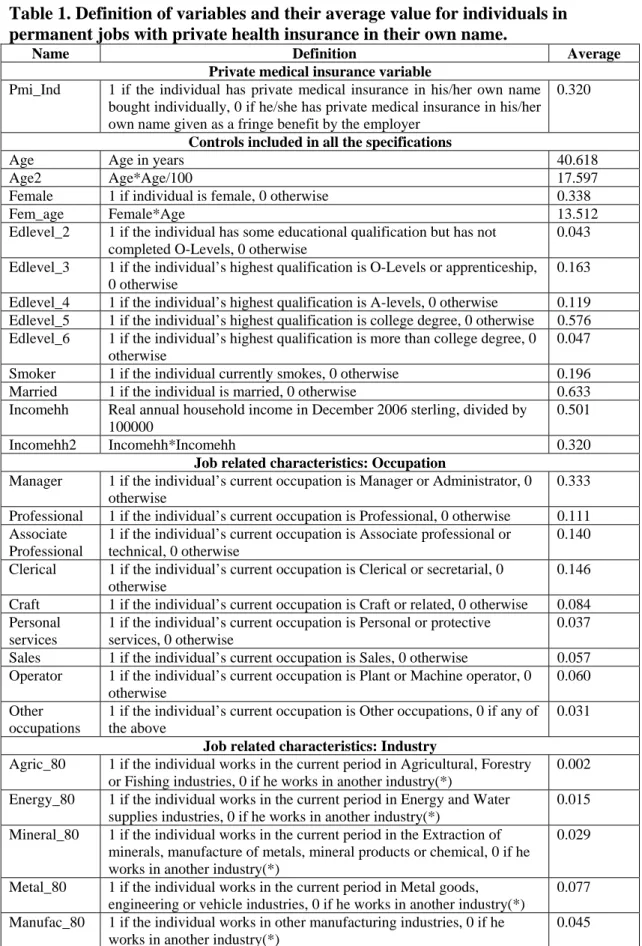
The definition of the variables that we use for the analysis are shown in
12Detailed information about the BHPS can be obtained from
http://www.iser.essex.ac.uk/ulsc/bhps/
Table 1. Apart from variables related to health insurance and health status, we also use education (6 categories), age, gender, whether or not the individual is married, whether or not the individual smokes, and household income. We also use variables related to job characteristics: whether or not the employer offers a pension, plant size (11 categories), occupation (9 categories), and industry (10 categories). The individual’s occupation refers to whether the individual is a manager, professional, technical, clerical, etc. Regarding industry variables, the BHPS uses the 1980 Standard Industrial Classification before the 12th wave, and the 1992 Standard Industrial Classification from wave 12th onwards.14
[TABLE 1 AROUND HERE]
5.2
Test rationale
One would like to base the test for adverse selection on comparing the risk of requiring medical care of those who decided to buy private medical insurance with the risk of those who decided not to buy it. However, one does not observe whether an individualtruly requires medical care but whether an individual ac-tually uses health care services. Hence, as it is common in the literature, we use actual utilization as a proxy for requiring medical care. Unfortunately, this test could overestimate adverse selection. Individuals with private health insurance might be hospitalized more often than individuals without private health insur-ance because they enjoy better access conditions (e.g., less waiting time) and not because they have a higher probability of requiring medical care.15 This is the
classical problem of distinguishing between moral hazard and adverse selection. Our strategy in this respect is described next.
14We use two sets of dummy variables for industry, one is based on the 1980 classification and the other one is based on 1992 classification. The set of dummy variables based on the 1980 classification takes value 0 for all waves after the 12th inclusive. The set of dummy variables based on the 1992 classification takes value 0 for all waves before the 12 wave. This strategy minimizes the possibility of bias at the expense of some efficiency loss.
15Different practice guidelines or doctor’s behavior in public and private facilities might also distort this comparison.
In the UK, there are three ways to acquire private insurance. First, private medical insurance can be bought directly in the market by the individual. Second, some employers offer their employees the option to buy private medical insurance. If the employee decides to buy the insurance offered by his employer, he will have the premium deducted explicitly from his wage. Consequently, he might decide not to buy it. Third, and very importantly for us, some employers directly provide their employees with private medical insurance as a fringe benefit. The BHPS asks about the source of private health insurance only to individuals who have health insurance in their own name. According to the BHPS, privately insured employees obtain their private insurance as follows: 45% pay directly for it,12% have the insurance deducted from their wages, and43% get it from the employer as a fringe benefit.
Our test for adverse selection will compare the probability of hospitalization of those who purchase private medical insurance directly with those who receive it as a fringe benefit from their employer.16 We exclude individuals that have
their insurance premium deducted from their wages because it is unclear how to classify them. On the one hand, they can choose whether to buy private health insurance or not, and hence they could be classified as part of the group that pay for health insurance directly. On the other hand, their insurance premium might be particularly low because the purchase is arranged through their employer, and hence they could also be classified as part of the group that receive private health insurance as a fringe benefit.17
The logic of the test we perform is that the population of employed individuals with permanent jobs is split into two groups: those who must decide whether to buy private insurance or not (or group D, for “deciders”) and those who receive private medical insurance from their employer as a fringe benefit (or group N, for “non deciders”). Our assumption is that, conditional on covariates and being
16We choose hospitalizations because in the UK private medical insurance is mainly used for hospital treatment.
17In our theoretical model, this would correspond to a situation where premia are so low that all risk types prefer the private option to the NHS alternative, and this would hold irrespective of whether adverse selection is present or not.
permanently employed, individuals that belong to the N-group have the same health status as individuals that belong to the D-group. Group D can again be divided into two subgroups: those who purchase private insurance, or group DI, and those who do not, or group DN. Since individuals in group D decide whether or not to buy private medical insurance, their behavior should follow our model of a substitutes framework (Section 3). Consequently, if adverse selection is present, the probability of hospitalization in group DI should be higher than the population average, i.e., that in group N. Conversely, in the absence of adverse selection, the probability of hospitalization in group DI should be lower than in group N. Notice that if the difference in the probability of hospitalization were not significantly different from zero then the only possible conclusion would be that the data are not informative enough to reject the null hypothesis that information is symmetric. It could not mean that adverse selection is absent, since if this were the case then the difference in the probability of hospitalization would not be zero but negative. This is strikingly different from the tests performed under the supplement or fully private framework where a non significant correlation between health care use and insurance coverage is taken as evidence against the presence of adverse selection.
Notice that, our strategy avoids the moral hazard bias outlined above, as both group N and DI should enjoy the same access conditions to hospitalization because they both have private medical insurance. However, our testing strategy is subject to three validity threats: (1) the health status of the N group was different from the health status of the D group, (2) N group individuals exert more preventive effort than DI individuals, (3) the coverage, and therefore the access conditions, provided by insurance contracts was different between the N group and the DI group. We will address these concerns after we have shown the results of the adverse selection test.
5.3
Test results
We restrict our sample to individuals in full time permanent jobs that have private medical insurance in their own name. As explained above, we do not consider those individuals that have their private medical insurance premium deducted from their wage. We will use a Probit model to estimate the difference in the probability of hospitalization between groups N and DI. We prefer to use a stan-dard Probit model rather than a random effect Probit model to avoid making distributional assumptions on the individual random effect. The estimates of the standard error are adjusted to take into account that the same individual is observed in different waves.
The results are reported in Table 2. The key variable is PMI_IND (top row of Table 2) that takes value 1 when the individual pays directly for private medical insurance and takes value 0 if the individual receives health insurance as a fringe benefit from the employer. The difference between the second and third column is that the second one does not condition on job characteristics while the third one does. Job characteristics include industry, occupation, plant size, and whether or not the employer offers a retirement pension. The marginal effects associated to PMI_IND are positive and statistically different from zero at 1%, indicating that individuals that buy private medical insurance directly have a higher prob-ability of hospitalization than individuals that obtain it as a fringe benefit from the employer. These estimates imply that the difference in the probability of hos-pitalization is0.026 if we do not condition job related characteristics, and 0.029 if we condition on job related characteristics.18 These are important differences
if we consider that the average probability of hospitalization is0.063.19
[TABLE 2 AROUND HERE]
Let us highlight that, as we have just seen, our results are robust to the introduction of the aforementioned job characteristics. This is important because
18These marginal effects are evaluated at the average of the other covariates.
19Other variables that affect the probability of hospitalization among this group of employed individuals with permament jobs are gender, age, and being married.
Table 3 shows that the percentage of employees with employer-provided health insurance differ considerably by industry and by type of occupation. For instance, managers and administrators are more likely to enjoy employer-provided health insurance than clericals workers. Financial services are also more likely to enjoy employer-provided health insurance than the agriculture sector. This could imply that the health status of the N group was different from the health status of the D group if employer provided private medical insurance is particularly popular among industries or occupations that display health status different from the average in the population. We do not believe this is a problem in our case because, as we have just seen, our results on adverse selection get even stronger when we condition on these job characteristic variables.
[TABLE 3 AROUND HERE]
5.4
Threats to validity
5.4.1 Representativeness of the health status of the comparison group
As discussed above, our previous result would not constitute evidence of adverse selection if individuals that obtain private medical insurance as a fringe benefit (individuals in the N-group) were particularly healthy among those individu-als that are permanently employed. Here we provide evidence in favour of our assumption that having employer-provided health insurance is independent of health status in the UK, conditional on our set of covariates and being employed in a permanent job. Consequently, the health of individuals with employer pro-vided health insurance must be representative of the health of the population with permanent jobs. We believe that this is the case because, unlike the US, employer provided health insurance is relatively uncommon and hence it is un-likely that it is an important factor driving employment choices. Reflecting this, private medical insurance is not among the 16 different answer options that the BHPS offers when it asks individuals the main reason to change jobs. A similar assumption to ours has been maintained for the US by Ettner (1997) and Cardon
and Hendel (2001).20 In fact, we believe that this assumption is more likely to
hold in the UK than in the US. The provision of health insurance by the employer should be less important in the UK than in the US because the NHS is available free to anyone in the UK, and individuals cannot opt out of it.
Two types of selection issues could potentially invalidate our assumption. One type of selection is “employer driven” and the other one is “employee driven.” The first one is related to the fact that jobs in certain occupations or industries are more likely to offer employer-provided health insurance than others. Our findings in Table 2 were robust to the introduction of job characteristics and, if anything, the difference in the probability of hospitalization between the N-group and the DI group became larger when we conditioned on job characteristics. Another possible source of bias in our comparison could be an “employee driven” bias. This would be the case if employees in worse health status look for jobs that offer employer-provided health insurance. Clearly, if this bias was present, it would go in our favour in the sense that we would be underestimating the extent of adverse selection.21
Despite the arguments above, we still would like to test whether the health of individuals with employer provided health insurance can be taken as representa-tive of the health of the population with permanent jobs. For this purpose, we build the variable EMP_INS that takes value 1 if the individual is part of the N group and 0 if he is part of the D group, independently of whether he is DI or DN. Table 4 shows the estimates of a Probit model for EMP_INS over the standard set of covariates and thirteen different binary variables each one corre-sponding a different health problem. This health related information is declared by the individual and it strongly predicts hospitalization.22 The estimates show
that observed health problems do not predict whether the individual belongs to
20Chiappori and Salanie (2003) state in page 129 that “the main identifying assumption used by Cardon and Hendel is that agents do not choose their employer on the basis of the health insurance coverage.”
21A similar argument was already used by Ettner (1997) for the US.
22Results on how the health problem variables predict hospitalization are available upon request from the authors.
the D or N group. The marginal effects for these health conditions are very small in size, and they are not individually statistically different from zero at usual confidence levels despite the large sample size of these regressions. The P-value of the joint hypothesis that all the coefficients associated with health problems are zero is 0.78 for the model that excludes job characteristics, and 0.96 for the model that includes them.
[TABLE 4 AROUND HERE]
The above results provide evidence that, conditional on covariates, there is no difference between the health status of individuals in group D and individuals in group N.23 Of course, we can only test this according to the health variables that we observe. There could be differences in health dimensions that we do not observe. In this case, the most likely bias is that potential employees in worse health status look for jobs that offer employer-provided health insurance. If this was the case our results in Table 2 will underestimate the extent of adverse selection.
5.4.2 Differences in preventive effort
A possible concern is that our results in Table 2 might not driven by adverse selection but by differences in preventive effort (ex-ante moral hazard). To be specific, if group N individuals were more risk averse than group DI individuals, then group N individuals might exert more preventive effort that might translate into a smaller probability of hospitalization. Though we believe it unlikely that group N individual are more risk averse than group DI individuals given that DI individual pay the premium themselves, we investigate this issue further by testing the differences in preventive effort between DI and N individuals.
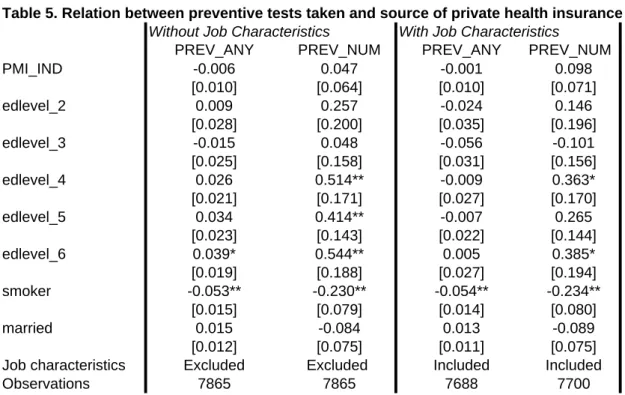
Table 5 shows marginal effects from Probit regressions in which the dependent variable takes value 1 if the individual has taken at least one preventive test in the
23In Table 4 we use observed health status rather than hospitalization because we use both individuals with and without private health insurance and they have different access conditions to hospitalizations.
last year and 0 if he has taken none, and OLS regressions in which the dependent variable is the number of preventive tests taken by the individual during the last year. The coefficients associated with the variable PMI_IND are not statistically different from zero at usual levels of confidence. This shows that there are not significant differences in the preventive effort exerted by individuals in group DI and N.
[TABLE 5 AROUND HERE]
5.4.3 Differences in the coverage of the contracts
Above we have found that the probability of hospitalization is larger for group DI individuals than for group N individuals. This is consistent with adverse selection but it is also consistent with a situation where individually purchased policies are more generous than corporate policies in the sense that individually purchased policies offer better access conditions to hospitalizations. There are three reasons why we think that the latter does not hold. The first one relies on further empirical exploitation of our data, the second one on theoretical grounds, and the third one relies on existing empirical research on the private health insurance market in the UK. We elaborate on these arguments in turn next.
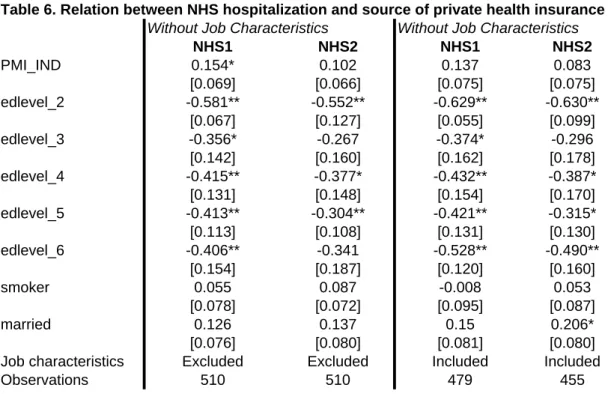
Firstly, the hypothesis that individually purchased policies are more generous than corporate policies is not supported by the data. We can investigate this because individuals with private medical insurance are still eligible to be treated by the NHS. Whether they will choose to be treated by the NHS or by private insurance will depend on the waiting time in the NHS and the generosity of their private coverage policy (deductibles, maximum amount covered, illnesses excluded, covered treatments, and so on). If individually purchased policies were more generous than corporate policies, then we should observe that, conditional on having a hospitalization, the probability of choosing NHS-funded treatment is smaller for individuals in the DI group than for individuals in the N group. We build two dependent variables, NHS1 that takes value 1 if the treatment
was funded entirely by the public system (NHS) and 0 if the treatment was funded entirely by the private system or co-funded by the public and private system. NHS2 that takes value 1 if the treatment was funded entirely by the public system (NHS) or co-funded by the private and public system, and 0 if the treatment was funded entirely by the private system. The percentage of co-funded treatments is very small (6%). Table 6 shows marginal effects from Probit regressions in which the dependent variables are NHS1 or NHS2. The marginal effects corresponding to PMI_IND are positive and, depending on the specification, statistically different from zero at 95% of confidence. Hence, there is no support for the hypothesis that individually purchased policies are more generous than corporate policies. If that was the case, we should observe that patients with individually purchased policies use the NHS less often, contrary to the results in Table 6. If anything, these results suggest that corporate policies are more generous than individually purchased ones, which would mean that our test underestimates the presence of adverse selection.
[TABLE 6 AROUND HERE]
Secondly, we know from our theoretical model in section 3 that group DI individuals will obtain full insurance. The issue is whether group N individuals also obtain full insurance or not. The most straightforward theoretical analysis shows that they do. Indeed, suppose that we want to find the menu of contracts that maximizes average employee welfare subject to (i) ensuring a fixed profit to the insurance company and (ii) keeping the risk mix in the firm fixed.24 It turns out that this menu reduces to a single (and therefore pooling) full-coverage contract.25 In other words, if employers do not use health insurance to distort
the risk mix, competition for workers will force employers to offer a full coverage
24The US experience is consistent with restriction (ii). According to Buchmueller and Dinardo (2002), the 1993 New York Small Group Market Reform, which prevented insurance firms from charging different premiums based on the ages of a firm’s workers, did not reduce the percentage of individuals with health insurance in the overall population.
25A formal proof of this is available upon request from the authors. Let us just insist on the fact that a single pooling contract with full insurance is optimal even if one allows firms to offer screening menus.
contract. Indeed, it is a widely supported view in the profession that employer provision of insurance palliates the adverse selection problem directly, without needing to resort to reductions in coverage.26 If both group DI individuals and group N individuals enjoy a contract with full insurance, they are both subject to the same incentives to obtain health care, and hence, enjoy the same access conditions.
Thirdly, Propper and Maynard (1989) study the most important features of the private health insurance in Britain. They claim that the benefits provided by corporate and individually purchased insurance policies are very similar (p. 11).
6
Conclusions
Recent empirical literature has found mixed support for the presence of adverse selection. In this paper, we focus on an institutional framework that has not been exploited before to test for adverse selection. In particular, we focus on a NHS framework where privately and publicly funded care are substitutive. Using a theoretical model, we have derived the properties of the equilibria in the presence and in the absence of adverse selection. The nature of the equilibria depends on the generosity of the public coverage. In the interesting case in which public and private markets coexist, we show that the probability of requiring medical care for individuals with private health insurance is higher than the average in the population in the presence of adverse selection. Conversely, in its absence, the probability of requiring medical care for those with private health insurance is smaller than the average in the population. Hence, our model predicts that in a substitutes framework like the NHS, adverse selection has a dramatic effect on the sign of the difference between the average probability of requiring medical care and the average probability for those who decide to buy private health insurance. The sign of this difference will depend on whether or not adverse selection is
26Directly quoting Bhattacharya and Vogt (2006): “For example, the leading health eco-nomics text says ‘group purchase by employers addresses the problem of adverse selection,’ (Folland et al., 2004). This sentiment is repeated in many places (Cutler, 2002; Gruber and Levitt, 2000; Buchmueller et al., 2002).”
present.
In the UK, private medical insurance is mostly used for hospitalizations. We test for adverse selection among permanent employees by comparing the prob-abilities of hospitalization of those that receive private medical insurance as a fringe benefit, and those who buy it directly. We find strong evidence of adverse selection. We show that our results cannot be driven by three alternative ex-planations. First, they cannot be due to the comparison group being healthier than the general population. In fact, particularly unhealthy individuals would have more of an incentives to get a job that provided private health insurance as a fringe benefit. In that case, we would in fact be underestimating the ex-tent of adverse selection. Second, we can rule out that our results are driven by differences in preventive effort. Third, we can also rule out that individually pur-chased contracts offer better coverage than employer provided health insurance contracts.
We find that adverse selection is present in the British private health insurance market. This has important implications. First, as we have seen, the risk mix that prevails in the publicly funded NHS, and therefore the costs borne by the government, greatly depend on the presence of adverse selection. Second, several authors have shown that if adverse selection is present then one can increase welfare by appropriately imposing taxes on the contracts intended for the low risks while subsidizing the contracts intended for the high risks.27
7
Appendix
Proof of Lemma 1
LetH0 = (w, aH) and L0 = (w, aL). We need to prove thataH < aL, or
equiva-lently that u(aH)< u(aL). NowH0 satisfiesUH(w, aH) =UH(α∗H). This implies
pHu(aH) + (1− pH)u(w) = u(w −pHℓ0). Similarly, L0 satisfies UL(w, aL) = 27For the case of perfectly competitive insurance markets, see Crocker and Snow (1985). For the case of health maintenence organizations that are horizontally differentiated, see Olivella and Vera (2007).
UL(α∗L). This implies pLu(aL) + (1−pL)u(w) = u(w−pLℓ0). Solving for u(aH)
andu(aL), we need to prove that
u(aH) = u(w−pHℓ0)−(1−pH)u(w) pH < u(w−pLℓ0)−(1−pL)u(w) pL =u(aL).
After some manipulation, this can be rewritten as
u(w−pLℓ0)> pL pH u(w−pHℓ0) +u(w) pH−pL pH . (2) Let x1 = w−pHℓ0, x2 = w, p1 = ppHL, and p2 = pH−pL pH . Notice that 0 < p1 < 1,
0 < p2 < 1, p1 + p2 = 1; so that (p1, p2) is a system of probabilities. Let
Ep(·) be the expectation operator associated to these probabilities. Notice that
Ep(x)≡p1x1+p2x2 =w−pLℓ. Therefore, expression (2) can be rewritten as
u(Ep(x))> Ep(u(x)).
This is true by Jensen’s inequality and the fact thatu(·)is strictly concave.
Proof of Proposition 1
Step 1. We prove first that no contract outside the set {P, α∗
L, α∗H} can belong
to an ESAC. In other words, any ESAC must be a subset of {P, α∗
L, α∗H}. Under
symmetric information, the private market is segmented. Fix a type J = L, H. Suppose, by contradiction, that in equilibrium the private sector attracts some individuals of typeJ with contractα0 =α∗J. ThenUJ(α0)> UJ(P)and moreover
either α0 does not yield zero profits or is not efficient, since if both were false
then efficiency and zero profit would imply that α0 = α∗J. Take the first case,
where profits are positive. Then there exists ε > 0 such that α′ = α
0+ε
1 1
and UJ(α′) > UJ(α0) ≥ UJ(P), so α′ monopolizes all individuals of type J
and still makes positive profits per consumer ifε is small enough, contradiction. Suppose now that α0 is not efficient, then there exists another contract α′ such
![Table 2. Relation between hospitalization and source of private medical insurance Without job characteristics With job characteristics PMI_IND 0.026** 0.029** [0.010] [0.010] edlevel_2 -0.014 -0.014 [0.019] [0.019] edlevel_3 -0.012 -0.01 [0.015] [0.015]](https://thumb-us.123doks.com/thumbv2/123dok_us/10039348.2496492/50.892.84.476.146.521/relation-hospitalization-private-medical-insurance-characteristics-characteristics-edlevel.webp)

![Table 4. Relation between source of health insurance and health status Without job characteristics With job characteristics Limbs -0.007 -0.003 [0.006] [0.004] Seeing -0.018 -0.002 [0.014] [0.012] Hearing -0.009 -0.003 [0.014] [0.010] Skin 0.01 0.006 [0.](https://thumb-us.123doks.com/thumbv2/123dok_us/10039348.2496492/52.892.94.508.169.992/table-relation-source-insurance-characteristics-characteristics-seeing-hearing.webp)