Research Article
A Mahalanobis Hyperellipsoidal Learning Machine Class
Incremental Learning Algorithm
Yuping Qin,
1Hamid Reza Karimi,
2Dan Li,
3Shuxian Lun,
4and Aihua Zhang
11College of Engineering, Bohai University, Jinzhou 121013, China
2Department of Engineering, Faculty of Engineering and Science, The University of Agder, 4898 Grimstad, Norway 3College of Mathematics and Physics, Bohai University, Jinzhou, China
4New Energy College, Bohai University, Jinzhou, China
Correspondence should be addressed to Yuping Qin; [email protected]
Received 23 December 2013; Accepted 31 December 2013; Published 11 February 2014 Academic Editor: Ming Liu
Copyright © 2014 Yuping Qin et al. This is an open access article distributed under the Creative Commons Attribution License, which permits unrestricted use, distribution, and reproduction in any medium, provided the original work is properly cited. A Mahalanobis hyperellipsoidal learning machine class incremental learning algorithm is proposed. To each class sample, the hyperellipsoidal that encloses as many as possible and pushes the outlier samples away is trained in the feature space. In the process of incremental learning, only one subclassifier is trained with the new class samples. The old models of the classifier are not influenced and can be reused. In the process of classification, considering the information of sample’s distribution in the feature space, the Mahalanobis distances from the sample mapping to the center of each hyperellipsoidal are used to decide the classified sample class. The experimental results show that the proposed method has higher classification precision and classification speed.
1. Introduction
Incremental learning is an intelligent technology of data mining and knowledge discovery. There are already some key methods of incremental learning, such as KNN, principal component analysis, Bayesian network, and Boosting and support vector machines (SVM), and this idea in the control
theory, such as data driven [1–5], promotes the development
of control method. Among these methods, SVM has a good generalization performance, because it does not depend on all the training data, but a subset named support vector. The number of support vectors is very small compared with the training data set, so SVM is a powerful tool to the incremental learning.
Many incremental learning algorithms based on SVM have been proposed, and they received better results, such as
the incremental learning Batch SVM [6,7], on-line recursive
algorithm [8], divisional training SVM algorithm [9], fast
incremental learning algorithm [10], and𝛼-SVM algorithm
[11]. However, these algorithms are only suitable to the case
that the new incremental samples belong to old classes. When a new class was added to the classification system, the above
methods could not be fully accommodated to this situation
and the old models became useless. Reference [12] proposed
a class incremental learning algorithm. The algorithm reuses the old models of the classifier and trains only one binary subclassifier when a new class comes. But it is not suitable to large data set, because all samples participate in the training in the process of each incremental learning. For the
disad-vantage, [13] proposed a class incremental learning algorithm
based on hyper sphere support vector machine (HS-CIL), but the algorithm is only suitable to the case that the sample’s distribution is hyper sphere shaped and the density is higher.
For the disadvantage, [14] proposed a hyperellipsoidal class
incremental learning algorithm (HE-CIL), but the algorithm does not consider the influence of the outlier samples. There-fore, a Mahalanobis hyperellipsoidal learning machine class incremental learning algorithm (MHE-CIL) is proposed in this paper. To every class sample, the smallest hyperellipsoidal that encloses as much samples as possible and pushes the out-lier samples away is trained in the feature space. Mahalanobis distances are used to confirm the classified sample class.
The rest of this paper is organized as follows. InSection 2,
a brief review of Mahalanobis hyperellipsoidal learning
Volume 2014, Article ID 894246, 5 pages http://dx.doi.org/10.1155/2014/894246
machine is given. InSection 3, a new Mahalanobis hyperellip-soidal learning machine class incremental learning algorithm
is discussed in detail. InSection 4, experimental results are
given on Reuters 21578. Finally, conclusion is outlined in
Section 5.
2. Mahalanobis Hyperellipsoidal
Learning Machine
Given a set of training samples of a class {𝑥𝑖}𝑁𝑖=1, where
𝑥𝑖 ∈ 𝑅𝑑 and 𝑁is the number of samples, let𝑋be a 𝑑 ×
𝑁sample matrix. Training a Mahalanobis hyperellipsoidal
𝐸(𝑎, 𝑅) in the feature space, where 𝑎 is the center of the
hyperellipsoidal and𝑅is the radius of the hyperellipsoidal,
the hyperellipsoidal encloses most of the mappings of sample
and the radius 𝑅 is as small as possible. If there are no
remote points, then the hyperellipsoidal will enclose all the mappings of sample. If there are remote points, allowing part of the samples outside of the superellipsoid, and searching for the smallest superellipsoid which can surround the most samples. When we are uncertain whether there are remote
points, nonnegative slack variables 𝜉𝑖 (𝑖 = 1, 2, . . . , 𝑁)are
introduced to allow some of the mappings of sample outside the hyperellipsoidal. Using the method that is similar to finding optimal hyperplane of SVM to obtain the smallest
hyperellipsoidal [15–17], the formulation is as follows:
min 𝑎,𝑅,𝜉𝑖 𝑅 2+ 𝐶∑𝑁 𝑖=1 𝜉𝑖 s.t. (𝑥𝑖− 𝑎)𝑇Σ−1(𝑥𝑖− 𝑎) ≤ 𝑅2+ 𝜉𝑖 𝜉𝑖≥ 0, 𝑖 = 1, 2, . . . , 𝑁, (1)
where 𝐶is used to compromise the number of noises out
of hyperellipsoidal and the radius of hyperellipsoidal, Σ is
covariance matrix of the samples andΣ−1is the inverse of the
covariance matrixΣ.
To solve the optimization problem above, one can con-struct the Lagrange function as follows:
𝐿 (𝑅, 𝑎, 𝛽, 𝛾, 𝜉𝑖) = 𝑅2+ 𝐶∑𝑁 𝑖=1 𝜉𝑖 −∑𝑁 𝑖=1 𝛼𝑖{𝑅2+ 𝜉𝑖− (𝑥𝑖− 𝑎)𝑇Σ−1(𝑥𝑖− 𝑎)} −∑𝑁 𝑖=1 𝛽𝑖𝜉𝑖, (2)
where𝛼𝑖≥ 0and𝛽𝑖≥ 0are the Lagrange multipliers.
According to the Kuhn-Tucker theorem (KKT) in opti-mization theory, the following conditions are satisfied:
𝜕𝐿 𝜕𝑅 = 2𝑅 (1 − 𝑁 ∑ 𝑖=1 𝛼𝑖) = 0 ⇒∑𝑁 𝑖=1 𝛼𝑖= 1, 𝜕𝐿 𝜕𝜉𝑖 = 𝐶 − 𝛼𝑖− 𝛽𝑖= 0 ⇒ 0 ≤ 𝛼𝑖≤ 𝐶, 𝜕𝐿 𝜕𝑎 = − 𝑁 ∑ 𝑖=1 2𝛼𝑖(𝑥𝑖− 𝑎) = 0 ⇒ 𝑎 =∑𝑁 𝑖=1 𝛼𝑖𝑥𝑖. (3)
Substituting (3) into (2), the dual optimal problem is
obtained as follows: max 𝛼𝑖≥0 𝑁 ∑ 𝑖=1 𝛼𝑖𝑥𝑇𝑖Σ−1𝑥𝑖−∑𝑁 𝑖=1 𝑁 ∑ 𝑗=1 𝛼𝑖𝛼𝑗𝑥𝑇𝑖Σ−1𝑥𝑗 s.t. 𝑁 ∑ 𝑖=1 𝛼𝑖= 1 0 ≤ 𝛼𝑖≤ 𝐶, 𝑖 = 1, 2, . . . , 𝑁. (4)
The kernel form of (4) is as follows:
max 𝛼𝑖≥0 𝑁 ∑ 𝑖=1 𝛼𝑖𝑘 (𝑥𝑖, 𝑋) 𝑄𝑇Ω−2𝑄𝑘(𝑥𝑖, 𝑋)𝑇 −∑𝑁 𝑖=1 𝑁 ∑ 𝑗=1𝛼𝑖𝛼𝑗𝑘 (𝑥𝑖, 𝑋) 𝑄 𝑇Ω−2𝑄𝑘(𝑥 𝑗, 𝑋)𝑇 s.t. 𝑁 ∑ 𝑖=1 𝛼𝑖= 1 0 ≤ 𝛼𝑖≤ 𝐶, 𝑖 = 1, 2, . . . , 𝑁, (5)
where𝐾(⋅)is kernel function and𝐾(𝑥𝑖, 𝑥𝑗) = 𝑔(𝑥𝑖)𝑇𝑔(𝑥𝑗).
The examples that lie outside or on the margin are the
corresponding𝛼𝑖nonzero. These examples are called support
vectors.
The center of the smallest hyperellipsoidal 𝑎 can be
obtained as follows:
𝑎 = ∑ 𝑖
𝛼𝑖𝑔 (𝑥𝑖) . (6)
The square kernel Mahalanobis distance from the
map-ping𝑔(𝑥)of sample𝑥to the center𝑎of the hyperellipsoidal
in the feature space is defined as follows:
𝑑2(𝑔 (𝑥) , 𝑎) = (𝑔 (𝑥) − 𝑎)𝑇Σ−1(𝑔 (𝑥) − 𝑎) = 𝑁 (𝑘 (𝑥, 𝑋) −∑𝑁 𝑖=1 𝛼𝑖𝑘 (𝑥𝑖, 𝑋)) 𝑄𝑇Ω−2 × 𝑄 (𝑘 (𝑥, 𝑋) −∑𝑁 𝑖=1 𝛼𝑖𝑘 (𝑥𝑖, 𝑋)) . (7)
The radius of the smallest hyperellipsoidal 𝑅 can be
determined by (7), via KKT conditions as follows:
𝑑2(𝑥, 𝑎) < 𝑅2 𝛼𝑖= 0, 𝑑2(𝑥, 𝑎) = 𝑅2 0 < 𝛼𝑖< 𝐶,
𝑑2(𝑥, 𝑎) > 𝑅2 𝛼𝑖= 𝐶.
(8)
3. Incremental Learning Algorithm
We give a set of training samples𝐴 = {𝑥𝑖, 𝐸𝑖}𝑙𝑖=1and kernel
function𝐾(⋅), where𝑥𝑖 ∈ 𝑅𝑛,𝐸𝑖 ∈ {1, 2, . . . , 𝑁},𝑁is the
number of class of the training set 𝐴, 𝑙 is the number of
training samples, and 𝐾 corresponds to inner product in
feature space, namely,𝐾(𝑥𝑖, 𝑥𝑗) = 𝑔(𝑥𝑖)𝑇𝑔(𝑥𝑗).
Assume that 𝐴𝑚 is a subset of training samples 𝐴,
where all the samples of the subset𝐴𝑚 belong to the 𝑚th
class (𝑚 = 1, 2, . . . , 𝑁). For every subset𝐴𝑚, the smallest
hyperellipsoidal𝐸(𝑎𝑚, 𝑅𝑚)is trained in feature space, where
𝑎𝑚is the center of the hyperellipsoidal and𝑅𝑚is the radius of
the hyperellipsoidal.
If a new class, which defined𝐵, is generated, training the
smallest hyper ellipsoidal𝐸(𝑎𝑁+1, 𝑅𝑁+1)in the feature space,
and adding the classifier to old models. One time incremental learning is finished.
For the sample 𝑥 to be classified, compute the
Maha-lanobis distance from the mapping𝑔(𝑥)of the sample𝑥to
the center𝑎𝑚of the hyperellipsoidal according to (7).
If all 𝑑𝑚(𝑔(𝑥), 𝑎𝑚) satisfy 𝑑𝑚(𝑔(𝑥), 𝑎𝑚) > 𝑅𝑚 (𝑚 =
1, 2, . . . , 𝑁), and there is no hyperellipsoidal that encloses the
mapping𝑔(𝑥)of the sample𝑥, then compute the membership
that the sample𝑥belongs to the𝑚th class according to (9) and
then confirm the class of sample𝑥as follows:
𝑟𝑚= 𝑅𝑚
𝑑𝑚(𝑔 (𝑥) , 𝑎𝑚), (9)
class=arg max
𝑖 𝑟𝑖. (10)
If there are no less than two 𝑑𝑚(𝑔(𝑥), 𝑎𝑚) (𝑚 ∈
{1, 2, . . . , 𝑁})that satisfy𝑑𝑚(𝑔(𝑥), 𝑎𝑚) ≤ 𝑅𝑚, then compute
the membership that the sample𝑥belongs to the𝑚th class
according to (11) and then confirm the class of sample𝑥as
follows:
𝑟𝑖= 1 − 𝑑 (𝑔 (𝑥) , 𝑎𝑚)
𝑅𝑚 . (11)
For the sample𝑥to be classified, the classification
algo-rithm is described in detail as follows.
Step 1. Computing𝑑𝑚(𝑔(𝑥), 𝑎𝑚) (𝑚 = 1, 2, . . . , 𝑁)according
to (7).
Step 2. If only one𝑑𝑚(𝑔(𝑥), 𝑎𝑚) (𝑚 ∈ {1, 2, . . . , 𝑁})satisfies
𝑑𝑚(𝑔(𝑥), 𝑎𝑚) ≤ 𝑅𝑚, then the sample belongs to the𝑚th class;
go toStep 5; otherwise go toStep 3.
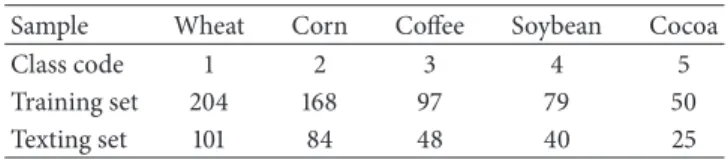
Table 1: Training set and testing set.
Sample Wheat Corn Coffee Soybean Cocoa
Class code 1 2 3 4 5
Training set 204 168 97 79 50 Texting set 101 84 48 40 25
Step 3. If all 𝑑𝑚(𝑔(𝑥), 𝑎𝑚) (𝑚 = 1, 2, . . . , 𝑁) satisfy
𝑑𝑚(𝑔(𝑥), 𝑎𝑚) > 𝑅𝑚, then compute the membership that
the sample𝑥belongs to the𝑚th class according to (9) and
then confirm the class of sample𝑥by (10) and go toStep 5;
otherwise go toStep 4.
Step 4. If more than one𝑑𝑚(𝑔(𝑥), 𝑎𝑚) (𝑚 ∈ {1, 2, . . . , 𝑁})
satisfies𝑑𝑚(𝑔(𝑥), 𝑎𝑚) ≤ 𝑅𝑚, then compute the membership
that the sample𝑥belongs to the𝑚th class according to (11)
and then confirm the class of sample𝑥by (10).
Step 5. End.
4. Experiments
Experiments are made on Reuters 21578, in which five categories and 896 texts are used. 598 texts are used as training set, and the rest 298 texts are used as testing set (see
Table 1). Information gain is used to reduce feature dimension and the weight of every word is computed according to TF-IDF.
To verify the efficiency of the proposed method, the same tasks are realized by using HS-CIL, HE-CIL, and MHE-CIL methods. The computational experiments were done on a Pentium 1.6 G with 512 MB memory. Liner kernel function
is used for all the experiments. System parameter𝐶 = 10,
V= 0.01.
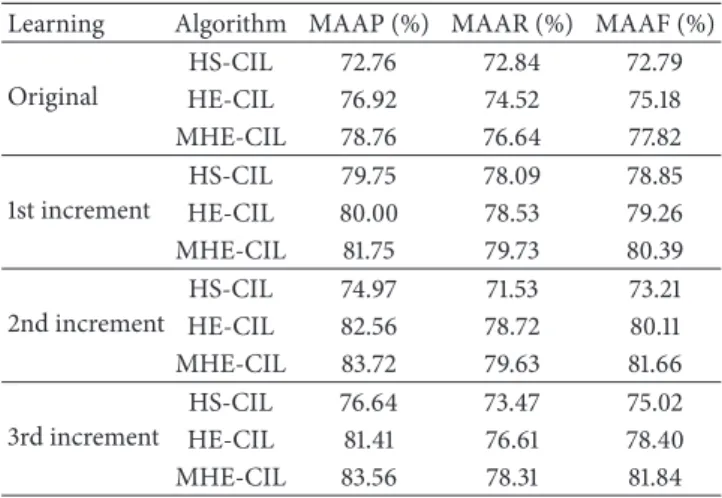
The macroaverage precision (MAAP), macro average
recall (MAAR), and macroaverage𝐹1(MAAF) [18] are used
to evaluate the classification performance of the algorithm. In experiments, the original sample set includes two class samples (wheat and corn). Three times class incremental learning is done; the first time increment is the third class sample (coffee), the second time increment is the forth class sample (soybean), and the third time increment is the fifth class sample (cocoa). The macroaverage precision,
macroaverage recall, and macroaverage 𝐹1 value of three
algorithms are given inTable 2. The training time and testing
time of three algorithms are given inTable 3.
The experimental results show the precision, the recall,
and the𝐹1 value of MHE-CIL method which are obviously
higher than the other two methods. The key reasons are that MHE-CIL method reduces the space that hyperellip-soidal encloses by pushing the outlier samples away, and the information of sample’s distribution is considered by using Mahalanobis distance. The training time of MHE-CIL method is faster compared with HE-MHE-CIL method, and it is nearly the same as HS-CIL method. The classification speed of MHE-CIL method is faster compared with HE-CIL method, and it is nearly the same as HE-CIL method.
Table 2: The comparison of MAAP, MAAR, and MAAF. Learning Algorithm MAAP (%) MAAR (%) MAAF (%) Original HS-CIL 72.76 72.84 72.79 HE-CIL 76.92 74.52 75.18 MHE-CIL 78.76 76.64 77.82 1st increment HS-CIL 79.75 78.09 78.85 HE-CIL 80.00 78.53 79.26 MHE-CIL 81.75 79.73 80.39 2nd increment HS-CIL 74.97 71.53 73.21 HE-CIL 82.56 78.72 80.11 MHE-CIL 83.72 79.63 81.66 3rd increment HS-CIL 76.64 73.47 75.02 HE-CIL 81.41 76.61 78.40 MHE-CIL 83.56 78.31 81.84 Table 3: The comparison of training time and testing time. Learning Algorithm Training times (ms) Testing times (ms) Original HS-CIL 110 94 HE-CIL 126 83 MHE-CIL 112 88 1st increment HS-CIL 15 140 HE-CIL 33 132 MHE-CIL 16 135 2nd increment HS-CIL 32 157 HE-CIL 36 161 MHE-CIL 33 158 3rd increment HS-CIL 31 204 HE-CIL 48 185 MHE-CIL 32 187
5. Conclusion
A novel class incremental learning algorithm is proposed. In the process of class incremental learning, only the new class samples participate in training and the old models of the classifier can be reused. In the process of classification, the Mahalanobis distance is used to confirm the class of classified sample, and the information of the sample’s distribution in the feature space is considered. The experimental results show that the proposed algorithm not only improves classification accuracy obviously, but also ensures training speed and classification speed. How to use kernel function theory to increase the density of the samples would be our research work in the future.
Conflict of Interests
The authors declare that there is no conflict of interests regarding the publication of this paper.
Acknowledgments
This study is partly supported by the National Natural Science Foundation of China (no. 61304149), the Natural Science
Foundation of Liaoning Province in China (no. 201202003), and the Program for New Century Excellent Talents in University (no. NCET-11-1005).
References
[1] S. Yin, S. X. Ding, A. H. A. Sari, and H. Hao, “Data-driven monitoring for stochastic systems and its application on batch process,”International Journal of Systems Science, vol. 44, no. 7, pp. 1366–1376, 2013.
[2] S. Yin, S. X. Ding, A. Haghani, H. Hao, and P. Zhang, “A comparison study of basic data-driven fault diagnosis and process monitoring methods on the benchmark Tennessee Eastman process,”Journal of Process Control, vol. 22, no. 9, pp. 1567–1581, 2012.
[3] S. Yin, H. Luo, and S. Ding, “Real-time implementation of fault-tolerant control systems with performance optimization,”IEEE Transactions on Industrial Electronics, vol. 61, no. 5, pp. 2402– 2411, 2014.
[4] S. Yin, G. Wang, and H. R. Karimi, “Data-driven design of robust fault detection system for wind turbines,”Mechatronics, 2013.
[5] S. Yin, X. Yang, and H. R. Karimi, “Data-driven adaptive observer for fault diagnosis,”Mathematical Problems in Engi-neering, vol. 2012, Article ID 832836, 21 pages, 2012.
[6] S. R¨uping, “Incremental learning with support vector machines,” inProceedings of the IEEE International Conference on Data Mining (ICDM ’01), pp. 641–642, December 2001. [7] C. Domeniconi and D. Gunopulos, “Incremental support vector
machine construction,” inProceedings of the IEEE International Conference on Data Mining (ICDM ’01), pp. 589–592, December 2001.
[8] G. Cauwenberghs and T. Poggio, “Incremental and decremental support vector machine learning,” inAdvances in Neural Infor-mation Processing Systems, pp. 409–415, 2001.
[9] J. Zhang, Z. Li, and J. Yang, “A divisional incremental training algorithm of Support Vector Machine,” inProceedings of the IEEE International Conference on Mechatronics and Automation (ICMA ’05), pp. 853–856, August 2005.
[10] R. Kong and B. Zhang, “Fast incremental learning algorithm for support vector machine,”Control and Decision, vol. 20, no. 10, pp. 1129–1136, 2005.
[11] R. Xiao, J. Wang, and F. Zhang, “An approach to incremental SVM learning algorithm,” in Proceedings of the 12th IEEE International Conference on Tools with Artificial Intelligence (ICTAI ’00), pp. 268–273, 2000.
[12] B.-F. Zhang, J.-S. Su, and X. Xu, “A class-incremental learn-ing method for multi-class support vector machines in text classification,” inProceedings of the International Conference on Machine Learning and Cybernetics, pp. 2581–2585, August 2006. [13] Y. P. Qin, X. N. Li, and C. l. Wang, “Study on class incremen-tal learning algorithm based on hyper-sphere support vector machines,”Computer Science, vol. 8, article 28, 2008.
[14] A. Ghorbel, A. Almaksour, A. Lemaitre, and E. Anquetil, “Incremental learning for interactive sketch recognition,” in
Graphics Recognition: New Trends and Challenges, pp. 108–118, Springer, New York, NY, USA, 2013.
[15] G. Ateniese, G. Felici, L. V. Mancini, A. Spognardi, A. Villani, and D. Vitali, “Hacking smart machines with smarter ones: how to extract meaningful data from machine learning classifiers,”
[16] F. Porikli and Y. Chi, “Multi-class classification method,” US Patent 20, 130, 156, 300, 2013.
[17] N. Shahid, I. H. Naqvi, and S. B. Qaisar, “One-class support vector machines: analysis of outlier detection for wireless sensor networks in harsh environments,”Artificial Intelligence Review, 2013.
[18] F. Sebastiani, “Machine learning in automated text categoriza-tion,”ACM Computing Surveys, vol. 34, no. 1, pp. 1–47, 2002.
Submit your manuscripts at
http://www.hindawi.com
Hindawi Publishing Corporation
http://www.hindawi.com Volume 2014
Mathematics
Journal ofHindawi Publishing Corporation
http://www.hindawi.com Volume 2014
Hindawi Publishing Corporation http://www.hindawi.com
Differential Equations
International Journal of
Volume 2014
Applied MathematicsJournal of
Hindawi Publishing Corporation
http://www.hindawi.com Volume 2014
Hindawi Publishing Corporation
http://www.hindawi.com Volume 2014
Hindawi Publishing Corporation
http://www.hindawi.com Volume 2014
Mathematical PhysicsAdvances in
Complex Analysis
Journal ofHindawi Publishing Corporation
http://www.hindawi.com Volume 2014
Optimization
Journal ofHindawi Publishing Corporation
http://www.hindawi.com Volume 2014
Combinatorics
Hindawi Publishing Corporation
http://www.hindawi.com Volume 2014
International Journal of
Hindawi Publishing Corporation
http://www.hindawi.com Volume 2014
Journal of
Hindawi Publishing Corporation
http://www.hindawi.com Volume 2014
Function Spaces
Abstract and Applied Analysis Hindawi Publishing Corporation
http://www.hindawi.com Volume 2014 International Journal of Mathematics and Mathematical Sciences
Hindawi Publishing Corporation http://www.hindawi.com Volume 2014
The Scientific
World Journal
Hindawi Publishing Corporation
http://www.hindawi.com Volume 2014
Hindawi Publishing Corporation
http://www.hindawi.com Volume 2014
Discrete Dynamics in Nature and Society
Hindawi Publishing Corporation
http://www.hindawi.com Volume 2014 Hindawi Publishing Corporation
http://www.hindawi.com Volume 2014
Discrete Mathematics
Journal ofHindawi Publishing Corporation
http://www.hindawi.com Volume 2014
Hindawi Publishing Corporation
http://www.hindawi.com Volume 2014